Tag Archives: science

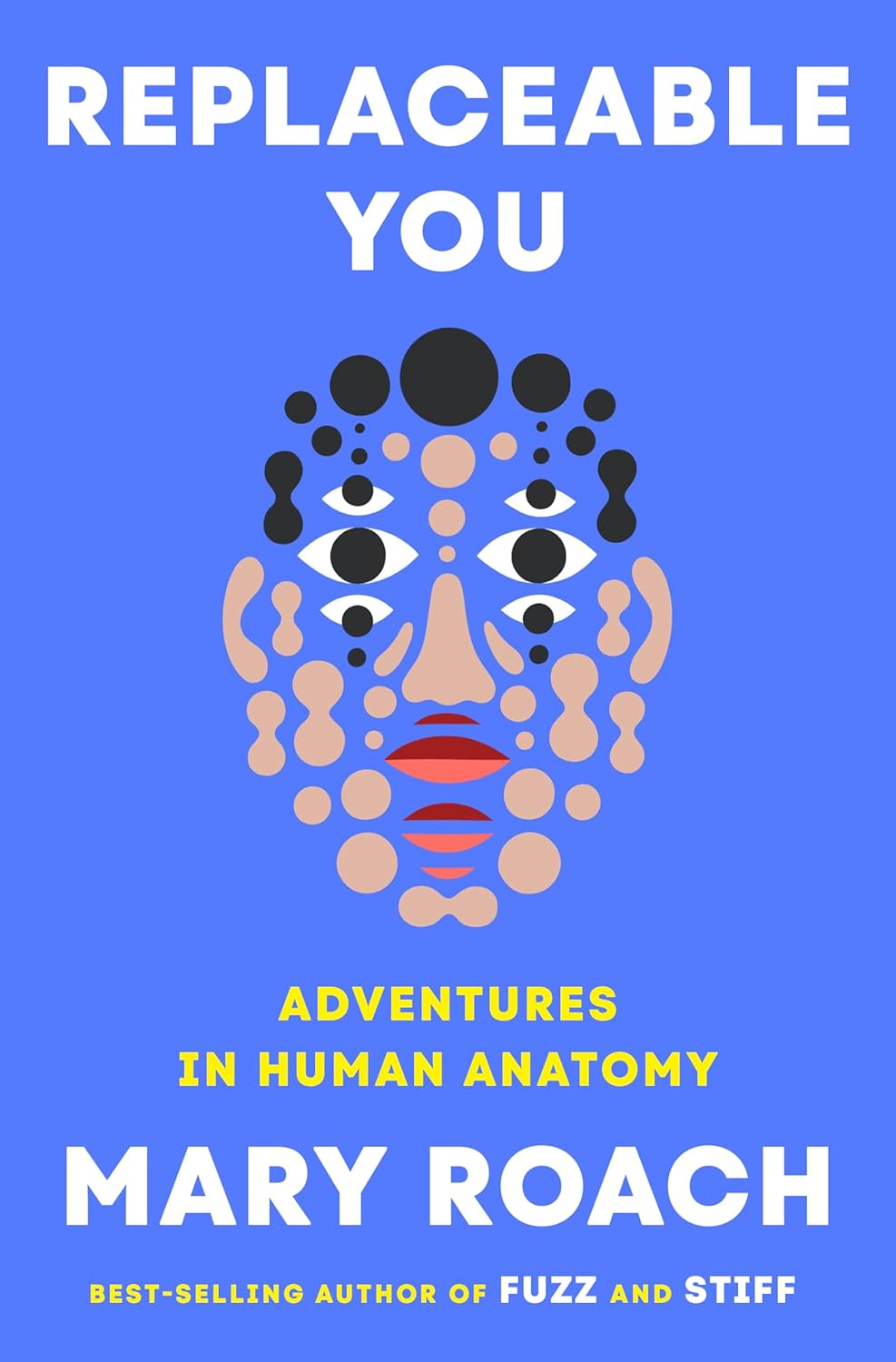
Replaceable You by Mary Roach

book cover

It’s another photograph of the penis [transplanted from the owner’s middle finger], now with a rustic ceramic pitcher hanging off of it. Exactly as you or I could put a hand out, palm up, and hang a pitcher off our middle finger. The pitcher is hand-painted, white with a red and green floral pattern. I’m picturing the man and his partner again, this time having lunch in the kitchen. A little iced tea, my love?

Eventually the day arrives when no further breach is possible. Mr. Baron, wrote his doctor, Richard Martland, “was now informed, the only chance for saving his life was by making an artificial anus . . . the inconveniences resulting from such operation, were candidly pointed out to him.” Mrs. White, on the occasion of her twelfth day without a bowel movement, is presented with the same proposition. Both patients consented. Or rather, as Pring put it, “did not violently object.” And so it went. “An opening was now made . . . and instantly a large quantity of liquid feces and wind escaped,” Martland wrote. Both doctors were impressed by the force with which the matter was expelled, with Pring taking additional note of the “considerable distance” traveled. – There was no mention of a fan in the vicinity.

This book certainly lends new meaning to the expression “an heir and a spare.”

I imagine many of us, certainly folks of my demographic, have had the experience of having parts replaced, probably because of need, but for some because of choice. I know I would happily have my begrudging spine replaced if I had the chance. And there are certainly a few improvements I could use that would be competing for second place on that list. Thus, my interest in Mary Roach’s latest, Replaceable You. (My ex can attest to the truth of the title’s applicability to the entire me.) Of course, I would read anything Mary Roach has written. She is one of my all-time favorite authors. And just in case her work is new to you, she combines a hard-reporting look at a particular scientific realm with a sense of humor that will leave you gasping for breath. Complete swallowing any ingested liquids before reading her work, as they may come blasting out your nose and mouth before you can get a grip. You have been warned.

description
Mary Roach – image from Harvard Bookstore – shot by Jen Siska

Roach has made a career of writing about the human body, from conception (Boink) to grave (Stiff), and beyond (Spook), with travels through the alimentary canal (Gulp), the body’s reaction to space flight (Packing for Mars), to war (Grunt) and even to strangeness having to do with our interactions with animals (Fuzz). This time around, she covers a range of body parts subject to replacing. She sniffs out the history of nose jobs back to the 1500s, and lets us in on why they were in such high demand back then. She brings home the bacon by filling us in on the status of pig research (on, not by) for the purpose of developing organs that can be transplanted into humans, a subject close to my heart.

A formal “miniature swine development” project got underway in 1949, a collaboration between two Minnesota powerhouses, the Mayo Foundation (research arm of the Mayo Clinic) and the Hormel Institute (research arm of pork).

There are sections on the replacement, or enhancement, of sexual organs. One of the opening quotes of this review notes a particular form of actual, not kidding, replacement for a male member. Female anatomy comes in for a bit of consideration as well.

Dow Corning…made the first silicone breast implant, circa 1961, this one at the urging of Texas plastic surgeon Thomas Cronin. Cronin had been “inspired by the look and feel of a bag of blood.” It is hard for me not to picture the scene: Cronin standing around the OR, idly gazing at a bag hanging on a transfusion pole and turning to a colleague: Hey. Does that remind you of something? Cronin contacted Dow, and his resident, Frank Gerow, implanted some prototypes into dogs. The team were “excited” by the outcome—and again, stop me from picturing this.

Continuing downstairs…

Who looks at the human digestive tract and thinks, Moist, tubular, stretchy . . . Might that make a reasonable vagina?

Some, apparently. The derriere comes in for a long look as well. Part of this is a consideration of the changing fashions in tush shape, stretching from sane to anime.

I have made it (well in) to septuagenarian with what is probably an unremarkable range of replacement parts. My right arm was the recipient of two metal plates and a bone graft from my hip after a rather nasty industrial accident in 1970. The plates were removed once they had done their job of helping my bones knit, a few years later. The bone graft helped heal another fracture, and was eventually absorbed back into my skeleton.

Roach tells of prosthetic limbs, and the surprising news that some people prefer them to the original. In fact, the initial inspiration for this book came from a reader who had suggested that Mary take on the exciting world of football referees. Understandably, that failed to score, but it turned out that the woman, who has spina bifida, had a problem with her foot. It had, as a result of her other difficulties, become less than useless. She wanted it removed so she could get a prosthetic, but few surgeons would consider electively removing it. Mary joined her at the Amputation Coalition National Conference, and the game was…um…afoot.

It will come as no shock that using one’s own body bits as a source of transplantation offers the huge advantage of sparing you the need for a lifetime of immunosuppressive drugs. The body’s Studio 54 security guard can take a quick look and wave the new part in as the right sort. It worked for me a second time.

Other recent personal additions were the product of open-heart surgery, three stents and an aortic valve replacement. The stents were made up of material extracted from my right leg, and the valve was contributed by a member of our porcine community. I have yet to experience any desire to go digging for truffles in nearby woodlands.

Roach takes joy in comparing the techniques and tools of hip replacement surgery to woodworking, noting that while patients could actually be conscious during the surgery, the clanging, sawing machinery noise would be so disturbing that it is deemed preferable for patients to remain unconscious for the duration. She says that “Hip replacement has the visual drama of a visit to a Chevron station.”

Sadly, I was born with a mouthful of (well, maybe not born with, which would be weird, but ultimately host to a couple of sets, baby and adult) soft teeth (my dentist’s words). This led, over time, to a need for fillings, caps, bridges and dentures.
.
If you count up all the teeth that are removed and replaced with implants or dentures, I bet they would lead the pack in sheer numbers of replacement bits. Mary leads us on a walk through dentures in history, the up and down sides, as well as the benefits of not using them at all. Yes, Geoge Washington makes an appearance. You will find the section on spring-loaded replacements both fascinating and alarming, and concerning as well is the fact that so many people have elected to remove healthy teeth in order to install dentures.

Replacing hair is big business these days. But not just up top. Pubic hair is also replaceable. Not only can the short and crinkly be replaced, with hair from the head, but the opposite can be done as well. Of course this can present some grooming challenges, as pubic and head hair grow differently and behave inconsistently when treated with grooming products. Mary subjected herself to a bit of hair harvesting in her travels.

My donor site is smeared with bacitracin, but no gauze is taped in place, because my hair would get stuck. On the flight home, I will feel the back of my head start to ooze. Do you fly Southwest? Don’t sit in 11B.

She delves into the growth industry of 3D printing of bodily materials. It turns out that it is not so simple as it might seem. Each muscle and organ has particular abilities and behaviors that are very difficult to replicate, involving twisting, contracting, and reacting to incoming messaging from the brain. The Star Trek replicator might do a great job of producing “Earl Grey, hot,” but fabricating people-pieces is proving a much more complex undertaking than sci-fi writers imagined.

Eye lenses are being replaced at increasing rates. There are even many people who, as with tooth replacement noted above, are having their natural lenses replaced in order to improve their vision.

I have worn glasses since I was eight years old, for distance. The only issue I had with them was losing track of them. But in the last few years, it became obvious that there was a buildup of material on the left lens of my eye (not just the product of inattentive eyeglass wiping) that made night driving particularly challenging. Oncoming headlights, even non-bright ones, spread a glare across my field of view that was problematic. I had cataract surgery earlier this year (2025), left eye only. And it worked like a squeegee on a filthy window. The headlights are still miserable, particularly when people insist on using their brights, and when many newer cars use lights that are brighter than the prior generations of illumination, but the improvement in my vision was immediate.

She writes about the processes involved in recovering bio-materials from the recently dead, the potential for banking our own cells as a source for future replacement materials, a machine for offloading heart and respiration work from the body temporarily, and introducing us to the wonderful world of ostomies, noted up top.

Mary may write about science, but she is not, per se, a scientist. Thus, she can offer us an every-person view into the subjects she investigates. She reacts how we might react when faced with the same discoveries. She brings the oh, wow!, the joy-of-discovery moments to life for readers, and thus makes what she has learned stick for us more than it would from any dry textbook. If she leaves you in stitches, that might just be a part of your replacement work. If you burst with laughter, bust a gut, if you crack up or your laughter is side-splitting, that may be why you needed the work in the first place. Of course, if you laugh your head off, there is probably no short-term solution to that. Replaceable You is the real thing, as is Mary Roach. She is one of a kind. Accept no substitute. She is irreplaceable.

Nana takes a seat at Kuzanov’s desk and starts opening files on his computer desktop. After a few false starts, she locates a folder of photographs documenting a finger transplant performed on a cancer patient. Most of the man’s penis had been amputated, leaving him unable to do two of the things most men like to do with their penis: penetrate and pee while standing. The surgery would restore both. – She missed one.

Review posted – 09/19/25

Publication date – 09/16/25

I received an ARE of Replaceable You from W.W. Norton & Company in return for a fair review. Thanks, folks, and thanks to NetGalley for facilitating. And could you check to see if anyone left any spare spines lying around.

This review is cross-posted on Goodreads. Stop by and say Hi!

===================================EXTRA STUFF

Links to Roach’s personal, Instagram and Twitter pages

Profile – from her site

I grew up in a small house in Etna, New Hampshire. My neighbors taught me how to drive a Skidoo and shoot a rifle, though I never made much use of these skills. I graduated from Wesleyan in 1981 and drove out to San Francisco with some friends. I spent a couple years working as a freelance copy editor before landing a half-time PR job at the SF Zoo. On the days when I wasn’t there in my little cubicle in the trailer behind Gorilla World, I freelanced articles for the Sunday magazine of the local newspaper. One by one, my editors would move on to bigger publications and take me along with them. In the late 1990s, magazines began to sputter out and travel budgets evaporated, and so I switched to books.
People call me a science writer, though I don’t have a science degree and sometimes have to fake my way through interviews with experts I can’t understand.
I have no hobbies. I mostly just work on my books and hang out with my family and friends. I enjoy bird-watching (though the hours don’t agree with me), hiking, backpacking, overseas supermarkets, Scrabble, mangoes, and that late-night “Animal Planet” show about horrific animals such as the parasitic worm that attaches itself to fishes’ eyeballs but makes up for it by leading the fish around.

Interviews
—–Stuff to Blow Your Mind on iHeart – Replaceable You, with Mary Roach by Robert Lamb – audio (36 minutes) with available transcript
—–Peculiar Book Club – MARY ROACH is Un-Replaceable! – video – 1:10:03 – from 5:00
—–NPR – From heart to skin to hair, ‘Replaceable You’ dives into the science of transplant with Brandy Shillace
—–Association of Health Care Journalists – Mary Roach calls herself ‘the gateway drug to science’ by Lesley McClurg

Other Mary Roach books we have enjoyed
—–2021 – Fuzz: When Nature Breaks the Law
—–2016 – Grunt: The Curious Science of Humans at War
—–2013 – Gulp
—–2010 – Packing for Mars
—–2006 – Spook Six Feet Over – recently renamed
—–2004 – Stiff

Items of Interest
—–New York Times – 10 Icky Things Mary Roach Has (Unfortunately) Brought to My Attention – by Sadie Stein – from sundry MR writings, in case you have not laughed enough from reading her latest
—–Bauman Medical – What is a Pubic Hair Transplant?
—–Youtube – A particularly disturbing transplantation scene from the 1973 film Oh Lucky Man

Song
—–Beyonce – Irreplaceable
2 Comments

Filed under History, Non-fiction, Public Health, Science and Nature

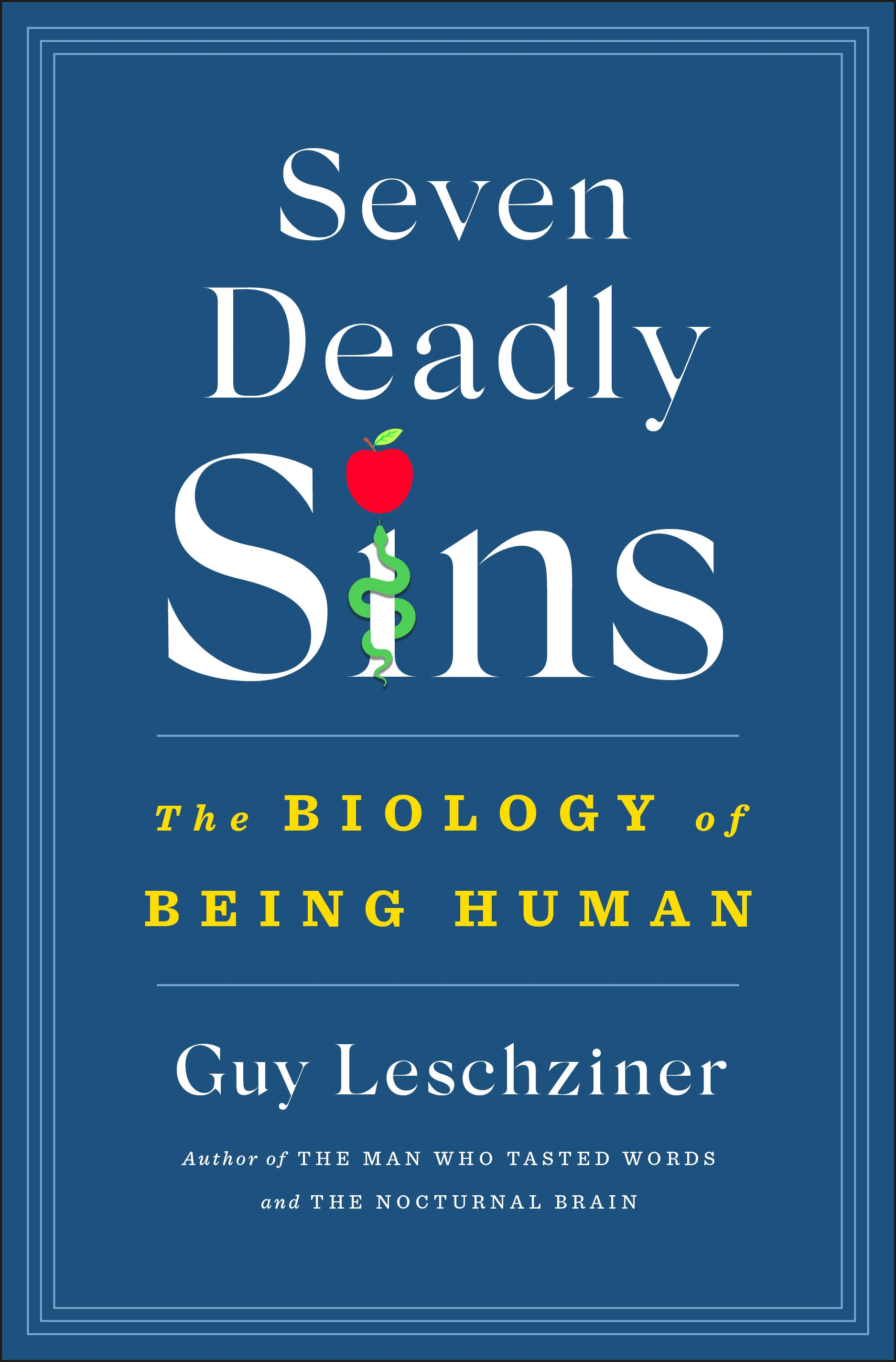
Seven Deadly Sins by Guy Leschziner

book cover

The ebb and flow of human history is defined by the Seven Deadly Sins: wrath, gluttony, lust, envy, sloth, greed, and pride. From the wrath that has ignited revolutions, to the greed that has re-sculpted the world map. From the sloth that has led to the fall of empires, to the envy that has built them. From the lust that has led to the fall of politicians and the betrayal of national secrets, to the voracious gluttony that has left our environment in ruination, and the pride that has fueled countless conflicts.

Disorders of the brain, of our genes, or other physical conditions, may give rise to gluttony, lust, wrath or pride. The effects of our environment or our upbringing may produce envy, lust or sloth. Crucially, these disorders unmask what is already in us, what already exists in all of us.

William J. Bennet (before he was outed as a compulsive gambler) is reputed to have said “One man’s vice is another man’s virtue.” Pope Gregory, in the sixth century CE, had a different idea, whittling a larger, earlier list down to seven deadly sins. (One wonders if there might be a grander list of [insert number here] bloody annoying sins). I do remember in my Catholic grammar school days Monsignor Marshall giving a sermon on venial sin (non-deadly, but as far as I can recall not presented as a list), in which he offered up the image of Jesus on the cross, and proclaimed that committing a venial sin was like slapping the nailed Christ across the face, albeit not very hard. No Jewish mother ever delivered a more impactful guilt trip.

description
Professor Guy Leschziner – image from The Daily Mail

In his prior book, The Man Who Tasted Words, Professor Leschziner looked at places where the lines between our senses appear to be somewhat porous, sense-A leaking into sense-B for some individuals. Hearing colors, seeing sounds, aphasic things like that. He offered an examination of what is considered usual, and where, in the brain, wires may have become crossed. He looked at individuals who reported such experiences and attempted to trace back into the brain where each sense resided, and connected to others.

Here he uses as his starting point the notion of the seven deadly sins, and offers neurological analysis of behaviors commonly regarded as sinful. Bu the Seven Deadly sins seem to divide into two groups, one based on behavior and one based on emotion. Wrath, Gluttony, Sloth and Greed require action to do actual damage, while Pride, Envy and Lust can remain internal. You may think you are better than everyone else, but unless you do something based on that belief, it makes no difference. Ditto Lust and Envy. In the absence of acting on these feelings, no harm, no foul, so the playing field for looking at The Seven is uneven from the start. The subtext is the question of free will. Are we all functional free agents able to determine right from wrong or are we driven by our biology, by what our brains have, by genetic heritage and experiential conditioning, commanded us to do? And how have the behaviors that have defined our species, that have led to our accomplishments as well as our excesses, our failings, served us? Is there a range within which our less than idyllic urges can function healthfully, and outside of which they constitute pathology?
Look at aberrant behavior. Dive in to see exactly which parts of the brain have been harmed, if any. Map behaviors, needs, urges, inclinations to parts of the brain. In a way, this is a bit like explorations of yore, sailing out to see what lay over the horizon, or, fictionally, heading out on a starship to see what the universe may present. He uses several case studies of people who manifest behaviors illustrative of each of the sins, looking for neurological bases. Just as in his examination of cross-sense irregularities in his prior book, Leschziner looks at these patients with an eye toward identifying which parts of the brain bear the most responsibility for the problematic behaviors. These include a man who had had a brain bleed that changed his personality, a woman who was incapable of feeling satisfied no matter how much she ate, a 34yo man with Parkinson’s and an increasing obsession with sex, a woman who believes her totally faithful husband is cheating on her, a young father who sleeps twenty hours a day, a man has delusions of grandeur until multiple abscessed teeth are removed, oh, and the Panama Papers. Centers of emotional concern include the amygdala, the pre-frontal cortex, a warrior gene, and the hypothalamus internally. He looks at the influence of bacteria, viruses, dopamines, and more impacting from the outside. Increasingly, science can indeed offer some answers to the why of behaviors, to a point.

In his novel, Fleur de Lis, Anatole France wrote. “The law, in its majestic equality, forbids rich and poor alike to sleep under bridges, to beg in the streets, and to steal bread.” There are clearly hypocritical societal interpretations of sin, of what sinful behaviors will be tolerated and which will be sanctioned. (Unless, of course, you are a president with a friendly Congress and SCOTUS, in which case, just go ahead with whatever you are doing there on Fifth Avenue.)

Poor man wanna be rich, rich man wanna be king
And a king ain’t satisfied till he rules everything
– Springsteen – Badlands

And most societies assign moral responsibility to the actor. The question is whether a person is morally responsible for his/her actions or is a slave to, and predetermined by impulses, by one’s underlying and overwhelming personal psychological makeup.

if you believe that the brain is the origin of our personalities and our character traits, the basis of our decisions, be they good or bad, then it is arguable that much of what defines us is outside of our control.

Whether we are all able to make actual free choices or are slaves to our biology, it is clear that society needs to be able to restrict our ability to harm each other, that protecting each other from the worst in people is a reasonable social responsibility.

It is made clear that the drives that we regard as sinful have provided considerable benefit to our evolution as a species. No lust? No reproduction. No envy? No reason to be more productive. No wrath? No defense against attack.

Leaving the question of evil. At first blush is seems that evil serves no obvious Darwinian purpose. On second thought, though, I expect there might be a case made for evil existing as an existential challenge in order to provide a testing ground against which one might measure strength of character and/or the superiority of one’s genes, whether physical or intellectual. In a way, like ice ages, rapid climate change, or a voracious saber-tooth tiger, evil might be seen as a natural force, even if it manifests through human beings.

Leschziner has offered up a provocative, thoughtful brain-candy-ish look at how science, as it advances, keeps finding biological explanations for fraught psychological behaviors. But our impulses and makeup remain what they are. And this is one of the pleasures of reading The Seven Deadly Sins. Learning what a strange creature is homo sapiens, and how we are put together. It seems quite clear that the real original sin is to have been born human.

extrinsic factors – medication, injury, or functional disturbance of the brain – rather than our values can cause us to act in ways that contravene our moral
code. However, that dividing line between what constitutes normality and pathology shifts in the sand. That line is blurred by the prevailing winds of our views on morality, legality, philosophy and medicine.

Review posted – 02/21/25

Publication date – 12/3/24

I received paper and ePub AREs of Seven Deadly Sins from St Martin’s in return for a fair review. Thanks, folks, and thanks to NetGalley for facilitating.

This review is cross-posted on Goodreads. Stop by and say Hi!

=======================================EXTRA STUFF

Links to the author’s personal, Instagram, and Twitter pages
Profile

Interviews
The Guardian – Science Weekly Podcast – Are we hardwired to commit ‘deadly sins’? – podcast
– audio – 23:59
—–The Jewish Chronicle – Were the Nazis inherently evil? ByJennifer Lipman
—–Greed, gluttony, sloth…lust! Why you sinned this Christmas by Anna Maxted

Items of Interest from the author
—–Big Issue – The truth is we’re all sinners – it’s how we survive as human beings
—–Next Big Idea Club – A Scientific Examination of the Seven Deadly Sins

My review of the author’s prior book
—–2022 – The Man Who Tasted Words

=======================EXTRA EXTRA STUFF

George Carlin famously distilled the ten commandments down to two.

It seems pretty clear that the seven deadly sins can likewise be slimmed down as well.

Pride. What does this actually mean?
Believing that you are better than other people? What if you are? Faster, stronger, better looking, smarter. Something more than others. Is recognizing your superiority a sin if it is true? The bible seems to maintain that an “Excessive” self-regard is where the line is crossed, but who gets to determine where the line is drawn between factual and excessive self-regard?

But pride does seem to be a pre-condition for other sins. Wrath, or extreme anger, certainly seems an appropriate response to extreme provocation. Hardly a sin. But in order to get into a sinful bit of wrathful behavior it must be excessive. In order for it to be excessive the deliverer of such wrath must hold a higher view of him or herself vis a vis the target than seems justifiable. Soooo, excessive pride, right? So, scratch wrath, and we are down to six.

Gluttony – excessive consumption to the point of waste.
Wiki tells us that In Christianity, it is considered a sin if the excessive desire for food leads to a lack of control over one’s relation with food or harms the body. But if the desire for food entails loss of control over one’s relation to food, where is free will? Isn’t that a definition of pathology? And a pathological behavior is hardly sinful. And just what constitutes excessive desire? If we remove the pathological from this formula, we are left with a person feeling entitled to consume (and I think it is safe to expand the notion of consumption here from food to all things material) as if they are better or more deserving of such things. Which brings us back to pride. Gluttony eats itself into a coma and we are down to five.

Greed
Catholic.com claims that Greed is the disordered love of riches. Hmmm, who gets to define “disordered?” and doesn’t a love of riches include a personal belief that one deserves such riches? Here we go again. It requires excessive self-regard to crave riches at a “disordered” level, no? Greed crushes itself with massive accumulation of stuff and we are left with four.

For these other sins, we delineate the pathologies that shape our thoughts and behaviours, and set them apart from those underlying character traits through their intensity and consequences. For greed, we do no such thing. Yet greed, like the other sins, is perilous in its most extreme forms, causing harm to individuals and wider society alike.

Is Donald Trump, a career criminal, capable of differentiating between right and wrong, or was he so damaged by his genetics and upbringing and injured by his subsequent business training at the feet of his sociopathic father, that he is incapable of telling or even caring about the difference between good and bad? Similar for Elon Musk. How great would it be were Leschziner able to do a detailed examination of both men’s brains. Because if they are capable of discriminating right from wrong, then we have a pretty clear proof that there are indeed forces of evil loose in the world, which I expect would come as a great shock to few but the most ardent atheists.

Lust and envy seem sub-elements of the same thing, wanting something that someone else has. Surely lust between two unattached people is no sin. It is only when one person (at least) is already attached that lust becomes problematic (presuming a monogamous baseline). So, wanting something (someone) who/which is not yours, but which is attached to, or is owned by someone else. So what? We all want stuff we do not or cannot have. How is this a sin? It seem to me that having feelings like lust and envy is completely natural. It is only when we take actions to effectuate such the desire, to the detriment of others that the sin element is realized. Down to two.

According to Wikipedia Sloth is the most difficult sin to define and credit as sin, since it refers to an assortment of ideas, dating from antiquity and including mental, spiritual, pathological, and conditional states. One definition is a habitual disinclination to exertion, or laziness. Willful laziness is surely not cool. Just ask any married person whose partner declines to hold up his or her end, opting instead to watch football or soaps. This one seems likely to be based in behavior, as the sinner here engages in slothful behavior, doesn’t just feel…um…slothful. I could certainly see many real-world examples, beyond couch potato chore-avoiders. There are many people who cannot be bothered exercising the intelligence they were born with to examine themselves, their community, public issues, religious beliefs, or much of anything. It may well be that they believe themselves not up to such analysis, and maybe they are not. But for many, if not all, it does seem that the disinclination rests on a belief that they are too good to have to bother with such things, that they have it all figured out and need look no further than the perimeter of their personal bubble…so…excessive pride. And poof! We are down to one.

Pride goeth before the fall, and, apparently every other form of sinfulness. There is only one deadly sin, excessive self-regard, which feeds all the others, and becomes problematic only when put into actual real-world action.

Leave a comment

Filed under Non-fiction, Psychology and the Brain, Public policy, Science and Nature

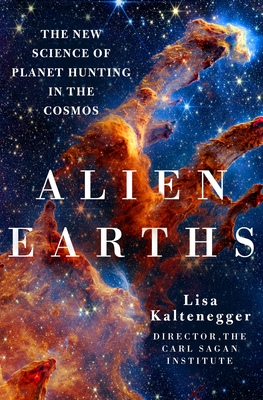
Alien Earths by Lisa Kaltenegger

book cover

Before I started searching for life in the cosmos, I just assumed scientists knew how it started on Earth. We don’t.

…it is sobering to realize that for most of Earth’s history, humans would not have been able to survive on this planet. If we could rewind Earth’s history and start again, it seems unlikely that Earth would produce humans again. A planet with different starting conditions and paths of evolution has no obligation to support life similar to Earth’s, let alone curious humans.

The truth is out there.

Are we alone in the cosmos? The question should have an obvious answer: yes or no. But once you try to find life somewhere else, you realize it is not so straightforward.

At least until the age of permanent haze across the planet, we have always had the stars in our consciousness. Since the second century AD we have had stories about alien worlds. Since Galileo we have been able to see other worlds in the cosmos. A 1792 novel by Voltaire tells of an alien encounter. Concern about extraterrestrial locales has been a part of human consciousness ever since. The concern is certainly fed by the history of strange human invaders helping themselves to land distant from their home soil.

description
Lisa Kaltenegger – image from The Guardian – shot by Naomi Haussmann/The Observer

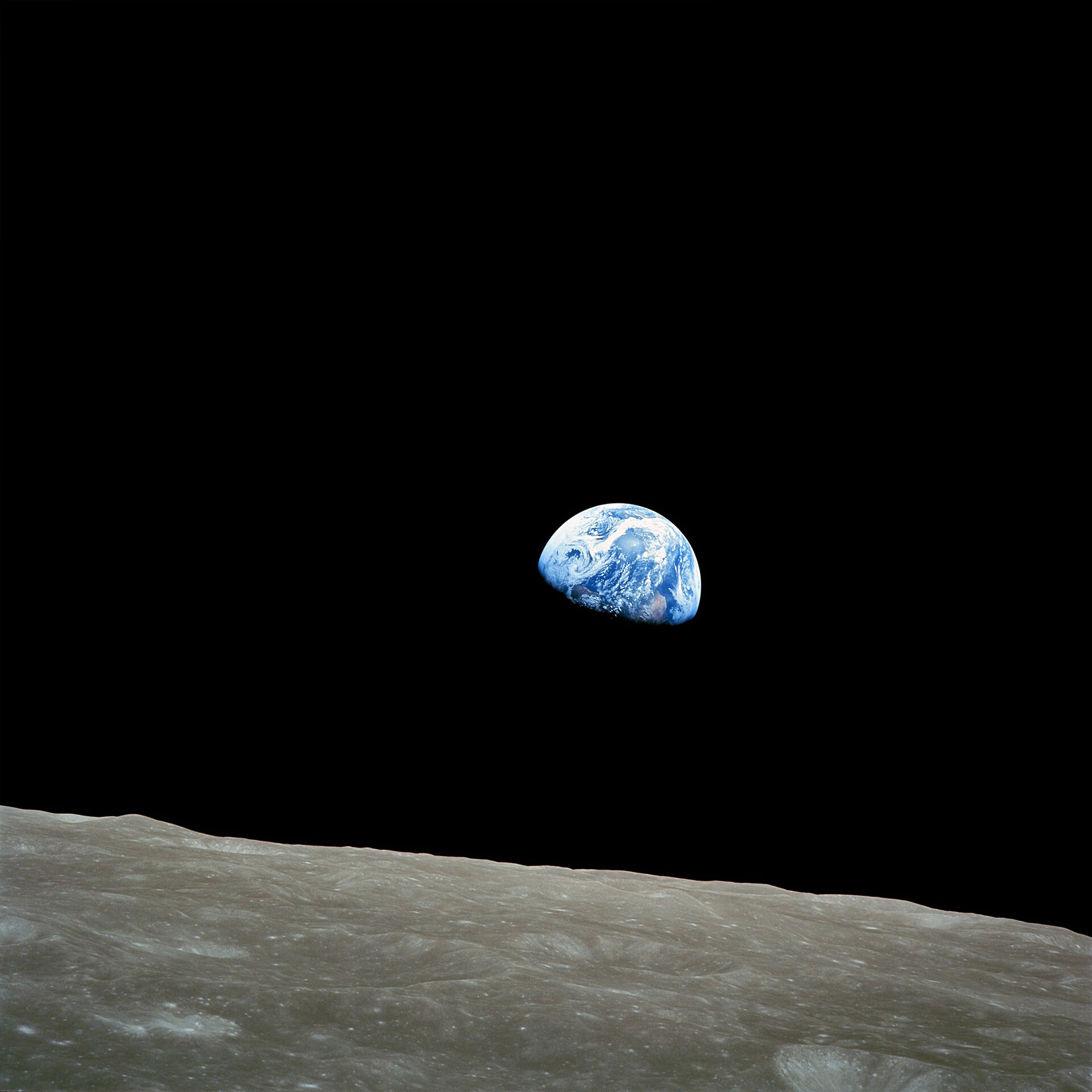
The interest in things alien certainly kicked up in the twentieth century. Many of us grew up in the space age, witness to the first “Beep-Beep” from orbit, the first peopled orbiters, rapt in front of our televisions when mankind first set foot on the moon. Part of this experience is to be awash in the science fiction of our own and earlier ages, dreaming of strange other-world societies, fearful of invasion, eager to learn the lessons of advanced technology. Some were even impressed and excited enough by the technology and the optimism of the age to begin college careers with the dream of becoming aeronautical engineers, and designing some of the hardware of the future.

description
Earthrise – image from Wikipedia

But so much of this was based on fantasy, (including that engineering thing) limited to imagining what might exist out there. Even the early observations of other planets in the solar system generated fantasies in addition to scientific elucidation. But in 1995 scientists discovered the first two exoplanets, and new discoveries are now a nearly daily event. Today, because of the major advances that we have made in telescope technology, we are able to see to the far ends of the universe. Enter Lisa Kaltenegger, founder and head of the Carl Sagan Institute at Cornell University

I spend my days trying to figure out how to find life on alien worlds, working with teams of tenacious scientists who, with much creativity and enthusiasm and, often, little sleep but lots of coffee, are building the uniquely specialized toolkit for our search.

In studying what we have seen, it has become possible to detect stars that have planets around them. In fact, most stars have company. The way this is detected is to measure “wobble” in the light being observed from distant places. As if you were looking at a bright light and someone threw a ball across your field of view. The measured light would change and you could tell that something had been there. Keep looking to see if it repeats. If it does, then you probably have a planet orbiting that star. (or an annoying neighbor tossing something back and forth in front of you) Keep pointing the James Webb Space Telescope (the state of the art in telescopy today) to more and more locations in space. And discover more and more planets.

description
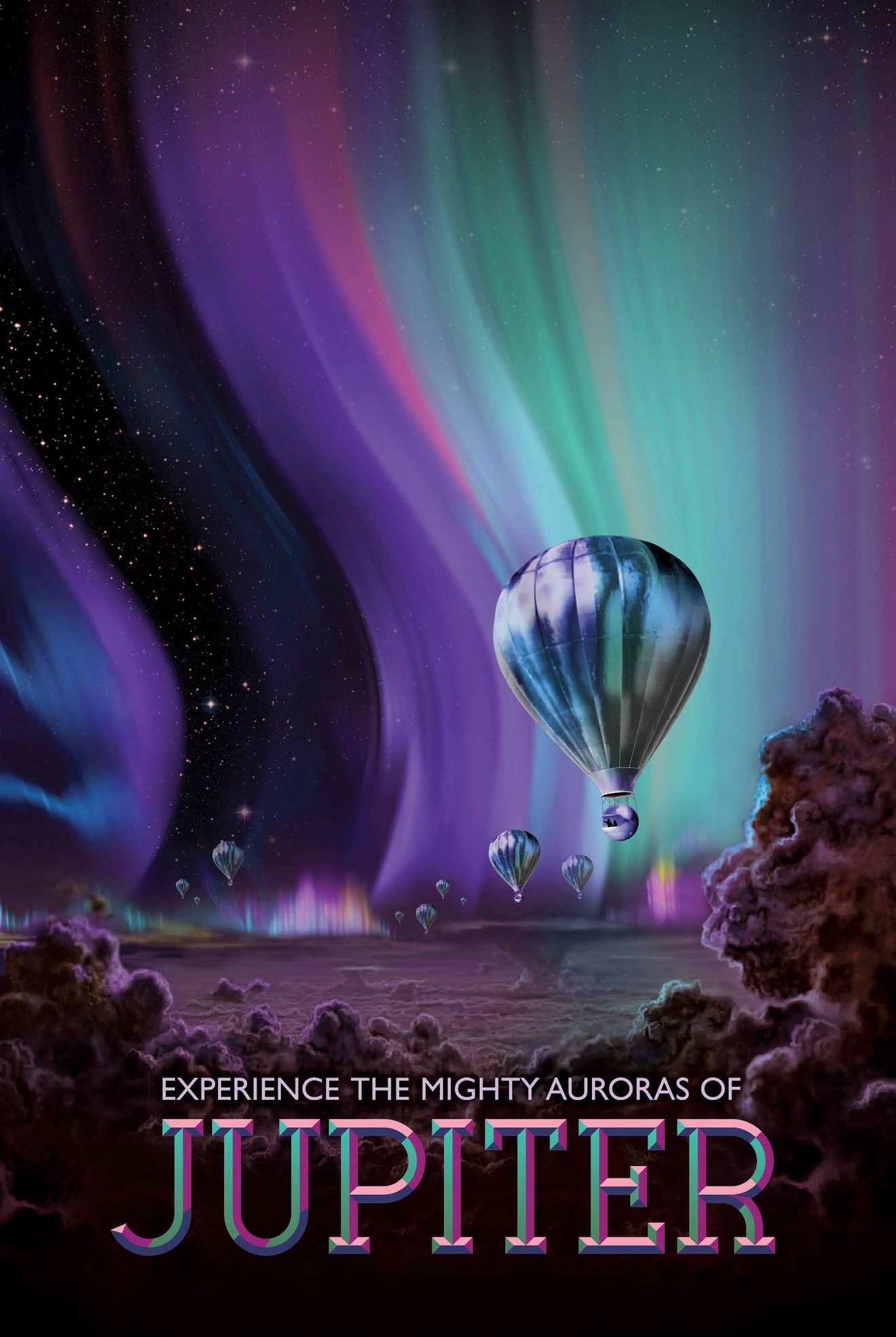
Jupiter – image from Exoplanet Travel Bureau – NASA

Kaltenegger has been looking into the reality of other worlds her entire career, and in doing so, has advanced our knowledge base considerably. She begins this book with a brief visit to an other planet, one that is very different from ours, a star-facing world that has portions in eternal day, night, and dusk, and local life adapted to the local venues, just to get things started on what we might expect out there, just to challenge our assumptions.

description
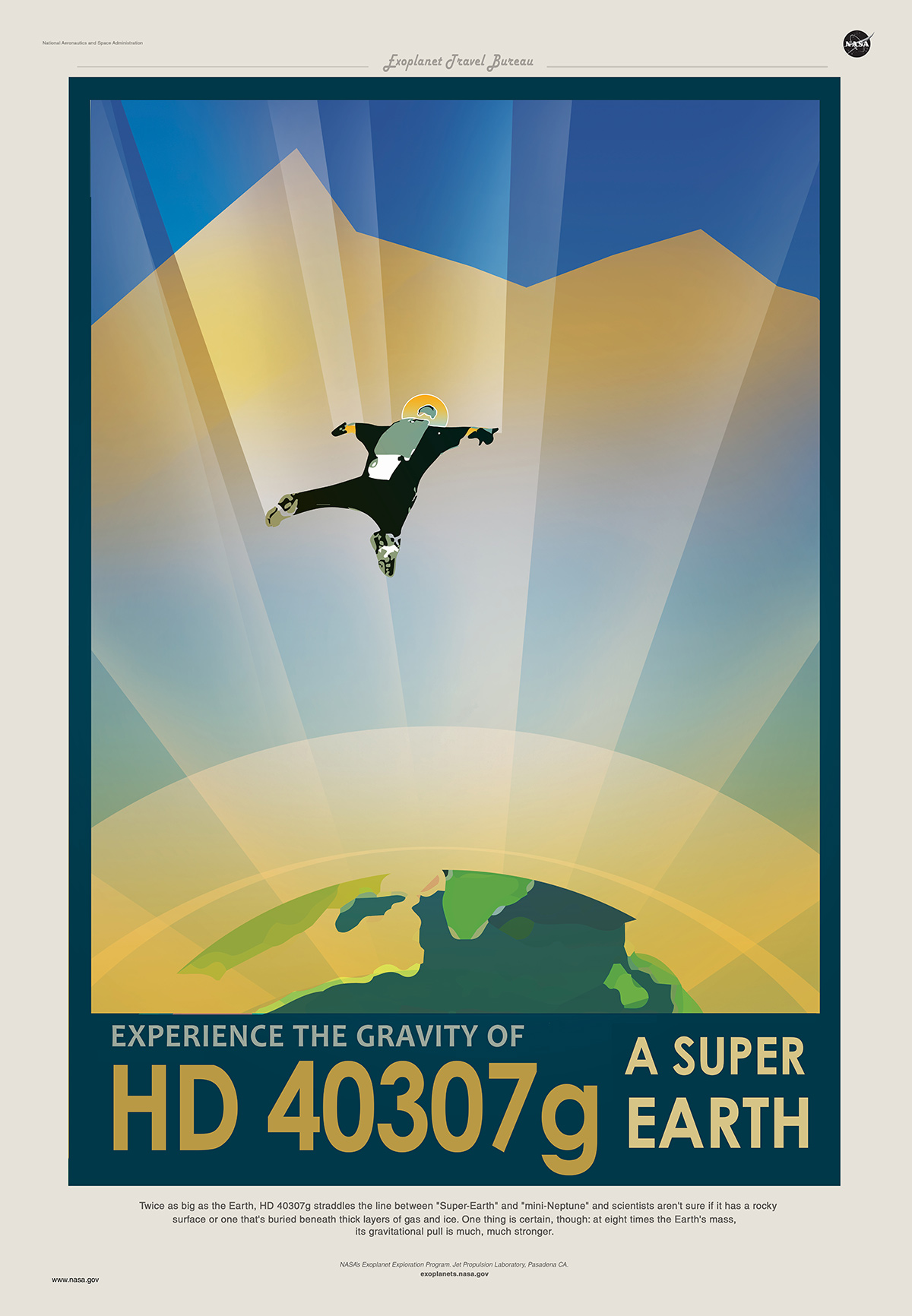
HD 40307g – A Super Earth – image from Exoplanet Travel Bureau – NASA

She follows with a history of Mother Earth, noting major stops along the evolution of our favorite place. She notes how life might have formed, when, and how that event altered the atmosphere and even the color of our atmosphere. The sequence is important, as her discussion of our exoplanet dreams demonstrates that we are a prisoner of time. What we see with our telescopes (and eyes) arrived here on light, and light must travel at or below the universal speed limit. (a leisurely 186,282 miles per second) So, whatever we see from even a nearby star/planet system originated tens or hundreds of years go, or even billions for our more distant neighbors. Anything residents of out there might have seen of us (really only since we started sending signals into the ether maybe a hundred years ago) is quite dated relative to who and what we are today. Absent the invention of a Warp Drive of some sort, we are doomed to be always too far away in years and miles from other intelligent species. Well, maybe.

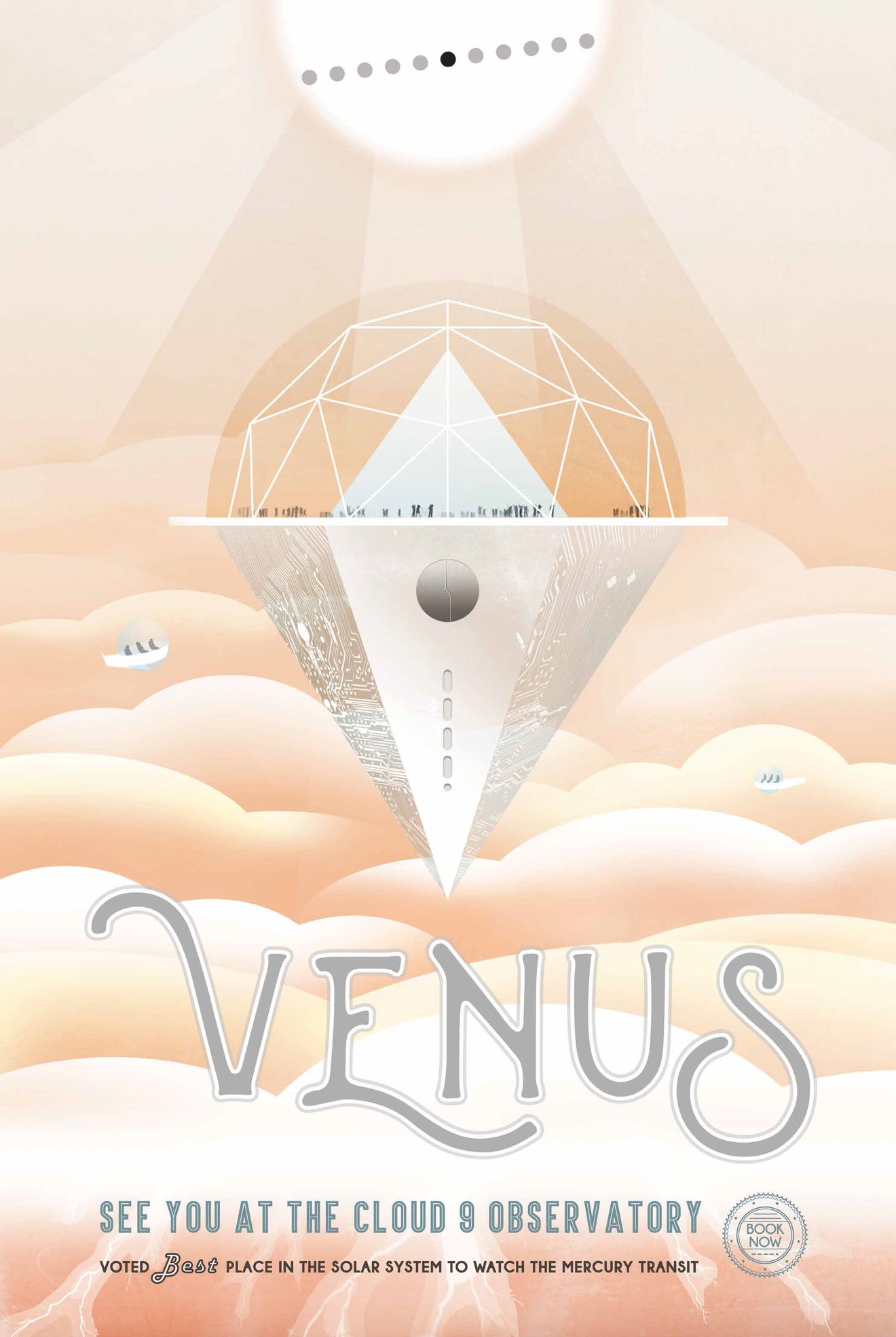
description
Venus – image from Exoplanet Travel Bureau – NASA

It is possible, I suppose, for a civilization with massive resources to send a desperate one-way mission to save their species from hundreds of light years away. It is unlikely that any visitors from such distant realms would be making reports home. But this need not necessarily apply to all possible visitors. It appears that there are plenty of possible planets within a few light years of us that might present some interplanetary possibilities.

description
Mars – image from Exoplanet Travel Bureau – NASA

Kaltenegger delves into the nearer-earth planets, looks at their characteristics, and offers explanations as to their suitability for life. She looks at probable communication issues should we ever come across an ET, suggesting it might be the equivalent of humans attempting to communicate with a jellyfish

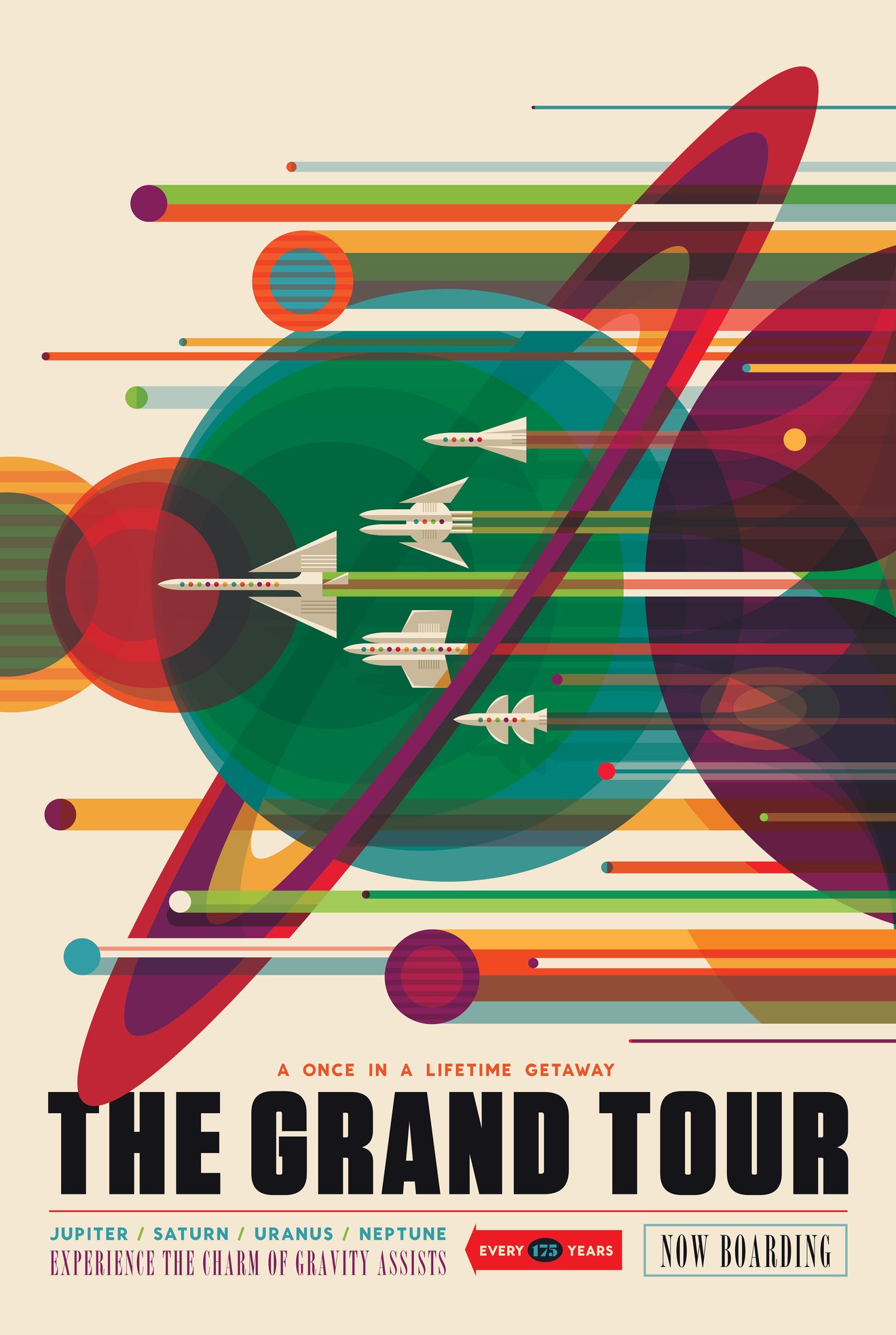
description
Grand Tour – image from Exoplanet Travel Bureau – NASA

Kaltenegger and her team design computer simulations, based on the hard work of examining concrete materials, inert and biologic, and putting that intel into a database. Check the signature spectrum of every new world and compare it with the growing list of catalogued items.

Today, solving the puzzle of these new worlds requires using a wide range of tools like cultivating colorful biota in my biology lab, melting and tracing the glow from tiny lava worlds in my geology lab, developing strings of codes on my computer, and reaching back into the long history of Earth’s evolution for clues on what to search for. With our own Earth as our laboratory, we can test new ideas and counter challenges with data, inspired curiosity, and vision. This interaction between radiant photons, swirling gas, clouds, and dynamic surfaces driven by the strings of code within my computer, creates a symphony of possible worlds—some vibrant with a vast diversity of life, others desolate and barren.

She notes the core need of life-sustaining planets is to be rocky. Sorry, Jupiter, no gas giants need apply (but their moons might). They also need to be within a certain range of the stars they circle, the so-called “Goldilocks Zone,” not so close as to be too hot nor so distant as to be too cold, and they need to show the presence of key life-sustaining elements.

description
Europa – image from Exoplanet Travel Bureau – NASA

Kaltenegger offers readers info on some topics likely to be new to most of us, Stellar Corpses, for example, warm ice, the Fermi Paradox, the Drake Equation, the Great Silence, tardigraves, and plenty more. All of these are explained clearly and simply. It is as if the author is telling us: This is what we have learned. This is what we expect. This is how we go about gathering information, fusing our fields of expertise, learning more, solving the mysteries that the data present. This is our understanding of what is possible. This is our plan for looking further and farther.

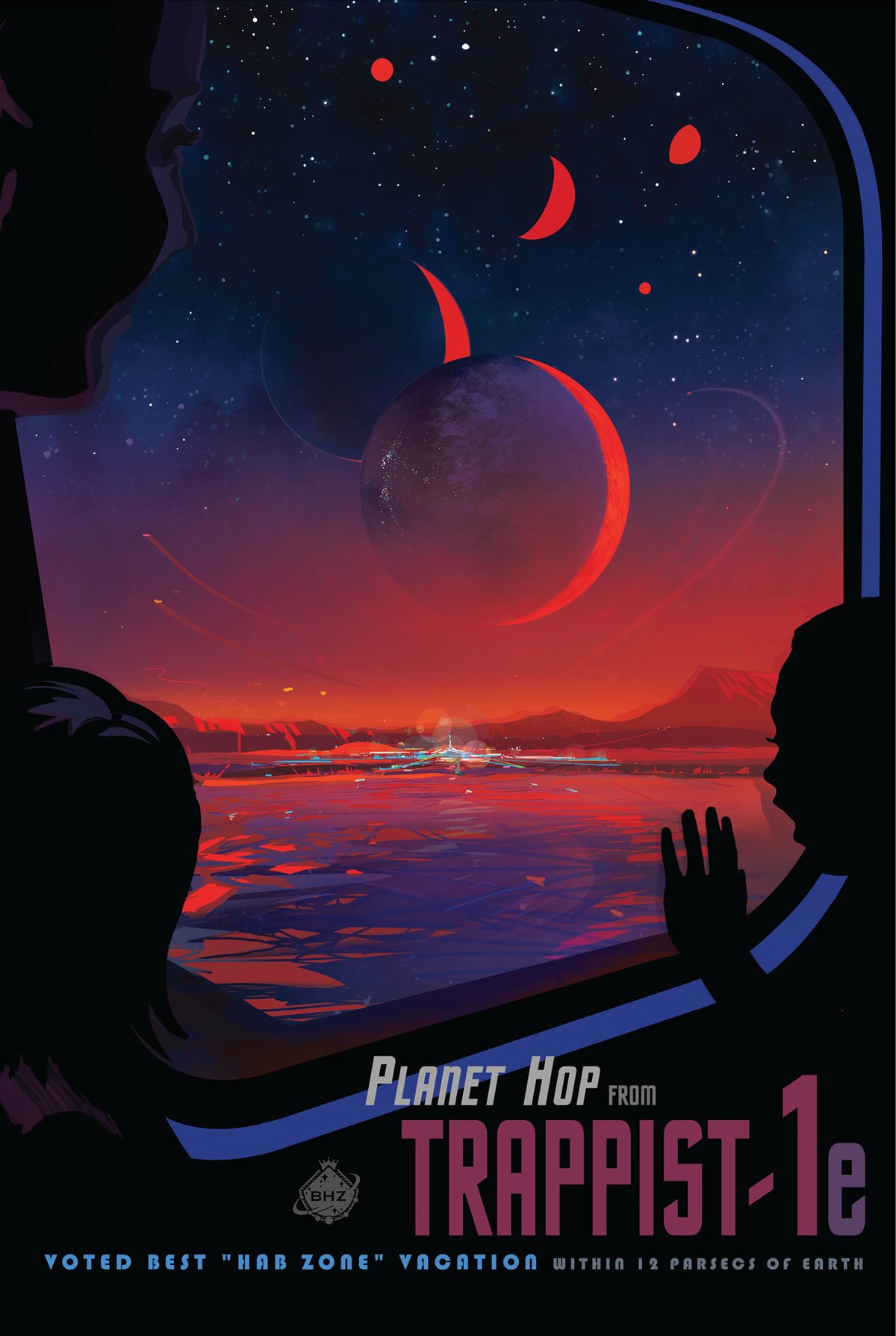
description
Trappist – image from Exoplanet Travel Bureau – NASA

Alien Earths may not point to an actual catalog of life-sustaining exoplanets, but it does offer an accessible pop-science portrait of the current state of the art in the search. This galactic age of exploration has been ongoing for some time, getting a jolt from the discovery of other worlds. It has advanced to where we are now looking for (and expecting to find) evidence of life on other planets. It is likely that what we find will be pretty basic, single-cell critters, maybe even plant life. And it will probably take a good long time before we can move up to the final phase of the game, finding intelligent life. The time scale for any potential interaction is likely to be considerable, but who knows? The universe is full of surprises among its billions and billions of stars.

So far, despite wild claims to the contrary, we have not found any definitive proof of life on other planets. Until we do, we will continue to improve our toolkit and look for signs of alien life the hard way: searching planet by planet and moon by moon.

Review posted – 09/27/24

Publication date – 04/16/24

I received an ARE of Alien Earths from St. Martin’s Press in return for a fair review. Thanks, folks, and thanks to NetGalley for facilitating.

This review is cross-posted on Goodreads. Stop by and say Hi!

=======================================EXTRA STUFF

Links to the author’s personal, FB, Instagram, and Twitter pages

Interviews
—–We live in a golden time of exploration’: astronomer Lisa Kaltenegger on the hunt for signs of extraterrestrial life by Emma Beddington
—–Chris Evans Breakfast Show – Lisa Kaltenegger: Is There Alien Life? – Video – 25:39
—–StarTalk – Distant Aliens and Space Dinosaurs – with Neil DeGrasse Tyson – audio – 50:03
—–StarTalk – Astrophysicists Discuss Whether JWST Discovered Alien Exoplanets – Neil DeGrasse Tyson – video – 48:58

Item of Interest from the author
—–Lisa Kaltenegger. On Looking for Signs of life – Video – 10:36

Items of Interest
—–NASA – Jet Propulsion Laboratory – Visions of the Future
—–The Carl Sagan Institute
—–Unilad.com – NASA discovered -planet bigger than Earth with a ‘gas that is only produced by life’

Song
—–Monty Python’s Galaxy Song

Leave a comment

Filed under History, Non-fiction, Reviews, Science and Nature

How to Win Friends and Influence Fungi – edited by Chris Balakrishnan, Matt Wasowski

book cover

Nerd Nite is an event usually held at a bar or other public venue where usually two or three presenters share about a topic of personal interest or expertise in a fun-yet-intellectual format while the audience shares a drink. It was started in 2003 by then-graduate student (now East Carolina University professor) Chris Balakrishan at the Midway Cafe in the Jamaica Plain neighborhood of Boston. In 2006 Nerd Nite spread to New York City, where Matt Wasowski was tasked with expanding the idea globally. – from Wikipedia

Be There and Be Square – Nerd Nite logo

There was a nerd magazine in 2012, a Youtube presence, and occasional podcasts. This is the first Nerd Nite book.

Misophonia can attach itself to any repetitive sound, but the most common ones are things, like chewing, breathing, sniffing, and throat clearing. It can be hard for sufferers to talk about because of how difficult it can be to tell someone politely that the sound of them keeping themselves alive is repulsive to you.

There are 71 entries, taken from live presentations done by the authors of each piece. (TED talks for those with short attention spans and a need for alcohol?) Nerd Nites have been held in over 100 cities across the globe. The material here covers eleven scientific areas. (see below) All the entries are brief, so if one does not appeal to your mental tastebuds hang on a couple of minutes for the next one, or just skip past.

description
Chris Balakrishnan and Matt Wasowski – editors – image (from some time ago) from Facebook

You can digest this book a few morsels at a time, and not have to worry about the fate of a fictional hero or put-upon victim. Nope. The heroes here are the scientists, the presenters. One of the great failings of popular science books, IMHO, is the absence of humor, or poor attempts at it. Not here. There are many moments in this one, and humor in almost all of them. That made me very happy. Of the 71 pieces, almost all are very pop-sciency, understandable by most readers, even me. There were only one or two that made my head hurt. It makes an excellent bed-side read. It was an upstairs book for me, to be read before nodding off, hopefully. Sometimes that takes a while. This is not an all-inclusive list of the articles, but lets you know what might be in store in its eleven sections

1 – Creature Features – on weird animals
2 – Mmmm…Brains – strangeness with how we learn and adapt
3 – Bodily Fluids – on things like coping with poo in space. (In space, no one can hear you fart?)
4 – Doing It – like it suggests, on sex, human and non-human, (no, not with each other. Don’t be weird.)
5 – Health and (un)Wellness – human smells (See Paul Giamatti in The Holdovers) – on therapeutic maggots, adolescent medicine, et al
6 – Pathogens and parasites – on birds, bacteria in birds, zombies, the scotch tape test (don’t ask), viruses
7 – Death and Taxes – mass extinction, cancer, algae
8 – Space, the Big and the Beautiful – ignorance, asteroid avoidance and use, life on Europa?, artificial gravity, studying a pristine meteorite, Webb telescope
9 – Tech (High and Low) – GMOs, dating app, human powered flight, cyborging humans, domesticating bacteria, nuclear fusion
10 – Math is fun – a seminal experiment, the math of gossip, the golden ratio, infinity, cryptography
11 – Careers – things removed from dogs, useless inventions, myths about death, animals CSI, amputations, fermentation, flames.

there are approximately 100 trillion microorganisms (mainly bacteria), representing as many as 30,000 different species, living in every crevice, nook, and mucosal cranny of your body that you can imagine.

I would include a list of my favorite articles, but it would wind up as long as the parts list above. But ok, because I have the sense of humor of a twelve-year-old, the one that made me laugh the most was To Boldy Go: Dealing with Poop and Pee in Space. Apollo 10 astronauts were gifted with the visual, and no doubt olfactory, treat of a turd meandering about in their capsule. This begins a talk about how one handles bodily waste in zero G. Another on bladder control, or the absence thereof, was sidesplitting. Others, on camel spiders and hangovers, generated a fair number of LOLs.

Some were fascinating, like one having to do with making a brain on a chip. (Can it be served with Salsa?) The pieces on bacteria and their importance to human life, heck, to all life on Earth, were fascinating.

There is plenty of weirdness, about diverse forms of milk, the proper use of maggots in healing, zombie parasites, asteroids, artificial gravity, and here we go with another bloody list. Sorry. Take my word, there is a wealth of material here that will broaden your knowledge base, and serve up plenty of conversational hors d’oeuvres for cocktail party chatter.

It worked quite well for me. There is a downside, though. Because all the articles here are very short, one is often left hungry for more. On the other hand, that limitation might provoke you to sate that desire with a bit of extra research, which is always a good idea. So, never mind.

If science piques your curiosity, if learning new and diverse things makes your heart race, or if you like to laugh, then this book is for you. How to Win Friends and Influence Fungi is a very filling read, one nibble at a time.

Review posted – 06/14/24

Publication date – 02/01/24

I received a hardcover of How to Win Friends and Influence Fungi from St. Martin’s Press in return for a fair review. Thanks, folks.

This review is cross-posted on Goodreads. Stop by and say Hi!

======================================EXTRA STUFF

Author/Editor links

Chris Balakrishnan – Program Director at the National Science Foundation – His personal and FB pages
A list of his articles

Matt Wasowski – Director of New Business and Product Development, Events at SAE International – His FB, LinkedIn and Twitter pages

Items of Interest from the authors (really editors)
—–Soundcloud – excerpt – 5:01
—–Birdsong: How the Twittering Set Learns to Speak
—–“Nerd Nite Published a Book!” by Matt Wasowski – Nerd Nite Austin 155, January 2024

1 Comment

Filed under Non-fiction, Psychology and the Brain, Reviews, Science and Nature

Fearfully and Wonderfully Made by Maureen Seaberg

book cover

I had no idea my experience was so different from other people’s. Now I’m convinced that everybody has their own unique holographic experience of the sensory world.”

Synesthesia has been incorrectly defined, in my humble opinion, as “crossed wires in the brain” or “mixed-up senses.” In fact, synesthetes have the same primary response to a stimulus as neurotypical people do. If the numeral 5 appears in newsprint, I know that it is black on a white (well, somewhat beige) background. However, simultaneously, I see navy blue around that number and above that number it, like an aura. Therefore, I’ve created what I believe is a much better definition: Synesthesias are traits in which a sensory stimulus yields the expected sensory response plus one or more additional sensory responses.

For myself, I have always been on the lower end of the taste/smell sensitivity bell curve, presuming there to be such a thing. I have always attributed this to the DNA luck of the draw. Some of it, though, might be a product of my homemaker mother’s abilities as a cook. There were a few things she made that were mouth-watering, but for the most part, it was said of Mom that she had a close relationship with Chef-Boyardee. Thus, it is no shock that my appreciation for cuisine exists in a narrow range. As smell is closely associated with taste, the two have traveled this low experiential road together. But maybe there is some hope for me and for folks with limitations like mine Maybe there are ways to expand the range of flavors and aromas we can detect and enjoy. (Make real friends with our taste buds?) That possibility is one of the points that Maureen Seaberg makes in her new book, Fearfully and Wonderfully Made. There are several others.

description
Maureen Seaberg – image from Amazon

Seaberg is a synesthete, gifted with abilities beyond the average. Even within that, she is a tetrachromat, proud possessor of four sets of visual cones to our usual kit of three. She has used this extra-sightedness to help a cosmetics firm produce more pleasing hues. She is also a mirror-touch synesthete, which means that she can feel your pain, really.

Patricia Lynne Duffy, a member of the United Nations Staff 1 Percent for Development Fund committee, was safely ensconced in her Manhattan office, but when she read the proposals before her, she felt the pain of the world’s most fragile people.

She is the author of multiple books on her personal experience as a sensory anomaly, and others looking into the science of what makes us different. Among these are Tasting the Universe, Struck by Genius, and The Synesthesia Experience.

While highlighting the differences in human capacity, Seaberg argues that we are all potentially synesthetes, but that our acculturation has defined limits to what our senses regard as the human range. She says we are capable of much more, and cites sundry studies to show our surprising range. One shows that we can detect light down to a single photon.

Is it that we are all, or most of us, or many of us, capable of experiencing, sensing much more of our world that we have to date? Are these tools in our toolbox that we have merely never been trained to use? Seaberg uses the examples of many people who are either synesthetes, or who have naturally enhanced capabilities to argue that we could be experiencing much, much more than we do. She also notes people who, through traumatic events, (a mugging in one case) have subsequently displayed enhanced capacities, supporting the notion that we all may have considerable untapped potential. One surprising element here is her reporting on the benefits of the Montessori teaching method, which encourages multi-sensate learning.

She suggests we incorporate into our psychological and medical frameworks the notion of a Perception Quotient, or PQ. Just as we have for our rational processing with the intelligence Quotient, or IQ, and EQ for Emotional abilities.

Seaberg spends some time with the question of transhumanism, the notion that people can evolve beyond our current biological constraints by incorporating connections (merging?) with technology. She argues against such, contending that our realized and latent capacities can take us a lot further than we have gone, without the need for electronic enhancement.

There’s plenty of evidence that humans are adapting to, even passing, machines by using their senses. Just look at the mind-meld young people have with their personal devices and the manual deftness with which they use them compared to older generations. Maybe the singularity moves in two directions, and we meet somewhere along the way. There’s a human-based component not yet considered. And since we’ve recently learned that human sensory potentials are far greater than we knew, perhaps we have a little more time to think about the value of being Homo sapiens.

In a related vein, she notes that there are mirror-touch synesthetes who blur those lines.

A very small subset of the neurological outliers known as mirror-touch synesthetes have extreme empathy for machines. They are sometimes able to feel the mechanisms in their own sensitive bodies. I call them machine synesthetes or machine empaths.

She touches on some even more esoteric subjects, like the remote viewing program sponsored by the USA military from the 1970s into the 1990s, and the possibility of consciousness permeating more of our biosphere than we may have realized.

If you are looking for a how-to re expanding your sensate horizons I would look elsewhere. The prompts offered for that here are introductory at best. Seaberg does offer some other places to go for that. This is more a treatise on the possibility of capacity expansion, not a manual for expanding ourselves.

If we are indeed the architects of our own reality, it is clear that some of us have been gifted with a superior toolkit for interpreting what we see, hear, smell, taste, and touch, in that construction process. Maybe for the rest of us there are some tools in the basement or shed that have been gathering dust all our lives, tools that can be cleaned off, greased up, and maybe even powered up. It may or may not be a widespread opportunity, but it is certainly a hopeful and very interesting one. In trying to make sense of senses, Maureen Seaberg has written a fascinating, accessible work on human possibility that should stimulate your curiosity, whether or not you experience collateral sounds, colors, scents or other incomings. Checking this book out would definitely be sensible.

“We genuinely experience scent as the emotion we have attached to it,” one sensory educator said. “Our hearts lift at the aroma that reminds us of a happy day at the beach, or our hearts break a little when we smell the aroma of a long-dead relative’s soap.”

Review posted – 10/20/23

Publication date – 8/8/23

I received an ARE of Fearfully and Wonderfully Made from St. Martin’s Press in return for a fair review. Thanks, folks, and thanks to NetGalley for facilitating.

This review is cross-posted on Goodreads. Stop by and say Hi!

=======================================EXTRA STUFF

Links to the author’s personal, Instagram, LinkedIn, and Twitter pages

Interviews
—–Audacy – The Science of Synesthesia and Super Sensors – audio – 30 min
—–PSIfest 2023 – Curious Realm – Maureen Seaberg @PSIFest 2023 – Video – 27:01

Songs/Music
—–Rollingstones – She’s a Rainbow – maybe another form of synesthesia

Items of Interest
—–Untapped Cities – THE SECRET COLORS OF NYC: HOW MAC’S NEW COLOR TALENT SEES THE CITY DIFFERENTLY THAN YOU by Owen Shapiro
—–Charlotte McConaghy’s wonderful novel, Once There Were Wolves, offers a fictional look at someone with mirror-touch synesthesia
—–Wiki – Montessori Method
—–Wiki – The Stargate Project – remote viewing by the military
—–Wiki – Transhumanism
—–Optimax – Tetrachromacy: Do you have superhuman vision?

Leave a comment

Filed under Evolution, Non-fiction, Science and Nature

Knowing What We Know by Simon Winchester

book cover

The arc of every human life is measured out by the ceaseless accumulation of knowledge. Requiring only awareness and yet always welcoming curiosity, the transmission of knowledge into the sentient mind is an uninterruptible process of ebbings and flowings. There are times—in infancy, or when at school in youth—during which the rate at which knowledge is gathered becomes intense and urgent, a welling tsunami of information ever ready for the mind to process. At other times, maybe later in life, the inbound knowledge drifts in more slowly, set to adhere and thicken like moss, or a patina.

Digital amnesia, for example, is now widely agreed to be a phenomenon, a thing. It is a condition that posits that words looked up online are often forgotten almost as quickly as they are acquired. Information that we know can easily be Googled needs never be known, or if it is known, needs never to be retained. Telephone numbers, for example, once so often known and the more cherished ones remembered, need not even be known at all now. The name of the person to be called is all that is required. The name is hyperlinked to the phone’s dialing system and merely touching the name gets the distant phone to ring.

Epistemology is one of those ten-dollar words that make my brain hurt, particularly as its meaning is not made obvious through common Latin roots. Speaking it aloud could certainly lead one astray. It is neither the study of urine, excessive alcohol consumption, nor anger, but the study of knowledge. Winchester spends some time trying to define just what knowledge is. If you think it is something consisting of 100% verified, tested, water-tight, bullet-proof factoids, you will be disappointed. Simon traces human thought on this back to the ancients and adopts, as the world has, the definition of knowledge as “justified true belief.” (JTB) So, not the same thing as facts, information, or truth. Squishier. But still fascinating. He tracks advances in the Theory of Knowledge (TOK), (sadly, nothing to do with the media platform) including the latest thinking.

description
Simon Winchester – image from Kepler’s Literary Foundation

The sub-title of the book bears noting, The Transmission of Knowledge: From Ancient Wisdom to Modern Magic. Once having established what knowledge actually is, Winchester goes on to write about the means by which that knowledge was dispersed. He goes back to the development of the earliest known languages, marking the bridge where pictographic symbols were succeeded by letters representing sounds. It is fascinating to note that the use of written language arose more or less at the same time across the planet, across cultures that had had no contact with each other.

Once languages existed, schools would be needed, to sustain cultures and communities. The earliest known examples sprang up in Iraq and China. So, the means of transmission, beyond the family, was teachers. Some things never change. Winchester notes the considerable similarities between ancient and modern education. And some modern differences.

A Chinese school final exam is to the American SAT as Go is to Go Fish.

He touches on the greatest hits of educational advancement. Gutenberg democratized, to a considerable degree, the acquisition of knowledge, or at least access to books, with his seminal press. A huge, big deal, as regular folks could now read materials that previously been reserved for the clergy and educated classes.

Another advancement earning considerable attention is the library, humanity’s storehouse of knowledge. Winchester goes into some detail on different sorts of libraries and how they spread. There are many fun bits of intel here, such as on the shift from scrolls to folded paper for books, and on an eccentric indexing system used in one notable private English library.

…knowledge has long been seen as far too precious to treat with casual disregard. It needs to not just be kept, but kept safe and secure. For almost as long as language, especially written language, has existed, we have sought ways of collecting, storing, and safeguarding this endlessly swelling body of what is known, of what has been learned, and of all that can then be taught, discussed, challenged, debated, and decided. The most widely recognized and most ancient means of storage is the institution that derives its English name from the Latin word for the inner bark of a tree, on which early works were said to have been written. The Latin word for this bark is liber; by way of centuries of etymological convolution, the English word, used since Chaucer’s time, is, of course, the library.

Each revolution in how knowledge was transmitted was revolutionary well beyond the specific hardware upgrade. It was not just readily printable books that revolutionized the world. Printing presses were used to print newspapers as well, ushering in a world of regular information delivery to great numbers of people. Of course, newspapers have always been used as a source of propaganda and misinformation in addition to true reporting of actual events. So the capacity for mayhem grew with the capacity for a growth in awareness.

Why…did the transmission of knowledges that seem so potentially beneficial to us all get to be so drowned out by the noise of commerce and nationalism and war?

Encyclopedias come in for a close look. They were seen as the informational bible for large numbers of people, as they sought to offer buyers all the information currently known. He covers several of the major such products, including those beyond the Encyclopedia Britannica. (I remember when I was a child in the 1950s Bronx, our local supermarket, an A&P, sold the Frunk and Wagnall’s encyclopedia volume by volume. Hardcover, very thin paper, occasional illustrations. I remember looking forward to the arrival of every single one of the twenty-five volumes. There would always be something of interest.) Such publications continued the work of Gutenberg, making potentially vast amounts of information available to regular people.

Further advances in info transmission were to come. The telegraph shrunk the world of the 19th century the way the internet has done today. Radio broadcasting had a great impact. We learn much about the early days of the BBC, and its Japanese counterpart, including the impact those institutions had on the education, and attitudes toward education, of their respective populations. This was particularly eye-opening.

The middle of the 20th century saw major advances. Computer chips revolutionized everything. Now we can access information on most things instantly, or close enough to it, using a hand-held device. And in place of bookshelf-filling volumes we can check with Wikipedia for information on almost anything.

But knowledge is a feeder to a larger question. Whither wisdom?

What can and may and will happen next to our mental development if and when we have no further need to know, perhaps no need to think? What if we are then unable to gain true knowledge, enlightenment, or insight—that most precious of human commodities, true wisdom? What then will become of us?

This is not a new concern. Socrates was worried that the development of writing would impair people’s ability to understand things. He thought that if people could access written material, they would no longer have a need to memorize said material, by which means they supposedly incorporated it into their personal long-term storage, and had it available at the speed of thought. It is no big stretch to be concerned that the outsourcing of so much intellectual heavy lifting, which has been a product of the computer revolution, might leave our minds flabby and diminished.

Winchester offers a look at the greatest thinkers of all time, polymaths ancient and modern. In addition to the usual suspects, there are some names here that will be unfamiliar. Really? I never even heard of that guy. is a reaction I had more than once to some of the personages in his all-time, intellectual all-star roster.

If there is one thing that I found lacking in the book, well, lacking is not the right word, more like something I would have liked to have seen there. Is a look at how knowledge is lost or destroyed, whether by misfortune of evil intent. For just as knowledge can advance civilization, denial of access to it can help bring about a dark age.

Winchester’s aim here is to wonder how we will fare going forward when so much of our learning is housed outside our brains. Knowledge is a crucial element in the development of wisdom. Will our brains, uncluttered of vast amounts of information, be freed to contemplate deeper truths? Or will the neurons that gather information be too softened to address heavier thinking? Given what I have heard of so many younger people in the work force, I am leaning toward the dark side on this one. But I sure hope I am wrong. Encountering a passel of bright young minds in the last few years keeps alive hopes for better.

Simon Winchester is a national treasure. (probably for two countries, as he is an English-born American citizen) He repeatedly produces amazingly interesting books that open our eyes to parts of the world, contemporary and historical, that might otherwise remain unknown. Considering how much he has taught us through his writings, there is no question but that the world is a much richer place for how much knowledge and wisdom he has imparted to us all through his ongoing production of fascinating material. You may or may not become wise as a result of reading this book, but I guarantee you will become more knowledgeable.

How, in sum, do we value the knowledge that, thanks to the magic of electronics, is now cast before us in so vast and ceaseless and unstoppable a cascade? Amid the torrent and its fury, what is to become of thought—care and calm and quiet thoughtfulness? What of our own chance of ever gaining wisdom? Do we need it? Does anybody? How does a world function if no one within it is wise?

Review posted – 9/15/23

Publication date – 4/23/23

I received an ARE of Knowing What We Know from Harper in return for a fair review.

This review is cross-posted on Goodreads. Stop by and say Hi!

=======================================EXTRA STUFF

Links to the Winchester’s personal, Twitter and FB pages

A nice overview of Winchester’s professional life can be found here

Interviews
—–The Michael Schermer Show – Are We Risking Our Ability to Think?
There is a wonderful story re material in the Encyclopedia Britannica about how a relied-upon source can foment truly awful errors.
—–Free Library of Philadelphia – Simon Winchester | Knowing What We Know: The Transmission of Knowledge
—–Live Talks Los Angeles – Simon Winchester in conversation with Ted Habte-Gabr at Live Talks Los Angeles

Reviews of other Simon Winchester books we have read:
—–2021 – Land: How the Hunger for Ownership Shaped the Modern World
—–2018 – The Perfectionists
—–2015 – Pacific
—–2010 – Atlantic
—–2008 – The Man Who Loved China
—–2005 – Krakatoa: The Day the World Exploded
—–2001 – The Map That Changed the World
—–1998 – The Professor and the Madman

Leave a comment

Filed under anthropology, History, Non-fiction, Science and Nature

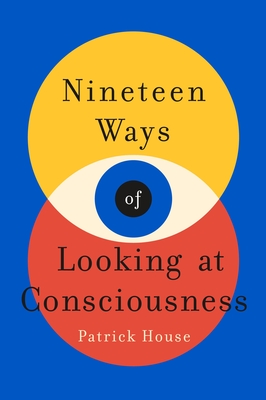
Nineteen Ways of Looking at Consciousness by Patrick House

book cover

The brain…is a thrift-store bin of evolutionary hacks Russian-dolled into a watery, salty piñata we call a head.

…consciousness is not something passed on or recycled–like single molecules of water, which are retained as they move about the earth as ice, water, or dew–from one living creature to the next…instead consciousness should be grown from “scratch” with only a few well-timed molecular parts from plans laid out. It is not drawn from a recycled tap of special kinds of cells or dredged from the vein of free will. No, the darn thing grows. From its own rules. All by itself. And we have no idea how or why.

When I was still a programmer it was necessary to understand the many characteristics of, and rules about using, the objects that we would place on the screen in an application. Under what conditions did one appear? Physical dimensions, like width and height. Does it have a borderline around it? How wide is that line? Does it have a background color? How about a foreground color? Can it display images, text, both? Where does it get its information, keyboard entry, internal calculation? and on and on and on. Fairly simple and straightforward once one knows how it works. But consider the human brain, with billions of neurons, and a nearly infinite possible range of interactions among them. Somehow, within that biological organ, there is a thing we refer to as consciousness. We are who and what we are, and saying so, thinking so, makes us conscious, at the very least. But how did this gelatinous, gross substance, come to develop awareness of self? And just what is consciousness, anyway?

description
Patrick House – image from Attention Fwd ->

Patrick House, a Ph.D. neuroscientist, researcher and writer, offers a wide range of looks at what consciousness might be, mostly by looking at details of the brain. How do the characteristics of zombie food come to be, and how do they combine to create something far greater than a tasty meal for the hungry dead? He looks at many of the currently popular ideas that try to get a handle on the fog that is consciousness.

The book is a collection of possible mechanisms, histories, observations, data, and theories of consciousness told nineteen different ways, as translations of a few moments described in a one-page scientific paper in Nature, published in 1998, titled “Electric Current Stimulates Laughter.” The idea is an homage to a short book of poetry and criticism, Nineteen Ways of Looking at Wang Wei, which takes the poem “Deer Park” by Wang Wei and analyzes nineteen different translations of it in the centuries since it was originally written.

He points out more than once that our brains did not emerge in an instant, all sparkling, from the build-a-brain factory. They evolved, from the very first living cell, so at each step of the evolutionary ladder, whatever traits favored survival and reproduction became dominant, pushing prior adaptations into the DNA equivalent of attic storage. Some of the accretion of the prior adaptations may vanish over time, but bags of the stuff are still lying about.

In tracing how our brains evolved, He points out qualities, like the brain’s need for cadence, and timekeeping, shows that language and action are comparable products of the brain and reports on how speech arose from systems that governed movement. He looks at the brain’s mission of preventing our bodies from losing 1.5 degrees of internal temperature, at how we map out the sensate terrain around us, and at the significance of size in brain complexity.

Imagery runs rampant. There is a chapter on the pinball machine as an appropriate metaphor for consciousness. It was a TILT for me. But ineffective chapters like that one are rare, and can be quickly forgotten when the next chapter offers another fascinating perspective, and bit of evolutionary vision. Another, more effective image, was scientists looking for “surface features” of the brain that might tell us where consciousness lies, like geologists surveying terrain to identify likely ore locations.

Throughout the book House refers to a patient, referred to as Anna, who, while having neurosurgery, had her brain poked in various locations by the surgeon, testing out the function of different parts of her gray matter, prompting some unexpected results. Grounding much of the discussion in the experience of an actual person helped make the material more digestible.

As I read, questions kept popping up like synapses flashing a signal to the next synapse. First of all is a definition of consciousness. What is it? How is it defined? Probably the most we can hope for is to infer its existence from externalities, in the same way that astrophysicists can infer the presence of a black hole by measuring the light coming from nearby objects, without ever being able to actually see the black hole, itself. Is there a measurable range of consciousness? Is entity #1 more or less conscious than entity #2. (Man, that is one seriously self-aware tree) How might we measure such a thing? This is actually addressed in one of the chapters. I would have been interested in more on consciousness in the world of Artificial Intelligence. If programmers put together a sufficient volume of code, with a vast array of memory and data, might there be a possibility of self-awareness? What would it take?

For an item on an electronic screen, one can find out the specific characteristics that comprise it. And with that knowledge, check against a list of possible items it might be. It might be a text-box, or a drop-down menu, or a check-box, a button that triggers an action when clicked. But with the brain, while we can compile a considerable list of characteristics, there is not really a list against we can check those things to arrive at a clear conclusion. Oh yeah, any entity, biological or electronic, that possesses at least some number of certain core characteristics, can be considered to be conscious. Nope, it does not work that way.

I found by the end of the book that I had learned a fair bit about how brains evolved, which is always a wonderful experience, but was as uncertain at the end as at the beginning about just what consciousness is. I expect that House shares that leaning, to at least some degree.

There is no one such thing as “consciousness,” and the attempt to study it as a singular phenomenon will go nowhere.

But he does suggest that consciousness exists as a range of experiences rather than as a singular entity with firmly defined borders. It is a fascinating read, even if the core definition is lacking. One thing is for sure, it is brain candy of the first order whether you are self-aware or not.

And just for fun, for next week’s class, be prepared to discuss the difference between consciousness and the mind.

Review posted – October 29, 2022

Publication date – September 22, 2022

I received an ARE of Nineteen Ways of Looking at Consciousness from St. Martin’s Press in return for a fair review. Thanks, folks.

This review has been cross-posted on GoodReads

=======================================EXTRA STUFF

Links to the House’s personal, and Twitter pages

Items of Interest
—–Wang Wei – Deer Park

Leave a comment

Filed under Non-fiction, Psychology and the Brain, Science and Nature

The World As We Knew It – edited by Amy Brady and Tajja Isen

book cover

“At a time when our planet is experiencing terrifying and unprecedented levels of change, what corresponding transformations have you witnessed in your lives, yards, neighborhoods, jobs, relationships, or mental health?” That’s the question that Tajjia Isen and I asked the contributors to this anthology. We wanted to hear their personal stories, allow then to serve as witnesses of this incredibly complex moment in history. – from the Introduction

This is what climate change is. It’s what it does to the psyche, along with the body and the places we love. It’s nearly invisible until the moment something startles you into attention. A creeping catastrophe waiting with arms outstretched to deliver a suffocating embrace. And once the knowledge is gained, there is no unknowing it. You are no longer climate blind. You see and cannot unsee.

Things change. Often it happens too slowly for us to notice. Sometimes processes have been evolving for a while and take a sudden, tipping point jump into the observable. But often it takes being away for a while to get a visceral sense of change.

description
Tajja Isen – image from Catapult, where she is Editor in Chief

What do you notice, and what slips by as just the normal range of expected experience? I have been around long enough to have personal elements that fit in with the editors’ approach. I was not keeping track of the frequency or height of the snowfalls that marked winter growing up in the Bronx. Does it snow more now? Less? Maybe, but not that I could say from personal observation, particularly. Although there was a stretch of years when it began to seem that snow was a thing of the past. Then it returned. I would have to look through tables of data to really know. Summers were hot growing up, days in the 90s, maybe a few in triple digits. Fire hydrants, including the one in front of the apartment building where I was raised, were opened, sometimes by friendly firefighters, sometimes by unauthorized people, so kids like me could get some relief from the heat. Are NYC summers hotter now? I don’t really know off the top of my head. Again, I would have to check tables of historical data. But I do know that Summer nights in New York were increasingly uncomfortable over my many years there, with overnight lows far too often in the 80s. Yes, the city holds the heat well, but it held it well during the entirety of my life. Something had changed. Then there was Superstorm Sandy.

description
Amy Brady – image from LitHub

In a way, the editors asked their contributors to respond to a lawyerly question: What did you notice and when did you notice it? With the extra of asking how the noticed change(s) impacted them. Editors Amy Brady and Tajja Isen have put together essays from nineteen writers from around the world, each exploring what they have noticed.

In 2022, we are witnesses to one of the most transformative moments in human history: a time when climate change is altering life on Earth at an unprecedented rate, but also a time when the majority of us can still remember when things were more stable. We are among the first—and perhaps one of the last—human populations to have memories of what life was like before. To us, the “new normal” is not how it’s always been. Our lives jostle against incongruous memories of familiar places. We are forced to confront, in strange and sometimes painful ways, how much those places have changed.

Being swamped with relentless tales of big scale environmental horror can have a numbing effect. Numbers, estimates, projections, possible outcomes, blah, blah, blah. We can stop hearing after a while, tune it out. Outrage is appropriate and we experience that, but it is not something we can endure continuously. At our core, humans are creatures of story, not statistics. For as long as we have existed people have concocted origin stories, not origin reports. So, maybe story is a better way to communicate, to connect, to inform people, some people anyway, about the real on-the-ground reality of global warming. And that is what we have here.

These nineteen stories are memoirish, covering the far reaches of the planet and a range of personal experiences. Landscapes that have been transformed by warming, devastating long-term drought, massive reduction in wildlife, invasive species wreaking havoc on formerly stable ecosystems, growing public consciousness of particles per million in the air, and on.

Some are a bit tangential. In Unearthing, Lydia Yuknovich focuses on the harm done by the Hanover, Washington facilities that produced much of the fissile materials used in America’s nuclear bombs. Her witness to the very personal impact of radioactive pollution on a peer growing up is not really a global warming tale, however heart-breaking. Some focus less on personal global warming miseries to look more at human interactions, class, racial and gender politics coming in for some attention

Some tales are wonderful in their strangeness. Walking on Water looks at how those charged with relocating both people and native deities to make way for a huge dam in Africa interact with local people and customs. Signs and Wonders notes, and celebrates, the increasing weirdness in the world, as long-hidden things begin to reappear when landscapes change and glaciers recede.

Some offer strong imagery. In Cougar, Terese Svoboda builds on an experience she had while driving, in which she narrowly avoided hitting a cougar that was making a dash across a Nebraska highway. She looks at ways the creature is making a comeback, among other elements in her story, and sees cause for hope that humanity can find a way as well.

In The Development, one of my favorite stories in the collection, Alexandra Kleeman notes a slice of green near her Staten Island apartment and pays attention as this (at least temporarily) abandoned piece of NYC is taken over by nature, plants left alone to grow, to spread, wildlife moving in. The optimism of regeneration lives side by side with the dread that it is only a matter of time before developers carve a pristine, straight-line urban walkway out of it.

Lacy M. Johnson tells of her religious father, in Leap. He was a white collar at a coal plant, justifying the environmental carnage being caused as God giving people the Earth to use however we want.

Some focus on illness. Warming has expanded the range of ticks that carry Lyme disease to the chagrin of well, everyone. Having had the pleasure some years back, I can very much relate to this concern. Lyme disease gets a mention in two of the stories. Porochista Khakpour’s Season of Sickness tells of his travails with Lyme and the joys of black mold in his apartment, and on. Is warming only generating more risks, or is it also impacting our resistance?

The collection is rich in beautiful writing and insight. The sense of place is particularly strong throughout. It certainly offers a prompt most of us can work from. What have you noticed? And how has it impacted your life?

One change that stands out from personal experience is a product of the others, expectations. Growing up, most of us, I believe, expected that the physical world would continue on pretty much as it had. That is no longer the case for anyone who pays any attention to environmental events in the world. While the fear of imminent and instantaneous destruction in the 1950s and 1960s, helped along by duck-and-cover drills during the Cold War, may have dissipated, (although it has certainly not been eliminated) the existential threats of today have more to do with our less flash-bang demise. The ticking up of temperatures worldwide makes us all frogs in the proverbial pot of warming water. And it seems an insuperable task trying to get those in charge of the range to turn off the flame, or at least turn it down enough. Will my children and grandchildren be able to see the places in the world I have been able to see? Will all those places even exist? What does warming mean for their longevity? Human lifespans increased significantly in the USA over the 20th century. I have already outlived my father. Will my children outlive me? We know that change is possible. When I was a kid it seemed that everyone smoked. After decades of effort, smoking was much reduced. Hope is a reason to go on, to keep trying, but one change I see is a whittling back of hope itself. Sure, there are positive developments. Electric cars have arrived and renewable energy production is growing as a percentage of overall supply. General awareness has surely grown. Our understanding of the complicated parts that make up global warming is expanding, increasing the possibility that fixes, or at the least ameliorations, can be identified, whether or not they are implemented. But is that enough to stave off the worst? Is anything, at this point, enough? Are we in the world of Don’t Look Up, where the only sane response is resignation? I sure hope not.

We must learn to become conservationists of memory. Otherwise, this damage we have done to our planet will cost us our past, as it may already have cost us our future. And without a past or a future, what are we? Nothing. A flickering violence of a species, here such a short time, insatiable, then gone. – Omar El Akkad

Review posted – July 8, 2022

Publication date – June 14, 2022

I received a copy of The World As We Knew It from Catapult in return for a fair review. Thanks, folks.

This review has been cross-posted on GoodReads

=======================================EXTRA STUFF

Links to Amy Brady’s personal, FB, Instagram, and Twitter pages

Links to Tajja Isen’s’s personal, Instagram, and Twitter pages

Interviews
—–Publishers Weekly – ‘The Raw Data of Someone Else’s Life’: PW Talks with Amy Brady and Tajja Isen by Liza Monroy
—–Writer Unboxed – Seeking the Existential, the Intimate, and the Urgent: Essays That Model Masterful Storytelling by Julie Carrick Dalton

Items of Interest from the author(s)
—–LitHub – A list of pieces Brady wrote for LitHub
—–Orion Magazine – excerpt – Faster Than We Thought by Omar El Akkad

2 Comments

Filed under Non-fiction, Public Health, Science and Nature

The Last Days of the Dinosaurs by Riley Black

book cover

The disaster goes by different names. Sometimes it’s called the end-Cretaceous mass extinction. For years, it was called the Cretaceous-Tertiary, or K-T, mass extinction that marked the end of the Age of Reptiles and the beginning of the third, Tertiary age of life on Earth. That title was later revised according to the rules of geological arcana to the Cretaceous-Paleogene mass extinction, shorted to K-Pg. But no matter what we call it, the scars in the stone tell the same story. Suddenly, inescapably, life was thrown into a horrible conflagration that reshaped the course of evolution. A chunk of space debris that likely measured more than seven miles across slammed into the planet and kicked off the worst-case scenario for the dinosaurs and all other life on Earth. This was the closest the world has ever come to having its Restart button pressed, a threat so intense that—if not for some fortunate happenstances—it might have returned Earth to a home for single-celled blobs and not much else.

The loss of the dinosaurs was just the tip of the ecological iceberg. Virtually no environment was left untouched by the extinction, an event so severe that the oceans themselves almost reverted to a soup of single-celled organisms.

This is a story about two things, Earth’s Big Bang and evolution. K-Pg (pronounced Kay Pee Gee – maybe think of it as KFC with much bigger bones, where everything is overcooked?) marks the boundary between before and after Earth’s own Big Bang, manifested today by a specific layer of stone in the geologic record.

description
Riley with Jet – image from The Museum of the Earth

Ok, yes, I know that the catastrophic crash landing of the bolide, a seven-miles-across piece of galactic detritus, most likely an asteroid, that struck 66.043 million years ago, give or take, was not the biggest bad-parking-job in Earth’s history. An even bigger one hit billions of years ago. It was nearly the size of Mars, and that collision may have been what created our moon. Black makes note of this in the book. But in terms of impact, no single crash-and-boom has had a larger effect on life on planet Earth. Sure, about 3 billion years ago an object between 23 and 36 miles across dropped in on what is now South Africa. There have been others, rocks larger than K-Pg, generating even vaster craters. But what sets the Chicxulub (the Yucatan town near where the vast crater was made, pronounced Chick-sue-lube) event on the apex is its speed and approach, 45 thousand mph, entering at a 45-degree angle. (You wanna see the fastest asteroid ever to hit Earth? Ok. You wanna see it again?) It also helps that the material into which it immersed itself was particularly likely to respond by vaporizing over the entire planet. An excellent choice for maximum destruction of our mother. And of course, its impact on life, animal life having come into being about 800 million years ago, was unparalleled. In the short term, it succeeded in wiping out the large non-avian dinosaurs, your T-Rex sorts, Triceratops grazers, brontosaurian browsers, and a pretty large swath of the planetary flora as well, burning up much of the globe and inviting in a nuclear winter that added a whole other layer of devastation. Aqueous life was not spared. You seen any mososaurs lately? Even tiny organisms were expunged en masse. (Cleanup in aisle everywhere!)

description
Image from Facts Just for Kids

Here’s what the Earth looked like just before, just after, and then at increments, a week, a month, a year, and on to a million years post event. It is a common approach in pop science books to personalize the information being presented. Often this takes the form of following a particular scientist for a chapter as she or he talks about or presents the matter under consideration. In The Last Days… Black lets one particular species, usually one individual of that species per chapter, lead the way through the story, telling how it came to be present, how it was impacted by the…um…impact, and what its descendants, if there would be any, might look like. She wants to show why the things that were obliterated came to their sad ends, but also how the things that survived managed to do so.

description
Quetzcoatlus – image from Earth Archives

But as fun and enlightening as it is to track the geological and ecological carnage, like an insurance investigator, (T-Rex, sure, covered. But those ammonites? Sorry, Ms. Gaea, that one’s not specified in the contract. I am so sorry.) is only one part of what Riley Black is on about here. She wants to dispel some false ideas about how species take on what we see as environmental slots.

description
Mesodma – image from Inverse

Some folks believe that there are set roles in nature, and that the extinction of one actor (probably died as a result of saying that verboten word while performing in The Scottish Play) leads inevitably to the role being filled by another creature (understudy?) As if the demise of T-Rex, for example, meant that some other seven-ton, toothy hunter would just step in. But there is no set cast of roles in nature, each just waiting for Mr, Ms, or Thing Right to step into the job. (Rehearsals are Monday through Saturday 10a to 6p. Don’t be late), pointing out that what survived was largely a matter of luck, of what each species had evolved into by the time of the big event. If the earth is on fire, for example, a small creature has a chance to find underground shelter, whereas a brontosaurus might be able to stick it’s head into the ground, but not much else, and buh-bye bronto when the mega-killer infrared pulse generated by you-know-what sped across the planet turning the Earth into the equivalent of a gigantic deep fryer and making all the exposed creatures and flora decidedly extra-crispy.

description
Thescelosaurus – image from Wiki

Black keeps us focused on one particular location, Hell Creek, in Montana, with bits at the ends of every chapter commenting on things going on in other, far-away parts of the world, showing that this change was global. When the impact devastates the entire planet, it makes much less sense to think of the specific landing spot as ground zero. It makes more sense to see it as a planet-wide event, which would make the entire Earth, Planet Zero. It was not the first major planetary extinction, or even the second. But it was the most immediate, with vast numbers of species being exterminated within twenty-four hours.

description
Thoracosaurus – image from artstation.com

I do not have any gripes other than wishing that I had had an illustrated copy to review. I do not know what images are in the book. I had to burrow deep underground to find the pix used here. I expect it is beyond the purview of this book, but I could see a companion volume co-written by, maybe, Ed Yong, on how the microbiomes of a select group of creatures evolved over the eons. For, even as the visible bodies of critters across the planet changed over time, so did their micro-biome. What was The Inside Story (please feel free to use that title) on how the vast array of bugs that make us all up changed over the millions of years, as species adapted to a changing macrobiome.

description
Purgatorius – image from science News

I love that Riley adds bits from her own life into the discussion, telling about her childhood obsession with dinosaurs, and even telling about the extinctions of a sort in her own life. What glitters throughout the book, like bits of iridium newly uncovered at a dig, is Black’s enthusiasm. She still carries with her the glee and excitement of discovery she had as a kid when she learned about Dinosaurs for the first time. That effervescence makes this book a joy to read, as you learn more and more and more. Black is an ideal pop-science writer, both uber-qualified and experienced in her field, and possessed of a true gift for story-telling.

Also, the appendix is well worth reading for all the extra intel you will gain. Black explains, chapter by chapter, where the hard science ends and where the speculation picks up. Black incorporates into her work a wonderful sense of humor. This is always a huge plus!

description
Eoconodon – image from The New York Times

Pull up a rock in the Hell Creek amphitheater. Binoculars might come in handy. An escape vehicle (maybe a TVA time door?) of some sort would be quite useful. Get comfortable and take in the greatest show on Earth (sorry Ringling Brothers) There literally has never been anything quite like it, before or since. The Last Days of the Dinosaurs a joy to read, is one of the best books of the year.

From the time life first originated on our planet over 3.6 billion years ago, it has never been extinguished. Think about that for a moment. Think through all those eons. The changing climates, from hothouse to snowball and back again. Continents swirled and bumped and ground into each other. The great die-offs from too much oxygen, too little oxygen, volcanoes billowing out unimaginable quantities of gas and ash, seas spilling over continents and then drying up, forests growing and dying according to ecological cycles that take millennia, meteorite and asteroid strikes, mountains rising only to be ground down and pushed up anew, oceans replacing floodplains replacing deserts replacing oceans, on and on, every day, for billions of years. And still life endures.

Review posted – May 13, 2022

Publication date – April 26, 2022

I received an ARE of The Last Days of the Dinosaurs from St. Martin’s Press in return for working my ancient, nearly extinct fingers to the bone to write a review that can survive. Thanks, folks.

This review has been cross-posted on Goodreads. Stop by and say Hi!

=======================================EXTRA STUFF

Links to the author’s personal, FB, Instagram, Tumblr, and Twitter pages

Profile from Museum of the Earth

Vertebrate Paleontologist & Science Writer
Riley Black is a vertebrate paleontologist and science writer. She is passionate about sharing science with the public and writes about her experiences as a transgender woman in paleontology.

Riley began her science writing career as a Rutgers University undergraduate. She founded her own blog, Laelaps, and later wrote for Scientific American, Smithsonian Magazine, National Geographic, and more. Riley has authored books for fossil enthusiasts of all ages, including Did You See That Dinosaur?, Skeleton Keys, My Beloved Brontosaurus, and Written in Stone.
Riley loves to spend time in the field, searching the Utah landscape for signs of prehistoric life. Her fossil discoveries are in the Carnegie Museum of Natural History, the Natural History Museum of Utah, and the Burpee Museum of Natural History. Riley’s work in the field fuels her writing. She believes doing fieldwork is the best way to learn about paleontology.

In your own words, what is your work about?

“What really holds my work together is the idea that science is a process. Science is not just a body of facts or natural laws. What we find today will be tested against what we uncover tomorrow, and sometimes being wrong is a wonderful thing. I love the fact that the slow and scaly dinosaurs I grew up with are now brightly-colored, feathered creatures that seem a world apart from what we used to think. I believe fossils and dinosaurs provide powerful ways to discuss these ideas, how there is a natural reality we wish to understand with our primate brains. The questions, and why we’re asking them, are more fascinating to me than static answers.”

Interviews
—–IFL Science – IFLScience Interview With Riley Black: The Last Days of the Dinosaurs – video – 15:40 – with Dr. Alfredo Carpineti – There is a particularly lovely bit at the back end of the interview in which Black talks about the inclusion in the book of a very personal element
—–Fossil Friday Chats – “Sifting the Fossil Record” w/ Riley Black” – nothing to do with this book, but totally fascinating

Items of Interest from the author
—–WIRED – articles by the author as Brian Switek
—–Scientific American – articles by the author as Brian Switek
—–Riley’s site – a list of Selected Articles
—–Science Friday – articles by the author
—–Excerpt

Items of Interest
—–Earth Archives – Quetzlcoatlus by Vasika Udurawane and Julio Lacerda
—–NASA – Sentry Program
—–Science Friday – Mortunaria – a filter-feeding plesiosaur
—–Biointeractive – The Day the Mesozoic Died: The Asteroid That Killed the Dinosaurs – on the science that produced our understanding of how the dinosaurs died out – video – 33:50
—–Wiki on the Hell Creek Formation

Leave a comment

Filed under Non-fiction, paleontology, Science and Nature

The Treeline by Ben Rawlence

book cover

Big changes are taking place across the vast plain stippled by spruce and striated with water that unfolds below the aircraft at 10,000 feet. The skin of the earth is melting, microbial life waking after thousands, possibly millions, of frozen years. The soil is transpiring—perspiring one could say since more moisture is being released than absorbed—and animals and plants are taking note. It is a new world, and intelligent life—the smart genes—is sniffing it out, sending out suckers, seeds and scouts, ranging north, getting ready.

The Treeline is a mind-blowing piece of work that will teach you many, many things you never suspected, while feeding your sense of awe and your sense of dread. We look to the margins for evidence of large changes in the world, tell-tale signs like rising levels along water frontages, expanding desert edges, changes in growing seasons, changes in wildlife. The treeline was the edge Ben Rawlence chose.

description
Ben Rawlence – Image from 5 x 15

He had spent years writing human rights reports and trying to get the UN and governments to address refugee issues, but when he started writing through the eyes of the refugees themselves, in several books, many more people began to listen.

Understanding that the conflict and the displacement that was going on was driven by climate change I began to look for other examples, other parts of the world where we could see this process in action, where we could see climate breakdown as history already, and we could catch a glimpse of the future that awaits the rest of us. So I began digging around and doing research and came across this very arresting image of the trees and the forest moving north towards the pole. I discovered that the forest was on the move and the trees were turning the white arctic green. They shouldn’t be on the move. That’s not supposed to happen. And this sinister fact has huge consequences for all life on earth. – from the 5×15 piece

So, what exactly is the treeline? Generically, it is the latitude above which there are no trees, roughly the Arctic Circle. Another measure is the rippled line around the globe south of which the average July temperature is ten degrees centigrade or higher. (The Arctic Squiggle?) Discovering that the Arctic treeline consisted of mostly six types of trees, he set about to look at each of these.

Scots pine in Scotland, birch in Scandinavia, larch in Siberia, spruce in Alaska and, to a lesser extent, poplar in Canada and rowan in Greenland. I decided to visit each tree in its native territory, to see how the different species were faring in response to warming, and what their stories might mean for the other inhabitants of the forest, including us.

The Arctic treeline is actually fairly squishy, not so much a line as an area of transition, an ecotone, where tree presence diminishes rather than ceases. Rawlence begins with a look at where he lives, in Wales, at the yew, struggling to persist in a world that is no longer conducive to its needs. But that may be changing. Then, it is off to the Cairngorm Mountains in Scotland, the Scandinavian interior, Siberia (larch), Alaska, Canada, and Greenland, looking at the role the boreal plays in our environment, and at the impact of global warming on these borderlands.

More than the Amazon rainforest, the boreal is truly the lung of the world. Covering one fifth of the globe, and containing one third of all the trees on earth, the boreal is the second largest biome, or living system, after the ocean. Planetary systems—cycles of water and oxygen, atmospheric circulation, the albedo effect, ocean currents and polar winds—are shaped and directed by the position of the treeline and the functioning of the forest.

One of the things that most impressed me, among the many fascinating nuggets to be found here were descriptions of the structures underlying forests.

Wherever there are mushrooms, ferns, bracken and particular kinds of woodland plants like violets there was once forest. Rings of mushrooms are usually the outline, the long-ago earthwork of a tree stump. There are between fifteen and nineteen ecto-mycorrhizal fungi (fungi growing around the roots) in a mature pine forest, and they play a role in everything from carbon and nutrient transport to lichen cover, taking sugar from the tree and providing it with minerals in exchange. Planting trees without regard for the essential symbiotic “other half” of the forest below ground may be far less effective than allowing the ground to evolve into woodland at its own pace. Oliver Rackham describes a planted oak wood in Essex that even after 750 years still does not possess the orchids, plants and mushrooms that you would expect of a natural wood.

I was reminded of what it might look like to see a city like New York or London from above and believe it to be constructed entirely of the visible structures, not appreciating that there are vast underground networks, water lines, sewer lines, gas lines, electrical lines, communication cables, transit tubes, and the like that provide the lifeblood which allows the above-ground, visible city to survive. Globally, these threads of mycorrhizal fungi make up between a third and a half of the living mass of soils. Soil is in fact a huge, fragile tangle of tiny connected threads. Having done some digging in our back yard, I can very much appreciate that.

Another impressive feat is Rawlence’s strength in communicating how local populations interact with the trees among which they live. There are many surprises to be found here, in the range of specific benefits trees provide for one, which includes the fact that they transmit aerosols carrying chemicals that help maintain health in humans, that their leaves, berries, bark and other parts providing medicine for a wide range of illnesses, that they provide materials that oceans need to sustain life, that they drive planetary weather. Did you know that there are birch trees with things called trichomal hairs on the underside of their leaves, that capture particulates from the air, natural air filters that then allow the materials to be dropped to the ground, and washed away with the next rain? They also act like a fur coat for the leaves. The list goes on. You will be surprised by many of the uses that Arctic peoples have devised to make use of their local trees.

Will it be possible to continue such a positive relationship as the land becomes less supportive of human endeavors? The Sami people, for example, are finding it increasingly difficult to manage their reindeer herds. Snowmobiles are less than ideal when there is no snow. Substituting four-wheel All Terrain Vehicles may allow them to herd their critters, but using them damages the landscape even more. At what point will it be impossible to continue at all?

There are plenty of dark tidings. In this ring of melting ice global warming is taking place at a rate far in excess of what we experience in the more temperate zones. And then this unnerving bit; with more Co2 in the air, trees do not need to work so hard to get what they need, thus will produce less oxygen. Uh oh. As the forests of the northern hemisphere migrate north (race actually, at a rate of hundreds of feet a year in some places instead of inches per century) they are pursued on their southern end by increasingly fire-prone conditions. How much of our forest land will be consumed by a Langolier-like army of drought and flames before finding more welcoming climes? And then there is methane, pretty pearl-like bubbles when seen through clear Arctic ice, but how about this cheery nugget as permafrost becoming permaslush?

Some studies have suggested that an unstable seabed could release a methane “burp” of 500–5000 gigatonnes, equivalent to decades of greenhouse gas emissions, contributing to an abrupt jump in temperature that humans will be powerless to arrest.

In pop science books, the author acts as a guide to the subject matter, introducing us to the places he visits, and the experts he consults. Rawlence is an engaging and informative teacher with a gift for extracting local cultural lore and area-specific histories, as well as reporting the science in accessible terms. He seems like someone you would want to hang out with. You would certainly like to sign up for any class he teaches. You will learn a lot. He is also a lyrical writer, able to offer not only straight-ahead exposition, but poetical, sometimes emotion-filled reactions to the places he visits and the experiences he has on this journey.

The brilliant sun on the pinkish cliffs and the starched blue of the sky, which has been mostly hidden all week, make the morning sing. The scent of a meadow is so heady it should be bottled. The hay has been freshly cut: huge plastic-covered bales guide the eye to a combine harvester abandoned mid-job, its windows covered in sparkling dew. Beyond, the path crosses the meadow to a wide bend that the flooding river has worked into a series of interlinked channels. The little bridges have been overwhelmed and carefully placed stepping-stones lie visible in the clear stream, half a meter underwater. Feet have cut a higher path along the edge of the valley, around drowned shrubs, riparian willow now floating midstream. The roar of the main river is all around. Gray water cradling slabs of dirty ice meanders around a cliff and then widens into a foaming skirt over even-sized white granite boulders that snag the ice and make it dance and nod until it falls apart and joins the sea-ward torrent.

Rawlence a not a fan of western capitalism, and it would be difficult to argue that the short-term profit motive is not at variance with the long-term health of the planet, but places that were at least nominally socialist did a pretty good job of devastating their environments too. Maybe the problem is a human one first, and a economic-political one second. Maybe if we lived as long as some trees (not all are long-lived) we might have a more long-term view of what matters, and not keep rushing to use everything as fast as we possibly can before someone else does. Rawlence keeps his eyes on the scientific and anthropological issues at hand. How is warming impacting these trees, the landscapes in which they exist, the societies that have lived with them for centuries, and the wider world? What can we learn from the changes that have already taken place? What can we look forward to? What can we do about it?

Despite the growth of electric car usage and renewable power generation, we have arrived at this party too late, and relatively empty-handed. Attempts to mitigate global warming cannot change the fact that there is warming to come that is already baked in. We can do nothing to change that. It will continue, even were we to cease all carbon usage tomorrow. Not that we should abandon attempts to reduce emissions. But we should know that we will not see the benefits of those actions. The mitigation work we do today may impact future generations, but the planet will continue heating up for quite some time regardless. The most we can hope for in the short term is to slow the rate somewhat.

The Treeline is a must read for anyone interested in environmental issues, global warming in particular. Who doesn’t love trees? After reading this you will love them ever more. As Rawlence points out, we are at our core tree people, having evolved thumbs to get around in an arboreal world, and having lived among or near trees for all of human history. We have evolved together, and will continue to do so. But we will have to adapt to the new Anthropocene world rather than attempting to force it back into its prior form.

In the future, when the ice is gone, there may be no such thing as a treeline at all.

Review posted – February 18, 2022

Publication date – February 15, 2022

I received an ARE of The Treeline from St. Martin’s Press in return for a fair review, and a promise to plant a few saplings. Thanks, folks. And thanks to NetGalley for facilitating.

This review has been cross-posted on GoodReads

=======================================EXTRA STUFF

Links to the author’s Twitter page

Lizzie Harper, a Welsh illustrator, provided many images for the book. Sadly, there were none in the e-galley I read. But you can see some on her site. Here are links to Harper’s personal, FB, LinkedIn, PInterest, and Twitter pages

Interview
—InterMultiversal – An Interview with Ben Rawlence by Simon Morden

Items of Interest from the author
—–Video trailer for the book – 1:09
—–5 x 15 – Ben Rawlence on The Treeline – video
—–The Big Issue – ‘As the planet warms, the forest is on the move’ by Rawlence

Items of Interest
—–Patagonia Films – Treeline (Full Film) | The Secret Life of Trees – video 40:16
—–Cairngorms Connect – 200-year vision to enhance habitats, species and ecological processes across a vast area within the 600 square kilometer Cairngorms National Park.
—–NY Times – Feb. 4, 2022 – Seen From Space: Huge Methane Leaks by Henry Fountain

You Might Also Want To Check Out
—–Land by Simon Winchester
—–Being a Human by Charles Foster
—–The Earth’s Wild Music by Kathleen Dean Moore
—–Road of Bones – not in form, obviously. But this one offers a fictional horror-story take on the great north rebelling against the outrages of humanity

Music
—–George Winston – Forest
—–Sondheim – Into the Woods

Leave a comment

Filed under Non-fiction, Public policy, Science and Nature