Tag Archives: biology

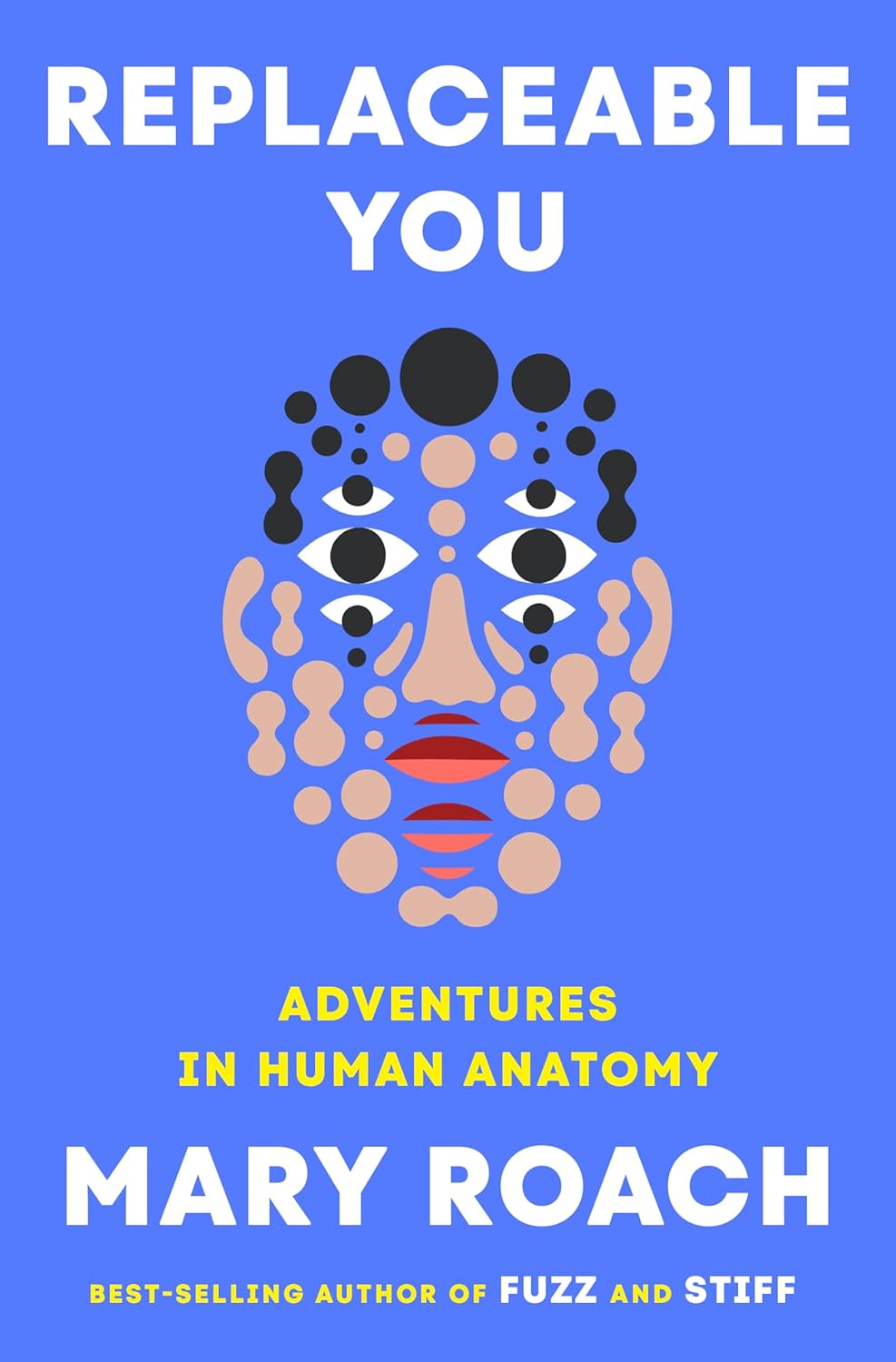
Replaceable You by Mary Roach

book cover

It’s another photograph of the penis [transplanted from the owner’s middle finger], now with a rustic ceramic pitcher hanging off of it. Exactly as you or I could put a hand out, palm up, and hang a pitcher off our middle finger. The pitcher is hand-painted, white with a red and green floral pattern. I’m picturing the man and his partner again, this time having lunch in the kitchen. A little iced tea, my love?

Eventually the day arrives when no further breach is possible. Mr. Baron, wrote his doctor, Richard Martland, “was now informed, the only chance for saving his life was by making an artificial anus . . . the inconveniences resulting from such operation, were candidly pointed out to him.” Mrs. White, on the occasion of her twelfth day without a bowel movement, is presented with the same proposition. Both patients consented. Or rather, as Pring put it, “did not violently object.” And so it went. “An opening was now made . . . and instantly a large quantity of liquid feces and wind escaped,” Martland wrote. Both doctors were impressed by the force with which the matter was expelled, with Pring taking additional note of the “considerable distance” traveled. – There was no mention of a fan in the vicinity.

This book certainly lends new meaning to the expression “an heir and a spare.”

I imagine many of us, certainly folks of my demographic, have had the experience of having parts replaced, probably because of need, but for some because of choice. I know I would happily have my begrudging spine replaced if I had the chance. And there are certainly a few improvements I could use that would be competing for second place on that list. Thus, my interest in Mary Roach’s latest, Replaceable You. (My ex can attest to the truth of the title’s applicability to the entire me.) Of course, I would read anything Mary Roach has written. She is one of my all-time favorite authors. And just in case her work is new to you, she combines a hard-reporting look at a particular scientific realm with a sense of humor that will leave you gasping for breath. Complete swallowing any ingested liquids before reading her work, as they may come blasting out your nose and mouth before you can get a grip. You have been warned.

description
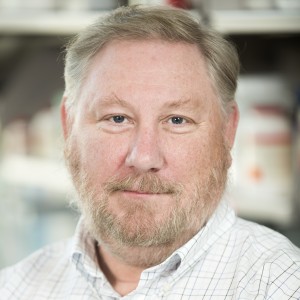
Mary Roach – image from Harvard Bookstore – shot by Jen Siska

Roach has made a career of writing about the human body, from conception (Boink) to grave (Stiff), and beyond (Spook), with travels through the alimentary canal (Gulp), the body’s reaction to space flight (Packing for Mars), to war (Grunt) and even to strangeness having to do with our interactions with animals (Fuzz). This time around, she covers a range of body parts subject to replacing. She sniffs out the history of nose jobs back to the 1500s, and lets us in on why they were in such high demand back then. She brings home the bacon by filling us in on the status of pig research (on, not by) for the purpose of developing organs that can be transplanted into humans, a subject close to my heart.

A formal “miniature swine development” project got underway in 1949, a collaboration between two Minnesota powerhouses, the Mayo Foundation (research arm of the Mayo Clinic) and the Hormel Institute (research arm of pork).

There are sections on the replacement, or enhancement, of sexual organs. One of the opening quotes of this review notes a particular form of actual, not kidding, replacement for a male member. Female anatomy comes in for a bit of consideration as well.

Dow Corning…made the first silicone breast implant, circa 1961, this one at the urging of Texas plastic surgeon Thomas Cronin. Cronin had been “inspired by the look and feel of a bag of blood.” It is hard for me not to picture the scene: Cronin standing around the OR, idly gazing at a bag hanging on a transfusion pole and turning to a colleague: Hey. Does that remind you of something? Cronin contacted Dow, and his resident, Frank Gerow, implanted some prototypes into dogs. The team were “excited” by the outcome—and again, stop me from picturing this.

Continuing downstairs…

Who looks at the human digestive tract and thinks, Moist, tubular, stretchy . . . Might that make a reasonable vagina?

Some, apparently. The derriere comes in for a long look as well. Part of this is a consideration of the changing fashions in tush shape, stretching from sane to anime.

I have made it (well in) to septuagenarian with what is probably an unremarkable range of replacement parts. My right arm was the recipient of two metal plates and a bone graft from my hip after a rather nasty industrial accident in 1970. The plates were removed once they had done their job of helping my bones knit, a few years later. The bone graft helped heal another fracture, and was eventually absorbed back into my skeleton.

Roach tells of prosthetic limbs, and the surprising news that some people prefer them to the original. In fact, the initial inspiration for this book came from a reader who had suggested that Mary take on the exciting world of football referees. Understandably, that failed to score, but it turned out that the woman, who has spina bifida, had a problem with her foot. It had, as a result of her other difficulties, become less than useless. She wanted it removed so she could get a prosthetic, but few surgeons would consider electively removing it. Mary joined her at the Amputation Coalition National Conference, and the game was…um…afoot.

It will come as no shock that using one’s own body bits as a source of transplantation offers the huge advantage of sparing you the need for a lifetime of immunosuppressive drugs. The body’s Studio 54 security guard can take a quick look and wave the new part in as the right sort. It worked for me a second time.

Other recent personal additions were the product of open-heart surgery, three stents and an aortic valve replacement. The stents were made up of material extracted from my right leg, and the valve was contributed by a member of our porcine community. I have yet to experience any desire to go digging for truffles in nearby woodlands.

Roach takes joy in comparing the techniques and tools of hip replacement surgery to woodworking, noting that while patients could actually be conscious during the surgery, the clanging, sawing machinery noise would be so disturbing that it is deemed preferable for patients to remain unconscious for the duration. She says that “Hip replacement has the visual drama of a visit to a Chevron station.”

Sadly, I was born with a mouthful of (well, maybe not born with, which would be weird, but ultimately host to a couple of sets, baby and adult) soft teeth (my dentist’s words). This led, over time, to a need for fillings, caps, bridges and dentures.
.
If you count up all the teeth that are removed and replaced with implants or dentures, I bet they would lead the pack in sheer numbers of replacement bits. Mary leads us on a walk through dentures in history, the up and down sides, as well as the benefits of not using them at all. Yes, Geoge Washington makes an appearance. You will find the section on spring-loaded replacements both fascinating and alarming, and concerning as well is the fact that so many people have elected to remove healthy teeth in order to install dentures.

Replacing hair is big business these days. But not just up top. Pubic hair is also replaceable. Not only can the short and crinkly be replaced, with hair from the head, but the opposite can be done as well. Of course this can present some grooming challenges, as pubic and head hair grow differently and behave inconsistently when treated with grooming products. Mary subjected herself to a bit of hair harvesting in her travels.

My donor site is smeared with bacitracin, but no gauze is taped in place, because my hair would get stuck. On the flight home, I will feel the back of my head start to ooze. Do you fly Southwest? Don’t sit in 11B.

She delves into the growth industry of 3D printing of bodily materials. It turns out that it is not so simple as it might seem. Each muscle and organ has particular abilities and behaviors that are very difficult to replicate, involving twisting, contracting, and reacting to incoming messaging from the brain. The Star Trek replicator might do a great job of producing “Earl Grey, hot,” but fabricating people-pieces is proving a much more complex undertaking than sci-fi writers imagined.

Eye lenses are being replaced at increasing rates. There are even many people who, as with tooth replacement noted above, are having their natural lenses replaced in order to improve their vision.

I have worn glasses since I was eight years old, for distance. The only issue I had with them was losing track of them. But in the last few years, it became obvious that there was a buildup of material on the left lens of my eye (not just the product of inattentive eyeglass wiping) that made night driving particularly challenging. Oncoming headlights, even non-bright ones, spread a glare across my field of view that was problematic. I had cataract surgery earlier this year (2025), left eye only. And it worked like a squeegee on a filthy window. The headlights are still miserable, particularly when people insist on using their brights, and when many newer cars use lights that are brighter than the prior generations of illumination, but the improvement in my vision was immediate.

She writes about the processes involved in recovering bio-materials from the recently dead, the potential for banking our own cells as a source for future replacement materials, a machine for offloading heart and respiration work from the body temporarily, and introducing us to the wonderful world of ostomies, noted up top.

Mary may write about science, but she is not, per se, a scientist. Thus, she can offer us an every-person view into the subjects she investigates. She reacts how we might react when faced with the same discoveries. She brings the oh, wow!, the joy-of-discovery moments to life for readers, and thus makes what she has learned stick for us more than it would from any dry textbook. If she leaves you in stitches, that might just be a part of your replacement work. If you burst with laughter, bust a gut, if you crack up or your laughter is side-splitting, that may be why you needed the work in the first place. Of course, if you laugh your head off, there is probably no short-term solution to that. Replaceable You is the real thing, as is Mary Roach. She is one of a kind. Accept no substitute. She is irreplaceable.

Nana takes a seat at Kuzanov’s desk and starts opening files on his computer desktop. After a few false starts, she locates a folder of photographs documenting a finger transplant performed on a cancer patient. Most of the man’s penis had been amputated, leaving him unable to do two of the things most men like to do with their penis: penetrate and pee while standing. The surgery would restore both. – She missed one.

Review posted – 09/19/25

Publication date – 09/16/25

I received an ARE of Replaceable You from W.W. Norton & Company in return for a fair review. Thanks, folks, and thanks to NetGalley for facilitating. And could you check to see if anyone left any spare spines lying around.

This review is cross-posted on Goodreads. Stop by and say Hi!

===================================EXTRA STUFF

Links to Roach’s personal, Instagram and Twitter pages

Profile – from her site

I grew up in a small house in Etna, New Hampshire. My neighbors taught me how to drive a Skidoo and shoot a rifle, though I never made much use of these skills. I graduated from Wesleyan in 1981 and drove out to San Francisco with some friends. I spent a couple years working as a freelance copy editor before landing a half-time PR job at the SF Zoo. On the days when I wasn’t there in my little cubicle in the trailer behind Gorilla World, I freelanced articles for the Sunday magazine of the local newspaper. One by one, my editors would move on to bigger publications and take me along with them. In the late 1990s, magazines began to sputter out and travel budgets evaporated, and so I switched to books.
People call me a science writer, though I don’t have a science degree and sometimes have to fake my way through interviews with experts I can’t understand.
I have no hobbies. I mostly just work on my books and hang out with my family and friends. I enjoy bird-watching (though the hours don’t agree with me), hiking, backpacking, overseas supermarkets, Scrabble, mangoes, and that late-night “Animal Planet” show about horrific animals such as the parasitic worm that attaches itself to fishes’ eyeballs but makes up for it by leading the fish around.

Interviews
—–Stuff to Blow Your Mind on iHeart – Replaceable You, with Mary Roach by Robert Lamb – audio (36 minutes) with available transcript
—–Peculiar Book Club – MARY ROACH is Un-Replaceable! – video – 1:10:03 – from 5:00
—–NPR – From heart to skin to hair, ‘Replaceable You’ dives into the science of transplant with Brandy Shillace
—–Association of Health Care Journalists – Mary Roach calls herself ‘the gateway drug to science’ by Lesley McClurg

Other Mary Roach books we have enjoyed
—–2021 – Fuzz: When Nature Breaks the Law
—–2016 – Grunt: The Curious Science of Humans at War
—–2013 – Gulp
—–2010 – Packing for Mars
—–2006 – Spook Six Feet Over – recently renamed
—–2004 – Stiff

Items of Interest
—–New York Times – 10 Icky Things Mary Roach Has (Unfortunately) Brought to My Attention – by Sadie Stein – from sundry MR writings, in case you have not laughed enough from reading her latest
—–Bauman Medical – What is a Pubic Hair Transplant?
—–Youtube – A particularly disturbing transplantation scene from the 1973 film Oh Lucky Man

Song
—–Beyonce – Irreplaceable
2 Comments

Filed under History, Non-fiction, Public Health, Science and Nature

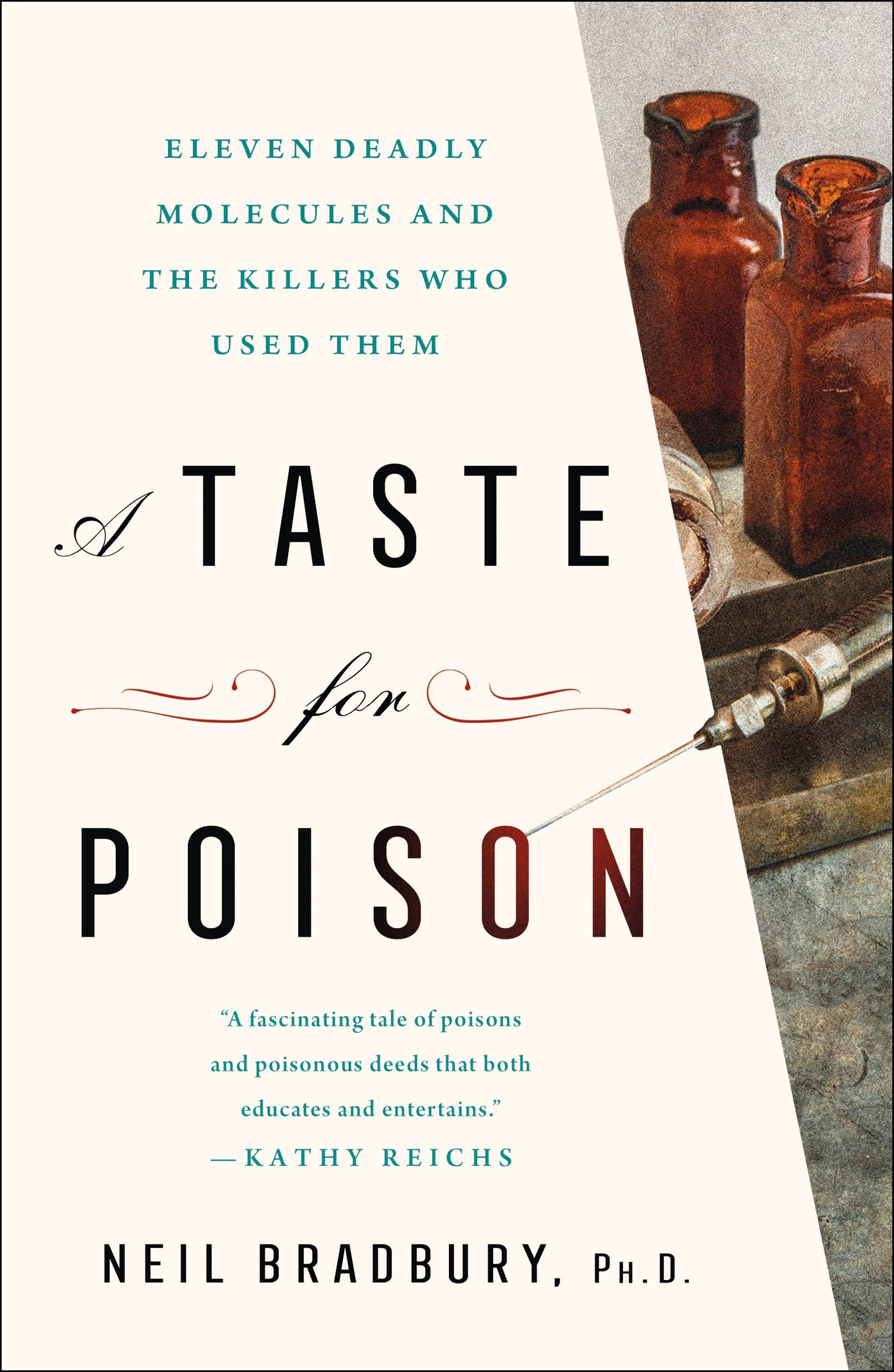
A Taste for Poison by Neil Bradbury

book cover

… a chemical is not intrinsically, good or bad, it’s just a chemical. What differs is the intent with which the chemical is used: either to preserve life – – or to take it.

Within the annals of crime, murder holds a particularly heinous position. And among the means of killing, fewer methods generate such a peculiar morbid fascination as poison. Compared with hot blooded spur of the moment, murderers, the planned and cold calculations involved in murder by poison, perfectly fit the legal term malice aforethought. Poisoning requires planning and knowledge of the victim’s habits. It requires consideration of how the poison will be administered. Some poisons can kill within minutes; others can be given slowly, over time, gradually accumulating in the body, but still leading inexorably to the victim’s death.

If you are a fan of True Crime, if you are a fan of TV procedurals, if you are a fan of murder mysteries, A Taste for Poison is a must read. You will be much better prepared to keep up with the medical examiners in all venues when you can recognize the victims’ symptoms, at least if the book or show gives you a chance to try figuring it out for yourself before the truth is revealed.

Neil Bradbury grew up fascinated by murder mysteries and poisons. He is a graduate of the University of St. Andrews in Scotland, and the University of Wales School of Medicine, with degrees in Biochemistry and Medical Biochemistry. Although he grew up in the UK, he now lives and works in Illinois, USA, where he’s a scientist, teacher and writer. He also gets to play with nasty chemicals every day (during scientific experiments of course). – from his site

description
Dr. Neil Bradbury – image from his site

He has carefully mixed his interests and profession to produce a fun, informative look at poisons through the ages. One might wonder if he wrote the book using a poison pen. I wouldn’t, but some might. He includes looks at the following: Aconite, Arsenic, Atropine, Chlorine, Cyanide, Digoxin, Insulin, Potassium, Polonium, Ricin, and Strychnine. None would qualify as pretty, although cyanide does gift its victims with a lovely ruddy complexion.

One of the primary themes of the book is that poisoning is the misapplication of healing pharma to dark purpose. Think water. Necessary for human survival, comes in many forms. These days it forms a base layer for a surface layer of every imaginable flavor, nifty literary tool too, right? But water-boarding, or tsunami? Not so much.

Bradbury goes through the medically helpful aspects of multiple poisons, then shows how they have been used to kill, who used them, on whom they were used, how the crimes were figured out and prosecuted, and what happened to the poisoners. In doing this he provides us with a history of when it became possible to diagnose (detect) each poison as a murder weapon, (of particular interest in historical mystery dramas) and details the biology of how each works its dark arts inside the human body.

Sadly, for those with a poison-based homicidal urge, the subjects of Bradbury’s reporting, for the most part, were tried and convicted. And today, in the absence of governments protecting state-sponsored poisoners, very few such crimes go unpunished.

You are unlikely to recognize the names here, at least the names of the killers, attempted killers, and victims, but as with many in the history of medicine, that is not unusual. Nevertheless, the details are here, as many crimes are examined.

Bradbury offers a fun collection of historical odds and ends, like how the telegraph, newly in service, foiled the escape of one poisoner. Or how one particular poison may have been at the root of vampire mythology, or how strychnine was used as a pick-me-up in the early 20th century, or the surprising cost of manufacturing polonium, and even a new take on some Van Goh masterpieces.

The only downside for me was that I tended to get a bit lost in the sections detailing the biological and chemical workings of these substances inside the body. I would not say they are extremely technical. I would say that I was always complete garbage at chemistry, and not a whole lot better at biology, so may have nurtured a disaffection that is unlikely to affect you the same way. There is some humor in the book, but not a whole lot.

Still, As a consumer of a considerable amount of crime-based entertainment, I was particularly drawn to this book. The how-dun-it often is as important as the who, and by detailing victim symptomology as well as poisoner and investigator methodologies, we can all get a greater appreciation for the challenges entailed. I may not have had the right chemical receptors for the scientific details, but there is plenty of intel in here that will enhance your engagement in crime shows, and teach you a bit about the history of these substances, many of which exist in common parlance. So, it may or may not be for you. I guess you will just have to pick your poison.

…in France in the late 1600s, the effectiveness of arsenic and disposing of wealthy relatives who had the temerity to remain alive, was so widespread that it gained the name Poudre de succession, or “inheritance powder.”

Review posted – 11/17/23

Publication dates
———-Hardcover – 2/1/22
———-Trade paperback – 8/15/23

I received a paperback of A Taste for Poison from Griffin in return for a fair review. I am happy to report that the tingling feeling in my hands, which began after I first began to read the book, soon abated. Thanks, folks, and thanks to NetGalley for facilitating.

This review is cross-posted on my site, Goodreads. Stop by and say Hi!

=======================================EXTRA STUFF

Links to the author’s personal and Goodreads author pages

Alas, as far as I was able to find, Bradbury’s on-line presence is slender, limited to his personal site and GR author page. Maybe laying low after having taken care of some personal rivals?

Interview
—–Murder & MayhemTalking Poisons with Dr. Neil Bradbury

Items of Interest
—–Listverse – Top 10 Remorseless Poisoners That History Almost Forgot by Radu Alexander
—–Philadelphia Inquirer –A Pennsylvania nurse is accused of killing 4 patients, injuring others with high doses of insulin by Bruce Shipkowski and Brooke Schultz, Associated Press
—–Wikipedia – List of Poisonings through history – from 399 BC to 2021 – a nifty list

Leave a comment

Filed under History, Non-fiction, Science and Nature, True crime

The World As We Knew It – edited by Amy Brady and Tajja Isen

book cover

“At a time when our planet is experiencing terrifying and unprecedented levels of change, what corresponding transformations have you witnessed in your lives, yards, neighborhoods, jobs, relationships, or mental health?” That’s the question that Tajjia Isen and I asked the contributors to this anthology. We wanted to hear their personal stories, allow then to serve as witnesses of this incredibly complex moment in history. – from the Introduction

This is what climate change is. It’s what it does to the psyche, along with the body and the places we love. It’s nearly invisible until the moment something startles you into attention. A creeping catastrophe waiting with arms outstretched to deliver a suffocating embrace. And once the knowledge is gained, there is no unknowing it. You are no longer climate blind. You see and cannot unsee.

Things change. Often it happens too slowly for us to notice. Sometimes processes have been evolving for a while and take a sudden, tipping point jump into the observable. But often it takes being away for a while to get a visceral sense of change.

description
Tajja Isen – image from Catapult, where she is Editor in Chief

What do you notice, and what slips by as just the normal range of expected experience? I have been around long enough to have personal elements that fit in with the editors’ approach. I was not keeping track of the frequency or height of the snowfalls that marked winter growing up in the Bronx. Does it snow more now? Less? Maybe, but not that I could say from personal observation, particularly. Although there was a stretch of years when it began to seem that snow was a thing of the past. Then it returned. I would have to look through tables of data to really know. Summers were hot growing up, days in the 90s, maybe a few in triple digits. Fire hydrants, including the one in front of the apartment building where I was raised, were opened, sometimes by friendly firefighters, sometimes by unauthorized people, so kids like me could get some relief from the heat. Are NYC summers hotter now? I don’t really know off the top of my head. Again, I would have to check tables of historical data. But I do know that Summer nights in New York were increasingly uncomfortable over my many years there, with overnight lows far too often in the 80s. Yes, the city holds the heat well, but it held it well during the entirety of my life. Something had changed. Then there was Superstorm Sandy.

description
Amy Brady – image from LitHub

In a way, the editors asked their contributors to respond to a lawyerly question: What did you notice and when did you notice it? With the extra of asking how the noticed change(s) impacted them. Editors Amy Brady and Tajja Isen have put together essays from nineteen writers from around the world, each exploring what they have noticed.

In 2022, we are witnesses to one of the most transformative moments in human history: a time when climate change is altering life on Earth at an unprecedented rate, but also a time when the majority of us can still remember when things were more stable. We are among the first—and perhaps one of the last—human populations to have memories of what life was like before. To us, the “new normal” is not how it’s always been. Our lives jostle against incongruous memories of familiar places. We are forced to confront, in strange and sometimes painful ways, how much those places have changed.

Being swamped with relentless tales of big scale environmental horror can have a numbing effect. Numbers, estimates, projections, possible outcomes, blah, blah, blah. We can stop hearing after a while, tune it out. Outrage is appropriate and we experience that, but it is not something we can endure continuously. At our core, humans are creatures of story, not statistics. For as long as we have existed people have concocted origin stories, not origin reports. So, maybe story is a better way to communicate, to connect, to inform people, some people anyway, about the real on-the-ground reality of global warming. And that is what we have here.

These nineteen stories are memoirish, covering the far reaches of the planet and a range of personal experiences. Landscapes that have been transformed by warming, devastating long-term drought, massive reduction in wildlife, invasive species wreaking havoc on formerly stable ecosystems, growing public consciousness of particles per million in the air, and on.

Some are a bit tangential. In Unearthing, Lydia Yuknovich focuses on the harm done by the Hanover, Washington facilities that produced much of the fissile materials used in America’s nuclear bombs. Her witness to the very personal impact of radioactive pollution on a peer growing up is not really a global warming tale, however heart-breaking. Some focus less on personal global warming miseries to look more at human interactions, class, racial and gender politics coming in for some attention

Some tales are wonderful in their strangeness. Walking on Water looks at how those charged with relocating both people and native deities to make way for a huge dam in Africa interact with local people and customs. Signs and Wonders notes, and celebrates, the increasing weirdness in the world, as long-hidden things begin to reappear when landscapes change and glaciers recede.

Some offer strong imagery. In Cougar, Terese Svoboda builds on an experience she had while driving, in which she narrowly avoided hitting a cougar that was making a dash across a Nebraska highway. She looks at ways the creature is making a comeback, among other elements in her story, and sees cause for hope that humanity can find a way as well.

In The Development, one of my favorite stories in the collection, Alexandra Kleeman notes a slice of green near her Staten Island apartment and pays attention as this (at least temporarily) abandoned piece of NYC is taken over by nature, plants left alone to grow, to spread, wildlife moving in. The optimism of regeneration lives side by side with the dread that it is only a matter of time before developers carve a pristine, straight-line urban walkway out of it.

Lacy M. Johnson tells of her religious father, in Leap. He was a white collar at a coal plant, justifying the environmental carnage being caused as God giving people the Earth to use however we want.

Some focus on illness. Warming has expanded the range of ticks that carry Lyme disease to the chagrin of well, everyone. Having had the pleasure some years back, I can very much relate to this concern. Lyme disease gets a mention in two of the stories. Porochista Khakpour’s Season of Sickness tells of his travails with Lyme and the joys of black mold in his apartment, and on. Is warming only generating more risks, or is it also impacting our resistance?

The collection is rich in beautiful writing and insight. The sense of place is particularly strong throughout. It certainly offers a prompt most of us can work from. What have you noticed? And how has it impacted your life?

One change that stands out from personal experience is a product of the others, expectations. Growing up, most of us, I believe, expected that the physical world would continue on pretty much as it had. That is no longer the case for anyone who pays any attention to environmental events in the world. While the fear of imminent and instantaneous destruction in the 1950s and 1960s, helped along by duck-and-cover drills during the Cold War, may have dissipated, (although it has certainly not been eliminated) the existential threats of today have more to do with our less flash-bang demise. The ticking up of temperatures worldwide makes us all frogs in the proverbial pot of warming water. And it seems an insuperable task trying to get those in charge of the range to turn off the flame, or at least turn it down enough. Will my children and grandchildren be able to see the places in the world I have been able to see? Will all those places even exist? What does warming mean for their longevity? Human lifespans increased significantly in the USA over the 20th century. I have already outlived my father. Will my children outlive me? We know that change is possible. When I was a kid it seemed that everyone smoked. After decades of effort, smoking was much reduced. Hope is a reason to go on, to keep trying, but one change I see is a whittling back of hope itself. Sure, there are positive developments. Electric cars have arrived and renewable energy production is growing as a percentage of overall supply. General awareness has surely grown. Our understanding of the complicated parts that make up global warming is expanding, increasing the possibility that fixes, or at the least ameliorations, can be identified, whether or not they are implemented. But is that enough to stave off the worst? Is anything, at this point, enough? Are we in the world of Don’t Look Up, where the only sane response is resignation? I sure hope not.

We must learn to become conservationists of memory. Otherwise, this damage we have done to our planet will cost us our past, as it may already have cost us our future. And without a past or a future, what are we? Nothing. A flickering violence of a species, here such a short time, insatiable, then gone. – Omar El Akkad

Review posted – July 8, 2022

Publication date – June 14, 2022

I received a copy of The World As We Knew It from Catapult in return for a fair review. Thanks, folks.

This review has been cross-posted on GoodReads

=======================================EXTRA STUFF

Links to Amy Brady’s personal, FB, Instagram, and Twitter pages

Links to Tajja Isen’s’s personal, Instagram, and Twitter pages

Interviews
—–Publishers Weekly – ‘The Raw Data of Someone Else’s Life’: PW Talks with Amy Brady and Tajja Isen by Liza Monroy
—–Writer Unboxed – Seeking the Existential, the Intimate, and the Urgent: Essays That Model Masterful Storytelling by Julie Carrick Dalton

Items of Interest from the author(s)
—–LitHub – A list of pieces Brady wrote for LitHub
—–Orion Magazine – excerpt – Faster Than We Thought by Omar El Akkad

2 Comments

Filed under Non-fiction, Public Health, Science and Nature

The Last Days of the Dinosaurs by Riley Black

book cover

The disaster goes by different names. Sometimes it’s called the end-Cretaceous mass extinction. For years, it was called the Cretaceous-Tertiary, or K-T, mass extinction that marked the end of the Age of Reptiles and the beginning of the third, Tertiary age of life on Earth. That title was later revised according to the rules of geological arcana to the Cretaceous-Paleogene mass extinction, shorted to K-Pg. But no matter what we call it, the scars in the stone tell the same story. Suddenly, inescapably, life was thrown into a horrible conflagration that reshaped the course of evolution. A chunk of space debris that likely measured more than seven miles across slammed into the planet and kicked off the worst-case scenario for the dinosaurs and all other life on Earth. This was the closest the world has ever come to having its Restart button pressed, a threat so intense that—if not for some fortunate happenstances—it might have returned Earth to a home for single-celled blobs and not much else.

The loss of the dinosaurs was just the tip of the ecological iceberg. Virtually no environment was left untouched by the extinction, an event so severe that the oceans themselves almost reverted to a soup of single-celled organisms.

This is a story about two things, Earth’s Big Bang and evolution. K-Pg (pronounced Kay Pee Gee – maybe think of it as KFC with much bigger bones, where everything is overcooked?) marks the boundary between before and after Earth’s own Big Bang, manifested today by a specific layer of stone in the geologic record.

description
Riley with Jet – image from The Museum of the Earth

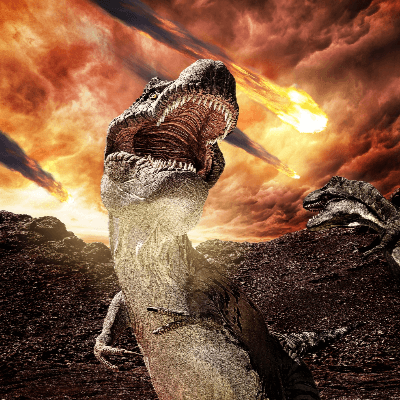
Ok, yes, I know that the catastrophic crash landing of the bolide, a seven-miles-across piece of galactic detritus, most likely an asteroid, that struck 66.043 million years ago, give or take, was not the biggest bad-parking-job in Earth’s history. An even bigger one hit billions of years ago. It was nearly the size of Mars, and that collision may have been what created our moon. Black makes note of this in the book. But in terms of impact, no single crash-and-boom has had a larger effect on life on planet Earth. Sure, about 3 billion years ago an object between 23 and 36 miles across dropped in on what is now South Africa. There have been others, rocks larger than K-Pg, generating even vaster craters. But what sets the Chicxulub (the Yucatan town near where the vast crater was made, pronounced Chick-sue-lube) event on the apex is its speed and approach, 45 thousand mph, entering at a 45-degree angle. (You wanna see the fastest asteroid ever to hit Earth? Ok. You wanna see it again?) It also helps that the material into which it immersed itself was particularly likely to respond by vaporizing over the entire planet. An excellent choice for maximum destruction of our mother. And of course, its impact on life, animal life having come into being about 800 million years ago, was unparalleled. In the short term, it succeeded in wiping out the large non-avian dinosaurs, your T-Rex sorts, Triceratops grazers, brontosaurian browsers, and a pretty large swath of the planetary flora as well, burning up much of the globe and inviting in a nuclear winter that added a whole other layer of devastation. Aqueous life was not spared. You seen any mososaurs lately? Even tiny organisms were expunged en masse. (Cleanup in aisle everywhere!)

description
Image from Facts Just for Kids

Here’s what the Earth looked like just before, just after, and then at increments, a week, a month, a year, and on to a million years post event. It is a common approach in pop science books to personalize the information being presented. Often this takes the form of following a particular scientist for a chapter as she or he talks about or presents the matter under consideration. In The Last Days… Black lets one particular species, usually one individual of that species per chapter, lead the way through the story, telling how it came to be present, how it was impacted by the…um…impact, and what its descendants, if there would be any, might look like. She wants to show why the things that were obliterated came to their sad ends, but also how the things that survived managed to do so.

description
Quetzcoatlus – image from Earth Archives

But as fun and enlightening as it is to track the geological and ecological carnage, like an insurance investigator, (T-Rex, sure, covered. But those ammonites? Sorry, Ms. Gaea, that one’s not specified in the contract. I am so sorry.) is only one part of what Riley Black is on about here. She wants to dispel some false ideas about how species take on what we see as environmental slots.

description
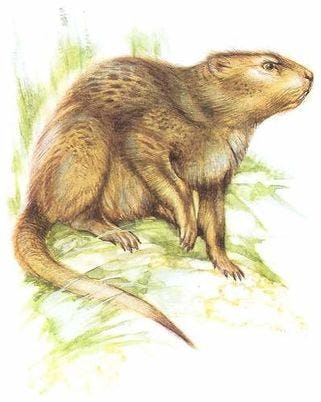
Mesodma – image from Inverse

Some folks believe that there are set roles in nature, and that the extinction of one actor (probably died as a result of saying that verboten word while performing in The Scottish Play) leads inevitably to the role being filled by another creature (understudy?) As if the demise of T-Rex, for example, meant that some other seven-ton, toothy hunter would just step in. But there is no set cast of roles in nature, each just waiting for Mr, Ms, or Thing Right to step into the job. (Rehearsals are Monday through Saturday 10a to 6p. Don’t be late), pointing out that what survived was largely a matter of luck, of what each species had evolved into by the time of the big event. If the earth is on fire, for example, a small creature has a chance to find underground shelter, whereas a brontosaurus might be able to stick it’s head into the ground, but not much else, and buh-bye bronto when the mega-killer infrared pulse generated by you-know-what sped across the planet turning the Earth into the equivalent of a gigantic deep fryer and making all the exposed creatures and flora decidedly extra-crispy.

description
Thescelosaurus – image from Wiki

Black keeps us focused on one particular location, Hell Creek, in Montana, with bits at the ends of every chapter commenting on things going on in other, far-away parts of the world, showing that this change was global. When the impact devastates the entire planet, it makes much less sense to think of the specific landing spot as ground zero. It makes more sense to see it as a planet-wide event, which would make the entire Earth, Planet Zero. It was not the first major planetary extinction, or even the second. But it was the most immediate, with vast numbers of species being exterminated within twenty-four hours.

description
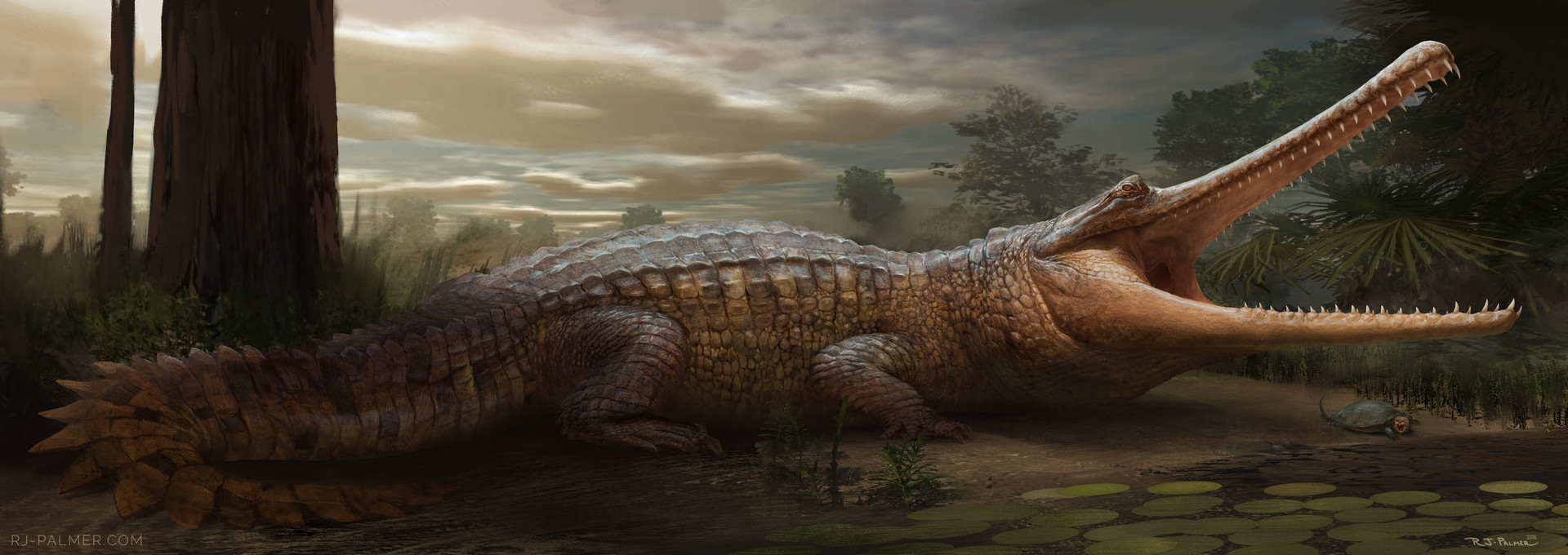
Thoracosaurus – image from artstation.com

I do not have any gripes other than wishing that I had had an illustrated copy to review. I do not know what images are in the book. I had to burrow deep underground to find the pix used here. I expect it is beyond the purview of this book, but I could see a companion volume co-written by, maybe, Ed Yong, on how the microbiomes of a select group of creatures evolved over the eons. For, even as the visible bodies of critters across the planet changed over time, so did their micro-biome. What was The Inside Story (please feel free to use that title) on how the vast array of bugs that make us all up changed over the millions of years, as species adapted to a changing macrobiome.

description
Purgatorius – image from science News

I love that Riley adds bits from her own life into the discussion, telling about her childhood obsession with dinosaurs, and even telling about the extinctions of a sort in her own life. What glitters throughout the book, like bits of iridium newly uncovered at a dig, is Black’s enthusiasm. She still carries with her the glee and excitement of discovery she had as a kid when she learned about Dinosaurs for the first time. That effervescence makes this book a joy to read, as you learn more and more and more. Black is an ideal pop-science writer, both uber-qualified and experienced in her field, and possessed of a true gift for story-telling.

Also, the appendix is well worth reading for all the extra intel you will gain. Black explains, chapter by chapter, where the hard science ends and where the speculation picks up. Black incorporates into her work a wonderful sense of humor. This is always a huge plus!

description
Eoconodon – image from The New York Times

Pull up a rock in the Hell Creek amphitheater. Binoculars might come in handy. An escape vehicle (maybe a TVA time door?) of some sort would be quite useful. Get comfortable and take in the greatest show on Earth (sorry Ringling Brothers) There literally has never been anything quite like it, before or since. The Last Days of the Dinosaurs a joy to read, is one of the best books of the year.

From the time life first originated on our planet over 3.6 billion years ago, it has never been extinguished. Think about that for a moment. Think through all those eons. The changing climates, from hothouse to snowball and back again. Continents swirled and bumped and ground into each other. The great die-offs from too much oxygen, too little oxygen, volcanoes billowing out unimaginable quantities of gas and ash, seas spilling over continents and then drying up, forests growing and dying according to ecological cycles that take millennia, meteorite and asteroid strikes, mountains rising only to be ground down and pushed up anew, oceans replacing floodplains replacing deserts replacing oceans, on and on, every day, for billions of years. And still life endures.

Review posted – May 13, 2022

Publication date – April 26, 2022

I received an ARE of The Last Days of the Dinosaurs from St. Martin’s Press in return for working my ancient, nearly extinct fingers to the bone to write a review that can survive. Thanks, folks.

This review has been cross-posted on Goodreads. Stop by and say Hi!

=======================================EXTRA STUFF

Links to the author’s personal, FB, Instagram, Tumblr, and Twitter pages

Profile from Museum of the Earth

Vertebrate Paleontologist & Science Writer
Riley Black is a vertebrate paleontologist and science writer. She is passionate about sharing science with the public and writes about her experiences as a transgender woman in paleontology.

Riley began her science writing career as a Rutgers University undergraduate. She founded her own blog, Laelaps, and later wrote for Scientific American, Smithsonian Magazine, National Geographic, and more. Riley has authored books for fossil enthusiasts of all ages, including Did You See That Dinosaur?, Skeleton Keys, My Beloved Brontosaurus, and Written in Stone.
Riley loves to spend time in the field, searching the Utah landscape for signs of prehistoric life. Her fossil discoveries are in the Carnegie Museum of Natural History, the Natural History Museum of Utah, and the Burpee Museum of Natural History. Riley’s work in the field fuels her writing. She believes doing fieldwork is the best way to learn about paleontology.

In your own words, what is your work about?

“What really holds my work together is the idea that science is a process. Science is not just a body of facts or natural laws. What we find today will be tested against what we uncover tomorrow, and sometimes being wrong is a wonderful thing. I love the fact that the slow and scaly dinosaurs I grew up with are now brightly-colored, feathered creatures that seem a world apart from what we used to think. I believe fossils and dinosaurs provide powerful ways to discuss these ideas, how there is a natural reality we wish to understand with our primate brains. The questions, and why we’re asking them, are more fascinating to me than static answers.”

Interviews
—–IFL Science – IFLScience Interview With Riley Black: The Last Days of the Dinosaurs – video – 15:40 – with Dr. Alfredo Carpineti – There is a particularly lovely bit at the back end of the interview in which Black talks about the inclusion in the book of a very personal element
—–Fossil Friday Chats – “Sifting the Fossil Record” w/ Riley Black” – nothing to do with this book, but totally fascinating

Items of Interest from the author
—–WIRED – articles by the author as Brian Switek
—–Scientific American – articles by the author as Brian Switek
—–Riley’s site – a list of Selected Articles
—–Science Friday – articles by the author
—–Excerpt

Items of Interest
—–Earth Archives – Quetzlcoatlus by Vasika Udurawane and Julio Lacerda
—–NASA – Sentry Program
—–Science Friday – Mortunaria – a filter-feeding plesiosaur
—–Biointeractive – The Day the Mesozoic Died: The Asteroid That Killed the Dinosaurs – on the science that produced our understanding of how the dinosaurs died out – video – 33:50
—–Wiki on the Hell Creek Formation

Leave a comment

Filed under Non-fiction, paleontology, Science and Nature

Life’s Edge by Carl Zimmer

book cover

…the question of what it means to be alive has flowed through four centuries of scientific history like an underground river… More than 150 years later, despite all that biologists have learned about living things, they still cannot agree on the definition of life.

I have had the pleasure of driving up a mountain through mist and cloud, and of walking in London through pea soup fog. Where exactly did the clear air end and the more particulate air begin? It is not entirely…um…clear. Sure, there is a difference between standing, or driving in air that one cannot visually penetrate and looking through a wide outdoor expanse on a cloud-free, crystalline winter day. But it is not a barrier drawn with a straight edge. Thus it appears with the line between living and not-living. With the examples detailed in Life’s Edge, it is clearer than ever that there are more things under heaven and earth than had been dreamed of in our philosophies. There are those, certainly, who proclaim that this or that specific location is where the thing called life begins. Rules have been drawn up to plant markers, to draw lines. But like an outdoor crime-scene police-tape, the fog of what lies within and without wanders freely past those lines, with no regard for the designs or preferences of humans.

description
Carl Zimmer – image from The Psychology Podcast

New York Times science columnist and multiple-award-winning science-writer Carl Zimmer’s fourteenth book takes readers on an exploration to that amorphous borderland between the living and the non-living. It is a journey that raises a lot more questions than it answers. Zimmer employs a tried and true approach, each chapter moving on to the next lab, the next researcher, the next wild bit of research, and filling in with nice chunks of science history, as he circles around the question.

description
Alysson Muotri – image from The Stem Cell Podcast

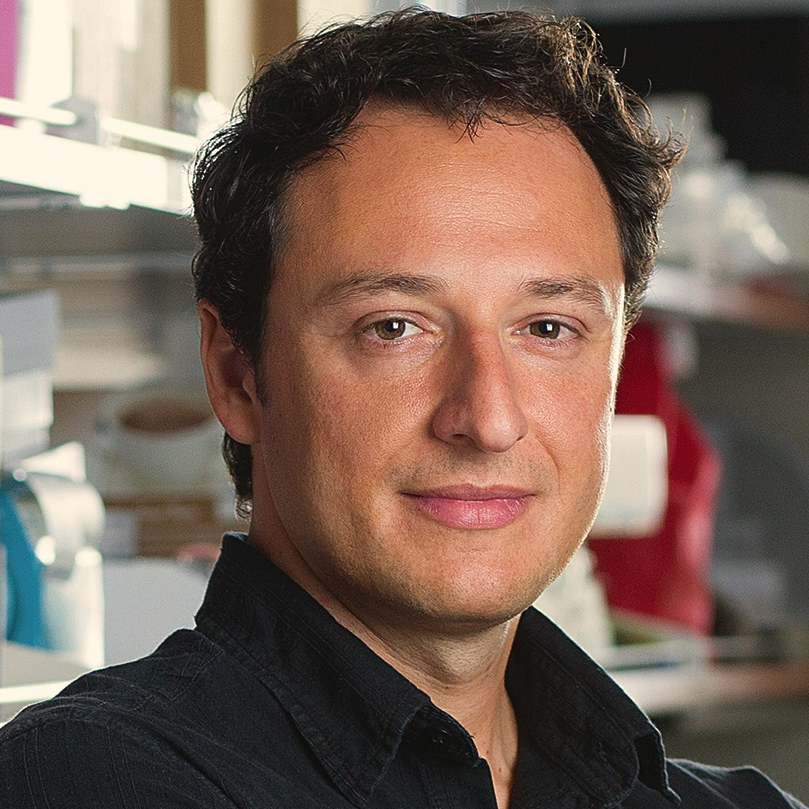
Many of the things Zimmer reports on are fascinating. Some, however, will disturb your sleep. For an example of the latter, Alysson Muotri, at the Sanford Consortium for Regenerative Medicine, takes skin samples and reprograms them into neurons to study neurological diseases and possible treatments. They are grown into miniature organs called organoids, and are allowed to reproduce, up to a point. When he started growing these things, he assumed that they could never become conscious. “Now I’m not so sure, he confessed.” Zimmer tells, also, of a researcher, a very long time ago, who was notorious for experimenting on living animals.

description
Cerebral organoid – image from European Research Council

Clearly a significant concern for our culture is where “life” begins, and further, where “human life” begins. It all comes down to definitions. Is Thomas Aquinas’s notion of the “ensoulment” of human embryos the same as defining when life becomes human life? There have been other notions employed in the history of Christianity. Zimmer looks at how legal definitions of life, for purposes including supporting abortion laws, and concerning a widening spectrum of medical and legal issues, fail to hold up under scientific scrutiny.

description
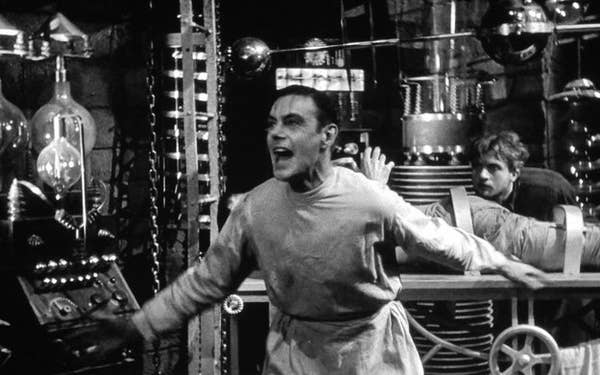
”It’s Alive!” (or is it?) – from Frankenstein – image from Buzzfeed

The concern here is not just what is life, but how can we tell when something actually is alive? He looks at how humans perceive life and react to it. We have a sense of life being present or absent, an intuition that is not unique to our species. Ravens hold what can only be seen as funerals for dead flock members. Chimps engage in group laments for late members, as do many other creatures.

To be alive is to not be dead…Humanity did not come to this realization through logic and deduction. Our understanding of death is not like Darwin’s theory of evolution or Thompson’s discovery of the electron. It has its origins in ancient intuitions.

Zimmer looks at metabolic rate. In the 17th century, there was a widespread fear of being afflicted with a death-like state that might leave its victims without detectable breath or heartbeat, thus generating a rampant terror of being buried alive. This concern inspired a well-known short story.

The boundaries which divide Life from Death are at best shadowy and vague. – Edgar Allan Poe, The Premature Burial

Zimmer reports on a woman who was pronounced dead, twice. (third time’s the charm?) Where is the line between brain death and true, no backsies, total death? Can a person meet the criteria for brain death one day, and later not meet it?

description
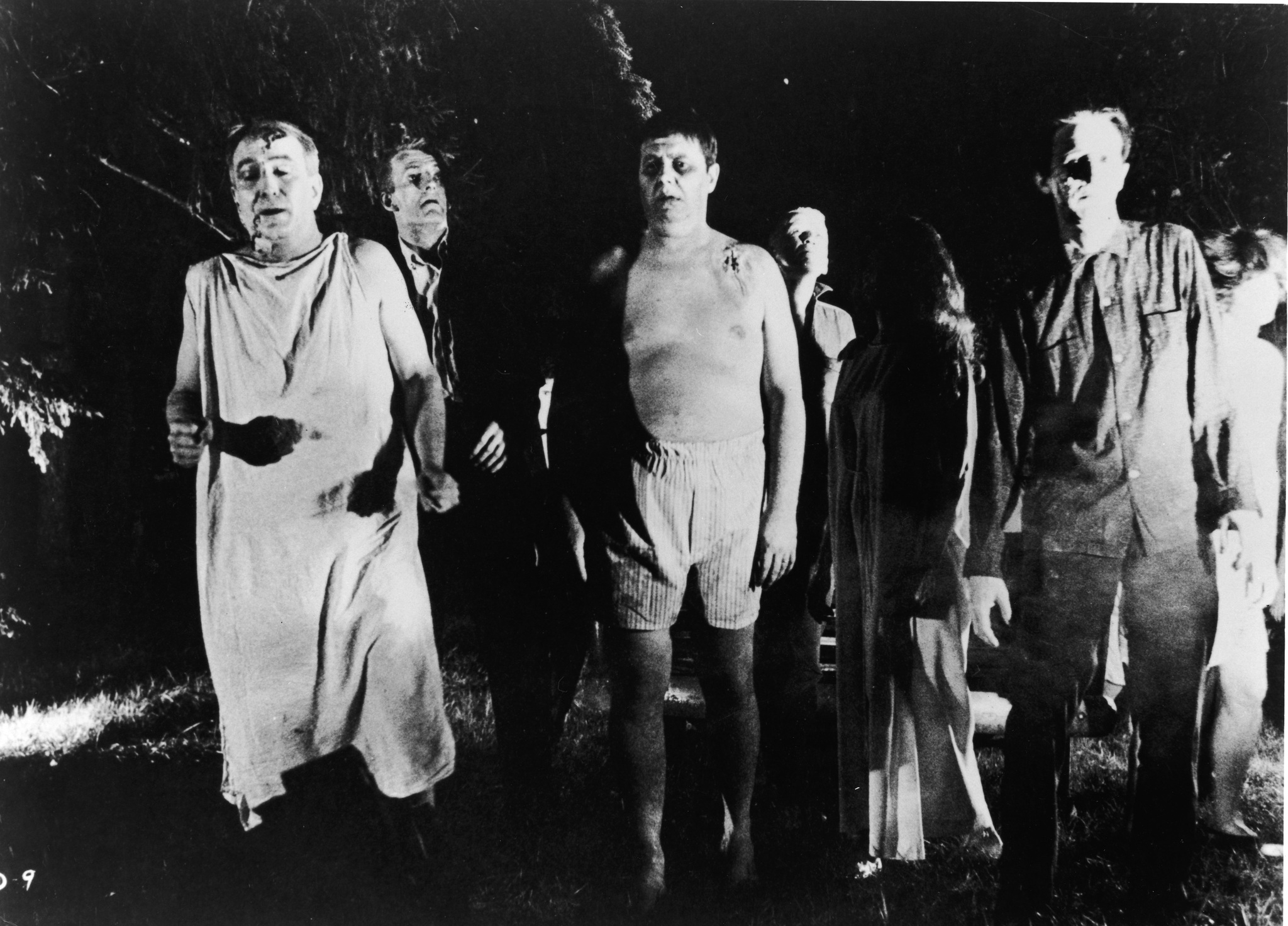
From The Night of the Living Dead – image from Wikipedia

But what constitutes life? How about adding some ingredients to agar, leaving it alone for a few hours and then finding a thriving slime mold, one with remarkable survival skills. What about spores, some of which can survive in space? Are spores alive? Or only potentially alive, or an ingredient in a recipe for making life?

Scientists have been arguing over whether viruses are alive for about a century, ever since the pathogens came to light. Writing last month in the journal Frontiers in Microbiology, two microbiologists (Hugh Harris and Colin Hill) at University College Cork took stock of the debate. They could see no end to it. “The scientific community will never fully agree on the living nature of viruses,” they declared. – from Zimmer’s Secret Life piece in the NY Times

description
“I vunder vut it vood be like to be really dead” – image from The Indy Channel

Whether you prefer your undead to be of the vampiric, zombie, or reanimated sort, or are more inclined to unicellular spore candidates, or maybe pre-conscious organoids, there are plenty of candidates for entities on the fringes of life.

In addition to providing readers with a better handle on the attempt to delineate the line between life and not-life, there are plenty of interesting questions raised and fun facts to be gleaned. We learn, for example, that Erwin Schrödinger was set up by the government at Trinity College. (But he may have simultaneously both been there and not, depending on whether any students saw him give a lecture.) We also learn that when Vitamin C was discovered, the discoverer wanted to name it “Godnose.” And how about meteorites as a possible source of Terran life? Or maybe they contributed one or more of the ingredients necessary for the recipe? I particularly enjoy when science writers imbue their work with a sense of humor. That is mostly lacking here, which is disappointing. But there is plenty of material to keep your brain cells flashing on and off.

Who decides on a definition of life? In an ideal world, science should lead on matters that are subject to physical investigation and repeatable experimentation. And yet…

It may be enough for you to align with Supreme Court Justice Potter Stewart who, when it came time to issue a ruling pertaining to pornography, said that he knows it when he sees it. We as a species tend to think that we know life when we see it. But it would be a good thing to recognize that all extant definitions of life are squishy, relying on philosophy or religion for their support. So I would appreciate it if no one would use their definition to tell me or anyone who does not share their perspective what they can or cannot do. Because when it comes to folks twisting science to political ends, I know it when I see it.

Life’s Edge may not provide a definitive guide to the line between living and nonliving. Such a line does not really exist in biology. But it does point out where the arguments lie about where those lines might be drawn, or, at least, where they might be investigated. It raises the larger question, though, of whether that line can, at least from a scientific perspective, be drawn at all.

Life is what the scientific establishment (probably after some healthy disagreement) will accept as life.

Review first posted – March 19, 2021

Publication dates
———-March 9, 2021 – hardcover
———-March 8, 2022 – trade paperback

I received an e-book ARE if Life’s Edge from Dutton in exchange for an honest review, and some of those interesting things that have been growing, unasked, in my basement.

This review has been cross-posted on GoodReads

=======================================EXTRA STUFF

Links to the author’s personal, FB, Instagram, Tumblr, PInterest, and Twitter pages

I heartily recommend you check out Siddhartha Mukherjee’s amazing NY Times review What Does It Mean to Be a Living Thing?

Items of Interest from the author
—–What is Life – audio – A series of live conversations between writer Carl Zimmer and eight leading thinkers on the question of what it means to be alive.
—–Slate – excerpt – What on Earth are These Things? – on organoids
—–NY Times – The Secret Life of a Coronavirus – is it alive?

Songs/Music
—–From Sondheim’s CompanyBeing Alive
—–Aerosmith – Livin’ On the Edge
—–Opening of Saturday Night Fever – The Bee Gees Stayin’ Alive
—–Madonna – Borderline
—–GaGa – Edge of Glory
—–Shruti Haasan – Edge
—–Monty Python’s The Meaning of Life – Every Sperm is Sacred

Leave a comment

Filed under History, Non-fiction, Public policy, Reviews, Science and Nature