Category Archives: Reviews

The Mighty Red by Louise Erdrich

book cover

The absence of birds made Diz uneasy, but he wasn’t spraying birds, was he? Yet there were fewer birds around his farm. Used to be robins hunting worms in the furrows. Used to be blackbirds around the green bins. Owls at dawn, rats in their claws. Well, maybe he had a sudden thought those could have been the rats and mice he had to poison. He thought back to how birds used to chatter as the sun rose. Now, a few sparrows, maybe, or more often just the hiss and boom of wind.

While working in her garden, Crystal appreciated how their families were like the Lord’s ivy, a weed ineradicable by human means. It grows low to the ground and can’t be mowed. It throws its stems long and roots straight down every few inches, just like the people along the river. There seems to be a Frechette or a Poe anywhere you land, but low-key, invisible. The Lord’s ivy, or ground ivy, creeping charlie, thrives under the leaves of other plants and goes wherever it is not wanted. It just keeps throwing itself along stem by stem and blooms so modestly you’d hardly mark the tiny purple flowers. People step down and pass, the weed springs up, uncrushable.

But, implanted or not, there is plenty of stress to go around.

description
Louise Erdrich in front of her Minneapolis bookstore – image from The Paris Review – shot by Angela Erdrich

Romantic stress
The core of the novel is an ill-considered relationship. Kismet and Gary are teenagers, rich with hormones and needs. But are they ready to be married? She had planned to go to college. Gary is the star quarterback, but has a need for Kismet that has nothing to do with their romance. And then there is Hugo, brilliant, ambitious, and totally in love with her, (… he closed his eyes and thought about how he was helpless in the tractor beam of love.) centering his life on making himself successful enough to woo her away from Gary. Coming of age is a major element, and is wonderfully portrayed. Erdrich says in the B&N interview that she had really wanted to write a love triangle. Well, among other things. She also wanted to write about …

Financial stress

I really set it in 2008…because I don’t feel our country has ever really dealt with the fallout from 2008. I feel like there was so much that there was so much loss, that people lost homes, people lost jobs, things hollowed out in such a big way and that was never really addressed. We never really came back from that time, 2008, 2009 into the present, because the pandemic happened. – from the B&N interview

Winnie Geist lived through the Reagan era in which her family’s farm was lost, sold for a fraction of its worth. David Stockman is name-dropped from the 1980s.

While she was in high school, the government accelerated her family’s loan payments and blow after blow had landed. They’d lost their home, their farm, everything. Except one another, they kept saying, except us.

Crystal Poe is Kismet’s mother. When ne’er-do-well-actor dad, Martin, goes walkabout, Crystal has to sell off possessions to keep afloat.

description
Erdrich would like to see Irene Bedard as Crystal – from the Hoda & Jenna interview – image from Wikipedia

Ecological stress
Connection to the land is always a feature of Louise Erdrich’s work. The Lord’s ivy quote at the top reflects the root of this. Winnie’s angst at the loss of her family farm offers another. There are multiple instances of characters expressing, and acting on, (or not) concerns for the well-being of the ground on which they live and work. It is the treatment of the land that gets the most attention, the tension between using chemical-based products to maximize production per acre, versus a less corporate approach that supports a more ecologically balanced, restorative brand of farming.

I don’t think about politics when I write. I think about the characters and the narrative. My novels aren’t op-eds. Nobody reads a book unless the characters are powerful—bad or good or hopelessly ordinary. They have to have magnetism. If you write your characters to fit your politics, generally you get a boring story. If you let the people and the settings in the book come first, there’s a better chance that you can write a book shaped by politics that maybe people want to read. – from the Paris Review interview

Parental stress
Erdrich has four daughters, so has had plenty of experience with mother-child interactions. She says she loved being the mother of teens, seeing the excitement of their choices, and trying to be more of a guide than a hard-liner. Crystal struggles to influence Kismet without coming on too strong, which would predictably result in increased resistance. Gary’s mother clearly loves him, and goes out of her way to see to her baby’s happiness, maybe too far out of her way. Crystal and Winnie are definitely both afraid for their children, although for very different reasons.

description
Erdrich would like to see Isabella LeBlanc as Kismet – from the Hoda & Jenna interview – image from Minnesota Native News

A bit of fun
There is a series of flamboyant crimes committed by an outlaw, who acquires a nickname and a fair bit of public fame, in the same way that notorious historical criminals like Billy the Kid drew public interest and admiration.

This book is set during the economic collapse of 2008–09. What Martin does is only what a lot of people wanted to do. I didn’t think of what he did as villainy, but yes, I suppose it was absolutely crazy, and, you know, fun to write. I have to amuse myself. – from the Bookpage interview

There was more that motivated Erdrich. She is from the Red River Valley of North Dakota, has much family in the area and returns frequently. She wanted to write about the changes she had seen there. (like the mighty Red, history was a flood.) One element of this was that her first job was hauling sugar beets. The industry was undeveloped at the time. She wanted to write about how it had evolved over the last thirty years. The original title of the novel was Crystal.

When I started it I thought I would be writing about the 2011 lockout by Crystal Sugar and how it impacted people who were working there. They lost a lot in terms of their insurance and their benefits and wages…it was a really tough lockout. I wanted to write about that at first, but then I started writing something else entirely and I enjoyed writing it more so I kept with that one and it became more about a number of people living along the river. – from the B&N interview

Many of Louise Erdrich’s novels (this is her nineteenth) have centered on Native American history, lore, and contemporary experience. While there are several characters here whose Native roots are noted, this is not really a book about the Native experience, the way that The Round House, LaRose, The Night Watchman, and others are.

Magical realism remains a sharp tool in Erdrich’s kit. Crystal listens to a late-night radio show that centers on strangeness, including angels. A caller wonders if her child is protected by a guardian angel, given the number of close calls they had had. One character is haunted by the ghost of a friend. The aroma of a used dress speaks to its new owner. One character has a presentiment about an imminent danger.

description
Erdrich would like to see Brett Kelly as Hugo – from the Hoda & Jenna interview – image from Alchetron

There is a mystery here as well. what happened at “the party” and why is it such a hush-hush subject? Something terrible is hinted at. There are ripples emanating from this event that inform multiple character arcs.

There are a few literary references applied here. Madame Bovary is one. If you know the story, the echoes will boom at you. If not, it is no trick to pull up an abstract. Ditto for Anna Karenina. (see EXTRA STUFF for links)

As with any work of fiction it requires that we relate, at least somewhat, to at least some of the characters. Erdrich has a gift for writing characters that, whatever they may do, we can appreciate their motives, even if we may not agree with their choices. This is a major strength of the novel. She crafts rounded humans, ambitious, frightened, rational, irrational, loving, thoughtful, feckless, smart in wildly divergent ways, and, ultimately, satisfying. She does this while incorporating a payload of ecological concern, relationship insight, and an appreciation of history’s impact on lived experience, while adding a layer of magic to aid our understanding, and including a few laughs to smooth the way. Louise Erdrich is a national treasure, a reliable source of quality literary fiction, and an ongoing delight to read. The Mighty Red is indeed a mighty read.

Review posted – 12/13/24

Publication dates
———-Hardcover – 10/1/24
———-Trade paperback – 11/04/25

I received an ARE of The Mighty Red from Harper (through my Book Goddess dealer) in return for a fair review. Thanks, folks, dear.

This review is cross-posted on Goodreads. Stop by and say Hi!

=======================================EXTRA STUFF

Interviews
—–*Barnes & Noble Book ClubLouise Erdrich discusses THE MIGHTY RED with Lexie Smyth and Jenna Seery – with Lexi Smyth and Jenna Seery – video 45:37 – This is the one you want to check out
—–Today with Hoda and Jenna – Author Louise Erdrich talks ‘The Mighty Red,’ takes fan questions
—–my link text
—–The Paris Review my link text
—–Book Page – Red is an earth tone by Alice Cary

Other Louise Erdrich novels I have reviewed
—–2021 – The Sentence
—–2020 – The Night Watchman
—–2017 – Future Home of the Living God
—–2016 – LaRose
—–2010 – Shadow Tag
—–2012 – The Round House
—–2008 – The Plague of Doves
—–2005 – The Painted Drum

Items of Interest
—–Project Gutenberg – Madame Bovary – full text
—–GetAbstract – of Madame Bovary
—–Project Gutenberg – Anna Karenina – full text
—–ReWire The West – Anna Karenina: Summary and Analysis
—–North Dakota State University – WHY IS THE RED RIVER OF THE NORTH SO VULNERABLE TO FLOODING?
—–MPR News – 20-month lockout over, sugar workers brace for return to work by Dan Gunderson
Leave a comment

Filed under Cli-Fi, Fiction, Literary Fiction

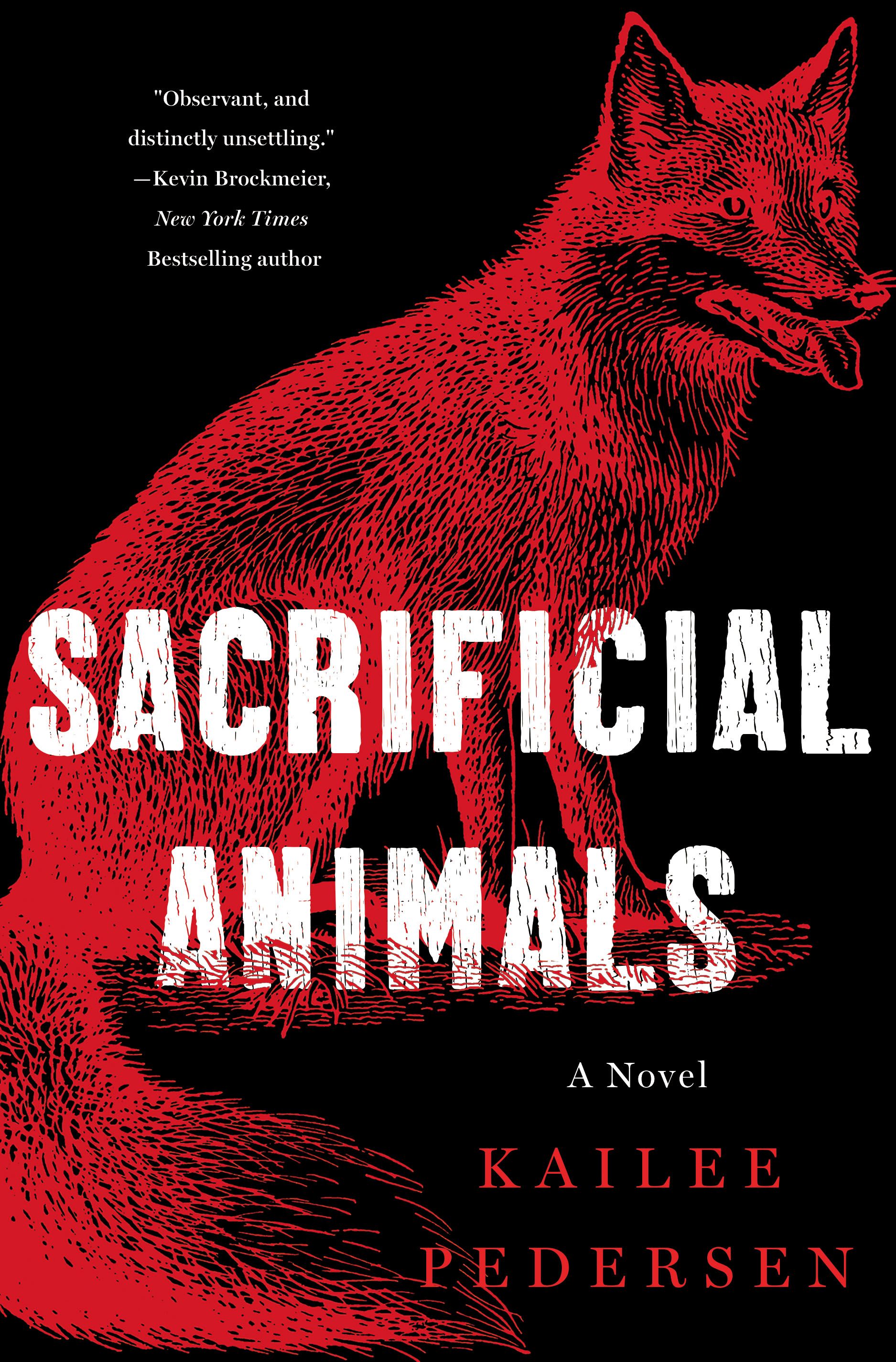
Sacrificial Animals by Kailee Pedersen

book cover

Swiftly and violently as a gunshot a scream pierces the sloped fields lying open and fallow behind the house. Sounding like a woman being murdered in the way he has seen it on television where her agony is drawn out over several breathless and voyeuristic minutes until he changes the channel. Yet he knows it is not a woman but some unnamable beast of the forest come to bewitch and maim. A mother despondent, in all her devastated keening—the fox whose children now reside in the stomachs of the hounds at Stag’s Crossing has finally returned.

The difference between wolves and foxes his father says is that wolves love to hunt and foxes love to play. A tantalizing trail of blood in the half-melted snow. Wolves only have enough foresight to kill and upon their killing they will feed ravenously and strip the bones. But foxes; they are quick-witted and brutal. When they hunt they do so with finesse stalking and pouncing then snapping the spine in their slender jaws.

What goes around comes around.

Life’s a bitch and then you die.

Carlyle Morrow is bitter widower, his third son, Christopher, buried on his land, along with his mother, who died in the attempt to birth him. Morrow is left on his thousand acres in the middle of Nebraska with two sons. Joshua is the golden boy, beautiful, attentive to Carlyle’s every wish, a loyal favorite lapdog. Nick is the second son, plain in appearance, tepid in his embrace of his father’s violent nature. He possesses a bit of his mother’s second sight, his orientation less than that of a purebred. They have both been made to endure a legacy of cruelty passed down from father to son over at least three generations. Carlyle forces him into an act, while hunting, that goes beyond wrongfulness, beyond sin, into the realm of abomination. Nick will live with the guilt the rest of his life, even though the responsibility was not all his. Now in their forties, Nick and Josh have been separated from their father for decades. (Nick still calls) But neither can refuse the summons to return home on news that their father is preparing to die.

description
Kailee Pederson – image from her Twitter profile

We follow Nick as he recalls his life, his struggles with Joshua and Carlyle, mostly the latter. He always found his brother’s wife, Emilia, fascinating, alluring in the mode of a siren. Carlyle is cruel, requiring complete obedience. He expects his sons to love the raw violence that marks his life. He does not raise his boys so much as train them. He even wishes that they could be as faithful and bloodthirsty as his best friends.

If Carlyle could have had dogs for sons he would have been a happy man; but when has a Morrow man ever been happy?

The structure of the novel is a back and forth, with alternating chapters, Then and Now. We learn how the boys’ treatment (Nick’s mostly) brings them to become the men they are in their forties. One would think that with chapters labeled so, there would be a clear differentiation between the internal timelines of each chapter. But no, there are transgressions within, as “Now” chapters, as well as “Then” chapters include lookbacks. Seems not cricket to me, but no biggie. The personal history is clearly a roadmap to the boys’ doom, which is referenced many times, so will not come as a shock. Pederson keeps offering glimpses of the future, a bell being rung louder and louder with each recurrence. There is an unrelenting atmosphere of dread. Awful things will be happening, although we are not let in on the specifics. For example, an early omen.

No thousand acres, no grand inheritance can ever be enough to postpone their destinies. Nick will die as bitter as he came into the world. He knows this just as well at thirteen as he will in thirty years.

Carlyle’s cruelty and monstrous control pushed them both away, Nick to New York, and a career as a cruel literary reviewer, Josh to the other coast with his wife, Emilia, whom Carlyle would not even allow into the house because of her Asian descent.

Yet in only ten years his children will betray him in their own inimitable ways—Joshua marrying out, Nick exiling himself to a foreign land. And in their absence Stag’s Crossing will lie silent and fallow as the fields surrounding it. This place: no place for young men.

or old men, for that matter. This tale displays the violence of a Cormac McCarthy tale. It is not for anyone with an aversion to scenes of death, particularly the death of animals. It comes as no surprise that

Cormac McCarthy is an all-time favorite writer for me, perhaps my favorite of favorites, and his influence is very obvious here.. – from the JamReads interview

References to animals are legion, not in a happy way, for the most part. It is clear that the Morrows fit in well. A sample:

Would he kneel before his father’s magnificence and eat oats from his hand like a wayward steer?
————————————–
Now he and Joshua must return to Stag’s Crossing. Return to that grand two-story house where as children they were left alone for hours at a time savaging each other like wild dogs.
————————————–
Finally, she turned to him. Only the slightest tilt of her neck, elegant as a swan’s.
————————————–
Upon awakening she is languorous as a cat sunning itself in a windowsill.
————————————–
Joshua sees him lying down next to him perfectly still. Breathing through his nose softly like a newborn foal.

There are only a gazillion more of these.

Pederson is masterful with sustaining tension. The reminders of doom help, but there is much more going on here. The tragedy felt very Shakespearean. (Titus Andronicus maybe? King Lear with competing sons instead of daughters?) People make choices, and suffer the results. The language is rich and diverse, from terse Cormac-McCarthy-esque declaratives to languid poetical passages.

Pederson uses much of her background to inform her tale. She was adopted by a Nebraska family, is of Asian descent and uses her experience as a gay kid coming of age to inform her portrayal of Nick’s growing sexual awareness and exploits. She weaves a Chinese myth into the story, providing some early breadcrumbs to lay a foundation for the horror to come. It does.

Given that the characters are so damaged, and so damaging, it can be tough to work up a lot of sympathy for them, even Nick, who carries forward into his writing the cruelty he was bred to in Nebraska. Carlyle is pretty much a pure monster, and Joshua is given much less coverage that the rest of his family. Emilia is mysterious and alluring whenever we see her, which is mostly at the back end.

This is Kaileen Pederson’s first novel It is an impressive debut, a smartly literary horror story. We cannot get enough of these.

Much of the novel’s setting of Stag’s Crossing, the thousand-acre farm owned by the Morrow family, is directly based on my family’s farm in Nebraska. I always found the woods that surround our farm to be a very contemplative, mystical, and mysterious place. I knew I wanted to draw on my Chinese background for Sacrificial Animals, so I started to think about different aspects of Chinese mythology that could be a good fit for this setting. Without giving anything away, I will just say the natural world plays a huge role in the mythological elements of the novel, and foxes — as featured on the cover — are one of my favorite animals.

Review posted – 11/15/24

Publication date – 8/20/24

I received an ARE of Sacrificial Animals from St. Martin’s Press in return for a fair review. Thanks, folks, and thanks to NetGalley for facilitating.

This review is cross-posted on Goodreads. Stop by and say Hi!

=======================================EXTRA STUFF

Links to Pederson’s personal, Instagram, and Twitter pages

Profile – from Macmillan

Kailee Pedersen writes haunted, unsettling speculative fiction. She graduated with a B.A. in Classics from Columbia University, specializing in ancient Greek. Kailee was adopted from Nanning in 1996 and grew up in Nebraska, where her family owns a farm. Her writing on LGBTQ+ and Asian American themes was awarded an Artist Fellowship by the Nebraska Arts Council in 2015. When not scribbling down her next book, you can catch her singing opera, playing video games, or working as a software engineer in New York City. Sacrificial Animals is her first novel.

Interviews
—–B&N Reads – Poured Over: Kailee Pedersen on Sacrificial Animals By Jenna Seery / August 20, 2024 – audio
Sound quality is bad, Kailee is tough to understand.
—–JamReads – Some Thoughts with … Kailee Pedersen – by Jamedi

Items of Interest from the author
—–American Foreign Service Association – 2012 – Burmese Days: Democratization and the U.S. – Burma Relationship
—– KAILEE PEDERSEN: IN PRAISE OF THE DIFFICULT WOMEN OF EAST ASIAN LITERATURE

Leave a comment

Filed under Fiction, Horror, Mystery, Reviews, Suspense, Thriller, Thriller

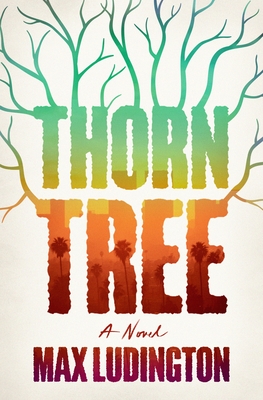
Thorn Tree by Max Ludington

<img src=”book cover” alt=”book cover” width=”187″ height=”300″ align=”left” hspace=”10″ vspace=”10″>

At the base level it’s fear. It’s all about fear. People ask, ‘What are you afraid of?’ and that is not an answerable question. Any time I name a source for my fear I feel it as a deflection. I mean, sure, I can get close. You know, as in: I’m afraid of people because someone I trusted fucked with me when I was a child. I was traumatized, yes, and the fear probably began there, I guess. But I don’t really know because it seems, now, somehow elemental. It embodies some ancient, sleeping doom, and the only escape is self-destruction. You know? Like, if I become my own doom I’ve taken that power away from anything else. It’s preemptive. At least there’s agency in it.”
She felt the laughter spill out of her in a rush. Its piercing volume was at odds with the moment and the release it brought. Leo looked at her dumbfounded.
“Get the fuck out of my head, man,” Celia said.

He had merely done what men had been doing since the primeval birth of jealousy. Just a spoon of love from my forty-five, save you from another man. Howlin’ Wolf was just singing about what thousands had wished they could do, and probably had done, before there were cops and laws and all the rest of the arbitrary bullshit. And it had felt good, hadn’t it?

Daniel is 68, living a quiet life in a Hollywood Hills guest house when a visitor repeatedly appears. Dean is six years old and clearly in need of companionship. He lives with his grandfather, Jack, on the larger house on the property. Jack is not always particularly attentive. And Mom, Celia, is a rising young actress who is often away on prolonged shoots. Daniel is happy for the company.

description
Max Ludington – image from Macmillan – shot by Jennifer Silverman

The novel braids the stories of Jack, Daniel and Celia, mostly Jack and Daniel. The story takes place in multiple times, today being 2017, and the backstory stepping up from 1968 to the seventies, to 1980, and 1988. Celia is not a part of the earlier events.

The sixties events cast a light on a turbulent time, touching on many of the aspects one might expect, young love, drug-dealing, acid trips, communes, San Francisco, wth a very dodgy cult among them. But despite the surface level, there is also consideration of the sort of existential, philosophical searching that was, for many, an important part of those times.

Young Daniel (1960s) makes a youthful mistake and suffers a grievous wrong, which follows him all his life. In the 1970s he finds solace in the desert, constructing a significant work of art, the Thorn Tree of the title. It gets him some notice, gives him a way to express what is inside him, and leads to some stability in his life.

Celia did an image search for the sculpture, and there it was, standing next to the modern art museum, taller than the building itself. It was huge, with thick, meandering branches and bristling snakelike twigs. Most of the branches, while not attempting verisimilitude, were formed with inherently natural shapes and gnarled twists, but here and there some were deliberately hewn into shapes that could never have occurred in nature: curving double on themselves and then back again to form tight willowy S-shapes, or turning straight downward at acute angles for a foot or two before continuing up and outward, as if infused genetically with lightning.

Jack is a very different sort. A predator, a sociopath or something like it, Jack wants what he wants and is not much concerned about who he damages to get it. He is routinely unkind, and worse, but he is also a seeker of truth, becoming connected with a cult and seriously mulling the writings on which the cult bases its outlook, even if the tenets of that group serve to bolster his own self-justification.

Daniel and Jack are linked through these years, the source of that link being one of the mysteries of the book. Jack is definitely a dark force. Daniel exists on a brighter side, despite having made some bad choices. He is a character who grows. But while Jack grows in a way, his widened view of reality is ultimately redirected to his narcissism. Not much is really done with Celia.

There is some lyrical writing which gives the story texture, depth to the two main characters, which makes it engaging, and a look at the times, both 60s and 70s, which gives it some substance. In addition it considers repercussions throughout one’s lives of actions taken in our youth.

Daniel stood for a moment at the threshold of the branches and looked up. The wind was made louder here in contact with the tree. The gravel path went around the south side, and he followed it to where it ended at an overlook. There was a plaque on a post, but he didn’t read it. Instead of standing at the overlook and staring out to sea, as the landscape designer had intended, he turned and went in under the branches, and immediately the world of the tree took over. He was surprised—he’d thought his memory of it was hopelessly colored by LSD and shock and time, that he had probably falsely mythologized every aspect of it and it would be just a place, with soil and roots and air but not the indwelling spirit he’d imbued it with in his mind. But it was as it had been—the wind quieting and the light clarifying, damping the sun into deep greenness—inhabited by a sense of protection and safety unchanged by the years of foot traffic and human attention.

There are many more of this sort. The voice is omniscient narrator, which presents way too many opportunities to tell rather than show. But I doubt this will bother most readers. Some characters come and go, seeming to be throw-aways. It is one of the things that make the book feel over-long. I kept hoping that some of these might be given a deeper look, with Jack getting less.

The alternating timelines, a fairly typical literary device, made sense to me. The Grateful Dead offer a link between now and then. There seemed some interest in other literary devices. For example, a boy appears to have a magical relationship with birds, but the image drops after partial usage.

Thorn Tree is an interesting read, offering some substance, interesting characters, and a strong core mystery. But for a book that is not overlong, at about four hundred pages, it felt like a much longer read because of the excess attention paid to Jack, and some tangential tales. The descriptive writing (I am a sucker for that) gives one a reason to push through, however prickly the passage.

Review posted – 11/01/24

Publication date – 4/15/24

I received an ARE of Thorn Tree from St. Martin’s Press in return for a fair review. Thanks, folks, and thanks to NetGalley for facilitating.

This review is cross-posted on Goodreads. Stop by and say Hi!

=======================================EXTRA STUFF

Links to Ludington’s personal, Goodreads, and Twitter pages

Profile – from Macmillan

MAX LUDINGTON’s first novel, Tiger in a Trance, was a New York Times Notable book, and his fiction has appeared in Tin House, Meridian, HOW Journal, Outerbridge, and On the Rocks: the KGB Bar Fiction Reader. He lives in Brooklyn, New York and teaches in the writing department at Pratt Institute.

Interview
—–The Palisades Newsletter – Max Ludington Reflects on His Second Novel, THORN TREE

Song
—–The Doors – Five To One
—–The Grateful Dead – The Very Best of the Grateful Dead

Leave a comment

Filed under California, Fiction, Historical Fiction, Literary Fiction, Reviews

If Something Happens to Me by Alex Finlay

book coverNo family is without its secrets.

Ryan Richardson had been pining for Alison Lane (Ali) for years. They have known each other since 9th grade, and cared for each other for a long time. They will be leaving for different colleges soon. Their special night is interrupted by rain. Back to her father’s BMW, it was looking like Paradise by the Dashboard Lights would finally become a reality, two teens parked in a Lover’s Lane in Leavenworth, Kansas. Alison does not hit him with an I gotta know right now, but they are this close to heaven when the car door is ripped open. Ryan takes a heavy blow to the head, and comes to on the wet grass. The car, and Ali are gone.

description
Alex Finlay – image from Amazon

We meet Ryan again, the presumed perp, five years later, long suspected of and hassled about that night. Ali has not been heard from. On vacation in Tuscany, his father notifies him that the missing BMW has been found. As if that is not enough, he receives a note in his hotel room from a mysterious stranger, demanding a meeting, and the game is afoot, sending Ryan on a quest to find out the truth of what had really happened that terrible night.

Poppy McGee is late of the military, an MP, having earned her discharge by standing up for herself in a suitable fashion. She had hoped for a gig on the federal level, FBI maybe, but finds herself stuck, instead, in Leavenworth, Kansas, her home town. Her father’s friend, Sheriff Ken, had offered her a safe landing. Deputy Sheriff McGee soon finds herself up to her neck in the five-year-old disappearance. Way to begin!

Shane O’Leary is a very bad man, a Philadelphia gangster with few qualms about the occasional homicide. We soon learn of his involvement in everything;

These three will twirl around each other for the rest of the book, with chapters alternating among them, as each pursues a goal.

Poppy and Ryan are appealing characters, finding a way forward after having faced some serious challenges. O’Leary has a bit of appeal from his love of family. But really, he is a straight up monster.

Finlay offers us a range of venues, from the small city (under 40k pop.) of Leavenworth to the metropolis of Philadelphia, from Tuscany to a small hamlet in the UK to Paris.

I had never done, really, a European setting and so it is set part in Kansas. I thought a contrast for that would be Ryan on this trip in Italy. It starts with me having a trip in Italy when I was finishing the book What Have We Done?. I always thought this would be a cool setting. And then I finished the novel in Paris, so I naturally wanted to weave that into the story, which I did. And while I was in Paris for this extended period where I had gone just to finish the book, my wife and I went to this small village I had lived in in the UK as a boy. I hadn’t been back in forty years…so that was in the book as well. It was personal travel that inspired settings, but also just things that had stuck with me for forty years. – from the promo

The secondary characters are given sufficient attention, adding depth to the characterization of the primary three. And Finlay has done a wonderful job of giving several of them explanatory, if not exactly exculpatory, three-dimensionality.

Poppy, in particular, confronts frenemy, Agent Fincher, a fed, who wants Poppy to share details on the investigation. She offers up some details of her own, but leaves us wondering if she is for real.

The agent sits there appraising Poppy, watches her eat. Eventually, she says, “Are you familiar with Russian folklore, Deputy Sheriff McGee?”
This is too much. Poppy gives the agent a lazy-eyed stare. “Do I look like I’m familiar with Russian folklore?”
Agent Fincher allows herself a smile. “In Russian folklore there’s someone called the Holy Fool.”
The woman is an oddball or genius, Poppy can’t tell which. It’s possible her schtick is just a tactic to get Poppy to talk.
“The Holy Fool is an outsider—sometimes an eccentric, sometimes crazy, sometimes just a child. But it’s their outsider status that makes them a truth teller.”
“I’m not sure where this is—”
“You heard of the story ‘The Emperor’s New Clothes’?”
What the hell, Poppy decides to bite. “The story about the emperor who’s told he has a magical outfit and everyone plays along even though he’s naked?”
Agent Fincher snaps her fingers. “Everyone except a little boy. He’s a Holy Fool—someone who’s free to state the truth.”
“What’s this have to do with anything?”
“Oh . . . I don’t know. After you punched your commanding officer in the nose, I was hoping you were one.”
“One what?” Poppy asks.
“A Holy Fool.”
Poppy shakes her head. This lady’s been looking into Poppy’s background. Following her. What’s her deal?
“In real life, our Holy Fools are whistle-blowers. People willing to sacrifice loyalty to their job or other institution to expose the truth.”

So, should Poppy trust this person or not?

Many novels offer a thing called payload. What did you learn? This is a look at some real-world thing, how certain activities are carried out, the details of philatelic theft, how drugs are transported, how money is laundered, how even benign activities are undertaken. Although there is a bit of this in looking at how O‘Leary launders his income, this was an area in which the book was lacking. While that mote of depth was absent, this will take nothing away from the pace or fun of the book.

If Something Happens to Me is a tale of murder, bullying, REVENGE, passion, and a core mystery (why was Ali kidnapped?) that explains it all. It will keep you guessing and flipping those pages. The only thing that will happen to you on reading Finlay’s latest is that warm, filling feeling of having just read a very satisfying thriller.

Review posted – 10/11/24

Publication date – 5/28/24

I received a ePub ARE and a hard copy of If Something Happens to Me from Minotaur in return for a fair review. Thanks, folks, and thanks to NetGalley for facilitating.

This review is cross-posted on Goodreads. Stop by and say Hi!

=======================================EXTRA STUFF

Links to Finlay’s personal, FB, and Instagram pages

Profile – From the author’s real-name website

Anthony Franze is a critically acclaimed novelist with St. Martin’s Press, and a lawyer in the Appellate & Supreme Court practice of a prominent Washington, D.C. law firm.
For more than a decade, Anthony was an adjunct professor of law teaching courses in Federal Courts, Legal Rhetoric, and Appellate Practice, and he currently participates in a European faculty exchange program where he teaches at law schools abroad.
He writes legal thrillers under his own name, including THE LAST JUSTICE (2012), THE ADVOCATE’S DAUGHTER (2016), and THE OUTSIDER (2017) He writes commercial fiction under a pen name, [Alex Finley] and his 2021 novel was an Indie Next pick, a LibraryReads selection, an Amazon Editor’s Best Thriller, as well as a CNN, Newsweek, E!, BuzzFeed, Business Week, Goodreads, Parade, PopSugar, and Reader’s Digest best or most anticipated thriller of the year. His work has been translated into more than a dozen languages and optioned for television and film.

Interviews
—–Authors on the Air – Alex Finlay — If Something Happens to Me – by James L’Etoile – video – 20:48
—–The Poisoned Pen Bookstore – Alex Finlay discusses If Something Bad Happens to Me by Barbara Peters – video – 52:15

My review of Finlay’s prior book
—–2023 – What Have We Done

Items of Interest from the author
—–Promo
—–Google Play Books – Audiobook preview – 16:05

Leave a comment

Filed under Fiction, Mystery, Reviews, Suspense, Thriller

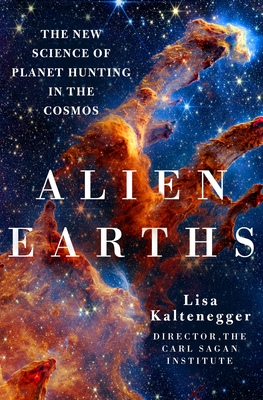
Alien Earths by Lisa Kaltenegger

book cover

Before I started searching for life in the cosmos, I just assumed scientists knew how it started on Earth. We don’t.

…it is sobering to realize that for most of Earth’s history, humans would not have been able to survive on this planet. If we could rewind Earth’s history and start again, it seems unlikely that Earth would produce humans again. A planet with different starting conditions and paths of evolution has no obligation to support life similar to Earth’s, let alone curious humans.

The truth is out there.

Are we alone in the cosmos? The question should have an obvious answer: yes or no. But once you try to find life somewhere else, you realize it is not so straightforward.

At least until the age of permanent haze across the planet, we have always had the stars in our consciousness. Since the second century AD we have had stories about alien worlds. Since Galileo we have been able to see other worlds in the cosmos. A 1792 novel by Voltaire tells of an alien encounter. Concern about extraterrestrial locales has been a part of human consciousness ever since. The concern is certainly fed by the history of strange human invaders helping themselves to land distant from their home soil.

description
Lisa Kaltenegger – image from The Guardian – shot by Naomi Haussmann/The Observer

The interest in things alien certainly kicked up in the twentieth century. Many of us grew up in the space age, witness to the first “Beep-Beep” from orbit, the first peopled orbiters, rapt in front of our televisions when mankind first set foot on the moon. Part of this experience is to be awash in the science fiction of our own and earlier ages, dreaming of strange other-world societies, fearful of invasion, eager to learn the lessons of advanced technology. Some were even impressed and excited enough by the technology and the optimism of the age to begin college careers with the dream of becoming aeronautical engineers, and designing some of the hardware of the future.

description
Earthrise – image from Wikipedia

But so much of this was based on fantasy, (including that engineering thing) limited to imagining what might exist out there. Even the early observations of other planets in the solar system generated fantasies in addition to scientific elucidation. But in 1995 scientists discovered the first two exoplanets, and new discoveries are now a nearly daily event. Today, because of the major advances that we have made in telescope technology, we are able to see to the far ends of the universe. Enter Lisa Kaltenegger, founder and head of the Carl Sagan Institute at Cornell University

I spend my days trying to figure out how to find life on alien worlds, working with teams of tenacious scientists who, with much creativity and enthusiasm and, often, little sleep but lots of coffee, are building the uniquely specialized toolkit for our search.

In studying what we have seen, it has become possible to detect stars that have planets around them. In fact, most stars have company. The way this is detected is to measure “wobble” in the light being observed from distant places. As if you were looking at a bright light and someone threw a ball across your field of view. The measured light would change and you could tell that something had been there. Keep looking to see if it repeats. If it does, then you probably have a planet orbiting that star. (or an annoying neighbor tossing something back and forth in front of you) Keep pointing the James Webb Space Telescope (the state of the art in telescopy today) to more and more locations in space. And discover more and more planets.

description
Jupiter – image from Exoplanet Travel Bureau – NASA

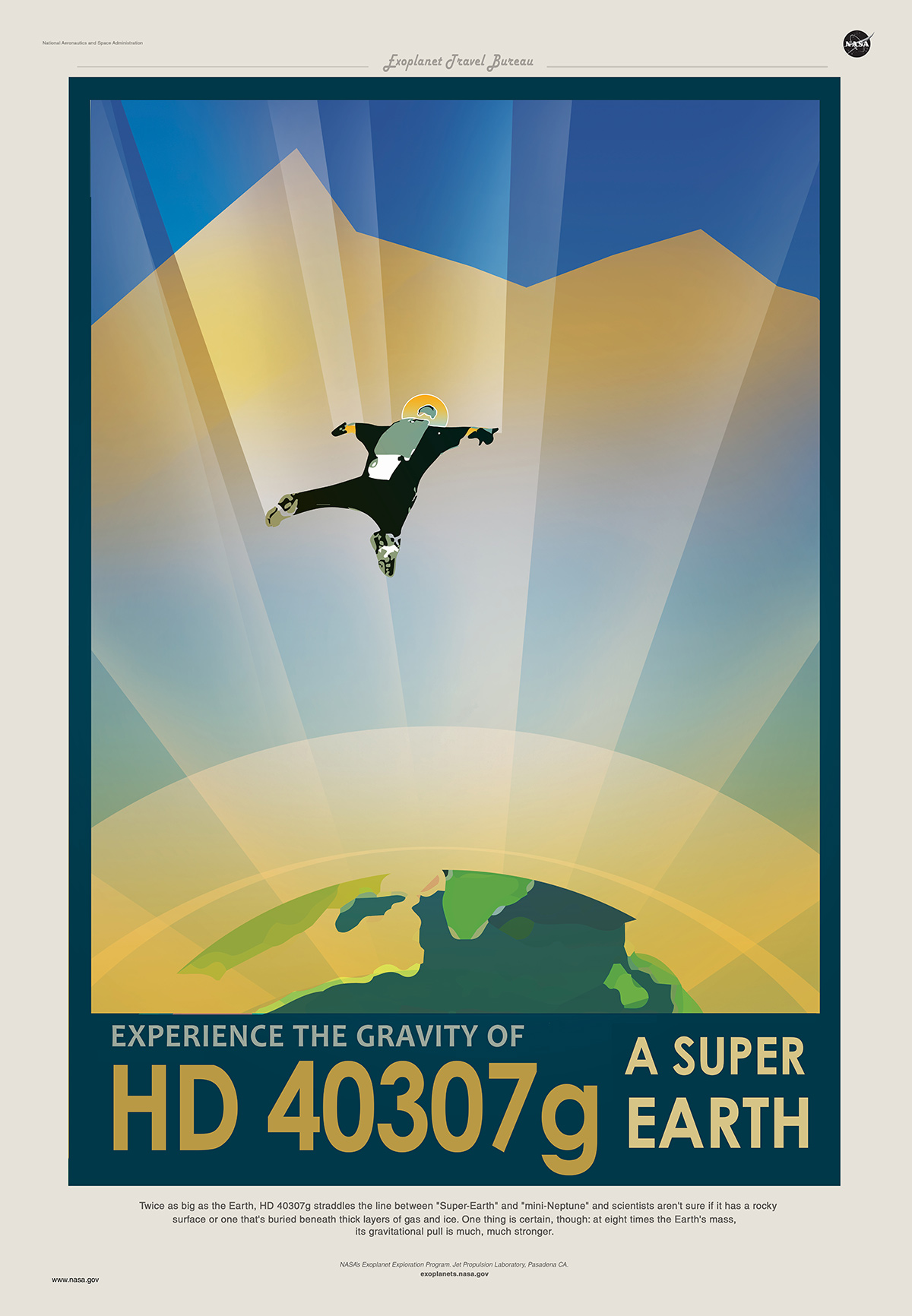
Kaltenegger has been looking into the reality of other worlds her entire career, and in doing so, has advanced our knowledge base considerably. She begins this book with a brief visit to an other planet, one that is very different from ours, a star-facing world that has portions in eternal day, night, and dusk, and local life adapted to the local venues, just to get things started on what we might expect out there, just to challenge our assumptions.

description
HD 40307g – A Super Earth – image from Exoplanet Travel Bureau – NASA

She follows with a history of Mother Earth, noting major stops along the evolution of our favorite place. She notes how life might have formed, when, and how that event altered the atmosphere and even the color of our atmosphere. The sequence is important, as her discussion of our exoplanet dreams demonstrates that we are a prisoner of time. What we see with our telescopes (and eyes) arrived here on light, and light must travel at or below the universal speed limit. (a leisurely 186,282 miles per second) So, whatever we see from even a nearby star/planet system originated tens or hundreds of years go, or even billions for our more distant neighbors. Anything residents of out there might have seen of us (really only since we started sending signals into the ether maybe a hundred years ago) is quite dated relative to who and what we are today. Absent the invention of a Warp Drive of some sort, we are doomed to be always too far away in years and miles from other intelligent species. Well, maybe.

description
Venus – image from Exoplanet Travel Bureau – NASA

It is possible, I suppose, for a civilization with massive resources to send a desperate one-way mission to save their species from hundreds of light years away. It is unlikely that any visitors from such distant realms would be making reports home. But this need not necessarily apply to all possible visitors. It appears that there are plenty of possible planets within a few light years of us that might present some interplanetary possibilities.

description
Mars – image from Exoplanet Travel Bureau – NASA

Kaltenegger delves into the nearer-earth planets, looks at their characteristics, and offers explanations as to their suitability for life. She looks at probable communication issues should we ever come across an ET, suggesting it might be the equivalent of humans attempting to communicate with a jellyfish

description
Grand Tour – image from Exoplanet Travel Bureau – NASA

Kaltenegger and her team design computer simulations, based on the hard work of examining concrete materials, inert and biologic, and putting that intel into a database. Check the signature spectrum of every new world and compare it with the growing list of catalogued items.

Today, solving the puzzle of these new worlds requires using a wide range of tools like cultivating colorful biota in my biology lab, melting and tracing the glow from tiny lava worlds in my geology lab, developing strings of codes on my computer, and reaching back into the long history of Earth’s evolution for clues on what to search for. With our own Earth as our laboratory, we can test new ideas and counter challenges with data, inspired curiosity, and vision. This interaction between radiant photons, swirling gas, clouds, and dynamic surfaces driven by the strings of code within my computer, creates a symphony of possible worlds—some vibrant with a vast diversity of life, others desolate and barren.

She notes the core need of life-sustaining planets is to be rocky. Sorry, Jupiter, no gas giants need apply (but their moons might). They also need to be within a certain range of the stars they circle, the so-called “Goldilocks Zone,” not so close as to be too hot nor so distant as to be too cold, and they need to show the presence of key life-sustaining elements.

description
Europa – image from Exoplanet Travel Bureau – NASA

Kaltenegger offers readers info on some topics likely to be new to most of us, Stellar Corpses, for example, warm ice, the Fermi Paradox, the Drake Equation, the Great Silence, tardigraves, and plenty more. All of these are explained clearly and simply. It is as if the author is telling us: This is what we have learned. This is what we expect. This is how we go about gathering information, fusing our fields of expertise, learning more, solving the mysteries that the data present. This is our understanding of what is possible. This is our plan for looking further and farther.

description
Trappist – image from Exoplanet Travel Bureau – NASA

Alien Earths may not point to an actual catalog of life-sustaining exoplanets, but it does offer an accessible pop-science portrait of the current state of the art in the search. This galactic age of exploration has been ongoing for some time, getting a jolt from the discovery of other worlds. It has advanced to where we are now looking for (and expecting to find) evidence of life on other planets. It is likely that what we find will be pretty basic, single-cell critters, maybe even plant life. And it will probably take a good long time before we can move up to the final phase of the game, finding intelligent life. The time scale for any potential interaction is likely to be considerable, but who knows? The universe is full of surprises among its billions and billions of stars.

So far, despite wild claims to the contrary, we have not found any definitive proof of life on other planets. Until we do, we will continue to improve our toolkit and look for signs of alien life the hard way: searching planet by planet and moon by moon.

Review posted – 09/27/24

Publication date – 04/16/24

I received an ARE of Alien Earths from St. Martin’s Press in return for a fair review. Thanks, folks, and thanks to NetGalley for facilitating.

This review is cross-posted on Goodreads. Stop by and say Hi!

=======================================EXTRA STUFF

Links to the author’s personal, FB, Instagram, and Twitter pages

Interviews
—–We live in a golden time of exploration’: astronomer Lisa Kaltenegger on the hunt for signs of extraterrestrial life by Emma Beddington
—–Chris Evans Breakfast Show – Lisa Kaltenegger: Is There Alien Life? – Video – 25:39
—–StarTalk – Distant Aliens and Space Dinosaurs – with Neil DeGrasse Tyson – audio – 50:03
—–StarTalk – Astrophysicists Discuss Whether JWST Discovered Alien Exoplanets – Neil DeGrasse Tyson – video – 48:58

Item of Interest from the author
—–Lisa Kaltenegger. On Looking for Signs of life – Video – 10:36

Items of Interest
—–NASA – Jet Propulsion Laboratory – Visions of the Future
—–The Carl Sagan Institute
—–Unilad.com – NASA discovered -planet bigger than Earth with a ‘gas that is only produced by life’

Song
—–Monty Python’s Galaxy Song

Leave a comment

Filed under History, Non-fiction, Reviews, Science and Nature

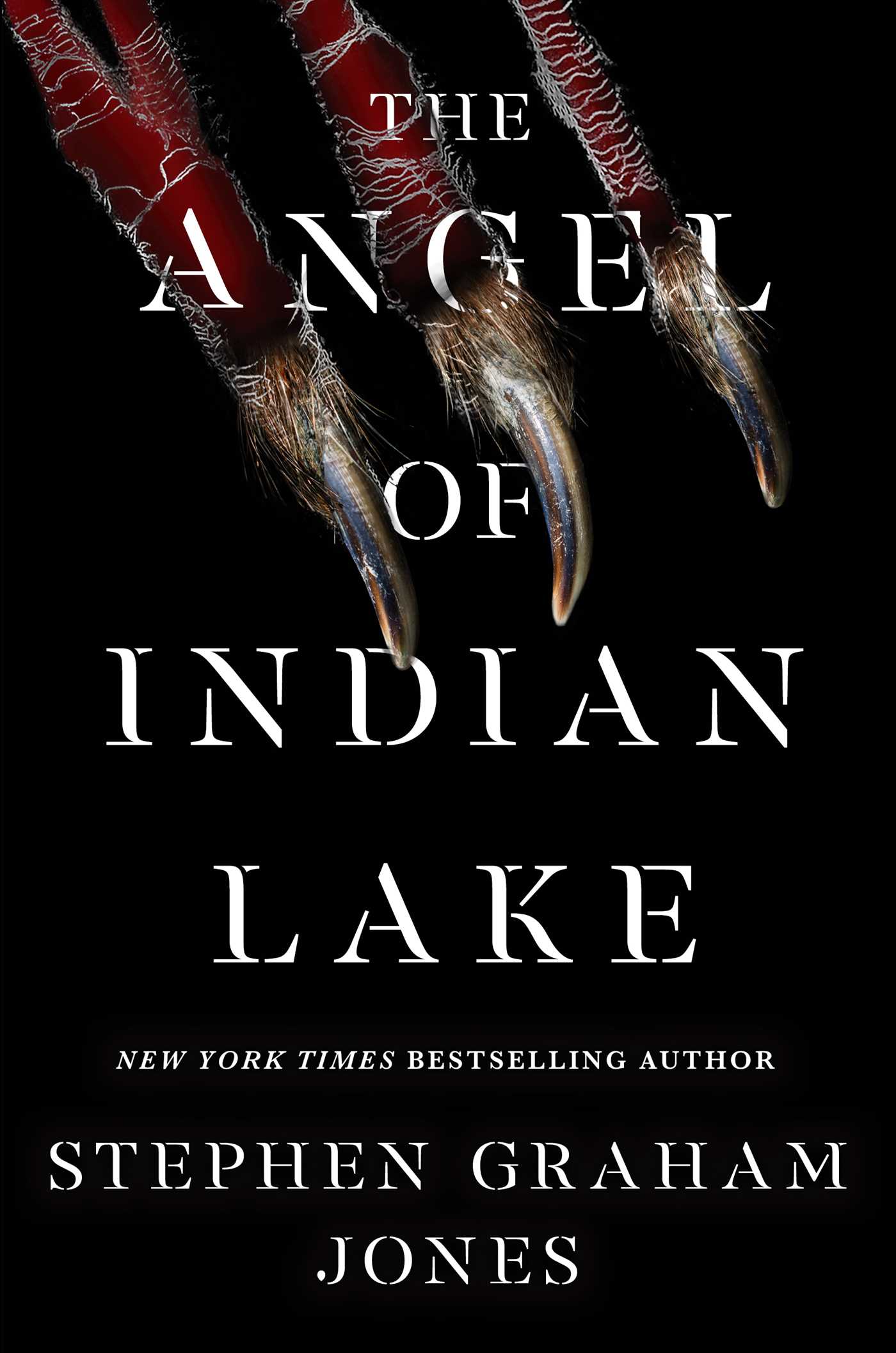
The Angel of Indian Lake (The Indian Lake Trilogy, #3) by Stephen Graham Jones

book cover

Her husband died in the water in 2015, and her son was suffocated with a dry-cleaning bag in 2019.
And now she’s got a chainsaw.

…this is maybe the one thing I believe in in the whole world: that when it’s your time, you don’t run from it—you stand against it, you keep your eyes open, and you rip and claw your whole way down, hope you can at least be a worthy trophy.

Don’t even try to read this unless you have been through Volumes #1 and #2 of the series. There is a lot going on in volume #3. Strap in.

description
Stephen Graham Jones – image from Library Journal

Seventeen in what is now called The Independence Day Massacre, having served undeserved time after the most recent mass slaughter, centered on Dead Mill South, now twenty-four, Jade Daniels is back in town. Did her time. Paid her debt to society and has a job as the history teacher in the local school. Her wealthy bff Letha Mondragon’s sponsorship may have something to do with that. She carries scars both physical and emotional from her tribulations in the first two novels of the trilogy. And plenty from before even that.

…you know the first one is third person of course, but it’s really tight on Jade. I think when people remember My Heart is a Chainsaw, they always say Jade is a narrator, and that’s always weird to me because she’s like our narrative focus, but she’s not actually the one speaking except for in her “Slasher 101” essays. Then when I figured out I was going to do a sequel and then a trilogy, I realized I’ve got to modulate the delivery throughout these three books.
So what I landed on for doing that was in the second one, it’s going to shatter and splinter into a multivocal thing with a lot of people speaking in Reaper, and a lot of people’s angles. To me, that was kind of set up for missing Jade. Like “This is fun, but I wish we had Jade.” So then in the third one, if I were able to, instead of only letting her speak during the [essays], if the main part of the narrative became her voice, then I was hoping that could feel like a return a little bit. Or it could just be as simple as I knew I was having to say goodbye to Jade and I wanted to hang out with her more. And how better to hang out with her than first person?
– from the Paste interview

She is our Virgil through the rings of Proofrock hell.We get the take of the ultimate final girl, (although she does not see herself that way) as she tries to figure out what is going on, as the bodycount rises. As part of that we hear her talk with her much-admired, and quite dead, history teacher, Mister Holmes. We are given access to the weekly sessions with her state-mandated shrink, Sharona, in which they both wear ghostface masks and sit on a swing set, as one does. In addition, we are treated to reports from a seemingly omniscient security agency tracking Jade’s every word and action.

A dad makes the mistake of hanging out in the local school’s hug-n-go lane, as it turns out to be more of a hug-n-get-decapitated lane. More heads will roll. Kids using VCR tech to produce a piece charmingly titled The Savage History of Proofrock, Idaho are lured to a discovery their friend had made, some long-lost victims. Another student makes use of drone tech to support a documentary, turning up some very interesting shots. Fiction soon gives way to fact. And, oh, there are footprints extending from a grave, which is very suggestive. (although odd only in that the risen dead emerged from a grave and not a lake) Speaking of graves, they play a significant role throughout the tale, as Jade visits her favorite late residents with some frequency. There is another graveyard commemorating a particular sub-set of the lost. And an unwanted commercial repurposing of land considered hallowed.

description
Devery Jacobs – image from Vanity Fair. SGJ could see her playing you-know-who.

There are enough bloodbaths in this town that someone could make a killing by opening a place called ProofBaaden, offering free towels, and wet places in which people could conduct unpleasant business.

There are forest fires, herds of panic-stricken animals, a mad recluse set on avenging the loss of his wife, and evil dead who will enlist a host to their ranks. There are many ends, loose and otherwise, that need to be tied up in this 465 page novel. There are murder mysteries to be solved and cold cases to be made warm, including the biggest mystery of them all, What the hell is all this killing about?

There are many substantive elements that poke their heads up from among the carnage. SGJ pays homage to the slasher genre. Jade is not the only character who sees life through the slasher-mask perspective of an afficionado. Appreciators of the form will find plenty to cheer for here.

The third installment of a trilogy always has to up the stakes and kill people we thought couldn’t die. I knew this going in, knew I’d have to do all that. In Chainsaw, Jade was fighting for herself. In Reaper, she was fighting for her friends, for this family she’d cobbled together. In Angel, she’s having to fight for her community—for Proofrock. And of course I had to adhere to Randy’s rules for the third in a trilogy, too. They were very helpful. This is my first time doing this, I mean. I needed a lot of help. – from the Nerd Daily interview

Class comes in for a look, as those who enjoy the advantages of those means are also responsible for much of the destruction that takes place in Proofrock. There is also a very feminist tilt here, as the final girl has always been a hero, but the baddies take on the feminine form as well. There is also an ongoing struggle of ill-treated women fighting back against their abusers. And there is a final twist that will resonate, culturally.

For many, there is pleasure to be had in recognizing the references, the many, many references to slasher films. There might actually be references to every slasher film. While I have seen a fair number of these, I am by no means a maven. This made it a bit of a challenge appreciating the shout-outs in the book without having to constantly google the titles, not to mention the stand-alone character citations.

The pleasure of this book is traveling along with Jade as she tries not only to survive but to get to the bottom of the entire unholy business, while saving her community. No dead ends here. Final girls rule, whether or not they survive.

…justice doesn’t extract itself, you’ve got to pull it bloody and pulsing from the chest of whoever wronged you.

Review posted – 08/30/24

Publication date – 3/06/24

Next up from SGJ is The Buffalo Hunter Hunter, due out March 2025

I received an ARE of The Angel of Indian Lake from S&S/Saga/Press in return for a fair review. Thanks, folks, and thanks to NetGalley for facilitating.

This review is cross-posted on Goodreads. Stop by and say Hi!

=======================================EXTRA STUFF

Links to Jones’s personal, Twitter and FB pages

Interviews
—–Paste – Stephen Graham Jones on The Angel of Indian Lake, Slasher Tropes, and Saying Goodbye to Jade Daniels by Matthew Jackson
—–Cemetery Dance- The Cemetery Dance Interview: Stephen Graham Jones by Cabriel Hart
—–Nerd Daily – Q&A: Stephen Graham Jones, Author of ‘The Angel of Indian Lake’ by Elise Dumpleton
—–Library Journal – LJ Talks to Horror Writer Stephen Graham Jones, Author of ‘Don’t Fear the Reaper’ by Becky Spratford – From 2022, but fascinating, by Becky Spratford
—–Off Book – Off Book: Stephen Graham Jones – video – 14:58 – at 6:45

There’s probably 12-14 beats of the slasher. You got to have the opening blood sacrifice. You got t have the red herrings, you’ve got to have the third rail body dumps. You’ve got to its like you’re going around a carousel and reaching out and hitting 12 or 14 bells as you go around. You got t hit all those bells for sure. But what I think makes a really good slasher movie is if you’re doing a revenge slasher of a mystery slasher, I guess they get called both, delaying knowledge of who the slasher is. That’s the most pleasurable, such that everything crashes to a head at the reveal when the person pulls their mask off and gives their big speech about I did this because you did this to me, or whatever it is.

My reviews of (sadly, only four) previous books by Jones
—–2023 – Don’t Fear the Reaper -The Indian Lake Trilogy #2
—–2021 – My Heart is a Chainsaw -The Indian Lake Trilogy #1on Coot’s Reviews
—–2020 – The Only Good Indians
—–2016 – Mongrels

Item of Interest from the author
—–CrimeReads – Excerpt

Item of Interest
—–ScreenRant – Randy’s Rules

The rules in Scream are a basic set to survive any horror film: you can never have sex, you can never drink or do drugs, and never (ever, under any circumstances) say “I’ll be right back”. Ironically, Randy explains these rules during a party, with half the attendees already drunk. Still, they hold some truth: Sidney has sex with Billy, and although she’s later attacked, it’s Billy the one who ultimately dies. Tatum (Rose McGowan) goes to the basement to get more beers and is killed there, and Stu says “I’ll be right back” right after Randy explains the rules, and is later killed (albeit in self-defense) by Sidney. In Scream 2, the rules for a horror sequel are: the body count is always bigger, the death scenes are more elaborate (“more blood, more gore”), and the third rule is not explained in the final cut, although it was revealed in the teaser trailer to be “never, ever, under any circumstances assume the killer is dead”.

Leave a comment

Filed under Horror, Native Americans, Reviews

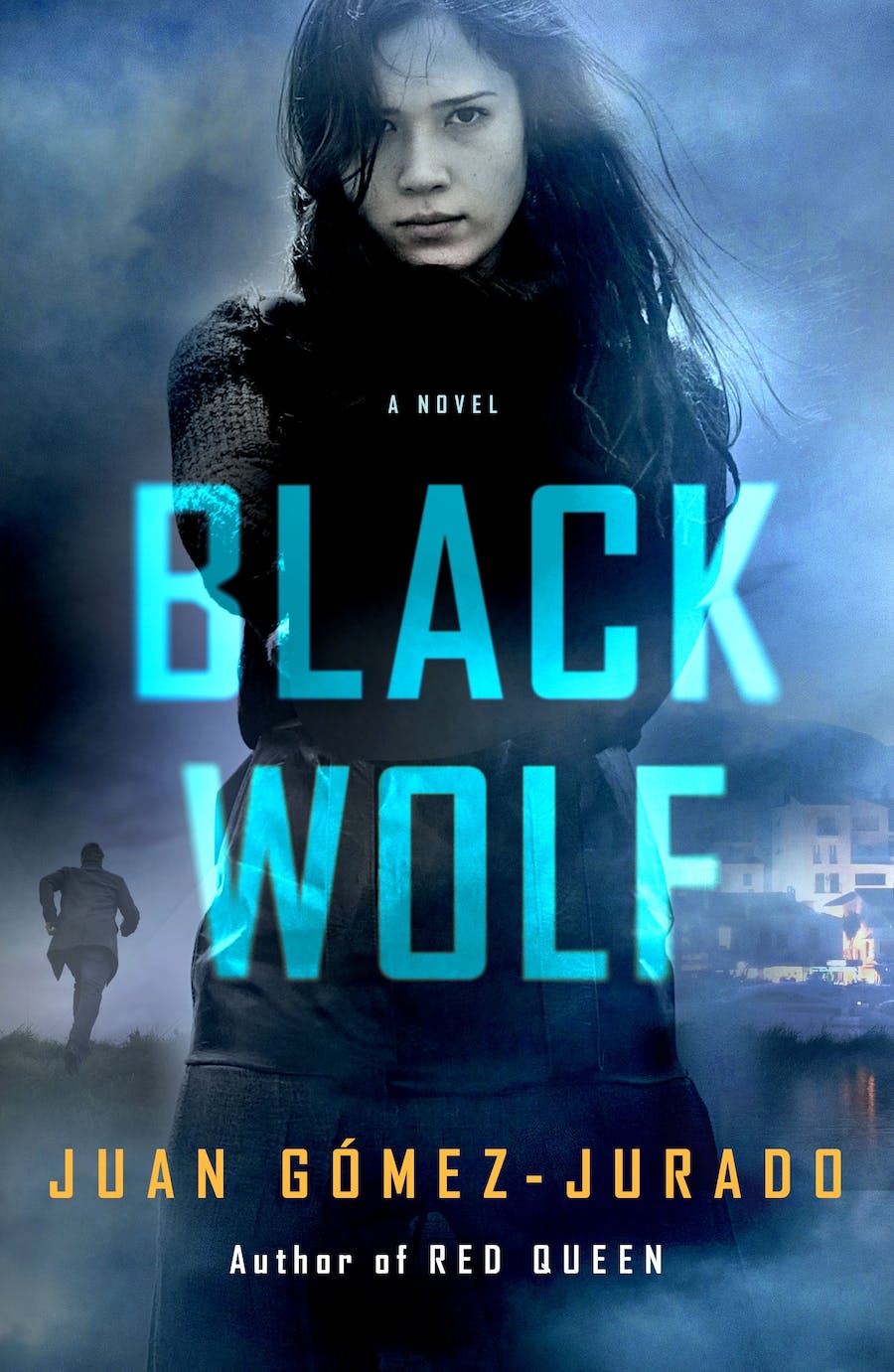
Black Wolf (Antonia Scott, #2) by Juan Gómez-Jurado

book cover

While she may be capable of functioning several levels into the future, her mind is no crystal ball. She may have the ability to visualize dozens of disparate pieces of information simultaneously, but her brain doesn’t work like in those movies where you see a whole string of letters superimposed on the face of the protagonist as they’re thinking.
Antonia Scott’s mind is more like a jungle, a jungle full of monkeys leaping at top speed from vine to vine, carrying things. Many monkeys and many things, swinging past one another in midair, baring their fangs.
Today, the monkeys are carrying dreadful things, and Antonia is afraid.

Antonia is afraid of almost nothing, apart from herself. Afraid of life, maybe. After all, she relaxes by imagining for three minutes every day how she could kill herself.

The Black Wolf is the second in Juan Gómez-Jurado’s Antonia Scott series. If you have not read the first, Red Queen, I would take a break, read that one, then come back. Also, if you have not read the first book in the series, there are some items in this review that might be spoilerish for you. Caveat lector.

Red Queen is a super-secret international anti-crime organization. They specialize in finding and developing a small number of exceptional human beings to become the mental equivalent of super-soldiers, assigned to look into Europe’s worst crimes. Antonia Scott is the Red Queen in Spain. She has an amazing mind, but also some issues, as you might suspect, given the two quotes at the top of this review. She has a pill she takes when it all becomes too much for her. Sometimes she takes too many. Jon Gutierrez is an erstwhile cop from Bilbao who was recruited to assist Antonia with matters of a police sort, and with more baby-sitting types of responsibilities. He is a large man (but not fat) with red hair, and a very good guy. The pair had a nasty adventure in book #1, with a primary villain who remained beyond their reach.

description
Juan Gómez-Jurado – Image from Expansión – photo credit – Luis Malabran

We begin with the extraction of a very water-logged body from a river. Antonia wonders if it might be a major nemesis from the prior book, Sandra Fajardo. She has been on the lookout for this baddie ever since.

The story continues with an assassination attempt at a shopping mall in Marbella, a city on Spain’s southern coast. A mafioso has been killed. His beautiful wife, Lola Moreno, who travels with a bodyguard, is set upon by a professional assassin or two, but the lady has skills, and manages to escape. She will provide one of the two major story lines of the novel. Antonia and Jon are sent to have a look by their boss, the mysterious Mentor, which made me think of M in the Bond novels

We alternate, more or less, between Lola’s flight from henchmen directed by a Russian mafia don, and Antonia’s and Jon’s tracking of clues. This is Antonia’s domain, seeing, or sensing things that others miss. She is somewhere between Sherlock Holmes and Lisbeth Salander of the Millenium series.

There will be blood, unpleasantness with cars, an infuriating discovery, close calls, and twists. We get some backstory on both Lola and Antonia, helping explain how they became who they are.

And then there is a killer, the famed assassin, the Black Wolf, feared even by other professional killers.

description
Vicky Luengo as Antonia and Hovik Keucherian as Jon – image from Amazon UK

Many of the chapters begin with fairy-tale-like recollections. This one is typical.

There was once a little girl who grew up in a sad, loveless home where the food tasted of ashes and the future was black, she tells herself as she waits.

Jorado offers paralleling of characters. For example, the mob boss Orlov with Mentor, and Antonia with the Black Wolf. It is satisfying to see excellent craft like this on display.

He also regularly offers up a collection of interesting foreign words, that describe a particular situation or feeling better than Spanish or English. Here are a couple:

Kegemteraan is in Malay. In Malay it would mean “the joy of stumbling”. The simultaneous feeling of pleasure and grief when you know that you have done something that you shouldn’t.
Curious. You know you are wrong but you keep doing it again and again since it hurts but you also enjoy it.

Bakiginin – In Karelian, a language spoken from the Gulf of Finland to the White Sea, it means “the sadness of a wall builder.” The contrast between the need to keep the world away from your life, and the impossibility of doing so.

Gomez-Jurado did this in the first book in the series. It is a charming element.

description
Alex Brendemühl as Mentor – image from Amazon UK

One thing that irks in tales of this sort is the perpetually stupid local authority. Here the area captain seems to be blaming A&J for the carnage that they are investigating, as if they had somehow caused it. But the author has some fun with this trope, which I will not spoil here.

Antonia’s and Jon’s personal relationships come in for examination, enhancing their appeal, but it is kept to a minimum, so adds color without interfering with the story.

And the story is great fun. A rock’em sock’em thriller, pitting the best mind against the darkest evil, with plenty of conflict, and lots of clues (and some red herrings) to tease you into guesses and theories. Humanizing of (some of) the baddies combines with offering appealing, quirky, leads and a story that speeds along way over the limit. The Black Wolf is an excellent follow-up to Red Queen, leaving one panting for the third entry in the series. That need will be satisfied on March 12, 2025, with the publication in English of The White King. I can hardly wait.

She has a black belt in lying to herself, and only a yellow one in expressing her reality.

Review posted – 07/26/24

Publication date – 3/12/24 – in English
First published in Spain – 10/24/2019

I received an ARE of The Black Wolf from Minotaur in return for a fair review. Thanks, folks, and thanks to NetGalley for facilitating.

<

This review is cross-posted on Goodreads. Stop by and say Hi!

=======================================EXTRA STUFF

Links to Gomez-Jurado’s personal, FB, and Twitter pages

Profile – fromWikipedia

Born in Madrid, Spain on December 16, 1977, Juan Gómez-Jurado, is a Spanish journalist and author. He is a columnist in “La Voz de Galicia” and “ABC”, distributed in Spain, and he participates in multiple radio and TV programs. His books have been translated into 42 languages and he is one of the most successful living Spanish authors, along with Javier Sierra and Carlos Ruiz Zafón. His writing has been described by critics as “energetic and cinematographic”. He worked in various Spanish media outlets, including 40 Principales, Cadena Ser, Cadena Cope, Radio España, Canal + and ABC, before publishing his debut novel, God’s Spy (Espía de Dios) in 200

Interview
—–Radio New Zealand – Spanish author Juan Gomez-Jurado on his best-selling – audio – 23:32 – by Kathryn

My review of Gomez-Jurado’s prior book
—–2023 – Red Queen

Music
—– Joaquín Sabina – 19 Days and 500 Nights – Jon listens to this

Item of Interest
—–Arganzuela Footbridge – appears in Chapter 3

Leave a comment

Filed under Fiction, Mystery, Reviews, Thriller

Hit ‘Em Where It Hurts by Rachel Bitecofer and Aaron Murphy

book cover

The GOP is a threat to your freedom, health, wealth, and safety. If they gain control of the federal government they plan on passing a national abortion ban, gutting Medicare, destroying Obamacare, raising taxes on working families, and stealing a lifetime of YOUR Social Security money.

Partisanship creates a convenient shortcut that low-interest and low-information voters can rely on to make their vote decisions, and it colors our entire perception of the political world.

There are two things that should never be discussed in polite company, religion and politics. Well, presuming you, gentle reader, to be a reasonably polite person…sorry.

Rachel Bitecofer is a PhD in political science and international affairs. In 2017 she wrote The Unprecedented 2016 Presidential Election, a book analyzing the 2016 US elections. She made her reputation by being one of the few political analysts who correctly predicted Biden’s 2020 victory with impressive specificity, and the size of the Blue Wave in 2018. She has come to some conclusions about why Democrats so frequently lose to Republican candidates whose interests are in opposition to those of their constituents. In order for Dems to make inroads with voters, they will have to take some pages from the GOP campaign playbook. Hit ‘Em Where It Hurts lays out what the other side is doing, and extracts from that lessons to be learned to improve outcomes.

description
Rachel Bitecofer – image from The Telegraph – credit Christopher Newport University

What is it that they do? Well, demagoguing issues and playing the politics of division, lying relentlessly and repeating their lies ad nauseum, of course. Not news. But Bitercofer digs into the specifics of how the GOP goes about this. She also offers analysis of voting groups, with an eye to how one engages different populations.

Ordinary people hate losing, or losing out on things we like or think we might like–with more intensity than we like gaining those things. A simpler way to put it is losing makes us feel twice as bad as winning makes us feel good.

Instead of the usual Democratic campaign of demonstrating to voters why a candidate is better able, better prepared, and maybe a better person, Bitecofer urges Dems to engage in impactful criticism of their opponents. Or, why the other candidates will be bad for you, applying the blame of truth not just to the down-ballot candidates, but to the party as a whole. Voters may or may not recall a candidate’s name, but they’re likely to remember how they feel about Rs and Ds. Where I live, for example, it is not just GOP senatorial candidate Dave McCormick who is a terrible person with terrible plans, it is the entire Republican Party. Frankly, it is not a tough case to make. Not to the exclusion, of course, of promoting better ideas and humans, but with maybe a shifting of campaign resources from all positive to more attack-mode.

When, at the 2016 Democratic convention, Michelle Obama first said, “When they go low, we go high,” it was a rousing moment which spoke to people being and becoming their best selves. Good values matter. But from a tactical perspective it is self-defeating. In basketball, these days, it is called undercutting (back when I was a terrible player, it was called low-bridging), when a defender hits an airborne shooter, causing a dangerous crash to the floor. Going high when the opposition is spending millions going low is a surefire way to ensure a broken back or a losing campaign.

There are two things that low information, and low interest voters (and they are legion) rely on in deciding who to vote for. Most important is party affiliation and second is their familiarity with the names of candidates. So, as a rule, a Republican will vote for the Republican on the ticket, regardless of the candidate’s merits. We can, for example, fully expect that, in addition to his core supporters, Donald Trump will receive tens of millions of votes from people who simply do not care about his 34 felony convictions, his attempt to stage a coup, his stealing of classified documents, his relentless lying and his considerable hostility to democracy. Nope. If he’s got an “R” next to his name, he’s our guy. To be fair, there are some Dem voters would vote for a cheese sandwich if it was on the ballot with a “D” next to its name, but I expect fewer than the “R” non-MAGA voters or leaners. Core voters for both parties will support their team.

But there is a middle ground, comprised of voters who lean and the truly unaffiliated, a small number. This is where the battle is engaged. Campaign ads must portray not only the candidate of the opposing party, but the party he/she represents, in a bad, but honest light. And do it relentlessly. She calls this Negative Partisanship. Instead of proclaiming only the virtues of our candidate, we must also portray the darkness of our opposition, something that has worked quite well for Republicans, but which has met with resistance from many Democratic candidates. Also, this should not be limited to the candidate in a given election, but applied across the board to the Republican Party. It is the party that will see to it that our rights and freedoms are pared back, while the rich get richer, not just the candidate. This has the benefit of being a worthy broad brush, as all Republican pols do whatever their Dear Leader wants.

There are barriers to Democrats progressing in political warfare tactics, primarily money. The right has a well-funded, (by billionaire oligarch sorts like the Koch brothers and major corporations like the big oil producers ) well-oiled machine for spreading their message. Think tanks provide academic cover for nonsensical or dark policies. Check out the Heritage Foundation’s Project 2025 for maybe the best example of this, certainly the most alarming, and probably the most dangerous. The American Legislative Exchange Council (ALEC) is a central clearinghouse for the creation of rightist legislation. It is no accident that the same text is used in state bills across the nation. Dems do not have a comparable entity. Neither do we have Fox News, the primary purveyor of political misinformation, even if it does cost them the odd billion dollars or so in court settlements. It is an uneven playing field.

In the absence of that sort of infrastructure, Dems must rely on improving messaging, making it more pointed. When it comes to public policy, the majority of voters side with Democratic positions, on sensible gun control, abortion rights, the inviolability of Social Security and Medicare, and more recently on the need for Obamacare. It is important, Bitecofer says, to point out to voters just what they are in danger of losing, highlighting the differences between Dems and Republicans. What are they trying to take from you? Pretty easy re SS and Medicare, which have huge national constituencies. Republicans are eager to gut both. People are more likely to respond to a campaign that points to Republicans trying to take away your medical choices, your literal freedoms, than they are to a detailed message about how a religious belief should not be made into public policy. How about the safety of your children? Are they likelier to come home from school in one piece if we allow military grade weapons to be bought by just about anyone? Are you ok with schools having to run active-shooter drills? It is not necessary to get into the corruption of the NRA or point out that that organization has become a funnel for Russian money to right-wing politicians. Simplify, show contrasts, and point out potential personal losses.

In most political books the analysis of why we are where we are is all fine and dandy, but what does it mean for addressing it, given that the dark side has, effectively, limitless funding to spread their lies, the mainstream media has shown itself to be highly resistant to calling out liars, and most voters simply do not give a shit? Are we doomed to relentless right-wing propaganda and spin through their pervasive media capture, aided of course by Putin and other foreign allies of American fascists? What can be done to get people to recognize the existential threat posed to our democracy? Turns out there are some things we can do. This is what makes Hit ’Em Where It Hurts different from most political analyses, and a must read for anyone engaged in political campaigns.

This is not unplowed earth in which Bitecofer toils. There have been plenty of books written about political tactics. Rick Wilson’s wonderful 2020 book, Running Against the Devil, offers advice on how to go about campaigning against Trump. One book that stands out the most for me is Saul Alinsky’s look at how to organize a movement for change, a community organizer guide, based on his decades of experience. In the 1970s many progressive and liberal activists studied his now classic 1971 political strategy book, Rules for Radicals. The benefit of these, and surely many other books is that they offer specifics re how to move forward. While Bitecofer’s book differs in focus from Alinsky’s the intention of both works is to show people how to seek and gain power over their own lives through democratic means. Bitecofer’s Hit ‘Em Where it Hurts is a Rules for Radicals for the 21st century. We have already seen some application of her approach in current and recent campaigns, whether inspired by her or someone else. The tactics she espouses have found their way into the real world and we will see in 2024 if candidates are willing to accept her counsel and do what it takes to win. I truly hope that most of them do.

think of all elections, big and small, as battles in a much larger and far more consequential electoral war, whose victors will determine the future of this nation.

Review posted – 07/12/24

Publication date – 02/06/24

This review is cross-posted on Goodreads. Stop by and say Hi!

======================================EXTRA STUFF

Links to the Bitecofer’s personal Substack, Threads, FB, Instagram, and Twitter pages

Profile – from SALT

Senior Fellow, Elections, The Niskanen Center
Rachel Bitecofer is assistant director of the Wason Center for Public Policy at Christopher Newport University, where she teaches classes on political behavior, elections, & political analysis and conducts survey research and elections analysis. Her research has been featured in many media outlets such as The New York Times, The Washington Post, USA Today, NPR, and she is a contracted commentator on CBC Radio. Her book, The Unprecedented 2016 Presidential Election (Palgrave McMillan) is available via Amazon.
Her innovative election forecasting model predicted the 2018 midterms five months before Election Day, far ahead of other forecasting methods. Her forecasting work argues that American elections have become increasingly nationalized and highly predictable; with partisanship serving as an identity-based, dominant vote determinant for all but a small portion of Americans.

Interviews
—–CSPAN – Washington, DC – Prose & Prose bookstoreHit ‘Em Where It Hurts – How to Save Democracy by Beating Republicans at Their Own Game by Adam Parkhomenk – video – 1:04:00
—–Salon – Rachel Bitecofer’s tough-love lesson for Democrats: Time to fight dirty by Paul Rosenberg
—–The Al Franken podcast – Democratic Strategists Rachel Bitecofer and Justin Barasky on Democratic Messaging
– video – 48:00
—–Morning Joe – Democrats Seek to Recreate Midterm Success in 2024
“Roe is a concrete way to show people you have a right and the Republicans stole it from you”

Items of Interest from the author
—–ResearchGate – A list of her publications from January 2018 to January 2023
—–Web site for the book

Item of Interest
—–PoliticalCharge.org – An Elections Specialist You Should Get to Know by Tokyosand

Leave a comment

Filed under Activism, Non-fiction, Reviews

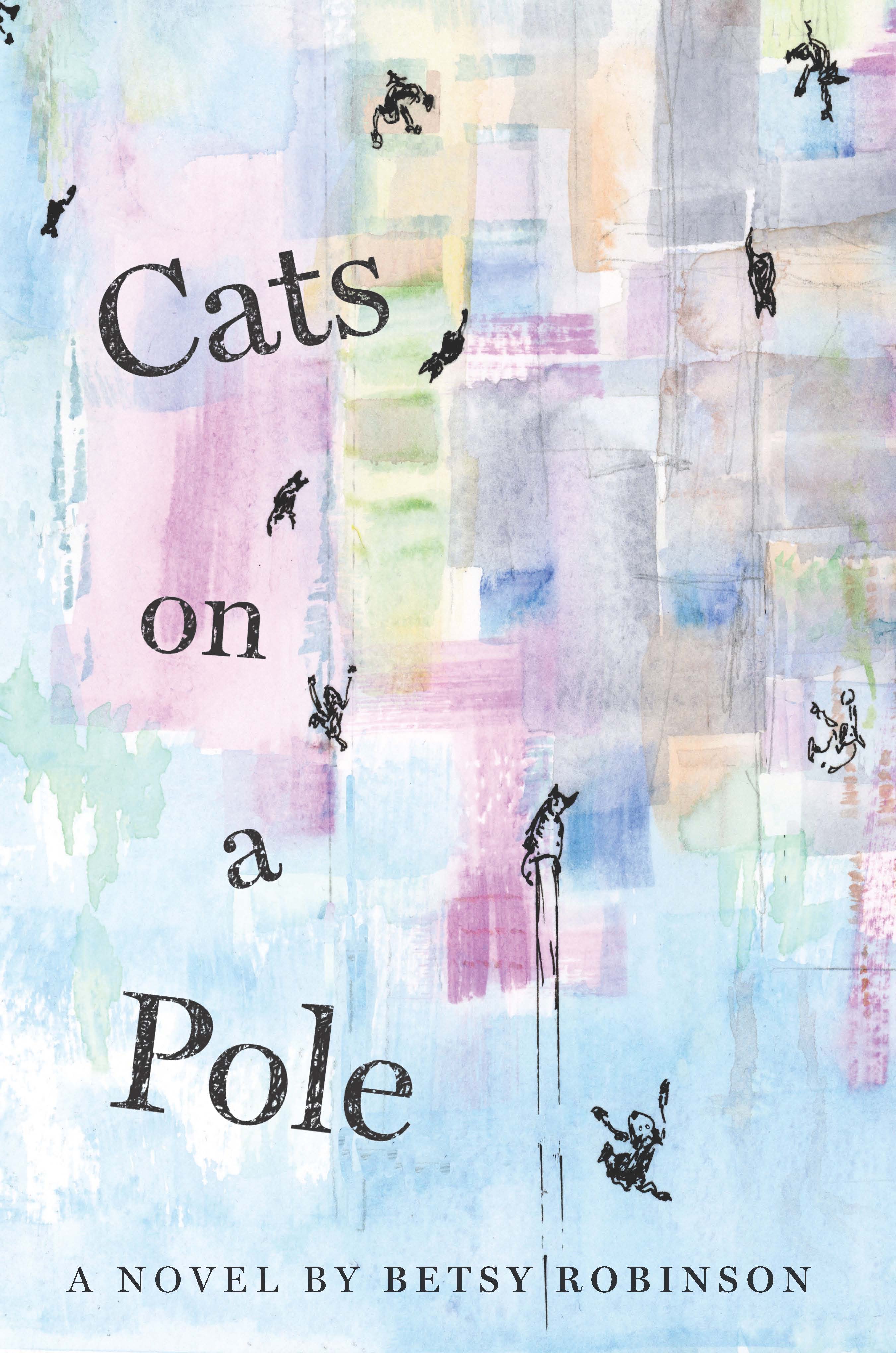
Cats on a Pole by Betsy Robinson

book cover

Harmony thought about cats as she rolled out of bed and staggered to the bathroom. Her favorite cat was the one that used to get stuck on top of a telephone pole in front of the house where she grew up. At least once a month in the warm weather, she’d hear the neighbor kids yelling, “Cat’s on a pole!” as they gathered around to taunt the poor thing.
Harmony would watch the scene from her kitchen window, and a couple of times she tried to thought-talk the cat down. “Are you out of your mind?” the cat would answer. “They’ll kill me.”

When he was forty-three, he met Judy. By then, construction work had taken second seat to massage therapy, where he discovered he had a gift.
He didn’t understand how it worked; he just knew that when he touched people, his hands grew hot, his heart exploded, the room filled with colors, and sometimes helpers in subtle bodies would instruct him where to touch. And the clients felt better.

Harmony and Joshua have special abilities. You might even call them superpowers. As with most such talented people, that has not necessarily led to them being happy. Joshua makes a living running healing classes at his own studio. He has always had what seems a pheromonic gift for attracting women. Woof! But commitment has never been a strong suit. Until he married Judy and they had a baby, Emily. Still, it is tough to resist all those longing gaze from his students and assistants.

description
Betsy with pooch – image from her site

Harmony is forty-something, works at a gardening magazine, is of uncertain ethnicity, having been adopted and having no real memory of her birth parents, and is different from the rest of us. She sees colors around people, auras, and has a sense of smell that allows her to tell about a person’s health, among other things. It is understandable that being in a relationship can be tough if you can pretty much read the other person’s thoughts and feelings. Insightful? Yes, very literally. She thinks of it as being about energy, hers, others, an experiential milieu no stranger to her than seeing the usual colors or hearing the sounds of the world are for most of us. But can you live through every day seeing, sensing the world like that? Harmony is in mourning for her best friend, her late pooch and beloved companion of 18 years, Delilah.

Each believes they are unique, and are destined to remain that way. It is pretty clear that these two crazy kids are destined to get together in one way or another. In this magical rom-com, they meet cute on a Manhattan bus, and we are off to the races.

The story centers on their relationship, which, surprisingly, never gets truly physical. Maybe metaphysical? With or without physical touching it is intensely sexual. They are both, because of their abilities, outsiders. Joshua manages by running a school, trying to help people find the abilities they have, but do not recognize. He is able to direct his energy to healing as well. ”We all have this capacity,” says Robinson in her video promo for the book. She has been involved for a long time with spiritual psychology and healing arts, so brings an interesting perspective to Joshua and Harmony’s capacities.

[In therapy] I was talking about how I reacted to various people in the office. There was one guy there who wanted an office wifey. I couldn’t stand this guy. Every time he would approach me it was like I was getting slimed with ectoplasm. Etheric gunk would come over me. I wanted to take a shower.

Harmony gets more ink of the two, with a large piece of that her interactions with her therapist, Doctor Thompson. These are fabulous.

Spectral beings are also a considerable presence. Ghosts? Angels? Something else? Like Julie Jordan in the musical Carousel, Harmony’s favorite musical, both Joshua and Harmony see or sense presences, which sometimes become active to the point of issuing directions.

Keep an eye out for mirrors, an image that pops up multiple times. Can you actually see yourself? Or does truly getting to know yourself require another person?

There are a few cockroach POV scenes that are hilarious, even to a native of NYC who had to contend with them for a lifetime, sometimes in large numbers. Lord knows, those of us who have spent much of our lives in city apartments can well attest to their persistence, and share Josh’s frustration at their ability to mockingly skitter away from our attempts to extinguish them. Robinson is a funny writer, so there are plenty of LOLs throughout the novel, not all related to bugs.

Cats on a Pole is a moving story about people searching for…something, love, companionship, understanding, truth, connection, release. There will be tears as well as laughs. The novel also offers a deeper perspective on spirituality and the meaning of death. It all builds up to a surprising climax, so buckle in. These cats may be stuck atop a pole, (or multiple poles?) getting some temporary safety, but they also gain a broader view of the world, and so will you.

What was extraordinary were her colors—raw red and orange energy around her torso, a deep indigo, bluer than the bottom of the ocean with radiant purple wafting through it vibrating so fast above her head it made him feel faint just to watch it. But watch it he did. How could he not? Her desire was direct and raw.

Review posted – 07/05/24

Publication date – 07/02/24

I received an eBook version of Cats on a Pole from the author in return for a fair review. Thanks Betsy.

This review is cross-posted on Goodreads. Stop by and say Hi!

=======================================EXTRA STUFF

Links to Robinson’s personal, Twitter and FB pages

(Partial) Profile – from her site

Betsy Robinson was raised an atheist and went on to make her living as a writer and editor of spiritual subject matter: as managing editor of Spirituality & Health magazine for six and a half years and as an editor of spiritual psychology and books about shamans and traditional healers.

She is or has been an actor, a playwright, an essayist, an editor, a freelance writer, messenger, paralegal, legal secretary, chambermaid, IHOP hostess, fortune cookie writer, novelist, and more. Cats on a Pole is her third novel. Plan Z was published in 2001 and The Last Will & Testament of Zelda McFigg came out in 2014.

Interviews
—– Ectoplasmic Inspo + Publisher at 73: Betsy Robinson – mostly on becoming a publisher
—– Why Publish “Cats on a Pole” and “The Spectators” Now? self-interview – video – 4:25

My review of an earlier book by the author
—–The Last Will & Testament of Zelda McFigg

Songs/Music from Carousel – Harmony buys a CD of the 1987 revival
It does make one wonder if Harmony’s last name was an homage to the composer.
—–What’s the use of Wond’rin
—–The Carousel Waltz
—–You’ll Never Walk Alone
—–If I loved You

Items of Interest from the author
—– Her promo video
—–Book trailer
—–Betsy reads from the book

1 Comment

Filed under Fantasy, Fiction, Reviews, Romantic Comedy

Under the Storm by Christoffer Carlsson

book cover

History doesn’t allow itself to be rewritten that easily.

One single night: A house burned down in Tolarp. There was someone inside, on the kitchen floor. One instant, a before and after: the stillness before the spark appeared, and the inferno that followed. One single event: That was all it took to redirect the path of a life. Like the filament of a root moving through time.

Or, in this case, two lives.

How do you deal when the thing that obsesses you interferes with your life?

Isak Nyqvist is seven years old in 1994. Vidar Jörgensson is a young cop, four years in the police. We will follow them through the next twenty-one years. Both their lives are largely defined by the fire that takes place on a cold night in November. A young woman is found dead inside a torched house. It was not the fire that killed her.

description
Christoffer Carlsson – image from Frankurter Rundschau – credit Emelie Asplund

Isak loves his uncle Edvard, 25, who has spent a lot of loving time with him, but Edvard has a history of rage, much of it provoked, and a lot of it ascribed to him because his father was a violent person. He had been dating Lovisa Markstrom, was seen leaving the scene of the crime on the night of the fire, and is presumed to have been the one who killed her. There is circumstantial evidence supporting that belief. The town is certain of it, given his family history. The person who had seen him that night was Vidar. But Vidar has his doubts, or will.

Vidar has many local connections and uses those to help his investigation. Isak’s family is known by everyone, not in a good way. Gramps was known as a violent person. Isak’s uncle Edvard was also painted with that same brush, so it is easy to believe that he killed his girlfriend. Isak is only 7 when the murder take place but local biases, and bullies pile on Isak, assigning to him the snap-judgments that were affixed to his uncle

The story is told in three parts, the first being when the death occurred, 1994, the second in 2003 and the third in 2015. Even though Isak has doubts, he still cannot believe his loving, kind uncle could be responsible for a murder. Vidar becomes aware of some problems with the evidence, sees alternate explanations for the crime and becomes obsessed with it for the rest of his police career and beyond. It even threatens his marriage (Wait, didn’t she know this about him when they got together?) The trope of the investigator’s non-understanding significant other gets on my nerves.

Isak is impacted both internally, wondering if Edvard really was a killer, and wondering if genetics are destiny, and externally, as bullies constantly remind him that his uncle is serving time, and provoking him to violence. (Why are provoking bullies never held to account? Is the world really that dumb? Don’t answer that.)

The long expanse of the tale gives us insight into the main characters, how they feel and behave in the world, and what has gone into creating those feelings and behaviors. It is both heart-breaking and illuminating.

The parallelism of Isak and Vidar works well, showing how history ripples forward into the future for both of them, albeit in very different ways. Carlsson offers many specific ways in which their paths run in the same direction. Both their lives are crap, in a way. Both have boxes of clues to their mysteries. Vidar’s wife’s assumptions and lack of understanding re Vidar mirrors the community’s view of Erik. Vidar imagines himself as a child, akin to a dream of Isak’s

In Carlsson’s previous novel (at least as far as USA release dates go) Carlsson had used a similar structure, with Vidar’s father tracking a crime from 1986 to 2019, stopping off at several intermediate years to track the characters and advance our understanding of the very cold case.

This original Swedish language book was released in 2019, before Blaze Me a Sun (2021). Vidar Jörgensson features in this one. But in the later book, it is Vidar’s father who stars, with Vidar being introduced later in the tale. I do not know if Under the Storm was intended as a prequel, or maybe was written later but published earlier. I read the pair in the order in which they were published in the USA, #2, then #1. There is a third, which was released in Sweden in 2023, Levande och döda (The Living and the Dead). I do not know when an English translation will be available.

Family is a major concern, as it was in Blaze Me a Sun. How does the cop’s obsession (or deep commitment to truth) impact his friendships, his work life, his marriage? (“You seem so far away sometimes,” she said at last.) How does Isak’s affection for and connection with a much-loved uncle affect his ability to have a normal social life, to have a family life? How is the rest of Edvard’s family impacted by his travails?

As with Blaze Me a Sun, there is mention of a local superstition. That one had to do with fortune, good or bad, being caused by how one saw a particular bird. Here it is a place where a legendary rich man is buried, a place where ghostly apparitions are said to appear. Under a bridge in Anarp is where The Old Man sleeps, a boogie man who is death to anyone who meets his ghost. Non-superstition-based history is also addressed, as Carlsson tracks town history back to sundry events, like the introduction of manufacturing in the town, its loss and attempt to revive it.

A persistent motif throughout is secrecy, as one might expect in a procedural murder tale. Vidar and Isak, while not alone in this, are robust practitioners. Isak keeps two things to himself from the night of and a short time after. It is never particularly clear why he fails to tell what he knows in time to have an impact. Vidar does not tell his boss what he is working on in the latter parts of the novel. Schtupping a local married lady is also kept on the down-low. Talking separately to Edvard and Isak while not informing either of them of his contact is another. Vidar keeping secret a challenging work-based relationship also requires deceit.

The noir atmosphere gets jiggy when a major hurricane, Gudrun, blows through. Homes are destroyed, people displaced. This was a real storm that caused major damage in Sweden. Details of the experience of such a beast are chilling. Maybe not the same as the assassination of the Prime Minister in the psyche of the nation, but it had a real impact. A heat wave also adds to the tension.

Carlsson succeeds in presenting both detailed character portraits and in giving us a sense of what life was like in this area, a place in which he grew up. He is a PhD criminologist for his day job, publishing papers and teaching. He grew up around things criminal, as mom was a police dispatcher. It is clear that a lot of the conversation on which he eavesdropped at home as a kid made an impact. He knows crime, both real and fictitious, and writes with authority about it.

This is a procedural, however lengthy the duration of the investigation. You will enjoy Vidar picking up on clues and following through, as he spends a lifetime attempting to find out the truth about that night. In the beginning it is a hot, fiery case that becomes a cold-case in the following parts of the novel. (In Sweden are all cases cold cases?) But not to Vidar. He is a flawed guy, but is determined to find out what really happened that night. Under the Storm is a triumph of the genre, tickling your brain with the mystery, engaging you emotionally with the characters, and offering up informed looks at a place and time, well, times. As a smart, accomplished example of Swedish noir, Under the Storm is out of this world.

The world had shown what it was truly capable of. As if a lifeline was suddenly severed, it could take your loved ones away. The world watched without blinking as you fell.

Review posted – 06/28/24

In Sweden – 3/1/2019
English Translation – 2/27/24

I received an ARE of Under the Storm from Hogarth in return for a fair review. Thanks, folks, and thanks to NetGalley for facilitating.

This review is cross-posted on Goodreads. Stop by and say Hi!

=======================================EXTRA STUFF

Links to the Carlsson’s Instagram and Twitter pages

Profile – from Penguin Random House

Christoffer Carlsson was born in 1986 on the west coast of Sweden. He holds a PhD in criminology from the University of Stockholm and is one of Sweden’s leading crime experts. Carlsson is the youngest winner of the Best Swedish Crime Novel of the Year, voted by the Swedish Crime Writers’ Academy, and has been a finalist for the prestigious Glass Key award, given to the best Scandinavian crime novel of the year.

Interview
—–The Occasional Bookwitch Christoffer Carlsson – neither pink nor fluffy

It’s close to where he grew up, where he and his brother used to play. And then, halfway through writing the book, his parents sold up and moved away from his childhood home, moving into a flat in town, enjoying their new life on the 13th floor with marvelous views. ‘The novel became some sort of farewell. It was pretty hard. It’s as if part of my past has moved out of reach.’

My review of another book in this series
—–Blaze Me a Sun

Item of Interest from the author
—–With the Dead – this is a must-read item, as Carlsson details how he became a writer. You will see how his books incorporate elements of his life.

Item of Interest
—–Cyclone Gudrun

Leave a comment

Filed under Fiction, Mystery