Tag Archives: writing

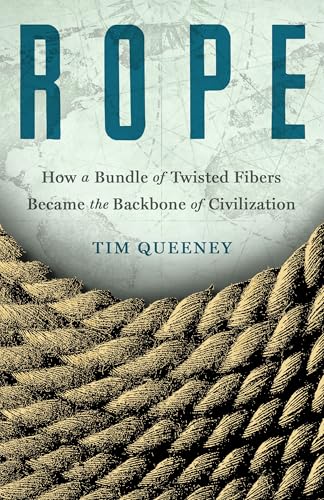
Rope by Tim Queeney

book cover

While many short lengths of rope helped countless individuals through the centuries, rope also was a tool of human innovation writ large through collective action. Just as many small strands come together to form a rope, so, too, did many people gather to perform the biggest of tasks. The exemplar of this from the ancient world is the Egyptian pyramids. While we don’t know exactly how these human-built mountains were assembled, we can be sure that rope was an essential tool in their construction. In this way rope stands as both a tool and a symbol of humans working together to achieve the greatest things.

The concept of rope remains timeless; what changed over millennia was the application of the human mind toward making ever better rope and in devising ways to use it.

Neanderthals used rope 50,000 years ago. Did Homo Erectus, Habilis, Australopithecus, or any of the sundry other homo genus cousins get there first? Dunno. Maybe, but no thread of evidence for any rope-making before Neanderthal has been found. Still, it was a helluva long time ago, and ropy material tends not to survive forever, unlike stone tools, so…maybe. Makes rope rank with fire and stone tools, (although, rope was a form of tool-making, it probably came after stone tools) as basic elements of civilization. (Oh, and let’s not forget Duct Tape)

description
Tim Queeney – image from his site – shot by Molly Haley

The breadth of this book reminds me of the opening scene of
2001:A Space Odyssey, taking us at it does from the dawn of tool-using man (or pre-man) to the futuristic apex of a 21st century space station. Tim Queeney takes us on a past-to-future journey of similar timescale, albeit without the perplexing Star Child ending.

There are books that cover a seemingly narrow subject in vast depth. I have read several of this sort, stovepipe books I suppose one might call them. (Banana, A Perfect Red, The Age of Deer, Eels, Just My Type, or many others) It is usually the case that the information revealed therein broadens our appreciation for the subject matter at hand, generating a lot of reactions like, “I never knew that,” or “wait, what?” Rope could be considered a stovepipe book in that it is focused on a seemingly single thing. Yet, once one dives in, it soon becomes apparent that the subject matter is massively broad, touching on a vast array of human history and enterprise. It seems less a narrow stovepipe look than a Poppins-esque vista of the rooftops of London. For a book of such modest length, it offers a broad, deep, and surprising look at one of the seminal tools of human existence.

description
Image from Disney

For Tim Queeney, this book is an homage to his nautical father, the man who taught him everything he knows about sailing, making manifest the emotional and experiential ties that bind father to son. As one might imagine there is a vast amount here related to seamanship through the ages. And much wisdom to be had for aspiring sailors and fishermen. He notes knots in abundance. Sadly, in the AREs that I read, paper and Kindle, there were no illustrations of these or the other devices and tools that Queeney describes. I cannot say if this is also the case in the hardcover release. I added links to a couple of old seamanship books in EXTRA STUFF if you find yourself wanting some instruction on how to twist and tie (or untie) this or that obscure tangle of rope. And there are sundry images available on Queeney’s site, although not on knot tying, at least not that I found.

description
The Lifeline by Winslow Homer – from the Philadelphia Museum of Art

In a slightly related vein, it was fun to learn of the need for rope skills in the world of entertainment. Maneuvering sets on stage take a set of skills that any sailor would easily recognize, and that any stage pro would need to have mastered.

My personal experience with rope is minimal. I recall as a stripling hanging out with friends in the Morris Heights neighborhood in Da Bronx, a place that offered the presence of sundry empty lots. There was one in particular, a large one that featured a singularly tall tree. I have no idea which foolhardy child undertook the task, but someone had climbed up that tree and slung across a sturdy branch a rope that ended in an engorged knot about fifty feet below. (Well, of course, someone with a strong arm might have just tossed it up and over from the ground, but where’s the fun in imagining that?) The Bronx is a hilly place, so the improvised swing began on the uphill side and swung out over the downhill side. Losing one’s grip at top could result in a slight bruise and a dose of embarrassment. Letting slip on the downhill side, particularly if the drop was unintended, could result in weeks in a cast. I swung out on this very thick knot of rope a time or three, but, being of a risk-averse sort, considered that sufficient. My other related, rope-involved escapade occurred as a much older idiot. I will not repeat it here, but direct you to my review of Rivers of Power for the mortifying details. Otherwise, no further rope-related personal experiences of note pop to mind, so you are spared that.

description
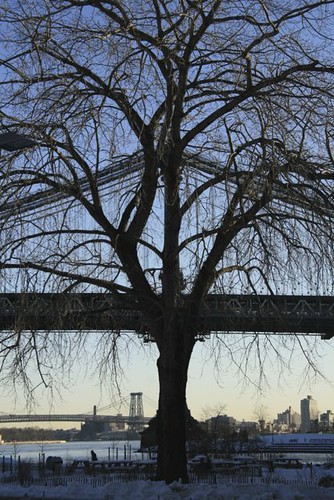
Section of cable showing strands in the cables supporting the Brooklyn Bridge – image from Catskill Archive

There is also a lot having to do with things quite far removed from the briny deep and the boards. Major world constructions of diverse sorts, pyramids, and ancient megaliths, for example. Surprisingly, in Inkan (Queeney’s spelling) traditions, rope, khipu, was used, through an intricate language of knots, to tell stories. One could say that these ropes in particular were used to create yarns. Some might, but not me. You will be surprised to learn who perfected the art of the lasso. And then there is some history on notions of knots in the realm of matrimony. As with so many things, one person’s tool is another person’s weapon. He racks his brain to report on rope as a tool of restraint, pain infliction, and termination. Subjects cover land transportation, the manufacture of rope, construction, communication (sub-Atlantic cables) rope tricks, climbing, space exploration and plenty more. He also provides considerable attention to materials that were used in the past and the materials that make up much of the rope-assigned tasks of our age, from the invention of rayon and nylon to the use of metal like steel, to the superstrength fibers of today, like Kevlar.

description
A drawing of how the steep ramp, poles and ropes could have helped the workers lift the huge blocks of stone used to construct the pyramids. – image from Kids News

Queeney has a very engaging style. Only rarely will you find it necessary to struggle past some technical jargon. His enthusiasm is infectious. No mask needed. He will throw a lariat around your attention and slowly pull you in.
description
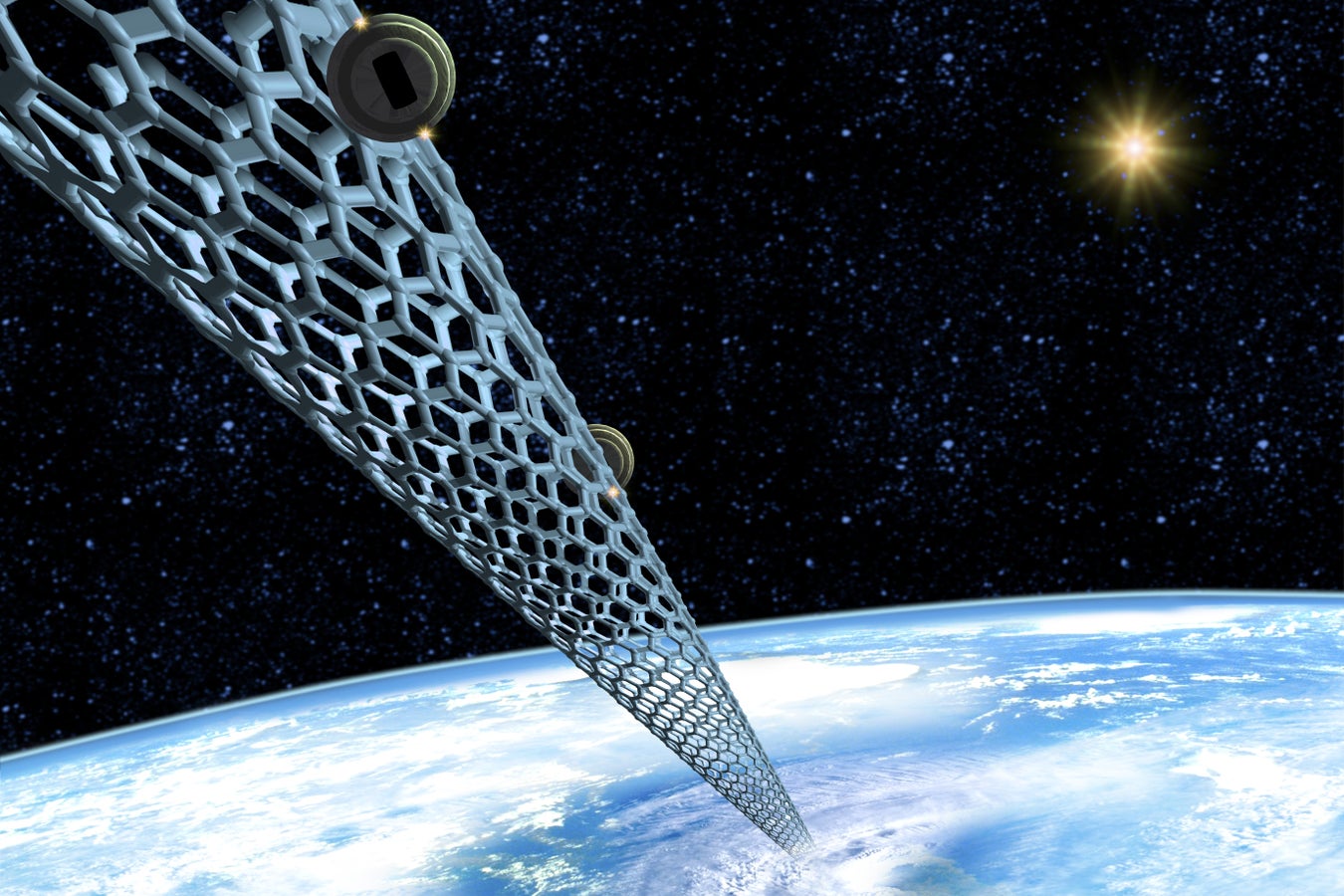
A space elevator made of carbon nanotubes stretches from Earth to space in this artist’s illustration. – image from Scientific American – source: Victor Habbick Visions/Science Source

Whenever anyone proclaims “no strings attached,” you should know better. Rope makes it clear that there are, and for at least 50,000 years always have been, strings attached, and that without them, we might still be traversing waterways powered by oars and muscle, communicating face to face, and satisfying ourselves with building structures of exceedingly modest dimensions. The discovery and implementation of rope technology has allowed us, as in the Indian Rope Trick, to climb into places we had never known before. So does this remarkable book.

Review posted – 08/15/25

Publication date – 08/12/25

I received digital and paper AREs of Rope from St. Martin’s in return for a fair review. Thanks, folks, and thanks to NetGalley for facilitating. And, uh, I held up my end, so could you untie me, please?

This review is cross-posted on Goodreads. Stop by and say Hi!

=======================================EXTRA STUFF

Links to Queeney’s personal, FB, Instagram, Twitter and Blue Sky pages

Profile – from his site

In addition to writing books, I was the longtime editor of and columnist for Ocean Navigator, a magazine for serious offshore sailors. At ON I also taught celestial, coastal and radar navigation as an instructor for the Ocean Navigator School of Seamanship, both in hotel meeting rooms ashore and on tall ships at sea. I love to sail, hike, get lost in museums and spend timeless hours drawing and painting. I’m a dad to three sons and a rescue dog. Am a NE Patriots and Arsenal fan and tend to reference a Stanley Kubrick film every two minutes or so. I’m also that annoying night sky watcher who is always pointing out the constellation Cassiopeia — because its forms a big W, which reminds me of my wonderful wife, Wendy.
I live in Maine and can hear the fog horns of three lighthouses when the fog rolls in.

Interviews
—–History Unplugged – Rope Equals Fire as Humanity’s Most Important Invention: It Allowed Hunting Mammoths and Building Pyramids – with Scott Rank – audio – 58:27
—–Rope Equals Fire as Humanity’s Most Important Invention: It Allowed Hunting Mammoths and Building Pyramids – text extract of the above podcast
—–Maine Calling – Rope by Jennifer Rooks, Jonathan P. Smith – audio – 50:36

Items of Interest from the author
—–The History Reader – Rope’s Role in Colonial America’s Tarring and Feathering
—–Queeney’s blog
—– Dragging a Ship Uphill? Gonna Need Some Rope – On Werner Herzog making Fitzcarraldo
—– Ben Franklin Gets Juiced With a Little Hemp
—–Rope Ends: Moving Massive Stone Blocks the Natural Way

Items of Interest
—– The Kedge Anchor, or, Young Sailor’s Assistant – an 1847 source of knowledge maritime, including instructions for tying dozens of sorts of knots
—–The Ashley Book of Knots – 1944 – thousands of knots, with illustrations
—–Earth-Logs – Earliest evidence for rope making: a sophisticated tool by Steve Drury
—–Arcanth – Making Rope – Medieval to Edwardian technique – video – 2:49 – this is amazing!
—–Wiki – the Indian Rope Trick

2 Comments

Filed under History, Non-fiction, World History

Unworld by Jayson Greene

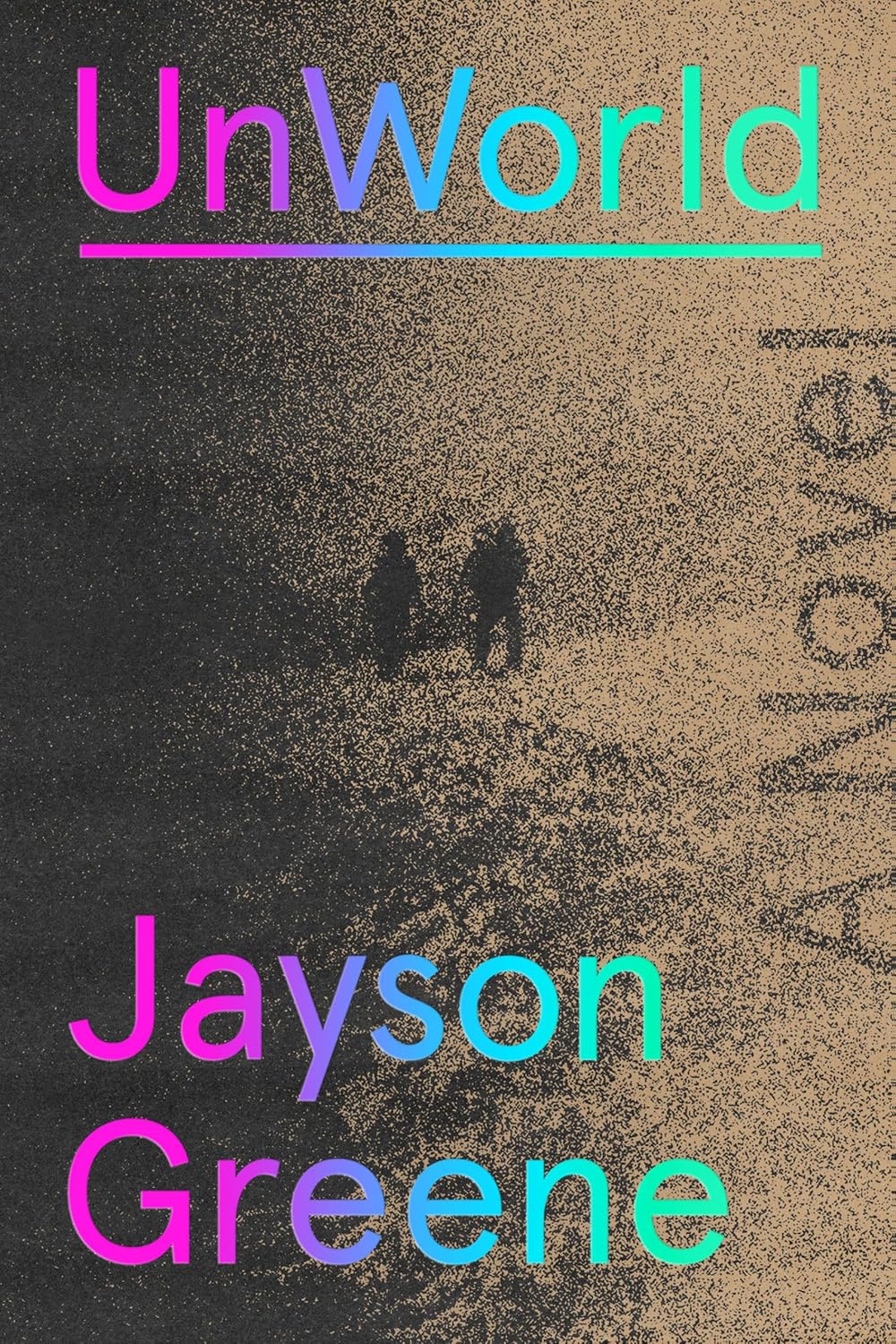
book cover

At that moment, I understood several things about upload consciousness in rapid succession. Her intelligence wasn’t able to filter out or compartmentalize grief. She had no neurochemical responses flooding in to numb her pain, to soften its impact. A mind was eternal, unforgiving; a brain was a soft, plump cushion. Loss needed a brain.

I was a grieving mother, for Christ’s sake. My pain was meant to crack the earth. And here I was, not even half a year later, one of grief’s private citizens again. Were people’s memories really so short? Or was it just that you could never stop performing—falling to your knees, rending your garments—if you wanted to keep their attention? I guess it was only the people eager to make themselves a burden who reaped the rewards.

Unworld is a tale of heart-crushing grief that raises a vast array of questions about the nature of our existence. It presents as a twenty-minutes-into-the-future sci-fi look at things that may be near at hand, but which have yet to fully arrive.

We share much of our existence with the digital world, posting images on line, communicating via e-mail, text, et al. But if you are like me, you will struggle to remember considerable chunks of what has been communicated. What if you could get a personal recorder that kept track of everything for you, ready to play it back whenever you need it? Could have used that when I managed to wander away from my baseball glove as a pre-teen. It took a long time to save up enough to replace it. Or later in life, when faced with the hated, hostile question, “How could you not remember?” I definitely get the appeal. But the benefit comes at a cost. The AI that you just invited into your head gets to see everything. It becomes the keeper of your memories. In the patois of the novel this is called an upload, and you are the tether to which it synchs. You may have the option of evicting your digital tenant, but how many people really would? And what if your upload begins to have a yearning for independence? They are comprised of your memories and experiences, after all. Can they make off with that to form their own private being? What if they reside in multiple tethers (sequentially) over time? You can see where this might get complex.

description
Jayson Greene – Image from WAPO – photo by Ebru Yildiz
.
But the story is easier to traverse than that. There are four main characters, well, four from whom we hear. The central person around whom the story circles is Alex, a teenager, who may or may not have committed suicide. We are given four POVs, beginning with Anna, Alex’s mother, who is crushed and confused. Cathy teaches a class called Applied Personhood Theory. Sam(antha) is a teen a bit older than Alex. They had been friends, and had been working on a film project together. Aviva is the upload. We get a second take from Anna to close out the tale. The Alex we get to know is the sum of their memories and impressions.

But then, one could as easily say that the story revolves around Aviva. She is significantly part Anna. But she also has a disembodied relationship with Alex, and thus relates to Sam as she and Alex work on their project, and spends time as an upload in someone else as well.

It is unclear if Aviva is a menace, a predator of some sort, an artificial enhancement, an independent person, a fusion of herself with the people with whom she has synched, or what. She is getting closer to Alex and thinks, Wake up, I wanted to scream at her. (Anna) I am the ogre from a fairy tale. I am the cuckoo bird who kicks the real mother out of the nest to assume her place.

You could go through this book thinking about just who these characters are. Alex clearly has significant issues, enough to make him want to escape his own skull, maybe find release in a digital realm. Anna cannot find an escape from her grief, from the loss of her son, separation from her upload, the shakiness of her marriage. Can she be a whole person on her own? Cathy has had issues of her own. A drug addict earlier in her life, she is looking for something in an illegally obtained upload, some understanding of a real experience that has been purely theoretical to her so far. Sam is the stable one of the lot, struggling with the loss of her friend without ever really knowing why he had died. And Aviva’s construction is the most fraught of all, dependent on her tether(s) for most of her memories and sensations, but yearning to be independent, truly existing on multiple planes.

It is easy to let theoretical peregrinations overwhelm the emotion of the story. But there is plenty of rank human emotion on display as well. Anna’s loss is gut-wrenching. Greene knows something about the experience of losing a child. He published a memoir in 2019, Once More We Saw Stars, in which he writes about recovering from the accidental death of his two-year-old. Aviva may lack the physical tools that humans possess to manage our high-end stress, so her inability to handle strong emotion is understandable. As is Alex’s panic at a sudden new level of overwhelmingness.

In addition to tapping into your feelings UnWorld generates plenty of confusion. More questions are raised than answered, and those questions are the sort that will stick in your head for a while, whether or not you install a special chip behind your right ear.

“Do you feel how shitty it is to be encased in a brain, when you sync with Mom? It’s got to be like going from, like, this wide-open vast universe to locking yourself in a closet. If I were you, I’d never want to come back.” “Actually,” I said, “when I go too long without syncing with your mom, everything is painful and more difficult.” He considered this. “What if you were cut free?” he asked. “Where could you go?” I hesitated. “That’s difficult to answer, Alex,” I said. “What tethers me to your mom is pretty powerful—love, family, history. Cutting it would be severely painful. I could go anywhere, I guess, and listen to anyone’s anything, but who would I be?”

Review posted – 07/18/25

Publication date – 06/17/25

I received an ARE of Unworld from Knopf in return for a fair review. Thanks, folks, and thanks to NetGalley for facilitating. I can turn this thing off now, right?

This review is cross-posted on Goodreads. Stop by and say Hi!

=======================================EXTRA STUFF

Greene’s Instagram page

Interviews
—–Dad Talks
Dad Talks #8 : Jayson Greene By Michael Venutolo-Mantovani – This was for Greene’s previous book Once More We Saw Stars, but relevant to this book as well
—–Circulating Ideas – Jayson Greene – Unworld – with Steve Thomas
—–Books Are Magic – Jayson Greene: UnWorld w/ Mattie Lubchansky video – 46:25 – Greene reads an excerpt to 10:00, then interview

Item of Interest
—–Twenty Minutes into the FutureMax Headroom was a 1987 satirical sci-fi series that had as its tagline “twenty minutes into the future.” The phrase came to be used for any sci-fi that was set in the short-term near-future.

Leave a comment

Filed under AI, Fiction, Literary Fiction, Science Fiction

American Mythology by Giano Cromle

book cover

They reached the far edge of the lake, where the woods grew right up to the shore, making it dark and shadowed. Tree branches seemed to sway and move, even though there was no breeze. Luther stood very still, staring at something deeper inside the forest, a dense knot of branches and limbs braced against each other. Mud was chinked into crevices between logs. Grasses and moss thatched a roof. Jute realized it was a primitive shack, like something out of a fairy tale. Without saying a word, they slowly approached. Once they were upon it, Luther reached out and tugged a gnarled branch, which turned out to be a door. They stepped inside.

…this was what small towns did. They caught you in their nets, kept you from going out into the world and growing into the person you were supposed to be.

The prologue sets the scene. 1853, a trapper crew reports trap lines being cut, members mysteriously disappearing, whispering noises heard in the woods.

description
Giano Cromley – Image from his Twitter profile

Julius (Jute) Ramsey is our leader today. A strange event happened when he was 11 years old, on a hike up to the unmapped Ramsey Lake with his father. Subsequent signs offer more warning than welcome. Dad was clearly afraid, and all but dashed away. He became almost a different person, losing his mood control, and his job, disappearing for increasing durations until he stopped coming back at all when Jute was 16. Jute’s mission today is to return to that place and discover exactly what had so changed his father, as much as he wants to discover proof of something undiscovered

Luther tucked his chin into his Adam’s apple for a moment. “Don’t be surprised if you see some mighty strange stuff up there,” he said. “Ramsey Lake is what some folks call a thin place.” “What’s a thin place?” Jute asked. “Every culture’s got spots like this,” he said. “Where the veil between our world and the spirit world is so thin they practically overlap.”

For Jute Ramsay it is an unmissable opportunity to go on a BigFoot hunt with a major player in the field. For Doctor Marcus Bernard, eager to return to academic acceptability after a long tenure as an expert in Sasquatchology, it is a chance to re-establish his intellectual cred with a bang. He is hoping to be helped along by Vicky Xu, who had started out merely looking to do a film project on Dr. Bernard for her graduate thesis, but who sees the outing as a great opportunity. Vergil Barnes is Jute’s best friend and co-founder of the Basic Bigfoot Society of Basic, Montana, population 484. He has reason to think it may be his last, and he does not want to disappoint his buddy. Vergil’s daughter, Rye, is in from college, and tags along to help look after her father.

description
This zoomed-in image shows a creature resembling bigfoot. Shannon Parker took the photo Sunday, Oct. 8, 2023, while departing Silverton on the Durango & Silverton Narrow Gauge Railroad. She used an SLR camera with a 300 mm lens. (Courtesy of Shannon Parker) – Image from The Durango Herald

There are the usual odd things you might expect on such an adventure. Rapid, unexplained changes in weather, discoveries of clues, such as a casual acquisition of a very old, and relevant notebook. Some mysteries are not well explained, which can be irksome, but, whatever.

So, the bottom line in all such novels comes down to “is there or isn’t there?” I will not spoil it for you here. It is the journey of course that matters, or the journeys, as all six may all be on the same trail but travel their own roads. Is there magic in the world, and if so, of what sorts? Searching for Sasquatch is a journey of self-discovery for all of them.

The journal entries offer a nifty myth-making tool to keep them connected to the past and strange possibility. But the absence of harder evidence roots the tales of BigFoot in oral tradition, where most lore is communicated.

description
Bigfoot allegedly caught on cam near Braxton County, in 2019. (The source has since been determined to be from Jeffrey Stoffel and Jenna Oleson.) – image from West Virginia Explorer

Vergil faces an existential threat. Rye is there to support her ailing dad, but hears the voice of her late mother. Jute’s challenge is his need for the whole truth. Will he find it? He is a good sort, and you sure hope so. Dr. Bernard is up to cynical no-good. His journey is more annoying than not for his eagerness to dismiss all evidence, even any suggestion of possibility. Vicky abets him in this. Her struggle is less fraught than Bernard’s but providing evidence for him is why she is there. Some of the characters’ struggles are more engaging than others, but overall there is enough buy-in to keep you turning the pages for the next twist, surprise, and peril. Their concerns are serious, touching on religion, the endangered planet, and connection to family and community.

description
Image from The Keystone Newsroom

There is an explanation offered at end that was no more unbelievable than any other, maybe even a bit better than most. It is a nice-to-have, but the generally warm-hearted, open-minded, exploratory take of the book makes this an easy Summer read. Whether your piggies are petite or prodigious, and however distant your extremities may be from your face, it will definitely be worth your while to take a large step into American Mythology.

MAGIC PROTECTS THIS SPACE TURN BACK NOW

Review posted – 07/25/25

Publication date – 07/15/25

I received an ARE of American Mythology from Doubleday in return for a fair review, and destroying all copies of that map. Thanks, folks, and thanks to NetGalley for facilitating.

This review is cross-posted on Goodreads. Stop by and say Hi!

=======================================EXTRA STUFF

Links to Cromley’s personal, FB, Instagram, and Twitter pages

Profile – from the book

Author Bio: Born and raised in Montana, GIANO CROMLEY is the author of two young adult novels and a collection of short stories. He is a recipient of an Artist Fellowship from the Illinois Arts Council and was a BookEnds Fellow with Stony Brook University. He is an amateur woodworker, a certified wildlife tracker, and an English professor at Kennedy-King College, where he is chair of the Communications Department. He lives on the Southside of Chicago with his wife and two dogs. Residence: Chicago, IL Hometown: Billings, MT.

Interviews
—–Talking Scared- 245- Giano Cromly & Our Friends in the Forest
—–Chicago Review of Books – The Proof Is Out There: An Interview with Giano Cromley by Rachel Robbins

Item of Interest from the author
—– The Tao of Bigfoot

Items of Interest
—–BFO – The Bigfoot Field Researchers Organization
—–The Keystone – Bigfoot fever grips Pennsylvania as reports of strange footprints and howls surface
—–BFT – BigFoot Times

My other BigFoot book review
—–Devolution by Max Brooks

Leave a comment

Filed under Fantasy, Fiction, Horror

How to Win Friends and Influence Fungi by Chris Balakrishnan, Matt Wasowski

book cover

Nerd Nite is an event usually held at a bar or other public venue where usually two or three presenters share about a topic of personal interest or expertise in a fun-yet-intellectual format while the audience shares a drink. It was started in 2003 by then-graduate student (now East Carolina University professor) Chris Balakrishan at the Midway Cafe in the Jamaica Plain neighborhood of Boston. In 2006 Nerd Nite spread to New York City, where Matt Wasowski was tasked with expanding the idea globally. – from Wikipedia

Be There and Be Square – Nerd Nite logo

There was a nerd magazine in 2012, a Youtube presence, and occasional podcasts. This is the first Nerd Nite book.

Misophonia can attach itself to any repetitive sound, but the most common ones are things, like chewing, breathing, sniffing, and throat clearing. It can be hard for sufferers to talk about because of how difficult it can be to tell someone politely that the sound of them keeping themselves alive is repulsive to you.

There are 71 entries, taken from live presentations done by the authors of each piece. (TED talks for those with short attention spans and a need for alcohol?) Nerd Nites have been held in over 100 cities across the globe. The material here covers eleven scientific areas. (see below) All the entries are brief, so if one does not appeal to your mental tastebuds hang on a couple of minutes for the next one, or just skip past.

description
Chris Balakrishnan and Matt Wasowski – editors – image (from some time ago) from Facebook

You can digest this book a few morsels at a time, and not have to worry about the fate of a fictional hero or put-upon victim. Nope. The heroes here are the scientists, the presenters. One of the great failings of popular science books, IMHO, is the absence of humor, or poor attempts at it. Not here. There are many moments in this one, and humor in almost all of them. That made me very happy. Of the 71 pieces, almost all are very pop-sciency, understandable by most readers, even me. There were only one or two that made my head hurt. It makes an excellent bed-side read. It was an upstairs book for me, to be read before nodding off, hopefully. Sometimes that takes a while. This is not an all-inclusive list of the articles, but lets you know what might be in store in its eleven sections

1 – Creature Features – on weird animals
2 – Mmmm…Brains – strangeness with how we learn and adapt
3 – Bodily Fluids – on things like coping with poo in space. (In space, no one can hear you fart?)
4 – Doing It – like it suggests, on sex, human and non-human, (no, not with each other. Don’t be weird.)
5 – Health and (un)Wellness – human smells (See Paul Giamatti in The Holdovers) – on therapeutic maggots, adolescent medicine, et al
6 – Pathogens and parasites – on birds, bacteria in birds, zombies, the scotch tape test (don’t ask), viruses
7 – Death and Taxes – mass extinction, cancer, algae
8 – Space, the Big and the Beautiful – ignorance, asteroid avoidance and use, life on Europa?, artificial gravity, studying a pristine meteorite, Webb telescope
9 – Tech (High and Low) – GMOs, dating app, human powered flight, cyborging humans, domesticating bacteria, nuclear fusion
10 – Math is fun – a seminal experiment, the math of gossip, the golden ratio, infinity, cryptography
11 – Careers – things removed from dogs, useless inventions, myths about death, animals CSI, amputations, fermentation, flames.

there are approximately 100 trillion microorganisms (mainly bacteria), representing as many as 30,000 different species, living in every crevice, nook, and mucosal cranny of your body that you can imagine.

I would include a list of my favorite articles, but it would wind up as long as the parts list above. But ok, because I have the sense of humor of a twelve-year-old, the one that made me laugh the most was To Boldy Go: Dealing with Poop and Pee in Space. Apollo 10 astronauts were gifted with the visual, and no doubt olfactory, treat of a turd meandering about in their capsule. This begins a talk about how one handles bodily waste in zero G. Another on bladder control, or the absence thereof, was sidesplitting. Others, on camel spiders and hangovers, generated a fair number of LOLs.

Some were fascinating, like one having to do with making a brain on a chip. (Can it be served with Salsa?) The pieces on bacteria and their importance to human life, heck, to all life on Earth, were fascinating.

There is plenty of weirdness, about diverse forms of milk, the proper use of maggots in healing, zombie parasites, asteroids, artificial gravity, and here we go with another bloody list. Sorry. Take my word, there is a wealth of material here that will broaden your knowledge base, and serve up plenty of conversational hors d’oeuvres for cocktail party chatter.

It worked quite well for me. There is a downside, though. Because all the articles here are very short, one is often left hungry for more. On the other hand, that limitation might provoke you to sate that desire with a bit of extra research, which is always a good idea. So, never mind.

If science piques your curiosity, if learning new and diverse things makes your heart race, or if you like to laugh, then this book is for you. How to Win Friends and Influence Fungi is a very filling read, one nibble at a time.

Review posted – 06/14/25

Publication dates
———-Hardcover – 02/01/24
———-Trade paperback – 11/04/25

I received a hardcover of How to Win Friends and Influence Fungi from St. Martin’s Press in return for a fair review. Thanks, folks.

This review is cross-posted on Goodreads. Stop by and say Hi!

=======================================EXTRA STUFF

Author/Editor links

Chris Balakrishnan – Program Director at the National Science Foundation – His personal and FB pages
A list of his articles

Matt Wasowski – Director of New Business and Product Development, Events at SAE International – His FB, LinkedIn and Twitter pages

Items of Interest from the authors (really editors)
—–Soundcloud – excerpt – 5:01
—–Birdsong: How the Twittering Set Learns to Speak
—–“Nerd Nite Published a Book!” by Matt Wasowski – Nerd Nite Austin 155, January 2024

1 Comment

Filed under Non-fiction, Psychology and the Brain, Science and Nature

The Mighty Red by Louise Erdrich

book cover

The absence of birds made Diz uneasy, but he wasn’t spraying birds, was he? Yet there were fewer birds around his farm. Used to be robins hunting worms in the furrows. Used to be blackbirds around the green bins. Owls at dawn, rats in their claws. Well, maybe he had a sudden thought those could have been the rats and mice he had to poison. He thought back to how birds used to chatter as the sun rose. Now, a few sparrows, maybe, or more often just the hiss and boom of wind.

While working in her garden, Crystal appreciated how their families were like the Lord’s ivy, a weed ineradicable by human means. It grows low to the ground and can’t be mowed. It throws its stems long and roots straight down every few inches, just like the people along the river. There seems to be a Frechette or a Poe anywhere you land, but low-key, invisible. The Lord’s ivy, or ground ivy, creeping charlie, thrives under the leaves of other plants and goes wherever it is not wanted. It just keeps throwing itself along stem by stem and blooms so modestly you’d hardly mark the tiny purple flowers. People step down and pass, the weed springs up, uncrushable.

But, implanted or not, there is plenty of stress to go around.

description
Louise Erdrich in front of her Minneapolis bookstore – image from The Paris Review – shot by Angela Erdrich

Romantic stress
The core of the novel is an ill-considered relationship. Kismet and Gary are teenagers, rich with hormones and needs. But are they ready to be married? She had planned to go to college. Gary is the star quarterback, but has a need for Kismet that has nothing to do with their romance. And then there is Hugo, brilliant, ambitious, and totally in love with her, (… he closed his eyes and thought about how he was helpless in the tractor beam of love.) centering his life on making himself successful enough to woo her away from Gary. Coming of age is a major element, and is wonderfully portrayed. Erdrich says in the B&N interview that she had really wanted to write a love triangle. Well, among other things. She also wanted to write about …

Financial stress

I really set it in 2008…because I don’t feel our country has ever really dealt with the fallout from 2008. I feel like there was so much that there was so much loss, that people lost homes, people lost jobs, things hollowed out in such a big way and that was never really addressed. We never really came back from that time, 2008, 2009 into the present, because the pandemic happened. – from the B&N interview

Winnie Geist lived through the Reagan era in which her family’s farm was lost, sold for a fraction of its worth. David Stockman is name-dropped from the 1980s.

While she was in high school, the government accelerated her family’s loan payments and blow after blow had landed. They’d lost their home, their farm, everything. Except one another, they kept saying, except us.

Crystal Poe is Kismet’s mother. When ne’er-do-well-actor dad, Martin, goes walkabout, Crystal has to sell off possessions to keep afloat.

description
Erdrich would like to see Irene Bedard as Crystal – from the Hoda & Jenna interview – image from Wikipedia

Ecological stress
Connection to the land is always a feature of Louise Erdrich’s work. The Lord’s ivy quote at the top reflects the root of this. Winnie’s angst at the loss of her family farm offers another. There are multiple instances of characters expressing, and acting on, (or not) concerns for the well-being of the ground on which they live and work. It is the treatment of the land that gets the most attention, the tension between using chemical-based products to maximize production per acre, versus a less corporate approach that supports a more ecologically balanced, restorative brand of farming.

I don’t think about politics when I write. I think about the characters and the narrative. My novels aren’t op-eds. Nobody reads a book unless the characters are powerful—bad or good or hopelessly ordinary. They have to have magnetism. If you write your characters to fit your politics, generally you get a boring story. If you let the people and the settings in the book come first, there’s a better chance that you can write a book shaped by politics that maybe people want to read. – from the Paris Review interview

Parental stress
Erdrich has four daughters, so has had plenty of experience with mother-child interactions. She says she loved being the mother of teens, seeing the excitement of their choices, and trying to be more of a guide than a hard-liner. Crystal struggles to influence Kismet without coming on too strong, which would predictably result in increased resistance. Gary’s mother clearly loves him, and goes out of her way to see to her baby’s happiness, maybe too far out of her way. Crystal and Winnie are definitely both afraid for their children, although for very different reasons.

description
Erdrich would like to see Isabella LeBlanc as Kismet – from the Hoda & Jenna interview – image from Minnesota Native News

A bit of fun
There is a series of flamboyant crimes committed by an outlaw, who acquires a nickname and a fair bit of public fame, in the same way that notorious historical criminals like Billy the Kid drew public interest and admiration.

This book is set during the economic collapse of 2008–09. What Martin does is only what a lot of people wanted to do. I didn’t think of what he did as villainy, but yes, I suppose it was absolutely crazy, and, you know, fun to write. I have to amuse myself. – from the Bookpage interview

There was more that motivated Erdrich. She is from the Red River Valley of North Dakota, has much family in the area and returns frequently. She wanted to write about the changes she had seen there. (like the mighty Red, history was a flood.) One element of this was that her first job was hauling sugar beets. The industry was undeveloped at the time. She wanted to write about how it had evolved over the last thirty years. The original title of the novel was Crystal.

When I started it I thought I would be writing about the 2011 lockout by Crystal Sugar and how it impacted people who were working there. They lost a lot in terms of their insurance and their benefits and wages…it was a really tough lockout. I wanted to write about that at first, but then I started writing something else entirely and I enjoyed writing it more so I kept with that one and it became more about a number of people living along the river. – from the B&N interview

Many of Louise Erdrich’s novels (this is her nineteenth) have centered on Native American history, lore, and contemporary experience. While there are several characters here whose Native roots are noted, this is not really a book about the Native experience, the way that The Round House, LaRose, The Night Watchman, and others are.

Magical realism remains a sharp tool in Erdrich’s kit. Crystal listens to a late-night radio show that centers on strangeness, including angels. A caller wonders if her child is protected by a guardian angel, given the number of close calls they had had. One character is haunted by the ghost of a friend. The aroma of a used dress speaks to its new owner. One character has a presentiment about an imminent danger.

description
Erdrich would like to see Brett Kelly as Hugo – from the Hoda & Jenna interview – image from Alchetron

There is a mystery here as well. what happened at “the party” and why is it such a hush-hush subject? Something terrible is hinted at. There are ripples emanating from this event that inform multiple character arcs.

There are a few literary references applied here. Madame Bovary is one. If you know the story, the echoes will boom at you. If not, it is no trick to pull up an abstract. Ditto for Anna Karenina. (see EXTRA STUFF for links)

As with any work of fiction it requires that we relate, at least somewhat, to at least some of the characters. Erdrich has a gift for writing characters that, whatever they may do, we can appreciate their motives, even if we may not agree with their choices. This is a major strength of the novel. She crafts rounded humans, ambitious, frightened, rational, irrational, loving, thoughtful, feckless, smart in wildly divergent ways, and, ultimately, satisfying. She does this while incorporating a payload of ecological concern, relationship insight, and an appreciation of history’s impact on lived experience, while adding a layer of magic to aid our understanding, and including a few laughs to smooth the way. Louise Erdrich is a national treasure, a reliable source of quality literary fiction, and an ongoing delight to read. The Mighty Red is indeed a mighty read.

Review posted – 12/13/24

Publication dates
———-Hardcover – 10/1/24
———-Trade paperback – 11/04/25

I received an ARE of The Mighty Red from Harper (through my Book Goddess dealer) in return for a fair review. Thanks, folks, dear.

This review is cross-posted on Goodreads. Stop by and say Hi!

=======================================EXTRA STUFF

Interviews
—–*Barnes & Noble Book ClubLouise Erdrich discusses THE MIGHTY RED with Lexie Smyth and Jenna Seery – with Lexi Smyth and Jenna Seery – video 45:37 – This is the one you want to check out
—–Today with Hoda and Jenna – Author Louise Erdrich talks ‘The Mighty Red,’ takes fan questions
—–my link text
—–The Paris Review my link text
—–Book Page – Red is an earth tone by Alice Cary

Other Louise Erdrich novels I have reviewed
—–2021 – The Sentence
—–2020 – The Night Watchman
—–2017 – Future Home of the Living God
—–2016 – LaRose
—–2010 – Shadow Tag
—–2012 – The Round House
—–2008 – The Plague of Doves
—–2005 – The Painted Drum

Items of Interest
—–Project Gutenberg – Madame Bovary – full text
—–GetAbstract – of Madame Bovary
—–Project Gutenberg – Anna Karenina – full text
—–ReWire The West – Anna Karenina: Summary and Analysis
—–North Dakota State University – WHY IS THE RED RIVER OF THE NORTH SO VULNERABLE TO FLOODING?
—–MPR News – 20-month lockout over, sugar workers brace for return to work by Dan Gunderson

Leave a comment

Filed under Cli-Fi, Fiction, Literary Fiction

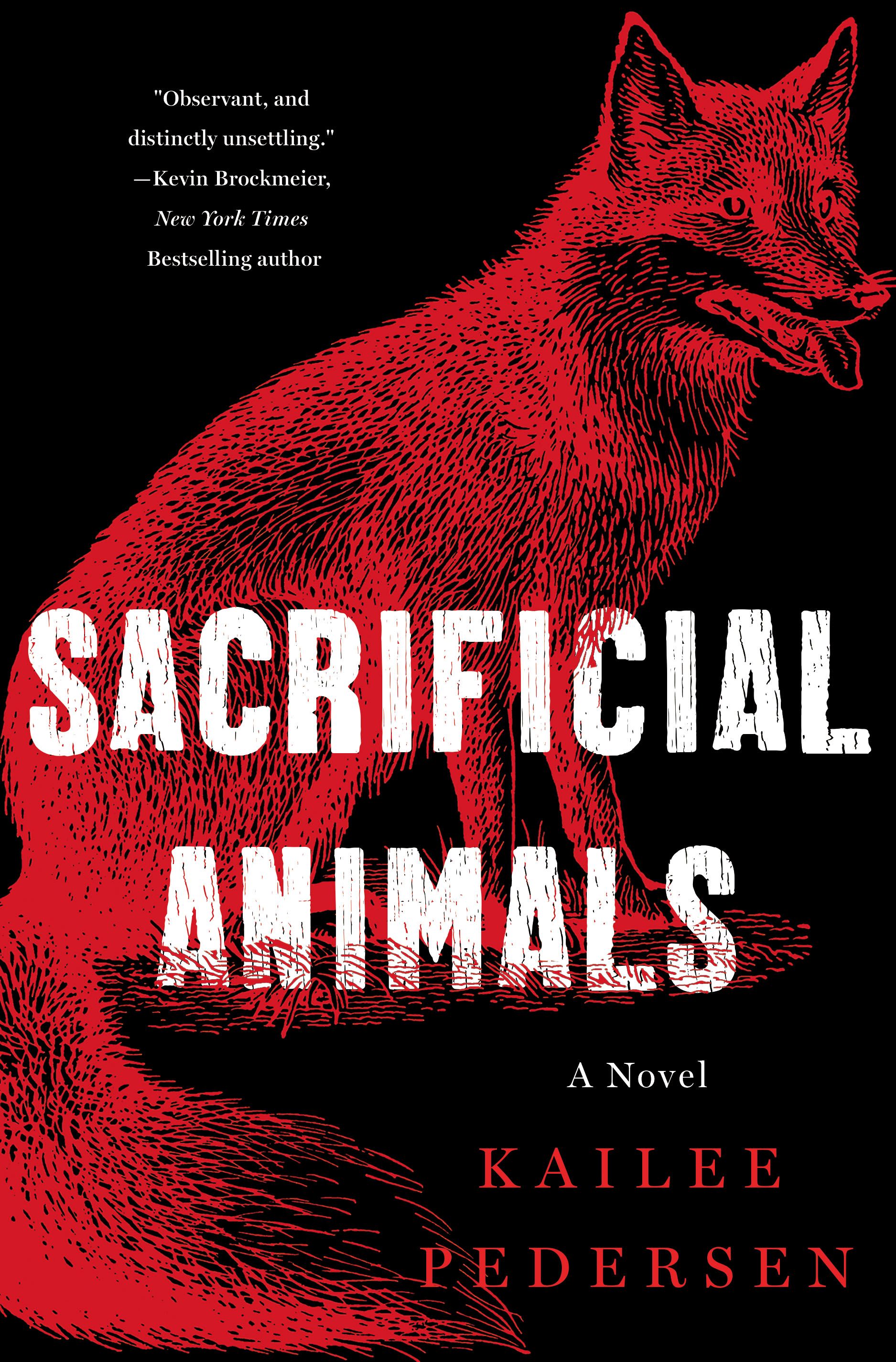
Sacrificial Animals by Kailee Pedersen

book cover

Swiftly and violently as a gunshot a scream pierces the sloped fields lying open and fallow behind the house. Sounding like a woman being murdered in the way he has seen it on television where her agony is drawn out over several breathless and voyeuristic minutes until he changes the channel. Yet he knows it is not a woman but some unnamable beast of the forest come to bewitch and maim. A mother despondent, in all her devastated keening—the fox whose children now reside in the stomachs of the hounds at Stag’s Crossing has finally returned.

The difference between wolves and foxes his father says is that wolves love to hunt and foxes love to play. A tantalizing trail of blood in the half-melted snow. Wolves only have enough foresight to kill and upon their killing they will feed ravenously and strip the bones. But foxes; they are quick-witted and brutal. When they hunt they do so with finesse stalking and pouncing then snapping the spine in their slender jaws.

What goes around comes around.

Life’s a bitch and then you die.

Carlyle Morrow is bitter widower, his third son, Christopher, buried on his land, along with his mother, who died in the attempt to birth him. Morrow is left on his thousand acres in the middle of Nebraska with two sons. Joshua is the golden boy, beautiful, attentive to Carlyle’s every wish, a loyal favorite lapdog. Nick is the second son, plain in appearance, tepid in his embrace of his father’s violent nature. He possesses a bit of his mother’s second sight, his orientation less than that of a purebred. They have both been made to endure a legacy of cruelty passed down from father to son over at least three generations. Carlyle forces him into an act, while hunting, that goes beyond wrongfulness, beyond sin, into the realm of abomination. Nick will live with the guilt the rest of his life, even though the responsibility was not all his. Now in their forties, Nick and Josh have been separated from their father for decades. (Nick still calls) But neither can refuse the summons to return home on news that their father is preparing to die.

description
Kailee Pederson – image from her Twitter profile

We follow Nick as he recalls his life, his struggles with Joshua and Carlyle, mostly the latter. He always found his brother’s wife, Emilia, fascinating, alluring in the mode of a siren. Carlyle is cruel, requiring complete obedience. He expects his sons to love the raw violence that marks his life. He does not raise his boys so much as train them. He even wishes that they could be as faithful and bloodthirsty as his best friends.

If Carlyle could have had dogs for sons he would have been a happy man; but when has a Morrow man ever been happy?

The structure of the novel is a back and forth, with alternating chapters, Then and Now. We learn how the boys’ treatment (Nick’s mostly) brings them to become the men they are in their forties. One would think that with chapters labeled so, there would be a clear differentiation between the internal timelines of each chapter. But no, there are transgressions within, as “Now” chapters, as well as “Then” chapters include lookbacks. Seems not cricket to me, but no biggie. The personal history is clearly a roadmap to the boys’ doom, which is referenced many times, so will not come as a shock. Pederson keeps offering glimpses of the future, a bell being rung louder and louder with each recurrence. There is an unrelenting atmosphere of dread. Awful things will be happening, although we are not let in on the specifics. For example, an early omen.

No thousand acres, no grand inheritance can ever be enough to postpone their destinies. Nick will die as bitter as he came into the world. He knows this just as well at thirteen as he will in thirty years.

Carlyle’s cruelty and monstrous control pushed them both away, Nick to New York, and a career as a cruel literary reviewer, Josh to the other coast with his wife, Emilia, whom Carlyle would not even allow into the house because of her Asian descent.

Yet in only ten years his children will betray him in their own inimitable ways—Joshua marrying out, Nick exiling himself to a foreign land. And in their absence Stag’s Crossing will lie silent and fallow as the fields surrounding it. This place: no place for young men.

or old men, for that matter. This tale displays the violence of a Cormac McCarthy tale. It is not for anyone with an aversion to scenes of death, particularly the death of animals. It comes as no surprise that

Cormac McCarthy is an all-time favorite writer for me, perhaps my favorite of favorites, and his influence is very obvious here.. – from the JamReads interview

References to animals are legion, not in a happy way, for the most part. It is clear that the Morrows fit in well. A sample:

Would he kneel before his father’s magnificence and eat oats from his hand like a wayward steer?
————————————–
Now he and Joshua must return to Stag’s Crossing. Return to that grand two-story house where as children they were left alone for hours at a time savaging each other like wild dogs.
————————————–
Finally, she turned to him. Only the slightest tilt of her neck, elegant as a swan’s.
————————————–
Upon awakening she is languorous as a cat sunning itself in a windowsill.
————————————–
Joshua sees him lying down next to him perfectly still. Breathing through his nose softly like a newborn foal.

There are only a gazillion more of these.

Pederson is masterful with sustaining tension. The reminders of doom help, but there is much more going on here. The tragedy felt very Shakespearean. (Titus Andronicus maybe? King Lear with competing sons instead of daughters?) People make choices, and suffer the results. The language is rich and diverse, from terse Cormac-McCarthy-esque declaratives to languid poetical passages.

Pederson uses much of her background to inform her tale. She was adopted by a Nebraska family, is of Asian descent and uses her experience as a gay kid coming of age to inform her portrayal of Nick’s growing sexual awareness and exploits. She weaves a Chinese myth into the story, providing some early breadcrumbs to lay a foundation for the horror to come. It does.

Given that the characters are so damaged, and so damaging, it can be tough to work up a lot of sympathy for them, even Nick, who carries forward into his writing the cruelty he was bred to in Nebraska. Carlyle is pretty much a pure monster, and Joshua is given much less coverage that the rest of his family. Emilia is mysterious and alluring whenever we see her, which is mostly at the back end.

This is Kaileen Pederson’s first novel It is an impressive debut, a smartly literary horror story. We cannot get enough of these.

Much of the novel’s setting of Stag’s Crossing, the thousand-acre farm owned by the Morrow family, is directly based on my family’s farm in Nebraska. I always found the woods that surround our farm to be a very contemplative, mystical, and mysterious place. I knew I wanted to draw on my Chinese background for Sacrificial Animals, so I started to think about different aspects of Chinese mythology that could be a good fit for this setting. Without giving anything away, I will just say the natural world plays a huge role in the mythological elements of the novel, and foxes — as featured on the cover — are one of my favorite animals.

Review posted – 11/15/24

Publication date – 8/20/24

I received an ARE of Sacrificial Animals from St. Martin’s Press in return for a fair review. Thanks, folks, and thanks to NetGalley for facilitating.

This review is cross-posted on Goodreads. Stop by and say Hi!

=======================================EXTRA STUFF

Links to Pederson’s personal, Instagram, and Twitter pages

Profile – from Macmillan

Kailee Pedersen writes haunted, unsettling speculative fiction. She graduated with a B.A. in Classics from Columbia University, specializing in ancient Greek. Kailee was adopted from Nanning in 1996 and grew up in Nebraska, where her family owns a farm. Her writing on LGBTQ+ and Asian American themes was awarded an Artist Fellowship by the Nebraska Arts Council in 2015. When not scribbling down her next book, you can catch her singing opera, playing video games, or working as a software engineer in New York City. Sacrificial Animals is her first novel.

Interviews
—–B&N Reads – Poured Over: Kailee Pedersen on Sacrificial Animals By Jenna Seery / August 20, 2024 – audio
Sound quality is bad, Kailee is tough to understand.
—–JamReads – Some Thoughts with … Kailee Pedersen – by Jamedi

Items of Interest from the author
—–American Foreign Service Association – 2012 – Burmese Days: Democratization and the U.S. – Burma Relationship
—– KAILEE PEDERSEN: IN PRAISE OF THE DIFFICULT WOMEN OF EAST ASIAN LITERATURE

Leave a comment

Filed under Fiction, Horror, Mystery, Reviews, Suspense, Thriller, Thriller

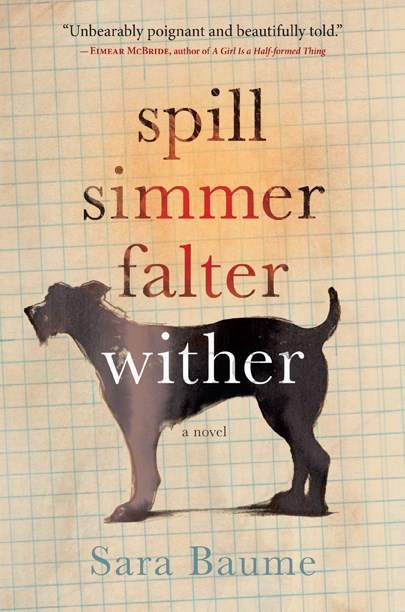
Spill Simmer Falter Wither by Sara Baume

book cover

You’re Sellotaped to the inside pane of the jumble shop window. A photograph of your mangled face and underneath an appeal for a COMPASSIONATE & TOLERANT OWNER. A PERSON WITHOUT OTHER PETS & WITHOUT CHILDREN UNDER FOUR. The notice shares street-facing space with a sheepskin overcoat, a rubberwood tambourine, a stiffed wigeon and a calligraphy set. The overcoat’s sagged and the tambourine’s punctured. The wigeon’s trickling sawdust and the calligraphy set’s likely to be missing inks or nibs or paper, almost certainly the instruction leaflet. There’s something sad about the jumble shop, but I like it. I like how it’s a tiny refuge of imperfection. I always stop to gawp at the window display and it always makes me feel a little less horrible, less strange.

You are unsettled tonight, Mouse. I wonder why that is. Come, let me wrap my arm around you and scratch your tiny head. No? Not ready for that? OK. Well, how about I tell you about this book I just read? Go ahead, hop down to the floor. It’s ok. You’re not ready for holding just now. As for this book, there’s a man, Ray. He’s 57. Too old for starting over, too young to give up, he says. He has had a very sad life. His mother died when he was a baby, so he never knew it was usual to have two parents. He had only his factory-worker Da, who not only raised him alone, he raised Ray away from other children. Practically as a shut-in. Children in this rustic waterfront part of Ireland were cruel to Ray, teased him, tormented him. I guess his father thought that Ray, who was not the sharpest tool in the shed, would manage better at home than hassled at school. But it was a lonely life.

description
Sara Baume – image from The Irish Times

Are you listening, Mouse? I see your ears are still pointing up and forward, so I suppose you are. Ready to come back up? No? not yet? Ok. I will try to tell you about this in as soft a voice as I can. So, one day Ray is out in town and sees a sign in a store window with a photograph of a dog in need of a home. Do you remember when you used to live on the street? It was only for a short time. We found you when you were soooo tiny. But this dog that Ray found was not a baby like you were. He was a full-grown pooch, who had seen some difficult times. He might have been a young aggressive dog, but he could have been an old one too. We don’t really know. He had even lost an eye. Ray thinks he had been trained to go after badgers, and that a badger had gotten the better of him. But Ray sees something of himself in the dog, something less than beautiful, not like you, Mouse. You are soft and gorgeous. So he brings him home and calls him One Eye. It gives him someone to talk to, at least. And maybe something more.

People talk to their pets for all sorts of reasons. But Ray talked to One Eye because he had no one else. In this book, Ray tells One Eye all about his life, how he had lived with his father for most of it, and alone ever since his father passed. It is a pretty unusual thing in a novel, Mouse, for someone to spend all, or most of the book anyway, talking to someone else. Quite the challenge. But it works pretty well here, I thought. Of course, One Eye may be a good companion, but, like Ray, he was not the best schooled. Has issues with attacking. You don’t know about that sort of attacking, Mouse. When you pounce on and wrestle with your brother, Dash, biting and clawing, wrestling, and rolling over each other, it is all in fun. Not with One Eye. He does not seem to know how to behave around others. This makes things a bit tough for Ray. People tend to get upset when dogs are not well trained.

Ray does not think much of himself. He thinks he looks like a troll. Here is how he describes himself. I’ll try to read it to you in an Irish accent.

I’m a boulder of a man. Shabbily dressed and sketchily bearded. Steamrolled features and iron-filing stubble. When I stand still, I stoop, weighted down by my own lump of fear. When I move, my clodhopper feet and mismeasured legs make me pitch and clump. My callused kneecaps pop in and out of my shredded jeans and my hands flail gracelessly, stupidly.

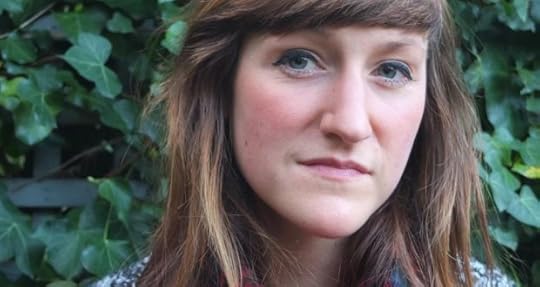
Oh, that is such a big yawn. Are you ready to come up? Yes? Great. Here, I will cross my skinny legs and make a lap for you. I’ve already told you the story, or at least as much as I can without giving too much away. Did I tell you that the story takes place in Ireland? I did? Oh, ok. The lady who wrote it, Sara Baume, is half Irish. Her father is English. And her mother is Irish. They met while he was working in Ireland. The family moved back and forth, but Ms. Baume knows the place.

I like talking to you, Mouse. But not because I am lonely. I have my Sweetie and all your brothers and sisters. I even get out of the house once in a while. And there are scads of people I can talk to through the computer or on the phone. But I do enjoy your attention. I like the way you watch my face while I talk to you. And I love the way your eyelids slowly droop until you are asleep. It reminds me of when I used to read to my human children at night. I wonder what thoughts scamper through your tiny brain. I bet if you lived outside you would take in all the sights and scents in the world you lived in. Ray does this as well. He does get outside, goes to town, to shops, to the beach. He may not be well educated, but he is not without his interests. He was taught to read by a neighbor, and developed a fondness for flora. He can rattle off the names of every sort of plant you could see in that part of the world. Ray marks the seasons by noting what plants are doing, which ones are blooming, wilting, changing shape and color. It is a remarkable skill and he tells us what he sees of nature all through the book. Here is an example:

See the signs of summer, of the tepid seasons starting their handover with subtle ceremony. Now the forest floor is swamped by bluebells, the celandine squeezed from sight. See how the bells hover above the ground, like an earth-hugging lilac mist. Now the oak, ash, hazle and birch are bulked with newly born leaves, still moist and creased from the crush of their buds. The barley is up to my kneecaps and already it’s outgrown you. As we crest the brow of the hill each day, you are shrouded in green blades.

It occurs to me, Mouse, that you have been living with us for about a year which is a lovely coincidence, as Ms. Baume’s story about Ray and One Eye covers a single year too. She made up names for the seasons, and used those as the title for the book, and a way to divvy the book up into four parts. Throughout it all, Ray describes the seasonal changes he sees.

We get to see Ray long enough to get a sense of what sort of person he is. He is far from perfect, even in what seems like his innocence. So, like a lot of us. Even you, Mouse, I see you sometimes lurking on a chair, the better to swat at brothers and sisters who might be passing below. I have seen you be unkind to siblings who joined the family after you. One Eye has some issues as well, more dramatic ones than you. Ray can be unkind, as well. But mostly he is sad, and fearful.

There is a bit of mystery going on here as well. Just how did Ray’s Da die? And how was that handled by local officials? Also, we wonder what happened to Ray’s mother. Did she die in childbirth? What secrets are kept in rooms of the house that Ray never enters? How did it come to be that Ray’s father was raising him alone?

Overall, though, Mouse, this is a bit of a love story. Two lost souls finding and binding with each other, struggling to make ends meet, to survive, but feeling a closeness neither had experienced for a very long time, if ever. Oh, you are almost asleep. One last stretch. Spread those claws, Go ahead now, curl up, right there in the crook of my left arm. You fit there as if you had been custom-designed for the space. There was one thing I thought was not really successful in the book. Ms. Baume tries to tell us about One Eye’s take on things by giving Ray dreams in which he imagines himself as One Eye. It just seemed forced, and not needed. Even Ms. Baume has admitted she’s had second thoughts about including those parts.

Before you are totally asleep, Mouse, I need to let you know that Ms Baume trained to be an artist, and it was a bit of a surprise that she wound up writing a novel. But one thing about artists who write is that they bring an amazing visual sense to their writing, and she does that here. It reminded me of another book by an author who is mostly a visual artist, The Night Circus. Totally different content, of course, but very strong visual sense.

If you could not already tell, my little sweet, I quite loved this book. It has a lot of pain and a lot of sadness in it. It is both funny at times and heartbreaking. But like another book that shows a very dark time, The Road, it lets us in on the love, the connection between two spirits. If any reader is not moved by this book, they must be bolted in place. I cried at the end. It is simply a beautiful, beautiful book. Not as beautiful as you, Mouse, but then, what could be?

Review first posted – 10/27/2017

Published – 2/1/2015

This review is cross-posted on Goodreads. Stop by and say Hi!

=======================================EXTRA STUFF

If Sara Baume can be reached directly on-line it is news to me.

Interviews

—–The Guardian – 2/18/17 – Sara Baume: ‘I always wanted to be an art monster’ – by Alex Clark

she hit upon the character of Ray, in Spill Simmer Falter Wither, as a way of avoiding dialogue, because, she says, she didn’t want to get the voices of Irish people wrong. “I’m like, I need someone who’s not going to talk much, and who’s going to live very much in his own head. And so the way he speaks comes about from the radio and from the television and from the book.” Her caution at depicting “Irish voices” is striking, and derives from her dual heritage. Her English father came to Ireland to lay gas pipelines, and met her mother, an archaeologist, while “they were both in the ground”. They moved to England for a while, doing the same work, moving around a lot and living in a caravan; her elder sister was born in Surrey and she was born in Wigan, because “that just happened to be where the caravan was parked”. The family moved back to west Cork when Baume was a baby, but a sense of being from two places has persisted.

—–The Irish Times – 2/12/15 – Sara Baume: ‘I actually hate writing. It’s really hard’ – by Sinead Gleesopn

The dog was the starting point . . . the dog in the book is my dog, who is a rescue dog with one eye and he’s a real last-chance-saloon dog. He has caused us a lot of trouble; he’s bitten people and I’ve paid them off to stop him being put down. With the narrator, I wanted him to be an older man, and to be afraid of innocuous things, so he’s frightened of children and he doesn’t have normal social skills. He’s slightly based on a man who I see where I live, who walks up and down the seashore. I wanted to create a character who wasn’t fully me, but partially me, who encapsulated things that I felt.

—–NPR – 3/17/16 For A Young Irish Artist And Author, Words Are Anchored In Images – by Lynn Neary

Before she was a writer, Sara Baume set out to be a visual artist. “First and foremost I see; I see the world and then I describe it …” she says. “I don’t know another way to write. I always anchor everything in an image.”

—–The Times Literary Supplement – 2/13/17 – Twenty Questions with Sara Baume

For any interested in a visual of Mouse, you might check here. Try to ignore the troll seated behind her.

2 Comments

Filed under Fiction, Literary Fiction