Tag Archives: philosophy

Knowing What We Know by Simon Winchester

book cover

The arc of every human life is measured out by the ceaseless accumulation of knowledge. Requiring only awareness and yet always welcoming curiosity, the transmission of knowledge into the sentient mind is an uninterruptible process of ebbings and flowings. There are times—in infancy, or when at school in youth—during which the rate at which knowledge is gathered becomes intense and urgent, a welling tsunami of information ever ready for the mind to process. At other times, maybe later in life, the inbound knowledge drifts in more slowly, set to adhere and thicken like moss, or a patina.

Digital amnesia, for example, is now widely agreed to be a phenomenon, a thing. It is a condition that posits that words looked up online are often forgotten almost as quickly as they are acquired. Information that we know can easily be Googled needs never be known, or if it is known, needs never to be retained. Telephone numbers, for example, once so often known and the more cherished ones remembered, need not even be known at all now. The name of the person to be called is all that is required. The name is hyperlinked to the phone’s dialing system and merely touching the name gets the distant phone to ring.

Epistemology is one of those ten-dollar words that make my brain hurt, particularly as its meaning is not made obvious through common Latin roots. Speaking it aloud could certainly lead one astray. It is neither the study of urine, excessive alcohol consumption, nor anger, but the study of knowledge. Winchester spends some time trying to define just what knowledge is. If you think it is something consisting of 100% verified, tested, water-tight, bullet-proof factoids, you will be disappointed. Simon traces human thought on this back to the ancients and adopts, as the world has, the definition of knowledge as “justified true belief.” (JTB) So, not the same thing as facts, information, or truth. Squishier. But still fascinating. He tracks advances in the Theory of Knowledge (TOK), (sadly, nothing to do with the media platform) including the latest thinking.

description
Simon Winchester – image from Kepler’s Literary Foundation

The sub-title of the book bears noting, The Transmission of Knowledge: From Ancient Wisdom to Modern Magic. Once having established what knowledge actually is, Winchester goes on to write about the means by which that knowledge was dispersed. He goes back to the development of the earliest known languages, marking the bridge where pictographic symbols were succeeded by letters representing sounds. It is fascinating to note that the use of written language arose more or less at the same time across the planet, across cultures that had had no contact with each other.

Once languages existed, schools would be needed, to sustain cultures and communities. The earliest known examples sprang up in Iraq and China. So, the means of transmission, beyond the family, was teachers. Some things never change. Winchester notes the considerable similarities between ancient and modern education. And some modern differences.

A Chinese school final exam is to the American SAT as Go is to Go Fish.

He touches on the greatest hits of educational advancement. Gutenberg democratized, to a considerable degree, the acquisition of knowledge, or at least access to books, with his seminal press. A huge, big deal, as regular folks could now read materials that previously been reserved for the clergy and educated classes.

Another advancement earning considerable attention is the library, humanity’s storehouse of knowledge. Winchester goes into some detail on different sorts of libraries and how they spread. There are many fun bits of intel here, such as on the shift from scrolls to folded paper for books, and on an eccentric indexing system used in one notable private English library.

…knowledge has long been seen as far too precious to treat with casual disregard. It needs to not just be kept, but kept safe and secure. For almost as long as language, especially written language, has existed, we have sought ways of collecting, storing, and safeguarding this endlessly swelling body of what is known, of what has been learned, and of all that can then be taught, discussed, challenged, debated, and decided. The most widely recognized and most ancient means of storage is the institution that derives its English name from the Latin word for the inner bark of a tree, on which early works were said to have been written. The Latin word for this bark is liber; by way of centuries of etymological convolution, the English word, used since Chaucer’s time, is, of course, the library.

Each revolution in how knowledge was transmitted was revolutionary well beyond the specific hardware upgrade. It was not just readily printable books that revolutionized the world. Printing presses were used to print newspapers as well, ushering in a world of regular information delivery to great numbers of people. Of course, newspapers have always been used as a source of propaganda and misinformation in addition to true reporting of actual events. So the capacity for mayhem grew with the capacity for a growth in awareness.

Why…did the transmission of knowledges that seem so potentially beneficial to us all get to be so drowned out by the noise of commerce and nationalism and war?

Encyclopedias come in for a close look. They were seen as the informational bible for large numbers of people, as they sought to offer buyers all the information currently known. He covers several of the major such products, including those beyond the Encyclopedia Britannica. (I remember when I was a child in the 1950s Bronx, our local supermarket, an A&P, sold the Frunk and Wagnall’s encyclopedia volume by volume. Hardcover, very thin paper, occasional illustrations. I remember looking forward to the arrival of every single one of the twenty-five volumes. There would always be something of interest.) Such publications continued the work of Gutenberg, making potentially vast amounts of information available to regular people.

Further advances in info transmission were to come. The telegraph shrunk the world of the 19th century the way the internet has done today. Radio broadcasting had a great impact. We learn much about the early days of the BBC, and its Japanese counterpart, including the impact those institutions had on the education, and attitudes toward education, of their respective populations. This was particularly eye-opening.

The middle of the 20th century saw major advances. Computer chips revolutionized everything. Now we can access information on most things instantly, or close enough to it, using a hand-held device. And in place of bookshelf-filling volumes we can check with Wikipedia for information on almost anything.

But knowledge is a feeder to a larger question. Whither wisdom?

What can and may and will happen next to our mental development if and when we have no further need to know, perhaps no need to think? What if we are then unable to gain true knowledge, enlightenment, or insight—that most precious of human commodities, true wisdom? What then will become of us?

This is not a new concern. Socrates was worried that the development of writing would impair people’s ability to understand things. He thought that if people could access written material, they would no longer have a need to memorize said material, by which means they supposedly incorporated it into their personal long-term storage, and had it available at the speed of thought. It is no big stretch to be concerned that the outsourcing of so much intellectual heavy lifting, which has been a product of the computer revolution, might leave our minds flabby and diminished.

Winchester offers a look at the greatest thinkers of all time, polymaths ancient and modern. In addition to the usual suspects, there are some names here that will be unfamiliar. Really? I never even heard of that guy. is a reaction I had more than once to some of the personages in his all-time, intellectual all-star roster.

If there is one thing that I found lacking in the book, well, lacking is not the right word, more like something I would have liked to have seen there. Is a look at how knowledge is lost or destroyed, whether by misfortune of evil intent. For just as knowledge can advance civilization, denial of access to it can help bring about a dark age.

Winchester’s aim here is to wonder how we will fare going forward when so much of our learning is housed outside our brains. Knowledge is a crucial element in the development of wisdom. Will our brains, uncluttered of vast amounts of information, be freed to contemplate deeper truths? Or will the neurons that gather information be too softened to address heavier thinking? Given what I have heard of so many younger people in the work force, I am leaning toward the dark side on this one. But I sure hope I am wrong. Encountering a passel of bright young minds in the last few years keeps alive hopes for better.

Simon Winchester is a national treasure. (probably for two countries, as he is an English-born American citizen) He repeatedly produces amazingly interesting books that open our eyes to parts of the world, contemporary and historical, that might otherwise remain unknown. Considering how much he has taught us through his writings, there is no question but that the world is a much richer place for how much knowledge and wisdom he has imparted to us all through his ongoing production of fascinating material. You may or may not become wise as a result of reading this book, but I guarantee you will become more knowledgeable.

How, in sum, do we value the knowledge that, thanks to the magic of electronics, is now cast before us in so vast and ceaseless and unstoppable a cascade? Amid the torrent and its fury, what is to become of thought—care and calm and quiet thoughtfulness? What of our own chance of ever gaining wisdom? Do we need it? Does anybody? How does a world function if no one within it is wise?

Review posted – 9/15/23

Publication date – 4/23/23

I received an ARE of Knowing What We Know from Harper in return for a fair review.

This review is cross-posted on Goodreads. Stop by and say Hi!

=======================================EXTRA STUFF

Links to the Winchester’s personal, Twitter and FB pages

A nice overview of Winchester’s professional life can be found here

Interviews
—–The Michael Schermer Show – Are We Risking Our Ability to Think?
There is a wonderful story re material in the Encyclopedia Britannica about how a relied-upon source can foment truly awful errors.
—–Free Library of Philadelphia – Simon Winchester | Knowing What We Know: The Transmission of Knowledge
—–Live Talks Los Angeles – Simon Winchester in conversation with Ted Habte-Gabr at Live Talks Los Angeles

Reviews of other Simon Winchester books we have read:
—–2021 – Land: How the Hunger for Ownership Shaped the Modern World
—–2018 – The Perfectionists
—–2015 – Pacific
—–2010 – Atlantic
—–2008 – The Man Who Loved China
—–2005 – Krakatoa: The Day the World Exploded
—–2001 – The Map That Changed the World
—–1998 – The Professor and the Madman
Leave a comment

Filed under anthropology, History, Non-fiction, Science and Nature

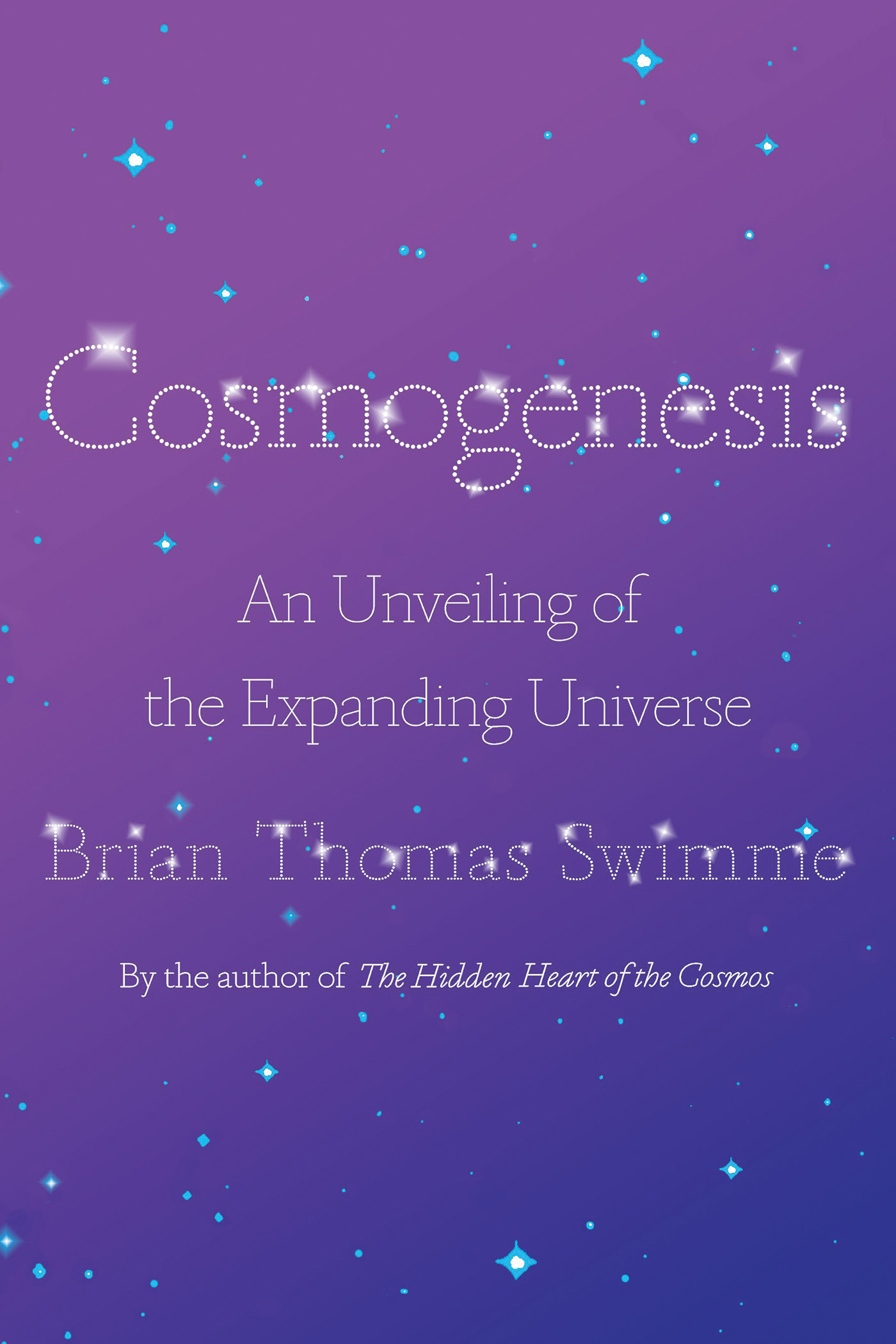
Cosmogenesis by Brian Thomas Swimme

book cover

…it feels today that we are in the middle of a profound transformation of humanity.

We don’t live in a cosmos. We live in a cosmogenesis, a universe that is becoming, a universe that established its order in each era and then transcends that order to establish a new order.

Cosmos – The universe seen as a well-ordered whole; from the Greek word kosmos ‘order, ornament, world, or universe’, so called by Pythagoras or his disciples from their view of its perfect order and arrangement. – from Oxford reference

Genesis – Hebrew Bereshit (“In the Beginning”), the first book of the Bible. Its name derives from the opening words: “In the beginning….” Genesis narrates the primeval history of the world – from the Encyclopedia Britannica

description
Brian Thomas Swimme – image from Journey of the Universe

So, Cosmogenesis means, at its root, the beginning of everything. Diverse cultures have come up with diverse understandings of how everything came to be. Where Swimme differs is in seeing the genesis, the beginning, the creation of everything as an ongoing process, not a one-off in deep history.

Cosmogenesis tracks Swimme’s journey from math professor to spokesman for a movement that seeks to rejoin science and spirituality. The stations along this route, which runs from 1968 to 1983, consist of people he considers great minds. He gushes like a Swiftie with closeup tickets to an Eras Tour show over several of these genius-level individuals, while relying on his analytical capacity to note shortcomings in some of the theories some others propose. Swimme mixes his approach a bit. It is in large measure a memoir, with a focus on his intellectual (and spiritual) growth, along with descripti0ns of the places where he lived, taught, and studied, and the people who inspired him, providing some background to the theories and ovbservations to which he is exposed.

A mathematics PhD, with a long and diverse teaching history, he grounds his work in the scientific. But he does not separate the scientific from the spiritual, from the human. In his view, we are all a part of the ongoing evolution of everything, noting that every subatomic part that make up every atom in our bodies, in our world, was present at the Biggest Bang, then was further refined by the lesser bangs of supernovas manufacturing what became our constituent parts. Even today, we bathe, wallow, bask, and breathe in radiation from that original event. It may have occurred fourteen billion years ago, but in a measurable way it is happening still. And we all remain a part of it.

There is a piece of Swimme’s material-cum-spiritual notion that I found very appealing. I have experienced an ecstatic state while perceiving beauty in the world. On telling my son about one such, I remarked that it was like a religious experience. He answered, “why like?” Swimme recruits like experiences to bolster the connection between the humanly internal and the eternal of the cosmos.

Bear in mind that Swimme grew up in a Catholic tradition, which clearly impressed him. There is a strong incense scent of religiosity to his work. Not saying that Cosmogenesis is a religion, but I am not entirely certain it is not.

As a child I had learned that the Mass was where the sacred lived.

I had a very different response to the religious world to which I was exposed as a child through twelve years of Catholic education. There was no connection for me between the Mass and the sacred, whatever that was. Mass represented mostly a burden, a mandatory exercise, communicating nothing about layers of experience beyond the material, while offering hard evidence of the power of institutions to control how I spent my time. I did not, at the time, understand the community building and reinforcing aspect to this weekly tribal ritual, separate from the religious content.

I believe that what we think of as spiritual or spectral is the reality that lies beyond our perceptual bandwidth. The ancients did not understand lightning, so imagined a god hurling bolts. With scientific understanding of lightning, Zeus is cast from an imagined home on Mount Olympus to the confines of cultural history. Science expands our effective, if not necessarily our physical, biological bandwidth, and thus captures, making understandable, realities once thought the domain of imagined gods. But what of feeling? The ecstatic state I experience when witnessing the beauty of the world, is that a purely biological state, comprised of hormones and DNA? Or do we assign to that feeling, which can be difficult to explain, a higher meaning because of our inability to define it precisely enough? And, in doing so, are we not following in the path of the ancient Greeks who assigned to extra-human beings responsibility for natural events? So, I am not sure I am buying in to Swimme’s views.

It is, though, something, to pique the interest of people like myself who have rejected most forms of organized religion, particularly those that focus on a human-like all-powerful being, (see George Carlin’s routine re this. I’m with George.) but who hold open a lane for a greater, a different understanding of all reality. Where is the line between the material and the spiritual? How did we come to be here? Evolution provides plenty to explain that. But we still get back to a linear understanding of time as an impasse. If the (our) universe began with the big bang, then what came before? Einstein showed with his special theory of relativity that time is not so fixed a concept as we’d thought. Things operate at different speeds, relative to each other, depending on distance and speed. Who is to say that there might not be more fungability to our understanding of time, maybe even radically so? In a way, this is what Swimme is on about, ways of looking at our broader reality, at our origins and ongoing evolution, (not just the evolution of our species, but of the universe itself) through other, more experiential perspectives, (a new Gnosticism?) while still including science.

Humans have expressed their faith in a great variety of symbols, many of which have inspired me at one time or another. But today, if you ask for the foundation of my faith, I would say the stone cliffs of the Hudson River Palisades.

Overall I found this book brain candy of the first order. Take it as a survey-course primer for the theory he propounds. There are many videos available on-line for those interested in going beyond Cosmo 101. So, Is cosmogenesis one of the ten greatest ideas in human history as is claimed here? That is above my pay grade. Some of the notions presented here seemed a bit much, but there was enough that was worth considering that made this a satisfying, intriguing read. Suffice it to say that it is a fascinating take on, well, everything, and can be counted on to give your gray cells, comprised of materials that have been around for 14 billion years, a hearty jiggle at the very least.

Everything is up in the air. We are living in a deranged world where nihilism dominates every major state. The contest today is for the next world philosophy.

Review posted – January 13, 2023

Publication date – November 15, 2022

I received a hardcover of Cosmogenesis from Counterpoint in return for a fair review.

This review has been cross-posted on GoodReads

=======================================EXTRA STUFF

Links to the author’s personal, FB, and Twitter pages

Twitter and Facebook do not appear to have ever been used you might also try

Interviews
—–Deeptime Network – Brian Swimme — What’s Next? Planetary Mind and the Future – video – 1:12:41 – from 6:50
—–Sue Speaks – SUE Speaks Podcast: Searching for Unity in Everything – podcast – 31:27

Items of Interest from the author
—– The Third Story of the Universe
—–A Great Leap in Being – 28:56
—–Human Energy – Introduction to the Noosphere: The Planetary Minds
—–Journey of the Universe

Items of Interest
—–San Francisco Chronicle – Science doesn’t cover it all, author Brian Thomas Swimme explains
—–
George Carlin on religion

1 Comment

Filed under Bio/Autobio/Memoir, History, Non-fiction, Religion, Reviews, Science and Nature

Life’s Edge by Carl Zimmer

book cover

…the question of what it means to be alive has flowed through four centuries of scientific history like an underground river… More than 150 years later, despite all that biologists have learned about living things, they still cannot agree on the definition of life.

I have had the pleasure of driving up a mountain through mist and cloud, and of walking in London through pea soup fog. Where exactly did the clear air end and the more particulate air begin? It is not entirely…um…clear. Sure, there is a difference between standing, or driving in air that one cannot visually penetrate and looking through a wide outdoor expanse on a cloud-free, crystalline winter day. But it is not a barrier drawn with a straight edge. Thus it appears with the line between living and not-living. With the examples detailed in Life’s Edge, it is clearer than ever that there are more things under heaven and earth than had been dreamed of in our philosophies. There are those, certainly, who proclaim that this or that specific location is where the thing called life begins. Rules have been drawn up to plant markers, to draw lines. But like an outdoor crime-scene police-tape, the fog of what lies within and without wanders freely past those lines, with no regard for the designs or preferences of humans.

description
Carl Zimmer – image from The Psychology Podcast

New York Times science columnist and multiple-award-winning science-writer Carl Zimmer’s fourteenth book takes readers on an exploration to that amorphous borderland between the living and the non-living. It is a journey that raises a lot more questions than it answers. Zimmer employs a tried and true approach, each chapter moving on to the next lab, the next researcher, the next wild bit of research, and filling in with nice chunks of science history, as he circles around the question.

description
Alysson Muotri – image from The Stem Cell Podcast

Many of the things Zimmer reports on are fascinating. Some, however, will disturb your sleep. For an example of the latter, Alysson Muotri, at the Sanford Consortium for Regenerative Medicine, takes skin samples and reprograms them into neurons to study neurological diseases and possible treatments. They are grown into miniature organs called organoids, and are allowed to reproduce, up to a point. When he started growing these things, he assumed that they could never become conscious. “Now I’m not so sure, he confessed.” Zimmer tells, also, of a researcher, a very long time ago, who was notorious for experimenting on living animals.

description
Cerebral organoid – image from European Research Council

Clearly a significant concern for our culture is where “life” begins, and further, where “human life” begins. It all comes down to definitions. Is Thomas Aquinas’s notion of the “ensoulment” of human embryos the same as defining when life becomes human life? There have been other notions employed in the history of Christianity. Zimmer looks at how legal definitions of life, for purposes including supporting abortion laws, and concerning a widening spectrum of medical and legal issues, fail to hold up under scientific scrutiny.

description
”It’s Alive!” (or is it?) – from Frankenstein – image from Buzzfeed

The concern here is not just what is life, but how can we tell when something actually is alive? He looks at how humans perceive life and react to it. We have a sense of life being present or absent, an intuition that is not unique to our species. Ravens hold what can only be seen as funerals for dead flock members. Chimps engage in group laments for late members, as do many other creatures.

To be alive is to not be dead…Humanity did not come to this realization through logic and deduction. Our understanding of death is not like Darwin’s theory of evolution or Thompson’s discovery of the electron. It has its origins in ancient intuitions.

Zimmer looks at metabolic rate. In the 17th century, there was a widespread fear of being afflicted with a death-like state that might leave its victims without detectable breath or heartbeat, thus generating a rampant terror of being buried alive. This concern inspired a well-known short story.

The boundaries which divide Life from Death are at best shadowy and vague. – Edgar Allan Poe, The Premature Burial

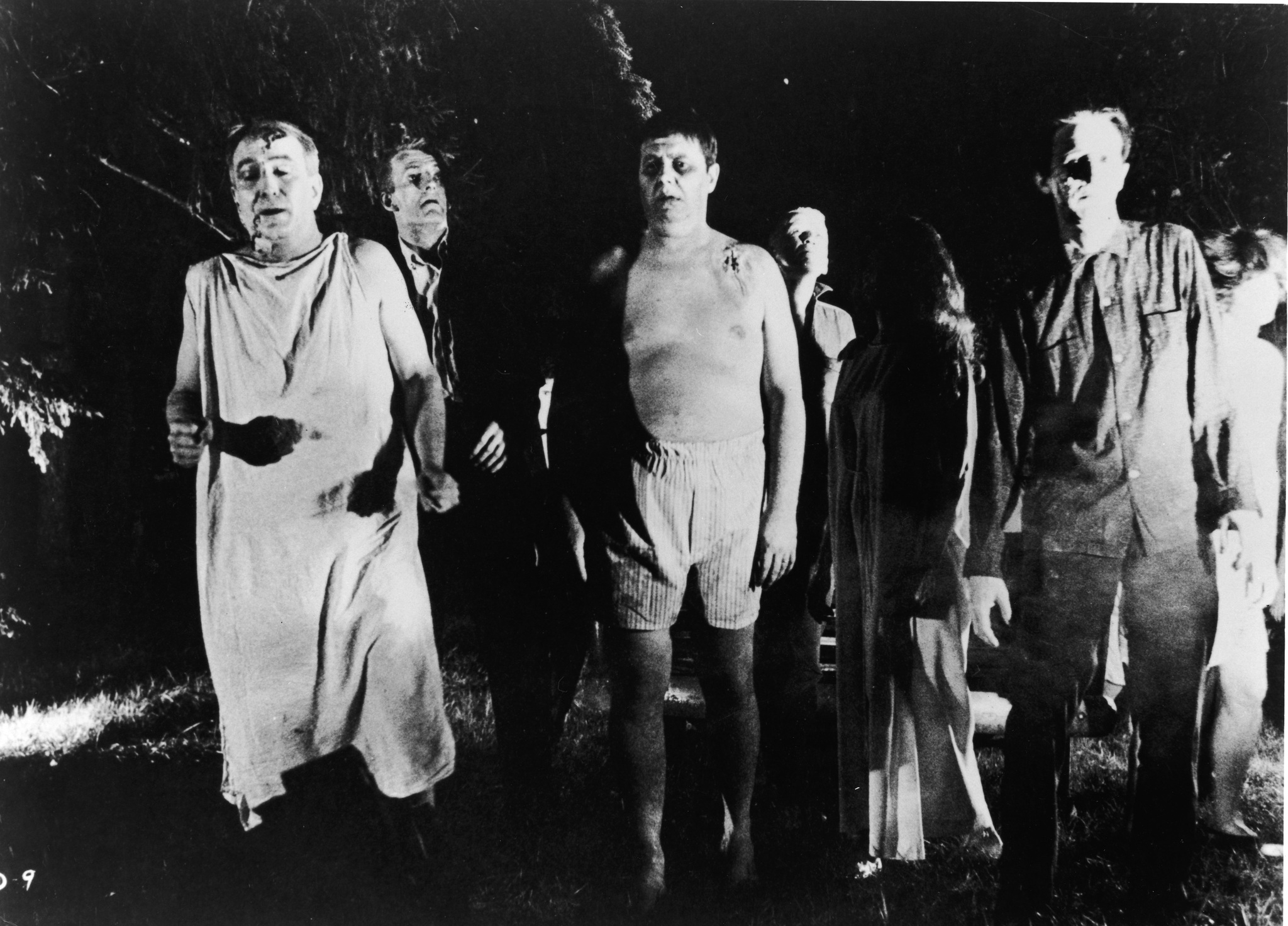
Zimmer reports on a woman who was pronounced dead, twice. (third time’s the charm?) Where is the line between brain death and true, no backsies, total death? Can a person meet the criteria for brain death one day, and later not meet it?

description
From The Night of the Living Dead – image from Wikipedia

But what constitutes life? How about adding some ingredients to agar, leaving it alone for a few hours and then finding a thriving slime mold, one with remarkable survival skills. What about spores, some of which can survive in space? Are spores alive? Or only potentially alive, or an ingredient in a recipe for making life?

Scientists have been arguing over whether viruses are alive for about a century, ever since the pathogens came to light. Writing last month in the journal Frontiers in Microbiology, two microbiologists (Hugh Harris and Colin Hill) at University College Cork took stock of the debate. They could see no end to it. “The scientific community will never fully agree on the living nature of viruses,” they declared. – from Zimmer’s Secret Life piece in the NY Times

description
“I vunder vut it vood be like to be really dead” – image from The Indy Channel

Whether you prefer your undead to be of the vampiric, zombie, or reanimated sort, or are more inclined to unicellular spore candidates, or maybe pre-conscious organoids, there are plenty of candidates for entities on the fringes of life.

In addition to providing readers with a better handle on the attempt to delineate the line between life and not-life, there are plenty of interesting questions raised and fun facts to be gleaned. We learn, for example, that Erwin Schrödinger was set up by the government at Trinity College. (But he may have simultaneously both been there and not, depending on whether any students saw him give a lecture.) We also learn that when Vitamin C was discovered, the discoverer wanted to name it “Godnose.” And how about meteorites as a possible source of Terran life? Or maybe they contributed one or more of the ingredients necessary for the recipe? I particularly enjoy when science writers imbue their work with a sense of humor. That is mostly lacking here, which is disappointing. But there is plenty of material to keep your brain cells flashing on and off.

Who decides on a definition of life? In an ideal world, science should lead on matters that are subject to physical investigation and repeatable experimentation. And yet…

It may be enough for you to align with Supreme Court Justice Potter Stewart who, when it came time to issue a ruling pertaining to pornography, said that he knows it when he sees it. We as a species tend to think that we know life when we see it. But it would be a good thing to recognize that all extant definitions of life are squishy, relying on philosophy or religion for their support. So I would appreciate it if no one would use their definition to tell me or anyone who does not share their perspective what they can or cannot do. Because when it comes to folks twisting science to political ends, I know it when I see it.

Life’s Edge may not provide a definitive guide to the line between living and nonliving. Such a line does not really exist in biology. But it does point out where the arguments lie about where those lines might be drawn, or, at least, where they might be investigated. It raises the larger question, though, of whether that line can, at least from a scientific perspective, be drawn at all.

Life is what the scientific establishment (probably after some healthy disagreement) will accept as life.

Review first posted – March 19, 2021

Publication dates
———-March 9, 2021 – hardcover
———-March 8, 2022 – trade paperback

I received an e-book ARE if Life’s Edge from Dutton in exchange for an honest review, and some of those interesting things that have been growing, unasked, in my basement.

This review has been cross-posted on GoodReads

=======================================EXTRA STUFF

Links to the author’s personal, FB, Instagram, Tumblr, PInterest, and Twitter pages

I heartily recommend you check out Siddhartha Mukherjee’s amazing NY Times review What Does It Mean to Be a Living Thing?

Items of Interest from the author
—–What is Life – audio – A series of live conversations between writer Carl Zimmer and eight leading thinkers on the question of what it means to be alive.
—–Slate – excerpt – What on Earth are These Things? – on organoids
—–NY Times – The Secret Life of a Coronavirus – is it alive?

Songs/Music
—–From Sondheim’s CompanyBeing Alive
—–Aerosmith – Livin’ On the Edge
—–Opening of Saturday Night Fever – The Bee Gees Stayin’ Alive
—–Madonna – Borderline
—–GaGa – Edge of Glory
—–Shruti Haasan – Edge
—–Monty Python’s The Meaning of Life – Every Sperm is Sacred

Leave a comment

Filed under History, Non-fiction, Public policy, Reviews, Science and Nature