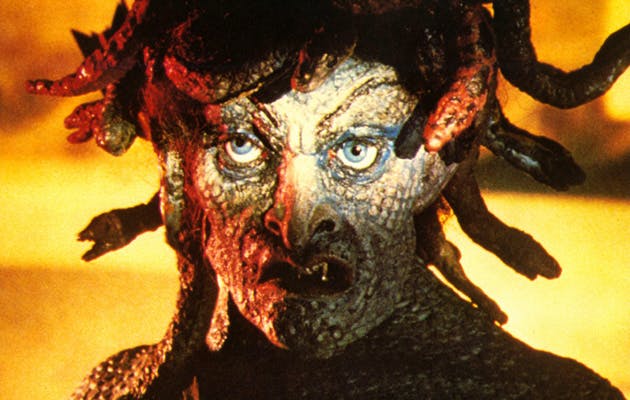
Tag Archives: literary-fiction

The Apartment by Ana Menéndez

book cover

The dead, after all, do not walk backwards but they do walk behind us. They have no lungs and cannot call out but would love for us to turn around. They are victims of love, many of them. – Anne Carson – from the epigraph

We are our own ghosts, dragging our mournful pasts behind us forever.

An apartment in Miami Beach, from 1942 to 2012, seventy years of tenants, eleven of them, each with a story to be told. The conceit of the novel is that the apartment retains some form of consciousness. Nothing particularly overt, mind you. It is handled more like a repository for emotional flotsam, psychic impressions that accumulate and rattle around with the tide of each new resident, to no obvious major purpose, until the final third of the book, when the apartment acquires a spokesperson, a late resident, who is on a mission to save the current one, Lana.

description
Ana Menendez – Image from her site

So, was all the depositing of emotional residue by the prior nine tenants merely substructure on which this final pair could rest? I found that a jarring shift, a sort of unwelcome unreliable narrator, as we are no longer hearing apt 2B, but as if this person proclaimed, “Shove over, flat. I’ll take it from here.”

Menendez’s work is mostly in short form, so it makes sense that her novel is of the linked-story form, as each resident in turn gets anywhere from six to twenty-two pages for their tale. Even though there is a through-arc, it still feels like a short-story collection, which is fine with me. But this form does limit how much one can get invested in any one character. The final chapter, at a novella-length eighty-four pages, changes this dynamic and gives us a bit more to hold on to with its two primaries.

After a prologue, in which an indigenous woman sees the first European invaders on what is now Miami Beach, establishes the roots of the storytelling arc, we jump to the beginnings of World War II. An apartment building called The Helena is still moist with drying paint when it is requisitioned by the military. Major Jack Appleton has been moved from Texas to lead an officers’ school. His wife, Sophie, is not what you might call thrilled. Appleton is controlling and abusive. They are not long for this place.

During their stay a ship is set ablaze and sunk off the coast by a German U-boat, bringing the war home. In fact, while the violence may be almost entirely off-screen, there is plenty of it. It is a pervasive thread in The Apartment, from the genocidal infections brought by the first Europeans, to carnage wrought by German forces. A veteran suffers from PTSD after serving in Viet Nam. A Marielita flees her abusive father, but is being kept by an abusive lover. A woman dreams that her husband is coming to kill her. A couple fear for their lives, concerned that they are being pursued by agents from their home country. A soldier is killed in action. There is a suicide and another tenant who might follow suit. A man is set upon by thugs in the street and is beaten bloody.

Each chapter ends with an interstitial piece, as the apartment is vacant for a time. Cleaners come in to prepare for the next renter. Some offer some wonderful short character pieces. The apartment sees and feels.

The front door closes, and absence returns to apartment 2B. but there is still someone here to record the fact, this unseen eye that moves across the floor as it if were a page, sweeps the bedroom, the naked walls, lingers at the single living room window with its blinds at half-mast.

We get a Cook’s Tour of many significant moments in American history, including foreign events that impact here through the residents of 2B, WWII, tensions between the USA and Cuba, Viet Nam, the Mariel boatlift, the demise of the junta in Argentina, USA involvement in Central American conflicts, 9/11, the demise of printed newspapers, Lebanon, Afghanistan. A lot.

I’ve been interested for a long time in how the trauma of war and displacement plays out across generations. So this was one of the main ideas I wanted to explore in the novel. Many of the conflicts in this novel have ties to the United States, which of course can sadly be said of many conflicts in the world today. We are all implicated. But simply on a craft level, as a writer, there were some conflicts that I wanted to include for personal reasons.
The conflict in Lebanon is one of them, as my great-grandparents fled to Cuba following early conflict there at the turn of the last century. The violence in Cuba and its long aftermath is of course a special obsession as the daughter of Cuban immigrants. And the conflict in Afghanistan looms large for us as Americans and for me personally as I spent ten unforgettable days in the country in 1998.
– from the Lithub interview

Everyone at the Helena is a transplant from someplace else. Many of the characters are foreign-born, carrying with them a sense of mourning for their lost birthplaces. Some have to jump down to the bottom of the work ladder they had ascended back home and begin the climb again, or take on completely alternate work just to get by. Even those who have made successful new lives pine for what was lost.

SHAPIRO: You introduce us very early on in the text to a Spanish word, morrina. What does the word mean? And how did you think about the concept in relation to the narrative you were writing?
MENENDEZ: It’s a concept that I think runs through maybe all of my books – this sense of saudade, as the Portuguese maybe would describe it. Most cultures have a word for this. It’s this sort of bittersweet nostalgia – the sense that the past is sweet and wonderful to wallow in precisely because it cannot be recovered. And I think that that’s an obsession that has run through most of what I write – not consciously but simply as a product of my upbringing and my own situation. My parents, of course, are immigrants. They call themselves exiles from Cuba. And so for me, it speaks to, you know, one doesn’t need to be an exile or a migrant to have this sense that things were sweet in the past and to sort of take refuge in it.
– from the NPR interview

The vast majority of the stories, eight of eleven, center on women. Conflict abroad manifests as abuse or misery at home. Few move on from 2B to a better life. There are exceptions. Relationships are pretty universally strained. Abuse recurs. A marriage of convenience challenges a relationship of love. There are betrayals, problems with gambling, alcoholism, depression, desperation, racism, bigotry of various sorts, and shame. Some are tormented by decisions they have made in the past. Some seem more like lost wanderers, thrown up on shore after being tossed roughly about by an angry sea.

The residents vary in their work lives, with creative arts well represented. There are multiple painters, their models, a journalist and a concert pianist. The most piercing spectral presence of all is a painting one of the residents is working on, as it manifests a particular bit of darkness.

Snakes pop up throughout. The book opens with A serpent coils through the underbrush of palmetto and coco plum…Harmless, this one, this time.. Later “Time, spooky and fickle. Not arrow, but snake.” There are more.

And now back to the apartment designation. Wait, 2B? Or not? Certainly calls up a soliloquy from Hamlet. And informs a fair piece of the book. The Danish Prince wonders if he should keep on keeping on after, learning that dear uncle murdered his father. Certainly many of the characters here have suffered the slings and arrows of outrageous fortune. Some put up a good fight, taking up arms against a sea of troubles. And by opposing [attempting to] end them. Well, some efforts are made. The alternative, the not 2B part, is to end the Heart-ache and the thousand natural shocks that the flesh is heir to. One last “check, please.” And one of ours does indeed choose to find out what dreams may come, when we have shuffled off this mortal coil. Is it the fear of the undiscovered country, of unknowable death, that keeps most grinding through the day-after-day? Or some loftier feeling, hope, or value? May it is simply momentum.

While The Apartment is not a traditionally formatted novel, it is nonetheless a beautiful work of writing. While we may not have much time with many of the characters, Menendez does a lot in a short space, a talent no doubt honed by her history of short story writing. The stories are moving, at times to the point of tears.

Will Sophie get away from her abusive spouse? Will Eugenio find his way to California? Will Sandman find a way to survive his PTSD? Will Isabel make her own life and not remain a kept toy of an older man? Will Margot and her husband evade those who might be after them? How will Susan handle her loss? Will Marilyn stay with her damaged bf? How will Beatrice cope with the change in her circumstances? Will Pilar be able to find journalism work again? Will Lenin succeed in his mission? Will Lana let the many friendly neighbors help her out, or is her secret too much to reveal?

There is poetic beauty in here that deserves to be read, to be appreciated. You may or may not feel impelled to look for deteriorating flats in a soon-to-be submerged part of Florida, but it would be worth your while to check in with your real estate agent and arrange to give 2B a look. It might turn out to be just the right place for you.

In the English novels she studied in school, the characters all seemed masters of their own fates. When they stumbled, it was because of a flaw. The direction their lives took was the direction they determined through their choices. But this was not Margot’s experience of the world. The world so far acted on her without consultation or sympathy. Her life, dictated first by her family’s wealth and now by her husband’s work, lacked the agency she was taught to recognize in great works. Even this latest leaving had been out of her hands. Maybe the only true literature was the old ghost stories her grandmother used to whisper to her on those windy cold nights on the Pampas. Spirit and mortals alike, all subject to unseen forces that swelled beneath them, hidden and untamable.

Review posted – 9/8/23

Publication date – 6/27/23

I received hardcover of The Apartment from Counterpoint in return for a fair review and a one-year lease. Thanks, folks.

This review is cross-posted on Goodreads. Stop by and say Hi!

=======================================EXTRA STUFF

Links to the Menendez’s personal, FB, Instagram, and Twitter, sorry, X pages

Profile – from her site

Ana Menéndez has published five books of fiction: The Apartment (2023), Adios, Happy Homeland! (2011), The Last War (2009), Loving Che (2004) and In Cuba I Was a German Shepherd (2001), whose title story won a Pushcart Prize. She has worked as a journalist in the United States and abroad, lastly as a prize-winning columnist for The Miami Herald.
As a reporter, she wrote about Cuba, Haiti, Kashmir, Afghanistan, and India. Her work has appeared in Vogue, Bomb Magazine, The New York Times and Tin House and has been included in several anthologies, including The Norton Anthology of Latino Literature. She has a BA in English from Florida International University and an MFA from New York University.
From 2008 to 2009, she lived in Cairo as a Fulbright Scholar in Egypt. She has also lived in India, Turkey, Slovakia and The Netherlands, where she designed a creative writing minor at Maastricht University in 2011. For the past 20 years, she has taught at various writing conferences and programs including, most recently, Bread Loaf and the MFA Program for Writers at Warren Wilson College. She lives in Miami and is currently an associate professor at FIU with joint appointments in English and the Wolfsonian Public Humanities Lab.

Interviews
—–NPR – Author Ana Menendez explores stories a single location could tell in ‘The Apartment’ by Linah Mohammad, Ashley Brown, Ari Shapiro
—–Lithub – Ana Menéndez on Crafting a Connected Cast of Characters by Jane Ciabattari

Items of Interest from the author
—–Links to other things she has written

Items of Interest
—–The Poetry Foundation – To Be or Not To Be – from Shakespeare’s Hamlet
—–Wiki – The Mariel Boatlift
—–Museum of Florida History – Florida on the Home Front: The German Submarine Threat off Florida’s Coast – “The most dramatic sinking in Florida waters took place the night of April 10, 1942, when U-123 torpedoed the tanker Gulfamerica off Jacksonville Beach. The resulting fiery explosion was clearly seen onshore and curious crowds gathered to view the ship’s destruction and looked on in shock as the German submarine surfaced and fired its deck gun at the tanker.”

Leave a comment

Filed under Fiction, Historical Fiction, Literary Fiction, Short Stories

Looking Glass Sound by Catriona Ward

book cover

The sea whispers, faint. It sounds like pages shuffling. A seal barks. I lick a finger and test the breeze. The wind is in the east. A moment later it comes, mournful and high. The stones are singing and I feel it, at last, that I’m home. I listen for a time, despite my tiredness. I think, if heartbreak had a sound, it would be just like this.

She can smell him the way wild animals smell prey.

The visions don’t frighten me anymore. I can usually tell what’s real and what isn’t.

Don’t get comfortable.

Wilder Harlow has returned to the cottage where he stayed as a teen, to write the book he had started over three decades before. He is not entirely well. We meet him in 1989, via his unpublished memoir, which tells of the momentous events of that Summer. He was sixteen. His parents had just inherited a cottage from the late Uncle Vernon, and opt to spend a summer there before deciding whether to sell. It is on the Looking Glass Sound of the title, near a town, Castine, in Maine. Beset in prep school, for his unusual features, particularly pale skin and bug eyes, Wilder is ready for a novel experience. (“I’m looking at myself in the bathroom mirror and thinking about love, because I plan on falling in love this Summer. I don’t know how or with whom.”)

description
Catriona Ward – image from Love Reading

The sound has an unusual…um…sound.

The leaves of the sugar maple whisper—under it, there’s a high-pitched whine, a long shrill note like bad singing…it sounds like all the things you’re not supposed to believe in—mermaids, selkies, sirens…’What’s that sound?’ It seems like it’s coming from inside of me, somehow. Dad pauses in the act of unlocking the door. ‘It’s the stones on the beach. High tide has eaten away at them, making little holes—kind of like finger stops on a flute—and when the wind is in the east, coming over the ocean, it whistles through.’

Sure, dad, but the wind-driven whistling is not the only sound that haunts in these parts.

It does not take long for Wilder to make two friends. Nathaniel is the son of a local fisherman, his mother long gone. Harper is English, her well-to-do parents summer there. Wilder’s relationships with these two will define not only this Summer and the one after, but the rest of his life. Harper is a flaming redhead, with issues. She has been kicked out of many schools, for diverse crimes. So, of course, Wilder is madly in love with her at first sight. Nat, a golden boy in Wilder’s eyes, has a way of describing fishing with a harshness that is unsettling. The three form their own tribe for a time.

Pearl is named for her mother’s favorite jewel. She was only five when mom disappeared. They had been staying at a B&B in Castine. But Pearl’s mother is far from forgotten.

Sometimes her mother talks to Pearl in the night. She learns to keep herself awake, so she can hear her. It always happens the same way. Rebecca’s coming. It starts with the sound of the wind roaring in Pearl’s head, just like that day on the mountain. And then Rebecca’s warm hands close over her cold ears.

The area has a local creep. Dagger Man is the name assigned to whoever is responsible for a series of break-ins of homes occupied by Summer people. He takes photos of kids sleeping. Then sends the polaroids to the parents.x The images include a dagger to the throat. Adding to the creepiness, there is a history of women going missing here. And a legend of a sea goddess luring people to a dark end.

The second summer in Castine, there is an accident in a secret cave, involving Wilder, Nat, and Harper. It leads to a very dark, traumatic discovery, upending their worlds.

When Wilder heads off to college, soon after, he is intent on becoming a writer, but, while there, his closest friend, Sky, steals his story, going on to publish a wildly successful novel using it. Wilder is never able to get past this, thus his final return to the source a lifetime later, to have one last go at writing his true version.

Ward employs some of the usual tricks of creating a discomfiting atmosphere. The sounds emanating from the bay are strong among these. Even underwater I can still hear the wind singing in the rocks. And I hear a voice, too, calling. In describing Harper, Wilder notes Her hair is deep, almost unnatural red, like blood. And The wet sand of the bay is slick and grey. It’s obscene like viscera, a surface that shouldn’t be uncovered. (Well, ok then. Which way to the pool?) Nat describing how his father kills seals is pretty chilling.

Ward has had some eerie experiences,

I suffer from hypnagogic hallucinations. They started when I was about 13, taking the form of a hand in the small of my back as I was falling asleep, shoving me out of bed really hard. I knew there was someone in the room and I knew they didn’t mean me well. With the information I had at the time – pre-Google as well – there was no other explanation for it, was there? I think it’s probably the deepest chasm I have ever looked into. There’s nothing comparable to it in the daylight world. – from the 9/26/22 Guardian interview

which find their way into the story.

So, there are two presenting mysteries, Dagger Man and the missing women. And a bit of magic in the air, whether it is a dark siren luring some to a watery grave, mysterious noises and notes, or teens fooling around with witchy spells. Are the kids just being imaginative, or is there something truly spectral going on?

A feeling of powerlessness is core to the horror genre. The main characters here share a deep sense of vulnerability. This is very much a coming-of-age novel. Adolescence is a prime vulnerable state, a transition between childhood and the mystery of adulthood. Not knowing who you are. Trying on different roles, names, behaviors, hoping for love, of whatever sort, always susceptible to rejection and/or betrayal, and/or disappointment. There is added vulnerability with their families. Any teen going through changes would benefit from a solid base of parental constancy. Wilder’s parents are going through more than just a rough patch. Nat does not seem particularly close to his only parent. Harper refers to a pet dog that protects her from her father. There are enough secrets in the world. Bad families, bad fathers. Pearl’s mother, like Nat’s, is long gone. In addition to whatever else assails them, there is self-harm.

The Dagger Man is wandering about. People disappear. The bay has disturbing aspects to engage all the senses. There are a few more stressors, as well. That certainly sets the stage for an unsettling horror tale. That would all be plenty. But wait, there’s more.

Some books have unreliable narrators This one has an unreliable ensemble, existing in unreliable worlds. Looking Glass Sound is not your usual scare-fest. The terrors here lie deeper than a slasher villain or a vengeful ghost. In addition to the external frights, these have to do with existential concerns, about identity, who, what, where, and when you are. Offering the sorts of thoughts that can interfere with a restful night, with the legs to disturb your sleep for a long time. This would be more than enough, but wait.

This is also a book about writing. A pretty common element in many novels, it’s on steroids in this one, cruising along in the meta lane.

Writers are monsters, really. We eat everything we see.

The book is a mirror and I am stepping through the looking glass.

‘Writing is power,’ she says. ‘Big magic. It’s a way of keeping someone alive forever.’

I think about our three names, us kids, as we were. ‘Wilder,’ I whisper to myself sometimes. ‘Nathaniel, Harper.’ We’re all named after writers. It’s too much of a coincidence. Harper. Wilder. Harlow. The names chime together. The kind of thing that would never happen in real life but it might happen in a book.

‘You wanted to live forever,’ Harper says gently. ‘You both did, you and Wilder. That’s all writers really want, whatever they say.

She also gets into the morality of story ownership. When does your personal tale become a commodity? Who has the right to tell your story?

I cannot say I have ever read a book quite like this one. It is not an easy read. Despite some surface technique that places it in the gothic/horror realm, there is a lot more going on here. You will have to be on top of your reading game to keep track, but it will be worth your time and studied attention. There should be surgeon general’s warning on this book. Stick with it and you will get a very satisfying read, and endure many nights of unwelcome wondering.

I wake to the sound of breath. No hand caressing me, this time. Instead I have the sense that I am being pummeled and stretched, pulled by firm hands into agonizing, geometrical shapes. I scream but no voice comes from my throat. Instead, an infernal scratching—horrible, like rats’ claws on stone, like bone grinding, like the creak of a bough before it breaks. Or like a pen scratching on paper.

Review posted – 7/21/23

Publication date – 08/08/23

I received an ARE of Looking Glass Sound from Tor/Nightfire in return for a fair review. Thanks, folks, and thanks to NetGalley for facilitating. Can you please turn down the volume on that thing?

This review is cross-posted on Goodreads. Stop by and say Hi!

=======================================EXTRA STUFF

Profile – from Wikipedia
Catriona Ward was born in Washington, D.C. Her family moved a lot and she grew up all over the world, including in the United States, Kenya, Madagascar, Yemen, and Morocco. Dartmoor was the one place the family returned to on a regular basis. Ward read English at St Edmund Hall, Oxford. Ward initially worked as an actor based in New York. When she returned to London she worked on her first novel while writing for a human rights foundation until she left to take an MA in creative writing from the University of East Anglia. That novel, Rawblood (distributed in the United States as The Girl from Rawblood), was published in 2015. Now she writes novels and short stories, and reviews for various publications.[1] Ward won the August Derleth Award for Best Horror Novel in 2016 …and again in 2018 for Little Eve, making her the first woman to win the prize twice.
Her most successful novel has been The Last House on Needless Street.

Links to Ward’s FB and Instagram pages

Interviews
—–The Guardian – 9/26/22 – Catriona Ward: ‘When done right, horror is a transformative experience.’ by Hephzibah Anderson
—–The Guardian – 3/13/21‘Every monster has a story’: Catriona Ward on her chilling gothic novel by Justine Jordan
—–Lit Reactor – Catriona Ward: Learning to Fail by Jena Brown
—–The Big Thrill – 8/31/2021 – Up Close: Catriona Ward by April Snellings
—–Tor/Forge – Catriona Ward – What Was Your Inspiration for Looking Glass Sound?
—–Books Around the Corner – Catriona Ward by Stephanie Ross
—–Quick Book Reviews – Episode 206 – April 24, 2023 – Books! Boks! Books! from 26:06 to 42:30

Items of Interest
—–The Novelry – 10/2/2022 – Catriona Ward and the Power of Writing Horror
—–NHS – Charles Bonnet syndrome

Leave a comment

Filed under Fantasy, Fiction, Horror, Literary Fiction, Mystery, psycho killer, Suspense, Thriller, Thriller

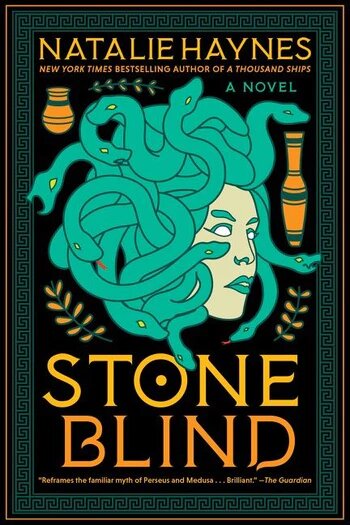
Stone Blind by Natalie Haynes

book cover

Perseus…has no interest in the well being of any creature if it impedes his desire to do whatever he wants. He is a vicious little thug and the sooner you grasp that, and stop thinking of him as a brave boy hero, the closer you’ll be to understanding what actually happened.

Who decides what is a monster?

When Natalie Haynes wrote Pandora’s Jar, a collection of ten essays on the women in Greek myths, she included a chapter on Medusa. In nine-thousand words she offered a non-standard view of the story of heroic Perseus slaying the gorgon. But the story stayed with her, well, the rage about the story of how ill-treated this supposed monster had been, anyway. If the feeling remained that powerful for so long, it was a message. She needed to devote a full book to this outrage in order to get any peace. Thus Stone Blind.

description
Natalie Haynes – image from Hay Festival

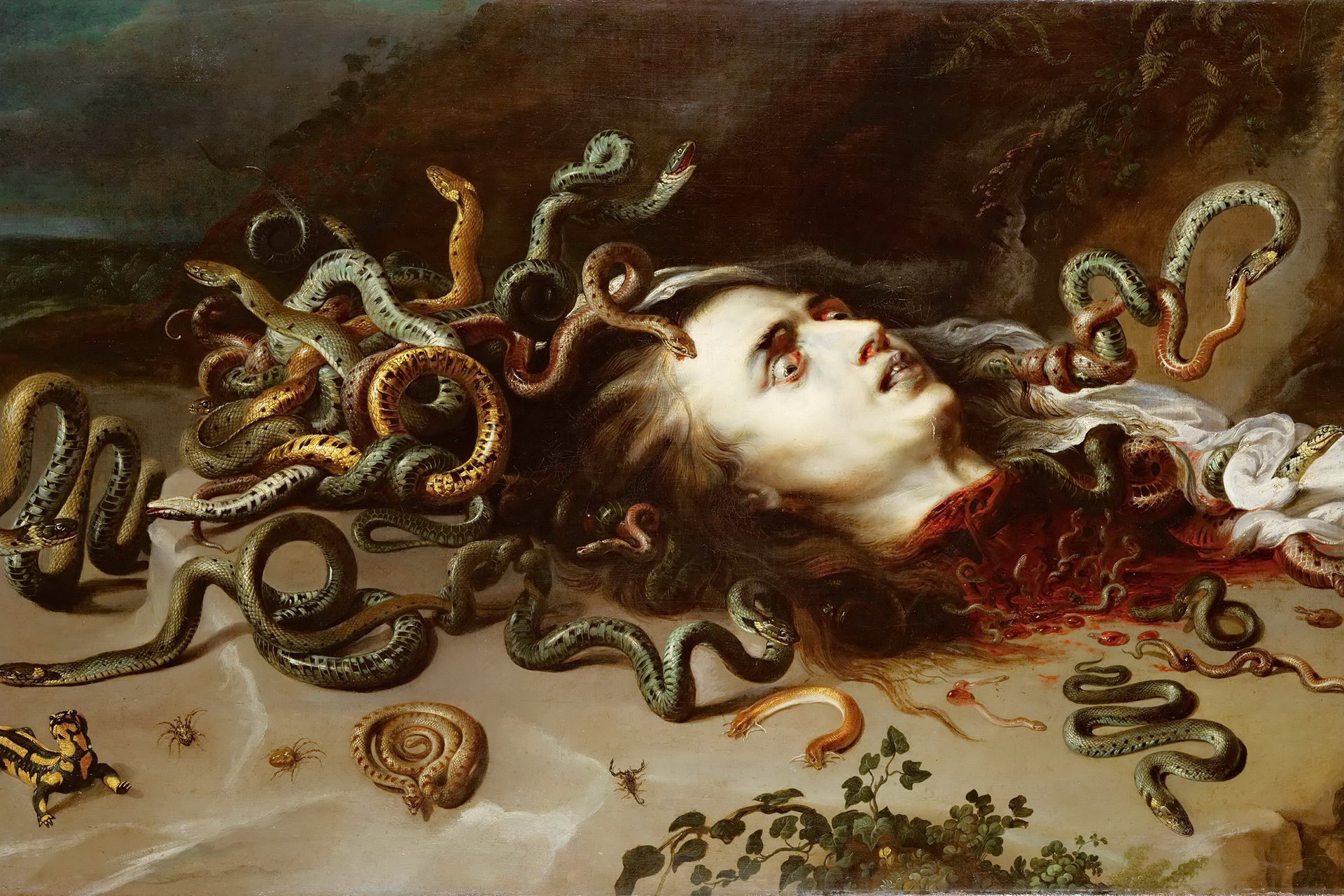
We learn how Medusa came by her notable do. After being sexually assaulted by Poseidon in one of Athena’s temples, the goddess was appalled. No, not by the rape. I mean a god’s gotta do what a god’s gotta do. But that he raped Medusa in Athena’s temple! Desecration! Well, that cannot go unpunished. So, Athena seeks revenge on Poseidon by assaulting Medusa, figuring, we guess, that this might make Poseidon sad, or something. Uses her goddess powers to turn Medusa’s hair to snakes and her eyes to weapons of mass destruction. Any living creature she looks at will be lithified.

description
Image from Mythopedia – Head of Medusa by Peter Paul Rubens – 1618

Then there is the other half of this tale, Perseus. We are treated to his dodgy beginnings, another godly sexual assault. He is not portrayed here as the hero so many ancient writings proclaim. Decent enough kid, living with his mom, Danae, and a stepfather sort, until mom is threatened with being forcibly married to the local king, a total douche. Junior tries to make a deal to get her out of it, said douche sending him on a seemingly impossible quest. Good luck, kid. I mean, seriously, how in hell can he hope to bring back a gorgon’s head?

description
Image from Ancient Origins

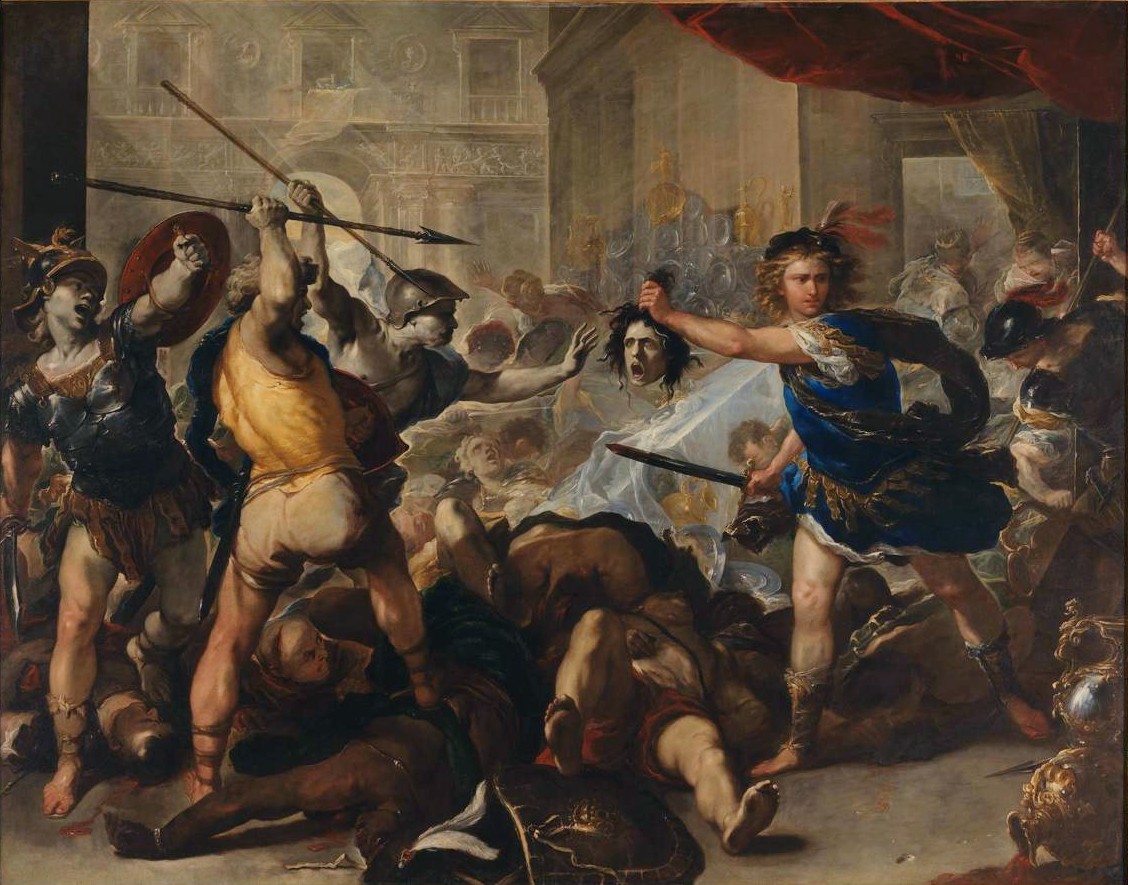
Zeus feels a need to help the kid out. I mean, Perseus may be a bastard, but hey, in Greek mythology, that would put him in the majority. Am I right? Still, he is Zeus’s bastard, so Pop does what he can to help him out, sending along two gods to coach and aid the lad as needed. Hermes and Athena snark all over Perseus, pointing out his many weaknesses and flaws, while providing some very real assistance. They may not hold the kid in high regard, but neither can they piss off the boss. Very high school gym, and totally hilarious.

description
Image from Wiki – Perseus Turning Phineus and his followers to stone by Luca Giordano – 1680s

Which should not be terribly surprising. Haynes is not just an author and classicist, but a stand-up comedian. You can glean what you need to know about her comedic career from the Historical Archivist interview linked in EXTRA STUFF. There is plenty of humor beside godly dissing of Perseus. Athena (referred to as Athene in the book) tries to talk an unnamed mortal into signing on to a huge battle between the Olympian gods and the Giants, new powerhouse versus the current champs. It is clearly a tough sell.

‘If you get trodden on by a giant or a god – which wouldn’t be intentional on our part, incidentally – but in the heat of battle one of us might step in the wrong place and there you’d be. . . . Well, would have been. Anyway, it would be painless. Probably very painful just before it was painless, but not for long.’… ‘Come on. If you do die, I’ll put in a word for you to get a constellation. Promise.’

There are plenty more like these, including a particularly shocking approach to relieving a really bad headache.

description
Image from Scary For Kids (reminds me of the nun I had for eighth grade)

But the whole quest experience uncovers Perseus’s inner god-like inclinations. He becomes an entitled rich kid with far too many high-powered connections helping him out. And develops a taste for slaughter. When Andromeda sees a knight in shining armor, come to save her from certain death by sea monster, her parents suggest that “Maybe, Sweetie, you might consider how gleeful he was when he was murdering defenseless people?” Or noting that if he had really been solid on keeping promises he might have headed straight home to save his mom with that snaky head instead of stopping off to frolic in blood for a few days. “This boy’s gonna be trouble, Andy.”

description
Image from Classical Literature

The gods have issues. The Housewives of Olympus could well include some unspeakable husbands, who seem to have a thing for forcing themselves on whomever (or whatever) catches their eye. As a group they are always on the lookout for slights, insults, or minor border transgressions. What a bunch of whiny bitches! But with power, unfortunately, to make life unspeakable for us mere mortals, whose life expectancy is not even a rounding error to their eternal foolishness. Medusa, in that way, was one of us. There is uncertainty about Perseus.

description
Image from Talking Humanities

Sisters abound. Apparently, triple-sister deities was a thing for the ancient Greeks. We are treated to POVs from Medusa’s two gorgon sibs, and look on as Perseus hoodwinks the three hapless Graiai sisters, who are doomed to having to share a single eye and a single tooth among them. (Could you please wipe that thing off before you pass it along?) The Nereids are more numerous (50) and a bit of a dark force here.

description
From Greek Legends and Myths – by Arnold Böcklin (1827–1901)

Never one to stick to a single POV, Haynes offers us many discrete perspectives over seventy-five chapters. Fifteen are one-offs. The Gorgoneion leads the pack with thirteen chapters, followed by Athene with eleven, Andromeda with eight and Medusa with seven. There are some unusual POVs in the mix, a talking head (no, not David Byrne), a crow, and an olive tree among them. Haynes dips into omniscient narrator mode for a handful of chapters as well.

description
Image From Empire

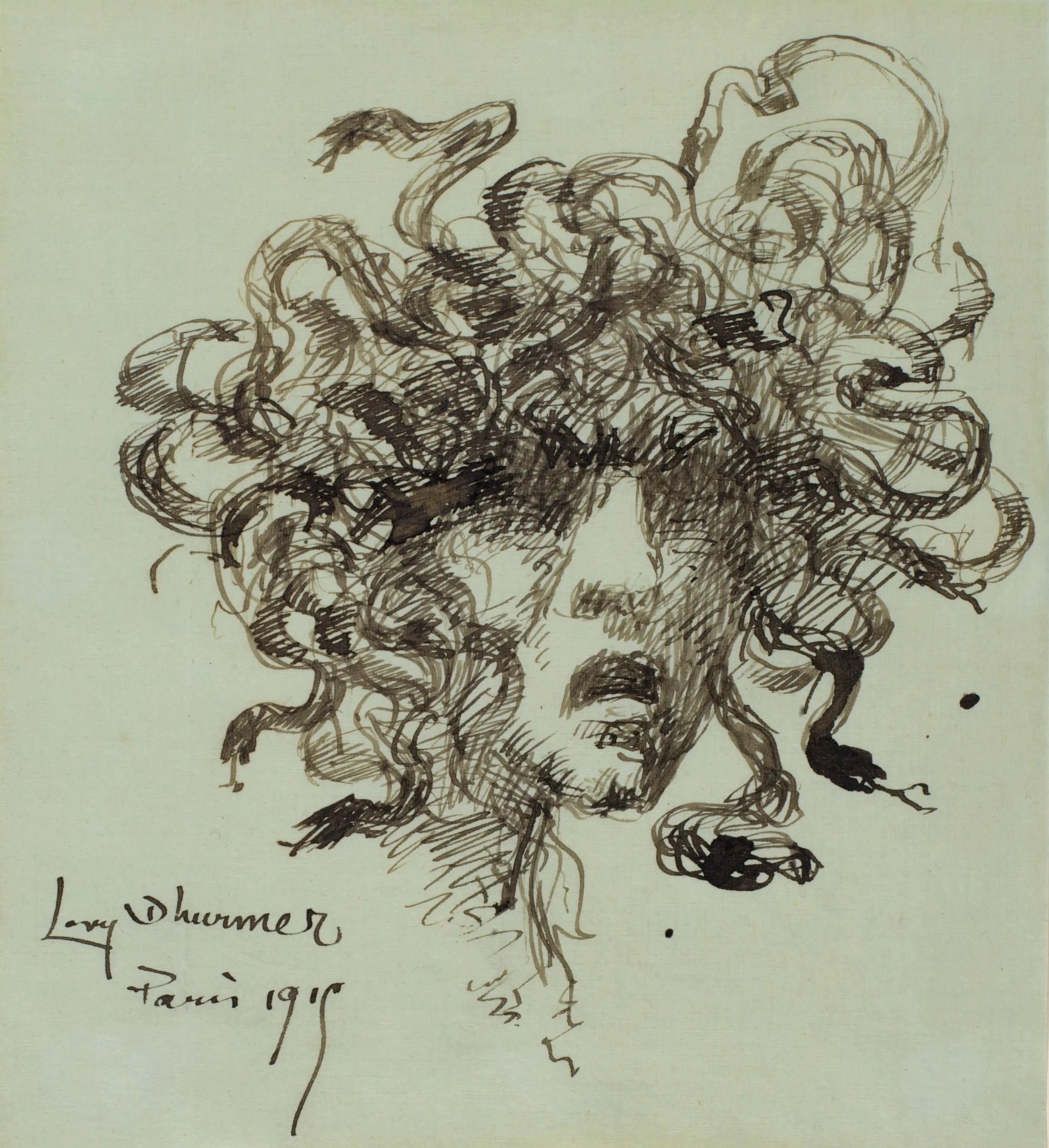
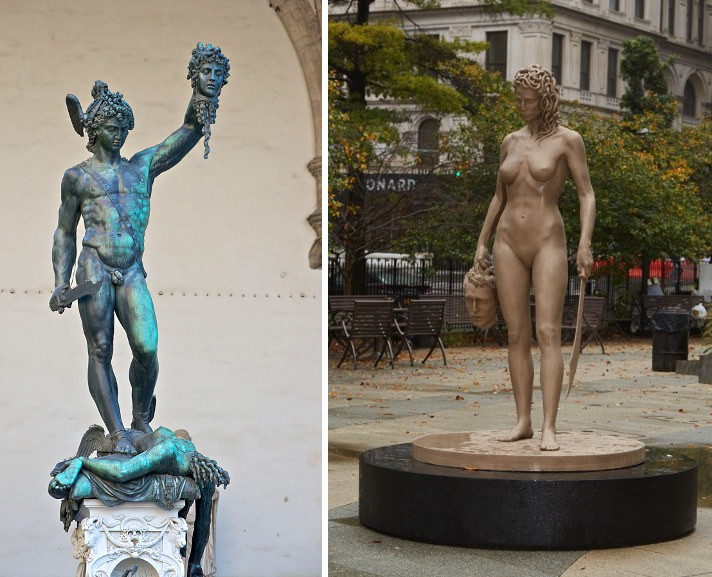
As noted in EXTRA STUFF, there is a particularly offensive sculpture of Perseus holding Medusa’s severed head. Not only has he murdered her, he is standing on her corpse. You can see how this would piss off a classicist who knows that Medusa never hurt anyone. Damage done by her death-gaze was inadvertent or done by others using her head as a weapon. And this supposedly brave warrior killed this woman in her sleep. Studly, no? And with all sorts of magical help from his father’s peeps. What a guy!

description
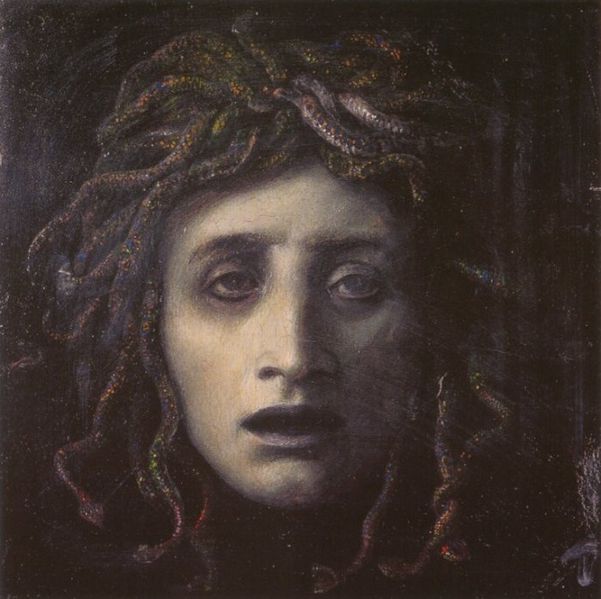
Image from Smithsonian American art Museum – by Lucien Levy-Dhurmer – 1915

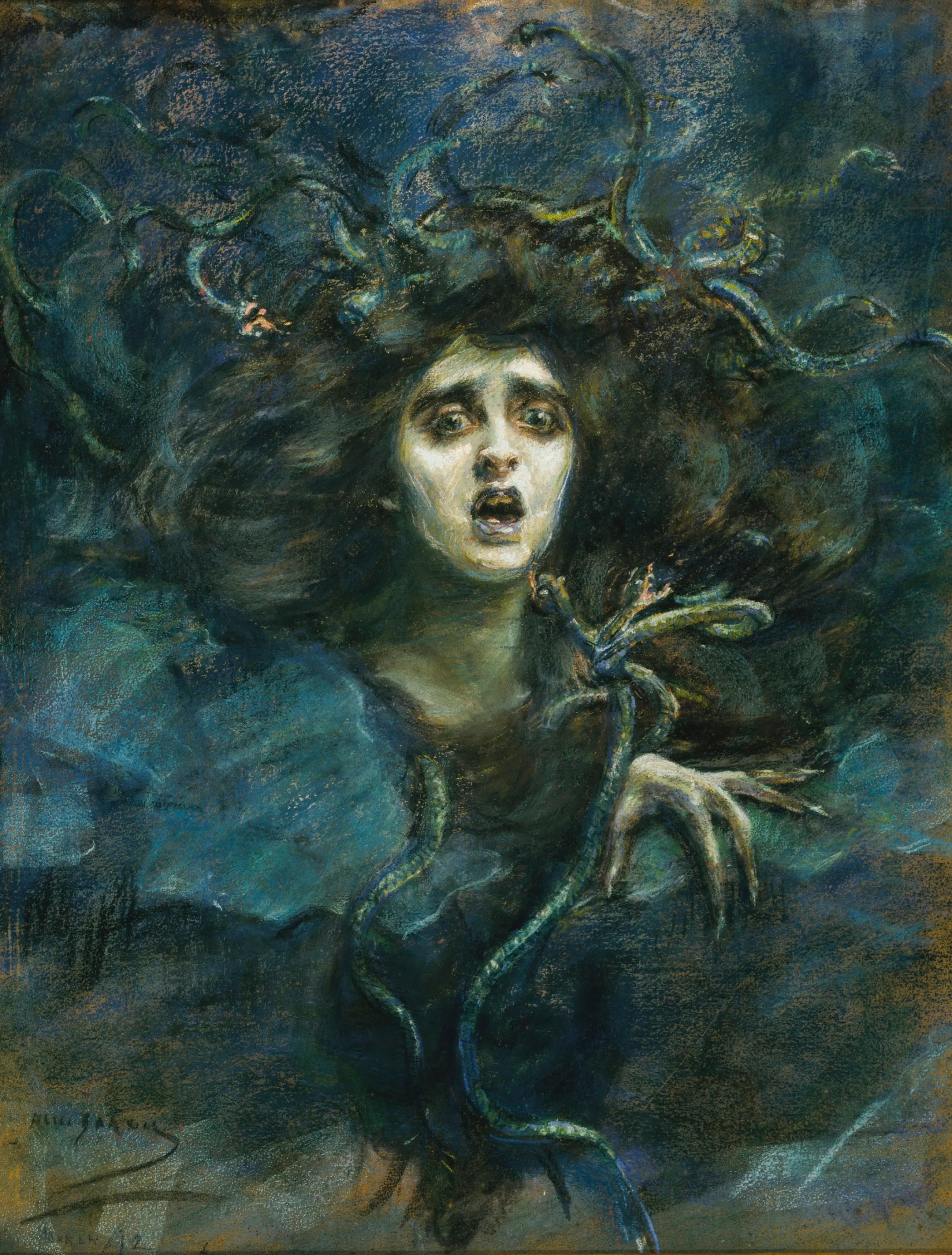
Natalie Haynes set out to tell Medusa’s story, and it is completely clear by the end that the monstrosity here is the treatment this innocent female mortal received, at the hands of abusers both male and female. Haynes keeps the story rolling with the diverse perspectives and short chapters, so that even if you remember most of the classic myth there will be plenty of mythological history you never knew. You will also laugh out loud, which is a pretty good trick for what is really a #METOO novel. The abuse of the powerless, of women in particular, by the powerful has been going on only forever. Haynes has made clear just how the stories we have told for thousands of years reinforce, and even celebrate, that abuse. Next up for her, fiction-wise, is Medea. I can’t wait.

description
Image from Smithsonian American Art Museum – by Alice Pike Barney – 1892

Medusa may not have been a goddess, but it seems quite clear that Natalie Haynes is. This is a wonderful read, not to be missed.

He’s just a bag of meat wandering round, irritating people.’

Review posted – 02/24/23

Publication dates – Hardcover
———-UK – September 15, 2022 Mantle
———-USA – February 7, 2021 – Harper

This review has been cross-posted on GoodReads. Stop by and say Hi!

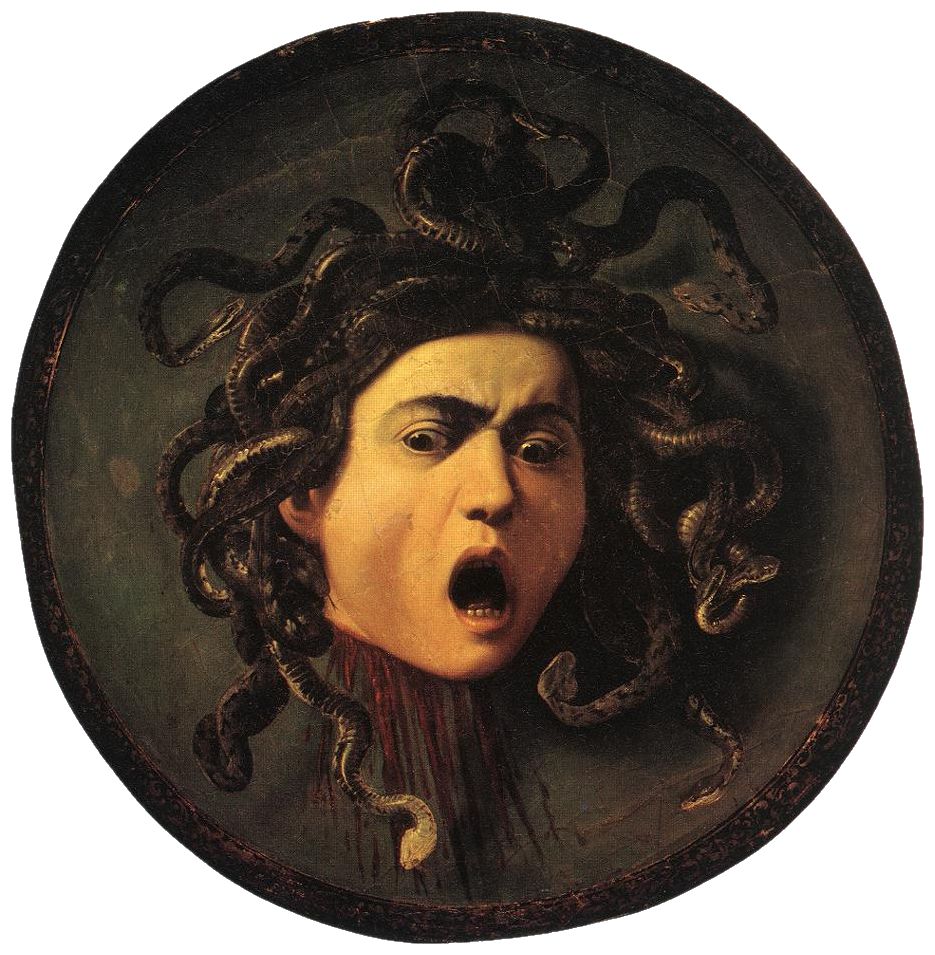
description
Image from Wiki by Caravaggio – 1597

=======================================EXTRA STUFF

Links to the author’s personal, Twitter and Instagram pages

Interviews
—–The Bookseller – Natalie Haynes on challenging patriarchal historical narratives and championing female voices by Alice O’Keeffe
—–CBC – Natalie Haynes on the fantastic and fearsome women of Greek myth
—–LDJ Historical Archivist – Brick Classicist of the Year 2023 Natalie Haynes – video – 16:46 – this is delicious
—–Harvard Bookstore – Natalie Haynes discusses “Stone Blind” – video 1:03:55 – – This is amazing! So much info. You will learn a lot here.

My review of other work by the author
—–2021 (USA) – A Thousand Ships – Helen of Troy and the women of the Homeric epics

Items of Interest
—–Wiki on Gorgoneion
—–The Page 69 Test – Stone Blind – a bit of fluff
—–Widewalls – An Icon of Justice – Or Something Else? A New Medusa in a NYC Park – interesting contemporary sculptural response to a classical outrage.

description
Left: Benvenuto Cellini – Perseus holding the head of Medusa, 1545–1554. Image creative commons / Right: Luciano Garbati – Medusa With The Head of Perseus, 2008-2020. Installed at Collect Pond Park. Courtesy of MWTH Project – images and text from Widewalls article
The MWTH (Medusa with the head) image is sometimes accompanied by the ff: “Be thankful we only want equality and not payback.”

Leave a comment

Filed under Fantasy, Feminism, Fiction, Historical Fiction, Literary Fiction

The Last Chairlift by John Irving

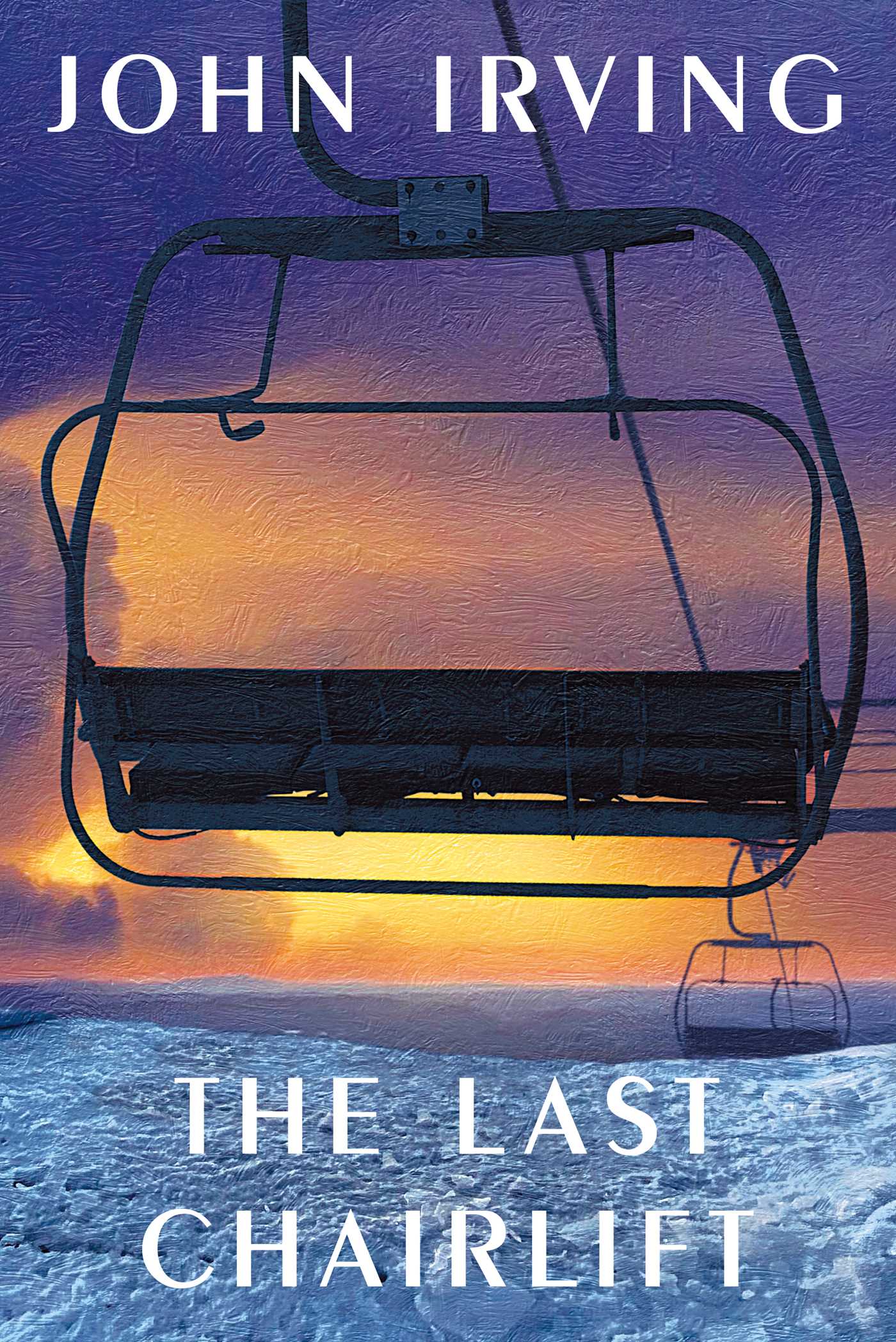
book cover

Think of your first good kiss. Was it life-changing, or was it no big deal? Do you remember how old you were? Did it matter, at the time, who gave it to you? Do you even remember who it was?
I’ll tell you this: when you’re thirteen and your mother gives you your first good kiss, you better hope someone matches it or eclipses it—soon. That’s your only hope.

Autobiography just isn’t good or bad enough to work as fiction… Unrevised, real life is just a mess.

The overall format is one of a frame, with Adam Brewster opening by letting us know that this is the story of his life and times, then returning to turn out the lights when the tale has been completed. It is a family saga of Irving’s era, 50’s 60s, (Vietnam) 70s, 80s (Reagan, AIDS) et al, to the mad, reactionary violence of the 21st century. Adam Brewster, a writer and screenwriter, is our narrator for a look at the sexual politics of a lifetime, from his birth in 1941 to his later days some eighty years on.

Adam’s mother, Rachel Brewster (Little Ray), was a nearly-pro ski nut, who spent large parts of every year on the slopes, settling for work as an instructor. That left Adam in the hands of his grandmother for much of his upbringing, assisted by a passel of relations. He would hunger for time with his only known parent for much of his life, a core element of the novel.

description
John Irving – image from Outside Magazine

Readers of John Irving will recognize much that is familiar, from his prior work and his life. The novel is set in Exeter, New Hampshire, Irving’s home town; includes a benign stepparent teaching at Phillips Exeter (as his actual stepfather did); includes the narrator as a student there. Yep, Irving attended. There is wrestling, of course. Bears are limited to a kind of snowshoe shaped like their paws. A hotel figures large. There is an absent biological father, (Irving’s father was in the US Army Air Force. He never met him.); a mother with too many secrets; there is also reference made to an inappropriate relationship between an adult woman and an underage boy. (something Irving himself experienced); considerable attention is directed to feeling like, to being, an outsider.

”That’s just who you are, Adam,” my older cousin said. “There’s a foreignness inside you—beginning with where you come from. The foreignness is in you—that’s just who you are. You and me and Ray—we’re outliers.”

In fact, Irving turns the tables here, as Adam, as the only straight among the main characters, is the outsider in his own family, always the last to get things, he is nonetheless loved and supported by his sexually diverse relations.

His mother’s lifelong lover, Molly, effectively his stepmother, tells Adam, “There’s more than one way to love people, Kid.” It serves as a core message for the book and for Irving’s oeuvre. One of the main characters is transgender. He first wrote a sympathetic trans character in The World According to Garp, in 1978. So, when his son, born many years after the book was published, came out to his parents as trans, she knew her father would be completely supportive.

The politics of divergent sexuality through time manifests in diverse venues. Raucous comedic material performed at a comedy club in one era is considered too much for a later sensibility, a new puritanism of correctness. Safety for being different is a concern. Adam is very worried when his stepfather is out in their town dressed as a woman, even trails him sometimes in case a backup is needed. Reagan’s unwillingness to address AIDS until six years into his presidency is noted. Acceptance increases over time, but increased acceptance sparks increased resistance. A performer of material deemed unacceptable to some becomes a target for violence in a more disturbed climate.

In addition to the overarching theme of looking at sexual politics, sexuality is shown as far less important than the connection between people. Things that may seem sexual actually have a lot less to do with sex than connection. For instance, Adam and his mother often sleep together, in the slumbering, not biblical sense, well past the age where that is generally deemed ok. There is another relationship in which a straight man and a gay woman share a bed, sans fooling around.

There is hilarity aplenty, not least with Adam’s young sequence of damaged or damaging lovers. Lots of cringy LOL material there. I counted a dozen “LOLs” in my notes, some for entire chapters.

And then there are ghosts. Irving calls this a ghost story. I refer you to a piece on his site that addresses this directly.

Ghosts don’t just warn us about the future; they remind us of what we’ve forgotten about the past. All this is to say, I have a history of being interested in ghosts. And here come the ghosts again. In my new novel…the ghosts are more prominent than before; the ghosts, or hints of ghosts, begin and end the novel.

We all have ghosts we live with, but the ones here are visible, well, to some, anyway. They hang out in large numbers at a hotel in Aspen, but also turn up at home. The spectres are historical and familial, with some able to interact with the physical world (sometimes with LOL results) sometimes condemned to remain non-impactful. They do indeed, as noted above, remind us of the past, sometimes darkly so, but some offer direction and comfort. And Irving uses his behemoth of a novel to keep generating new ones. They pass over in a wide range of ways; lightning, murder on a stage, sudden avalanche, cancer, suicide, murder in a hotel, falling from a chairlift, leaping from a chairlift, death in war, et al. Falkner famously said “The past is never dead. It’s not even the past.” I guess it could be said for many characters in The Last Chairlift that even the dead are never entirely dead.

Adam’s profession offers ample opportunity for Irving (winner of a National Book Award AND a screenwriting Oscar) to present a wealth of material about writing, both for the screen and for print.

“My life could be a movie,” you hear people say, but what do they mean? Don’t they mean their lives are too incredible to be real—too unbelievably good or bad? “My life could be a movie” means you think movies are both less than realistic and more than you can expect from real life. “My life could be a movie” means you think your life has been special enough to get made as a movie; it means you think your life has been spectacularly blessed or cursed.
But my life is a movie, and not for the usual self-congratulatory or self-pitying reasons. My life is a movie because I’m a screenwriter. I’m first and foremost a novelist, but even when I write a novel, I’m a visualizer—I’m seeing the story unfold as if it were already on film.

Imagining the stories you want to write, and waiting to write them, is part of the writing process—like thinking about the characters you want to create, but not creating them. Yet when I did this, when I was just a kid at Exeter—when I thought about writing all the time, but I never finished anything I was writing—this amounted to little more than daydreaming.

you don’t see with hindsight in a first draft. You have to finish the first draft to see what you’ve missed.

Fiction writers like what we call truthful exaggeration. When we write about something that really happened—or it almost happened, could have happened—we just enhance what happened. Essentially, the story remains real, but we make it better than it truly was, or we make it more awful—­depending on our inclination.

There are many more—it is a very long book—but this last one in particular speaks very directly to Irving’s process. As noted up top, he returns to familiar themes and situations. In interviews he says that he begins with the same life experiences, but then changes where they go, how they morph, as if his creative process was to take the stem cells of his experiences and direct them to grow into a wide range of possible pieces. Same source, different outcomes.

It is not just the characters and situation that have morphed, it is the form as well. As Adam is a screenwriter as well as a novelist, and as this story is Adam’s, it is fitting that how he perceives the world makes its way into how he presents his story. There are long chapters that are written in screenplay format, complete with fade-ins, fade-outs, off-screen narration, closeups, wide-shots, the whole toolkit. It is an interesting tactic. I found it off-putting, but it does allow for a different approach to the material.

He does not just talk about writing per se, but incorporates into the novel considerable attention to his favorite book of all time, Moby Dick. (he has the last line of Moby Dick tattooed on his left forearm) This book opens with My mother named me Adam…, which resonates with Call me Ishmael and no less with …I am born from David Copperfield, Dickens being a particular Irving favorite. He sees himself as more of a 19th century novelist than a 21st century one.

…because those novels have always represented the model of the form for me. I loathed Hemingway. I thought Faulkner was excessive. Fitzgerald was ok, but lazy at times. I was enamored of the kind of novel all of my classmates at school despised.

References to Melville’s masterpiece (sometimes hilariously), Dickens, Ibsen, and plenty of others abound.

It is pretty clear that John Irving has had an interesting life. Eighty years old at the time of publication, he does not see The Last Chairlift as his last hurrah. In fact, he signed a three-book deal with Simon and Schuster, of which this was merely the first. He promises, though, that the next two will be a lot shorter.

Until then, this one will certainly suffice. Irving has lost none of his sense of humor. This book was more than occasionally laugh-out-loud funny. He has lost none of his feel for writing relatable humans. While some of the supporting cast are painted in broad strokes, to illustrate this or that sociopolitical issue of a given time, the main ones, and even hordes of second-tier characters are drawn with fine lines, and deep sensitivity. He has lost none of his vision, seeing clearly the currents of the eras considered, and how those have impacted social and political possibility for rounded humans who do not fit the square holes of a boilerplate majority. For all that Irving writes about people who are different, he makes it eminently clear that in matters that count we all share the same needs, to be loved, seen, and respected for who we are. Here’s hoping it will not be another seven years until we get to enjoy another of John Irving’s marvelous works.

…the dead don’t entirely go away—not if you see them on the subway, or in your heart.

Review posted – February 17, 2023

Publication date – October 18, 2022

I received an ARE of The Last Chairlift from Simon & Schuster in return for a fair review. Thanks, folks, and thanks to NetGalley for facilitating.

This review has been cross-posted on GoodReads. Stop by and say Hi!

=======================================EXTRA STUFF

Irving’s personal and FB pages

Interviews
—–CBS Sunday Morning – John Irving: A Writer’s Life with Rita Braver – a delight – Sees himself as a 19th century writer
—–Late Night with Seth Meyers – John Irving Doesn’t Write a Book Until He Knows How It’s Going to End
—–Freethought Matters – Freethought Matters: John Irving
– video – 28:08 – with Ann Laurie Gaylor and Dan Barker – Interview begins at 2:57 – focus on chairlift begins at about 18:00
—–NPR Podcasts – Book of the Day – ‘The Last Chairlift’ is John Irving’s latest novel on sexual politics with Scott Simon – Audio – 10:26
—–Hazlift – ‘Hope is an Elusive Quality’: An Interview with John Irving by Haley Cunningham
—–Toronto Star – Hugging us back in the dark: John Irving on making us care about his characters, sexual politics, and the ghosts in his new book ‘The Last Chairlift’ by Deborah Dundas

Items of Interest from the author
—–Here Come the Ghosts Again on ghosts in his novels
—–CBS News – excerpt
—–Lithub – excerpt

My review of another book by Irving
—–In One Person

Items of Interest
—– Moby Dick – Full text – with annotations
—–David Copperfield – Full text – with footnote annotations

Items of Interest from the author
—– Here Come the Ghosts Againon ghosts in his novels

Leave a comment

Filed under Feminism, Fiction, Historical Fiction, Literary Fiction, Reviews

The Night Ship by Jess Kidd

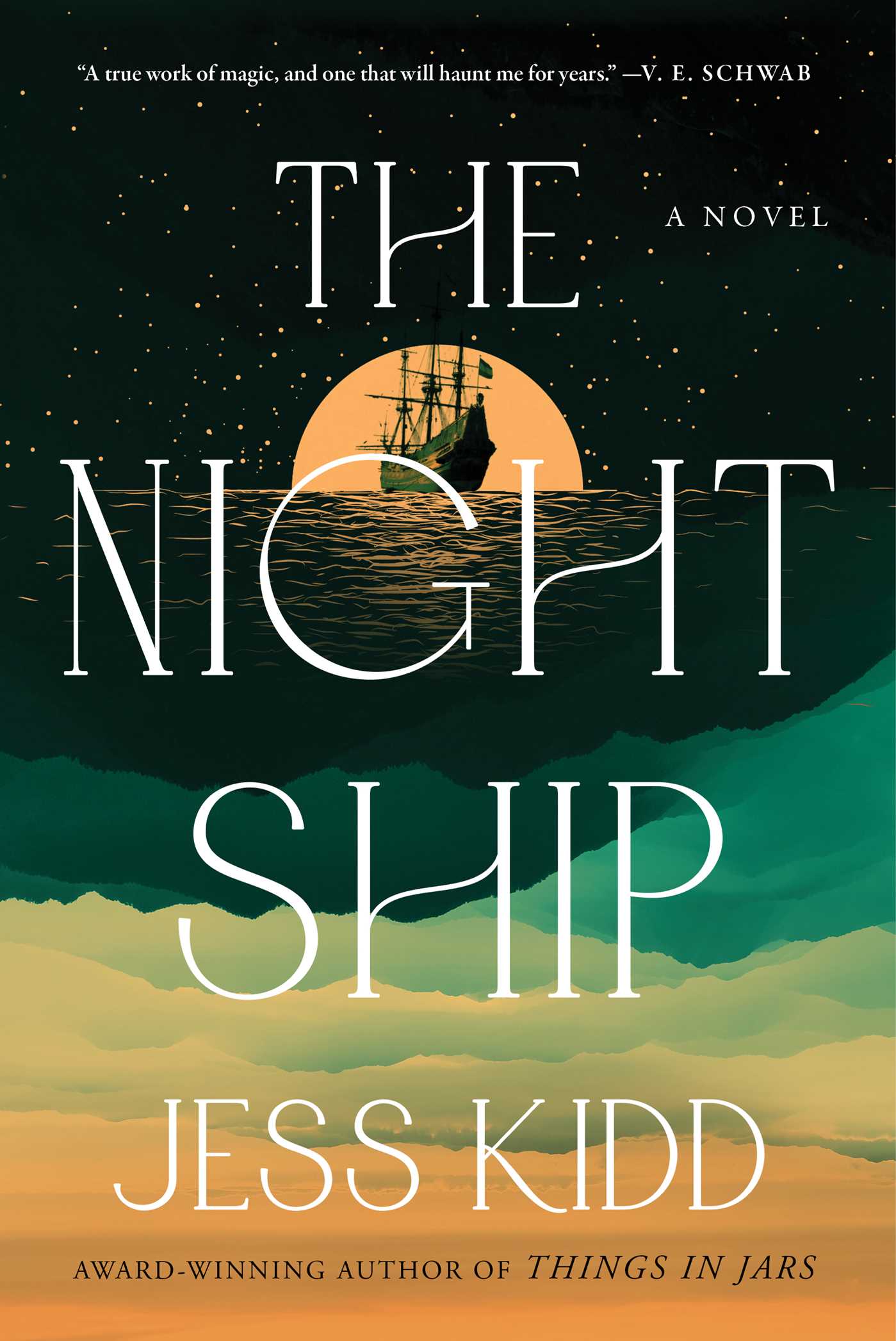
book cover

“Come.” John Pinten turns and puts his palm against the hull. “Do as I do.”
Mayken crawls forward and puts her palm next to his, flat against the planks. She sees how much smaller and cleaner her hand is. Too clean for a cabin boy. But John Pinten doesn’t seem to notice.
“She’s all that lies between us and the deep dark fathoms of the sea.” John Pinten’s voice grows quiet, grave. “Can you feel the ocean pulling at the nail heads, pressing against the planks, prizing the caulking? The water wants in.”

Old superstitions are rife now. The sailors lead the way. Words must be chanted over knots. Messmates must be served in a particular order. A change of wind direction must be greeted. Portents are looked for and translated. The cut of the wake noted. The shape of clouds debated…A lamp taken down into the hold will now burn green. Monstrous births plague the onboard animals. Their issue is hastily thrown overboard to prevent alarm. Eyeless lambs. Mouthless piglets. A litter of rabbits joined together, a mass of heads and limbs. The gardener harvests fork-tailed carrots from his boxed plot outside the hen coop.
“It’s the way of long journeys,” says Creesje. “They alter what people think and see.”

1628 – Mayken van der Heuvel heads out on a long, exciting, but very dangerous adventure. She is setting sail on the grandest ship of the era, the Batavia, to a place by the same name, the capital of the Dutch East Indies. Well, in 1628, anyway. Today, we know it as Jakarta, Indonesia. Her journey is not being undertaken by choice, though. Mayken’s mother died giving birth to a child not her husband’s. The girl is being sent to her father, accompanied by a nursemaid, the kindly, but very superstitious, Imke. Mayken is nine years old.

There are many layers to this child: undergarments, middle garments, and top garments. Mayken is made of pale skin and small white teeth and fine fair hair and linen and lace and wool and leather. There are treasures sewn into the seams of her clothing, small and valuable, like her.
Mayken has a father she’s never met. Her father is a merchant who lives in a distant land where the midday sun is fierce enough to melt a Dutch child.

We follow Mayken’s adventures on this months-long journey across the world. But we know from the beginning that the ship will not complete its trip.

1989 – A nine-year-old boy has just endured a journey of his own.

Gil is made of pale skin and red hair and thrifted clothes. His shoes, worn down on the outsides, lend an awkward camber to his walk. Old ladies like him, they think he’s old-fashioned. Truck drivers like him because he takes an interest in their rigs. Everyone else finds him weird.

He never knew his father, and Mom kept them on the move all of his brief life, until her death. Gil has been sent to live with his crusty fisherman grandfather, Joss. To the place off the west coast of Australia where the off-course Batavia met its inglorious end. Researchers have been retrieving bits of the ship and its contents. The island is said to be haunted by the spirit of a young girl, Little May.

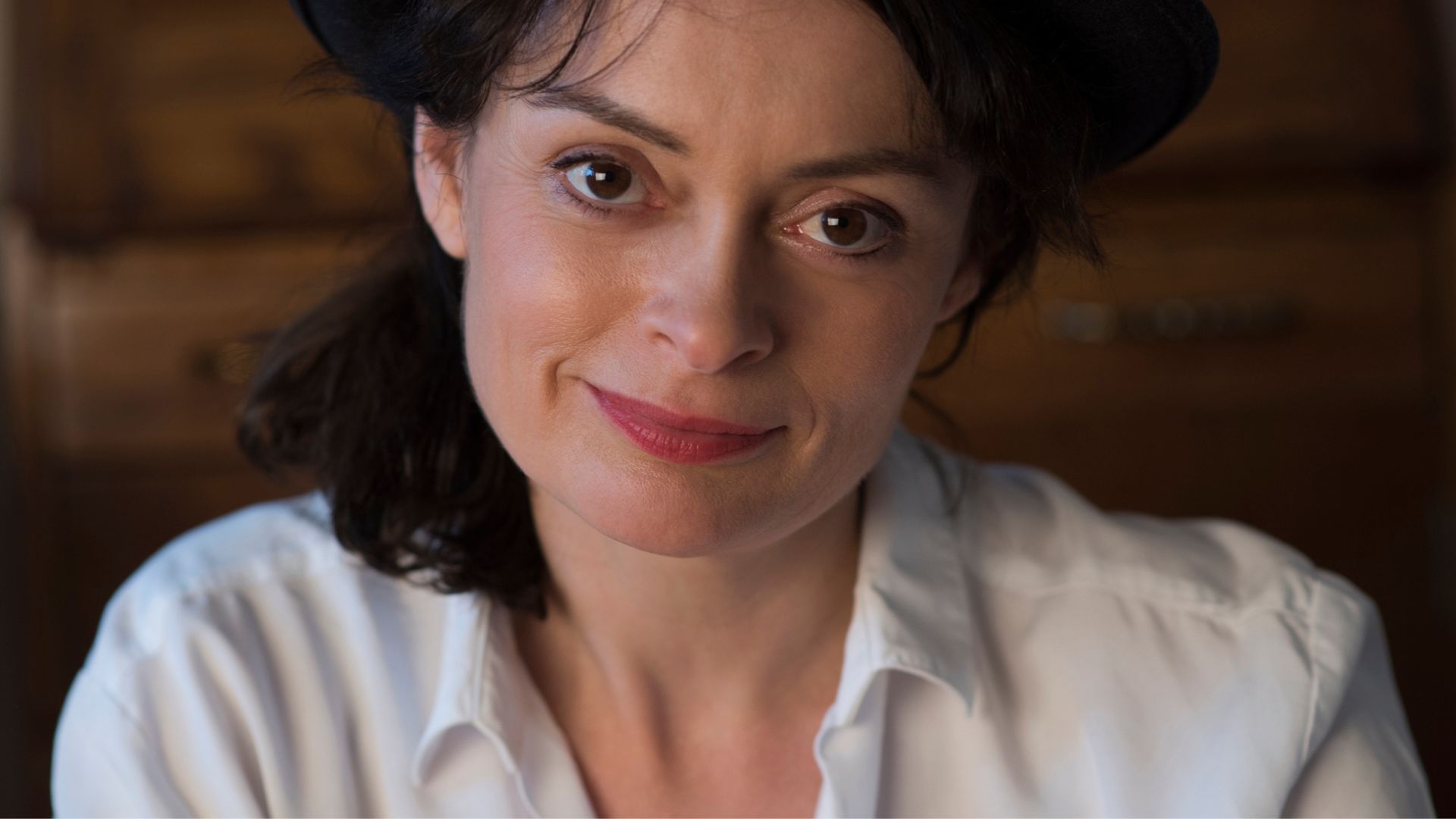
description
Jess Kidd – image from The Bookseller – by Cordula Tremi

Kidd learned about the Batavia while casting about for a subject for her next novel. I will leave you to explore the real-life story here in Wikipedia and in the Sea Museum site.

Mayken and Gil’s stories are told in alternating chapters. The duration of their experiences, however, is not the same. Mayken’s time on the Batavia is considerably longer than Gil’s, on what is now Beacon Island. Kidd handles this disparity well, so that difference is not obvious.

Mayken is a particularly curious and adventurous little girl, exploring and experiencing the ship with a range of partners, despite her caretakers preferring for her to be a demure, proper young lady. She has a talent for gaining trust and affection from those around her, both children and adults. It comes in handy. Being a child, she carries some odd notions with her, and is susceptible to things that challenge credulity. She is convinced that there is a mythical beast in the deep hold of the ship. (The eel creature was an ancient monster and foe of all humankind. Its name was Bullebak.) Is the evidence she spies of its existence sharp perception or childish imagination? Being the child of a wealthy household, she gains a lot more latitude from those in charge than a street urchin might, which allows her to get away with slipping away from the “Above World” of the deck and passengers to the “Below World” where the crew lives and works.

description
The Batavia replica was constructed between 1985 and 1995 at the Bataviawerf (Batavia shipyard) in Lelystad, The Netherlands. Image: Malis via Wiki Commons – image and text from Sea Museum

Gil is a lonely boy, who has seen little stability in his life, and more than his share of horror. Grandpa Joss is less than welcoming, (Gil’s mother had not exactly been a model daughter.) wants him to become a fisherman like him, an occupation to which Gil is ill-suited and strongly opposed. He finds a friend or two. Silvia, the young wife of an older fisherman (and hated rival to his grandfather) takes him under her wing. Dutch, an older deckhand, takes an interest in him as well. In addition, Gil acquires a companion of a different sort, Enkidu, a tortoise named for a bff from ancient literature.

There are challenges to survival for both Mayken and Gil, not just their initial de-parenting trauma and grief. In fact there is enough mirroring of their experiences for a carnival fun house. Both are, effectively, orphaned only children, with dead mothers and absent fathers, sent to live with relations after the death of their mothers. Both explore strange new places, with the assistance of those more familiar. Both have a belief in the reality of supposedly mythical beings, finding it easier to seek explanations for the world in cultural fantasies than in the awfulness of the humans around them. (The shadow-monster darkens and becomes solid. It is terrible. Slime slicks and drips over ancient barnacled scales. Eyes, luminous and bulging. Gills rattling venomously. A great, festering eel-king.) It is called a Bunyip.

Both are outsiders, in peril from people in their community. There is plenty more. But both come into possession of a stone with a hole in it, that is supposed to have special properties, a witch-stone, or hag-stone. The very same one. It is a link across three hundred sixty years, connecting their parallel experiences. As children, neither has control over much of anything, so they are both at the mercy of the adults around them, not all of whom are benign. With limited immediate familial resources, they are trying to create a kind of family for themselves.
description
This engraving depicts three scenes associated with the loss of the Dutch ship Batavia in 1629. Top: Batavia approaches the Houtman Abrolhos Islands off Western Australia at night. Lower right: the vessel aground on a reef with the crew in boats attempting to refloat it. Lower left: the state of the Batavia the next day, and the passengers and crew abandoning the ship. ANMM Collection 00004993

One of the wonderful things about this novel is the view we get of a lengthy ocean voyage in the 17th century.

The physical research helped. “Bumping my head about 400 times as I walked around the ‘Batavia’ replica, it really helped to get a physical sense of the life. The same with the island, walking around and seeing the barrenness and feeling the elements.” – from The Bookseller interview

The demise of the ship is terrifying, but not so much as the demise of civilization that follows for the survivors. Existential threats abound in 1989 as well, for Gil and others.

There are many compelling secondary characters. Several on the ship stand out, a soldier, John Pinten, the ship’s doctor, Aris Jansz, Holdfast, a denizen of the rigging, who snatches Mayken up. Imke the nursemaid is a fun addition, and Creesje, who looks to help Mayken going forward, is a warm, nurturing presence. Those surrounding Gil are likewise interesting. Gil’s colorful grandfather, Joss, goes through some changes. Dutch is a warm force, as is a researcher, on the island looking into the wreck.

While Mayken and Gil are entirely fictional, Kidd has populated her story with many of the actual people who were on the Batavia. The presence of those historical personages gives the events that take place in the novel even greater heft. The kids are very nicely drawn, and will engage your interest and sympathy.

description
Wallabi Island (left), Beacon Island (centre) and Morning Reef (right). Image: Hesperian with NASA satellite photos via Wiki Commons. – image and text from Sea Museum

Tension ratchets up for both Mayken and Gil. While we know the fate of the Batavia, we do not know the fate of all those she carried.

Unlike in her previous book, Things in Jars, which dealt very considerably with things fantastical, the unreality of the creatures May and Gil perceive is much more subtle. The creatures both claim to be real may or may not be. But both creatures serve admirably as metaphors for the awfulness of humanity.

While this may not be the best possible choice for reading on a ship-based vacation, it is a moving and fascinating read for landlubbers. Kidd writes with the touch of the poet, adorning her compelling, moving story with sparkling descriptive finery, while offering us a child’s-eye view of the most remarkable ship of its time, and telling a tale of doom. Both Gil’s and Mayken’s stories are strong enough masts to have sailed alone, but together they make a weatherly craft and catch a strong wind, easily speeding past potential story-telling shoals.

“How do you describe dread, Gil? That’s what the bunyip is: an attempt to give fear a shape.”
Gil thinks on this.
“Everyone’s fear looks different,” Birgit continues. “So everyone’s creature looks different. But they all eat crayfish, women, and children. That seems to be universal.”
“They’re just warnings for kids. Not to play near water or talk to strangers.”

Review posted – December 16, 2022

Publication date – October 18, 2022

I received an ARE of The Night Ship from Atria in return for a fair review, and a small, ancient piece of (maybe) bone, recently dug up in our back yard. Thanks, folks.

This review has been cross-posted on GoodReads

=======================================EXTRA STUFF

Links to Kidd’s personal, Twitter, Goodreads, Instagram and FB pages

Interviews
—–The Bookseller – Jess Kidd discusses her latest novel, new perspectives and maritime disasters by Alice O’Keefe
—–BNBook Club Jess Kidd discusses SCATTERED SHOWERS with Miwa Messer and Shannon DeVito – video – 41:28 – forget the title – they talk about The Night Ship

My review of an earlier book by the author
—–Things in Jars

Items of Interest
—–Wiki on The Batavia
—–Sea Museum – The Batavia
—–Wiki on Beacon Island
—–The Wayback Machine – Batavia’s Graveyard
—–Western Australian Museum – Batavia’s History
—–Dutch Folklore Wikia – Bullebak
—–American Museum of Natural History – The Bunyip
—–Wiki on Bunyip

Leave a comment

Filed under Fantasy, Fiction, Historical Fiction, Literary Fiction

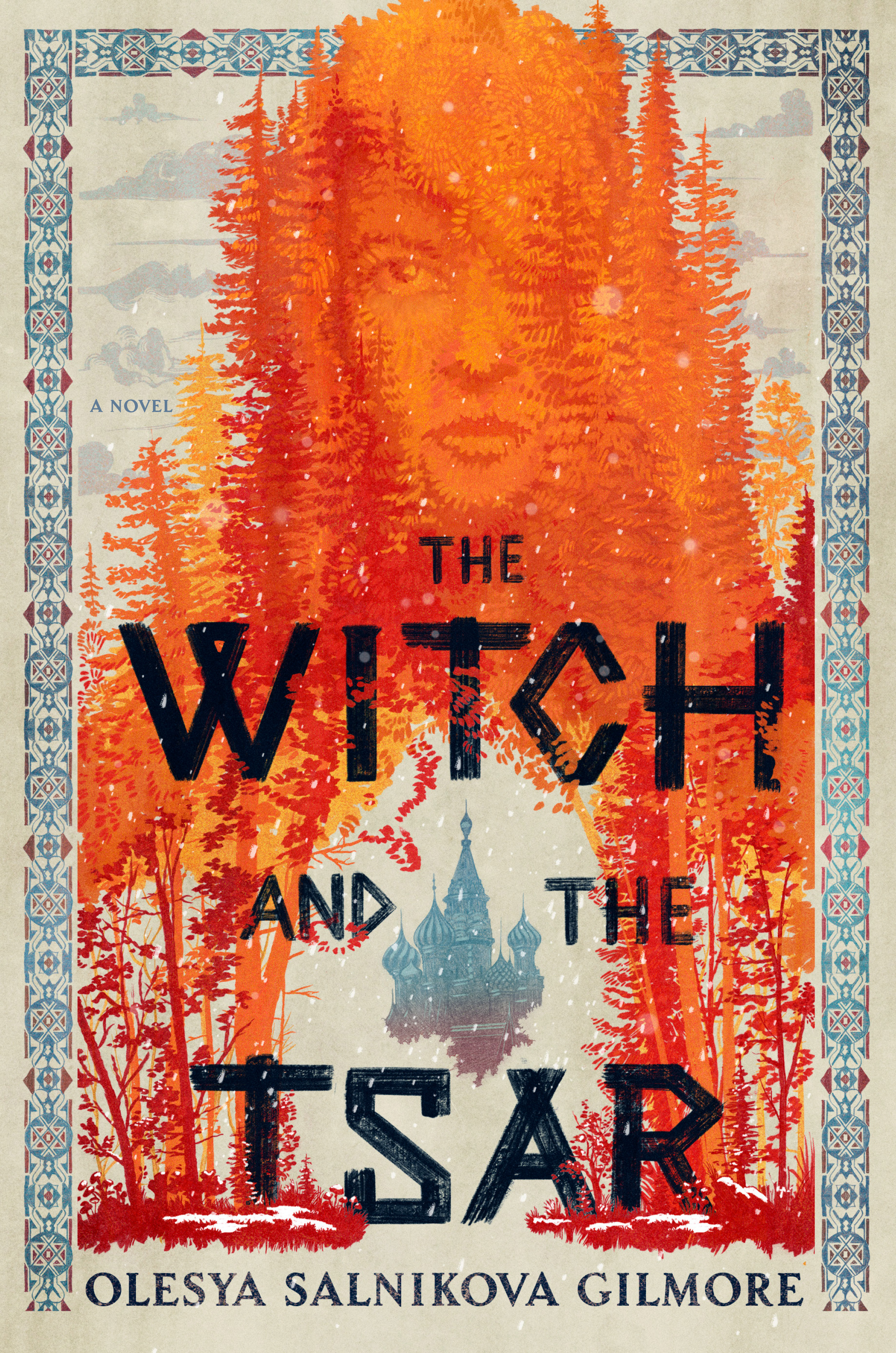
The Witch and the Tsar by Olesya Salnikova Gilmore

book cover

Once war is on men’s minds, Selica had said, it festers within, claiming them.

For a soldier to let his enemy live despite the entrenched inclination to kill touched my heart with a flame. And as he looked out on our land, on the people dying and bleeding on it, no matter if they were Russian or Mongol, I saw pain, deep and endless and raw, open inside him like a ravine about to swallow us. There was light there, light that left me hopeful. Perhaps life, possibly even goodness, did exist, even in a soldier, and it prevailed in the world after all.

Baba Yaga, aka Bony Legs, has gotten a bad rap. Ivan the Terrible, however, deserves all the lousy press that can be heaped upon him. Terrible seems far too tame a word, The monstrous, the psycho-killer, the unspeakable, the mindless slayer of mankind, and on, and on, [insert your pejorative here]. (Of course, this is the portrait presented in the book. The real-life Ivan may have had cause for his paranoia, given the considerable opposition of the gentry to many of his policies. Find out more in this small piece in Britannica.)

description
Olesya Salnikova Gilmore – image from her site

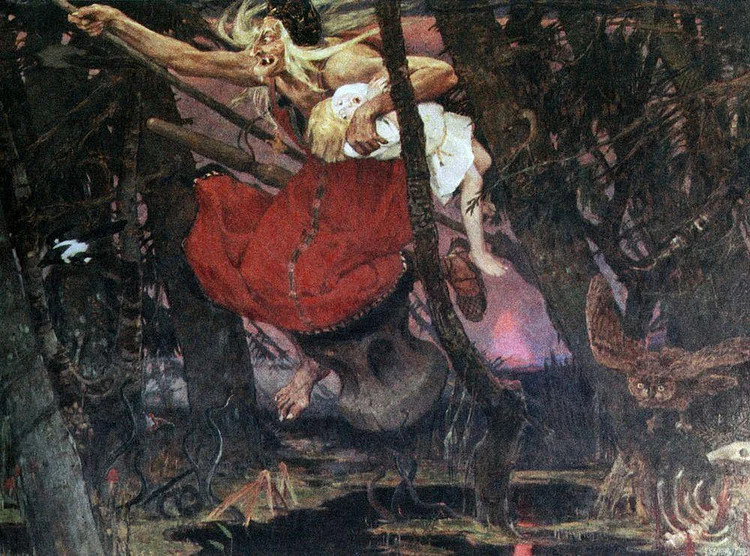
The most common images of Yaga are of a frightening witch, tooling about in a strange vehicle, trapping and devouring children, and generally doing dirt to people, a personification of evil. But even in traditional lore, she is sometimes shown with a softer side, a healer instead of a tormenter, a consoler, a comforter instead of a horror. She has been seen as a personification of nature, a Slavic version of Persephone. She appears as a change agent in many stories, a trickster, helping the hero or heroine fulfill their quest.

description
Image from The House of Twigs

I had written two books that had gone nowhere. Totally uninspired, almost desperate, I turned to the Russian folktales I had grown up with as a child. Baba Yaga loomed large in these stories—her elusive and mercurial character, her enchanting chicken-legged hut, her terrific mortar and pestle mode of transport, her sharp tongue and fearsome appearance, unsurprising for a woman of knowledge living alone in the wood.
As it turns out, some scholars believe the Baba Yaga we know—the old, ugly hag from the fairy tales—is based on, or is a descendent of, a fertility and earth goddess worshiped by ancient pagan Slavs. I was instantly fascinated by how a goddess could become a witch and just knew I had to write a book not about the infamous hag, but about the little-known woman named Yaga.
– from the Writer’s Digest interview

description
A painting portraying Baba Yaga. According to Slavic folklore, Baba Yaga was a witch who often preys on children to eat them. However, some accounts present her as a wise and helpful creature. The painting was created in 1917 and is now located at the House Museum of Viktor Vasnetsov in Moscow.

Gilmore is looking to give Yaga some better press, make her more human in some ways, more of a bad-ass superhero in others. She has a team, of course. (Y-men?) The house on chicken legs that is the very definition of creepy, has been transformed into Little Hen, a supportive, nurturing friendly character who might have been the original mobile home. When Yaga speaks to Little Hen she regards her as somewhere between a beloved pet and a partner. Dyen (meaning day) is a considerable wolf. He (thankfully) is Yaga’s primary means of high speed transportation, while also offering his considerable fierceness. Noch (meaning night) is an owl. Noch specializes in reconnaissance and intel-gathering. They share Yaga’s immortality.

description
Xénia Hoffmeisterová [cs], Ježibaba [cs] (2000)

As a provider of potions for this and that, Yaga has a following. Among those is the tsar’s wife, the tsaritsa, whom she has known for a long time. She is suffering from an illness that the court physicians cannot seem to touch. Yaga helps her out, but suspects foul play. Although she would prefer to remain safely in her house in the woods, she must go to Moscow to find out who is doing this to Anastasia Romanovna, a kind, sweet young woman. It would appear that Yaga and crew are not the only immortals wandering about. The tsar has fallen under the influence of a dark-hearted ageless sort, someone Yaga knows. And the game is afoot.

description
Image from King Edward’s Music

Tsar Ivan is not exactly the best administrator, and it is not long before he is laying waste to large swaths of the country, under the guidance of a dark force. Whether getting there because of his genetic inheritance, or because his mind had been poisoned by a demonic sort, (The actual Ivan was quite superstitious, taking an interest in witchcraft and the occult.) Ivan, who seems at least somewhat rational when we meet him, is soon barking mad, seeing enemies everywhere, even among friends, and showing no hesitation about slaughtering anyone who displeases him. Yaga loves her Mother Russia and considers it her patriotic duty to defend her against enemies foreign and domestic. Ivan definitely counts among the latter. So, superhero vs supervillain.

description
Ivan Bilibin, Baba Yaga, illustration in 1911 from “The tale of the three tsar’s wonders and of Ivashka, the priest’s son” (A. S. Roslavlev)

There are levels of existence here with diverse characteristics, lands of the dead and living, a glass mountain, with spells aplenty. Yaga’s adventures might remind you of western mythology and Campbellian quest forms having to do with descending to hell in order to emerge better armed to take on whatever. Yaga needs help from other immortal sorts to accomplish her mission, which becomes pointedly clear later in the book. In the shorter term, she is faced with carnage in Russia, and trying to find ways to stop or even just slow it down.

description
Baba Yaga depicted in Tales of the Russian People (published by V. A. Gatsuk in Moscow in 1894)

There is even a bit of romance to counterbalance some of the considerable blood-letting.

After I had witnessed my first birthing not ten years into my life, Mokosh had explained to me the intricacies of lovemaking and child making. “Though immortals can birth other gods and half gods,” she had said, gently, “it is not simple for us, with mortals above all. Most of the time, it happens not. It is even harder for half gods. If it happens, it does so for a reason. It is willed by the Universe.” I had known many men over the centuries, both mortal and immortal. Not once had my trysts ended in anything other than fleeting pleasure or pointless regret. I knew it would never happen for me.

But then she meets Vasily Alekseyevich Adashev, studly warrior, but mortal, which is a problem. It gets complicated. He is probably in his 20s or 30s, she is several hundred. (Baba Cougar?) It is a delightful element.

This is a time of transition in Russia, when the old gods were being replaced by the Christian invader. But local loyalties were sometimes with the old and sometimes with the new. Yet, the old gods were still actively interfering in human activities. Getting a look at such a tumultuous period in Russian history is one of the bonuses of this book.

description
Image from Meet the Slavs

The view of reality Gilmore presents is informed by her childhood exposure to Russian mythology. She was born in Moscow and spent her early years there. Fairy tales from childhood figure large, particularly stories set in Old Russia. (Gilmore would have included even more, but maybe in some future work.) Setting her tale in medieval times felt right, which led to focusing on Ivan as THE medieval tsar. It helped that he made an ideal villain, given his location in history, his interest in the occult, and his apparently mass murderous sociopathy. What makes a guy go there?

This being a book by a Russian-born author, about Russia, you can expect that many characters will be referred to be multiple names. And it can be tricky discerning the good Ivans, Vasilies and Alexes from the bad ones. I read an ARE, so cannot say if the final print (and epub) versions contain character lists. If your copy lacks one, you might want to start your own. My minimal gripes about the book have to do with the attention required to keep everyone straight, and a need for a primer on the structure of everything in Old Russian lore. How many layers of afterlife are there? How does one move from to another? It can be eye-crossing keeping this in order.

description
Image from Amino Apps

That said, I found The Witch and the Tsar a delightful, satisfying read. Yaga was a very appealing character. Gilmore has succeeded in making her relatable, and her companions appealing. The devastation wrought by Ivan and those driving him provide all the motive force anyone might require to do everything possible to stop it, which gives us a lot to root for. The romantic element is a nice touch. Added payload on Russian history, folklore, and old religion is most appreciated. I have provided a few links in EXTRA STUFF to more about Yaga in folklore. I urge you to check those out. Baba Yaga may have had plenty of unpleasant things written about her, and many a hideous image created, but in The Witch and the Tsar, Yaga is looking pretty good.

Mother had taught me the immortal side of earth magic, of doing without awareness, without feeling. With Dusha, I learned to listen to the natural world around me, not only to the sky, the trees, the waters, the very air, but also to myself.

Review posted – 11/25/22

Publication date – 9/20/22

I received an ARE of The Witch and the Tsar from Ace of Berkley of Penguin Random House in return for a fair review. Thanks, folks, and thanks to NetGalley for facilitating.

This review has been cross-posted on GoodReads

=======================================EXTRA STUFF

Links to the Gilmore’s personal, FB, Instagram, and Twitter pages

Gilmore is hard at work on her next novel, with a draft due to her editor in September. This one will be a gothic, set in the 1920s, after the revolution. Two sisters confront their past in their old ancestral house in Moscow. Pub date TBD.

Interviews
—–Malaprop’s Bookstore & Cafe – The Book of Gothel: Mary McMyne in convo with Olesya Salnikova Gilmore – video – Gilmore reads from the beginning of her book – 0:00 to 21:48. Mary McMyne then reads from her book – to 39:43. Then Stephanie Jones-Byrne interviews them from about 40 minutes
—–Writer’s Digest – Olesya Salnikova Gilmore: On Introducing Russian History to Fantasy Readers by Robert Lee Brewer
—–Paulette Kennedy – DEBUT SPOTLIGHT: Olesya Salnikova Gilmore

Items of Interest from the author
—–Paste Magazine – excerpt
—–discussion guide from her site

Items of Interest
—–World History Encyclopedia – Baba Yaga
—–Literary Hub – Baba Yaga Will Answer Your Questions About Life, Love, and Belonging by Taisia Kitaiskaia
—–Britannica on Ivan the Terrible

Leave a comment

Filed under Fantasy, Fiction, Historical Fiction, Literary Fiction

Honor by Thrity Umrigar

book cover

If her years as a reporter had taught her anything, it was these two things: One, the world was filled with people who were adrift, rudderless, and untethered. And two, the innocent always paid for the sins of the guilty.

…their traditions mean more to them than their humanity.

While reading Thrity Umrigar’s latest, novel, Honor, her ninth for adults, my thoughts kept drifting to Charles Dickens’ A Tale of Two Cities, not the totality of the story so much as the classic opening sentence.

It was the best of times, it was the worst of times, it was the age of wisdom, it was the age of foolishness, it was the epoch of belief, it was the epoch of incredulity, it was the season of Light, it was the season of Darkness, it was the spring of hope, it was the winter of despair, we had everything before us, we had nothing before us, we were all going direct to Heaven, we were all going direct the other way—in short, the period was so far like the present period, that some of its noisiest authorities insisted on its being received, for good or for evil, in the superlative degree of comparison only.

In the case of Honor there are not exactly two cities. Mumbai certainly counts, but Birwad is a remote, rural village. It was the best of times for the reporter, India-born, but American since age fourteen, an international correspondent for a major New-York-based newspaper. It was the worst of times for the local woman, a young widow, living a terrible life in Birwad. Her brothers had murdered her husband, the light of her life, in plain sight, happily including their own sister in the conflagration. It was the spring of hope for a crusading lawyer, Anjali, desperate to find a woman willing to press charges against abusers like these, very grateful to have finally found one. She is hoping to establish a precedent, maybe even gain some justice. It was the winter of despair. But even if Gorvind and Arvind can be convicted and sent to prison, Meena would still be stuck living with her mother-in-law, who hates her, blaming her for the death of her son. It was an epoch of belief. The brothers had torched their own sister because she, a Hindu, had dared marry a Muslim, which the brothers believed was an abomination. They also hated her because she worked, while they did not, again somehow shameful, even though she gave them her entire salary. It was an era of incredulity. Really, this medieval bullshit is still going on in the 21st century?

description
Thrity Umrigar

Smita Agarwal had not wanted to go back to Mumbai, but the veteran reporter cut short her vacation in the Maldives when she got a call from Shannon Carpenter (broken hip, in hospital), a friend, and the South Asia Correspondent for her newspaper. Smita expects to be hanging with her pal for a while as she prepares for surgery, then recovers. But Shannon redirects her to taking on reporting duties for a grim story. The trial of brothers Gorvind and Arvind is due for a verdict soon. An associate of Shannon’s is sent along to help with translation, and coping with local cultural issues. Mohan is not a reporter, but someone is needed to help smooth things for Smita, who will need a translator. She has not been back to India for decades, and very much needs the help.

What Smita finds in this remote place is incredibly disturbing, a primitive society riven by a particularly deep and violent religious division and a legal system that is a caricature of bias and corruption, although sadly far too real. Smita interviews Meena, her mother-in-law, the brothers, the village leader who had encouraged them to commit the crime, and the lawyer who is handling the case against them. There is no ambiguity about guilt here. The only legal question is whether there will be any sort of justice in such a backwater.

Honor is a tale of two tales. It is not only in Birwad that bias crimes are committed. Alternating with the tale of Meena is Smita’s attempt to address the reason her family moved to the states from Mumbai when she was a teen. She revisits her old neighborhood and speaks, or tries to speak with people she knew back then. Her story is revealed bit by bit over the course of the novel. Later she tells Mohan the full tale of her family’s experience. It is clear that it is not only remote, rural India that has a problem with mindless us-versus-them bigotry.

The parallel stories incorporate contrasting elements. The novel looks at old versus new, faith versus materialism, rationality versus extremist religiosity, corruption versus honesty, modernity versus tradition, right versus wrong, kindness versus cruelty, understanding versus blind rejection, patriarchal abuse versus gender equity. There is the contrast between the cosmopolitan Smita and the rural Meena, the comfortable Mohan and the struggling villagers.

Smita wrestles with her feelings about India, mostly repulsed by it because of the treatment her family had received, the ongoing religious warfare, and a million small miseries the nation inflicts on everyone. But she also recognizes some of the kinder sides to life there, particularly as epitomized by Mohan. She is also confronted with a woman in Meena who had actually done a radical thing, standing up for love in the face of extreme bias, and then standing up for justice in a cruelly unjust place. She had opened herself to huge peril by attending to her heart. Whereas Smita lives a solo existence, sustaining barriers that prevent her from ever committing to anyone emotionally. Even though Smita’s reporting for a western newspaper is expected to benefit the fight against religious bigotry, this is not a trope of westerner coming to the rescue of a desperate third-worlder. Here, the illiterate local has much to teach the sophisticate.

The novel had dual inspirations. First was the reporting of New York Times reporter Ellen Barry, who documented some of the worst outrages of Indian injustice during her years working there. There are a couple of links in EXTRA STUFF to Barry’s NY Times work, and one article of hers in particular that was an obvious source for this novel. The second inspiration was Umrigar’s family’s history.

In 1993, my middle-aged father stood on our balcony and watched helplessly as the apartment building across the street burned. It had been set on fire by a mob of angry Hindus who had heard that a Muslim family lived on the ground floor.
By this time, I was living in faraway America, safe from the paroxysm of insanity and violence that gripped Bombay—the erstwhile most tolerant and cosmopolitan of Indian cities—during that terrible period. But I can still hear the bewilderment in my father’s voice as he later recounted the incident during our weekly phone chat. I immediately worried about my family’s well-being, but he brushed aside my fretting. We were Parsis, a small, prosperous, and educated religious minority in India; the joke was that there were so few of us, nobody saw us as any kind of threat.
– from the Bookbrowse interview

So, the two places may be dramatically different, but the underlying problems are remarkably similar. In addition to continuing her writing about India, in which she focuses on class and gender issues, there was another stream that flowed into her work this time.

I wrote ‘Honor’ during the Trump years,” she says. “I was writing about India, but I was also writing about my own adopted country. This othering of others is not a phenomena you can assign to any one country. The trend winds are blowing across the world’s two largest democracies, India and the United States. I am sometimes appalled and bewildered and dismayed by the parallels.” – from the LA Times interview

It is certainly no stretch to see in people who erected a gallows for a vice president who would not do what their leader wanted the very group madness Umrigar shows us in India. The Indian version gives us a village leader stoking the violence, encouraging the brothers to commit an atrocity. Here we have Trump, Tucker Carlson, Fox News and a host of fascist demagogues screaming lies about “the other.”
A major focus in Honor is on how the word has been misused to support unconscionable policies and actions.

The word honor has been abused and shorn of its meaning in traditional, male-dominated societies, where it is simply a cover for the domination of women by their fathers, brothers, and sons. The sexual politics of the so-called honor killings are impossible to avoid. Women are raped, killed, and sacrificed to preserve male pride and reputations.


In this novel, I wanted to reclaim the word and give it back to the people to whom it belongs—people like Meena, a Hindu woman, and her Muslim husband, Abdul, who allow their love to blind them to the bigotries and religious fervor that surround them, who transcend their own upbringing to imagine a new and better world. – from the Bookbrowse interview

Honor is a tale of two loves. We get from Meena’s POV her history with Abdul, and how that love survives his murder in her love for their daughter. Smita has never really had that kind of relationship, but finds herself increasingly drawn to Mohan, as she sees him in action, helping her maneuver a culture she does not really understand, sees what a good, kind man he is, and begins to wonder if there is some way to sustain their connection after her work on this story is complete. She also struggles with her feelings about India, which have been hostile, but as warm memories from her youth return, as she learns from Mohan of the many good things about her birth country, she warms to it, and regains some of the affection she once had for her homeland.

I see that child who lay upon her bosom and who bore my name, a man winning his way up in that path of life which once was mine. I see him winning it so well, that my name is made illustrious there by the light of his. I see the blots I threw upon it, faded away. I see him, fore-most of just judges and honoured men, bringing a boy of my name, with a forehead that I know and golden hair, to this place—then fair to look upon, with not a trace of this day’s disfigurement—and I hear him tell the child my story, with a tender and a faltering voice.


“It is a far, far better thing that I do, than I have ever done; it is a far, far better rest that I go to than I have ever known.” – Tale of Two Cities – via Project Gutenberg
Shift the boy in Dickens’ tale to Meena’s daughter, Abru, in this one and it also fits right in. Honor is a gut punch that will being you to tears of grief and rage. Hopefully it will make you aware of the currents of group hatred that flow in far too many places, probably one uncomfortably close to home. But it will also offer you cause for hope, cause to see beyond the storm clouds of conflict to the clearing skies of hope. Honor is not a far, far better book than Umrigar has ever written. Really? With her dazzling oeuvre, what could be? But it is certainly among her strongest works. And that is saying a lot.

Despite the darkness of the subject matter, Umrigar sustains a positive outlook. In the LA Times interview, she references Tony Kushner.

He says something to the effect of: Hope is not a choice. Hope is a moral obligation. I try and live by those words. I may sometimes not feel hopeful about my own personal circumstances, which is absurd because I’ve had every opportunity and privilege in the world. But I always feel hopeful about humanity.”

Review posted – March 25, 2022

Publication date – January 4, 2022

This review has been, or soon will be cross-posted on my site, Coot’s Reviews. Stop by and say Hi!

=======================================EXTRA STUFF

Links to the author’s personal, Twitter and FB pages

Interviews
—–Bookbrowse – An interview with Thrity Umrigar – there are two parts to this, first, an essay by Umrigar re Honor then an interview from 2006. Both are excellent
—–LA Times – A book of horror and hope in India, inspired by extremists closer to home BY BETHANNE PATRICK

My reviews of prior books by Thrity Umrigar
—–2018 – The Secrets Between Us
—–2016 – Everybody’s Son
—–2011 – The World We Found
—–2009 – The Weight of Heaven
—–2008 – The Space Between Us

Items of Interest from the author
—–Book Club Kit
—–excerpt – Chapter Five
—–Workman Library – Thrity Umrigar discusses her upcoming novel, HONOR (Jan 2022) – video – 3:22

Songs/Music
There is a play list in the Book Club Kit

Items of Interest
—–NY Times – articles by Ellen Barry
—–Read this one of Barry’s in particular – How to Get Away With Murder in Small-Town India
—–Wiki on Honor Killing
—–Gutenberg – A Tale of Two Cities by Charles Dickens – the entire text

Reminds Me Of
—–The Heart of Darkness

Leave a comment

Filed under Fiction, India, Literary Fiction, Public policy, Religion

Damnation Spring by Ash Davidson

book cover

He pictured the 24-7 tree herself: a monster, grown even wider now than the twenty-four feet, seven inches that originally earned her the name, three hundred seventy feet high, the tallest of the scruff of old-growth redwoods left along the top of 24-7 Ridge. He’d circled that tree every morning for the last thirty-five years, figuring the best way to fall her, but it had always been just a story he’d told himself, like his father before him, and his granddad before that. Someday, Rich remembered his father saying. As a boy, it had seemed possible, though generations of Gundersens had died with the word on their breath.

“The real timber’s gone,” Lark said. “What’s left, ten percent, including the parks? Two thousand years to grow a forest, a hundred years to fall it. No plague like man.”

It’s 1977 in Klamath, California. Redwood country. Rich Gunderson has rolled the dice. He staked all the money he and his wife, Colleen, have been saving to buy a once-in-a-lifetime piece of property, the 24-7, over seven hundred acres of old growth forest, ripe for logging. But he needs the Sanderson Timber Co., which he has been working for all his life, to build a road close enough to it that he can get the logs out. It seems likely to happen, given that Sanderson is currently logging adjacent parcels. But when a skull is found, all work is halted until it can be determined whether the logging will be allowed to continue. A halt could mean the difference between making back his investment and having land of his own, a place on which he and his family can live, with a nice bit of cash beside, and losing everything.

The pilot had followed the coastline, turning inland at Diving Board Rock. It was Rich’s first and only ¬bird’s-eye view of his life: the small green house with its white shutters set back on the bluff at the foot of Bald Hill, the cedar-¬shingle tank shed. The plane’s ¬engine noise buzzed inside his chest, a hundred McCulloch chainsaws revving at once. They’d flown over 24-7 Ridge, the big tree herself lit by an errant ray of sun, glowing orange, bright as a torch, and, for an instant, Rich had caught a glimmer of the inholding’s potential—an island of private land in a sea of company forest. They’d flown over the dark waves of big pumpkins in Damnation Grove—redwoods older than the United States of America, saplings when Christ was born. Then came the patchwork of clear-cuts, like mange on a dog, timber felled and bucked and debarked, trucked to the mill, sawed into lumber, sent off to the kilns to be dried. The pilot had flipped a switch and spray had drifted out behind them in a long pennant—taste of chlorine, whiff of diesel—Rich’s heart soaring.

description
Ash Davidson – Image from the Grand Canyon Trust

He and Colleen have suffered some serious losses already. They have a five-year-old son, Chub, who is about to start Kindergarten. But they had hoped for a larger brood. Colleen, only thirty-four, has just suffered her eighth miscarriage. Rich does not want for them to go through that again, so is keeping his distance, frustrating Colleen, who is eager to keep trying.

He does not keep his distance from this land, however. Carrying on the tradition of his father and grandfather before him, Rich is a high climber, a particularly perilous specialty in an already dangerous line of work. He is very fortunate to have lasted longer than his forebears, surviving into his fifties. Bunyonesque at over six feet six inches, Rich is a gentle giant, determined to take care of his family. But how he can go about doing that is becoming complicated. He remembers his father taking him up to the 24-7, and pointing out the biggest, (There she is. Twenty-four feet, seven inches across. Someday, you and me are going to fall that tree.) a lifetime ago, when his father had just turned thirty.

description
A high rigger – using just his rope and spiked boots, he must climb the tree sawing off tree limbs as he goes – image and descriptive text from the Washington Historical Society

Colleen works as a midwife. Hers are not the only reproductive anomalies in the area. Miscarriages are rampant, as are birth defects. One woman she had been helping gave birth to a baby that was anencephalic. In the Library Journal interview, Davidson talks about her inspiration for the book.

My family lived in Klamath, California, where the book is set. My parents weren’t loggers—my mom taught school, my dad did carpentry work. But they did rely on a nearby creek for drinking water, similar to Rich and Colleen’s setup in the book, and became so concerned about herbicide contamination in that creek that they stopped drinking from our tap. Still today, not one of us does. I was three when we left Klamath, but I grew up hearing stories about our life there. I’d always wondered: what were those herbicides? – from the Shelf Awareness interview

Daniel Bywater was raised locally. An erstwhile classmate and an old flame of Colleen’s, he is back in the area, doing a postdoc in fisheries biology, testing the water to see what might be causing the significant reduction in fish life. It is pretty clear that the cause is the toxic chemicals that Sanderson sprays relentlessly in the area, making sure the logging roads do not get overgrown, and access to the to-be-logged trees is uninhibited. With the prompt of Daniel, Colleen begins to see that the environment in which she lives may be a factor in her difficulties carrying a baby to term. The Gundersons get their water directly from Damnation Creek.

description
Redwoods – image from homestratosphere.com

The conflict is set. Sanderson, eager to fend off any attempts to prevent them from clear-cutting the lands they control, versus those concerned with the health and safety of the people living and working in the area, and the carnage being wreaked on the local eco-system. The company is not above using bribery, blackballing, physical intimidation, and worse to control the allowable debate.

People are struggling. Deer Creek has dried up. It is probably wise to head indoors when the far-too-frequent company chopper passes overhead spraying something that smells of chlorine. Folks live in single-wides or rent houses they used to own, now property of the government on a 25 year lease, after they were eminent-domained for parkland. Pay has been shifted from production based to a daily rate. Not an idyllic existence

It would be an easy thing to present the company as pure evil (well, it pretty much is here, so scratch that), and the locals who support cutting-uber-alles as ignorant rubes. Some are, and there are those who are willfully ignorant, and willing to go to dark extremes to protect their personal fortunes, but Davidson has offered instead a very close look at the crux of the conflict. Can you really expect people who, for generations, have known only one way of living, to welcome outsiders telling them that they can no longer continue to work the jobs they have worked for decades, to live the way they have been forever? Even if that way of life is harming them (it is), that harm may not be felt immediately. No one except the company owners and upper managers are living well. It is a hard-scrabble existence, even for the fully employed. The loss of that small income would be harsh and sudden. And there is no certainty that other means of getting by will magically appear. For good or ill, people’s livelihoods are tied to the survival of the timber company. To damage that is to imperil them all. In showing the perspective of the people residing in the affected area, Davidson treats the issues she raises in a serious, nuanced, and respectful manner.

”Ask any of these guys. You won’t find a guy that loves the woods more than a logger. You scratch a logger, you better believe you’ll find an ‘enviro-mentalist’ underneath. But the difference between us and these people is we live here. We hunt. We fish. We camp out. They’ll go back where they came from, but we’ll wake up right here tomorrow. This is home. Timber puts food on our tables, clothes on our kids’ backs. You know, a redwood tree is a hard thing to kill. You cut it down, it sends up a shoot. Even fire doesn’t kill it. Those big pumpkins up in the grove, they’re old. Ready to keel over and rot. You might as well set a pile of money on fire and make us watch.”

It is clear that, even though he is in the business of removing trees from the landscape, that Rich does have a feel for, a love of the land. He often brings his son out into the woods to show him the woods, the topography, the beauty of their home. Rich wants to make sure he passes on what he can while he can. A charming element of this is when Rich teaches his son to use his hand as a map of their area. I could not help but think of Rich as a Fess-Parker-as-Davy-Crockett-or-Daniel-Boone sort, substantial, serious. But also kind and educable, interested in doing right by his family. This creates an internal conflict for him. Protect his family by seeing to it that the land he bought gets logged, and thus ensure their financial future, or consider that maybe Colleen is right to be concerned about the perils to them all of Sanderson’s spraying.

description
Image from Santa Cruz Land Trust

It is not spraying alone that is problematic. Hillsides, denuded of the plant life that held firmly onto the ground, lose their ability to absorb the considerable rain that falls in the area, and their ability to remain in place. It has got to be tough to remain connected to the land if the very land itself is washing away.

Colleen suffers additional misery to that of enduring multiple miscarriages from the fact that her sister, Enid, seems to get pregnant at the drop of a condom. Enid uncrosses her legs for two minutes and a baby pops out.

There is imagery aplenty to help things along. The huge lighthouse of a redwood has already been mentioned as a symbol of both permanence and possibility. Rich endures a bad tooth for much of the novel, maybe a conscience, or growing awareness that needs tending to. A dog which has had its vocal cords cut by a heartless owner surely stands in for silencing alarms of impending danger in the wider world. Showing the multigenerational element of the community reminded me of judging the age of a tree by the number of rings, but I am pretty sure that is just my projection.

I think sometimes we assume that working in an industry like logging is a choice easily substituted with another choice, but there is real grief in letting go of a good job that has defined you. Damnation Spring is set forty years ago, but we see parallels in industry today. There are plenty of reasons why a coal miner in West Virginia can’t just pick up and move west to work on a solar farm. When your whole life is in a place, the idea of uprooting it is so overwhelming, it’s understandable that dying in the life you know might be preferable to starting over. – from the Library Journal interview

There are also a larger perspectives one can see here. We can see in the microcosm of a small community what a larger society might look like when there is only one dominant political and economic power source, and it acts in its own interest regardless of the harm it does to all around it, and having no respect for the truth. This is what happens when there is power without accountability. Davidson shows how behavior ripples outward, from industry to community to family to individuals. The feckless, short-term profit-motive of Sanderson Timber forces the community to come to grips (or not) with the ecological and personally biological impacts of its work, which manifests in public (and secretive) behavior, pushing families into hard choices, and impacting individual lives. There is also the larger echo of events over four decades back (and more) impacting the world today. How much carbon in the atmosphere, for example, is not being sequestered because of clear-cutting? How many species of animal and plant life are being exterminated because of short term profit motives? And there is the immediate contemporary echo of so much of the planet still being plundered instead of managed, harvested, and renewed.

description
A 2006 mudslide in Northern California – image from DCBS News

The story is told from the alternating perspectives, Rich, Colleen and Chub.

Damnation Spring started out as a first-person novel in Rich’s voice. But I kept running into walls–things he couldn’t know or wouldn’t notice. Even after I added Colleen, they were both so quiet. I needed Chub. He’s curious. He’s lower to the ground. He’s five at the beginning of the book. I’d worked as a nanny, so I had some experience with children that age. They’re observant, but not judgmental, and still fully alive to the magic of the world, from birds’ nests to Bigfoot. – from the Shelf Awareness interview

This works well to offer a rounded take on the action of the story.

Davidson spent the first three years of her life in Klamath, not of a logging family. Mom was a teacher, dad a carpenter. But they used a nearby creek for drinking water, like Rich and Colleen in the novel. Her parents became concerned about chemicals in the water, so stopped using it. Davidson heard about this later on, but retained curiosity about the experience. The story grew from that to wondering about how families and a whole community might respond when their homes, their communities became unsafe to live in.

Gripes
Throughout the course of the book we are given relentless examples of the horrors being inflicted on people, fauna, and flora, in addition to the huge reproductive issues. Beehives are obliterated, diseased deer stumble through the woods, nosebleeds are ubiquitous. This can get overbearing, as if we are being beaten over the head with it all, over and over and over. Yes, yes. Everything is being poisoned. Do we really need twenty more examples? Got it.

The story-telling is effective. We see the characters and how their relationships with each other work. It is dense with detail, but maybe too much detail, enough so that it makes it, sometimes, tough to see the forest for the trees, and sometimes a slog to read.

There is a response Rich has late in the book to something Colleen does that had me thinking of the real-life Daniel Boone. I understand the possibility of his response, but found it a bit of a stretch to accept in the 20th century, in the culture which is portrayed. He might have reached the destination to which he arrives, but it would have been with considerably more weeping and gnashing of teeth. In this case, maybe, a bit more detail would have been warranted.

Overall, though, Damnation Spring is a powerful example of eco-lit, a humanity-based look at crimes against nature, featuring strongly-drawn characters that you can care about, dastardly doings enough to keep the action moving, some payload on the dynamics within a stressed logging community, and more on the impact of chemical spraying and clear-cutting. The book is printed on recycled paper, but you might feel more comfortable giving the trees a break and reading this one as an e-book.

You can bury us, but you can’t keep us from digging our way out.

Review first posted – July 30, 2021

Publication dates
———-Hard cover – August 3, 2021
———-Trade paperback – May 3, 2022

I received an ARE of Damnation Spring from Scribner, of Simon & Schuster, in return for some seedlings and fertile soil. Thanks to ZC at S&S for providing, Cai at GR for cluing me in to this book, and NetGalley for facilitating.

This review has been cross-posted on GoodReads. Stop by and say Hi!

=======================================EXTRA STUFF

Links to the author’s personal, FB, and Twitter pages

Interviews
—–Shelf Awareness – Ash Davidson: Living and Dying on Timber bny Samantha Zaboski
—–Library Journal – Debut Author Ash Davidson Discusses Her Epic, Immersive Novel Damnation Spring – this was sponsored by Simon & Schuster

Books this one made me think of
—–Annie Proulx – Barkskins – a historical novel, a saga, showing the logging of North America since the 17th century
—–Richard Preston – The Wild Trees – non-fic about tree-climbers, with a lot of interesting intel on the earth’s wooden giants

Song/Music
—–Johnny Cash – My Shoes Keep Walking Back to You from “November 6 – Colleen” chapter

Items of Interest
—–Coast Redwood Ecology and Management
—–Nashville Review – August 1, 2016 – Higher Ground
—–Book Club Guide

Leave a comment

Filed under Cli-Fi, Fiction, Literary Fiction

The Center of Everything by Jamie Harrison

book cover

Good mothers were rarities, the center of everything.

Sometimes the beauty of the written word can make you stop, pause, sigh deeply, and appreciate the moment. I am fortunate to have been able to read and report on many top tier works of fiction. It remains a singular joy to come across written passages that bring me near to tears with their sheer power and beauty. Here is the beginning of the novel, the beginning of what brought on my overwrought response:

When Polly was a child, and thought like a child, the world was a fluid place. People came and went and never looked the same from month to month, or year to year. They shifted bodies and voices—a family friend shaved a beard, a great-aunt shriveled into illness, a doctor grew taller—and it would take time to find them, to recognize them. Polly studied faces, she wondered, she undid the disguise. But sometimes people she loved disappeared entirely, curling off like smoke. Her father, Merle, told her that her mind was like a forest, and the trees inside were her people, each leaf or needle a memory. Her mother, Jane, said that memories were the way a person tried to turn a life into a story, and Papa, Polly’s great-grandfather, said that there was a story about everything. He would tell them something long and strange to explain the existence of tigers or caves or trees, but then he’d say, Well, the Greeks said the same thing, or the Finns; the Athabascans, the Etruscans, the Utes, Days were an Aztec snake swallowing its tail, water came from a Celtic goddess’s eyes, thunder was a deadly fart from a Bantu in the sky.

See what I mean? The issues noted in the passage presage the stories and memory issues to come. The way a child thinks? Check. People looking different from one time to another? Check. Needing time to recognize faces beneath disguises? Check. People disappearing? Sadly, check. Memory as a way of turning lived experience into story? Check. Cultures, and people coming up with tales to explain observed events? Check.

description
Jamie Harrison – image from her site

We meet Polly Schuster (nee Berrigan) as an adult, 42, having recently suffered a serious injury, hit by a car while bike-riding. She has a considerable scar on her skull from the needed repairs. The damage to her brain has left her something other than what she had been up until then. She has become forgetful, can drift off sometimes while with other people, but mostly she now has issues with memory. With her great-aunt Maude coming to town to celebrate her 90th birthday, there is a flurry of preparations (stories told, photographs and artifacts of earlier times unearthed) that summon memories for Polly. But can she rely on those recollections? What we have here is an unwillingly unreliable narrator.

The novel is told in (mostly) two times, the present (2002) in Montana, and 1968, when Polly was eight years old and her family lived on Long Island, with dramatic events in 1968 leading up to what she calls “The End of the World” and “The Beginning of the World,” in that order. The 2002 world is ordered by Maude’s arrival, but also by an alarming event.

Water here is less the usual symbol of rebirth than of death. Two boating incidents a lifetime apart. Were they accidents, or something else? This being Montana, a river runs through the story. Ariel, a young woman the Schusters had hired as a sitter for their two children, has gone missing, kayaking on the Yellowstone River too early in the season, (The Yellowstone runs rough this time of year. Someone dying on the river was not unusual. It was easier when it was a tourist, but far too often it was a local, like Ariel.) she has vanished. Her riverine companion, Graham, a person of questionable character and veracity, survived. He is widely suspected of having a hand in Ariel’s fate, whatever that turns out to be. Was she the victim of simple misfortune, or something worse? Where is she? What about the man Polly had found dead on the beach back in 1968? What was the deal with that? There are other incidents involving water, including a woman who drowns, trapped underwater after an accident, a plane crashing into a lake, another body found on a beach, and a woman attempts suicide by walking into the sea.

Polly’s great-grandmother Dee told her once that there were three kinds of dreams—not the passing filaments, the sorted trash from the day, but the ones that came back, over and over—about three kinds of things: wishes or desires, loss or being lost, and fear. All her life, Polly thought these categories felt true, and lately, they came to her in combination.

What are memories, but the distilled media and emotional resonance of events we have experienced? Yet, our abilities as children to understand what those events are, or mean is far from complete, our ability to form coherent, accurate recollections remains incomplete. Thus, magical thinking. Three-year-old Polly believed that when people died they went somewhere else, disguised. So, when Jane and Merle moved to NYC she thought they were looking for her late grandfather and aunt. Four-year-old Helen, Polly’s daughter in 2002, looks under rocks for the missing Ariel, fearing she may have melted. Seven and eight-year-old Polly tries to make some sense of the bodies found on Long Island beaches in successive summers. Then tries to remember, from adulthood, with a damaged brain, what it was that had actually happened.

There are plenty of identifiable links to the author’s life. Here are a few. Living in Montana is the most obvious. But other residences noted in the novel reflect Harrison’s experience as well. Her parents lived in Long Island when she was small, as did Polly’s. Both Harrison and her husband, and Polly and Ned moved from New York to Montana. When Harrison moved, she and her husband lived with well-known painter and writer, Russell Chatham, thus, perhaps a bit of inspiration for the painter character, Rita. Although, I expect her exposure to Chatham was a lot less dramatic than Polly’s is to Rita. Born in the same year as Polly, Harrison grew up in an accomplished, artistic family. Her father, Jim Harrison, was the author of Legends of the Fall, among other works. A-list writers were part of her growing up experience. Papa reflects this, renowned for his study of story and culture, a Joseph Campbell sort. Livingston, MT, where Harrison lives, is, notoriously, home, at least part-time, to a host of Hollywood A-listers. Notorious because the wealthy Californians did an excellent job of bidding up the price of local land and housing, to the point that many locals who might want to stick around have been priced out. The western invaders are represented, at least somewhat, by Drake Aasgard, an actor of note, who employs Polly to screen scripts for him.

Those good mothers, noted in the quote at the top, and the title of the book, are far from ubiquitous, and so, are special when they turn up. But it seemed to me that the title could, as easily, be referring to family, or even memory, as the center of everything. My only gripe about the book is that the mysteries seemed at times to drift maybe a bit too far back from the amazing description of the concrete lives of the central characters. Tap, tap, tap. This is all very interesting, but I want to know what happened to…

There are mysteries to be solved, sans PI. Polly drifts out of reality at times, struggling to discern what is, or was real. The story is told both from adult Polly’s perspective and from her as a child. This is pulled off quite well, believable in both cases.

Polly continues to struggle throughout. Some mysteries are resolved. Some questions remain, but the greatest strength of the novel, in addition to her celestial command of language, is Harrison’s vivid, detailed portrayal of an extended family, a community of the related and connected. Polly may be the lead, but this is an ensemble cast, with many interesting characters, who gain our attention in different ways. The rich detail Harrison offers gives very real texture to the characters’ lives. Both time settings are given close looks and we can see what the characters see, feel what they feel. There are characters aplenty striding through, many of whom would merit their own full-length tales. Papa and Dee’s household in the 60s was warm, raucous, and exciting. These people will certainly grab and hold your interest. There is magic aplenty in this book, and not in a fantasy way, although Polly does have some experiences that could easily have gone there.

The Center of Everything is a triumph, evocative writing, wonderful characters, smart consideration of how story functions in the world, as well as in literature, a 3D-immersive portrayal of a family, and a few mysteries as well. This novel should be at the center of your reading plans this winter, if you can remember.

Childhood is a green knot, hiding places and suspended time. It is the speed she can run through grass, the heat of the air, the fear of pissing her pants on the school bus, the difficulty of returning someone’s gaze, a bright object in the sand, the way a good moment can slide to bad.

Review posted – January 29, 2021

Publication date – January 12, 2021

I received a copy of this book from Counterpoint in exchange for an honest review. At least I think that was the deal. I can’t quite seem to recall.

=============================EXTRA STUFF

Links to the author’s personal, Twitter, GR and FB pages

Interviews
—–Lithub – Jamie Harrison on Finding Her Way to the Writer’s Life in the American West by Thomas McGuane (an old family friend)
—–David Abrams Books – My First Time: Jamie Harrison – for The Widow Nash, but some materials here are relevant

Items of Interest
—–Lapham’s Quarterly – Once Upon Time – the four oldest Fairy Tales
description
An image of it – Jamie says, in a facebook posting of this, “This is fun; I played around with these shifts in my new book.” One of the characters studies how stories change over eons, culture to culture.
—–Wiki on Jim Harrison, Jaime’s father, renowned poet, and author of Legends of the Fall – he was a professor at Stony Brook University on Long Island in 1965-66

Leave a comment

Filed under Reviews

Red at the Bone by Jacqueline Woodson

book cover

…now I knew there were so many ways to get hung from a cross—a mother’s love for you morphing into something incomprehensible. A dress ghosted in another generation’s dreams. A history of fire and ash and loss. Legacy.

Melody is sixteen, having her coming out party in her home, her grandparents home, in Brooklyn’s Park Slope. We are introduced to her father, her grandparents, her bff, her world. She has chosen for her entrance music something that draws a line between her generation and those that came before, Prince’s Darling Nikki. The guests are thankful that the lyrics have been omitted. [you can see them at the end of EXTRA STUFF]. But it is the connections across generational lines that are at the core of Jacqueline Woodson’s latest novel. How the past persists through time, molding, if not totally defining us, informing our options, our choices, our possibilities, the impact of legacy.

description
Jacqueline Woodson – image from the New York Times

Red at the Bone is a short book with a long view. (I have had people say, “I’ve read that in a day” and I’m like, “Yo, it took me four years to write that. Go back and read it again.” – from the Shondaland interview) It is not just about race and legacy, but about class, about parenting, about coming of age, about the making and unmaking of families.

Look closely. It’s the spring of 2001 and I am finally sixteen. How many hundreds of ancestors knew a moment like this? Before the narrative of their lives changed once again forever, there was Bach and Ellington, Monk and Ma Rainey, Hooker and Holiday. Before the world as they knew it ended, they stepped out in heels with straightening-comb burns on their ears, gartered stockings, and lipstick for the first time.

Iris found motherhood too soon, was fifteen when she became pregnant with Melody. Buh-bye Catholic school. Buh-bye coming out party. And when her parents were unwilling to endure their neighbors’ scorn, buh-bye neighborhood. It’s tough to be a proper, upstanding family, respected by all, when the sin is so public, and the forgiveness element of their Catholic community is so overwhelmed by the urge to finger-point and shame.

Class informs who we choose and the roads we take through our lives. Although paths may cross, as we head in diverging directions we can wave to each other for a while, but eventually, mostly, we lose sight of those who have traveled too far on that other bye-way. The baby-daddy, Aubrey, steps up, but, really, Iris does not think he is a long-term commitment she wants to make. She has been raised middle-class, and Aubrey’s background, ambitions, and interests do not measure up.

When she looked into her future, she saw college and some fancy job somewhere where she dressed cute and drank good wine at a restaurant after work. There were always candles in her future—candlelit tables and bathtubs and bedrooms. She didn’t see Aubrey there.

Her decision impacts her daughter, who grows up largely motherless, a mirror to her father, who had grown up fatherless, although without the resources his daughter has from her mother’s parents.

One impact of history is how the Tulsa Massacre, specifically, cascades down through the generations, driving family members to achieve, and to zealously protect what they have gained, ever knowledgeable that everything might be taken from them at any time. (Melody is named for her great-grandmother, who suffered in the Tulsa Massacre.)

Every day since she was a baby, I’ve told Iris the story. How they came with intention. How the only thing they wanted was to see us gone. Our money gone. Our shops and schools and libraries—everything—just good and gone. And even though it happened twenty years before I was even a thought, I carry it. I carry the goneness. Iris carries the goneness. And watching her walk down those stairs, I know now that my grandbaby carries the goneness too.

The goneness finds a contemporary echo when a family member is killed in the 9/11 attack, a space that cannot be filled. Goneness appears in other forms, when Iris leaves her Catholic school, and, later, heads off to college.

Music permeates the novel, from Melody’s name (and the person who had inspired it) to the atmosphere of various locales, from Po’Boy’s recollections to Aubrey’s parentage, from Melody’s coming out song to Iris’s college playlist. Who among us does not have music associated with the events of our life?

Most good novels offer a bit of reflection on the narrative process. The person-as-a-story here reminded me of Ocean Vuong writing about our life experience as language in On Earth We’re Briefly Gorgeous.

…as we dance, I am not Melody who is sixteen. I am not my parents’ once illegitimate daughter—I am a narrative, someone’s almost forgotten story. Remembered.

There are many moments in this book that reach deep. In a favorite of these, Aubrey remembers the pedestrian things he liked in his peripatetic single-parent childhood, a Whitman-esque litany of physical experience, capped with an image of fleeting, unsurpassed beauty, and desperate longing that well mirrors his love for Iris, and is absolutely heart-wrenching.

The stories within the novel are told from several alternating perspectives, Melody, Aubrey and Iris getting the most time, and Iris’s parents, Sabe and Po’Boy, getting some screen time as well. We see Iris and Aubrey as teens and adults, and are given a look at Aubrey’s childhood as well. Sabe and Po’Boy provide a contemporary perspective, but a connection back to their young adulthood too.

Woodson’s caution to the fast-reader to go back and try again is advice well worth heeding. Red at the Bone is a tapestry, with larger images, created with threads that are woven in and out, and drawn together to form a glorious whole. You will see on second, third, or further readings flickers here that reflect events from there, see the threads that had gone unnoticed on prior readings. It is a magnificent book, remarkably compact, but so, so rich. Surely one of the best books of 2019.

Review posted – December 27, 2019

Publication date – September 17, 2019

This review has been cross-posted on GoodReads

=======================================EXTRA STUFF

Links to the author’s personal, FB, and Tumblr pages

My review of Woodson’s prior novel, Another Brooklyn

Interviews – Video/audio
—–The Daily Show – Trevor Noah
—————Print
—–Longreads – “We’re All Still Cooking…Still Raw at the Core”: An Interview with Jacqueline Woodson – by Adam Morgan
—–NPR – Weekend Edition – History And Race In America In ‘Red At The Bone’ – by Scott Simon
—–Shondaland – Jacqueline Woodson Will Not Be Put in a Box – by Britni Danielle

Items of Interest
—–NPR – Jacqueline Woodson: What Is The Hidden Power Of Slow Reading?
—–Wiki – The Tulsa Race Massacre
—–Rollingstone – The Tulsa Massacre Warns Us Not to Trust History to Judge Trump on Impeachment – by Jamil Smith
—–The Party – by Paul Lawrence Dunbar – read by Karen Wilson
—–Sojourner Truth’s seminal speech – Ain’t I a Woman?

Songs – both from the book and her stated playlist from the Longreads interview
—–Prince – Darling Nikki
—–Eva Cassidy – Songbird
—–EmmyLou Harris – Don’t Leave Nobody But the Baby
—–J. Cole – Young, Dumb, and Broke
—–Etta James – I’d Rather Go Blind
—–Erroll Garner – Fly Me to the Moon
—–Erroll Garner – Jeannine, I Dream of Lilac Time
—–The Chi Lites – Have You Seen Her?
—–Boy George – That’s the Way
—–5th Dimenion – Stoned Soul Picnic
—–Phoebe Snow – Poetry Man

Darling Nikki
Prince
I knew a girl named Nikki I guess you could say she was a sex fiend,
I met her in a hotel lobby masturbating with a magazine,
She said how’d you like to waste some time and I could not resist when I saw little Nikki grind.
She took me to her castle and I just couldn’t believe my eyes,
She had so many devices everything that money could buy,
She said “sign your name on the dotted line.” The lights went out and Nikki started to grind.
Nikki
The castle started spinning or maybe it wa my brain.
I can’t tell you what she did to me but my body will never be the same.
Awe, her lovin will kick your behind, she’ll show you no mercy
But she’ll sure ‘nough, sure ‘nough show you how to grind
Come on Nikki
I woke up the next morning, Nikki wasn’t there.
I looked all…
Sometimes the world’s a storm.
One day soon the storm will pass
And all will be bright and peaceful.
Fearlessly bathe in the,
Purple rain
Source: LyricFind

Leave a comment

Filed under Fiction, Historical Fiction, Literary Fiction, New York City, Reviews