Tag Archives: Historical Fiction

Happy Land by Dolen Perkins-Valdez

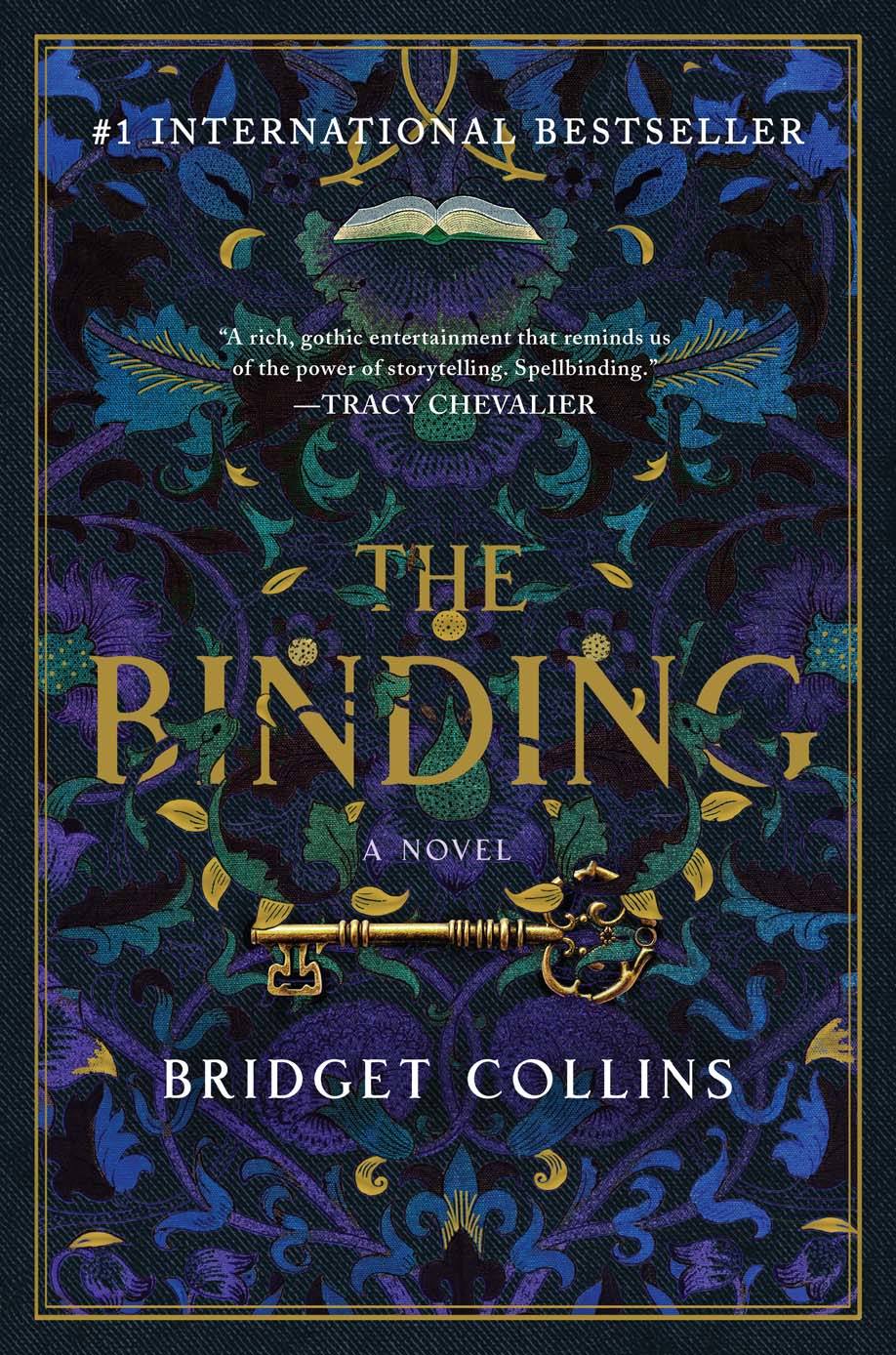
book cover

Calling something your own is a powerful prayer and there was God in it.

This is sacred ground for my family. I graze the tips of the grass with my palm as I wonder about their stories. Who were my people, and what had they sought on this mountain? I’ve never done any kind of family research, never had enough of a family to even know where to start, but now I’m beginning to realize, since arriving here, how much this missing hole goes beyond a decade-long spat.

When Veronica (Nikki) Lovejoy-Berry, a D.C. real estate agent, receives a summons from her long unseen grandmother in North Carolina, she senses the urgency and hurries down. Grandma is getting on, but remains self-reliant and reasonably spry.

Mother Rita was insistent—I need your help and if you come down here I will tell you everything your Mama hasn’t told you about our family. It wasn’t exactly an invitation I could refuse.

Mom and Grandma had become estranged many years earlier, erecting a wall between grandmother and granddaughter as well. During her visit Nikki is regaled with a tale that has a magical aura. The place where her grandmother lives was once called Happy Land. It was a community formed in the post-Civil-War period by freed slaves, not as a typical American town or village, but in the image of the communities from which the ancestors of its members had been taken. These people decided to create a kingdom, with a king and queen, as their ancestors had had in Africa.

description
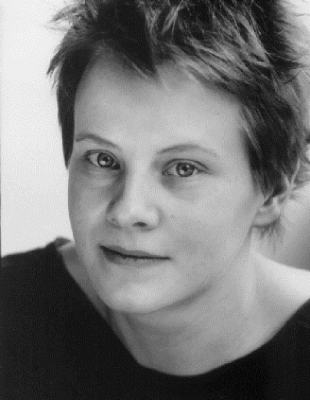
Dolen Perkins-Velez – image from Torch Literary Arts

The story alternates between the contemporary struggle of Mother Rita to retain ownership of her land, as she fills her granddaughter in on the history of the place, and the tale of one of the original settlers of the kingdom, its first queen, Luella Bobo. We are given a very up-close-and-personal look at what life was like in the 1870s, the closing years of Reconstruction, for freed slaves, what it took to establish themselves both personally and as communities, what obstacles they had to overcome. It offers an eye-opening perspective for any who are not very familiar with the era.

description
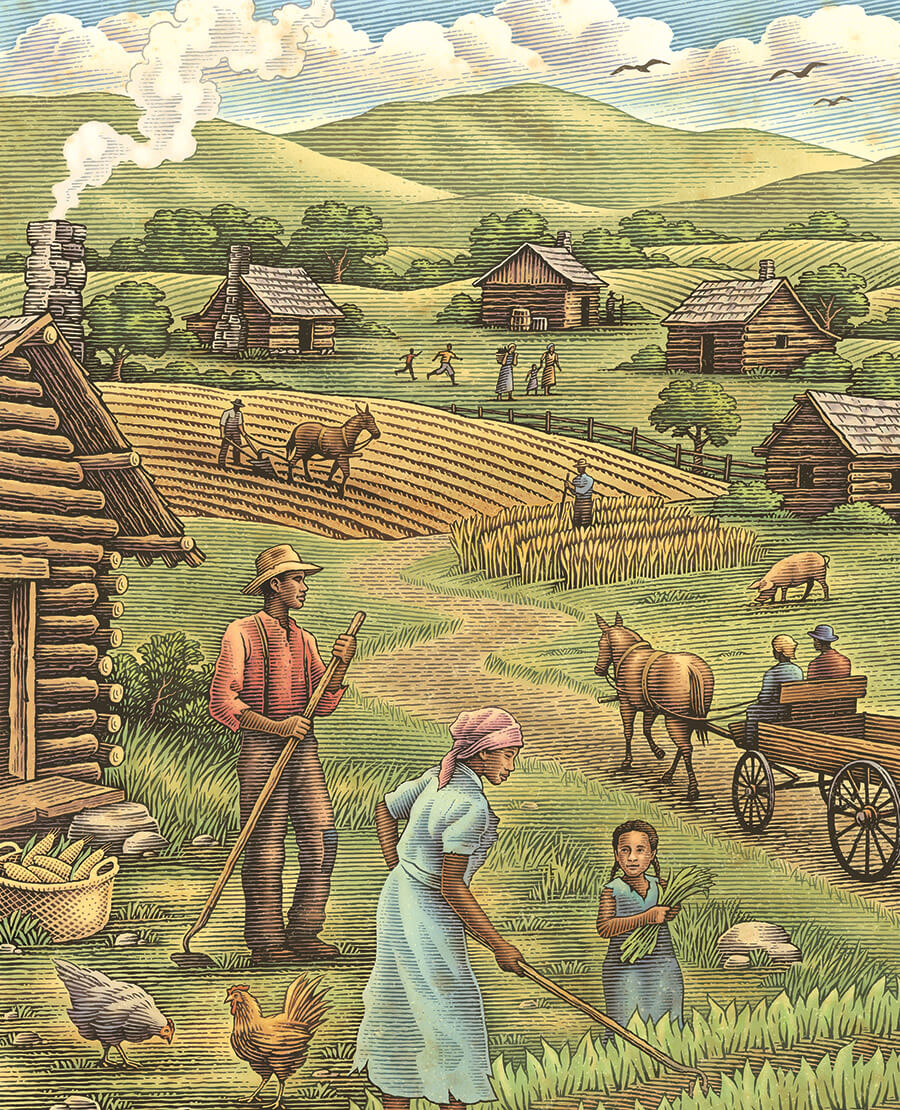
Working the Fields illustration by Erwin Sherman

Nikki is not on a mission. She is tired, struggling and unsatisfied with her life. She is eager to quickly resolve whatever it is that Mother Rita wants of her and dash back to DC as quickly as possible. She has no particular interest in history, family or other, which makes her a fair every-person stand-in for readers. It is through her POV that we slowly gain an appreciation for the importance of knowing one’s personal, and family history, and the significance of the land as an anchor for that connection. The novel is based on real events.

While researching Black history in western North Carolina, I stumbled on an article about this kingdom outside of Hendersonville. It was just a local newspaper, and I thought, “What is that?” It was a very brief article with an illustration showing that there had been this Black community during Reconstruction in the mountains. – from the Rumpus interview

Mother Rita does her best to pass on to Nikki the lore and knowledge she has tended her entire life.

All my life, I’ve been part of a small family circle. By the time my daddy was 20, both of his parents had passed away. He and Mama, with their desire to build a family out of nothing, were a perfect match for each other in that way. The two of them against the world. For me, not having a sibling or even a cousin has been the only existence I’ve ever known. Now here I am, walking beside my grandmother on acres and acres of land that my people have inhabited for over a hundred years. It’s hard to put how I’m feeling into words other than to say I’m dizzy with grief. I didn’t know you could mourn something you never had.

One element is the connection to the outdoors that Rita is able to spark in her grandchild, teaching her to appreciate gardening, and to pass on her considerable expertise. Nikki slowly finds herself able to step back from her urban self to find a connection with and a love for the sights, scents, the tactile feel of this other sort of place.

After the Great Migration, so many Black people ended up concentrated in cities, and we often forget that we are fundamentally a rural people. You don’t have to go back many generations to a grandmother or a great-grandfather who was a country person. – from The Rumpus interview

description
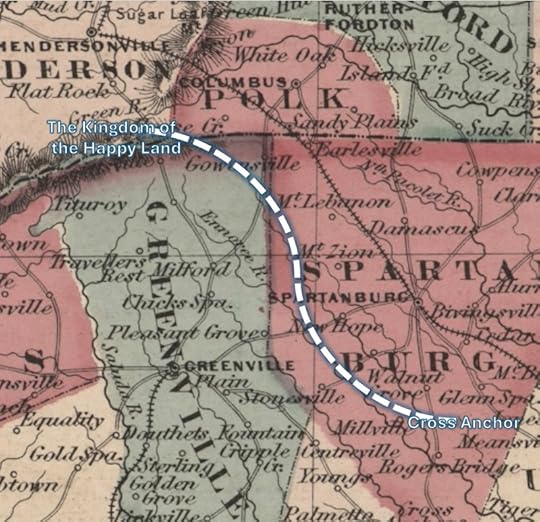
Cross Anchor, a remote township in southern Spartanburg County, S.C., was home to the founders of the Kingdom of the Happy Land before and just after the Civil War. – image from Blue Ridge Archive

A particular revelation is a particular legal mechanism used by the greedy and unscrupulous to cheat people, black people in particular, out of their land. It is remarkable just how much land was taken this way. Less surprising was the abuse of the criminal system to intimidate blacks who owned land, or aspired to do so. Equal treatment before the law remained a dream deferred. This gives the novel particular resonance in a time when the Deconstruction of the Trump era seeks to turn the clock back to an age before legal protections existed.

description
The Kingdom by Erwin Sherman

That said, Happy Land presents a message of hope. Whatever one may think of the royal approach those people favored, they took the opportunity presented by the end of slavery to make decisions for themselves, to organize their own community, to develop their own businesses, to participate in an equal way with the commerce of the area beyond their enclave. Even emerging from the horrors of enslavement, and suffering the ongoing oppression of those who preferred the ownership of human beings as property, these people kept the light of possibility alive. It is a surprising and moving story, which offers us historical reason to keep our spirits receptive to the need for and possibility of hope in an increasingly dark time.

In fall of 1873, a group of freedpeople left Spartanburg County, South Carolina, headed north across the state line into North Carolina. Near Zirconia, North Carolina, the people established a remote community that they called a kingdom. They named a king and queen, formed a communal treasury, and eventually purchased 205 acres of land in 1882 from John Davis, land that was spread across the North Carolina–South Carolina state line. Approximately half was deeded to Luella Montgomery and the other half to Robert Montgomery.
At its height, it is believed the kingdom numbered over two hundred people.
– from the Author’s Note

Review posted – 6/6/25

Publication date – 4/8/25

I received an ARE of Happy Land from Berkley in return for a fair review. Thanks, folks, and thanks to NetGalley for facilitating.

This review is cross-posted on Goodreads. Stop by and say Hi!

=======================================EXTRA STUFF

Links to the author’s personal, FB, Instagram, and Twitter pages

Interviews
—–The Rumpus – The Kingdom of Happy Land: A Conversation with Dolen Perkins-Valdez by NEFERTITI ASANTI – APRIL 28, 2025
—–NPR – Author Dolen Perkins-Valdez discusses her new novel ‘Happy Land’ by Michael Martin
—–May 2025 Feature: Dolen Perkins-Valdez by Jae Nichelle – begins down on the page, after the excerpt
—–Writers Digest – Dolen Perkins-Valdez: On History’s Untold Stories – More about her prior novel, but still quite interesting

My reviews of earlier work by Perkins-Velez
—–2010 – Wench
—–2022 – Take My Hand

Item of Interest from the author
—–Torch Literary Arts – excerpt – Chapter 4

Items of Interest
—–OurState.com – Lost & Found: The Kingdom of the Happy Land by Brad Campbell
—–Blue Ridge Archive – Welcome to the Kingdom of the Happy Land

Leave a comment

Filed under American history, Fiction, Historical Fiction, Literary Fiction, Reviews

The Haunting of Moscow House by Olesya Salnikova Gilmore

book cover

Irina calls her fanciful whenever she mentions ghosts. Still, something isn’t right about the house, hasn’t been right since Uncle Pasha was shot dead there three years before, and Grand-père Sergei succumbed to his illness mere days after.
Though she’s never seen one, Lili has believed in ghosts for quite a long time.
Do you think the dead can rise? Her voice, from a long-forgotten memory.
Of course, Nicky had answered, as if it were the most natural thing in the world.

…with each death, the spirits are more corporeal and alive. And the family is in greater danger.

It is 1921, and the suffering is not yet done. World War I, then the ongoing civil war, now famine. Bolsheviks have taken charge. They use the Cheka to enforce the new norms, inflict the governing biases, and relentlessly add to the general misery. The displaced aristocracy struggles to get by, well, those who were not summarily shot.

description
Olesya Salnikova Gilmore – Image from PRH – credit Nicola Levine Photography

To the new Soviet republic, the Bolsheviks, and the Cheka secret police, they are still countesses Irina and Liliya Goliteva, the people’s class enemy as descendants of one of the greatest and most ancient aristocratic clans of an imperial Russia dead and buried. Like most of their family. But unlike many former people, Irina’s family didn’t flee Russia. They stayed in hope of a return to normalcy. Now it is too late. Even if they could obtain papers, how could a household of women and children brave the danger of travel and exile?

Running out of household valuables to sell, the sisters take jobs with the American Relief Administration (ARA). The ARA is there to provide aid, food in particular. The sisters are managing the challenges, but there is something else. It appears that there are strange, spectral things going on in their home, the once-grand Moscow House. There are sounds, scents, footsteps, the sorts of things one can expect in a gothic novel.

So much of the novel is inspired by some of my favorite gothic stories, particularly by the Russian/Slavic gothic genre and the Ukrainian author who arguably founded it—Nikolai Gogol. – from the Afterward

Gogol and other folk sources are given plenty of recognition in the pages, allowing one the opportunity to do some digging and appreciate the inspirations.

We follow Irina (28) and her sister, Lili (18), as they try to survive through this trying period. Chapters alternate, more or less, between the two. The gothic elements build, from a few inklings to full-blown. It is not just one or two spectres turning up, but a whole host of late family members. The house is commandeered by the government, and the actual family is relegated to the attic. That does not work out well for the occupiers, as one then another is found dead. The work of one of the living inhabitants or ghostly revenge?

There are certainly some creepy bits, a norm for the genre, a few jump-cut scenes, and a spooky soothsayer. But is it scary? Mostly not, for me, (a particularly high bar) although there were some welcome surprises. There is one particular sort of ghost from Russian lore that was a new one on me. A creepy doll offers a tingle or two. That they grow in corporeality with each new death offered a welcome bit of unease. After a while, though, one gets used to the spirits, and in doing so their impact is reduced. Yeah, we’ve got a haunted house. So? The sisters keep coming and going as if it were infested with a more usual sort of pest.

Both become involved in romances, one with a Yank, the other with a childhood sweetheart. This is lovely, particularly in offering the possibility of positive outcomes for the sibs. Of course, it also adds to the ongoing tension between staying to preserve the family history and line, and fighting the good fight, or leaving to preserve their lives. How many people today are faced with comparable choices?

In fairy tales, paupers became princesses, not the other way around. But Soviet Russia is a warped Wonderland, where all is topsy-turvy and not what it should be.

One might, I expect, consider a take in which the Cheka taking charge in Moscow is a lot like the spectres taking over the Moscow House. It does cause one to recall that the Introduction of The Communist Manifesto begins, “A spectre is haunting Europe—the spectre of communism.” Certainly those spooks have landed in Russia and, through bloodshed, are gaining in strength. I have no idea if this was at all on Gilmore’s mind. But maybe. Spectres within and spectres without? Maybe a bit of dialectical materialism (or dialectical immaterialism?) for good measure?

Overall. I enjoyed The Haunting of Moscow House, particularly for the portrait of the time (The ARA was a real non-profit), the depiction of the desperation among Muscovites, and exposure to some unfamiliar gothic Slavic writing and lore. The sisters are engaging. The tension is palpable, and the spook infestation is fun.

I suppose one cannot help but compare this to Gilmore’s freshman offering, The Witch and the Tsar. That one was less reality based, more fantastical, and a bit more fun. But this one is also quite good, rich with extras both historical and literary.

Irina is crossing into the next room when she feels a prickle of cold on her arm. A draft of air. But the damask curtains are sealed tight. No, it is as if someone has moved past her. She turns sharply, as fearful as the other morning. Odd. She has never been afraid in the house. She doesn’t have Lili’s active imagination. Nor is she given over to delusions. It is only the howl and tear of the wind, the rattle of the windows in their casements, the faint give of a latch. With all this noise, she almost doesn’t hear it.
The creak of parquet, somewhere near. And again, unmistakable now. Creak. Creeeaak.
Footsteps. Small, like a child’s.
Irina backs up with wide eyes—when there is a deep growl. Then an earsplitting screech, and a dark shape hurtles across her path. A glint of red, as if red eyes have snapped to hers. The next second, scuffling and the thumping of bare feet, then nothing.
What was that? Some animal, trapped in the house?
That’s when the air implodes all around her.

Review posted – 12/20/24

Publication date – 9/3/24

I received an ARE of The Haunting of Moscow House from Berkley in return for a fair review. Thanks, folks, (Does it feel unnaturally cold to you here?) and thanks to NetGalley for facilitating.

This review is cross-posted on Goodreads. Stop by and say Hi!

=======================================EXTRA STUFF

Links to Gilmore’s personal, FB, Instagram, and Twitter pages

Profile – from her site
Olesya Salnikova Gilmore is the author of The Witch and the Tsar and The Haunting of Moscow House. Originally from Moscow, she was raised in the US and graduated from Pepperdine University with a BA in English/political science, and from Northwestern School of Law with a JD. She practiced litigation at a large law firm for several years before pursuing her dream of becoming an author. Now she is happiest writing speculative historical fiction inspired by Eastern European history and folklore. Her work has appeared in LitHub, Tor.com, CrimeReads, Writer’s Digest, Historical Novels Review, Bookish, Washington Independent Review of Books, among others. She lives in a wooded, lakeside suburb of Chicago with her husband and daughter.

Interviews
—–JeanBookNerd – Olesya Salnikova Gilmore Interview – The Haunting of Moscow House
—–Turn the Page – Episode 314E: Olesya Salnikova Gilmore on THE HAUNTING OF MOSCOW HOUSE – audio – 24:17
—–How Do You Write – Ep. 358: POV Hack: Using Method Acting with Olesya Salnikova Gilmore video – 31:09 – with Rachel Herron (from 5:36) – mostly about her prior novel, but offers a nice sense of the author, her process, how she uses method acting and her lawyerly background

My review of Gilmore’s prior book
—–2022 – The Witch and the Tsar

Items of Interest from the author
—–Crimereads – GOTHIC FICTION WITH A TWIST
—–Writer’s Digest – Finding Magic at the Intersection of Reality and Fantasy in Fiction
—–Reactor – Five Books about Haunted Houses that Crumble

Items of Interest
—–Carol’s Notebook – The Shroud – a Russian fairy tale referenced in Chapter 3
—–Story Telling Institute – Vasilia the Beautiful – a Russian fairy tale referenced in Chapter 11

Leave a comment

Filed under Fantasy, Fiction, Historical Fiction, Literary Fiction

Thorn Tree by Max Ludington

<img src=”book cover” alt=”book cover” width=”187″ height=”300″ align=”left” hspace=”10″ vspace=”10″>

At the base level it’s fear. It’s all about fear. People ask, ‘What are you afraid of?’ and that is not an answerable question. Any time I name a source for my fear I feel it as a deflection. I mean, sure, I can get close. You know, as in: I’m afraid of people because someone I trusted fucked with me when I was a child. I was traumatized, yes, and the fear probably began there, I guess. But I don’t really know because it seems, now, somehow elemental. It embodies some ancient, sleeping doom, and the only escape is self-destruction. You know? Like, if I become my own doom I’ve taken that power away from anything else. It’s preemptive. At least there’s agency in it.”
She felt the laughter spill out of her in a rush. Its piercing volume was at odds with the moment and the release it brought. Leo looked at her dumbfounded.
“Get the fuck out of my head, man,” Celia said.

He had merely done what men had been doing since the primeval birth of jealousy. Just a spoon of love from my forty-five, save you from another man. Howlin’ Wolf was just singing about what thousands had wished they could do, and probably had done, before there were cops and laws and all the rest of the arbitrary bullshit. And it had felt good, hadn’t it?

Daniel is 68, living a quiet life in a Hollywood Hills guest house when a visitor repeatedly appears. Dean is six years old and clearly in need of companionship. He lives with his grandfather, Jack, on the larger house on the property. Jack is not always particularly attentive. And Mom, Celia, is a rising young actress who is often away on prolonged shoots. Daniel is happy for the company.

description
Max Ludington – image from Macmillan – shot by Jennifer Silverman

The novel braids the stories of Jack, Daniel and Celia, mostly Jack and Daniel. The story takes place in multiple times, today being 2017, and the backstory stepping up from 1968 to the seventies, to 1980, and 1988. Celia is not a part of the earlier events.

The sixties events cast a light on a turbulent time, touching on many of the aspects one might expect, young love, drug-dealing, acid trips, communes, San Francisco, wth a very dodgy cult among them. But despite the surface level, there is also consideration of the sort of existential, philosophical searching that was, for many, an important part of those times.

Young Daniel (1960s) makes a youthful mistake and suffers a grievous wrong, which follows him all his life. In the 1970s he finds solace in the desert, constructing a significant work of art, the Thorn Tree of the title. It gets him some notice, gives him a way to express what is inside him, and leads to some stability in his life.

Celia did an image search for the sculpture, and there it was, standing next to the modern art museum, taller than the building itself. It was huge, with thick, meandering branches and bristling snakelike twigs. Most of the branches, while not attempting verisimilitude, were formed with inherently natural shapes and gnarled twists, but here and there some were deliberately hewn into shapes that could never have occurred in nature: curving double on themselves and then back again to form tight willowy S-shapes, or turning straight downward at acute angles for a foot or two before continuing up and outward, as if infused genetically with lightning.

Jack is a very different sort. A predator, a sociopath or something like it, Jack wants what he wants and is not much concerned about who he damages to get it. He is routinely unkind, and worse, but he is also a seeker of truth, becoming connected with a cult and seriously mulling the writings on which the cult bases its outlook, even if the tenets of that group serve to bolster his own self-justification.

Daniel and Jack are linked through these years, the source of that link being one of the mysteries of the book. Jack is definitely a dark force. Daniel exists on a brighter side, despite having made some bad choices. He is a character who grows. But while Jack grows in a way, his widened view of reality is ultimately redirected to his narcissism. Not much is really done with Celia.

There is some lyrical writing which gives the story texture, depth to the two main characters, which makes it engaging, and a look at the times, both 60s and 70s, which gives it some substance. In addition it considers repercussions throughout one’s lives of actions taken in our youth.

Daniel stood for a moment at the threshold of the branches and looked up. The wind was made louder here in contact with the tree. The gravel path went around the south side, and he followed it to where it ended at an overlook. There was a plaque on a post, but he didn’t read it. Instead of standing at the overlook and staring out to sea, as the landscape designer had intended, he turned and went in under the branches, and immediately the world of the tree took over. He was surprised—he’d thought his memory of it was hopelessly colored by LSD and shock and time, that he had probably falsely mythologized every aspect of it and it would be just a place, with soil and roots and air but not the indwelling spirit he’d imbued it with in his mind. But it was as it had been—the wind quieting and the light clarifying, damping the sun into deep greenness—inhabited by a sense of protection and safety unchanged by the years of foot traffic and human attention.

There are many more of this sort. The voice is omniscient narrator, which presents way too many opportunities to tell rather than show. But I doubt this will bother most readers. Some characters come and go, seeming to be throw-aways. It is one of the things that make the book feel over-long. I kept hoping that some of these might be given a deeper look, with Jack getting less.

The alternating timelines, a fairly typical literary device, made sense to me. The Grateful Dead offer a link between now and then. There seemed some interest in other literary devices. For example, a boy appears to have a magical relationship with birds, but the image drops after partial usage.

Thorn Tree is an interesting read, offering some substance, interesting characters, and a strong core mystery. But for a book that is not overlong, at about four hundred pages, it felt like a much longer read because of the excess attention paid to Jack, and some tangential tales. The descriptive writing (I am a sucker for that) gives one a reason to push through, however prickly the passage.

Review posted – 11/01/24

Publication date – 4/15/24

I received an ARE of Thorn Tree from St. Martin’s Press in return for a fair review. Thanks, folks, and thanks to NetGalley for facilitating.

This review is cross-posted on Goodreads. Stop by and say Hi!

=======================================EXTRA STUFF

Links to Ludington’s personal, Goodreads, and Twitter pages

Profile – from Macmillan

MAX LUDINGTON’s first novel, Tiger in a Trance, was a New York Times Notable book, and his fiction has appeared in Tin House, Meridian, HOW Journal, Outerbridge, and On the Rocks: the KGB Bar Fiction Reader. He lives in Brooklyn, New York and teaches in the writing department at Pratt Institute.

Interview
—–The Palisades Newsletter – Max Ludington Reflects on His Second Novel, THORN TREE

Song
—–The Doors – Five To One
—–The Grateful Dead – The Very Best of the Grateful Dead

Leave a comment

Filed under California, Fiction, Historical Fiction, Literary Fiction, Reviews

Goldenseal by Maria Hummel

book cover

Falling into friendship, with Edith was also, for Lacey, inextricable, with falling in love with the northern summer. Never had she woken to birdsong, or plunged headfirst into cool water on a blazing day, or listened to the whispers of the oaks as a thunderstorm, swept in. Never had the sun felt so warm and golden, or rain soaked her so completely. The shrill of crickets, alarming at first, began to soothe her to sleep at night. A toad hunched by a log was so intensely ugly she cried out in shock, while a fox, slipping through the pines, looked like the tip of a paintbrush dipped in orange. Her hands and legs became tan and useful. She could tie three kinds of sailor knots, and she could kick her way up a river current. Her face in the spotty cabin mirror was freckled, it also looked rounder and full. She was gaining weight back, and when one night Edith observed, “You’re not coughing anymore,” Lacey realized it was true.

“When the stranger returned to the city…” are the opening words of Goldenseal, or could be of a fun Western. The description that follows is pure delight, set in 1990 Los Angeles, as Maria Hummel shows off her poet’s gift for description. In The Rumpus interview she talks about having to tone that element down to spend more focus on moving the story forward. A loss for the likes of me. Edith Holle left Lacey, and Los Angeles forty-four years ago. She is back now on a mission known only to herself.

I was interested in creating a novel that had an allegorical Western feel. The stranger comes back to this city for the first time in forty-four years; “the stranger comes to town.” That’s the beginning of the classic Western, and Westerns play an important role throughout the story, as both subject and backdrop, especially in regard to gender. Because in the classic Western, the “stranger” is male, right? But here, it’s Edith, an old woman in a wrinkled skirt and sneaker boots. – from The Rumpus interview

In addition to the western genre references, there is a mystery afoot here, well, a few. What was the nature of Edith’s connection to Lacey? Why did she leave? Why is she back?

description
Maria Hummel – Image from her site

We get an up close look at Lacey’s discomfort, wondering what Edith is up to, stressing over what to wear, as if her sartorial selections might provide a layer of armor, but Lacey is also clearly dying to see her. Once the waiting is done, we get on with the bulk of the story. It is told in two time lines. First is an ongoing conversation between the two women, the frame. Second is the history they recount within it.

Lacey Crane was born in Prague, her parents fleeing before, but not because of, the future Nazi invasion. Middle class, they were able to experience success in the hotel business. We get a look at the impact of the Holocaust on her parents, particularly her Jewish mother. As girls, Lacey and Edith meet at a California camp, where Edith is a bit of a loner, the daughter of the camp caretaker, special for her talent at stage performance, among other things, but seen as too lower class for most of the privileged girls. Not for Lacey. They become instant besties. (see quote at top) Edith’s home life is challenging, and Lacey wants to take her away from all that.

We follow the development of their friendship, and of their lives, together and apart. It is events in adulthood that split them, a final, dramatic schism. Dirty laundry is pulled from their memory bags, and held up for close inspection. Some garments are left unaired.

The contemporary conversation functions as a way for them to both examine the lives they have led. It also illuminates some of the changes women experienced in the 20th century.

The novel germinated over a protracted period, until all the elements finally came together. First was the Biltmore. When she and her husband moved there in the early aughts, Hummel was smitten with the LA hotel culture, particularly that hotel.

[This] combined with a book that I read that came out in American translation in 2001 called Embers …originally published in 1942, is a story about two old friends, males, an old general and a soldier, meeting in a castle in the Carpathians for the first time in forty years. They’re also weighing out friendship. When I read that book, I thought, this is such a great treatise on friendship, but it’s about male friendship. Female friendship is different. Wouldn’t it be great to use this structure but set it in an American castle? There it is. Then the third piece was, as we all experienced, we lived like recluses, particularly for me, the academic year that was 2020/’21. I thought, I know how to write this character now, this person who’s basically a hermit who lives in the hotel and never goes out and is locked in her tower. – from the Moms Don’t Have Time to Read Books interview

Underneath it all is that primal bond, forged in childhood, hardened in adulthood but seriously damaged. We are waiting for the high noon moment when the women unholster their revelations and take aim.

The Lacey-Edith intersection is, in a way, where Old World meets New. Lacey having been born middle class in Europe. Edith living a much more frontier-type of existence in the American far west. Lacey is relatively well-to-do, while Edith is a bit of a Cinderella character, responsible beyond her years, kept as something of a household slave by an unfeeling parent. Maybe Lacey can fit her up with a glass slipper, get her a carriage ride to something better? There are medical remedies from both the Old World and the New that present the strengths of both cultures. Familial tragedies echo across the divide.

Do we care? Each girl faces challenges at home. And both are portrayed as decent kids, so it is not hard to feel for them. The tale of their early friendship is incredibly charming and engaging, a major strength of the novel. The bond between these two is palpable and we want it to be eternal. Each girl finds relief from her personal stresses in having someone with whom to share. We get glimpses of their time together later, as teens, but these are fleeting, and lack the immediacy and impact of their camp days. Their time as adults is also presented in brief glimpses, stroboscopic flashes of events. Sure, there is angst, pain, heartbreak, betrayal, and disappointment, but having stepped back from Lacey and Edith, the impact is dulled. It is not a bad thing to leave readers wanting more of a character but it seemed to me that we got a bit short-changed and should not have needed that much more.

The narrative flow works quite well, switching back and forth between the contemporary and historical. But in a latter section of the novel, the conversation became much less…conversational, transforming into almost straight up exposition. I found this distancing, and thus off-putting.

There is a lot going on in Goldenseal. Thematically, it offers a trove of genre touches, coming of age, mystery, western, domestic drama and probably others. Hummel writes beautiful descriptions. I wish there had been even more of that. She gets us to care about her leads. And offers a persuasive explanation at the end, for most questions. It is a good read for sure, but maybe a Silver Seal instead of a Golden One.

Review posted – 03/29/24

Publication date – 01/09/24

I received a hardcover copy of Goldenseal from Counterpoint in return for a fair review. Thanks, folks.

This review is cross-posted on Goodreads. Stop by and say Hi!

=======================================EXTRA STUFF

Links to Hummel’s personal and Twitter pages

Profile – from her website

Maria Hummel is a novelist and poet. Her books include Goldenseal, Lesson in Red, a follow-up to Still Lives, a Reese Witherspoon x Hello Sunshine pick, a Book of the Month Club pick, and BBC Culture Best Book of 2018; Motherland, a San Francisco Chronicle Book of the Year; and House and Fire, winner of the APR/Honickman Poetry Prize… Hummel worked for many years as an arts editor and journalist, and as a writer/editor for The Museum of Contemporary Art, experience that informed Still Lives and Lesson in Red. She also taught creative writing at Stanford University and Colorado College, and is now a full professor at the University of Vermont. She lives in Vermont with her husband and sons.

Interviews
—–The Mark Twain House & Museum Program – GOLDENSEAL with Maria Hummerl and Barbara Bourland by Omar Savedo – Video – 58:15
—–Moms Don’t Have Time to Read Books – Maria Hummel, Goldenseal by Zibby Owens
—–The Rumpus Friendship Sunset: A Conversation with Maria Hummel by Jenny Bartoy

Items of Interest from the author
—–Reading Group Guide
—–LitHub – The Shadow Self of Domestic Stories: A Reading List of Novels Set in Hotels

Leave a comment

Filed under Fiction, Historical Fiction, Literary Fiction, Mystery

Golden Gate by Amy Chua

book cover

“Evil is everywhere. Where you least expect it. It can seep out of the radio. Or a lobster salad.”
“Oh, Issy—why do you say that?”
“Because it talks to me.”
“What talks to you?”
“Evil.”
“Iris talks to you, and evil talks to you?”
“Yes.”
“Are they the same?”

Part of me wanted to shut her up—if there’s one thing I couldn’t stand, it was a rich girl who felt unlucky in life. But another part knew that what she was saying was factually true. Her family was a train wreck, almost as bad as my mine except rich. Meanwhile, a third part of me couldn’t help noticing her long lashes and her lips—she had what they call a rosebud mouth, a perfect version of it. “I may have misjudged you, miss. If I did, I’m sorry.”
“Don’t soften on me,” she said.
“If it was a hundred in the shade, I wouldn’t soften on you, miss.”
“Good. Because I’m bad, Detective. I do terrible things. And if you soften on me, I’ll do them to you.”

There are six primary (fictional) females driving the story in The Golden Gate, with Detective Al Sullivan functioning as the hub to which they all connect and around whom they all spin. There might have been a seventh, but Iris Stafford plunged down a laundry chute in 1930 at age seven, under mysterious circumstances, and appears now mostly in memories, dark visions, and dreams. Her sister, Isabella, all grown up in 1944, is a knockout, as was their mother, Sadie. The Stafford girls have two first cousins. Cassie Bainbridge is an expert hunter, (think Artemis) and a frightening wonder to behold when butchering large game. Nicole is fascinated by the far left, maybe dangerously so. Then there is Genevieve Bainbridge, grandmother to Iris and Isabella, Cassie and Nicole, mother to Sadie and John (who does not much figure in any of this.)

description
Professor Amy Chua – image from AboveTheLaw.com

Genevieve is 62 when we meet her, through a deposition she is writing for the DA. There are eleven parts to this document, sub-chapters, spread throughout the book. It is through these that we learn of the events circa and before 1930. But take her words with a shaker of salt. This Bainbridge is an unreliable narrator. She is faced with a very tough situation. The DA has made clear his belief that one of her three granddaughters is guilty of murder, and he is squeezing her to finger the guilty party, lest all three suffer consequences. The events of the novel take place primarily in two times, 1930, when Iris dies, and 1944, the today of the tale.

Detective Sullivan is having drinks with a young woman in the hotel bar, when he is summoned by hotel management, about a report of gunshots in one of the rooms. Walter Wilkinson, an industrialist running for president, has acquired a new bit of decoration in his room, a bullet hole above his bed. He offers a tale about a Russian Communist assassin, is relocated to another room, and goes about his night, as does Sullivan. Until a call comes in several hours later. The renowned Claremont Hotel in Berkeley, CA, need some assistance dealing with a newly deceased guest. Mr. Wilkinson had clearly had a pretty tough night.

A crew of detectives is called in. Guests, employees and everyone in the vicinity are identified and interviewed, and clues begin to emerge. Timelines and whereabouts are established. Who saw whom emerge from what room, or walk down which hall, at what time, dressed how, gender, ethnicity, age, and so on. The usual procedural digging offers up a list of folks who may have had it in for WW, for a wide range of issues, some personal, some professional.

Complications appear like shadows at dusk. Was it the same shooter both times? And what about the unusual way in which his body was left? Witnesses can be unreliable. You cannot believe everything people tell you. Can you believe anything? In fact, there is a sufficient number of the questionably balanced in this novel that the place could be known as much for its head cases as for its headlands. The constant lying and misdirection offer up enough twists to make this read feel like a very tasty bowl of rotini. And it is indeed very tasty.

There are two levels at play, the payload, a take on the time and place, and the mystery…well, mysteries. We are eager to learn not only what happened to candidate Wilkinson including wondering if he had it coming) but to Iris Stafford. Did she really fall down a laundry chute to her death? Or was there some dark force at play responsible for killing a seven-year-old child? Chua does a great job of keeping us guessing, and there is plenty to guess about. I figured out one element about halfway through, but there were many others I did not see coming at all. There are surprises aplenty.

So, who killed WW (who is loosely based on Wendell Wilkie)? Who was that cowled person seen leaving the scene of the crime? Some people were seen entering and leaving the victim’s room, including an Asian woman and someone answering to the description of the three cousins. Interestingly, Wilkinson had a connection with Madame Chiang Kai-shek.

Speaking of which, Chua peppers her novel with actual historical figures. The First Lady of China did, in fact, live in Berkeley during the period of the novel. Her reason for being there is not known. Chua offers one possible explanation. August Vollmer is a name you are unlikely to know, but he was a seminal figure in the evolution of policing. He served as police chief in Berkeley for a time, and is lightly incorporated into the tale, as Al’s mentor, among other things.

Place is of paramount importance in good detective tales, and Chua further satisfies the historical need by telling us about the construction of the Golden Gate Bridge, offering some of her characters a role in its opening. She also writes about the boom-town growth of the area during World War II, when it replaced Pearl Harbor as the premier shipbuilding location in the states, producing an astounding number of vessels for the war, and in so doing, attracting workers from around the country. Some were more welcome than others, as one might expect. There are union issues, housing shortages, poverty, racism, political intrigue, sexual shenanigans, tong gangs, and appearances by two noteworthy ahead-of-their-time accomplished female professionals.

Bigotry was shameless and rampant, with Mexicans forcibly “repatriated” by the hundreds of thousands, the Chinese Exclusion Act still in place, and hostile derision openly directed at “Okies,” a term then referring to poor white migrants from the Dust Bowl. In the 1940s came the Japanese internment, when full-fledged American citizens were literally caged off. For the first time, Blacks came to the Bay Area in significant numbers, pouring in from the American South in search of jobs, only to find themselves subjected to vicious prejudice, excluded by labor unions, denied entry into restaurants, theaters and hotels, and barred from living in white neighborhoods. Throughout this period, numerous other ethnic groups—such as Italians, Greeks, Poles, Slavs, Hungarians, and Jews—occupied a subordinate position too, not yet considered fully white. – from the Author’s Note

Chua builds this into her characters.

I chose to make Detective Sullivan a light-skinned mixed-race man in part because Berkeley’s police force in the 1940s included almost no women or minorities, but also because I wanted to explore the phenomenon of racial “passing.” Sullivan is part Mexican, part Nebraskan, and part Jewish on his Mexican side…But Sullivan can pass as white and chooses to go by Al Sullivan rather than Alejo Gutiérrez for reasons he has not fully admitted to himself. – from the Author’s Note

In fact, there is enough passing here to make one wonder if Berkeley streets are constructed of all left lanes. In addition to Al, noted above, Japanese characters pass for Chinese. Gay characters pass for straight. One does what one must to survive in a hostile environment. Pathological liars pass for honest citizens. Crazy people pass for sane, and rich kids pass for revolutionaries. But another way to look at some of this is as reinvention. Sometimes you need to change how you present yourself to the world, change how the world sees you, in order to become your truest self.

Al is a good guy, conflicted about his decision to conceal his heritage. In addition to his detective work, Al must handle a family problem. His half-sister does not function well in the world, has issues with substances and decision-making. Somehow, she produced an amazing kid. Miriam is eleven going on thirty, from having to cope with so much. She could use some more schooling, but is uber bright, and she loves her uncle Al, who is put into the position of having to take care of her during of her mom’s absences. The love between these two glows like a lighthouse beacon glaring through thick bay fog. Some of the most wonderful scenes in the book are those between Al and Miriam.

While it is not a large element, there is also occasional humor.

I hate to say it of a fellow Berkeley officer, but Dicky O’Gar was so thick he couldn’t tell which way an elevator was going if you gave him two guesses.

The events take place in the Berkeley Hills, for the most part. So, near to, while not exactly one of, the ground-zeros for hard-boiled detective yarns. There is some nifty noir-ish patois, (the second quote at the top of this review offers an excellent example) but I would not call this a noir novel, per se. While there is plenty of darkness and grim reality, there is enough optimism to float it out of that sub-genre.

Gripes are few. I found the explanation of one of the deaths that occurs less than satisfying. There is a taste of a fantasy element, revolving around the continued presence in the Claremont of the late Iris Stafford. While it adds atmosphere, it suggests more than it actually delivers.

Bottom line is that The Golden Gate is a first-rate entertainment, with fun, quirky, interesting fictional supporting characters, an introduction to some actual historical people of note, an insightful look at a vibrant place in an exciting time, a primary character to care about, and mysteries to keep your gray cells sparking. What’s not to like?

I put my collar up, pulled my hat brim down, and set off through the drizzle, wondering how much I’d been played in the last seventy-two hours and by how many different women.

Review posted – 12/29/23

Publication date – 9/19/23

I received an ARE of The Golden Gate from Minotaur Books in return for a fair review. Thanks, folks, and thanks to NetGalley for facilitating an ePub as well.

This review is cross-posted on Goodreads. Stop by and say Hi!

=======================================EXTRA STUFF

Links to Chua’s personal, FB, Instagram, and Twitter pages

Profile – from Wikipedia

Amy Lynn Chua (born October 26, 1962), also known as “the Tiger Mom“, is an American corporate lawyer, legal scholar, and writer. She is the John M. Duff Jr. Professor of Law at Yale Law School with an expertise in international business transactions, law and development, ethnic conflict, and globalization.[5] She joined the Yale faculty in 2001 after teaching at Duke Law School for seven years. Prior to teaching, she was a corporate law associate at Cleary, Gottlieb, Steen & Hamilton. Chua is also known for her parenting memoir Battle Hymn of the Tiger Mother. In 2011, she was named one of Time magazine’s 100 most influential people, one of The Atlantic’s Brave Thinkers, and one of Foreign Policy‘s Global Thinkers.

The Golden Gate is her first novel.

Interviews
—–Washington Post – Amy Chua says her hard-boiled detective also is a bit of a ‘tiger mom’ By Sophia Nguyen
—–USNews – ‘Tiger Mom’ Amy Chua Writes First Novel, ‘The Golden Gate’

Item of Interest from the author
—–Macmillan – Discussion Questions

Items of Interest
—–Wiki on August Vollmer, mentioned in Chapter 3, and throughout
—–Wiki on The Mann Act – mentioned in Chapter 14.4
—–Wiki on The Golden Gate Bridge

Leave a comment

Filed under Fiction, Historical Fiction, Mystery, Noir, Reviews, Suspense

Woman of Light by Kaji Fajardo-Anstine

book cover

The radio smelled of dust and minerals, and in some ways reminded Luz of reading tea leaves. They were similar, weren’t they? She saw images and felt feelings delivered to her through dreams and pictures. Maybe those images rode invisible waves, too? Maybe Luz was born with her own receiver. She laughed, considering how valuable such a thing must be, a radio built into the mind.

Maria Josie insisted Diego and Luz must learn the map, as she called it, and she showed them around first on foot and later by streetcar. She wore good walking shoes, and dressed herself and the children in many layers. It tends to heat up, she had said, another moment, it might hail. The siblings learned to be cautious. It was dangerous to stroll through mostly Anglo neighborhoods, their streetcar routes equally unsafe. There were Klan picnics, car races, cross burnings on the edge of the foothills, flames like tongues licking the canyon walls, hatred reaching into the stars.

There is a lot going on in this novel, so buckle up. Focused on the experiences of 17/18 year-old Luz Lopez–the Woman of Light of the story–in Depression-era Denver, the story alternates between her contemporary travails and the lives of her ancestors. The beginning is very Moses-like, a swaddling Pidre being left by his mother on the banks of an arroyo in The Lost Territory in 1868. We follow Pidre and his children and grandchildren into the 1930s. All have special qualities. Among them, Luz, his granddaughter, reads tea leaves, seeing visions of both past and future. Diego, his grandson, would definitely belong to House Slytherin in a different universe. He tames and performs with rattlesnakes.

description
Kali Fajardo-Anstine in the Western History & Genealogy Department of the Denver Public Library – image from 5280 – photo by Caleb Santiago Alvarado

This is a story about stories, how telling them carries on identity, while ignoring them can help erase the culture of a people. Pidre is noted as a talented story-teller, urged, as he is given away, to remember your line. KFA remembers hers, giving a voice to Chicano-Indigenous history.

My ancestors were incredibly hard working, generous, kind, and brilliant Coloradans. But they were also poor and brown and this meant our stories were only elevated within our communities. When I began writing seriously in my early twenties, I was reading books by James Baldwin, Sandra Cisneros, Edward P. Jones, and Katherine Anne Porter, and many, many others. I saw how these authors shined the spotlight on their people and I also wanted to write work that was incredibly sophisticated that honored my cultural group, making us more visible in the mainstream. – from the Pen America interview

Fajardo-Anstine brings a lot of her family’s history into this novel. Her great-aunt’s name is Lucy Lucero. In addition to the name of our protagonist, a second connection can be found in the name of the stream where Pidre is found, Lucero. An uncle was a snake charmer. An aunt worked in a Denver glass factory, as Luz’s aunt works in a mirror factory in the book. Her family had hidden from KKK, as characters do here. Her Belgian coal-miner father abandoned his family, as Luz and Diego’s father does here.

There is a feel to the book of family stories being told around a table, or in a living room, by elders, passing on what they know to those most recently arrived. Remember these tales, the speaker might say, and in doing so remember where you came from, so you can better know who your people are and ultimately who you are.

As they hopped and skipped in and out of the archway lights, Luz imagined she was jumping between times. She saw herself as a little girl in the Lost Territory with her mother and father walking through snow fields, carrying fresh laundry to the company cabin. Then she saw herself in Hornet Moon with Maria Josie, beside the window to her new city, those few photographs of her parents scattered about the floor, the only remnants of them she had left. She saw herself eating Cream of Wheat for breakfast with Diego in the white-walled kitchen. They were listening to the radio, the summertime heat blowing in from the windows, the mountains far away behind the screen.

The racism that Luz and other confront is not subtle. A public park features a sign

NOTICE
This Park Belongs to WHITE PROTESTANTS
NO GOOKS
SPICS
NIGGERS
Allowed

Luz is denied an opportunity to apply for a job because she is not white. A KKK march has a very pogrom-like, 1921-Tulsa-like feel.

Luz gets a chance to see the range of crimes going on in the city, when she gets a particular job. Sees how the system that is supposed to protect regular folks does anything but. The murder of a Hispanic activist by the police is not just a historical image, but a resonant reminder of police killing of civilians in today’s world, usually with little accountability. The more things change…

There is a magical element in this novel, that, when combined with the multi-generational structure, and richness of language, and, of course, her focus on particular groups of people, makes one think of Louise Erdrich. As to the first, among others, Luz receives visions while reading tea leaves, and at other times as well. An ancestor speaks with the dead. A saintly personage associated with mortality appears in the flesh. People appear who may or may not be physically present.

The ancestry begins with Pidre in 1868, but in his infancy we meet elders who reach back much further.

The generation I knew in real life was born around 1912 and 1918. They would talk about the generation before—their parents, but also their grandparents. That meant I had firsthand knowledge spanning almost two hundred years. When I sat down to think about the novel and the world I was creating, I realized how far back in time I was able to touch just based on the oral tradition. My ancestors went from living a rural lifestyle—moving from town to town in mining camps, and before that living on pueblos and in villages—to being in the city, all within one generation. I found it fascinating that my great-grandma could have grown up with a dirt floor, not going to school, not being literate, and have a son graduate with his master’s degree from Colorado State University. To me, time was like space travel, and so when I decided on the confines of the novel, I knew it had to be the 1860s to 1930s. – from the Catapult interview

Luz is an appealing lead, smart, ambitious, mostly honorable, while beset by the slings and arrows of ethnic discrimination. Like Austen women, she is faced with a world in which, because of her class and ethnicity, making her own way in the world would be very tough without a husband. And, of course, the whole husband thing comes with its own baggage. Of course, the heart wants what it wants and she faces some challenges in how to handle what the world offers her. She does not always make the best choices, a flaw likely to endear her to readers even more than an antiseptic perfection might.

The supporting cast is dazzling, particularly for a book of very modest length (336p hardcover). From a kick-ass 19th century woman sharpshooter, to a civil rights lawyer with conflicting ambitions, from a gay mother-figure charged with raising children not her own to a successful Greek businessman, from Luz’s bff cuz to the men the two teens are drawn to, from an ancient seer to a corrupt politician, from…to…from…to… Fajardo-Astine gives us memorable characters, with color, texture, motivations, edges you can grab onto, elements to remember. It is an impressive group.

And the writing is beautiful. This is the opening:

The night Fertudez Marisol Ortiz rode on horseback to the northern pueblo Pardona, a secluded and modest village, the sky was so filled with stars it seemed they hummed. Thinking this good luck, Fertudez didn’t cry as she left her newborn on the banks of an arroyo, turkey down wrapped around his body, a bear claw fastened to his chest.
“Remember your line,” she whispered, before she mounted her horse and galloped away.
In Pardona, Land of Early Sky, the elder Desiderya Lopez dreamt of stories in her sleep. The fireplace glowed in her clay home as she whistled snores through dirt walls, her breath dissipating into frozen night. She would have slept soundly until daybreak, but the old woman was pulled awake by the sounds of plodding hooves and chirping crickets, the crackling of burnt cedar, an interruption between dawn and day.

Really, after reading that, ya just have to keep on. One of the great strengths of this novel is its powerful use of imagery. There are many references to light, as one would expect. Water figures large, from Pidre’s introduction in the prologue, left by a stream, to our introduction to Luz and her aunt Maria Josie sitting together in Denver, near the banks where the creek and the river met, the city’s liquid center…, to a rescue from a flash flood, to an unborn buried near a river, and more. A bear-claw links generations. This makes for a very rich reading experience.

I felt that the narrative fizzled toward the end, as if, having accomplished the goal of presenting a family and group history, filling a vacuum, there was less need to tidy everything up, a quibble, given that the novel accomplishes its larger aims.

Kaji Fajardo-Astine’s 2019 short-story collection, Sabrina & Corina, made the finals for National Book Award consideration. You do not need to read tea leaves or have visions to see what lies ahead. Woman of Light, a first novel, illuminates that future quite clearly. By focusing a beacon on an under-told tale, Kaji Fajardo-Astine, is certain to have a brilliant career as one of our best novelists.

Celia, Estevan’s sister. Luz listened and watched as she read her own words in her own voice. First in Spanish and then in English. The crowd moved with each syllable, cries of anguish. A lamp unto my feet, a woman yelled behind Luz. A light unto my path.

Review posted – June 17, 2022

Publication date – June 7, 2022

I received a digital ARE of Woman of Light from One World in return for a fair review. Thanks, folks, and thanks to NetGalley for facilitating.

This review has been cross-posted on GoodReads

=======================================EXTRA STUFF

Links to the author’s personal, Instagram, and Twitter pages

Interviews
—–Red – June, 2022 – Q&A: Kali Fajardo-Anstine’s “Woman of Light” with Cory Phare
—–Pen America – 2019 – THE POWER OF STORYTELLING: A PEN TEN INTERVIEW WITH KALI FAJARDO-ANSTINE with Lily Philpott – not specific to this novel, but interesting
—–Catapult – June, 2022 – Kali Fajardo-Anstine Believes Memory Is an Act of Resistance with Jared Jackson

Items of Interest
—–Following the Manito Trail
—–5280 – Inside Denver Author Kali Fajardo-Anstine’s Much Anticipated Debut Novel by Shane Monahan

Leave a comment

Filed under Feminism, Fiction, Historical Fiction, Literary Fiction, Native Americans

Heaven-Sent – Cloud Cuckoo Land by Anthony Doerr

book cover

Sometimes the things we think are lost are only hidden, waiting to be rediscovered.

Anthony Doerr has written a masterpiece of a tale, connecting five characters, over hundreds of years through their relationship to a single book. Cloud Cuckoo Land is an ancient story written by Antonius Diogenes around the first century C.E. (Only in the novel. While the author is real, the book was made up.) It tells of a shepherd, Aethon, seeking a magical, heavenly place in the sky, the “Cloud Cuckoo Land” of the title. Each of the five characters are introduced to this story, and we see how it impacts their lives. Each has characteristics that set them apart. But all have lost, or lose, at least one parent.

description
Anthony Doerr – image from Boise State Public Radio

We meet Konstance, 14, on an interstellar, generational ship, maybe the late 21st century, maybe the 22nd. She is laying out on the floor of a large room the scraps of pages that comprise the book. (Sometimes he [Doerr] would lay out all these micro chapters on the floor so he could see them and discover the resonances between characters across space and time. – from the NY Times interview) She was born on The Argos, and the plan is that she will not live long enough to reach the ship’s destination, but will grow to adulthood and raise a family there, passing down humanity’s culture so that someday, homo sapiens can rebuild on a new, unspoiled home world, Beta Oph2. Hopefully that planet will remain better off once people arrive. She is driven by her need to know, a boundless curiosity, and a willingness to think outside the ship.

Anna is an orphan. In 15th century Constantinople we follow her from age 7 to early adolescence. She and her older sister, Maria, work as seamstresses in the house of Nicholas Kalaphates. It is a Dickensian world of exploitation of diverse sorts. Anna is far too bright to be denied the world of words, and, once exposed to it, she pursues that world doggedly. On her travels through the city on errands she comes across a class of boys being taught Greek, The Odyssey, and attends, surreptitiously. The master agrees to teach her privately in return for modest items. Her literacy makes her a suspect to the adults around her, a criminal to others, and possibly a witch to the most ignorant, but leads her to a ruined library and eventually, to Aethon.

description
The Imperial Library at Constantinople [in better days] – image from Novo Scriptorium

Omeir was born in 1439, like Anna, but with a cleft lip and palate. The superstitious country people in his home town believed him cursed, demonic even, so he is driven out of town, exiled to a remote part of what is now Bulgaria, where he does his best to remain out of sight, to be raised by his grandfather. But Omeir is a survivor. He becomes a marvel at the care of oxen, raising and training two to immense proportions. The team of three are remarkable workers. Downside is that the new sultan demands Omeir, now an adolescent, and his oxen serve in his army. He is planning to lay siege to Constantinople, a city with walls that have withstood such attacks for over eleven hundred years. Omeir will encounter Aethon later.
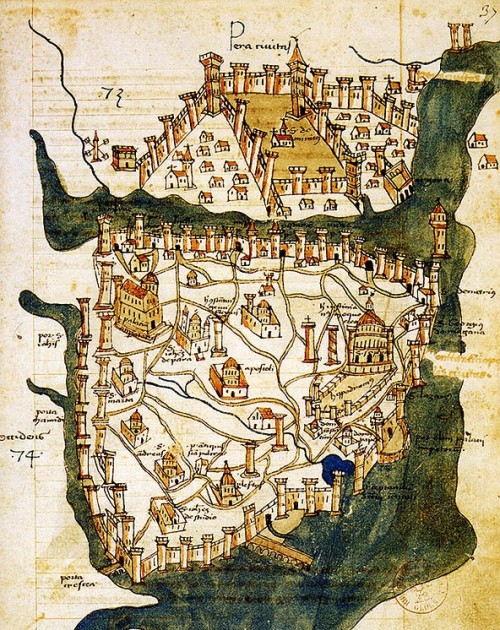
description
The oldest surviving map of Constantinople, by Cristoforo Buondelmonti, dated to 1422. The fortifications of Constantinople and of Galata, at the northern shore of the Golden Horn, are prominently featured. – image from Wikipedia

Seymour does not fit in. He lives with his mother, who struggles to get by on low-wage jobs. Probably on the spectrum, he struggles with more than the usual travails of growing up. He cannot, for example, tolerate loud sound. He cannot or will not remain in his seat at school. The world overwhelms him and when the pressure of it builds too high, he screams, which is not conducive to a successful school life. A class library outing brings him into contact with a whole new world, when the librarian, Marian, (surely a nod to The Music Man) hooks him up with nature books. He finds comfort in the natural world, befriending a large, amenable owl, and reveling in walks in the woods adjacent to his home. We follow him from childhood into adolescence and into his development as an eco-warrior. Seymour is the avatar of Doerr’s concerns about environmental degradation, presenting a generational cri du coeur, however misguided in its application, about the destruction of a following generation’s natural heritage.

We see Zeno as a child. He realizes he is gay at an early age. But it is the 1940s in Idaho, and this is simply not allowed. He has to keep that part of himself hidden. We see him again as a POW during the Korean War, when he learns Greek, and as an octogenarian teacher. He lives in a small Idaho community, and is leading five students in a stage performance of Cloud Cuckoo Land, a book he translated from the Greek, well, from what bits remained of it.

As with All the Light We Cannot See, Doerr’s 2014 Pulitzer Prize winning novel, his characters here are young. (Not necessarily for the entire book, but for a good chunk) He says writing from a child’s perspective allows one to “to see more nakedly some of the things that we’ve elided or erased in our minds because of age.” (From the NYTimes interview). Each comes to the world with their own personal content, but also with a sense of wonder. Anna is amazed by the vast universe of story that can be reached through literacy. Seymour is dazzled by nature and nature books. Konstance is amazed by the things she can see, the places she can visit, the knowledge she can gain in the virtual library on the ship. Zeno also finds a refuge and a world of possibility in his local library. For Omeir, it is the tales his grandfather tells him when they’re out trapping grouse that capture his imagination.

While all the characters have their individual stories, Zeno and Seymour’s stories converge in today’s Lakeport, Idaho; (Doerr and family spend a lot of time in McCall, Idaho, a likely model for Lakeport) Anna and Omeir’s stories converge in the siege of Constantinople in the fifteenth century, and all their stories converge on the connection to that ancient book up through the somewhat near future of Konstance’s experience.

description
Mural at the Turkish Military Museum of the scene outside the walls of Constantinople in 1453 – image from Europe Between East and West

It is these connections, these convergences, that provide the structure and core mystery of the book. How does this first century story find its way to fifteenth century Constantinople, to the world of today, and to the future in which Konstance lives? How is it preserved, by whom, and why? Asked about the spark for his focus on the preservation of literature, of culture, Doer said:

I’m getting close to 50. And though I still feel and behave like a kid most of the time, my eyesight is fading, I can apparently injure myself while sleeping and my little baby boys are suddenly big hairy-legged job-working car-driving high school kids. I’m realizing that everything—youth, hairlines, memories, civilizations—fades. And the amazing technology that is a printed book seems to be one of the few human inventions that has outlived whole human generations. What a privilege it is to open a book like The Iliad and summon tales that entertained people almost 3,000 years ago.

The folks doing most of the preserving are librarians of one sort or another. Each of the characters has a relationship with a librarian, Zeno and Seymour with the librarians in Lakeport, Idaho, Anna with scribes in Constantinople, Omeir with Anna, and Konstance with the AI controller of her ship.

I hope that my readers will be reminded that librarians serve as stewards of human memory—without librarians, we lose perhaps our most important windows into the human journey. – from the QBD interview

Part of his growing-up environment was spending a lot of time in libraries as his teacher mom often made use of them as a form of day care for Doerr and his brothers. It’s not like he minded. In fact, he even dedicated the book to librarians.

They were a place where I felt completely safe. And just the miracle of them, there’s something that – talk about peeling the scales off your eyes. Like, here’s the work of all these masters available to you for free. And you can take them home. – from the NPR interview

As with All the Light…, Doerr found inspirations for the elements of the book in diverse places. It was while researching the walls at Saint Malo for his prior book that he came across repeated references to the millennium-long impenetrability of the walls of Constantinople, and dug into that a lot deeper. He is also interested in how technology induces change. In All the Light… it was radio. Here it is gunpowder and advanced armaments in the 15th century, allowing a new level of violence in the assault on supposedly impervious walls. In the contemporary world it is the internet allowing in both a world of information and a cannonade of lies and manipulation. He sees the future as being driven by artificial intelligence.

One of the things that most stuck with me was the portrayal of reading, particularly the reading of material to others, as not only an act of kindness, of affection, but also be a source of healing, and certainly comfort. There are several times when characters read to other characters who are ill, to positive effect. We are a species that relies on stories to make sense of our world, and to inspire, to spark imagination. The story of Aethon inspires all the main characters to dream of more, to dream of better, to dream beyond realistic possibility.

Doerr enjoys tossing in a bit of classical reference spice. The ship Argos, of course, recalls Jason and his crew. Zeno is saved by a dog named Athena as Hercules was rescued by the goddess herself. There are plenty more of these.

I would keep an eye out for owl imagery, and roses come in for some repeated attention as well. Walls get special attention. The big one in Constantinople is the most obvious, but Konstance has physical walls of her own she needs to get through. Seymour tries breaching a physical wall, as Zeno tries to defend one. The notion of paradise permeates. The title alone refers to an unrealizable fantasy of heaven. It is the heaven that Aethon pursues. For Zeno it is a place where he can be accepted, loved, while being his true self. Seymour is lured by the promise of a sylvan environmentalist camp where he can embrace nature with others of like mind. A development in his beloved woods is called Eden’s Gate (close enough to make one think of Heaven’s Gate). He and his mother live on Arcady Lane. For Anna it is a dream of a better life outside the city.

How Doerr weaves all this together is a dazzling work of genius. He will leave you breathless, even as he shows you the construction of his multiple threads, bit by bit by bit.

“That’s the real joy,” Doerr said, “the visceral pleasure that comes from taking these stories, these lives, and intersecting them, braiding them.” – from the NY Times interview

Mirroring is employed extensively as the experiences of all five characters (and Aethon) repeat in one form or another for them all.

The book lists at 640 hardcover pages. Do not take this at face value. In terms of actual words, Cuckoo Land is about the same length as All the Light. There are many pages holding only titles or section headings. There is a lot of white space. That does not make this a fast read. It would still be around 500 pages if one stripped it down to word-count alone. But it is less daunting than the presenting length of 640 pages. Also, Doerr writes in small chunks. You can always use a spare minute or two to drop in on this book and still get through a chapter or five. There is a reason for this.

He had hit upon this approach for the most practical of reasons. As a parent, he couldn’t hope to get more than an hour or two of solid work done before having to attend to shuttling the boys to swim practice or some other activity. “I might have stumbled accidentally into that,” he said. – from the NY Times interview

While there are dark events that take place in this novel, the overall feel is one of optimism, of possibility, of persistence, and of the availability of beauty and hope to all, if only we can keep alive our connections to each other through time and place, keep alive hopes for a better place, for a better, meaningful life, and continue to dream impossible dreams. If you read nothing else this year, do yourself a favor and read Cloud Cuckoo Land, and be transported (no wings required) to a literary paradise by this book, which I hope will be read as long as there are people able to read. It is a heavenly book, and an immediate classic.

“Repository,” he finally says, “you know this word? A resting place. A text—a book—is a resting place for the memories of people who have lived before. A way for the memory to stay fixed after the soul has traveled on.”
His eyes open very widely then, as though he peers into a great darkness.
“But books, like people, die too. They die in fires or floods or in the mouths of worms or at the whims of tyrants. If they are not safeguarded, they go out of the world. And when a book goes out of the world, the memory dies a second death.”

Review posted – October 22, 2021

Publication dates
———-Hardcover – September 28, 2021
———-Trade paperback – September 27, 2022

I received an ARE of Cloud Cuckoo Land from Simon & Schuster, but I first learned of it from Cai at GR, who passed on my request to someone at S&S, who sent me an ARE and passed on my request to the person responsible for this e-galley, who ok’d that too. Thanks to all, and thanks to NetGalley for providing an e-ARE.

=======================================EXTRA STUFF

Links to the author’s personal, Instagram, GR, and FB pages

Interviews
—–The Guardian – Anthony Doerr: ‘Rather than write what I know, I write what I want to know’ by Anthony Cummins
—–CBS – Sunday Morning – Novelist Anthony Doerr on “Cloud Cuckoo Land” – with Lee Cowan – video – 7:49
—–NPR – Anthony Doerr On The Spark That Inspired ‘Cloud Cuckoo Land’ – audio – 8:26 – with Scott Simon – text of the interview is on the page as well
—–Seattle Times – Pulitzer winner Anthony Doerr discusses his new novel, the timeless power of books and more by Moira Macdonald
—–New York Times – For His Next Act, Anthony Doerr Wrote a Book About Everything by Gal Beckerman
—–Parade – Anthony Doerr Revels in the Uplifting Messages of Stories in His New Epic Cloud Cuckoo Land by Dillon Dodson
—–QBD Book Club: Cloud Cuckoo Land with Anthony Doerr with Victoria A. Carthew – video – 28:06

My review of Doerr’s prior novel
—–All the Light We Cannot See

Songs/Music
—–Les Miserables I Dreamed a Dream – Anne Hathaway
—–Man of La Mancha – The Impossible Dream – Richard Kiley at the Tony Awards
—–The Music Man – Madam Librarian
—–Edison Lighthouse – Love Grows Where my Rosemary Goes – Playing when Zeno is in London

Items of Interest from the author
—–audio excerpt – 0:58

Items of Interest
—–Interesting Literature – on the etymology of the phrase Cloud Cuckoo Land
Since the late nineteenth century, the phrase has been used more generally to refer to ‘a fanciful or ideal realm or domain’. Indeed, most of the time people use ‘cloud cuckoo land’ they do so without referencing the phrase back to Aristophanes; indeed, many people who use the phrase may well be unaware of the term’s origins in the work of ancient Greece’s greatest comic playwright.
—–Wiki on The Fall of Constantinople
—–Wiki on The Imperial Library of Constantinople
—–Generation Starship – thanks to Derus for the ref

5 Comments

Filed under AI, Artificial Intelligence, Cli-Fi, Fiction, Historical Fiction, Literary Fiction, Reviews, Sci-fi, Science Fiction

Things in Jars by Jess Kidd

book cover

A cloth covers the jar that Bridie took from the bookcase in the nursery, and Ruby is thankful for this. For the contents have the ability to rearrange even a dead man’s sense of reality. As with all terrible, wondrous sights, there is a jolt of shock, then a hypnotic fascination, then the uneasy queasiness, then the whole thing starts again; the desire to look and the desire never to have looked in the first place.

1860s London, the prime of the Victorian age. About fifteen years before Sherlock Holmes begins using his talents to suss truth from mystery, Bridie applies her peculiar talents to helping the police in cases of an unusual nature. A sign outside her door announces:

Mrs Devine
Domestic Investigations
Minor surgery (Esp. Boils, Warts, Extractions)
Discretion Assured

but she is known mostly for her ability to discern the cause of death, when simple observation will not suffice. She would do as well with a sign that says Investigator of the Bizarre. Her Scotland Yard contact and sometime employer is one Inspector Valentine Rose, and business is brisk.

London is awash with the freshly murdered. Bodies appear hourly, blooming in doorways with their throats cut, prone in alleyways with the head knocked in. Half-burnt in hearths and garroted in garrets, folded into trunks or bobbing about in the Thames, great bloated shoals of them.

She is called on to look into inexplicable deaths, primarily among the flotsam of society. London has been undergoing the installation of a world class sewer system, and diggings have turned up some extremely cold cases. The latest calls her to a crypt in Highgate Chapel. A mother and child have been unearthed, the child having significant bodily abnormalities. Around the same time, a dodgy-seeming doctor comes a-calling, seeking her assistance on behalf of his patron, Sir Edmund Athestan Berwick. Seems the baronet’s daughter has been kidnapped. Going to the police is not really an option. And the game is afoot. Any chance the two cases are linked?

description
Jess Kidd – image from Metro.

The purloined child, Christabel, has some peculiarities of her own.

The man, looking up, hesitates and the child bites him, a nip of surprising sharpness. He pulls his hand away in surprise and sees a line of puncture holes, small but deep…The man stands, dazed, flexing his hand. Red lines track from palm to wrist to elbow, the teeth marks turn mulberry, then black…What kind of child bites like this, like a rat? He imagines her venom—he feels it—coursing through him …A blistering poison spreads, a sudden fire burning itself out as it travels…All- the time the creature watches him, her eyes darkening—a trick of lamplight, surely!…He would scream if he could, but he can only reach out. He lies gasping like a landed fish.

Poor unfortunate soul.

description
Image from The Times

With Sherlockian insight, a talent for disguises, and lots of shoe leather, Bridie sets about following leads and examining clues trying to get to the bottom of a case that is unusually fishy. Like that later consulting detective, Bridie smokes a pipe, which is often enlivened by substances other than pure tobacco, things with names such as Mystery Caravan or Fairground Riot, concocted by Dr. Rumhold Fortitude Prudhoe, a close friend. She shares her quarters with a particularly helpful assistant, the seven-foot-tall Cora Butter, who asks more than once whether Bridie would like this or that person held upside down. The medical bag Bridie totes is her own. The other frequent companion in her investigations is a dead man. While on the job at Highgate Chapel, he first appeared to her in the attached graveyard, notable not only for his transparency, but for his indecorous attire. Ruby Doyle had been a renowned boxer in his day, and appears in shorts, shirtless, sporting a cocked top hat, an impressive handlebar moustache, muscles aplenty, and a considerable number of tattoos, with peculiarities all their own. He seems to know Bridie quite well. One of the mysteries of the book is why she does not seem to remember him, particularly as she finds him very, very attractive.

description
Tom Hardy – add a handlebar moustache, top hat, and some more tats, and Kidd sees him as Ruby

The supporting cast is a delight. Lee refers to those who work with her as Bridie’s Victorian A-team. Beyond those noted above there is a criminal circus owner with a weakness for strong women, psycho killers of both the male and female persuasion, a misshapen sniveling abettor who could have snuck out of a Dickens novel to put some time in here, an honorable street urchin, orphans, a mysterious woman who may be haunting the baronet, and plenty more.

The story is told in two timelines. Bridie investigates the taking of Christabel in 1863, and we get looks back into Bridie’s childhood from 1837 to 1843, the earlier period explaining much of what is to come twenty years later. And explaining how Bridie came to have the skills she possesses. Bridie was born in Ireland, like the author, but I expect Jess Lee’s transition to life in London was a tad less fraught.

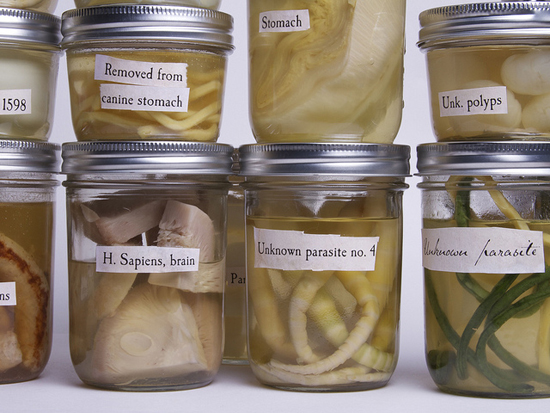
description
Image from Foodiggity.com

Among other things, Kidd is interested in presenting a realistic portrait of the period. ( I…wanted to give a basis of a real, gritty, accurate portrayal of Victorian London.) Visually, she offers panoramic looks through the dark eyes of ravens, and Bridie’s pedestrian peregrinations, particularly through less-than-posh parts of the city. She offers a particularly effective olfactory perspective as well.

Breathe in—but not too deeply. Follow the fulsome fumes from the tanners and the reek from the brewery, butterscotch rotten, drifting across Seven Dials. Keep on past the mothballs and the cheap tailor’s and turn left at the singed silk of the maddened hatter. Just beyond, you’ll detect the unwashed crotch of the overworked prostitute and the Christian sweat of the charwoman. On every inhale a shifting scale of onions and scalded milk, chrysanthemums and spiced apple, broiled meat and wet straw, and the sudden stench of the Thames as the wind changes direction and blows up the knotted backstreets. Above all, you may notice the rich and sickening chorus of shit.

She was greatly influenced by journalist William Mayhew’s encyclopedic 1851 book London Labour and the London Poor. There is a look at the jailhouse, which appears to be guarded by particularly corrupt versions of Tweedle-Dee and Tweedle-Dum. Toss in, (or dig up) some resurrectionists, too. Part of the Victorian culture was a craze for collecting exotic things. One story that fed her interest was that of The Irish Giant, an exceptionally tall gent (7’7”) who became the talk of London for a brief time. But after his early demise, and despite his specific instructions to the contrary, his remains were obtained by a collector and put on display. There is a link to this tale in EXTRA STUFF.

description
Image from Traveldarkly.com

Lee is also interested in Irish folklore and partakes of that richly for the core element of the story. The incorporation of this element brings with it the main fantasy strand of the novel. One look at the cover of the book will inform you that there be mermaids (or something akin) here. Lee adds additional magical elements, as such critters appear here to have considerable power to influence the world about them, and specific powers that we would never associate with The Little Mermaid, although, considering the things we see in jars, we might have to reconsider the implications of the song Part of Your World:

Look at this stuff
Isn’t it neat?
Wouldn’t you think my collection’s complete?
Wouldn’t you think I’m the girl
The girl who has ev’rything?
Look at this trove
Treasures untold
How many wonders can one cavern hold?
Lookin’ around here you’d think
(Sure) she’s got everything

Hmmmmmm.

description
Image from Klyker.com

There is considerable humor in Things in Jars.

Her spectacularly ugly bonnet is curled up before the fire, bristling with feathers. She refused to give it up into the hands of the butler. Not that the butler was overeager to take it. If it comes alive, Sir Edmund thinks, he will do for it with the poker.

My particular LOL favorite is the prayer young Bridie offers up at bedtime.

God grant eternal rest to Mammy, Daddy, James, John, Theresa, Margaret, Ellen, and little baby Owen. God grant that bastard Paddy Fadden a kick up his hole and severe death to him and his gang, of a slow and terrible variety.

How could you not absolutely love such a child?

The disappointments in Things in Jars were few. I wish there had been more provision of clues throughout the book about what the deal was with Ruby. I was ok with the explanation, but it needed a better support structure. A bit more background on Cora would have been welcome. One actual gripe was a scene in which Bridie falls asleep while on the job. No way would this have happened. Booo! Almost all the violence occurs off-stage. In addition to one event described in a quote from the book in the review, we are shown the beginning of one attack by a ruffian on a lady. Tender souls might turn away. That’s really about it for such things.

description
Image from Nickcook.net

But the delights in Things in Jars could fill a wing of the British Museum. Bridie is a delicious lead, tough as nails without being impervious, bright, with a solid background that explains how she knows what she knows. She is a lot of fun to follow. The Holmesian parallels are a treat. The supporting cast is like a three-ring circus, in the best possible way, diverse, interesting, and fun to watch (both the light and the dark). We feel the fear when appropriate, and see Bridie’s affection for Ruby grow. A taste of Irish folklore is both creepy and educational, and Lee’s portrait of 19th century London offers an exceptionally immersive experience. You really get a feel (and smell) of being there. A real-world mystery with fabulous elements of fantasy. In short, Things in Jars is an absolute delight. For the hours you are reading this book you will be part of that world.

Review first posted – January 17, 2020

Publication date – February 4, 2020

I received an ARE of this book from Atria in return for some specimens I have been keeping in a special place in the lab basement for some years. They promised to return them after a thorough examination.

This review is cross-posted on Goodreads. Stop by and say Hi!

=======================================EXTRA STUFF

Links to the author’s personal, Twitter, Goodreads, Instagram and FB pages

My review of a 2023 book by Kidd
—–The Night Ship

Interviews
—–Savidge Reads – Sinister & Supernatural Shenanigans with Jess Kidd – by Simon Savidge
—–Stitcher – S3E4 – Chatting with Jess Kidd – audio – 1:29:12 – by Tim Clare – you can safely begin at about 46:00 for a focus on Jars
—–Well, not an interview, really, but a piece Kidd wrote for LitHub on her favorite ghost stories – Books That Blur the Lines Between Living and Dead

Items of Interest
—–Waterstones – A look at the Operating Theater – Kidd gives a tour
—–Writing i.e. – On Writing Things in Jars by Jess Kidd
—–Gutenberg – London Labour and the London Poor (1851) by William Mayhew
—–Joseph Bazalgette – engineer of the massive sewer works in London
—–Otherworldly Oracle – Mermen Legends. – a fun bit of fluff
—–Wikipedia – The Irish Giant

Leave a comment

Filed under Fantasy, Fiction, Historical Fiction, Thriller, Thriller

The Binding by Bridget Collins

book cover

We’ve been called witches since the beginning of time. Word-cunning, they used to call it—of a piece with invoking demons…We were burned for it too. The Crusade wasn’t new, we’ve always been scapegoats. Well, knowledge is always a kind of magic, I suppose.

Emmett Farmer is a young man with issues. He used to think that he would inherit his family’s farm. It was the life he was used to and the road he expected to follow to, and beyond, the horizon. But he has not been himself lately. His abilities have deteriorated. He loses himself, in time, suffering dizziness, nausea, and weakness. Some say he was cursed by a witch. When he is offered an apprenticeship with a bookbinder, it offers a way out, however frightening the career and his mentor might be.

description
Bridget Collins – image from United Agents, UK

Despite some raw similarities, bookbinding in Bridget Collins’s world is not quite the same as it is in ours. Emmett trains with the elderly Seradith, a woman seen as being a witchy sort by some of the locals. In fact, bookbinding is seen as a dodgy sort of work. What is bound in books here are memories. Instead of sharing recollections or stories, as they do in our reality, the memories bound into beautifully crafted leather books in this world are removed from clients by binders. Unlike books in our world, which are designed to be shared, these books are meant to be hidden. Being on the NY Times Top Ten list would kinda defeat the purpose.

At least that is the intent. Cheat on your taxes? Pay off your mistress to keep quiet at the height of a political campaign? Sell out your nation’s security in return for real estate consideration by a foreign enemy? Awkward. But there is a solution, well, for part of it, anyway. Go to a binder and the memories will be nicely removed, leaving your tiny mind virginally memory and guilt free, and ready for that sit-down with whoever might be heading an investigation. If memory-cleansing bookbinding existed in our world, I imagine there would be a long line of potential clients. Of course, it might be a challenge to find binders with the innate talent to make those memories move from a client’s brain to the page. One can train in how to work the leather, sew the pages, and do all the material steps entailed in constructing such a book, but only those with a special gift can smooth the passage from one medium to the other. Emmett Farmer, it turns out, has such a gift. It does not help much with tilling fields, but is crucial for this special craft.

…the hours passed slowly, full of small, solid details; at home, in the busyness of farm life, I’d never had the time to sit and stare, or pay attention to the way a tool looked, or how well it was made, before I used it. Here the clock in the hall dredged up seconds like stones and dropped them again into the pool of the day, letting each ripple widen before the next one fell.

Emmett acclimates to Seradith’s remote locale (out in the marshes), begins to learn the manual end of the binding craft, and is eager to move beyond to learn what bookbinding is really all about (he does not actually know). He is particularly curious about what goes on beyond certain forbidden doors at Seradith’s emporium, but even glancing inside such doors causes him major episodes of what his boss calls Binder’s Disease, costing him days of consciousness and bringing forth strange visions. These strains increase when certain clients arrive. When he finds a book with his name on it, Emmett realizes that he is less than whole.

Part Two of the novel is Emmett’s bound story as reported in that book. Part Three returns us to Emmett’s now, and how he deals with what he has learned. More than that about the goings on risks spoiling a key plot twist. But it does touch on forbidden love and the dangers of loving outside one’s class, however that may be defined.

The Binding is an engaging page turner of an historical fantasy, particularly the first third, in which we are introduced to Collins’s world, an amalgam of the medieval and circa 1890 rural England. The mystery of Emmett’s affliction is enticing and his experience at Seradith’s is riveting. I found Part Two, Emmett’s bound story, interesting, but nowhere near as gripping. Part three is pretty much a continuation of Part Two, but with Emmett aware of his history, so is more of a cloth with the second than the first part. Not to say that the latter two are not good, just not so fabulous as the opening, in terms of the engagement of the story, at least. In terms of looking at the socio-economic implications of binding, they are wonderful.

One fascinating thing is how Collins came up with her concept. She was working as a volunteer at Samaritans, a non-profit that offers people who will listen for people who need to talk. What would it be like if I could reach out and winch that memory from you? She was also taking a book-binding class at the time, and a happy combination was conceived. In setting her story in late 19th century rural England she uses some history of the era to correspond with events in the created reality. For example, the Binding Law of 1850 in Emmett’s world corresponds to the 1850 legalization of gin (I’ll drink to that!) in English law. The Crusades here, for example, were not about perceived Middle Eastern outrages, addressed with European outrages, but were focused on scapegoating binding for the social and economic disruptions brought about by the rise of capitalism. Binders are viewed as women accused of witchcraft have been in our world, dealers in mysterious practices, necessary for providing needed services, but not to be trusted, and maybe evil.

There are many novels that use memory loss as a core mechanism. Some elements of these are fairly common. How is memory lost? Literature is rich with examples, usually of the traumatic sort, usually involving violence, typically a blow to the head. These tend to populate books in which memory loss features as a Maguffin for propelling a thriller or mystery. Next down the list is memory lost through illness, typically Alzheimers’ disease. Still Alice fits in there nicely. There are stories in which memory loss is via external misadventure of a broader, science-fictiony sort, things like plagues. The Book of M is a wonderful example. Less populous is the sort in which memory is willingly surrendered, Eternal Sunshine of the Spotless Mind pops to mind. (and we elect to keep it there, for now) The Binding relies on the last of these, substituting a bit of magic for the sci-fi explanation offered in Eternal Sunshine.

What lifts The Binding above the crowd of memory-loss novels is its consideration of the societal implications of voluntary forgetting. There are complications, of course, and they are wonderfully explored. Some with power want others to forget what they have done. Think of it as an employment contract, or a user agreement for partaking in pretty much any software. You agree to this and that, and such and such, which will entail the surrender of some inalienable rights. Just click agree at the bottom of the mouse-print form. But damn, you need the job, or want to use the software. However, what if what you are surrendering to the seller, or employer, is the right to your own memories? And what if the person in power has done something they would rather you not remember? You might find yourself (or what is left of you) wearing out a path to the binder’s shop for a bit of a memory trim (Boss just sent me over. Says you should just take a bit off the top, please, and close on the sides, ok?) I will leave to your imagination (and the book of course) how such a system might be abused. So, we have an author who looks at political power in a very personal way. Workers of the world unite! You have nothing to lose but your…wait, what was that again? Continuing the image, what if you are starving and selling your memories as a way to put food on the table, the way many in poverty engage in sex work to make ends meet? Puts me in mind of the Beggarwoman from Sweeney Todd (Hey, don’t I know you, Mister?”) Which of course presumes that there are binders out there with somewhat lower ethical standards than the very righteous Seradith. Shocking, I know.

To lift the novel even higher is a parallel consideration, the significance, the power of books themselves, what it means to write a book, to read a book, and to share the experiences of another through the written page. I was reminded of The Guernsey Literary and Potato Peel Pie Society and The Book Thief.

What if we look at books as a manifestation of self? Not exactly a stretch. Do authors lose a part of themselves when they commit their thoughts to the page? Is reading a book written by someone else a form of voyeurism? Just as in our world, books can be used for benign or malign purposes, books are treated as treasured valuables by some and as a form of personal or mass-produced filth by others. Seradith, essentially, amputates memories, as a physician would take an unhealable limb, a benign act, and saves the bound memory in a beautifully crafted book, kept safe in a vault. Others may make use of such books for corrupt purposes. You, yes you, reading this, you know the power of books, how they can act like a drug, slaking, temporarily, an unquenchable thirst. Very drug-like, no? How about the power of books to heal? Ever read anything that made you feel better? Certainly any well-written memoir can offer one a view of someone’s inner life, but at least in our world, that does not require that the author forget what she has written. Books change lives, whether we read or write them. For writers, a part of themselves definitely finds its way onto the page. And a world in which all books are locked away sounds rather medieval.

Collins offers a bit of wry perspective on writing.

There’s a growing trade in fakes, you know. Does that concern you?” He paused, but he didn’t seem surprised not to get an answer. “I’ve never seen one—well, as far as I know-but I’m curious. Could one really tell the difference? Novels, they call them. They must be much cheaper to produce. You can copy them, you see. Use the same story over and over, and as long as you’re careful how you sell them, you can get away with it. it makes one wonder who would write them. People who enjoy imagining misery, I suppose. People who have no scruples about dishonesty. People who can spend days writing a long sad lie without going insane…My father, of course, is a connoisseur. He claims that he would know instantly if he saw a novel. He says that a real, authentic book breathes an unmistakable scent of…well. He calls it truth, or life. I think maybe he means despair.

I doubt that despair is what you will experience on reading The Binder. This is a marvelous read, a thoughtful, engaging novel, featuring a large dollop of Dickensian social commentary, while following an appealing everyman through the perils of coming of age, and offering in addition insightful observations on memory-as-self and the power of books. I was sure I had something more to say, but I seem to have forgotten what that was.

Review first posted – January 4, 2019

Publication
—–UK – January 10, 2019
—–USA – April 16, 2019
———-April 21, 2020 – trade paper

This review is cross-posted on Goodreads. Stop by and say Hi!

=======================================EXTRA STUFF

Links to the author’s personal, Twitter and GR pages

If you check only one interview with the author, make it this one, in which the author talks with her US editor. The Library Lovefest audio is about 40 minutes long on Soundcloud, and is well worth the time invested. – Editors Unedited: Editor Jessica Williams in Conversation with Author Bridget Collins

Lists
—–GR list of Amnesia and Memory Loss Fiction
—–Popular Memory Loss Books on GR
—–Books featuring amnesia

The Memory Files – film
—–Memento
—–Eternal Sunshine of the Spotless Mind
—–The Bourne Identity (film)
—–The English Patient (film)

The Memory Files – fiction
—– The Bourne Identity (novel)
—–The English Patient (novel)
—–Still Alice
—–The Book of M
—–The Guernsey Literary and Potato Peel Pie Society
—–The Book Thief

Bookbinding
—–from Instructables.com – How to Bind Your Own Hardback Book
—–Self-Publishing Basics: 5 Book Binding Styles Illustrated

Leave a comment

Filed under Fantasy, Fiction, Literary Fiction