Tag Archives: Fiction

Meet Me in Another Life by Catriona Silvey

book cover

Santi steps closer as she holds the light up to the gears. ‘Think we can fix it?’
Thora puts her weight to one of the gears and tries to shove it backwards. ‘No,’ she says, after a few seconds. ‘I’m afraid time has stopped.’
Santi tries to push the gear in the other direction. Giving up, he steps back. ‘I guess it has.’ He smiles at her sideways in the flickering light. ‘Welcome to forever.’
It’s a pretentious thing to say. But Thora has to admit that’s exactly how this feels: a moment taken out of time, with no beginning or end.

Imagine you are looking at the screen in a large cinema. There are blips in the image, fleeting, but present. As the film moves on to the next scene, there are more blips, holes in the image, with another image, another, pentimento film, going on behind the up-front film. Another scene on the big screen, with more blip, until the characters in the front film, look at each other and say, “did you see that?” As they slowly become more and more aware that there is something going on in the film behind them, they turn and watch, and their behavior in the front film changes, to take account of the new knowledge.

description
Catriona Silvey – image from Harper Voyager – photo credit – Hazel Lee

That is what reading Meet Me in Another Life is like. Thora and Santi (Santiago) find themselves in Cologne. (neither is a native) They meet cute, at first, anyway. Until, oopsy, soon after they meet, tragedy. It takes only a short time to know that these two have a special bond, one that will persist through life after life, as one or the other is gone by the end of each of the eighteen chapters, to be reunited in the next. Their ages vary in each iteration. In a few they are the same age. In some, one or the other is older, a little, more than a little, or maybe a lot. Their positions of authority vary as well, parent/child, teacher/student, cop/trainee, patient/caretaker, if there is any such hierarchical relationship between them. They have varying personal relationships, with each other (bf/gf, married, prospects), or he with Heloise, she with Jules. But their passion for learning, for exploration, for science binds them together.

It is clear to us early on that there is a mystery to be solved. Why the recurring lives? Why the disparate ages, roles, and relationships? After a time, it becomes clear to Thora and Santi, too. They begin to realize that they have known each other and remember things from their former lives. Also, there are some consistencies, some places and characters that recur, unchanged.

Recurring elements (Santi’s cat, a tattoo on Thora’s wrist) first gain meaning through repetition, and then become touchstones, triggering inferences for the reader about how the characters have changed and where they might be headed. Once Santi and Thora realize they are trapped in a loop, they (along with the reader) must piece together the clues scattered through the narrative to figure out what might really be going on. – from the LitHub article

The notion that sparked the book is very down to earth. But these are two characters who are reaching for the stars, and Silvey’s solution was very fantasy/sci-fi-ish.

…the question was: can two people ever know each other completely? That led me to the idea of characters who meet again and again in different versions of their lives…I think of the book as an argument: Thora and Santi have very different attitudes to their situation, and that leads them to respond to it in different ways. – from the Deborah Kalb interview

There are obvious similarities to other works that deal in re-iteration. Kate Atkinson’s Life After Life (when Thora refers to herself as the Fox to Santi’s Wolf, is that a nod to that book?) uses the method in consideration of England in the first half or the 20th Century, and looking at the possible branches life might take were one to choose A instead of B, or B instead of C, giving the available choices a go until a desirable path forward is found. Thora, in particular, and Santi try this out, but it is not enough to solve the puzzle. Cloud Atlas is another novel offering common characters in diverse times (and places. This one is all in Cologne). Groundhog Day is the most famous cinematic rom-com loop and Andy Samberg’s Palm Springs gave it a similar go in 2020. 50 First Dates anyone? There is a clear romantic element in this one, too, as Thora and Santi are souls who are clearly meant to be together, (Yeah, I know, some might see them as merely tethered. But my take is that there is greater depth to their connection.) despite the fact that Thora is bisexual and has major hots for a woman, Jules, in many of the stories. Santi and Thora are a couple in others.

Their divergent perspectives offer a fascinating core to their discussions. He is religious, believes in God, an afterlife, and that there is a reason for being, maybe a mission even. Life should make sense. He thinks if he can figure out what God wants of him they can step outside their seemingly endless repetitions. She is an atheist and is having none of that. They talk about faith, determinism, eternity, and plenty more that raises this above the level of a simple entertainment.

Santi has always trusted in fate: that there is one way thing have to go. He isn’t literal enough to believe that the future is written in the stars—he’s doing a PhD in astronomy, after all—but his memories of other skies still unsettle him. The idea that there are other possible configurations for the universe, that God could be running them all in parallel, cuts against everything he believes. The only way he can reconcile what he remembers is to think that it’s a message, one he’s not yet ready to understand. He watches the world like a detective, like a poet, waiting for the meaning to come clear.

Santi’s faith seems more in fate than in the divine, given his inability to allow for a deity capable of managing multiple universes. But the faith he has, of whatever sort, is put to the test, repeatedly.

They struggle to know themselves, as much as they try to understand each other.

”This’ll never work, you know,” she says conversationally.
Santi frowns at her. “Who says?”
“All my exes. Most recently, my ex-girlfriend Jules. She told me when we broke up what my problem is.”
“What’s your problem?”
“I always want somewhere else. I’m never just—content to be where I am.”
He shrugs. “Neither am I.”
She gives him a look. ”What do you mean? You’re, like, Mr Serenity.”
A smile cracks his face. “That may be what it looks like on the outside. But inside, I’m always searching…We’re the same that way.”

As in any good mystery, there are plenty of clues sprinkled throughout the eighteen stories. Making sense of them is the challenge for us readers as much as it is for Thora and Santi. I was only partly successful at sussing out what was going on, even with keeping an excel sheet to track differences and commonalities among the stories. (Don’t judge me!) This is a good thing. Of course, you may be a lot smarter than me and figure it all out early on. That would be too bad. Not knowing, trying to figure it out from the clues provided, was part of the fun.

None of this matters if we do not care about our two leads. Not to worry. While both characters have qualities that raise them well above average, they often find themselves in everyman (and woman) situations and pedestrian lives. Their clear bond with each other is almost a third lead, so strongly does this come across. You will definitely be rooting for them to figure out how to get off what seems an eternal hamster wheel. The novel is as engaging and enjoyable as it is intellectually stimulating.

My only gripe, and it is minor, is that there seemed a bit too much exposition. There is nothing wrong with exposition, but the telling/showing seesaw felt a bit too heavy on one end at times.

Are Thora and Santi two star-crossed lovers or is their connection made in heaven? Only the stars (and the author) know for sure. Allow yourself to be delighted. There is plenty here that can generate that feeling. You may forget about this review, this book, for a while, but I am fairly certain the book, preferably, will turn up again in your life. Try your best. It will be worth your time. Remember.

If God’s test were easy, it would be meaningless.

Review posted – June 11, 2021

Publication date – April 27, 2021

If you are looking for a SUMMER BOOK, this is my rec – no-holds-barred, #1 fab beach read, or anywhere read.

The film rights have been optioned by Atlas Entertainment and Pilot Wave, with Gal Gadot to produce and star. I spotted much news coverage of this that was, IMHO, wrong-headed, in portraying the book as an LGBTQ sci-fi novel. Thora is indeed bi-sexual, with more story time with female than male partners, but that is sooooo not what this book is about. We do know that once Hollywood gets its claws on a novel, the end product can diverge dramatically (or even melodramatically) from the source material. This initial coverage is not encouraging. But then, many film-rights options are never exercised. So we, who favor hewing as closely as possible to written source material, are a long way from having to fret over this.

This review has been cross-posted on GoodReads

=======================================EXTRA STUFF

Links to the author’s personal, GR, and Twitter pages, and her academic site (Silvey has a PhD in language evolution, and has published numerous papers)

Interviews
—–Book Q&As with Deborah Kalb
—–The Royal Institution – Formatted Q/A – thin, but fun

Q/A

I asked Silvey a question on the Ask The Author part of her GR page, to which she offered a response in very short order.

Q – How did your research on the evolution of language manifest in MMiAL?

A – That’s an interesting question! My honest answer is “not really”… I did realise after writing the book that there is a linguistically informed way of thinking about time loops, and why they might be appealing to a reader – I wrote about that in an essay on LitHub: https://lithub.com/on-the-counterintu… But if my experience as a researcher influenced the book at all during the writing, it might be in the way Thora and Santi’s situation mirrors the strange, lonely-together rootlessness of academics – people who are usually foreigners in the place they’re living, brought together by shared passions, using English as a lingua franca but often talking past each other.

Songs/Music
—–Silvey’s Song list for Thora
—– Silvey’s Song list for Santi
—–What Silvey listened to on repeat while working on the book
———-Tom Rosenthal and dodie – Years Years Bears
———-The Mountain Goats – Love Love Love
———-Michael Stipe & Big Red Machine – No Time For Love Like Now

Items of Interest from the author
—–Silvey’s site – Excerpt – Chapter 1 – Welcome To Forever
—–Crimereads – Excerpt – Chapter 8 – 115 – We Are Here
—–Lithub – On the Counterintuitive Appeal of the Literary Time Loop – in this article, linked in Silvey’s Q/A response above, she explains very clearly how time loop narratives work in a literary framework. This is MUST READ material!

Items of Interest
—–Smithsonian – Félicette, the First Cat in Space, Finally Gets a Memorial – referenced in chapter 3, et al
—–Contact – referenced in chapter 7
—–I was intending to provide a link here to the Odysseum in Cologne, a science museum of note in the book, but their site is currently unavailable


1 Comment

Filed under Fantasy, Fiction, Sci-fi, Science Fiction, Science Fiction

The Hidden Palace (The Golem and the Jinni #2) by Helene Wecker

book cover
If you have not yet read The Golem and the Jinni, stop! Right now! Go back. Read that, then we can talk about the sequel. Read it already? Great. Not yet? Ok, I’ll wait, but not for a thousand years, like some.

You’re back? Cool. Great book, right? So Chava, the golem of book #1 and Ahmad, the jinni of that tale, are a bit older, and a bit wiser. They are also a bit more rounded as characters. We’ll get to them in a bit.

The story begins with an extremely devout rabbi, Lev Altschul (very old school) on the Lower East Side (not the guy from the earlier book) He has come across some ancient texts, books with arcane knowledge. He is not the greatest parent in the world, a widower, much more devoted to his studies than his daughter, Kreindel. She is taken care of by, essentially, a committee of congregation members. But she loves her pop and wants to learn, wants to study. Of course, girls were not welcome to imbibe the texts that Jewish boys were encouraged to learn. She spies on lessons and picks up what she can. As it happens there is a pogrom underway in one of the usual places in Eastern Europe. The rabbi, with the help of those old books, can now do something about it. He determines to send to a rabbi in Lithuania a weapon that can be used to defend oppressed Jews there. He works day and night to construct a golem for them. It does seem that Wecker’s golems always run into transit issues. Instead of heading across the Atlantic, as planned, this one, Yossele, remains in New York, due to an untimely building fire. He awaits only wakening.

description
Helene Wecker – image from Fantasy Book Cafe

Speaking of golems, Chava is trying her best to be as human as possible, given her natural limitations.

Q: When you thought about writing a golem character, did you think about other legends and myths about people being created out of inanimate matter? Adam from earth? The famous Golem of Prague, the greek myth of Prometheus, or Pygmalion? Frankenstein’s monster? Or even the idea of creating a modern robot? Did you want to write from those traditions or come up with something completely different?


A: I certainly wrote the Golem’s character with those legends and stories in mind. In fact, in early drafts she was much closer to something like the Golem of Prague. She had less emotion, and less insight into the emotions of others. But it became clear that that wouldn’t do for a main character. So I made her more empathic, more “human” in that sense, and I think that brought her closer to the androids and cyborgs of modern science fiction, like the replicants of Blade Runner and Star Trek’s Lt. Commander Data. But I think all these stories have the same sources at heart, and the same central question, of what happens when we create life that approaches human but isn’t quite. – from LitLovers interview re Book One

Despite being a magical clay being conjured by a spell, Chava still feels the compulsion to help others. And being telepathic allows her to have a pretty good idea of what folks feel, and need. Shutting out the onslaught of telepathic noise remains a challenge, but a much reduced one, as she has learned how to block a lot of it out, and she tries to stay away from overcrowded places. Concerned about people noticing her agelessness, after so long a time at the bakery, where she has been working since she arrived, Chava decides it is wise to move on. After completing a course of study at Teacher’s College, she finds an excellent gig at a Jewish orphanage in Manhattan, teaching cooking.

description
Lt Commander Data of Star Trek NG – image from Wikipedia

Speaking of hot things, in Book One, Ahmad was mostly an elemental character, all fire and immediate gratification. Book Two shows a bad boy who can still bring the heat, but who has gained considerably more awareness, of himself, and of the world around him. He has grown a sense of decency, personal responsibility, and a need for purpose. He remains in business with Arbeely, the man who had released him from his thousand-year imprisonment in a flask. He molds iron with his bare hands. Business is good, booming even, so they expand to grander quarters, where Ahmad’s smoldering creative ambitions ignite to full blast.

Sleepless in Manhattan, Chava and Ahmad walk the streets and rooftops in the wee hours. They are best friends, committed to exclusivity with each other re the benefits of their connection. The young man enamored of Chava in Book One, her husband, is no more, killed off in that earlier tale. She is rightfully concerned about the downsides of having a husband or bf made of flesh and blood, and who might not live, ya know, forever, not to mention the risk of him discovering what she really is. Ahmad has sworn off humans, after the damage he did to Sophia Winston in the first book.

And, speaking of damaged heiresses, Sophia has been promoted to a top-tier character. She struggles to cope with the affliction that resulted from her getting jiggi with a jinni. I guess you could call it an STD, but not the usual sort. (Even had penicillin been invented, it would not have done the trick.) She cannot get warm. Sophia is convinced that only place where there is any hope of succor is the Middle East. She travels to many ancient sites, in a constant search for local experts in pharmacology able to concoct potions that alleviate her perpetual chill. (I suppose one might see in Sophia’s inability to douse her inner flames a symbol of her carrying the torch for someone. I wouldn’t. But some might.)

description
Cleopatra’s Needle, was transported from Egypt and installed in Central Park in 1881 – image from Wikipedia

In case there were not enough magical beings wandering about, Wecker balances the scales, tipped by the weighty presence of Yossele, by adding one more. As it happens, Sophia encounters in her travels yet another fire being, a jinniyeh, Dima. It appears that the iron-bound jinni (Ahmad) is a character of legend in the jinni world. This female jinni has something special about her too, (I mean, aside from being a jinni, and going about her business unimpeded by attire) and is hoping to meet up with the only other jinni she has heard of who is also an outsider in their particular circle. She stands in contrast to Ahmad, presenting as the self-centered ball of fire he used to be.

Everybody wants something. Chava wants to be human; Ahmad wants a purpose; Sophia wants a cure; the jinniyeh wants a compatriot, maybe a partner. And in case that is not enough, Yossele wants to protect his master. Kreindel wants to study Hebrew and learn all that her father had learned. More? Remember Anna, a former workmate of Chava’s at the bakery? Chava had seriously put an end to Anna’s husband whaling on her, and subsequently helped Anna and her son, Toby. Anna is terrified of Chava and wants her to stay away. In this book, Toby is a fifteen-year-old Western Union messenger, who wants to know who his father is, and who that creep in his recurring dreams might be, and what the deal is with Chava and that Arab guy.

description
Replicants from Blade Runner – image from NME

Wecker has seriously kicked up her game for this novel. There was plenty going in in the first book in terms of discussions about serious questions of religion and morality. That is no less the case in this one, with the exception that these characters are better drawn, more complex, and more interesting. They struggle with ethical dilemmas, and are challenged to make difficult decisions. There are some lovely interactions among them that will make you smile, maybe even recognize similar tete-a-tetes from your own experience.

description
Pennsylvania Station – image from Traditional Building

This is not a ha ha funny book, but there are some elements of humor here and there. In a way it is a running joke that Ahmad, while working on a large construction, has continual problems keep the over-sized glass panels he has designed from smashing. Given that the primary ingredient in glass is sand, it seems fair to ask if Ahmad might be trying to build a literal sand-castle.

description
Washington Square Park – circa 1907 – image from NY Public Library

Speaking of palaces, not all are hidden. The newly opened Pennsylvania Station, a glorious structure, is seen as a kind of palatial caravansery, a roadside inn for travelers from all over, where information was exchanged and commerce was conducted. It is a favorite spot for Ahmad on his urban peregrinations. He does not tell Chava about it, however, which makes Penn Station a bit of a hidden palace for him. Enough, certainly to merit being shown on the cover of the book. The ancient city of Palmyra, which we visit in Sophia’s wanderings, had once been a center of trade, and had a caravansary, but was mostly a ruin at the time of her visit. Palatial buildings are not the only old-world structures that echo in early 20th century Manhattan. The famous arch in Washington Square Park, erected in 1895, which was featured on the cover of The Golem and the Jinni, is reminiscent of the famous arch of Palmyra. The Greenwich Village arch is encountered again in Book Two. Cleopatra’s Needle, a two-hundred-ton obelisk, originally built in Egypt in the 15th century, was transported to Central Park in 1881. Sophia’s father visits it often.

description
The arch in Palmyra – image from Wikipedia

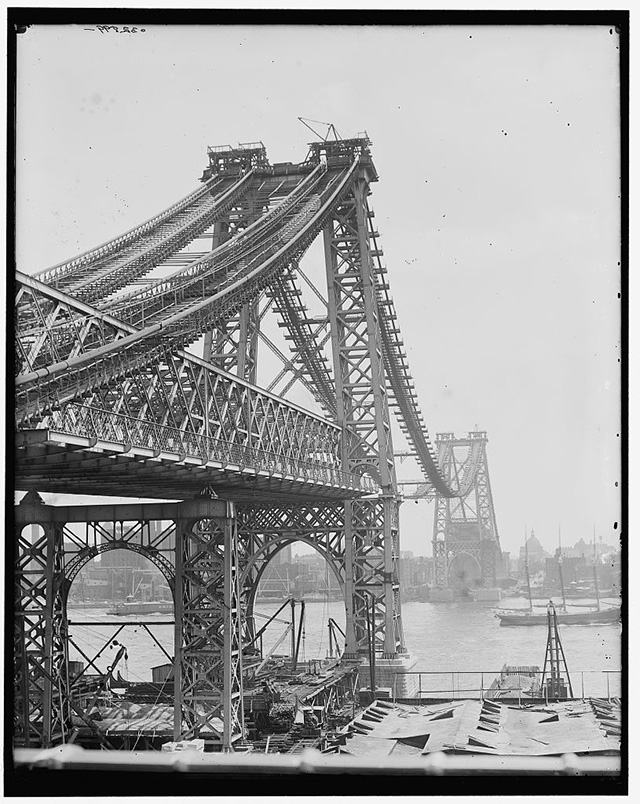
There are many historical touchstones, as the book begins in 1900 and ends with the approach of World War I. Wecker notes the completion of the Williamsburg Bridge in 1903, the Triangle Shirtwaist Fire of 1911, the 911 of its time, with mass casualties, and people jumping from the top three floors of the ten-story Asch building to keep from being burned alive. We hear news of the start of World War I in Europe, come across the sinking of the Lusitania in 1915 and see the Arab community in lower Manhattan’s Little Syria neighborhood beginning its move to Atlantic Avenue in Brooklyn.

We also see some of the anachronistic social and legal norms of the time. Kreindel is not allowed to study what Yeshiva boys can. Chava is not allowed to own property. Women walking alone at night are considered suspect. So the women in Wecker’s stories have to be extra strong.

I don’t think I set out to deliberately showcase strong women, but I did consciously work to give every female character her due. I was very aware that I couldn’t be lazy about the women in my book, that the Victorian setting and the “fairytale” aspects might pull me toward more stereotypically weak or flat female characters if I wasn’t careful. At the same time, I couldn’t be anachronistic; I had to be true to the constraints that women lived with in that era. In the end, I became very interested in how they lived with those constraints, how they either chafed against them or found a (perhaps uneasy) peace and a certain amount of self-expression despite them. – from the Fantasy Literature interview in 2013

Secrecy is a theme that permeates. Chava thinks Ahmad would prefer having a jinniyeh to her, but cannot bring herself to ask him. He is hiding from her what he has learned about a huge sacrifice Arbeely had made for him. Kreindel lies about her age, and is hiding the fact that there is a golem under her control in Manhattan. (For my money, Kreindel is the most intriguing character in the novel, a child with limited tools forced to cope with life and death decisions, in an often hostile environment. She generates both admiration for her tough-as-nails exterior and empathy for her suffering.) Sophia is hiding her need for a special potion. Dima hides from her kind what her special characteristic is. In addition to hiding from humans what she actually is, Chava keeps Riverside Park and the streets she walks by day secret from Ahmad, as he keeps Penn Station secret from her. Ahmad is working on a huge project in his building that he will not let anyone see. I suppose one might see each of these characters as their own walking, talking hidden palaces.

description
The Williamsburg Bridge under construction circa 1900-1906 – image from the Library of Congress via Untappedcities.com

The whole Golem/Jinni duology (so far) might have gone in a very different direction. Wecker talks about how it all got started in a lovely interview with the blogger Lady Grey, who has, in fact, been a friend of Wecker’s since childhood. It was during her MFA program that Wecker ran into a problem. She had wanted to write a book of linked stories, family tales of cultural background and immigration. Wecker is Jewish and her husband is Arab-American. She was impressed by how similar their family stories were, and wanted to highlight that.

You don’t pay all that money for them to be nice to you. They’re gonna tell you what they think. I was having this conversation with a friend of mine, Amanda, who was in my workshop with me. She gave me probably the best tough love conversation I’ve had in my life. She said, “Helene, can I ask you a question? Why are you writing like this?” I said “What do you mean, writing like what?” She said, “Ok, you’re doing these very Raymond Carver, very realist short stories. Very MFA model. But that’s not who you are. I’ve been to your apartment. I’ve seen your bookshelves. I know what a nerd you are. And you are always talking in class about injecting the genre into literature, and busting down the barriers and bringing magic into stories and that’s what you groove on. So why are you not doing that?” I honestly had never thought of that. She had taken my head and whipped it around to where I needed to be looking at. You know I’m still like “But that’s not…these stories…don’t…with the,…that, no.“ She said “ok, look. The next thing I see from you in the workshop, I want it to be about your family, but I want it to be magical.” I was like, “Ok…well that’s my marching orders. I’m going to do what she said. I went home and sat and thought about it. It was, literally, two hours later I had the rough outline for what would be The Golem and the Jinni.” – from the Lady Grey interview

It has been eight years since The Golem and the Jinni was published. Why did it take so long to wrote Volume Two? When her first novel was published, Wecker had a one-year-old. That child is now nine and a second has joined the family. Go ahead, try writing a novel with a baby, then giving birth to another, then having small children to take care of, even if you are sharing the duties with your mate. Piece of cake, right? Her editor was pretty understanding, at one point even telling her that if she was not ok with what she had written so far, to take another YEAR! So, supportive beyond belief.

I was lucky, and The Golem and the Jinni was successful enough that, before long, I could start thinking seriously about selling my next book. Readers seemed interested in a sequel; my publisher, too, liked the concept. I had a few vague ideas for other, non-Golem-and-Jinni books, but none of them were clamoring to be told. I was now mother to a two-year-old, with a baby on the way. I was turning forty, and I was tired. The first book had taken me seven years to write. I really, really didn’t want to do that again. Write a sequel, said my weary brain. It’s got to be easier than starting over from the beginning. – from the Fantasy Café interview

I guess that may have provided the needed direction, but her real -world constraints remained, and the work took much longer than hoped. I have seen no affirmation that a third Golem/Jinni book is planned. A third book is expected from Wecker, but there is no certainty that it will be another Golem/Jinni novel. In the interview with Lady Grey, Wecker talks about having a slew of material that was cut from this book. It sounded to me like she was contemplating a volume of stories that could accompany her two novels. But the ending of this one presents several hooks that could be developed into a third novel. I know which direction I hope she takes.

My gripes are minimal. While there is some humor in the book, it could have done with a bit more. The larger concern is that, even with some elements resolved, there are some in need of further exploration, and, in the absence of a third novel in the series, the ending leaves one hanging. While I would place a cautious wager on the series being made into a true trilogy, it is far from a certainty that this will happen, so far as I know.

Her lead characters are complex, and sustain our interest; their wants and challenges are clear; the secondary characters work well to support the narrative stream; Wecker offers an insightful portrait of a place and time; the action keeps us flipping the pages, eager to see what happens next; there are intelligent and emotional discussions about real-world concerns and moral issues; and there are sane outcomes offered to the challenges the characters experience. Ultimately, as will become clear when you read this book, it was worth the extra time it took for The Hidden Palace to find the light of day. It is as intelligent, engaging, and delightful a read as you could possibly wish for. Helene Wecker is a gifted weaver of tales, a fabulous, magical story-teller, and she is only getting better.

Review first posted – May 28, 2021

Publication dates
———-Hardcover – June 8, 2021
———-Trade paperback – June 7 ,2022

This review has been cross-posted on GoodReads

=======================================EXTRA STUFF

Links to the author’s personal, Twitter, GR, Instagram, and FB pages

—–Library Love Fest – An Interview with Helene Wecker, Author of THE HIDDEN PALACE – with Chris Connolly – audio – 36:21
—–Fantasy Literature – Marion chats with Helene Wecker by Marion Deeds – this one is from 2013, and deals directly with the first Golem/Jinni book, but the content of the interview is still very informative for readers of the current book
—–LitLovers – An Interview with Helene Wecker
—–Discovering Magic with Helene Wecker – audio – 42:19 – with Lady Grey – they were friends since grade school – Trek nerds

Items of Interest from the author
—–Fantasy Café – Women in SF&F Month: Helene Wecker – on her challenges in writing The Hidden Palace
—–Jewish Book Council – Excerpt

Items of Interest
—–Odessa pogrom of 1905
—–Wiki on Palmyra
—–The Triangle Shirtwaist Fire
—–The Hotel Earle
—–Penn Station

My review of The Golem and the Jinni

Leave a comment

Filed under Fantasy, Fiction, Historical Fiction, Literary Fiction, New York City

The Perfect Daughter by D.J. Palmer

book cover

“When we arrested her, she was covered in blood—it was all over her body, in her hair—so when you come to the station, you should bring a change of clothes.…there are no visible wounds on Penny. But the victim was found deceased at the scene, and we believe it’s the victim’s blood on your daughter’s body.”
Grace got the impression the detective was holding something back.
“She’s calling herself Eve, but that’s not the name on her license.”
Again, a chill ran through Grace. Eve.
“She said she doesn’t remember anything that happened before we showed up. We think maybe she’s in shock, but we’re not sure,” Allio went on. “Is Eve a nickname?”
Grace paused, deciding how to answer. “It’s more complicated than that,” she offered.

It certainly is.

A bucket of ammonia, boats and water, a book with a blue cover. What do they all mean? The clues keep popping up, from different voices throughout the novel. Of course, the voices, however diverse they may be, all reside inside one body. Penny Francone is afflicted (or is it protected?) by a mental health condition now known as DID, or Dissociative Identity Disorder, what we used to call Multiple Personality Disorder. People with this are seen today as a single, splintered personality, rather than separate entire personalities vying for literal face time.

description
D.J. Palmer, or Daniel Palmer or son of Michael Palmer – From Judith D. Collins Consulting

We are presented straight away with a particularly tough scenario. It was sixteen-year-old Penny’s birth mother, Rachel, a woman with a checkered past, who was brutally murdered. Penny had been found, unaccompanied, in a city park when she was four years old. Birth mother and daughter had recently reestablished contact, and Penny had gone to b-mom’s place to meet. Penny was found next to the body, covered in blood, holding the murder weapon. Did Penny kill her mother? Looks pretty open and shut. But perhaps it was one of her alters, Eve, maybe, or Ruby, or Chloe, or even some other, as yet undiscovered, alter. But the question remains. Is Penny a supremely gifted liar, fooling everyone, and truly guilty of slaughtering the woman who had cruelly abandoned her, or is there something else going on?

Grace Francone is terrified for her child. DID is not a fully recognized condition, and there is a strong likelihood that her teenager will spend the rest of her life in prison, for a crime she apparently cannot recall committing. She is currently being held in a less than cushy state institution, largely a grim custodial service for the criminally insane. Penny’s eighteen-year-old brother, Jack, serving the needs of exposition, is planning to make a documentary about his sister. We get his intermittent second-person commentary, as if he is telling Penny about his plans.

Your shrink at Edgewater was a guy named Dr. Dennis Palumbo, who we all despised. Well, maybe all but Ryan, because Palumbo thought the same thing he did: that you didn’t have DID. According to Palumbo, DID wasn’t even a real condition, and didn’t belong in the DSM…It’s thought that DID is just a variant of a borderline personality disorder, or in your case an antisocial personality disorder, and that the appearance of your alters is akin to fantasy play rather than a verifiable neurological state. In short, Palumbo thought you were an expert liar.

Thankfully, Palumbo (The name of this character, BTW, was sold at auction to raise money for The Evelyn Swierczynski Foundation. There is a real-world writer/psychologist named Dr. Dennis Palumbo out there.) is replaced with a different shrink, someone with a more open mind, Dr. Mitchell Hughes, a guy with issues of his own, (does there exist a shrink with none?) but an eagerness to learn the truth about his patient.

In order for Penny to avoid becoming a permanent resident of a penal institution, she will need support for her not-guilty-by-reason-of-insanity plea with an official DID diagnosis. Doc Mitch is skeptical, but willing to look at the facts. He and Grace form a team trying to ferret out the truth, and give Penny at least a fighting chance. Most mysteries entail sleuthing in the concrete world, and there is plenty of that here, for sure, but this Doctor Holmes and Ms. Watson must do a lot of their work inside the world of Penny’s personalities. It is far from elementary.

This was a bit of a change for DJ Palmer.

This was the hardest book I’ve ever attempted. There were so many moving parts and for my first ever mystery (mostly I do crawl out from a hole thrillers, not murder mysteries with clues peppered throughout). – from the Judith D. Collins interview

And nicely done too. It is the author’s third novel under this name. Saving Meghan came out in 2019 and The New Husband was published in 2020. But DJ Palmer is an alter, of a sort, for Daniel Palmer. He is the son of physician and noted author of medical thrillers, Michael Palmer. Daniel even wrote some books that were published under Michael’s name (“with Daniel Palmer”) after his father died. His books as Daniel tended toward the technological thriller sort, building on his years working in the tech industry, while those written as DJ tend more towards the familial and medical. Saving Meghan, for example, is about Munchausen’s by Proxy.

When I switched from writing as Daniel Palmer to writing as DJ Palmer, my themes changed along with my name. The DJ books delve more into family drama and psychological suspense. – from The Nerd Daily interview

As such, DJ can step back from the ready-set-flee that permeates so many thrillers and look at the family dynamics at play. Loyalty, for example, comes in for some attention. Grace is fiercely loyal to and protective of Penny, and her brother, Jack, is on her side as well, but big brother Ryan is more hostile than helpful. A question is raised as to where Penny’s loyalties lie regarding her birth mother.

The story is presented through several non-DID points of view. We see most through Grace, as she girds for battle, and enters the fray. Jack offers some exposition in his once-removed take, as he addresses Penny, as if writing letters to her. Finally, there is Doctor Mitch, who offers us medical expertise, and the step-by-step of exploring a very strange terrain.

Palmer offers not just a medical take on DID, but shows how it impacts in personal, family, legal, and medical ways, and how easily it can be misdiagnosed. He does a great job of showing how DID affects not only how her family relates to Penny, but how the world does. There are serious legal implications for her if the people in a position to decide her future deny the existence of the DID diagnosis entirely. In that case, it is off to jail forever. Life over. In addition, Grace having to take on the out-of-pocket legal costs and spend her time working on the case instead of at the family business (a pizzeria based on Palmer’s experience with owning a small restaurant) has serious implications for the family’s financial welfare, and stress level. It certainly turns on its head the supposed legal presupposition of innocent until proven guilty and shows how families of the accused are punished along with those charged with a crime. A dismissive diagnosis can destroy a life, but also cause collateral damage to all those connected to it. One of Palmer’s aims in the book was to dispel myths about the DID condition. He certainly changed my perception.

The action continues apace, as clues are found, investigated and incorporated or dismissed. This is a very readable, engaging thriller-mystery. But every now and then there are passages that made me break out into smiles.

On that bleak afternoon, Lucky Dog looked anything but. The dark interior had the ambience of a power outage… Four of the nine stools at the dark varnished wood bar were occupied by beefy men, who put the dive in dive bar… Behind the bar stood stacks of bottles that looked sticky even from a distance. The air reeked of booze and cleaners, overlaid by a whiff of desperation.

Just gotta love that.

DJ Palmer has integrated multiple elements, of medical mystery, suspense, family drama, and high-tension-watch-your-back thriller, into an engaging, white-knuckle read. Polly-Eve-Chloe-Ruby Francone may not be the ideal progeny, but The Perfect Daughter is a perfectly fabulous read. Set aside as many hours as it takes. You owe it to your self.

“Dr. Cross, who gave us the DID diagnosis, said that we all start out with multiple personalities when we’re young. Is that something you believe?”
“I do,” said McHugh, nodding. “It’s like learning about life through committee. Those disparate voices in our young minds help us figure out the world and how different environments and stimuli affect us. Do we like things sweet or sour; what’s funny to us; what scares us? By age nine, our experiences tend to mold us into the person we become, and all those likes and dislikes, our moods and disposition, solidify into a single identity—this concept of self.”

Review first posted – April 30, 2021

Publication dates
———-Hardcover – April 20, 2021
———-Trade paperback – April 5, 2022

This review has been cross-posted on GoodReads

=======================================EXTRA STUFF

Links to the author’s personal, other personal, Twitter, Instagram and FB pages

My review of Palmer’s 2022 novel, My Wife is Missing

Interviews
—–The Nerd Daily – Q&A: D.J. Palmer, Author of ‘The New Husband’
—–Three Good Things – D.J. Palmer and Lisa Unger – chatty, offers a feel for the author, but is not particularly informative
—–The Poisoned Pen Bookstore – DJ Palmer in Conversation with Lee Child – This is a really good one
—–Judith D. Collins Consulting – Q & A with D. J. Palmer – there is a fair bit here

Items of Interest
—–The Perfect Daughter Discussion Guide
—–American Psychiatric Association – What Are Dissociative Disorders?
—– American Documentary – Busy Inside – the film is a documentary about people with Dissociative Identity Disorder – this link takes you to the film’s site, but not to the film itself

The following emerged from some inner rhymester

CLUES
Boats and water figure large,
a book with a blue cover,
A bucket of ammonia,
And meanings to discover

Ruby, Chloe, Eve, and Penny,
We’re not sure, in truth, how many,
Did an alter kill her mother
Or could it be it’s someone other?

Tough to question any one
So quickly are they here and gone.
But answers lie behind those screens
All is rarely what it seems.

2 Comments

Filed under Fiction, Mystery, Suspense, Thriller

Mother May I by Joshilyn Jackson

book cover

I woke up to see a witch peering in my bedroom window. She was little more than a dark shape with a predator’s hungry eyes, razor-wire skinny but somehow female, staring in through the partly open drapes. Sunrise lit up the thin, silvery hair that straggled out from under her hat. I should have leaped up screaming. I should have run at her with any weapon I could find. Instead I thought, I hope she’s not standing on my basil plants, hazy and unworried. Even half asleep, I knew that there was no such thing as witches. I’d long forgotten the most important thing the theater had ever taught me—that the human body can hold two truths at once. Even truths that seem to rule each other out: There’s no such things as witches, true. And I was looking at one.

Once upon a time is a familiar beginning. The Brothers Grimm (Jake and Willy) collected a trove of European folklore notable for, among other things, its dark content. Jackson was raised with those stories, (I always reference fairy tales in my books. Ever since I was a young child, I have been an avid reader. I like fairy tales, so I just put them in the stories. – from the No Apologies interview) maybe a bit more than most of us. She lends this part of herself to her desperate lead, with some added brio.

I’d been raised on Grimms’ fairy tales by a mother who saw the world as something huge and wild—carnivorous. Her world was full of witches.

And sometimes the darkness of life matches the depths of grim imagination. Soon after her first witch sighting, there is a second, at her daughters’ school. And all it takes is a momentary lapse of attention and her infant son, Robert, is snatched away. No changeling is left in his place, but there is a message. Follow my instructions to the letter, or else.

All my books, in some way or another, look with varying degrees of hope and cynicism at how far we can walk into the black and still be saved. What are the tiny lights that turn us and call us home, and why do some people see those faint, glowing calls, while others walk straight off the edge of the world and are lost? Many of my dearest people from my lost years are dead, or went into the prison system or disappeared. And me? I have this lovely life, much like Amy’s, where I go to book club, make lasagna and walk the dog. – from the Book Reporter interview

That certainly makes one wonder about Jackson’s wastrel past. The task she is forced to undertake has unexpected and horrifying results that threaten Bree Cabbat’s beautiful life. She had been born poor, but got a scholarship to college and then married well, securing an upper-middle-class utopia with a successful studly lawyer husband, three beautiful kids (well, for now anyway) a lovely home in a well-to-do neighborhood, and a satisfying community life. But, one wrong move and it could all vanish. How fragile life can be, no?

description
Joshilyn Jackson – image from the Atlanta Journal Constitution – photo by Bob Andres of AJC

Poverty, class origins, the randomness of opportunity, the fragility of a happy life, all figure large in Jackson’s novels. Her previous novel, for example, Never Have I Ever, let us know that her lead, Amy, had done things that her family’s means were able to keep under wraps. But her comfortable life is threatened by a blackmailer who knows her big secret. In this one, Bree is stuck having to deal without even knowing what her nemesis is tormenting her about. Jax makes the point that for those with money or damn good luck it is possible to screw up and get a second chance, or a third, fourth and so on, while for those on the lower economic fringe, one mistake and your future becomes a hopeless, eternal present.

I serve on the board of a small non-profit, Reforming Arts (reformingarts.org.). We teach college-level liberal arts classes to people incarcerated in Georgia’s women’s prisons. I try to teach one semester a year, and so far, all my classes have been in the maximum security facility.
Our students are diverse in terms of age and race and orientation. The one thing they almost universally have in common is that they were raised in grinding poverty, often by disordered or abusive families. We punish the poor more quickly and more severely; sometimes it feels as if being poor is itself a crime.
– from Book Reporter interview

A lot of the impetus for Jackson’s writing about mothers derives from her personal experience.

…motherhood was transformative for me…I felt I became a more dangerous animal once my heart was living and breathing and toddling around on little fat legs outside of me, out in the dangerous world. – from the Book Reporter interview

Here we have two mothers at war. One is seeking revenge for a long-ago wrong. Bree is willing to do whatever it takes to protect her baby. Both are in full-on Mama Grizzly mode, and find a sort-of empathy with each other, despite the ongoing horror. Their links are not just through their common concern as mothers, but in their common class background. This bond between enemies is a technique Jackson carries over from her prior novel, Never Have I Ever, in which Amy Whey and her blackmailer, Roux, find themselves to be strangely sympatico, well able to understand each other, while those around them seem not to get them.

Never… represented a redirection of sorts for Jackson, away from romantic comedy-drama. But even in the books she wrote prior to that there were often underlying crimes that drove the action. So the shift to writing thrillers was not really all that big a change. It has been, however, a very effective one. Mother May I is a can’t-stop-reading-page-turning-keep-you-up-all-night domestic thriller. Every time you think you can see the road ahead, there is the squealing of brakes hitting a hairpin curve too fast, and, with a sudden acceleration, you are speeding off in another direction. (Re the books she loves to read, Jackson says, My favorite kind is the first reversal just 25% into the book, then stays windy from there – from the Inside Flap interview) This book has more twists than a box of rotini.

A strong piece of this novel is Jackson’s use of her theatrical background to support her character’s actions and capabilities. She was a theater major in college, has done some acting and even reads audio books professionally, not just her own. She gives Bree her theater training, the better to allow her to lie in public, with her words and her body. That’s what actors do, right? It helps Bree in dire circumstances, but also in lesser ones.

There are several elements that appear in some or all of Jackson’s novels. Deep secrets figure large, whether our lead is looking to penetrate one or defend against one of theirs being exposed. Class and family resources, or lack of same, are frequently core elements. That is very much the case here. There is a duel between antagonists. Check. Redemption turns up a lot. In fact, in the Library Love Fest interview, Jackson refers to herself as “a redemption-obsessed novelist.” Her characters, certainly her lead characters, seem to be in persistent need of cleansing from the wrongs they have done. That is less the case for Bree in this book, per se, but the need for redemption is still a strong element. Jackson has a gift for ending her chapters with hooks that generate many a late night ”goddammit!” as readers know that they will not be able to go to sleep until they can read just one more chapter, and then just one more chapter, and then just one more chapter, and so on. There are usually adolescents involved, although in this novel, they play a secondary role. Jackson is also fond of portraying constructed families. As with the teens, that is here, but in a very small way. She also includes fairy tale elements (check) and says that there is a Stephen King reference in all her books (not telling). Readers familiar with her work will be more than satisfied with Mother May I, holding to the familiar themes and story elements while adding some newer, harder-edged moving parts. Readers new to her work are in for a great treat.

In her Inside Flap interview, Jackson was asked, “Is it one of your goals, to have us think as we read?” She said, “My goal is to write a book that you can pour yourself a giant Marguerita, go down to the beach, have a great time and never think again if you don’t want to. But, if you want to, it’s there for you…there’s those layers. This is a book about class…how class plays into what justice looks like.” Either way, it works quite well.

No one’s personal history is lily-white. Some witches are real; the past never forgets and needs only a little prompting to come after you, teeth-bared; happily ever after is for fairy tales, and sometimes not even there.

Review first posted – April 23, 2021

Publication dates
———-Hardcover – April 6, 2021
———-Trade paperback – April 5, 2022

This review has been cross-posted on GoodReads

=======================================EXTRA STUFF

An aside. In the Book Reporter interview, Jackson said, “I’m working on a book called TWO TRUTHS AND A LIAR right now. The first line is: “The day my baby disappeared, I woke up to see a witch peering in my bedroom window.” I am not sure why the title changed, but I expect that opening line was thought to give away too much too soon. The baby is not swiped until chapter 2 in the final version.

Links to the author’s personal, FB, Instagram, and Twitter pages

Interviews
—–The Inside Flap – Ep. 119 Method Writing With Joshilyn Jackson by Dave Medicus – audio – 1:26:04 – start at 29:30 to 51:00
—–No Apology Book Reviews – Interview with Joshilyn Jackson (Mother May I) by Danielle
—–Library Love Fest – Editors Unedited: Emily Krump in conversation with Joshilyn Jackson, author of MOTHER MAY I – audio – 34:27 – A convo between Jackson and her editor
—–BookReporter – Interview: July 31, 2019
—–Los Angeles Public Library – Interview With an Author: Joshilyn Jackson by Daryl M.
—–Owltail – How Story Works by Lani Diane Rich

Items of Interest from the author
—–Novel Suspects – excerpt
—–The Atlanta Journal Constitution – Paths Not Taken – definitely check this out – it explains a lot

My reviews of other books by Joshilyn Jackson
—–2019 – Never Have I Ever
—–2017 – The Almost Sisters
—–2016 – The Opposite of Everyone
—–2013 – Someone Else’s Love Story

Leave a comment

Filed under Fiction, Mystery, Suspense, Thriller

When the Stars Go Dark by Paula McLain

book cover

A town like this feels so safe and apart from the outside world. You start to wonder if it’s dangerous.”
“The fairy tale of it, you mean?”
“Right. False security. You stop looking over your shoulder, because the picture feels real. Nothing bad can happen when there’s a moat around the whole town, right? Battlements. Guards at the gate. But the dragon shows up anyway.”

“These are my obsessions,” Paula McLain said. “How do we survive the unsurvivable? How do we climb off the table as a victim? How did we get there in the first place?” – from the NY Times Personal article

San Francisco Detective Anna Louise Hart has problems of her own. Something terrible has happened to her child. Her husband is not eager to see her. Needing to get away, she heads north to a place she sees as a refuge of sorts, Mendocino, the place where, after a succession of bad experiences, she had finally been taken in as a foster by a warm, supportive couple. Memories abound, marked by the presence of an enigmatic sculpture in the middle of town.

Above the roofline of the Masonic Hall and against a gauzy sky, the figures of Time and the Maiden stand sharp and white, the most iconic thing in the village. A bearded, elderly figure with wings and a scythe, braiding the hair of a girl standing before him. Her head bowed over a book resting on a broken column, an acacia branch in one of her hands, an urn in the other, and an hourglass near her feet—each object an enigmatic symbol in a larger puzzle. The whole carving like a mystery in plain sight.

description
Time and the Maiden – image from Serendipity Patchwork

Almost immediately I knew the story had to be set in Mendocino—a small coastal town in Northern California where I spent time in my twenties—and that the time frame of the narrative had to be pre-DNA, pre-cellphone, before the Internet had exploded and CSI had lay people thinking they could solve a murder with their laptop. – from the Author’s Note

Hart’s work in San Francisco had centered on finding lost children. She was in a special unit for this. It’s the sort of work that leads one to sacrifice other aspects of one’s life. I pictured a missing persons expert obsessed with trying to save a missing girl and also struggling to make peace with her past. And straight away, after renting an off-the-grid cabin several miles outside of town, reconnecting with an old friend who is now the sheriff, saying Hi to some other folks and places from her days there as a kid, a local girl, the daughter of a famous actress, vanishes. Having some expertise in the field, Anna offers to help, and the game is afoot.

description
Paula McLain – image from Writers Write

…when she started digging into the research, she realized that there had been real-life abductions in California at that time — including the kidnapping of 12-year-old Polly Klaas from her Petaluma bedroom. McLain weaves Klaas’s tragic story into the novel, reminding the reader of yet another young woman who never had a chance to shine. – from the NY Times Personal interview

In addition to Polly, McLain incorporated into her story several real-world disappeared girls, as points of reference. She does not go into their characters much beyond rough descriptions. But this does let us know that the fictional tale she presents has a very real flesh-and-blood basis, the time she portrays presenting more peril than usual. And she does not stop there in paralleling the real and the created.

Sexual abuse of children is a focus, as is coping with being in the foster care system. These are experiences with which McLain is painfully familiar. In the Times article noted in EXTRA STUFF, Why I Took a Vow of Celibacy, she writes about her abuse as a foster kid.

Some nights nothing happened. Other nights I would wake to a shape in the doorway, the husband’s inky silhouette. And then I would disappear inside myself, barely breathing, frozen. I vanished so expertly that I wasn’t actually in my body any longer as he peeled me away from my sister. I didn’t make a sound.

It would have been easy to make this a total downer of a story, but McLain points out some of the bright sides as well. Anna recalls with great love the supportive foster family she had lived with in Mendocino, and shows how a community can come together to try to help each other, in this case reflecting the real-world effort made to find Polly Klaas when she was abducted.

McLain’s descriptions border on the transcendental at times, both lyrically beautiful, and evocative of underlying story content. They reminded me of the poetic magnificence (as well as the issues taken on) of Rene Denfeld. So, it seemed fitting that in the acknowledgments, Denfeld is listed among authors whose work inspired her.

Above the cloud line, an eerie yellow sphere is rising. It’s the moon, gigantic and overstuffed, the color of lemonade. I can’t stop watching it roll higher and higher, saturated with brightness, like a wound. Or like a door lit entirely by pain.

Uh oh. The eeriness of the environment resonates throughout the novel, but it is also clear that Anna has an appreciation for nature, a feeling of connection, gaining a sense of comfort from it, even though it can seem very dark at times.

Firs and pines and Sitka spruce thicken around me, pushing in from all directions, black-tipped fairy-tale trees that knit shadows out of nothing, night out of day—as if they’ve stolen all the light and hidden it somewhere. God, but I’ve missed them.

And building on nature’s challenge, she sees hope in people’s ability to contend with extreme and persistent difficulties.

“Krummholz” is the word for this kind of vegetation I remember from one of Hap’s [her beloved foster father] lessons, a German term that means “bent wood.” Over many decades, hard weather has sculpted the trees into grotesque shapes. The salt-rich north wind kills the tips of the branches, forcing them to dip and twist, swooping toward the ground instead of the sky. They’re a living diagram of adaptation, of nature’s intelligence and resilience. They shouldn’t be able to keep growing this way, and yet they do.

She adds some lovely noir content and cadences, the sort one might expect from a female continental op, substituting a chemical solution for the usual flask, or lower desk drawer fifth. I zipped myself into a dress I couldn’t feel, so high on Ativan it could have been made of knives. Fairy tales come in for several mentions, not in a comforting way. There be monsters here.

description
Maps from the book

The story is intriguing and keeps one eager to read more. What happened with Cameron, the primary missing girl, an adoptee? Was she abducted? Had she been lured away? Had she been abused? Given the number of girls gone missing, is there a serial killer working the area? Clues are followed, each bit leading to new suspicions, whether dead-ending or propelling the investigation. There is tension between the investigating partners, as one might expect. The book clicks along at a good pace, and delivers the goods.

There were some elements that interfered at times, though. Anna comes on a seemingly stray pooch who becomes a valued ally. Except it seemed that the dog was in and out, here, then not here, as if the notion of a canine companion appealed (the dog is given the name of McLain’s real-life furry friend), but did not seem fully integrated into the story. More a device than a character. In another instance Anna is going about the business of investigating a possible abduction or worse, with several local suspects, and this San Francisco detective is NOT PACKING! This is like the monster movie scene in which the small child runs back toward the room where the creature was last seen to retrieve a cherished stuffy. Really? If you’re gonna do that, at least offer up a satisfactory preparatory explanation. Did I miss this somewhere? A flashlight goes dark at a critical moment – puh-leez! And a character appears at a particularly opportune moment to offer crucial assistance. Sure, whatever.

But don’t let the occasional eye-roll distract from the overall wonderfulness of the book. In addition to keeping your blood pressure at an unhealthy level, McLain offers up some real-world payload in educating us about the plague of sexual abuse of children, particularly the potential perils of foster care, and how the afflicted are damaged in more than just physical ways. She points out the sometimes complex nature of abductions, and how pain can travel down through generations. You will never think of the bat signal the same way again. The stars may certainly go dark for those on the receiving end of these societal horrors, but in both keeping us entranced and filling us with new intel and perspectives, Paula McLain shines very brightly indeed.

You know, we don’t always understand what we’re living inside of, or how it will matter. We can guess all we want and prepare, too, but we never know how it’s going to turn out.

Review posted – April 9, 2021

Publication dates
———-Hardcover – April 13, 2021
———-Trade paperback – April 5, 2022

I received a digital ARE from Ballantine Books through NetGalley in return for an honest review.

This review has been cross-posted on GoodReads

=============================EXTRA STUFF

Links to the author’s personal, FB, and Instagram pages

From the bio on McLain’s site:

Paula McLain was born in Fresno, California in 1965. After being abandoned by both parents, she and her two sisters became wards of the California Court System, moving in and out of various foster homes for the next fourteen years. When she aged out of the system, she supported herself by working as a nurses aid in a convalescent hospital, a pizza delivery girl, an auto-plant worker, a cocktail waitress–before discovering she could (and very much wanted to) write. She received her MFA in poetry from the University of Michigan in 1996. She is the author of The Paris Wife…an international bestseller…She is also the author of two collections of poetry; a memoir, Like Family, Growing up in Other People’s Houses; and a first novel, A Ticket to Ride. She lives with her family in Cleveland.

Interview
—–NY Times – April 3, 2021 – Paula McLain Wrote a Thriller — and This Time, It’s Personal by Elisabeth Egan

Items of Interest from the author
—– There is a list of links to other writing on her site
—–NY Times – 3/12/2021 – Why I Took a Vow of Celibacy

Items of Interest
—–Book Club Kit
—–Rainer Maria Rilke – I Am Much Too Alone in This World, Yet Not Alone – A line from this poem turns up in Chapter 22
—–The Reid Technique – of police interrogation -noted in Chapter 24
—–The Polly Klaas Foundation

Songs/Music
—–Bob Seger – Against the Wind – In chapter 34, Anna hears this on her car radio
—–The Little Mermaid – Under the Sea referenced in chapter 46

Leave a comment

Filed under Fiction, Mystery, Reviews, Suspense, Thriller

The Center of Everything by Jamie Harrison

book cover

Good mothers were rarities, the center of everything.

Sometimes the beauty of the written word can make you stop, pause, sigh deeply, and appreciate the moment. I am fortunate to have been able to read and report on many top tier works of fiction. It remains a singular joy to come across written passages that bring me near to tears with their sheer power and beauty. Here is the beginning of the novel, the beginning of what brought on my overwrought response:

When Polly was a child, and thought like a child, the world was a fluid place. People came and went and never looked the same from month to month, or year to year. They shifted bodies and voices—a family friend shaved a beard, a great-aunt shriveled into illness, a doctor grew taller—and it would take time to find them, to recognize them. Polly studied faces, she wondered, she undid the disguise. But sometimes people she loved disappeared entirely, curling off like smoke. Her father, Merle, told her that her mind was like a forest, and the trees inside were her people, each leaf or needle a memory. Her mother, Jane, said that memories were the way a person tried to turn a life into a story, and Papa, Polly’s great-grandfather, said that there was a story about everything. He would tell them something long and strange to explain the existence of tigers or caves or trees, but then he’d say, Well, the Greeks said the same thing, or the Finns; the Athabascans, the Etruscans, the Utes, Days were an Aztec snake swallowing its tail, water came from a Celtic goddess’s eyes, thunder was a deadly fart from a Bantu in the sky.

See what I mean? The issues noted in the passage presage the stories and memory issues to come. The way a child thinks? Check. People looking different from one time to another? Check. Needing time to recognize faces beneath disguises? Check. People disappearing? Sadly, check. Memory as a way of turning lived experience into story? Check. Cultures, and people coming up with tales to explain observed events? Check.

description
Jamie Harrison – image from her site

We meet Polly Schuster (nee Berrigan) as an adult, 42, having recently suffered a serious injury, hit by a car while bike-riding. She has a considerable scar on her skull from the needed repairs. The damage to her brain has left her something other than what she had been up until then. She has become forgetful, can drift off sometimes while with other people, but mostly she now has issues with memory. With her great-aunt Maude coming to town to celebrate her 90th birthday, there is a flurry of preparations (stories told, photographs and artifacts of earlier times unearthed) that summon memories for Polly. But can she rely on those recollections? What we have here is an unwillingly unreliable narrator.

The novel is told in (mostly) two times, the present (2002) in Montana, and 1968, when Polly was eight years old and her family lived on Long Island, with dramatic events in 1968 leading up to what she calls “The End of the World” and “The Beginning of the World,” in that order. The 2002 world is ordered by Maude’s arrival, but also by an alarming event.

Water here is less the usual symbol of rebirth than of death. Two boating incidents a lifetime apart. Were they accidents, or something else? This being Montana, a river runs through the story. Ariel, a young woman the Schusters had hired as a sitter for their two children, has gone missing, kayaking on the Yellowstone River too early in the season, (The Yellowstone runs rough this time of year. Someone dying on the river was not unusual. It was easier when it was a tourist, but far too often it was a local, like Ariel.) she has vanished. Her riverine companion, Graham, a person of questionable character and veracity, survived. He is widely suspected of having a hand in Ariel’s fate, whatever that turns out to be. Was she the victim of simple misfortune, or something worse? Where is she? What about the man Polly had found dead on the beach back in 1968? What was the deal with that? There are other incidents involving water, including a woman who drowns, trapped underwater after an accident, a plane crashing into a lake, another body found on a beach, and a woman attempts suicide by walking into the sea.

Polly’s great-grandmother Dee told her once that there were three kinds of dreams—not the passing filaments, the sorted trash from the day, but the ones that came back, over and over—about three kinds of things: wishes or desires, loss or being lost, and fear. All her life, Polly thought these categories felt true, and lately, they came to her in combination.

What are memories, but the distilled media and emotional resonance of events we have experienced? Yet, our abilities as children to understand what those events are, or mean is far from complete, our ability to form coherent, accurate recollections remains incomplete. Thus, magical thinking. Three-year-old Polly believed that when people died they went somewhere else, disguised. So, when Jane and Merle moved to NYC she thought they were looking for her late grandfather and aunt. Four-year-old Helen, Polly’s daughter in 2002, looks under rocks for the missing Ariel, fearing she may have melted. Seven and eight-year-old Polly tries to make some sense of the bodies found on Long Island beaches in successive summers. Then tries to remember, from adulthood, with a damaged brain, what it was that had actually happened.

There are plenty of identifiable links to the author’s life. Here are a few. Living in Montana is the most obvious. But other residences noted in the novel reflect Harrison’s experience as well. Her parents lived in Long Island when she was small, as did Polly’s. Both Harrison and her husband, and Polly and Ned moved from New York to Montana. When Harrison moved, she and her husband lived with well-known painter and writer, Russell Chatham, thus, perhaps a bit of inspiration for the painter character, Rita. Although, I expect her exposure to Chatham was a lot less dramatic than Polly’s is to Rita. Born in the same year as Polly, Harrison grew up in an accomplished, artistic family. Her father, Jim Harrison, was the author of Legends of the Fall, among other works. A-list writers were part of her growing up experience. Papa reflects this, renowned for his study of story and culture, a Joseph Campbell sort. Livingston, MT, where Harrison lives, is, notoriously, home, at least part-time, to a host of Hollywood A-listers. Notorious because the wealthy Californians did an excellent job of bidding up the price of local land and housing, to the point that many locals who might want to stick around have been priced out. The western invaders are represented, at least somewhat, by Drake Aasgard, an actor of note, who employs Polly to screen scripts for him.

Those good mothers, noted in the quote at the top, and the title of the book, are far from ubiquitous, and so, are special when they turn up. But it seemed to me that the title could, as easily, be referring to family, or even memory, as the center of everything. My only gripe about the book is that the mysteries seemed at times to drift maybe a bit too far back from the amazing description of the concrete lives of the central characters. Tap, tap, tap. This is all very interesting, but I want to know what happened to…

There are mysteries to be solved, sans PI. Polly drifts out of reality at times, struggling to discern what is, or was real. The story is told both from adult Polly’s perspective and from her as a child. This is pulled off quite well, believable in both cases.

Polly continues to struggle throughout. Some mysteries are resolved. Some questions remain, but the greatest strength of the novel, in addition to her celestial command of language, is Harrison’s vivid, detailed portrayal of an extended family, a community of the related and connected. Polly may be the lead, but this is an ensemble cast, with many interesting characters, who gain our attention in different ways. The rich detail Harrison offers gives very real texture to the characters’ lives. Both time settings are given close looks and we can see what the characters see, feel what they feel. There are characters aplenty striding through, many of whom would merit their own full-length tales. Papa and Dee’s household in the 60s was warm, raucous, and exciting. These people will certainly grab and hold your interest. There is magic aplenty in this book, and not in a fantasy way, although Polly does have some experiences that could easily have gone there.

The Center of Everything is a triumph, evocative writing, wonderful characters, smart consideration of how story functions in the world, as well as in literature, a 3D-immersive portrayal of a family, and a few mysteries as well. This novel should be at the center of your reading plans this winter, if you can remember.

Childhood is a green knot, hiding places and suspended time. It is the speed she can run through grass, the heat of the air, the fear of pissing her pants on the school bus, the difficulty of returning someone’s gaze, a bright object in the sand, the way a good moment can slide to bad.

Review posted – January 29, 2021

Publication date – January 12, 2021

I received a copy of this book from Counterpoint in exchange for an honest review. At least I think that was the deal. I can’t quite seem to recall.

=============================EXTRA STUFF

Links to the author’s personal, Twitter, GR and FB pages

Interviews
—–Lithub – Jamie Harrison on Finding Her Way to the Writer’s Life in the American West by Thomas McGuane (an old family friend)
—–David Abrams Books – My First Time: Jamie Harrison – for The Widow Nash, but some materials here are relevant

Items of Interest
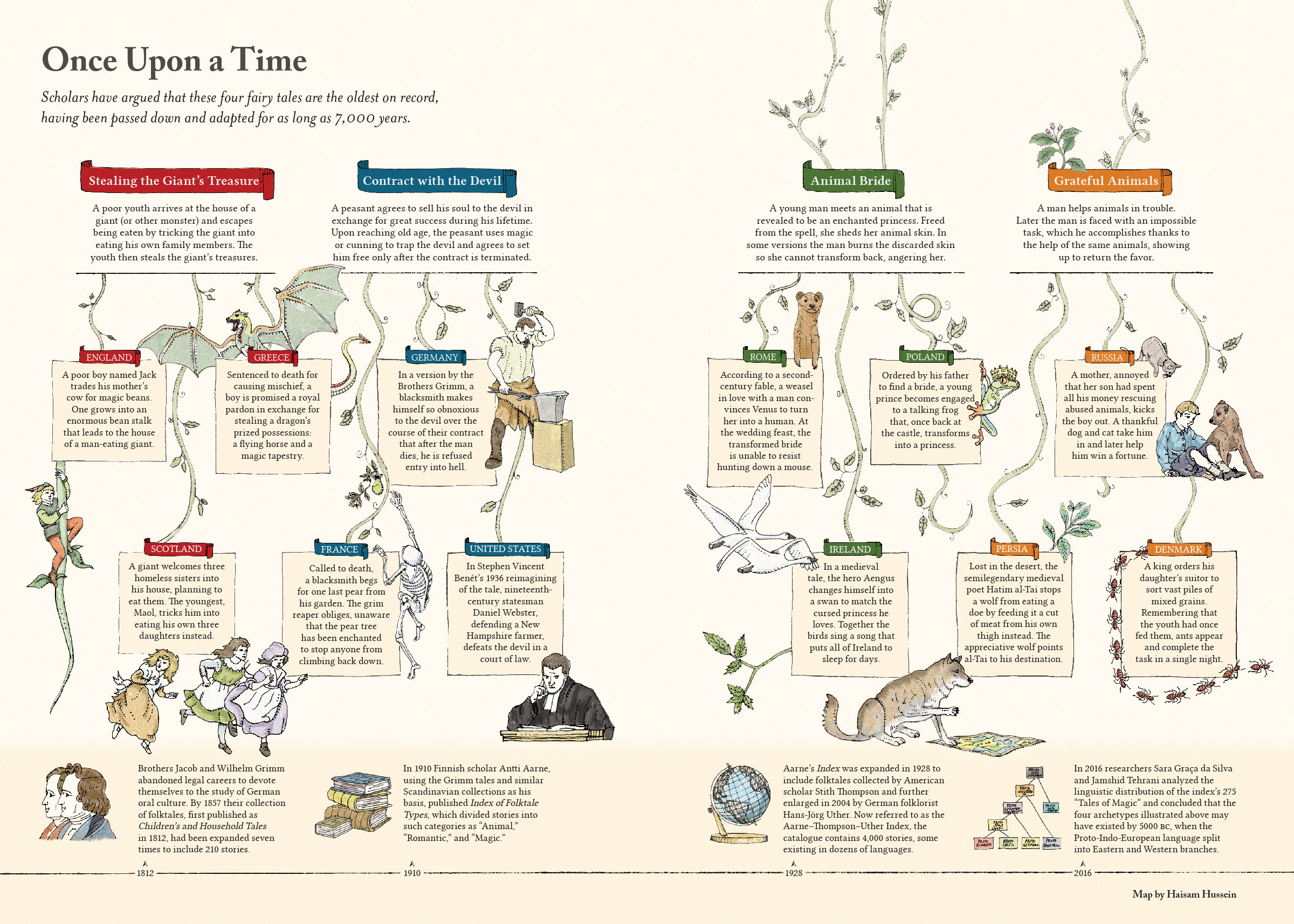
—–Lapham’s Quarterly – Once Upon Time – the four oldest Fairy Tales
description
An image of it – Jamie says, in a facebook posting of this, “This is fun; I played around with these shifts in my new book.” One of the characters studies how stories change over eons, culture to culture.
—–Wiki on Jim Harrison, Jaime’s father, renowned poet, and author of Legends of the Fall – he was a professor at Stony Brook University on Long Island in 1965-66

Leave a comment

Filed under Reviews

A Thousand Ships by Natalie Haynes

book cover

Sing, O goddess, the anger of Achilles son of Peleus, that brought countless ills upon the Achaeans. Many a brave soul did it send hurrying down to Hades, and many a hero did it yield a prey to dogs and vultures, for so were the counsels of Jove fulfilled from the day on which the son of Atreus, king of men, and great Achilles, first fell out with one another. – the opening of The Iliad by Homer

I’m not sure I could have made it more obvious, but he hasn’t understood at all. I’m not offering him the story of one woman during the Trojan War, I’m offering him the story of all the women in the war. Well, most of them (I haven’t decided about Helen yet. She gets on my nerves.). I’m giving him the chance to see the war from both ends: how it was caused and how its consequences played out. Epic in scale and subject matter.

Calliope, Homer’s presumed muse, keeps trying to get him to tell the broader tale, not just the one about the men and their battles and intrigues. But he insists on a singular, male-oriented view of the Troy story (Ilios is Greek for Troy). That is the only one we have gotten, well, from him, anyway. Other classical writers have offered some different perspectives, Euripedes in particular.

description
Natalie Haynes – Image from her site – photo credit: Dan Mersh

We have all read it, (you did do the assigned reading in school right?) or certainly at least heard about it. The Iliad, by Homer, is the most widely read epic poem ever. The action centers on the leaders and the combatants, with a healthy dose of less-than-divine gods and goddesses, and adventure aplenty. It is rather light, though, on the stories about the impact of this lengthy war on women. Whudduwe? Chopped livah?

So, Natalie Haynes offers a retelling of the story of Troy from the perspective of its female characters, the story she imagines Calliope might have been pressing on her reluctant client. And the Odyssey as well, as we trail Odysseus through some of his dodgy travails.

The drama of war is not always found on the battlefield. It’s in the build-up, the aftermath, the margins. Where the women are waiting. – Haynes – from The Observer article

Beware Greeks bearing gifts.

description
Trojan Horse – image from ThoughtCo.com

Just like today, the lives of regular people in Greek mythology are made miserable by the feckless, selfish, ignorant actions of the people in charge. And those on high are not shy about using others, other gods, lower-level gods, demi-gods, and mere mortals to implement their dark desires. For example, Gaia, mother of Titans (take that, Daenerys) is maybe a bit more like Joan Crawford (Earth-Mommy dearest?) in this telling, or a very unhappy landlady. (banging on the ceiling with a broom handle?)

Mankind was just so impossibly heavy. There were so many of them and they showed no sign of halting their endless reproduction. Stop, she wanted to cry out, please stop. You cannot all fit on the space between the oceans…you must stop, so that I can rest beneath your ever-increasing weight.

Zeusy, Sweetie, can you help me out here? And what better way to take off a bit of excess earthly poundage than a lengthy and particularly bloody war. Sure, Gai, no prob. And thus, with the eager assistance of a cast of the greedy, prideful, bloodthirsty, short-sighted, dumb, and just plain foolish, we get a decade-long war, short on forward movement but long on casualties, and stories.

description
Cassandra in front of the burning city of Troy – by Evelyn De Morgan – from Wikimedia

We follow a cast of mostly female characters as they endure or succumb to the horrors of war, politics and religion. Hecabe, Priam’s widow is a central core among the captive wives and daughters of the defeated Trojans, holding the group together as they ponder and plan for their fates in the hands of their captors. They cope with their treatment by the Greek victors. Some names will be familiar. Others, less so. You have probably heard of Cassandra. And certainly you know of Hector, but not his widow Andromache. They face moral choices no less than their y-chromosome counterparts. When and how to resist, when and how to go along. Finding ways to seek justice, revenge, or freedom. Banding together. Even the hated Helen is given a turn. Their lives, and deaths are no less heroic, despite a lower body count.

description
Penthesilea – image from Total War Saga: Troy

Non-Trojan women get a perspective as well. You may have heard of Hippolyta, Queen of the Amazons, but maybe not of Penthesilea, an amazing Amazonian character, Xena, or Wonder Woman, sans the tech. Leading her force into battle, looking to take on Achilles himself. You go, girl. Clytemnestra, wife of Agamemnon, gets some recognition for the atrocities she has endured, not just the one for which she has received a dark reputation.

description
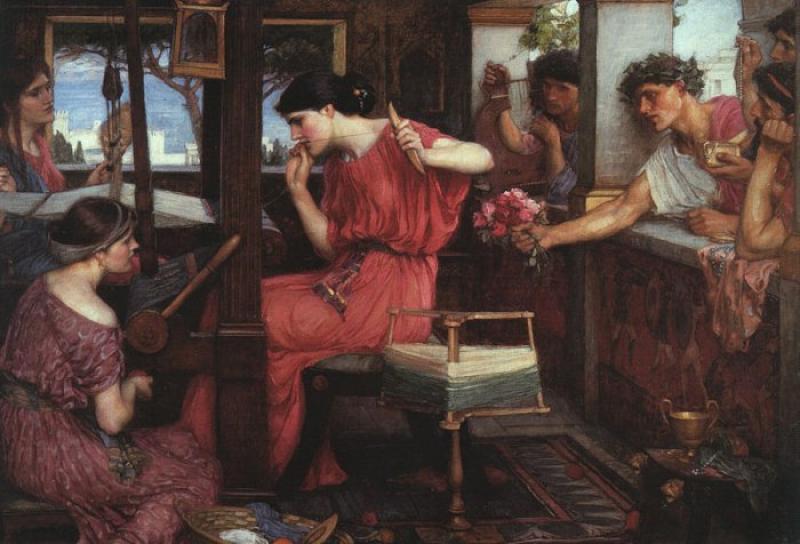
Penelope – image from The Arts Desk – painting by John William Waterhouse

Penelope tells Odysseus’s story via letters, having heard of his doings from local bards, who clearly get great reception on their muse-links. So, Ody, the war’s over, dinner is getting cold, your son would like to meet you, what time do you think you’ll be home? There are several Penelope chapters, written as letters to her MIA hubs. Pretty funny stuff, looking at the adventures of Odysseus from the perspective of the ones left behind. Oh, so after you poked out the Polyphemus’s one eye and were sailing off into the distance, you felt it necessary to tell him your real name? Just what the hell is wrong with you? You knew that Poseidon was his father, right? Hope you enjoy that curse he dumped on you. Well, no wonder you got blown off course. How old are you?…Really, you took a side trip to Hades? What were you thinking? Shacked up with Circe for a year and that Orygian home-wrecker Calypso for seven FU@#ING YEARS!!! My patience is running a wee bit thin, husband. Her exasperation really comes through.

You were wedded to fame more than you were ever wedded to me. And certainly, your relationship with your own glory has been unceasing.

The men do not come off well, overall, Achilles is not just the greatest warrior who ever lived, but a feckless murder machine who sees no difference between taking on Trojan warriors on the battlefield and mowing down unarmed old men, women, and children from his horse. His bf, Patroclus, thinks a high body count is all that matters, regardless of type. Agamemnon, nominal leader of the Greek coalition army, is venal, pathetic, entitled and cowardly. Can he be impeached? Really, you are willing to slaughter one of your kids to get a fair wind for your ships just because some priest tells you so? Really? Dude, you deserve what you get.

What kind of man wore a bronze breastplate and a plumed helmet to return home? One who believed that his power was seated in his costume, she supposed. The red leather of his scabbard was very fine, studded with gold flecks. She did not recognize it, and realized this must be part of his share of the fabled wealth of Troy. To have killed her child for a decorated bit of animal skin. She could feel the contempt shaping her mouth into a sneer, and stopped herself. Now was not the time to lose control. That would happen later.

The gods are portrayed as their usual awful selves, which is no surprise. Power corrupts, and, apparently, makes you really stupid, too. While most of the women come to a bad end. This is not a spoiler, because you read the book, right? But some get in a few licks of their own, and a few even escape.

description
Detail of painting The Muses Urania and Calliope by Simon Vouet, in which she holds a copy of the Odyssey – image from Wikimedia

There are many lessons from The Iliad that still pertain thousands of years after its writing. Antenor telling those in charge that the Trojan horse might, just possibly, be a ploy, and Cassandra cursed with knowing what lies ahead but never being acknowledged might, just possibly, remind some of the Trump administration’s response to the Covid crisis. And a Trojan willing to open the gates for an invading horde might certainly resonate with corrupt American legislators offering tours and even directions to a Capitol-invading mob in 2021. The classics are classic for a reason

description
Clytemnestra and Agamemnon – Pierre-Narcisse Guerin (1774-1833) – Image from Greek Legends and Myths

To see or hear Haynes speak is to be instantly charmed, and better, educated and entertained. She is a gifted lecturer, bringing to her talks all the effervescence, delight, and enthusiasm she clearly brings to her fiction. She is an amazing writer, bringing the ancients to life for us in the 21st century. And her decade-plus career as a stand-up comedian clearly informs her work. While not LOL-funny here, her portrayal of Penelope’s remarkable forbearance certainly has a sharp comedic edge. Overall, Haynes has given voice to a side of the Trojan War that has been much overlooked. A Thousand Ships deserves to get millions of readers. It’s smart, entertaining take on a classic story is a new classic, all its own.

A war does not ignore the lives of half the people it touches. So why do we?

Review posted – January 22, 2021

Publication dates
———- May 2nd 2019 by Mantle (UK)
———–January 26, 2021 – Harper (USA)

=============================EXTRA STUFF

Links to the author’s personal, Twitter and Instagram pages

Interviews
—–NPR – The Trojan Women — And Many More — Speak Up In ‘A Thousand Ships’ by Lulu Garcia-Navarro
—–Books on the Go – Ep 78: Interview with Natalie Haynes, ‘A Thousand Ships’ – with Anna Bailliekaras – audio – 36:43
—–The Guardian – Standups on why they quit comedy: ‘I have nightmares about having to do it again’ by Brian Logan – Haynes is one of several stand up comedians who talk about why they got out
—–Salon London – In conversation with ‘the Nation’s Great Muse’: Natalie Haynes – video – 1:04:13
—–Harrogate Literature Festival – mostly on Pandora’s Jar rather than A Thousand Ships, but wonderfully entertaining, and some outstanding and surprising information about Helen
—–The Guardian – Standups on why they quit comedy: ‘I have nightmares about having to do it again’ by Brian Logan – Haynes is one of several stand-up comedians who talk about why they got out

Items of Interest – by the author
—–Natalie Haynes: Troy Story – A. G. Leventis WCN Ancient Worlds Study Day 2019
You must watch this. You will not be sorry
—–Natalie Haynes Stands Up for the Classics – BBC Radio 4 – A lecture series by Haynes – audio
—–The Observer – Helen of Troy: the Greek epics are not just about war – they’re about women
—–Decline and fall: what Donald Trump can learn from the Roman emperors
—–Troy Story – Heroes Gods and Amazons!

Items of Interest
—– Where Does the Phrase “Beware of Greeks Bearing Gifts” Come From? By N.S. Gill
—–wiki on Calliope
—–wiki on Clytemnestra
—–Homer (no, wiseguy, not the one from The Simpsons) – The Iliad – full-text from Gutenberg

Leave a comment

Filed under Reviews

The Plot by by Jean Hanff Korelitz

book cover

…a few minutes later in the car, he found the first of the messages. It had been forwarded from the contact form on his own author website (Thanks for visiting my page! Have a question or a comment about my work? Please use the form!) just around the time as he was about to go on the air with local Seattle institution Randy Johnson, and it had already been sitting there in his own email in-box for about ninety radioactive minutes. Reading it now made every good thing of that morning, not to speak of the last year of Jake’s life, instantly fall from him and land in a horrible, reverberating crack. Its horrifying email address was TalentedTom@gmail.com, and though the message was brevity itself at a mere four words, it still managed to get its point across. You are a thief, it said.

Buckle up. Jacob Finch Bonner (Jake) had some early success as a writer. His novel, The Invention of Wonder, received critical acclaim, the New York Times including it in its list of New and Noteworthy books. But it has been a while since that critical (if not commercial) triumph. A story collection was largely ignored and then there was, well, nada. Jake teaches at Ripley University in northern Vermont. It is not writer’s block Jake suffers, it is more like Writer’s-Great-Wall-of-China. He teaches creative writing, endures the continual delights of academia politics, and lives, literally, on Poverty Lane. But then Evan Parker happens.

description
Jean Hanff Korelitz – image from her site – Photo: Michael Avedon

An incoming student, Evan is convinced that he has a perfect plot for a novel. He is insufferable, arrogant, condescending, and clearly thinks that Jake cannot really teach him anything. He does not want to tell anyone the specifics of his work, just get a degree, educational cred, and some connections, figuring that is all he will need. But a time comes when he does share with Jake the arc and some detail of his novel. Turns out Evan was right. A few years later Ripley has down-sized, and Jake is working at a proprietary artist colony.

All he had ever wanted was to tell—in the best possible words, arranged in the best possible order—the stories inside him. He had been more than willing to do the apprenticeship and the work. He had been humble with his teachers and respectful of his peers. He had acceded to the editorial notes of his agent (when he’d had one) and bowed to the red pencil of his editor (when he’d had one) without complaint. He had supported the other writers he’d known and admired (even the ones he hadn’t particularly admired) by attending their readings and actually purchasing their books (in hardcover! at independent bookstores!) and he had acquitted himself as the best teacher, mentor, cheerleader, and editor that he’d known how to be, despite the (to be frank) utter hopelessness of most of the writing he was given to work with. And where had he arrived, for all of that? He was a deck attendant on the Titanic, moving the chairs around with fifteen ungifted prose writers while somehow persuading them that additional work would help them improve.

But when Jake learns that Evan Parker has died, and that his magnum opus appears to have never been published, he makes a decision, backing it up with large volumes of excuse-making and a cyclotronic level of self-justifying spin. Three years later he is on his long-dreamed-of book tour, promoting his hugely successful novel, Crib. He still carries guilt and paranoia about being found out. The guilt he manages (Mr. Bonner, when it pops up, take two excuses in a large glass of entitlement and call me in the morning), but I guess you can’t be too paranoid. Then the message.

This is where the book kicks into high gear. Who is #Talented Tom, how much does he know, what can he prove, what does he want, and what will he do? Is this blackmail? I was reminded of a classic story of guilt and crime.

…at length, I found that the noise was not within my ears. No doubt I now grew very pale; –but I talked more fluently, and with a heightened voice. Yet the sound increased –and what could I do? It was a low, dull, quick sound –much such a sound as a watch makes when enveloped in cotton. I gasped for breath –and yet the officers heard it not. I talked more quickly –more vehemently; but the noise steadily increased. from Edgar Allen Poe’s The Tell-Tale Heart

An e-mailed threat was not the only thing he left Seattle with. Anna Williams, a fan, the producer at the Randy Johnson show at KBIK, who had arranged for Jake to do the interview, chats him up afterwards. They have a coffee, stay in touch even when he returns to New York, and their connection soon become a thing. The messages do not stop.

but the noise steadily increased. Oh God! what could I do? I foamed –I raved –I swore!– EAP

We ride along as Jake deals with his publisher, his agent, his fans, and his peers. There is a lot of support for him in the community, as most presume it is just a nutter harassing him in search of a lawyer-enhanced payday. But Jake knows this is no gold-digging faker. Yet he still feels it necessary to keep this from Anna for a long time, even after they are living together. Just how dangerous is TalentedTom?

I seem to be attracted to sociopathic male antagonists. I also appear to like college campuses. – from the Scoundrel Time interview

The engine shifts into overdrive when Jake decides to stop playing defense and begins doing some serious research to identify his tormentor, and learns that his may not be the only theft related to Evan’s plot.

It grew louder –louder –louder! And still the men chatted pleasantly, and smiled. Was it possible they heard not? Almighty God! –no, no! They heard! –they suspected! –they knew! – EAP

In addition to Poe, I was reminded of another book-stealing novel of recent vintage, A Ladder to the Sky, with a much more flagrant, and feckless thief. In this one Korelitz drives us through Jake’s excuses and makes us consider just where fair use ends and theft begins.

As one might expect there is a lot in here about writing. Where do you get your ideas? an eternal question, the struggle to create. Coping with a book tour, difficult questions, redundant questions, ignorant interviewers. As this is Korelitz’s seventh published novel, and I am sure she has motored the book tour circuit a time or six, I expect this is the product of experience. As is her take on campus life, coping with students, and the horrors of faculty politics. Not to mention a writer’s inner turmoil.

The Plot may seem a little hard on writers, but that shouldn’t surprise anyone; we’re hard on ourselves. In fact, you couldn’t hope to meet a more self-flagellating bunch of creatives anywhere. At the end of the day, though, we are the lucky ones. First, because we get to work with language, and language is thrilling. Second, because we love stories and we get to frolic in them. Begged, borrowed, adapted, embroidered … perhaps even stolen: it’s all a part of a grand conversation. – from Acknowledgements

The only place I had issues was with the baddie’s final explanations. I cannot really go into details as it would require significant spoilage, but the motivation for what comes at the end seems thin. A name change might have raised questions at an institution. And one might have expected a greater bit of interest on the part of the authorities after one death, particularly in tracing back a specific person’s real-world movements, and someone else’s on-line activity.

That said, keep your BP meds handy. This is a tension-filled journey, page-turning wonderfulness, leaving you panting to know what happens next, and unable to turn out the light and go to sleep before you get through some serious white-knuckle twists and turns to arrive at The Plot’s destination.

I felt that I must scream or die! and now –again! –hark! louder! louder! louder! louder! – EAP

Review first posted – January 15, 2021

Publication date – May 11, 2021

I received an early e-look through MacMillan’s Reading Insiders Club. While reluctant at first, they came around after I used a pitch written by a friend.

This review has been cross-posted on GoodReads
=======================================EXTRA STUFF

Links to the author’s personal, Twitter – for insulting morons, Twitter #2 – for book promo and FB pages

Her FB page is inaccessible at present. I am not sure if she has shut it down permanently, or if access is merely limited.

This is Korelitz’s 7th published novel

Her book You Should Have Known was adapted to the recent TV miniseries, The Undoing

Interview
—–Scoundrel Time – Into that Dark Room Where the Fiction Gets Made: An Interview with Novelist Jean Hanff Korelitz

Items of Interest
—–The Poe Museum – The Tell-Tale Heart
—–My review of John Boyne’s 2018 novel, A Ladder to the Sky
—–Sidebar Saturdays – Plots, Prose And Plagiarism In Fiction – Four Things Every Writer Should Know About Literary Theft by Matt Knight
—–Catapult – Reading Group Guide

2 Comments

Filed under Fiction, Mystery, psycho killer, Suspense, Thriller

Things in Jars by Jess Kidd

book cover

A cloth covers the jar that Bridie took from the bookcase in the nursery, and Ruby is thankful for this. For the contents have the ability to rearrange even a dead man’s sense of reality. As with all terrible, wondrous sights, there is a jolt of shock, then a hypnotic fascination, then the uneasy queasiness, then the whole thing starts again; the desire to look and the desire never to have looked in the first place.

1860s London, the prime of the Victorian age. About fifteen years before Sherlock Holmes begins using his talents to suss truth from mystery, Bridie applies her peculiar talents to helping the police in cases of an unusual nature. A sign outside her door announces:

Mrs Devine
Domestic Investigations
Minor surgery (Esp. Boils, Warts, Extractions)
Discretion Assured

but she is known mostly for her ability to discern the cause of death, when simple observation will not suffice. She would do as well with a sign that says Investigator of the Bizarre. Her Scotland Yard contact and sometime employer is one Inspector Valentine Rose, and business is brisk.

London is awash with the freshly murdered. Bodies appear hourly, blooming in doorways with their throats cut, prone in alleyways with the head knocked in. Half-burnt in hearths and garroted in garrets, folded into trunks or bobbing about in the Thames, great bloated shoals of them.

She is called on to look into inexplicable deaths, primarily among the flotsam of society. London has been undergoing the installation of a world class sewer system, and diggings have turned up some extremely cold cases. The latest calls her to a crypt in Highgate Chapel. A mother and child have been unearthed, the child having significant bodily abnormalities. Around the same time, a dodgy-seeming doctor comes a-calling, seeking her assistance on behalf of his patron, Sir Edmund Athestan Berwick. Seems the baronet’s daughter has been kidnapped. Going to the police is not really an option. And the game is afoot. Any chance the two cases are linked?

description
Jess Kidd – image from Metro.

The purloined child, Christabel, has some peculiarities of her own.

The man, looking up, hesitates and the child bites him, a nip of surprising sharpness. He pulls his hand away in surprise and sees a line of puncture holes, small but deep…The man stands, dazed, flexing his hand. Red lines track from palm to wrist to elbow, the teeth marks turn mulberry, then black…What kind of child bites like this, like a rat? He imagines her venom—he feels it—coursing through him …A blistering poison spreads, a sudden fire burning itself out as it travels…All- the time the creature watches him, her eyes darkening—a trick of lamplight, surely!…He would scream if he could, but he can only reach out. He lies gasping like a landed fish.

Poor unfortunate soul.

description
Image from The Times

With Sherlockian insight, a talent for disguises, and lots of shoe leather, Bridie sets about following leads and examining clues trying to get to the bottom of a case that is unusually fishy. Like that later consulting detective, Bridie smokes a pipe, which is often enlivened by substances other than pure tobacco, things with names such as Mystery Caravan or Fairground Riot, concocted by Dr. Rumhold Fortitude Prudhoe, a close friend. She shares her quarters with a particularly helpful assistant, the seven-foot-tall Cora Butter, who asks more than once whether Bridie would like this or that person held upside down. The medical bag Bridie totes is her own. The other frequent companion in her investigations is a dead man. While on the job at Highgate Chapel, he first appeared to her in the attached graveyard, notable not only for his transparency, but for his indecorous attire. Ruby Doyle had been a renowned boxer in his day, and appears in shorts, shirtless, sporting a cocked top hat, an impressive handlebar moustache, muscles aplenty, and a considerable number of tattoos, with peculiarities all their own. He seems to know Bridie quite well. One of the mysteries of the book is why she does not seem to remember him, particularly as she finds him very, very attractive.

description
Tom Hardy – add a handlebar moustache, top hat, and some more tats, and Kidd sees him as Ruby

The supporting cast is a delight. Lee refers to those who work with her as Bridie’s Victorian A-team. Beyond those noted above there is a criminal circus owner with a weakness for strong women, psycho killers of both the male and female persuasion, a misshapen sniveling abettor who could have snuck out of a Dickens novel to put some time in here, an honorable street urchin, orphans, a mysterious woman who may be haunting the baronet, and plenty more.

The story is told in two timelines. Bridie investigates the taking of Christabel in 1863, and we get looks back into Bridie’s childhood from 1837 to 1843, the earlier period explaining much of what is to come twenty years later. And explaining how Bridie came to have the skills she possesses. Bridie was born in Ireland, like the author, but I expect Jess Lee’s transition to life in London was a tad less fraught.

description
Image from Foodiggity.com

Among other things, Kidd is interested in presenting a realistic portrait of the period. ( I…wanted to give a basis of a real, gritty, accurate portrayal of Victorian London.) Visually, she offers panoramic looks through the dark eyes of ravens, and Bridie’s pedestrian peregrinations, particularly through less-than-posh parts of the city. She offers a particularly effective olfactory perspective as well.

Breathe in—but not too deeply. Follow the fulsome fumes from the tanners and the reek from the brewery, butterscotch rotten, drifting across Seven Dials. Keep on past the mothballs and the cheap tailor’s and turn left at the singed silk of the maddened hatter. Just beyond, you’ll detect the unwashed crotch of the overworked prostitute and the Christian sweat of the charwoman. On every inhale a shifting scale of onions and scalded milk, chrysanthemums and spiced apple, broiled meat and wet straw, and the sudden stench of the Thames as the wind changes direction and blows up the knotted backstreets. Above all, you may notice the rich and sickening chorus of shit.

She was greatly influenced by journalist William Mayhew’s encyclopedic 1851 book London Labour and the London Poor. There is a look at the jailhouse, which appears to be guarded by particularly corrupt versions of Tweedle-Dee and Tweedle-Dum. Toss in, (or dig up) some resurrectionists, too. Part of the Victorian culture was a craze for collecting exotic things. One story that fed her interest was that of The Irish Giant, an exceptionally tall gent (7’7”) who became the talk of London for a brief time. But after his early demise, and despite his specific instructions to the contrary, his remains were obtained by a collector and put on display. There is a link to this tale in EXTRA STUFF.

description
Image from Traveldarkly.com

Lee is also interested in Irish folklore and partakes of that richly for the core element of the story. The incorporation of this element brings with it the main fantasy strand of the novel. One look at the cover of the book will inform you that there be mermaids (or something akin) here. Lee adds additional magical elements, as such critters appear here to have considerable power to influence the world about them, and specific powers that we would never associate with The Little Mermaid, although, considering the things we see in jars, we might have to reconsider the implications of the song Part of Your World:

Look at this stuff
Isn’t it neat?
Wouldn’t you think my collection’s complete?
Wouldn’t you think I’m the girl
The girl who has ev’rything?
Look at this trove
Treasures untold
How many wonders can one cavern hold?
Lookin’ around here you’d think
(Sure) she’s got everything

Hmmmmmm.

description
Image from Klyker.com

There is considerable humor in Things in Jars.

Her spectacularly ugly bonnet is curled up before the fire, bristling with feathers. She refused to give it up into the hands of the butler. Not that the butler was overeager to take it. If it comes alive, Sir Edmund thinks, he will do for it with the poker.

My particular LOL favorite is the prayer young Bridie offers up at bedtime.

God grant eternal rest to Mammy, Daddy, James, John, Theresa, Margaret, Ellen, and little baby Owen. God grant that bastard Paddy Fadden a kick up his hole and severe death to him and his gang, of a slow and terrible variety.

How could you not absolutely love such a child?

The disappointments in Things in Jars were few. I wish there had been more provision of clues throughout the book about what the deal was with Ruby. I was ok with the explanation, but it needed a better support structure. A bit more background on Cora would have been welcome. One actual gripe was a scene in which Bridie falls asleep while on the job. No way would this have happened. Booo! Almost all the violence occurs off-stage. In addition to one event described in a quote from the book in the review, we are shown the beginning of one attack by a ruffian on a lady. Tender souls might turn away. That’s really about it for such things.

description
Image from Nickcook.net

But the delights in Things in Jars could fill a wing of the British Museum. Bridie is a delicious lead, tough as nails without being impervious, bright, with a solid background that explains how she knows what she knows. She is a lot of fun to follow. The Holmesian parallels are a treat. The supporting cast is like a three-ring circus, in the best possible way, diverse, interesting, and fun to watch (both the light and the dark). We feel the fear when appropriate, and see Bridie’s affection for Ruby grow. A taste of Irish folklore is both creepy and educational, and Lee’s portrait of 19th century London offers an exceptionally immersive experience. You really get a feel (and smell) of being there. A real-world mystery with fabulous elements of fantasy. In short, Things in Jars is an absolute delight. For the hours you are reading this book you will be part of that world.

Review first posted – January 17, 2020

Publication date – February 4, 2020

I received an ARE of this book from Atria in return for some specimens I have been keeping in a special place in the lab basement for some years. They promised to return them after a thorough examination.

This review is cross-posted on Goodreads. Stop by and say Hi!

=======================================EXTRA STUFF

Links to the author’s personal, Twitter, Goodreads, Instagram and FB pages

My review of a 2023 book by Kidd
—–The Night Ship

Interviews
—–Savidge Reads – Sinister & Supernatural Shenanigans with Jess Kidd – by Simon Savidge
—–Stitcher – S3E4 – Chatting with Jess Kidd – audio – 1:29:12 – by Tim Clare – you can safely begin at about 46:00 for a focus on Jars
—–Well, not an interview, really, but a piece Kidd wrote for LitHub on her favorite ghost stories – Books That Blur the Lines Between Living and Dead

Items of Interest
—–Waterstones – A look at the Operating Theater – Kidd gives a tour
—–Writing i.e. – On Writing Things in Jars by Jess Kidd
—–Gutenberg – London Labour and the London Poor (1851) by William Mayhew
—–Joseph Bazalgette – engineer of the massive sewer works in London
—–Otherworldly Oracle – Mermen Legends. – a fun bit of fluff
—–Wikipedia – The Irish Giant

Leave a comment

Filed under Fantasy, Fiction, Historical Fiction, Thriller, Thriller

Red at the Bone by Jacqueline Woodson

book cover

…now I knew there were so many ways to get hung from a cross—a mother’s love for you morphing into something incomprehensible. A dress ghosted in another generation’s dreams. A history of fire and ash and loss. Legacy.

Melody is sixteen, having her coming out party in her home, her grandparents home, in Brooklyn’s Park Slope. We are introduced to her father, her grandparents, her bff, her world. She has chosen for her entrance music something that draws a line between her generation and those that came before, Prince’s Darling Nikki. The guests are thankful that the lyrics have been omitted. [you can see them at the end of EXTRA STUFF]. But it is the connections across generational lines that are at the core of Jacqueline Woodson’s latest novel. How the past persists through time, molding, if not totally defining us, informing our options, our choices, our possibilities, the impact of legacy.

description
Jacqueline Woodson – image from the New York Times

Red at the Bone is a short book with a long view. (I have had people say, “I’ve read that in a day” and I’m like, “Yo, it took me four years to write that. Go back and read it again.” – from the Shondaland interview) It is not just about race and legacy, but about class, about parenting, about coming of age, about the making and unmaking of families.

Look closely. It’s the spring of 2001 and I am finally sixteen. How many hundreds of ancestors knew a moment like this? Before the narrative of their lives changed once again forever, there was Bach and Ellington, Monk and Ma Rainey, Hooker and Holiday. Before the world as they knew it ended, they stepped out in heels with straightening-comb burns on their ears, gartered stockings, and lipstick for the first time.

Iris found motherhood too soon, was fifteen when she became pregnant with Melody. Buh-bye Catholic school. Buh-bye coming out party. And when her parents were unwilling to endure their neighbors’ scorn, buh-bye neighborhood. It’s tough to be a proper, upstanding family, respected by all, when the sin is so public, and the forgiveness element of their Catholic community is so overwhelmed by the urge to finger-point and shame.

Class informs who we choose and the roads we take through our lives. Although paths may cross, as we head in diverging directions we can wave to each other for a while, but eventually, mostly, we lose sight of those who have traveled too far on that other bye-way. The baby-daddy, Aubrey, steps up, but, really, Iris does not think he is a long-term commitment she wants to make. She has been raised middle-class, and Aubrey’s background, ambitions, and interests do not measure up.

When she looked into her future, she saw college and some fancy job somewhere where she dressed cute and drank good wine at a restaurant after work. There were always candles in her future—candlelit tables and bathtubs and bedrooms. She didn’t see Aubrey there.

Her decision impacts her daughter, who grows up largely motherless, a mirror to her father, who had grown up fatherless, although without the resources his daughter has from her mother’s parents.

One impact of history is how the Tulsa Massacre, specifically, cascades down through the generations, driving family members to achieve, and to zealously protect what they have gained, ever knowledgeable that everything might be taken from them at any time. (Melody is named for her great-grandmother, who suffered in the Tulsa Massacre.)

Every day since she was a baby, I’ve told Iris the story. How they came with intention. How the only thing they wanted was to see us gone. Our money gone. Our shops and schools and libraries—everything—just good and gone. And even though it happened twenty years before I was even a thought, I carry it. I carry the goneness. Iris carries the goneness. And watching her walk down those stairs, I know now that my grandbaby carries the goneness too.

The goneness finds a contemporary echo when a family member is killed in the 9/11 attack, a space that cannot be filled. Goneness appears in other forms, when Iris leaves her Catholic school, and, later, heads off to college.

Music permeates the novel, from Melody’s name (and the person who had inspired it) to the atmosphere of various locales, from Po’Boy’s recollections to Aubrey’s parentage, from Melody’s coming out song to Iris’s college playlist. Who among us does not have music associated with the events of our life?

Most good novels offer a bit of reflection on the narrative process. The person-as-a-story here reminded me of Ocean Vuong writing about our life experience as language in On Earth We’re Briefly Gorgeous.

…as we dance, I am not Melody who is sixteen. I am not my parents’ once illegitimate daughter—I am a narrative, someone’s almost forgotten story. Remembered.

There are many moments in this book that reach deep. In a favorite of these, Aubrey remembers the pedestrian things he liked in his peripatetic single-parent childhood, a Whitman-esque litany of physical experience, capped with an image of fleeting, unsurpassed beauty, and desperate longing that well mirrors his love for Iris, and is absolutely heart-wrenching.

The stories within the novel are told from several alternating perspectives, Melody, Aubrey and Iris getting the most time, and Iris’s parents, Sabe and Po’Boy, getting some screen time as well. We see Iris and Aubrey as teens and adults, and are given a look at Aubrey’s childhood as well. Sabe and Po’Boy provide a contemporary perspective, but a connection back to their young adulthood too.

Woodson’s caution to the fast-reader to go back and try again is advice well worth heeding. Red at the Bone is a tapestry, with larger images, created with threads that are woven in and out, and drawn together to form a glorious whole. You will see on second, third, or further readings flickers here that reflect events from there, see the threads that had gone unnoticed on prior readings. It is a magnificent book, remarkably compact, but so, so rich. Surely one of the best books of 2019.

Review posted – December 27, 2019

Publication date – September 17, 2019

This review has been cross-posted on GoodReads

=======================================EXTRA STUFF

Links to the author’s personal, FB, and Tumblr pages

My review of Woodson’s prior novel, Another Brooklyn

Interviews – Video/audio
—–The Daily Show – Trevor Noah
—————Print
—–Longreads – “We’re All Still Cooking…Still Raw at the Core”: An Interview with Jacqueline Woodson – by Adam Morgan
—–NPR – Weekend Edition – History And Race In America In ‘Red At The Bone’ – by Scott Simon
—–Shondaland – Jacqueline Woodson Will Not Be Put in a Box – by Britni Danielle

Items of Interest
—–NPR – Jacqueline Woodson: What Is The Hidden Power Of Slow Reading?
—–Wiki – The Tulsa Race Massacre
—–Rollingstone – The Tulsa Massacre Warns Us Not to Trust History to Judge Trump on Impeachment – by Jamil Smith
—–The Party – by Paul Lawrence Dunbar – read by Karen Wilson
—–Sojourner Truth’s seminal speech – Ain’t I a Woman?

Songs – both from the book and her stated playlist from the Longreads interview
—–Prince – Darling Nikki
—–Eva Cassidy – Songbird
—–EmmyLou Harris – Don’t Leave Nobody But the Baby
—–J. Cole – Young, Dumb, and Broke
—–Etta James – I’d Rather Go Blind
—–Erroll Garner – Fly Me to the Moon
—–Erroll Garner – Jeannine, I Dream of Lilac Time
—–The Chi Lites – Have You Seen Her?
—–Boy George – That’s the Way
—–5th Dimenion – Stoned Soul Picnic
—–Phoebe Snow – Poetry Man

Darling Nikki
Prince
I knew a girl named Nikki I guess you could say she was a sex fiend,
I met her in a hotel lobby masturbating with a magazine,
She said how’d you like to waste some time and I could not resist when I saw little Nikki grind.
She took me to her castle and I just couldn’t believe my eyes,
She had so many devices everything that money could buy,
She said “sign your name on the dotted line.” The lights went out and Nikki started to grind.
Nikki
The castle started spinning or maybe it wa my brain.
I can’t tell you what she did to me but my body will never be the same.
Awe, her lovin will kick your behind, she’ll show you no mercy
But she’ll sure ‘nough, sure ‘nough show you how to grind
Come on Nikki
I woke up the next morning, Nikki wasn’t there.
I looked all…
Sometimes the world’s a storm.
One day soon the storm will pass
And all will be bright and peaceful.
Fearlessly bathe in the,
Purple rain
Source: LyricFind

Leave a comment

Filed under Fiction, Historical Fiction, Literary Fiction, New York City, Reviews