Tag Archives: book-reviews

The Future by Naomi Alderman

book cover

The road to ruin is paved with certainty. The end of the world is only ever hastened by those who think they will be able to protect their own from the coming storm.

Love is the mind killer.

So what would you do if your super-secret software gave you the alert? End times are afoot. Time to scoot! If you are like most of us, you might seek our your nearest and dearest to see the world out together. But what if you are one of the richest people on the planet? Well, in that case, you would have prepared a plan, an escape, a plane, supplies, a bunker somewhere safe. Buh-bye, and off they go. The they in this case includes three billionaires, the heads of humongous tech companies, some years in the not-too-distant future, Lenk Sketlish, Zimri Nommik, and Ellen Bywater.

They were definitely not inspired by anyone specifically who could sue me for everything I’m worth and barely notice it…They are composite characters made up of some of the ridiculous and awful things that tech billionaires have done and some of it just made up out of my head. But of course the companies are inspired by real companies. – from the LitHub interview

What if you were the number one assistant to one of these folks, or the less-than-thrilled wife of another, or the ousted former CEO and founder of a third one, maybe the gifted child of one? You might have been spending your time trying to see what you could do to mitigate the vast harm these mega-corporations have done to the planet. These are Martha Einkorn, Lenk’s #2, Selah Nommik, Zimri’s Black British wife, Alex Dabrowski, founder and former CEO of the company now headed by Ellen, and Badger, Ellen’s son.

“Margaret [Atwood] has very much covered how bad it can get, so we don’t need a lesser writer doing that,” Alderman says. “I’m interested in the most radical ideas about how we can make things better, and what are the avenues we can pursue.” – from the AP interview

BTW, Atwood mentored Alderman.

What if you were attending a conference in Singapore, having recently met one of group B above for an interview, and gotten entangled in an unexpected way, but now find yourself in the vast mall in which the conference is being held, being chased and shot at by some psycho, probably a religious nut? Lai Zhen is a 33yo refugee from Hong Kong, an archaeologist and well-known survivalist influencer. She had met someone she thinks may be The One, but her immediate survival is taking up all available mental space. Thankfully, she has help, but will it be enough?

description
Naomi Alderman – image from The Guardian

The action-adventure-sci-fi shell encasing The Future is a dystopian near-future that takes an if-this-goes-on perspective re the road we are currently traveling toward planetary devastation, global warming, the increasing greedification of the world economy, and concentration of wealth, at the expense of sustainability and human decency. But Alderman has done so much more with it.

The Future has a brain and a heart, to go along with the coursing hormones, and some serious mysteries as well. Did I mention there is a romance in here also? Good luck shelving this thing. You probably will not have much luck putting it down once you start reading. Well, take that advisedly. I did find that it took a while to settle in, as there is a fair bit to get through with introducing all the characters, but once you get going, day-um, you will want to keep on.

While offering a look at survival post everything, Alderman tosses in some fun high tech and BP-raising sequences. And she gives readers’ brains a workout, providing considerable fodder for book club discussions. To bolster the thematic elements, Aldermen provides plenty of connections to classic tales, biblical and other, that offer excellent starting points for lively discussions.

Martha was raised in an apocalypse-concerned cult, led by her father. As an adult she gets involved in on-line exchanges about questions like what might be learned from the experience of a biblical apocalypse survivor, Lot. Alderman was raised as an Orthodox Jew, studying the Torah in the original, so knows her material well. (God was about to firebomb Sodom when Lot’s kindness to a couple of god’s emissaries earned him and his family a get-out-of-hell-free pass.) In addition, she finds relevance in Ayn Rand, The Iliad, The Odyssey, and more.

She brings in a discussion of the enclosure act in the UK, how the stealing of public land by the wealthy has a mirror in the theft of public space of different sorts in the 20th and 21st centuries. But the biggest issue at work here is trust. In fact, Alderman had intended to title the book Trust. But when Herman Diaz’s novel, Trust, won a Pulitzer Prize, she had to find an alternative. Can Zhen trust her new love interest. Can she trust the AI that is supposedly helping her? Can she trust any of the oligarchs? Can she trust people she has known for years on line, but never met in person? This is a core concept, not just on a personal, but on a societal level. Civilizations are built on trust. It is an issue that touches everyone.

The wealthier you are, the less you have to ask people things and the less you ask people for things, the less you have to discover that you can trust and rely on them. Eventually, that erodes your ability to trust. Then, you’re sunk. – from the Electric Literature interview

Consider a concern that is immediate in early 2024. Can American allies, whose alliances have kept the world out of World War III since the end of World War II, trust the US intelligence services with their secrets, when our next president might give, trade, or sell it to our enemies? Can you trust that the person you are communicating with on-line is being honest with you. (As someone who has met people through Match.com, I am particularly aware of that one.) If you are stuck on a survival island, can you trust that the other people there will not do you in, in order to improve their chances of gaining power once things begin to return to some semblance of global livability?

In today’s culture, technology, particularly social media, “encourages us not to really trust each other,” Alderman explains. “The ways that we use to communicate with each other have been monetized in order to make us as angry at and afraid [of one another] as possible.” And while the internet can all too often amplify “absolute hateful stupidity” to feed our distrust of one another, the author continues, “It can also demonstrably, again and again, multiply our knowledge and capacity to understand.” – from the Shondaland interview

Zhen’s is our primary POV through this, although we spend a lot of time with Martha. She is an appealing lead, a person of good intentions, and reasonably pure heart. She is wicked smart, able, and adaptive. It is easy to root for her to make it through. But, noting the second quote at the top of this review, if Love is the mind killer, might it impair her clarity of thought, her maintenance of necessary defenses? Of might it impair that of the person she is love with?

The concern with dark forces is a bit boilerplate. Two of the oligarchs are cardboard villains; another has some edges.
But it is the conceptual bits that give The Future its heft. Oh, and one more thing. Woven throughout the 432 pages of this book is minor crime, Grand Theft Planet. It should come as no surprise that an author who has had great success with her previous novels, and who has spent some years writing video games, would produce a fast-paced, engaging read, replete with dangers, anxieties, fun toys, and wonderful, substantive philosophical sparks. I cannot predict the future any better than 2016 presidential pollsters, but my personal AI suggests that should The Future will find its way to you, you will be glad it did.

Imagining bad futures creates fear and fear creates bad futures. The pulse beats faster, the pressure rises, the voice of instinct drives out reason and education. At a certain point, things become inevitable.

Review posted – 3/8/24

Publication date – 11/7/23

I received an ARE of The Future from Simon & Schuster in return for a fair review, and the password to my super-secret software. Thanks, folks, and thanks to NetGalley for facilitating.

This review is cross-posted on Goodreads Goodreads. Stop by and say Hi!

=======================================EXTRA STUFF

Links to the author’s personal, Instagram, GR, and Twitter pages

Profile – from Simon & Schuster

Naomi Alderman is the bestselling author of The Power, which won the Women’s Prize for Fiction, and was chosen as a book of the year by The New York Times, The Washington Post, the Los Angeles Times, and was recommended as a book of the year by both Barack Obama and Bill Gates. As a novelist, Alderman has been mentored by Margaret Atwood via the Rolex Arts Initiative, she is a Fellow of the Royal Society of Literature, and her work has been translated into more than thirty-five languages. As a video games designer, she was lead writer on the groundbreaking alternate reality game Perplex City, and is cocreator of the award-winning smartphone exercise adventure game Zombies, Run!, which has more than 10 million players. She is professor of creative writing at Bath Spa University. She lives in London.

Interviews
—–Professional Book Nerds – Dystopian Futures with Naomi Alderman – video, well, mostly audio, with no real video – 41:59
—–Toronto Public Library – Naomi Alderman | The Future | Nov 13, 2023 with Vass Bednar – 45:05 – there is a nice bit in here on tech as neither bad nor good, but a tool which can be used for good or evil.
—–Literary Hub – Naomi Alderman on Creating a Fictional Tech Dystopia by Jane Ciabattari
—–Shondaland – Naomi Alderman Is Still Finding Hope in Humankind by Rachel Simon
—–AP- Naomi Alderman novel ‘The Future’ scheduled for next fall by Hillel Italic
—–Electric Literature – Dystopian Future Controlled by Technology by Jacqueline Alnes
—–Independent – How We Met: Naomi Alderman & Margaret Atwood – by Adam Jacques – Atwood mentored Alderman in 2012 – a fun read

Item of Interest from the author
—–BBC Sounds – audio excerpt – 1.0 – The End of Days – 15:47

Items of Interest
—–Tristia by Ovid – Zhen reads this prior to a trip to Canada
—–The Admiralty Islands
—–inert submunition dispenser – a kind of cluster bomb
—–Wiki on the enclosure act

Leave a comment

Filed under Action-Adventure, AI, Cli-Fi, computers, Fiction, Literary Fiction, Mystery, Reviews, Science Fiction, Thriller, Thriller

The Invisible Hour by Alice Hoffman

book cover

in every fairy tale girl who is saved is the one who rescues herself.

people in love were such fools, they made up excuses, they wound up doing as they pleased no matter how much good advice they been given.

The Invisible Hour is a twice-told tale of a mother and a daughter.

Ivy Jacobs’ Beacon Hill family did not exactly treat it as a crimson-letter day when the sixteen-year-old informed her parents that she was pregnant by a feckless Harvard sophomore. Despite her tender years, Ivy wanted to see the pregnancy through and keep the baby. Decisions and plans were made, none of them involving input from Ivy. The newborn would be put up for adoption. Ivy bails, getting as far away as she can, which turns out to be a sort-of commune in western Massachusetts.

description
Alice Hoffman – image from Penguin Random House – shot by Alyssa Peek

Mia Jacob is the daughter Ivy bore. We meet her at 15. Living in the place to which her mother had fled, The Community. More of a cult really, an authoritarian farm where the leader’s will is law. Joel Davis took Ivy in, married her soon after she’d arrived, so is Mia’s step-father. But child-rearing is communal here, so parenting is not what you or I would recognize. You will recognize the cult-leader, control-freak personality Joel wears like the headgear sported by the QAnon Shaman. Vanity is supposedly being punished, but it is accomplishment, growth, intelligence and independence that are the targets. He likes his followers unquestioning and compliant.

Ivy has stolen parenting moments over the years, so has had a hand in helping Mia find her true self, a young woman who is curious about the world, eager to learn, to investigate, to explore, to read. Discovery of her criminal reading marks her for punishment. When we meet Mia she is, as her mother was, a teen about to flee her oppressive environment.

Although we learn about and spend time with both women, it is Mia who is our primary focus. In a dark time, she considers suicide, but, fortuitously, reads a book that saves her, changing her life, giving her hope, The Scarlet Letter.

We follow her coming of age, assisted by her mother and an understanding librarian in the town where The Community sells their produce.

Her passion for Hawthorne is such that she finds in it a magical power. Alice Hoffman loves her some fairy tales, so it will come as no great shock that one fine day Mia finds herself transported back to the 19th century, and into the presence of her literary love object. Complications ensue. In those, however, we get a sense of Hawthorne, his personality, his material conditions, his family and friends, and his writing challenges. Nice looking fellah, too, to go with that oversized talent.

There is some wonderful imagery woven into the novel. The notion of invisibility is large among these. There are times in which it might be useful to go unseen, as in when one is doing something for which one might be punished, or which are simply secret. On the other hand, it is not so wonderful to be unseen in normal human interactions. Like “Yo, dude, human here. Whaddaya? Blind?” There is some literal invisibility as well.

Apples are a core element as well. There is a particular breed of apple grown in the area, which is no Eden. They seem less associated with The Fall than with a push. Joel uses leaves of that apple tree as a threat. One could certainly see his actions as serpentine. Mia even decides never to eat apples, given the associations she has for them with The Community. Howdaya like dem apples? Johnny Appleseed comes in for some attention, with plantings of his effort bearing local fruit.

The woods as a magical place gets a visit or two. Indeed, magical things go on there. Strange people and buildings appear. There is even one “Once upon a time” in the book. The Woods is where Mia goes to escape.

Much of the tension in the book centers around women taking control of their own lives. This happens in various ways. There is the usual disobedience one would expect, with the most daring taking the greatest risks. Reading figures large in this, as subservience is sustained under the lash of forced-ignorance. Reading is the gateway drug to independent thinking, and dreaming of better. Some women even learn herbal medicine, to see to their needs. The comparisons of the modern day with the repressive Puritan world depicted in The Scarlet Letter are clearly drawn. Plus ça change…

I think it’s a bad idea to write for the moment because the moment passes so quickly. The other thing about time is that what’s right and what’s good and what’s accepted suddenly becomes not. I thought about that with the way women were treated in “The Scarlet Letter,” the way that the Puritans blamed women, and they believed in original sin and that women were responsible for that because of Eve. It all changed, but then it changes back. And then it changes again. A lot of the things that women are coping with right now are not that different, really. The judgment against women. – from the Salon interview

There is a garden in town where all the plants are red. It may feel familiar to frequent readers of Hoffman.

This new book [The Invisible Hour] actually takes place in a town where I wrote a book of connecting stories about called The Red Garden, so it’s the same place. It’s just a novel that takes place in that town. – from the Salon interview

I consider myself an Alice Hoffman fan. While I have not read all her books, I have certainly read more than a couple. Any reader of her books knows that there are certain things one can expect. Among other things, there will be an engaging lead, facing difficult choices, and there will usually be bits, at least, of magic, often of a fairy tale sort. So, one cannot really gripe about a time-travel element pushing things too far, particularly when done in the service of giving us a closer look at a literary icon. My sole gripe is that I felt that the baddie was given too much magical license to pursue his dark ends.

Otherwise, despite it’s title, The Invisible Hours very much deserves to be seen. It offers not only an uplifting, engaging tale of empowerment, but an homage to one of the greats of American literature, and long-form praise of the power, the importance, the necessity of reading. I am sure we can all see the value in that.

“Q: Did you set out to write a novel so deeply rooted in women’s empowerment? How did it evolve to include time travel?”

“A: I started to think about The Scarlet Letter and how modern-day issues for women are not that foreign from issues in that time period. I’m not certain I realized when I first read Nathaniel Hawthorne’s great novel what the deeper meaning of his heroine’s situation is—she has no say over her body or her choices and yet, she does make her own choices. It’s a very brave book.
I’ve always wanted to time travel and been drawn to books about time travel. I think during the time of Covid, when I was writing this, more than ever I want it to be in another time period.”
– from A Conversation with Alice Hoffman, an appendix in the book

Review posted – 12/22/23

Publication date – 8/15/23

This review is cross-posted on my site, Goodreads. Stop by and say Hi!

=======================================EXTRA STUFF

Links to the author’s personal, Instagram and FB pages
Profile

Other Hoffman books I have reviewed:
—–1999 – Local Girls
—–2003 – Green Angel
—–2004 – Blackbird House
—–2005 – The Ice Queen
—–2011 – The Red Garden
—–2011 – The Dovekeepers
—–2017 – Faithful
—–2017 – The Rules of Magic
—–2019 – The World That We Knew

Interviews
—–Salon – “I want to believe”: Alice Hoffman is always seeking magic, practical and otherwise by Alison Stine
—–Shondaland – Alice Hoffman Talks Her Latest Novel, ‘The Invisible Hour’ by Sandra Ebejer
—–Harvard Review – An Interview with Alice Hoffman by Christina Thompson

Song
—–Agnes Obel – Brother Sparrow – relevance to the chapter title

Item of Interest from the author
—–Salon – Alice Hoffman: Five amazing tips to help you write your novel

Items of Interest
—–Wiki on Nathaniel Hawthorne
—–Wiki on Johnny Appleseed, mentioned multiple times
—–Gutenberg – full text of The Scarlet Letter
—–Good Will Hunting – Howdaya like dem apples?
—–Wiki on the QAnon Shaman

Leave a comment

Filed under Fantasy, Feminism, Fiction, Historical Fiction, Literary Fiction, Religion

A Taste for Poison by Neil Bradbury

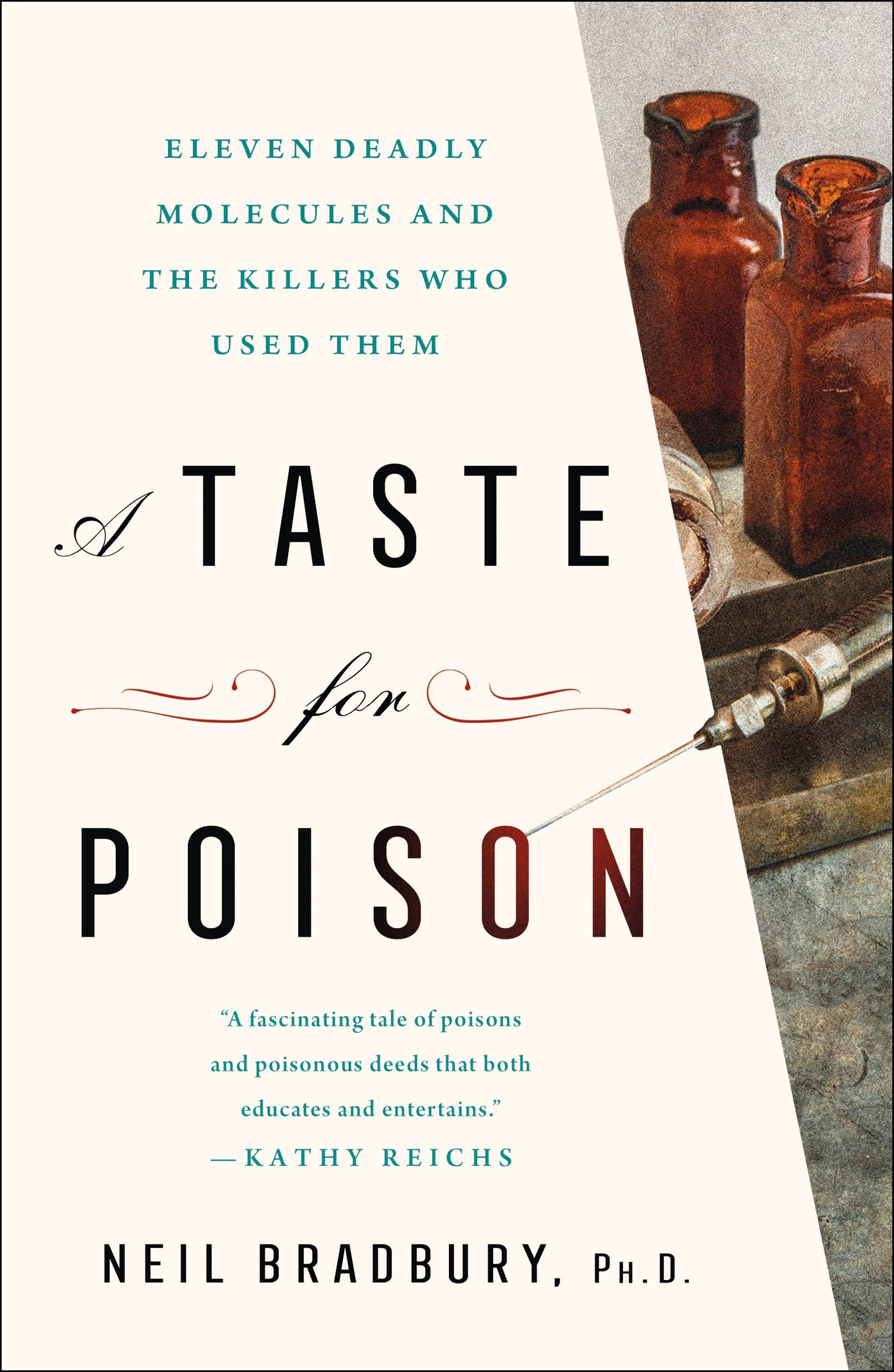
book cover

… a chemical is not intrinsically, good or bad, it’s just a chemical. What differs is the intent with which the chemical is used: either to preserve life – – or to take it.

Within the annals of crime, murder holds a particularly heinous position. And among the means of killing, fewer methods generate such a peculiar morbid fascination as poison. Compared with hot blooded spur of the moment, murderers, the planned and cold calculations involved in murder by poison, perfectly fit the legal term malice aforethought. Poisoning requires planning and knowledge of the victim’s habits. It requires consideration of how the poison will be administered. Some poisons can kill within minutes; others can be given slowly, over time, gradually accumulating in the body, but still leading inexorably to the victim’s death.

If you are a fan of True Crime, if you are a fan of TV procedurals, if you are a fan of murder mysteries, A Taste for Poison is a must read. You will be much better prepared to keep up with the medical examiners in all venues when you can recognize the victims’ symptoms, at least if the book or show gives you a chance to try figuring it out for yourself before the truth is revealed.

Neil Bradbury grew up fascinated by murder mysteries and poisons. He is a graduate of the University of St. Andrews in Scotland, and the University of Wales School of Medicine, with degrees in Biochemistry and Medical Biochemistry. Although he grew up in the UK, he now lives and works in Illinois, USA, where he’s a scientist, teacher and writer. He also gets to play with nasty chemicals every day (during scientific experiments of course). – from his site

description
Dr. Neil Bradbury – image from his site

He has carefully mixed his interests and profession to produce a fun, informative look at poisons through the ages. One might wonder if he wrote the book using a poison pen. I wouldn’t, but some might. He includes looks at the following: Aconite, Arsenic, Atropine, Chlorine, Cyanide, Digoxin, Insulin, Potassium, Polonium, Ricin, and Strychnine. None would qualify as pretty, although cyanide does gift its victims with a lovely ruddy complexion.

One of the primary themes of the book is that poisoning is the misapplication of healing pharma to dark purpose. Think water. Necessary for human survival, comes in many forms. These days it forms a base layer for a surface layer of every imaginable flavor, nifty literary tool too, right? But water-boarding, or tsunami? Not so much.

Bradbury goes through the medically helpful aspects of multiple poisons, then shows how they have been used to kill, who used them, on whom they were used, how the crimes were figured out and prosecuted, and what happened to the poisoners. In doing this he provides us with a history of when it became possible to diagnose (detect) each poison as a murder weapon, (of particular interest in historical mystery dramas) and details the biology of how each works its dark arts inside the human body.

Sadly, for those with a poison-based homicidal urge, the subjects of Bradbury’s reporting, for the most part, were tried and convicted. And today, in the absence of governments protecting state-sponsored poisoners, very few such crimes go unpunished.

You are unlikely to recognize the names here, at least the names of the killers, attempted killers, and victims, but as with many in the history of medicine, that is not unusual. Nevertheless, the details are here, as many crimes are examined.

Bradbury offers a fun collection of historical odds and ends, like how the telegraph, newly in service, foiled the escape of one poisoner. Or how one particular poison may have been at the root of vampire mythology, or how strychnine was used as a pick-me-up in the early 20th century, or the surprising cost of manufacturing polonium, and even a new take on some Van Goh masterpieces.

The only downside for me was that I tended to get a bit lost in the sections detailing the biological and chemical workings of these substances inside the body. I would not say they are extremely technical. I would say that I was always complete garbage at chemistry, and not a whole lot better at biology, so may have nurtured a disaffection that is unlikely to affect you the same way. There is some humor in the book, but not a whole lot.

Still, As a consumer of a considerable amount of crime-based entertainment, I was particularly drawn to this book. The how-dun-it often is as important as the who, and by detailing victim symptomology as well as poisoner and investigator methodologies, we can all get a greater appreciation for the challenges entailed. I may not have had the right chemical receptors for the scientific details, but there is plenty of intel in here that will enhance your engagement in crime shows, and teach you a bit about the history of these substances, many of which exist in common parlance. So, it may or may not be for you. I guess you will just have to pick your poison.

…in France in the late 1600s, the effectiveness of arsenic and disposing of wealthy relatives who had the temerity to remain alive, was so widespread that it gained the name Poudre de succession, or “inheritance powder.”

Review posted – 11/17/23

Publication dates
———-Hardcover – 2/1/22
———-Trade paperback – 8/15/23

I received a paperback of A Taste for Poison from Griffin in return for a fair review. I am happy to report that the tingling feeling in my hands, which began after I first began to read the book, soon abated. Thanks, folks, and thanks to NetGalley for facilitating.

This review is cross-posted on my site, Goodreads. Stop by and say Hi!

=======================================EXTRA STUFF

Links to the author’s personal and Goodreads author pages

Alas, as far as I was able to find, Bradbury’s on-line presence is slender, limited to his personal site and GR author page. Maybe laying low after having taken care of some personal rivals?

Interview
—–Murder & MayhemTalking Poisons with Dr. Neil Bradbury

Items of Interest
—–Listverse – Top 10 Remorseless Poisoners That History Almost Forgot by Radu Alexander
—–Philadelphia Inquirer –A Pennsylvania nurse is accused of killing 4 patients, injuring others with high doses of insulin by Bruce Shipkowski and Brooke Schultz, Associated Press
—–Wikipedia – List of Poisonings through history – from 399 BC to 2021 – a nifty list

Leave a comment

Filed under History, Non-fiction, Science and Nature, True crime

Things in Jars by Jess Kidd

book cover

A cloth covers the jar that Bridie took from the bookcase in the nursery, and Ruby is thankful for this. For the contents have the ability to rearrange even a dead man’s sense of reality. As with all terrible, wondrous sights, there is a jolt of shock, then a hypnotic fascination, then the uneasy queasiness, then the whole thing starts again; the desire to look and the desire never to have looked in the first place.

1860s London, the prime of the Victorian age. About fifteen years before Sherlock Holmes begins using his talents to suss truth from mystery, Bridie applies her peculiar talents to helping the police in cases of an unusual nature. A sign outside her door announces:

Mrs Devine
Domestic Investigations
Minor surgery (Esp. Boils, Warts, Extractions)
Discretion Assured

but she is known mostly for her ability to discern the cause of death, when simple observation will not suffice. She would do as well with a sign that says Investigator of the Bizarre. Her Scotland Yard contact and sometime employer is one Inspector Valentine Rose, and business is brisk.

London is awash with the freshly murdered. Bodies appear hourly, blooming in doorways with their throats cut, prone in alleyways with the head knocked in. Half-burnt in hearths and garroted in garrets, folded into trunks or bobbing about in the Thames, great bloated shoals of them.

She is called on to look into inexplicable deaths, primarily among the flotsam of society. London has been undergoing the installation of a world class sewer system, and diggings have turned up some extremely cold cases. The latest calls her to a crypt in Highgate Chapel. A mother and child have been unearthed, the child having significant bodily abnormalities. Around the same time, a dodgy-seeming doctor comes a-calling, seeking her assistance on behalf of his patron, Sir Edmund Athestan Berwick. Seems the baronet’s daughter has been kidnapped. Going to the police is not really an option. And the game is afoot. Any chance the two cases are linked?

description
Jess Kidd – image from Metro.

The purloined child, Christabel, has some peculiarities of her own.

The man, looking up, hesitates and the child bites him, a nip of surprising sharpness. He pulls his hand away in surprise and sees a line of puncture holes, small but deep…The man stands, dazed, flexing his hand. Red lines track from palm to wrist to elbow, the teeth marks turn mulberry, then black…What kind of child bites like this, like a rat? He imagines her venom—he feels it—coursing through him …A blistering poison spreads, a sudden fire burning itself out as it travels…All- the time the creature watches him, her eyes darkening—a trick of lamplight, surely!…He would scream if he could, but he can only reach out. He lies gasping like a landed fish.

Poor unfortunate soul.

description
Image from The Times

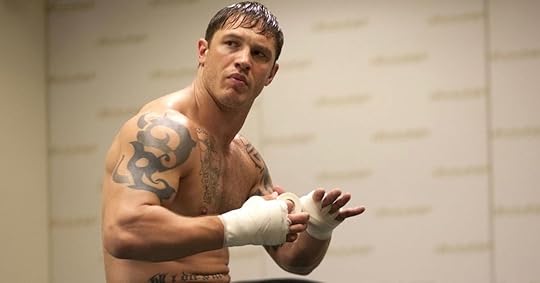
With Sherlockian insight, a talent for disguises, and lots of shoe leather, Bridie sets about following leads and examining clues trying to get to the bottom of a case that is unusually fishy. Like that later consulting detective, Bridie smokes a pipe, which is often enlivened by substances other than pure tobacco, things with names such as Mystery Caravan or Fairground Riot, concocted by Dr. Rumhold Fortitude Prudhoe, a close friend. She shares her quarters with a particularly helpful assistant, the seven-foot-tall Cora Butter, who asks more than once whether Bridie would like this or that person held upside down. The medical bag Bridie totes is her own. The other frequent companion in her investigations is a dead man. While on the job at Highgate Chapel, he first appeared to her in the attached graveyard, notable not only for his transparency, but for his indecorous attire. Ruby Doyle had been a renowned boxer in his day, and appears in shorts, shirtless, sporting a cocked top hat, an impressive handlebar moustache, muscles aplenty, and a considerable number of tattoos, with peculiarities all their own. He seems to know Bridie quite well. One of the mysteries of the book is why she does not seem to remember him, particularly as she finds him very, very attractive.

description
Tom Hardy – add a handlebar moustache, top hat, and some more tats, and Kidd sees him as Ruby

The supporting cast is a delight. Lee refers to those who work with her as Bridie’s Victorian A-team. Beyond those noted above there is a criminal circus owner with a weakness for strong women, psycho killers of both the male and female persuasion, a misshapen sniveling abettor who could have snuck out of a Dickens novel to put some time in here, an honorable street urchin, orphans, a mysterious woman who may be haunting the baronet, and plenty more.

The story is told in two timelines. Bridie investigates the taking of Christabel in 1863, and we get looks back into Bridie’s childhood from 1837 to 1843, the earlier period explaining much of what is to come twenty years later. And explaining how Bridie came to have the skills she possesses. Bridie was born in Ireland, like the author, but I expect Jess Lee’s transition to life in London was a tad less fraught.

description
Image from Foodiggity.com

Among other things, Kidd is interested in presenting a realistic portrait of the period. ( I…wanted to give a basis of a real, gritty, accurate portrayal of Victorian London.) Visually, she offers panoramic looks through the dark eyes of ravens, and Bridie’s pedestrian peregrinations, particularly through less-than-posh parts of the city. She offers a particularly effective olfactory perspective as well.

Breathe in—but not too deeply. Follow the fulsome fumes from the tanners and the reek from the brewery, butterscotch rotten, drifting across Seven Dials. Keep on past the mothballs and the cheap tailor’s and turn left at the singed silk of the maddened hatter. Just beyond, you’ll detect the unwashed crotch of the overworked prostitute and the Christian sweat of the charwoman. On every inhale a shifting scale of onions and scalded milk, chrysanthemums and spiced apple, broiled meat and wet straw, and the sudden stench of the Thames as the wind changes direction and blows up the knotted backstreets. Above all, you may notice the rich and sickening chorus of shit.

She was greatly influenced by journalist William Mayhew’s encyclopedic 1851 book London Labour and the London Poor. There is a look at the jailhouse, which appears to be guarded by particularly corrupt versions of Tweedle-Dee and Tweedle-Dum. Toss in, (or dig up) some resurrectionists, too. Part of the Victorian culture was a craze for collecting exotic things. One story that fed her interest was that of The Irish Giant, an exceptionally tall gent (7’7”) who became the talk of London for a brief time. But after his early demise, and despite his specific instructions to the contrary, his remains were obtained by a collector and put on display. There is a link to this tale in EXTRA STUFF.

description
Image from Traveldarkly.com

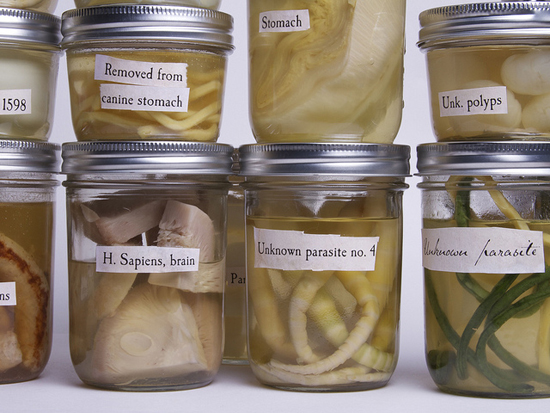
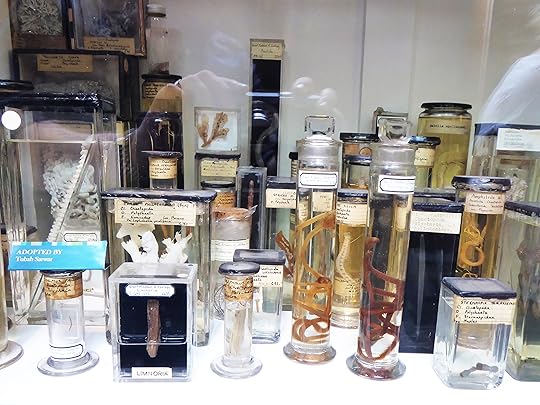
Lee is also interested in Irish folklore and partakes of that richly for the core element of the story. The incorporation of this element brings with it the main fantasy strand of the novel. One look at the cover of the book will inform you that there be mermaids (or something akin) here. Lee adds additional magical elements, as such critters appear here to have considerable power to influence the world about them, and specific powers that we would never associate with The Little Mermaid, although, considering the things we see in jars, we might have to reconsider the implications of the song Part of Your World:

Look at this stuff
Isn’t it neat?
Wouldn’t you think my collection’s complete?
Wouldn’t you think I’m the girl
The girl who has ev’rything?
Look at this trove
Treasures untold
How many wonders can one cavern hold?
Lookin’ around here you’d think
(Sure) she’s got everything

Hmmmmmm.

description
Image from Klyker.com

There is considerable humor in Things in Jars.

Her spectacularly ugly bonnet is curled up before the fire, bristling with feathers. She refused to give it up into the hands of the butler. Not that the butler was overeager to take it. If it comes alive, Sir Edmund thinks, he will do for it with the poker.

My particular LOL favorite is the prayer young Bridie offers up at bedtime.

God grant eternal rest to Mammy, Daddy, James, John, Theresa, Margaret, Ellen, and little baby Owen. God grant that bastard Paddy Fadden a kick up his hole and severe death to him and his gang, of a slow and terrible variety.

How could you not absolutely love such a child?

The disappointments in Things in Jars were few. I wish there had been more provision of clues throughout the book about what the deal was with Ruby. I was ok with the explanation, but it needed a better support structure. A bit more background on Cora would have been welcome. One actual gripe was a scene in which Bridie falls asleep while on the job. No way would this have happened. Booo! Almost all the violence occurs off-stage. In addition to one event described in a quote from the book in the review, we are shown the beginning of one attack by a ruffian on a lady. Tender souls might turn away. That’s really about it for such things.

description
Image from Nickcook.net

But the delights in Things in Jars could fill a wing of the British Museum. Bridie is a delicious lead, tough as nails without being impervious, bright, with a solid background that explains how she knows what she knows. She is a lot of fun to follow. The Holmesian parallels are a treat. The supporting cast is like a three-ring circus, in the best possible way, diverse, interesting, and fun to watch (both the light and the dark). We feel the fear when appropriate, and see Bridie’s affection for Ruby grow. A taste of Irish folklore is both creepy and educational, and Lee’s portrait of 19th century London offers an exceptionally immersive experience. You really get a feel (and smell) of being there. A real-world mystery with fabulous elements of fantasy. In short, Things in Jars is an absolute delight. For the hours you are reading this book you will be part of that world.

Review first posted – January 17, 2020

Publication date – February 4, 2020

I received an ARE of this book from Atria in return for some specimens I have been keeping in a special place in the lab basement for some years. They promised to return them after a thorough examination.

This review is cross-posted on Goodreads. Stop by and say Hi!

=======================================EXTRA STUFF

Links to the author’s personal, Twitter, Goodreads, Instagram and FB pages

My review of a 2023 book by Kidd
—–The Night Ship

Interviews
—–Savidge Reads – Sinister & Supernatural Shenanigans with Jess Kidd – by Simon Savidge
—–Stitcher – S3E4 – Chatting with Jess Kidd – audio – 1:29:12 – by Tim Clare – you can safely begin at about 46:00 for a focus on Jars
—–Well, not an interview, really, but a piece Kidd wrote for LitHub on her favorite ghost stories – Books That Blur the Lines Between Living and Dead

Items of Interest
—–Waterstones – A look at the Operating Theater – Kidd gives a tour
—–Writing i.e. – On Writing Things in Jars by Jess Kidd
—–Gutenberg – London Labour and the London Poor (1851) by William Mayhew
—–Joseph Bazalgette – engineer of the massive sewer works in London
—–Otherworldly Oracle – Mermen Legends. – a fun bit of fluff
—–Wikipedia – The Irish Giant

Leave a comment

Filed under Fantasy, Fiction, Historical Fiction, Thriller, Thriller

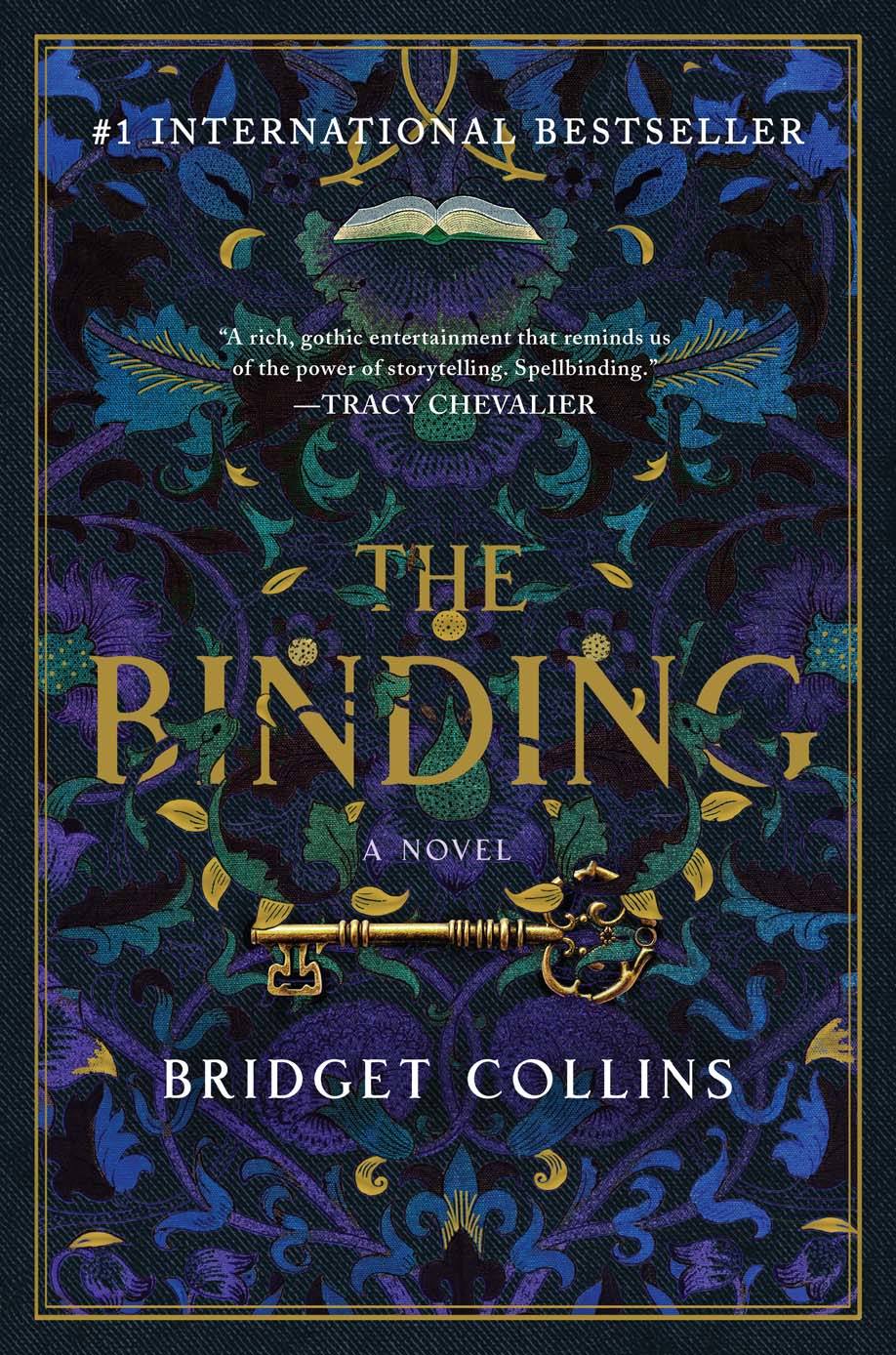
The Binding by Bridget Collins

book cover

We’ve been called witches since the beginning of time. Word-cunning, they used to call it—of a piece with invoking demons…We were burned for it too. The Crusade wasn’t new, we’ve always been scapegoats. Well, knowledge is always a kind of magic, I suppose.

Emmett Farmer is a young man with issues. He used to think that he would inherit his family’s farm. It was the life he was used to and the road he expected to follow to, and beyond, the horizon. But he has not been himself lately. His abilities have deteriorated. He loses himself, in time, suffering dizziness, nausea, and weakness. Some say he was cursed by a witch. When he is offered an apprenticeship with a bookbinder, it offers a way out, however frightening the career and his mentor might be.

description
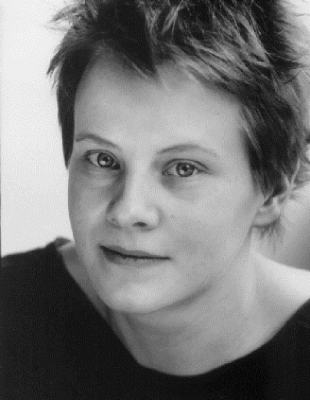
Bridget Collins – image from United Agents, UK

Despite some raw similarities, bookbinding in Bridget Collins’s world is not quite the same as it is in ours. Emmett trains with the elderly Seradith, a woman seen as being a witchy sort by some of the locals. In fact, bookbinding is seen as a dodgy sort of work. What is bound in books here are memories. Instead of sharing recollections or stories, as they do in our reality, the memories bound into beautifully crafted leather books in this world are removed from clients by binders. Unlike books in our world, which are designed to be shared, these books are meant to be hidden. Being on the NY Times Top Ten list would kinda defeat the purpose.

At least that is the intent. Cheat on your taxes? Pay off your mistress to keep quiet at the height of a political campaign? Sell out your nation’s security in return for real estate consideration by a foreign enemy? Awkward. But there is a solution, well, for part of it, anyway. Go to a binder and the memories will be nicely removed, leaving your tiny mind virginally memory and guilt free, and ready for that sit-down with whoever might be heading an investigation. If memory-cleansing bookbinding existed in our world, I imagine there would be a long line of potential clients. Of course, it might be a challenge to find binders with the innate talent to make those memories move from a client’s brain to the page. One can train in how to work the leather, sew the pages, and do all the material steps entailed in constructing such a book, but only those with a special gift can smooth the passage from one medium to the other. Emmett Farmer, it turns out, has such a gift. It does not help much with tilling fields, but is crucial for this special craft.

…the hours passed slowly, full of small, solid details; at home, in the busyness of farm life, I’d never had the time to sit and stare, or pay attention to the way a tool looked, or how well it was made, before I used it. Here the clock in the hall dredged up seconds like stones and dropped them again into the pool of the day, letting each ripple widen before the next one fell.

Emmett acclimates to Seradith’s remote locale (out in the marshes), begins to learn the manual end of the binding craft, and is eager to move beyond to learn what bookbinding is really all about (he does not actually know). He is particularly curious about what goes on beyond certain forbidden doors at Seradith’s emporium, but even glancing inside such doors causes him major episodes of what his boss calls Binder’s Disease, costing him days of consciousness and bringing forth strange visions. These strains increase when certain clients arrive. When he finds a book with his name on it, Emmett realizes that he is less than whole.

Part Two of the novel is Emmett’s bound story as reported in that book. Part Three returns us to Emmett’s now, and how he deals with what he has learned. More than that about the goings on risks spoiling a key plot twist. But it does touch on forbidden love and the dangers of loving outside one’s class, however that may be defined.

The Binding is an engaging page turner of an historical fantasy, particularly the first third, in which we are introduced to Collins’s world, an amalgam of the medieval and circa 1890 rural England. The mystery of Emmett’s affliction is enticing and his experience at Seradith’s is riveting. I found Part Two, Emmett’s bound story, interesting, but nowhere near as gripping. Part three is pretty much a continuation of Part Two, but with Emmett aware of his history, so is more of a cloth with the second than the first part. Not to say that the latter two are not good, just not so fabulous as the opening, in terms of the engagement of the story, at least. In terms of looking at the socio-economic implications of binding, they are wonderful.

One fascinating thing is how Collins came up with her concept. She was working as a volunteer at Samaritans, a non-profit that offers people who will listen for people who need to talk. What would it be like if I could reach out and winch that memory from you? She was also taking a book-binding class at the time, and a happy combination was conceived. In setting her story in late 19th century rural England she uses some history of the era to correspond with events in the created reality. For example, the Binding Law of 1850 in Emmett’s world corresponds to the 1850 legalization of gin (I’ll drink to that!) in English law. The Crusades here, for example, were not about perceived Middle Eastern outrages, addressed with European outrages, but were focused on scapegoating binding for the social and economic disruptions brought about by the rise of capitalism. Binders are viewed as women accused of witchcraft have been in our world, dealers in mysterious practices, necessary for providing needed services, but not to be trusted, and maybe evil.

There are many novels that use memory loss as a core mechanism. Some elements of these are fairly common. How is memory lost? Literature is rich with examples, usually of the traumatic sort, usually involving violence, typically a blow to the head. These tend to populate books in which memory loss features as a Maguffin for propelling a thriller or mystery. Next down the list is memory lost through illness, typically Alzheimers’ disease. Still Alice fits in there nicely. There are stories in which memory loss is via external misadventure of a broader, science-fictiony sort, things like plagues. The Book of M is a wonderful example. Less populous is the sort in which memory is willingly surrendered, Eternal Sunshine of the Spotless Mind pops to mind. (and we elect to keep it there, for now) The Binding relies on the last of these, substituting a bit of magic for the sci-fi explanation offered in Eternal Sunshine.

What lifts The Binding above the crowd of memory-loss novels is its consideration of the societal implications of voluntary forgetting. There are complications, of course, and they are wonderfully explored. Some with power want others to forget what they have done. Think of it as an employment contract, or a user agreement for partaking in pretty much any software. You agree to this and that, and such and such, which will entail the surrender of some inalienable rights. Just click agree at the bottom of the mouse-print form. But damn, you need the job, or want to use the software. However, what if what you are surrendering to the seller, or employer, is the right to your own memories? And what if the person in power has done something they would rather you not remember? You might find yourself (or what is left of you) wearing out a path to the binder’s shop for a bit of a memory trim (Boss just sent me over. Says you should just take a bit off the top, please, and close on the sides, ok?) I will leave to your imagination (and the book of course) how such a system might be abused. So, we have an author who looks at political power in a very personal way. Workers of the world unite! You have nothing to lose but your…wait, what was that again? Continuing the image, what if you are starving and selling your memories as a way to put food on the table, the way many in poverty engage in sex work to make ends meet? Puts me in mind of the Beggarwoman from Sweeney Todd (Hey, don’t I know you, Mister?”) Which of course presumes that there are binders out there with somewhat lower ethical standards than the very righteous Seradith. Shocking, I know.

To lift the novel even higher is a parallel consideration, the significance, the power of books themselves, what it means to write a book, to read a book, and to share the experiences of another through the written page. I was reminded of The Guernsey Literary and Potato Peel Pie Society and The Book Thief.

What if we look at books as a manifestation of self? Not exactly a stretch. Do authors lose a part of themselves when they commit their thoughts to the page? Is reading a book written by someone else a form of voyeurism? Just as in our world, books can be used for benign or malign purposes, books are treated as treasured valuables by some and as a form of personal or mass-produced filth by others. Seradith, essentially, amputates memories, as a physician would take an unhealable limb, a benign act, and saves the bound memory in a beautifully crafted book, kept safe in a vault. Others may make use of such books for corrupt purposes. You, yes you, reading this, you know the power of books, how they can act like a drug, slaking, temporarily, an unquenchable thirst. Very drug-like, no? How about the power of books to heal? Ever read anything that made you feel better? Certainly any well-written memoir can offer one a view of someone’s inner life, but at least in our world, that does not require that the author forget what she has written. Books change lives, whether we read or write them. For writers, a part of themselves definitely finds its way onto the page. And a world in which all books are locked away sounds rather medieval.

Collins offers a bit of wry perspective on writing.

There’s a growing trade in fakes, you know. Does that concern you?” He paused, but he didn’t seem surprised not to get an answer. “I’ve never seen one—well, as far as I know-but I’m curious. Could one really tell the difference? Novels, they call them. They must be much cheaper to produce. You can copy them, you see. Use the same story over and over, and as long as you’re careful how you sell them, you can get away with it. it makes one wonder who would write them. People who enjoy imagining misery, I suppose. People who have no scruples about dishonesty. People who can spend days writing a long sad lie without going insane…My father, of course, is a connoisseur. He claims that he would know instantly if he saw a novel. He says that a real, authentic book breathes an unmistakable scent of…well. He calls it truth, or life. I think maybe he means despair.

I doubt that despair is what you will experience on reading The Binder. This is a marvelous read, a thoughtful, engaging novel, featuring a large dollop of Dickensian social commentary, while following an appealing everyman through the perils of coming of age, and offering in addition insightful observations on memory-as-self and the power of books. I was sure I had something more to say, but I seem to have forgotten what that was.

Review first posted – January 4, 2019

Publication
—–UK – January 10, 2019
—–USA – April 16, 2019
———-April 21, 2020 – trade paper

This review is cross-posted on Goodreads. Stop by and say Hi!

=======================================EXTRA STUFF

Links to the author’s personal, Twitter and GR pages

If you check only one interview with the author, make it this one, in which the author talks with her US editor. The Library Lovefest audio is about 40 minutes long on Soundcloud, and is well worth the time invested. – Editors Unedited: Editor Jessica Williams in Conversation with Author Bridget Collins

Lists
—–GR list of Amnesia and Memory Loss Fiction
—–Popular Memory Loss Books on GR
—–Books featuring amnesia

The Memory Files – film
—–Memento
—–Eternal Sunshine of the Spotless Mind
—–The Bourne Identity (film)
—–The English Patient (film)

The Memory Files – fiction
—– The Bourne Identity (novel)
—–The English Patient (novel)
—–Still Alice
—–The Book of M
—–The Guernsey Literary and Potato Peel Pie Society
—–The Book Thief

Bookbinding
—–from Instructables.com – How to Bind Your Own Hardback Book
—–Self-Publishing Basics: 5 Book Binding Styles Illustrated

Leave a comment

Filed under Fantasy, Fiction, Literary Fiction