Category Archives: Literary Fiction

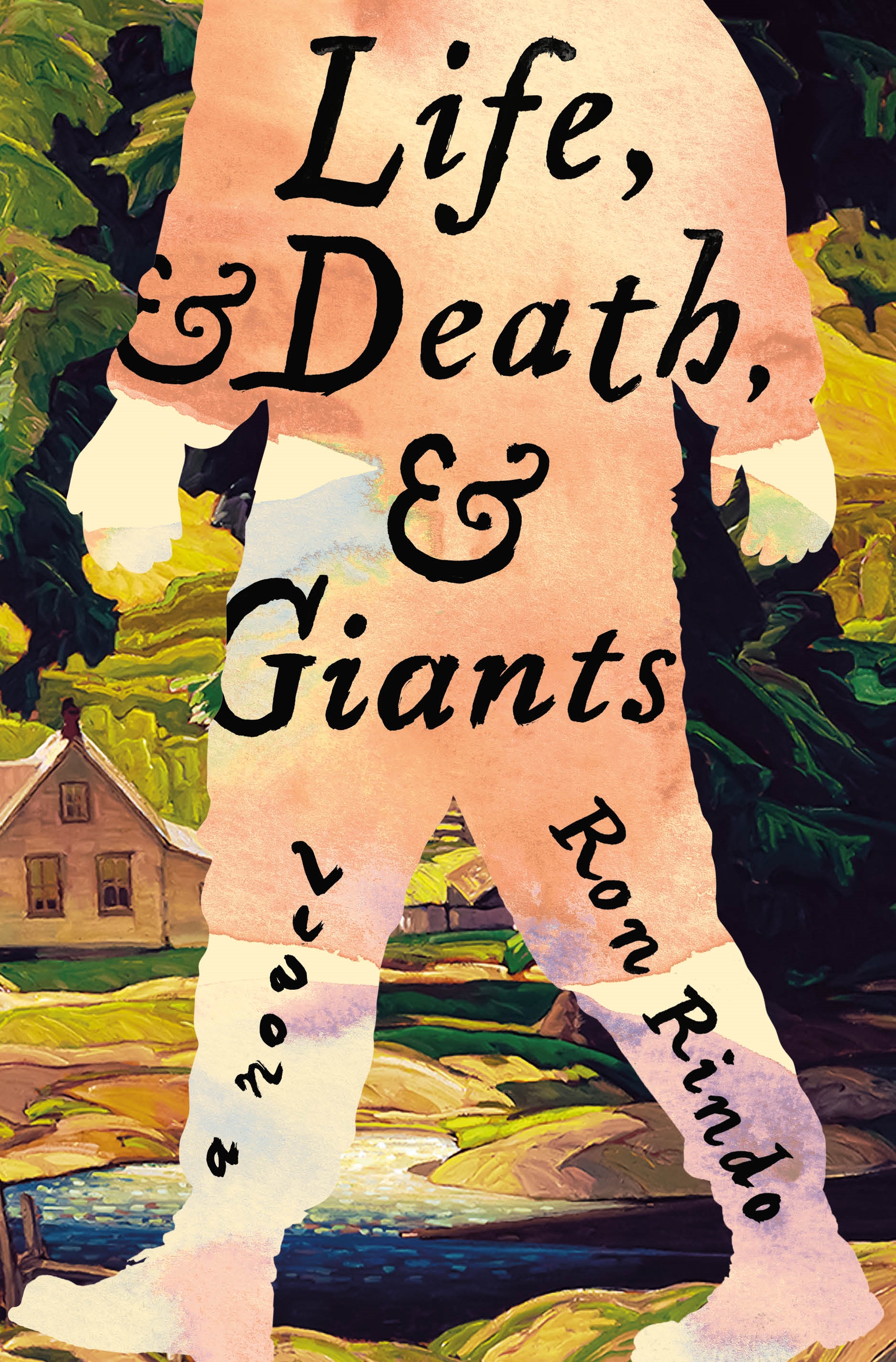
Life, and Death, and Giants by Ron Rindo

book cover

At age one, Gabriel Fisher weighed thirty-four pounds and stood forty-one inches tall. It was not only Gabriel’s unusual size that dazzled Thomas, but also his unusual way with animals. As a three-year-old boy, Gabriel would often sit on a milking stool beside Jasper’s chicken coop with a piece of bread hidden behind his back. He’d wait, watching the chickens scratch in the yard until his favorite hen, a barred rock named Betsy, eased her way close to his feet, and then he’d reveal the bread with a flourish. The other hens would race toward him, but Betsy would immediately hop on his lap and peck at the bread until she’d eaten it all. Afterward, Gabriel would cuddle her while he napped in the afternoon sunshine, and she’d turn her beak into the hollow under his armpit and fall asleep.

I recognized myself inside those pages. In a life devoted to goodness, devoted to God, there can still be yearning. A quiet mouth, a devoted heart, does not mean a quiet mind. Sometimes while reading, I found myself crying, overwhelmed by the depth and breadth of Miss Dickinson’s daring, by the baring of her soul.

Some books you rip through, eager, panting, for the resolution of a conflict and the presentation of the next one. Some books demand that you go through them slowly, a stroll hand in hand. Instead of a 5K. Life, and Death, and Giants is a book you want to take your time with, savor, taste, relish, feel.
description
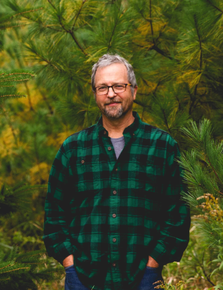
Ron Rindo – image from Wisconsin Literary Map

Ron Rindo came across the story of the tallest person ever, from the 1920s and 1930s, and wondered how the modern world might react to a someone of like dimensions.

Just eight pounds five ounces at birth, [Robert Pershing] Wadlow stood eight feet 11.1 inches tall, weighed 439 pounds, and had size 37 feet at the time of his death, at age twenty-two, his extraordinary growth driven by hypertrophy of the pituitary gland. For a time, Wadlow toured with the Ringling Brothers Circus and promoted shoes for the International Shoe Company, but he seems to have sought a normal life, resisting efforts to define him exclusively as a circus attraction. He died of an infection in Manistee, Michigan, and is buried in Oakwood Cemetery in Alton, Illinois. My musings about how the twenty-first-century world might react to a giant in its midst provided the initial inspiration for this novel. – from the Acknowledgments

Giants such as these may have a brief stay among us, but, unlike the “beetle at the candle” or the “Hopper of the mill” can maintain more than their mere accidental existence. (The title of the novel is taken from that of the poem by Emily Dickinson. There is a link to it in EXTRA STUFF.) Gabriel Fisher is a magical person, imbued with qualities of a different realm. It is not just his physical characteristics, which mimic those of an actual human being, or the athletic prowess that traveled with his inflated size, but his kindness, considerateness, his gentleness, and his Franciscan affinity for creatures wild and domestic. A Tom Bombadil comparison would also be apt.

He opened his mouth, bayed like a young coyote. “That’s the boy,” Thomas said, smiling. “Let everyone know you’re here.” From the woods just beyond Thomas’s yard, a red fox barked, and squirrels began chattering. A half mile down the road, farm dogs howled; cattle lowed in their sunny pastures.

But, as great a presence as Gabriel is, it is the other characters in the novel who tell us what we need to know about him. He is a central hub around whom all the character spokes attach and it is their stories that make the novel roll.

“It’s a polyphonic novel, told from multiple perspectives, so in a sense, it’s five different stories,” says Rindo. “Hannah, Doc Kennedy, Billy Walton and Trey Beathards tell Gabriel’s story, but in the process, each of them tell their own story, too.” – from the Madison Magazine interview

Hannah Fisher is Gabriel’s grandmother. She loves him unreservedly, but the code of her Amish religion keeps her at a distance for far too long. Gabriel was born out of wedlock, his mother, who dies in childbirth, shunned by the community. Hers is one of the primary voices we hear throughout, as she struggles with the tensions between her faith, her love, and her sense of right and wrong.

Dr. Thomas Kennedy is a veterinarian, and the other primary voice here. Tragedy and unwarranted suspicion had driven him from a more urban life to this rustic town of Lakota, Wisconsin. He forms a life-time bond with Gabriel by virtue of delivering him into the world. Their connection is a thing of beauty, and will warm your heart. He also nurtures a friendship with Hannah. He is as good a person as you will come across anywhere.

Billy Walton manages a youth baseball team, and recruits the very oversized Gabriel to sign on. He is, of course a marvelous and dangerous player, given his power. Billy owns the local bar, and is making a place for himself after a lifetime of screwups.

Trey Beathards used to be someone, a football player, later a coach, then a drug addict and womanizer. There is much of Trey that is in need to rebuilding. He becomes Gabriel’s high school football coach, and guides his next steps. Billy and Trey introduce us to the great sports myth piece of the novel as Gabriel’s prowess exceeds any reasonable expectation, becoming the stuff of legends.

Most of the primary life tales told here share an arc. A past with troubles, self-inflicted or not, then rising from their ashes to find hope, redemption, or something like it. It is in how the characters behave around Gabriel, how they help him, look after him, care about him that we see a community in action. I am trying not to say it takes a village, but it is unavoidable.

There is a set of secondary characters here who add to the community element of the story, a gay couple who take in a stray, a severe Amish husband who does not welcome any “English” influence, a crusty older Amish man who seems to have burned all his bridges, a brotherly caretaker who goes above and beyond in caring for another.

The lines between Amish and “English” can be difficult to traverse, but Gabriel has a foot in both worlds and helps bring them to a common cause. In a different way, Thomas tries to expose Hannah to possibilities beyond her Amish restrictions. Rindo’s handling of religious and secular perspectives is deft.

You will enjoy the occasional book references scattered throughout, both to specific novels and to other unnamed texts. In parallel with the split between seeking fame versus opting for retreat, there is the tension between looking outward for inspiration and looking inward.

In his day job, Rindo teaches, among other things, the poetry of Emily Dickinson. That appreciation makes its way into the novel in two forms, a book of Dickinson’s poems that Hannah’s mother had left for her, and work left by another maternal influence. The poet’s perspective is woven into the tale, in a concern for faith, for nature ,and for the struggle to figure out how to live one’s best life, alone and in community, and the many sorts of love one can enjoy.

There were multiple times while reading this book that I was moved to tears. Not just for the emotional content of the characters’ struggles, but for the poetic descriptions, particularly of natural events.

Sometimes we feel we are on the scent of hidden things, but we doubt ourselves. Sometimes it’s because we believe we must be mistaken. Other times, it’s because we fear we might be right and we don’t want to be, or can’t be, because of who we are or where we live. But then something comes along to reveal that what we have scented with our innermost soul simply is, and our fear subsides. This revelation was my mother’s legacy, a book of poems she’d hidden, like a pheasant in the orchard grass.

There is no need to fear anything here. Life, and Death, and Giants is a heart-warming novel that will bring tears to your eyes, but which will also prompt you to consider just how to live, and just how society might work with a baseline of respect. It is one of the great works of 2025.

Review posted – 09/12/25

Publication date – 9/9/25

I received an ARE of Life, and Death, and Giants from St. Martin’s in return for a fair review. Thanks, folks, and thanks to NetGalley for facilitating.

This review is cross-posted on Goodreads. Stop by and say Hi!

==================================EXTRA STUFF

Links to Rindo’s personal and Instagram pages

Profile – from Wisconsin Literary Map

An English professor at the University of Wisconsin-Oshkosh, Ron Rindo was raised in Muskego, Wisconsin, and lives with his wife, Jenna, on five acres of wooded land in Pickett, where they raised five children and keep an orchard and an array of vegetable and flower gardens. He has published three short story collections, Suburban Metaphysics and Other Stories (New Rivers Press, 1990); Secrets Men Keep (New Rivers Press, 1995); and Love in an Expanding Universe (New Rivers Press, 2005); and a novel, Breathing Lake Superior (Brick Mantel Books, 2022). His short stories and essays have also appeared in a wide variety of journals, and an essay, “Gyromancy,” was reprinted in The Best American Essays, 2010

Interviews
—–ABC National Radio – Greyhounds, dark academia and an Amish community in new fiction by Toni Jordan, R.F. Kuang and Ron Rindo – audio – from 37:22
—–Madison Magazine – This novel set in small-town Wisconsin is more than a ‘tall tale’ by Anna Kottakis

Music
—–Hungarian Rhapsody Number 2 – in Chapter 8

Items of Interest from the author – Links to these short stories can also be found in Rindo’s website
—–Terrain.org – The Return of Migrating Birds
—–The Summerset Review – Horses
—–Wilderness House Literary Review – The Mystery in Summer Rain
—– The Trumpeter – The Song of the Tree Frog
—–Tikkun – A Theory of Everything

Items of Interest
—–All Poetry – Life, and Death, and Giants
—– Eddie Carmel

For what it’s worth, I had the experience, growing up in the West Bronx, of seeing Eddie Carmel every now and again. He and his parents lived there. It’s not like we ever had a conversation. But my pals and I spotted him climbing into a taxi or other car, feet planted in the front passenger seat. Tush in the rear. At that time of his life, he was afflicted with scoliosis, among other maladies, and walked with at least one cane. While it was startling to see someone that large (believe the 8’9″ number. There is no way he was only 7’3″) it was also very sad. It seemed from looking at him, his face, that this was a man who was in great pain. He was someone who was no longer able, if he had ever been able, to be comfortable in his own oversized skin. Awe was replaced with a very large feeling of pity.

2 Comments

Filed under Fantasy, Fiction, Literary Fiction

Unworld by Jayson Greene

book cover

At that moment, I understood several things about upload consciousness in rapid succession. Her intelligence wasn’t able to filter out or compartmentalize grief. She had no neurochemical responses flooding in to numb her pain, to soften its impact. A mind was eternal, unforgiving; a brain was a soft, plump cushion. Loss needed a brain.

I was a grieving mother, for Christ’s sake. My pain was meant to crack the earth. And here I was, not even half a year later, one of grief’s private citizens again. Were people’s memories really so short? Or was it just that you could never stop performing—falling to your knees, rending your garments—if you wanted to keep their attention? I guess it was only the people eager to make themselves a burden who reaped the rewards.

Unworld is a tale of heart-crushing grief that raises a vast array of questions about the nature of our existence. It presents as a twenty-minutes-into-the-future sci-fi look at things that may be near at hand, but which have yet to fully arrive.

We share much of our existence with the digital world, posting images on line, communicating via e-mail, text, et al. But if you are like me, you will struggle to remember considerable chunks of what has been communicated. What if you could get a personal recorder that kept track of everything for you, ready to play it back whenever you need it? Could have used that when I managed to wander away from my baseball glove as a pre-teen. It took a long time to save up enough to replace it. Or later in life, when faced with the hated, hostile question, “How could you not remember?” I definitely get the appeal. But the benefit comes at a cost. The AI that you just invited into your head gets to see everything. It becomes the keeper of your memories. In the patois of the novel this is called an upload, and you are the tether to which it synchs. You may have the option of evicting your digital tenant, but how many people really would? And what if your upload begins to have a yearning for independence? They are comprised of your memories and experiences, after all. Can they make off with that to form their own private being? What if they reside in multiple tethers (sequentially) over time? You can see where this might get complex.

description
Jayson Greene – Image from WAPO – photo by Ebru Yildiz
.
But the story is easier to traverse than that. There are four main characters, well, four from whom we hear. The central person around whom the story circles is Alex, a teenager, who may or may not have committed suicide. We are given four POVs, beginning with Anna, Alex’s mother, who is crushed and confused. Cathy teaches a class called Applied Personhood Theory. Sam(antha) is a teen a bit older than Alex. They had been friends, and had been working on a film project together. Aviva is the upload. We get a second take from Anna to close out the tale. The Alex we get to know is the sum of their memories and impressions.

But then, one could as easily say that the story revolves around Aviva. She is significantly part Anna. But she also has a disembodied relationship with Alex, and thus relates to Sam as she and Alex work on their project, and spends time as an upload in someone else as well.

It is unclear if Aviva is a menace, a predator of some sort, an artificial enhancement, an independent person, a fusion of herself with the people with whom she has synched, or what. She is getting closer to Alex and thinks, Wake up, I wanted to scream at her. (Anna) I am the ogre from a fairy tale. I am the cuckoo bird who kicks the real mother out of the nest to assume her place.

You could go through this book thinking about just who these characters are. Alex clearly has significant issues, enough to make him want to escape his own skull, maybe find release in a digital realm. Anna cannot find an escape from her grief, from the loss of her son, separation from her upload, the shakiness of her marriage. Can she be a whole person on her own? Cathy has had issues of her own. A drug addict earlier in her life, she is looking for something in an illegally obtained upload, some understanding of a real experience that has been purely theoretical to her so far. Sam is the stable one of the lot, struggling with the loss of her friend without ever really knowing why he had died. And Aviva’s construction is the most fraught of all, dependent on her tether(s) for most of her memories and sensations, but yearning to be independent, truly existing on multiple planes.

It is easy to let theoretical peregrinations overwhelm the emotion of the story. But there is plenty of rank human emotion on display as well. Anna’s loss is gut-wrenching. Greene knows something about the experience of losing a child. He published a memoir in 2019, Once More We Saw Stars, in which he writes about recovering from the accidental death of his two-year-old. Aviva may lack the physical tools that humans possess to manage our high-end stress, so her inability to handle strong emotion is understandable. As is Alex’s panic at a sudden new level of overwhelmingness.

In addition to tapping into your feelings UnWorld generates plenty of confusion. More questions are raised than answered, and those questions are the sort that will stick in your head for a while, whether or not you install a special chip behind your right ear.

“Do you feel how shitty it is to be encased in a brain, when you sync with Mom? It’s got to be like going from, like, this wide-open vast universe to locking yourself in a closet. If I were you, I’d never want to come back.” “Actually,” I said, “when I go too long without syncing with your mom, everything is painful and more difficult.” He considered this. “What if you were cut free?” he asked. “Where could you go?” I hesitated. “That’s difficult to answer, Alex,” I said. “What tethers me to your mom is pretty powerful—love, family, history. Cutting it would be severely painful. I could go anywhere, I guess, and listen to anyone’s anything, but who would I be?”

Review posted – 07/18/25

Publication date – 06/17/25

I received an ARE of Unworld from Knopf in return for a fair review. Thanks, folks, and thanks to NetGalley for facilitating. I can turn this thing off now, right?

This review is cross-posted on Goodreads. Stop by and say Hi!

=======================================EXTRA STUFF

Greene’s Instagram page

Interviews
—–Dad Talks
Dad Talks #8 : Jayson Greene By Michael Venutolo-Mantovani – This was for Greene’s previous book Once More We Saw Stars, but relevant to this book as well
—–Circulating Ideas – Jayson Greene – Unworld – with Steve Thomas
—–Books Are Magic – Jayson Greene: UnWorld w/ Mattie Lubchansky video – 46:25 – Greene reads an excerpt to 10:00, then interview

Item of Interest
—–Twenty Minutes into the FutureMax Headroom was a 1987 satirical sci-fi series that had as its tagline “twenty minutes into the future.” The phrase came to be used for any sci-fi that was set in the short-term near-future.

Leave a comment

Filed under AI, Fiction, Literary Fiction, Science Fiction

Happy Land by Dolen Perkins-Valdez

book cover

Calling something your own is a powerful prayer and there was God in it.

This is sacred ground for my family. I graze the tips of the grass with my palm as I wonder about their stories. Who were my people, and what had they sought on this mountain? I’ve never done any kind of family research, never had enough of a family to even know where to start, but now I’m beginning to realize, since arriving here, how much this missing hole goes beyond a decade-long spat.

When Veronica (Nikki) Lovejoy-Berry, a D.C. real estate agent, receives a summons from her long unseen grandmother in North Carolina, she senses the urgency and hurries down. Grandma is getting on, but remains self-reliant and reasonably spry.

Mother Rita was insistent—I need your help and if you come down here I will tell you everything your Mama hasn’t told you about our family. It wasn’t exactly an invitation I could refuse.

Mom and Grandma had become estranged many years earlier, erecting a wall between grandmother and granddaughter as well. During her visit Nikki is regaled with a tale that has a magical aura. The place where her grandmother lives was once called Happy Land. It was a community formed in the post-Civil-War period by freed slaves, not as a typical American town or village, but in the image of the communities from which the ancestors of its members had been taken. These people decided to create a kingdom, with a king and queen, as their ancestors had had in Africa.

description
Dolen Perkins-Velez – image from Torch Literary Arts

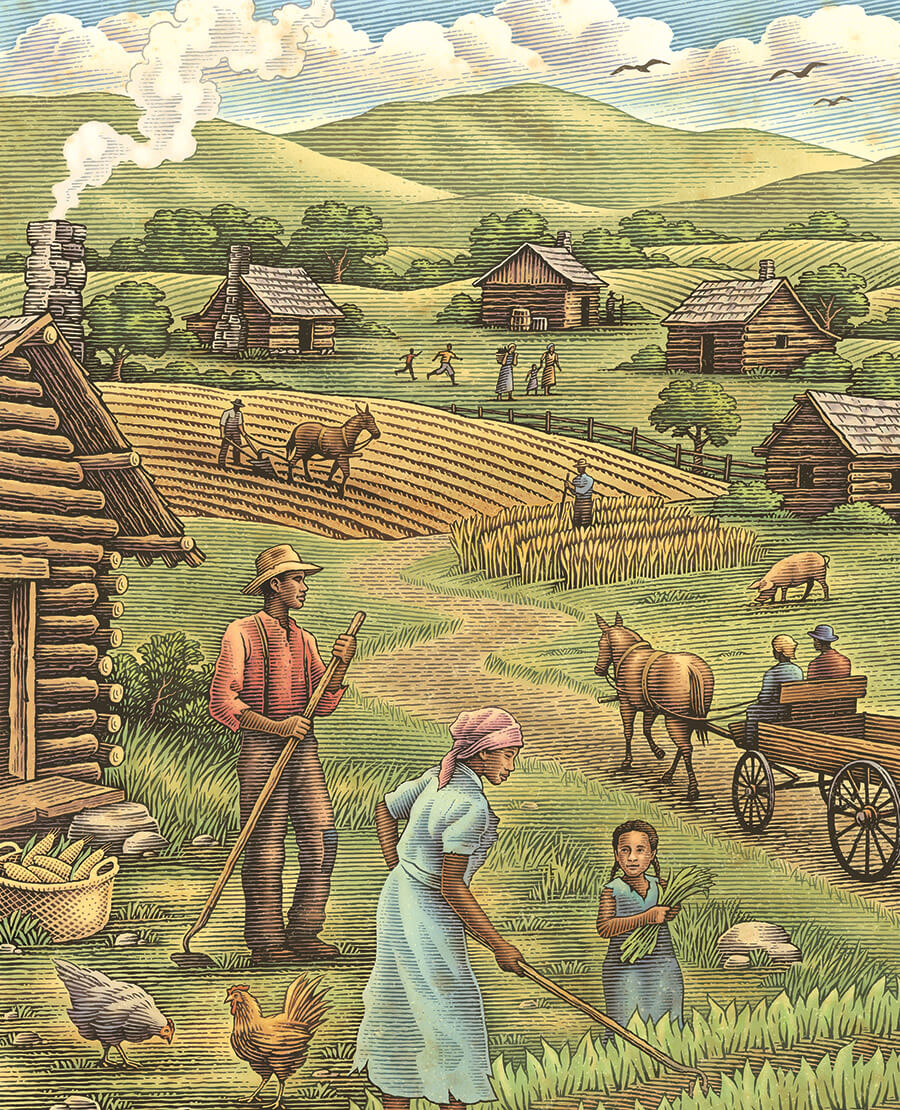
The story alternates between the contemporary struggle of Mother Rita to retain ownership of her land, as she fills her granddaughter in on the history of the place, and the tale of one of the original settlers of the kingdom, its first queen, Luella Bobo. We are given a very up-close-and-personal look at what life was like in the 1870s, the closing years of Reconstruction, for freed slaves, what it took to establish themselves both personally and as communities, what obstacles they had to overcome. It offers an eye-opening perspective for any who are not very familiar with the era.

description
Working the Fields illustration by Erwin Sherman

Nikki is not on a mission. She is tired, struggling and unsatisfied with her life. She is eager to quickly resolve whatever it is that Mother Rita wants of her and dash back to DC as quickly as possible. She has no particular interest in history, family or other, which makes her a fair every-person stand-in for readers. It is through her POV that we slowly gain an appreciation for the importance of knowing one’s personal, and family history, and the significance of the land as an anchor for that connection. The novel is based on real events.

While researching Black history in western North Carolina, I stumbled on an article about this kingdom outside of Hendersonville. It was just a local newspaper, and I thought, “What is that?” It was a very brief article with an illustration showing that there had been this Black community during Reconstruction in the mountains. – from the Rumpus interview

Mother Rita does her best to pass on to Nikki the lore and knowledge she has tended her entire life.

All my life, I’ve been part of a small family circle. By the time my daddy was 20, both of his parents had passed away. He and Mama, with their desire to build a family out of nothing, were a perfect match for each other in that way. The two of them against the world. For me, not having a sibling or even a cousin has been the only existence I’ve ever known. Now here I am, walking beside my grandmother on acres and acres of land that my people have inhabited for over a hundred years. It’s hard to put how I’m feeling into words other than to say I’m dizzy with grief. I didn’t know you could mourn something you never had.

One element is the connection to the outdoors that Rita is able to spark in her grandchild, teaching her to appreciate gardening, and to pass on her considerable expertise. Nikki slowly finds herself able to step back from her urban self to find a connection with and a love for the sights, scents, the tactile feel of this other sort of place.

After the Great Migration, so many Black people ended up concentrated in cities, and we often forget that we are fundamentally a rural people. You don’t have to go back many generations to a grandmother or a great-grandfather who was a country person. – from The Rumpus interview

description
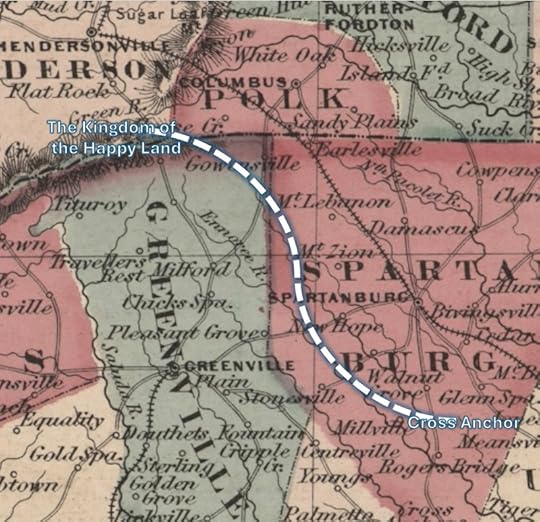
Cross Anchor, a remote township in southern Spartanburg County, S.C., was home to the founders of the Kingdom of the Happy Land before and just after the Civil War. – image from Blue Ridge Archive

A particular revelation is a particular legal mechanism used by the greedy and unscrupulous to cheat people, black people in particular, out of their land. It is remarkable just how much land was taken this way. Less surprising was the abuse of the criminal system to intimidate blacks who owned land, or aspired to do so. Equal treatment before the law remained a dream deferred. This gives the novel particular resonance in a time when the Deconstruction of the Trump era seeks to turn the clock back to an age before legal protections existed.

description
The Kingdom by Erwin Sherman

That said, Happy Land presents a message of hope. Whatever one may think of the royal approach those people favored, they took the opportunity presented by the end of slavery to make decisions for themselves, to organize their own community, to develop their own businesses, to participate in an equal way with the commerce of the area beyond their enclave. Even emerging from the horrors of enslavement, and suffering the ongoing oppression of those who preferred the ownership of human beings as property, these people kept the light of possibility alive. It is a surprising and moving story, which offers us historical reason to keep our spirits receptive to the need for and possibility of hope in an increasingly dark time.

In fall of 1873, a group of freedpeople left Spartanburg County, South Carolina, headed north across the state line into North Carolina. Near Zirconia, North Carolina, the people established a remote community that they called a kingdom. They named a king and queen, formed a communal treasury, and eventually purchased 205 acres of land in 1882 from John Davis, land that was spread across the North Carolina–South Carolina state line. Approximately half was deeded to Luella Montgomery and the other half to Robert Montgomery.
At its height, it is believed the kingdom numbered over two hundred people.
– from the Author’s Note

Review posted – 6/6/25

Publication date – 4/8/25

I received an ARE of Happy Land from Berkley in return for a fair review. Thanks, folks, and thanks to NetGalley for facilitating.

This review is cross-posted on Goodreads. Stop by and say Hi!

=======================================EXTRA STUFF

Links to the author’s personal, FB, Instagram, and Twitter pages

Interviews
—–The Rumpus – The Kingdom of Happy Land: A Conversation with Dolen Perkins-Valdez by NEFERTITI ASANTI – APRIL 28, 2025
—–NPR – Author Dolen Perkins-Valdez discusses her new novel ‘Happy Land’ by Michael Martin
—–May 2025 Feature: Dolen Perkins-Valdez by Jae Nichelle – begins down on the page, after the excerpt
—–Writers Digest – Dolen Perkins-Valdez: On History’s Untold Stories – More about her prior novel, but still quite interesting

My reviews of earlier work by Perkins-Velez
—–2010 – Wench
—–2022 – Take My Hand

Item of Interest from the author
—–Torch Literary Arts – excerpt – Chapter 4

Items of Interest
—–OurState.com – Lost & Found: The Kingdom of the Happy Land by Brad Campbell
—–Blue Ridge Archive – Welcome to the Kingdom of the Happy Land

Leave a comment

Filed under American history, Fiction, Historical Fiction, Literary Fiction, Reviews

The Haunting of Moscow House by Olesya Salnikova Gilmore

book cover

Irina calls her fanciful whenever she mentions ghosts. Still, something isn’t right about the house, hasn’t been right since Uncle Pasha was shot dead there three years before, and Grand-père Sergei succumbed to his illness mere days after.
Though she’s never seen one, Lili has believed in ghosts for quite a long time.
Do you think the dead can rise? Her voice, from a long-forgotten memory.
Of course, Nicky had answered, as if it were the most natural thing in the world.

…with each death, the spirits are more corporeal and alive. And the family is in greater danger.

It is 1921, and the suffering is not yet done. World War I, then the ongoing civil war, now famine. Bolsheviks have taken charge. They use the Cheka to enforce the new norms, inflict the governing biases, and relentlessly add to the general misery. The displaced aristocracy struggles to get by, well, those who were not summarily shot.

description
Olesya Salnikova Gilmore – Image from PRH – credit Nicola Levine Photography

To the new Soviet republic, the Bolsheviks, and the Cheka secret police, they are still countesses Irina and Liliya Goliteva, the people’s class enemy as descendants of one of the greatest and most ancient aristocratic clans of an imperial Russia dead and buried. Like most of their family. But unlike many former people, Irina’s family didn’t flee Russia. They stayed in hope of a return to normalcy. Now it is too late. Even if they could obtain papers, how could a household of women and children brave the danger of travel and exile?

Running out of household valuables to sell, the sisters take jobs with the American Relief Administration (ARA). The ARA is there to provide aid, food in particular. The sisters are managing the challenges, but there is something else. It appears that there are strange, spectral things going on in their home, the once-grand Moscow House. There are sounds, scents, footsteps, the sorts of things one can expect in a gothic novel.

So much of the novel is inspired by some of my favorite gothic stories, particularly by the Russian/Slavic gothic genre and the Ukrainian author who arguably founded it—Nikolai Gogol. – from the Afterward

Gogol and other folk sources are given plenty of recognition in the pages, allowing one the opportunity to do some digging and appreciate the inspirations.

We follow Irina (28) and her sister, Lili (18), as they try to survive through this trying period. Chapters alternate, more or less, between the two. The gothic elements build, from a few inklings to full-blown. It is not just one or two spectres turning up, but a whole host of late family members. The house is commandeered by the government, and the actual family is relegated to the attic. That does not work out well for the occupiers, as one then another is found dead. The work of one of the living inhabitants or ghostly revenge?

There are certainly some creepy bits, a norm for the genre, a few jump-cut scenes, and a spooky soothsayer. But is it scary? Mostly not, for me, (a particularly high bar) although there were some welcome surprises. There is one particular sort of ghost from Russian lore that was a new one on me. A creepy doll offers a tingle or two. That they grow in corporeality with each new death offered a welcome bit of unease. After a while, though, one gets used to the spirits, and in doing so their impact is reduced. Yeah, we’ve got a haunted house. So? The sisters keep coming and going as if it were infested with a more usual sort of pest.

Both become involved in romances, one with a Yank, the other with a childhood sweetheart. This is lovely, particularly in offering the possibility of positive outcomes for the sibs. Of course, it also adds to the ongoing tension between staying to preserve the family history and line, and fighting the good fight, or leaving to preserve their lives. How many people today are faced with comparable choices?

In fairy tales, paupers became princesses, not the other way around. But Soviet Russia is a warped Wonderland, where all is topsy-turvy and not what it should be.

One might, I expect, consider a take in which the Cheka taking charge in Moscow is a lot like the spectres taking over the Moscow House. It does cause one to recall that the Introduction of The Communist Manifesto begins, “A spectre is haunting Europe—the spectre of communism.” Certainly those spooks have landed in Russia and, through bloodshed, are gaining in strength. I have no idea if this was at all on Gilmore’s mind. But maybe. Spectres within and spectres without? Maybe a bit of dialectical materialism (or dialectical immaterialism?) for good measure?

Overall. I enjoyed The Haunting of Moscow House, particularly for the portrait of the time (The ARA was a real non-profit), the depiction of the desperation among Muscovites, and exposure to some unfamiliar gothic Slavic writing and lore. The sisters are engaging. The tension is palpable, and the spook infestation is fun.

I suppose one cannot help but compare this to Gilmore’s freshman offering, The Witch and the Tsar. That one was less reality based, more fantastical, and a bit more fun. But this one is also quite good, rich with extras both historical and literary.

Irina is crossing into the next room when she feels a prickle of cold on her arm. A draft of air. But the damask curtains are sealed tight. No, it is as if someone has moved past her. She turns sharply, as fearful as the other morning. Odd. She has never been afraid in the house. She doesn’t have Lili’s active imagination. Nor is she given over to delusions. It is only the howl and tear of the wind, the rattle of the windows in their casements, the faint give of a latch. With all this noise, she almost doesn’t hear it.
The creak of parquet, somewhere near. And again, unmistakable now. Creak. Creeeaak.
Footsteps. Small, like a child’s.
Irina backs up with wide eyes—when there is a deep growl. Then an earsplitting screech, and a dark shape hurtles across her path. A glint of red, as if red eyes have snapped to hers. The next second, scuffling and the thumping of bare feet, then nothing.
What was that? Some animal, trapped in the house?
That’s when the air implodes all around her.

Review posted – 12/20/24

Publication date – 9/3/24

I received an ARE of The Haunting of Moscow House from Berkley in return for a fair review. Thanks, folks, (Does it feel unnaturally cold to you here?) and thanks to NetGalley for facilitating.
This review is cross-posted on Goodreads. Stop by and say Hi!

=======================================EXTRA STUFF

Links to Gilmore’s personal, FB, Instagram, and Twitter pages

Profile – from her site
Olesya Salnikova Gilmore is the author of The Witch and the Tsar and The Haunting of Moscow House. Originally from Moscow, she was raised in the US and graduated from Pepperdine University with a BA in English/political science, and from Northwestern School of Law with a JD. She practiced litigation at a large law firm for several years before pursuing her dream of becoming an author. Now she is happiest writing speculative historical fiction inspired by Eastern European history and folklore. Her work has appeared in LitHub, Tor.com, CrimeReads, Writer’s Digest, Historical Novels Review, Bookish, Washington Independent Review of Books, among others. She lives in a wooded, lakeside suburb of Chicago with her husband and daughter.

Interviews
—–JeanBookNerd – Olesya Salnikova Gilmore Interview – The Haunting of Moscow House
—–Turn the Page – Episode 314E: Olesya Salnikova Gilmore on THE HAUNTING OF MOSCOW HOUSE – audio – 24:17
—–How Do You Write – Ep. 358: POV Hack: Using Method Acting with Olesya Salnikova Gilmore video – 31:09 – with Rachel Herron (from 5:36) – mostly about her prior novel, but offers a nice sense of the author, her process, how she uses method acting and her lawyerly background

My review of Gilmore’s prior book
—–2022 – The Witch and the Tsar

Items of Interest from the author
—–Crimereads – GOTHIC FICTION WITH A TWIST
—–Writer’s Digest – Finding Magic at the Intersection of Reality and Fantasy in Fiction
—–Reactor – Five Books about Haunted Houses that Crumble

Items of Interest
—–Carol’s Notebook – The Shroud – a Russian fairy tale referenced in Chapter 3
—–Story Telling Institute – Vasilia the Beautiful – a Russian fairy tale referenced in Chapter 11

Leave a comment

Filed under Fantasy, Fiction, Historical Fiction, Literary Fiction

The Mighty Red by Louise Erdrich

book cover

The absence of birds made Diz uneasy, but he wasn’t spraying birds, was he? Yet there were fewer birds around his farm. Used to be robins hunting worms in the furrows. Used to be blackbirds around the green bins. Owls at dawn, rats in their claws. Well, maybe he had a sudden thought those could have been the rats and mice he had to poison. He thought back to how birds used to chatter as the sun rose. Now, a few sparrows, maybe, or more often just the hiss and boom of wind.

While working in her garden, Crystal appreciated how their families were like the Lord’s ivy, a weed ineradicable by human means. It grows low to the ground and can’t be mowed. It throws its stems long and roots straight down every few inches, just like the people along the river. There seems to be a Frechette or a Poe anywhere you land, but low-key, invisible. The Lord’s ivy, or ground ivy, creeping charlie, thrives under the leaves of other plants and goes wherever it is not wanted. It just keeps throwing itself along stem by stem and blooms so modestly you’d hardly mark the tiny purple flowers. People step down and pass, the weed springs up, uncrushable.

But, implanted or not, there is plenty of stress to go around.

description
Louise Erdrich in front of her Minneapolis bookstore – image from The Paris Review – shot by Angela Erdrich

Romantic stress
The core of the novel is an ill-considered relationship. Kismet and Gary are teenagers, rich with hormones and needs. But are they ready to be married? She had planned to go to college. Gary is the star quarterback, but has a need for Kismet that has nothing to do with their romance. And then there is Hugo, brilliant, ambitious, and totally in love with her, (… he closed his eyes and thought about how he was helpless in the tractor beam of love.) centering his life on making himself successful enough to woo her away from Gary. Coming of age is a major element, and is wonderfully portrayed. Erdrich says in the B&N interview that she had really wanted to write a love triangle. Well, among other things. She also wanted to write about …

Financial stress

I really set it in 2008…because I don’t feel our country has ever really dealt with the fallout from 2008. I feel like there was so much that there was so much loss, that people lost homes, people lost jobs, things hollowed out in such a big way and that was never really addressed. We never really came back from that time, 2008, 2009 into the present, because the pandemic happened. – from the B&N interview

Winnie Geist lived through the Reagan era in which her family’s farm was lost, sold for a fraction of its worth. David Stockman is name-dropped from the 1980s.

While she was in high school, the government accelerated her family’s loan payments and blow after blow had landed. They’d lost their home, their farm, everything. Except one another, they kept saying, except us.

Crystal Poe is Kismet’s mother. When ne’er-do-well-actor dad, Martin, goes walkabout, Crystal has to sell off possessions to keep afloat.

description
Erdrich would like to see Irene Bedard as Crystal – from the Hoda & Jenna interview – image from Wikipedia

Ecological stress
Connection to the land is always a feature of Louise Erdrich’s work. The Lord’s ivy quote at the top reflects the root of this. Winnie’s angst at the loss of her family farm offers another. There are multiple instances of characters expressing, and acting on, (or not) concerns for the well-being of the ground on which they live and work. It is the treatment of the land that gets the most attention, the tension between using chemical-based products to maximize production per acre, versus a less corporate approach that supports a more ecologically balanced, restorative brand of farming.

I don’t think about politics when I write. I think about the characters and the narrative. My novels aren’t op-eds. Nobody reads a book unless the characters are powerful—bad or good or hopelessly ordinary. They have to have magnetism. If you write your characters to fit your politics, generally you get a boring story. If you let the people and the settings in the book come first, there’s a better chance that you can write a book shaped by politics that maybe people want to read. – from the Paris Review interview

Parental stress
Erdrich has four daughters, so has had plenty of experience with mother-child interactions. She says she loved being the mother of teens, seeing the excitement of their choices, and trying to be more of a guide than a hard-liner. Crystal struggles to influence Kismet without coming on too strong, which would predictably result in increased resistance. Gary’s mother clearly loves him, and goes out of her way to see to her baby’s happiness, maybe too far out of her way. Crystal and Winnie are definitely both afraid for their children, although for very different reasons.

description
Erdrich would like to see Isabella LeBlanc as Kismet – from the Hoda & Jenna interview – image from Minnesota Native News

A bit of fun
There is a series of flamboyant crimes committed by an outlaw, who acquires a nickname and a fair bit of public fame, in the same way that notorious historical criminals like Billy the Kid drew public interest and admiration.

This book is set during the economic collapse of 2008–09. What Martin does is only what a lot of people wanted to do. I didn’t think of what he did as villainy, but yes, I suppose it was absolutely crazy, and, you know, fun to write. I have to amuse myself. – from the Bookpage interview

There was more that motivated Erdrich. She is from the Red River Valley of North Dakota, has much family in the area and returns frequently. She wanted to write about the changes she had seen there. (like the mighty Red, history was a flood.) One element of this was that her first job was hauling sugar beets. The industry was undeveloped at the time. She wanted to write about how it had evolved over the last thirty years. The original title of the novel was Crystal.

When I started it I thought I would be writing about the 2011 lockout by Crystal Sugar and how it impacted people who were working there. They lost a lot in terms of their insurance and their benefits and wages…it was a really tough lockout. I wanted to write about that at first, but then I started writing something else entirely and I enjoyed writing it more so I kept with that one and it became more about a number of people living along the river. – from the B&N interview

Many of Louise Erdrich’s novels (this is her nineteenth) have centered on Native American history, lore, and contemporary experience. While there are several characters here whose Native roots are noted, this is not really a book about the Native experience, the way that The Round House, LaRose, The Night Watchman, and others are.

Magical realism remains a sharp tool in Erdrich’s kit. Crystal listens to a late-night radio show that centers on strangeness, including angels. A caller wonders if her child is protected by a guardian angel, given the number of close calls they had had. One character is haunted by the ghost of a friend. The aroma of a used dress speaks to its new owner. One character has a presentiment about an imminent danger.

description
Erdrich would like to see Brett Kelly as Hugo – from the Hoda & Jenna interview – image from Alchetron

There is a mystery here as well. what happened at “the party” and why is it such a hush-hush subject? Something terrible is hinted at. There are ripples emanating from this event that inform multiple character arcs.

There are a few literary references applied here. Madame Bovary is one. If you know the story, the echoes will boom at you. If not, it is no trick to pull up an abstract. Ditto for Anna Karenina. (see EXTRA STUFF for links)

As with any work of fiction it requires that we relate, at least somewhat, to at least some of the characters. Erdrich has a gift for writing characters that, whatever they may do, we can appreciate their motives, even if we may not agree with their choices. This is a major strength of the novel. She crafts rounded humans, ambitious, frightened, rational, irrational, loving, thoughtful, feckless, smart in wildly divergent ways, and, ultimately, satisfying. She does this while incorporating a payload of ecological concern, relationship insight, and an appreciation of history’s impact on lived experience, while adding a layer of magic to aid our understanding, and including a few laughs to smooth the way. Louise Erdrich is a national treasure, a reliable source of quality literary fiction, and an ongoing delight to read. The Mighty Red is indeed a mighty read.

Review posted – 12/13/24

Publication dates
———-Hardcover – 10/1/24
———-Trade paperback – 11/04/25

I received an ARE of The Mighty Red from Harper (through my Book Goddess dealer) in return for a fair review. Thanks, folks, dear.

This review is cross-posted on Goodreads. Stop by and say Hi!

=======================================EXTRA STUFF

Interviews
—–*Barnes & Noble Book ClubLouise Erdrich discusses THE MIGHTY RED with Lexie Smyth and Jenna Seery – with Lexi Smyth and Jenna Seery – video 45:37 – This is the one you want to check out
—–Today with Hoda and Jenna – Author Louise Erdrich talks ‘The Mighty Red,’ takes fan questions
—–my link text
—–The Paris Review my link text
—–Book Page – Red is an earth tone by Alice Cary

Other Louise Erdrich novels I have reviewed
—–2021 – The Sentence
—–2020 – The Night Watchman
—–2017 – Future Home of the Living God
—–2016 – LaRose
—–2010 – Shadow Tag
—–2012 – The Round House
—–2008 – The Plague of Doves
—–2005 – The Painted Drum

Items of Interest
—–Project Gutenberg – Madame Bovary – full text
—–GetAbstract – of Madame Bovary
—–Project Gutenberg – Anna Karenina – full text
—–ReWire The West – Anna Karenina: Summary and Analysis
—–North Dakota State University – WHY IS THE RED RIVER OF THE NORTH SO VULNERABLE TO FLOODING?
—–MPR News – 20-month lockout over, sugar workers brace for return to work by Dan Gunderson

Leave a comment

Filed under Cli-Fi, Fiction, Literary Fiction

Thorn Tree by Max Ludington

<img src=”book cover” alt=”book cover” width=”187″ height=”300″ align=”left” hspace=”10″ vspace=”10″>

At the base level it’s fear. It’s all about fear. People ask, ‘What are you afraid of?’ and that is not an answerable question. Any time I name a source for my fear I feel it as a deflection. I mean, sure, I can get close. You know, as in: I’m afraid of people because someone I trusted fucked with me when I was a child. I was traumatized, yes, and the fear probably began there, I guess. But I don’t really know because it seems, now, somehow elemental. It embodies some ancient, sleeping doom, and the only escape is self-destruction. You know? Like, if I become my own doom I’ve taken that power away from anything else. It’s preemptive. At least there’s agency in it.”
She felt the laughter spill out of her in a rush. Its piercing volume was at odds with the moment and the release it brought. Leo looked at her dumbfounded.
“Get the fuck out of my head, man,” Celia said.

He had merely done what men had been doing since the primeval birth of jealousy. Just a spoon of love from my forty-five, save you from another man. Howlin’ Wolf was just singing about what thousands had wished they could do, and probably had done, before there were cops and laws and all the rest of the arbitrary bullshit. And it had felt good, hadn’t it?

Daniel is 68, living a quiet life in a Hollywood Hills guest house when a visitor repeatedly appears. Dean is six years old and clearly in need of companionship. He lives with his grandfather, Jack, on the larger house on the property. Jack is not always particularly attentive. And Mom, Celia, is a rising young actress who is often away on prolonged shoots. Daniel is happy for the company.

description
Max Ludington – image from Macmillan – shot by Jennifer Silverman

The novel braids the stories of Jack, Daniel and Celia, mostly Jack and Daniel. The story takes place in multiple times, today being 2017, and the backstory stepping up from 1968 to the seventies, to 1980, and 1988. Celia is not a part of the earlier events.

The sixties events cast a light on a turbulent time, touching on many of the aspects one might expect, young love, drug-dealing, acid trips, communes, San Francisco, wth a very dodgy cult among them. But despite the surface level, there is also consideration of the sort of existential, philosophical searching that was, for many, an important part of those times.

Young Daniel (1960s) makes a youthful mistake and suffers a grievous wrong, which follows him all his life. In the 1970s he finds solace in the desert, constructing a significant work of art, the Thorn Tree of the title. It gets him some notice, gives him a way to express what is inside him, and leads to some stability in his life.

Celia did an image search for the sculpture, and there it was, standing next to the modern art museum, taller than the building itself. It was huge, with thick, meandering branches and bristling snakelike twigs. Most of the branches, while not attempting verisimilitude, were formed with inherently natural shapes and gnarled twists, but here and there some were deliberately hewn into shapes that could never have occurred in nature: curving double on themselves and then back again to form tight willowy S-shapes, or turning straight downward at acute angles for a foot or two before continuing up and outward, as if infused genetically with lightning.

Jack is a very different sort. A predator, a sociopath or something like it, Jack wants what he wants and is not much concerned about who he damages to get it. He is routinely unkind, and worse, but he is also a seeker of truth, becoming connected with a cult and seriously mulling the writings on which the cult bases its outlook, even if the tenets of that group serve to bolster his own self-justification.

Daniel and Jack are linked through these years, the source of that link being one of the mysteries of the book. Jack is definitely a dark force. Daniel exists on a brighter side, despite having made some bad choices. He is a character who grows. But while Jack grows in a way, his widened view of reality is ultimately redirected to his narcissism. Not much is really done with Celia.

There is some lyrical writing which gives the story texture, depth to the two main characters, which makes it engaging, and a look at the times, both 60s and 70s, which gives it some substance. In addition it considers repercussions throughout one’s lives of actions taken in our youth.

Daniel stood for a moment at the threshold of the branches and looked up. The wind was made louder here in contact with the tree. The gravel path went around the south side, and he followed it to where it ended at an overlook. There was a plaque on a post, but he didn’t read it. Instead of standing at the overlook and staring out to sea, as the landscape designer had intended, he turned and went in under the branches, and immediately the world of the tree took over. He was surprised—he’d thought his memory of it was hopelessly colored by LSD and shock and time, that he had probably falsely mythologized every aspect of it and it would be just a place, with soil and roots and air but not the indwelling spirit he’d imbued it with in his mind. But it was as it had been—the wind quieting and the light clarifying, damping the sun into deep greenness—inhabited by a sense of protection and safety unchanged by the years of foot traffic and human attention.

There are many more of this sort. The voice is omniscient narrator, which presents way too many opportunities to tell rather than show. But I doubt this will bother most readers. Some characters come and go, seeming to be throw-aways. It is one of the things that make the book feel over-long. I kept hoping that some of these might be given a deeper look, with Jack getting less.

The alternating timelines, a fairly typical literary device, made sense to me. The Grateful Dead offer a link between now and then. There seemed some interest in other literary devices. For example, a boy appears to have a magical relationship with birds, but the image drops after partial usage.

Thorn Tree is an interesting read, offering some substance, interesting characters, and a strong core mystery. But for a book that is not overlong, at about four hundred pages, it felt like a much longer read because of the excess attention paid to Jack, and some tangential tales. The descriptive writing (I am a sucker for that) gives one a reason to push through, however prickly the passage.

Review posted – 11/01/24

Publication date – 4/15/24

I received an ARE of Thorn Tree from St. Martin’s Press in return for a fair review. Thanks, folks, and thanks to NetGalley for facilitating.

This review is cross-posted on Goodreads. Stop by and say Hi!

=======================================EXTRA STUFF

Links to Ludington’s personal, Goodreads, and Twitter pages

Profile – from Macmillan

MAX LUDINGTON’s first novel, Tiger in a Trance, was a New York Times Notable book, and his fiction has appeared in Tin House, Meridian, HOW Journal, Outerbridge, and On the Rocks: the KGB Bar Fiction Reader. He lives in Brooklyn, New York and teaches in the writing department at Pratt Institute.

Interview
—–The Palisades Newsletter – Max Ludington Reflects on His Second Novel, THORN TREE

Song
—–The Doors – Five To One
—–The Grateful Dead – The Very Best of the Grateful Dead

Leave a comment

Filed under California, Fiction, Historical Fiction, Literary Fiction, Reviews

Goldenseal by Maria Hummel

book cover

Falling into friendship, with Edith was also, for Lacey, inextricable, with falling in love with the northern summer. Never had she woken to birdsong, or plunged headfirst into cool water on a blazing day, or listened to the whispers of the oaks as a thunderstorm, swept in. Never had the sun felt so warm and golden, or rain soaked her so completely. The shrill of crickets, alarming at first, began to soothe her to sleep at night. A toad hunched by a log was so intensely ugly she cried out in shock, while a fox, slipping through the pines, looked like the tip of a paintbrush dipped in orange. Her hands and legs became tan and useful. She could tie three kinds of sailor knots, and she could kick her way up a river current. Her face in the spotty cabin mirror was freckled, it also looked rounder and full. She was gaining weight back, and when one night Edith observed, “You’re not coughing anymore,” Lacey realized it was true.

“When the stranger returned to the city…” are the opening words of Goldenseal, or could be of a fun Western. The description that follows is pure delight, set in 1990 Los Angeles, as Maria Hummel shows off her poet’s gift for description. In The Rumpus interview she talks about having to tone that element down to spend more focus on moving the story forward. A loss for the likes of me. Edith Holle left Lacey, and Los Angeles forty-four years ago. She is back now on a mission known only to herself.

I was interested in creating a novel that had an allegorical Western feel. The stranger comes back to this city for the first time in forty-four years; “the stranger comes to town.” That’s the beginning of the classic Western, and Westerns play an important role throughout the story, as both subject and backdrop, especially in regard to gender. Because in the classic Western, the “stranger” is male, right? But here, it’s Edith, an old woman in a wrinkled skirt and sneaker boots. – from The Rumpus interview

In addition to the western genre references, there is a mystery afoot here, well, a few. What was the nature of Edith’s connection to Lacey? Why did she leave? Why is she back?

description
Maria Hummel – Image from her site

We get an up close look at Lacey’s discomfort, wondering what Edith is up to, stressing over what to wear, as if her sartorial selections might provide a layer of armor, but Lacey is also clearly dying to see her. Once the waiting is done, we get on with the bulk of the story. It is told in two time lines. First is an ongoing conversation between the two women, the frame. Second is the history they recount within it.

Lacey Crane was born in Prague, her parents fleeing before, but not because of, the future Nazi invasion. Middle class, they were able to experience success in the hotel business. We get a look at the impact of the Holocaust on her parents, particularly her Jewish mother. As girls, Lacey and Edith meet at a California camp, where Edith is a bit of a loner, the daughter of the camp caretaker, special for her talent at stage performance, among other things, but seen as too lower class for most of the privileged girls. Not for Lacey. They become instant besties. (see quote at top) Edith’s home life is challenging, and Lacey wants to take her away from all that.

We follow the development of their friendship, and of their lives, together and apart. It is events in adulthood that split them, a final, dramatic schism. Dirty laundry is pulled from their memory bags, and held up for close inspection. Some garments are left unaired.

The contemporary conversation functions as a way for them to both examine the lives they have led. It also illuminates some of the changes women experienced in the 20th century.

The novel germinated over a protracted period, until all the elements finally came together. First was the Biltmore. When she and her husband moved there in the early aughts, Hummel was smitten with the LA hotel culture, particularly that hotel.

[This] combined with a book that I read that came out in American translation in 2001 called Embers …originally published in 1942, is a story about two old friends, males, an old general and a soldier, meeting in a castle in the Carpathians for the first time in forty years. They’re also weighing out friendship. When I read that book, I thought, this is such a great treatise on friendship, but it’s about male friendship. Female friendship is different. Wouldn’t it be great to use this structure but set it in an American castle? There it is. Then the third piece was, as we all experienced, we lived like recluses, particularly for me, the academic year that was 2020/’21. I thought, I know how to write this character now, this person who’s basically a hermit who lives in the hotel and never goes out and is locked in her tower. – from the Moms Don’t Have Time to Read Books interview

Underneath it all is that primal bond, forged in childhood, hardened in adulthood but seriously damaged. We are waiting for the high noon moment when the women unholster their revelations and take aim.

The Lacey-Edith intersection is, in a way, where Old World meets New. Lacey having been born middle class in Europe. Edith living a much more frontier-type of existence in the American far west. Lacey is relatively well-to-do, while Edith is a bit of a Cinderella character, responsible beyond her years, kept as something of a household slave by an unfeeling parent. Maybe Lacey can fit her up with a glass slipper, get her a carriage ride to something better? There are medical remedies from both the Old World and the New that present the strengths of both cultures. Familial tragedies echo across the divide.

Do we care? Each girl faces challenges at home. And both are portrayed as decent kids, so it is not hard to feel for them. The tale of their early friendship is incredibly charming and engaging, a major strength of the novel. The bond between these two is palpable and we want it to be eternal. Each girl finds relief from her personal stresses in having someone with whom to share. We get glimpses of their time together later, as teens, but these are fleeting, and lack the immediacy and impact of their camp days. Their time as adults is also presented in brief glimpses, stroboscopic flashes of events. Sure, there is angst, pain, heartbreak, betrayal, and disappointment, but having stepped back from Lacey and Edith, the impact is dulled. It is not a bad thing to leave readers wanting more of a character but it seemed to me that we got a bit short-changed and should not have needed that much more.

The narrative flow works quite well, switching back and forth between the contemporary and historical. But in a latter section of the novel, the conversation became much less…conversational, transforming into almost straight up exposition. I found this distancing, and thus off-putting.

There is a lot going on in Goldenseal. Thematically, it offers a trove of genre touches, coming of age, mystery, western, domestic drama and probably others. Hummel writes beautiful descriptions. I wish there had been even more of that. She gets us to care about her leads. And offers a persuasive explanation at the end, for most questions. It is a good read for sure, but maybe a Silver Seal instead of a Golden One.

Review posted – 03/29/24

Publication date – 01/09/24

I received a hardcover copy of Goldenseal from Counterpoint in return for a fair review. Thanks, folks.

This review is cross-posted on Goodreads. Stop by and say Hi!

=======================================EXTRA STUFF

Links to Hummel’s personal and Twitter pages

Profile – from her website

Maria Hummel is a novelist and poet. Her books include Goldenseal, Lesson in Red, a follow-up to Still Lives, a Reese Witherspoon x Hello Sunshine pick, a Book of the Month Club pick, and BBC Culture Best Book of 2018; Motherland, a San Francisco Chronicle Book of the Year; and House and Fire, winner of the APR/Honickman Poetry Prize… Hummel worked for many years as an arts editor and journalist, and as a writer/editor for The Museum of Contemporary Art, experience that informed Still Lives and Lesson in Red. She also taught creative writing at Stanford University and Colorado College, and is now a full professor at the University of Vermont. She lives in Vermont with her husband and sons.

Interviews
—–The Mark Twain House & Museum Program – GOLDENSEAL with Maria Hummerl and Barbara Bourland by Omar Savedo – Video – 58:15
—–Moms Don’t Have Time to Read Books – Maria Hummel, Goldenseal by Zibby Owens
—–The Rumpus Friendship Sunset: A Conversation with Maria Hummel by Jenny Bartoy

Items of Interest from the author
—–Reading Group Guide
—–LitHub – The Shadow Self of Domestic Stories: A Reading List of Novels Set in Hotels

Leave a comment

Filed under Fiction, Historical Fiction, Literary Fiction, Mystery

The Future by Naomi Alderman

book cover

The road to ruin is paved with certainty. The end of the world is only ever hastened by those who think they will be able to protect their own from the coming storm.

Love is the mind killer.

So what would you do if your super-secret software gave you the alert? End times are afoot. Time to scoot! If you are like most of us, you might seek our your nearest and dearest to see the world out together. But what if you are one of the richest people on the planet? Well, in that case, you would have prepared a plan, an escape, a plane, supplies, a bunker somewhere safe. Buh-bye, and off they go. The they in this case includes three billionaires, the heads of humongous tech companies, some years in the not-too-distant future, Lenk Sketlish, Zimri Nommik, and Ellen Bywater.

They were definitely not inspired by anyone specifically who could sue me for everything I’m worth and barely notice it…They are composite characters made up of some of the ridiculous and awful things that tech billionaires have done and some of it just made up out of my head. But of course the companies are inspired by real companies. – from the LitHub interview

What if you were the number one assistant to one of these folks, or the less-than-thrilled wife of another, or the ousted former CEO and founder of a third one, maybe the gifted child of one? You might have been spending your time trying to see what you could do to mitigate the vast harm these mega-corporations have done to the planet. These are Martha Einkorn, Lenk’s #2, Selah Nommik, Zimri’s Black British wife, Alex Dabrowski, founder and former CEO of the company now headed by Ellen, and Badger, Ellen’s son.

“Margaret [Atwood] has very much covered how bad it can get, so we don’t need a lesser writer doing that,” Alderman says. “I’m interested in the most radical ideas about how we can make things better, and what are the avenues we can pursue.” – from the AP interview

BTW, Atwood mentored Alderman.

What if you were attending a conference in Singapore, having recently met one of group B above for an interview, and gotten entangled in an unexpected way, but now find yourself in the vast mall in which the conference is being held, being chased and shot at by some psycho, probably a religious nut? Lai Zhen is a 33yo refugee from Hong Kong, an archaeologist and well-known survivalist influencer. She had met someone she thinks may be The One, but her immediate survival is taking up all available mental space. Thankfully, she has help, but will it be enough?

description
Naomi Alderman – image from The Guardian

The action-adventure-sci-fi shell encasing The Future is a dystopian near-future that takes an if-this-goes-on perspective re the road we are currently traveling toward planetary devastation, global warming, the increasing greedification of the world economy, and concentration of wealth, at the expense of sustainability and human decency. But Alderman has done so much more with it.

The Future has a brain and a heart, to go along with the coursing hormones, and some serious mysteries as well. Did I mention there is a romance in here also? Good luck shelving this thing. You probably will not have much luck putting it down once you start reading. Well, take that advisedly. I did find that it took a while to settle in, as there is a fair bit to get through with introducing all the characters, but once you get going, day-um, you will want to keep on.

While offering a look at survival post everything, Alderman tosses in some fun high tech and BP-raising sequences. And she gives readers’ brains a workout, providing considerable fodder for book club discussions. To bolster the thematic elements, Aldermen provides plenty of connections to classic tales, biblical and other, that offer excellent starting points for lively discussions.

Martha was raised in an apocalypse-concerned cult, led by her father. As an adult she gets involved in on-line exchanges about questions like what might be learned from the experience of a biblical apocalypse survivor, Lot. Alderman was raised as an Orthodox Jew, studying the Torah in the original, so knows her material well. (God was about to firebomb Sodom when Lot’s kindness to a couple of god’s emissaries earned him and his family a get-out-of-hell-free pass.) In addition, she finds relevance in Ayn Rand, The Iliad, The Odyssey, and more.

She brings in a discussion of the enclosure act in the UK, how the stealing of public land by the wealthy has a mirror in the theft of public space of different sorts in the 20th and 21st centuries. But the biggest issue at work here is trust. In fact, Alderman had intended to title the book Trust. But when Herman Diaz’s novel, Trust, won a Pulitzer Prize, she had to find an alternative. Can Zhen trust her new love interest. Can she trust the AI that is supposedly helping her? Can she trust any of the oligarchs? Can she trust people she has known for years on line, but never met in person? This is a core concept, not just on a personal, but on a societal level. Civilizations are built on trust. It is an issue that touches everyone.

The wealthier you are, the less you have to ask people things and the less you ask people for things, the less you have to discover that you can trust and rely on them. Eventually, that erodes your ability to trust. Then, you’re sunk. – from the Electric Literature interview

Consider a concern that is immediate in early 2024. Can American allies, whose alliances have kept the world out of World War III since the end of World War II, trust the US intelligence services with their secrets, when our next president might give, trade, or sell it to our enemies? Can you trust that the person you are communicating with on-line is being honest with you. (As someone who has met people through Match.com, I am particularly aware of that one.) If you are stuck on a survival island, can you trust that the other people there will not do you in, in order to improve their chances of gaining power once things begin to return to some semblance of global livability?

In today’s culture, technology, particularly social media, “encourages us not to really trust each other,” Alderman explains. “The ways that we use to communicate with each other have been monetized in order to make us as angry at and afraid [of one another] as possible.” And while the internet can all too often amplify “absolute hateful stupidity” to feed our distrust of one another, the author continues, “It can also demonstrably, again and again, multiply our knowledge and capacity to understand.” – from the Shondaland interview

Zhen’s is our primary POV through this, although we spend a lot of time with Martha. She is an appealing lead, a person of good intentions, and reasonably pure heart. She is wicked smart, able, and adaptive. It is easy to root for her to make it through. But, noting the second quote at the top of this review, if Love is the mind killer, might it impair her clarity of thought, her maintenance of necessary defenses? Of might it impair that of the person she is love with?

The concern with dark forces is a bit boilerplate. Two of the oligarchs are cardboard villains; another has some edges.
But it is the conceptual bits that give The Future its heft. Oh, and one more thing. Woven throughout the 432 pages of this book is minor crime, Grand Theft Planet. It should come as no surprise that an author who has had great success with her previous novels, and who has spent some years writing video games, would produce a fast-paced, engaging read, replete with dangers, anxieties, fun toys, and wonderful, substantive philosophical sparks. I cannot predict the future any better than 2016 presidential pollsters, but my personal AI suggests that should The Future will find its way to you, you will be glad it did.

Imagining bad futures creates fear and fear creates bad futures. The pulse beats faster, the pressure rises, the voice of instinct drives out reason and education. At a certain point, things become inevitable.

Review posted – 3/8/24

Publication date – 11/7/23

I received an ARE of The Future from Simon & Schuster in return for a fair review, and the password to my super-secret software. Thanks, folks, and thanks to NetGalley for facilitating.

This review is cross-posted on Goodreads Goodreads. Stop by and say Hi!

=======================================EXTRA STUFF

Links to the author’s personal, Instagram, GR, and Twitter pages

Profile – from Simon & Schuster

Naomi Alderman is the bestselling author of The Power, which won the Women’s Prize for Fiction, and was chosen as a book of the year by The New York Times, The Washington Post, the Los Angeles Times, and was recommended as a book of the year by both Barack Obama and Bill Gates. As a novelist, Alderman has been mentored by Margaret Atwood via the Rolex Arts Initiative, she is a Fellow of the Royal Society of Literature, and her work has been translated into more than thirty-five languages. As a video games designer, she was lead writer on the groundbreaking alternate reality game Perplex City, and is cocreator of the award-winning smartphone exercise adventure game Zombies, Run!, which has more than 10 million players. She is professor of creative writing at Bath Spa University. She lives in London.

Interviews
—–Professional Book Nerds – Dystopian Futures with Naomi Alderman – video, well, mostly audio, with no real video – 41:59
—–Toronto Public Library – Naomi Alderman | The Future | Nov 13, 2023 with Vass Bednar – 45:05 – there is a nice bit in here on tech as neither bad nor good, but a tool which can be used for good or evil.
—–Literary Hub – Naomi Alderman on Creating a Fictional Tech Dystopia by Jane Ciabattari
—–Shondaland – Naomi Alderman Is Still Finding Hope in Humankind by Rachel Simon
—–AP- Naomi Alderman novel ‘The Future’ scheduled for next fall by Hillel Italic
—–Electric Literature – Dystopian Future Controlled by Technology by Jacqueline Alnes
—–Independent – How We Met: Naomi Alderman & Margaret Atwood – by Adam Jacques – Atwood mentored Alderman in 2012 – a fun read

Item of Interest from the author
—–BBC Sounds – audio excerpt – 1.0 – The End of Days – 15:47

Items of Interest
—–Tristia by Ovid – Zhen reads this prior to a trip to Canada
—–The Admiralty Islands
—–inert submunition dispenser – a kind of cluster bomb
—–Wiki on the enclosure act

Leave a comment

Filed under Action-Adventure, AI, Cli-Fi, computers, Fiction, Literary Fiction, Mystery, Reviews, Science Fiction, Thriller, Thriller

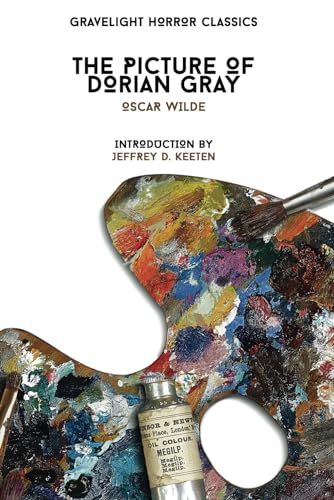
The Picture of Dorian Gray by Oscar Wilde, introduction by Jeffrey D. Keeten

book cover

There were moments when he looked on evil simply as a mode through which he could realize his conception of the beautiful.

“How sad it is! I shall grow old, and horrible, and dreadful. But this picture will remain always young. It will never be older than this particular day of June…. If it were only the other way! If it were I who was to be always young, and the picture that was to grow old! For that—for that—I would give everything! Yes, there is nothing in the whole world I would not give! I would give my soul for that!”

Be careful what you wish for.

description
Oscar Wilde – image from Wikipedia

Man sells soul to the devil in return for…something, in this case a body encased in eternal youth, while a portrait takes on the outward manifestation of his aging and his sins. It ends badly, as deals with the devil usually do. This is hardly a unique tale. In fact, it is a bit of a trope, a Faustian bargain. There is a lovely listing here of examples new and old. Absent, of course, is the most famous, and least successful example of a soul-selling, really more of a soul-buying, from Matthew 4:1-11, when the devil made Jesus an offer he actually could refuse. Don Corleone would have been very disappointed.

But it is a bit more complicated than that, as these things often are. It is always a challenge and an adventure to read a classic. Books become regarded as a base part of our culture for reasons. They can establish motifs, or ways of seeing the world that resonate with their contemporary audiences (well, not always) and future generations. They can offer us a portrait of a time and place, a culture, a class, a social or political issue. They can illuminate moral questions, deal in universal themes, offer insight into human motivation, whether individually or en masse. And we come to see them in particular ways. In The Strange Case of Dr. Jekyll and Mr. Hyde, the prior re-pub in this Gravelight series, what one finds in the original is not quite what one might expect, given how popular culture has transformed the story by bleaching out important nuance. That is less the case with Dorian Gray, at least in part because there appears to have been fewer iterations of the tale in popular entertainments. But, nonetheless, our understanding of the story is generally of the bare bones sort. There is plenty of flesh to give those bones some added heft.

description
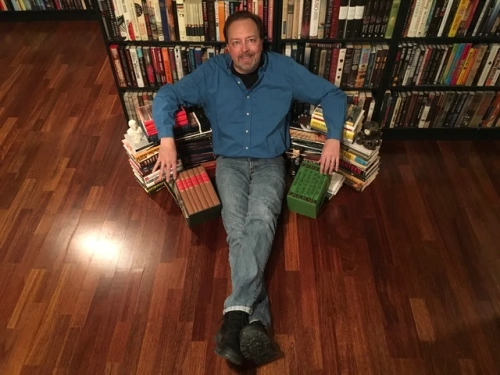
Jeffrey Keeten – they came to take his furniture, but the only way they will take his books is from his cold dead hands – image from his site

The history of a book matters. Keeten’s introduction offers an excellent take on how Dorian was received at publication. It generated quite a bit of attention on its release. There were many who were not amused. That may have contributed to the fact that The Picture of Dorian Gray is singular in being the sole novel published by Oscar Fingal O’Flahertie Wills Wilde. The subject matter was considered a big no-no in 1890. The Dorian of the title is a man of many tastes, and apparently insatiable appetites. He manages to bring ruin to both men and women. It was not, in particular, the ruination of women that caused a storm. The periodical in which it was first published was withdrawn from bookshops due to the outrage.

Wilde was a very popular writer of the time, wearing his sexuality like a badge. A tough stance to assume in a culture that preferred to sate it appetites and interests discretely. His novel was a shocker for the time in portraying homosexuality in interest, if hardly in action. The painter of Dorian’s portrait is clearly smitten with him, dazzled by his physical beauty, which he sees also as representative of an underlying perfection.

For all the shock of its homosexual content, there is no physical contact of that sort in the pages. (an earlier version may have been more direct) All is insinuation, suggestion, hinting. It is the same technique that has worked quite well for ages in the horror genre. Shadows, rattling chains, creaky doors, unsourced moans. Sometimes we are offered the shocker scene in which the monster is revealed. The Opera Phantom’s mask is pulled off to reveal the horror of his face. Hyde’s deformity is revealed as the window into Jekyll’s soul. And so it is here. Dorian’s true nature is revealed. The “I’m shocked, shocked” reaction of contemporary critics suggests more about what they were projecting onto the novel than what was actually there.

description
The portrait used in the 1945 film by Ivan Le Lorraine Albright – image from Wikipedia

So, what is the horror that is on display? It is the hedonism of the late 19th century English upper class, sashaying about in the interesting, entertaining, appealing drag of philosophy. Henry argues for the unashamedly sybaritic life. Art need have no meaning, no being other than itself. Apply to humans. Is art, is beauty the highest value? When beauty is left to dangle free, disconnected from any higher value, what is its impact on the world? Actions have no moral content. It is in fact a positive good to live a life dedicated to the primitive accumulation of sensation, through the arts, through physical pleasures, not just of sex, but of sight, smell, sound and touch, to experience beauty in all its forms. Try everything. Art for art’s sake in the guise of human experience. Some people have an amazing ability to come up with excuses for their excesses, explanations, some reason for why they shouldn’t be held accountable for their actions. Like the poor and taxes, we will always have the morally challenged, the malignant narcissists, the sociopaths with us.

beauty is a form of genius—is higher, indeed, than genius, as it needs no explanation. It is of the great facts of the world, like sunlight, or spring-time, or the reflection in dark waters of that silver shell we call the moon. It cannot be questioned. It has its divine right of sovereignty. It makes princes of those who have it. You smile? Ah! when you have lost it you won’t smile…. People say sometimes that beauty is only superficial. That may be so, but at least it is not so superficial as thought is. To me, beauty is the wonder of wonders. It is only shallow people who do not judge by appearances. The true mystery of the world is the visible, not the invisible….

But if this was on the up and up, there would have been no need to keep one’s behavior secret. It is clearly a place where freedom crosses the line into license. The practitioners of such a “philosophy” knew they were up to no good. They merely wanted to hide from the responsibility. Dr Jekyll was quite happy to have an alter-ego he could let loose on the world, to have the sorts of fun he could not have as himself in public view. They knew, not just that their behavior was wrong, not just that it ran afoul of extant mores, but that their reasoned explanation was taffeta thick.

description
Hurd Hatfield as Dorian in the 1945 film – image from Wikipedia

It is not the barely latent bisexuality of the novel that marks Dorian as fallen, it is that he had ruined peoples’ lives, men and women, not by having sex with them, (which is suggested, but never acted out on the pages) but by corrupting them in various ways, by causing them to become as self-centered, as pleasure-seeking as he was. A person can get away with this if he or she is wealthy enough. Paying off porn stars to keep quiet about an extramarital fling certainly fits into such a scenario. Dorian manages to keep his scandals at bay with the use of his wealth.

It is as true today as it was when Wilde was writing this book, the selfishness, the hedonism, the amorality of the wealthy feeds on the blood and life forces of those they exploit, few of whom can afford to fight back directly. (You go, E. Jean!) I imagine this is a core of what Wilde was getting at, and the real reason his critics were so angry at him.

Dorian does not come to his corruption unaided. He arrives as a beautiful young man, who is seen as being as pristine inside as he is on the surface. The Victorians were very concerned with exteriors, believing that they served as personal screens displaying to the world a person’s character. But then he is introduced to Lord Henry Wotton. Henry proceeds to emit a torrent of nonsense, albeit amusing nonsense, mocking the morals of the time. Wilde, speaking through Henry, is cattier than my living room when I shake a container of treats. Henry offers a torrent of false, cynical aphorisms, suitable material to be printed on small pieces of paper and tucked inside poisoned fortune cookies. Were he opining today, Henry would be posting outrageous clickbait opinions on Twitter. Here are a few examples. They are legion, and will sound familiar in tone to characters from Wilde’s 1895 theatrical triumph, The Importance of Being Earnest

…beauty, real beauty, ends where an intellectual expression begins. Intellect is in itself a mode of exaggeration, and destroys the harmony of any face. The moment one sits down to think, one becomes all nose, or all forehead, or something horrid.

…the one charm of marriage is that it makes a life of deception absolutely necessary for both parties. I never know where my wife is, and my wife never knows what I am doing. When we meet-we do meet occasionally, when we dine out together or go down to the Duke’s—we tell each other the most absurd stories with the most serious faces.

…as for believing things, I can believe anything, provided that it is quite incredible.

It is the cynical Henry who finds in the gullible Dorian the raw material with which to cast the young man into a representative of his very hedonistic view of life. Dorian offers the plasticity of the young to the dubious molding of the amoral. The young man is all ears. He even takes time away from the painter, Basil Hallward, to learn at Wotton’s feet. .

To a large extent the lad was his own creation. He had made him premature. That was something. Ordinary people waited till life disclosed to them its secrets, but to the few, to the elect, the mysteries of life were revealed before the veil was drawn away. Sometimes this was the effect of art, and chiefly of the art of literature, which dealt immediately with the passions and the intellect. But now and then a complex personality took the place and assumed the office of art, was indeed, in its way, a real work of art, life having its elaborate masterpieces, just as poetry has, or sculpture, or painting.

We are offered a bit of background on Dorian, to help explain his vulnerability to Lord Henry’s dark influence. And are even given a bit of theatrical brimstone to explain how the deal with the devil is achieved. Neither really matters much.

description
Angela Lansbury as Sibyl Vane in the 1945 film – image from Wikipedia

Early on, Dorian is smitten with a beautiful young actress, Sibyl Vane, who considers him her Prince Charming. It is Sibyl’s appearance, her elevated acting performances, in addition to her beauty, that attracts Dorian. But when her dazzling talent on stage suddenly vanishes, she can no longer offer Dorian the thing he most admired, and he dumps her, cruelly. It is the first crime to which we are witness, the first time his painting changes. The pursuit of beauty and sensation above all else has claimed its first victim. There will be many more, but most of those bad behaviors take place off screen.

Wilde put all of himself into this novel

“Basil Hallward is what I think I am: Lord Henry is what the world thinks me: Dorian what I would like to be.”

Unlike Lord Henry and Basil Hallward though, Wilde acted on his urges. Unlike Dorian, Wilde was imprisoned for his actions. Unlike Henry’s and Dorian’s depraved indifference to the harm they caused others, it is not clear that Wilde was a cruel person.

Dorian is clearly a corrupt individual. Whether he arrived there unaided or had a push is of secondary importance. Lord Henry is clearly corrupt as well, even though we do not see him engage in any physical acts of treachery. Perhaps the corruption of youth, pulling Luke Dorian to the dark side is enough. Henry and Dorian both represent the worst of the amorality of the Victorian age, the hypocrisy of the upper class. This seems the true target of Wilde’s effort. He is not celebrating amorality, but pointing an accusing finger at it, and letting us know who are its most damaging practitioners. At one point Dorian even shows enough residual humanity to want to turn over a new leaf, not appreciating that to succeed he would need to upend an entire forest. (don’t write. I know that the leaf in question was supposed to mean a book page.)

Keeten goes into some detail on the derivation of the name Dorian Gray. Why not Loki? There are very concrete reasons. In fact, there is a lot you will enjoy learning when you check out his introduction. It is rich with detail about the author, the book, and the controversy that surrounded its publication. It also looks at the lasting impact Wilde has had on modern culture. It will definitely increase your appreciation of this wonderful novel.

I suppose there might be a modern version in which Gray and his portrait are linked by quantum entanglement, or one should be made if it does not already exist. The battle between inner self and outer manifestation is certainly an eternal literary theme.

For the second time, a sojourn down the Gravelight illuminated alley of classic horror has proved stimulating and enlightening. From Keeten’s smart, incisive introduction to the chance to see what the original of a household-name classic was really on about, The Picture of Dorian Gray offers a richly rewarding reading experience, clever, funny, dark, shocking, intelligent, satirical, and satisfying.

There were moments when he looked on evil simply as a mode through which he could realize his conception of the beautiful.

Review posted – 02/23/24

Publication date – 11/6/23

I received copy of The Picture of Dorian Gray from Gravelight Press in return for a fair review. Thanks, folks.

This review is cross-posted on my site, Goodreads. Stop by and say Hi!

=======================================EXTRA STUFF

Links to Keeten’s personal, FB, and Instagram pages

Prior reviews for books intro’d by Jeffrey Keeten
—– Exhumed: 13 Tales Too Terrifying to Stay Dead – edited by David Yurkovich
—– The Strange Case of Dr. Jekyll and Mr. Hyde – edited by David Yurkovich

Items of Interest
—–Les Cent Nouvelles – a book of coarse French stories referenced in Chapter 4
—–Margaret of Valois
—–Manon Lescaut – an 18th C. novel in which young lovers live a life of sexual and social freedom, while giving morality little thought – referenced in chapter 4
—–The St. James’s Gazette – referenced in chapter 10
—–Elephantis – author of a sex manual in Classical Greece – noted in Chapter 11
—–Against Nature by Joris-Karl Huysmans – cited in the introduction – Dorian’s reading of this 1884 celebration of sensory gluttony contributes to his corruption
—–Wiki Deals with the devil in popular culture

2 Comments

Filed under classics, Fantasy, Fiction, Historical Fiction, Horror, Literary Fiction, Reviews

The Hive and the Honey by Paul Yoon

book cover

Come. I want to show you something. I learned it from the missionary. We haven’t seen him in a while, yes?…I retrieve my teacup where there is a little honey left, and I walk toward the perimeter of the woods and hold it up. I hear her coming up behind me, the slow rustle of her skirt in the grass, but I don’t turn.
A few minutes later, a bee appears, hovering, circling, then dips into the cup. Then it flies away into the woods. I follow it. She follows me. When I can’t see it anymore or hear it anymore, I stand still and hold up the cup and wait for the bee to come back. Which it does. So we move on, and as we head farther into the woods, I tell the daughter that it is a trick I learned from the missionary. We’re creating a trail.
“To the hive,” I say. “And the honey.”

In The Hive and the Honey Paul Yoon returns to areas that readers of his earlier work will recognize. This is his third story collection, following Once the Shore (2009) and The Mountain (2017). He has published two novels as well, Snow Hunters (2013) and Run Me To Earth (2020). He treats often in themes of Korean diaspora, losing a sense of home, trying to build new families and communities, feeling alone, often being alone, the impact of history on one’s lived experience, and the impacts of war. That holds here.

I can’t speak to a unifying Korean identity, but I think, growing up, because I had very little access to an extended family, I was often searching for my own version of that. And I think all my characters are searching for their own version of family. They’re quite literally and figuratively orphans. And they want to rebuild. They want to find a home in all sense of that word. – from the Pen-Ten Interview

There are seven stories in the collection, ranging from 17th century Japan to 20th century New York. The age of the primary characters covers a wide range. One lead is 16, others are in their 20s, returning from war or prison, or still in uniform. There is a couple in their forties and we see one life across decades.

description
Paul Yoon – image from Interlocutor – shot by Paul Yoon

A persistent challenge is to make a home. In Bosun, Bo tries to find a home and family in a small upstate NY town. In At The Post Station, Two samurai must repatriate a 12yo Korean boy to officials from his country. Toshio, the samurai who has been raising his young charge for many years, must face this direct loss of family. The boy must face introduction to an entirely alien culture. Cromer offers a middle-aged London shop-keeper couple, both children of North Korean refugees, who had opted to never have children of their own. But when a 12 yo apparently- battered runaway boy turns up in their shop, many miles from home, it makes them face the insular, child-free lives they had chosen, the community they had not built, the family they had not made. In The Valley of the Moon a man returns from a settlement to his isolated family farm after The Korean War. It is a moonscape, littered with bones and craters. He slowly but steadily brings the farm back. He even takes in two orphans to make a proto-family, but the damage from the war, and from an act he commits before the kids arrived, haunts him for the rest of his life.

Biological families here are all dispersed, or worse. Characters are often stuck on their own. Relations in other places are unreachable, unresponsive, or dead. Some of the impetus for the collection was Yoon’s own familial diaspora.

My grandfather was a Korean War refugee who eventually, after the war, settled in a house in the mountains in South Korea. Where he lived wasn’t nearly as isolated as the setting of “Valley of the Moon,” but my memory of him was that he was—or had become after the war—a bit of a loner, someone who kept to himself, and so I think (a) the character of Tongsu and where he returns to was always linked from the start, and (b) that initial push forward into this story stemmed from wanting to create and capture, perhaps, some corner of family history that felt, and still feels, really distant to me—to engage with that distance, creatively, and to engage with him and with so many others of that generation who had to flee their homes and do anything they could to survive during those horrific years. – from the New Yorker interview

Yoon’s characters also travel far afield. Bosun came to the USA at 18. In Komarov, a Korean cleaning woman is living in Spain. At the Post Station features a boy who was held prisoner by Japan for his entire life and will now be faced with living in an alien culture in Korea. In Cromer, the parents of the couple living in London all escaped from North Korea, and a young Korean boy flees apparent physical abuse. In The Hive and the Honey, the community over which the young soldier watches is comprised of Koreans who had left Korea and were establishing a small community in eastern Russia. In Person of Korea, the lead’s father had taken work far from home and had become unreachable. Families that remain (the survivors) are severely depleted, family trees having been pruned to stumps or worse by war and dispersion. Holding on even to images of one’s past can become a challenge.

Bo thought he would eventually miss Queens or perhaps even South Korea, where he had spent the first eighteen years of his life, but as the months went on, they were like the faces he tried to recall: far away, as though the places he’d once lived had been homes to someone else.

But for all the travails, the challenges, there is an intrepid spirit at work that pushes them onward. How easy would it have been for the farmer to simply walk away from his devastated fields? For the convict to have given up hope?

The use of imagery is exquisite, illuminating themes, showing how the past impacts, intercedes in, and informs the present.

Every night, the moon rose from here, and fell, and shattered. And then built itself back up again.

This certainly stands in well for the challenge of all these characters, forced as they are to reconstruct lives after the world has caused them so much disruption. The quote at the top of this review offers another wonderful image. Luring bees with honey then following them back to their nest, taking the steps one can take, however many may be needed, to reach your goal, whether the location of a hive, a home, or something else. A tree grows through the skull of a corpse, offering a (perhaps grim) reminder that life continues, creating a future by feeding on the past.

These are very moving tales, as rich with hope, tenacity, and sweetness as they are with loss, disappointment, and sadness, personal tales told against a backdrop of a nation’s history. The Hive and the Honey is an outstanding literary short-story collection, well deserving of all the award buzz it has been receiving. What could be sweeter?

economic reasons.”During the pandemic, Yoon says, “we were all scattered. I was separated from friends and to cope I imagined a kind of map. We were all in different places, but we were all part of one world. That got me thinking about the family tree, thinking of that as a map as well. This was the seed of the collection: the movement of a country and its people.” – from the Louisa Ermelino PW interview

THE STORIES

Bosun – a Korean man, just released from an upstate New York prison, tris to make a life for himself in a small community nearby.

Komarov – A refugee from North Korea is working as a cleaner in Spain when she is approached by Korean agents to spy on a Russian boxer they believe to be her son.

At the Post Station – Two 17th C. samurai accompany a Korean boy, who had been held hostage all his life, to Korean officials who will take him home.

Cromer – The children of escaped North Koreans, a middle-aged couple in London consider their life choices when a 12yo runaway boy happens into their convenience store.

The Hive and the Honey – A young Russian soldier is charged with overseeing a Korean settlement in remote eastern Russia. Things get out of hand when there is a killing, then another.

Person of Korea – When the uncle with whom he had been living dies, a 16yo boy travels to find his father, a security guard on an island off the east coast of Russia.

Valley of the Moon – two years after the Korean War a man returns home to a devastated, vacated farm, and tries to bring it back to life. He takes in two orphans and has a difficult, life-changing encounter with someone looking to cross the border.

Review posted – 02/09/24

Publication date – 10/10/23

I received an ARE of The Hive and the Honey from Simon & Schuster in return for a fair review. Thanks, folks, and thanks to NetGalley for facilitating.

This review is cross-posted on my site, Goodreads. Stop by and say Hi!

=======================================EXTRA STUFF

Paul Yoon’s personal site

Profile – from Wiki

Paul Yoon (born 1980) is an American fiction writer. In 2010 The National Book Foundation named him a 5 Under 35 honoree.

Early life and education
Yoon’s grandfather was a North Korean refugee who resettled in South Korea, where he later founded an orphanage. Yoon graduated from Phillips Exeter Academy in 1998 and Wesleyan University in 2002.

Career
His first book, Once the Shore, was selected as a New York Times Notable Book; a Los Angeles Times, San Francisco Chronicle, Publishers Weekly, and Minneapolis Star Tribune Best Book of the Year; and a National Public Radio Best Debut of the Year. His work has appeared in the PEN/O. Henry Prize Stories collection, and he is the recipient of a 5 under 35 Award from the National Book Foundation. His novel, Snow Hunters, won the 2014 New York Public Library Young Lions Fiction Award. His 2023 story collection, The Hive and the Honey, was named a finalist for The Story Prize.
Recently a part of the faculty of the Bennington Writing Seminars, Yoon is now a Briggs-Copeland lecturer at Harvard University.

Interviews
—–Publishers Weekly – In Seven Stories, Paul Yoon’s New Book Spans 500 Years of Korean Diaspora By Louisa Ermelino | Jul 07, 2023
—–The Pen-Ten Interview – Paul Yoon | The PEN Ten Interview by Sabir Sultan – October 12, 2023
—–The New Yorker – Paul Yoon on the Korean War’s Aftershocks by Cressida Leyshon – about Valley of the Moon
—–Publisher’s Weekly – Paul Yoon’s Haunted Geographies by Conner Reed
—–LitHub – Writing as Transformation: Who Paul Yoon Needed to Become to Finish His Book by Laura van den Berg (Yoon’s wife)

Leave a comment

Filed under Fiction, Historical Fiction, Literary Fiction, Short Stories