Yearly Archives: 2013

The Wind is not a River by Brian Payton

book cover

The Aleutian Archipelago: fourteen large and fifty-five small volcanic islands, strung over more than a thousand miles. Somewhere there, he’s alive. On good days, her faith overshadows doubt. And what is faith but belief independent of proof, a conviction that stands on its own. To this she knows John would roll his eyes. The thought makes her smile.

John Easley is missing. Shaken by the death of his RCAF brother over the English Channel, the 38-year-old writer determines to bring information to the people at home about what is really happening in the war. It seems so much more meaningful to him than reporting on bird migration for National Geographic. He feels he owes Warren at least that much. His wife, Helen, disagrees. Their last words before he took off yet again on a war-reporting mission were harsh, and final.

She is facing challenges of her own. Her father is not well, and she wants to be there for him. She is struggling with not having much by way of work skills and is stuck at a low-level job. John’s absence gnaws at her until, realizing that she still loves him, she decides to do everything in her power to find and bring him home. John had bailed out from a damaged aircraft over the Japanese occupied island of Attu. He struggles to survive in the treeless tundra. Helen struggles to find him.

book cover

Brian Payton – from his site

The story flips back and forth between the challenges John and Helen face. John has to figure out how to stay alive, and hidden from the occupying army. I was reminded of David Malouf’s excellent book, An Imaginary Life , about another person isolated in an arctic realm. Helen must figure out how to find John. Both face daunting tasks.

The Wind is a powerful, beautifully written, heart-wrenching love story, but sails well past any simple notions of romance. There is struggle here with the imagined instead of the actual partner. Does there come a time when imagination, whether fed by love or not, loses its sharp focus? How can love survive absence of the other? How far can love take a person when the odds are overwhelmingly against? Can love keep someone alive?

In addition to the compelling tale of a reverse Odyssey, one in which Penelope goes in search of Ulysses, Payton offers us considerable payload in his look at a little-seen part of WW II history. For those who thought that the last time the USA endured the landing of foreign troops was during the War of 1812, you have another think coming. Japan captured and occupied several of the Aleutian islands, and had plans to advance farther. News media of the time was subject to government censorship and the political leaders did not want it known that a foreign power had successfully invaded US territory. We are given a look at a remote and challenging aspect of the war. Along those lines Payton drops in bits of information. For instance, because the land was challenging as a place on which to build strong flat surfaces, a runway was constructed of metal matting cinched together. Another scene shows Americans dropping off planes for Soviet pilots to fly back to the USSR and use in the war on Hitler. We also get a look at the USO,

USO in the Aleutians
The USO sees action – from strangemilitary.com

and, chillingly, the treatment of local evacuees by the US military. So, food for the brain as well as the heart.

As for gripes, I have two. While the cover art is beautiful, it fails to let the reader know what this book is all about, focusing as it does on a single early moment in the story, and ignoring what follows. I was not all that thrilled with the ending. But that did not detract from the great joy that can be had reading this book. Your heart will get quite a workout. John Easley, a decent guy, is engaged in a prolonged life-and-death struggle, and Helen’s love takes on heroic dimensions. There is a large range of emotion from which to draw here. Uplift to be experienced, delight in beauty of various sorts, appreciation for the sacrifices of some, anger, sadness and disappointment as well. Bring your hankies. The love that Brian Payton portrays glows even brighter against the spare environment in which it is set.

Publication Date is January 7, 2014

Review posted 12/16/13

=======================================EXTRA STUFF

Links to the author’s personal, Twitter and FB pages

The American Booksellers Association named the Wind is not the River a January ’14 Next List pick

Mention is made in the book about John Huston making a documentary of the military campaign in the Aleutians. Here is the film, Report from the Aleutians. It clocks in at 43:13.

A shorter (17:26), color version can be found here

Here is a map of the Aleutians that seemed too tough to read to fit the image into the body of the review

The National Park Service also has some interesting information about the Aleutians here

Leave a comment

Filed under Fiction, Literary Fiction, Reviews

Astoria by Peter Stark

book cover

Astoria is a tale of two journeys. It is an adventure of the highest order, and with Peter Stark as your guide, it is one of the best non-fiction books you will read for a very long time.

In 1803, the Louisiana Purchase had brought the young United States all the land draining into the Mississippi (at least according to our side of the story). The President wanted to know all he could about what he had bought, particularly as there were still some disagreements going on over the breadth of the purchase. Thus the Lewis and Clarke Expedition, in 1804, and the later Red River Expedition and Pike Expedition provided Jefferson the information about this new land he needed to negotiate with France, and others. But what lay beyond? Opportunity, resources, and vast swaths of land.

description
Peter Stark – image taken from Random House

In the early 1800s, John Jacob Astor was one of the richest men of his time. He had made a fortune trading North American furs in Europe, and had begun trading with China as well. What he had in mind was to take advantage of the fur resources of the Northwest and establish a triangle trade. Northwest furs to the Orient, porcelain from China to London and New York and other goods from there back to the Northwest. His aim was to monopolize trading on the Pacific Rim, at a time when Lewis and Clark had been across the country only a few years prior. He involved Jefferson, who also had a more global vision than other men of the day. The Northwest was unclaimed by westerners, (no thought was given, per usual, to the native people who were actually living there) and was considered available for the taking. For Astor it was to be a base for establishing a trade monopoly. Jefferson saw an opportunity to spread democracy to the west coast, and encouraged Astor. To accomplish his aim, it would be necessary for Astor to establish a base of operations. He decided on the area near the mouth of the Columbia River. He put together two groups of men to reach the spot, one to travel by sea the other to cross the continent by land. It is their adventures that form the bulk of the story, and what a story it is.

Were this a novel, the dueling road trips would both be tales of self-discovery. This is a case where reality exceeds fiction. The character of many of the travelers is revealed in how they handle the extreme stresses to which they are subjected. Following the development, or revelation of their characters, for good or ill, is one of the great pleasures to be had in reading Astoria.

The ship Astor sent was the Tonquin, a 290 ton bark. He selected as its captain the young (31) US Navy lieutenant Jonathan Thorn. Thorn had been a military hero, serving with distinction in the Barbary Wars, and Astor wanted someone who could fend off potential attacks. Our friends across the pond, engaged in a tiff with Napoleon, had taken to stopping vessels in international waters and shanghaiing sailors or passengers who were British subjects to fight the French. Rule Britannia was not being sung by the crews of American-flag ships. This aquatic stop-and-frisk imposition would be one of the causes of the War of 1812.

description
An engraving of the Tonquin at the entrance to the Columbia, from the Oregon historical Society

While the captain was the right sort for dealing with a military crew and worked well within the rigid specifications of a military regimen, he was not so adept at controlling a crew that was not exactly military, and most of whom were not even American citizens. Also aboard were shareholders in Astor’s company, a dozen clerks, four tradesmen and a baker’s dozen rough and tumble voyageurs from what is now Canada. He also had a lot to learn about dealing with locals and trade negotiating. The ship was challenged to endure near continual onslaught, whether from the elements, a pursuing ship, or the captain’s personality. He got along so well with the crew that they took to speaking with each other in their native tongues, which Thorn did not speak. And more than once he intentionally set sail while tardy returnees were still on land. His rigidity made for a dark passage. And his sometimes cavalier attitude towards the survival of his own men is breathtaking. He might be charged with depraved indifference today. Along with a certain Captain Queeg, I was reminded of a scene from Monty Python and the Holy Grail . Consider here Thorn as the king (although Arthur seems quite a bit less rigid) and the castle residents as his crew.

The Overland Party was led by Wilson Price Hunt, a young (27) businessman who had worked with fur-traders in St Louis. A polar opposite to Thorn, Hunt was someone who sought, above all else, to construct consensus. The Overland group did not exactly have a roadmap to their destination. The route they took followed in the footsteps of Lewis and Clark for a time, but they had to carve a new trail at a certain point, into completely unknown and not terribly welcoming territory.

description
Despite the term Overland, much of the Overland Party’s travel was done by water, on rivers. This is the sort of conveyance the Voyageurs were accustomed to paddling – the image is from the Canadian Encyclopedia

Far too much of their river time was spent in water of this sort.
description
From the Susquehanna Chapter of the Wooden Canoe Heritage Association

In a blog entry on Stark’s site, he writes

The big Montreal freight canoes could be as long as 40 feet, yet made of lightweight birchbark, and capable of carrying three or four tons of supplies or furs, propelled by ten or twelve voyageurs.

It is amazing how many times the Overland Party was assisted by Native Americans. But there were also plenty of locals who were not exactly happy to see them. How the Overland group interact with the natives they encounter is a significant element of the story. How they survived, (or didn’t) is the stuff of adventure yarns. How Hunt herded his pack of cats (and sometimes didn’t) is very impressive.

This was definitely not a crew to belong to if you walked on four limbs. Resources became extremely scarce, and desperate measures had to be taken. There is even a hint that starving sojourners might have partaken of the special meat.

Some characters stand out here. My favorite is Marie Dorian, a native woman who had married a Metis named Pierre. He dragged her along on the Overland trek, along with her two small (2 and 4 year old) children even thought she was pregnant at the time. Hers is a particularly poignant profile in courage and endurance. There are a few legendary names that folks in this tale encounter, including Sacagawea and Daniel Boone.

The story is the thing here, and focus remains on the travails of the travelers. But there are also excellent, informative asides, relevant to the tale, about various and sundry things. One tells why sea otter pelts are so highly valued. Another looks into the societal composition of some native groups, looking at their sources of wealth and social organization. Consideration is given to how the locals react to newcomers, and why, citing past experiences. There is also ongoing consideration for the impact on the enterprise of potential and then kinetic British-US hostilities.

We know today that the nation did indeed expand to the West Coast, but the details are plenty soft in your recollections, I will wager. It might not even be that you (or I) forgot, but that we never really knew. Astoria offers an excellent way to mend that hole. It will excite you in the process. This is real-life adventuring, life and death on the line, people you will admire and scoundrels who will make you want to hiss. What a fun read, and what an informative book. It may or may not be a far, far better read than you have ever had before, but I cannot urge you strongly enough to climb, trek, paddle or sail to your nearest book-trading post. This journey to Astoria is very definitely a trip worth taking.

PS – the volume I worked from was an ARE, so did not have all the materials expected to be in the final hardcover edition. Spaces were left for illustrations but I did not get to see those. One thing I did see is that there is a very helpful Cast of Characters section at the front of the book, and another at the back called The Fate of the Astorians, which I thought was pretty cool.

Astoria will be released in March 2014

=======================================EXTRA STUFF

Peter Stark’s site

Here is a link to the Wiki entry for the Tonquin – but if you have not yet read the book, be warned that there is very spoilerish info there.

Although I expect the physique of this re-enactor might not match the bulkier torsos of actual voyageurs, this might give you an idea of what was considered proper attire for the proud paddlers
description
So there it is. I was wondering what had happened to that shirt. For more on voyageurs check out this piece from McGill University

Astor could not have suspected that Astoria would become a familiar site in many films. Here is a list of a bunch. It includes The Goonies, Short Circuit, Kindergarten Cop, The Black Stallion and plenty more.

John Day was a member of the Overland Party. He does run into a bit of trouble at the mouth of what was then the Mah-hah River, along the Columbia. It was later renamed for him. A geologically notable site through which that river wanders was also named for him. Day himself was never near there. I have had the pleasure and there are a few shots in my Northwest set on Flickr that offer a glimpse of the striking landscape.

The National Park Service site for John Day NP is definitely worth a look

Among the places the Overland Party encountered, one that held great hope for them was seeing one particular Mountain chain.

The three mountains were hailed by the travelers, Wilson Price Hunt, weighted by his Yankee reserve and need for geographic grounding in this unmapped wilderness, called them the Pilot Knobs. The buoyant French-Canadian voyageurs called them as they saw them, the Trois Tetons,–“the three breasts”. It’s the voyageurs’ name, which has stuck for these mountains that tower above today’s Jackson Hole, Wyoming.

Tetons 831
Grand indeed

Also, that image I use as my GR avatar to spare you the crypt-worthy image of my ancient puss is from the Tetons as well.

Today’s city of Astoria, Oregon has a nice site

Sadly, while I have been to Astoria, and even visited its Astor Column, it was while my wife and I were in a bit of a rush, heading back to our temporary camp in Portland from a trip to the coast. Did not get there until far too late in the day to get any decent photographs. Then, assisted by considerable fog, we inadvertently took a scenic route that featured a seemingly endless series of blind turns, and was inhabited by large numbers of bulky four-legged creatures standing in the middle of the road and appearing only moments before impact…well, in my white-knuckled imagination, anyway. Having read the book, I would dearly love to return to Astoria, in daylight, and have much more of a clue than I had then what it was all about.

3 Comments

Filed under Reviews

Eels by James Prosek

book coverYeah I know, there are two reactions to the notion of eels. First there is fear when one thinks of large, oceanic moray eels popping up out of some hidden coral niche to snatch a chunk out of your leg as you swim by. Second is “eeewww.” This is for the slippery guys who inhabit rivers, streams and extreme restaurants. Get over it.

description
James Prosek – from NPR

James Prosek’s Eels is a fascinating look at an unappreciated creature. Did you know that scads of eels migrate from freshwater streams and rivers to mid-ocean to spawn? The location of the Pacific spawning ground is still unknown, (or at least unrevealed) but they head for the Sargasso Sea in the Atlantic. The author attempted to keep eels once, but their wanderlust resulted in them damaging themselves trying to escape. The urge to get back to the sea can also result in the major YouTube wet dream of giant eel balls (no, Beavis, not oversized fish nads, but masses of intertwined critters, cavorting in a movable orgy) rolling their way over dry land to get to the ocean. It is probably a good idea to step aside.

description
from fishermensvoice.com

Prosek offers wonderful profiles of people for whom the eel is a major part of their lives, scientists, eelers, eco-warriers, South Sea Islanders. Ray Turner is a back-woods sort in Pennsylvania who makes a living as an eeler from a year’s worth of work and a few nights of harvest. A large part of the book looks at the significance of the eel in Maori culture. This is quite eye-opening. Think buffalo and Plains Indians. He writes also of how the Japanese regard the eel and manages to find a flight to the very remote Micronesian island of Pohnpei, mentioned to him by a few of the people he interviewed for the book. It is a place of great significance in eel legend. Eels are reputed to be able to make sounds like barking dogs and crying babies, and are ascribed magical powers beyond that. Way cool. He also looks at the activities of conservationists who are trying to spare these remarkable creatures from extinction.

description
a Moray eel from howstuffworks.com – not just another pretty face

Catches of eels are plummeting worldwide, the result of dams, overfishing, and the usual human fouling of natural waterways, increasing the need for information about the eel life-cycle so that this important fish (yes, eels are fish) can be preserved.

Prosek’s book is, in short, great fun. By the time I finished I could honestly say, “I’ve been slimed,” but in a good way. This book was released in 2009. It is definitely worth your while trying to locate a copy and when you do, don’t let your chance to learn about these fascinating creatures slip away.

Review posted on GR in June 2010 – updated December 2013

=======================================EXTRA STUFF

Prosek’s web site

There is a video on PBS featuring Prosek, The Mystery of Eels that is definitely worth a look, although it is refreshing to see that there is something that this renaissance man, (yeah, he plays music too, in addition to being an accomplished artist and scientist) is not great at, voice-overs. The content and visuals more than make up for Prosek’s stolid delivery.

12/3/13 – Gillian Anderson, in full eel attire, promoting conservation – must see

2 Comments

Filed under Non-fiction, Reviews, Science and Nature

Catching Fire by Suzanne Collins

book coverSparks fly in the second volume of Suzanne Collins’ blockbuster Hunger Games trilogy, Catching Fire. Victory in the 74th games has not been all that sweet for surprise double-victors Katniss Everdeen and Peeta Mellark. And it is extremely sour for the reigning government. Katniss had shown them up big time when she publicly defied the gamemasters to keep from having to kill Peeta, an act of sedition as much as it was an act of courage and honor. President Snow burns with rage at Katniss for showing up the games, the Capitol, and him personally. He recognizes that it is necessary to give the subjects of his government some hope, but Katniss and Peeta have provided a spark to the tinder of popular resentment, and Snow needs to forestall a conflagration.

description
The author

Katniss is not in a good place back in District 12 after the games. Yeah, she has a nifty new house in the victor village, and her family is well taken care of, but she is experiencing a fair bit of PTSD. Collins describes Kat the victor.

She has nightmares. She has flashbacks. And in the beginning you can see she’s practicing avoidance. She’s completely pushed Peeta to arm’s length, you know? She’s trying to stay away from him. Why? Because everything associated with him except some very early childhood memories are associated with the Games. She’s conflicted to some degree about her relationship with Prim because she couldn’t save Rue. So she’s dealing with all that, and her method of dealing with it is to go to the woods and be alone and keep all of that as far away as possible, because there just are so many triggers in her everyday life. – from the Time interview

Part of the requirement for games winners is to go on a Victory Tour across all the districts. One of the soft spots in the logic of the story is that President Snow would think for a second that parading across the defeated districts the youngsters who had killed their children was anything but a guaranteed recipe for disaster. It is believed that Katniss’ popularity and selling the lie of her death-defying love for Peeta would gain some love for the Capitol, and would dampen public unrest. Sure, whatever. Of course, Katniss manages to fan the flames of the people’s unhappiness with things as they are by her acts of kindness and respect for some of her fallen competitors and their families. As her popularity grows, the pin she wore in the 74th games, the mockingjay, spreads as a symbol of resistance. I am sure Emily Dickenson would approve. Time for Plan B.

description

With his hopes for a palliative Victory Tour in ashes, Snow come up with another plan. How better to douse the embers of hope than to destroy all those who would fan the flame. So, for the 75th games, instead of a new crop of potential contestants, children between 12 and 18, from whom game contestants might be selected, he decrees that this time the tributes (those selected) will be chosen from the pool of prior winners. Hell-uh-oh, Kat and Peet, this means you-oo. Hell hath no fury like a president scorned. There is no law, only power, and Snow aims to char those caught, or even suspected, of playing with matches. And if crushing the Hunger Games victors from all twelve districts crushes the rebellious spirit of the people, well, may the odds be ever in your favor. Of course, we all know there is a third volume in the series, so I am giving nothing up by reporting that the plan goes up in smoke.

description

There are many notions in play in Catching Fire, among them visions from the classical world of Greece and Rome. The whole notion of the games was taken from the Greek myth of Theseus and the Minotaur. King Minos of Crete had issues with Athens. There are varying accounts of how this came to be, but the accounts agree on the arrangement that was made. Athens was forced to send seven boys and seven girls to Crete every nine years to make a nice snack for a Minotaur, who resided in a labyrinth constructed by Daedelus. The kids are sent, but Theseus, an Athenian prince, wanted to get rid of the Minotaur, and thus the need for kid-burger specials, and so inserts himself in place of one of the young’uns. He gets some help from Cretan princess Ariadne, who offers a way for the children to escape the Minotaur’s maze after Theseus, hopefully, dispatches the beast. Her solution is significant here, beyond the classic story, as the unraveling of string, of a sort, figures large in Catching Fire in helping out the tributes.

Katniss Everdeen grew from a raw teen in Book I to become a warrior. She grows stronger still in Book II, overcoming her fears and miseries, growing in strength, even while accepting that her fate was likely sealed. She is a gladiator, thrown into an arena to do battle for the pleasure and control of the rulers. And another classical notion comes in here, the slave warrior leading a rebellion. Katniss, by defying the Capitol in Book I and by her actions this time, has become the face of popular resistance, whether potential or kinetic.

There are contemporary issues that resonate as well. Collins said:

The Hunger Games is a reality television program. An extreme one, but that’s what it is. And while I think some of those shows can succeed on different levels, there’s also the voyeuristic thrill, watching people being humiliated or brought to tears or suffering physically. And that’s what I find very disturbing. There’s this potential for desensitizing the audience so that when they see real tragedy playing out on the news, it doesn’t have the impact it should. It all just blurs into one program. – from Scholastic article

And it is not exactly news that we are increasingly living in a world in which the one-percenters get to live lives of obscene luxury while working people are denied basic rights. The ancient Roman practice of eating to excess, then using a vomitorium to make room for even more indulgence is brought up in Collins’ vision as a very telling link between decadence old and new.

And then there is the romantic element. Peeta is a wonderful guy, pure soul, gifted communicator, smart, strong as an ox, loves her, but, while she may find him attractive as a friend, does she find him attractive enough to throw over her childhood sweetheart, Gale? The pressure is unspeakable as the President, in order to save his own face, is insisting that she and Peeta make good on their cover story from their first game together. At the end of the 74th, Katniss had threatened pairs-suicide if the rulers insisted on having a single winner, and she prevailed. But the Capitol sold it as a manifestation of her love for Peeta, while the reality had been that she had stood up against the Capitol rulers. She agreed to help sell the lie after the games in order to keep bad things from happening to her family. Peeta and Katniss have to cope with the public lie of their being a couple, but must also contend with the fact that they really are very fond of each other. Add in another hottie in the shape of the studly Finnick Odair (a tribute in the 75th) and the potential for emotional imbalance is considerable.

Some of Collins’ secondary characters get to spread their wings a bit, most particularly the District 12 mentor, Haymitch Abernathy, who gets to do a lot but much of his activity is told after the fact rather than shown. The president, Coriolanus Snow, gets to strut and fret his hour upon the stage, issuing threats mostly. I expect it is no accident that the president’s given name is the same as that of a Roman consul notorious for his low opinion of the ruled.

Ok, I really enjoyed this book. I do have one gripe, though. Really, you knew there would have to be one. The Hunger Games story is really one long tale, and in order to keep from having to sell the book with its own set of wheels so you can tote it around, the publisher has divided it, like all Gaul, into three parts. (Unlike the greedy film makers who are taking it a step further and making four films out of a trilogy) And while it may make sense for this volume to have ended where it did, it seemed to me that it went from full on action to see ya next time in an awful hurry. That’s it. That’s my gripe. I had originally intended to make this a four-star rating, but on further consideration, in light of what Collins has done in terms of looking at real issues in a serious way, while offering top-notch entertainment, bringing in cultural foundations, and for making me root for a teenager to do something other than get a bad case of zits or run afoul of a serial killer, I am upping it to five. Catching Fire sizzles.

=======================================EXTRA STUFF

An excellent cheat sheet to catch you up on what happened in the first book

An interview on Scholastic.com

Neat bit on Theseus and the Minotaur in an SC interview in the School Library Journal

The five part Time interview

Part 1
Part 2
Part 3
Part 4
Part 5

SC’s site


2 Comments

Filed under Fiction, Literary Fiction, Reviews, YA and kids

Bird Box by Josh Malerman

book cover

Close your eyes and imagine the basso sound of voiceover icon Don LaFontaine intoning, “In a world gone mad…” and that is pretty much where Bird Box begins. Open your eyes and go mad. Kill others, yourself. Can you keep from peeking? For how long? In Josh Malerman’s post-apocalyptic, eye-opening scare-scape, something happened. An invasion? Some natural phenomenon? No one is really certain. But what has become clear is that anyone who steps outside with their eyes open goes insane, not just gibbering or confused, but violently and destructively, homicidally mad.

description
From the film

In the near-future today of the story, Malorie is a young mother, with two small children in her charge. She has been training them for over four years, to hear, with a sensitivity and acuity more usually associated with flying mammals. They embark on a river journey to what she hopes is a safe haven, twenty miles away, blindfolded. Any noise could be someone, or something following them. She must rely on the skill she has rigorously drilled into the boy and girl every day to help guide them, and alert them to danger. And we must wonder if the destination she aims for will offer relief or some version of Mistah Kurtz.

Chapters alternate, mostly, between the river journey and Malorie’s back story. We follow her from when The Problem began, seeing death and destruction in first a few isolated locations, then spreading everywhere, seeing loved ones succumb, then finding a place to live, a refuge, with others, and watch as they cope, or fail.

In horror stories, it helps to have an appealing hero. I am sure most of us have seen our share of splatter films in which the demise of each obnoxious teen is met with cheers rather than with dismay. The other sort is of the Wait until Dark variety, in which our heart goes out to the Audrey Hepburn character beset by dark forces. Bird Box is the latter type. Malorie is a very sympathetic character, an everywoman trying her best under ridiculous circumstances, more the Nancy Thompson (Heather Langenkamp) of Nightmare On Elm Street or the Laurie Strode (Jamie Lee Curtis) of Halloween, than the Ripley (Sigourney Weaver) of Alien, but Malorie does what she must to survive and to prepare with patience and diligence to sally forth against the unknown.

description
Author image taken from Fearnet.com

Malerman was bitten by the horror bug as an early teen:

My big introduction wasTwilight Zone: the Movie, the first horror movie I ever saw. After that came Saturday Shockers and sneaking in whatever I could at a friend’s house (Faces of Death, Psycho… Blacula…Prom Night.) I was also reading a lot. There’s a great period of horror fiction history, before the novel-boom of the 70’s spearheaded by Rosemary’s Baby, The Other, and The Exorcist, in which the short story ruled the genre. That period is golden and completely bursting with ideas. I read M.R. James, H.P. Lovecraft, Poe, Blackwood, Bierce, et al. When you first approach it, the genre, it feels infinite, but it’s not. So, come high school, I was trying to write my own scary stories, weird poems, strange tales. (from Detroit CBS Local news interview)

He likes to write with horror movie soundtracks on. And he is a musical sort as well, singing and playing in the band The High Strung. In fact, fans of Shameless, on Showtime, have already been exposed to Malerman’s work, as the writer and performer of that show’s theme song.

The dynamics of the house-full of refugees in the back story will feel familiar. Who to let in, or not, concerns over sharing limited resources, discussions over what adventuresome risks might or might not be worth taking re looking toward the future, or in trying to learn more about the cause of their situation. One might be forgiven for seeing here a societal microcosm, but I do not really think this was what Malerman was on about. He does offer a bit of a larger, thematic view though, tied to the central image of the book, which definitely adds to the heft of the story. A wondering at more existential questions

She thinks of the house as one big box. She wants out of this box. Tom and Jules, outside, are still in this box. The entire globe is shut in. The world is confined to the same cardboard box that houses the birds outside. Malorie understands that Tom is looking for a way to open the lid. He’s looking for a way out. But she wonders if there’s not a second lid above this one, then a third above that.
Boxed in, she thinks. Forever.

You really want Malorie to reach safety with the children, but there is a gauntlet to be run, and there is no certainty that any of them will make it. The dangers are human, natural and eldritch, and I mean that in a very Lovecraftian way.

You will definitely not want to put Bird Box down once you pick it up. This is a very scary, and gripping novel. If you are reading on the train, you may miss your stop. If you are reading at bedtime, you will definitely miss a few winks, and might want to sleep with the lights on after you finish.

I think some horror authors are trying to scare you, but with me, I’m as scared as the reader is of the story. I’ve always been that way, since watching the Twilight Zone movie — watching Firestarter when my parents were out, or sneaking out to watch A Nightmare on Elm Street at a friend’s house because I couldn’t watch it at my house. That makes you doubly scared — of the movie, and of the possibility of Mom finding out. (from Metrotimes interview)

A generic problem I have with the book is that the dark elements here sometimes tend to step back when they have decided advantages, failing to make the most (or worst as the case may be) of their positions. It was not obvious to me that there was some point being made by these unexpected choices. Nevertheless, Malerman takes the notion of the unseen and pushes readers to create the scariest thing of all, that which lurks in the imagination.

It is not at all dangerous to see how much fun this book is. Usually it is considered a good thing to think outside the box, but in this case it is clearly a far, far better thing that Malerman has done his thinking inside one.

Posted on GR November 19, 2013

Pub date – May 2014

=======================================EXTRA STUFF
Interviews

Huffington Post
Detroit CBL Local News
Metro Times

JM on FB
The High Strung on FB

Leave a comment

Filed under Fiction, Horror, Reviews

Among the Great Apes by Paul Raffaele

book cover

…through the observations in Africa and Southeast Asia of scores of primatologists spawned by Fossey and Goodall, we have discovered great ape species each have their separate character. The orangutans are introspective loners; gorillas laid back and largely undemonstrative; the bonobos gleeful hedonists; and chimpanzees the thugs, by far the most destructive and murderous…from the Prologue

But, to varying degrees, and for diverse reasons, they are all disappearing from the wild.

description
From the Universitad Pompeo Fabra in Barcelona

The author wanted to see what he could of them in their native haunts while there was still the opportunity. He looks at gorillas, chimpanzees, bonobos and orangutans, the first three in Africa, the last in Borneo. What he finds is both fascinating and alarming.

Paul Rafaele is a certified character. In 2007, he was interviewed by Peter Carlson for The Washington Post. Carlson characterized him as

a professional adventurer, perhaps the last in a long line of popular writers who ventured into wild places and returned with electrifying tales of fearsome animals and strange humans.
“He’s the last of a breed,” says Carey Winfrey, Smithsonian magazine’s editor in chief. “I don’t want to use the word ‘throwback,’ but he is a throwback.”
He’s a throwback, Winfrey says, to such 19th-century British explorer-writers as Richard Burton and John Hanning Speke and to the American writer Richard Halliburton, who traveled to Devil’s Island and swam the Sea of Galilee and followed Cortez’s route through Mexico and wrote about it all in countless articles and best-selling books in the 1920s and ’30s.
“He has a childlike curiosity and enthusiasm for people and places,” Winfrey says. “His world is a world of infinite possibilities and infinite heterogeneity. It’s the world as seen through the eyes of a 16-year-old schoolboy

The last apes the Aussie adventurer reported on in book form were the naked variety, and he was looking into the predilection of some for feeding on their own. Not so much with our furrier cousins.

description
This image graces the inside rear flap of the book, and does as good a job as any of portraying the author

Gorillas

Diane Fossey made the world aware of gorillas, but not all of them. Turns out there are several sub-species. She specialized in the mountain variety, the largest of the four. There are eastern and western lowland varieties and the one you almost certainly never heard of, the Cross River gorillas, which are undoubtedly the most endangered of them all. Sorry, none from Skull Island or any other islands for that matter.

description
The best known gorilla of all time

Raffaele interviews a host of field experts and fills us in on how gorillas live. We get a look at their family structure, group interaction, diet, child rearing, and the problem infants face should troop leadership change hands. We also learn that gorilla vocalization includes higher-pitched tonal calls, similar to humans humming and singing, favored by younger troop members. Can’t you damn kids keep it down? (toga, toga, Toga, Toga, TOga, TOga, TOGa, TOGa, TOGA, TOGA) Sometimes the musicality spreads. Raffaele quotes gorilla expert Amy Vedder:

One individual would start a low rumbling sound, breathing in and out in a modulated tone. This might remain a solo performance, and last no more than a minute. Often, however, others would join, adding gender- and age-specific basses, baritones, tenors and sopranos in a mix. The result was a chorus of entwined melodies, rising and falling in a natural rhythm that might continue for several minutes; a gorilla Gregorian chant in a Virunga cathedral.

Bet ya didn’t see that coming. We learn a bit about the differences among the subspecies. The Cross River offers the most unique experience of the four gorilla habitats. No, our furry friends are not punting back and forth across a waterway on bespoke rafts. Their particular brand of gorilla is named for the Cross River, where they live. It took greater effort for Raffaele to get to them than it did to reach any of the others. He was not exactly a kid when he headed out there, a trek that included significant life-threatening passages. It is particularly exciting to read of that leg of his adventure. The Cross River gorillas are the least interfered-with of any gorilla population. The animals are not at all habituated to humans, and their protectors want to keep it that way.

The plusses and minuses of habituation to people come in for considerable discussion here, for all the species under review. All the gorilla sub-species face enormous challenges. Eliminate near-constant civil wars, locals setting traps by the thousands in gorilla habitat to catch bush meat of various sorts, corrupt officials selling off protected land for logging and making charcoal, and our cousins’ chances of surviving into the 22nd century would skyrocket. If wishes were horses, though, a lot of these folks would probably kill and eat them. The fear is quite real that someday in the 21st century, because of greed and corruption, when we think of gorillas in the mist, the only thing remaining will be the mist.

Chimpanzees

If Kong was the prototypical image many of us had of gorillas, there is a chimpanzee of comparable familiarity, although of much more modest dimensions.

description
Doctor Zira in Planet of the Apes (1968)

No, but nice try. There was a much earlier representative of the species, one that remained in the public consciousness long after the films in which he appeared had become quaint. I speak, of course, of a matinee idol.

description
Why, Cheeta, of course, ever helpful, ever reliable, Jungle Man’s best friend

The reality of chimpanzee life in the wild is not quite so comforting. Raffaele learns about how culture is transmitted from generation to generation, relative educability of male and female young, age-based mate preference by males (it is not what you might expect), their use of medicinal plants, including A. pluriseta, an abortifacient. They are also quite willing to form gangs and murder members of their own troop. They show a decided predilection for violence. Chimpanzees are clever, and use their intelligence for dark ends.

Bonobos

Bonobos are very similar to chimps in appearance, seeming to be a slightly smaller version. But there are significant differences between the species. Carston Knott, keeper of great apes at the Frankfurt zoo, told Raffaele,

I tell new keepers that if you throw a screwdriver in with the gorillas, they wouldn’t notice it for weeks on end unless they sat on it. The chimpanzees would use it to destroy something within minutes, but the bonobos and orangutans, within thirty minutes, would figure out how to use it to unlock the cage door and escape.

Considerable differences are noted here between chimps and bonobos, the latter being the closest ape to humans, DNA-wise. It is summed up nicely in one simple statement: Chimps are from Mars, bonobos are from Venus. Well, one aspect of their existence anyway

Chimpanzee females come into heat for only a few days a month, and so competition for them among the males can be fierce, with the dominant male granting more mating rights to his allies. But bonobo females are receptive to the males for most of each month, and that means there is hardly any fighting by the males for their favors.

The lively sex lives of bonobos is not restricted by age or gender. Monkey business is just fine for bonobos, whatever their age, with partners of both genders, with plenty positional creativity being applied. Another element that differentiates bonobos from chimps is that bonding with mom persists for a lifetime. Chimpanzee maternal bonds are a lot more fragile. Unlike their larger ape cousins, bonobos do not kill other bonobos.

Orangutans

The orangutan is the largest arboreal creature on earth. Unlike their African cousins, orangutans are primarily solitary, slow moving creatures. They do not really need to get anywhere in a hurry. The orang habitat is under considerable assault, as the government clears large swaths of native forest in order to plant palm oil trees to satisfy a growing international demand. Raffaele picks up a bit of intel on the orang sex life. It includes oral. He spends some time looking at an operation in Borneo that aims at rehabbing orphaned orangs and returning them to the wild, paying particular attention to some serious problems with the program. One unusual feature about orangs is that there is dimorphism among males. The leader of the pack grows large and sprouts those facial flanges that look like rubber add-ons. Should the big guy slip on a banana peel and take a header, the vacuum will indeed be filled. And the successor will sprout the same extra bits.

description
Clyde’s seems an appropriate response to the eco-vandalism the Indonesian government is committing against the orangutans’ habitat

Raffaele does take breaks from his extended nature travels to stop in at facilities doing relevant research in various parts of the world. These outings are quite interesting. He is not a fan of zoos, but does acknowledge that the finer institutions of that sort do offer real potential benefits to the species with which they work. He also has a riveting conversation with the head of a tribe whose members, he says, can transform themselves into gorillas and back again. Very Castaneda.

You may or may not go ape for Among the Great Apes, but you will certainly want to hoot and holler for all that you will learn on this journey, and might even want to thump your chest a bit when you are done, thus letting those around you know just how big and powerful your brain has become. And as for the 800 pound gorilla in the room, it is probably two gorillas inside an over-sized gorilla suit. Real gorillas only grow to about four hundred pounds. It night not even do them much good were they to begin growing to double their natural size. The challenges all the great apes face are unrelenting and deadly. The long-term prospects for all the creatures addressed here are far from great. But you will learn a heck of a lot following Raffaele on his quest, or I’m a monkey’s uncle.

======================================EXTRA STUFF

PR on Facebook

PR on Twitter

Interview with the Washington Post

The Smithsonian page for Raffaele includes links to several articles he wrote for them over the years. The information reported in several of these were incorporated into the book

Ok, I really tried to figure out how to get this image into the body of the review, but I just could not force it in. So, in a fit of self-indulgence, I am dropping it down here. Any look at a book about apes, and yes I know this is not supposed to be an ape, but a Homo Sap predecessor, seems incomplete without it.

description
If you do not recognize this, you may have more evolving to do

April 26, 2016 – Just came across this sad news piece by Rachel Nuwer in the NY Times about some simian cousins – New Gorilla Survey Supports Fears of Extinction Within Decade

September 10, 2016 – An interesting piece in the NY Times about bonobo girl-power – In the Bonobo World, Female Camaraderie Prevails by Natalie Angier

November 8, 2016 – A video item in the NY Times reports on research showing similarities between human and bonobo vision – The Aging Eyes of Bonobos

December, 2016 – National Geographic Magazine – Inside the Private Lives of Orangutans – By Mel White – Photographs and Videos by Tim Laman – Pretty interesting stuff

description
A Sumatran orang branching out – from the article

September 2017 – National Geographic Magazine – The Gorillas Dian Fossey Saved Are Facing New Challenges – By Elizabeth Royte

October 2017 – National Geographic Magazine – How Jane Goodall Changed What We Know About Chimps – by Tony Gerber

description
Flint was the first infant born at Gombe after Jane arrived. With him she had a great opportunity to study chimp development—and to have physical contact, which is no longer deemed appropriate with chimps in the wild. – photograph by Hugo can Lawick – Image and description from article above

October 24, 2017 – Wild and Captive Chimpanzees Share Personality Traits With Humans – by Karen Weintraub

November 2, 2017 – NY Times – New Orangutan Species Could Be the Most Endangered Great Ape – by Joe Cochrane

description
An orangutan from the Batang Toru region of the island of Sumatra in Indonesia, which researchers say is a distinct, third species of great apes. Credit Tim Laman
Text and image from the NY Times article above

November 4, 2017 – NY Times – Smuggled, Beaten and Drugged:The Illicit Global Ape Trade – by Jeffrey Gentleman

description
A female bonobo feeding fruit to her baby at Lola Ya Bonobo. Since 2005, United Nations investigators say, tens of thousands of apes have been trafficked or killed. – Credit Bryan Denton for The New York Times
Image and text from above NYT article

April 27, 2018 – NY Times – Stand up and pay attention. Researchers may have found a clue in a particular population of chimps that helps explain how humans began to walk upright – Hints of Human Evolution in Chimpanzees That Endure a Savanna’s Heat – by Carl Zimmer

description
Early hominins might have used some of the strategies documented in Fongoli chipmanzees, like staying near water. Humans have skin glands that let us sweat much more than chimpanzees, and the origin of our upright posture might have been an adaptation to stay cooler.CreditFrans Lanting/lanting.com – Image and text from above article

3 Comments

Filed under Non-fiction, Reviews, Science and Nature

The Enchanted by Rene Denfeld

book cover

What matters in prison is not who you are but what you want to become. This is the place of true imagination.

Rene Denfeld, the author of The Enchanted has the heart of a warrior and the soul of a poet. She has written a novel about identity, understanding, the roots of crime, the reality of prison life, the possibility for redemption, and the ability of people to use imagination to rise beyond the purely material to the transcendent. There are three primary and several very strongly written secondary characters whose stories are interwoven.

In the death row of a stone prison somewhere in America, a nameless inmate, entombed in a lightless dungeon, has constructed a fantastical appreciation for the world he inhabits, bringing a glorious light into his Stygian darkness.

The most wonderful enchanted things happen here—the most enchanted things you can imagine. I want to tell you while I still have time, before they close the black curtain and I take my final bow.

In reading, he has the freedom his external circumstances preclude. And he interprets his surroundings through a magical lens. The rumblings of tectonic activity become golden horses racing underground. He sees small men with hammers in the walls (a particularly Lovecraftian notion) and flibber-gibbets, beings who feed on the warmth of death itself. He visualizes his very sweat rising to join the atmosphere and raining down on China. He is also able to perceive feelings and needs in others, observing from his isolation, and offering a bit of narrator omniscience. That he is able to find enchantment in this darkest of situations is breathtaking. I was reminded, in a way, of Tolkien’s Gollum, the battle between the darkness and the light within a single being. But enchantment is not reserved for the inmate alone.

description
Rene Denfeld

An investigator, known only as The Lady, is working on the case of a prisoner named York. After being on death row for twelve years, York had decided to abstain from any further appeals. The Lady had been hired by York’s attorneys to look into his case. We follow her as she unearths a horrific past that helps explain how York came to be where and who he is. She has a history of her own that informs her ability to relate to her clients. Once upon a time she needed a redoubt of her own.

What did she think about during those endless hours in the laurel hedge? As a child, she made an imaginary world so real that she could feel and taste it today. Sometimes she would imagine that she and her mom lived on a magical island where the trees dripped fruit. Other times they traveled all over the world, just the two of them, like the best of buddies. In all the stories her mom was whole and she was safe. When she left the laurel hedge, she would bend the thick green leaves back, to hide where she had been. And when she came back the next day, crawling with a sandwich she had made of stale bread with the mold cut off, and hardened peanut butter from the jar, the magic would be waiting for her.

She has enchantment in her adult life as well, while pursuing her investigation, as she is dazzled by some of the natural beauty she encounters.

A fallen priest tends to the spiritual needs of the inmates, but he guards a secret that he desperately needs to confess. While he offers what comfort he can to the inmates, who can really see him? Who can forgive him?

Much of this novel is about seeing and being seen, of crime, punishment and forgiveness. The Lady’s role is to see the prisoners, see their history, see what lies beneath the awful exterior. She is respected and admired, but not much seen herself. Many of the inmates and guards get by precisely because they succeed in remaining unseen. Prison is a dangerous place in which to be seen. Those who see might use that vision for dark purposes.

Denfeld lifts a wet rock to reveal the maggot-ridden structure of unofficial prison governance, the corruption and cruelty that permeates this world, even with a fair warden nominally in charge. Corrupt guards ally with brutish alpha inmates for their mutual gain. There is considerable detail about prison life, including such things as why metal food trays are used instead of plastic, how the bodies of the deceased are handled, what events are considered disruptive and what are considered ameliorative, and even some history of the prison, including reasons for elements of its design. She also looks through the eyes of the warden and the guards, offering keen insight.

The story lines include learning what The Lady discovers as she looks into York’s past, following the travails of a new, young, white-haired prisoner, seeing how corruption in the prison operates, and accumulating bits of the nameless prisoner’s story.

There are indeed monsters inside the stone walls, as there are monsters without, both drawn to the despoiling of innocence and beauty. But in this pit of ultimate despair, where all hope is lost, there is magic of another sort. Life may be harsh and death may be near, but welcoming the golden subterranean steeds, attending to the little men with hammers, imagining elements of one’s self traversing the planet, traveling along with the characters in a book, seeing, really seeing others, can lift one beyond the cares of the physical world.

Can there be redemption for the horrific crimes these condemned men have committed? Should they die for their crimes, whether they want to or not? Might it be a harsher punishment, even crueler, to keep them alive?

Denfeld has a considerable history. She is an investigator for death-row inmates, and thus the model for The Lady. Her knowledge of the prison world is well applied here. She wrote a piece for the New York Times Magazine on the impact on children of being raised by cognitively impaired parents, a subject that is significant in the story. In addition, her 2007 book, All God’s Children informs her knowledge of the often violent world of street families, young criminals in particular. She is also an amateur boxer. I would not mess with her.

This is simply one of the most moving books I have ever read. Not only is the material heart-breaking, but the language Denfeld uses in her descriptions, the gentle magic of the imagination with which she imbues some of her characters is poetic and stunning.

I hear them, the fallen priest and the lady. Their footsteps sound like the soft hush of rain over the stone floors. They have been talking, low and soft, their voices sliding like a river current that stops outside my cell. When I hear them talk, I think of rain and water and crystal-clear rivers, and when I hear them pause, it is like a cascade of water over falls.

While there is enough darkness in The Enchanted to fill a good-size dungeon, it is the moments of light, the beauty of language and imagination, and the triumph of spirit that will cast a spell over you that will last until you shuffle off this mortal coil.

The Enchanted will be available March 2014

This review was posted November 4, 2013

=====================================EXTRA STUFF

The author’s web site web site

The author’s Facebook page

2 Comments

Filed under Fiction, Literary Fiction, Reviews

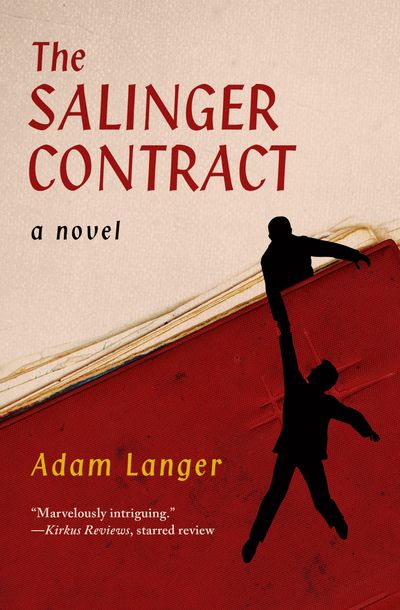
The Salinger Contract by Adam Langer

book cover

Whenever I saw Salinger’s novels or story collections on my friends’ bookshelves, or when I heard authors…talk about how much they admired the guy, I wondered how those books could have influenced them so greatly. I wondered too how Mr. Salinger—in seclusion for more than forty years in Cornish, New Hampshire—felt about the readers who admired his work. If somehow knowing he had touched Hinckley and Chapman and, later, Jared Lee Loughner, who shot Congresswoman Gabrielle Giffords, had convinced him that escaping society had been the right move. I wondered how it would feel to write something—a story, a novel, an article—that would inspire someone to change his or her life for better or worse.

There are questions raised in The Salinger Contract about where the responsibility of the author leaves off. Would Salinger have written his books had he known they would inspire murderous lunatics? Would it have made any difference at all? Maybe those sorts would have just found the same inspiration somewhere else, and the rest of us might have been deprived of some pretty good reading. The question becomes less than academic here.

description
The Reclusive One

Another notion is causality in writing. In an interview with Alexandria Symonds in InterviewMagazine.com, after talking about a proposal by a Hollywood sort that he write a new version of Murder, She Wrote, Langer says:

It’s such a cliché to have the writer who writes about crime turn around and solve them. I thought that was a lame idea, and I didn’t write anything for him, but it did occur to me to completely reverse the polarity on it and come up with an idea of a writer whose books become the basis for crimes.

Ever wonder why famous writers vanish during periods we believe to have been creatively fallow? Langer did, and offers one possible answer. Conner Joyce is a writer of crime fiction. But sales are not improving, as attested by the light turnouts on his book tour, and sliding sales. His family finances are not what they should be and his marriage is not exactly the steadiest. So, when a mysterious billionaire, Dex Dunford, offers him a considerable sum to write a novel just for him, and for him alone, Conner is tempted.

I had friends who were fairly prominent in the literary world who would meet some guy who did not have an apparently interesting life story but who would say, “I will give you double what you normally make for your book. Write my life story.” And if you don’t have a trust fund or residuals, it becomes a very tempting sort of offer. – from the Symonds interview

Of course, as with any such deal, there are conditions, secrecy being prime among them. Dex comes complete with a large bodyguard/enforcer named Pavel Bilski. (think a larger version of Steven Bauer as Avi on Ray Donovan, then add a few inches and fifty pounds), so telling would be a definite no-no.

One of the things Langer is addressing here is the notion of the boundaries between art and reality. Where one leaves off and the other begins takes concrete form when Langer casts himself as a character in the art he creates. This technique is hardly novel here, calling to mind, among many others, Charlie Kaufman in The Orchid Thief /Adaptation, Jonathan Ames of Bored to Death, Dante as a visitor to several realms in tales that range from the infernal to the paradisiacal, and John Fowles in The French Lieutenant’s Woman. Langer, the character, had had a bit of time in the limelight while running a New York based literary magazine. He was known for the many interviews he had conducted, and profiles written of authors. Things in the publishing industry being what they are these days, Langer, the character, finds himself trying to work on his personal writing projects while serving as a house-spouse in Bloomington, Indiana, where his wife is teaching at a university, the Lit mag having gone the way of many publications. Real Adam was a senior editor of Book Magazine until it folded. Fictional Langer had written a profile of Joyce back in the day and when the author makes a book-tour stop in Bloomington, the two get together. Langer, the character, is the eyepiece through which we see Conner’s experience, which is the primary plot track.

description
Adam Langer – the real one

One of the fun elements in the book is the author’s look at the publishing industry, offering payload on the significance of literary whales, some detail on the experience of book touring, intel on top editors, and the sort of portrait one might expect of a popular author of junk books. Particularly fun was Dex talking about the household name authors who had taken him up on his offer over the years. While you may get a chuckle here or there, this is not a laugh-out-loud sort of satire, but a darker, substantive look at questions that matter in the world of writing and publishing. I enjoyed it for that as much as anything. There are also larger issues in play; what is truth and what is fiction, what are we willing to do for money, what responsibility do authors have for what readers do with their work. There is also a brief look at politics in academia, but that was pretty familiar territory, so did not offer much that was new, although it was entertaining. Fans of the late TV show, 666 Park Avenue will find a Drakian thing or two to enjoy. And residents of Chi-town will appreciate the many local references, by Chicago native Langer.

I did find, at times, that there were notions proffered that were problematic, for example

In my experience, every criminal would be an artist if he had the talent, and every artist would become a criminal if he had the guts; in my case, it took an artist to teach me how to be a criminal.

Really? Rather a broad generalization, no? And later

Maybe the reader understood more about a book than its writer ever did. Maybe you know more about me from reading this sentence than I ever could.

While there may be something to the notion that once a story has been published into the world, the world will decide what it means, the fact remains that authorial intent is real, and it would be the rare exception, IMHO, for a reader to grasp an author’s intent more clearly than the author herself.

So, does it all work? Well, there are some stretches to be made, some disbelief to be suspended, but The Salinger Contract is a fun, fast-paced, engaging read, with a core of serious and satiric content wrapped in a shell of adventure. If you need to hide away for a while, this would be a good book to take along.

Posted October 25, 2013

I received this book via GR’s First Reads program – Thanks guys!

====================================EXTRA STUFF

A Wiki profile of the author, the real one

Twitter for Langer

An article by AL – How I Learned Not To Be J.D. Salinger

The InterviewMagazine.com Adam Langer is not in Hiding – must-read material

Leave a comment

Filed under Fiction, Literary Fiction, Reviews

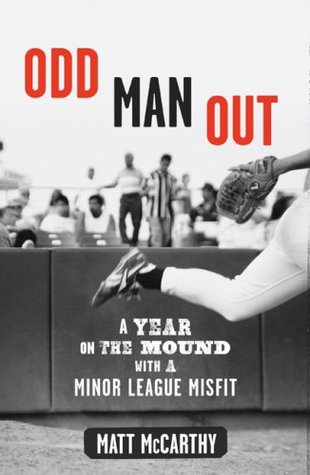
Odd Man Out by Matt McCarthy

book cover

In the 2002 ML baseball draft, Matt McCarthy, a Yale lefty with a fastball that had occasional familiarity with 90+mph was drafted in the 26th round by the Anaheim Angels. He was urged by friends and relations to keep a journal of his experiences, and those journals form the basis of this 2009 story of his single season in the sun of professional baseball.

When the book came out, there was a bit of a firestorm. McCarthy got some of his names, dates, and possibly facts wrong enough that the New York Times highlighted them in two articles. (The links are at the bottom of this review.) It does sound to me that he got a few things wrong. It is even possible that his characterization of this player or that might cause those people some harm. I have no way of knowing the truthfulness of McCarthy’s writing. But I am familiar with how difficult it can be to reconstruct events several years after the events, based on handwritten notes, so am inclined to give McCarthy the benefit of the doubt, and ascribe no malice to his writing. I expect that mistakes which do appear in the book are simply off the plate and are not intentional beanballs. In several instances, I expect that people are simply embarrassed at some of the revelations and it is easier to deny them than to take responsibility.

description
Matt McCarthy

There are some items in the book that might be troublesome for some of the players. McCarthy describes behavior between players that indicates a gay inclination. And that is a barrier that MLB has not yet faced up to. McCarthy also reports on his Rookie League manager’s antics. These include directing his pitcher to hit an opposing batter in retaliation for Provo players having been hit, some mood-swinging, and a remarkable and humorous substitute for the team’s rally monkey. Some players are reported to be milking their disabled list status to avoid playing, and the ethnic separation of players is distinctive, with all Hispanic players, of whatever national origin, designated as “Dominicans” and all others as “Americans.”

So what’s the big deal? Frankly, I do not think there is one. I have read my share of baseball books, and I did not find this one to be exceptional. There were some bits of information that were not at all surprising, such as the use of steroids, (The only surprise might be that there were players who were not using) and the horrors of massive bus rides, the low-wage life that most of these players endure, and the mix of fresh blood on the way up and older players on the way down, high draft picks being handled with kid gloves, and lower draft picks being treated with far less kindness. Class as defined by draft rank may be different from class as defined by wealth or race, but the results are similar. The eagerness of some families in Provo to take in players for a season was a bit of news for me. Aside from a laugh here or there it was mostly pedestrian material, IMHO. That the coach was a character offered some spice. And a ballpark visit by Larry King, his much younger trophy wife and a vile offspring was amusing in a horrifying way.

While McCarthy writes in a very readable, breezy style, there are plenty of baseball books that offer more substance. Jim Bouton’s Ball Four remains the standard beaver-shoot-and-tell example if you are looking for player shenanigans. Bottom of the 33rd: Hope, Redemption, and Baseball’s Longest Game is another that offers a look at the minors, although for a much more defined moment in time. Slouching Toward Fargo by Neal Karlen gives the reader some sense of the non-ML minors.

McCarthy, realistic about his pro-ball prospects, always kept a hand in his other career option, and continued working and studying towards a life in medicine, no, not sports medicine, but infectious diseases. He is now a practicing physician.

Odd Man Out is neither a grand slam nor a strikeout, but more of a seeing eye single ahead of a stolen base.

Posted October 15, 2013

======================================= EXTRA STUFF

Two articles noted above, from the New York Times, both by Benjamin Hill and Alan Schwarz, both published March 2, 2009
Errors Cast Doubt on a Baseball Memoir
and
Excerpts From a Disputed Baseball Memoir

And a more respectful interview – Matt McCarthy, author of ‘Odd Man Out,’ talks with USA TODAY by Dan Friedell

2 Comments

Filed under Baseball, Bio/Autobio/Memoir, Non-fiction, Reviews

The Free by Willy Vlautin

book cover

When Leroy Kervin was 24, a roadside bomb in Iraq parked him in a German hospital with fractures and a serious brain injury. Couldn’t talk. Couldn’t walk. Despite seven years of rehab and huge struggles to regain some of his normal functions, Leroy still suffers from acute PTSD, physical struggles, constant fear, and a fog-shrouded view of the world around him. So, when he wakes up one day miraculously clear-headed, and assumes that this respite is temporary, all he can think is that he will never return to the way things were. To make sure of that he decides to use this fleeting moment of personal reanimation to kill himself. Leroy’s decision brings together the main characters in Willy Vlautin’s look at what it is to be working class in 21st century America.


I write, or hope to write, stories about the working class. I’ve always been a fan of stories about working people, and normal people and the day-to-day struggles they go through. – from interview at 13E Note Editions

Freddie McCall was the night man at the long term care facility where Leroy was living. He is roused by the commotion of Leroy plunging down a staircase onto some wooden stakes. Freddie calls 911 and sees that Leroy is taken to a hospital.

…he held two kitchen towels over the main wound and stared at Leroy’s face. There was a two-inch cut on his cheek leaking blood, and a growing welt on his forehead. Freddie wanted to say something to comfort him, but every time he tried to speak he began to cry.

He’d always liked Leroy. For a man who couldn’t speak, whose brain had been caved in by war, he had a personality. He liked Cap’n Crunch and would watch the science fiction channel for days on end. He had never picked a fight or become violent towards the other residents. He would fall into fits of despair when he refused to leave his bed, but who wouldn’t? And there were times, dozens of them, in the two years that Freddie had been there, when Leroy would wake him in the middle of the night. He would pull Freddie to the back door and knock on it. Freddie would find the key, unlock it, and they would go outside and look at the stars. Leroy would move around the small lawn like an old man, his head back, staring at the faraway galaxies.

Freddie has had a rough go of it himself, and gets why Leroy might want to end his suffering. McCall is the third generation living in his house, but he is among the many suffering under the burden of the number one cause of bankruptcy in the nation, medical bills. One of his daughters was born with dysplasia, required multiple surgeries to repair her hips and Freddie is sinking quickly in a quicksand of debt. And his wife took off with their kids to Vegas to live with her boyfriend. She didn’t take the bills with her. Freddie works two jobs, overnights at the group home and days at Logan’s Paint Store. He catches snatches of sleep when he can. There is no longer heat in his house because he was unable to pay the fuel bill. Desperate for money, he takes on a dodgy venture.

In its majestic equality, the law forbids rich and poor alike to sleep under bridges, beg in the streets, and steal loaves of bread. – Anatole France from La Vie en fleur

Pauline is a nurse at the hospital where Leroy is taken. She tries to help take care of her father, who declines to bathe, wash or eat more than a very narrow list of things. Her mother took off when she was a kid, leaving her in the care of a man who was mentally ill. She did not understand that at the time, but does now. Pauline lives with her pet rabbit Darla, and gets lonely, sometimes. But she has a friend she has known since childhood, and a heart that pulls her to connect with people.

description
the author – from Australian Broadcasting in 2010

One of the major elements in The Free is how just folks can care for each other in a pure way.

I do believe in the kindness of strangers. One of the great things about being in a band is you find that out. People really help struggling bands. Over the years people have been so nice to me and my band, helped us out, fed us, put us up for the night…It’s easy to be scared and cynical. All you have to do is read the paper. I know I have a rough time that way. But I do believe humans, although violent and destructive, have a great ability for kindness. – from interview at 13E Note Editions

Freddie looks out for the residents at the group home and their families, looking for ways to spare them unnecessary costs, even if it means having to do extra work himself. Pauline comes across a runaway teen girl, and goes to extraordinary lengths trying to save her from certain destruction. For all the hoopla given the wealthy when they make large contributions to this or that, it is the lower economic end that actually gives more, and Vlautin is well aware of that.

One of the most surprising, and perhaps confounding, facts of charity in America is that the people who can least afford to give are the ones who donate the greatest percentage of their income. In 2011, the wealthiest Americans—those with earnings in the top 20 percent—contributed on average 1.3 percent of their income to charity. By comparison, Americans at the base of the income pyramid—those in the bottom 20 percent—donated 3.2 percent of their income. The relative generosity of lower-income Americans is accentuated by the fact that, unlike middle-class and wealthy donors, most of them cannot take advantage of the charitable tax deduction, because they do not itemize deductions on their income-tax returns. – from Why the Rich Don’t Give to Charity by Ken Stern in the April 2013 Atlantic

And this does not even take into account the in-kind contributions people make with their time and labor.

Leroy’s suicide attempt was not successful and he hangs on in a hospital room. Awake, he is in constant pain, so he decides to remove himself from the realm of the real. Most of our experience of Leroy is in his sci-fi fantasies. I was reminded of Billy Pilgrim’s escape to Tralfamador in Kurt Vonnegut’s Slaughterhouse Five. Leroy’s adventures contain elements of memory and of fantasy. They are also where Vlautin becomes most metaphorically direct in his critique of 21st century America. This is a world in which people are marked as military-worthy or not, but the mark eventually becomes a mark of Cain and bands of vigilantes hunt them. There is a lot in here about racism, the media, the mean-spirited world in which we live. Leroy’s real-world girlfriend, Jeannette, is a major character in Leroy’s dream-life and nurtures him there the way she nurtured him in real life. It is sometimes difficult to tell where memory leaves off and fantasy picks up.

Religion comes in for some attention here, and not in a supportive way. Religious faith in Vlautin’s universe is a bludgeon used by the unscrupulous, the ignorant, or both to inflict their demands on the young and the powerless. Christian charity in the land of The Free is an oxymoron.

One of the core problems of our economy is personified by an owner who is completely incompetent, but owns and benefits from having a business only because his father left it to him.

Detroit is like rich people. You always hear stories where the dad comes up the rough way, struggles and works harder than everyone else. He builds something, something of value. He spends his whole life doing it. Then his kids come along and take over. They’re so well off that they don’t understand how hard it is to create something good. They just see the money and run with that until it quits. Then everything is lost and even the good idea gives out…

I was most moved by the stories of Freddy and Pauline. Leroy’s story is certainly compelling, but I found it the least engaging of the trio. The one-step-removed methodology used for him kept me feeling one-step–removed as well. If the option were available, I would have knocked my rating down to a 4.5, but the power of the rest moves me to keep this one at five stars. I expect that Willy Vlautin will begin to gain recognition as one of America’s finest artists, a modest guy who embraces his humble beginnings and works to offer us a look at what is becoming the real America for increasing numbers of us. To all of you who are not doing so great in our new two-tiered economy, I strongly encourage you to get into Willy Vlautin. He has been into you for a long time.

Posted – October 10, 2013

The Free will be published in February 2014

====================================THE AUTHOR

Willy Vlautin, born in 1967, grew up in Reno, Nevada. He was a working class kid, raised by a single mom. He was never a great student but had a feel for music and for story. He is one of the founders of the alt-country band Richmond Fontaine. Vlautin’s stories make up much of the lyrics used in the band’s songs. There is a fair bit of crossover between the songs and Willy’s other writing. The Free is his fourth novel. His first, Motel Life has been made into a film with Emile Hirsch, Stephen Dorff and Kris Kristofferson, among others. It is due for release November 2013. His second novel was the award-winning Northline, and the 2010 release, Lean on Pete, was also widely praised.. Vlautin continues to write songs and stories. He lives outside Portland, Oregon these days, when not travelling with the band, but would love to return to Reno someday. His writing calls to mind John Steinbeck and his musical work summons images of Woody Guthrie. He is one of the best writers of his generation.

======================================EXTRA STUFF

Willy Vlautin’s site

Willy on Facebook

A promotional vid for The Free

Wiki page on Willy

A short story by WV

Interview with 13eNote

1 Comment

Filed under Fiction, Literary Fiction, Reviews