
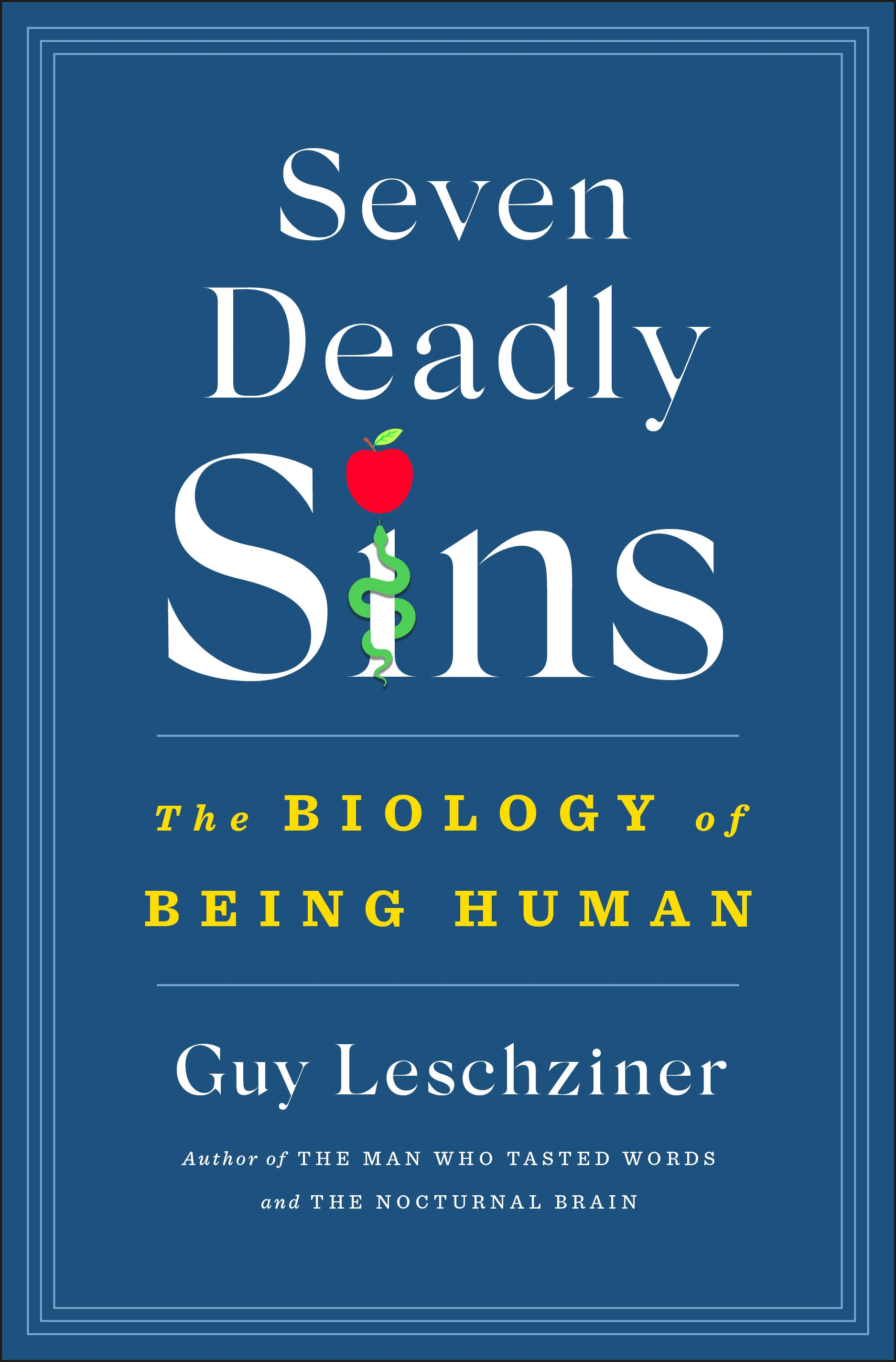
The ebb and flow of human history is defined by the Seven Deadly Sins: wrath, gluttony, lust, envy, sloth, greed, and pride. From the wrath that has ignited revolutions, to the greed that has re-sculpted the world map. From the sloth that has led to the fall of empires, to the envy that has built them. From the lust that has led to the fall of politicians and the betrayal of national secrets, to the voracious gluttony that has left our environment in ruination, and the pride that has fueled countless conflicts.
Disorders of the brain, of our genes, or other physical conditions, may give rise to gluttony, lust, wrath or pride. The effects of our environment or our upbringing may produce envy, lust or sloth. Crucially, these disorders unmask what is already in us, what already exists in all of us.
William J. Bennet (before he was outed as a compulsive gambler) is reputed to have said “One man’s vice is another man’s virtue.” Pope Gregory, in the sixth century CE, had a different idea, whittling a larger, earlier list down to seven deadly sins. (One wonders if there might be a grander list of [insert number here] bloody annoying sins). I do remember in my Catholic grammar school days Monsignor Marshall giving a sermon on venial sin (non-deadly, but as far as I can recall not presented as a list), in which he offered up the image of Jesus on the cross, and proclaimed that committing a venial sin was like slapping the nailed Christ across the face, albeit not very hard. No Jewish mother ever delivered a more impactful guilt trip.

Professor Guy Leschziner – image from The Daily Mail
In his prior book, The Man Who Tasted Words, Professor Leschziner looked at places where the lines between our senses appear to be somewhat porous, sense-A leaking into sense-B for some individuals. Hearing colors, seeing sounds, aphasic things like that. He offered an examination of what is considered usual, and where, in the brain, wires may have become crossed. He looked at individuals who reported such experiences and attempted to trace back into the brain where each sense resided, and connected to others.
Here he uses as his starting point the notion of the seven deadly sins, and offers neurological analysis of behaviors commonly regarded as sinful. Bu the Seven Deadly sins seem to divide into two groups, one based on behavior and one based on emotion. Wrath, Gluttony, Sloth and Greed require action to do actual damage, while Pride, Envy and Lust can remain internal. You may think you are better than everyone else, but unless you do something based on that belief, it makes no difference. Ditto Lust and Envy. In the absence of acting on these feelings, no harm, no foul, so the playing field for looking at The Seven is uneven from the start. The subtext is the question of free will. Are we all functional free agents able to determine right from wrong or are we driven by our biology, by what our brains have, by genetic heritage and experiential conditioning, commanded us to do? And how have the behaviors that have defined our species, that have led to our accomplishments as well as our excesses, our failings, served us? Is there a range within which our less than idyllic urges can function healthfully, and outside of which they constitute pathology?
Look at aberrant behavior. Dive in to see exactly which parts of the brain have been harmed, if any. Map behaviors, needs, urges, inclinations to parts of the brain. In a way, this is a bit like explorations of yore, sailing out to see what lay over the horizon, or, fictionally, heading out on a starship to see what the universe may present. He uses several case studies of people who manifest behaviors illustrative of each of the sins, looking for neurological bases. Just as in his examination of cross-sense irregularities in his prior book, Leschziner looks at these patients with an eye toward identifying which parts of the brain bear the most responsibility for the problematic behaviors. These include a man who had had a brain bleed that changed his personality, a woman who was incapable of feeling satisfied no matter how much she ate, a 34yo man with Parkinson’s and an increasing obsession with sex, a woman who believes her totally faithful husband is cheating on her, a young father who sleeps twenty hours a day, a man has delusions of grandeur until multiple abscessed teeth are removed, oh, and the Panama Papers. Centers of emotional concern include the amygdala, the pre-frontal cortex, a warrior gene, and the hypothalamus internally. He looks at the influence of bacteria, viruses, dopamines, and more impacting from the outside. Increasingly, science can indeed offer some answers to the why of behaviors, to a point.
In his novel, Fleur de Lis, Anatole France wrote. “The law, in its majestic equality, forbids rich and poor alike to sleep under bridges, to beg in the streets, and to steal bread.” There are clearly hypocritical societal interpretations of sin, of what sinful behaviors will be tolerated and which will be sanctioned. (Unless, of course, you are a president with a friendly Congress and SCOTUS, in which case, just go ahead with whatever you are doing there on Fifth Avenue.)
Poor man wanna be rich, rich man wanna be king
And a king ain’t satisfied till he rules everything – Springsteen – Badlands
And most societies assign moral responsibility to the actor. The question is whether a person is morally responsible for his/her actions or is a slave to, and predetermined by impulses, by one’s underlying and overwhelming personal psychological makeup.
if you believe that the brain is the origin of our personalities and our character traits, the basis of our decisions, be they good or bad, then it is arguable that much of what defines us is outside of our control.
Whether we are all able to make actual free choices or are slaves to our biology, it is clear that society needs to be able to restrict our ability to harm each other, that protecting each other from the worst in people is a reasonable social responsibility.
It is made clear that the drives that we regard as sinful have provided considerable benefit to our evolution as a species. No lust? No reproduction. No envy? No reason to be more productive. No wrath? No defense against attack.
Leaving the question of evil. At first blush is seems that evil serves no obvious Darwinian purpose. On second thought, though, I expect there might be a case made for evil existing as an existential challenge in order to provide a testing ground against which one might measure strength of character and/or the superiority of one’s genes, whether physical or intellectual. In a way, like ice ages, rapid climate change, or a voracious saber-tooth tiger, evil might be seen as a natural force, even if it manifests through human beings.
Leschziner has offered up a provocative, thoughtful brain-candy-ish look at how science, as it advances, keeps finding biological explanations for fraught psychological behaviors. But our impulses and makeup remain what they are. And this is one of the pleasures of reading The Seven Deadly Sins. Learning what a strange creature is homo sapiens, and how we are put together. It seems quite clear that the real original sin is to have been born human.
extrinsic factors – medication, injury, or functional disturbance of the brain – rather than our values can cause us to act in ways that contravene our moral
code. However, that dividing line between what constitutes normality and pathology shifts in the sand. That line is blurred by the prevailing winds of our views on morality, legality, philosophy and medicine.
Review posted – 02/21/25
Publication date – 12/3/24
I received paper and ePub AREs of Seven Deadly Sins from St Martin’s in return for a fair review. Thanks, folks, and thanks to NetGalley for facilitating.




This review is cross-posted on Goodreads. Stop by and say Hi!
=======================================EXTRA STUFF
Links to the author’s personal, Instagram, and Twitter pages
Profile
Interviews
The Guardian – Science Weekly Podcast – Are we hardwired to commit ‘deadly sins’? – podcast
– audio – 23:59
—–The Jewish Chronicle – Were the Nazis inherently evil? ByJennifer Lipman
—–Greed, gluttony, sloth…lust! Why you sinned this Christmas by Anna Maxted
Items of Interest from the author
—–Big Issue – The truth is we’re all sinners – it’s how we survive as human beings
—–Next Big Idea Club – A Scientific Examination of the Seven Deadly Sins
My review of the author’s prior book
—–2022 – The Man Who Tasted Words
=======================EXTRA EXTRA STUFF
George Carlin famously distilled the ten commandments down to two.
It seems pretty clear that the seven deadly sins can likewise be slimmed down as well.
Pride. What does this actually mean?
Believing that you are better than other people? What if you are? Faster, stronger, better looking, smarter. Something more than others. Is recognizing your superiority a sin if it is true? The bible seems to maintain that an “Excessive” self-regard is where the line is crossed, but who gets to determine where the line is drawn between factual and excessive self-regard?
But pride does seem to be a pre-condition for other sins. Wrath, or extreme anger, certainly seems an appropriate response to extreme provocation. Hardly a sin. But in order to get into a sinful bit of wrathful behavior it must be excessive. In order for it to be excessive the deliverer of such wrath must hold a higher view of him or herself vis a vis the target than seems justifiable. Soooo, excessive pride, right? So, scratch wrath, and we are down to six.
Gluttony – excessive consumption to the point of waste.
Wiki tells us that In Christianity, it is considered a sin if the excessive desire for food leads to a lack of control over one’s relation with food or harms the body. But if the desire for food entails loss of control over one’s relation to food, where is free will? Isn’t that a definition of pathology? And a pathological behavior is hardly sinful. And just what constitutes excessive desire? If we remove the pathological from this formula, we are left with a person feeling entitled to consume (and I think it is safe to expand the notion of consumption here from food to all things material) as if they are better or more deserving of such things. Which brings us back to pride. Gluttony eats itself into a coma and we are down to five.
Greed
Catholic.com claims that Greed is the disordered love of riches. Hmmm, who gets to define “disordered?” and doesn’t a love of riches include a personal belief that one deserves such riches? Here we go again. It requires excessive self-regard to crave riches at a “disordered” level, no? Greed crushes itself with massive accumulation of stuff and we are left with four.
For these other sins, we delineate the pathologies that shape our thoughts and behaviours, and set them apart from those underlying character traits through their intensity and consequences. For greed, we do no such thing. Yet greed, like the other sins, is perilous in its most extreme forms, causing harm to individuals and wider society alike.
Is Donald Trump, a career criminal, capable of differentiating between right and wrong, or was he so damaged by his genetics and upbringing and injured by his subsequent business training at the feet of his sociopathic father, that he is incapable of telling or even caring about the difference between good and bad? Similar for Elon Musk. How great would it be were Leschziner able to do a detailed examination of both men’s brains. Because if they are capable of discriminating right from wrong, then we have a pretty clear proof that there are indeed forces of evil loose in the world, which I expect would come as a great shock to few but the most ardent atheists.
Lust and envy seem sub-elements of the same thing, wanting something that someone else has. Surely lust between two unattached people is no sin. It is only when one person (at least) is already attached that lust becomes problematic (presuming a monogamous baseline). So, wanting something (someone) who/which is not yours, but which is attached to, or is owned by someone else. So what? We all want stuff we do not or cannot have. How is this a sin? It seem to me that having feelings like lust and envy is completely natural. It is only when we take actions to effectuate such the desire, to the detriment of others that the sin element is realized. Down to two.
According to Wikipedia Sloth is the most difficult sin to define and credit as sin, since it refers to an assortment of ideas, dating from antiquity and including mental, spiritual, pathological, and conditional states. One definition is a habitual disinclination to exertion, or laziness. Willful laziness is surely not cool. Just ask any married person whose partner declines to hold up his or her end, opting instead to watch football or soaps. This one seems likely to be based in behavior, as the sinner here engages in slothful behavior, doesn’t just feel…um…slothful. I could certainly see many real-world examples, beyond couch potato chore-avoiders. There are many people who cannot be bothered exercising the intelligence they were born with to examine themselves, their community, public issues, religious beliefs, or much of anything. It may well be that they believe themselves not up to such analysis, and maybe they are not. But for many, if not all, it does seem that the disinclination rests on a belief that they are too good to have to bother with such things, that they have it all figured out and need look no further than the perimeter of their personal bubble…so…excessive pride. And poof! We are down to one.
Pride goeth before the fall, and, apparently every other form of sinfulness. There is only one deadly sin, excessive self-regard, which feeds all the others, and becomes problematic only when put into actual real-world action.
 Matthew Quick deals in damage control, from the very nervous Pat Peoples in Silver Linings Playbook to the probably autistic Bartholomew Neil in The Good Luck of Right Now, to a crate of bruised produce in his latest novel, Love May Fail. Portia Kane made a bad choice when she was younger, going for what glittered instead of substance, in her case her writerly yearnings. After confronting her cheating pornographer hubby, Ken (not a doll) in flagrante with another chicklet half her age, Portia manages not to fire her Colt 45, but, instead, heads back home, leaving her terminally damaged marriage in Florida. This being a Matthew Quick novel, home is his usual literary stomping ground, the Philadelphia area, Oaklyn, NJ specifically, which happens to be the town where Quick grew up. Portia moves in with mom who lives with some damage of her own. She is an agoraphobic hoarder with, I am sure, a rainbow of maladies identifiable in the




 Coot's Reviews