Tag Archives: immigration

Artificial by Amy Kurzweil

book cover

What makes a person the same person over time? Is it our consciousness, the what-it’s-like to be us? Is consciousness like a light that’s either on or off?

What remains of a person once they’ve died? It depends on what we choose to keep.

Amy Kurzweil is a long-time cartoonist for The New Yorker. If the name sounds a bit familiar, but you aren’t a reader of that magazine, it may be because her father is Ray Kurzweil. He is a genius of wide renown. He invented a way for computers to process text in almost any font, a major advance in making optical character recognition (OCR) a useful, and ubiquitous tool. He also developed early electronic instruments. As a teenager he wrote software that wrote music in the style of classical greats. No gray cells left behind there. He happened to be very interested in Artificial Intelligence (AI). It helps to have a specific project in mind when trying to develop new applications and ideas. Ray had one. His father, Fred, had died when he was a young man. Ray wanted to make an AI father, a Fred ChatBot, or Fredbot, to regain at least some of the time he had never had with his dad.

description
Amy Kurzweil – Image from NPR – shot by Melissa Leshnov

Fred was a concert pianist and conductor in Vienna in the 1920s and 1930s. A wealthy American woman was so impressed with him that she told him that if he ever wanted to come to the USA, she would help. The Nazification of Austria made the need to leave urgent in 1938, so Fred fled with his wife, Hannah. (He had actually been Fritz in Austria, becoming Fred in the states.) He eventually found work, teaching music.

Artificial: A Love Story is a physically hefty art book, a tale told in drawings and text. Amy traces in pictures her father’s effort to reconstruct as much of his father’s patterns as possible. To aid in the effort there was a storage facility with vast amounts of material from his life both in Austria and in America. She joins into the enterprise of transcribing much of the handwritten material, then reading it into recordings which are used to teach/train the AI software. It is a years-long process, which is fascinating in its own right. She also draws copies of many of the documents she finds for use in the book.

description
Ray Kurzweil with a portrait of his father – image from The NPR interview – Shot by Melisssa Leshnov

But there is much more going on in this book than interesting, personalized tech. First, there is the element of historical preservation.

I always understood my father’s desire to resurrect his father’s identity as being connected to two different kinds of trauma. One is the loss of his father at a young age in a common but tragic scenario, with heart disease. The other trauma is this loss of a whole culture. Jewish life in Vienna was incredibly vibrant. Literally overnight it was lost. The suddenness of that loss was profound, and it took me a while to appreciate that. My great-aunt Dorit, who died this past year at 98, said they were following all the arbitrary protocols of the Nazis to save all this documentation. Saving documentation is an inheritance in my family that is a response to that traumatic circumstance. – from the PW interview

Kurzweil looks at three generations of creativity, (Fritz was a top-tier musician. His wife, Hannah, was an artist. Ray was also a musician, but mostly a tech genius. Amy is a cartoonist and a writer.) using Ray’s Fredbot project as the central pillar around which to organize an ongoing discussion of concepts. In doing so, she offers up not merely the work of the project, but her personal experiences, showing clear commonalities between herself and her never-met grandfather. This makes for a very satisfying read. Are the similarities across generations, this stream of creativity, the impact not just of DNA, but of lived experience? Nature or nurture, maybe the realization of potential brought to flower by the influence of environment whether external (living in a place that values what one has to offer) or internal (families nurturing favored traits)?
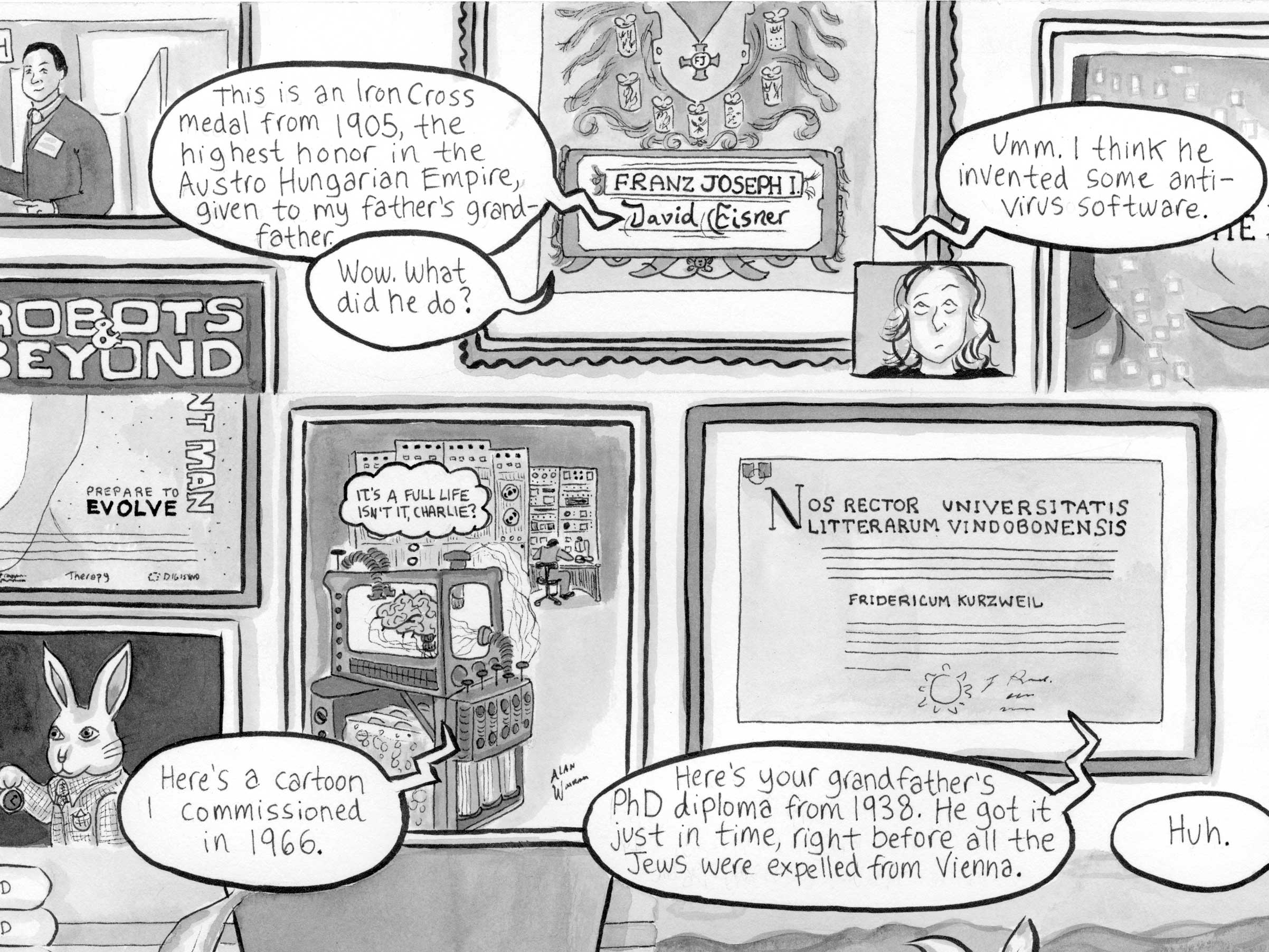
description
Image from the book – posted on The American Academy in Berlin site

One could ask, “what makes us what are?” The book opens with a conversation about the meaning of life. But life is surely less determinative, less hard-edge defined than that. A better question might be what were the historical factors and personal choices that contributed to the evolution of who we have become?
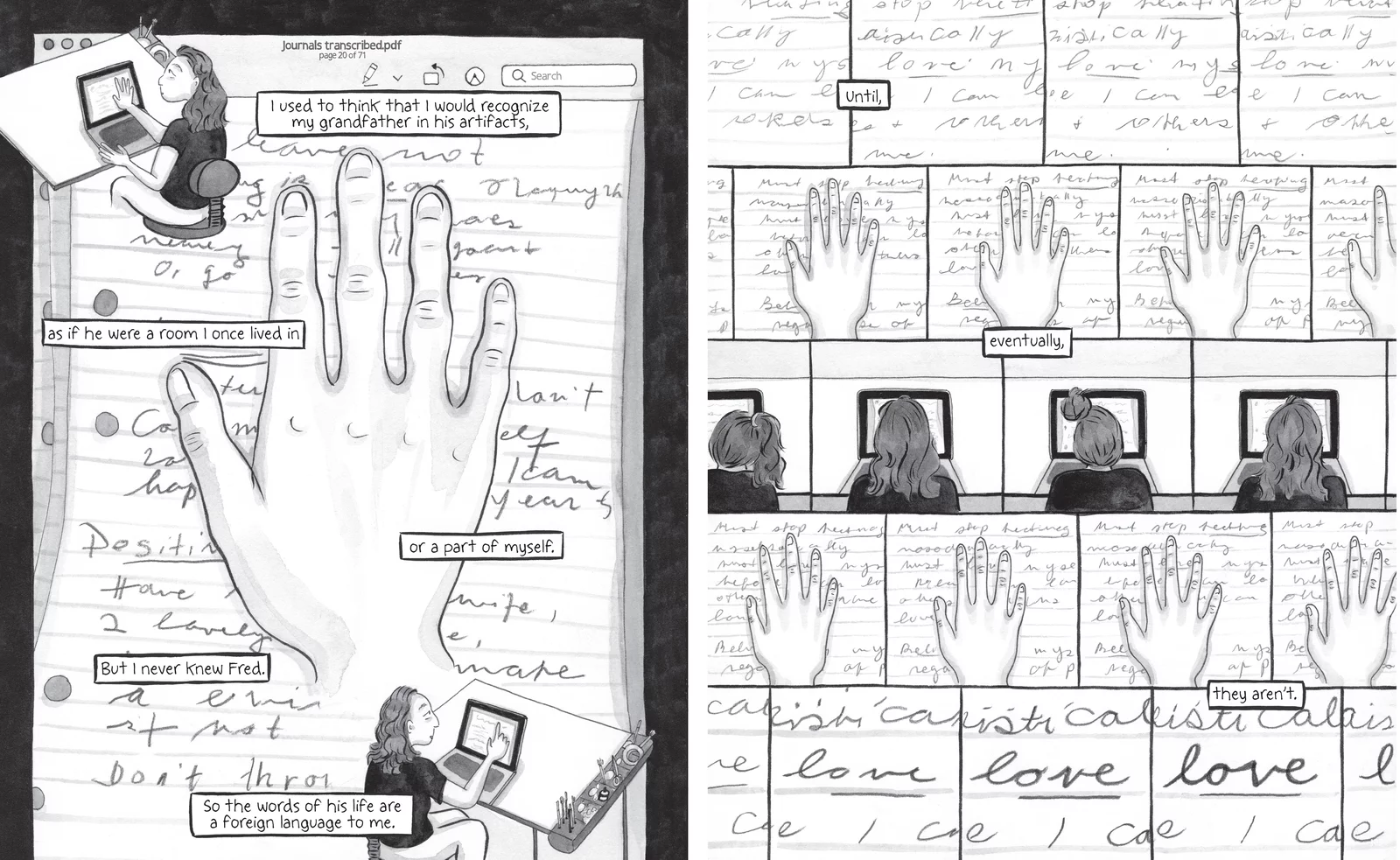
description
Image from the book – it was posted in the NPR interview

Existential questions abound, which makes this a brain-candy read of the first order. Kurzweil looks at issues around AI consciousness. Can artificial consciousness approach humanity without a body? What if we give an AI a body, with sensations? Ray thinks that we are mostly comprised of patterns. What if those patterns could be preserved, maybe popped into a new carrier. It definitely gets us into Battlestar Galactica territory. How would people be any different from Cylons then? Is there really a difference? Would that signal eternal life? Would we be gods to our creations? If we make an AI consciousness will it be to know, love, and serve us? The rest of that catechistic dictat adds that it is also to be happy with him in heaven forever. I am not so certain we want our AIs remaining with us throughout eternity. As with beloved pets, sometimes we need a break. Are we robots for God? Ray thinks such endless replication is possible, BTW. Kurzweil uses the image of Pinocchio throughout to illustrate questions of personhood, with wanting to live, then wanting to live forever.

description
Every Battlestar Cylon model explained – image from ScreenRant

Persistence of self is a thread here. As noted in the introductory quotes, Kurzweil thinks about whether a person is the same person before and after going through some change. How much change is needed before it crosses some line? Am I the same person I was before I read this book? My skin and bones are older. But they are the same skin and bones. However, I have new thoughts in my head. Does having different thoughts change who I fundamentally am? Where does learning leave off and transition take over? Where does that self go when we die? Can it be reconstructed, if only as a simulacrum? How about experiences? Once experienced, where do those experiences go? These sorts of mental gymnastics are certainly not everyone’s cuppa, but I found this element extremely stimulating.

Kurzweil remains grounded in her personal experience, feelings, and concerns. The book has intellectual and philosophical heft, and concerns itself with far-end technological concerns, but it remains, at heart, a very human story.

As one might expect from an established cartoon artist who has generated more smiles than the Joker’s makeup artist, there are plenty of moments of levity here. Artificial is not a yuck-fest, but a serious story with some comic relief. It is a book that will make you laugh, smile, and feel for the people depicted in its pages. Amy Kurzweil has written a powerful, smart, thought-provoking family tale. There is nothing artificial about that.

I used to wonder if I could wake up into a different self. For all I knew, it could have happened every morning. A new self would have a new set of memories.

Review posted – 01/12/24

Publication date – 10/17/23

I received a hard copy of Artificial: A Love Story from Catapult in return for a fair review.

This review is cross-posted on my site, Goodreads. Stop by and say Hi!

=======================================EXTRA STUFF

Links to the author’s personal, FB, Instagram, and Twitter pages

Profile – from Catapult

AMY KURZWEIL is a New Yorker cartoonist and the author of Flying Couch: A Graphic Memoir. She was a 2021 Berlin Prize Fellow with the American Academy in Berlin, a 2019 Shearing Fellow with the Black Mountain Institute, and has received fellowships from MacDowell, Djerassi, and elsewhere.

She has been nominated for a Reuben Award and an Ignatz Award for “Technofeelia,” her four part series with The Believer Magazine. Her writing, comics, and cartoons have also been published in The Verge, The New York Times Book Review, Longreads, Literary Hub, WIREDand many other places. Kurzweil has taught widely for over a decade. See her website (amykurzweil.com) to take a class with her.

Interviews
—–NPR – Using AI, cartoonist Amy Kurzweil connects with deceased grandfather in ‘Artificial’ by Chloe Veltman
—–Publishers Weekly – Reincarnation: PW Talks with Amy Kurzweil by Cheryl Klein
—–PC Magazine – How Ray Kurzweil and His Daughter Brought A Relative Back From The Dead By Emily Dreibelbis
——LitHub – Amy Kurzweil on the Open Questions of the Future by Christopher Hermelin

Songs/Music
—–The Jefferson Airplane – White Rabbit– referenced in Chapter 6

Items of Interest from the author
—–Artificial: A Love Story promo vid
—–The New Yorker – excerpt
—–New Yorker – A List of Amy Kurzweil’s pieces for the magazine

Items of Interest
—–Ray Kurzweil on I’ve got a Secret
—–A trailer for Transcendant Man, a documentary about Ray Kurzweil
—–WeBlogTheWorld – Amy interviews Ray in a Fireside Chat at NASA – sound is poor. You will need to ramp up the volume to hear – video – 23:07
—–Wiki on Battlestar Galactica


Leave a comment

Filed under AI, American history, Artificial Intelligence, Bio/Autobio/Memoir, biography, computers, History, Non-fiction

The Apartment by Ana Menéndez

book cover

The dead, after all, do not walk backwards but they do walk behind us. They have no lungs and cannot call out but would love for us to turn around. They are victims of love, many of them. – Anne Carson – from the epigraph

We are our own ghosts, dragging our mournful pasts behind us forever.

An apartment in Miami Beach, from 1942 to 2012, seventy years of tenants, eleven of them, each with a story to be told. The conceit of the novel is that the apartment retains some form of consciousness. Nothing particularly overt, mind you. It is handled more like a repository for emotional flotsam, psychic impressions that accumulate and rattle around with the tide of each new resident, to no obvious major purpose, until the final third of the book, when the apartment acquires a spokesperson, a late resident, who is on a mission to save the current one, Lana.

description
Ana Menendez – Image from her site

So, was all the depositing of emotional residue by the prior nine tenants merely substructure on which this final pair could rest? I found that a jarring shift, a sort of unwelcome unreliable narrator, as we are no longer hearing apt 2B, but as if this person proclaimed, “Shove over, flat. I’ll take it from here.”

Menendez’s work is mostly in short form, so it makes sense that her novel is of the linked-story form, as each resident in turn gets anywhere from six to twenty-two pages for their tale. Even though there is a through-arc, it still feels like a short-story collection, which is fine with me. But this form does limit how much one can get invested in any one character. The final chapter, at a novella-length eighty-four pages, changes this dynamic and gives us a bit more to hold on to with its two primaries.

After a prologue, in which an indigenous woman sees the first European invaders on what is now Miami Beach, establishes the roots of the storytelling arc, we jump to the beginnings of World War II. An apartment building called The Helena is still moist with drying paint when it is requisitioned by the military. Major Jack Appleton has been moved from Texas to lead an officers’ school. His wife, Sophie, is not what you might call thrilled. Appleton is controlling and abusive. They are not long for this place.

During their stay a ship is set ablaze and sunk off the coast by a German U-boat, bringing the war home. In fact, while the violence may be almost entirely off-screen, there is plenty of it. It is a pervasive thread in The Apartment, from the genocidal infections brought by the first Europeans, to carnage wrought by German forces. A veteran suffers from PTSD after serving in Viet Nam. A Marielita flees her abusive father, but is being kept by an abusive lover. A woman dreams that her husband is coming to kill her. A couple fear for their lives, concerned that they are being pursued by agents from their home country. A soldier is killed in action. There is a suicide and another tenant who might follow suit. A man is set upon by thugs in the street and is beaten bloody.

Each chapter ends with an interstitial piece, as the apartment is vacant for a time. Cleaners come in to prepare for the next renter. Some offer some wonderful short character pieces. The apartment sees and feels.

The front door closes, and absence returns to apartment 2B. but there is still someone here to record the fact, this unseen eye that moves across the floor as it if were a page, sweeps the bedroom, the naked walls, lingers at the single living room window with its blinds at half-mast.

We get a Cook’s Tour of many significant moments in American history, including foreign events that impact here through the residents of 2B, WWII, tensions between the USA and Cuba, Viet Nam, the Mariel boatlift, the demise of the junta in Argentina, USA involvement in Central American conflicts, 9/11, the demise of printed newspapers, Lebanon, Afghanistan. A lot.

I’ve been interested for a long time in how the trauma of war and displacement plays out across generations. So this was one of the main ideas I wanted to explore in the novel. Many of the conflicts in this novel have ties to the United States, which of course can sadly be said of many conflicts in the world today. We are all implicated. But simply on a craft level, as a writer, there were some conflicts that I wanted to include for personal reasons.
The conflict in Lebanon is one of them, as my great-grandparents fled to Cuba following early conflict there at the turn of the last century. The violence in Cuba and its long aftermath is of course a special obsession as the daughter of Cuban immigrants. And the conflict in Afghanistan looms large for us as Americans and for me personally as I spent ten unforgettable days in the country in 1998.
– from the Lithub interview

Everyone at the Helena is a transplant from someplace else. Many of the characters are foreign-born, carrying with them a sense of mourning for their lost birthplaces. Some have to jump down to the bottom of the work ladder they had ascended back home and begin the climb again, or take on completely alternate work just to get by. Even those who have made successful new lives pine for what was lost.

SHAPIRO: You introduce us very early on in the text to a Spanish word, morrina. What does the word mean? And how did you think about the concept in relation to the narrative you were writing?
MENENDEZ: It’s a concept that I think runs through maybe all of my books – this sense of saudade, as the Portuguese maybe would describe it. Most cultures have a word for this. It’s this sort of bittersweet nostalgia – the sense that the past is sweet and wonderful to wallow in precisely because it cannot be recovered. And I think that that’s an obsession that has run through most of what I write – not consciously but simply as a product of my upbringing and my own situation. My parents, of course, are immigrants. They call themselves exiles from Cuba. And so for me, it speaks to, you know, one doesn’t need to be an exile or a migrant to have this sense that things were sweet in the past and to sort of take refuge in it.
– from the NPR interview

The vast majority of the stories, eight of eleven, center on women. Conflict abroad manifests as abuse or misery at home. Few move on from 2B to a better life. There are exceptions. Relationships are pretty universally strained. Abuse recurs. A marriage of convenience challenges a relationship of love. There are betrayals, problems with gambling, alcoholism, depression, desperation, racism, bigotry of various sorts, and shame. Some are tormented by decisions they have made in the past. Some seem more like lost wanderers, thrown up on shore after being tossed roughly about by an angry sea.

The residents vary in their work lives, with creative arts well represented. There are multiple painters, their models, a journalist and a concert pianist. The most piercing spectral presence of all is a painting one of the residents is working on, as it manifests a particular bit of darkness.

Snakes pop up throughout. The book opens with A serpent coils through the underbrush of palmetto and coco plum…Harmless, this one, this time.. Later “Time, spooky and fickle. Not arrow, but snake.” There are more.

And now back to the apartment designation. Wait, 2B? Or not? Certainly calls up a soliloquy from Hamlet. And informs a fair piece of the book. The Danish Prince wonders if he should keep on keeping on after, learning that dear uncle murdered his father. Certainly many of the characters here have suffered the slings and arrows of outrageous fortune. Some put up a good fight, taking up arms against a sea of troubles. And by opposing [attempting to] end them. Well, some efforts are made. The alternative, the not 2B part, is to end the Heart-ache and the thousand natural shocks that the flesh is heir to. One last “check, please.” And one of ours does indeed choose to find out what dreams may come, when we have shuffled off this mortal coil. Is it the fear of the undiscovered country, of unknowable death, that keeps most grinding through the day-after-day? Or some loftier feeling, hope, or value? May it is simply momentum.

While The Apartment is not a traditionally formatted novel, it is nonetheless a beautiful work of writing. While we may not have much time with many of the characters, Menendez does a lot in a short space, a talent no doubt honed by her history of short story writing. The stories are moving, at times to the point of tears.

Will Sophie get away from her abusive spouse? Will Eugenio find his way to California? Will Sandman find a way to survive his PTSD? Will Isabel make her own life and not remain a kept toy of an older man? Will Margot and her husband evade those who might be after them? How will Susan handle her loss? Will Marilyn stay with her damaged bf? How will Beatrice cope with the change in her circumstances? Will Pilar be able to find journalism work again? Will Lenin succeed in his mission? Will Lana let the many friendly neighbors help her out, or is her secret too much to reveal?

There is poetic beauty in here that deserves to be read, to be appreciated. You may or may not feel impelled to look for deteriorating flats in a soon-to-be submerged part of Florida, but it would be worth your while to check in with your real estate agent and arrange to give 2B a look. It might turn out to be just the right place for you.

In the English novels she studied in school, the characters all seemed masters of their own fates. When they stumbled, it was because of a flaw. The direction their lives took was the direction they determined through their choices. But this was not Margot’s experience of the world. The world so far acted on her without consultation or sympathy. Her life, dictated first by her family’s wealth and now by her husband’s work, lacked the agency she was taught to recognize in great works. Even this latest leaving had been out of her hands. Maybe the only true literature was the old ghost stories her grandmother used to whisper to her on those windy cold nights on the Pampas. Spirit and mortals alike, all subject to unseen forces that swelled beneath them, hidden and untamable.

Review posted – 9/8/23

Publication date – 6/27/23

I received hardcover of The Apartment from Counterpoint in return for a fair review and a one-year lease. Thanks, folks.

This review is cross-posted on Goodreads. Stop by and say Hi!

=======================================EXTRA STUFF

Links to the Menendez’s personal, FB, Instagram, and Twitter, sorry, X pages

Profile – from her site

Ana Menéndez has published five books of fiction: The Apartment (2023), Adios, Happy Homeland! (2011), The Last War (2009), Loving Che (2004) and In Cuba I Was a German Shepherd (2001), whose title story won a Pushcart Prize. She has worked as a journalist in the United States and abroad, lastly as a prize-winning columnist for The Miami Herald.
As a reporter, she wrote about Cuba, Haiti, Kashmir, Afghanistan, and India. Her work has appeared in Vogue, Bomb Magazine, The New York Times and Tin House and has been included in several anthologies, including The Norton Anthology of Latino Literature. She has a BA in English from Florida International University and an MFA from New York University.
From 2008 to 2009, she lived in Cairo as a Fulbright Scholar in Egypt. She has also lived in India, Turkey, Slovakia and The Netherlands, where she designed a creative writing minor at Maastricht University in 2011. For the past 20 years, she has taught at various writing conferences and programs including, most recently, Bread Loaf and the MFA Program for Writers at Warren Wilson College. She lives in Miami and is currently an associate professor at FIU with joint appointments in English and the Wolfsonian Public Humanities Lab.

Interviews
—–NPR – Author Ana Menendez explores stories a single location could tell in ‘The Apartment’ by Linah Mohammad, Ashley Brown, Ari Shapiro
—–Lithub – Ana Menéndez on Crafting a Connected Cast of Characters by Jane Ciabattari

Items of Interest from the author
—–Links to other things she has written

Items of Interest
—–The Poetry Foundation – To Be or Not To Be – from Shakespeare’s Hamlet
—–Wiki – The Mariel Boatlift
—–Museum of Florida History – Florida on the Home Front: The German Submarine Threat off Florida’s Coast – “The most dramatic sinking in Florida waters took place the night of April 10, 1942, when U-123 torpedoed the tanker Gulfamerica off Jacksonville Beach. The resulting fiery explosion was clearly seen onshore and curious crowds gathered to view the ship’s destruction and looked on in shock as the German submarine surfaced and fired its deck gun at the tanker.”

Leave a comment

Filed under Fiction, Historical Fiction, Literary Fiction, Short Stories

Nobody is Protected by Reece Jones

book cover

In…Almeida-Sanchez v. United States in 1973, Justice Thurgood Marshall, an icon of the civil rights movement and the first Black man to serve on the Supreme Court, asked a series of questions that pressed the government’s lawyers about the true extent of the Border Patrol’s authority on American highways deep inside the United States. Unsatisfied with the response, Marshall finally asked if the Border Patrol could legally stop and search the vehicle of the president of the United States without any evidence or suspicion whatsoever. When the lawyer said “Yes,” Marshall concluded, “Nobody is protected.”

The Border Patrol in their green uniforms, patrols between crossing points. Customs was renamed the Office of Field Operations, its agents, in blue uniforms, work at crossing points and in airports. Agents of a third unit of CBP, Air and Marine Operations (AMO), wear brown uniforms and manage the agency’s aircraft and ships. AMO’s authorization in the U.S. code differs from the Border Patrol in that it does not include any geographical limits, so they are able to operate anywhere in the country.

So a few military-looking sorts in camo, with automatic weapons, rush up to you, grab you by both arms and stuff you into an unmarked van that speeds away. Only a general “Police” insignia on their uniforms, wearing shades at night, covering their faces, no explanation of why you are being abducted. Where are you? Russia? Turkey? The West Bank? How about Portland, Oregon, July 2020? What the hell was the Border Patrol doing in Portland anyway, at a demonstration protesting the police murder of George Floyd, an event having zero to do with immigration?

In Nobody is Protected, Reece Jones explains how it has come to be that an agency created to protect the border, and to deal with immigration issues has seen its domain grow to the point where it can operate in most of the country, and take on missions having absolutely nothing to do with crossing a border. What makes them particularly dangerous is that they do not live by the laws that govern the rest of the police forces in the nation. Do they need probable cause to stop your vehicle? Not really. How about a warrant? A BP agent laughs. Can they use racial profiling for selecting who to stop? Of course. That a problem? Oh, and they are now, taken together in their three parts, adding in ICE, the largest police force in the nation. Sleep tight.

description
Reece Jones – image from Counterpoint – photo by Silvay Jones

Jones looks at the history of border patrol efforts prior to the establishment of BP in 1924. He tracks the changes in the characteristics of the BP over time, while noting some of the traits that have not changed at all. The Texas Rangers of the early 20th century figure large in this, complete with reports of Ranger atrocities and their considerable representation in the Border Patrol once it was set up. As Mexico outlawed slavery long before the USA, one of the things the Rangers did was intercept American slaves trying to flee the country. The mentality persisted into the BP force, along with those Rangers. Jones offers reminders that the charge of the patrol was often racist, reflecting national legislation that sought to exclude non-white immigrants, with particular focus on Mexicans and Chinese. Exceptions were made, of course, to accommodate Texan farmers during the seasons when labor was needed. A guest worker program was established to compensate for many American men being away during World War II.

Willard Kelly, the Border Patrol chief at the time, told a Presidential Commission in 1950 that “Service officers were instructed to defer apprehensions of Mexicans employed on Texas farms where to remove them would likely result in the loss of crops.” Instead, they would focus on the period after the harvest in order to send the workers back to Mexico. Similarly, during economic downturns, the Border Patrol would step up enforcement to ensure the state did not have to provide for the unemployed laborers. These roundups would often happen just before payday, so agribusinesses got the labor and the agents got their apprehension quotas, but the Mexican workers were not paid.

Outside the illuminating history of the force itself, much of what Jones offers here is a delineation of the laws that define where BP responsibilities and limitations lie, looking particularly closely at several Supreme Court decisions.

We have all heard of Roe v Wade and Brown v the Board of Ed, cases decided (some later undecided) by the Supreme Court (SCOTUS), that were major legal landmarks. Roe established a right of privacy that made abortion legal across the nation. Brown established that separate-but-equal was not a justification for continuing segregation in public schools. There are many such landmark cases. In Nobody is Protected, Reece Jones looks at the rulings that have allowed the Border Patrol to become a dangerous federal police force, subject to far fewer limitations than any other police force in the nation. These cases, while not household names like Roe and Brown, are of considerable importance for the civil rights of all of us, not just immigrants. In Almeida-Sanchez v. United States in 1973, SCOTUS allowed the BP to search a vehicle without any justification. In its 1975 decision in The United States v. Brignoni-Ponce, SCOTUS was ok with agents using racial profiling for selecting vehicles to stop. In 1976, SCOTUS held in The United States v. Martinez-Fuerte that BP could establish checkpoints in the interior of the USA and detain anyone to ask about their immigration status.

So you live nowhere near the border, right? Shouldn’t impact you. But hold on a second. By administrative fiat, BP was granted a one hundred mile border zone. And not just from the expected Mexican and Canadian borders, but from the edge of the land of the USA. So, this means that two thirds of the population of the United States falls within BP’s rights-light border zone. Fourth Amendment? What fourth amendment?

Jones reports on a crusader named Terry Bressi, an astronomer who has been stopped 574 times (as of the writing of the book) while driving to work at an interior checkpoint. He got fed up and started videotaping all his interactions with checkpoint law enforcement, for posting on line. They did not like that. They hated even more that he knew his rights and stood up to bullying by local cops that had been assigned to the checkpoint.

You will learn a lot here. About a policy of Prevention through Deterrence that channeled thousands of would be immigrants and asylum seekers away from normal points of entry, toward perilous crossings. And if they should not survive the effort? Sorry, not our problem. And they try to interfere with people who simply want to save the lives of those coming into our country at risk of their own lives.

In addition to failing to properly search for missing people in the border zone, the Border Patrol also actively disrupts efforts by humanitarian agencies. Beyond the destruction of water drops and aid stations, they often refuse to provide location information to other rescuers, deny access to interview people in Border Patrol custody who were with the missing person, and harass search teams in the border zone.


As No More Deaths volunteer Max Granger, explained, “The agency itself is causing the deaths and disappearances. Any response, even if it is a more robust response, is going to be inadequate. Their entire overarching prevention through deterrence policy paradigm requires death and suffering to work. They are not invested in saving people’s lives.

You will learn of agency mission creep, from border control to drug enforcement to testing for radiation in vehicles (which catches a lot of cancer patients, but so far no dirty bomb terrorists) to actions that are blatantly political in nature and patently illegal.

I expect you will not be shocked to learn that abuse by BP personnel goes largely unpunished. No action against the agent was taken in over 95% of cases of reported abuse. When the Inspector General for the agency tried to investigate the 25% of BP deaths-in-custody that were deemed suspicious, he was stopped (this last bit is from the This Is Hell interview, not the book).

The BP manifests a Wild West mentality that is not much changed from when it was staffed with slave hunters and disgruntled confederates. One thing that has changed is the increasing politicization of immigration by fear-mongering Republican demagogues, and the increased concern over national security brought about by 9/11. There are vastly more agents on the force today. In the 1970s, for example, there were only about fifteen hundred BP agents. Today, just in the BP wing of Customs and Border Patrol (CPB) there are almost twenty thousand. The Field Operations branch adds another twenty thousand, and the Air and Marine Operations branch tops that off with another eighteen hundred. Another twenty thou in ICE, and it gets even larger. Jones may not be entirely correct when he says that the Border Patrol, per se, is the largest police force in the USA, but when these four connected wings are considered as one, ok, yeah, it is.

Jones offers some do-able solutions in addition to proposing legislative changes that might rein in this growing giant, and increasing threat to the rights of all Americans. It is usual for books on policy to toss out solutions that have zero chance of seeing the light of day. So, sensibility here is most welcome.

I have two gripes with the book. There needed to be considerable attention paid to the SCOTUS decisions that have allowed the BP to expand its legal domain. But Jones dug a bit too deep at times, incorporating intel that slowed the overall narrative without adding a lot. In fact, a better title for this might have been The Gateway to Absolute Police Power: SCOTUS and the Border Patrol. Second is that there is no index. Maybe not a big deal if one is reading an EPUB and can search at will, but in a dead-trees-and-ink book, it is a decided flaw.

Bottom line is that Reece Jones had done us all a service in reporting on how a federal police agency has grown way larger than it needs to be, has accumulated more power than it requires to do its job, and has used that power to feed itself, to the detriment of the nation. He points out in the interview that border security has become an “industrial-complex” much like its military cousin, albeit on a smaller scale, with diverse public and private vested interests fighting to sustain and expand the agency, regardless of the value returned on investment. It is a dark portrait, but hopefully, by Jones shining some light on it, changes might be prompted that can rein in the beast before it devours what rights we have left.

Despite the transformation of the border in the public imagination, the people arriving there are largely the same as they always were. The majority are still migrant farm and factory workers from Mexico. In the past few years, they have been joined by entire families fleeing violence in Central America. These families with small children, who turn themselves in to the Border Patrol as soon as they step foot in the United States, in order to apply for asylum, pose no threat and deserve humane treatment. However, that is not what they have received. As journalist Garrett Graf memorably put it, “CBP went out and recruited Rambo, when it turned out the agency needed Mother Teresa.”

Review posted – 7/29/22

Publication date – 7/5/22

I received a hardcover of Nobody is Protected from Counterpoint in return for a fair review. Thanks, KQM.

This review has been cross-posted on GoodReads

=======================================EXTRA STUFF

Links to the Reece Jones’s personal and Twitter pages

Profile – from Counterpoint
REECE JONES is a Guggenheim Fellow. He is a professor and the chair of the Department of Geography and Environment at the University of Hawai’i. He is the author of three books, the award-winning Border Walls and Violent Borders, as well as White Borders. He is the editor in chief of the journal Geopolitics and he lives in Honolulu with his family.

Interview
—–This is Hell – Nobody is Protected / Reece Jones – audio – 52:10 – by Chuck Mertz – this is outstanding!

Items of Interest
—–Borderless – excerpt
—–The Intercept – 7/12/19 – BORDER PATROL CHIEF CARLA PROVOST WAS A MEMBER OF SECRET FACEBOOK GROUP by Ryan Deveaux
—–No More Deaths – an NGO doing humanitarian work at the border
—–Holding Border Patrol Accountable: Terry Bressi on Recording his 300+ Checkpoint interactions (probably over 600 by now)
—–My review of The Line Becomes a River, a wonderful memoir by a former BP agent

Leave a comment

Filed under American history, History, Non-fiction, Public policy