Tag Archives: fantasy

Atlas of Unknowable Things by McCormick Templeman

book cover

…the world seems especially chaotic and violent to me lately, like basic human decency has gone out the window. Most days I think I’m imagining it, but some nights I wake up with this certainty that it’s real, almost like there’s this slow leak of evil drifting out into the world tainting everything it touches.

I began to understand. I had stepped through a veil of sorts. Hildegard wasn’t like other places. There were rules here I didn’t understand. There were puzzles and clues and mysteries, and even though I felt an almost immediate and palpable sense of danger, some part of me was excited. I’d spent my entire life waiting for something to feel real, to feel important. I’d always wanted to feel at the center of something truly grand. And though I couldn’t say definitively that what was happening to me was necessarily grand, at least it was something.

As for the title, it turns out many of the things at issue are indeed knowable.

Post-grad Robin Quain is going through an identity crisis. She had a bad experience with a bf who had stolen her research to publish as his own. Then she is staying with her cousin, Paloma, in New York when her roomie goes suddenly suspicious and hostile, adding to her disorientation. Robin is looking into the possibility that the witch trials were actually an attempt to squash a long-standing established religion. She finds a clue that might lead her to a great discovery, a particular artifact. While doing this she learns that a woman has died and another, one linked to her research, has gone missing. Both were near a small college in Colorado, one that has an impressive library that might help her find what she seeks, one where the missing woman had taught, one where Robin is now accepted for a summer residency, and the game is on.

description
McCormick Templeman – Image from Lighthouse Writers

Hildegard College really does seem like a game site, not just to us as readers, but also to Robin as a character. The story has a video game feel, find hidden clues, pick up weapons/tools, advance a level, answer riddles, repeat. But she feels less than entirely safe, or welcomed.

I felt like a fawn isolated from the herd as a pack of wolves slowly surrounded it, closing in, preparing for the sacrificial feast.

The student body is gone for the season, leaving the staff, professors mostly. They have a surprising history of connection with the institution. They also seem a particularly unusual collection of brains and beauty.

There is more at stake than the particular bit of history/lore that she is delving into. There are mysteries aplenty in the Rockies, including just what the hell is going on at this very eccentric tucked-away place. It is definitely something significant. There are many hints of things that might be considered supernatural, paranormal, or mythical. (Templeman has a PhD in English lit with a specialty in 19th century horror, so this fits right in) Strange flashes of light and howls in the woods, death of a local from mauling by an unidentified animal, sirens that go off in the wee hours that are most definitely not sounded to warn of loose guard dogs, large horned beings that appear in bedrooms, an island to which no one is allowed access, you know, stuff. Is Robin being paranoid? Is she being paranoid enough? Templeman provides plenty of red-herring clues that keep us guessing. Witches? Vampires? Werewolves? Ghosts? What?

The book makes several mentions of the dubious line that divides science from magic, a major thematic thread.

“Witchcraft and science aren’t as far apart as we’d all like to believe. Some say the supernatural is just natural phenomena for which we don’t yet have a scientific explanation.”

…is it possible to perceive a glimmer of the factual and historical within mankind’s persistent attraction to the supernatural?

…where are we? Where are we really?” In the depth of the night, the trees seemed to be moving in our direction. Or was it something else? He kissed my forehead. “Oh, sweetie, we’re in the place monsters come from.” “Monsters are real?” “They always have been. You just need to venture far enough out into the woods.”

It is not just the line between science and myth that is at issue, but the line between reality and something other. Robin has a real identity challenge, which makes this a more complex than usual journey of self-discovery. It runs the risk of making Robin an unreliable narrator.

There is a lot to enjoy IN Atlas, particularly the research nuggets that enrich the narrative. Templeman fills us in on elements relating to Joan of Arc, Scottish witch trials, ancient religions, a full bouquet of botanical skinny (a PhD in Chinese medicine no doubt helps Templeman here), tarot-like divination, and plenty more.

Robin’s difficulties at the school include a newfound proclivity for somnambulism. This seemed a bit overused, as Robin flits between this and that state whenever it seems convenient for the story to progress. There is a struggle Robin goes through that, while key to our suspension of disbelief, I found less than persuasive. This knocked it down a notch for me. But overall, the genre bending in Atlas is fun. The suspense is palpable. The fodder for imagination is voluminous. The scientific and historical knowledge on display is colossal. Robin is an appealing academic every-woman, a truth-seeker in a challenging place, and thus we can engage with her. It is a knowable thing that Atlas is a fun read that will keep you googling references and flipping pages.

Sometimes no rescue is possible—not when you’re the problem.

Review posted – 10/17/25

Publication date – 10/07/25

I received an ARE of Atlas of Unknowable Things from Saint Martin’s Press in return for a fair review. Thanks, folks, and thanks to NetGalley for facilitating.

This review is cross-posted on Goodreads. Stop by and say Hi!

=======================================EXTRA STUFF

Links to the Templeman’s personal, Instagram, and Goodreads pages

Profile – from her site

McCormick Templeman is a writer, editor, and scholar. A former professor, she has taught a variety of courses in English literature and creative writing. After graduating from Reed College (go Griffins) with a BA in English Literature, she went on to earn an MFA in Creative Writing from Naropa University, and a PhD in English and Literary Arts from the University of Denver where, in addition to creative writing, she specialized in 19th century horror and depictions of medicine in literature.

Possessed of a lifelong interest in the healing arts, she worked for a time as a licensed acupuncturist and herbalist and ran her own clinic in New York City. She holds a doctorate in acupuncture and traditional Chinese medicine from Pacific College of Health and Science, a certificate in plant medicine from Cornell, and she is currently working toward becoming a clinical mental health counselor.

Interviews
—– Dennis James Sweeney’s Substack 2025 – Two Questions with McCormick Templeman, author of Atlas of Unknowable Thing
—–In Walks a Woman – Atlas of Unknowable Things by McCormick Templeman / Special Guest Dr. Rachel Feder – audio – 58 minutes

Items of Interest from the author
—–Eater of Books – Blog Tour Guest Post with McCormick Templeton, Author in Slasher Girls and Monster Boys in which MT lists her top ten under-the-radar horror films
—–Google – preview

3 Comments

Filed under Fantasy, Fiction, Horror, Mystery, Thriller

American Mythology by Giano Cromle

book cover

They reached the far edge of the lake, where the woods grew right up to the shore, making it dark and shadowed. Tree branches seemed to sway and move, even though there was no breeze. Luther stood very still, staring at something deeper inside the forest, a dense knot of branches and limbs braced against each other. Mud was chinked into crevices between logs. Grasses and moss thatched a roof. Jute realized it was a primitive shack, like something out of a fairy tale. Without saying a word, they slowly approached. Once they were upon it, Luther reached out and tugged a gnarled branch, which turned out to be a door. They stepped inside.

…this was what small towns did. They caught you in their nets, kept you from going out into the world and growing into the person you were supposed to be.

The prologue sets the scene. 1853, a trapper crew reports trap lines being cut, members mysteriously disappearing, whispering noises heard in the woods.

description
Giano Cromley – Image from his Twitter profile

Julius (Jute) Ramsey is our leader today. A strange event happened when he was 11 years old, on a hike up to the unmapped Ramsey Lake with his father. Subsequent signs offer more warning than welcome. Dad was clearly afraid, and all but dashed away. He became almost a different person, losing his mood control, and his job, disappearing for increasing durations until he stopped coming back at all when Jute was 16. Jute’s mission today is to return to that place and discover exactly what had so changed his father, as much as he wants to discover proof of something undiscovered

Luther tucked his chin into his Adam’s apple for a moment. “Don’t be surprised if you see some mighty strange stuff up there,” he said. “Ramsey Lake is what some folks call a thin place.” “What’s a thin place?” Jute asked. “Every culture’s got spots like this,” he said. “Where the veil between our world and the spirit world is so thin they practically overlap.”

For Jute Ramsay it is an unmissable opportunity to go on a BigFoot hunt with a major player in the field. For Doctor Marcus Bernard, eager to return to academic acceptability after a long tenure as an expert in Sasquatchology, it is a chance to re-establish his intellectual cred with a bang. He is hoping to be helped along by Vicky Xu, who had started out merely looking to do a film project on Dr. Bernard for her graduate thesis, but who sees the outing as a great opportunity. Vergil Barnes is Jute’s best friend and co-founder of the Basic Bigfoot Society of Basic, Montana, population 484. He has reason to think it may be his last, and he does not want to disappoint his buddy. Vergil’s daughter, Rye, is in from college, and tags along to help look after her father.

description
This zoomed-in image shows a creature resembling bigfoot. Shannon Parker took the photo Sunday, Oct. 8, 2023, while departing Silverton on the Durango & Silverton Narrow Gauge Railroad. She used an SLR camera with a 300 mm lens. (Courtesy of Shannon Parker) – Image from The Durango Herald

There are the usual odd things you might expect on such an adventure. Rapid, unexplained changes in weather, discoveries of clues, such as a casual acquisition of a very old, and relevant notebook. Some mysteries are not well explained, which can be irksome, but, whatever.

So, the bottom line in all such novels comes down to “is there or isn’t there?” I will not spoil it for you here. It is the journey of course that matters, or the journeys, as all six may all be on the same trail but travel their own roads. Is there magic in the world, and if so, of what sorts? Searching for Sasquatch is a journey of self-discovery for all of them.

The journal entries offer a nifty myth-making tool to keep them connected to the past and strange possibility. But the absence of harder evidence roots the tales of BigFoot in oral tradition, where most lore is communicated.

description
Bigfoot allegedly caught on cam near Braxton County, in 2019. (The source has since been determined to be from Jeffrey Stoffel and Jenna Oleson.) – image from West Virginia Explorer

Vergil faces an existential threat. Rye is there to support her ailing dad, but hears the voice of her late mother. Jute’s challenge is his need for the whole truth. Will he find it? He is a good sort, and you sure hope so. Dr. Bernard is up to cynical no-good. His journey is more annoying than not for his eagerness to dismiss all evidence, even any suggestion of possibility. Vicky abets him in this. Her struggle is less fraught than Bernard’s but providing evidence for him is why she is there. Some of the characters’ struggles are more engaging than others, but overall there is enough buy-in to keep you turning the pages for the next twist, surprise, and peril. Their concerns are serious, touching on religion, the endangered planet, and connection to family and community.

description
Image from The Keystone Newsroom

There is an explanation offered at end that was no more unbelievable than any other, maybe even a bit better than most. It is a nice-to-have, but the generally warm-hearted, open-minded, exploratory take of the book makes this an easy Summer read. Whether your piggies are petite or prodigious, and however distant your extremities may be from your face, it will definitely be worth your while to take a large step into American Mythology.

MAGIC PROTECTS THIS SPACE TURN BACK NOW

Review posted – 07/25/25

Publication date – 07/15/25

I received an ARE of American Mythology from Doubleday in return for a fair review, and destroying all copies of that map. Thanks, folks, and thanks to NetGalley for facilitating.

This review is cross-posted on Goodreads. Stop by and say Hi!

=======================================EXTRA STUFF

Links to Cromley’s personal, FB, Instagram, and Twitter pages

Profile – from the book

Author Bio: Born and raised in Montana, GIANO CROMLEY is the author of two young adult novels and a collection of short stories. He is a recipient of an Artist Fellowship from the Illinois Arts Council and was a BookEnds Fellow with Stony Brook University. He is an amateur woodworker, a certified wildlife tracker, and an English professor at Kennedy-King College, where he is chair of the Communications Department. He lives on the Southside of Chicago with his wife and two dogs. Residence: Chicago, IL Hometown: Billings, MT.

Interviews
—–Talking Scared- 245- Giano Cromly & Our Friends in the Forest
—–Chicago Review of Books – The Proof Is Out There: An Interview with Giano Cromley by Rachel Robbins

Item of Interest from the author
—– The Tao of Bigfoot

Items of Interest
—–BFO – The Bigfoot Field Researchers Organization
—–The Keystone – Bigfoot fever grips Pennsylvania as reports of strange footprints and howls surface
—–BFT – BigFoot Times

My other BigFoot book review
—–Devolution by Max Brooks

Leave a comment

Filed under Fantasy, Fiction, Horror

Something in the Walls by Daisy Pearce

book cover

… just after Christmas, Alice Webber started to get sick. She complained of pains in her sides like needles being pressed there. When they lifted her shirt, there was a pinprick rash and blood welling up as if the skin had been broken. A few days later she started vomiting. By this point Alice was too weak to get out of bed so her mother put a bowl beside it. When she came to empty it, she found watery bile and clots of black hair, like you’d pull out of a plughole. Another time Alice coughed up a handful of sewing pins bent into strange shapes. She developed a fever which made her start seeing things. She got delusional.”
“In what way?”
“Alice told her parents that a witch was spying on her through the chimney breast. She said the witch had a black tongue and her face was ‘all on upside down.’

“She was saying such odd things. At school, then here at home. Sometimes it was like she was listening to music you couldn’t hear, you know? I’d catch her just staring at the fireplace and her lips were moving but no sound was coming out. When I asked her what she was doing, she said”—here Lisa sighs, fretful and ill at ease. It’s clear she isn’t comfortable talking about this—“she said that the dead wanted her to open her throat.”

When Sam Hunter and Mina Ellis pull up at 13 Beacon Terrace in Banathel, an English backwater, there is a crowd gathered. Mostly people wanting something from the girl inside. They seem to think she can communicate with the dead, and there are people with whom they would love to reconnect.

description
Daisy Pearce – image from her site

Sam is a reporter who specializes in debunking superstitious claptrap and fraud. Mina is a recent graduate in child psychology. Sam had asked her along to offer an evaluation. Well, there is certainly something off happening at the Webber household

Alice Webber has tales to tell. (She’s the girl you see giggling with her friends at the back of the bus or fooling around in the arcades. Normal. Unexceptional.) She believes there is a witch living in the walls of her bedroom. She can tell because she sees the witch’s eyes looking at her through gaps in the brick chimney. It began when a group of (not really) friends play a mean trick on her at a supposedly haunted house. Now she hears and speaks in voices.

For a moment I think she is speaking—I can see her shoulders twitch, her mouth slowly moving—but the voice I hear is slurring and thick, heavy. Like a throat full of molasses. It is a language I don’t recognise, Germanic maybe. The words spread like a ripple, like oil on water, dark and tainted. It fills me with something icy and unknowing and I taste the bitterness of bile in the back of my throat.

Both Sam and Mina (“It’s my dad. He took my mother to Whitby Abbey while she was pregnant with me. My poor brother narrowly escaped being called Van Helsing.”) have arrived with significant emotional baggage. Sam lost his seven-year-old daughter, Maggie. Mina lost her brother, Eddie, when they were kids. Both Mina and Sam hold out hope that they can somehow reconnect with their lost ones, maybe reduce the guilt they both feel. Is there any chance Alice can actually help them? Alice may look like an average teen with professional aspirations that end at the beauty salon, but what if there is something operating through her?

The novel has a feel of both contemporary spook story and a folk horror tale, rich with back-country superstition, practices, and beliefs. Banathel has a long history of belief in witches, and a rich supply of hagstones everywhere you look. It is reminiscent of works like Tom Tryon’s novel Harvest Home and the 1973 horror classic, The Wicker Man, reliant on deep rural isolation.

The tension ramps up with every strange new event, encouraged by the persistence of contemporary doubt, ancient superstition, the growing crowd and its increasingly threatening regard for the girl. Do they want to help her or use her, or do they want something else? In addition, while there is a mystery in every horror tale, there is also a tension between where magical manifestations leave off and human agency steps in. Ditto here.

While it certainly seemed fun for Mina to have such a nominal root in classic horror, (a pearl among women) it did not seem to me that enough was done with her nifty name. And for a psychologist to be entangled with someone so clearly wrong for her was disappointing. (Although I suppose many of us have had that experience.) As for seeing someone looking through gaps in bricks, did no one consider maybe a bit of plaster, spackle, or poster of a favorite musician to cover the spaces? Or maybe hiring a handyman named Bert to have a go at clearing it out?

On the other hand, the lovely details of dark manifestation that Pearce weaves into her tale, the sights, sounds, and textures, add that frisson that every good horror novel needs. The overarching heat that bears down on all provides another layer of dread. It might even enhance the feel of this book for readers to take it on in July.

I have a particularly high bar for fright. It is a rare horror novel that keeps me up at night. There are real-world stresses and manifestations of evil that offer that service quite happily. Something in the Walls came close, but caused no lost zzzzzzzs here. Not to say it will not for you, who have a more usual receptivity to such things. It did, however, offer an appealing lead, a tantalizing mystery, a colorful portrait of a tucked-away place, and kept up a brisk tempo.

Most witch hunts are a bad idea, but it might be a better one to track down Something in the Walls. There may be a thrill or two just lying in wait for you.

If you gaze long enough into an abyss, the abyss will gaze back into you. – Friedrich Nietzsche

Review posted – 4/4/25

Publication date – 2/25/25

I received an ARE of Something in the Walls from Minotaur in return for a fair review, and my agreeing to get the hell out of their chimney. Thanks, folks, and thanks to NetGalley for facilitating.

This review is cross-posted on Goodreads. Stop by and say Hi!

=======================================EXTRA STUFF

Links to Pearce’s personal, Instagram, and Twitter pages

Profile – from her site

Daisy Pearce was born in Cornwall and grew up on a smallholding surrounded by hippies. She read Cujo and The Hamlyn Book of Horror far too young and has been fascinated with the macabre ever since.
Daisy began writing short stories as a teenager and after spells living in London and Brighton she had her first short story ‘The Black Prince’ published in One Eye Grey magazine. Another short story, ‘The Brook Witch’, was performed on stage at the Small Story Cabaret in Lewes in 2016. In 2015 The Silence’ won a bursary with The Literary Consultancy. Later that year Daisy also won the Chindi Authors Competition with her short story ‘Worm Food’. A further novel was longlisted for the Mslexia Novel Award…Daisy currently works in a library where she stacks books and listens to podcasts on true crime and folklore.

Interview
—–Bloody Good Reads – Chapter 109 – Daisy Pearce – audio – 38:38 – on writing what she loves

Items of Interest from the author
—–Crime Reads – DAISY PEARCE ON POLTERGEISTS, MISOGYNY, AND COMING OF AGE IN A FRACTURED WORLD
—–Short story – The Brook Witch – linked from her website
—–Short story – The Spirit of Christmas – linked from her website

Leave a comment

Filed under Fantasy, Fiction, Horror, Mystery, Thriller

Toto by A.J. Hackwith

book cover

Every dog has the Growl in it, no matter how big or little, how scruffy or cute, how pampered, old, or toothless. Every dog has in the first wolf barely coaxed to a campfire. Maybe we never have a chance to use it in our kind lives, and our humans would never suspect. But if we do, it’s because none of us, not a single pup, has forgotten the first campfire. And though we have taken on many jobs for our humans since then, there is one that is summarized in the Growl.
This One Is Mine to Protect

Ninety percent of magic is public opinion.

I’ve a feeling we’re not in Kansas anymore. Well, after animal control had tried taking Toto, maybe that is not a bad thing.

description
A.J. Hackwith – image from her site – shot by Karen Osborne.

The Wizard of Oz is arguably the first modern American fairy tale, and Dorothy one of the first prototypes for the army of empowered, female YA protagonists we have today. And growing up as a rural girl in Nebraska—one hop north of Dorothy’s Kansas—it’s no surprise then that I was desperately obsessed with the story. I always wanted to find the rainbow, yellow brick road, or magic slippers that would take me somewhere else. I always wanted to pay homage to Oz, and as a lifelong dog lover, it felt natural that Toto’s perspective was the way into a whole new view of the classic story. – from the Writers Digest interview

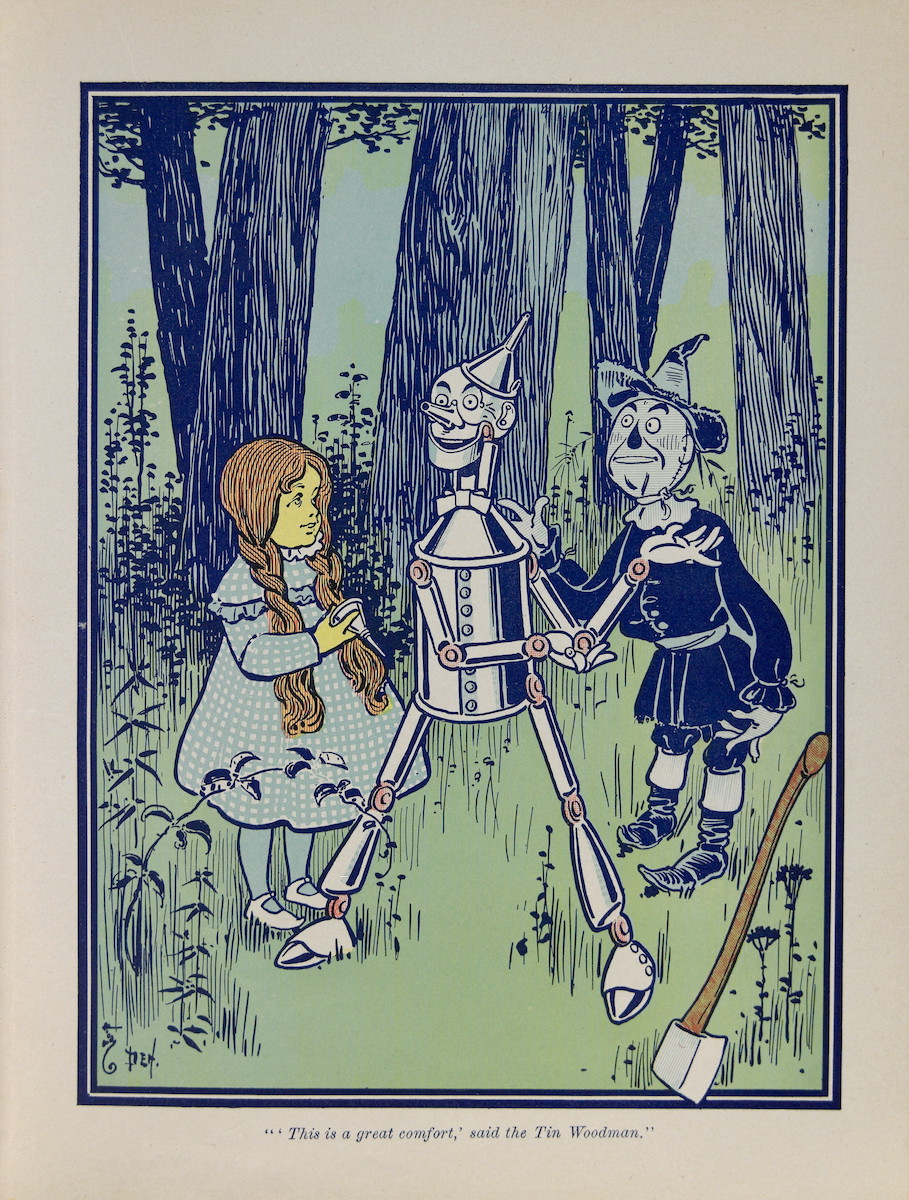
Hackwith has quite a bit of fun reimagining the OZ we all know. Dorothy is a contemporary teen in a hoodie, with a smartphone, but she is still pure of heart. The Scarecrow is much as he was in the film. The Tin Woodsman, Nick Chopper, is a self-made construct of impressive stature and physical capacity, (Baum had written a bit of back story about him. See EXTRA STUFF for this) with a vocabulary reminiscent of Groot. He is accompanied by a bad-ass sister, a knight, (Lettie) who is not at all metallic.

description
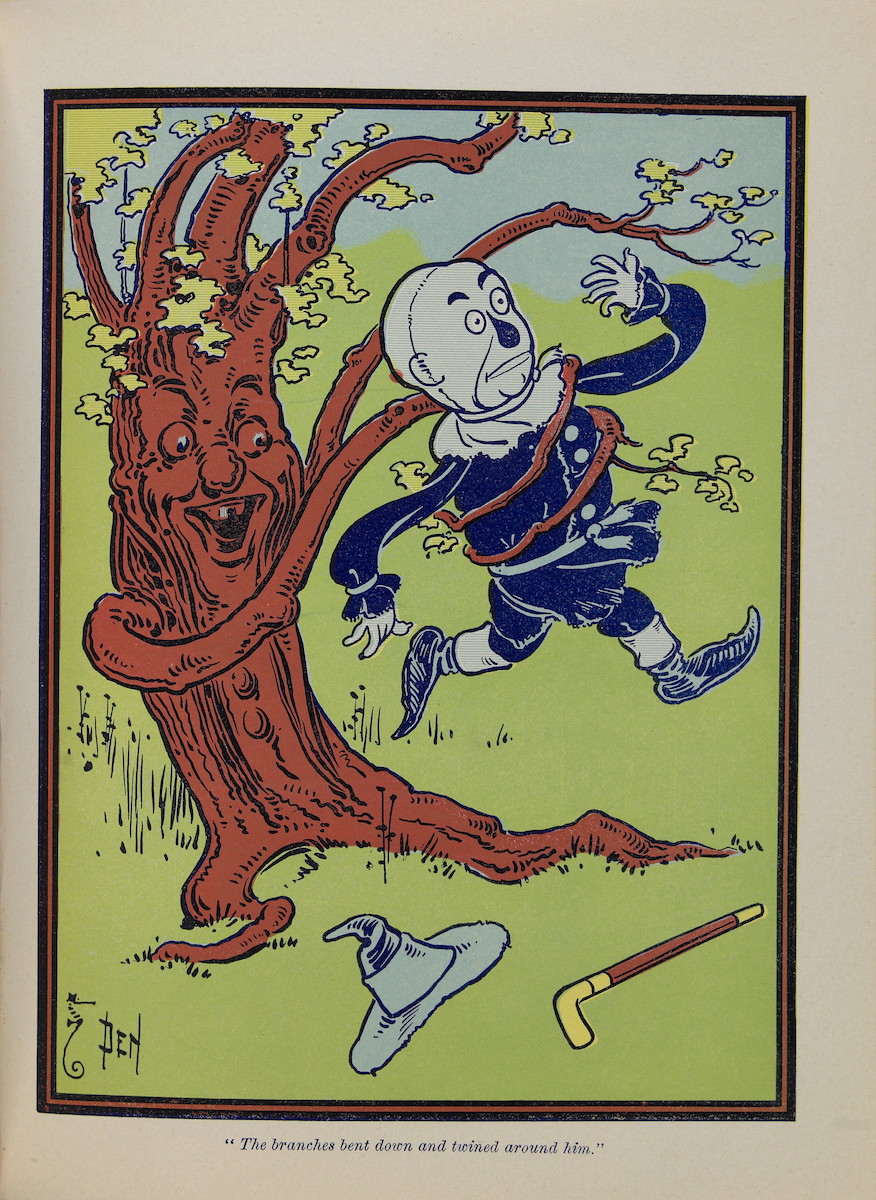
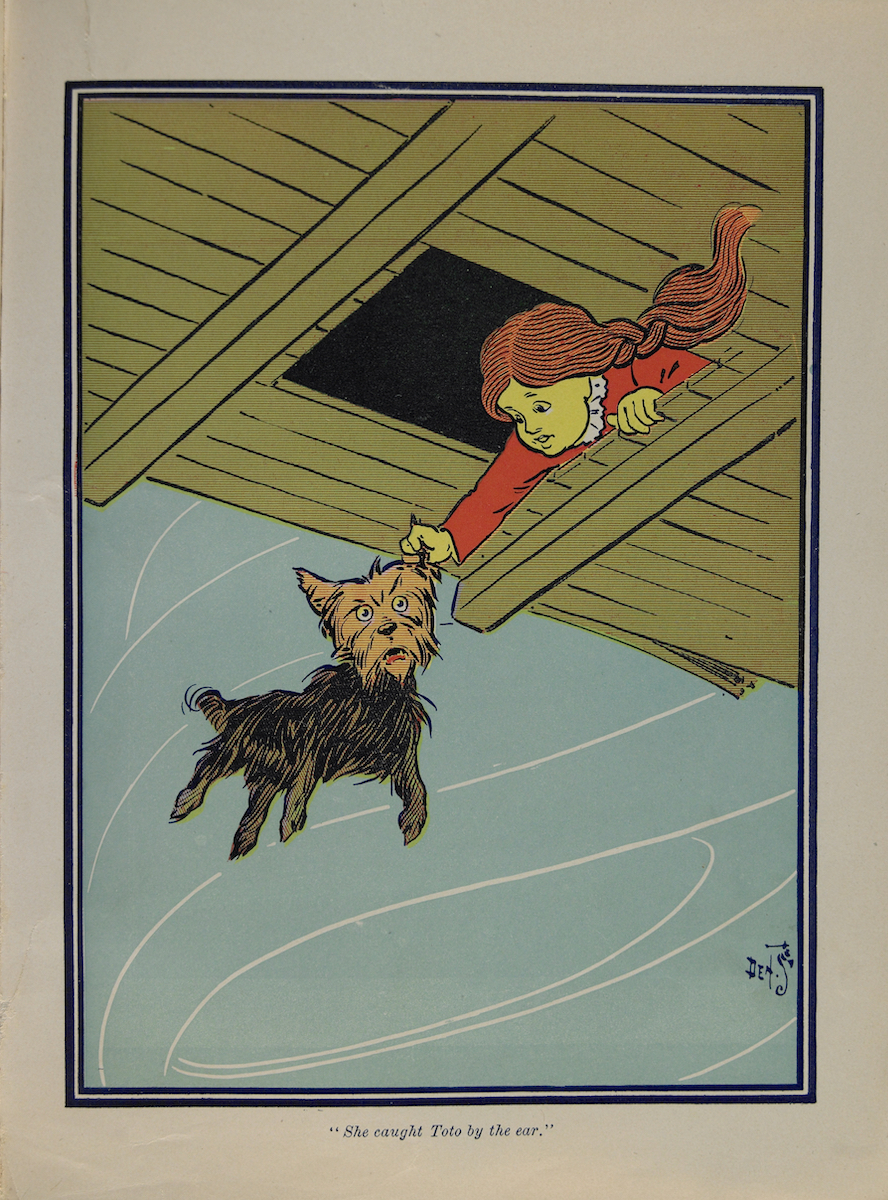
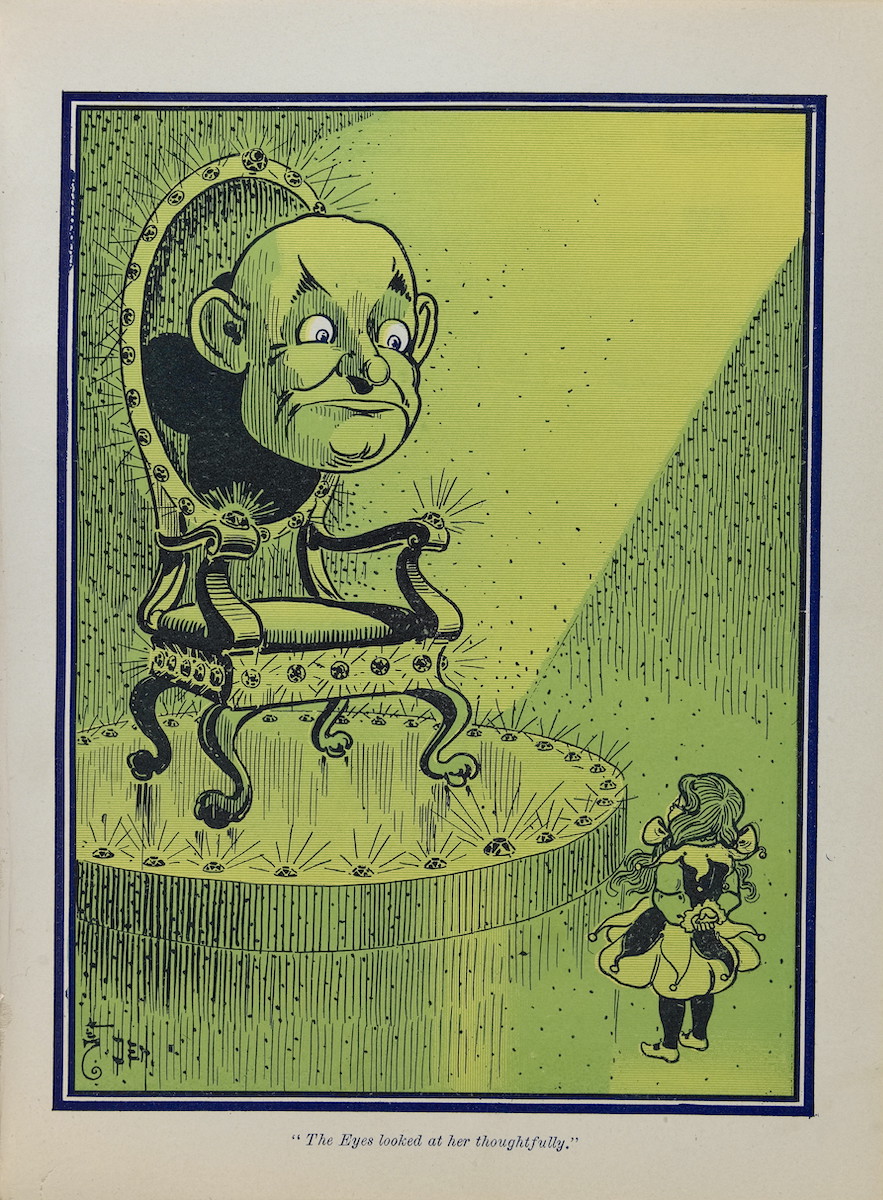
All the Oz illustrations in this review by W.W. Denslow. are from the 1900 publication of The Wonderful Wizard of Oz

The Cowardly Lion is a bit of a scaredy cat but more a very reserved, thoughtful feline. The Wizard may know a thing or two, but is very much a crook. There is a revolutionary bluejay who thinks he is a crow. There is a bubble-propelled witch. And flying monkey sorts loyal to the witch we all know and love. A young one, an engineer, less crusty that her peers, plays a key role.

description

And then there is Toto, front and center, able to speak and be understood, by most folks anyway, full of snarky commentary and struggling with the benefits of being a good dog or a bad dog. I mean if he had been a good dog, and animal control came for him anyway, what was the actual point? He will struggle throughout. Unlike his role in the original story, Toto has a lot more agency here, engaging in adventures away from Dorothy.

Imagine the flattest, grayest, most cornfed place you can imagine. Now add depression and life wrecked by late-stage capitalism. That’s Kansas. It’s like the dull beginning of every ad for pharmaceuticals right before Xylohappitoxin or whatever fixes everything. Sure, I make the best of it. Stealing socks and digging in old lady Brumley’s garden. But me and Dorothy are meant for bigger things, like destiny and boss battles and whatever that “Likeandsubscribe” stuff is the glass-people are hype about. – from the Fresh Fiction piece

Tasks are assigned to our travelling troupe by local bigshots. Bring me this, bring me that. Shoes are given a bit more attention than in the film, silver this time instead of ruby red, in keeping with the novel instead of the film.

There is commentary on politics; the bluejay is fond of holding forth with leftist pronunciations that will be laughingly familiar to any who have had connection with such folks; manipulators encourage people to do the wrong things; a race of beings has been subjugated; a leader pillages a natural environment to the detriment of all. Haves take advantage of have-nots…and on.

When Frank L. Baum sat down to write the The Wonderful Wizard of Oz, his country was in a state of turmoil which might seem very, very familiar to us these days. Economic and international pressures were ripping apart the perceived stability of the middle class. Hotly contested initiatives like the silver standard are referenced in Dorothy’s own silver shoes (changed to ruby for the technicolor movie). Populist leaders are lambasted in characters like the Cowardly Lion and the Emerald City itself can be read as a giant allegory to the capitalist power of Wall Street in Baum’s era. Oz was never a sterile product of pure imagination. The books reflected Baum’s opinions on the realities of the world. – from the Nerd Daily piece

description

This is a satire, so there are many fun flicks at the source material, as well as the political scene. And homages as well. Of course, it helps to be familiar with more than merely the 1939 film. The original novel would be a good place to start. The Broadway show and then film of The Wiz, and many more. L. Frank Baum wrote fourteen Oz novels, and short stories beyond. Many were written under pseudonyms. And even after Baum died, his publisher continued publishing Oz books by other writers. Gregory Maguire’s 1995 novel, (then Broadway show, then film) Wicked, and several subsequent novels, offer more source material. And there are even many more Oz books by other writers.

description

Of course, any literary road trip is a journey of self-discovery. Toto will resolve some things; Dorothy will plot a course for herself; and the rest of the gang will find their ways forward as well. But as with any road trip, it is the journey that is of interest and not the ultimate destination(s). Dorothy’s (and Totos’) actual feelings about Kansas are given a look. Dorothy has a the chance to be her own person in a challenging world, and consider what she might do with herself if given the opportunity. There is plenty of resonance here for many of us who felt, for various reasons, constrained by our beginnings.

You ever feel trapped in a family you don’t belong in? In a place that’s just so . . . so that it’s suffocating? That you know there’s more, so much more, out there, and it’s worth seeing, and every day you wake up in the same bed is like drowning a teaspoon at a time? I never wanted—I just . . .” She took in a sharp breath, catching herself. Her gaze refocused away from the window and back on me. For a flicker beat she looked like a duotype print of Dorothy. Hair obscured in soft shadow, a dark wardrobe that could have included the ratty tee Dorothy slept in when she finally peeled off the hoodie on the weekends . . . and a face so full of hunger-pang sadness, it could swallow the world with those wide eyes.

Hackwith’s look at the surviving wicked witch is a delight.

There may be no place like home, but who says we can have only one home in our lives? Toto is a fun romp through the OZ of our memories and/or imaginations. It is listed as YA, and I am sure it will appeal to that demo, but it was a fun read, particularly for an old dog like me, with long memories to be touched, revived, and beguiled.

This is the thing tall people, even tall dogs, never understand. Everyone looks at the world from three, four, even five feet up in the air. That’s where all the deception is. Everyone makes sure things look nice from that angle. Tables are kept tidy. Skirts are pressed. Floorboards are swept. Railings are dusted. Everyone wants to make a nice impression, tell a nice story from their point of view.
But when you see the world from five inches off the ground? That’s when you get the unvarnished truth.

Review posted – 01/31/25

Publication date – 11/12/24

I received an ARE of Toto from Ace in return for a fair review. Thanks, folks, and thanks to NetGalley for facilitating.

This review is cross-posted on Goodreads. Stop by and say Hi!

=======================================EXTRA STUFF

Links to Hackwith’s personal, FB, Instagram, and Twitter pages

Profile – from Penguin Random House

A. J. Hackwith (she/they) is (almost) certainly not an ink witch in a hoodie. She’s a queer writer of fantasy and science fiction living in the woods of the Pacific Northwest with her partner and various pet cryptids. A.J. is the author of a number of fantasy novels, including the acclaimed LIBRARY OF THE UNWRITTEN fantasy trilogy. She is a graduate of the Viable Paradise writer’s workshop and her work appears in Uncanny Magazine and assorted anthologies. Summon A.J. at your own peril with an arcane circle of fountain pens, weird collections of rusted keys, and homebrew D&D accessories.

Interview
—–Writers Digest – A. J. Hackwith: On the Fortitude of Little Dogs – with Robert Lee Brewer

Items of Interest from the author
—–Fresh Fiction – . J. Hackwith | Conversations in Character with Toto
—–Google Play Books – excerpt
—–Wikipedia – Tin Woodman – on how Nick Chopper became the Tin Woodman as per L. Frank Baum
—–Nerd Daily – Storytelling Is Political, And That’s A Good Thing

Items of Interest
—–Gutenberg – The Wonderful Wizard of Oz by L. Frank Baum
—–Gutenberg – The Tin Woodman of Oz by L. Frank Baum
—–Youtube- Heartless – The Story of the Tin Man – 22:48
—–Wiki – Groot

Leave a comment

Filed under Fantasy, Fiction, YA and kids

Cats on a Pole by Betsy Robinson

book cover

Harmony thought about cats as she rolled out of bed and staggered to the bathroom. Her favorite cat was the one that used to get stuck on top of a telephone pole in front of the house where she grew up. At least once a month in the warm weather, she’d hear the neighbor kids yelling, “Cat’s on a pole!” as they gathered around to taunt the poor thing.
Harmony would watch the scene from her kitchen window, and a couple of times she tried to thought-talk the cat down. “Are you out of your mind?” the cat would answer. “They’ll kill me.”

When he was forty-three, he met Judy. By then, construction work had taken second seat to massage therapy, where he discovered he had a gift.
He didn’t understand how it worked; he just knew that when he touched people, his hands grew hot, his heart exploded, the room filled with colors, and sometimes helpers in subtle bodies would instruct him where to touch. And the clients felt better.

Harmony and Joshua have special abilities. You might even call them superpowers. As with most such talented people, that has not necessarily led to them being happy. Joshua makes a living running healing classes at his own studio. He has always had what seems a pheromonic gift for attracting women. Woof! But commitment has never been a strong suit. Until he married Judy and they had a baby, Emily. Still, it is tough to resist all those longing gaze from his students and assistants.

description
Betsy with pooch – image from her site

Harmony is forty-something, works at a gardening magazine, is of uncertain ethnicity, having been adopted and having no real memory of her birth parents, and is different from the rest of us. She sees colors around people, auras, and has a sense of smell that allows her to tell about a person’s health, among other things. It is understandable that being in a relationship can be tough if you can pretty much read the other person’s thoughts and feelings. Insightful? Yes, very literally. She thinks of it as being about energy, hers, others, an experiential milieu no stranger to her than seeing the usual colors or hearing the sounds of the world are for most of us. But can you live through every day seeing, sensing the world like that? Harmony is in mourning for her best friend, her late pooch and beloved companion of 18 years, Delilah.

Each believes they are unique, and are destined to remain that way. It is pretty clear that these two crazy kids are destined to get together in one way or another. In this magical rom-com, they meet cute on a Manhattan bus, and we are off to the races.

The story centers on their relationship, which, surprisingly, never gets truly physical. Maybe metaphysical? With or without physical touching it is intensely sexual. They are both, because of their abilities, outsiders. Joshua manages by running a school, trying to help people find the abilities they have, but do not recognize. He is able to direct his energy to healing as well. ”We all have this capacity,” says Robinson in her video promo for the book. She has been involved for a long time with spiritual psychology and healing arts, so brings an interesting perspective to Joshua and Harmony’s capacities.

[In therapy] I was talking about how I reacted to various people in the office. There was one guy there who wanted an office wifey. I couldn’t stand this guy. Every time he would approach me it was like I was getting slimed with ectoplasm. Etheric gunk would come over me. I wanted to take a shower.

Harmony gets more ink of the two, with a large piece of that her interactions with her therapist, Doctor Thompson. These are fabulous.

Spectral beings are also a considerable presence. Ghosts? Angels? Something else? Like Julie Jordan in the musical Carousel, Harmony’s favorite musical, both Joshua and Harmony see or sense presences, which sometimes become active to the point of issuing directions.

Keep an eye out for mirrors, an image that pops up multiple times. Can you actually see yourself? Or does truly getting to know yourself require another person?

There are a few cockroach POV scenes that are hilarious, even to a native of NYC who had to contend with them for a lifetime, sometimes in large numbers. Lord knows, those of us who have spent much of our lives in city apartments can well attest to their persistence, and share Josh’s frustration at their ability to mockingly skitter away from our attempts to extinguish them. Robinson is a funny writer, so there are plenty of LOLs throughout the novel, not all related to bugs.

Cats on a Pole is a moving story about people searching for…something, love, companionship, understanding, truth, connection, release. There will be tears as well as laughs. The novel also offers a deeper perspective on spirituality and the meaning of death. It all builds up to a surprising climax, so buckle in. These cats may be stuck atop a pole, (or multiple poles?) getting some temporary safety, but they also gain a broader view of the world, and so will you.

What was extraordinary were her colors—raw red and orange energy around her torso, a deep indigo, bluer than the bottom of the ocean with radiant purple wafting through it vibrating so fast above her head it made him feel faint just to watch it. But watch it he did. How could he not? Her desire was direct and raw.

Review posted – 07/05/24

Publication date – 07/02/24

I received an eBook version of Cats on a Pole from the author in return for a fair review. Thanks Betsy.

This review is cross-posted on Goodreads. Stop by and say Hi!

=======================================EXTRA STUFF

Links to Robinson’s personal, Twitter and FB pages

(Partial) Profile – from her site

Betsy Robinson was raised an atheist and went on to make her living as a writer and editor of spiritual subject matter: as managing editor of Spirituality & Health magazine for six and a half years and as an editor of spiritual psychology and books about shamans and traditional healers.

She is or has been an actor, a playwright, an essayist, an editor, a freelance writer, messenger, paralegal, legal secretary, chambermaid, IHOP hostess, fortune cookie writer, novelist, and more. Cats on a Pole is her third novel. Plan Z was published in 2001 and The Last Will & Testament of Zelda McFigg came out in 2014.

Interviews
—– Ectoplasmic Inspo + Publisher at 73: Betsy Robinson – mostly on becoming a publisher
—– Why Publish “Cats on a Pole” and “The Spectators” Now? self-interview – video – 4:25

My review of an earlier book by the author
—–The Last Will & Testament of Zelda McFigg

Songs/Music from Carousel – Harmony buys a CD of the 1987 revival
It does make one wonder if Harmony’s last name was an homage to the composer.
—–What’s the use of Wond’rin
—–The Carousel Waltz
—–You’ll Never Walk Alone
—–If I loved You

Items of Interest from the author
—– Her promo video
—–Book trailer
—–Betsy reads from the book

1 Comment

Filed under Fantasy, Fiction, Reviews, Romantic Comedy

The House of Last Resort by Christopher Golden

book cover

A forty-minute drive from the volcanic Mount Etna, Becchina should have been alive.
Instead, it was the corpse of a town that didn’t even realize it was already dead.

A low scritching noise caught his attention, and he swung the flashlight beam down to the right, where the natural tunnel and the man-made wall formed a dark and jagged corner. Tiny, putrid-yellow eyes glittered in the shadows.
“Jesus Christ!” Tommy hissed, jerking backward in revulsion as the flashlight beam illuminated the foot-long rat crouched in that corner.
Silent, twitching, the rat stared brazenly up at him, unafraid. It watched him with apparent disdain, as if to let Tommy know that he was the intruder here, not the rat.

A deal that is too good to believe. Ownership of an abandoned hilltop house in a Sicilian town (Becchina, a made-up town, – buh-kee-na) for a single euro, as long as you agree to live there for five years and invest 50K euros fixing it up. What could possibly go wrong? Tommy and Kate Puglisi see this as a once-in-a-lifetime opportunity. A chance for a much better future than they could ever afford in Boston.

description
Christopher Golden – Image from MichelleRLane.com

The world seemed to be unraveling every day. American culture seemed to be rotting from the inside out, manipulated by an amoral oligarchy whose worst enemy was young people who didn’t want to play their game, and Kate and Tommy were happy to be counted in that category. The irony had not been lost on them, that the nineteenth and twentieth centuries had been defined by people leaving the so-called Old World to seek their fortunes in the New World, and now she and Tommy were doing the opposite, seeking new life in the Old World. But they both believed that earlier generations had it right—a slower life, a smaller circle, a focus on home.

That Tommy’s family had come from Becchina gave it an additional draw, a chance to spend time with his grandparents, whom he loved and very much wanted to see lot of in their final years. The importance of that is magnified by the fact that both of Tommy’s parents are dead. Tommy and Kate are on extended time off from work, so can attend to getting things fixed up before returning to their jobs, remote jobs, which allows them the freedom to live anywhere. And they do not yet have children.

Of course the house comes with some unadvertised extras. The book opens with:

The rats are like fingers.
No. That’s not right. Fingers can reach out, can grasp and extend. The rats are not like fingers at all. They are periscopes, like those on submarines, each able to give its captain only a limited view of the world above. From their place below, among the dead, the lost ones can see only as far as the rats can see. But they are patient, and so they wait. And they let the rats run.

Uh oh. Squatters. Toss in being within commuting distance of Mount Etna to shake things up. Oh, and that lady down the hill who is always staring daggers at them whenever they pass by. And the family, who is warm and welcoming but not altogether forthright about the history of the town or the house. On the other hand, there is a group of other new arrivals, lured by the same opportunity. They call themselves The Imports. It’s fun seeing Tommy reconnect with famiglia. He and Kate slowly get to know the town and some of its residents, make friends, and come up with a plan to boost the local economy. Can-do Yanks in action.

But things keep happening. Kate thinks she sees someone in the house, but did she really? A tremor arrives soon after they do. There is a part of the house that the R/E agent somehow managed to overlook when showing the place. A door that was locked, but then is mysteriously open. Golden makes generous use of Gothic fiction features (see abbreviated list in EXTRA STUFF) to give you chills.

Tommy and Kate are actually a happy couple. Many horror books use spectral events as manifestations of underlying relationship problems. Not the case here. This is also not a case in which better-off sorts gentrify an old area, forcing out the locals. Instead, they are trying to save, replenish, and reconstruct, infusing new life into a withered, crumbling, forgotten town. The houses The Imports bought were already abandoned. The newbies are looking to build up not just the houses they occupy but the community as well. So, the dark forces here are not cutouts for obvious social criticism. They are pretty much straight up malignancy coming at you in sundry ways. One way is our visceral reaction to vermin.

The rats that feature in the opening lines persist throughout, gaining in their power to induce fear and loathing. It was a specific choice. In the Book Nook interview, Golden talks about how he believes we mortals have a race-memory fear of rats, the result of plagues that wiped large portions of humanity from the planet multiple times, akin to the natural fear most of us have of snakes, from the days when they were in our immediate environment and posed a mortal threat. Rats give us the creeps.

What you get in The House of Last Resort is a likable pair in peril, with a plentiful supply of scary, a cauldron of creepy, and a shipload of shivers. If you think your basement is a mess, you have no idea. There are nifty twists, some local color and action aplenty to keep you turning the pages. Depending on your susceptibility to such books, you may get a sleepless night or two out of this one. A fun read, a pure entertainment, uncluttered by larger sociopolitical concerns, a fabulous summer read. But probably a bad idea to take this along if you plan to visit Sicily.

A voice crying out. Tommy frowned, wondering if that had been a dream or if it had been what woke him.
The wind gusted, rattling the window in its frame. He listened to see if the cry would come again but heard nothing beyond the sighs and creaks of the old house.

Review posted – 04/05/24

Publication date – 01/30/24

I received an ARE of The House of Last Resort from St. Martin’s Press in return for a fair review, and some DNA samples. Thanks, folks, and thanks to NetGalley for facilitating.

This review is cross-posted on Goodreads. Stop by and say Hi!

======================================EXTRA STUFF

Links to Golden’s personal, FB, Instagram, and Twitter pages

Profile

Golden is a monster of an author who got started, and found success, very early. He has a gazillion publications to his credit and an army-size host of teleplay credits from his years writing for Buffy with Joss Whedon, and plenty more. And then there are the comics. You may have heard of Hell Boy, among those. Here is a list of what he has published, from Fiction DB. I personally think he has elves, or more likely, goblins, chained to computers in his basement helping him crank out such volume.

My reviews of Golden’s two prior books
———-2022 – Road of Bones
———-2023 – All Hallows

Interviews
—–Paul Semel – Exclusive Interview: “The House Of Last Resort” Author Christopher Golden
—– WYSO – Book Nook – ’The House of Last Resort,’ by Christopher Golden by Vick Mickunas – audio – 50:04

Checklist – Partial Characteristics of the Gothic Novel
See my review of While You Sleep for more of this sort
Setting – castle or old mansion – oh, Yeah
Secret passages or creaky doors – of course
Atmosphere of mystery or suspense – fuh shoo-uh
Ancient prophecy or legend – sort of
Omens, portents, visions – tremors, hints from neighbors and family
Supernatural or otherwise inexplicable events – ghost sightings?
High, overwrought emotion – you betcha
Women in distress – actually not so much. Both Tommy and Kate are beset
Women threatened by powerful, tyrannical male – see above

Leave a comment

Filed under Fiction, Horror

The Picture of Dorian Gray by Oscar Wilde, introduction by Jeffrey D. Keeten

book cover

There were moments when he looked on evil simply as a mode through which he could realize his conception of the beautiful.

“How sad it is! I shall grow old, and horrible, and dreadful. But this picture will remain always young. It will never be older than this particular day of June…. If it were only the other way! If it were I who was to be always young, and the picture that was to grow old! For that—for that—I would give everything! Yes, there is nothing in the whole world I would not give! I would give my soul for that!”

Be careful what you wish for.

description
Oscar Wilde – image from Wikipedia

Man sells soul to the devil in return for…something, in this case a body encased in eternal youth, while a portrait takes on the outward manifestation of his aging and his sins. It ends badly, as deals with the devil usually do. This is hardly a unique tale. In fact, it is a bit of a trope, a Faustian bargain. There is a lovely listing here of examples new and old. Absent, of course, is the most famous, and least successful example of a soul-selling, really more of a soul-buying, from Matthew 4:1-11, when the devil made Jesus an offer he actually could refuse. Don Corleone would have been very disappointed.

But it is a bit more complicated than that, as these things often are. It is always a challenge and an adventure to read a classic. Books become regarded as a base part of our culture for reasons. They can establish motifs, or ways of seeing the world that resonate with their contemporary audiences (well, not always) and future generations. They can offer us a portrait of a time and place, a culture, a class, a social or political issue. They can illuminate moral questions, deal in universal themes, offer insight into human motivation, whether individually or en masse. And we come to see them in particular ways. In The Strange Case of Dr. Jekyll and Mr. Hyde, the prior re-pub in this Gravelight series, what one finds in the original is not quite what one might expect, given how popular culture has transformed the story by bleaching out important nuance. That is less the case with Dorian Gray, at least in part because there appears to have been fewer iterations of the tale in popular entertainments. But, nonetheless, our understanding of the story is generally of the bare bones sort. There is plenty of flesh to give those bones some added heft.

description
Jeffrey Keeten – they came to take his furniture, but the only way they will take his books is from his cold dead hands – image from his site

The history of a book matters. Keeten’s introduction offers an excellent take on how Dorian was received at publication. It generated quite a bit of attention on its release. There were many who were not amused. That may have contributed to the fact that The Picture of Dorian Gray is singular in being the sole novel published by Oscar Fingal O’Flahertie Wills Wilde. The subject matter was considered a big no-no in 1890. The Dorian of the title is a man of many tastes, and apparently insatiable appetites. He manages to bring ruin to both men and women. It was not, in particular, the ruination of women that caused a storm. The periodical in which it was first published was withdrawn from bookshops due to the outrage.

Wilde was a very popular writer of the time, wearing his sexuality like a badge. A tough stance to assume in a culture that preferred to sate it appetites and interests discretely. His novel was a shocker for the time in portraying homosexuality in interest, if hardly in action. The painter of Dorian’s portrait is clearly smitten with him, dazzled by his physical beauty, which he sees also as representative of an underlying perfection.

For all the shock of its homosexual content, there is no physical contact of that sort in the pages. (an earlier version may have been more direct) All is insinuation, suggestion, hinting. It is the same technique that has worked quite well for ages in the horror genre. Shadows, rattling chains, creaky doors, unsourced moans. Sometimes we are offered the shocker scene in which the monster is revealed. The Opera Phantom’s mask is pulled off to reveal the horror of his face. Hyde’s deformity is revealed as the window into Jekyll’s soul. And so it is here. Dorian’s true nature is revealed. The “I’m shocked, shocked” reaction of contemporary critics suggests more about what they were projecting onto the novel than what was actually there.

description
The portrait used in the 1945 film by Ivan Le Lorraine Albright – image from Wikipedia

So, what is the horror that is on display? It is the hedonism of the late 19th century English upper class, sashaying about in the interesting, entertaining, appealing drag of philosophy. Henry argues for the unashamedly sybaritic life. Art need have no meaning, no being other than itself. Apply to humans. Is art, is beauty the highest value? When beauty is left to dangle free, disconnected from any higher value, what is its impact on the world? Actions have no moral content. It is in fact a positive good to live a life dedicated to the primitive accumulation of sensation, through the arts, through physical pleasures, not just of sex, but of sight, smell, sound and touch, to experience beauty in all its forms. Try everything. Art for art’s sake in the guise of human experience. Some people have an amazing ability to come up with excuses for their excesses, explanations, some reason for why they shouldn’t be held accountable for their actions. Like the poor and taxes, we will always have the morally challenged, the malignant narcissists, the sociopaths with us.

beauty is a form of genius—is higher, indeed, than genius, as it needs no explanation. It is of the great facts of the world, like sunlight, or spring-time, or the reflection in dark waters of that silver shell we call the moon. It cannot be questioned. It has its divine right of sovereignty. It makes princes of those who have it. You smile? Ah! when you have lost it you won’t smile…. People say sometimes that beauty is only superficial. That may be so, but at least it is not so superficial as thought is. To me, beauty is the wonder of wonders. It is only shallow people who do not judge by appearances. The true mystery of the world is the visible, not the invisible….

But if this was on the up and up, there would have been no need to keep one’s behavior secret. It is clearly a place where freedom crosses the line into license. The practitioners of such a “philosophy” knew they were up to no good. They merely wanted to hide from the responsibility. Dr Jekyll was quite happy to have an alter-ego he could let loose on the world, to have the sorts of fun he could not have as himself in public view. They knew, not just that their behavior was wrong, not just that it ran afoul of extant mores, but that their reasoned explanation was taffeta thick.

description
Hurd Hatfield as Dorian in the 1945 film – image from Wikipedia

It is not the barely latent bisexuality of the novel that marks Dorian as fallen, it is that he had ruined peoples’ lives, men and women, not by having sex with them, (which is suggested, but never acted out on the pages) but by corrupting them in various ways, by causing them to become as self-centered, as pleasure-seeking as he was. A person can get away with this if he or she is wealthy enough. Paying off porn stars to keep quiet about an extramarital fling certainly fits into such a scenario. Dorian manages to keep his scandals at bay with the use of his wealth.

It is as true today as it was when Wilde was writing this book, the selfishness, the hedonism, the amorality of the wealthy feeds on the blood and life forces of those they exploit, few of whom can afford to fight back directly. (You go, E. Jean!) I imagine this is a core of what Wilde was getting at, and the real reason his critics were so angry at him.

Dorian does not come to his corruption unaided. He arrives as a beautiful young man, who is seen as being as pristine inside as he is on the surface. The Victorians were very concerned with exteriors, believing that they served as personal screens displaying to the world a person’s character. But then he is introduced to Lord Henry Wotton. Henry proceeds to emit a torrent of nonsense, albeit amusing nonsense, mocking the morals of the time. Wilde, speaking through Henry, is cattier than my living room when I shake a container of treats. Henry offers a torrent of false, cynical aphorisms, suitable material to be printed on small pieces of paper and tucked inside poisoned fortune cookies. Were he opining today, Henry would be posting outrageous clickbait opinions on Twitter. Here are a few examples. They are legion, and will sound familiar in tone to characters from Wilde’s 1895 theatrical triumph, The Importance of Being Earnest

…beauty, real beauty, ends where an intellectual expression begins. Intellect is in itself a mode of exaggeration, and destroys the harmony of any face. The moment one sits down to think, one becomes all nose, or all forehead, or something horrid.

…the one charm of marriage is that it makes a life of deception absolutely necessary for both parties. I never know where my wife is, and my wife never knows what I am doing. When we meet-we do meet occasionally, when we dine out together or go down to the Duke’s—we tell each other the most absurd stories with the most serious faces.

…as for believing things, I can believe anything, provided that it is quite incredible.

It is the cynical Henry who finds in the gullible Dorian the raw material with which to cast the young man into a representative of his very hedonistic view of life. Dorian offers the plasticity of the young to the dubious molding of the amoral. The young man is all ears. He even takes time away from the painter, Basil Hallward, to learn at Wotton’s feet. .

To a large extent the lad was his own creation. He had made him premature. That was something. Ordinary people waited till life disclosed to them its secrets, but to the few, to the elect, the mysteries of life were revealed before the veil was drawn away. Sometimes this was the effect of art, and chiefly of the art of literature, which dealt immediately with the passions and the intellect. But now and then a complex personality took the place and assumed the office of art, was indeed, in its way, a real work of art, life having its elaborate masterpieces, just as poetry has, or sculpture, or painting.

We are offered a bit of background on Dorian, to help explain his vulnerability to Lord Henry’s dark influence. And are even given a bit of theatrical brimstone to explain how the deal with the devil is achieved. Neither really matters much.

description
Angela Lansbury as Sibyl Vane in the 1945 film – image from Wikipedia

Early on, Dorian is smitten with a beautiful young actress, Sibyl Vane, who considers him her Prince Charming. It is Sibyl’s appearance, her elevated acting performances, in addition to her beauty, that attracts Dorian. But when her dazzling talent on stage suddenly vanishes, she can no longer offer Dorian the thing he most admired, and he dumps her, cruelly. It is the first crime to which we are witness, the first time his painting changes. The pursuit of beauty and sensation above all else has claimed its first victim. There will be many more, but most of those bad behaviors take place off screen.

Wilde put all of himself into this novel

“Basil Hallward is what I think I am: Lord Henry is what the world thinks me: Dorian what I would like to be.”

Unlike Lord Henry and Basil Hallward though, Wilde acted on his urges. Unlike Dorian, Wilde was imprisoned for his actions. Unlike Henry’s and Dorian’s depraved indifference to the harm they caused others, it is not clear that Wilde was a cruel person.

Dorian is clearly a corrupt individual. Whether he arrived there unaided or had a push is of secondary importance. Lord Henry is clearly corrupt as well, even though we do not see him engage in any physical acts of treachery. Perhaps the corruption of youth, pulling Luke Dorian to the dark side is enough. Henry and Dorian both represent the worst of the amorality of the Victorian age, the hypocrisy of the upper class. This seems the true target of Wilde’s effort. He is not celebrating amorality, but pointing an accusing finger at it, and letting us know who are its most damaging practitioners. At one point Dorian even shows enough residual humanity to want to turn over a new leaf, not appreciating that to succeed he would need to upend an entire forest. (don’t write. I know that the leaf in question was supposed to mean a book page.)

Keeten goes into some detail on the derivation of the name Dorian Gray. Why not Loki? There are very concrete reasons. In fact, there is a lot you will enjoy learning when you check out his introduction. It is rich with detail about the author, the book, and the controversy that surrounded its publication. It also looks at the lasting impact Wilde has had on modern culture. It will definitely increase your appreciation of this wonderful novel.

I suppose there might be a modern version in which Gray and his portrait are linked by quantum entanglement, or one should be made if it does not already exist. The battle between inner self and outer manifestation is certainly an eternal literary theme.

For the second time, a sojourn down the Gravelight illuminated alley of classic horror has proved stimulating and enlightening. From Keeten’s smart, incisive introduction to the chance to see what the original of a household-name classic was really on about, The Picture of Dorian Gray offers a richly rewarding reading experience, clever, funny, dark, shocking, intelligent, satirical, and satisfying.

There were moments when he looked on evil simply as a mode through which he could realize his conception of the beautiful.

Review posted – 02/23/24

Publication date – 11/6/23

I received copy of The Picture of Dorian Gray from Gravelight Press in return for a fair review. Thanks, folks.

This review is cross-posted on my site, Goodreads. Stop by and say Hi!

=======================================EXTRA STUFF

Links to Keeten’s personal, FB, and Instagram pages

Prior reviews for books intro’d by Jeffrey Keeten
—– Exhumed: 13 Tales Too Terrifying to Stay Dead – edited by David Yurkovich
—– The Strange Case of Dr. Jekyll and Mr. Hyde – edited by David Yurkovich

Items of Interest
—–Les Cent Nouvelles – a book of coarse French stories referenced in Chapter 4
—–Margaret of Valois
—–Manon Lescaut – an 18th C. novel in which young lovers live a life of sexual and social freedom, while giving morality little thought – referenced in chapter 4
—–The St. James’s Gazette – referenced in chapter 10
—–Elephantis – author of a sex manual in Classical Greece – noted in Chapter 11
—–Against Nature by Joris-Karl Huysmans – cited in the introduction – Dorian’s reading of this 1884 celebration of sensory gluttony contributes to his corruption
—–Wiki Deals with the devil in popular culture

2 Comments

Filed under classics, Fantasy, Fiction, Historical Fiction, Horror, Literary Fiction, Reviews

The Invisible Hour by Alice Hoffman

book cover

in every fairy tale girl who is saved is the one who rescues herself.

people in love were such fools, they made up excuses, they wound up doing as they pleased no matter how much good advice they been given.

The Invisible Hour is a twice-told tale of a mother and a daughter.

Ivy Jacobs’ Beacon Hill family did not exactly treat it as a crimson-letter day when the sixteen-year-old informed her parents that she was pregnant by a feckless Harvard sophomore. Despite her tender years, Ivy wanted to see the pregnancy through and keep the baby. Decisions and plans were made, none of them involving input from Ivy. The newborn would be put up for adoption. Ivy bails, getting as far away as she can, which turns out to be a sort-of commune in western Massachusetts.

description
Alice Hoffman – image from Penguin Random House – shot by Alyssa Peek

Mia Jacob is the daughter Ivy bore. We meet her at 15. Living in the place to which her mother had fled, The Community. More of a cult really, an authoritarian farm where the leader’s will is law. Joel Davis took Ivy in, married her soon after she’d arrived, so is Mia’s step-father. But child-rearing is communal here, so parenting is not what you or I would recognize. You will recognize the cult-leader, control-freak personality Joel wears like the headgear sported by the QAnon Shaman. Vanity is supposedly being punished, but it is accomplishment, growth, intelligence and independence that are the targets. He likes his followers unquestioning and compliant.

Ivy has stolen parenting moments over the years, so has had a hand in helping Mia find her true self, a young woman who is curious about the world, eager to learn, to investigate, to explore, to read. Discovery of her criminal reading marks her for punishment. When we meet Mia she is, as her mother was, a teen about to flee her oppressive environment.

Although we learn about and spend time with both women, it is Mia who is our primary focus. In a dark time, she considers suicide, but, fortuitously, reads a book that saves her, changing her life, giving her hope, The Scarlet Letter.

We follow her coming of age, assisted by her mother and an understanding librarian in the town where The Community sells their produce.

Her passion for Hawthorne is such that she finds in it a magical power. Alice Hoffman loves her some fairy tales, so it will come as no great shock that one fine day Mia finds herself transported back to the 19th century, and into the presence of her literary love object. Complications ensue. In those, however, we get a sense of Hawthorne, his personality, his material conditions, his family and friends, and his writing challenges. Nice looking fellah, too, to go with that oversized talent.

There is some wonderful imagery woven into the novel. The notion of invisibility is large among these. There are times in which it might be useful to go unseen, as in when one is doing something for which one might be punished, or which are simply secret. On the other hand, it is not so wonderful to be unseen in normal human interactions. Like “Yo, dude, human here. Whaddaya? Blind?” There is some literal invisibility as well.

Apples are a core element as well. There is a particular breed of apple grown in the area, which is no Eden. They seem less associated with The Fall than with a push. Joel uses leaves of that apple tree as a threat. One could certainly see his actions as serpentine. Mia even decides never to eat apples, given the associations she has for them with The Community. Howdaya like dem apples? Johnny Appleseed comes in for some attention, with plantings of his effort bearing local fruit.

The woods as a magical place gets a visit or two. Indeed, magical things go on there. Strange people and buildings appear. There is even one “Once upon a time” in the book. The Woods is where Mia goes to escape.

Much of the tension in the book centers around women taking control of their own lives. This happens in various ways. There is the usual disobedience one would expect, with the most daring taking the greatest risks. Reading figures large in this, as subservience is sustained under the lash of forced-ignorance. Reading is the gateway drug to independent thinking, and dreaming of better. Some women even learn herbal medicine, to see to their needs. The comparisons of the modern day with the repressive Puritan world depicted in The Scarlet Letter are clearly drawn. Plus ça change…

I think it’s a bad idea to write for the moment because the moment passes so quickly. The other thing about time is that what’s right and what’s good and what’s accepted suddenly becomes not. I thought about that with the way women were treated in “The Scarlet Letter,” the way that the Puritans blamed women, and they believed in original sin and that women were responsible for that because of Eve. It all changed, but then it changes back. And then it changes again. A lot of the things that women are coping with right now are not that different, really. The judgment against women. – from the Salon interview

There is a garden in town where all the plants are red. It may feel familiar to frequent readers of Hoffman.

This new book [The Invisible Hour] actually takes place in a town where I wrote a book of connecting stories about called The Red Garden, so it’s the same place. It’s just a novel that takes place in that town. – from the Salon interview

I consider myself an Alice Hoffman fan. While I have not read all her books, I have certainly read more than a couple. Any reader of her books knows that there are certain things one can expect. Among other things, there will be an engaging lead, facing difficult choices, and there will usually be bits, at least, of magic, often of a fairy tale sort. So, one cannot really gripe about a time-travel element pushing things too far, particularly when done in the service of giving us a closer look at a literary icon. My sole gripe is that I felt that the baddie was given too much magical license to pursue his dark ends.

Otherwise, despite it’s title, The Invisible Hours very much deserves to be seen. It offers not only an uplifting, engaging tale of empowerment, but an homage to one of the greats of American literature, and long-form praise of the power, the importance, the necessity of reading. I am sure we can all see the value in that.

“Q: Did you set out to write a novel so deeply rooted in women’s empowerment? How did it evolve to include time travel?”

“A: I started to think about The Scarlet Letter and how modern-day issues for women are not that foreign from issues in that time period. I’m not certain I realized when I first read Nathaniel Hawthorne’s great novel what the deeper meaning of his heroine’s situation is—she has no say over her body or her choices and yet, she does make her own choices. It’s a very brave book.
I’ve always wanted to time travel and been drawn to books about time travel. I think during the time of Covid, when I was writing this, more than ever I want it to be in another time period.”
– from A Conversation with Alice Hoffman, an appendix in the book

Review posted – 12/22/23

Publication date – 8/15/23

This review is cross-posted on my site, Goodreads. Stop by and say Hi!

=======================================EXTRA STUFF

Links to the author’s personal, Instagram and FB pages
Profile

Other Hoffman books I have reviewed:
—–1999 – Local Girls
—–2003 – Green Angel
—–2004 – Blackbird House
—–2005 – The Ice Queen
—–2011 – The Red Garden
—–2011 – The Dovekeepers
—–2017 – Faithful
—–2017 – The Rules of Magic
—–2019 – The World That We Knew

Interviews
—–Salon – “I want to believe”: Alice Hoffman is always seeking magic, practical and otherwise by Alison Stine
—–Shondaland – Alice Hoffman Talks Her Latest Novel, ‘The Invisible Hour’ by Sandra Ebejer
—–Harvard Review – An Interview with Alice Hoffman by Christina Thompson

Song
—–Agnes Obel – Brother Sparrow – relevance to the chapter title

Item of Interest from the author
—–Salon – Alice Hoffman: Five amazing tips to help you write your novel

Items of Interest
—–Wiki on Nathaniel Hawthorne
—–Wiki on Johnny Appleseed, mentioned multiple times
—–Gutenberg – full text of The Scarlet Letter
—–Good Will Hunting – Howdaya like dem apples?
—–Wiki on the QAnon Shaman

Leave a comment

Filed under Fantasy, Feminism, Fiction, Historical Fiction, Literary Fiction, Religion

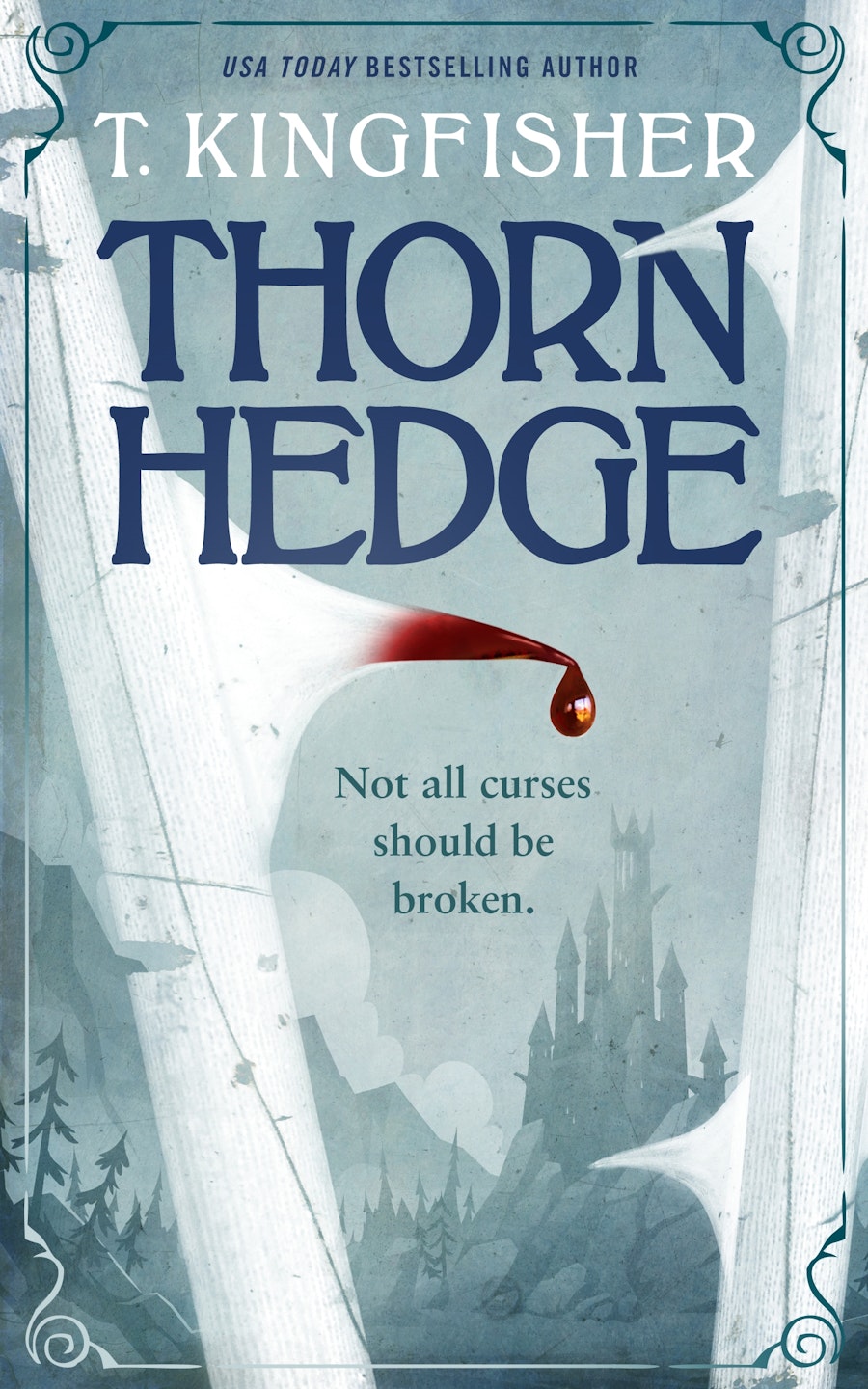
Thornhedge by T. Kingfisher

book cover

In the early days, the wall of thorns had been distressingly obvious. There was simply no way to hide a hedge with thorns like sword blades and stems as thick as a man’s thigh. A wall like that invited curiosity and with curiosity came axes, and it was all the fairy could do to keep some of those curious folk from gaining entrance to the tower.
Eventually, though, the brambles had grown up around the edges—blackberry and briar and dog rose, all the weedy opportunists—and that softened the edge of the thorn wall and gave the fairy some breathing room. Roving princes and penniless younger sons had been fascinated by the thorns, which were so obviously there to keep people out. Hardly anybody was interested in a bramble thicket.

How does anyone manage? There are too many streams and they all flow and all of them could be good and there’s no way to know. How does anyone ever choose to do anything?

Match.com profile – Languid Lady – Wanna meet a real princess? Low maintenance, fond of comfortable bedding, long walks in dreamland, quiet weekends at home in the castle. If you are looking for consistency, a quiet, luxurious, restful life, send me a message. Only real princes need apply. Let’s make some magic together. (Submitted for a friend)

description
T. Kingfisher aka Ursula Vernon – image from Open Library

We all know, or should know, the story of Sleeping Beauty, whether the Disney version or some other. Beautiful princess is tucked away in a tower for a seemingly endless nap, done dirt by an evil fairy. Kingfisher, as she has done many times with established tales, offers a different perspective.

description
Illustration for Charles Perrault’s La Belle au Bois Dormant from Histoires ou Contes du Temps passé: Les Contes de ma Mère l’Oye (1697) – image from Wiki

This time, what if it was not a dark force, but a kind one that had caused all those zzzzzzzzzs? What if there was a good reason for doing so? What is someone was charged with making sure that no one disturbed the sleeper, however many years, decades, centuries might pass?

One thing I like to do with fairy tales is to look at them and go “How can I make this even worse?” – from the Grim Dark interview

I am not so sure that Kingfisher’s tale really is a worse version. Well, maybe worse that the Disney version. But far from the worst. There is one (and there are others as bad) in which a wandering king happens by the castle where a sleeper named Talia is housed. He decides this is a great opportunity for him, absconds with her virginity, and leaves the unconscious Talia pregnant with twins. What a guy!

We get a look at some of the trappings of fairy tales, including a fairy civilization that is maybe not so nice. Another, the Greenteeth, who raised her, provide our heroine with her other side abilities. These include the power to switch back and forth between human and toad form, which can come in handy. Her name is Toadling. She has been dutifully standing guard over the castle in which the sleeper has been kept for multiple centuries.

description
From MY BOOK OF FAVOURITE FAIRY TALES ILLUSTRATED BY JENNIE HARBOUR. – image from Wiki

Until one day, a knight arrives. Halim is not one of those spoiled, handsome, armored snots who usually trot through such tales, slaying dragons and rescuing (abducting?) fair maidens. He is a Muslim, for one, and, not being a first-born, not exactly in line for a nice inheritance.

Being a knight isn’t about being religious, you know, so much as it is to figure out what to do with your extra sons so they don’t tear up the family seat. Every now and then someone gets the idea we should start chopping each other’s heads off, but in practice, the Pope squats in Rome like a spider and the caliphs glare at one another over their walls, and the rest of us get along as best we can with each other.”

As is obvious from this, Halim comes across as a pretty decent sort, mostly there to check out something he had read, about a long-form sleeper in a tower. I suppose there might be an angle of interest in forming an alliance with a landed bit of royalty when your own prospects are a bit slim, but really, it is mostly curiosity. We are led to think that he is a good guy by the conversations he has with Toadling. But is he on the level with her, or is he trying to manipulate her into letting him past the massive thorn hedge that surrounds the castle?

description
The Sleeping Beauty by Edward Frederick Brewtnall – image from Wiki

For her part, Toadling is riven with guilt for having messed up a magical task she had been assigned, thus her lengthy tenure at this post. She is dutiful, and honor-bound.

Toadling tells Halim her (and thus the sleeper’s) story in bits, so that by the time we are nearing the end, we know all there is to know about how the whole princess-in-a-tower situation came to be, the decisions that were made, the actions that followed and the active perils.

description
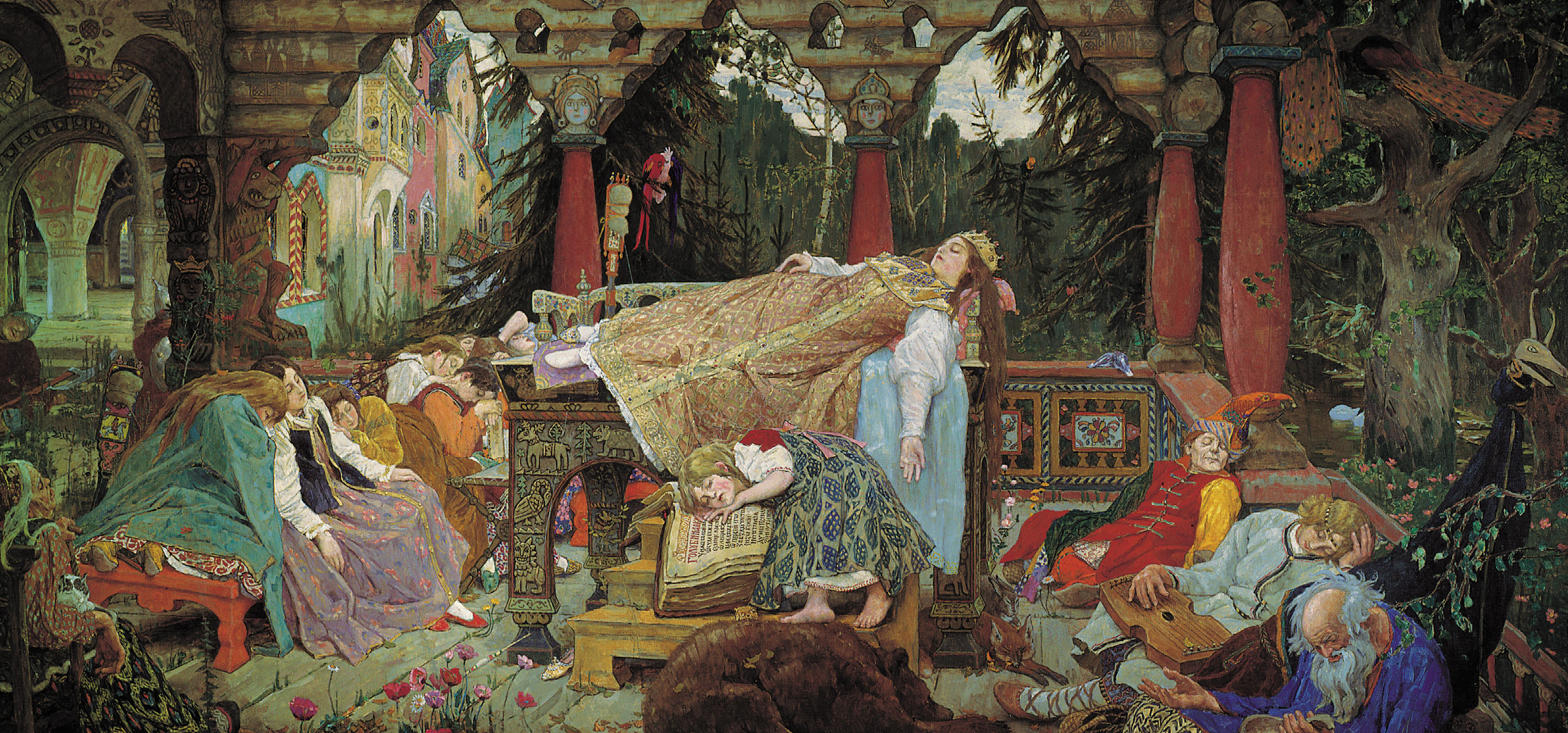
The sleeping Beauty by Viktor Vasnetsov – image from Wiki – Showing the somnolence of the entire household – not so much in this telling

There are multiple sources of joy in this novella (30K words). The first is the interaction between Halim and Toadling. Both are modest people. She tells Halim that she is not beautiful, and he says the same of himself.

Practical overworked middle-aged women basically keep the world running…And being myself a rather frumpy middle-aged woman, I write stories about people like me partly because they’re very much who I can write, but also because I want those women to have stories. Sometimes we read fantasy stories in order to pretend we’re someone else, but sometimes we read fantasy stories in order to pretend that people like us can have adventures too. Mind you, if the readers ever get tired of reading about middle-aged gardeners, I’m probably in trouble, but so far, so good. – from the Grim Dark interview

The second is the creative reinterpretation Kingfisher had concocted of the classic tale. It is far from alone. The Sleeping Beauty story first appeared in the 14th century. A later version, adapted by Charles Perrault in the late seventeenth century forms the basis of all later versions, including the one transmitted by the Brothers Grimm. That one was called Little Briar Rose. I am sure you will be excited to learn that there is classification system for fairy tales, called the Aarne-Thompson system. It was news to me that this existed. It is a major tool for folklorists. Sleeping Beauty slots in at Type #410, FYI. There have been many versions over eight hundred years.

The third is Toadling herself. She is such a wonderful character, a good person challenged with outrageous fortune in her life, but holding up because her core is good, kind, and strong. You will quite enjoy spending time with her.

description
Disney’s Aurora – image from ArmChairCinema.com

Thematically, there are walls aplenty in here, the fortress, of course, the thornhedge of the book’s title, and the barriers between the human world and the land of fairy. Halim offers a lovely image for Toadling.

“There’s a very high wall,” said Halim, “according to the imams, called al-A’raf. Between hell and paradise. And if you haven’t been good enough or evil enough to go one place or the other, you live in this wall. But even those people will eventually enter paradise, because God is merciful.” He jammed his chin onto his fist and gazed at Toadling. “It seems like you’ve been stuck in that wall for quite a long time now . . . That’s all the theology I’ve got in me, incidentally, so I hope it’s useful.”
Toadling sighed. “I would like to climb down from that wall,” she admitted.

And there is the wall between Toadling and Halim. Will they break through that one?

description
Sleeping Beauty wakes up after the kiss of a prince — Or –Startled by the presence of a strange man, the young lady sat up while sharply wiping her mouth. “And just who the f&^k are you, dirtbag?” by Otto Kubel- image from Wiki

Bottom line is that Thornhedge is a lot of fun. It takes our expectations and turns them inside out, all the while offering us the welcome companionship of Toadling. This new interpretation of an old tale is rich with creativity. No spindles required. Let Kingfisher put you under her spell and you will be in for a magical read.

Review posted – 10/27/23

Publication date – 8/15/23

I received an ARE of Thornhedge from Tor.com in return for a fair(y) review. Thanks, folks, and thanks to NetGalley for facilitating.

This review is cross-posted on Goodreads. Stop by and say Hi!

=======================================EXTRA STUFF

Links to the author’s personal, Goodreads, and Twitter pages

Profile – from the Fantasy Hive
T. Kingfisher is the adult fiction pseudonym of Ursula Vernon, the multi-award-winning author of Digger and Dragonbreath. She is an author and illustrator based in North Carolina who has been nominated for the Ursa Major Award, the Eisner Awards, and has won the Nebula Award for Best Short Story for “Jackalope Wives” in 2015 and the Hugo Award for Best Novelette for “The Tomato Thief” in 2017. Her debut adult horror novel, The Twisted Ones, won the 2020 Dragon Award for Best Horror Novel, and was followed by the critically acclaimed The Hollow Places.

Interviews
—–The Fantasy Hive – Interview with T. Kingfisher
—–Grim Dark Magazine- Not All Curses should be Broken by Rona Denton
—–Orion Magazine – T. Kingfisher Wrings Hope and Drama from Fairy Tales by Kyla McCallum

My review of an earlier book by Kingfisher
—–What Moves the Dead

Songs/Music
—–Into the Woods – Agony (reprise)
—–Beautiful Dreamer – written by Stephen Foster – performed by Leslie Guinn and Gilbert Kalish

Items of Interest
—–Wiki on Sleeping Beauty – there is a lot here
—–Wiki – The Fairy Tales of the Brothers Grimm (Rackham)/Briar Rose
—–Wiki – Aarne–Thompson–Uther Index

Leave a comment

Filed under Fantasy, Fiction, Literary Fiction, Novella, Romantic Comedy

The Edge of Sleep by Jake Emanuel, Willie Block and Jason Hurley

book cover

Here’s what I can say with some certainty. Something is happening. Case in point: WZPE’s AM news show usually ends at 8am. Not today. They’ve basically got the phone lines wide open, and people are calling in by the hundreds. The last caller just sobbed, “They’re dead, they’re dead, they’re dead,” and disconnected.
There are TV and radio stations all over the state that just . . . aren’t on the air at all.
From my window, if I elevate my chair, I usually have a great view of the mile-long gridlock at the intersection of Monaghan and Wolcott. The traffic lights there aren’t even working, but the intersection’s just . . . dead. No cars that I’ve seen.
Usually by now my upstairs neighbor is jazzercising. But the whole building is strangely subdued. I haven’t heard a single other person.
Perhaps it’s my overactive imagination . . . but I really don’t think that’s the case.
If you have any information about what might be happening, I’ll see you in the comments.
—Posted by Eli Broder, 7/4/25 9:12am

Dave Torres is a security guard at Daxalab. He and his co-worker and best friend, Matteo Leon, are having a bad night. After their shift they head, quite late, to a party only to find the guests mostly gone already. Of course, some are more gone than others. Like the one on the couch whom they had thought was passed out. Turns out he had passed on. Dave goes looking for their host only to find him in bed, in no better shape than the couch stiff. What is going on? And why are the roads so empty?

description
Willie Block and Jake Emanuel – image from Deadline.com

Off to the hospital they head, to see that the bodies are handled, or, out of the frying pan…The body count there is impressive, and growing. They meet a tough nurse, Linda, who is doing her best to keep it all together, but things are clearly falling apart. Dave gets that sleep is the trigger and desperately calls his ex to warn her. Katie finally joins them.

A large room, lined with storage bins and shelves, has been transformed into a morgue. Shoved along the west wall are gurneys bearing zippered white bags. Human-sized bags, arranged haphazardly, as though they were rolled into the room and released to drift where they may. Which is exactly what happens next: An orderly in a white smock bangs into the room through an adjacent door, back first, then drags a fresh gurney into the room, pivots, and releases it, sending it spinning across the floor. It thumps into another gurney, and both roll in separate directions. The orderly, not pausing to admire his handiwork, disappears through the door again.

So we have a small group that sets out to decode the situation. There is a separate pair. Eli Broder (of the opening quote) is confined to a wheel chair. Boston is quiet, too quiet. His online messages begging for information on what is happening receive scant response. Millie is a narcoleptic coder, in the process of being fired from her job, who finally responds. She goes to him and they face the situation together.

description
Podcast episode 3 – the Black Triangle – image from Markiplier Wiki

These are our two primary threads. Third is a lookback for Dave to events from this childhood. He has had sleep issues all his life, for which he has received some serious medical intervention. His miseries include nightmares about an elephant and a whale since he was a kid. When his dreams slip into the waking world, his life becomes seriously troubled.

They all figure out in short order that going to sleep is a bad idea. To sleep, perchance to dream? Nah. More like to sleep, perchance to die. Each group goes through challenges in progressing to understanding, and getting, geographically, from where they are to where they want to be. Ergo, road trips. During these, we get more insight into the characters. As they begin to glean some truths behind the sleep-bomb that appears to be wiping out humanity, it becomes harder and harder to function, even to think, as their fatigue become profound. How long can the primaries remain awake? Where can they find answers to the why and how of it all? Even if they find answers will they retain consciousness enough to actually do anything about it?

description
Podcast episode 6 – The Dream – image from Markiplier Wiki

The story is set, primarily, in Santa Mira, California. No, it is not a real place, but it may, still, sound familiar. That is because the fictional place has been used in many films.

Santa Mira felt like a fun nod to Invasion Of The Body Snatchers, a huge influence on the show. And we think it’s a cool tradition that many writers and creators have used the same town. – from Paul Semel interview

The 1956 version of Invasion was set in Santa Mira, as was E.T., a Dean Koontz novel, Phantoms, and several Sharknado sequels.

Edge all began with an eight-episode podcast, the first season airing in 2019. I have listened to some of the podcast, although not all of it, reluctant to spoil the read. There is a link to that in EXTRA STUFF. It was adapted for TV, filmed in Vancouver in 2021. I was unable to find definitive intel on where that might be available. A second podcast season is slated for release this year (2023). Emanuel and Block, authors of the podcast, already rewrote the podcast for the TV series, and with this novel, it is yet another version. They tried to keep it fresh with each rewrite. They even brought in a fresh set of eyes in Jason Gurley to help out. To keep themselves sane, they made changes with each rewrite, so you can expect that this book is not slavishly attached to the original podcast.

After working on The Edge Of Sleep for so long, and in so many different iterations, we needed a fresh set of eyes. Jason had some really creative and cool ideas to expand the story. – from the Paul Semel interview

The authors include a considerable list of one-off characters who struggle with fatigue, and succumb. Were they added for texture, or to establish them for future episodes?

description
Podcast episode 7 – The Pit – image from Markiplier Wiki

The main characters had at least a bit of depth to them, but only Dave was really developed enough to hold much interest. On the other hand, if one looks at this as the first part of a longer series, it is usual to introduce the characters and plan on developing them later.

There are elements that are creative and intriguing, having to do with dreaming, sleep disorders, and things too spoilerish to note here. On the other hand, there are some significant downsides. First is that the ending, while offering some resolutions, feels like too much of a cliffhanger. Explanations were interesting but far too sketchy. If you are interested in continuing on with this series, by all means, dive in. But if you are looking at The Edge of Sleep as a stand-alone read, you are likely to be very disappointed. The characters had a bit of depth to them, but only Dave was really developed enough to hold much interest. On the other hand, if one looks at this as the first part of a longer series, which it certainly is, it is usual to introduce the characters first and develop them later on. While it had conceptual bits that were satisfying, my bottom line on The Edge of Sleep was that it was a bit of a snooze.

“Mama,” Davy, the child, moans.
“This is your fault,” the beast says. Its trunk searches out Davy’s face, presses slick against his cheek, exhales hot, sour breath into his hair. “I warned you, didn’t I.”
Davy looks down at his pajama shirt. Something beneath bulges. Utter panic consumes him as he clutches at his shirt, trying to hold it away from his skin. He looks wildly at the thing above him.
“I can’t stop it now,” the elephant grunts. Its mouth unhinges, and a thick river of mustard-colored bile streams onto Dave’s legs. “I wouldn’t if I could. You aren’t a good boy.”
Davy, blinded by pain, cups his hands over his chest in time to catch the small elephant that bursts from his breastbone. Yellow foam rises in Dave’s throat; he can’t clear it to breathe.
The small elephant stretches in Davy’s little palms, glistening and damp. Davy’s vision blurs; he’s suddenly terribly sleepy, and his hands fall limp.

Review posted – 07/28/23

Publication date – 06/23/23

I received an ARE of The Edge of Sleep from St. Martin’s Press in return for a fair review. I was able to get some shut-eye between reading sessions. Thanks, folks, and thanks to NetGalley for facilitating.

This review is cross-posted on Goodreads. Stop by and say Hi!

=======================================EXTRA STUFF

Jake Emanuel’s Instagram, and Twitter pages

Willie Block’s FB, Instagram, and Twitter pages

Interviews
—–PaulSemel.com – Exclusive Interview: “The Edge Of Sleep” Co-Authors Willie Block & Jake Emanuel
—–Red Cow Entertainment – Discount Film School – Jake Emanuel and Willie Block, on Screenwriting with Frankie Frain

Item of Interest
—–Season 1 of the show, entire

Leave a comment

Filed under Fantasy, Fiction, Horror, Mystery, Sci-fi, Thriller