

Calling something your own is a powerful prayer and there was God in it.
This is sacred ground for my family. I graze the tips of the grass with my palm as I wonder about their stories. Who were my people, and what had they sought on this mountain? I’ve never done any kind of family research, never had enough of a family to even know where to start, but now I’m beginning to realize, since arriving here, how much this missing hole goes beyond a decade-long spat.
When Veronica (Nikki) Lovejoy-Berry, a D.C. real estate agent, receives a summons from her long unseen grandmother in North Carolina, she senses the urgency and hurries down. Grandma is getting on, but remains self-reliant and reasonably spry.
Mother Rita was insistent—I need your help and if you come down here I will tell you everything your Mama hasn’t told you about our family. It wasn’t exactly an invitation I could refuse.
Mom and Grandma had become estranged many years earlier, erecting a wall between grandmother and granddaughter as well. During her visit Nikki is regaled with a tale that has a magical aura. The place where her grandmother lives was once called Happy Land. It was a community formed in the post-Civil-War period by freed slaves, not as a typical American town or village, but in the image of the communities from which the ancestors of its members had been taken. These people decided to create a kingdom, with a king and queen, as their ancestors had had in Africa.
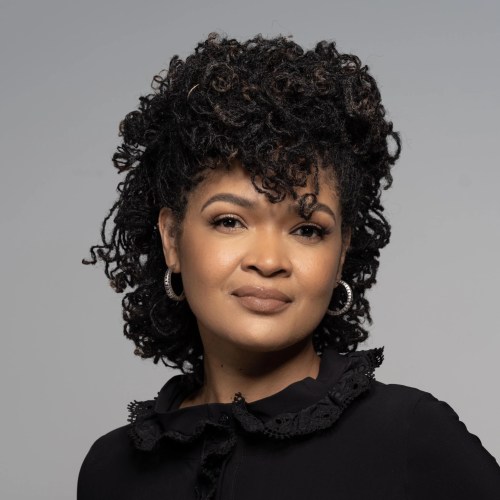
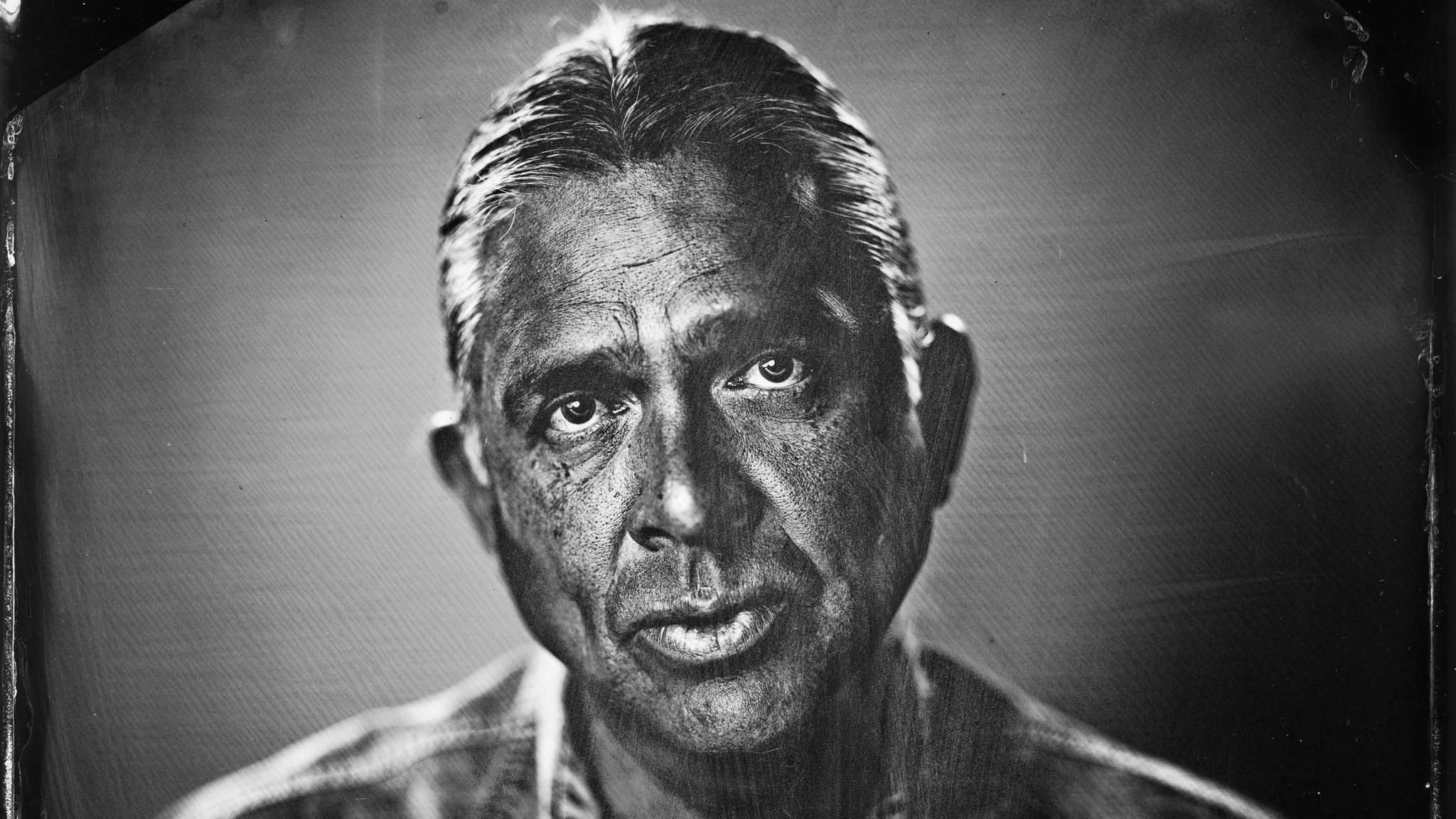
Dolen Perkins-Velez – image from Torch Literary Arts
The story alternates between the contemporary struggle of Mother Rita to retain ownership of her land, as she fills her granddaughter in on the history of the place, and the tale of one of the original settlers of the kingdom, its first queen, Luella Bobo. We are given a very up-close-and-personal look at what life was like in the 1870s, the closing years of Reconstruction, for freed slaves, what it took to establish themselves both personally and as communities, what obstacles they had to overcome. It offers an eye-opening perspective for any who are not very familiar with the era.
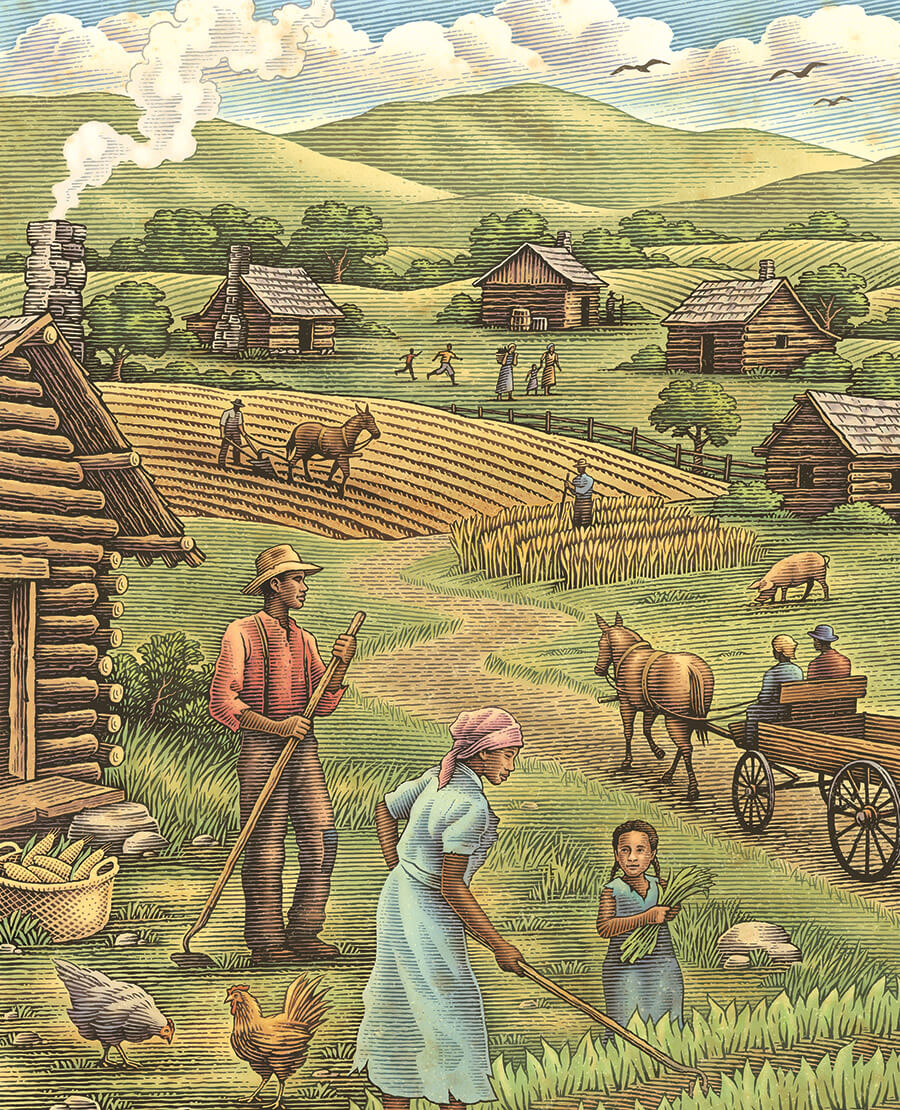
Working the Fields illustration by Erwin Sherman
Nikki is not on a mission. She is tired, struggling and unsatisfied with her life. She is eager to quickly resolve whatever it is that Mother Rita wants of her and dash back to DC as quickly as possible. She has no particular interest in history, family or other, which makes her a fair every-person stand-in for readers. It is through her POV that we slowly gain an appreciation for the importance of knowing one’s personal, and family history, and the significance of the land as an anchor for that connection. The novel is based on real events.
While researching Black history in western North Carolina, I stumbled on an article about this kingdom outside of Hendersonville. It was just a local newspaper, and I thought, “What is that?” It was a very brief article with an illustration showing that there had been this Black community during Reconstruction in the mountains. – from the Rumpus interview
Mother Rita does her best to pass on to Nikki the lore and knowledge she has tended her entire life.
All my life, I’ve been part of a small family circle. By the time my daddy was 20, both of his parents had passed away. He and Mama, with their desire to build a family out of nothing, were a perfect match for each other in that way. The two of them against the world. For me, not having a sibling or even a cousin has been the only existence I’ve ever known. Now here I am, walking beside my grandmother on acres and acres of land that my people have inhabited for over a hundred years. It’s hard to put how I’m feeling into words other than to say I’m dizzy with grief. I didn’t know you could mourn something you never had.
One element is the connection to the outdoors that Rita is able to spark in her grandchild, teaching her to appreciate gardening, and to pass on her considerable expertise. Nikki slowly finds herself able to step back from her urban self to find a connection with and a love for the sights, scents, the tactile feel of this other sort of place.
After the Great Migration, so many Black people ended up concentrated in cities, and we often forget that we are fundamentally a rural people. You don’t have to go back many generations to a grandmother or a great-grandfather who was a country person. – from The Rumpus interview
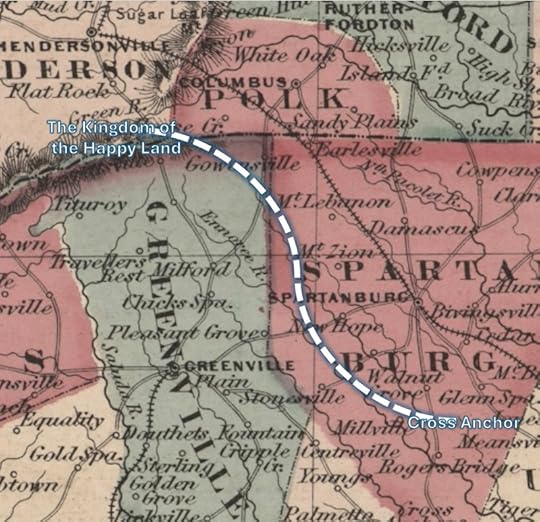
Cross Anchor, a remote township in southern Spartanburg County, S.C., was home to the founders of the Kingdom of the Happy Land before and just after the Civil War. – image from Blue Ridge Archive
A particular revelation is a particular legal mechanism used by the greedy and unscrupulous to cheat people, black people in particular, out of their land. It is remarkable just how much land was taken this way. Less surprising was the abuse of the criminal system to intimidate blacks who owned land, or aspired to do so. Equal treatment before the law remained a dream deferred. This gives the novel particular resonance in a time when the Deconstruction of the Trump era seeks to turn the clock back to an age before legal protections existed.

The Kingdom by Erwin Sherman
That said, Happy Land presents a message of hope. Whatever one may think of the royal approach those people favored, they took the opportunity presented by the end of slavery to make decisions for themselves, to organize their own community, to develop their own businesses, to participate in an equal way with the commerce of the area beyond their enclave. Even emerging from the horrors of enslavement, and suffering the ongoing oppression of those who preferred the ownership of human beings as property, these people kept the light of possibility alive. It is a surprising and moving story, which offers us historical reason to keep our spirits receptive to the need for and possibility of hope in an increasingly dark time.
In fall of 1873, a group of freedpeople left Spartanburg County, South Carolina, headed north across the state line into North Carolina. Near Zirconia, North Carolina, the people established a remote community that they called a kingdom. They named a king and queen, formed a communal treasury, and eventually purchased 205 acres of land in 1882 from John Davis, land that was spread across the North Carolina–South Carolina state line. Approximately half was deeded to Luella Montgomery and the other half to Robert Montgomery.
At its height, it is believed the kingdom numbered over two hundred people. – from the Author’s Note
Review posted – 6/6/25
Publication date – 4/8/25
I received an ARE of Happy Land from Berkley in return for a fair review. Thanks, folks, and thanks to NetGalley for facilitating.




This review is cross-posted on Goodreads. Stop by and say Hi!
=======================================EXTRA STUFF
Links to the author’s personal, FB, Instagram, and Twitter pages
Interviews
—–The Rumpus – The Kingdom of Happy Land: A Conversation with Dolen Perkins-Valdez by NEFERTITI ASANTI – APRIL 28, 2025
—–NPR – Author Dolen Perkins-Valdez discusses her new novel ‘Happy Land’ by Michael Martin
—–May 2025 Feature: Dolen Perkins-Valdez by Jae Nichelle – begins down on the page, after the excerpt
—–Writers Digest – Dolen Perkins-Valdez: On History’s Untold Stories – More about her prior novel, but still quite interesting
My reviews of earlier work by Perkins-Velez
—–2010 – Wench
—–2022 – Take My Hand
Item of Interest from the author
—–Torch Literary Arts – excerpt – Chapter 4
Items of Interest
—–OurState.com – Lost & Found: The Kingdom of the Happy Land by Brad Campbell
—–Blue Ridge Archive – Welcome to the Kingdom of the Happy Land










 ” alt=”book cover” width=”187″ height=”300″ align=”left” hspace=”10″ vspace=”10″>


 Coot's Reviews