The Sleepwalker’s Guide to Dancing by Mira Jacob

book cover
We arrive in this world connected, to people, to places, to cultures. Just because we move on with our lives, emotionally, intellectually, or geographically, this does not mean that our connections are all left behind.

In Mira Jacob’s debut novel, The Sleepwalker’s Guide to Dancing, her characters all struggle with connections, to each other, to their past, to their culture, and ultimately to themselves. For some that struggle includes a connection to reality. The story looks at three places, India, Albuquerque and Seattle, and three times, the late 70s, early 80s and 1998.

When we meet the Eapen family, in 1979, they are visiting the place and family they had left, in Salem, India. Thomas Eapen, a surgeon, had sought a better life for his wife and children in America. Home still has power, though, and his mother, also a physician, tries her best to persuade her son to remain. We meet the family members who had remained, and see some of the strains that might lead one to seek a life elsewhere. The motherland still has a hold, though, and Thomas’s wife Kamala, would like nothing more than to remain.

Amina Eapen is a photographer, working in Seattle in 1998. She had been a successful photojournalist, but has stepped back from that for reasons I will not go into here, and is now shooting events. Amina has a gift for capturing telling moments and is our camera into the history and struggles of the Eapen family. Dr. Thomas Eapen is seriously ill, seeing things that are not there, talking to people who are long dead. It has affected his work. When his wife calls Amina, she returns home to Albuquerque. Eapen’s illness is the maguffin for examining the experience of the Eapen family.

In addition to the strain of emigrating from India and constructing a new life on the other side of the world, the Eapens suffered a huge loss. We learn early on that Amina’s brother, Akhil, died young. The story goes to the early 1980s, where we see Amina and her brother in school, beginning to have relationships, struggling to grow up. Akhil shows some odd behavior, sleeping for vast stretches, falling asleep in inappropriate situations, believing that something glorious is in store for him if only he can complete a particular task. It is not entirely clear whether this is eccentricity or a condition, and neurosurgeon Thomas dismisses it.

So, there is a bit of mystery here. What happened to Akhil? What is going on with Thomas? It also takes some time to learn why it was that Amina stepped away from photojournalism. It is in peeling back the layers of those stories that we learn about the characters. There is a bit of romance as well, but, thankfully, it does not at all take away from the story.

While this is not a laugh-out-loud sort of read, there are plenty of light, even delightful moments that will make you smile. Of course, there are very sad ones as well

book cover

The author – from her web site

Much is made of attachment to place. When Thomas cedes his ownership rights to a family property in India there is a direct connection to be made to a story to which Amina is connected, of Native Americans in the northwest ceding land to the extant society in return for the hope that a large amount of cash can improve their lives. There are also smaller scale elements relating to territory.

To live in the Eapen’s house was to acknowledge the sharpness of invisible borders, the separations that had divided it like two countries since 1983. It had been years since Amina had seen her mother wade into the yellow light of her father’s porch, and as far as she knew, Thomas had never once crossed the gate into Kamala’s garden.

One of the connections made is in the similarities between the old world and the new, between generations. Just as Thomas’s mother schemes to try to keep him in India, Amina’s mother schemes to try to keep her in New Mexico. Just as Thomas’s brother spoke to people who were not there in India, Thomas holds his own conversations with the dead in America. Both Thomas and Akhil balk at the limitations inherent in their conditions. Food is used as a way for old and new to connect

Cooking was a talent of her mother’s that Amina often thought of as evolutionary, a way for Kamala to survive herself with friendships intact. Like plumage that expanded to rainbow an otherwise unremarkable bird. Kamala’s ability to transform raw ingredients into sumptuous meals brought her the kind of love her personality on its own might have repelled.

Bonds are made through feeding as a way of loving.

Another element is secrecy. Amina maintains a private cache of her special photographs, non-commercial ones that epitomize her skill at catching important moments. Thomas keeps his medical situation secret, and a few other things besides. And that ties in to feeling like an outsider, whether one is a native in a land now dominated by European invaders, or a new arrival in America, whether one is a black sheep in a family or an ostracized teen at school.

Amina has a wonderful relationship with her cousin, the wonderfully named Dimple, and there is a supportive, non-parental adult, the cool aunt, Sanji, who is able to bridge the gap between the young and the not so young, offering understanding and support, along with adult wisdom.

As for the sleepwalking element, there is a character who literally sleepwalks, and his connection to dancing is revealed at the end. Thomas’s visions might be seen as a form of sleepwalking. Akhil has big issues with sleep, but sleepwalking is not among them. And there are other characters who see things that are not there, which may be a form of sleepwalking. There is a mention in the book of a sleepwalker’s disregard for her surroundings. It is unclear if the author is suggesting that we are all sleepwalkers in a way, or that we should pay more attention to our effects on the world, or should attend to our visions. Did not get it. Doesn’t matter though. There is plenty to go with here, even if one is not able to cross every thematic t or dot every metaphorical i.

Gripes? I would have liked to have seen more, well anything actually, on the Eapen family’s experience when they had first moved to the USA. We only get to see them once they are already settled.

Amina is engaging, definitely worth caring about. Family is family is family, whether the family in question is from India or Indiana, and you are sure to recognize some folks in Amina’s clan who remind you of members of yours. The story is interesting. One gets a strong sense of the warmth and humor as well as the struggles inherent in these multigenerational family connections. Awake or asleep, the music is playing here, and it wouldn’t hurt to step out onto the dance floor for a while.

I received this book through GR’s First Reads program – thanks guys!

Review posted – April 25, 2014
Pub date – July 2014

=======================================EXTRA STUFF

Mira Jacob co-authored Kenneth Cole’s autobio, wrote VH-1’s Pop-Up Video, and was a co-founder of Pete’s Reading Series, at Pete’s Candy Store, in Williamsburg, Brooklyn, a venue where authors have been reading their work to appreciative audiences for over a decade. She is married to academy award nominated documentarian, Jed Rothstein. They live, with their son, in Brooklyn.

Links to the author’s personal, Twitter and FB pages

The Eapen family are Syrian or Saint Thomas Christians. This Christian sect was news to me. The wiki entry is pretty interesting.

Leave a comment

Filed under Fiction, Literary Fiction, Reviews

The Home Place by Carrie La Seur

book cover

There’s no place like home. There’s no place like home. Dorothy Gale

Alma Terrebonne is a successful Seattle-based corporate lawyer. She makes a nice living, has a handsome banker bf named Jean Marc, and a promising future that is hers for the taking. But when her little sister dies under suspicious circumstances she races home.

Vicky Terrebonne was a single mother in Billings, Montana. One freezing night, she left the semi-conscious group of substance abusers at her apartment, hoping to score some weed from her ex. Victoria’s frozen, face-down body was found the next day. As soon as her mother had headed out, 11 year old Brittany started calling family members, hoping someone would come to take her away before Vicky returned. When no help came she retreated, in an incredibly moving moment, to find comfort with her imaginary dog.

Maybe Thomas Wolfe was right, but Alma heads back to the place and family she had fled anyway. She figures it would only be a few days. But she plans to keep a keen eye out for the predatory sorts in her office who are eager to take advantage of her absence to steal cases from her. It is no secret that the prairie is not the only place with vultures.

book cover

The author – from her site

Through Alma’s return we get the back story of the Terrebonne family. Alma and Vicky’s parents had died when Alma was 17 and Vicky several years younger. Vicky was taken in by her Aunt Helen and domineering Uncle Walt, but stays away from them now. She had a history of drug-abuse and was constantly calling on all possible family members for help, usually of the financial sort. Alma had managed a nifty escape to a northeast college, then law school and finally a career on the coast. There are plenty of family secrets to go along with the mystery of whether Vicky was the victim of circumstance or foul play.

to him, the home place is beyond quaint. It’s isolated, disconnected, abandoned—and she knows better than he does how many eccentricities it hides. Firearms and whiskey hidden in odd corners, violence and insanity just below the surface, the way that civilization can become nothing but a thin polish over the animal will to survive.

Be it ever so humble, the home place of the title is a property that has been in the family for generations, rural, limited communications capacity, an outhouse, primitive. It was where her father and Uncle Walt had been raised. It is also a place where she and her sister had spent a lot of time as kids. It is the epitome of home, and offers the good earth that is the essence of the family name.

For a Terrebonne, the home place is the safe haven, the convergence of waters, the place where the beloved dead are as real as the living

If home is such a wonderful thing, why do we refer to the unattractive as homely? The home place of Montana, in this portrait, is one that features long-term, unacknowledged PTSD, cooking of books and maybe an illegal substance or two, anti-gay bigotry, violence of various sorts, a dark view of the Mormons, shady business dealings and a somewhat cartoonish bully of a land agent who does everything but kick a dog trying to intimidate mostly elderly people into selling their land to a mining interest. La Seur also offers some description of the relationships between the white residents and the local Native American population, which includes the detective assigned to Vicky’s case.

La Seur is a Billings resident so she knows of what she speaks in describing the place, and the interactions among its residents. The language she employs to give readers a sense of Montana begins at a very lofty place:

The cold on a January night in Billings Montana, is personal and spiritual. It knows your weaknesses. It communicates with your fears. If you have a god, this cold pulls a veil between you and your deity. It gets you alone in a place where it can work at you. If you are white, especially from the old families, the cold speaks to you of being isolated and undefended on the infinite homestead plains. It sounds like wolves and reverberates like drums in all the hollow places where you wonder who you are and what you would do in extremis. In this cold, you understand at last that you are not brave at all.

This wonderfully spun passage goes on for a bit and remains glorious. Such rich description does have the occasional reprise, but it was disappointing that there was not more of it.

La Seur also knows of the rape of landscape. Like Alma, La Seur is an attorney, a working class girl who managed to become a Yale grad and Rhodes scholar. She founded the non-profit organization Plains Justice to give residents a voice to stand up against the power of big mining interests. I expect her descriptions of despoiled landscapes and the tactics of land agents come from personal experience,

So, we have a mystery, an onion of family secrets to be peeled back, some wonderful descriptions, a strong character in Alma, consideration of the best use of the land and what constitutes a home. What’s not to like?

I am particularly allergic to romance books. Although I read plenty of books that have romance in them, I would never read a book that was labeled romance. While there is not nearly the volume of romance here that one might find in an actual specimen of the genre, there was enough to trigger my gag reflex. Part of home for Alma is Chance Murphy (not nicknamed Last or Fat, so far as I know), a cowboy sort with a degree in electrical engineering, sensitive, tough. I think he came from the build-a-guy factory. I could see him introducing himself. “Why, howdy ma’am. My name’s Studly, Studly McMuffin,” as he touches two fingers to the front tip of his Stetson. Or maybe he has a red cape stowed somewhere. Alma is plenty tough, and the story is interesting enough. This not-so-lonely ranger, or at least the degree of him, was a distraction and a downer for me. I understand that his presence was not fluff, as he offered a second draw for Alma and allows for some more detail to her back story. Not only does she have to look at how involved she wants to be in raising her niece, but there is the question of whether she wants to take a chance on rekindling her just-down-the-road adolescent romance with mister perfect, and where she ultimately wants to hang her hat.

With all she knows about the legal world, and conflicts around mining rights on the high plains, combined with her evident ability to weave a story, La Seur has the raw materials that are needed to put together a dazzling sophomore effort. One is already under way. I am looking forward to it.

There is plenty of grit in this very promising freshman novel, enough to compensate for the mush. I get that not everyone starts to sneeze and wheeze when a female character gets the drools for some guy, so it may not irk you as much as it did me. The Home Place offers a detailed look at Big Sky country that is not all bison, trout, mountains and glaciers, a look that synchs pretty well with another recent Montana novel, Fourth of July Creek. La Seur does let us in on the appeal of the place. Whether for good, ill, or both, there probably is no place like home for most of us. So tracking Alma’s decision process should ring at least some bells for plenty of readers. You will learn a bit about a place you most likely do not know well, get to unravel a few mysteries at the same time, and you won’t have to leave the comfort of you-know-where to do it.

Review posted – April 18, 2014
Pub date – July, 2014

=======================================EXTRA STUFF

Links to the author’s personal, Twitter and FB pages

A profile of La Seur from The Rhodes Project

La Seur also posted several energy-related vids on youtube that might be of interest

A quote from Carrie

It doesn’t matter if our elected leaders understand the seriousness of climate change if they lack the balls to face down [the] fossil industry. (4/11/14)

2 Comments

Filed under Reviews

Communication: From Pheromones to the Internet and Beyond by Max Swanson

book cover

In Communications: From Pheromones to the Internet and Beyond, Max Swanson, a long-time researcher with Atomic Energy of Canada, and physics prof at the U of North Carolina, offers a wide-ranging overview of communication, from unicellular beasties to complex organisms, from humans to machines, from proximate to distant, from the physical to the abstract, from then to now and from now to the future. Along the way he looks at communication as it pertains to religion, politics, education, government and marketing. He casts an eye on self and spiritual communication as well. He has clearly given the subject a lot of thought and presents myriad ways in which communication occurs, including, but not limited to sight, touch, sound, feel, language and even ways of communication that might not seem obvious, such as DNA. There are significant and valid points raised here. One is the importance of education for females. Another is the danger of concentrating media control in too few hands. Yet another looks at the historical experience of nations that base their education systems on testing to the exclusion of all else.

I had very mixed feelings about Communication. It is unclear to me who the intended audience is. It comes across as equal parts fascinating and obvious. There are plenty of jaw-dropping items, where you are pleading for Swanson to tell you more, tucked in between sections that make one want to wonder aloud “yeah, and?” Here is one of the latter, on the relative merits of information vs misinformation.

Wild swings in the stock markets and the global economy are due in large part to panic or euphoria caused by inadvisable spin of financial news, whether good or bad. On the other hand, timely worldwide flow of information facilitates the realistic evaluation of news, the distribution of goods, the coordination of health maintenance, and timely warnings of disasters such as earthquakes, hurricanes and tsunamis.

Duh-uh.

However, as a springboard for investigation of its composite elements Communication is marvelous. Have a class of 12th graders read this and there is huge potential that each will come across something that stimulates their curiosity. They won’t so much be able to satisfy it here as be prompted to a journey that might lead somewhere exciting, even if they do that search on handheld communication devices, and have to occasionally be zapped with tasers whenever they text someone or resume that game of Angry Birds. Here is one of the fun items:

In Egypt, thousands of years before the Christian era, giant obelisks may have provided a unique and innovative long-range communication system. By striking these obelisks, priests in Luxor and other religious centers could have created resonant sounds heard many kilometers away.

If you are thinking, as I did, that this sounds like a fab idea for an action/adventure novel, sorry, it has already been taken. Damn! Maybe as an element in a video game? And another:

Most humans are capable of hearing sounds with a frequency between 20 hertz ad 20,000 hertz (cycles per second) and volume greater than 5-15 decibels. [Are decibels digital temptresses?] Hearing is best in the frequency range between 1,000 and 5,000 hertz. Some very low frequency sounds cannot be consciously heard, but are accompanied by a vague feeling of unease when in their presence. This feeling may be associated with the phenomenon of ghosts.

Seems like he buried the lead there, slipping in an item we could use a bit more on, but it is off to the next topic straight away.

I am sorry to report that much of Communication reads like a text book, and is sorely lacking in the sort of humor that someone like Mary Roach brings to science to grease the intellectual in-ports. But there are also many fun items to be found here, no question. The issue is balancing the delight of taking in the juicy bits with the not-so-exciting other elements. Bottom line for me is that I am glad I read it. I learned some new things, which is like heroin to me, and that made trudging through the rest an acceptable cost. It might be for you too.

Posted April 11, 2014

I received this book through the GR FirstReads program.

Leave a comment

Filed under Non-fiction, Reviews, Science and Nature

The Miniaturist by Jessie Burton

book coverThe death of Nella Oortman’s father left the family in difficult straits, saddled with unexpected debts and a declining standard of living. But the widow finds a suitable match for Nella, in a successful Amsterdam merchant and trader. As he travels extensively, the wedding is a quick affair, and it is a month before he will return to his home. In October of 1686, Nella arrives there, in a very exclusive part of the city. She is greeted by her new husband’s sister, Marin, who makes her feel as welcome as a case of influenza, and who just might make you think of Mrs. Danvers.

As a wedding gift to his 18-year-old bride 39-year old Johannes Brandt acquires for her a cabinet, a kind of doll house that mirrors the Brandt home. Nella engages the services of a miniaturist, a craftsperson, to help fill the spaces. What she receives is far more than she expected, as the pieces reflect a bit too closely persons and events in the family’s life, some frighteningly so. Also, they do not always remain exactly as they were when she’d received them. And they arrive with Delphic messages. Do these tiny constructions predict the future, reflect their owners’ fears and concerns, reveal secrets, tell truths, or offer misdirections? Nella determines to find out who this mysterious miniaturist is and what is behind these small objects.

descriptiondescription
Burton says “When writing my hero, Johannes, I had this guy in mind.”

Burton did considerable research to get her 17th century details right.

I have a bibliography as long as my arm. And then there are first-hand resources—maps, paintings, diaries, prices of food, inventories, wills—and the physical city of Amsterdam itself. I first went in 2009, which is when I saw the house in the Rijksmuseum, and then again August 2012 for my birthday – with a long list of questions and locations to visit post-fourth draft. Where did they bury the bodies in the Old Church? How many windows on the front of a gable? How did they winch furniture in? A lot in the book is all historically true in terms of life in the city… – from the Richard Lee interview

Nella’s search and her coming of age occur in a difficult time and place. The Amsterdam of the late 17th century, the Dutch Golden Age, is a world financial and military capital, a harsh, unforgiving place, where human failing and difference is not be tolerated, where neighbors are encouraged to spy and report on neighbors, (yes, very much like your office) and where it is always a contest whether the worship of gold or god will hold sway in any given circumstance. The two domains cross paths frequently.

It is this city. It is the years we all spend in an invisible cage, whose bars are made of murderous hypocrisy.

It is a time when being a woman was much more of a challenge than it is today. Marriage, paradoxically, was seen by some as the only way for women to secure any influence over their own lives. But what if a woman wanted something more, something of her own, the opportunity to be the architect of her own fortune, and not submit to a life in a golden cage. Nella may have stepped into a wealthy man’s world, but she must still take care for the many traps that have been laid by a cold society and those jealous of her husband’s success and of her. And there are challenges as well with her marriage, which was not quite what she had bargained for.

I wanted to create women who are not more ‘strongly female’ or ‘stronger than other females’, or ‘strong’ because they are braver than men, or can physically lift more saucepans or anything like that. I just wanted some women who for once are not defined by any other ideal than that they are human. – from the Richard Lee interview

descriptiondescription
Images that inspired Nella and Marin

Jessie Burton has written a dazzling first novel. The Miniaturist presents readers with a worthy mystery, and maybe a bit of magic, offering enough twists and turns for a figure skating contest, opening tiny door after tiny door to reveal the secrets of Brandt’s household. This is a look at the Dutch golden age that will resonate with contemporary gender, race, religious and power issues. The author offers just enough imagery to enhance without overwhelming, and breathes life into an array of compelling characters. In addition, Burton paints this world with the eye of a true artist, and does it all in a book that you will not want to put down. It will require no Dutch courage to get through this one. To have crafted The Miniaturist is no small achievement. Jessie Burton has written a book that seems destined to be huge.

description
The dollhouse of the real Petronelle Oortman, currently in the Rijksmuseum in Amsterdam

Review posted – April 4, 2014
Release date in the UK – July 3, 2014
Release date in the US – August 26, 2014

=======================================EXTRA STUFF

One must wonder what London-resident Burton thinks of actors, given how she portrays one here, and given that she has worked as an actress, while toiling as an executive assistant to bring in a few guilders. Here are links to the author’s personal webpage and her Twitter feed. She has a few more historical novels in the works. If she continues writing at this level she will be making history instead of writing about it.

In addition, her Pinterest page is most definitely worth a look

There is a lot of interesting material on Burton in this interview by Richard Lee at the Historical Novel Society site and more here in a piece from The Guardian.

Sugar loaves figure significantly in the story. While I had heard the term Sugarloaf before, my only association with it was with mountains, whether the iconic mound in the Rio de Janeiro harbor, or the host of other mountains across the planet that share the name. Never gave it much thought. But folks with a bit more historical knowledge than me (most of you) would probably know that there was a time when sugar was routinely formed into solid cone shapes for shipping. That Rio hill and its cousins seem a bit more understandably named now.

Here is a link to the wiki entry for sugarloaf, which I found pretty interesting. And another that deals with tools used for handling the stuff. Sweet.

descriptiondescription

3 Comments

Filed under Fantasy, Fiction, Historical Fiction, Literary Fiction, Reviews

Kidding Ourselves by Joseph T. Hallinan

book cover

Realism has its limitations

Don’t I know. But after reading Joseph Hallinan’s Kidding Ourselves, you will find a way to get rid of those extra pounds; you will finally step up and demand that raise you have been denied for the last several years; you will ask out that person you have had your eye on for so long; you will give up that nasty habit, you know the one; and you will finally get around to writing that book. All you have to do is want it enough, and think positively. Yeah, right. We have been fed a steady diet of positive thinkology from Norman Vincent Peale to Professor Harold Hill to Tony Robbins, from cultish directions like EST, and from con artists from Ponzi to Madoff.

descriptiondescription

Ponzi – old and new

Barbara Ehrenreich, in Bright-Sided , pulled back the curtain on a lot of the sort of scamming that the think-positive sorts have been inflicting on us all. I share her views on this stuff. Most of the see-no-evil promulgators seek little more than to divert our attention from the real societal causes of many of our maladies, and in doing so pad their own pockets. Most of us, for example, are not struggling financially because we got too little education, the wrong sort of education, are lazy, unfocused, not good enough, not beautiful or strong enough, or are bad people who deserve what happens to us. It is because the rich SOBs who run the world decided to steal more than they already had, and have the power to make government hold us down while they go through our pockets, and then demand that we thank them for the privilege.

Blaming the victim is a national, no, a global past-time, and urging people to believe that the fault is in them and that if they just had a better attitude they would succeed, is the sort of tangy Kool Aid that people like Jim Jones have been peddling for a long time.

This is all to say that I approached the book with a full magazine of attitude and an itchy finger. So, is this guy another in a long line of con artists trying to blame the victim? Turns out, not so much. At ease, soldier.

book cover

The author – from Wikimedia

Joseph T. Hallinan is a Pulitzer Prize winning journalist, who reported for the Wall Street Journal, has written on the prison system, and wrote a 2009 popular psychology look at some of our many imperfections as human beings, the how and why we are the way we are, Why We Make Mistakes. Hallinan’s latest, Kidding Ourselves, a relatively short book (210 pps in my proof), looks at a narrow range of human behavior, although it does manage to cover a fairly wide swath of human (and sometimes non-human) experience. He is not so much promoting the notion of looking on the sunny side of life as taking a pop-psych microscope to the behavior itself. He breaks down the many ways in which homo sap practices self-delusion, and it is not exactly all positive.

Health-wise, he offers evidence that one’s attitude definitely matters. Expecting a positive outcome has measurable palliative results, independent of the pharmacological benefit of drugs or procedures applied to a medical problem. The obverse is true as well, expecting the worst can often bring it about. One really can die from, say, hypochondria, or a broken heart. Depression does cause physical harm to those who experience it.

Hallinan looks into the relationship between our perceptions and reality. You know that right-wing uncle who insists that Obama was born in Kenya and is a Muslim? You showed him all the evidence, right? And the result? He absolutely refused to accept the facts, clinging instead to his attitudes. I’d want to smack him too. Hallinan looks into this and offers an explanation for this seemingly inexplicable dedication to ignorance.

The book is about how we need to feel some control in our lives, almost more than anything else, whether it is that the cross-walk sign might flash “Walk” sooner in response to our pressing a button, whether it is that we can, through wise investing, control our financial future, or whether we believe that by repeating some ritual behavior we might therefore succeed in some endeavor. And we kid ourselves in order to be able to feel that there is something, anything, that is under our control. Otherwise we feel completely hopeless and the implications of that are not good. One result of this is that the confidence we gain from our beliefs, regardless of their basis in reality, can sometimes make the difference between success and failure, improvement or relapse, life or death.

This is, as noted, a short book, so one does not expect a deep, heavily detailed scientific treatise. It is pop-psychology, written by a journalist, not a scientist, meant for readers like you and me. That said, my antennae started to vibrate a time or three when I felt that the analysis was particularly, and problematically blindered. For example, Hallinan cites surveys of public attitudes regarding taxation that shows a persistent degree of dissatisfaction despite changes in rates over time. Problem is that the rate change under study is the top marginal tax rate, the rate paid by the highest wage-earners. Most people are not affected by this, so why would their attitude change at all? And given that taxes on working and middle class wage-earners had not dropped, and may even have gone up over the time span covered in the study, it is no surprise that general attitudes toward taxation would have seen little change. Another section looks at the persistence of false beliefs, as if they exist in a vacuum.

How could so many people persistently believe something unsupported by facts?
“I don’t have an explanation for that,” said pollster Jim Williams. “All I can say is that we have looked at that in other places in the past and it’s never gone away.”

Fuh real? How dim are you guys? Have you never heard of the 24/7 Lie Network at Fox, the masses of newspapers owned by Rupert Murdoch or Clear Channel broadcasting, right-wing radio, and the gazillions of know-nothing web-sites that sprout like algal blooms in the path of agricultural runoff? Sure, people will cling to nonsense in the absence of such assistance, but when it is blasted into your brain constantly, it will have an impact. So yeah, it does seem sometimes that the author has been a bit blind to some obvious real-world factors, which is ironic, as he points out the bias inherent in some well-known scientists here as well.

But he does offer quite a few examples of real scientific studies that indicate that sometimes mind-over-matter really….um…matters. Not, of course, in other-worldly sorts of manifestations, like making that missing limb grow back, or altering the immediate balance in your bank account. But to the extent that confidence comes into play, and it does come into play quite a bit, it might not hurt to accentuate the positive, Whistle a Happy Tune , hum a little Zip-a-Dee-Doo-Dah or channel a small, very, very small dose of Stuart Smalley. You may be a loser, a 97 pound weakling, too fat, too skinny, too old, too young, too tall, too short, but the extra boost that confidence, fueled by religion, superstition, and downright nonsense injects really can make a difference in many of life’s outcomes.

He makes a case that self-delusion, as a defense against hopelessness, is a crucial element in what it means to be human, and that it has provided actual evolutionary advantages. It may be that to err is human, but it would appear equally human to convince ourselves that we were right all along. Hallinan maintains that self-delusion not only exists across all human cultures but is present in animal psychology as well. Rats kid themselves too.

There will always be a danger that the limited range covered in this book will be taken by the con artists of the world as being more than it is and be presented as an “I told you so.” It isn’t. It is specific, illuminating and fascinating. I kid you not.

This book was received via GR’s First Reads program – Thanks, guys

Review Posted – March 21, 2014

Publication date – May 20, 2014

=============================EXTRA STUFF

I did not find a web-site for the author unadorned, but here is one for his earlier book, Why We Make Mistakes.

Here is a wiki on a 1986 essay by philosopher Henry G. Frankfurt that seems germane, On Bullshit

And a few more musical links that fit right in, from Stevie Wonder, George Michael , and The Monkees. So many more could work here.

In Salon, an excerpt from an interesting book by Oliver Burkeman, Positive Thinking is for Suckers

Leave a comment

Filed under Non-fiction, Psychology and the Brain, Reviews

Thorn Jack by Katherine Harbour

book cover

In the beginning was nothing. From nothing emerged night. Then came the children of nothing and night

Seventeen-year-old Finn Sullivan has the luck of the Irish, if you consider how the phrase was used during Irish immigration to the New World. When she was living in Vermont, her mother was killed in an auto accident. A move to San Francisco did not improve things for good as her older sister, Lily Rose, committed suicide there. A need for a change of scene brings Finn and her Da back to the town where he was raised, Fair Hollow, in upstate New York. Enrolled in a local college, HallowHeart, she meets the dazzling but mysterious Jack Fata. They may or may not be fated to be together, but the Fata family is very definitely a big deal in this small town, which is not exactly the epitome of exurban serenity.

“So what’s with all the little pixies everywhere? Carved into HallowHeart, the theater…”
“They were worshipped here…”
“Pixies?”
“Fairy folk. Some of the immigrants from Ireland followed the fairy faith. And the Irish had badass fairies.”

The local décor seems to favor the mythological, as if the entire place had brought in the Brothers Grimm and Arthur Rackham to consult on a makeover. The older mansions tend toward the abandoned and the locals tend toward the odd. Finn finds a few friends, and together they try to figure out the enigma that is Fair Hollow, maybe save a few folks from a dark end, and try to stay alive long enough to accomplish both.

book cover

the author

There are twists aplenty and a steady drumbeat of revelation and challenge to keep readers guessing. Finn is easy to root for, a smart, curious kid with a good heart who sometimes makes questionable decisions, but always means well. Jack offers danger and charm, threat and vulnerability. And Reiko Fata, the local Dragon Lady, a strong malevolent force, provides a worthy opponent. Harbour has fun with characters’ names that even Rowling would enjoy. Jane Ivy, for example, teaches botany. A teacher of metal-working is named, I suspect, for a metal band front man.

Each chapter begins with two quotes (well, most chapters anyway). One is from diverse sources on mythology and literature, and the second is from the journal of Finn’s late sibling. They serve to give readers a heads up about some elements of what lies ahead. One of the things that I found interesting about this book was the sheer volume of references to literature and mythology from across the world, not just in the chapter-intro quotes but in the text as well. I spent quite a bit of time making use of the google machine checking out many of these. You could probably craft an entire course on mythology just from the references in this book. In fact the author includes a bibliography of some of the referenced works. There are references as well to painterly works of art. Harbour includes a glossary of terms used by or in reference to the Fata family that comes in very handy. The core mythological element here is Tam Lin, a tale from the British Isles about a man who is the captive of the Queen of the Fairies and the young lady who seeks to free him.

The dream scene where Finn is speaking with her older sister and things grow sinister was an actual dream I had when I was seventeen. The revision was influenced by a book called Visions and Folktales in the West of Ireland, by Lady Gregory, a collection of local stories about some very scary faeries. The Thorn Jack trilogy is influenced by Shakespeare, Alice in Wonderland, Peter Pan, and Frankenstein. – from the author’s site

It is tough to read a book about young attraction of this sort and not think of Twilight, or Romeo and Juliet for that matter. And where there is a school in a place in which there are some odd goings on, and mystery-laden instructors, there will always be a whiff of Hogwarts in the air. But this one stands pretty well on its own.

Gripes-section. I did indeed enjoy the mythology tutorial available here, but sometimes I felt that the author could have pared this element down a bit. One result of this wealth of material was that it made the book a slow read for me. But then I have OCD inclinations, and have to look up every bloody one of these things. You may not suffer from this particular affliction, so may skip through much more quickly than I did. Or, if you are a regular reader of fantasy fiction, you may already know the references that my ignorant and memory-challenged self had to look up. Also, there are a LOT of characters. I tried my best to keep track by making a list and I strongly advise you to keep a chart of your own. It can get confusing. Finally, the quoted passages from Lily Rose’s journal do not much sound like passages from anyone‘s journal and seem to be present primarily to offer a double-dip into mythological reference material.

That said, Thorn Jack was engaging and entertaining, offering mystery, frights, young romance, and a chance to brush up on your mythology. Think Veronica Mars in Forks by way of Robert Graves.

Harbour has two more planned for the series, The Briar Queen and The Nettle King. I would expect she would address some of the questions that linger at the end of this first entry. What did her parents know and when did they know it? Is there an actual core curriculum requirement at HallowHeart College?

Review Posted March 14, 2014

Release Date – June 24, 2014

=====================================EXTRA STUFF

The author’s personal, Twitter and FB pages

Also, definitely check out another of Harbour’s sites, Dark Faery/Black Rabbit , which includes additional entries from Lily Rose’s journal, among other things.

book cover There are some scenes in Thorn Jack that include statuary of magical beings. I wonder if, as Harbour is from Albany, and was certainly exposed to Saratoga Springs, only about 30 miles away, (my wife and I visited in Autumn 2013) she might have been influenced by this Pan statue and/or similar pieces in Congress Park there. On her site, she talks about being inspired by abandoned mansions along the Hudson. Here is a site that shows all sorts of abandoned buildings, along the Hudson and elsewhere.

2 Comments

Filed under Fantasy, Fiction, Reviews, YA and kids

Fourth of July Creek by Henderson Smith

book coverThere should be fireworks shooting off for Smith Henderson’s first novel, as it is a just cause for celebration. This is not to say that the subject matter is exactly festive, but the book is a triumph.

Pete is a social worker in Tenmile, Montana, a place so insignificant it was named for it’s distance from the nearest possible somewhere. The folks he is charged with trying to help out need all the support they can get, but some can’t seem to accept any.

There are three main threads braided into this novel. Cecil is a troubled teen in a household where the biggest problem is his substance-abusing layabout mother. The two do not get along, big time. Firearms are involved.

When eleven-year-old Benjamin Pearl wanders into town alone, dressed in rags, and looking like he’d been reared by wolves, Pete is called in to check things out. Following the story of Benjamin and his family is the core here, although a portion of almost every chapter is given over to the third thread, Rachel Snow, Pete’s daughter, who has troubles of her own. Pete is the central element interlacing with the threads.

Pete Snow is basically a decent guy, bloody far from perfect, but his heart is in the right place. He really cares about the people he is charged with helping, and tries his damndest to figure out what the best thing is to do for each. That it does not always work out, and that he is better at helping others than he is himself, are foregone conclusions.

description
The Author

Smith Henderson offers us a look at a place in America, rural, and sometimes not so rural Montana, but also a time. It is no coincidence that the story is set in 1980, when the promotion of “Morning in America” also encouraged the release of a lot of pent-up insanity. Benjamin’s father is a seriously scary survivalist. His paranoia may at times have a basis in reality, but his worldview is straight out of the Lunatic Fringe Encyclopedia. There have always been folks with Jonathan Pearl’s particular flavor of madness, but it looks like Henderson is signaling what lies ahead, a world in which entities like right-wing talk radio, Fox News and any organization associated with the Koch brothers foment fear 24/7 and offer a media route in which to legitimize lunacy. Ben’s father actually believes, when he sees jet contrails, that the gub’mint is spying on him. There is plenty more to that story, but the political, this-is-what-is-being-unleashed, element is quite significant, although it is only implied. The implications of freedom are given a look. At what point does your ability to be free, living a life of paranoia, infringe on the rights of those who have not chosen the same path? Where is the line between legitimate desires for non-interference and license to do whatever? Where is the line between society’s right to protect it’s children and parents’s rights to raise children as they see fit?

We get a look at institutional limitations and extreme downsides, even when those institutions are staffed by well-meaning folks. Of course not every one is so well-meaning. We also get a look at the hazards to kids of growing up working class, from screwed up homes. Children have a lot to contend with here.

Ok, now that I have made the whole thing sound like such a downer, time to shine a bit of light in the darkness. While Pete definitely has his issues, he is beautifully drawn and is someone we can cheer on, most of the time anyway. There are some good people in Tenmile, a family who fosters kids in need, a caring judge, a tonic to the extant horrors. Learning about the survivalist world is fascinating stuff, even if these days we know more about it than we should have to. The writing is powerful and stunningly beautiful. A sample of lovely descriptive:

He liked the Sunrise Cafe for its coffee and smoky ambience and the way his arms stuck to the cool plastic tablecloths in summer and how the windows steamed, beaded, and ran with tears when everyone got out of church and came in for breakfast on a cold morning. He liked how Tenmile smelt of burnt leaves for most of October. He liked the bench in front of the tobacco shop on the square and how you could still send a child to buy you a pouch of Drum from inside with no problem from the proprietor. He liked the bowling alley that was sometimes, according to a private schedule kept only by them, absolutely packed with kids from the local high school and the surrounding hills who got smashed on bottles of vodka or rotgut stashed under their seats and within their coats. How much biology throbbed and churned here–the mist coming off the swales on the east side of town and a moose or elk emerging as though through smoke or like the creature itself was smoking. How the water looked and how it tasted right out of the tap, hard and ideal, like ice cold stones and melted snow. How trout looked in that water, brown and wavering and glinting all the colors there were and maybe some that didn’t really exist on the color wheel, a color, say, that was moss and brown-spotted like peppercorns and a single terra-cotta-colored stone and a flash of sunlight all at once. That color existed in the water here.

There are plenty more examples to be found here. One particular image of native fauna coming into contact with civilization was particularly chilling.

Henderson may be new to novel-writing, but he has already had some success with other forms. I do not know if he had much success as a social worker, a prison guard or a technical writer, but he co-wrote a feature film, while at the University of Texas, Dance With The One, won a 2012 Pushcart Prize for his story Number Stations, and the 2011 PEN Emerging Writers Award for Fiction. I guess he has emerged. It should be known that you have probably seen some of Smith Henderson’s work already, without realizing. You know that half-time Superbowl ad for Chrysler, with Clint Eastwood, Halftime in America? Henderson was one of the writers. It ain’t halftime this time. Henderson, with Fourth of July Creek goes long and scores a game-winning TD.

There is satisfaction to be had in how Henderson resolves the conflicts he has presented. And even when his outcomes are not happy ones, they are believable. We have been treated in recent years to a wealth of top-notch first novels. Fourth of July Creek will fit in nicely with the likes of The Orchardist, The Enchanted, and The Guilty One, for example, and it would sit very comfortably next to works by Willy Vlautin. Smith Henderson’s is a dazzling new literary voice, and the release of this outstanding work is cause enough to light up the sky with barges-full of pyrotechnics.

Publication date – May 27, 2104

This review was first posted on GoodReads on March 7, 2014

=============================EXTRA STUFF

Couldn’t find a web or FB page for Henderson, but here he is on Twitter

In case you missed it above, here is the Halftime in America ad

Leave a comment

Filed under Fiction, Literary Fiction, Reviews

Winter’s Tale by Mark Helprin

book cover

The last thing Mrs. Gamely said to her daughter was, “Remember, what we are trying to do in this life is to shatter time and bring back the dead.”

Winter’s Tale is a BIG book. I refer not only to its 748-page length, but to its ambition. It is a big book about big ideas, and it takes some big characters to realize the author’s ambition. There are a few here.

description
Colin Farrell as …

Peter Lake, the rock on which Mark Helprin builds much of his story, shares his genesis with the likes of Moses and Kal-El, set adrift as an infant in a small craft in New York harbor when his immigrant-wannabe parents are about to be turned away. Foundling Peter is raised by a group known at Baymen, an unusual band that is part deep interior bayou folk and part Native Americans. They inhabit, and work the Bayonne Marsh, a piece of New Jersey visible from New York harbor. His story is the primary character-driven thread here. We see Peter and this world from the beginning of the twentieth century to the turn of the millennium. Peter makes his way from Dickensian street urchin to mechanic to gang-member and burglar, to something grander.

description
Listo as …

Athansor is a great white horse, the stuff of legends, which comes in handy when there are impossible distances to be leapt and rescues or escapes to be effected. Boy meets horse when this milk-truck equine’s fanciful walkabout through the city is interrupted by his encounter with Peter, who is fleeing for his life from the Short Tails gang and its larger-than-life leader, Pearly Soames. Pearly would like to send Peter to meet his maker with extreme prejudice for a betrayal we will learn about later. Athansor and Peter gallop through this imaginary version of New York, doing things like snatching hats off policemen and dashing through a theater in mid-performance. (A real hoofer on Broadway) If you think this is the beginning of a beautiful friendship, you would be right. Hi, ho, Athansor, Away!

description
Jessica Brown Findlay as …

Beverly Penn is a consumptive 18-year-old (they upped her to 21 for the film) heiress who suffers so from the fever of her condition that she sleeps on the roof in winter in order to cool off. (Cue the Drifters ) She is playing the piano when she is startled, seeing Peter as he is in the process of burglarizing the family home. Having had a vision that something significant would be changing her life, it seems clear to her that the something is the criminal element in her living room. She has other visions as well, visual and auditory perceptions of a reality beyond that of which mere mortals are aware. There are other large figures in the story, and other story lines, but these are the main ones. And the story of Peter and Beverly’s love is balanced by Pearly and Peter’s antipathy.
description
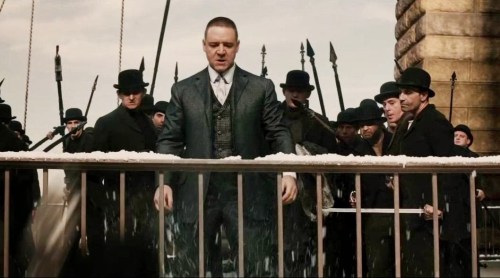
Russell Crowe as Pearly Soames with his droogies Short Tails

The author is not content to weave a tale around his maybe-doomed lovers, but offers us other couples to tote some of that emotional freight. We meet families at various points in their history. A tot in one section becomes a capitalist scion in another, for example. I will spare you too much plot summary, or a fuller list of characters. Even by my generous standards it would be excessively long. But I have included a link to such a blow-by-blow in the Extra Stuff section if that seems useful. Suffice it to say that in upstate New York there is a Brigadoon-like town known as The Lake of the Coheeries, and some pretty magical things take place there. No, you do not have to wait a hundred years before it appears. It actually does not appear on any maps, but can be accessed if you know how. It is the source for several of our additional characters, and some fabulously creative images. It lies beyond the crucible zone that surrounds the city, substituting a huge hill of ice and snow as a barrier for the white clouds that enclose the city farther south. The town serves as a fairyland version of the country, in the same way that Helprin’s vision of New York City (well, really, Manhattan. His vision of the city offers little for the other four boroughs than a Breughelian image of them as places to avoid.) is a fantastical version of the real place. But all this seems a maguffin for the real business here, which lies in the themes being addressed.

Themes
Mark Halperin has written a love song to New York, well, parts of it anyway. There is a stunning lyricism to his descriptions of the city, alive with romantic vision, yet also fueled by a dose of paranoia and class fear. But he is after bigger fish than venting his affection for The Big Apple or whatever nickname might apply in his alternate universe, a whole ocean’s worth. Small matters like free will, the nature of existence, the relationship between the rational and the spiritual, the nature of time, justice, mortality. You know, stuff.

Helprin argues that the spiritual must accompany the rational or the result is a soulless existence.

Well, we’ve been mechanized. We view ourselves as mechanisms. This is a trend since The Enlightenment. The Enlightenment, in my view, has two streams – a good stream and a bad stream. The good stream is the beauty of reason, to approach something via scientific method, via logic. The ugly part of The Enlightenment is that if you confine yourselves to those methods, then you are limiting yourself in terms of your understanding of what a human soul is. By necessity, because you cannot define the soul as it’s not subject to proof, human beings become mechanisms. Without faith, a person is a mechanism, and then there’s no reason he shouldn’t be treated or work under those assumptions, as a mechanism. – from Contemporary Lit interview

Is there some underlying logic to our universe, machines, physical, psychic or spiritual that whirr, turn and grind to support everything?

“Apart from natural laws, from the world as we know it,” Hardesty speculated, “maybe there are laws of organization which bind us to patterns that we can’t see and to tasks that we don’t perceive.”

And Helprin takes a long view of things

“Churchmen,” she had said, “like Boissy d’Anglas, burn themselves up in seeking, and they find nothing. If your faith is genuine, then you meet your responsibilities, fulfill your obligations, and wait until you are found. It will come. If not to you, then to your children, and if not to them, then to their children.”

Helprin posits a world or worlds in which the select few can see and access an underlying reality, and it is not clear that there is a path to this understanding other than dumb luck. One must wonder if the writers of The Matrix or promoters of born-again-isms had Helprin in mind.

her strength was not derived from things which can be catalogued or reasonably discussed. She had an inexplicable lucidity, a power to see things for what they were. Somehow she had come into possession of a pure standard. It was as if lightning had struck the ground in front of her and had been frozen and prolonged until she could see along its bright and transparent shaft all the way to its absolute source.

No, this is not taken from the Left Behind series and Bev was not bitten by an irradiated spider.

Brooklyn Bridge and God

The city as crucible, which we first see from a god-like view, looking down, is surrounded by an enormous and deitifically powerful white cloud. Unlike the low-hanging clouds in real NYC, which can make building tops appear to vanish when they pass through, this white cloud can actually take the things it touches. It makes the city into an almost-closed system that will experience both the deadly cold of extreme winter and intense heat from another source.

“…these winters have not been for nothing. They are the plough. The wind and the stars are harrowing the land and battering the city. I feel it and can see it in everything. The animals know it is coming. The ships in the harbor rush about and have come alive because it is coming. I may be dead wrong but I do believe that every act has significance, and that, in our time, all the ceaseless thunder is not for nothing.”

There is the potential for greatness in cities, this one in particular, but there must be a blood-letting in order to usher in a new golden age, and that seems perfectly fine for the god of this novel.

The notion of justice also comes in for considerable attention. Peter’s first craft is named “City of Justice.” Jackson Mead, a builder of bridges, says, “My purpose, in one word, is justice.” A significant silver tray that Hardesty Marratta (a significant character) cherishes in inscribed thus: “For what can be imagined more than the sight of a perfectly just city rejoicing in justice alone.” Peter engages in a quest for justice as well. In a passage about time, justice gets the final word

The universe is still and complete. Everything that ever was, is; everything that ever will be, is—and so on, in all possible combinations. Though in perceiving it we imagine that it is in motion, and unfinished, it is quite finished and quite astonishingly beautiful. In the end, or, rather, as things really are, any event, no matter how small, is intimately and sensibly tied to all others. All the lost ones are redeemed; the dead come back to life; the perfectly blue days that have begun and ended in golden dimness continue, immobile and accessible; and, when all is perceived in such a way as to obviate time, justice becomes apparent not as something that will be, but as something that is.

And it’s just tough luck on those who fall afoul of the currents of time. If you are rich, then I guess you were meant to be, and if you were dirt poor, well, sorry, it was always thus. It does strike me that this is a point of view that might be favored by those who have landed in the cushier seats.

Imagery
Be careful where you step. You may bump into another image. Gates figure large here. Both the literal gates that surround the Battery in lower Manhattan and a set of four psychic gates that cities are supposed to have, (resonating with the four parts of the novel) visible, of course, only to people who are very, very special. Color figures large. Pearly (whose name certainly reflects the seasonal milieu) is deeply affected by color and seeks it out by whatever means possible.

But, whereas the wall was white, the city was a palette of upwelling colors. Its forms and geometry entranced him—the orange blaze in clear upper windows; a gas lamp’s green and white bell-like glare; leaping tongues of fire; red-hot booming chambers in the charcoal; shoe-black horses trotting airily at the head of varnished carriages; peaked and triangular roofs; the ballet of the crowds as they took stairs, turned corners, and forged across streets; the guttural noise of machinery…sails that filled the ends of streets with billows of white or sharp angular planes, and then collapsed into the bordering buildings or made of themselves a guillotine

Blue and gold come in for particular and much-repeated attention. Stars shine brightly here as well, whether the actual universe of stars or their simulacra in a large chamber or a magical painting. Bridges and rainbows carry significance as well. Machines are also more than mere mechanisms.

description
Mark Helprin – image from NPR

Politics
In case you did not know, Helprin is a political sort, a conservative true believer who writes speeches for Republican leaders. His particular sensibilities enter here as well, as he offers the odd diatribe on how any sort of public assistance is a form of satanic temptation, leading good people astray and allowing bad people to milk the rest of us to support what is portrayed as a life of low leisure. He also has a vision of wide swaths of the lower classes as being purely bent on destruction, as if the race riots of the 60s had burned a hole in his vision and he was forced thereafter to see everything in the world through those altered lenses. It gets intrusive at times. At least he has the decency to balance his Ayn Randish laudatory portrayal of one mogul with an equally dark one of another (a Rupert Murdoch stand-in). And he does offer an interesting proposal for an ideal way to organize a company that speaks to a need for fairness, but which would never be tolerated in the real world by those whose mission it is to absorb ALL the wealth. He also harbors a view of criminality that is, to say the least, eccentric. That said, the political aspect, while present and occasionally toxic, could have been a lot worse.

In Sum
What is impressive about Winter’s Tale is the sheer volume of creativity on display here. His portrayal of a Dickensian sort of steam-punk New York was fascinating and effective. The Lake of the Coheeries is very effectively magical. But just as it is wonderful to enjoy a slice of cake, it can become a different sort of experience if one were to try devouring the entire thing. So it is here, a case of creativity run amok. The author wanders off. For example, after we have invested in Peter, Beverly and Athansor, Helprin sets them aside for almost two hundred pages to play in some other snow fields. Really? Helprin is at his weakest when attempting a sort-of slapstick humor. Those bits fall very, very flat. As do sections where a character acquires otherworldly powers. And Athansor’s propensity for arriving in the nick of time to save this or that one makes one wonder if he might have been a sort of deity made by one of the many machines that populate the story. If you have not yet read Winter’s Tale, prepare to make a special effort to keep track of the characters. There are many. And, oh yeah, lest you think the opening quote was purely gratuitous, there are resurrections here. Helprin is definitely thinking BIG.

You may find Winter’s Tale exhilarating and you may find it exhausting. You may feel enlarged by the beauty of the imagery and reduced by the occasional mean-spiritedness manifested by the author. You may feel intellectually stimulated by the grand notions portrayed, but deadened by the familiar trope of access being reserved only to the elect. You may feel deeply at the poetry of Helprin’s descriptions, (they certainly sing to me in my love for my home town) but may experience frustration that he takes so bloody long to get to the point. Winter’s Tale may leave you cold, or it may warm you to unimagined possibilities. But whether your reaction is pain, exultation or both, you will definitely react. Winter’s Tale has been called one of the 25 greatest American novels of the 20th Century. I do not agree, but I can see why some people think that. It is pretty clear that it is one of the most ambitious. I believe it would have been a better book with a tighter focus and about two hundred or so fewer pages. But, even though I have issues with the book I do believe that it is well worth reading. Winter’s Tale may not have completely warmed the cockles of my reader’s heart, but it is still pretty chill.

Posted on GR on February 28, 2014

==================================EXTRA STUFF

Interview with MH in The Paris Review and in Contemporarylit.com – This the source of the quote from the author used in the review

This review in the Thriving Family web site contains a detailed run through of the events of the book and a look at some of the imagery

Leave a comment

Filed under Fantasy, Fiction, Literary Fiction, Reviews

Gravesend by William Boyle

book cover

When a man knows another man
is looking for him
He doesn’t hide.

–Frank Stanford, “Everybody Who is Dead”

Even death starts to look attractive when hope is gone. And the fittingly named Gravesend of William Boyle’s first novel is a place where hope is regularly interred. Conway D’Innocenzio and RayBoy Calabrese are in a race. The finish line is their own demise, and the contest is neck and neck all the way. Death comes in many guises. Conway’s big brother, Duncan D’Innocenzio, found his when a gay-bashing teenaged thug and his pals chased him into traffic on the Belt Parkway. RayBoy, the alpha asshole, did 16 years for the deed, but the RayBoy that was is no longer. Now he is looking to pay for his crime for real. Conway wants to kill him, which would seem a nice match. Only problem is that, after sixteen years of planning his revenge, letting his life waste away while he stewed, Conway can’t seem to pull the trigger.

The death-wish field here makes it seem more like a group outing than a pairs event. Ray’s nephew, Eugene, is a 15-year-old, wanna-be thug, with a limp, a misguided case of hero worship and a worse case of bad judgment. Alessandra, an actress back from the other coast to help take care of her widowed father, is one of the few main characters here who seem determined to stay alive. The old classmate she looks up, Stephanie, is the epitome of what it is to be trapped like a rat in the place where you grew up, and to internalize the incarceration.

This is not the well-heeled Brooklyn of the Heights, the Slope, Fort Greene or Boerum Hill. Not the trendy arts scene of DUMBO, not the hipster haven of Williamsburg, nor the post-apocalyptic deathscape of Brownsville. Gravesend is a neighborhood on the southern end of Brooklyn, working-class, ethnic, hard-scrabble. Like most neighborhoods in New York it watches as one immigrant group moves up, hopefully, and another moves in. It used be primarily Italian, still is, but things are changing. Not always for the better. Unfortunately, for some, they are not changing enough, and the only way up is to blast your way there or to leave entirely. The place has its share of gangsters and gang-bangers, dive bars and secluded, while public, spots for the exercise of what is usually private behavior. And the environment helps make these characters who they are.

description
The author was raised in a small town in Brooklyn, and now writes and teaches in Mississippi – “I see Brooklyn in new ways from here.”

Boyle has plenty of experience with working class Brooklyn life, having had a full measure, hailing from the County of Kings, Gravesend in particular. He communicates quite well the ironically small-town feeling that pertains in so many New York neighborhoods, where kids have only a slight image of what may lie across the bridges and tunnels in Manhattan, or pretty much anywhere in the wider world. I can affirm from personal experience that Boyle speaks truth.

Neighborhood as small town or not, is it possible to go home again? And would you really want to? Can one really get satisfaction from revenge? Or is it that, in the same way that depression is anger directed inward, revenge is self-loathing directed outward?

The writing here is taut. I would not say that Boyle’s text is a place where adjectives go to die, but they’re not bleeding over the edges of the pages either. The narrative movement is certain and consistent, moving towards resolution of the inevitable sort. Which is not to say there are no surprises. There are. The story is not a mystery, per se, but more a look at how place affects people. Rayboy was admired as a kid for his thuggish exploits, was found attractive by girls. Not exactly a disincentive. Homophobia was hardly unknown in the environment of his youth. His nephew Eugene, short on adult male models on which to base his vision of what being a man looks like, fixates on the one male he knows who was effective and respected.

While the bulk of the story is dark, there are some rays of light. Good can be found, although more in thought than deed. Hope digs its way back up to the surface, allowing for some second chances. Alessandra’s affection for a particular painting at the Met can be seen both as an artistic inspiration and an omen. Her participation in various forms of Manhattan life lifts her spirits. After all, she did manage to make it out to the west coast. But hope had better move quickly before another body lands on it. Stephanie latches on to Alessandra as a way out, but she may be too limited to make a go of that.

Most of the characters may not be the sorts you would want your children to marry, but they are very well realized. Boyle offers us abundant surface, but also scrapes plenty of layers away so we can see what is going on beneath.

My gripe with this book was definitely of the minor sort. The title, Gravesend, is particularly apt, suiting well the content, given the body count, whether from violence or less dramatic means. But Boyle wanders a bit in his native borough. If you are expecting a singular, focused portrait of this neighborhood, fuhgeddaboudit. The author gives us a look, for sure, but we also spend time in Bay Ridge, Sunset Park, Manhattan’s East Village, a small slice of Queens and even go for a couple of jaunts upstate along the Hudson, these reflecting the author’s personal NY geography, or a lot of it anyway.

It was fun to walk through so many places that are personally familiar, Nellie Bly, the promenade near the Verrazano Bridge, Xaverian High School under another name, subway stations, and so on. I also related to the Stephanie character, as one of the things that makes me truly shudder is the thought of being stuck back in the Bronx neighborhood in which I was raised. No love-hate issues going on there. Such dark fears constitute more of a Twilight Zone episode.

Arthur Miller lived for many years in Gravesend, as did Carlo Gambino. In Boyle’s Gravesend we get to hear the patois of the latter, and look at the people and places of his tale through eyes that see the world a lot more like the former. Gravesend, Boyle’s first novel, is a pretty good beginning to what promises to be a very illustrious long-form career. Dig in.

=============================EXTRA STUFF

Links to the author’s personal, Twitter links

Interview with the author from LA Review of Books – mucho goodness to be had here

Another wonderful interview with Boyle, by Irene McGarrity

Plumb Beach is the scene of a crime – here is some info on the place

A real life case that, the author confirmed, provided inspiration for the story.

This is the Joan of Arc image that Alessandra focuses on in the Metropolitan. It is a mind-blowing painting to see in person. This link adds some background to the work.

Leave a comment

Filed under Fiction, Reviews

The $11 Billion Year by Anne Thompson

book cover Anne Thompson is an on-online Hollywood reporter. Aware that the what’s-happening-right-now world of just-in-time digital journalism (or most print journalism for that matter) does not allow for much reflection, she was looking for a way to tell her story of change in the movie business. Thompson was inspired by William Goldman’s The Season: A Candid Look at Broadway, which covered one year in the theater and, in The $11 Billion Year, applies that formula to the business of tinsel town.

While The $11 Billion Year book hardly qualifies as a rom-com there are definite elements of affection. Thompson headed into the ‘wood some time back, working as a film columnist and editor at Variety. She hails from that other big cinematic locale in the US, New York City. Clearly a bit of home came along for the ride, as she remains a Yankees fan. Thompson worked for Entertainment Weekly, Hollywood Reporter, and other entertainment media as well.

book cover

Anne Thompson

She began her blog “Thompson on Hollywood” in 2007, which conjures for me an image of the writer in a saddle atop the sign (not gonna go with cowgirl here), and heightens the disappointment I feel at my lack of expertise with Photoshop. It is not nearly a bio-pic either, as Thompson keeps herself pretty much in the background. Nor is it likely that this book will begin a franchise or constitute a blockbuster and be a tentpole to support her other endeavors, but hopefully it will find an audience.

book cover

The $11 billion of the title refers to film income for one year, and that’s just domestic. Sounds like H’wood is doing nicely, able to put food on the dining room table, and maybe a few lines on the coffee table. In fact, according to Thompson

Hollywood is like Harold Lloyd in Safety Last, hanging desperately to the hands of that old (silent) clock, which is moving inevitably toward future time.

She says that Hollywood studios, increasingly profit centers in Blob-like corporate behemoths, are narrowing the range of product they are willing to put out, going increasingly for the formulaic, the tried-and-true, and thus are pushing talent into other venues, TV, internet, VOD, Netflix, et al. This represents the real core of the book, the migration from a studio-centric film world to a more dispersed digital environment.

book cover

Scary Times

This is not necessarily a terrible thing, as technological changes have put the means of production into the hands of more and more potential film-makers, and a broad range of potential venues has arisen to provide places where these films can be sold and seen. One interesting bit of history Thompson looks at is the rationale for and the transition from film (1999) to digital (2012), and how the diverse parties came to an agreement.

description

She tracks the annual festival migrations, from Sundance in January to the SXSW in Spring, Cannes in May and the Fall festivals in Venice, Telluride, Toronto and New York, stopping at other annual events along the way. At Cinemacon, filmmakers show their upcoming product to theater owners. And fan-boy nerds rule at Comic-Con. Part of this is to track the progress, or lack of progress of films through this gauntlet, whether the end result is to gain notice for awards season or merely to get some distribution at all and make back production costs. You will get at least a feel, and sometimes more, for each of these festivals.

She writes in some detail about a handful of films whose titles are familiar and others you may not have heard of. Attention is paid as well to gender issues in the industry, with a focus on Kathryn Bigelow. The book offers for your consideration a look at some of the politicking that goes on before and into Oscar season, and some bits of info on AMPAS (The Academy of Motion Picture Arts and Sciences) membership, which is about 6,000 strong, and is by invitation only. You will pick up some terminology too, and a few more abbreviations to add to your alphabet soup. “IP”, for example has nothing to do with an initial public something or other, but refers to “Intellectual Property,” the from part of an Oscar nomination for Adapted Screenplay. You will find that NATO can be something other than a plot device in a war flick. (National Association of Theater Owners). MG is not a car or a medication dosage but a Minimum Guarantee, a cash advance payable to the producer upon delivery of the completed film in exchange for exclusive rights to distribute a film in a sales territory. One last term, “four-quadrant” refers to a film that can attract viewers from diverse demographics, including the young, the old, male and female. There are plenty more expressions and letter combinations to take in.

As with any survey-type book, there is always the problem of wanting to know more about this or that element.

Thompson’s prose is fluid, as easy to read as a film treatment . If you are a fan of the cinema (Yes, yes, me, me) there is plenty of scene stealing material here, and a bit of comic relief, but the end result is a fascinating documentary look at how the whole business has changed, a long tracking shot of the running of the festivals, a bit of close-up on Oscar season machinations, and some previews of what might lie ahead. While I could not say for certain that The $11 Billion Year would walk away with a statue for best book about the business of Hollywood, not having screened read other candidates, there is no denying that it has earned at least a nomination. And that’s a wrap. Let’s do lunch. I have a project I’d like to tell you about. I’ll have my people call your people. Okay?

Publication date – March 4, 2014

Posted 2/7/2014

==================================EXTRA STUFF

Links to the author’s blog, Twitter and FB pages. Seriously, if you want to keep up with things Hollywood, Thompson’s blog is a can’t miss, four-quadrant, blockbuster product.

Thompson mentions Emma Fitzpatrick’s wonderful send-up of Anne Hathaway in a satirical version of I Dreamed a Dream . If you have not yet seen this you absolutely must.

A nice profile of the author

Thompson’s top ten films of 2012, the year covered in the book

Leave a comment

Filed under Reviews