Darkness the Color of Snow by Thomas Cobb

book cover

I mean how much of any one guy belongs to himself and how much belongs to the team? I mean we’re all free individuals, only we’re not. We can’t just do what we want, I mean, look, I can drive a hundred and ten down the wrong side of the road because I’ve got free will, no? No. Something of me belongs to the world or the country or the town or something. I mean I have to do what’s best for it. I mean I have to. I’m not a hundred percent free. Add that part of myself that is free is that way because of the town or country or whatever.

When rookie cop Ronny Forbert pulls over his old buddies for speeding, it should have just been a pain in the neck. Instead, the leader of the pack, well past inebriated, refuses to accede, struggles to avoid being cuffed, falls into the icy road and winds up a prime sample of road pizza when a speeding vehicle launches him head-first into the back end of his own jeep. The cop did nothing wrong. The road stain created his own demise. Scratch one asshole. Addition by subtraction. Right? Not so fast. Righteousness be damned. There are opportunities to be seized, agendas to be taken care of, and if a decent rookie officer is in danger of being gutted in the process, well, hey, that’s just business, nothing personal.

book cover

Thomas Cobb – from The Examiner

Lydell, New York is a remnant of what once was, an aging rust-belt town with its best days in the rearview. Local manufacturing has left for cheaper pastures, taking with it large volumes of hope.

The mother’s house is a little north of the grandmother’s. That makes it a little more upscale. When he gets there, there’s a car parked in the middle of the front lawn, minus hood and engine, and the shingled house is in need of paint or stain, but the porch isn’t buckled. It’s what passes for upscale in these parts.

Police Chief Gordy Hawkins may be a bit of a relic as well. Not just for being a prime candidate for retirement, but for maintaining some sense of honor, decency and community in a world of me-ism and values that do not look past the next quarter. He had brought Forbert in to the force, rescuing him from a youthful wrong turn, and maintains a fatherly connection to the young man. Chief Gordy is an extremely engaging character. I was very much reminded of Robert Taylor as Longmire, or why not double down with Jeff Bridges?

descriptiondescription

Martin Glendenning, president of the town council, a lawyer, and as oily a character as you are likely to encounter, is a different sort. Police? We doan need no steenking police. He has been trying to get rid of the local PD for some time, and turn over policing responsibilities to the state. He worships at the altar of tax cuts, and not having too much local police authority around, poking into his questionable business dealings would be a lovely part of that.

“We’ve become the enemy,” Pete says. “They resent that our service isn’t free. They don’t see what we do for them. They only see that they have to pay us. We’re so far below cable TV and Internet porn, they can’t even see us anymore.”
“There’s a whole new ideology that government, in any form, is an unnecessary evil,” Gordy says. “There’s nothing that’s looked at without suspicion. Used to be, everyone kind of pulled together. Now it’s everyone pulling in separate directions.

The story of Officer Forbert’s travails, particularly his growing self-doubt, and the portrait Thomas Cobb paints of this small town, are compelling in and of themselves.

Cobb, the author of Crazy Heart among other works, knows how to make characters real, knows how to make you feel for them, and knows how to portray place. This is a very moving tale. He is most at home writing about his beloved southwest and has great affection for the cowboy. It is not hard to see in Darkness… a small town sheriff up against the corrupt eastern bankers, particularly when the baddies employ local thugs to do some of their dastardly deeds. But the location speaks to a more contemporary form of conflict.

The larger element here is Lydell as a microcosm of the nation and the time, the conflict between individual wants and civic, communal responsibility. How do communities respond to tough times? Where does community end and the individual begin? Cobb is not offering solutions to what ails. He has written a story about how an unfortunate event is twisted by the unscrupulous, vain and greedy to serve their own ends, to the detriment of the rest of us. He offers praise of honor, seeing clearly that the values of a bygone age are threatened by the new age of self. Chief Gordy is a beacon of light in a bleak landscape, a true hero in place where winter has already arrived.

Review posted – 4/17/2015

Publication date – 8/18/2015

=============================EXTRA STUFF

Links to the author’s personal and FB pages

A short story by Cobb – I’ll Never Get out of This World Alice

Leave a comment

Filed under Fiction, Literary Fiction

The Kind Worth Killing by Peter Swanson

book cover

I’d taken enormous risks in the past two weeks, and I was lucky to have gotten away with them. But now I was done. It was over. I would live a quiet life and make sure that no one could hurt me again. I would continue to survive, knowing, as I’d known that night in the meadow, the stars pouring their light down on me, that I was special, that I was born with a different kind of morality. The morality of an animal—of a crow or a fox or an owl—and not of a normal human being.

Peter Swanson, author of The Girl with a Clock for a Heart, has a twisted mind, not that there’s anything wrong with that. He seems to think in curves, bends, dips and sudden, hairpin turns. The feeling is a bit akin to being here, or maybe here. The sudden changes in direction may generate a bit of screaming, but it’s all good.

It starts with a nod to, well, a bit more of a full body embrace of, Strangers on a Train, a 1950 psychological thriller by Patricia Highsmith, in which two men who meet while traveling get to sharing their troubles and decide that permanently eliminating each other’s problems might be the perfect solution. Hitchcock made a beautiful translation of the book to film in 1951. Swanson is a big fan of both Highsmith and Hitchcock.

I like the idea of sudden change. That you or me or anyone could go out to a bar one evening, and the random stranger who sits down beside you changes your life forever. It’s actually something that Hitchcock liked a lot himself. Most of his protagonists are accidental ones, just ordinary people who wind up in extraordinary circumstances.

In his version, Ted Severson a wealthy corporate raider (formerly a dot.com millionaire sort), at a Heathrow bar pre-flight, is approached by Lily, a lovely young thing. They strike up a conversation, and, as strangers might be better able to manage than people who actually know each other, (a theory titled The Rules of Airport Bars) they agree to tell each other the whole truth, and continue their truth-telling all the way back to Boston. The truth is gonna hurt…someone. Seems that Ted spotted his wife en flagrante with the contractor who was working with her on Ted’s Maine McMansion. Not good.

”How long ago was this?” asked my fellow traveler after I’d told her the story.
“Just over a week.”
She blinked her eyes, and bit at her lower lip. Her eyelids were pale as tissue paper.
“So what are you going to do about it?” she asked.
It was the question I’d been asking myself all week. “What I really want to do is kill her.” I smiled with my gin numbed mouth and attempted a little wink just to give her an opportunity to not believe me, but her face stayed serious. She lifted her reddish eyebrows.”
“I think you should.” She said.

And the game is afoot.

book cover

Peter Swanson

An earlier title for this book was The Lonely Lives of Murderers, which, personally, I prefer. We are treated to multiple narrators, not all of whom are psycho-killers. These serve not only to bear witness to events from diverse perspectives, but to bring in the back story as well, offering a sliver of understanding about how at least one of the psycho killers might have become that way. This is a considerable stylistic switch from Swanson’s previous book, which was written in the third person. It is, however, entirely consistent with the madcap dashings-about of that earlier work. Detective Rebecca James carries over from The Girl With A Clock for a Heart, but that did not seem a significant connection between the two books.

One soft spot of note is that it can sometimes be easy to mistake the voice of one sociopath for another. There could have been more of a tonal difference made between Lily and Miranda’s narration. This is not literature, and makes no bones about it. Swanson considers himself a failed poet, and teases himself a bit in the book by giving Ted an urge to write bawdy limericks. It’s cute. But poetry major or not, he has proven, again, that he can write a wonderful, slick entertainment. No sophomore jinx here. If you are the sort who objects to excessive reliance on the sociopath as a crutch, you may have a point, but then you would probably not be reading this sort of book anyway. Peter Swanson has written a twizzler of a novel, a sweet morsel with surprising and satisfying twists that will, when you are finished, leave you wanting more. It is a gripping read, fun, fast, and furious. The Kind Worth Killing is most definitely a psycho logical thriller worth reading. You might pick this up at an airport or rail terminal or maybe take it along for a day at the beach. You will be glad you had. But while you are sitting at that bar, killing time in a waiting room, maybe lounging under a palm tree or an oceanfront umbrella, be careful who you talk to and what truths you tell.

Review posted – 4/10/15

Publication date – 2/3/2015

=============================EXTRA STUFF

Links to the author’s Tumblr, Twitter and FB pages

Swanson’s web site has a cornucopia of samples of his Hitchcock poems, other poetry, short fiction and non-fiction, and is well worth checking out. Armchair Audience is Swanson’s site for writing on “Books read. Movies seen. TV Watched”

He writes 500 words a day, in the morning, then it is off to his paying gig, as a product manager for a non-profit. Hopefully The Kind Worth Killing will bring in enough scratch that he will have the luxury of writing full time. Early results are encouraging. Foreign book rights have been sold in eleven territories, and a film option has already been bought, by Nick Wechsler, producer of Magic Mike and The Road.

Free download of Strangers on a Train , the book

The film of Strangers on a Train can be seen here. The script was written by Czenzi Ormonde and some up-and-comer named Raymond Chandler, and if it is of interest, you can see the script here

I came across a couple of interviews you might like. Nicola Mira’s interview with Swanson for Thriller Book Journal was the source of Swanson’s comment about sudden change that I included in the review. Another is from the Dead Good site, which, while a Random House property, was not half-bad.. No specific interviewer is identified.

Leave a comment

Filed under Fiction, Thriller

Wolf Hall by Hilary Mantel

book cover

The fate of peoples is made like this, two men in small rooms. Forget the coronations, the conclaves of cardinals, the pomp and processions. This is how the world changes: a counter pushed across a table, a pen stroke that alters the force of a phrase, a woman’s sigh as she passes and leaves on the air a trail of orange flower or rose water; her hand pulling close the bed curtain, the discrete sigh of flesh against flesh.

Uneasy lies the head that wears the crown…but really, crown-wearers seem to have little difficulty with fabrication. Do they mean lie, as in lying down? I mean I would take it off before going to bed. It might get pretty uncomfortable trying to sleep with that thing still on. Wouldn’t it be more accurate to say uneasy “sits the head that wears the crown,” although that creates in my tiny mind an image of Mister Potato head, with legs and feet.

Well, I could not find one with legs but you get the picture.

descriptiondescription
His and Hers

How about uneasy stands the head… , but, oh, see Mr Potato head referred above. So I guess we will leave that one alone, as, clearly, it could be worse. In any case, as uneasy as that head might be, it is clearly more dangerous to anyone who has anything at all to do with the head that has the crown on it. Chopped tops are practically bounding down the streets like bulls in Pamplona. Of course there is the attraction of the power that emanates from the golden circlet. It seems to radiate a glow and a hum that attract the dishonest, the rapacious, seducers, flatterers, scoundrels and hypocrites in far greater numbers than the sort of person Diogenes was looking for, and many of them make moth-like crackling noises as they drift in a bit too close.

description
Hilary Mantel – image from The Guardian

One struggles to come up with a contemporary point of reference to help us grasp who Cromwell was. I suppose one might consider Thomas Cromwell to be a royal bug-zapper. There are other ways to see him of course. He was one of the greatest political fixers of all time. Think Olivia Pope as, say, Chief of Staff to the President. But whereas the fictional Olivia occasionally manifests the odd scruple, the real-world Thomas appears to have manifested fewer. In a similar vein, I suppose we might see him a consigliere to H8’s Don Corleone, or maybe Tony Soprano. Maybe Kissinger to Nixon?

descriptiondescription
Cromwell by Holbein and Mark Rylance as TC – from the Guardian

We meet Thomas as a lad, suffering abuse at the hands and boots, of his drunken father. Thomas is clearly a young man with an elevated spirit and he leaves his bloody home in Putney for a world of adventure and diverse experience. He reappears decades later, the person he had become. I could not help but be reminded of another famous personage who vanished from sight for a couple of decades, only to return from his journeys, possibly abroad, to flash across the pages of history, leaving a very large result. Cromwell was involved in a revolution of a religious sort as well, throwing out the money-changers, but with, perhaps not quite the personal up-side of his predecessor.

He is considered to be one of the most ruthless human beings of his time, in seeing that the king’s word was made flesh. Already married, but wifey does not pop out a male heir? What’s a king to do? Why, twist, turn, beg, borrow, steal, threaten, intimidate, and murder until you get your way. Spoiled children with their own states are fond of such behavior. Of course, to a large extent, one must engage in these forms of feces flinging and head-lopping at one remove, as kings are too proud to be seen with their hands so filled, whether with their own droppings or axe handles. Thus the presence of people like Thomas Cromwell. Thank you, your majesty, I’ll take that now.

Since the Catholic Church was all that stood in the way of Henry VIII getting what he wanted, H8 sought to remove it. Seizing the church’s real estate and other holdings would be a nice bonus. And setting up his non-ecclesiastical self as the head of his own sort-of Catholic Church, the Anglican Church, meant that, in addition to visiting horrors on the RC he would be claiming even more divine rights. Sheesh!

descriptiondescription
H8 by Holbein – from Wikimedia — and Damian Lewis – BBC

So, you would expect that in Hilary Mantel’s rollicking tale of Tudor England, Cromwell would be painted in rather dark shades. The author offers something other. Hogwarts DA Masters notwithstanding, the darkest of the dark arts is the power of manipulation. The proper words tossed near the proper ear can wreak devastation no less awful than an armored division. Cromwell is portrayed as a practitioner of 16th century RealPolitik, someone who uses his rapier wit, his power, his capacity for manipulation, his wide knowledge of the world, and his deep intelligence to serve his king. Is he in it mostly for himself? Maybe. Probably, but he is shown in small bites, talking to this one, planting spies, chatting with that one, nuancing everyone within reach to see things his way, the king’s way, and he sees that more direct action is taken when words alone will not do.

Cromwell, both the real one and his fictitious doppelganger, is a pretty interesting guy, rising from modest (and, if Mantel does not mislead, abusive) origins, dashing off to soldier for hire, becoming expert in international trade of various sorts, making very useful friends and connections along the way, becoming a lawyer, and with his contact list and rep for discretion, rising as far as a low-born can rise in Tudor England. I am sure that, had he shown an inclination towards the culinary arts, he might have been considered a Man for All Seasonings. (sorry)

He is our window on the Tudor era. Regardless of the accuracy of the portrayal, as a literary device, Cromwell is ideally placed to allow us a look into many of the machinations of the era. Questionable prophetess, the Holy Maid of London, making life uncomfortable for a wandering king? Cromwell is there. Both to hear her speak and see her burned. Anne Boleyn plotting to get around the Church’s refusal to annul H8’s marriage? Yep, TC is right in the middle. The population being laid waste by a plague sweating disease? He loses family. Cromwell was a real-life Zelig of the era, with a hand in every historical pie.

What motivates Thomas Cromwell? He moves through the novel like an avatar of the author, a witness to the things the author wants us so know, but lacking much of a personality himself. The delightfully acerbic wit he manifests is hardly unique to him in this telling. One might point to his ambition, and there are certain decisions he makes or directions he takes that offer some guidance, but I never really got much of a feel for what really makes Thomas tick. Is Thomas Cromwell Horatio Alger, an exemplar of hard work, smarts and ambition paying off in the end? Is he a model for the notion that power corrupts? Does he really have morals, or merely goals? Is he a religious extremist or a technocrat? In the second volume of her series Mantel points us to Cromwell’s quest for vengeance on all those who had seen to the toppling of his mentor and father figure, the larger-than-life Wolsey. But that is only hinted at in Wolf Hall (I absolutely see Sidney Greenstreet in my tiny mind as Wolsey) That makes a lot of sense, lending a core of cohesion to a sequence of loose scenes, a lot of this-happens-and-then-that.

descriptiondescription
Anne Boleyn by unknown and Claire Foy in the role

Well, Thomas is only one element here, albeit the largest. It is the era that Mantel brings to life. It was a time of big change. H8 may be established in our 21st century minds as a solidly placed monarch, but the security of his line was very much in question, thus the freaking out about producing a male heir. The Protestant Reformation was underway and the world was in flux. Plagues…um…plagued Europe and the enlightenment was far in the future.

While this look at the Tudor era is gruesome, enlightening and fun, it also shines a light, as good historical fiction does, on contemporary concerns. Torture? Check. Religious extremism? Check. TC is seen by at least one writer as a Tudor version of ISIS. Privacy concerns? Check. Government abuse of authority? Check. The one percent riding roughshod over the rest of us? Check. National wars for private purposes? Check. Issues of separation of church and state? Check. So, for those of you who have not yet taken on this large novel, and it’s younger siblings, one born, the other gestating, keep an eye out for how the Tudor era contains many of the same conflicts we endure today. Of course one might despair by doing this. Really? We have learned nothing in five hundred years? But one might also see some universality in the human condition, across time and space.

There are many, many characters in Wolf Hall. Mantel has included a nice list of them at the front of the book. I found I needed to refer to it frequently. It can be a bit daunting to keep track of what is going on, or to discern who is talking to whom, particularly when so many of the names are used by multiple characters. Most particularly, there are more Toms here than at a convention of male cats held in a turkey farm, enough Johns to construct a considerable public lavatory, as well as herds of Harries and Henries, Annes, Katherines and Marys, and probably a few more household names that repeat uncomfortably often. You will be needing that chart. That said, realizing that TC is the author’s and thus the readers’ eyes on pretty much everything helps.

There is a very different take here on Thomas More than the one we are accustomed to. A Man For All Seasons presented More as a moralist, one who stuck by his principles in opposing H8’s desire to be rid of wife #1 in favor of wife #2. In this version we are shown a Thomas More who is much more an Ayatollah than a serene wise man, as much a political player as a man of the cloth. He happily sends to the torturer and the executioner those who oppose his views. Mantel shows a bit of sympathy for H8 trying to dismantle an organization that includes such dark prigs.

descriptiondescription
Thomas More by Holbein and Anton Lesser in the role

The novel does not tie up neatly. There are two more volumes after all, and those who remember their history, or who, like me, are memory-challenged and need to look such things up, know how it ends, anyway. It is the journey through this often dark age that is the treat. The wit alone would have been enough for me. The feel for the time adds depth.

The novel and it’s younger sib have become the source material for both a BBC miniseries and stage productions in Britain and the USA, and seems to be gathering cultural strength and presence as more branches extend from the Wolf Hall tree. Can the graphic novel and the Barbie Anne Boleyn be far behind? The series from the Beeb has already aired on the east side of the pond, and is scheduled to begin on Easter, April 5, here in the states.

In short, for book with a considerable page count, and covering thirty five years of English and European history, the results of most of which we already know, Wolf Hall is an engrossing read, rich with all-world-large personalities, bristling with sharply barbed wit and intelligence, richly appointed with intrigue and betrayal, red with blood, and great fun to read. There are sections that sag a bit, but keep on, there will be another scene just around the bend that will make you smile and sometimes even laugh out loud. And there are passages that will transport you with their beauty and insight.

BTW, the title, Wolf Hall refers to the residence of the Seymours (the family serving up one of theirs to be counted among the many wives) and is a takeoff on a Latin saying, homo homini lupus est, or ‘man is a wolf to man.’ He is indeed, and what big teeth he has.

Review posted – 4/3/15

Publication date – 4/30/2009

=============================EXTRA STUFF

Links to the author’s personal, Twitter, Google + and FB pages

A nice article from the Telegraph about the historical TC

Another

Fab item by Mantel in the NY Review of Books on how her characters should be played

Interview with Mark Rylance , who plays TC in the BBC production.

He has no doubt there are parallels between Cromwell’s time and our own. “Although we’re not ruled by a sociopathic 14-year-old king, we seem to be ruled by a group of people who are completely in the service of corporations as much as the kings were in the service of the pope before Cromwell and Henry VIII changed the times.”

I included a link in the body of the review, but in case you missed it Dominic Selwood of the Telegraph has a dark view of TC – Thomas Cromwell was the Islamic State of his day

Martin Kettle of the Guardian has a more positive take – Cromwell, the fixers’ fixer: a role model for our times

An article from the NY Times about the upcoming mini-series

Leave a comment

Filed under Fiction, Historical Fiction, Literary Fiction

The Dovekeepers by Alice Hoffman

book cover

We were no different from the doves above us. We could not speak or cry, but when there was no choice we discovered we could fly. It you want a reason, take this: We yearned for our portion of the sky.

Masada, the word summons up images, war, Romans, Zealots, slaughter, mass suicide. A place of national pride for some, historical and archaeological controversy for many, a bit of Python mockery to others. On visiting the place itself Alice Hoffman was inspired to wonder about the experience of the women who had lived and died there. The result is The Dovekeepers. She uses the writings of Jewish historian Flavius Josephus as the foundation for her tale. (The Monty Python crew used Josephus’s writings as well, for a very different purpose, in Life of Brian.)

The four primary characters meet at Masada, where they are assigned to care for the doves. There are those who might consider this a hardship post, regarding doves as dirty, disgusting, filthy, and lice-ridden, or as rats with wings, but they are also a source of fertilizer, meat, eggs, and maybe a bit of hope. No one is designated as the concierge.

book cover

Alice Hoffman

The four are Yael, Revka, Aziza, and Shirah. Yael is notable for, among other things, her coloring. Her father, Yosef bar Elhanan, is a notorious assassin, a member of the Sicarii , a blade-minded branch of the Zealot movement. They do unpleasant things to Jews who collaborate with the occupying Romans. He was known not only for his effectiveness with sharp objects, but for his talent at going unnoticed. He did notice, however, that his wife died giving birth to their second child, Yael, and, possessing a mind and heart not nearly as honed as his weapons, he blames her. Thanks, Dad.

All the while I was growing up I wondered what it might be like to have a father who wouldn’t turn away from the sight of me, one who told me I was beautiful, even though my hair flamed a strange red color and my skin was sprinkled with earth-toned flecks as though I’d been splattered with mud. I’d heard my father say to another man that these marks were specks of my mother’s blood.

Their relationship is, shall we say, strained. Big brother, Amram, however, is the apple of papa’s eye, (I know, shocking) even follows him into the family business. That business involves doing in a Roman general, which gains them the attention of the occupying force and the family is forced to beat a hasty exodus from Jerusalem. They team up with another Sicarii family, headed by Jachim ben Simon. Things get complicated. They all endure a trial by heat, sand and misery on their trek, offering witness to others’ tales of sundry Roman atrocities as well. It is a road of self-discovery for Yael, and she arrives at Masada much changed from who she was when she had set out.

description
Rachel Broshahan as Yael – from CBS

Revka had a nice family. Hubby was a baker. Her daughter was married to a nice studious young man. They had two boys. Romans sacked their town, murdering Revka’s husband while slaughtering anyone within reach. Revka is forced to become a refugee. Further atrocities are visited on her family. While she gets a measure of revenge on the latest evil-doers, she darkens her own soul. Her grandchildren have become mute and her nice-young-man of a son-in-law has become a psycho warrior.

Aziza and her mother were sexually assaulted when Aziza was still a child. Mom decided to raise her as a boy to reduce the likelihood of that happening again. She becomes a bad-ass warrior. Her brother not so much. There is a scene that could have been pulled from Robin Hood in which Aziza demonstrates her proficiency with a bow and arrow. Also gawjuss. Think Xena, at least I did. (you sprouts out there might conjure Katniss)

description
Kathryn Prescott as Aziza – from CBS

Last and definitely not least is Shirah. A witchy sort, with a book of magic spells, great hair and ravishing beauty. She comes from a line of women in a particular line of work, but her mother sent her away from their home in Alexandria when she was young, as an anti-them pogrom was going on, to stay with relations in Jerusalem. Things do not go well for her there. She meets The One, but there is a mess with him being already married, and not up to standing up to his parents, and her being, oh, twelve. She later finds someone with whom to share a home, pops out a few progeny, but is now a single mom in Masada, doing the odd spell to help female residents with this and that, and still looking up to the goddess Ashtoreth for her main religious sustenance. But what’s the deal with her and the hunky head of the Masada warriors, Eleazar Ben Ya’ir? And what’s up with his seriously creepy wife?

description
Cote de Pablo as Shirah – from CBS

So that’s the four. We know (you know, right?) that things do not go well for the residents of Club Masada. The story is in tracking the progress of the place’s demise and how the four got there, and how they cope with the stresses that are steadily building. We are also given a bit of a tour, and get a sense of place beyond the stick figure general notion.

Hoffman definitely has an inclination towards incorporating history into her work, whether of the maritime sort in Blackbird House or a bit of Transcendentalism in The Red Garden. She is also fond of incorporating dollops of magic into her tales, sometimes more than a little. She usually tells tales of women who are forced to cope with challenging circumstances. And she is quite fond of fairy tales. It will come as no shock that this novel is very much in keeping with her previous work. What makes it different is its ambition, scope, and length. It is not a huge book, at 500 pages or so, but is bulkier than her previous work.

First, and probably most important, it is an engaging read. Her main characters are interesting, all strong in their way, and worth finding out about. The story moves along at a decent pace, most of the time. Place is of obviously central import and is given star treatment. I would not say that you could matter-transmit yourself to the fort and know your way around, but you might see places that look familiar and wonder how you knew about them. Hoffman mixes martial material of different flavors, blending some warriors in combat with the more appalling laying waste of defenseless civilians by armed sorts from both sides. There is romantic entanglement aplenty, but my guy-genes did not feel much inclination to generate spew. It all worked pretty well.

She may have overdone it a bit with her imagery, IMHO. Yael, in particular, is associated with, among other things, a Flaming Tree image. Red hair, get it? There are other bits of significance associated with this, but it seemed to me that it was popping up like one of those birthday candles that won’t go out. Yael is also associated with lions, in various guises, a love interest, an encounter with a feline or two in the desert, a kittie held captive by the occupying army. As a host to six of the creatures, I know that, however much we may love and be fascinated by them, sometimes you need to step back a bit. Maybe it is just that in a longer book there are more mentions than one is used to from Hoffman, who knows her way around imagery. I do not recall feeling bugged by other such strands. Watch for image streams relating to serpents and boids, sorry, birds (I am from Brooklyn, after all) Hoffman associates some elemental aspects with her characters, which seemed very fairy-tale-ish and ok. Shirah is associated with water, for example, and that aspect was used in moderation and worked quite well.

Magic most definitely plays a part here. Spells are cast and have the expected impact. Of course some of what works is an expert’s knowledge of science, and that seems like magic at times. It is suggested that one character’s cloak has a feature may make it a likely ancestor of a similar garment used in Hogwarts. One expects magic in AH’s novels. This is all good.

For her historical basis, Hoffman relies on the writings of Flavius Josephus. Here we get into a bit of controversy. The tale of mass suicide that is Masada appears not to have a particularly strong foundation in archaeological research. It was fluffed at a time when it served well as a symbol of Israeli determination and nationhood. Evidence that proves that the events Josephus describes actually occurred is less than entirely persuasive. While there are certainly elements of Josephus’s tale that have a basis in reality, others might constitute a bit of playing to his audience. We all have our national myths. Think George Washington and the Cherry Tree, Paul Revere’s ride, WMDs in Iraq. I do not fault Hoffman for centering her tale around a historical event that is less than universally accepted. Myth is what she does. And she has done an outstanding job with this one. Whether one sees the source material as ancient history or a mythologization of a less exceptional reality, the story she spins around that core is a compelling one.

I have only read a handful of Alice Hoffman’s adult books, so cannot claim a deep knowledge of her oeuvre. But I would put my shekels on The Dovekeepers being the crowning achievement of her career. (One might say it is the feather in her literary cap. I wouldn’t, but some might.)

Review posted – 3/28/15

Pub Date – 10/4/11

=======================================EXTRA STUFF

Links to the author’s personal and FB pages

Here is a reading guide from Hoffman’s site

The CBS mini-series is due any day now. The series makes do with three of the four primary characters, (sorry Revka) and Josephus is not a character in the book.

Oy, there are so many unfamiliar words used in this story that it would be a useful thing to have kept track of them. Sorry, kids, I did not. However, AH does collect some of those in a glossary on her site. It is not comprehensive, though. There are plenty more in the book.

A documentary that looks at the historical event: Time Travellers: Myth of Masada

Here is a nifty site if you are interested in this particular sort of boid bird

A couple of songs that seem, vaguely, suitable

Yes, yes, I know the title of the song is Edge of Seventeen, but I imagine most of us think of it as The White Winged Dove

A favorite from a non-Jewish Prince

And then there is Monty Python, noted at the top. Here is a site that not only links to the infamous Python suicide scene from Life of Brian, but offers a look at a scene, cut from the film, that had been intended to set it up.

Leave a comment

Filed under Fiction, Historical Fiction, Literary Fiction, Religion

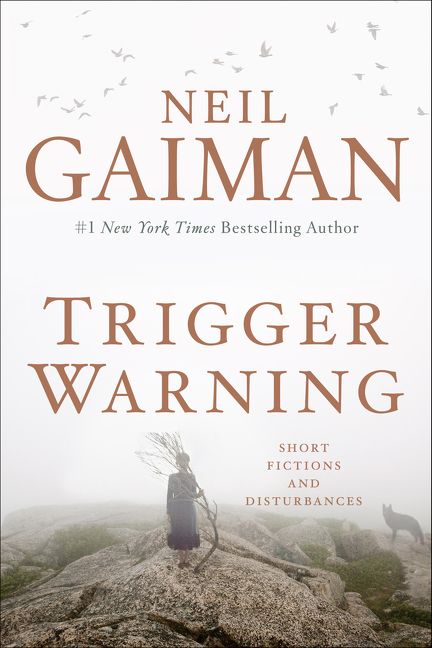
Trigger Warning by Neil Gaiman

book cover

The monsters in our cupboards and our minds are always there in the darkness, like mold beneath the floorboards and behind the wallpaper, and there is so much darkness, an inexhaustible supply of darkness. The universe is amply supplied with night.

There is a diversity of material in Neil Gaiman’s third and latest collection of short fiction, Trigger Warning. It is a potpourri of twenty four pieces, if we take as a single piece the entry called A Calendar of Tales, which, itself, holds a dozen. They are not all, despite the collection title, dark or frightening. He brings in some familiar names, David Bowie, Sherlock Holmes, Doctor Who, Maleficent, Snow White, a traveler from other Gaiman writings, Shadow Moon, twists endings into satisfactory curls for the most part, wanders far afield in setting and content, well, within the UK anyway, tosses in a few poems for good measure, and even offers up a few chuckles. He is fond not only of science fiction as a source, but of Scottish and Irish legends as well. If you are not smitten with the story you are reading at a given moment, not to worry, there is another close behind that is certain to satisfy.

Gaiman is overt in noting the absence of connective tissue among the tales. But there are some themes that pop up a time or three. Living things interred in walls, whether after they had expired or not. A bit of time travelling. Fairy tales are fractured. Favorite writers are admired.

book cover

Neil Gaiman – Photo by Kimberly Butler – on Harper Colllins site

In the introduction, Gaiman tells us a bit about the origins of each of the 24, a nifty item to check back on after one has read them all. Some of the material has been developed for other media. I added a link at bottom to a more-than-text offering re the Calendar of Tales, for one.

Overall I found Trigger Warning is a pretty good survey of Gaiman’s impressive range. He seems able to realize the dreams of the alchemists by transforming what seems every experience he has and every notion that crosses his interior crawl into gold. And some of the stories here are glittery indeed.

I quite enjoyed the collection. The uplift of the best more than made up for the downdraft of the lesser. If you enjoy fantasy, with a good dollop of horror, you could definitely give it a shot.

=======================================THE STORIES

1 – Making a Chair – a poem about the writing process.

2 – A Lunar Labyrinth – a tribute to Gene Wolfe – a traveler who enjoys roadside oddities is brought to a maze that is brought into a form of darkness by the full moon.
Here is a link to a site that will clue you in on roadside oddities in the USA. There is a book on such things for the other side of the pond, but I did not find a comparable link

3 – The Thing about Cassandra – An imaginary connection becomes real, with a delicious twist

4 – Down to a Sunless Sea – an abominable feast, but with some just desserts

5 – The Truth is a Cave in the Black Mountain – A not wholly human dwarf engages a local man to lead him to a cave reputed to be filled with tainted gold – I could not get the image of Peter Dinklage as Tyrion Lannister out of my tiny mind while immersed in this one. Sometimes the truth hurts.

6 – My Last Landlady – the rent is definitely too damn high

7 – Adventure Story – a bit of fun guaranteed to make you smile

8 – Orange – A teen who thinks she’s all that may indeed be – another smile-worthy item

9 – A Calendar of Tales – I won’t go into each – the collection was written from ideas received on-line. I found it a mixed bag, with March (Mom has a big secret), August ( a tale of fire and foolishness), September (a magic ring with the quality of a bad penny), October (a sweet tale, involving a Jinni), and December (a hopeful time-travel piece) my favorites

10 – The Case of Death and Honey – a fantastical tale in which a certain Baker Street resident takes on the mystery of death itself

11 – The Man Who Forgot Ray Bradbury – a tribute to Gaiman’s mentor

12 – Jerusalem – on one of the dangers of visiting the city

13 – Click-clack the Rattlebag – stories can be scary, regardless of the age of the teller

14 – An Invocation of Incuriousity – a time-travel piece – don’t touch the settings

15 – And Weep, Like Alexander – one possible reason why we do not have some of the futuristic inventions we expected long ago – cute, not scary

16 – Nothing O’Clock – a Doctor Who tale with a timely solution

17 – Diamonds and Pearls: A Fairy Tale – a fable with a moral

18 – The Return of the Thin White Duke – the completion of a story begun and abandoned while back for a magazine project on Bowie

19 – Feminine Endings – beware of street statue-performers

20 – Observing the Formalities – Maleficent as narrator of a poem about proper forms

21 – The Sleeper and the Spindle – A fairy tale with a nice twist

22 – Witch Work – a poem on the limits of witchy magic

23 – In Relig Odhrain – a poem on a saint who suffered an awful demise

24 – Black Dog – Shadow Moon stops in an ancient pub and is drawn into some serious darkness, scary fun.

Review posted – 3/20/15

Publication date – 2/3/2015

This review has also been posted on GoodReads

=====================================EXTRA STUFF

Links to the author’s personal, Twitter, Tumblr and FB pages

Here is a link to his separate blog

For a full-on media-rich offering the Calendar of Tales piece in Trigger Warning can be seen here

Harper has an on-line reading guide

Other Gaiman books I have reviewed
The Graveyard Book
The Ocean at the End of the Lane
Stardust

2 Comments

Filed under Fantasy, Fiction, Horror, Short Stories

A Reunion of Ghosts by Judith Claire Mitchell

book cover

The sins of the fathers are visited upon the children to the 3rd and 4th generations

Three sisters plan to see out the millennium together, really see it out. The agree to a mutual suicide pact (life has not been particularly kind), to be carried out as midnight approaches on December 31, 1999. (We doan need no steenking millennium). As a part of this deal they agree to write a family history in which the end is really…you know…the end. A Reunion of Ghosts is that, rather lengthy, suicide note. Sounds cheery, no?

One might suspect that some families might carry forward propensities, whether by DNA, the class-based transmission of means and opportunities, or, maybe something even darker. So much nicer for folks to have a familial propensity for, say red hair, or artistic achievement, like the Wyeths, or Brontes, or Marsalises, maybe an athletic endowment. The Alou boys pop to mind. Sometimes, however, what is passed down is less rewarding. If there are detectable genetic markers for suicide, these folks would probably light up the test like a Christmas tree, although, of course, being Jewish, it might be a Channukah bush instead. There is even a chart on page 8 of my ARE listing members of the family with when, where and how they pruned themselves. It could make for the beginning of darker version of Suicide Clue. Is it Great Grandfather Lenz in a hotel with morphine, maybe Great Grandmother Iris in the garden with a gun, or Grandfather Richard in the bedroom with an open window, maybe Mother in the Hudson with a Bridge? It goes on. I do not want to give the impression that the only way out is DIY. For good measure there are plenty of non-suicide deaths as well. But the question is raised, can the crimes of our forbears curse future generations? Are we to be held accountable for the dark doings of our parents, grand-parents, great-grand-parents? What if we are not, but think that we may be? Is history destiny?

book cover

Judith Claire Mitchell

There is certainly considerable family history here, however much individual tales might have been truncated. The story flips back and forth between the lives of the sisters (and within sundry periods of their lives) and the lives of their ancestors in the 19th and early 20th centuries. The oldest sister is Lady, approaching fifty. She wears nothing but black; Delph is the youngest, at 42. It is on her calf that the introductory quote is inked, a bible item uttered by their mother when JFK was shot. She is cursed with seeing peoples thoughts in bubbles as they pass. (Then never—not ever—have anything nice to say about anyone.); Vee is in the middle, and losing her latest battle with cancer. The three contend with scarring of one sort or another.They live on Riverside Drive in Manhattan’s Upper West Side, in an apartment their family has inhabited for ages.

The three let us in on pieces of their lives, loves sought, found and lost, sometimes tossed. Hearts are broken. They are very engaging, relatable and often very funny. Their conversations sometimes effervesce. There are wits aplenty to go around and we are witness to the banter. Whereas the sisters’ dramas tend to the personal, however difficult, awful mates, lousy luck, the issues of their ancestors are painted on a more colorful European palette. They endure personal travails, for sure, but the issues are a touch larger.

The Alter family originated in what is now Germany. Members of the clan were involved in various enterprises and professions. One owned a dye factory, another was responsible for technology that increased agricultural yields dramatically. One was a brilliant, educated woman struggling to find a place in an exclusively male world. There are plenty of colorful sorts in the family history, including a homosexual, malarial dwarf, who was also Germany’s trade ambassador to Japan. Wedded bliss was hardly the norm, and there are sundry carryings-on. One family shares space with Albert Einstein and his relatively miserable marriage. One bright light concocts and supervises the implementation of some very, very dark science. And of course, there is that familiar issue of Jewishness in Germany. While the sisters’ contemporary tales are relatable and moving, I found the historical segments much more interesting and fun, however distressing the content.

Aside from destiny, there are concrete ways in which the travails of one generation are visited on the next.

“All I said to her was the truth. It’s the same thing I said after the other two were born. The lesson from the camp. I tell it to Lady and Vee, too. When they’re asleep. ‘Never love anyone too much. You never know when they might be taken away.’ I whisper it in their ears. Every night, I whisper it.”

There are plenty of literary bits in here, but Mitchell keeps them at a reasonable level. The females in the family are all named for flowers. Color is a presence across generations. There is a wonderful piece on horizontal light, another on acausal time. But it is not the flourishes that carry the day, it is the characters and their tales, very well told.

Not really a spoiler. A bit of a rant here, which should not take up actual review space, but which requires an outlet, so, a su-aside (I have not yet figured out how to emulate the spoiler tag I used in Goodreads, so this thing is taking up space it was not intended to. Sorry. ) Really, fate, schmate. We are all given a hand. It may suck, or it may be a flush. Point is that it is up to us what to do with the hands we are dealt. It is definitely true that there are real-world limitations, whether because of how society or one’s DNA is organized. Maybe the damage we have suffered has become too much, or our resources for keeping on have become too depleted. Tossing away one’s life can be understandable when one is faced with having to endure extreme pain or loss of self en route to the end of the line with a terminal illness. Depression factors large in the world today, and, untreated, steals one’s resolve to carry on. And I am sure there are probably other understandable reasons to go all Kevorkian. But to give up in the absence of such extremes, the case for some of the characters here, seems an abdication of responsibility. For most of us there are at least some human connections that will be affected, so this usually solo act sends tendrils out to grip others. One’s sense of hope may have been plucked clean, but some feathers can grow back. There is a time to die for all of us, sooner, later, whenever. We take umbrage at the making of a pact by three, admittedly fictional, people to mutually cease to exist in the absence of a terminal condition times three. Maybe it is my former-Catholic DNA popping up and saying that suicide is a sin. I wouldn’t say that, but I would say that it is a waste. Society does a pretty good job of throwing away people. We do not really have to give it any extra help. Ok, rant over.

The worst thing, of course, the ultimate crime, is to even consider giving up a rent-controlled apartment on Riverside Drive. I mean, if the rent ain’t too damn high , you can walk to Zabar’s, see the Hudson, hang out in Riverside Park and discretely shoot spitballs at the joggers who trot by in thousand dollar sweats or bikers speeding by on their five-K rides, or stand around and watch the filming of one of the three thousand cop shows that use NYC for a set, exchange snide remarks about the blight of unsightly construction on the other side of the river, get in on some excellent sunsets, have reserved seating for fireworks, and not have to give up eating and replacing your threadbare threads just to manage the monthly. If that does not make life worth living I don’t know what might. Of course now I must fear that if I write a crap review my great-grandchildren will suffer because of it. And which of my bloody ancestors, I would like to know, is responsible for the state of my bank account? Talk about being cursed.

This is a remarkable novel, able to take on very serious subject matter and maintain a very smart sense of humor at the same time. A Reunion of Ghosts is definitely well worth checking out.

Review posted – 3/13/15

Publication date – 3/24/15

======================================EXTRA STUFF

This is Mitchell’s second novel. She teaches fiction writing to grads and undergrads at the University of Wisconsin in Madison,

A theme song for Reunion – oh yes, I did

Links to the author’s personal and FB pages

BUZZ

On January 8, Buzzfeed listed Reunion among 27 Of The Most Exciting New Books Of 2015

Barnes and Noble listed Reunion as one of its top picks for March 2015

The American Booksellers Association listed Reunion as one of its Indie Next Great Reads for April 2015

1 Comment

Filed under Fiction, Historical Fiction, Literary Fiction, Reviews

The Man Who Loved China by Simon Winchester

book cover

He decided initially to make a great historical list, a list of every mechanical invention and abstract idea—the building blocks of modern world civilization—that had been first conceived and made in China. If he could managed to establish a flawless catalog of just what the Chinese had created first, of exactly which of the world’s ideas and concepts had actually originated in the Middle Kingdom, he would be on to something. If he could delve behind the unforgettable remark that emperor Qianlong had made to the visiting Lord Macartney in 1792—“We possess all things…I have no use for your country’s manufactures”—if he could determine what exactly prompted Qianlong to make such a claim, then he would perhaps have the basis or a truly original and world-changing work of scholarship.

Whereas other great British explorers like Livingston, Scott, Drake and Cook sailed, rode or walked into places that had not been seen by westerners before, not much anyway, and produced useful and accurate maps of the places they explored, Noel Joseph Terence Montgomery Needham strode into places in China that had at least been visited by Europeans, but maybe not properly noticed, and created the equivalent of a map to its history. He would produce one of the monumental intellectual works of the 20th century, Science and Civilization in China,

book cover

Volume 1

and revolutionize how the West perceived a nation that had come to be regarded as a basket case. Like Moses, Joseph Needham did not survive to see the final product of his efforts, but he knew that it would come to be, as he had dedicated his energy, genius, love for and obsession with China to fueling the engine to its final destination. There are, to date, twenty four “substantial published works” in the project, according to the Needham Research Institute, with more in process.

Of course, as a remarkable Englishman, Needham would not be complete without his share of eccentricities, peculiarities and oddities. He was a nudist for one. Those of delicate sensibility afloat on the River Cam in Cambridge knew that there was a certain section of the waterway that might feature suit-free swimmers, and when to shield their gaze. Needham might be found among the bathers. He was also a practitioner of the open marriage. It is unlikely that his wife, Dorothy, the daughter of his Cambridge mentor, was much of a sexual wanderer, but Needham was a notorious womanizer. Of course there was one woman in particular who caught his fancy, and sparked Needham’s life work. 有缘千里来相会

She was named Lu Gwei-djen, and she was Chinese, born thirty-nine years before in the city of Nanjing, and a scientist like himself. They had met at Cambridge six years earlier…In falling headlong for Gwei-djen, Joseph Needham found that he also became enraptured by her country. She taught him her language, and he now spoke, wrote, and read it with a fair degree of fluency. She had suggested that he travel to China and see for himself what a truly astonishing country it was—so different, she kept insisting, from the barbaric and enigmatic empire most westerners believed it to be.

Lu Gwei-djen was a gifted biology researcher who came to Cambridge specifically to study with Needham and his wife, also a high-level scientist. Six months in, she and Needham were an item. Dorothy put up with it.

descriptiondescription
Lu Gewi-djen – from HCSC Foundation – Needham – from USA Today

The times were dramatic when Needham made his first visit to China in 1943. Japan occupied a considerable portion of the country. The trip took years to arrange, having to run a gauntlet of political interference. But once he arrived Needham immediately began identifying elements of contemporary Chinese civilization, technology and science, that dated back hundreds, and sometimes thousands of years, predating similar abilities in the west. He found that much of what was presumed to have originated in Europe had in fact begun in the Middle Kingdom. Needham made it his life’s work to dig into the history of all the Chinese science and technology history he could get his hands on to feed what he already knew would be his magnum opus. He travelled extensively in the non-occupied areas of China, at times barely escaping ahead of Japanese invaders.

Although he compiled a massive amount of information, the crux of his concern rested on what would come to be called The Needham Question or The Grand Question,

why…had modern science originated only in the western world? Much later on…a second question presented itself—namely why, during the previous fourteen centuries, had China been so much more successful than Europe in acquiring knowledge of natural phenomena and using it for human benefit?

Simon Winchester tracks Needham’s life from early childhood until his passing at age 95. He worked until the very end. And a remarkable life it was. His focus, of course, is on the time in which Needham acquired an interest in China and the subsequent lifetime labors. (只要功夫深,铁杵磨成针) A fair bit of ink is given to his relationship with Lu Gwei-djen, as it should be. And there is considerable reportage on Needham’s political views, and the trouble those got him into during the shameful McCarthy period of the Cold War. (一人难称百人心/众口难调)This makes for fascinating reading. Winchester also lets us in on what a pain in the neck it was for Needham, however, intrepid, to make his way around China on his investigations, in the absence of reliable transport. His life and status at Cambridge comes in for a look as well. Like the poor we will always have office politics with us. (强龙难压地头蛇 )

Joseph Needham is indeed one of the most remarkable people of the 20th century. I confess I had never before heard of him, which may say more about my educational shortcomings than Needham’s undeserved obscurity, but I will presume that there are many like me, (fewer, to be sure, on the eastern side of the pond) to whom the story of Joseph Needham will be a revelation. Simon Winchester has made a career out of writing about great accomplishments and the people responsible. (一步一个脚印儿) He has done us all a service to bring this amazing character to our attention. With the growth of China into one of the premier economic and military powers on the planet, it may not ensure a good fortune, but it would probably be a worthwhile thing to know as much as possible about its history and culture.

Publication – 2008

Review posted – 3/6/15

======================================EXTRA STUFF

Links to the author’s personal, Twitter and FB pages

An interesting wiki on the Historiography of science

If you feel like getting a start on reading Needham’s life work, you might check in with the Needham Research Institute . There are many photographs available there taken by Needham on his China visits.

A few other books by Simon Winchester –
Krakatoa
Atlantic
The Map That Changed the World
The Professor and the Madman
There are plenty more Winchester books out there. I have listed only the ones I have read.

The following are the full entries for the Chinese items included in the review. I found them in the China Highlights site.

有缘千里来相会 yǒu yuán qiān lǐ lái xiāng huì – Fate brings people together no matter how far apart they may be. This proverb points out that human relationships are decreed by Fate.

只要功夫深,铁杵磨成针 (zhǐ yào gōng fū shēn, tiě chǔ mó chéng zhēn) – If you work hard enough at it, you can grind even an iron rod down to a needle. This proverb encourages us to persevere in whatever we undertake. Just as the English proverb has it:”Constant drilling can wear away a stone”.

一人难称百人心/众口难调(yī rén nán chèn bǎi rén xīn / zhòng kǒu nán tiáo) – It is hard to please everyone.

强龙难压地头蛇 (qiáng lóng nán yā dìtóu shé) – Even a dragon (from the outside) finds it hard to control a snake in its old haunt. This means: Powerful outsiders can hardly afford to neglect local bullies.

一步一个脚印儿( yī bù yī gè jiǎo yìnr ): Every step leaves its print; work steadily and make solid progress.

1 Comment

Filed under History, Non-fiction, Reviews, Science and Nature

Church of Marvels by Leslie Parry

book cover

All great shows, she told me when I was little (and still learning to flex the tiny muscles in my esophagus), depend on the most ordinary objects. We can be a weary, cynical lot—we grow old and see only what suits us, and what is marvelous can often pass us by. A kitchen knife. A bulb of glass. A human body. That something so common should be so surprising—why, we forget it. We take it for granted. We assume that our sight is reliable, that our deeds are straightforward, that our words have one meaning. But life is uncommon and strange; it is full of intricacies and odd, confounding turns. So onstage we remind them just how extraordinary the ordinary can be. This, she said is the tiger in the grass. It’s the wonder that hides in plain sight, the secret life that flourishes just beyond the screen. For you are not showing them a hoax or trick, just a new way of seeing what’s already in front of them.

Ladies and Gentlemen, boys and girls, step right up. The show is about to begin. See the four-legged dancer, the half-man-half-woman. See the wheel of death, where knives fly toward a spinning lass. See the sword swallower (no, not that sort, puh-leez) and watch as one of our performers eats actual glass. But you had better be quick. This Coney Island sideshow, the Church of Marvels is about to burn to the ground.

description
1996.164.5-10 bw SL1” by H.S. Lewis – Brooklyn Museum. Via Wikimedia Commons – Remnants of a 1903 fire at Coney Island.

Sylvan Threadgill is 19 years old and living on his own in the bowels of end-of-the-19th century New York City. He earns a meager living as a night-soiler, cleaning up the remains of the day, and picks up some extra cash as a boxer. It is while at the former job that he comes across an unusual discard. Sylvan is a (mostly) good-hearted sort, and he takes the baby in, intending to find it’s mother.

Odile Church, the spinning girl on the Wheel of Death, having lost so much, including her mother, worries about what became of her twin, Isabelle, the star of the Church of Marvels. Belle had vanished before the fire. Odile sets off to the never-seen far away land of Manhattan on a quest to find Belle, following a single clue.

Alphie, a “Penny Rembrandt,” and sometime sex-worker, is in love, having been swept off her feet by an undertaker. His old-world Italian mother does not approve, but he marries Alphie anyway, making for a very tense household. Alphie suddenly finds herself a virtual prisoner in Blackwell’s asylum on what is now Roosevelt Island. It is a lovely place, specializing in order over humanity, with generous doses of cruelty tossed in. Charles Dickens actually visited the real Blackwell’s in the 1840s and did not have anything good to say about it. Alphie encounters another prisoner (who never speaks) with unique skills and they plot their escape. Sylvan pursues the truth about the found infant, as Odile tries her best to track down her sister. Truths are discovered, both wonderful and horrifying and all converge to a thrilling climax.

Leslie Parry has written some wonderful characters, people you will most definitely care about, and she has placed them in a marvelous setting.

book cover

Leslie Parry – from Missouri Review

The New York City of 1899 must have been a particularly bleak place for those at the lower end of things. But it is a marvelous place to read about. Parry has painted a colorful portrait of the time, offering chilling images of the era. She has a Dickensian penchant for naming her characters. A noseless street urchin is Sniff. A servant girl is Mouse. A nightsoil foreman is Mr. Everjohn. Another night-soiler is No Bones. A “widow” working in a bordello is Pigeon. There is much here about seeing what is in plain sight, but it is also clear that the author has done considerable digging to bring to light things that were hidden, or at least only slightly known. Opium dens among other things. The treatment of asylum inmates is as appalling as one might expect. The profession of night-soiler was news to me, as was the presence of a civil-war era floating ship hospital. You will enjoy learning of the professions of penny Rembrandt and JennySweeter, and of the significance of a north star symbol on the facades of local businesses.

There are sundry images that permeate the story. Tigers figure large for the girls, from the quilt their mother made for them as kids, to carnival tigers grooming Odile, to a literal take on Blake, to a notion of the secret in plain sight being a “tiger in the grass.” Church references extend beyond the family and family business name. A floating “church” serves as a venue for boxing matches, complete with a preacher and prayer cards. A sense of divinity is summoned on occasion as well. You might keep an eye out for crescents. Parry offers some passages on passages that certainly remind one of birthing and a sort of Campbellian descent.

…for a moment Sylvan had the dreamy sensation that he was swimming through the vein of a body, toward a lush, warming heart. Ahead of him the man was lumbering and stout, so large he had to duck beneath the doorframes, but he moved quickly, almost gracefully. The passage seemed to turn and fold back on itself, and then it came to an end. The man pulled aside a blue curtain and beckoned Sylvan inside.

One consistent concern is being seen for who one is, being appreciated, or at least, being accepted.

To be seen but not known was perhaps the loneliest feeling of all.

While I adore this book, I do have some gripes. There are enough orphans here to cast a production of Pirates of Penzance. While lost or missing parents may have been a much more common thing in 1899 than it is today, it seemed to me that the rope being used to lower the bucket to this well was getting a bit frayed. Mickey Finn is put to considerable use as well. There are two concerns that are heavily spoilerish, so I urge you to pass these by if you have not already read the book. RED means spoiler. Ok, you have been issued fair warning. We are to believe that Isabelle was de-tongued by one person. But how might that have been possible? Did Belle’s assailant grow extra arms? One set for holding Belle down, another for wielding both tongs and knife, and a third set for holding Belle’s mouth open? Nope. Did not buy that one. Also, we are to believe that Siamese twins, joined at the head, were successfully separated by a non-doctor in the 19th century? I doan theen so.

Church of Marvels offers a richly colorful landscape, although the hues tend to the dark end of the spectrum. The story is riveting and moving. The main characters are very interesting and mostly sympathetic. And there are enough twists to keep a contortionist bent out of shape. The image that Parry conjures of the time is richly detailed enough without being overwhelming, and the whole is presented with a warmth and charm that reminded me of The Golem and the Jinni. No, there is not the literal magical element of that other book, but both look at a historical New York and their characters with warmth and charm. In this case, presenting early New York as a kind of sideshow in and of itself.

I am not a regular attendee at any church, but I can heartily recommend Leslie Parry’s debut novel. This church is both unforgettable and marvelous.

Publication date – May 5, 2015
Review posted – 1/30/15

=======================================EXTRA STUFF

Links to the author’s personal, Facebook and Twitter pages

A 5 minute sample of the audio version, read by Denice Stradling

Flashback: When Roosevelt Island Was Blackwell’s Island


Ten Days in a Madhouse, by Bill De Main – about Nellie Bly’s 1887 undercover commitment to Blackwell’s

Some of Bly’s report is available here

Some of Bly’s report is available here

An intro to Nelly Bly on PBS

Leave a comment

Filed under Fantasy, Fiction, Historical Fiction, Literary Fiction

The Wilderness of Ruin: A Tale of Madness, Fire, and the Hunt for America’s Youngest Serial Killer by Roseanne Montillo

book cover

He pointed out that “a strong lack of conscience” is one of the hallmarks for these individuals. “Their game is self-gratification at the other person’s experience,” Hare said. “Psychopathic killers, however, are not mad, according to accepted legal and psychiatric standards. The acts result not from a deranged mind but from a cold, calculating rationality combined with a chilly inability to treat others as thinking, feeling humans.” – the author quoting Robert Hare, author of a book on Psychopathy

Call me Will. Some years ago, a lot, don’t ask, I thought I would see a bit of that northern rival city. It was wintry, snow on the ground. Accommodations were meager. No, I was not there alone, and the journey was not without portents. But I was spared a room-mate of the cannibalistic inclination. I still feel the pull, on occasions. Maybe stop by to see relics of Revolution, fields of dreams crushed and fulfilled, walk spaces where giants once strode. So I was drawn to Roseanne Montillo’s latest. In her previous book, The Lady and Her Monsters, she followed the trail of creation blazed by Mary Shelley as she put together her masterpiece, Frankenstein. In The Wilderness of Ruin, Montillo is back looking at monsters and creators. This time the two are not so closely linked. The monster is this tale is all too real, the youngest serial killer in US history. The artist in this volume is Herman Melville (and, of course, his monster as well, but the killer is the primary monster here) . Montillo treats us to a look at his life, or at least parts of it, and offers some details on the elements that went into the construction of his masterpiece, Moby Dick. A consideration of madness, in his work and in his life, and public discourse on the subject of madness links the two. A third character here is Boston of the late 19th century, as Montillo offers us a look at the place, most particularly in the 1870s. I am sure there are parts of the city remaining, in the Fenway-Kenmore neighborhood, for one, where a form of madness is regularly experienced.

Before the infamous serial killers whose names we know too well, before BTK and Dahmer, before Bundy and Gacy, long before the Boston Strangler, Bean Town was afflicted by a particularly bloody small-fry with particularly large problems. Jesse Pomeroy was a sociopathic little beast who, as a pre-teen, preyed on small children, kidnapping, assaulting and cutting them. He was even known to have taken a bite. As a teen, after a spell in juvie, he graduated to murder. The book calls him America’s youngest serial killer. A drunken, abusive lout of a father played a part, but was Jesse born a monster or was he made? Of course, he would probably not fit as an actual serial killer, as currently defined, but he was definitely a multiple murderer, generated considerable terror in the area, and was certainly sociopathic.

descriptiondescription
The young Jess Pomeroy and Herman Mellville

Montillo offers us a look at the mean streets of Boston in the 1870s. Her descriptions are filled with illuminating, and sometimes wonderful details. It was a very Dickensian scene with poverty widespread and in full view. Child labor was usual, housing was cramped and susceptible to conflagration. Class lines were sometimes demarcated quite clearly. Montillo tells of one in particular, Mount Vernon Street, that marked where well-to-do South Slope ended and working class North Slope began. It was also known as Mount Whoredom Street for its concentration of bordellos. My favorite period detail concerns a World Peace Jubilee that took place in 1872, following the end of the Franco-Prussian war. (The mayor was trying to spruce up the city’s image.) Johann Strauss played Blue Danube, and one hundred fifty firemen took the stage of the newly constructed Coliseum to perform a piece of music by pounding on 150 anvils, which probably makes Boston the birthplace of heavy metal (sorry).

description
The Coliseum in the World Peace Jubilee

Montillo also tells of the sort of political shortsightedness which has plagued governments everywhere. The Fire Chief had taken note of the unpleasantness endured by Chicago in 1871 and urged the city government to do some infrastructure investment to prevent a similar outcome. Think the city did it? Of course, after the conflagration, the media, indulging in their usual investigative acuity, somehow focused blame on the one guy who was trying to prevent catastrophe. Same ole media.

description
Baked Beantown – from Library of Congress

Melville had to endure some troubles of his own. We in the 21st century may regard Moby Dick as one of the masterpieces of American literature, but it sold like three-day old fish. Melville earned less than $600 for his effort, which labors took a considerable toll on his health and maybe on his sanity. Imagine you are Herman Melville and are working on your Opus Magnus, in a place (Arrowhead, in Pittsfield, MA) that is heavy with family, visitors, screaming children, constant distraction, and your family is trying to get you to stop writing, because, of course, it is the writing that is making you nuts. It is amazing to me that Melville did not take a page from Pomeroy’s book and reduce his distractions a notch. It will come as no surprise that he was quite interested in the notion of madness. It was a widely discussed issue of the day. There was direct applicability of the madness discussion to matters like sentencing. If a prisoner is considered insane, would it be ok to execute him? Montillo goes into some of the thought at the time and the thinkers making their cases. Melville’s interest in madness was certainly manifest in his book. Ahab has…issues.

Another treat in the book is some more back story on where and how Melville got some of his material. I had thought it was the tale of the Essex that had been the sole white whale inspiration. Turns out there was an earlier one. Just when you thought it was safe to go back in the whaler…. I am not aware of the name of the aged whale that took out the Essex, but the earlier one was named Mocha Dick, Mocha for the island near where it was sighted, and Dick as a generic appellation, like the Joe part of GI Joe. It does, however, sound like an unspeakable beverage not on sale at Starbuck’s, so far as I am aware.

description
Cover of J. N. Reynolds story Mocha Dick or the White Whale of the Pacific

Due to the joining together of a city and a multiple murderer, The Wilderness of Ruin does bear a base similarity to Erik Larson’s outstanding book, The Devil in the White City. Both tell of an awful killer, and depict a major American city at a time of great change. However Wilderness… does not deliver quite the punch of the earlier book.

First, the link between the killer and Melville lies not in their having anything to do with each other. It is in the fact that madness is associated with both of them. And that is a fairly thin tether with which to connect the two. There are added links having to do with perception of relative skull size and skin color, but I thought those were a stretch. Given how magnificently Montillo had delved into the underpinnings of Mary Shelley’s great work, I believe she would have been well served to have offered up another on Melville. It is possible, of course, that she did not have enough new material with which to populate an entire volume. And there is no shortage of material on Melville out there already. (a Google search of “Melville biography” yielded 9,460 results) Of course, I expect the same might have been said for Mary Shelley. Don’t know, but the linkage felt forced.

Second, there is not really much of a hunt for Pomeroy. He spends most of his time in the book well contained behind bars, attempting to escape his come-uppance legally, and with digging tools, unlike the devil in Chicago, who remained at his dark task for most of that tale.

Third, the title may suggest something to the author, (terminology used to describe the aftermath of the Chicago fire, perhaps) I did not really get a clear image of the stories being told from the title. I suppose Pomeroy creates his fair share of ruin, and Melville endures far too much, and, of course, the city goes all to blazes, but the title just felt off to me.

However, there is still plenty to like in The Wilderness…. That one can come away from this book with a Zapruder-like mantra, “There was a second white whale,“ is almost worth the price of admission on its own. For those who have not already availed of material on Herman, there is enough here to whet one’s appetite, without going overboard. Some of the details of 19th century Boston (Yes, the parts may not have been legally part of the Boston of the era, but they are part of it today) are fascinating. There is a nugget on the origin of a famous Poe story, from when he was stationed in Boston. The discussion on madness is certainly worth listening in on. As is an exchange of ideas about the benefits of solitary confinement. Finally, there is cross-centuries relevance to how government and media function. It will certainly come as no surprise to anyone living in 21st century America that lily-livered politicians would rather take a chance on their districts burning to the ground sooner than spend public money to protect them. And were you aware that Boston had suffered a catastrophic conflagration only a year after Chicago? (excluding you folks from the Boston area. You know about this, right?) And it will come as no surprise to anyone with a radio, television or computer that substantial portions of the media are dedicated to dimming the light by increasing the temperature. The book may not be equal to the sum of the parts, the linkages are a bit frayed, the hunt for and serial designation of the killer may have been exaggerated, but the parts are still pretty interesting. It is always a good thing to visit Boston.

Posted – 1/9/15

Publication date – 3/17/15

=======================================EXTRA STUFF

The author on Twitter

Moby Dick for free on Gutenberg

Billy Budd for free on Gutenberg Australia

Here is a wiki on Mocha Dick , and here the text of the Knickerbocker article in which that tale is told.

A wiki piece on the World Peace Jubilee

Leave a comment

Filed under American history, History, Non-fiction, psycho killer, Psychology and the Brain

Mr Mercedes by Stephen King

book cover

Every religion lies. Every moral precept is a delusion. Even the stars are a mirage. The truth is darkness, and the only thing that matters is making a statement before one enters it. Cutting the skin of the world and leaving a scar. That’s all history is, after all: scar tissue.

Detective Bill Hodges is 62, overweight, divorced and retired. He lives alone and has an uncomfortably familiar relationship with his father’s pistol. The two spend long hours together in front of the tube, taking in the sort of Maury-Povich-mind-poison that is probably grown in basement vats to be sold to post-lobotomy viewers for the price of a gazillion commercials, disposable hours of a pointless life, and a willingness to cash in one’s remnant humanity for a permanent gig as a morality-blind multi-eyed sofa spud.

Hodges had been on the job when a particularly heinous crime had been committed, but was out before he could find the evil-doer. His pre-suicidal reverie is disturbed by the non-postal-service delivery of a printed message. The nut job who did the crime taunts Hodges for his failure, and encourages him to take his suicidal contemplation a step further. Fat chance.

As far as the term hard-boiled goes, I feel pretty comfortable applying it to eggs (cooked in water until the yolk is firm). As for hard-boiled fiction, there are probably as many different definitions as there are diverse sorts of egg-layers. So I will offer no litmus test here to measure whether Mr Mercedes satisfies a certain set of definitional criteria. Is it truly hard-boiled or not? Is it truly noir-ish or not? To which I can only reply. Sorry dear, did you say something? Could you pass the bourbon, please. There are many sub-categories of the mystery genre, 14 of which are noted for your pleasure on the web site of the Seattle Mystery Bookshop. And I am certain that Mr Mercedes fits nicely into one of them. But whether you prefer your mystery tales hard-boiled, soft-boiled, poached, scrambled, fried or over-easy, the one thing that counts here is the chef author. Whatever he does with and to the genre, Stephen King will take you for a ride that includes at least a bit and maybe more than a bit of a scare. And scary is scary whether the source is a haunted house, a psycho alien clown or a very sick puppy.

Said sick puppy opens this story by driving the large Mercedes of the title directly into a crowd of the hopeful and desperate at a job fair in an unnamed Midwest town, killing eight and seriously injuring over a dozen more. (King talks about the genesis of this scene here, in a video clip from TV station WABI in Maine.) Not a recreational activity most of us might indulge in, but for Brady Harstfield murdering and maiming constitutes good times. He makes ends meet as a house-calling IT guy. His second job is as an ice-cream vendor. And, while it is fun to see Brady in his white truck gig, it did feel rather forced. If you are expecting Raymond Chandler here, or Dashiell Hammett, you will have to holster your expectations. There will be no trying-to-figure-out-whodunit in this story. The looney tunes with the diminished conscience and enlarged mommy issues is presented straight away as our psycho-killer. So, more Columbo than Marlowe. The trail we follow is in how the goodies discover and find their way to the baddie.

Erstwhile Detective Hodges takes the lead. King spends some time with introductions, as Mr Mercedes is the first of a planned trilogy. So we get to know a bit about him and his partners in anti-crime. Jerome Robinson is 17, black, 6’5”, a computer whiz, within reason, and Ivy League bound. He has been doing some lawn work and occasional IT assistance for Hodges, and is the closest thing the old guy has to a friend. Holly Gibney, 44, has issues, having spent a few sessions in institutions for the very nervous. She is a cousin to the late owner of the Mercedes that was used in the carnage. Hodges met her as he looked into the death of her cuz. Her mother Charlotte is an awful human being, controlling, greedy, and incapable of seeing Holly’s better qualities. She has some, intelligence and tenacity being high on that list. This oddball trio (the Harper Road Irregulars?) work the case, without, of course, involving the police any more than absolutely necessary. I found them extremely engaging. Jerome is probably too perfect, and Holly may be a bit too twitchy, but they are fun to follow.

King shows his playfulness with the genre, whatever genre it actually is. Of course, Hodges is just a retired detective not a PI, but when Holly’s aunt, Janelle Patterson, (named, surely, for a certain author King has called “a terrible writer”) hires him he takes a step in the genre direction. (I have vowed not to make any jejune comments regarding private dicks) Janelle even buys him what she calls a Philip Marlowe fedora. Janelle is, of course, the mandatory femme fatale, but if so, she is on the light side, lacking some of the attributes normally associated with that type. Could Hodges’ Harper Road address be a nod to Ross McDonald’s Lew Harper? The baddie references several cop dramas, NYPD Blue, Homicide, and The Wire, for example. Luther and Prime Suspect are noted as well, in a disparaging way. Mentions of Wambaugh and Grisham appear, and King double dips by naming a records department cop Marlo. There are undoubtedly many more, but those are the ones that jumped out at me.

King lets us look over Brady’s shoulder as well as over Hodges’, and tosses in some third-party views as well. Parenthood comes in for a difficult time. Only Jerome, of all the major, or even secondary characters, has a decent parent-child relationship with his actual family. Of course bubby family life is not exactly a staple of detective fiction, so that fits well enough.

Madness is the doorway that writers step through when they want to introduce a bit of fantasy to an otherwise real-world scenario. And SK simply could not help himself. Mr Mercedes is most definitely a non-fantasy novel, but there are a few (really, only a few) moments when familiar King woo-woo material appears. It will be interesting to see if this is a recurring feature in his trilogy or if SK can stay on the non-fantasy wagon for the entire ride.

So what’s the bottom line here? Stephen King cranks out novels, it seems, like Hershey produces kisses. They are all tasty and appealing, but there is a definite sameness to the product. King can draw readers in. He offers engaging characters, and understands the mechanics of tension and release as well as any living writer. Put a red wrapper on it and it remains a tasty treat. Blue? Same deal. I bet if King wanted to write a historical romance it would have engaging characters, some danger, some resolution. It would pull you in and hold on like a succubus (no, not public transportation through a red-light district) or like a succubus on a private dick. Sorry, I just could not stop myself. But at least I put the offending material under a spoiler tag, so that makes it ok, right? or, in this case, a femme fatale. I thought the anti-religion musing in which the killer indulges seemed like an interesting theme to explore further, but it seemed to fade.

You will rip through Mr Mercedes faster than the posted limit. There are some scary moments as you careen through, and you will care whether this one or that one comes to a bad end. Some do, some don’t. It is probably a good thing that King is looking to write things other than straight-up horror. He has to amuse himself somehow, keep those possessed typing fingers of his out of trouble. But overall, while Mr Mercedes will get you from here to there and show you a thing or two along the way, it felt a lot more like basic transportation than a true luxury ride.

Posted – 1/3/15

Published June 3, 2014

=======================================EXTRA STUFF

Here is SK’s site and FB page

Otto Penzler has nifty description of what constitutes hard-boiled fiction

A few other King Family items I have reviewed
by Stephen King
The Shining
Doctor Sleep
Under the Dome
Duma Key
Lisey’s Story
Revival

by Joe Hill
NOS4A2
20th Century Ghosts
Heart-Shaped Box

A Gif of the UK cover is cute, but I thought it too distracting to include above

description

Leave a comment

Filed under Fiction, Horror, Noir