Category Archives: Non-fiction

Machines of Loving Grace by John Markoff

book cover

Open the pod bay doors, HAL.
I’m sorry Dave. I’m afraid I can’t do that.
What’s the problem?
I think you know what the problem is just as well as I do.
What are you talking about HAL?
This machine is too important for me to allow you to jeopardize it.
– from 2001: A Space Odyssey

description
Smile for the camera, HAL

This is probably the #1 image most of us of a certain age have concerning the dangers of AI. Whether it is a HAL-9000, or a T-70, T-800, T-888, or T-900 Terminator, a Cylon, a science officer on the Nostromo, a dark version, Lore, of a benign android like STNG’s Commander Data, killer robots on the contemporary TV series Extant, or another of only a gazillion other examples in written word, TV and cinema, there has, for some time now, been a concern, expressed through our entertainment media, that in seeking to rely more and more on computers for everything we do, we are making a Mephistophelian deal and our machines might become our masters. It is as if we, a world of Geppettos, have decided to make our Pinocchios into real boys, without knowing if they will be content to help out in the shop or turn out more like some other artificial being. Maybe we should find a way to include in all AI software some version of the Blue Fairy to keep the souls of the machines on a righteous path.

description
description
Cylons

John Markoff, an Oakland, CA native, has been covering the digital revolution for his entire career. He began writing for InfoWorld in 1981, was later an editor at Byte magazine for about eight bits, then wrote about Silicon Valley for the San Francisco Examiner. In 1988 he began writing for the Business Section of the New York Times, where he remains to this day. He has been covering most of the folks mentioned in this book for a long time, and has knowledge and insight into how they tick.

For the past half century an underlying tension between artificial intelligence and intelligence augmentation—AI vs IA—has been at the heart of progress in computing science as the field has produced a series of ever more powerful technologies that are transforming the world. It is easy to argue that AI and IA are simply two sides of the same coin. There is a fundamental distinction, however, between approaches to designing technology to benefit humans and designing technology as an end in itself. Today, that distinction is expressed in whether increasingly capable computers, software, and robots are designed to assist human users or to replace them.

Markoff follows the parallel tracks of AI vs IA from their beginnings to their latest implementation in the 21st century, noting the steps along the way, and pointing out some of the tropes and debates that have tagged along. For example, in 1993, Vernor Vinge, San Diego State University professor of Mathematics and Hugo-award-winning sci-fi author argued, in The Coming Technological Singularity, that by no later than 2030 computer scientists would have the ability to create a superhuman artificial intelligence and “the human era would be ended.” VI Lenin once said, “The Capitalists will sell us the rope with which we will hang them.” I suppose the AI equivalent would be that “In pursuit of the almighty dollar, capitalists will give artificial intelligence the abilities it will use to make itself our almighty ruler.” And just in case you thought the chains on these things were firmly in place, I regret to inform you that the great state of North Dakota now allows drones to fire tasers and tear gas. The drones are still controlled by cops from a remote location, but there is plenty to be concerned about from military killer drones that may have the capacity to make kill-no-kill decisions within the next few years without the benefit of human input. Enough concern that Autonomous Weapons: an Open Letter from AI & Robotics Researchers, signed by the likes of luminaries like Stephen Hawking, Elon Musk, and tens of thousands of others, raises an alarm and demands that limits be taken so that human decision-making will remain in the loop on issues of mortality.

description
The other Mister “T”

Being “in the loop” is one of the major elements in looking at AI vs IA. Are people part of the process or what computerization seeks to replace? The notion of the driverless car comes in for a considerable look. This would probably not be a great time to begin a career as truck driver, cab driver, or delivery person. On the other hand, much design is intended to help folks, without taking over. A classic example of this is Siri, the voice interface available in Apple products. AI in tech interfaces, particularly voice-intelligent tech, speaks to a bright future.


descriptiondescription
B9 from Lost in Space and Robby the Robot from Forbidden Planet

Markoff looks at the history of funding, research, and rationales. The Advanced Research Projects Agency (ARPA), which has funded so much AI research, began in the 1950s in response to the Soviet launch of Sputnik. Drones is an obvious use for military AI tech, but, on a lower level, there are robot mules designed to tote gear alongside grunts, with enough native smarts to follow their assigned GI without having to be constantly told what to do. I am including links in the EXTRA STUFF section below for some of these. They are both fascinating and creepy to behold. The developers at Boston Dynamics seem to take inordinate glee in trying and failing to knock these critters over with a well placed foot to the midsection. It does not take a lot of imagination to envision these metal pooches hounding escaped prisoners or detainees across any kind of terrain.

description
Darryl Hannah, as the replicant Pris in Blade Runner, would prefer not to be “retired”

As with most things, tech designed with AI capacity can be used for diverse applications. Search and Rescue can easily become Search and Destroy. Driverless cars that allow folks to relax while on the road, can just as easily be driverless tanks.

Universities have been prime in putting the intel into AI. Private companies have also been heavily involved. Xerox’s Palo Alto Research Center (PARC) did, probably, more than any other organization to define the look and feel of computer interfaces since PCs and Apples first appeared. Much of the tech in the world, and working its way there, originates with researchers taking university research work into the proprietary market.

book cover

John Markoff – from TechfestNW

If you are not already a tech nerd (You, with the Spock ears, down, I said tech nerd, not Trek nerd. Sheesh!) and you try to keep up with all the names and acronyms that spin past like a stock market ticker on meth, it might be just a teensy bit overwhelming. I suggest not worrying about those and take in, instead, the general stream of the divergence between computerization that helps augment human capabilities, and computerization that replaces people. There is also a wealth of acronyms in the book. The copy I read was an ARE, so I was on my own to keep track. You will be reading copies that have an actual index, which should help. That said, I am including a list of acronyms, and their close relations, in the EXTRA STUFF section below.

While there are too many names to comfortably keep track of in Machines of Loving Grace, unless of course, you were made operational at that special plant in Urbana, Illinois, it is a very informative and interesting book. It never hurts when trying to understand where we are and struggling to foresee where we might be going, to have a better grasp on where we began and what the forces and decisions have been that led us from then to now. Markoff has offered a fascinating history of the augment-vs-replace struggle, and you need only an actual, biological, un-augmented intelligence to get the full benefit.

My instructor was Mister Langley and he taught me to sing a song. If you’d like to hear it I can sing it for you.

Review Posted – 8/28/15

Publication date – 8/25/2015

=======================================EXTRA STUFF

Links to the author’s Twitter and FB pages

A link to his overall index of NY Times work

Interviews with the author
—–Geekwire
—–Edge

Check out this vid of Boston Dynamics’ Big Dog, coping, on its own with a series of challenges. And Spot, sadly, not Commander Data’s pet.

UC Berkeley Professor Stuart Russell speaking at The Centre for the Study of Existential Risk on The Long Term Future of AI

GR friend Tabasco recommended this fascinating article – The AI Revolution: The Road to Superintelligence – By Tim Urban – must read stuff

And another recent NY Times piece on AI, Software Is Smart Enough for SAT, but Still Far From Intelligent, by John Markoff

And yet another from the Times, on voice recognition,IPhone 6s’s Hands-Free Siri Is an Omen of the Future, by Farhad Manjoo

==========================================ACRONYMS
AI – Artificial Intelligence
ArcMac – Architecture Machine Group
ARM – Autonomous Robot Manipulation
ARPA – Advanced Research Projects Agency
DRC – DARPA Robotics Challenge
CALO – not actually an acronym but short for Calonis, a Latin word meaning “soldier’s low servant” – a cognitive assistant here
CTO – Chief Technology Officer
EST – Erhard Seminars Training
GOAFI – Good Old-Fashioned Artificial Intelligence
HCI – Human Computer Interface
IA – Intelligence Augmentation
ICT – Information and Communications Technology
IFR – International Federation of Robotics
IR3 – The Computer and internet revolution
LS3 – Legged Squad Support System – check out this vid
MIT- Massachusetts Institute of Technology
NCSA – National Center for Supercomputing Applications – at the University of Illinois-Urbana-Champaign – developers of Mosaic, which was later renamed Netscape
NHA – Non-human agents
OAA – Open Agent Architecture –
OpenCV – Open Source Computer Vision
PDP – Parallel Distributed Processing
PR1 – Personal Robot One
SAIL – Stanford Artificial Intelligence Laboratory
SHRDLU – SHRDLU was an early natural language understanding computer program, in which the user carries on a conversation with the computer. The name SHRDLU was derived from ETAOIN SHRDLU, the arrangement of the alpha keys on a Linotype machine, arranged in descending order of usage frequency in English. – from Wiki
SLAM – Simultaneous Localization And Mapping
SNARC – Stochastic Neural Analog Reinforcement Calculator
STAIR – Stanford AI Robot
TFC – The F—ing Clown – Development team Internal name for Microsoft’s Clippy assistant
UbiComp – Ubiquitous Computing

Leave a comment

Filed under computers, History, Non-fiction

Elon Musk: Inventing the Future by Ashlee Vance

book coverElon Musk is not exactly a name that rolls easily off the tongue, like say Tony Stark, the fictional person to whom he is most often compared, or even Steve Jobs, a real-world visionary, whose mantle Musk now wears. There is no question that Musk is a special individual, someone with BIG dreams and the drive, talent, and money to make them happen. But, like Jobs, and Stark for that matter, he might be an acquired taste on a personal level. In Elon Musk: Tesla, SpaceX, and the Quest for a Fantastic Future biographer Ashlee Vance gives us a picture of both the dreams and the man, peering back to where Musk began, describing his journey from then to now, looking at how he is impacting the world today, and gazing ahead to where he wants to go. It is a pretty impressive vista. Here is what it says on the SpaceX website

SpaceX designs, manufactures and launches advanced rockets and spacecraft. The company was founded in 2002 to revolutionize space technology, with the ultimate goal of enabling people to live on other planets.

It might have seemed like visiting another planet when Musk split his home country of South Africa as a teen and headed to North America, anything to get away from an abusive upbringing. He seemed to been blessed not only with exceptional analytical capabilities, and probably an eidetic memory, but an impressively immense set of cojones. He was able to talk his way into whatever he needed and deftly talk his way out of trouble as well. Sometimes that entailed a bit of truth-bending, but whatever.

book cover Ashlee Vance – from HarperCollinscaption]Vance take us from his adolescence as a computer geek, bullied at school, through his arrival in Canada, cold-calling to get work, putting together his first dot.com startup, and using the money from that to invest in a banking-oriented company that would become PayPal. It was the mega-bucks from the sale of PayPal that would allow him to begin realizing his big dreams. In 2003, Musk bought into Tesla, then a struggling startup. The company took the early knowledge that lithium ion batteries had gotten pretty good, added some top level engineering, design and programming talent, and, after plenty of mis-steps and struggles, brought the remarkable all-electric Tesla Roadster to the market in 2008. Tesla followed this with the Model S in 2012. Not only did Consumer reports call this a great car, it named both the 2014 and 2015 versions the best overall cars of their years, and the best care they ever tested. The last time an auto startup succeeded in the USA was Chrysler, in the 1920s. But this is not about simply making a buck on a new car. The long term goal is to shift our petrochemical auto industry to renewable power, and the Tesla is a nifty start. Not only is the car amazing, the company has constructed a nationwide series of charging stations where Tesla owners can recharge their vehicles…for free. There are currently 499 such stations, with many more planned. Tesla is involved in building battery production factories, hoping to help support a growing electric-car auto-economy.


description
Inside the Tesla Model S – from Tesla Motors

But this was not the only big notion that drove Musk. A parallel effort was to develop a solar power business. And with the help of a couple of enterprising cousins, he did just that. SolarCity provides the solar arrays that prove power to the Tesla charging stations, but it has also become one of the largest solar utilities in the nation, installing, maintaining a third of the nation’s solar panel systems. There is obvious benefit to both Tesla and Solar City in sharing gains in battery and other technology. But I expect the third jewel in Musk’s crown is his favorite, SpaceX.

description
Falcon 9 first stage attempting a controlled landing – from Wikimedia

Musk doesn’t have much going on here, nothing major, only an ardent desire to colonize Mars. But it takes the establishment of an infrastructure in order to be get from point E to point M. Musk saw an opening in the market for satellite launch vehicles. Existing rockets blast things up into orbit and then burn up on their way back down. His idea was to design a rocket that could make its way back to earth in one piece, to be reused. And he has. SpaceX is nearing its goal of launching at least one rocket a month. The manifest available on SpaceX.com lists missions to date. The company also designed a capsule called the Dragon that can be used for cargo, but also for astronauts. The cost of launching a satellite using a Falcon is a fraction of what other options charge. The next step is a larger launch vehicle. Space X is expected to launch the first Falcon Heavy later this year, offering the biggest load capacity since the Saturn V was last used in 1973. And, while this is definitely good for business in the relatively short term, one must always keep in mind that this is a stage in a bigger plan for Musk. Once the launch infrastructure is established, plans can begin to move forward to put together Mars missions. Not go, look, and explore sorts of adventures, but establishing a colony, a permanent human presence on the red planet.

description
The Dragon Capsule, attached to the ISS – from Musk’s Twitter page

Of course when one has one’s eyes fixed on the stars (yes, Mars is a planet, I know, Geez), there is a large inclination to lose touch with earth-bound reality. In the movie, then play, then movie The Producers Max Bialystock, in order to cope with the absurd success of a play that was designed to fail, suggests to his partner, Leo Bloom, that one solution would be to do away with the cast. “You can’t kill the actors, Max! They’re human beings,” Leo says. “Human beings? Have you ever seen them eat?” Max replies. I suspect that there are more than a few folks who feel about Elon Musk the way Max felt about the actors. He is rather notorious for his insensitivity to anyone not living inside his head. For example, here is what potential recruits are told to expect when they meet with Musk.

The interview, he or she is told, could last anywhere from thirty seconds to fifteen minutes. Elon will likely keep on writing e-mails and working during the initial part of the interview and not speak much. Don’t panic. That’s normal. Eventually, he will turn around in his chair to face you. Even then, though, he might not make actual eye contact with you or fully acknowledge your presence. Don’t panic. That’s normal. In due course, he will speak to you.

Musk has an amazing capacity for work, putting in monstrous hours as a matter of course. But then he expects the same from those who work for him.

The rank and file employees…revere his drive and respect how demanding he can be. They also think he can be hard to the point of mean and come off as capricious. The employees want to be close to Musk, but they also fear that he’ll suddenly change his mind about something and that every interaction with him is an opportunity to be fired. “Elon’s worst trait by far, in my opinion, is a complete lack of loyalty or human connection,” said one former employee. “Many of us worked tirelessly for him for years and were tossed to the curb like a piece of litter without a second thought. Maybe it was calculated to keep the rest of the workforce on their toes and scared: maybe he was just able to detach from human connection to a remarkable degree. What was clear is that people who worked for him were like ammunition: used for a specific purpose until exhausted and discarded.”

Musk even fired his loyal assistant, Mary Beth Brown, who had been with him for twelve years, after she asked for a raise. What a guy.

Ego is certainly a big piece of the picture here. But I guess if you can do it, it ain’t bragging. Elon Musk is a larger than life figure, a computer geek, an engineer, an entrepreneur, and a dreamer, in addition to being a walking IED as someone to work for. He is one of the inspirations for Robert Downey‘s portrayal of Tony Stark in sundry Marvel Universe films. In fact, Downey came to visit Musk, specifically to get a taste of what a real billionaire techno-industrialist was like. Downey insisted on having a Tesla Roaster on the set of Iron Man, saying, ”Elon was someone Tony probably hung out with and partied with or more likely they went on some weird jungle trek together to drink concoctions with the shamans.” Musk even had a cameo in Iron Man II. The resulting publicity from this connection did little to diminish Musk’s view of himself. Living the high-life in Tinseltown, hanging with, social, economic and media A-listers added more gas to the bag. Part of his ego issue is that he tends to take internal company timetables and announce them to the world as promises (I can see his entire staff jointly rolling their eyes, clutching palms to temples and issuing choruses of “Oh my god” and “WTF” as they spin in place), then holds his employees to those unreasonable schedules. Of course this results in many missed deadlines, much ingestion of antacid and probably the odd nervous breakdown or two.

description
Musk, in an Iron Man II cameo – fromWired

Musk is the sort of guy who shows up with some regularity in science fiction novels, a genre trope, like the researcher who has exactly the sort of experience and insight the President/PM/Chairman/Secretary General needs in order to stave off global catastrophe. He’s the guy who has been secretly building the arc that the world needs to stave off extinction. In this case he is doing it publicly. Of course this raises some issues. Do we as a country, as a planet, really want to be reliant on private companies for our space exploration? Do we want a possible colony on Mars to be a privately held branch of Musk Industries? There are only a gazillion questions that are raised by the privatization of space. What’s good for the bottom line at SpaceX may or may not be good for humanity. We have certainly seen how a reliance on the inherent civic-mindedness and good will of corporations has worked on this planet. Musk is a dreamer, for sure, and I expect his dream of making a better world through the use of renewable energy and his hopes of establishing a human outpost on Mars are pure ideals. But the devil is always in the details, and what would happen should Musk be infected by another virulent strain of malaria and not escape with a near miss, as he did in 2001? Would the replacement CEO share his ideals? Would a replacement CEO be willing to take big risks to support those ideals? Would a replacement CEO look to sell Tesla off to GM to make a few quick billion? One person can move the world, but it takes more than a start to keep things rolling. We could certainly use plenty more people with the sort of drive and ambition that Elon Musk embodies. Innovation is a rare resource and must be cherished. But like any powerful force, it must be, if not tethered, at least monitored, to make certain that it does not run amok.

Ashlee Vance has done an amazing job of telling not only Musk’s story, but of making the life history of the several companies with which Musk has been involved fascinating reading. I did get the sense that Vance was, from all the time he spent with Musk, smitten with his subject. While his portrait of Musk is hardly a zit-free one, I got the feeling that there might be a few more skeletons safely tucked away in closets, a few more bodies buried in basements. Nevertheless, Elon Musk is a powerful, entertaining and informative look at one of the most important people of our time. Your personal vision of the future should certainly include checking out this book.

=======================================EXTRA STUFF

Links to the author’s personal, Twitter and FB pages

Here are links to Musk’s three main companies, SpaceX, Tesla, and Solar City

To Musk’s Twitter – Loooooooove the image he is using for this. He really needs a pinky ring to go with it though. There are a lot of nifty videos in here

Here is the press kit SpaceX provided with its latest Commercial Resupply Services mission to the International Space Station. There are many links in there that are worth checking out.

A visit to the Tesla Factory

And be sure to check out the link Tabasco brought in – Comment #1

Leave a comment

Filed under biography, business, Non-fiction, Science Fiction

Dead Wake by Erik Larson

book cover

The track lingered on the surface like a long pale scar. In maritime vernacular, the trail of fading disturbance, whether from ship or torpedo, was called a “dead wake.”

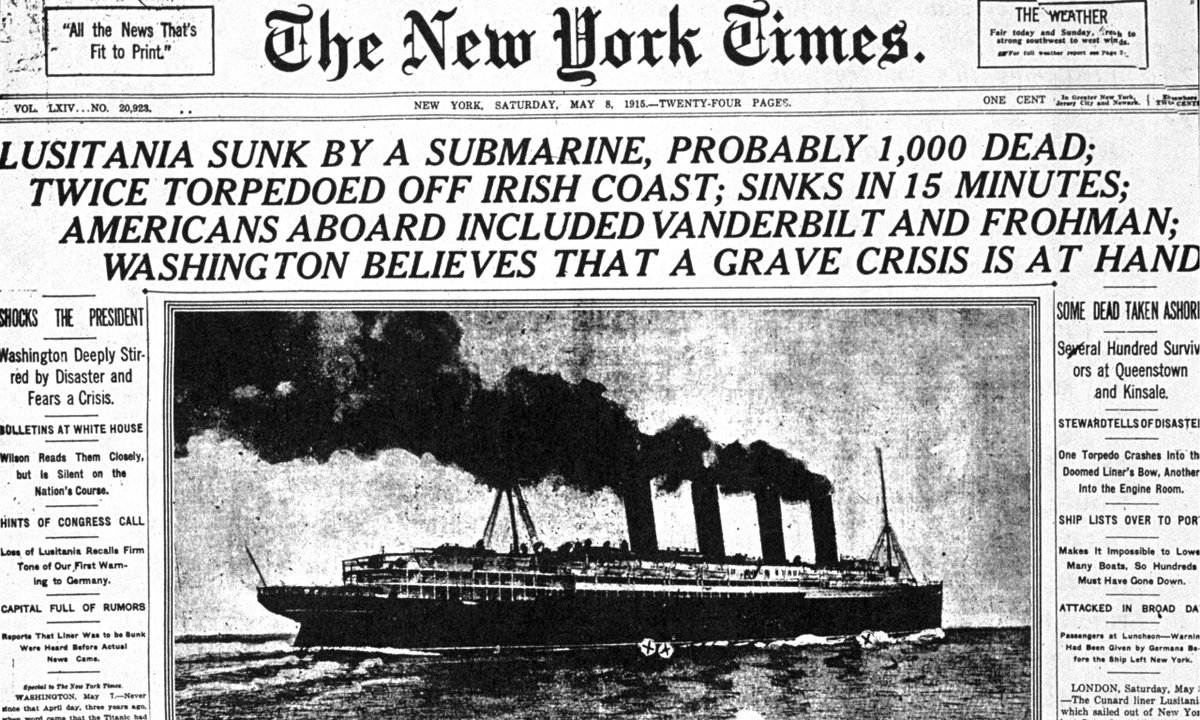
On May 7, 1914, only a few years after that most famous of ocean-liners had had an unfortunate encounter with an iceberg on its maiden voyage, RMS Lusitania, popularly referred to as “Lucy,” having already crossed the Atlantic dozens of times, this time carrying 1,962 souls, was sunk by a German U-boat off the Irish coast. Almost 1200 people perished. Erik Larson casts his perceptive eyes on the event, looking for explanations. Why was the ship sunk? Had it been possible for the ship to have avoided its fate? What were the global circumstances at the time and how did those effect the disaster? Who and what was on the ship? Why? What was the big deal about the Lusitania? Other ships had been sunk by U-boats during this conflict. How did the sinking of the Lusitania affect American entry into The Great War?

description
The New York Times headline – From PBS

We all have preconceptions, notions that hardly seem worth examining. I expect for most of us, the details of the sinking of the Lusitania are clouded by the fog of time. We might believe that, as with the sinking of the USS Maine in Cuba, the national response was immediate and violent. Turns out the reality was far different.

description
Artist rendering of the sinking – from Cinewiki.wikispaces.com

Larson looks at events in several threads. Mostly he follows the events on the Lusitania and on the German sub (U-20 – U-boat is an abbreviation of Unterseeboot, or undersea boat) that would bring it down. In parallel, he looks at the politics involved in, not so much the causes of World War I, but in the stages between the commencement of hostilities and the eventual drawing of the USA into the war. He looks at the milieu in which American president Woodrow Wilson existed, politically and personally. He looks at the people involved in making tactical decisions, and at a special, secret intelligence gathering location in the UK. He stops, also, for a look at the sad accumulation of the victims in Ireland.

Larson offers a view of the Lusitania that might not be obvious to those of us looking back a hundred years. We might, for example, think of it as a relatively slow moving ocean liner, but it was the fastest civilian ship of its time. Its exceptional speed was a major selling point. There is plenty more detail about the ship, the different sorts of lifeboats, with their potential benefits and downsides, the unusual hull it used. Lucy carried a relatively inexperienced crew, due to so many able-bodied seamen having been drawn into the military. New, unusual life vests were used on the ship, and training in their use was lacking, as was training in using the lifeboats.

descriptiondescription
The sinking was used for recruiting – in Britain and the USA

On the other side, it is remarkable how fragile U-boats were, and the limitations they faced in pursuing their mission. Larson offers us a look aboard the sub that did the deed, captain’s log and all. How fast were these boats? What was their range? What was their mission, their command structure? What was the physical environment like for submariners? What could they not do? Where could they not go? How did they keep in touch with their land-based command? What were their orders? What was the mindset of the captain, of his crew? Lots to look at here, eye-opening stuff. Don’t sign me up for life on a sub.

description
The wrecked U-20 after a failed attempt to scuttle – from Lusitania.net

And of course there was the interaction between militaries. How did the allies cope with the very effective plague the U-boats presented? Could they track them? If so, how did they track them? What were the capabilities of the super-secret Room 40? What was the decision process the German command used in deciding how to use this powerful weapon?

description
Room 40 – from Lusitania.net

One thing Larson does is follow the narrative of several of the passengers aboard the big boat. This brings the disaster away from technical details to actual human experience. You will get to know some of the passengers, and learn their fates.

There is a wealth of information in Dead Wake. For example, the biggest surprise for most readers, and perhaps the most controversial element in the book is the suggestion that Britain did not exactly do all it might have to protect Lucy from enemy attack, as there were some at the highest levels of government who believed that such an event might hasten the enlistment of the USA into the war. There were other factors for sure that contributed to why Lucy was where she was when she was, but most of those lack the bitter flavor of dark calculation. And maintaining the sour taste is a description of how shameless members of the admiralty sought to evade personal responsibility for the sinking by pointing fingers at a designated patsy. Despite the denials all around that the Lusitania was purely a civilian ship, the fact was that it was carrying a considerable supply of military materiel for use against Germany. Lucy would most definitely have had some ‘splaining to do’ had it been known that supposedly neutral America was using her as a military transport to support the Allies.

description
Erik Larson – from New Hampshire Public Radio

There is plenty of drama to go around here. Even though we know what will happen, Larson succeeds in instilling tension into the coming together of Lucy with her killer. The descriptions of life aboard the sub are compelling; information about the physical realities of the Lusitania is fascinating, and looking at the probable decision-making involved is enraging.

This is not to say that there are no rents in the hull taking on a bit of the briny. While it seemed clear that tracking individual passengers was intended to take the story from an emotionally removed overview down a bit closer to sea level, I found that most of these passages were not all that engaging. It also seemed not entirely clear that Woodrow Wilson’s domestic situation was necessarily all that important in his reluctance to bring the USA into the war.

On the other hand there are bits that are depressingly resonant with more contemporary outrages, as left hands not keeping right hands informed of their actions contributed to the ultimate catastrophe. Information that could have identified a sub in a shipping lane was available, but was not put together in time. Very reminiscent of 9/11. Our species certainly seems well practiced in learning nothing from history. One contributing factor was a corporate cost-cutting measure that kept Lucy from making her best time across the Atlantic. Had she been allowed to use all four of her boilers instead of only three, she would never have encountered U-20. The Deepwater Horizon disaster, and many more such incidents remind us that pursuit of the almighty dollar/pound/euro/(insert your currency here) will always be assigned a higher value than human life or the safety of the environment for many of the people making such decisions.

descriptiondescription
President Wilson and First Lord of the Admiralty Winston Churchill

Germany actually posted newspaper notices in American newspapers, before the Lusitania set sail from New York City, that all ships entering what was considered a war zone were at risk of being sunk. It would not be the last time clear messages of intent from Germany would be ignored to our everlasting regret.

description

Dead Wake is a wonderful piece of writing, not only diving down into details of what is probably a murky subject for most of us, offering a greater understanding of the physical event, but providing a context within which we can achieve a greater understanding of the causes and implications of the sinking of the RMS Lusitania. As a bit of historical reporting is it definitely a case of “Damn the torpedoes, full speed ahead.”

Review posted – 7/3/15

Publication date – 3/10/15

=======================================EXTRA STUFF

Links to the author’s personal, Twitter and FB pages

Lusitania Online is a wonderful source for all things Lucy

Video from the National Archives of passengers arriving and Lucy embarking on its final voyage- the first 1:50 is mostly people getting out of cars, so feel free to skip ahead a bit

A 1918 animation of the sinking

Arthur Conan Doyle’s story Danger! was written about 18 months before the outbreak of WWI. It anticipated in considerable detail the submarine warfare to come. You can read it on Gutenberg. In the preface to the 1918 collection in which it appears, Doyle noted that he attempted to present his notions to the government, noting that he:

…did indeed adopt every possible method, that he personally approached leading naval men and powerful editors, that he sent three separate minutes upon the danger to various public bodies, notably to the Committee for National Defence, and that he touched upon the matter in an article in The Fortnightly Review. In some unfortunate way subjects of national welfare are in this country continually subordinated to party politics, so that a self-evident proposition, such as the danger of a nation being fed from without, is waved aside and ignored, because it will not fit in with some general political shibboleth. 

If this reminds you at all of Bill Clinton and Richard Clarke trying to warn the incoming Bush administration of the danger presented by Osama bin Laden, it should.

Leave a comment

Filed under History, Non-fiction

The Man Who Loved China by Simon Winchester

book cover

He decided initially to make a great historical list, a list of every mechanical invention and abstract idea—the building blocks of modern world civilization—that had been first conceived and made in China. If he could managed to establish a flawless catalog of just what the Chinese had created first, of exactly which of the world’s ideas and concepts had actually originated in the Middle Kingdom, he would be on to something. If he could delve behind the unforgettable remark that emperor Qianlong had made to the visiting Lord Macartney in 1792—“We possess all things…I have no use for your country’s manufactures”—if he could determine what exactly prompted Qianlong to make such a claim, then he would perhaps have the basis or a truly original and world-changing work of scholarship.

Whereas other great British explorers like Livingston, Scott, Drake and Cook sailed, rode or walked into places that had not been seen by westerners before, not much anyway, and produced useful and accurate maps of the places they explored, Noel Joseph Terence Montgomery Needham strode into places in China that had at least been visited by Europeans, but maybe not properly noticed, and created the equivalent of a map to its history. He would produce one of the monumental intellectual works of the 20th century, Science and Civilization in China,

book cover

Volume 1

and revolutionize how the West perceived a nation that had come to be regarded as a basket case. Like Moses, Joseph Needham did not survive to see the final product of his efforts, but he knew that it would come to be, as he had dedicated his energy, genius, love for and obsession with China to fueling the engine to its final destination. There are, to date, twenty four “substantial published works” in the project, according to the Needham Research Institute, with more in process.

Of course, as a remarkable Englishman, Needham would not be complete without his share of eccentricities, peculiarities and oddities. He was a nudist for one. Those of delicate sensibility afloat on the River Cam in Cambridge knew that there was a certain section of the waterway that might feature suit-free swimmers, and when to shield their gaze. Needham might be found among the bathers. He was also a practitioner of the open marriage. It is unlikely that his wife, Dorothy, the daughter of his Cambridge mentor, was much of a sexual wanderer, but Needham was a notorious womanizer. Of course there was one woman in particular who caught his fancy, and sparked Needham’s life work. 有缘千里来相会

She was named Lu Gwei-djen, and she was Chinese, born thirty-nine years before in the city of Nanjing, and a scientist like himself. They had met at Cambridge six years earlier…In falling headlong for Gwei-djen, Joseph Needham found that he also became enraptured by her country. She taught him her language, and he now spoke, wrote, and read it with a fair degree of fluency. She had suggested that he travel to China and see for himself what a truly astonishing country it was—so different, she kept insisting, from the barbaric and enigmatic empire most westerners believed it to be.

Lu Gwei-djen was a gifted biology researcher who came to Cambridge specifically to study with Needham and his wife, also a high-level scientist. Six months in, she and Needham were an item. Dorothy put up with it.

descriptiondescription
Lu Gewi-djen – from HCSC Foundation – Needham – from USA Today

The times were dramatic when Needham made his first visit to China in 1943. Japan occupied a considerable portion of the country. The trip took years to arrange, having to run a gauntlet of political interference. But once he arrived Needham immediately began identifying elements of contemporary Chinese civilization, technology and science, that dated back hundreds, and sometimes thousands of years, predating similar abilities in the west. He found that much of what was presumed to have originated in Europe had in fact begun in the Middle Kingdom. Needham made it his life’s work to dig into the history of all the Chinese science and technology history he could get his hands on to feed what he already knew would be his magnum opus. He travelled extensively in the non-occupied areas of China, at times barely escaping ahead of Japanese invaders.

Although he compiled a massive amount of information, the crux of his concern rested on what would come to be called The Needham Question or The Grand Question,

why…had modern science originated only in the western world? Much later on…a second question presented itself—namely why, during the previous fourteen centuries, had China been so much more successful than Europe in acquiring knowledge of natural phenomena and using it for human benefit?

Simon Winchester tracks Needham’s life from early childhood until his passing at age 95. He worked until the very end. And a remarkable life it was. His focus, of course, is on the time in which Needham acquired an interest in China and the subsequent lifetime labors. (只要功夫深,铁杵磨成针) A fair bit of ink is given to his relationship with Lu Gwei-djen, as it should be. And there is considerable reportage on Needham’s political views, and the trouble those got him into during the shameful McCarthy period of the Cold War. (一人难称百人心/众口难调)This makes for fascinating reading. Winchester also lets us in on what a pain in the neck it was for Needham, however, intrepid, to make his way around China on his investigations, in the absence of reliable transport. His life and status at Cambridge comes in for a look as well. Like the poor we will always have office politics with us. (强龙难压地头蛇 )

Joseph Needham is indeed one of the most remarkable people of the 20th century. I confess I had never before heard of him, which may say more about my educational shortcomings than Needham’s undeserved obscurity, but I will presume that there are many like me, (fewer, to be sure, on the eastern side of the pond) to whom the story of Joseph Needham will be a revelation. Simon Winchester has made a career out of writing about great accomplishments and the people responsible. (一步一个脚印儿) He has done us all a service to bring this amazing character to our attention. With the growth of China into one of the premier economic and military powers on the planet, it may not ensure a good fortune, but it would probably be a worthwhile thing to know as much as possible about its history and culture.

Publication – 2008

Review posted – 3/6/15

======================================EXTRA STUFF

Links to the author’s personal, Twitter and FB pages

An interesting wiki on the Historiography of science

If you feel like getting a start on reading Needham’s life work, you might check in with the Needham Research Institute . There are many photographs available there taken by Needham on his China visits.

A few other books by Simon Winchester –
Krakatoa
Atlantic
The Map That Changed the World
The Professor and the Madman
There are plenty more Winchester books out there. I have listed only the ones I have read.

The following are the full entries for the Chinese items included in the review. I found them in the China Highlights site.

有缘千里来相会 yǒu yuán qiān lǐ lái xiāng huì – Fate brings people together no matter how far apart they may be. This proverb points out that human relationships are decreed by Fate.

只要功夫深,铁杵磨成针 (zhǐ yào gōng fū shēn, tiě chǔ mó chéng zhēn) – If you work hard enough at it, you can grind even an iron rod down to a needle. This proverb encourages us to persevere in whatever we undertake. Just as the English proverb has it:”Constant drilling can wear away a stone”.

一人难称百人心/众口难调(yī rén nán chèn bǎi rén xīn / zhòng kǒu nán tiáo) – It is hard to please everyone.

强龙难压地头蛇 (qiáng lóng nán yā dìtóu shé) – Even a dragon (from the outside) finds it hard to control a snake in its old haunt. This means: Powerful outsiders can hardly afford to neglect local bullies.

一步一个脚印儿( yī bù yī gè jiǎo yìnr ): Every step leaves its print; work steadily and make solid progress.

1 Comment

Filed under History, Non-fiction, Reviews, Science and Nature

The Wilderness of Ruin: A Tale of Madness, Fire, and the Hunt for America’s Youngest Serial Killer by Roseanne Montillo

book cover

He pointed out that “a strong lack of conscience” is one of the hallmarks for these individuals. “Their game is self-gratification at the other person’s experience,” Hare said. “Psychopathic killers, however, are not mad, according to accepted legal and psychiatric standards. The acts result not from a deranged mind but from a cold, calculating rationality combined with a chilly inability to treat others as thinking, feeling humans.” – the author quoting Robert Hare, author of a book on Psychopathy

Call me Will. Some years ago, a lot, don’t ask, I thought I would see a bit of that northern rival city. It was wintry, snow on the ground. Accommodations were meager. No, I was not there alone, and the journey was not without portents. But I was spared a room-mate of the cannibalistic inclination. I still feel the pull, on occasions. Maybe stop by to see relics of Revolution, fields of dreams crushed and fulfilled, walk spaces where giants once strode. So I was drawn to Roseanne Montillo’s latest. In her previous book, The Lady and Her Monsters, she followed the trail of creation blazed by Mary Shelley as she put together her masterpiece, Frankenstein. In The Wilderness of Ruin, Montillo is back looking at monsters and creators. This time the two are not so closely linked. The monster is this tale is all too real, the youngest serial killer in US history. The artist in this volume is Herman Melville (and, of course, his monster as well, but the killer is the primary monster here) . Montillo treats us to a look at his life, or at least parts of it, and offers some details on the elements that went into the construction of his masterpiece, Moby Dick. A consideration of madness, in his work and in his life, and public discourse on the subject of madness links the two. A third character here is Boston of the late 19th century, as Montillo offers us a look at the place, most particularly in the 1870s. I am sure there are parts of the city remaining, in the Fenway-Kenmore neighborhood, for one, where a form of madness is regularly experienced.

Before the infamous serial killers whose names we know too well, before BTK and Dahmer, before Bundy and Gacy, long before the Boston Strangler, Bean Town was afflicted by a particularly bloody small-fry with particularly large problems. Jesse Pomeroy was a sociopathic little beast who, as a pre-teen, preyed on small children, kidnapping, assaulting and cutting them. He was even known to have taken a bite. As a teen, after a spell in juvie, he graduated to murder. The book calls him America’s youngest serial killer. A drunken, abusive lout of a father played a part, but was Jesse born a monster or was he made? Of course, he would probably not fit as an actual serial killer, as currently defined, but he was definitely a multiple murderer, generated considerable terror in the area, and was certainly sociopathic.

descriptiondescription
The young Jess Pomeroy and Herman Mellville

Montillo offers us a look at the mean streets of Boston in the 1870s. Her descriptions are filled with illuminating, and sometimes wonderful details. It was a very Dickensian scene with poverty widespread and in full view. Child labor was usual, housing was cramped and susceptible to conflagration. Class lines were sometimes demarcated quite clearly. Montillo tells of one in particular, Mount Vernon Street, that marked where well-to-do South Slope ended and working class North Slope began. It was also known as Mount Whoredom Street for its concentration of bordellos. My favorite period detail concerns a World Peace Jubilee that took place in 1872, following the end of the Franco-Prussian war. (The mayor was trying to spruce up the city’s image.) Johann Strauss played Blue Danube, and one hundred fifty firemen took the stage of the newly constructed Coliseum to perform a piece of music by pounding on 150 anvils, which probably makes Boston the birthplace of heavy metal (sorry).

description
The Coliseum in the World Peace Jubilee

Montillo also tells of the sort of political shortsightedness which has plagued governments everywhere. The Fire Chief had taken note of the unpleasantness endured by Chicago in 1871 and urged the city government to do some infrastructure investment to prevent a similar outcome. Think the city did it? Of course, after the conflagration, the media, indulging in their usual investigative acuity, somehow focused blame on the one guy who was trying to prevent catastrophe. Same ole media.

description
Baked Beantown – from Library of Congress

Melville had to endure some troubles of his own. We in the 21st century may regard Moby Dick as one of the masterpieces of American literature, but it sold like three-day old fish. Melville earned less than $600 for his effort, which labors took a considerable toll on his health and maybe on his sanity. Imagine you are Herman Melville and are working on your Opus Magnus, in a place (Arrowhead, in Pittsfield, MA) that is heavy with family, visitors, screaming children, constant distraction, and your family is trying to get you to stop writing, because, of course, it is the writing that is making you nuts. It is amazing to me that Melville did not take a page from Pomeroy’s book and reduce his distractions a notch. It will come as no surprise that he was quite interested in the notion of madness. It was a widely discussed issue of the day. There was direct applicability of the madness discussion to matters like sentencing. If a prisoner is considered insane, would it be ok to execute him? Montillo goes into some of the thought at the time and the thinkers making their cases. Melville’s interest in madness was certainly manifest in his book. Ahab has…issues.

Another treat in the book is some more back story on where and how Melville got some of his material. I had thought it was the tale of the Essex that had been the sole white whale inspiration. Turns out there was an earlier one. Just when you thought it was safe to go back in the whaler…. I am not aware of the name of the aged whale that took out the Essex, but the earlier one was named Mocha Dick, Mocha for the island near where it was sighted, and Dick as a generic appellation, like the Joe part of GI Joe. It does, however, sound like an unspeakable beverage not on sale at Starbuck’s, so far as I am aware.

description
Cover of J. N. Reynolds story Mocha Dick or the White Whale of the Pacific

Due to the joining together of a city and a multiple murderer, The Wilderness of Ruin does bear a base similarity to Erik Larson’s outstanding book, The Devil in the White City. Both tell of an awful killer, and depict a major American city at a time of great change. However Wilderness… does not deliver quite the punch of the earlier book.

First, the link between the killer and Melville lies not in their having anything to do with each other. It is in the fact that madness is associated with both of them. And that is a fairly thin tether with which to connect the two. There are added links having to do with perception of relative skull size and skin color, but I thought those were a stretch. Given how magnificently Montillo had delved into the underpinnings of Mary Shelley’s great work, I believe she would have been well served to have offered up another on Melville. It is possible, of course, that she did not have enough new material with which to populate an entire volume. And there is no shortage of material on Melville out there already. (a Google search of “Melville biography” yielded 9,460 results) Of course, I expect the same might have been said for Mary Shelley. Don’t know, but the linkage felt forced.

Second, there is not really much of a hunt for Pomeroy. He spends most of his time in the book well contained behind bars, attempting to escape his come-uppance legally, and with digging tools, unlike the devil in Chicago, who remained at his dark task for most of that tale.

Third, the title may suggest something to the author, (terminology used to describe the aftermath of the Chicago fire, perhaps) I did not really get a clear image of the stories being told from the title. I suppose Pomeroy creates his fair share of ruin, and Melville endures far too much, and, of course, the city goes all to blazes, but the title just felt off to me.

However, there is still plenty to like in The Wilderness…. That one can come away from this book with a Zapruder-like mantra, “There was a second white whale,“ is almost worth the price of admission on its own. For those who have not already availed of material on Herman, there is enough here to whet one’s appetite, without going overboard. Some of the details of 19th century Boston (Yes, the parts may not have been legally part of the Boston of the era, but they are part of it today) are fascinating. There is a nugget on the origin of a famous Poe story, from when he was stationed in Boston. The discussion on madness is certainly worth listening in on. As is an exchange of ideas about the benefits of solitary confinement. Finally, there is cross-centuries relevance to how government and media function. It will certainly come as no surprise to anyone living in 21st century America that lily-livered politicians would rather take a chance on their districts burning to the ground sooner than spend public money to protect them. And were you aware that Boston had suffered a catastrophic conflagration only a year after Chicago? (excluding you folks from the Boston area. You know about this, right?) And it will come as no surprise to anyone with a radio, television or computer that substantial portions of the media are dedicated to dimming the light by increasing the temperature. The book may not be equal to the sum of the parts, the linkages are a bit frayed, the hunt for and serial designation of the killer may have been exaggerated, but the parts are still pretty interesting. It is always a good thing to visit Boston.

Posted – 1/9/15

Publication date – 3/17/15

=======================================EXTRA STUFF

The author on Twitter

Moby Dick for free on Gutenberg

Billy Budd for free on Gutenberg Australia

Here is a wiki on Mocha Dick , and here the text of the Knickerbocker article in which that tale is told.

A wiki piece on the World Peace Jubilee

Leave a comment

Filed under American history, History, Non-fiction, psycho killer, Psychology and the Brain

Not My Father’s Son by Alan Cumming

book cover

Wilkommen, bienvenue, welcome!

Settle in for a story that is appalling and entertaining, hopeful and disappointing, reflective and sometimes ephemeral.

Life is disappointing? Forget it.

It is a good thing that this advice was not followed. Remembering seems more the thing.

We have no troubles here. Here life is beautiful.

Ummm, not so much. And now, Meine Damen und Herren, Mes Dames et Messieurs, Ladies and Gentlemen,

Ich bin eur confrencier, je suis votre compere…I am your host.

the star of our show:

description
Cumming in the 1998 production – from Wmagazine.com – Photo by Joan Marcus.

“You need a haircut, boy!”

My father had only glanced at me across the kitchen table as he spoke but I had already seen in his eyes the coming storm.


I tried to speak but the fear that now engulfed me made it hard to swallow, and all that came out was a little gasping sound that hurt my throat even more. And I knew speaking would only make things worse, make him despise me more, make him pounce sooner. That was the worst bit, the waiting. I never knew exactly when it would come, and that, I know, was his favorite part.

Alan Cumming, star of stage and screen, notable Cabaret emcee, introducer of Masterpiece Mystery, bluish X-man, Smurf voice, and political operative Eli Gold on The Good Wife, among many other memorable characters, was raised on a large estate in Scotland. His father, Alex, was the head groundskeeper. He was also a mercurial and often cruel and violent parent to both Alan and his older brother Tom, offering ambiguous instructions to the boys and almost always finding the resulting work unsatisfactory, an excuse to justify the punishment that usually followed. Cumming’s experience as a battered child, coming to terms as an adult with some of the reasons for his harsh upbringing, and attempting to finally, decades later, move past it, is the core of the story in Not My Father’s Son. But this is not just a story of the father he knew. It is also about the grandfather he had never met.

description
Mary Darling and Alex Cumming – wedding day – from the NY Times

In 2010, Cumming, having attained a certain level of celebrity, was invited by the British show Who Do You Think you Are (now in the USA as well) to be a subject for their weekly genealogy quest program. The research that was intrinsic to this process would cast light on a black hole in his family history. As awful as his father was, Mary Darling, Alan’s mother, was his angel, always supporting and nurturing him. Within limits, of course. She did not seem to do a very good job of preventing her husband from tormenting their sons. She had last seen her own father, Tommie Darling, when she was eight years old. He had supposedly died in a gun accident in Malaysia in 1951. The family knew very little about him, and had few remnants of his existence. The TV show would follow that trail and find out what had happened to Tommie. (There is a link to the entire program in the EXTRA STUFF section below) Just before this process began, Alan’s father, long estranged, got in touch, passing along a disturbing piece of information.

description
As Eli Gold and Nightcrawler – from NothingButMemory.net

One part of this memoir is travelling along and peeling back the layers of the mystery that was Tommie Darling. (Peter Pan was not involved) As researchers for the program unearth more and more information about Tommie, Alan learns more and more about not only his family, but sees in his ancestor traits he recognizes in himself.

description
Masterpiece Mystery host – from the Boston Herald

Chapters alternate, more or less, between now (2010) and then, the years of Alan’s childhood, the new work prodding recollections of the past. However, it is not all childhood and now. Cumming also tells of his breakdown at age 28 when he was starring in a London production of Hamlet, rehearsing for his breakthrough role as the emcee in the London revival of Cabaret and planning to have a child with his wife. There is some detail here. Later he tells of meeting his current mate when he was 39. He seems to have packs of friends, who remain mostly nameless, in both London and New York, and who function as scenery, for the most part. He offers a few tales from his acting life.

When I joined Twitter I described myself as “Scottish elf trapped inside a middle aged man’s body” and I still think that’s accurate.

Despite Cumming’s elfishness, there is not much comedy in the book. Although Cumming the performer does indeed present a pixie-ish facade, the only real laugh, at least for me, was when he talked about Patti Smith and a particular vile habit of hers. A story about attempting to film against the incessant noise in South Africa during a particularly noisy World Cup is another light moment. A youthful masturbatory scene that one thinks might be queasily amusing turns in another, far more substantive direction.

The two parts of this story now seem so clearly connected, mirroring each other perfectly. I had lost a father but found a grandfather. One of them had never sought the truth and lived a life based on a lie; the other’s truth was hidden from us because society deemed it unsuitable. Both caused strife, and sadness. But now, both combined to reinforce for me what I knew to be the only truth: there is never shame in being open and honest. It was shame that prevented us from knowing what a great man Tommy Darling was. And it was shame that made my father treat me and Tom and my mum the way he did.

Not My Father’s Son is a moving and fascinating tale, and probably would not have been told had Cumming not been world famous. TV programs do not seek out the likes of you or me to give them permission to travel the world looking into our backgrounds. Most of us do not have the resources to delve into our family history so richly. It remains to be seen if the book would have been written had the TV program not been made. Cumming had indeed been thinking about his childhood for some time, but it was the show that prompted him to move ahead with it. What Cumming’s talent did was give him a way to get out of a bad situation. A lesser light might have dimmed if left in that place. One thing the book might do is prompt a bit of reflection. Surely there are leafless branches on all our family trees and Cumming’s tale of looking into his might encourage some of us to consider looking into some of ours. And maybe to look a bit closer at even our known history for a bit of help in explaining how we became the people we are.

description
Tom, Mary and Alan at Tommie’s grave

I have admired Alan Cumming as a performer ever since seeing him in the New York revival of Cabaret back in 1998. I now admire him as a writer as well. He has written a moving memoir of a father lost and a grandfather gained. It is rich with reflection, insight, pain, and healing. Any decent father would be bursting with pride to have a son capable of writing such a book.

Review posted – 10/17/14

Publication date – 10/7/14

=======================================EXTRA STUFF

Links to the author’s personal and Twitter pages

He is not on Facebook. Some miscreants have posed as him, but those pages have been taken down

Definitely check out his site. It is a cornucopia of info.

NY Times article on Alan

Here is the full Who Do You Think You Are episode from September 2010

1 Comment

Filed under Bio/Autobio/Memoir, Non-fiction, Reviews

Swimming with Warlords by Kevin Sites

book cover

“If the central government doesn’t stay together,” he said, “I’ll have to find a way to protect my people.”
What he said was a bad sign. “My people” in Afghanistan means one’s tribe. Very few outside of Kabul thought of themselves as citizens of the country—as Afghans.

There is a lot to like in journalist Kevin Sites’s latest report from the front, Swimming with Warlords. Sites takes us from point to point on his journey through geography and history, offering a look at the Afghanistan of 2001 as compared to the Afghanistan of late 2013. He spends considerable ink on warlords, but not enough, IMHO, to justify the title of the book. And this is just as well, because the other elements he finds to report on are even more interesting. He notes the extant miseries, for sure, but also finds some flowers blooming in the rubble, offering the fragrance of hope. He looks at the condition of women, notes gains and losses, bright spots and expectations maybe not so bright as we might hope. He looks at what is likely to happen when the US leaves. One major element here is the conflict between former allies within Afghanistan. Of course, he has been back to Afghanistan several times in between, but it is the bookend experience on which he focuses here. What has changed between the time when American forces attacked in the wake of 9/11, and today, as US troops prepare to depart in 2014?

Sites has certainly seen a lot during his many years in the field, across the war-torn planet, working for major news organizations like ABC, NBC and CNN, and newer entries like Yahoo! News and Vice. He has written two books, In the Hot Zone: One Man, One Year, Twenty Wars (2007) and Things They Cannot Say (2012). His bona fides are impeccable. He even teaches journalism these days in theUniversity of Hong Kong journalism and media program.

There are plenty of villains in Sites’s depiction of what has become a more-or-less permanent war zone, but there are a surprising number of heroes as well, some ambiguously so, others not. The place we know today as Afghanistan, which has been called “the graveyard of empires,” has endured seemingly constant invasions and internal conflict, from the days of Alexander the Great to the present. It seems like the entire place is a huge stadium in which Premier league teams have battled it out among themselves and with the locals, with some notable modern matches having been during the Great Game days of the British empire, the Soviet invasion of the 1970s and 1980s during the Cold War, and most recently, the Western invasion to oust Osama bin Terrorist and his Taliban hosts after 9/11. And it is a favored pitch in which Pakistan does its best to make trouble for India.

“The Taliban is really from Pakistan; they came here to destroy our country. That is clear to everyone,” said Jilani [a former Taliban member]. “In the beginning, I thought it was jihad against international troops, but I found out we were fighting for Pakistani interests—we were getting orders from Pakistan. Most of the leaders are not religious; they want to come to Afghanistan and tax the locals during the time of the harvest and take the money back to Pakistan. There is no jihad.” Jilani said.

I imagine banners being hung from the bullet-pocked remnants of rafters noting local championships triumphs. No 90 minute clock here, no four quarters. Like baseball, perhaps, the game continues until one team wins or one team tires of playing and leaves. The locals have nowhere to go, and all their skin is in the game. There is a very strong home-field advantage amid the crags, valleys and caves of this rugged land, but there is plenty of disagreement about where home actually begins and ends.

book cover

Kevin Sites

The US entered the playing field in the 1980s by providing arms and assistance to locals and some foreigners in Afghanistan in an attempt to make life miserable for the Soviets. In a classic example of the Pyrrhic Victory, the removal of the Soviets led to a continuation of the pre-existing tribal warfare, this time with more and better weapons, the ultimate rise of the Taliban to power and their hosting of you-know-who. I wonder if Charlie Wilson would have voted for the $4 to $6 trillion cost of this seemingly endless engagement.

In retracing his earlier path, Sites notes bridges gone, landscape devastated, military remnants littering the paths that pass for roads, the many minefields, both literal and political. One of the permanent features in a place where landscape defines effective limits is the presence of warlords. Feudalism lives in Afghanistan, where inter-ethnic conflict is merely a superset of conflicts within each ethnic group. If there was ever a concept of loving thy neighbor as yourself, it is unlikely to have extended much beyond the borders of the fief in which one lives. Mistrust, born of centuries of conflict, has deep roots here. Every action taken on a national level is seen as somehow ethnically drive, whether or not it actually is. Cooperation is minimal, fear is ever-present, and allegiances are alarmingly fluid.

Sites looks in on some warlords, living and dead, and some others who function as warlords in fact if not in name. The camp of martyred Tajik leader Ahmad Shah Massoud is now a shrine, and Massoud’s lieutenants have moved on to diverse and often dark occupations. He meets with police chiefs, who point out that they are powerless to enforce the laws as long as coping with the Taliban continues. And it is the police forces that suffer the brunt of the casualties in the fight. However not all warlords are alike. He spends some time with one who seemed to be doing pretty well in taking care of his people, improving their lives with ingenuity and managerial efficiency.

There are some darkly humorous moments, as when Sites recalls a 2001 lodging that, unbeknownst, included an unexploded 500 lb US bomb on the premises, fins up. Check please.

There are moving moments, including a weep-worthy tale of an Afghani father who had lost his daughter to a slightly off-target US incoming, yet betrayed no bitterness.

There are uplifting moments, when Sites talks with a woman who had started a radio station in order to get news and information to Afghani women, many of whom remain under lifelong virtual house-arrest for the crime of being female. Or in learning about Rahmaw Omarzad, an artist who returned to Afghanistan after the Taliban fell and established The Centre for Contemporary Art in Kabul.

There are delightful moments, as when we learn that an Aussie’s contribution of skateboards had grown into an island of hope in the form of an actual institution called Skateistan that includes instruction on far more than keeping one’s balance on wheels.

There are disappointing moments, when we see that many of those who had been educated, and were working on internationally funded development projects will be unemployed and maybe unemployable after the US leaves. Or in learning that Marza, the famed lion of the Kabul zoo, might have been somewhat less magnificent than reputed.

There are bizarre moments, such as learning that a fortress wall built 1500 years ago, the Bala Hisar, which legend holds has incorporated the bones of workers who died in its construction, might very well include some of the special extra filling.

And there are demoralizing moments, as when Sites describes an orphanage that would have been very much at home in the London of Charles Dickens. His report on drug addiction will strike a dark chord as well.

The condition of women’s rights in Afghanistan comes in for considerable attention, as he talks with women about their lives under the Taliban and after their ouster. There is a segment on an American woman, Kimberley Motley , who had started a legal practice in Afghanistan, and another on a woman the Taliban had kicked out of dental school, who had resumed her training and established a national Dental association. It will come as no shock that there remains in Afghanistan a practice of buying and selling wives. And a related tale tells of young boys, bacha bazi, who are treated as sexual pets by the wealthy, a substitute for the females who are kept under wraps.

The book seems a compendium of articles about Afghanistan crammed into a forced structure. But that is not really a problem here, as the information you gain far outweighs any feeling of the structure of the whole being not quite as advertised. Yes, there is a look at then and now, but the strength of the book lies in the collection of individual reports.

GRIPES
There are at least two elements in a book of this sort, the information to be gleaned about the presenting subject, and some insight into the teller of the tale. In this case, the subject is what has changed between 2001 when the Western attack on Afghanistan began following the events of 9/11 in the USA, and the present of the book, the year or so before US troops were scheduled to depart, whether completely or mostly. The other element is the author, him/herself. When you go on a journey, when you will be spending some time with your guide, you would like to know something about him. Sites does offer a few nuggets, and one that is particularly unflattering, but overall the sense I got was that it was mostly name, rank and serial number. While his recollected war stories are indeed interesting, there seems a paucity of info/insight about him. That is an area in which Swimming with Warlords only treads water. At end, we do not really know much more about Kevin Sites than we did before turning to page 1. I expect this is a lot about reportorial discipline, keeping one’s focus on the news and not the reporter, which is certainly a reasonable approach. But in this context, a book, a memoir of sorts, there is a need to be a bit more subcutaneous if an author wants to engender any feeling of camaraderie with his readers. It may be that in his previous books, The Things They Cannot Say and In the Hot Zone there is more of that. Don’t know, have not read those. But there is not nearly enough about KS in this one. I found myself wondering how he got into journalism, how from journalism he got into in-field war reporting. Is his work about adrenalin or something else? What are his values, his ideals? What does he hope to accomplish? What does he do when he is not ducking ordnance in war zones, where and why? Does he have family who worry about him when he is away? You know, stuff. This is not so much a classical road to self-discovery. Sites had already learned a lot about himself and his profession in the years between visits to Afghanistan. This is more like a look at the same eye chart with the optometrist clicking between the younger and more mature lenses. Is it clearer this way, or this way?

The title of the book seems ill chosen. There is indeed one scene in which KS goes for a literal swim with an actual warlord, but the title would make one suspect that the entirety of the volume consists of KS visiting with warlords, and that is not the case. Yes, KS does meet up with a few of these guys, but there is a lot more going on here, and it is unfortunate to have our attention focused on the narrower topic. A better title would have let readers know that he is writing a comparison of then and now. There is an ironic title for one of the chapters in the book, regarding parachute journalism, Yesterday, Today and Tomorrow, which would have made, IMHO, a better, certainly a more descriptive title than the one that was chosen. Sites may well have been swimming with bearded sharks, but the macho-ness of it adds little in the title selection.

I would not call this a gripe, but the book could use an acronym list, which should include SNAFU and FUBAR among its entries. In fact, the place might as well be name FUBARistan for all the horror that has gone on there over the centuries. An index, a glossary, and a map would have been helpful. If Sites is retracing a path, it would be nice to be able to follow along.

There are plenty of books about Afghanistan out there, (there is a list in the Extra Stuff section below), but Sites’ work has the benefit of freshness. He was there not long ago, at least in book, if not live TV time, and there is an immediacy to his reporting that draws one in, and makes one wonder what might be happening right now. He reports on interesting elements of the current Afghan reality, and finds some informed opinions about what lies ahead. I would not call this a great book, but it is certainly interesting, engaging, and informative. Definitely worth pulling on a suit and going in for a dip, whether with a warlord, shark, or someone a bit less threatening.

Review posted 10/10/14

Pub date – 10/14/14

=======================================EXTRA STUFF

Links to the author’s personal, Twitter, Google+ and FB pages

Articles by Sites on Vice

Some other reading on Afghanistan:

I have an Afghanistan shelf with 23 titles, mixed fiction and non. Within that, I heartily recommend the following to enhance your awareness of issues in the region

In the Graveyard of Empires: America’s War in Afghanistan

Seeds of Terror

Descent into Chaos

The Punishment of Virtue: Inside Afghanistan After the Taliban

Ghost Wars

Charlie Wilson’s War

Leave a comment

Filed under Afghanistan, Journalism, Non-fiction, Reviews

The Hidden Life of Deer by Elizabeth Marshall Thomas

book cover

Stand very still. Breathe as softly as you can. See that little flicking movement? No, not over there, straight ahead, behind the bush. Keep looking. You will see it. I promise. There. Didn’t I tell you? Cool, right? Isn’t she beautiful?

One of the foundations on which the study of nature is based is to be still and watch. Yes, there is a lot more to it, but you have to find some inner quiet, clear your mental and sensory palate, stop fidgeting, and allow the images, scents, sounds and feel of the world cross your senses, settle in and register. Watching and noticing is an excellent place to start. In The Hidden Life of Deer, Elizabeth Marshall Thomas has done just that. And she was able to learn a lot without having to look very far beyond her back door in Peterborough, NH.

book cover

The Author

Usually oak trees spread acorns over the landscape every autumn, but in 2007, in Thomas’s neck of the woods, they seemed to be on strike. Reluctant to see the local whitetails endure the particular hardship of cold plus starvation, Thomas took it upon herself to provide something that might help, corn. Deer had been visible on her land forever, but the feeding assured that there would be plenty of deer to watch.

There is probably more written about deer than any other animal. I found 1.2 million websites, 80 books in print, many more out of print and about 100 articles on deer. I really think they are the most studied mammals in the world, but nobody cares about their social lives. They care about the bacteria in their gut in winter, and things related to hunting them — but not what they really are or do. I wanted to just watch them and learn who they are.– from the Mother Nature Network interview

Thompson takes us along with her as she struggles with figuring out how to identify individual animals, and observing the dynamics of interactions among deer groups. There are nuggets of information scattered throughout the book, material that will make you smile as you add it to your accumulated knowledge of the world. Why, for example, do deer nibble and move, nibble and move, instead of chomping down a bit farther in a given patch? Why is food that is ok for deer at one time of year, useless in another? How can deer scat help you determine what direction the critter was headed? How dangerous are antlered buck battles? How can you tell a place is a deer resting spot? How have deer adapted to ways in which people hunt them?

…a useful way to look at another life-form is to assume that whatever it may be doing—chewing bark, digging a tiny hole, wrapping itself in a leaf, sending up a sprout, turning its leaves to face the sunlight—it is trying to achieve a goal that you, in your way, would also want to achieve. In fact, you can be sure of that. The closer you are taxonomically to what you are looking at, the more likely you are to recognize what it’s goals might be, and the further you are, the less likely. Either way it’s fascinating.

Thompson does not fawn solely over deer for the entirety. There is plenty of subsidiary intel here on other forest dwellers. Turkeys come in for a considerable look and you will be thankful, I guarantee it. Bobcat scat (no not a form of feline singing) on a boulder has particular significance, and is not just evidence that the kittie could not make it to the usual dumping ground in time. (see, I managed not to conjure an image of the guy below leaving a deposit in the woods) In fact there is a whole section on varieties of woodland scat that you will not want to wipe from your memory. There is a description of oak behavior, yes behavior, that will make you wonder if Tolkien’s depiction of ents might have more truth to it than most have suspected.

descriptiondescription

Not to leave all the consideration to the critters, Thompson offers some observations on human selection and characteristics as well.

suppose we had evolved in the northern forests, rather than simply arriving there as an invasive species. We certainly wouldn’t be naked—we’d be permanently covered with dense fur—and when our pineal glands told us that the days were getting short, we’d do a lot more than simply feel gloomy—we‘d redouble our efforts to find food, and we’d start breeding so that nine months later our young would be born in the spring. Allegedly we do eat and breed a bit more in the autumn, but if we were truly a northern hemispheric species, we’d do it in grand style…The reason we don’t have thick fur and a breeding season is not because we’re superior beings, but because we evolved where such things were not needed.

She also goes into some unusual hunting rituals humans engage in, wondering if the practices in question might extend into pre-history. She refers to such learning, handed down from generation to generation, as The Old Way, ( a subject she explores in depth in her book of that title) whether it is the passing of information by ungulates or homo sap.

In fact Thomas, an anthrolopogist, as well as a naturalist, has spent considerable time in Africa, living with and studying the Ju/’hoansi people of the Kalahari, writing about what she learned in The Harmless People, Warrior Herdsmen and The Old Way: A Story of the First People. She is best known for The Hidden Life of Dogs. She has also written about felines, in The Tribe of the Tiger: Cats and their Culture

Thomas is very easy to read. You need not be concerned with getting lost in scientific jargon. She is very down to earth, and very accessible. There is a spare beauty to her prose. She has also written several novels, (Reindeer Moon and The Animal Wife most prominently) so she knows how to frame and tell a story.

For most of us, city-dwellers by and large, opportunities for wildlife observation are much more limited than they are for those living so much closer to actual wilderness. But we need not be starved for information, insight, lore and wisdom about the natural world. Just as Thompson provided corn for deer to help get them from one year to another, so she has offered, in The Hidden Life of Deer, knowledge and nourishment for the mind and the soul. You will learn a lot reading this, some of it very surprising. The book has been found by many readers since its publication in 2009. Do yourself a favor and hunt down a copy, then sit somewhere where no one can see you and read it very quietly. I advise against twitching your ears.

Review posted – 9/5/14

Publication date – 2009

This review has also been posted on Goodreads.com
=======================================EXTRA STUFF

A PBS Nature Video – The Secret Life of Deer

The Quality Deer Management Association, a hunters site, yes, really has a lot of info on whitetails

A Lovely interview with the author on Mother Nature Network

A Publisher’s Weekly profile of Thomas, Rebel with a Cause

An interesting youtube vid of Thomas talking about The Old Way

There are six parts to this Daily Motion interview with Thomas. Here is a link to the first of those.

1 Comment

Filed under Non-fiction, Science and Nature

A Deadly Wandering by Matt Richtel

book cover Hi, welcome. I’m happy to see you are settling in to read this now. But…what?…really?…please…ignore that chirp that just told you a new e-mail arrived. It is probably just another add for Viagra or penile enlargement. It is almost never something critical, so…hey…come back. Son of a bitch. (Taps fingers on desk, plays some solitaire, checks watch) Ah, you’re back. Took long enough. Geez. All right, can we get back to it now? You remember? The book is A Deadly Wandering, a pretty amazing look at attention, the demands on it, how it functions, how it is being compromised, and what the implications are for some aspects of that. Stop, no, do you have to answer the phone now? Can’t it wait? (sighs loudly, checks e-mail on a separate screen; weather.com lets us know upcoming conditions in another tab; who is pitching for the Mets tonight?) Oh, you’re back, sorry. Been there long? I must have wandered off. Focus.

I know a little bit about distraction. My job entails constant blasts of it. I work as a dispatcher for a security company. I have a dozen or more sites checking in every hour to make sure our guards are not sleeping (or that they know how to set the alarms on their cell phones). People call asking for their schedules. People call at 2 in the morning to let us know they will not be showing up for their 6am shift. They call because they just turned the wrong way and the cell phone in their pocket somehow redialed the last number they’d called. They call at 4am to let us know they will not be coming in for their 6am shift. They call asking for direction when there is some event at their site that requires handling. Our clients call, sometimes asking for emergency ASAP coverage in diverse places across the continent, sometimes to add ridiculous increases to the number of guards they want for a morning shift at a large institution. Our security guards call to ask if their check is at the office, or to inquire as to why the totals on their checks did not match what they expected. They call to let us know they have arrived at their post. They call to let us know they have clocked out for the day. They call at 5am to let us know they will not be in for their 6am shift because they have a newly discovered “appointment.” There are many, many calls. It makes it damned tough to keep a log of all the calls, particularly when half a dozen arrive at the exact same moment. It makes it tough to prepare the multiple reports of overnight activity, all of which have to be transmitted during the busiest time of the morning. In the middle of this, the boss comes in, drops papers on my desk and asks when this or that person arrived at or left from a post sometime in the last week or so. For someone who is, shall we say, not comfortable with being interrupted, this presents some challenges. And it presents a real problem. I write the bulk of my reviews while at work. And to enter notes, do research on items, and then compose actual reviews of books during this time can be a bit difficult. Thoughts that have not made their way into a file are in constant danger of vanishing into the ether with the next barrage of incomings. I scream sometimes. I frequently forget what I was doing before the latest set of calls. And, struggling to remember, I am interrupted yet again by the next set. The one good thing about this blitzkrieg of interruption is that I am not enduring it while behind the wheel of a ton-plus hunk of metal hurtling down the road at 60 mph. My sanity may be in jeopardy, (or long gone) but I present no existential threat to the rest of humanity. The same cannot be said for the main character in Richtel’s story.

By all accounts nineteen-year-old Reggie Shaw is a decent young man. A Mormon, he was eager to serve his community by preparing for and then undertaking an LDS mission. His first try had come up short, so he was back home, working until he could build up enough moral credit to try again. In September, 2006, while driving a Chevy Tahoe SUV, Reggie had his Cingular flip-phone with him and was texting with his girlfriend. A witness reported seeing him weaving across the center line multiple times. Finally, Reggie weaved too far. The results were fatal. Reggie came through ok but two scientists were killed as a result of Reggie’s texting, leaving wives and children to pick up the charred pieces of their lives and go on without their breadwinners, husbands, fathers. Reggie denied he was texting when the accident occurred.

Matt Richtel is a novelist and top-notch reporter. He won a Pulitzer for a series of articles, written for the New York Times, in which he detailed the national safety crisis resulting from increasing use of distracting devices by drivers. He has written a few novels and even pens a comic strip. There is nothing at all amusing, however, about the tale he tells here.

book cover

Matt Richtel – from his site

The core of A Deadly Wandering is how constant distraction, particularly while in a car, kills. Richtel looks at the case of Reggie Shaw as a prime example of how the distractions that have become embedded in our lives have unintended consequences. Richtel spends time with Reggie, with the cop who pursued the case when most officials wanted to brush it off and move on, the surviving family members, and a victim’s advocate who pursued prosecution of the case. Richtel also talks with several neuroscientists who have been studying the science of attentiveness. That material is quite eye-opening.

There are legal questions in here regarding where responsibility lies for such events, and how far communities are willing to go to punish violations and even to establish that such behavior is not permissible. Where does your freedom to act irresponsibly interfere with my right to stay alive? There are scientific questions about how the brain functions in a world that seems to demand multi-tasking. How does the brain work in dealing with attentiveness? What is possible? What is not? Where are the edges of that envelope?

When drug companies want to bring to market a product for public use, they must go through a significant review process to make sure their product is safe to use. Before auto manufacturers can bring a vehicle to market they must put it through safety testing.

But neither Verizon nor any other cellphone company supports legislation that bans drivers from talking on the phone. And the wireless industry does not conduct research on the dangers, saying that is not its responsibility – From – Dismissing the Risks of a Deadly Habit

And the corporations know what they are doing with their techolology.

If you take yourself back millennia, and you’re in the jungle or you’re in the forest and you see a lion, then the lion hits your sensory cortices and says to the frontal lobe, whatever you’re doing, whatever hut you’re building, stop and run.
Well, here’s what scientists think is happening in this data era, is that these pings of incoming email, the phone ringing, the buzz in your pocket, is almost like we get little tiny lions, little tiny threats or, let’s say, maybe little tiny rabbits that you want to chase and eat, you get little tiny bursts of adrenaline that are bombarding your frontal lobe asking you to make choices. But these in some ways aren’t these modern bombardments; they’re the most primitive bombardments. They’re playing to these most primitive impulses and they’re asking our brain to make very hard choices a lot.
– from the Terry Gross interview

In addition, and in a chillingly similar impact to other addictive substances, our communications technology knows how to make itself feel crucial to us.

when you check your information, when you get a buzz in your pocket, when you hear a ring – you get what they call a dopamine squirt. You get a little rush of adrenaline. So you’re getting that more and more and more and more. Well, guess what happens in its absence? You feel bored. You’re actually conditioned by a kind of neurochemical response. – also from the NPR interview

Richtel follows Reggie’s story through to the end, at least for some of the players here. Laws have been changed. New knowledge has been gained. Responsibility has been allocated. Amends have been attempted. It is a moving tale. In addition, you will learn a lot about what science has found about how our brains handle multiple concurrent demands. You will learn about change in how distracted driving is being addressed by our legal system. But most of what you will get from reading this book is a chilling appreciation for what is involved in distracted driving. You might even be persuaded to switch off your phone the next time you get behind the wheel. At least I hope you are. I would like to live a bit longer and not be taken out before my time because someone was talking on the phone with their friend, texting with their significant other, or trying to order penile growth products from the road. I would like to live long enough to spend at least a few more nights screaming at the phone to stop ringing at work so I can get some writing done. That call you were thinking of making while in the car can wait. It really is a matter of life and death. A Deadly Wandering is must read material. Please, please pay attention.

Review posted – 7/18/14

Publication date – 9/23/14

This review has been also been posted at GoodReads

=============================EXTRA STUFF

Links to the author’s personal, Twitter and FB pages

A list of Richtel articles in the NY Times’ Bits blog

The Pulitzer site includes links to all the pieces in Richtel’s award-winning series. Very much worth checking out

Another article Richtel did looked at the benefits of uninterrupted face time free of technological intrusion, from August, 2010, Outdoors and Out of Reach, Studying the Brain

There is some great material in Richtel’s 2010 interview with Terry Gross on NPR, Digital Overload: Your Brain on Gadgets

There are some interesting pieces on Oprah’s site. Distracted Driving: What You Don’t See is pretty good. And it is worth checking out Oprah’s No Texting Campaign

Leave a comment

Filed under Non-fiction, Psychology and the Brain, Public Health, Reviews

How Jesus Became God by Bart D. Ehrman

book cover And it came to pass that I read and ye shall learn of a pretty amazing book. Biblical scholar Bart D. Ehrman takes on the subject of how, in history, the notion of Jesus as god developed. Was it there from the beginning? How did it arise? What does it even mean? Was he considered divine by believers before conception, at conception, at baptism by John, when he died on the cross, when he rose from the dead, when he headed upstairs to the executive offices? And the answer? Yes.

As with many mysteries there is a paucity of physical evidence. One might consider Ehrman’s task a very challenging episode of [Incredibly] Cold Case Files, or maybe fodder for a new version of a favorite show (as if there are not enough already) CSI Antiquity.

Not much to work with here as far as physical evidence goes, but Ehrman does apply his considerable skill to analyzing what documentation we have, tracing provenance, to the extent possible, applying what we know of the period(s), and lasering in on crucial questions.

description
The author

Ehrman makes it very clear that he is not about trying to turn anyone away from a particular set of beliefs.

I do not take a stand on the theological question of Jesus’s divine status. I am instead interested in the historical development that led to the affirmation that he is God.

Or who said what, and when, where and why did they say it? And who saw what, where, when, how and why?

My knowledge of the period is extremely limited. Twelve years of Catholic school taught me a lot more about obedience than it did about biblical scholarship, and while I have read the odd book here and there about the period, I claim no particular expertise, so am not in a position to offer a particularly educated consideration of the information presented here. Ehrman, on the other hand, has written vast amounts on things biblical. I refer you to his considerable bona fides, here. I am inclined to give his very accomplished, educated interpretation of the material he examines a bit more weight than I might the opinions proffered by individuals boasting lesser scholarly accomplishment.

Key, of course, is the belief that Jesus rose from the dead. Without that there is no such thing as Christianity, as prophets and Messiahs were sold by the gross at the dollar-store equivalent of the era. In fact, Ehrman opens his book citing an unnamed individual whom one might expect is JC, as the details are incredibly reminiscent. But no, it turns out to be another prophet entirely. (No, not Brian) His pilot was not picked up by the world at large, so you might find him in the antiquity channel’s version of “Brilliant but Cancelled.” And he was not alone. But, since any Tom, Dick, and Appolonius could claim to be a prophet, it was the claim that Jesus was resurrected that was key to a long run, and Ehrman focuses on that.

He looks into the details of Jesus’s death and supposed return. For example, how likely was it that he was buried at all? The answer will surprise you. How about the likelihood that someone who had just tried to have him done in would arrange a burial? How likely might it be for wanted criminals, as the apostles were, to stick around after their chief had been so harshly treated? It continues, but you get the idea. Each tiny piece needs to be examined.

One of the things that Ehrman does consistently and well is to define terms. Divine? In what sense? There is a lot of variety in levels of divinity. Ehrman points out a pyramidal structure common to many religions, and how supposedly monotheistic faiths shuck and jive trying to explain how the multiple divine entities in their religions do not violate the monotheism-shrink-wrap guarantee covenant (it’s in the mouse print). He applies his piercing logic to notions of resurrection as well.

For [most ancient people—whether Christian, Jewish, or pagan] the human realm was not an absolute category separated from the divine realm by an enormous and unbridgeable crevasse. On the contrary, the human and divine were two continuums that could, and did, overlap.

(Bette Midler knows about that, for sure) So what was it that was supposedly seen?

It was widely believed in antiquity that the spirit we have within us was also made of “stuff.” It was material. But it was very highly refined material that could not be seen with the eyes. (Kind of like what people think when they imagine they’ve seen a “ghost”—there’s something there, made of stuff, since it can be seen, even though it’s pure spirit.) When Paul speaks of a spiritual body, then, he means a body not made up of this heavy, clunky stuff that now makes up our bodies, but of the highly refined, spiritual stuff that is superior I every way and is not subject to mortality.

Who knew there was such a level of detail to consider? Was the risen Jesus made of chunky human flesh or the sort ectoplasm more usually associated with someone like, say, Slimer . Or was he some ethereal non-substance?

And what about the veracity of the stories that were told of the supposed resurrection?

Even apart from the fact that they were written forty to sixty-five years after the facts, by people who were not there to see these things happen, who were living in different parts of the world, at different times, and speaking different languages—apart from all this, they are filled with discrepancies, some of which cannot be reconciled. In fact, the Gospels disagree on nearly every detail in their resurrection narratives

So, we are relying, in the gospels at least, on an inconsistent story, from multiple non-witnesses, that was the end result of a decades-long biblical version of the game telephone? These days, of course, you can probably become a god, or at least obtain, Wizard-of-Oz-style, a document attesting to your divinity, by sending a certain sum to a particular web site. (GodsRUs.com would be my guess). It was so much more complicated back then.

So, what might be less than divine in Ehrman’s examination? Well, we are digging through some very old material here, and it is not surprising that in a book focused in the Middle East a bit of sand gets in. The level of detail does, on occasion, cause one’s eyes to ascend to another level of being. But I found this a fascinating, and educational read, opening up many notions to consideration that I had never really thought about. Whatever it may do for your spirit, this book will definitely stimulate your brain.

Whether you find this examination of history divinely inspired or deserving a place on the lower levels of you-know-where, it is certainly a fascinating look at a critical element of history, and, by implication, religious belief. But don’t take my word for it. See, feel and read it for yourself. And if it doesn’t work for you the first time, hey, you can always come back to it.

Posted May 23, 2014

=============================EXTRA STUFF

Links to the author’s personal, Twitter and FB pages

Ehrman’s blog, Christianty in Antiquity

Check here for a very nifty collection of audio and video clips of the author

1 Comment

Filed under History, Non-fiction, Religion, Reviews