Monthly Archives: December 2024

The Hitchcock Hotel by Stephanie Wrobel

book cover

Let us begin with an establishing shot. A three-story Victorian house stands alone on a hill in the White Mountains. The house boasts a wraparound porch, mansard roof, and bay windows. Despite the building’s age, her shingles gleam, shutters sparkle. In other words, she is beloved.
We swoop in through an open window on the third floor to reveal a handsome hotel room. A woman with a face of cracked earth leans against the four-poster bed, watching a man in his thirties survey himself in a pedestal floor mirror.
I twist away from the mirror to face my housekeeper.
“How do I look?”
Danny takes her time considering me. “Like Norman Bates,” she jokes.

What if I had never met this group at all? On one hand, they were the cause of my eventual ruin. On the other, these people were fundamental to the man I’ve become. For four years we were family. They shaped my beliefs and sense of humor. They cheered me on. They accepted me. Right up until they didn’t.

A locked room mystery in which the sins of the past are brought into the present, threatening the future. There will be blood. There will be suspense. There will be twists. There will be irony. There will be readerly fun.

description
Stephanie Wrobel – image from Festival of Authors

It was my mother who introduced my very young self (I was four when the show premiered) to Alfred Hitchcock, not so much through his films, which I would get to eventually, but through his TV series, Alfred Hitchcock Presents. Each episode featured Alfie offering often macabre intros, a la Rod Serling, but with considerable tongue-in-cheek humor. As for his films, Psycho remains one of my all-time favorites, as do many others. Consider me a fan, although, like the author, I have seen only a portion of Hitchcock’s 53-feature-film oeuvre.

“I was introduced to Hitchcock via North by Northwest during a film studies course in college. (If you’ve read my book, this will sound familiar.) I’ve been a big fan ever since. What surprised me most as I rewatched some films and watched others for the first time was how much they hold up in 2024—especially the humor. Hitchcock is known as the Master of Suspense, and he is, but I would argue he was just as much a master of comedy. I still can’t believe how funny his movies are. I don’t think humor is something my generation associates with Hitchcock unless you’re a big fan.” – from The Big Thrill interview

Like my mom, Alfred Smettle’s mother was a big fan as well, a gift she passed on to her only child. He carried that interest into college where he became a central figure in a class on film taught by a gifted teacher. (Wrobel had a Dr. Scott as an inspirational teacher in college, and honors him with the naming here.) He even started a film club to take his interest further, sharing his knowledge and enthusiasm with others. These included a band of five fellow students. Alfred was never one of the popular kids, but he found acceptance in the Blue House that they shared. Well, until something went very wrong. There are hints about a debacle in senior year, but we are not let in on what happened until the back end of the book.

description
Edward Hopper’s House by the Railroad – image from Wikipedia

The friends parted after college, but Alfred retained his fascination with Hitchcock, and now, sixteen years later, he has opened a Hitchcock-themed hotel (a B&B really) not far from the New Hampshire college they had attended. It features lots of memorabilia, many filmic artifacts, and considerable atmosphere. It is an old Victorian Alfred had done over. One might be reminded of a Hopper painting, and the infamous house it inspired. He invites them all to a free weekend there, hoping, among other things, to get the place some ta-die-faw publicity. Business needs a boost.

description
The Bates Motel House at Universal Studios – image from Paul Van Sprundel at WordPress

The group (the five guests plus Alfred and his housekeeper, Danny) is made up of the guilt-ridden, the vengeful, the desperate and the forlorn. In The Readers Couch interview, Wrobel talks about aligning her seven main characters with the seven deadly sins. (pride, greed, wrath, envy, lust, gluttony and sloth) It kind of works out, but there is plenty of overlap and double dipping, with one character seeming not to fit very well to any of these human proclivities. Grace is a hedge fund manager; Zoe is a chef who drank her way to a furlough; Julius was born to great wealth and little direction; Samira, newly divorced mom, had started a personal device business that had caught on; TJ is a security specialist who appears to be in some sort of trouble.
description
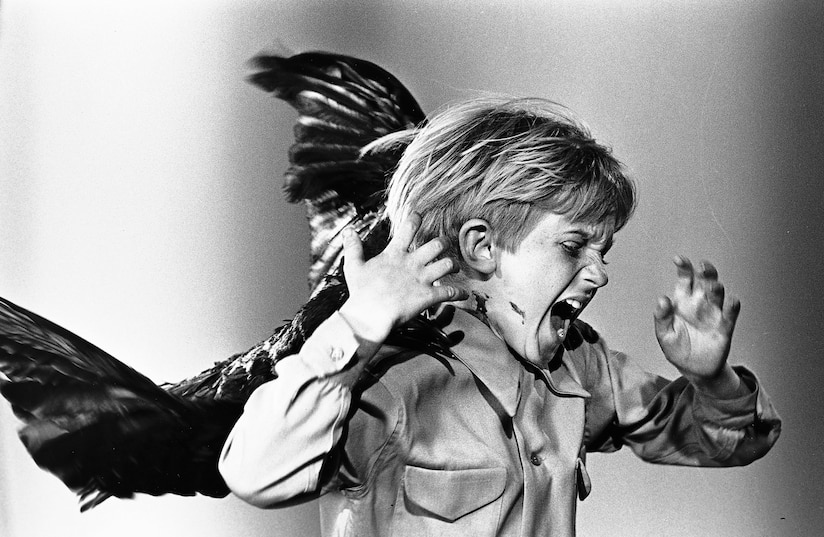
A bird attacking – from the Birds – image from TCM

If you are looking for Hallmark likeability, I can recommend about a thousand films and a gazillion books that will take care of that for you. None of these characters is entirely ok. The closest, I guess is Samira, who seems most eager for everyone to just get along. Alfred is definitely an odd duck, just a weeeee bit obsessive, but is he dangerous? (I am sure he “wouldn’t hurt a fly.”) Grace certainly has some hard edges, and a seeming disregard for others. TJ seems somewhat ok, but is sleeping with a married woman, and who knows what he might do given the external pressure he is under? Zoe has a serious alcohol issue. It has already cost her her job. What is fueling it, and might it lead her to dire blackout behavior? And what’s up with Danny, the housekeeper, who seems maybe a bit too fond of Alfred?

description
From Vertigo – image from The New Yorker

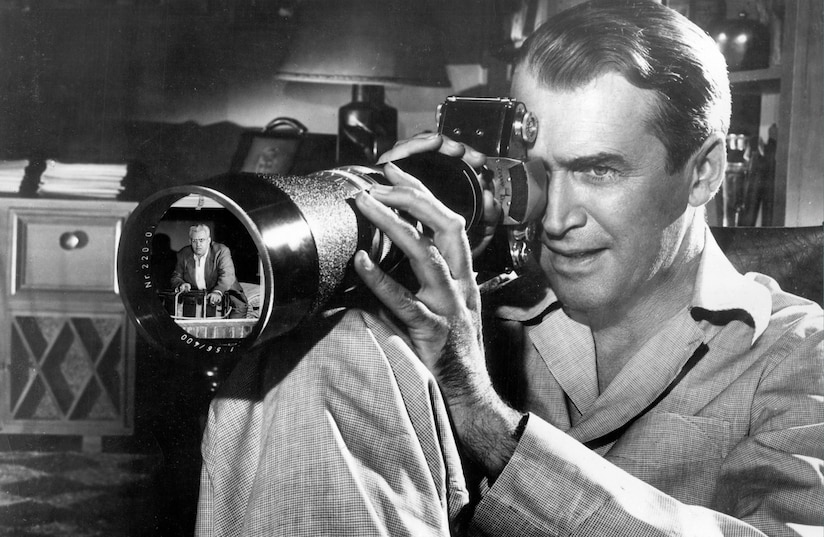
References to Hitchcock films abound throughout the book, beyond the Bates Motel House exterior and screenplay-like opening. Avian life puts in an appearance or two, (The Birds) As do a suspicious glass of milk (Suspicion), high places (Vertigo), voyeurism (Rear Window), rope (Rope) and others. Part of the fun of this read is identifying as many of these as possible, making it a bit of a treasure hunt.
description
Jimmy Stewart as L.B. Jefferies, having a peek in Rear Window – image from TCM

There is an abundance of non-Hitchcockian reference as well, TV and film mostly, from Dracula to Parks and Recreation. Not that these are all key to the plot, but they are fun markers nonetheless.

description
From the film Rope (1948) – image from The Movie Screen Scene

Major twists will keep you off-balance, as the game continues of trying to figure out whodunit, how and why. The Hitchcock Hotel offers a page-turning bit of suspense with a considerable payload of Hitchcockian homage. There may be death in store by the end of this novel, but one thing is for sure. With Stephanie Wrobel’s able assistance, Alfred Hitchcock lives.

What conclusion can a young man draw when he’s the only one who has a hard time making friendships that last? Maybe they stay away for a reason. Maybe his core is rotten. Maybe they all know something he keeps hidden from himself.

Review posted – 12/27/24

Publication date – 9/24/24

I received an ARE of The Hitchcock Hotel from Berkley in return for a fair review, and a few drops of my personal poison stash. Thanks, folks, and thanks to NetGalley for facilitating.

This review is cross-posted on Goodreads. Stop by and say Hi!

=======================================EXTRA STUFF

Links to Wrobel’s personal,FB, Instagram, and Goodreads pages

Profile – from her site

Stephanie Wrobel is the author of This Might Hurt and Darling Rose Gold, an international bestseller that has sold in twenty-one countries and was a finalist for the Edgar Award for Best First Novel. Her third book, The Hitchcock Hotel, is a USA Today bestseller that published in Fall 2024. She lives in New York City.

Interviews
—–The Big Thrill – PAYING HOMAGE TO THE MASTER OF SUSPENSE AND PAYING IT FORWARD by R. J. Belsky
—–BiffBamPop! – my link text by Andy Burns
—–How Do You Write – Ep. 358: POV Hack: Using Method Acting with Olesya Salnikova Gilmore – with Rachel Herron – video – 31:09
—–The Reader’s Couch – Ep. 234 The Hitchcock Hotel by Stephanie Wrobel – audio – with Victoria – 22:00

Items of Interest from the author
—–How to Tackle Editorial Feedback – very informative item for writers – there are many excellent pieces for writers on her site
—–CrimeReads – HOW TO WRITE PERFECT TWIST ENDINGS (THAT WILL SHOCK AND DELIGHT EVEN JADED SUSPENSE READERS)

Hitchcockian Wicki-ons
—–1940 – Rebecca
—–1941 – Suspicion
—–1948 – Rope
—–1954 – Rear Window
—–1955-1965 – Alfred Hitchcock Presents
—–1963 – The Birds
—–1958 – Vertigo
—–1960 – Psycho

Leave a comment

Filed under Fiction, Reviews, Suspense

The Haunting of Moscow House by Olesya Salnikova Gilmore

book cover

Irina calls her fanciful whenever she mentions ghosts. Still, something isn’t right about the house, hasn’t been right since Uncle Pasha was shot dead there three years before, and Grand-père Sergei succumbed to his illness mere days after.
Though she’s never seen one, Lili has believed in ghosts for quite a long time.
Do you think the dead can rise? Her voice, from a long-forgotten memory.
Of course, Nicky had answered, as if it were the most natural thing in the world.

…with each death, the spirits are more corporeal and alive. And the family is in greater danger.

It is 1921, and the suffering is not yet done. World War I, then the ongoing civil war, now famine. Bolsheviks have taken charge. They use the Cheka to enforce the new norms, inflict the governing biases, and relentlessly add to the general misery. The displaced aristocracy struggles to get by, well, those who were not summarily shot.

description
Olesya Salnikova Gilmore – Image from PRH – credit Nicola Levine Photography

To the new Soviet republic, the Bolsheviks, and the Cheka secret police, they are still countesses Irina and Liliya Goliteva, the people’s class enemy as descendants of one of the greatest and most ancient aristocratic clans of an imperial Russia dead and buried. Like most of their family. But unlike many former people, Irina’s family didn’t flee Russia. They stayed in hope of a return to normalcy. Now it is too late. Even if they could obtain papers, how could a household of women and children brave the danger of travel and exile?

Running out of household valuables to sell, the sisters take jobs with the American Relief Administration (ARA). The ARA is there to provide aid, food in particular. The sisters are managing the challenges, but there is something else. It appears that there are strange, spectral things going on in their home, the once-grand Moscow House. There are sounds, scents, footsteps, the sorts of things one can expect in a gothic novel.

So much of the novel is inspired by some of my favorite gothic stories, particularly by the Russian/Slavic gothic genre and the Ukrainian author who arguably founded it—Nikolai Gogol. – from the Afterward

Gogol and other folk sources are given plenty of recognition in the pages, allowing one the opportunity to do some digging and appreciate the inspirations.

We follow Irina (28) and her sister, Lili (18), as they try to survive through this trying period. Chapters alternate, more or less, between the two. The gothic elements build, from a few inklings to full-blown. It is not just one or two spectres turning up, but a whole host of late family members. The house is commandeered by the government, and the actual family is relegated to the attic. That does not work out well for the occupiers, as one then another is found dead. The work of one of the living inhabitants or ghostly revenge?

There are certainly some creepy bits, a norm for the genre, a few jump-cut scenes, and a spooky soothsayer. But is it scary? Mostly not, for me, (a particularly high bar) although there were some welcome surprises. There is one particular sort of ghost from Russian lore that was a new one on me. A creepy doll offers a tingle or two. That they grow in corporeality with each new death offered a welcome bit of unease. After a while, though, one gets used to the spirits, and in doing so their impact is reduced. Yeah, we’ve got a haunted house. So? The sisters keep coming and going as if it were infested with a more usual sort of pest.

Both become involved in romances, one with a Yank, the other with a childhood sweetheart. This is lovely, particularly in offering the possibility of positive outcomes for the sibs. Of course, it also adds to the ongoing tension between staying to preserve the family history and line, and fighting the good fight, or leaving to preserve their lives. How many people today are faced with comparable choices?

In fairy tales, paupers became princesses, not the other way around. But Soviet Russia is a warped Wonderland, where all is topsy-turvy and not what it should be.

One might, I expect, consider a take in which the Cheka taking charge in Moscow is a lot like the spectres taking over the Moscow House. It does cause one to recall that the Introduction of The Communist Manifesto begins, “A spectre is haunting Europe—the spectre of communism.” Certainly those spooks have landed in Russia and, through bloodshed, are gaining in strength. I have no idea if this was at all on Gilmore’s mind. But maybe. Spectres within and spectres without? Maybe a bit of dialectical materialism (or dialectical immaterialism?) for good measure?

Overall. I enjoyed The Haunting of Moscow House, particularly for the portrait of the time (The ARA was a real non-profit), the depiction of the desperation among Muscovites, and exposure to some unfamiliar gothic Slavic writing and lore. The sisters are engaging. The tension is palpable, and the spook infestation is fun.

I suppose one cannot help but compare this to Gilmore’s freshman offering, The Witch and the Tsar. That one was less reality based, more fantastical, and a bit more fun. But this one is also quite good, rich with extras both historical and literary.

Irina is crossing into the next room when she feels a prickle of cold on her arm. A draft of air. But the damask curtains are sealed tight. No, it is as if someone has moved past her. She turns sharply, as fearful as the other morning. Odd. She has never been afraid in the house. She doesn’t have Lili’s active imagination. Nor is she given over to delusions. It is only the howl and tear of the wind, the rattle of the windows in their casements, the faint give of a latch. With all this noise, she almost doesn’t hear it.
The creak of parquet, somewhere near. And again, unmistakable now. Creak. Creeeaak.
Footsteps. Small, like a child’s.
Irina backs up with wide eyes—when there is a deep growl. Then an earsplitting screech, and a dark shape hurtles across her path. A glint of red, as if red eyes have snapped to hers. The next second, scuffling and the thumping of bare feet, then nothing.
What was that? Some animal, trapped in the house?
That’s when the air implodes all around her.

Review posted – 12/20/24

Publication date – 9/3/24

I received an ARE of The Haunting of Moscow House from Berkley in return for a fair review. Thanks, folks, (Does it feel unnaturally cold to you here?) and thanks to NetGalley for facilitating.

This review is cross-posted on Goodreads. Stop by and say Hi!

=======================================EXTRA STUFF

Links to Gilmore’s personal, FB, Instagram, and Twitter pages

Profile – from her site
Olesya Salnikova Gilmore is the author of The Witch and the Tsar and The Haunting of Moscow House. Originally from Moscow, she was raised in the US and graduated from Pepperdine University with a BA in English/political science, and from Northwestern School of Law with a JD. She practiced litigation at a large law firm for several years before pursuing her dream of becoming an author. Now she is happiest writing speculative historical fiction inspired by Eastern European history and folklore. Her work has appeared in LitHub, Tor.com, CrimeReads, Writer’s Digest, Historical Novels Review, Bookish, Washington Independent Review of Books, among others. She lives in a wooded, lakeside suburb of Chicago with her husband and daughter.

Interviews
—–JeanBookNerd – Olesya Salnikova Gilmore Interview – The Haunting of Moscow House
—–Turn the Page – Episode 314E: Olesya Salnikova Gilmore on THE HAUNTING OF MOSCOW HOUSE – audio – 24:17
—–How Do You Write – Ep. 358: POV Hack: Using Method Acting with Olesya Salnikova Gilmore video – 31:09 – with Rachel Herron (from 5:36) – mostly about her prior novel, but offers a nice sense of the author, her process, how she uses method acting and her lawyerly background

My review of Gilmore’s prior book
—–2022 – The Witch and the Tsar

Items of Interest from the author
—–Crimereads – GOTHIC FICTION WITH A TWIST
—–Writer’s Digest – Finding Magic at the Intersection of Reality and Fantasy in Fiction
—–Reactor – Five Books about Haunted Houses that Crumble

Items of Interest
—–Carol’s Notebook – The Shroud – a Russian fairy tale referenced in Chapter 3
—–Story Telling Institute – Vasilia the Beautiful – a Russian fairy tale referenced in Chapter 11

Leave a comment

Filed under Fantasy, Fiction, Historical Fiction, Literary Fiction

The Mighty Red by Louise Erdrich

book cover

The absence of birds made Diz uneasy, but he wasn’t spraying birds, was he? Yet there were fewer birds around his farm. Used to be robins hunting worms in the furrows. Used to be blackbirds around the green bins. Owls at dawn, rats in their claws. Well, maybe he had a sudden thought those could have been the rats and mice he had to poison. He thought back to how birds used to chatter as the sun rose. Now, a few sparrows, maybe, or more often just the hiss and boom of wind.

While working in her garden, Crystal appreciated how their families were like the Lord’s ivy, a weed ineradicable by human means. It grows low to the ground and can’t be mowed. It throws its stems long and roots straight down every few inches, just like the people along the river. There seems to be a Frechette or a Poe anywhere you land, but low-key, invisible. The Lord’s ivy, or ground ivy, creeping charlie, thrives under the leaves of other plants and goes wherever it is not wanted. It just keeps throwing itself along stem by stem and blooms so modestly you’d hardly mark the tiny purple flowers. People step down and pass, the weed springs up, uncrushable.

But, implanted or not, there is plenty of stress to go around.

description
Louise Erdrich in front of her Minneapolis bookstore – image from The Paris Review – shot by Angela Erdrich

Romantic stress
The core of the novel is an ill-considered relationship. Kismet and Gary are teenagers, rich with hormones and needs. But are they ready to be married? She had planned to go to college. Gary is the star quarterback, but has a need for Kismet that has nothing to do with their romance. And then there is Hugo, brilliant, ambitious, and totally in love with her, (… he closed his eyes and thought about how he was helpless in the tractor beam of love.) centering his life on making himself successful enough to woo her away from Gary. Coming of age is a major element, and is wonderfully portrayed. Erdrich says in the B&N interview that she had really wanted to write a love triangle. Well, among other things. She also wanted to write about …

Financial stress

I really set it in 2008…because I don’t feel our country has ever really dealt with the fallout from 2008. I feel like there was so much that there was so much loss, that people lost homes, people lost jobs, things hollowed out in such a big way and that was never really addressed. We never really came back from that time, 2008, 2009 into the present, because the pandemic happened. – from the B&N interview

Winnie Geist lived through the Reagan era in which her family’s farm was lost, sold for a fraction of its worth. David Stockman is name-dropped from the 1980s.

While she was in high school, the government accelerated her family’s loan payments and blow after blow had landed. They’d lost their home, their farm, everything. Except one another, they kept saying, except us.

Crystal Poe is Kismet’s mother. When ne’er-do-well-actor dad, Martin, goes walkabout, Crystal has to sell off possessions to keep afloat.

description
Erdrich would like to see Irene Bedard as Crystal – from the Hoda & Jenna interview – image from Wikipedia

Ecological stress
Connection to the land is always a feature of Louise Erdrich’s work. The Lord’s ivy quote at the top reflects the root of this. Winnie’s angst at the loss of her family farm offers another. There are multiple instances of characters expressing, and acting on, (or not) concerns for the well-being of the ground on which they live and work. It is the treatment of the land that gets the most attention, the tension between using chemical-based products to maximize production per acre, versus a less corporate approach that supports a more ecologically balanced, restorative brand of farming.

I don’t think about politics when I write. I think about the characters and the narrative. My novels aren’t op-eds. Nobody reads a book unless the characters are powerful—bad or good or hopelessly ordinary. They have to have magnetism. If you write your characters to fit your politics, generally you get a boring story. If you let the people and the settings in the book come first, there’s a better chance that you can write a book shaped by politics that maybe people want to read. – from the Paris Review interview

Parental stress
Erdrich has four daughters, so has had plenty of experience with mother-child interactions. She says she loved being the mother of teens, seeing the excitement of their choices, and trying to be more of a guide than a hard-liner. Crystal struggles to influence Kismet without coming on too strong, which would predictably result in increased resistance. Gary’s mother clearly loves him, and goes out of her way to see to her baby’s happiness, maybe too far out of her way. Crystal and Winnie are definitely both afraid for their children, although for very different reasons.

description
Erdrich would like to see Isabella LeBlanc as Kismet – from the Hoda & Jenna interview – image from Minnesota Native News

A bit of fun
There is a series of flamboyant crimes committed by an outlaw, who acquires a nickname and a fair bit of public fame, in the same way that notorious historical criminals like Billy the Kid drew public interest and admiration.

This book is set during the economic collapse of 2008–09. What Martin does is only what a lot of people wanted to do. I didn’t think of what he did as villainy, but yes, I suppose it was absolutely crazy, and, you know, fun to write. I have to amuse myself. – from the Bookpage interview

There was more that motivated Erdrich. She is from the Red River Valley of North Dakota, has much family in the area and returns frequently. She wanted to write about the changes she had seen there. (like the mighty Red, history was a flood.) One element of this was that her first job was hauling sugar beets. The industry was undeveloped at the time. She wanted to write about how it had evolved over the last thirty years. The original title of the novel was Crystal.

When I started it I thought I would be writing about the 2011 lockout by Crystal Sugar and how it impacted people who were working there. They lost a lot in terms of their insurance and their benefits and wages…it was a really tough lockout. I wanted to write about that at first, but then I started writing something else entirely and I enjoyed writing it more so I kept with that one and it became more about a number of people living along the river. – from the B&N interview

Many of Louise Erdrich’s novels (this is her nineteenth) have centered on Native American history, lore, and contemporary experience. While there are several characters here whose Native roots are noted, this is not really a book about the Native experience, the way that The Round House, LaRose, The Night Watchman, and others are.

Magical realism remains a sharp tool in Erdrich’s kit. Crystal listens to a late-night radio show that centers on strangeness, including angels. A caller wonders if her child is protected by a guardian angel, given the number of close calls they had had. One character is haunted by the ghost of a friend. The aroma of a used dress speaks to its new owner. One character has a presentiment about an imminent danger.

description
Erdrich would like to see Brett Kelly as Hugo – from the Hoda & Jenna interview – image from Alchetron

There is a mystery here as well. what happened at “the party” and why is it such a hush-hush subject? Something terrible is hinted at. There are ripples emanating from this event that inform multiple character arcs.

There are a few literary references applied here. Madame Bovary is one. If you know the story, the echoes will boom at you. If not, it is no trick to pull up an abstract. Ditto for Anna Karenina. (see EXTRA STUFF for links)

As with any work of fiction it requires that we relate, at least somewhat, to at least some of the characters. Erdrich has a gift for writing characters that, whatever they may do, we can appreciate their motives, even if we may not agree with their choices. This is a major strength of the novel. She crafts rounded humans, ambitious, frightened, rational, irrational, loving, thoughtful, feckless, smart in wildly divergent ways, and, ultimately, satisfying. She does this while incorporating a payload of ecological concern, relationship insight, and an appreciation of history’s impact on lived experience, while adding a layer of magic to aid our understanding, and including a few laughs to smooth the way. Louise Erdrich is a national treasure, a reliable source of quality literary fiction, and an ongoing delight to read. The Mighty Red is indeed a mighty read.

Review posted – 12/13/24

Publication dates
———-Hardcover – 10/1/24
———-Trade paperback – 11/04/25

I received an ARE of The Mighty Red from Harper (through my Book Goddess dealer) in return for a fair review. Thanks, folks, dear.

This review is cross-posted on Goodreads. Stop by and say Hi!

=======================================EXTRA STUFF

Interviews
—–*Barnes & Noble Book ClubLouise Erdrich discusses THE MIGHTY RED with Lexie Smyth and Jenna Seery – with Lexi Smyth and Jenna Seery – video 45:37 – This is the one you want to check out
—–Today with Hoda and Jenna – Author Louise Erdrich talks ‘The Mighty Red,’ takes fan questions
—–my link text
—–The Paris Review my link text
—–Book Page – Red is an earth tone by Alice Cary

Other Louise Erdrich novels I have reviewed
—–2021 – The Sentence
—–2020 – The Night Watchman
—–2017 – Future Home of the Living God
—–2016 – LaRose
—–2010 – Shadow Tag
—–2012 – The Round House
—–2008 – The Plague of Doves
—–2005 – The Painted Drum

Items of Interest
—–Project Gutenberg – Madame Bovary – full text
—–GetAbstract – of Madame Bovary
—–Project Gutenberg – Anna Karenina – full text
—–ReWire The West – Anna Karenina: Summary and Analysis
—–North Dakota State University – WHY IS THE RED RIVER OF THE NORTH SO VULNERABLE TO FLOODING?
—–MPR News – 20-month lockout over, sugar workers brace for return to work by Dan Gunderson

Leave a comment

Filed under Cli-Fi, Fiction, Literary Fiction