Yearly Archives: 2020

Hollywood Park by Mikel Jollett

book cover

What do you do when you’re a scared-shitless kid that’s been faking it for so long? You bury it. You polish your smile and study until you can’t even focus your eyes. You buy yourself a big red sweater with an S across the chest, just like the superchild you once were. You try to prove them all wrong. You attempt to outrun it. But then you get injured and your mom goes insane and a kind man in a blue shirt with a trim black beard uses the words. Emotional abuse. Crossing physical boundaries, Trauma. Neglect. I feel like a blank space covered in skin.

Who is that masked man? If all of your life you’ve worn a mask, what do you see in the mirror? A reflection of someone you aren’t. How can you know who you really are, or who you might become, if you see your world through cut-out holes? And the world never gets to see you, never gets to relate to you, the real you, behind your facade. Kinda tough to live your best life that way. Kinda tough to live a real life that way. And how did that mask get there in the first place? And how did it impact the nuts and bolts of your life? And is there any hope you can tear it off without losing the you beneath, pull it off slowly, maybe un-sew it from your face, a stitch at a time?

description
Mikel Jollett – image from his Twitter

Who is that masked man, the kid from the cult, the pre-teen looking for thrills, the teenager who nearly killed himself, the long-distance-runner, the Stanford student, the substance abuser, the serial spoiler of relationships, the music-world journalist, the successful rock musician, the wonderful writer? Or are they all just different masks?

description
Synenon leader Charles Dederich – Image from San Diego State University

The impetus to write the book was a recent one. Jollett had been writing and performing music with his band, Airborne Toxic Event, since 2005, a step sideways from his intention to pursue a writing career, and a closely linked redirection from his work as a music journalist.

Then, in 2015, his father died, and Jollett says he was overwhelmed with grief and confusion. “I wondered why it hit me so hard, so I went back into my past—that day my mom took us out of the cult. I went in to lockdown and started to write.” He stayed with it for three years. – from the PW interview

There was a lot to write about. This coming of age story begins when he was five. Jollett had the bad luck to be born into a bad situation. His parents were members of Synenon, a place that came to public prominence in the 1960s in California, a goto drug rehab community for a while. People charged with substance-related crimes were often sent there by California courts. It probably did some good in the beginning, but as the leader of Synenon, Chuck Dederich, became more and more unhinged and power mad, his not totally crazy community became a totally crazy cult. Not the best start for a new life. One of the rules in Synenon was that children were to be raised communally. So, even though mom and/or dad might be around, they were not the ones providing care. Have a nice life.

“It was an orphanage!” Grandma screams. “That’s what you call a place where strangers raise your kids!” Grandma says that mom doesn’t even know who put us to bed or who woke us up or who taught us to read. She says we were sitting ducks. (We did play Duck Duck Goose a lot.) “You made them orphans, Gerry!” Grandma will point at us from her chair as we pretend not to listen.

We follow Mik’s journey from his earliest memories of Synenon, raised by people other than his parents until Mom flees with him and his older brother in the dark of night. Most orphanages do not send goons to track down people, including children, who leave. Even out of the Synenon cult, Mik, his brother, Tony, and his mom, Gerry, were not safe. Mik gets to see a fellow “splittee” get beaten nearly to death by Synenon enforcers outside his new home.

description
Facing your dark side – image from Narcissism and emotional abuse.co.uk

If this decidedly unstable beginning was not enough of a challenge, his mother was not the best of all possible parents.

Is that a mom? Someone who you can’t ever remember not loving you? I know Mom doesn’t think that’s what it is but I do…She tells me I’m her son and she wanted kids so she wouldn’t be alone anymore and now she has us and it is a son’s job to take care of his mother.

Gerry was just a weeeee bit narcissistic, to her children’s decided disadvantage. It would take Mik years to learn that the usual arrangement was that parents take care of children.

description
Image from collectiveevolution.com

Jollett takes us through many stages of his life, successfully modulating the narrative to fit the age he is portraying in each. As he grows, his awareness increases and his interests broaden. It makes him, appropriately, an unreliable narrator as young Mik does not yet have the tools to see past the misinformation he is being given.

It took my brother and I a long long time to piece together the reality that a functional adult might have about the situation, that we’d escaped a cult that had once done good things for addicts (including our father), that our mother was severely depressed, and that these experiences were very unique in some ways and quite common in others. So I wrote the book from that perspective, at least at the beginning: that of a child trying to piece together the reality of the changing world around him; because that’s how I experienced it. There were mysteries. What is a restaurant? (We’d never been in one). What is a car? A city? And, most devastatingly, what is a family? Because we simply didn’t know. – from the Celadon interview

Being born into a cult and having a depressed, toxically narcissistic mother were two strikes already, but then pop, and other paternal family members had spent considerable time behind bars, and in both his paternal and his maternal trees there was a history of substance abuse, of one sort or many. You’d think Mik was destined to wind up an alcoholic and/or a drug addict and in jail. Is genetics destiny? This is a core battle he faced in his life. Another was to come to terms with how his strange upbringing affected how he related to other human beings, particularly to women. He talks a lot about how he presented a façade to the world, while keeping his truest self well back, if he even knew his true self at all.

description
Robert Smith mask – Image from funkyBunky.co

Jollett endured years of poverty, and emotional abuse. He found outlets in criminal acts and substance abuse. But he also found other ways to fill his needs and channel his creativity. A close friend introduced him to the music that would push him in a new constructive direction.

I go to a place in my head where I can be alone. Listening to Robert Smith sing his happy songs about how sad he feels is like he’s there too, like he has his Secret Place in his head where he goes and since he wrote a song about it, he’s right there in my headphones, so we’re in this Secret Place together. Me and Robert. It’s a place where we are allowed to be sad, instead of feeling like freaks of nature, us weirdos and orphans.

A major change in Mik’s life is when he begins spending time with his father, Jimmy, and his father’s significant other, in Los Angeles, first summers, then, at age 11, moving there more permanently, Gerry having moved to Oregon with the boys when they were fleeing Synenon. It is a whole new world for him there, not just offering different ways to get into trouble, but the opportunity to get to know Jimmy and his father’s family, something that was not really possible in his earliest years, particularly as his mother had portrayed Jimmy negatively.

I’d been told so many terrible things about him at a very young age. He was a heroin addict, an ex-con who’d done years in prison. He “left my mother for a tramp.” That was a common refrain. But none of it turned out to matter. He was clean by the time I was born and all I ever knew once I got to spend time with him, was this guy who would do anything for me. He was affectionate. He took us everywhere. He cared so deeply about our basic happiness. He had a great laugh and a quiet wisdom about him. He never cared what I became in life. He wanted me to be honest, to be interesting (or simply funny), and to be around. – from the Celadon interview

The emotional core of the book is connections Jollett has, for good or ill, with the people in his life, friends, and particularly family.

Jimmy was fond of betting on the ponies. He took Mik with him once he started visiting LA. Hollywood Park is the track they attended. It is where Mik has meaningful heart-to-hearts with his father. It is a place that lives in his imagination as well, a place where he can connect with his family across time. Will Mik grow up to be a ”Jollett Man,” a bad-ass tough guy who leans hard toward wildness, or something other? There are certainly strains in him that offer other possibilities. His athleticism, intellectual curiosity, academic licks, creativity, musical talent, and stick-to-itive-ness offer hope for a future different from his father’s.

description
Image from The Smiths and Morrissey FB pages

As an adult, Mik finds a career in music, and gains insights into the musical creative process from some household names. He gains as well insights into his emotional state that help him understand the life he has been living. But the real core is how he got to that place to begin with.

description
Image from Invaluabl.com

Jollett employs literary tools to great effect. For example, as an eight-year-old in Oregon, his family raised and slaughtered rabbits for food. In addition to this being a sign of the family’s poverty, it is clear that young Mik senses that he, too, is being raised in an emotional cage to provide sustenance of another sort. His writing is smooth and often moving. There are sum-up portions at the end of chapters that pull together what that chapter has been about. These bits tend toward the self-analytical, and are often poetic.

…music makes me feel like I belong somewhere, that this person I don’t know, the one who swims beneath his life in a dark, chaotic, unknowable place, this one has a voice too.

Mikel Jollett has written a remarkable memoir, offering not just a look at his dramatic and event-filled personal journey, but a peek out from the masks he wore to the times he lived through. While his actions and experiences covered a considerable swath, there is always, throughout his moving tale, a connection to family, to his mother, father, brother, various step-parents, his extended family, and closest friends. The power of these connections caused him considerable difficulty, but also made it possible for him to weather some major life storms. The odds are you will be moved by Jollett’s celebration of real human bonding, cringe at some of the challenges he had to endure, mumble an “oh, no,” or worse, as you see the missteps along his path, cheer for the triumphs when they come, and luxuriate in the beauty of his writing. Whatever else you may get from the book, it is clear that Mikel Jollett is unmasked as an outstanding writer. Hollywood Park is a sure winner of a read. Bet on it.

One sentence [in The Scarlet Letter] stood out to me as I read on the edge of my bed. I marked the page: “No man, for any considerable period, can wear one face to himself, and another to the multitude, without finally getting bewildered as to which may be the true.” It made me think of the Secret Place, the place I hide with Robert Smith. I know this face. I’ve learned not to tell anyone at school about Synanon or Dad in prison or…Mom in the bed staring up at the ceiling. It’s a mask, this face you create for others, one you hide behind as you laugh at jokes you don’t understand and skip uncomfortable details, entire years of your life, as if they simply didn’t happen.

description
Jollett (l.), with dad Jimmy and brother Tony -image from Publishers Weekly

Review first posted – May 15, 2020

Publication dates
———-May 5, 2020 – hardcover
———-March 22, 2022 – trade paperback

I received an ARE of this book from Celadon in return for an honest review. But, do they really know who they gave this book to? I could be anyone, pretending to be anyone.

Thanks to MC, too.

This review has been cross-posted on GoodReads

=======================================EXTRA STUFF

Links to the author’s Twitter page and a promotional site for the book

Interviews
—–Publishers Weekly – Mikel Jollett Crafts a Heartbreaking Memoir of Staggering Growth by Louise Ermelino
—–Lit Hub – Sheltering: Mikel Jollett Challenges the Memoir Form
by Maris Kreizman – video – 17:58
—–Celadon – Mikel Jollett, Author of Hollywood Park, on Life Inside and Outside a Cult by Jennifer Jackson

My dad was my best friend and when he died it completely derailed my life. It wasn’t just sad, it was confusing. No one tells you that about grief. Or at least no one told me. Just how disorienting it is. And it’s probably the reason I started writing the book: because I couldn’t think about anything else. I was just baffled by how sad I was, how much it felt like the world was actually ending. I emerged from a very deep depression in which I hardly left the house for about six months. I’d put on weight, hadn’t written a word or a single song. I cried every day, and spent so much time just questioning who I was in the world without this guy who was the first person I ever trusted. And all I wanted to do was write about it because it helped me to understand it.

Songs/Music
—–Celadon – Animated Trailer for the album Hollywood Park by the author’s band Airborne Toxic Event – samples from the album songs, with animated backdrop
—–The Cure – Three Imaginary Boys
———-Boys Don’t Cry
—–Bob Dylan – A Hard Rain’s A Gonna Fall
—–The Smiths – The Queen is Dead
———-Please, Please, Please, Let Me Get What I Want
—–Jackson Browne – Running On Empty
———-The Pretender
—–The Airborne Toxic Event – Wishing Well
———-Sometime Around Midnight

Items of Interest
—–Instagram – images from the author and his band
—–The Hollywood Park Book Tour – only for ticket holders
—–The History of Synanon and Charles Dederich

Leave a comment

Filed under American history, Bio/Autobio/Memoir, biography, History, Religion, Reviews

Things in Jars by Jess Kidd

book cover

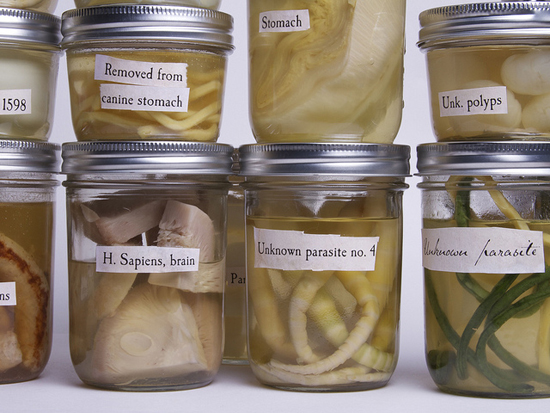
A cloth covers the jar that Bridie took from the bookcase in the nursery, and Ruby is thankful for this. For the contents have the ability to rearrange even a dead man’s sense of reality. As with all terrible, wondrous sights, there is a jolt of shock, then a hypnotic fascination, then the uneasy queasiness, then the whole thing starts again; the desire to look and the desire never to have looked in the first place.

1860s London, the prime of the Victorian age. About fifteen years before Sherlock Holmes begins using his talents to suss truth from mystery, Bridie applies her peculiar talents to helping the police in cases of an unusual nature. A sign outside her door announces:

Mrs Devine
Domestic Investigations
Minor surgery (Esp. Boils, Warts, Extractions)
Discretion Assured

but she is known mostly for her ability to discern the cause of death, when simple observation will not suffice. She would do as well with a sign that says Investigator of the Bizarre. Her Scotland Yard contact and sometime employer is one Inspector Valentine Rose, and business is brisk.

London is awash with the freshly murdered. Bodies appear hourly, blooming in doorways with their throats cut, prone in alleyways with the head knocked in. Half-burnt in hearths and garroted in garrets, folded into trunks or bobbing about in the Thames, great bloated shoals of them.

She is called on to look into inexplicable deaths, primarily among the flotsam of society. London has been undergoing the installation of a world class sewer system, and diggings have turned up some extremely cold cases. The latest calls her to a crypt in Highgate Chapel. A mother and child have been unearthed, the child having significant bodily abnormalities. Around the same time, a dodgy-seeming doctor comes a-calling, seeking her assistance on behalf of his patron, Sir Edmund Athestan Berwick. Seems the baronet’s daughter has been kidnapped. Going to the police is not really an option. And the game is afoot. Any chance the two cases are linked?

description
Jess Kidd – image from Metro.

The purloined child, Christabel, has some peculiarities of her own.

The man, looking up, hesitates and the child bites him, a nip of surprising sharpness. He pulls his hand away in surprise and sees a line of puncture holes, small but deep…The man stands, dazed, flexing his hand. Red lines track from palm to wrist to elbow, the teeth marks turn mulberry, then black…What kind of child bites like this, like a rat? He imagines her venom—he feels it—coursing through him …A blistering poison spreads, a sudden fire burning itself out as it travels…All- the time the creature watches him, her eyes darkening—a trick of lamplight, surely!…He would scream if he could, but he can only reach out. He lies gasping like a landed fish.

Poor unfortunate soul.

description
Image from The Times

With Sherlockian insight, a talent for disguises, and lots of shoe leather, Bridie sets about following leads and examining clues trying to get to the bottom of a case that is unusually fishy. Like that later consulting detective, Bridie smokes a pipe, which is often enlivened by substances other than pure tobacco, things with names such as Mystery Caravan or Fairground Riot, concocted by Dr. Rumhold Fortitude Prudhoe, a close friend. She shares her quarters with a particularly helpful assistant, the seven-foot-tall Cora Butter, who asks more than once whether Bridie would like this or that person held upside down. The medical bag Bridie totes is her own. The other frequent companion in her investigations is a dead man. While on the job at Highgate Chapel, he first appeared to her in the attached graveyard, notable not only for his transparency, but for his indecorous attire. Ruby Doyle had been a renowned boxer in his day, and appears in shorts, shirtless, sporting a cocked top hat, an impressive handlebar moustache, muscles aplenty, and a considerable number of tattoos, with peculiarities all their own. He seems to know Bridie quite well. One of the mysteries of the book is why she does not seem to remember him, particularly as she finds him very, very attractive.

description
Tom Hardy – add a handlebar moustache, top hat, and some more tats, and Kidd sees him as Ruby

The supporting cast is a delight. Lee refers to those who work with her as Bridie’s Victorian A-team. Beyond those noted above there is a criminal circus owner with a weakness for strong women, psycho killers of both the male and female persuasion, a misshapen sniveling abettor who could have snuck out of a Dickens novel to put some time in here, an honorable street urchin, orphans, a mysterious woman who may be haunting the baronet, and plenty more.

The story is told in two timelines. Bridie investigates the taking of Christabel in 1863, and we get looks back into Bridie’s childhood from 1837 to 1843, the earlier period explaining much of what is to come twenty years later. And explaining how Bridie came to have the skills she possesses. Bridie was born in Ireland, like the author, but I expect Jess Lee’s transition to life in London was a tad less fraught.

description
Image from Foodiggity.com

Among other things, Kidd is interested in presenting a realistic portrait of the period. ( I…wanted to give a basis of a real, gritty, accurate portrayal of Victorian London.) Visually, she offers panoramic looks through the dark eyes of ravens, and Bridie’s pedestrian peregrinations, particularly through less-than-posh parts of the city. She offers a particularly effective olfactory perspective as well.

Breathe in—but not too deeply. Follow the fulsome fumes from the tanners and the reek from the brewery, butterscotch rotten, drifting across Seven Dials. Keep on past the mothballs and the cheap tailor’s and turn left at the singed silk of the maddened hatter. Just beyond, you’ll detect the unwashed crotch of the overworked prostitute and the Christian sweat of the charwoman. On every inhale a shifting scale of onions and scalded milk, chrysanthemums and spiced apple, broiled meat and wet straw, and the sudden stench of the Thames as the wind changes direction and blows up the knotted backstreets. Above all, you may notice the rich and sickening chorus of shit.

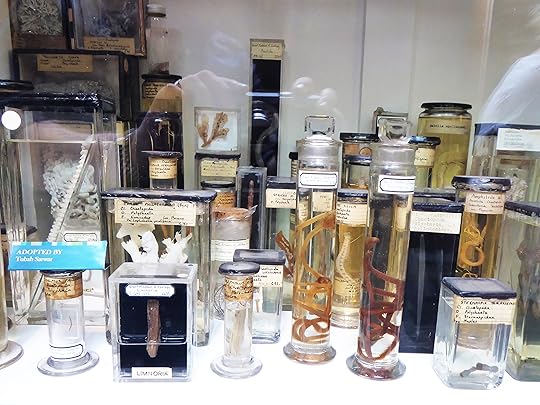
She was greatly influenced by journalist William Mayhew’s encyclopedic 1851 book London Labour and the London Poor. There is a look at the jailhouse, which appears to be guarded by particularly corrupt versions of Tweedle-Dee and Tweedle-Dum. Toss in, (or dig up) some resurrectionists, too. Part of the Victorian culture was a craze for collecting exotic things. One story that fed her interest was that of The Irish Giant, an exceptionally tall gent (7’7”) who became the talk of London for a brief time. But after his early demise, and despite his specific instructions to the contrary, his remains were obtained by a collector and put on display. There is a link to this tale in EXTRA STUFF.

description
Image from Traveldarkly.com

Lee is also interested in Irish folklore and partakes of that richly for the core element of the story. The incorporation of this element brings with it the main fantasy strand of the novel. One look at the cover of the book will inform you that there be mermaids (or something akin) here. Lee adds additional magical elements, as such critters appear here to have considerable power to influence the world about them, and specific powers that we would never associate with The Little Mermaid, although, considering the things we see in jars, we might have to reconsider the implications of the song Part of Your World:

Look at this stuff
Isn’t it neat?
Wouldn’t you think my collection’s complete?
Wouldn’t you think I’m the girl
The girl who has ev’rything?
Look at this trove
Treasures untold
How many wonders can one cavern hold?
Lookin’ around here you’d think
(Sure) she’s got everything

Hmmmmmm.

description
Image from Klyker.com

There is considerable humor in Things in Jars.

Her spectacularly ugly bonnet is curled up before the fire, bristling with feathers. She refused to give it up into the hands of the butler. Not that the butler was overeager to take it. If it comes alive, Sir Edmund thinks, he will do for it with the poker.

My particular LOL favorite is the prayer young Bridie offers up at bedtime.

God grant eternal rest to Mammy, Daddy, James, John, Theresa, Margaret, Ellen, and little baby Owen. God grant that bastard Paddy Fadden a kick up his hole and severe death to him and his gang, of a slow and terrible variety.

How could you not absolutely love such a child?

The disappointments in Things in Jars were few. I wish there had been more provision of clues throughout the book about what the deal was with Ruby. I was ok with the explanation, but it needed a better support structure. A bit more background on Cora would have been welcome. One actual gripe was a scene in which Bridie falls asleep while on the job. No way would this have happened. Booo! Almost all the violence occurs off-stage. In addition to one event described in a quote from the book in the review, we are shown the beginning of one attack by a ruffian on a lady. Tender souls might turn away. That’s really about it for such things.

description
Image from Nickcook.net

But the delights in Things in Jars could fill a wing of the British Museum. Bridie is a delicious lead, tough as nails without being impervious, bright, with a solid background that explains how she knows what she knows. She is a lot of fun to follow. The Holmesian parallels are a treat. The supporting cast is like a three-ring circus, in the best possible way, diverse, interesting, and fun to watch (both the light and the dark). We feel the fear when appropriate, and see Bridie’s affection for Ruby grow. A taste of Irish folklore is both creepy and educational, and Lee’s portrait of 19th century London offers an exceptionally immersive experience. You really get a feel (and smell) of being there. A real-world mystery with fabulous elements of fantasy. In short, Things in Jars is an absolute delight. For the hours you are reading this book you will be part of that world.

Review first posted – January 17, 2020

Publication date – February 4, 2020

I received an ARE of this book from Atria in return for some specimens I have been keeping in a special place in the lab basement for some years. They promised to return them after a thorough examination.

This review is cross-posted on Goodreads. Stop by and say Hi!

=======================================EXTRA STUFF

Links to the author’s personal, Twitter, Goodreads, Instagram and FB pages

My review of a 2023 book by Kidd
—–The Night Ship

Interviews
—–Savidge Reads – Sinister & Supernatural Shenanigans with Jess Kidd – by Simon Savidge
—–Stitcher – S3E4 – Chatting with Jess Kidd – audio – 1:29:12 – by Tim Clare – you can safely begin at about 46:00 for a focus on Jars
—–Well, not an interview, really, but a piece Kidd wrote for LitHub on her favorite ghost stories – Books That Blur the Lines Between Living and Dead

Items of Interest
—–Waterstones – A look at the Operating Theater – Kidd gives a tour
—–Writing i.e. – On Writing Things in Jars by Jess Kidd
—–Gutenberg – London Labour and the London Poor (1851) by William Mayhew
—–Joseph Bazalgette – engineer of the massive sewer works in London
—–Otherworldly Oracle – Mermen Legends. – a fun bit of fluff
—–Wikipedia – The Irish Giant

Leave a comment

Filed under Fantasy, Fiction, Historical Fiction, Thriller, Thriller

Red at the Bone by Jacqueline Woodson

book cover

…now I knew there were so many ways to get hung from a cross—a mother’s love for you morphing into something incomprehensible. A dress ghosted in another generation’s dreams. A history of fire and ash and loss. Legacy.

Melody is sixteen, having her coming out party in her home, her grandparents home, in Brooklyn’s Park Slope. We are introduced to her father, her grandparents, her bff, her world. She has chosen for her entrance music something that draws a line between her generation and those that came before, Prince’s Darling Nikki. The guests are thankful that the lyrics have been omitted. [you can see them at the end of EXTRA STUFF]. But it is the connections across generational lines that are at the core of Jacqueline Woodson’s latest novel. How the past persists through time, molding, if not totally defining us, informing our options, our choices, our possibilities, the impact of legacy.

description
Jacqueline Woodson – image from the New York Times

Red at the Bone is a short book with a long view. (I have had people say, “I’ve read that in a day” and I’m like, “Yo, it took me four years to write that. Go back and read it again.” – from the Shondaland interview) It is not just about race and legacy, but about class, about parenting, about coming of age, about the making and unmaking of families.

Look closely. It’s the spring of 2001 and I am finally sixteen. How many hundreds of ancestors knew a moment like this? Before the narrative of their lives changed once again forever, there was Bach and Ellington, Monk and Ma Rainey, Hooker and Holiday. Before the world as they knew it ended, they stepped out in heels with straightening-comb burns on their ears, gartered stockings, and lipstick for the first time.

Iris found motherhood too soon, was fifteen when she became pregnant with Melody. Buh-bye Catholic school. Buh-bye coming out party. And when her parents were unwilling to endure their neighbors’ scorn, buh-bye neighborhood. It’s tough to be a proper, upstanding family, respected by all, when the sin is so public, and the forgiveness element of their Catholic community is so overwhelmed by the urge to finger-point and shame.

Class informs who we choose and the roads we take through our lives. Although paths may cross, as we head in diverging directions we can wave to each other for a while, but eventually, mostly, we lose sight of those who have traveled too far on that other bye-way. The baby-daddy, Aubrey, steps up, but, really, Iris does not think he is a long-term commitment she wants to make. She has been raised middle-class, and Aubrey’s background, ambitions, and interests do not measure up.

When she looked into her future, she saw college and some fancy job somewhere where she dressed cute and drank good wine at a restaurant after work. There were always candles in her future—candlelit tables and bathtubs and bedrooms. She didn’t see Aubrey there.

Her decision impacts her daughter, who grows up largely motherless, a mirror to her father, who had grown up fatherless, although without the resources his daughter has from her mother’s parents.

One impact of history is how the Tulsa Massacre, specifically, cascades down through the generations, driving family members to achieve, and to zealously protect what they have gained, ever knowledgeable that everything might be taken from them at any time. (Melody is named for her great-grandmother, who suffered in the Tulsa Massacre.)

Every day since she was a baby, I’ve told Iris the story. How they came with intention. How the only thing they wanted was to see us gone. Our money gone. Our shops and schools and libraries—everything—just good and gone. And even though it happened twenty years before I was even a thought, I carry it. I carry the goneness. Iris carries the goneness. And watching her walk down those stairs, I know now that my grandbaby carries the goneness too.

The goneness finds a contemporary echo when a family member is killed in the 9/11 attack, a space that cannot be filled. Goneness appears in other forms, when Iris leaves her Catholic school, and, later, heads off to college.

Music permeates the novel, from Melody’s name (and the person who had inspired it) to the atmosphere of various locales, from Po’Boy’s recollections to Aubrey’s parentage, from Melody’s coming out song to Iris’s college playlist. Who among us does not have music associated with the events of our life?

Most good novels offer a bit of reflection on the narrative process. The person-as-a-story here reminded me of Ocean Vuong writing about our life experience as language in On Earth We’re Briefly Gorgeous.

…as we dance, I am not Melody who is sixteen. I am not my parents’ once illegitimate daughter—I am a narrative, someone’s almost forgotten story. Remembered.

There are many moments in this book that reach deep. In a favorite of these, Aubrey remembers the pedestrian things he liked in his peripatetic single-parent childhood, a Whitman-esque litany of physical experience, capped with an image of fleeting, unsurpassed beauty, and desperate longing that well mirrors his love for Iris, and is absolutely heart-wrenching.

The stories within the novel are told from several alternating perspectives, Melody, Aubrey and Iris getting the most time, and Iris’s parents, Sabe and Po’Boy, getting some screen time as well. We see Iris and Aubrey as teens and adults, and are given a look at Aubrey’s childhood as well. Sabe and Po’Boy provide a contemporary perspective, but a connection back to their young adulthood too.

Woodson’s caution to the fast-reader to go back and try again is advice well worth heeding. Red at the Bone is a tapestry, with larger images, created with threads that are woven in and out, and drawn together to form a glorious whole. You will see on second, third, or further readings flickers here that reflect events from there, see the threads that had gone unnoticed on prior readings. It is a magnificent book, remarkably compact, but so, so rich. Surely one of the best books of 2019.

Review posted – December 27, 2019

Publication date – September 17, 2019

This review has been cross-posted on GoodReads

=======================================EXTRA STUFF

Links to the author’s personal, FB, and Tumblr pages

My review of Woodson’s prior novel, Another Brooklyn

Interviews – Video/audio
—–The Daily Show – Trevor Noah
—————Print
—–Longreads – “We’re All Still Cooking…Still Raw at the Core”: An Interview with Jacqueline Woodson – by Adam Morgan
—–NPR – Weekend Edition – History And Race In America In ‘Red At The Bone’ – by Scott Simon
—–Shondaland – Jacqueline Woodson Will Not Be Put in a Box – by Britni Danielle

Items of Interest
—–NPR – Jacqueline Woodson: What Is The Hidden Power Of Slow Reading?
—–Wiki – The Tulsa Race Massacre
—–Rollingstone – The Tulsa Massacre Warns Us Not to Trust History to Judge Trump on Impeachment – by Jamil Smith
—–The Party – by Paul Lawrence Dunbar – read by Karen Wilson
—–Sojourner Truth’s seminal speech – Ain’t I a Woman?

Songs – both from the book and her stated playlist from the Longreads interview
—–Prince – Darling Nikki
—–Eva Cassidy – Songbird
—–EmmyLou Harris – Don’t Leave Nobody But the Baby
—–J. Cole – Young, Dumb, and Broke
—–Etta James – I’d Rather Go Blind
—–Erroll Garner – Fly Me to the Moon
—–Erroll Garner – Jeannine, I Dream of Lilac Time
—–The Chi Lites – Have You Seen Her?
—–Boy George – That’s the Way
—–5th Dimenion – Stoned Soul Picnic
—–Phoebe Snow – Poetry Man

Darling Nikki
Prince
I knew a girl named Nikki I guess you could say she was a sex fiend,
I met her in a hotel lobby masturbating with a magazine,
She said how’d you like to waste some time and I could not resist when I saw little Nikki grind.
She took me to her castle and I just couldn’t believe my eyes,
She had so many devices everything that money could buy,
She said “sign your name on the dotted line.” The lights went out and Nikki started to grind.
Nikki
The castle started spinning or maybe it wa my brain.
I can’t tell you what she did to me but my body will never be the same.
Awe, her lovin will kick your behind, she’ll show you no mercy
But she’ll sure ‘nough, sure ‘nough show you how to grind
Come on Nikki
I woke up the next morning, Nikki wasn’t there.
I looked all…
Sometimes the world’s a storm.
One day soon the storm will pass
And all will be bright and peaceful.
Fearlessly bathe in the,
Purple rain
Source: LyricFind

Leave a comment

Filed under Fiction, Historical Fiction, Literary Fiction, New York City, Reviews