Tag Archives: lgbtq

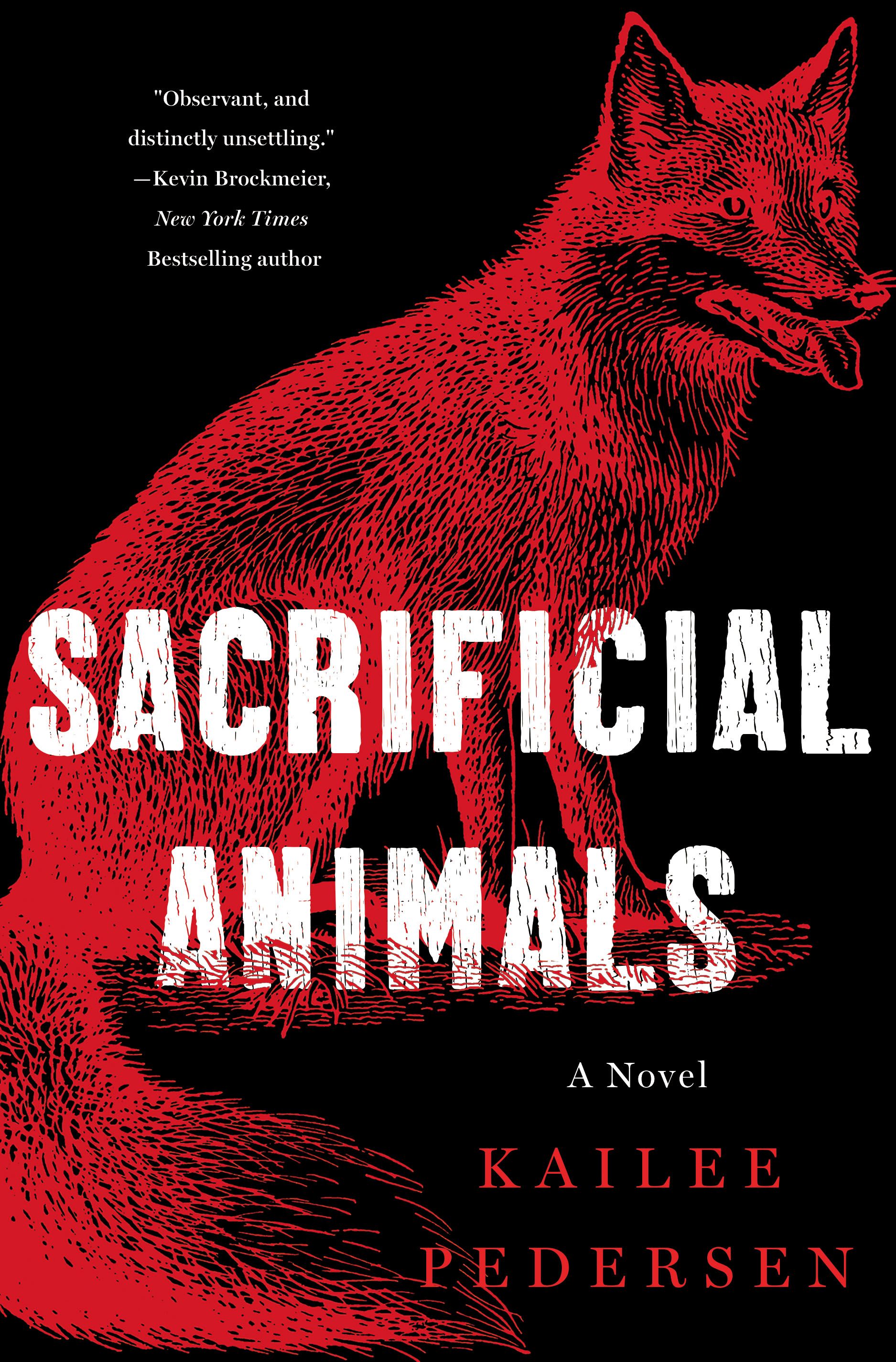
Sacrificial Animals by Kailee Pedersen

book cover

Swiftly and violently as a gunshot a scream pierces the sloped fields lying open and fallow behind the house. Sounding like a woman being murdered in the way he has seen it on television where her agony is drawn out over several breathless and voyeuristic minutes until he changes the channel. Yet he knows it is not a woman but some unnamable beast of the forest come to bewitch and maim. A mother despondent, in all her devastated keening—the fox whose children now reside in the stomachs of the hounds at Stag’s Crossing has finally returned.

The difference between wolves and foxes his father says is that wolves love to hunt and foxes love to play. A tantalizing trail of blood in the half-melted snow. Wolves only have enough foresight to kill and upon their killing they will feed ravenously and strip the bones. But foxes; they are quick-witted and brutal. When they hunt they do so with finesse stalking and pouncing then snapping the spine in their slender jaws.

What goes around comes around.

Life’s a bitch and then you die.

Carlyle Morrow is bitter widower, his third son, Christopher, buried on his land, along with his mother, who died in the attempt to birth him. Morrow is left on his thousand acres in the middle of Nebraska with two sons. Joshua is the golden boy, beautiful, attentive to Carlyle’s every wish, a loyal favorite lapdog. Nick is the second son, plain in appearance, tepid in his embrace of his father’s violent nature. He possesses a bit of his mother’s second sight, his orientation less than that of a purebred. They have both been made to endure a legacy of cruelty passed down from father to son over at least three generations. Carlyle forces him into an act, while hunting, that goes beyond wrongfulness, beyond sin, into the realm of abomination. Nick will live with the guilt the rest of his life, even though the responsibility was not all his. Now in their forties, Nick and Josh have been separated from their father for decades. (Nick still calls) But neither can refuse the summons to return home on news that their father is preparing to die.

description
Kailee Pederson – image from her Twitter profile

We follow Nick as he recalls his life, his struggles with Joshua and Carlyle, mostly the latter. He always found his brother’s wife, Emilia, fascinating, alluring in the mode of a siren. Carlyle is cruel, requiring complete obedience. He expects his sons to love the raw violence that marks his life. He does not raise his boys so much as train them. He even wishes that they could be as faithful and bloodthirsty as his best friends.

If Carlyle could have had dogs for sons he would have been a happy man; but when has a Morrow man ever been happy?

The structure of the novel is a back and forth, with alternating chapters, Then and Now. We learn how the boys’ treatment (Nick’s mostly) brings them to become the men they are in their forties. One would think that with chapters labeled so, there would be a clear differentiation between the internal timelines of each chapter. But no, there are transgressions within, as “Now” chapters, as well as “Then” chapters include lookbacks. Seems not cricket to me, but no biggie. The personal history is clearly a roadmap to the boys’ doom, which is referenced many times, so will not come as a shock. Pederson keeps offering glimpses of the future, a bell being rung louder and louder with each recurrence. There is an unrelenting atmosphere of dread. Awful things will be happening, although we are not let in on the specifics. For example, an early omen.

No thousand acres, no grand inheritance can ever be enough to postpone their destinies. Nick will die as bitter as he came into the world. He knows this just as well at thirteen as he will in thirty years.

Carlyle’s cruelty and monstrous control pushed them both away, Nick to New York, and a career as a cruel literary reviewer, Josh to the other coast with his wife, Emilia, whom Carlyle would not even allow into the house because of her Asian descent.

Yet in only ten years his children will betray him in their own inimitable ways—Joshua marrying out, Nick exiling himself to a foreign land. And in their absence Stag’s Crossing will lie silent and fallow as the fields surrounding it. This place: no place for young men.

or old men, for that matter. This tale displays the violence of a Cormac McCarthy tale. It is not for anyone with an aversion to scenes of death, particularly the death of animals. It comes as no surprise that

Cormac McCarthy is an all-time favorite writer for me, perhaps my favorite of favorites, and his influence is very obvious here.. – from the JamReads interview

References to animals are legion, not in a happy way, for the most part. It is clear that the Morrows fit in well. A sample:

Would he kneel before his father’s magnificence and eat oats from his hand like a wayward steer?
————————————–
Now he and Joshua must return to Stag’s Crossing. Return to that grand two-story house where as children they were left alone for hours at a time savaging each other like wild dogs.
————————————–
Finally, she turned to him. Only the slightest tilt of her neck, elegant as a swan’s.
————————————–
Upon awakening she is languorous as a cat sunning itself in a windowsill.
————————————–
Joshua sees him lying down next to him perfectly still. Breathing through his nose softly like a newborn foal.

There are only a gazillion more of these.

Pederson is masterful with sustaining tension. The reminders of doom help, but there is much more going on here. The tragedy felt very Shakespearean. (Titus Andronicus maybe? King Lear with competing sons instead of daughters?) People make choices, and suffer the results. The language is rich and diverse, from terse Cormac-McCarthy-esque declaratives to languid poetical passages.

Pederson uses much of her background to inform her tale. She was adopted by a Nebraska family, is of Asian descent and uses her experience as a gay kid coming of age to inform her portrayal of Nick’s growing sexual awareness and exploits. She weaves a Chinese myth into the story, providing some early breadcrumbs to lay a foundation for the horror to come. It does.

Given that the characters are so damaged, and so damaging, it can be tough to work up a lot of sympathy for them, even Nick, who carries forward into his writing the cruelty he was bred to in Nebraska. Carlyle is pretty much a pure monster, and Joshua is given much less coverage that the rest of his family. Emilia is mysterious and alluring whenever we see her, which is mostly at the back end.

This is Kaileen Pederson’s first novel It is an impressive debut, a smartly literary horror story. We cannot get enough of these.

Much of the novel’s setting of Stag’s Crossing, the thousand-acre farm owned by the Morrow family, is directly based on my family’s farm in Nebraska. I always found the woods that surround our farm to be a very contemplative, mystical, and mysterious place. I knew I wanted to draw on my Chinese background for Sacrificial Animals, so I started to think about different aspects of Chinese mythology that could be a good fit for this setting. Without giving anything away, I will just say the natural world plays a huge role in the mythological elements of the novel, and foxes — as featured on the cover — are one of my favorite animals.

Review posted – 11/15/24

Publication date – 8/20/24

I received an ARE of Sacrificial Animals from St. Martin’s Press in return for a fair review. Thanks, folks, and thanks to NetGalley for facilitating.

This review is cross-posted on Goodreads. Stop by and say Hi!

=======================================EXTRA STUFF

Links to Pederson’s personal, Instagram, and Twitter pages

Profile – from Macmillan

Kailee Pedersen writes haunted, unsettling speculative fiction. She graduated with a B.A. in Classics from Columbia University, specializing in ancient Greek. Kailee was adopted from Nanning in 1996 and grew up in Nebraska, where her family owns a farm. Her writing on LGBTQ+ and Asian American themes was awarded an Artist Fellowship by the Nebraska Arts Council in 2015. When not scribbling down her next book, you can catch her singing opera, playing video games, or working as a software engineer in New York City. Sacrificial Animals is her first novel.

Interviews
—–B&N Reads – Poured Over: Kailee Pedersen on Sacrificial Animals By Jenna Seery / August 20, 2024 – audio
Sound quality is bad, Kailee is tough to understand.
—–JamReads – Some Thoughts with … Kailee Pedersen – by Jamedi

Items of Interest from the author
—–American Foreign Service Association – 2012 – Burmese Days: Democratization and the U.S. – Burma Relationship
—– KAILEE PEDERSEN: IN PRAISE OF THE DIFFICULT WOMEN OF EAST ASIAN LITERATURE

Leave a comment

Filed under Fiction, Horror, Mystery, Reviews, Suspense, Thriller, Thriller

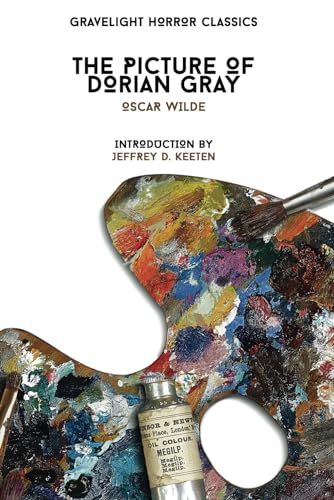
The Picture of Dorian Gray by Oscar Wilde, introduction by Jeffrey D. Keeten

book cover

There were moments when he looked on evil simply as a mode through which he could realize his conception of the beautiful.

“How sad it is! I shall grow old, and horrible, and dreadful. But this picture will remain always young. It will never be older than this particular day of June…. If it were only the other way! If it were I who was to be always young, and the picture that was to grow old! For that—for that—I would give everything! Yes, there is nothing in the whole world I would not give! I would give my soul for that!”

Be careful what you wish for.

description
Oscar Wilde – image from Wikipedia

Man sells soul to the devil in return for…something, in this case a body encased in eternal youth, while a portrait takes on the outward manifestation of his aging and his sins. It ends badly, as deals with the devil usually do. This is hardly a unique tale. In fact, it is a bit of a trope, a Faustian bargain. There is a lovely listing here of examples new and old. Absent, of course, is the most famous, and least successful example of a soul-selling, really more of a soul-buying, from Matthew 4:1-11, when the devil made Jesus an offer he actually could refuse. Don Corleone would have been very disappointed.

But it is a bit more complicated than that, as these things often are. It is always a challenge and an adventure to read a classic. Books become regarded as a base part of our culture for reasons. They can establish motifs, or ways of seeing the world that resonate with their contemporary audiences (well, not always) and future generations. They can offer us a portrait of a time and place, a culture, a class, a social or political issue. They can illuminate moral questions, deal in universal themes, offer insight into human motivation, whether individually or en masse. And we come to see them in particular ways. In The Strange Case of Dr. Jekyll and Mr. Hyde, the prior re-pub in this Gravelight series, what one finds in the original is not quite what one might expect, given how popular culture has transformed the story by bleaching out important nuance. That is less the case with Dorian Gray, at least in part because there appears to have been fewer iterations of the tale in popular entertainments. But, nonetheless, our understanding of the story is generally of the bare bones sort. There is plenty of flesh to give those bones some added heft.

description
Jeffrey Keeten – they came to take his furniture, but the only way they will take his books is from his cold dead hands – image from his site

The history of a book matters. Keeten’s introduction offers an excellent take on how Dorian was received at publication. It generated quite a bit of attention on its release. There were many who were not amused. That may have contributed to the fact that The Picture of Dorian Gray is singular in being the sole novel published by Oscar Fingal O’Flahertie Wills Wilde. The subject matter was considered a big no-no in 1890. The Dorian of the title is a man of many tastes, and apparently insatiable appetites. He manages to bring ruin to both men and women. It was not, in particular, the ruination of women that caused a storm. The periodical in which it was first published was withdrawn from bookshops due to the outrage.

Wilde was a very popular writer of the time, wearing his sexuality like a badge. A tough stance to assume in a culture that preferred to sate it appetites and interests discretely. His novel was a shocker for the time in portraying homosexuality in interest, if hardly in action. The painter of Dorian’s portrait is clearly smitten with him, dazzled by his physical beauty, which he sees also as representative of an underlying perfection.

For all the shock of its homosexual content, there is no physical contact of that sort in the pages. (an earlier version may have been more direct) All is insinuation, suggestion, hinting. It is the same technique that has worked quite well for ages in the horror genre. Shadows, rattling chains, creaky doors, unsourced moans. Sometimes we are offered the shocker scene in which the monster is revealed. The Opera Phantom’s mask is pulled off to reveal the horror of his face. Hyde’s deformity is revealed as the window into Jekyll’s soul. And so it is here. Dorian’s true nature is revealed. The “I’m shocked, shocked” reaction of contemporary critics suggests more about what they were projecting onto the novel than what was actually there.

description
The portrait used in the 1945 film by Ivan Le Lorraine Albright – image from Wikipedia

So, what is the horror that is on display? It is the hedonism of the late 19th century English upper class, sashaying about in the interesting, entertaining, appealing drag of philosophy. Henry argues for the unashamedly sybaritic life. Art need have no meaning, no being other than itself. Apply to humans. Is art, is beauty the highest value? When beauty is left to dangle free, disconnected from any higher value, what is its impact on the world? Actions have no moral content. It is in fact a positive good to live a life dedicated to the primitive accumulation of sensation, through the arts, through physical pleasures, not just of sex, but of sight, smell, sound and touch, to experience beauty in all its forms. Try everything. Art for art’s sake in the guise of human experience. Some people have an amazing ability to come up with excuses for their excesses, explanations, some reason for why they shouldn’t be held accountable for their actions. Like the poor and taxes, we will always have the morally challenged, the malignant narcissists, the sociopaths with us.

beauty is a form of genius—is higher, indeed, than genius, as it needs no explanation. It is of the great facts of the world, like sunlight, or spring-time, or the reflection in dark waters of that silver shell we call the moon. It cannot be questioned. It has its divine right of sovereignty. It makes princes of those who have it. You smile? Ah! when you have lost it you won’t smile…. People say sometimes that beauty is only superficial. That may be so, but at least it is not so superficial as thought is. To me, beauty is the wonder of wonders. It is only shallow people who do not judge by appearances. The true mystery of the world is the visible, not the invisible….

But if this was on the up and up, there would have been no need to keep one’s behavior secret. It is clearly a place where freedom crosses the line into license. The practitioners of such a “philosophy” knew they were up to no good. They merely wanted to hide from the responsibility. Dr Jekyll was quite happy to have an alter-ego he could let loose on the world, to have the sorts of fun he could not have as himself in public view. They knew, not just that their behavior was wrong, not just that it ran afoul of extant mores, but that their reasoned explanation was taffeta thick.

description
Hurd Hatfield as Dorian in the 1945 film – image from Wikipedia

It is not the barely latent bisexuality of the novel that marks Dorian as fallen, it is that he had ruined peoples’ lives, men and women, not by having sex with them, (which is suggested, but never acted out on the pages) but by corrupting them in various ways, by causing them to become as self-centered, as pleasure-seeking as he was. A person can get away with this if he or she is wealthy enough. Paying off porn stars to keep quiet about an extramarital fling certainly fits into such a scenario. Dorian manages to keep his scandals at bay with the use of his wealth.

It is as true today as it was when Wilde was writing this book, the selfishness, the hedonism, the amorality of the wealthy feeds on the blood and life forces of those they exploit, few of whom can afford to fight back directly. (You go, E. Jean!) I imagine this is a core of what Wilde was getting at, and the real reason his critics were so angry at him.

Dorian does not come to his corruption unaided. He arrives as a beautiful young man, who is seen as being as pristine inside as he is on the surface. The Victorians were very concerned with exteriors, believing that they served as personal screens displaying to the world a person’s character. But then he is introduced to Lord Henry Wotton. Henry proceeds to emit a torrent of nonsense, albeit amusing nonsense, mocking the morals of the time. Wilde, speaking through Henry, is cattier than my living room when I shake a container of treats. Henry offers a torrent of false, cynical aphorisms, suitable material to be printed on small pieces of paper and tucked inside poisoned fortune cookies. Were he opining today, Henry would be posting outrageous clickbait opinions on Twitter. Here are a few examples. They are legion, and will sound familiar in tone to characters from Wilde’s 1895 theatrical triumph, The Importance of Being Earnest

…beauty, real beauty, ends where an intellectual expression begins. Intellect is in itself a mode of exaggeration, and destroys the harmony of any face. The moment one sits down to think, one becomes all nose, or all forehead, or something horrid.

…the one charm of marriage is that it makes a life of deception absolutely necessary for both parties. I never know where my wife is, and my wife never knows what I am doing. When we meet-we do meet occasionally, when we dine out together or go down to the Duke’s—we tell each other the most absurd stories with the most serious faces.

…as for believing things, I can believe anything, provided that it is quite incredible.

It is the cynical Henry who finds in the gullible Dorian the raw material with which to cast the young man into a representative of his very hedonistic view of life. Dorian offers the plasticity of the young to the dubious molding of the amoral. The young man is all ears. He even takes time away from the painter, Basil Hallward, to learn at Wotton’s feet. .

To a large extent the lad was his own creation. He had made him premature. That was something. Ordinary people waited till life disclosed to them its secrets, but to the few, to the elect, the mysteries of life were revealed before the veil was drawn away. Sometimes this was the effect of art, and chiefly of the art of literature, which dealt immediately with the passions and the intellect. But now and then a complex personality took the place and assumed the office of art, was indeed, in its way, a real work of art, life having its elaborate masterpieces, just as poetry has, or sculpture, or painting.

We are offered a bit of background on Dorian, to help explain his vulnerability to Lord Henry’s dark influence. And are even given a bit of theatrical brimstone to explain how the deal with the devil is achieved. Neither really matters much.

description
Angela Lansbury as Sibyl Vane in the 1945 film – image from Wikipedia

Early on, Dorian is smitten with a beautiful young actress, Sibyl Vane, who considers him her Prince Charming. It is Sibyl’s appearance, her elevated acting performances, in addition to her beauty, that attracts Dorian. But when her dazzling talent on stage suddenly vanishes, she can no longer offer Dorian the thing he most admired, and he dumps her, cruelly. It is the first crime to which we are witness, the first time his painting changes. The pursuit of beauty and sensation above all else has claimed its first victim. There will be many more, but most of those bad behaviors take place off screen.

Wilde put all of himself into this novel

“Basil Hallward is what I think I am: Lord Henry is what the world thinks me: Dorian what I would like to be.”

Unlike Lord Henry and Basil Hallward though, Wilde acted on his urges. Unlike Dorian, Wilde was imprisoned for his actions. Unlike Henry’s and Dorian’s depraved indifference to the harm they caused others, it is not clear that Wilde was a cruel person.

Dorian is clearly a corrupt individual. Whether he arrived there unaided or had a push is of secondary importance. Lord Henry is clearly corrupt as well, even though we do not see him engage in any physical acts of treachery. Perhaps the corruption of youth, pulling Luke Dorian to the dark side is enough. Henry and Dorian both represent the worst of the amorality of the Victorian age, the hypocrisy of the upper class. This seems the true target of Wilde’s effort. He is not celebrating amorality, but pointing an accusing finger at it, and letting us know who are its most damaging practitioners. At one point Dorian even shows enough residual humanity to want to turn over a new leaf, not appreciating that to succeed he would need to upend an entire forest. (don’t write. I know that the leaf in question was supposed to mean a book page.)

Keeten goes into some detail on the derivation of the name Dorian Gray. Why not Loki? There are very concrete reasons. In fact, there is a lot you will enjoy learning when you check out his introduction. It is rich with detail about the author, the book, and the controversy that surrounded its publication. It also looks at the lasting impact Wilde has had on modern culture. It will definitely increase your appreciation of this wonderful novel.

I suppose there might be a modern version in which Gray and his portrait are linked by quantum entanglement, or one should be made if it does not already exist. The battle between inner self and outer manifestation is certainly an eternal literary theme.

For the second time, a sojourn down the Gravelight illuminated alley of classic horror has proved stimulating and enlightening. From Keeten’s smart, incisive introduction to the chance to see what the original of a household-name classic was really on about, The Picture of Dorian Gray offers a richly rewarding reading experience, clever, funny, dark, shocking, intelligent, satirical, and satisfying.

There were moments when he looked on evil simply as a mode through which he could realize his conception of the beautiful.

Review posted – 02/23/24

Publication date – 11/6/23

I received copy of The Picture of Dorian Gray from Gravelight Press in return for a fair review. Thanks, folks.

This review is cross-posted on my site, Goodreads. Stop by and say Hi!

=======================================EXTRA STUFF

Links to Keeten’s personal, FB, and Instagram pages

Prior reviews for books intro’d by Jeffrey Keeten
—– Exhumed: 13 Tales Too Terrifying to Stay Dead – edited by David Yurkovich
—– The Strange Case of Dr. Jekyll and Mr. Hyde – edited by David Yurkovich

Items of Interest
—–Les Cent Nouvelles – a book of coarse French stories referenced in Chapter 4
—–Margaret of Valois
—–Manon Lescaut – an 18th C. novel in which young lovers live a life of sexual and social freedom, while giving morality little thought – referenced in chapter 4
—–The St. James’s Gazette – referenced in chapter 10
—–Elephantis – author of a sex manual in Classical Greece – noted in Chapter 11
—–Against Nature by Joris-Karl Huysmans – cited in the introduction – Dorian’s reading of this 1884 celebration of sensory gluttony contributes to his corruption
—–Wiki Deals with the devil in popular culture

2 Comments

Filed under classics, Fantasy, Fiction, Historical Fiction, Horror, Literary Fiction, Reviews

The Bee Sting by Paul Murray

book cover

In the next town over, a man had killed his family. He’d nailed the doors shut so they couldn’t get out; the neighbours heard them running through the rooms, screaming for mercy. When he had finished he turned the gun on himself.
Everyone was talking about it – about what kind of man could do such a thing, about the secrets he must have had. Rumours swirled about affairs, addiction, hidden files on his computer.
Elaine just said she was surprised it didn’t happen more often.

For months now she has been having the same dream Of a flood that sweeps through the house Carries off clothes from the wardrobes Toys from the cupboards Food from the table In the dream she is trying to stop it She is wading around, pulling things out of the water But there’s too much to hold in her arms and it overcomes her The current grows stronger Pulls away the appliances the kitchen island tiles from the floor paint from the at the edge of the water watching her go Staring down as she’s swept past In their eyes she is old Her youth is gone too It has all been washed away by the water

The Barnes family is having their problems. It is 2014 in small-town Ireland. We follow Dickie, Imelda, his wife, PJ, their son, and Cass, a high school senior, through a range of travails. Leo Tolstoy’s Anna Karenina opens with, Happy families are all alike; every unhappy family is unhappy in its own way. Guess which category the Barnes family fits into.

PJ is almost a teen, so will have a lot of growing-up to do, but he is faced already with challenges that are plenty daunting. Coping with bullies at school is no fun, if a particularly usual checklist item in coming-of-age stories. But he is also beset by the thug teen child of one of his father’s customers, who feels his family has been cheated by Dickie. Beatings happen, and more are promised if he does not pay up. And these are the lesser of the challenges he faces. On the upside, he likes spending time hanging out with his father, working on a project in the woods behind their house.

description
Paul Murray – image from the Hindustan Times – shot by Lee Pelligrini

Cass has teen-angst aplenty, coping with her social status, her newly-ripening sexuality and her attraction to a promiscuous friend. She is trying to define who she is. (which is not exactly a wonderful person when we meet her.) A part of that is seeing herself as separate from her family. She would definitely not want to be associated with those people. She is particularly hostile to her father, blaming him for the demise of the family business, and the collateral social impact that is having on her. She is not a stunner like her mother, which does not help. The prospect of heading off to college in Dublin offers a concrete escape route, the sooner the better. She is besties, I guess, with Elaine, who is as amoral and unfeeling as she is beautiful.

Imelda came from a working-class family. Rough around the edges would be a kind description. But she was born a knockout. It was always going to be her ticket out. She falls in love with the town’s football superstar, Frank. They are to be wed. Frank stands to inherit a successful family business, and should be able to provide nicely for her. Problem is a literal crash and burn, and buh-bye Frank. She winds up marrying Frank’s older, smarter, but not-golden-boyish brother, Dickie.

Dickie had the brains for college, and attended, for a few years, until an unfortunate event derailed his collegiate career and he headed home. He may have been the smarter of the brothers, but Frank had the gift of salesmanship, and was a better fit to take over the car dealership. But when Frank dies, it falls to Dickie to step in. He manages, but it is not work he exactly loves.

These days, he is spending time in the woods behind their home, building a defense against Armageddon, spurred on by a troll-like employee who exhales conspiracy theories and seems to be looking forward to the coming end-times. He has a lot of time on his hands. The car-dealership is in the crapper. Along with plenty of other businesses, suffering not only from a global economic downturn, but massive flooding in the town. Dickie’s father, Maurice, retired, but still the owner, swoops in to try to fix things, blaming Dickie for the difficulties. Dickie is not entirely faultless here. But there are serious complications with him.

We follow these four for over six hundred pages, getting to know them intimately. We learn their secrets, see them change, see them cope with relentless stressors, see them grow, or not. This is the greatest power of the novel. Each is faced with decisions, moral choices, that define their character, that define their changes, maybe their failures. If that were all, it would be an outstanding piece of work, but Murray offers a very rich palette of content as well, raising it to another level.

There are many notions that run throughout The Bee Sting’s considerable girth. Space has been reserved to handle them all. The core, of course, is family. Not exactly the most functional, the Barnses. Parents who have been raised to hide their emotions have no natural ability to make a happy home.

You couldn’t protect the people you loved – that was the lesson of history, and it struck him therefore that to love someone meant to be opened up to a radically heightened level of suffering. He said I love you to his wife and it felt like a curse, an invitation to Fate to swerve a fuel truck head-on into her, to send a stray spark shooting from the fireplace to her dressing gown. He saw her screaming, her poor terrified face beneath his, as she writhed in flames on the living-room carpet. And the child too! Though she hadn’t yet been born, she was there too. All night he listened to her scream in his head – he couldn’t sleep from it, he just lay there and sobbed, because he knew he couldn’t protect her, couldn’t protect her enough…

On top of which, secrets abound. They are all trying to find a way out, except for PJ, who is mostly interested in seeing things returned to the way they were before the dealership miseries began, and radiated outward. Murray shows how dysfunction and damage can carry forward from one generation to the next, the brutality of Imelda’s family, the emotional absence of Dickie’s. But all has not been destroyed.

When Dad was fun everything was fun. Not just holidays, not just Christmas. Going to the supermarket! Cutting the grass! At bedtime they had pyjama races, they read Lord of the Rings cover to cover, they put a torch under their chins and told each other ghost stories…

Family connection is important, mostly in the desire of most to sever it. Dickie was desperate as a young man to get away, get an education, do something other than sell cars for the rest of his life. Imelda came from a toxic family (not all of them) and also struggles with her connection to the family she is in, for current-day part of the story. Cass wants out, ASAP. Tethers are cut, but some are also sewn. The tension between these struggles is fuel for the story.

Murray looks at the impact of the environment on peoples’ lives. The story is set at the tail end of the recession from the Celtic Tiger boom that had preceded. The economic environment was still pretty tough and we see how this impacts the family.

It will come as no shock that a major, unusual, flood impacts Dickie’s already sinking business, with talk of liquidation, that a water leak in the Barnes house carries omens, and that Imelda dreams of being washed away, as she is forced to cope with losing the luxury level lifestyle to which she thinks her incredible beauty entitles her. Cass’s collegiate prospects and social standing are endangered. Other players in the story are challenged as well. PJ is fast out-growing all his clothing, but does not want to be a burden on the now-struggling family, so keeps quiet and castigates his feet for growing too much. There is a stream involving the presence of gray squirrels in Ireland. They are an invasive species, as of a century back, and carry a disease that is fatal to the native red squirrels. Are they the only locals in danger of being wiped out?

Another stream is the notion of returning, coming back from the dead, in particular.

Some people might say that the key problem is with coming back from the dead specifically. Because obviously death is a pretty serious step with all kinds of long-term effects that you’re not going to just shake off. But lately you’ve noticed it with other things too, that even though they never actually died, when they came back from where they’d gone they were still completely changed.

Imelda keeps looking for the ghost of Frank to show up at her wedding to Dickie. Dickie is definitely not the same after returning from Dublin. Same for Cass and PJ. Other characters, a maid, a mechanic, a patriarch, return as well, with mixed results.

…is it worth taking the risk? Sometimes? If you could still sort of see the person they were and you thought maybe there was still enough time, if you knew what to do or say?

Bees get a bit of attention, if a bit less than expected. The bee sting of the title is inflicted on Imelda, on her way to her wedding to Dickie. Her face was in no condition to be seen, so every wedding picture of her is through her veil. There is another passage about the mating habits of bees. It does not end well for the males.

…the pesticide the farmers use on plants contains a neuro-toxin that destroys their memory so they forget their way home, can’t make it back to the hive where they live, and that’s why they’re dying out. When they looked in the hives they found them not full of dead bees, but mysteriously empty. Maybe that’s what happened to Cass, you think. Maybe air pollution in the city has damaged her brain and now she’s forgotten her home. Though really you know it started way before she came here.

The impact of stinging on the stinger is also considered.

There is even a bit of magic as Imelda’s Aunt Rose has a particular gift, sees things that others cannot, says sooths, a family thing, but not one that Imelda has ever manifested.

Murray writes in differing styles. Most of the book is presented as third-person omniscient, describing the actions and peering inside to reveal the characters’ thoughts and feelings. Standard stuff. The final section, The Age of Loneliness, is written in the second person. We alternately assume the POV of the main characters, as each races toward the stunning climax. Imelda gets a breathless, minimally formatted structure. There is a sample in the second quote at the top of this review.

I wrote Imelda’s section, and I knew she was on her way to this dinner… I wrote that first line like she, well, she needs to use the bathroom really urgently. And I put commas in and a full stop. And it did not feel right at all. The only way to write it was without the punctuation, and I wanted it to feel like you’re in her head. She doesn’t parse things in the same educated way that Dickie or indeed the kids would do. She just thinks in this much more immediate, intensive way. When you go from the kids’ sections into Imelda’s section, I wanted it to feel like, woah, there’s a change in gear here. Like there’s something’s going on that hasn’t been apparent up until now. At this moment in her life, but maybe at every point in her life, everything feels extremely precarious. She’s on this knife edge, all the time. She always feels like everything’s going to collapse, the floor is going to disappear from under her and she’s going to just tumble down into the past with her abusive dad and the poverty and the grimness and stuff. – from the. Hindustani Times interview

It would not be a Paul Murray novel if you did not come away from the reading without a few more laugh lines in your face. He takes the most liberty with this in the teens’ sections, the most reminiscent of the grand, rude humor of Skippy Dies to be found here. For example

Nature in her eyes was almost as bad as sports. The way it kept growing? The way things, like crops or whatever, would die and then next year they came back? Did no one else get how creepy that was?

or

Behind him, another boy, not as tall but slightly droopier, had started kissing Elaine. It was distracting; it seemed like she could hear it even over the metal, a squelching noise like walking on frogspawn.

or

It feels weird reading a prayer off his phone, where he has looked at so many unreligious things. He hopes the Virgin Mary knows it’s meant for her, that he’s not praying to e.g. Candy Crush or Pornhub.

You get the idea. Love this stuff.

So what’s not to like? Nothing, nothing at all. This is a wonderful, engaging, risk-taking, funny, moving, horrifying, engaging, biting, human triumph of a novel. You may feel stung by elements in this great tale, but you will come away with a literary trove of honey.

Ireland is a place where people are very good at talking. People are so funny and have such brilliant stories, and it’s a way to disguise what you’re actually feeling. The reason, I think, is because this is a place where very terrible things have happened and the way we deal with them is by not addressing them. So I feel like the ghosts are alive and they’re active. The past is affecting what you’re doing in a very real way. And if you don’t address the issues, then the darkness just grows, and the damage gets passed down from one generation to the next, like in the book. – from the Guardian interview

Review posted – 12/8/23

Publication date – 8/15/23

The Bee Sting was short-listed for the Booker Prize

I received an ARE of The Bee Sting from FSG in return for a fair review. Thanks, folks, and thanks to NetGalley for facilitating.

This review is cross-posted on my site, Goodreads. Stop by and say Hi!

=======================================EXTRA STUFF

Links to Paul Murray pages on Wikipedia and Goodreads

Interviews
—–Hindustani Times – Paul Murray – “Climate change is something I worry about all the time” by Saudamini Jain – READ THIS ONE
—– The Guardian – Paul Murray: ‘I just dumped all my sadness into the book’ by Killian Fox
—–The Booker Prizes – A Q&A with Booker Prize 2023 shortlisted author Paul Murray – video – 4:08

My review of an earlier book by Murray
—–Skippy Dies – one of the best books EVER!

Items of Interest from the author
—–New York Magazine – 3/15/23 – Who is Still Inside the Metaverse?
—–The Guardian – Paul Murray: ‘How the banks got rich off poor people would be a painful read without comedy’ on The Mark and the Void
—–Boston College Libraries – Fall 2022 – How to Write a Novel – video – 1:20:05 – Paul from 7:45 – On the book from 18:25 – well, sort of – Largely about why it took so long between novels – and his experience with screenwriting – Wicked funny, too.
—–Outlook India – Excerpt

Leave a comment

Filed under Fiction, Literary Fiction, Reviews

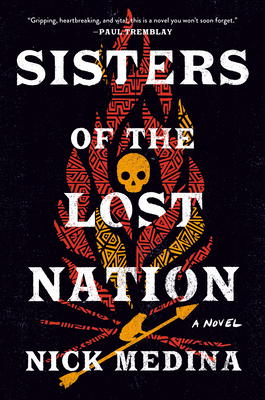
Sisters of the Lost Nation by Nick Medina

book cover

The spirit of a chief, you see, is a powerful thing. The skull became a head again when it was lifted from the grave . . . resurrected.”
“Resurrected?” she echoed.
“Alive again,” he said, his voice measured and grievously low, prolonging every word. “But not like it was before. Not like the old chief. It’s angry now that it’s been ripped from its rest. And ravenous. Hungry for revenge. It’ll eat anyone it encounters. It’ll tear flesh from bone.”
“How?” she said.
“It rolls, gathering mud and moss on its decaying flesh.”

Black bark to her sides and ash beneath her feet, she smelled the earthy odors of dirt, mud, burnt wood, and something so vile her stomach turned. It was the same smell the wind had wafted her way on the nights she’d been chased. Only the odor was stronger now. Inescapable.

Seventeen-year-old Anna Horn is terrified of two things. The first a magical, carnivorous head that gets around by rolling, and is possessed of a set of very nasty teeth. She believes it is determined to eat her. This is the result of a tale her Uncle Ray had told her ten years ago. Her terror about the rolling head permeates, as she fears its arrival every time there is a rustle in the bushes, the main difference in her experience of it being that she can flee faster at seventeen than she could at seven. The second is that she will never see her sister again. Fifteen-year-old Grace has joined the growing list of Native women gone missing.

description
Nick Medina – image from Transatlantic Agency

Anna is in the throes of that perennial challenge of the teen-years, (for some of us, this challenge can go on for decades) figuring out who she is. She is way more mature than most of us were at that age, for sure. She does not exactly dress to impress, favoring her father’s old clothes, and sporting a very unfashionable short haircut. She loves the stories of her tribe, the fictional Takodas, to the point of wanting to start a historical preservation society, to save Takoda history, myths, and traditions for future generations. The considerate and kind classmates at her mostly white school completely understand and support her efforts at self-discovery. As if. They make her school experience a living hell, taking it further than unkind words. Grace is a very different sort, desperate to fit in, wanting attention, focusing on her looks and pleasing others in order to grease the way to hanging with the cool kids. Acquiring a cell phone is the key to her potential rise, and she will do whatever she can to get the money for one.

The story flips back and forth in time, moving forward from Anna’s Day 1 in showing how events came to be, and from the day of Grace’s disappearance, showing the investigation and results. Chapters are labeled in reference to days since Anna’s story begins. Grace does not go missing until well along in those days. Chapters looking at the search for Grace are also labeled with the number of hours since her disappearance.

Medina wanted to highlight the epidemic of Missing and Murdered Indigenous Women and Girls (WWIMG) that has been devastating Native communities for a long time. He shows the all-too-familiar problems residents of tribal lands face when someone goes missing, a viper’s nest of overlapping legal jurisdictions, inadequate police funding, and official indifference among them, not to mention racism. Speaking of which Medina portrays people of all shades as less then admirable. Even the Native manager of the casino assigns Native workers based on their skin color. Fox Ballard, nephew of the tribal leader, is young, handsome, flashy, sculpted, and not at all to be trusted.

Medina pays attention, as well to the impact of modernization on traditional values. The Takoda nation has been significantly changed by the opening of a casino on the reservation. The most obvious contrast is that of Anna (traditional) vs Grace (modern). The new road offers up a steady supply of splatted frogs, a pretty clear image of the cost of replacing treasured values with treasure. Income from the casino is making its way to all the people on the rez, although it is also clear that some Takoda are more equal than others.

As explained in the Author’s note that follows the book, the inspiration for the carnivorous rolling head came from actual Wintu and Cheyenne legends. It reminded me of the relentless ungulate in Stephen Graham Jones’s The Only Good Indians, except that the elk in Jones’s tale is seeking revenge, while the head, though our only real look at it is through Anna’s terrified eyes, seems a more open opportunity attacker. Frankly, scary as it seems to her, it cannot hold a candle to Graham’s hoofed-slasher. It may have been scary to Anna as a character, but did not cause me any lost sleep as a reader.

I did feel at times that this book read more like a YA story than a fully adult one, an observation, not a black mark. The greatest strength of the novel is Medina’s portrayal of his lead, Anna. It is in seeing her social challenges, following her passions, tracking her investigative efforts, admiring her bravery, and rooting for her to mature to a point where she is comfortable in her own skin, that we come to care about her. That alone makes this a good read. The added payload, about the core issue of the book, Missing and Murdred Indigenous Women, about the impact of modernization on traditional values, about gender identity, and about the impact of story on our lives, gives it a far greater heft.

This is Medina’s first novel. He refers to it as a “thriller with mythological horror.” It is an impressive beginning to what we hope is a long and productive career.

She said Frog exemplified transformation. He entered life in one form and left it in another. From egg to tadpole, to tadpole with legs, to amphibian with tail, to tailless frog, he was never the same. He began life in water, only emerging once he was his true self. He symbolized change, rebirth, and renewal, and his spirit could bring rain.
Anna stared down at the ill-fated frog. The reservation was transforming. The asphalt beneath her feet was evidence of that. And yet the very symbol of change had become a victim of it. The absurdity didn’t escape her.

Review posted – 6/23/23

Publication date – 4/18/23

I received an ARE of book name from publisher in return for a fair review. Thanks, folks. Can you get that thing to stop chasing me? And thanks to NetGalley for facilitating.

This review is cross-posted on Goodreads. Stop by and say Hi!

=======================================EXTRA STUFF

Links to the author’s personal, Instagram, and Twitter pages

PROFILE – from The Transatlantic Agency

A Chicago native, Nick Medina is an author and college professor of public speaking and multicultural communication…Nick’s first short story was published in 2009 and he has since had dozens more published by West Pigeon Press, Dark Highlands, and UnEarthed Press, in addition to outlets in the U.S. and the U.K., such as Midwest Literary Magazine, The Washington Pastime, The Absent Willow Review and Underground Voices.

Interviews
—–Paulsemel.com – Exclusive Interview: “Sisters Of The Lost Nation” Author Nick Medina – e-mail interview
—–#Poured Over – The B&N Podcast – Nick Medina on Sisters of the Lost Nation – by Marie Cummings – video – 48:04
—–Murder by the Book – Special Prelaunch Q&A: Nick Medina Presents “Sister of the Lost Nation” by Sara DiVello – video – 33:31
—–FanFiAddict – Author Interview: Nick Medina (Sisters of the Lost Nation) by Cassidee Lanstra

Items of Interest from the author
—–Tor.Com – Excerpt
—–CrimeReads.com – EXPLORING SOCIAL ISSUES THROUGH HORROR

Items of Interest
—–Medina said that his initial inspiration for the novel was from an AP article published in the Chicago Tribune. Here is the article as published by AP – #NotInvisible: Why are Native American women vanishing? by Sharon Cohen
—–CBC – MMIWG cases continued at same rate even after national inquiry began, data shows
—– First People: American Indian Legends – The Rolling Head – A Cheyenne Legend

For horror grounded in the Native experience, I can recommend
—–Stephen Graham Jones – Mongrels
—–Stephen Graham Jones – The Only Good Indians
—–Stephen Graham Jones – My Heart is a Chainsaw
—–Stephen Graham Jones – Don’t Fear the Reaper
—–Cherie Dimaline – Empire of Wild

Leave a comment

Filed under Fantasy, Fiction, Horror, Mystery, Native Americans, Suspense, Thriller

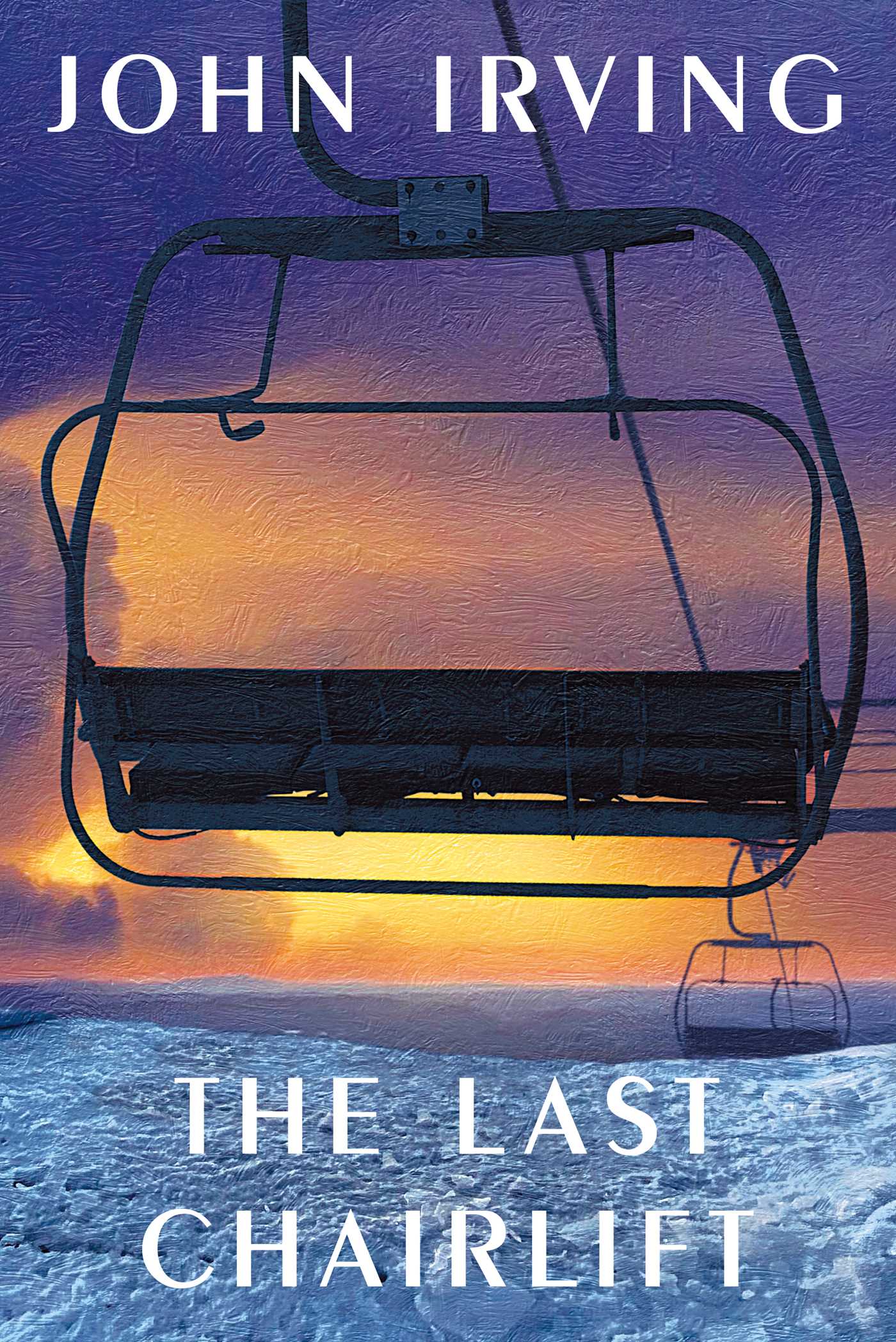
The Last Chairlift by John Irving

book cover

Think of your first good kiss. Was it life-changing, or was it no big deal? Do you remember how old you were? Did it matter, at the time, who gave it to you? Do you even remember who it was?
I’ll tell you this: when you’re thirteen and your mother gives you your first good kiss, you better hope someone matches it or eclipses it—soon. That’s your only hope.

Autobiography just isn’t good or bad enough to work as fiction… Unrevised, real life is just a mess.

The overall format is one of a frame, with Adam Brewster opening by letting us know that this is the story of his life and times, then returning to turn out the lights when the tale has been completed. It is a family saga of Irving’s era, 50’s 60s, (Vietnam) 70s, 80s (Reagan, AIDS) et al, to the mad, reactionary violence of the 21st century. Adam Brewster, a writer and screenwriter, is our narrator for a look at the sexual politics of a lifetime, from his birth in 1941 to his later days some eighty years on.

Adam’s mother, Rachel Brewster (Little Ray), was a nearly-pro ski nut, who spent large parts of every year on the slopes, settling for work as an instructor. That left Adam in the hands of his grandmother for much of his upbringing, assisted by a passel of relations. He would hunger for time with his only known parent for much of his life, a core element of the novel.

description
John Irving – image from Outside Magazine

Readers of John Irving will recognize much that is familiar, from his prior work and his life. The novel is set in Exeter, New Hampshire, Irving’s home town; includes a benign stepparent teaching at Phillips Exeter (as his actual stepfather did); includes the narrator as a student there. Yep, Irving attended. There is wrestling, of course. Bears are limited to a kind of snowshoe shaped like their paws. A hotel figures large. There is an absent biological father, (Irving’s father was in the US Army Air Force. He never met him.); a mother with too many secrets; there is also reference made to an inappropriate relationship between an adult woman and an underage boy. (something Irving himself experienced); considerable attention is directed to feeling like, to being, an outsider.

”That’s just who you are, Adam,” my older cousin said. “There’s a foreignness inside you—beginning with where you come from. The foreignness is in you—that’s just who you are. You and me and Ray—we’re outliers.”

In fact, Irving turns the tables here, as Adam, as the only straight among the main characters, is the outsider in his own family, always the last to get things, he is nonetheless loved and supported by his sexually diverse relations.

His mother’s lifelong lover, Molly, effectively his stepmother, tells Adam, “There’s more than one way to love people, Kid.” It serves as a core message for the book and for Irving’s oeuvre. One of the main characters is transgender. He first wrote a sympathetic trans character in The World According to Garp, in 1978. So, when his son, born many years after the book was published, came out to his parents as trans, she knew her father would be completely supportive.

The politics of divergent sexuality through time manifests in diverse venues. Raucous comedic material performed at a comedy club in one era is considered too much for a later sensibility, a new puritanism of correctness. Safety for being different is a concern. Adam is very worried when his stepfather is out in their town dressed as a woman, even trails him sometimes in case a backup is needed. Reagan’s unwillingness to address AIDS until six years into his presidency is noted. Acceptance increases over time, but increased acceptance sparks increased resistance. A performer of material deemed unacceptable to some becomes a target for violence in a more disturbed climate.

In addition to the overarching theme of looking at sexual politics, sexuality is shown as far less important than the connection between people. Things that may seem sexual actually have a lot less to do with sex than connection. For instance, Adam and his mother often sleep together, in the slumbering, not biblical sense, well past the age where that is generally deemed ok. There is another relationship in which a straight man and a gay woman share a bed, sans fooling around.

There is hilarity aplenty, not least with Adam’s young sequence of damaged or damaging lovers. Lots of cringy LOL material there. I counted a dozen “LOLs” in my notes, some for entire chapters.

And then there are ghosts. Irving calls this a ghost story. I refer you to a piece on his site that addresses this directly.

Ghosts don’t just warn us about the future; they remind us of what we’ve forgotten about the past. All this is to say, I have a history of being interested in ghosts. And here come the ghosts again. In my new novel…the ghosts are more prominent than before; the ghosts, or hints of ghosts, begin and end the novel.

We all have ghosts we live with, but the ones here are visible, well, to some, anyway. They hang out in large numbers at a hotel in Aspen, but also turn up at home. The spectres are historical and familial, with some able to interact with the physical world (sometimes with LOL results) sometimes condemned to remain non-impactful. They do indeed, as noted above, remind us of the past, sometimes darkly so, but some offer direction and comfort. And Irving uses his behemoth of a novel to keep generating new ones. They pass over in a wide range of ways; lightning, murder on a stage, sudden avalanche, cancer, suicide, murder in a hotel, falling from a chairlift, leaping from a chairlift, death in war, et al. Falkner famously said “The past is never dead. It’s not even the past.” I guess it could be said for many characters in The Last Chairlift that even the dead are never entirely dead.

Adam’s profession offers ample opportunity for Irving (winner of a National Book Award AND a screenwriting Oscar) to present a wealth of material about writing, both for the screen and for print.

“My life could be a movie,” you hear people say, but what do they mean? Don’t they mean their lives are too incredible to be real—too unbelievably good or bad? “My life could be a movie” means you think movies are both less than realistic and more than you can expect from real life. “My life could be a movie” means you think your life has been special enough to get made as a movie; it means you think your life has been spectacularly blessed or cursed.
But my life is a movie, and not for the usual self-congratulatory or self-pitying reasons. My life is a movie because I’m a screenwriter. I’m first and foremost a novelist, but even when I write a novel, I’m a visualizer—I’m seeing the story unfold as if it were already on film.

Imagining the stories you want to write, and waiting to write them, is part of the writing process—like thinking about the characters you want to create, but not creating them. Yet when I did this, when I was just a kid at Exeter—when I thought about writing all the time, but I never finished anything I was writing—this amounted to little more than daydreaming.

you don’t see with hindsight in a first draft. You have to finish the first draft to see what you’ve missed.

Fiction writers like what we call truthful exaggeration. When we write about something that really happened—or it almost happened, could have happened—we just enhance what happened. Essentially, the story remains real, but we make it better than it truly was, or we make it more awful—­depending on our inclination.

There are many more—it is a very long book—but this last one in particular speaks very directly to Irving’s process. As noted up top, he returns to familiar themes and situations. In interviews he says that he begins with the same life experiences, but then changes where they go, how they morph, as if his creative process was to take the stem cells of his experiences and direct them to grow into a wide range of possible pieces. Same source, different outcomes.

It is not just the characters and situation that have morphed, it is the form as well. As Adam is a screenwriter as well as a novelist, and as this story is Adam’s, it is fitting that how he perceives the world makes its way into how he presents his story. There are long chapters that are written in screenplay format, complete with fade-ins, fade-outs, off-screen narration, closeups, wide-shots, the whole toolkit. It is an interesting tactic. I found it off-putting, but it does allow for a different approach to the material.

He does not just talk about writing per se, but incorporates into the novel considerable attention to his favorite book of all time, Moby Dick. (he has the last line of Moby Dick tattooed on his left forearm) This book opens with My mother named me Adam…, which resonates with Call me Ishmael and no less with …I am born from David Copperfield, Dickens being a particular Irving favorite. He sees himself as more of a 19th century novelist than a 21st century one.

…because those novels have always represented the model of the form for me. I loathed Hemingway. I thought Faulkner was excessive. Fitzgerald was ok, but lazy at times. I was enamored of the kind of novel all of my classmates at school despised.

References to Melville’s masterpiece (sometimes hilariously), Dickens, Ibsen, and plenty of others abound.

It is pretty clear that John Irving has had an interesting life. Eighty years old at the time of publication, he does not see The Last Chairlift as his last hurrah. In fact, he signed a three-book deal with Simon and Schuster, of which this was merely the first. He promises, though, that the next two will be a lot shorter.

Until then, this one will certainly suffice. Irving has lost none of his sense of humor. This book was more than occasionally laugh-out-loud funny. He has lost none of his feel for writing relatable humans. While some of the supporting cast are painted in broad strokes, to illustrate this or that sociopolitical issue of a given time, the main ones, and even hordes of second-tier characters are drawn with fine lines, and deep sensitivity. He has lost none of his vision, seeing clearly the currents of the eras considered, and how those have impacted social and political possibility for rounded humans who do not fit the square holes of a boilerplate majority. For all that Irving writes about people who are different, he makes it eminently clear that in matters that count we all share the same needs, to be loved, seen, and respected for who we are. Here’s hoping it will not be another seven years until we get to enjoy another of John Irving’s marvelous works.

…the dead don’t entirely go away—not if you see them on the subway, or in your heart.

Review posted – February 17, 2023

Publication date – October 18, 2022

I received an ARE of The Last Chairlift from Simon & Schuster in return for a fair review. Thanks, folks, and thanks to NetGalley for facilitating.

This review has been cross-posted on GoodReads. Stop by and say Hi!

=======================================EXTRA STUFF

Irving’s personal and FB pages

Interviews
—–CBS Sunday Morning – John Irving: A Writer’s Life with Rita Braver – a delight – Sees himself as a 19th century writer
—–Late Night with Seth Meyers – John Irving Doesn’t Write a Book Until He Knows How It’s Going to End
—–Freethought Matters – Freethought Matters: John Irving
– video – 28:08 – with Ann Laurie Gaylor and Dan Barker – Interview begins at 2:57 – focus on chairlift begins at about 18:00
—–NPR Podcasts – Book of the Day – ‘The Last Chairlift’ is John Irving’s latest novel on sexual politics with Scott Simon – Audio – 10:26
—–Hazlift – ‘Hope is an Elusive Quality’: An Interview with John Irving by Haley Cunningham
—–Toronto Star – Hugging us back in the dark: John Irving on making us care about his characters, sexual politics, and the ghosts in his new book ‘The Last Chairlift’ by Deborah Dundas

Items of Interest from the author
—–Here Come the Ghosts Again on ghosts in his novels
—–CBS News – excerpt
—–Lithub – excerpt

My review of another book by Irving
—–In One Person

Items of Interest
—– Moby Dick – Full text – with annotations
—–David Copperfield – Full text – with footnote annotations

Items of Interest from the author
—– Here Come the Ghosts Againon ghosts in his novels

Leave a comment

Filed under Feminism, Fiction, Historical Fiction, Literary Fiction, Reviews