Tag Archives: California

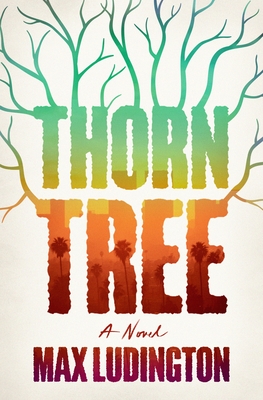
Thorn Tree by Max Ludington

<img src=”book cover” alt=”book cover” width=”187″ height=”300″ align=”left” hspace=”10″ vspace=”10″>

At the base level it’s fear. It’s all about fear. People ask, ‘What are you afraid of?’ and that is not an answerable question. Any time I name a source for my fear I feel it as a deflection. I mean, sure, I can get close. You know, as in: I’m afraid of people because someone I trusted fucked with me when I was a child. I was traumatized, yes, and the fear probably began there, I guess. But I don’t really know because it seems, now, somehow elemental. It embodies some ancient, sleeping doom, and the only escape is self-destruction. You know? Like, if I become my own doom I’ve taken that power away from anything else. It’s preemptive. At least there’s agency in it.”
She felt the laughter spill out of her in a rush. Its piercing volume was at odds with the moment and the release it brought. Leo looked at her dumbfounded.
“Get the fuck out of my head, man,” Celia said.

He had merely done what men had been doing since the primeval birth of jealousy. Just a spoon of love from my forty-five, save you from another man. Howlin’ Wolf was just singing about what thousands had wished they could do, and probably had done, before there were cops and laws and all the rest of the arbitrary bullshit. And it had felt good, hadn’t it?

Daniel is 68, living a quiet life in a Hollywood Hills guest house when a visitor repeatedly appears. Dean is six years old and clearly in need of companionship. He lives with his grandfather, Jack, on the larger house on the property. Jack is not always particularly attentive. And Mom, Celia, is a rising young actress who is often away on prolonged shoots. Daniel is happy for the company.

description
Max Ludington – image from Macmillan – shot by Jennifer Silverman

The novel braids the stories of Jack, Daniel and Celia, mostly Jack and Daniel. The story takes place in multiple times, today being 2017, and the backstory stepping up from 1968 to the seventies, to 1980, and 1988. Celia is not a part of the earlier events.

The sixties events cast a light on a turbulent time, touching on many of the aspects one might expect, young love, drug-dealing, acid trips, communes, San Francisco, wth a very dodgy cult among them. But despite the surface level, there is also consideration of the sort of existential, philosophical searching that was, for many, an important part of those times.

Young Daniel (1960s) makes a youthful mistake and suffers a grievous wrong, which follows him all his life. In the 1970s he finds solace in the desert, constructing a significant work of art, the Thorn Tree of the title. It gets him some notice, gives him a way to express what is inside him, and leads to some stability in his life.

Celia did an image search for the sculpture, and there it was, standing next to the modern art museum, taller than the building itself. It was huge, with thick, meandering branches and bristling snakelike twigs. Most of the branches, while not attempting verisimilitude, were formed with inherently natural shapes and gnarled twists, but here and there some were deliberately hewn into shapes that could never have occurred in nature: curving double on themselves and then back again to form tight willowy S-shapes, or turning straight downward at acute angles for a foot or two before continuing up and outward, as if infused genetically with lightning.

Jack is a very different sort. A predator, a sociopath or something like it, Jack wants what he wants and is not much concerned about who he damages to get it. He is routinely unkind, and worse, but he is also a seeker of truth, becoming connected with a cult and seriously mulling the writings on which the cult bases its outlook, even if the tenets of that group serve to bolster his own self-justification.

Daniel and Jack are linked through these years, the source of that link being one of the mysteries of the book. Jack is definitely a dark force. Daniel exists on a brighter side, despite having made some bad choices. He is a character who grows. But while Jack grows in a way, his widened view of reality is ultimately redirected to his narcissism. Not much is really done with Celia.

There is some lyrical writing which gives the story texture, depth to the two main characters, which makes it engaging, and a look at the times, both 60s and 70s, which gives it some substance. In addition it considers repercussions throughout one’s lives of actions taken in our youth.

Daniel stood for a moment at the threshold of the branches and looked up. The wind was made louder here in contact with the tree. The gravel path went around the south side, and he followed it to where it ended at an overlook. There was a plaque on a post, but he didn’t read it. Instead of standing at the overlook and staring out to sea, as the landscape designer had intended, he turned and went in under the branches, and immediately the world of the tree took over. He was surprised—he’d thought his memory of it was hopelessly colored by LSD and shock and time, that he had probably falsely mythologized every aspect of it and it would be just a place, with soil and roots and air but not the indwelling spirit he’d imbued it with in his mind. But it was as it had been—the wind quieting and the light clarifying, damping the sun into deep greenness—inhabited by a sense of protection and safety unchanged by the years of foot traffic and human attention.

There are many more of this sort. The voice is omniscient narrator, which presents way too many opportunities to tell rather than show. But I doubt this will bother most readers. Some characters come and go, seeming to be throw-aways. It is one of the things that make the book feel over-long. I kept hoping that some of these might be given a deeper look, with Jack getting less.

The alternating timelines, a fairly typical literary device, made sense to me. The Grateful Dead offer a link between now and then. There seemed some interest in other literary devices. For example, a boy appears to have a magical relationship with birds, but the image drops after partial usage.

Thorn Tree is an interesting read, offering some substance, interesting characters, and a strong core mystery. But for a book that is not overlong, at about four hundred pages, it felt like a much longer read because of the excess attention paid to Jack, and some tangential tales. The descriptive writing (I am a sucker for that) gives one a reason to push through, however prickly the passage.

Review posted – 11/01/24

Publication date – 4/15/24

I received an ARE of Thorn Tree from St. Martin’s Press in return for a fair review. Thanks, folks, and thanks to NetGalley for facilitating.

This review is cross-posted on Goodreads. Stop by and say Hi!

=======================================EXTRA STUFF

Links to Ludington’s personal, Goodreads, and Twitter pages

Profile – from Macmillan

MAX LUDINGTON’s first novel, Tiger in a Trance, was a New York Times Notable book, and his fiction has appeared in Tin House, Meridian, HOW Journal, Outerbridge, and On the Rocks: the KGB Bar Fiction Reader. He lives in Brooklyn, New York and teaches in the writing department at Pratt Institute.

Interview
—–The Palisades Newsletter – Max Ludington Reflects on His Second Novel, THORN TREE

Song
—–The Doors – Five To One
—–The Grateful Dead – The Very Best of the Grateful Dead

Leave a comment

Filed under California, Fiction, Historical Fiction, Literary Fiction, Reviews

Goldenseal by Maria Hummel

book cover

Falling into friendship, with Edith was also, for Lacey, inextricable, with falling in love with the northern summer. Never had she woken to birdsong, or plunged headfirst into cool water on a blazing day, or listened to the whispers of the oaks as a thunderstorm, swept in. Never had the sun felt so warm and golden, or rain soaked her so completely. The shrill of crickets, alarming at first, began to soothe her to sleep at night. A toad hunched by a log was so intensely ugly she cried out in shock, while a fox, slipping through the pines, looked like the tip of a paintbrush dipped in orange. Her hands and legs became tan and useful. She could tie three kinds of sailor knots, and she could kick her way up a river current. Her face in the spotty cabin mirror was freckled, it also looked rounder and full. She was gaining weight back, and when one night Edith observed, “You’re not coughing anymore,” Lacey realized it was true.

“When the stranger returned to the city…” are the opening words of Goldenseal, or could be of a fun Western. The description that follows is pure delight, set in 1990 Los Angeles, as Maria Hummel shows off her poet’s gift for description. In The Rumpus interview she talks about having to tone that element down to spend more focus on moving the story forward. A loss for the likes of me. Edith Holle left Lacey, and Los Angeles forty-four years ago. She is back now on a mission known only to herself.

I was interested in creating a novel that had an allegorical Western feel. The stranger comes back to this city for the first time in forty-four years; “the stranger comes to town.” That’s the beginning of the classic Western, and Westerns play an important role throughout the story, as both subject and backdrop, especially in regard to gender. Because in the classic Western, the “stranger” is male, right? But here, it’s Edith, an old woman in a wrinkled skirt and sneaker boots. – from The Rumpus interview

In addition to the western genre references, there is a mystery afoot here, well, a few. What was the nature of Edith’s connection to Lacey? Why did she leave? Why is she back?

description
Maria Hummel – Image from her site

We get an up close look at Lacey’s discomfort, wondering what Edith is up to, stressing over what to wear, as if her sartorial selections might provide a layer of armor, but Lacey is also clearly dying to see her. Once the waiting is done, we get on with the bulk of the story. It is told in two time lines. First is an ongoing conversation between the two women, the frame. Second is the history they recount within it.

Lacey Crane was born in Prague, her parents fleeing before, but not because of, the future Nazi invasion. Middle class, they were able to experience success in the hotel business. We get a look at the impact of the Holocaust on her parents, particularly her Jewish mother. As girls, Lacey and Edith meet at a California camp, where Edith is a bit of a loner, the daughter of the camp caretaker, special for her talent at stage performance, among other things, but seen as too lower class for most of the privileged girls. Not for Lacey. They become instant besties. (see quote at top) Edith’s home life is challenging, and Lacey wants to take her away from all that.

We follow the development of their friendship, and of their lives, together and apart. It is events in adulthood that split them, a final, dramatic schism. Dirty laundry is pulled from their memory bags, and held up for close inspection. Some garments are left unaired.

The contemporary conversation functions as a way for them to both examine the lives they have led. It also illuminates some of the changes women experienced in the 20th century.

The novel germinated over a protracted period, until all the elements finally came together. First was the Biltmore. When she and her husband moved there in the early aughts, Hummel was smitten with the LA hotel culture, particularly that hotel.

[This] combined with a book that I read that came out in American translation in 2001 called Embers …originally published in 1942, is a story about two old friends, males, an old general and a soldier, meeting in a castle in the Carpathians for the first time in forty years. They’re also weighing out friendship. When I read that book, I thought, this is such a great treatise on friendship, but it’s about male friendship. Female friendship is different. Wouldn’t it be great to use this structure but set it in an American castle? There it is. Then the third piece was, as we all experienced, we lived like recluses, particularly for me, the academic year that was 2020/’21. I thought, I know how to write this character now, this person who’s basically a hermit who lives in the hotel and never goes out and is locked in her tower. – from the Moms Don’t Have Time to Read Books interview

Underneath it all is that primal bond, forged in childhood, hardened in adulthood but seriously damaged. We are waiting for the high noon moment when the women unholster their revelations and take aim.

The Lacey-Edith intersection is, in a way, where Old World meets New. Lacey having been born middle class in Europe. Edith living a much more frontier-type of existence in the American far west. Lacey is relatively well-to-do, while Edith is a bit of a Cinderella character, responsible beyond her years, kept as something of a household slave by an unfeeling parent. Maybe Lacey can fit her up with a glass slipper, get her a carriage ride to something better? There are medical remedies from both the Old World and the New that present the strengths of both cultures. Familial tragedies echo across the divide.

Do we care? Each girl faces challenges at home. And both are portrayed as decent kids, so it is not hard to feel for them. The tale of their early friendship is incredibly charming and engaging, a major strength of the novel. The bond between these two is palpable and we want it to be eternal. Each girl finds relief from her personal stresses in having someone with whom to share. We get glimpses of their time together later, as teens, but these are fleeting, and lack the immediacy and impact of their camp days. Their time as adults is also presented in brief glimpses, stroboscopic flashes of events. Sure, there is angst, pain, heartbreak, betrayal, and disappointment, but having stepped back from Lacey and Edith, the impact is dulled. It is not a bad thing to leave readers wanting more of a character but it seemed to me that we got a bit short-changed and should not have needed that much more.

The narrative flow works quite well, switching back and forth between the contemporary and historical. But in a latter section of the novel, the conversation became much less…conversational, transforming into almost straight up exposition. I found this distancing, and thus off-putting.

There is a lot going on in Goldenseal. Thematically, it offers a trove of genre touches, coming of age, mystery, western, domestic drama and probably others. Hummel writes beautiful descriptions. I wish there had been even more of that. She gets us to care about her leads. And offers a persuasive explanation at the end, for most questions. It is a good read for sure, but maybe a Silver Seal instead of a Golden One.

Review posted – 03/29/24

Publication date – 01/09/24

I received a hardcover copy of Goldenseal from Counterpoint in return for a fair review. Thanks, folks.

This review is cross-posted on Goodreads. Stop by and say Hi!

=======================================EXTRA STUFF

Links to Hummel’s personal and Twitter pages

Profile – from her website

Maria Hummel is a novelist and poet. Her books include Goldenseal, Lesson in Red, a follow-up to Still Lives, a Reese Witherspoon x Hello Sunshine pick, a Book of the Month Club pick, and BBC Culture Best Book of 2018; Motherland, a San Francisco Chronicle Book of the Year; and House and Fire, winner of the APR/Honickman Poetry Prize… Hummel worked for many years as an arts editor and journalist, and as a writer/editor for The Museum of Contemporary Art, experience that informed Still Lives and Lesson in Red. She also taught creative writing at Stanford University and Colorado College, and is now a full professor at the University of Vermont. She lives in Vermont with her husband and sons.

Interviews
—–The Mark Twain House & Museum Program – GOLDENSEAL with Maria Hummerl and Barbara Bourland by Omar Savedo – Video – 58:15
—–Moms Don’t Have Time to Read Books – Maria Hummel, Goldenseal by Zibby Owens
—–The Rumpus Friendship Sunset: A Conversation with Maria Hummel by Jenny Bartoy

Items of Interest from the author
—–Reading Group Guide
—–LitHub – The Shadow Self of Domestic Stories: A Reading List of Novels Set in Hotels

Leave a comment

Filed under Fiction, Historical Fiction, Literary Fiction, Mystery

Golden Gate by Amy Chua

book cover

“Evil is everywhere. Where you least expect it. It can seep out of the radio. Or a lobster salad.”
“Oh, Issy—why do you say that?”
“Because it talks to me.”
“What talks to you?”
“Evil.”
“Iris talks to you, and evil talks to you?”
“Yes.”
“Are they the same?”

Part of me wanted to shut her up—if there’s one thing I couldn’t stand, it was a rich girl who felt unlucky in life. But another part knew that what she was saying was factually true. Her family was a train wreck, almost as bad as my mine except rich. Meanwhile, a third part of me couldn’t help noticing her long lashes and her lips—she had what they call a rosebud mouth, a perfect version of it. “I may have misjudged you, miss. If I did, I’m sorry.”
“Don’t soften on me,” she said.
“If it was a hundred in the shade, I wouldn’t soften on you, miss.”
“Good. Because I’m bad, Detective. I do terrible things. And if you soften on me, I’ll do them to you.”

There are six primary (fictional) females driving the story in The Golden Gate, with Detective Al Sullivan functioning as the hub to which they all connect and around whom they all spin. There might have been a seventh, but Iris Stafford plunged down a laundry chute in 1930 at age seven, under mysterious circumstances, and appears now mostly in memories, dark visions, and dreams. Her sister, Isabella, all grown up in 1944, is a knockout, as was their mother, Sadie. The Stafford girls have two first cousins. Cassie Bainbridge is an expert hunter, (think Artemis) and a frightening wonder to behold when butchering large game. Nicole is fascinated by the far left, maybe dangerously so. Then there is Genevieve Bainbridge, grandmother to Iris and Isabella, Cassie and Nicole, mother to Sadie and John (who does not much figure in any of this.)

description
Professor Amy Chua – image from AboveTheLaw.com

Genevieve is 62 when we meet her, through a deposition she is writing for the DA. There are eleven parts to this document, sub-chapters, spread throughout the book. It is through these that we learn of the events circa and before 1930. But take her words with a shaker of salt. This Bainbridge is an unreliable narrator. She is faced with a very tough situation. The DA has made clear his belief that one of her three granddaughters is guilty of murder, and he is squeezing her to finger the guilty party, lest all three suffer consequences. The events of the novel take place primarily in two times, 1930, when Iris dies, and 1944, the today of the tale.

Detective Sullivan is having drinks with a young woman in the hotel bar, when he is summoned by hotel management, about a report of gunshots in one of the rooms. Walter Wilkinson, an industrialist running for president, has acquired a new bit of decoration in his room, a bullet hole above his bed. He offers a tale about a Russian Communist assassin, is relocated to another room, and goes about his night, as does Sullivan. Until a call comes in several hours later. The renowned Claremont Hotel in Berkeley, CA, need some assistance dealing with a newly deceased guest. Mr. Wilkinson had clearly had a pretty tough night.

A crew of detectives is called in. Guests, employees and everyone in the vicinity are identified and interviewed, and clues begin to emerge. Timelines and whereabouts are established. Who saw whom emerge from what room, or walk down which hall, at what time, dressed how, gender, ethnicity, age, and so on. The usual procedural digging offers up a list of folks who may have had it in for WW, for a wide range of issues, some personal, some professional.

Complications appear like shadows at dusk. Was it the same shooter both times? And what about the unusual way in which his body was left? Witnesses can be unreliable. You cannot believe everything people tell you. Can you believe anything? In fact, there is a sufficient number of the questionably balanced in this novel that the place could be known as much for its head cases as for its headlands. The constant lying and misdirection offer up enough twists to make this read feel like a very tasty bowl of rotini. And it is indeed very tasty.

There are two levels at play, the payload, a take on the time and place, and the mystery…well, mysteries. We are eager to learn not only what happened to candidate Wilkinson including wondering if he had it coming) but to Iris Stafford. Did she really fall down a laundry chute to her death? Or was there some dark force at play responsible for killing a seven-year-old child? Chua does a great job of keeping us guessing, and there is plenty to guess about. I figured out one element about halfway through, but there were many others I did not see coming at all. There are surprises aplenty.

So, who killed WW (who is loosely based on Wendell Wilkie)? Who was that cowled person seen leaving the scene of the crime? Some people were seen entering and leaving the victim’s room, including an Asian woman and someone answering to the description of the three cousins. Interestingly, Wilkinson had a connection with Madame Chiang Kai-shek.

Speaking of which, Chua peppers her novel with actual historical figures. The First Lady of China did, in fact, live in Berkeley during the period of the novel. Her reason for being there is not known. Chua offers one possible explanation. August Vollmer is a name you are unlikely to know, but he was a seminal figure in the evolution of policing. He served as police chief in Berkeley for a time, and is lightly incorporated into the tale, as Al’s mentor, among other things.

Place is of paramount importance in good detective tales, and Chua further satisfies the historical need by telling us about the construction of the Golden Gate Bridge, offering some of her characters a role in its opening. She also writes about the boom-town growth of the area during World War II, when it replaced Pearl Harbor as the premier shipbuilding location in the states, producing an astounding number of vessels for the war, and in so doing, attracting workers from around the country. Some were more welcome than others, as one might expect. There are union issues, housing shortages, poverty, racism, political intrigue, sexual shenanigans, tong gangs, and appearances by two noteworthy ahead-of-their-time accomplished female professionals.

Bigotry was shameless and rampant, with Mexicans forcibly “repatriated” by the hundreds of thousands, the Chinese Exclusion Act still in place, and hostile derision openly directed at “Okies,” a term then referring to poor white migrants from the Dust Bowl. In the 1940s came the Japanese internment, when full-fledged American citizens were literally caged off. For the first time, Blacks came to the Bay Area in significant numbers, pouring in from the American South in search of jobs, only to find themselves subjected to vicious prejudice, excluded by labor unions, denied entry into restaurants, theaters and hotels, and barred from living in white neighborhoods. Throughout this period, numerous other ethnic groups—such as Italians, Greeks, Poles, Slavs, Hungarians, and Jews—occupied a subordinate position too, not yet considered fully white. – from the Author’s Note

Chua builds this into her characters.

I chose to make Detective Sullivan a light-skinned mixed-race man in part because Berkeley’s police force in the 1940s included almost no women or minorities, but also because I wanted to explore the phenomenon of racial “passing.” Sullivan is part Mexican, part Nebraskan, and part Jewish on his Mexican side…But Sullivan can pass as white and chooses to go by Al Sullivan rather than Alejo Gutiérrez for reasons he has not fully admitted to himself. – from the Author’s Note

In fact, there is enough passing here to make one wonder if Berkeley streets are constructed of all left lanes. In addition to Al, noted above, Japanese characters pass for Chinese. Gay characters pass for straight. One does what one must to survive in a hostile environment. Pathological liars pass for honest citizens. Crazy people pass for sane, and rich kids pass for revolutionaries. But another way to look at some of this is as reinvention. Sometimes you need to change how you present yourself to the world, change how the world sees you, in order to become your truest self.

Al is a good guy, conflicted about his decision to conceal his heritage. In addition to his detective work, Al must handle a family problem. His half-sister does not function well in the world, has issues with substances and decision-making. Somehow, she produced an amazing kid. Miriam is eleven going on thirty, from having to cope with so much. She could use some more schooling, but is uber bright, and she loves her uncle Al, who is put into the position of having to take care of her during of her mom’s absences. The love between these two glows like a lighthouse beacon glaring through thick bay fog. Some of the most wonderful scenes in the book are those between Al and Miriam.

While it is not a large element, there is also occasional humor.

I hate to say it of a fellow Berkeley officer, but Dicky O’Gar was so thick he couldn’t tell which way an elevator was going if you gave him two guesses.

The events take place in the Berkeley Hills, for the most part. So, near to, while not exactly one of, the ground-zeros for hard-boiled detective yarns. There is some nifty noir-ish patois, (the second quote at the top of this review offers an excellent example) but I would not call this a noir novel, per se. While there is plenty of darkness and grim reality, there is enough optimism to float it out of that sub-genre.

Gripes are few. I found the explanation of one of the deaths that occurs less than satisfying. There is a taste of a fantasy element, revolving around the continued presence in the Claremont of the late Iris Stafford. While it adds atmosphere, it suggests more than it actually delivers.

Bottom line is that The Golden Gate is a first-rate entertainment, with fun, quirky, interesting fictional supporting characters, an introduction to some actual historical people of note, an insightful look at a vibrant place in an exciting time, a primary character to care about, and mysteries to keep your gray cells sparking. What’s not to like?

I put my collar up, pulled my hat brim down, and set off through the drizzle, wondering how much I’d been played in the last seventy-two hours and by how many different women.

Review posted – 12/29/23

Publication date – 9/19/23

I received an ARE of The Golden Gate from Minotaur Books in return for a fair review. Thanks, folks, and thanks to NetGalley for facilitating an ePub as well.

This review is cross-posted on Goodreads. Stop by and say Hi!

=======================================EXTRA STUFF

Links to Chua’s personal, FB, Instagram, and Twitter pages

Profile – from Wikipedia

Amy Lynn Chua (born October 26, 1962), also known as “the Tiger Mom“, is an American corporate lawyer, legal scholar, and writer. She is the John M. Duff Jr. Professor of Law at Yale Law School with an expertise in international business transactions, law and development, ethnic conflict, and globalization.[5] She joined the Yale faculty in 2001 after teaching at Duke Law School for seven years. Prior to teaching, she was a corporate law associate at Cleary, Gottlieb, Steen & Hamilton. Chua is also known for her parenting memoir Battle Hymn of the Tiger Mother. In 2011, she was named one of Time magazine’s 100 most influential people, one of The Atlantic’s Brave Thinkers, and one of Foreign Policy‘s Global Thinkers.

The Golden Gate is her first novel.

Interviews
—–Washington Post – Amy Chua says her hard-boiled detective also is a bit of a ‘tiger mom’ By Sophia Nguyen
—–USNews – ‘Tiger Mom’ Amy Chua Writes First Novel, ‘The Golden Gate’

Item of Interest from the author
—–Macmillan – Discussion Questions

Items of Interest
—–Wiki on August Vollmer, mentioned in Chapter 3, and throughout
—–Wiki on The Mann Act – mentioned in Chapter 14.4
—–Wiki on The Golden Gate Bridge

Leave a comment

Filed under Fiction, Historical Fiction, Mystery, Noir, Reviews, Suspense