Inferno by Dan Brown

Inferno is Dan Brown’s 4th Robert Langdon adventure

Lasciate ogne speranza, voi ch’intrate

or

Abandon all hope, ye who enter here

Doré, Gate of Hell
Dante and Virgil approach the entrance to Hell
From the WorldofDante.org

The heat is on. There is, of course, a deadline. A mad scientist of a Dante super-fan, who takes theatrical delight in referring to himself as The Shade, would like to bring about a great renaissance for humanity, a reawakening similar to the one that occurred following the Black Plague. As with that earlier event, The Shade, a Batman villain if ever there was one, would like to cull the world’s population by, oh, say, a third. Malthus lives, and has spawned a group of die-hard Transhumanists who think we and our planet would be a lot better off were there significantly fewer of us using up space, air, water, et al, and hogging the remotes. Robert Langdon, returned to duty after sundry life-threatening adventures in Angels and Demons, The Da Vinci Code, and The Lost Symbol, has been called in to decipher the clues to where and how Mister Zobrist, (we can’t call him The Shade for 463 pages, can we?) conveniently dead in the opening, has set his viral bomb to go off. Or was he? Langdon wakes up in an ER, with a head wound, a distinctly fuzzy recollection of the recent past and thinks he is back in Massachusetts. Brunelleschi didn’t design any buildings in New England. That large dome you see out the window means you are in Florence. Oops. And, by the way, there is a well armed, nicely leather-clad biker person heading down the hall, weapons blazing. Check please. He and Doc McSmokin’, a 208 IQ, blonde, pony-tailed physician, named Sienna Brooks, dash out ahead of the ordnance and the game is afoot. This offers an example of something that is entirely depressing. Had that been an American hospital there is no way he could have gotten out without having to sign insurance forms or promissory notes, guns blazing or not. (Mister Langdon. We need you to sign here, here, here, and initial here, here and here. You, with the gun, take a number and have a seat.)

Woodward and Bernstein, in All the Presidents Men, report on G. Gordon Liddy holding his hand over a flame at a dinner party to impress someone or other. He held it long enough to singe himself, and cause alarm in those present. When he was asked “What’s the trick?” he answered, “The trick is not minding.” Reading a book of Daniel Brown’s is a far cry from holding one’s hand over an open flame. But there are elements to reading his work that are certainly painful. There are benefits to be had, things to be learned, issues to be raised, but there are clichés to be endured, characterizations to be tolerated, dei ex machina to be ignored. I suppose one might think of it as a form of Purgatory. You can certainly enjoy the good while putting up with the bad. The trick is not minding the latter.

One does not descend into reading Dan Brown’s infernal novel expecting literary power. There are certain formulae at work, and if you are not prepared to be led along, keeping the blinders firmly affixed for the duration, you might do better to read something else with the several hours it takes to work your way through the levels in Inferno. (Yes, there are some) We do not expect to find work similar to that of, say, Louise Erdrich, or Ron Rash, and it would be unfair, not to say unkind, to apply to Brown the metrics applied to writers of more serious fiction. But then, what standards should we apply?

There are two general qualities that merit our attention here, and more specific elements within each. Is it entertaining? Is it informative?

Entertaining

Does the story engage out attention? Or do we find ourselves wandering off?
Is it fast-paced?
Do we care about the characters?
Is it fun?
In short, does this make a good beach read?

Informative

Does it teach us something new?
Is the information interesting?
Does it address some larger issue, one of actual significance?
Does it make sense?

ENTERTAINMENT

Does the story engage our attention?

Sure. While not, for me at least, as engaging as The DaVinci Code, I kept turning all 463 pages, eager to find out what there was to be found, info and plot-wise. But I was not exactly panting to get back to the book at every free moment.

Is it fast-paced?

Is the Pope Argentinian? This is what Brown does. Aside from the sort of occasional interruptions that might give the wearer of a pace-maker the sweats, (noted in more detail below) he keeps things moving along. I was reminded of an old (1912) adventure tale, A Princess of Mars, by Edgar Rice Burroughs. That book was also a series. Battle, capture, rescue, escape, repeat, with bits of information about some underlying subject in the book tossed in to grease the narrative wheels. Ditto here.

Speaking of greasing, you will need to have some eye drops handy to avoid chafing from frequent eye-rolling. It seems that every time there is a need to gain access to some large institution, Brown trots out what seems almost a running joke of Robert Langdon having some relationship with the person in charge. I bet if Langdon needed 3am access to the UFO museum in Roswell, we would learn that he had tracked aliens with the museum director and had contributed a live specimen from the Crab Nebula at some time in the not too distant past. The Sulabh International Museum of Toilets? It wasn’t Washington who poohed there, or presented a monograph at the esteemed institution that resulted in such a large inflow of contributions that the institution was flush for a considerable period.

In a related matter, I was reminded of two cinematic clichés in particular. In one, the hero and heroine pause as the world collapses around them to engage in a lengthy soulful smooch. (Pay no attention to that incoming missile. Enjoy.) In the second, a child dashes back to the burning-building or alien-infested-spaceship to retrieve her (choose one – favorite stuffy, kitten, puppy, photo of long dead (but really only missing) mother or father). Brown spares us kittens and overlong liplocks, for the most part, but while Langdon and this volume’s Bond girl are dashing from persistent threats like a Florida race track rabbit, (who are those dogs?) Brown pauses the action every so often, inserts himself and his research into the narrative (Bob, Si, relax. We’ll pick this up again after lunch), and offers up the occasional art history lesson. I’m not saying that these are not informative and sometimes fun (as in the case of a particularly organ-rich Plaza della Signoria)

description
The Fountain of Neptune from The Museums of Florence

but it does alter the flow in a breathlessly paced novel to…um…take a breather. All right guys, up and at ‘em. Ready, set, flee.

Do we care about the characters?

Truthfully, it is tough not to care about a character that has the face of Tom Hanks ironed onto it, but yeah, I guess, although a lot less than a whole lot of other fictional people. It is fun to see Langdon attempting to recover his memory and figure out who that mysterious woman he keeps seeing in vision-flashes might be. Sienna Galore has a pretty interesting back-story, a large brain, and the usual physical assets required for Brown’s kicked-up Bond-girl roles. So sure, why not. Aside from those two, only a little here and there. Character is not the thing in Dan Brown books.

Is it fun?

As a straight up read, forgetting for the moment one’s analytical inclinations, yes. Brown does revel in puzzles and there are more secrets embedded in Inferno than there are candied items in a fruit cake. And some are quite delicious. (OK, I hereby out myself as a weirdo who likes fruit cake). Unlike one’s experience with fruit cake, however, you will miss out on that weighty feeling of having ingested a brick. Literarily, Inferno is a lot more like chiffon cake than its denser cousin. Also there are enough twists to keep the cap machines at the Nogara Coke bottling factory busy for a long time.

Does it make a good beach read?

Assolutamente

INFORMATION

Does it teach us something new?

Si! We learn of a mysterious transnational entity, that Brown swears is based on a real organization, that smoothes out the curves so that people of questionable motives, but certain resources, can go about their business unimpeded. The head of this group might have been well served with a fluffy white kitty and a pinky ring. Brown offers some nifty tour guides to this and that location in several cities, and a fair bit of history on Dante and his most famous bit of writing. He offers some illuminating details on this or that building, painting and sculpture, including where it might have traveled over the centuries (well, not the buildings, of course) and whether the version we see today is a fully original specimen. He also gives us a very good reason to take a tour of the secret passageways in Old World cities.

description
The Vasari Corridor from Wiki commons

Is the information interesting?

Leaving aside prophets and their like, before there were mononymous sorts like Liberace, Elvis and Madonna, even earlier than sorts like that English playwright, there was Durante degli Aligheri, known to a certain childhood acquaintance, Beatrice, as that boy who wouldn’t stop staring at her, known to certain priors in Florence as the guy who refused to pay his fine and was thus banned for life, and known to us in the 21st century as Dante.

description
Dante and His Poem by Michelino from Wikimedia

If you find Dante and his best-known work of interest, and really, you should, this book is a lot of fun. Of course what constitutes interesting is almost always in the eye of the beholder. If your thing is video games, well then not so much. (on the other hand, there actually is a lot here that does remind one of video game action, so I take that back) But if you are fascinated with old world history, art and architecture, Dante, the Black Death, Malthusian concerns, and the potential impact of a large human die-off, then Si, molto.

Does it address some larger issue, one of actual significance?

Sicuramente. Two in fact. One of the major elements in the story is the determination by our psycho-scientist billionaire sort that human population is about to reach a dangerous level, one which is likely to trigger all sorts of catastrophes. There are various ways one can address this concern, but the underlying concern is quite real. Brown does us all a service by bringing it to the attention of millions of readers. Another element here is the notion of “Transhumanism.” Basically this entails humans taking charge of our own evolution and using all the technology available to us to ensure maximization of our physical and intellectual capacities. Whether one sees this as a Satanic plot, yet another opportunity for the haves to have even more, or the beginning of a new human renaissance, the subject is worth checking out.

Does it make sense?

In some ways yes and in some ways no. There is validity to the underlying science. But would the baddie really leave a breadcrumb trail for potential foilers to his big bang?

That said, it can be fun to descend into the bowels of the earth, or the watery substructures of ancient architectural marvels, however many levels down you care to go.

Whether you think that Dan Brown belongs in literary heaven, Hades or somewhere in between, he makes a wonderful Virgil, leading us on an interesting journey, and showing us some things we might not have ever imagined. It may not qualify as a divine book, but Inferno is one hell of a read.

PS – One must note that the end of all three parts of Dante’s Commedia (the Divine was added later) end with the word “stars.” Brown does not disappoint on that score.

And I am sure there is significance to the fact that there are 104 chapters in the book, (plus a prologue and an epilogue, so 106) but I have not been able to suss out exactly what. There are 99 cantos in the Commedia, maybe a couple more with this or that added, but I do not know how one can fluff that up to 106. Yet, I am sure there is an explanation. When (if) I find it I will include it here.

WB2051

========================================EXTRA STUFF

Apparently the city of Manila took umbrage at a negative characterization in the book

An interesting discussion of Dante’s work

Wiki article on transhumanism

Washington Post review

Janet Maslin’s NY Times review, which includes a wonderful observation re the book’s publication date

WSJ piece on how Dan Brown kept the wraps on his story lest copycats scoop him

For some nice images and info on the Vasari Corridor

If you get the urge, you can read Dante’s masterpiece thanks to the Gutenberg project

If you believe that Dan Brown should be relegated to one of the lower levels of hell, you might enjoy this piece in The Daily Beast, by Noah Charney, who clearly enjoys pointing out all the things Brown got wrong

GR friend Connie reminds us that there is a wonderful piece by Rodin, The Gates of Hell, that is worth a look.

Here is a nice Q&A piece with Brown from the June 20, 2013, NY Times, part of their By the Book series

Some interesting images and notions on Dante’s hell, on a web post called The Topography of Hell

1 Comment

Filed under Reviews

Just My Type by Simon Garfield

Might be your type

I am hardly a monogamous sort. I find that I am regularly attracted to different types. Sometimes I like them with big bowls. I am definitely fond of zaftig with strokable, curvy edges, sometimes I prefer something a bit more conservative, upright, familiar. And rarely, slender even, maybe with sharp edges. Occasionally I go for something way out there, maybe with spikes or exploding bits. Ok, you can put your filthy mind back where it belongs now. We are talking about font types, but you knew that, right?

One of the great joys to be had in reading is to learn something new about some aspect of life that has been before your eyes all along. Walking down a street with no fonts on display might lead one to suspect involuntary transport to an unintended time and location, say Soviet era Moscow, or worse, Siberia. (and yes, there is a font called Siberian, a unicase, sans-serif). But for almost all of us, we are surrounded by fonts. Simon Garfield has certainly touched many, particularly in the GR community, with his work. We all do love to read and are probably more susceptible to the attraction of beauty, utility and charm in fonts than most. Yeah, we bad. But not only are fonts significant in the books, magazines, newspapers, and web-sites we read, they demand our attention as we walk down the street, step into an elevator, check the time, unwrap our breakfast, decide what faucet to twist when washing our hands, and they call to us from the labels on our clothing, whether obnoxiously plastered on the outside or applied more decently in clothing interiors. They are on traffic lights, highway signs, airport directives, the sides of police, fire and emergency vehicles. And they have, of course, been around in different times. Fonts do seem to capture elements of the zeitgeist.

description
A favorite haunt of mine back in the day

Thank goodness we have not heard of anyone with an allergy or aversion to fonts. Such an unfortunate would, under the onslaught of type in which we live, soon be reduced to a quivering mound of jelly. Fonts are everywhere and someone not only decided what font needed to be attached to each and every word, someone had to design each and every one. And I am not referring solely to you law-averse sorts (you know who you are) who communicate your needs with literal cut-and-paste design. Really, someone else designed each and every letter.

description
For particularly lazy criminals this Ransom Note Vector font might come in handy

Garfield offers us a laudable overview not just of what is out there in the world of fonting, (See, I didn’t say he was a font of wisdom on the subject) but how each and every bit of it (OK, OK, not each and every bit, but a whole lot of it) came to be, with notice given to many of those who did the hard work of designing and literally casting the dies which have defined printing for hundreds of years.

For those who might only know of Gutenberg from the project that is named after him, it was illuminating to learn that he had been a blacksmith before inventing the printing press. Working with molten metal definitely relates. Garfield offers us a considerable cast of characters (one might say they were all type cast. I wouldn’t. Or that they comprised a cast to die for. No, not me. That would be too low. But some might.) responsible for how words look. Gill Sans, for example was created by, no shock, Eric Gill. (Mister Sans is unaccounted for) Matthew Carter, the founder of Bitstream, designed Verdana among many others. John Baskerville designed the font that was named for him, but there was no mention of his dog. There really is a guy named Bodoni out there, first name, Giambattista. And on it goes. Some of these type-designers’ stories are more interesting than others. But if you find the one you are reading beginning to induce yawns, hang on for a few pages. There will be another that might catch your interest. There is attention given to the development of fonts in various countries, most notably Switzerland, Germany, France and England. Perhaps the most delicious name in the book belongs to a printer from the 1500s. Wynkun de Worde, the first Fleet Street printer, used an expanding range of typefaces, a big innovation at the time.

description
(Brothers Blynkun and Nodde de Worde did not get any ink here.)

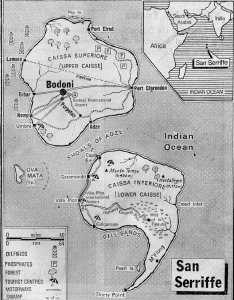
My absolute favorite item in the book has to do with a spoof published in The Guardian on April Fool’s Day in 1977, to mark the 10th anniversary of the Indian Ocean nationhood of San Serriffe. And no, it was not leaked by a twenty-something intelligence worker.

description
Some readers, we are told, tried to book holidays there

There is much information of other sorts as well in Just My Type. Garfield looks at research that says that our brains demand evenness in a font. He looks at the gold rush of printing that followed Gutenberg, at whether a font can be German or Jewish, and at tools for helping identify individual fonts, both books and software. And he offers some intel on how this or that locality selected the font to be used across their cities, for things like airport or street signage. In addition there are some bits on characters (the type type, not the human sort) most of us have never heard of. Doctor Seuss would be thrilled.


Letters from Seuss’s On Beyond Zebra

There are certainly many bad fonts out there. Garfield offers a list of the ten worst fonts in the world. With the explosive growth in the number of such creatures, I imagine this is a list that will be a challenge to maintain.

Ok, so this can be a fun book for us reader-sorts. But I confess it was not a total love fest for me. I found that the illustrations offered for many of the fonts were not sufficient, or even sometimes available. Also, as someone with a memory that is not nearly so well formed as the metal dies in question here, I found that much of the information seemed to slip past, in one eye and out the other. It was a lot to take in. So, that’s my mandatory gripe. If I could give the book four and a half stars I would, for the occasional glazing over I experienced. But there is such a wealth of interesting information that my kinder parts persuaded me to go ahead and submit a fiver.

One can only pray that the new fonts that continue to fill our world and our sensibilities will do at least as well, and hopefully even better than those that have come before. And it seems that we should take no chances with this, so I offer here the beginning of a celestial wish for visibility, clarity and readability

Helvetica, full of grace, the font is with thee…

you know, just in case.

Posted 6/14/13

8 Comments

Filed under Non-fiction, Reviews

Benediction by Kent Haruf

book cover

Kent Haruf takes his time. His first novel, The Ties That Bind, was published in 1984, winning a Whiting Foundation Award and a Hemingway Foundation/PEN citation. His second novel, Where You Once Belonged was published in 1990. Plainsong, which became a best-seller and was a National Book Award finalist, was published in 1999. It’s sequel, Eventide, was published in 2004. Nine years later we have Haruf’s fifth novel, Benediction. All his novels are set in the fictional town of Holt, Colorado, (a stand-in for Yuma where Haruf once lived) nearer to Kansas and Nebraska than to that suspect center of the scary urban, Denver. Benediction is not a sequel, but a stand-alone, although there are a few nods to characters from prior tales. All Haruf’s novels are top-notch, written at a very high plane of craft, observation and insight, and Benediction fits in very nicely with his existing, outstanding body of work.

description
Kent Haruf – Illustration by Jason Seller – image from the magazine 5280

Dad Lewis gets the bad news straight away, cancer, terminal. Get your affairs in order. Over the remaining few months of his life Dad (we never learn his proper first name) does just that. We visit with him as he tries to come to terms with his life, recalling how he came to be on his own as a teen, how he met the love of his life, how he treated those around him, his son, daughter, employees, neighbors. This being a Kent Haruf novel, it takes a village to tell a tale. Eight-year-old Alice has arrived next door, at her grandmother’s, her father long gone and her mother recently deceased. How the people of Holt cope with her presence will feel very familiar for return readers of Haruf’s work, but still both startling in some of the details and incredibly moving in its execution. Reverend Lyle, late of Denver, makes the crucial mistake of actually preaching the gospel, not what most of the parishioners want to hear. His wife and son wish he would keep such things to himself. Haruf was the son of a minister, and his depiction of the politics of town religious institutions has the ring of seen rather than revealed truth. There is an older mother-daughter pair who figure into the story, most particularly in a wonderful scene that is simultaneously baptismal and pagan, and a few more characters who matter beside. There are no saints here, no demons. (well, ok, a few very minor characters are purely awful) Forgiveness is a major element for many of the relationships here. It is tougher to create an image with fine lines than to paint with broad strokes. Haruf takes his time and makes his characters breathe.

All the lonely people. Where do they all come from? Holt apparently. There is enough quiet desperation in Holt that I was reminded at times of Edward Hopper’s Nighthawks. Love does not seem to last often enough, but there are some exceptions that keep hope alive. We are invited to look at relationships between parents and children, between present, past, potential and real lovers, and between people and the places in which they live. Communities definitely affect one’s options, for good and ill.

One might wonder how the author goes about constructing his novels. Fortunately he has told us

When I think of a story, I always begin with the characters. I daydream and brood and imagine that character for nearly a year and, of course, they all have to have problems, so I think about their problems. Then I begin to imagine and daydream about the people that would be in their lives, and their problems. It’s my biggest effort to figure out how to bring them together in a way that would move the story forward — not necessarily predictably but certainly inevitably.

The atmospherics of Holt figure significantly in how we are handled as readers. After Dad gets the news and returns home, the sun is down. An assault is accompanied by rain. A parent hitting a child is lit by The wind cried and whistled in the leafless trees. During a significant sermon, The sanctuary was hot. The windows were open but it was a hot day and hot inside. It gets hotter and you get the idea. The use of weather throughout is ever-present, but tempered, never intrusive, there to add a highlight, reinforce a mood, never to direct traffic. Characters relate a fair bit around food as well, feeding each other or not. The flatness of the terrain adds exposure. …on the plains, everything is visible, nothing is isolated. That appeals to me a great deal, these people being so visible, as if they’re seen in a spotlight. There is a scene that grabbed me, in which a character is walking the town at night and is stopped by the police:

Is there something wrong with you? What are you doing out here?
I’m just walking. Having a look around town.
Your family knows where you are?
They know I’m taking a walk.
It doesn’t bother you to look in other people’s houses? You think that’s all right.
I don’t think I’m doing any harm. I didn’t mean to.
Well, these people don’t like it. This man called you in.
What did he say?
That you were looking in his house.
Did he say what he was doing in his house?
Why would he say that?
People in their houses at night. These ordinary lives. Passing without their knowing. I’d hoped to recapture something.
The officer stared at him.
The precious ordinary.
I don’t know what you’re talking about, but you’d better keep moving.
I thought I’d see people being hurtful. Cruel. A man hitting his wife. But I haven’t seen that. Maybe all that’s behind the curtains. If you’re going to hit somebody maybe you pull the curtain first.
Not necessarily.
What I’ve seen is the sweet kindness of one person to another. Just time passing on a summer’s night. This ordinary life.

That passage seems to epitomize the writing and sensibility of Kent Haruf. His literary doppelganger, wandering through a town of people, seeing decency and finding meaning and joy in “this ordinary life.” It’s not hard to say something nice about Benediction. Haruf writes of real human concerns, real human problems, engagingly and effectively. You will come to care about someone in Haruf’s Holt, maybe more than one someone. Take your time with this one. Read it slowly. As we have come to expect, whenever Kent Haruf produces a new book, it is always a blessing.

======================================EXTRA STUFF
I found many interviews with the author, and have included links to a few here, in case you get the urge. The author quotes I used are from the first one listed.

Benediction was chosen as the #1 Indie Next List Pick for March 2013. Here is the interview from Bookselling This Week, a publication of the American Bookseller’s Association, by Elizabeth Knapp

From Telluride Inside and Out – interview by Mark Stephens

This Barnes and Noble profile was written by Christina Nunez

This interview is from November 2012, in Publishers Weekly on-line, by Claire Kirch

P.S. – I suspect that Kent Haruf has a secret first name, Clark.

Leave a comment

Filed under Literary Fiction, Reviews

Someone Else’s Love Story by Joshilyn Jackson

book coverI guarantee that when you reach the end of this novel the sound you hear will be coming from your own mouth, “Awwwwwwwwww.”

The last book I read and reviewed was David Vann’s magnificent Goat Mountain. Outstanding stuff, heavy with content, violent, dark. Someone Else’s Love Story, while not the opposite, is certainly worlds away. An antidote. Maybe chicken feathers for the soul.

The book opens with a poem by Emily Dickenson:

“Hope” is the thing with feathers—
That perches in the soul—
And sings the tune without the words—
And never stops—at all—

Keep it in mind. But back to beginnings. Consider the first actual paragraph

I fell in love with William Ashe at gunpoint, in a Circle K. It was on a Friday afternoon at the tail end of a Georgia summer so ungodly hot the air felt like it had been boiled red. We were both staring down the barrel of an ancient, creaky .32 that could kill us just as dead as a really nice gun could.

Hooked yet? I was. And glad of it.

description
Joshilyn Jackson

Shandi is 21, the mother of Natty, a precocious three-year-old. Her bff, Walcott, is helping her move to an apartment her father keeps in Atlanta. She is a familiar sort, a good-hearted everygal of a single mother, except stuck between her long-divorced and still contentious Jewish father (remarried with three more kids) and Christian, still-single, bitter mother. Stopping en route at a convenience store, her journey is interrupted when a gunman holds the place up, shooting a cop and taking those present hostage. Good thing there is a hulk of a guy there, football-player heft, and with brains to boot, a godlike hero who makes sure neither Shandi nor Natty come to harm.

Of course William Ashe has issues of his own, and maybe he has other reasons for risking taking a bullet than solely to protect a damsel and child in distress. Maybe he is choosing his own destiny, on the anniversary of a terrible event in his life.

Destiny does figure large in this story, and it is the consideration of this and other underlying concerns that gives the book greater heft than if it were a simple rom-com. Religion figures as well. It is no accident that Jackson, for example, uses “ungodly hot” in her opening paragraph. It could just as easily have been unbearably or unspeakably. There is a wide range of content here that relates to god. There is a virgin birth, no, really, a resurrection, miracles of one sort and another, sacrifice, concern with mythological beings like Norse gods and animated anthropomorphic creatures from Jewish legend. The book also looks at love, not just between the plus and minus poles of human magnetism, but between humans and god, between friends, between parents and children.

There are some things you will want to note as they pop up in the book. Birdhouses, birds and feathers flutter into view from time to time. I just bet they stand for something. Flowers and flower beds receive similar treatment, always raising Eden-ic possibilities. Ditto fireworks of one kind and another as an expression of love.

There is an investigation here of a back-story crime. It is handled with considerable nuance and maturity. Doubtless, there will be some who take offense at how this is treated. I thought it was excellently done. There is also a jaw-dropping (and wonderful) twist late in the book.

I was reminded very much of the feel of Silver Linings Playbook. Shandi, (can Jennifer Lawrence play her, pleeeeeease) William, and Walcott will win your heart. These are lovely characters, people worth caring about, facing difficult decisions and looking at core elements of life. Someone Else’s Love Story is about all sorts of love stories. It is about doing the right thing and struggling to figure out what that actually is. And it is lovingly and beautifully told. One right thing you can do is read this book. It may not be a religious experience for you, but I guarantee that it will be uplifting and leave your spirit feeling light as a feather. This is a lovely, charming book.

PS – I really hope they keep the cover art that is on the ARE I read. The image of birds, along with a few bursts of fireworks, is nothing short of perfect.

posted 5/17/13

1 Comment

Filed under Reviews, Romantic Comedy

Goat Mountain by David Vann

Goat Mountain is due out September 2013

Drama is a description of what is bad inside of us and the end point of that is hell, a description of a hellish landscape.

This is what David Vann had to say in an interview with GR pal Lou Pendergast. (A link to the full interview is in the LINKS section at the bottom of this review) It will come as no shock then that in his latest novel he presents us with a hellscape, and we see that some of the bad is not content to remain cooped up. In fact David Vann’s Goat Mountain is like Deliverance (without the sex) mated with The Golden Bough, as directed by Terence Malick.

Northern California. Rural. 1978. On several acres owned by their family for many years. A grandfather, father and eleven-year-old boy, accompanied by the father’s friend, Tom (his is the only name we learn), have come for an annual deer hunt. This is to be the boy’s first chance to kill a buck. They spot a poacher on a hill. Sight him through their scopes. Encouraged to look through the scope of dad’s rifle, the boy takes a careful sighting, then squeezes the trigger, instantly killing the unsuspecting man. What are the rules? Should the boy be turned in to the authorities? Should he himself be killed as an unfeeling abomination? Should the deed be covered up? Do they just walk away? Contending with this issue is the motive force in the story. But it is not the only thing going on here.

An idea is the worst thing that could happen to a writer, and as I’ve written these other books I’ve tried actually to not to know where I’m going. I think my ideas are very small and close the story off, instead I try to just focus on the landscape and the character with the problem and just find out what happens.

And yet some ideas manage to find their way in to this work. It is a good thing he eschewed this advice in favor of a bit of wisdom he received from a very accomplished writer.

I had a class with Grace Paley, and she said that every good story is at least two stories. And to me that’s the one unbreakable rule in writing – the only one. That if you just have an account of something, and it’s just an account – like in most people’s journals or blogs or whatever – it’s just sh*t. Like it will never work. I can’t think of a single good work ever that was just one thing – that was just an account of something. What we read for as readers is that second story – the subtext – and the interest of what story will come out from behind the other one. And so you can’t break that rule, as far as I can tell. I’ve never seen it done.

So what else is in here beyond the dramatic tension of a family trying to figure out what to do with their young murderer?

All of my books are about religion and our need for religion…I started as a religious studies major actually. One thing that links all of my works…is how philosophy can lead to brutality

Religion it is, but not just religion, human nature. Our narrator ponders whether killing is in our DNA.

We think of Cain as the one who killed his brother, but who else was around to kill? They were the first two born. Cain killed what was available. The story has nothing to do with brothers.

And later:

What we wanted was to run like this, to chase our prey. That was the point. What made us run was the joy and promise of killing.

The story is told mostly as an internal monologue by the boy, as both child and man. While we encounter him as an eleven year old boy, his story is related to us by the adult he will become. Positing a guess that the narrator is speaking from 2012, that makes the narrator 45 or so, just about the author’s age. And yes, Vann is familiar with hunting. I didn’t feel what I was supposed to feel. I killed my first deer when I was eleven and I started missing them after that.

Religion here considers the pre-historical

The first thing to distinguish man…there’s not much we can do that is older and more human than sitting at a fire. ..It’s only in fire or water that we can find a corollary to felt mystery, a face to who we might be. But fire is the core immediate. In fire we never feel alone. Fire is our first god.

In the atavistic is there relief from civilization? Vann offers a contemplation of human nature, through the eyes of a monster who feels more connection with ancient hunter-gatherers than he does with any living human.

I wish now I could have slept under hides. I wish now I could have gone all the way back, because if we can go far enough back, we cannot be held accountable.

Is the unfeeling boy really a monster, merely immature, or the core of what it is to be human?
David Vann and his father in Alaska
This image of Vann and his father was taken from The Guardian

The bible references here lean toward the Old Testament, and they are abundant. For those who, like me, enjoy trawling for literary references it might be wise to heed Chief Brody’s advice to Quint, “you’re gonna need a bigger boat.” Cain comes in for frequent mention. I noted his name nine times, but there may be more. There is a host of further biblical references, including one in which the boy endures his own Calvary-like hike. Edenic references abound. When we read I slithered my way up that steep canyon, my belly in the dirt, and I refused to be left behind, we might be reminded of Genesis 3:14:

Cursed are you above all livestock
and all wild animals!
You will crawl on your belly
and you will eat dust
all the days of your life.

There is a look at Jesus as being guilty of muddying the lines between life and death, the Ten Commandments as being directed against inherent human instinct, and the Eucharist as a way of remaining connected with our bestial nature. Consideration is given to the existence of the devil, and whether we need for there to be some dark agent in charge, anything in charge, because the existential chaos of being is beyond our ability to cope. What are the rules? Who made them and why? And what happens, what should happen, when we break them? There are also parts that reminded me of Dante’s Inferno, as the boy consumes some particularly sulphurous water early on and the group has to pass through a daunting metal gate to enter the place in which the story takes place, among other clues.

This is a book that reaches a grasping claw into your stomach and shakes your guts around before yanking them out. Definitely not a book for those who are uncomfortable with the dark, the violent or the sad. But even with all the brimstone challenging your nostrils, you cannot help but detect the aroma of power and substance in Vann’s harsh new novel. Once you calm down from the brutality of the story you will long consider the subjects it raises.

========================================INTERVIEW


David Vann very graciously took some time during a whirlwind book tour to answer some questions about Goat Mountain

W – There is a lot in Goat Mountain about the primitive, atavistic drives in human nature. When the boy thinks “Some part in me just wanted to kill, constantly and without end” was he expressing some primitive element within the human character, his personal pathology or something else?

I think it’s both. The book shows a descent that one particular mind takes (as in my novel Dirt, also, and my nonfiction book about a school shooting, Last Day On Earth) but I’m also trying to find shadows of something human and not just peculiar to an individual.

W – How much of what the boy considers, particularly as it relates to a compulsion to kill, reflects your view of human nature (Do you think we are killers by nature?) or was the boy making excuses for his aberrant urges?

I honestly can’t answer any of the big questions about human nature or even individuals. I wrote about my father’s suicide for ten years and yet his final moment still remains mysterious to me. With the school shooter, also, I could put together a narrative that made his final act possible but not inevitable. At the last moment, he and my father could have chosen differently. So I don’t think we’re determined. I think we can kill or not kill, and that many factors push us toward or away. In my fiction, everything is limited to a character’s view always, but I also have basically had or can imagine having all the thoughts and feelings of all my characters, in that they feel possible and believable to me.

W – In an interview you said your books are about “how philosophy can lead to brutality.” But the boy in Goat Mountain appears to have the brutality in him inherently. Can it be that brutality leads to philosophy?

That quote was specifically about Dirt, about the dangers of the New Age movement. But it’s an interesting question, whether brutality is so abhorrent it always has to be covered in philosophy in order for the perpetrators to be able to go on telling the story of themselves. You’re right that the narrator thinks he had an inherent brutality as a boy, or perhaps it was the culture he grew up in (he says children will find whatever they’re born into natural). He’s disturbed by the fact that he didn’t feel bad after first killing, but then this changes with the buck and after that he no longer wants to kill, and he becomes fully human when he kills without wanting to. That’s what I find really disturbing about human killing, when it’s divorced from instinct and becomes abstract and we kill for philosophy or religion or politics or calculated risk.

W – There are several references to a time before god. For example “grandfather did not come from god. I’m sure of that. He came from something older” and “The darkness a great muscle tightening, filled with blood, a living thing already before god came to do his work” and “The act of killing might even be the act that creates god.” The contemporary view of the Hebrew and Christian god is that there was no existence prior. If the boy believes in god how could he believe that there was a time before god?

There has to have been a time before god, because we made him, and it was quite a while before we came up with the idea of making gods. And antimatter is interesting as a concept, because it makes possible the existence of something before anything, the existence of what pulls existence into being. That’s what the grandfather in the book becomes, the thing that makes matter possible. That’s the closest I can imagine to god. Putting a face on god is as stupid as imagining aliens with a head and two arms and two legs. Our images of god are all simplistic like that, too dumb to be able to believe now. I began as a religious studies major and moved on to fiction, which investigates mystery more honestly.

W – Did you have Dante’s Inferno in mind while writing Goat Mountain? If so, were the obstructions the four face getting into their land an echo of the challenges Dante and Virgil face entering the Inferno?

D – I have always wanted to write an inferno, since it’s the natural goal or end of tragedy, as you’ve quoted from me before, and I like Dante’s depiction and also the Venerable Bede’s and Blake’s and McCarthy’s, and there are always obstructions to entering and time it takes to recognize. The inferno is an externalization of a felt landscape within, the shape of our human badness, and the characters have to be put under pressure for a while before they can start to see a mirroring in the landscape. So the book becomes increasingly hellish, as Dirt did. It’s really only in the final section of the novel, when they reach the burn (an area that had had a fire recently), that the architecture of their hell is more fully realized. So they don’t enter gates really but are steadily building.

W – If Goat Mountain completes a holy trinity for you, will you be continuing with religion as a major focus in your next book? What is your next project?

My next novel, which is finished, is titled Bright Air Black and is the story of Medea, set 3,250 years ago, trying to stay close to the archaeological record. It attempts to be a realistic and sympathetic portrayal of her as a destroyer of kings who wants a world not ruled by men. I’ve been wanting to write something about her for 25 years, and I’m fascinated by the time period because it’s the time the Greeks imagine as the beginning and therefore can be considered the beginning of western culture and literature, but it’s actually the end of an older world, the fall of the bronze age and Hittite empire and decline of the Egyptians. Medea worships Hecate and also Nute, an Egyptian goddess, so there’s a continuity with focus on gods and landscape. But Goat Mountain is the end of my books that have family stories and places in the background.

W – Are there any plans afoot for films to be made of any of your books?

I’ve co-written the screenplay for Caribou Island with two-time academy award-winning director Bill Guttentag, and we’re trying now to raise funding for the film. And the French producers Haut Et Court (producers of Coco Avant Chanel and The Class) and French-Canadian director Daniel Grau will be making a film from Sukkwan Island, the novella in Legend of a Suicide.

W – You said in an interview with the Australian Writers Centre:
…what I teach my students is how to read, how to be better readers, and the importance of studying language and literature. And, I use a linguistics approach for talking about style, very specifically talking about what individual sentences do, writing a grammar for a text.
Have you ever considered putting your teaching ideas into a book?

I have thought about that, because I can’t find a textbook that does what I’d want it to do, but I’m focused for now on writing novels.

W – What books have you read in the last year that you would recommend?

I’ve been reading a lot of books, about a book per week, and my favorite this year was John L’Heureux’s new novel The Medici Boy. A great portrait of an artist, an historical thriller, and a depiction of the persecution of gay men in 15th century Florence, it’s a rich masterpiece that I recommend to everyone.

W – What do you do for fun?

Right now I’m on a six-week residency in Amsterdam with the Dutch Lit Foundation, and my wife and I are going to music and museums and restaurants and walking all around the city. Amsterdam is wonderful. We live half the year in New Zealand, where I do watersports almost every day (waterskiing, wakeboarding, sailing, windsurfing, kayaking) or mountain-biking or hiking. And we sail on the Turkish coast each summer. I also play congas and a bit of guitar and I like tequilas and rums.

Thanks, David, for your time and fascinating insights.
Scheduled release date is September 10, 2013

==================================LINKS

Vann’s earlier novel, Caribou Island was my favorite book of 2011. And his 2008 Legend of a Suicide is compelling reading as well.

Lou Pendergrast’s interview with DV
(Source for “All my books are about religion” quote)

The author’s website – among other things there is a large list of interviews

And his GR page

The Family History Is Grim, but He’s Plotted a New Course – NY Times article on Vann from 2011
(Source for “an idea is the worst thing… quote)

University of Gloucestershire Creative Writing Blog interview with DV from October 10, 2011
(Source for Vann’s mention of Grace Paley)

The White Review with Melissa Cox (online only)
(Source of the “I didn’t feel what I was supposed to feel” quote)

Leave a comment

Filed under Interviews, Literary Fiction, Reviews

Frozen in Time by Mitchell Zuckoff

book coverWinter is coming.

Mitchell Zuckoff seems to be making a habit of looking into the travails of crash victims. His prior book, Lost in Shangri-la , followed three survivors of a WW II era plane crash in New Guinea. They faced the usual sorts of dangers, a step back to the Paleolithic, and a diverse assortment of possible ways to die; cannibals, elements of an enemy army, all sorts of predatory and/or poisonous critters, microscopic invaders that could ruin your day, and help see that it is your last. The whole world was watching and cheering for their safe return.

Reversing his orientation a bit this time Zuckoff, in his latest WW II opus, Frozen in Time, has substituted brutal cold, and a particularly unwelcoming landscape for those other hazards. I’ll take the cannibals every time. (with a nice Chianti) In this instance, the whole world was unaware of the events until well after they had come to a conclusion. Upping his game, Zuckoff deals not with a single crash, but with several, in a cascade.

description
Mitchell Zuckoff – image from the author’s site

I suggest that if you have a choice between death by the fire of a predatory jungle or the ice of an arctic wasteland, you would do well to choose the former. You’d have a better chance of making it. At least you would not have to worry so much that the ground on which you were standing might open up and swallow you whole, that you might lose body parts to the relentless cold of Arctic winter, that you might lose your mind waiting to be brought home, while blizzard-driven snow seeps into your shelter. And of course there is always the danger of becoming a GI-sicle for a prowling polar bear. There are survivors of this experience who lived through 148 days worth of cold days in hell.

Douglas : C-53 : Skytrooper

There is a saying that bad things come in threes. It might have been nice if that had been the case in Greenland, in 1942. Greenland seems to have the same effect on powered vehicles as the Bermuda Triangle. There were at least a dozen crashes there in 1942. The trouble under scrutiny here began on November 5, when a military cargo plane, a C-53 Skytrooper, [above] the equivalent of a civilian DC-3 airliner, was returning to its base from Reykjavik after a “milk run” delivery of war materials. It was carrying a crew of five.

Shortly after the plane reached the southeast cost of Greenland, a location that defined the edge of nowhere, disaster struck: …the Skytrooper went down on the ice cap. By some accounts, the crash occurred when one of the plane’s two engines failed, but other reports were silent on why the C-53 experienced what the military called a “forced landing.” The official crash report declared the cause “unknown and no reason given in radio contacts.” A handwritten notation added, “100 percent undetermined.”

The air over Greenland was a busy locale in those days, with dozens of flights transporting men and materials to the war every day, then returning home to do it again. But Greenland is the largest non-continental island on Planet Earth so, even with a lot of planes searching, locating a downed aircraft was no simple task. Here are some comparisons:

California – 163,696 sq miles
Texas – 268,820 sq miles
Alaska – 663,696 sq miles
Greenland – 836,302 sq miles

In other words, big frackin’ haystack.

On November 9 a B17F, a “Flying Fortress” redirected from its mission in Germany to participate in the search, ran into trouble

When they reached the end of Koge Bay fjord, [the crew] saw that everything outside was the same frightening shade of whitish gray. They couldn’t tell where the sky ended and the ice cap began…When the true horizon disappears in the Arctic haze, a pilot might as well be blind. Pilots fortunate enough to survive the phenomenon describe the experience as “flying in milk.”

It did not end well, and nine more servicemen were unwillingly grounded.


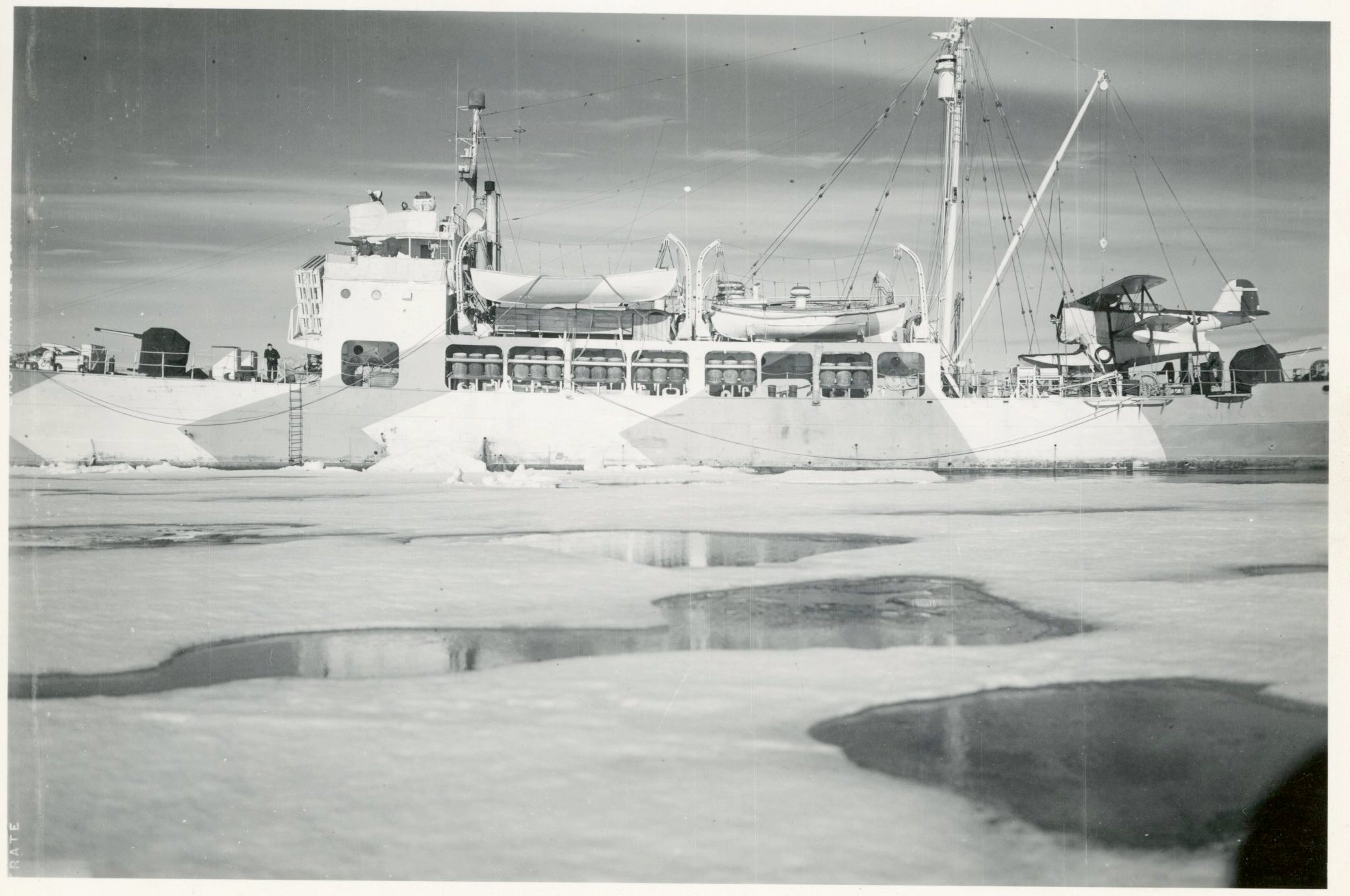
On November 29th, desperate to evacuate members of crews what had been stranded in an arctic wasteland for weeks, a pontooned Grumman seaplane know as a Duck, assigned to the Coast Guard ship Northland was making a second daring run, having already rescued some survivors.
It went back for more. But a storm blew in before the Duck could make it back to its base. The pilot was flying blind. The plane crashed into the ice. This is an image of the very plane, taking off. Not a lucky ducky.

image shows on my blog, see bottom

There is more, but these are the big three bits of awfulness of this tale.

Frozen in Time tells the stories of how the crash survivors fared, how the rescue operations were planned and how those worked out, or didn’t. These stories are both fascinating and chilling. There are many examples told of MacGyver-like creativity on the ground among the crash-ees, among the rescue teams and, decades later, in an expedition looking to bring ’em home. This last is a parallel tale that is given much less than half the book. Not all the men and not all the planes made it back in 1942. The author becomes involved with people who are looking to find and repatriate the remains of the crash victims who did not survive. There are a lot of personalities in play here and a fair bit of politicking. It is not as interesting as the core survival tale, but it is informative. A recovery mission does indeed take place, in 2012, and the author is a full participant in that.

It’s tough enough finding a 60+ year old wreck that stands still, (not counting myself) but in Greenland the ice sheet is a very large moving target. Drop a flag on point A and when you return it could be at Points E, Q or X. And then there is the accumulation of more than half a century’s worth of compacted snow.

Imagine searching for a diamond chip buried deep beneath a frozen football field; your best tool is a straw what makes tiny holes into the ground, through which you peer down to see what’s below; if your holes miss by even a little, you’ll miss it; and you have a brief window to explore ten potential locations before being kicked off the field.

The story of the attempt at recovering remains is certainly interesting. It is no surprise that there are sundry parties at Department of Defense meetings who offer a chilly reception to the contractor who was looking to undertake the mission. We get to be a fly on the wall for a few of these.

But the meat of the story is the tales of survival, how these men (all the crash-ees were men) contended with such a hostile environment, what they did to create livable living spaces, how they coped with hunger, as well as cold, and fear. Some fared better than others. It is a bit frightening to learn that a plane landing on a glacier is in danger of getting frozen to it, like a warm tongue to a frozen pipe. There are uplifting items as well in this dark tale. You will learn about the “Short Snorters Club,” if you are not already a member, and the purpose of a Snublebus. You will also expand your vocabulary a tad with some arctic terms.

You will learn as well, about the dedication of the military to bringing home every reachable service member, and about some of the after-effects of the stranding experience on those who made it out.

Spencer’s family knew him as warm and funny, and they’d remember him as a man who bought toilet paper in bulk long before warehouse stores. When his younger daughter Carol Sue asked why, Spencer explained: “I have been without toilet paper,” he told her, “and I am never going to be without toilet paper again.”

Not Scarlett O’Hara perhaps, but a telling indication of the permanence of the crash experience on the survivors. Many found themselves with increased susceptibility to cold. Not everyone had the luxury of such discomfort. One poor bastard survived a crash in the B-17 only to succumb to another as he was being flown away from the bomber in a rescue plane.

There are several crews to keep track of and I think it would have been useful for there to have been a section listing them by vehicle, rather than, or in addition to the straight alphabetic list provided in an appendix. That said, the volume I read was an ARE so there may be a difference or two between what I saw and what is in the final hardcover edition. Just in case it is not provided there,here is the crew list by craft.

C-53
Captain Homer McDowell, Jr
Lieutenant William Springer – co-pilot
Staff Sergeant Eugene Manahan
Corporal William Everett
Private Thurman Johannessen

A brand new B17F – radio sign PN9E
Pilot – Lt. Armand Monteverde
Co-pilot – Lt. Harry Spencer
Navigator – Lt William “Bill” O’Hara
Engineer – Private Paul Spina
Asst Engineer – Private Alexander “Al” Tucciarone
Radio Operator – Corporal Loren “Lolly” Howorth
Mechanic – Private Clarence Wedel 35,
Tech Sergeant Alfred “Clint” Best and
Staff Sergeant Lloyd Woody Puryear

The Grumman J2F-4, aka the Duck
John Pritchard
Benjamin Bottoms
Corporal Loren “Lolly” Howorth

You are on your own keeping track of other planes, ships and ground-based rescue teams that come into play in this story.

If you liked Lost in Shangri-La, it is a good bet you will find it worth the effort to search for a copy of Frozen in Time and bring it home. Read it in a warm place.

========================================EXTRA STUFF

The author’s web page

The author’s FB page for this book

Harper Collins promo video

Video of the downhole camera. (2012) Uncomfortably similar to a medical scoping

A Coast Guard page on an earlier attempt to locate the Duck

North South Polar – Lou’s site

List of crashes – 1942-44

Leave a comment

Filed under Non-fiction, Reviews, Science and Nature

Among the Cannibals by Paul Raffaele

book cover
What could be worse than a dog eat dog world? Oh.

I was of two very different minds about this book.

Australian Paul Raffaele is a feature writer for Smithsonian. He has covered many parts of the globe in his work for that venerable institution. And he travels far for this work, looking into that darkest of human activities. He investigates special meat-eaters in New Guinea, India, Tonga, ancient Mexico, and Africa. We have a certain image in mind of what cannibals might look like. I mean in the real world, not the dark imagination of Thomas Harris or the psychosis of some of our more aberrant criminals. They would probably live on Pacific Islands, or remotest Africa or South America, use primitive technology and have acquired a taste for missionary over easy. Mostly, but not entirely the case.

Cannibalism of one kind or another had been common around our globe through the millennia, and yet the classic Western image of cannibals is a terrified white Christian missionary in pith helmet crouching in a large outdoor cooking pot, the logs burning fiercely as wild-eyed African warriors in grass skirts dance about him shaking their spears. Their glinting eyes show their eagerness to tuck into their human meal. In truth there is not one record of a missionary ending up in an African cook pot. The cannibals invariably ate one another.

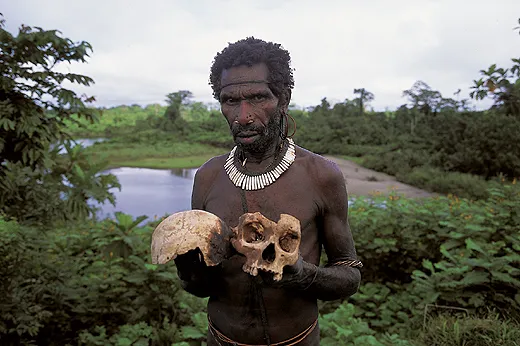
The book offers interesting, surprising, and very disturbing information about a practice most of us (certainly me) thought had vanished from human behavior. The reasons for chowing down on such forbidden fruit vary. High on the list is to degrade and strike fear into one’s enemies. Another is to honor close relations. Some even consider eating human flesh a form of religiousity. The Korowai people of New Guinea justify their practices by maintaining that victims had already been killed by evil spirits and it was only the evil spirits that had taken over the body that was being devoured.

description
Kilikili says he has killed no fewer than 30 khakhua (male witches) – from Smithsonian.com

The practice is supposedly a thing of the past in New Guinea, but I would not like to place too high a wager on that. Raffaele’s looks at the practice in Tonga and Aztec Mexico are more firmly planted in the past. Unfortunately, there are still people-eaters today. There is a Hindu sect in India, the Aghoris, whose holy men chow down on you-know-what “as the supreme demonstration of their sanctity.” They even sit atop rotting corpses as a show of devotion and Raffaele reports some particularly unspeakable acts in which they engage, that I will not report on here.

description
An image of this cheerful Aghori is sure to help you sleep at night – image from Dharma Keng

And no, wiseass, it is not a self-portrait. I cannot really fold my legs like that for any length of time, and I keep my hair and beard much shorter these days. But there is worse to come. His report on the activities of the Lord’s Resistance Army of northern Uganda takes the eating of human flesh to whole new level of depravity, a true heart of darkness. This information is the stuff of nightmares. Very disturbing.

I have a major gripe with the book. The cover is sprightly. It shows a hand reaching up out of a large cooking pot writing the book title. Lower down on the page is an icon that repeats inside as a section divider, a skull and crossbones in which the crossbones have been replaced with a knife and fork. One might get the impression that the information contained within would fulfill the silly graphics. We know that even such darkness can produce smiles. Sondheim’s Sweeney Todd (the stage version, not the very disappointing film), for example, is probably the only Broadway musical to have cannibalism as a central focus. Devouring scenery does not count. And while my personal favorite all-time Broadway show was rather dark, it still maintained a significant level of humor.

Todd: What is that?
Lovett: It’s Priest. Have a little priest.
Todd: Is it really good?
Lovett: Sir, It’s too good, at least.
And of course it don’t commit sins of the flesh
So it’s pretty fresh
Todd: Awful lot of fat
Lovett: Only where it sat
Todd: Haven’t you got poet or something like that?
Lovett: No, you see the trouble with poet is how do you know it’s deceased? Stick to priest.

And so on…

The light touch promised by the cover art for this book does not deliver as promised. There is nothing at all amusing about children living today who are forced to eat human flesh under pain of death. In that way the book offers a bait and switch, promising a light touch, but delivering a deep gouge.

I also found the author at times personally off-putting. While in Tonga, he felt it necessary to comment on his translator’s physical attributes in a way that came across as salacious.

Waiting outside and holding aloft my name printed in marker pen on a pad is a round-faced, bright-eyed girl who looks to be in her early twenties. She is clad in a Congo-style ankle-nudging cotton dress that fits tightly about her neatly rounded thighs, and a short-sleeved top printed with a spray of red orchids that clings to her firm high breasts. She has woven her hair in to strands festooned with colored beads. Unlike most of the women at the airport who are laden with fat and boasting the enormous bottoms that most African men are said to lust for, she is sleek and silky.

Either his editor was not doing a good job, or the author exercised an ill-advised veto.

Raffaele does not come across as a particularly deep thinker and this is not a scholarly investigation of a very dark side of humanity. There is only passing mention of the Catholic sacrament of Communion, in which practicing Catholics consume the body and blood of Christ. There is even less on the sundry cannibalistic psychopaths who have come to public notice. Are there any studies indicating when and where it might have begun? Raffaele does note that it existed in prehistory. Records go back at least as far as Herodotus (well before Soylent Green) of such culinary preferences, and it lasted into the 19th century, at least. How about a comparison with other species? How widespread is the practice in the animal kingdom. Are we really different from what we consider lower orders? For a more analytical look at the subject you might consider Carole Travis-Henikoff’s book, Dinner With a Cannibal: The Complete History of Mankind’s Oldest Tabboo. An NPR interview offers a taste of what she has to offer.

Among the Cannibals definitely offers new and intriguing information. Be forewarned that you will need a strong stomach to get through it all. But, because it was so much not what was expected, it left me with a bad taste in my mouth.

=======================================EXTRA STUFF

To remove the taste, you might consider taking in a bit more of Sweeney. Another gem from the vaults is a song by Sheb Wooley that was actually a #1 hit when I was a tyke.

If you get an invitation to the Donner Party, I would pass.

And of course, every abomination must have an advocate, so you might want to see the modest proposal the folks at Zebra Punch offer, while humming their particular version of Barbara Streisand’s classic tune, about why we should
eat people.

There is an interesting item on cannibalism in Wikipedia

Raffaele’s article for Smithsonian Magazine, Sleeping with Cannibals, was the basis for the book

Leave a comment

Filed under Non-fiction, Religion, Reviews, Science and Nature

The Child Thief by Brom

book cover

Like so many before me, I am fascinated by the tale of Peter Pan, the romantic idea of an endless childhood amongst the magical playground of Neverland. But, like so many, my mind’s image of Peter Pan had always been that of an endearing, puckish prankster, the undue influence of too many Disney films and peanut-butter commercials.
That is, until I read the original Peter Pan, not the watered-down version you’ll find in the children’s bookshops these days, but James Barrie’s original and politically uncorrected version, and then I began to see the dark undertones and to appreciate just what a wonderfully bloodthirsty, dangerous, and at times cruel character Peter Pan truly is.
– from the author’s site

This is not your father’s Peter Pan. Brom found some rather un-Disney-like mayhem tucked into this supposedly children’s novel. In The Child Thief he explores those darker regions. Mixing a stew of old-world mythologies, which he very nicely sources for us at the end of the book, Brom has created a very dark view of a childhood lost. What manner of creature is Peter? How did he become the way he is, violent, sociopathic, with some serious mother issues, yet supremely charismatic, deft, and fun? A history is offered.

description
Peter – from the author’s site

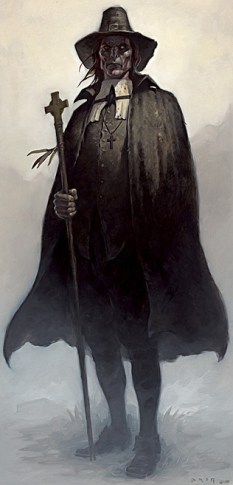
One thing making the book a fun read is that it is a sort of Where’s Waldo of literary and mythological references. One battle might have been taken from C.S. Lewis, replete with diverse species joining forces. Our Virgil into this inferno is Nick, a Brooklyn kid beset by drug dealers who have taken over his single-mother’s home. Peter, on an ongoing mission to recruit fresh blood for this tale’s version of Lost Boys (and Girls), The Devils, is ever on the lookout for kids with nowhere else to turn. He saves Nick from deadly peril and leads him through the Mist to Avalon, a decaying former paradise, resonant with the many such darkening worlds in children’s literature. A Wrinkle in Time pops to mind, The NeverEnding Story. The darkness here touches some contemporary issues, as the nasty flesh-eaters, degraded Puritans who were trapped in the Mist of Avalon centuries ago, have been dredging up oil from beneath the surface and using it to burn supposedly inflammable, sentient trees in an attempt to push back the magic folk and gain control of the place for their own, and in so doing obliterating the magic to be found in nature, as embodied by Peter and The Lady. Their evil leader is familiar, the completely irrational, sadistic Torquemada type.

descriptiondescription
The Captain and The Reverend – from the author’s site

Characters are not all so simplistic as the evil preacher. A Captain of the flesh-eaters (the local magic folk are decidedly vegetarian) turns out to be more than he appears. Nick struggles with his attraction to Avalon and the uber-mother, Lady of the Mist, while struggling to come to terms with his actions back in the real world.

description

There is considerable violence in this story, a body count that would be right at home in any contemporary video game (and yes, there is frequent mention of gameboys) and a chilling numbness on the part of most of the characters to the carnage. Arms, legs, and heads are chopped with enough frequency to carpet what remains of Avalon. It is a very male story, sort of a 300 for the pre-and-early-adolescent set. Far too much rah-rah-let’s-go-kill-some-flesh-eaters sort of speechifying. Can we zip up now and move along with the story?

There is a climactic big battle that I found a bit too much, even for this. But that is a quibble. Brom has wrought an interesting look at a classic character who has not seen much treatment of this sort before. Root questions are asked, and possible answers offered.

In addition, Brom has created beautiful black-and-white illustrations for the beginning of each chapter, and a set of full color paintings for the principal characters.

Review Posted 9/5/2009
Expanded and Re-posted – 6/5/15

=============================EXTRA STUFF

Links to the author’s personal, Twitter and FB pages


1 Comment

Filed under Fantasy