

It seems I’m involved in a conspiracy that spans space and time and a conflict whose outcome will determine humanity’s fate in two separate universes.
Oh, is that all? Flight 305 from New York to London runs into a little space-time turbulence and finds itself, or a piece of itself, anyway, in an English lake. Help should be along shortly, right…um, right? The passenger list included five people of interest. Venture capitalist and take charge sort Nick Stone has done nicely in tech and is en route to meet with some folks who are looking for him to invest in their projects. Harper Lane is a ghost-writer of biographies. She is facing a knotty question about her career direction, to take on the bio of a very high profile businessman and philanthropist or attend to her heart’s true writing passion, an original adventure series. Can’t do both. Theirs are the alternating viewpoints we have throughout Departure. The other three are Grayson Shaw, son of a billionaire, who seems determined to make everyone loath him with his persistently boorish behavior. How he got that way, as the King of Siam might say, is a puzzlement. Sabrina Schroder is a German genetics researcher, a doctor with a less than warm and fuzzy crypt-side manner, and Yul Tan (or you won’t) is that mysterious Asian guy who not only kept banging away at his laptop through the abbreviated flight, but who is at it still. What’s up with that? There are plenty of LOST-type goings-on in the opening, but we soon get an inkling of the predicament that underlies everything and that is when the story gets going for real. And who are those guys in the latest Haz-mat couture being dropped off by airships and why are they pointing weapons at us?
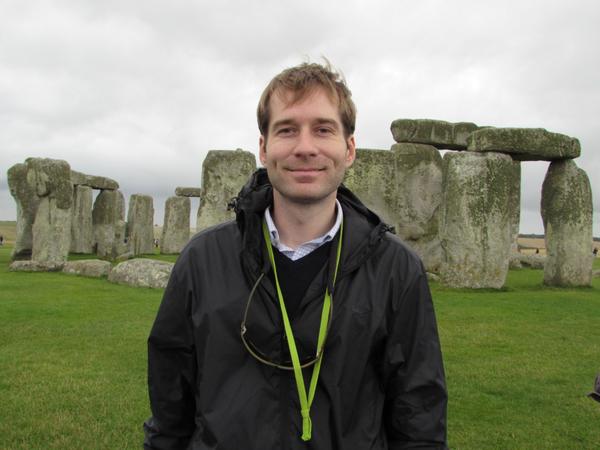
A.G. Riddle – from PBS
A.G. Riddle is one of those rarest of the rare, a very successful self-publisher. His trilogy, The Origin Mystery has, according to his site, sold over a million copies and has been optioned for film. Riddle used to be involved with starting internet companies. Not sure what that means, but he was able to quit his day job and devote himself full-time to writing, so I guess it worked out well for him. It is not hard to see Nick as a magnified version of the author. Departure was, likewise, a self-pub. It came out on January 1, 2014 and did well enough that a major publisher made an offer.
Departure is a turbo-charged maze of sci-fi action adventure tale that will keep you flipping the pages, wanting to find out what happens next. There is plenty of high tech, some of which seemed a bit gratuitous. And there is even some substance, with a focus is on the importance of decisions.
I wonder what the world would be like if we could all glimpse our future before every major decision. Maybe that’s what stories are for: so we can learn from people living similar lives, with similar troubles.
Yeah, sounds a bit teenaged to me too, and this is not the only example of such fourth-wall breakage about writing. But it is fleeting. The book is actually very much about decisions, turning points in which the future is determined. Harper may be looking at a tough career choice, but it has implications that might affect the future of the human race. A butterfly effect of Mothra-like dimensions, but without the adorable twins.
There are a few mysteries to be sorted out, for the first half of the book anyway. What was Yul Tan so into on his computer? And if it’s a game where can I get it? Where can Grayson find more alcohol? When will Nick and Harper get a room? Can the future of humanity be saved? And can you please explain quantum entanglement?
Yes, there is eye-rolling over-simplification, and character names that sometimes sound like they came from pulp novels of a bygone age. There are some absurdly large, Akashi Kaikyō Bridge level, (or for us Yanks, Verrazano-Narrows Bridge level) suspensions of disbelief that one must endure in reading this book. I will not specify them here, but am putting them in a red portion of the EXTRA STUFF section.So if you don’t want to know, skip the red stuff. Your eyes will roll, and if they don’t, they really, really should. Skip on by those and try not to let them interfere with the story. These items have nothing to do with time travel, but more with land use and international politics. But there are always complexities and minds to be bent when it comes to explaining movement and communication across timelines. Riddle offers a particularly nifty take on the communication piece. Kudos for that.
It is no stumper figuring out what AG Riddle is up to, keeping you strapped into your seats, breathlessly turning pages. Departure may take leave of its rational senses a fair bit, (not unlike Dan Brown offerings) but, nonetheless, it is a fast-paced, engaging sci-fi thriller that will impair your ability to make your travel connections. And if it prompts you to think a tiny bit more about the decisions you make in your life all the better. Having secured booking with a major publisher, and a film option to boot, Departure is about to take off and I expect you will enjoy the ride.
Published – January 1, 2014 (self) – October 20, 2015 (Harper)
Review Posted – September 11, 2015
======================================EXTRA STUFF
Links to the author’s personal, Twitter, Tumblr and FB pages
Pods. Although the sort of system Riddle posits is akin to the pneumatic tube notion being supported by Elon Musk , among others, the look Riddle described for the vehicles seemed to me more like that from this article from AllPics4U.com

I did wonder up above about Quantum Entanglement – Here are a couple of pieces that try to explain this very real form of weirdness
—–Wiki
—–ScienceDaily.com
—–Livescience.comt
Spoilerish eye-rollers. I am not entirely certain that the items noted here qualify as actual spoilers, but why take the chance?
The Podway first united Europe then Asia and finally the rest of the world, enabling safe, convenient, cost-effective mass transit.
Piece of cake, right? The transportation system that is projected to take over mass transit may or may not be a wonderful thing, but little attention is given to how insanely challenging it is to get rights of way, then to build the infrastructure, and what of the existing mass transit? Did it cease to exist? If it didn’t, then what happened to the real estate it occupied? And for there to be an underground tube connection to some building in the burbs or boonies? Really? And there is a bigger eye-roller. The core organization here has put forth a plan to erect a dam across the Gibraltar straits. That is probably do-able. What is not do-able is for every country with a border on the Mediterranean to go along with a project that will wipe out a vast swath of coastal sea for those nations, creating a new nation in the middle of the former body of water. Really? Not only will Mediterranean nations ok the loss of a fishing industry, they will be ok with the creation of another country on their sort-of borders? And what about nations with military ships? Are their navies to be use to decorate the dam? Are you insane? We are in wishing-will-make-it-so land. And not even a wizard, even if he’s a whiz of a wiz, could persuade me that this is doable on a planet still occupied by a large number of humans, hell, by any number of humans. It is possible to look past these bits of silliness, but it is not easy.



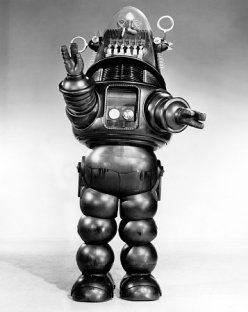


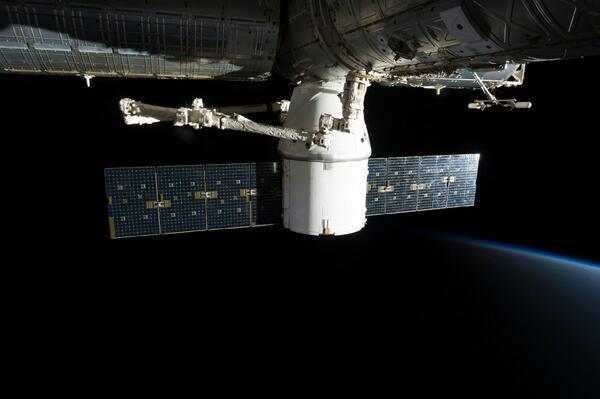
 Elon Musk is not exactly a name that rolls easily off the tongue, like say Tony Stark, the fictional person to whom he is most often compared, or even Steve Jobs, a real-world visionary, whose mantle Musk now wears. There is no question that Musk is a special individual, someone with BIG dreams and the drive, talent, and money to make them happen. But, like Jobs, and Stark for that matter, he might be an acquired taste on a personal level. In Elon Musk: Tesla, SpaceX, and the Quest for a Fantastic Future biographer Ashlee Vance gives us a picture of both the dreams and the man, peering back to where Musk began, describing his journey from then to now, looking at how he is impacting the world today, and gazing ahead to where he wants to go. It is a pretty impressive vista. Here is what it says on the SpaceX website
 Ashlee Vance – from HarperCollinscaption]Vance take us from his adolescence as a computer geek, bullied at school, through his arrival in Canada, cold-calling to get work, putting together his first dot.com startup, and using the money from that to invest in a banking-oriented company that would become PayPal. It was the mega-bucks from the sale of PayPal that would allow him to begin realizing his big dreams. In 2003, Musk bought into Tesla, then a struggling startup. The company took the early knowledge that lithium ion batteries had gotten pretty good, added some top level engineering, design and programming talent, and, after plenty of mis-steps and struggles, brought the remarkable all-electric Tesla Roadster to the market in 2008. Tesla followed this with the Model S in 2012. Not only did Consumer reports call this a great car, it named both the 2014 and 2015 versions the best overall cars of their years, and the best care they ever tested. The last time an auto startup succeeded in the USA was Chrysler, in the 1920s. But this is not about simply making a buck on a new car. The long term goal is to shift our petrochemical auto industry to renewable power, and the Tesla is a nifty start. Not only is the car amazing, the company has constructed a nationwide series of charging stations where Tesla owners can recharge their vehicles…for free. There are currently 499 such stations, with many more planned. Tesla is involved in building battery production factories, hoping to help support a growing electric-car auto-economy.


 There are so many elements to Some Luck, long-listed for the 2014 National Book Award, that wherever your interests may lie, there is much here from which to choose. Take your pick—a Pulitzer-winning author going for a triple in the late innings, finishing up her goal of writing novels in all forms. Take your pick—a look at 34 years of a planned hundred year scan of the USA through the eyes of a Midwest family, winning, engaging characters, seen from birth to whatever, good, bad and pffft, where’d that one go? Take your pick—a look at the changes in farming, over the decades, the impact of events like the Depression and massive drought on people you care about. Take your pick—the impact of the end of World War I on the breadbasket, a sniper’s eye view of World War II, the chilly beginning of the Cold War. Take your pick– the searing summer heat that killed many, the biting snow-bound winter that stole the heat from every extremity. Take your pick– an infant’s eye view of learning to speak, a teenager’s look at awakening sexuality, an older man looking back on his life. Take your pick—the newness and revolution of cars, tractors, hybrid plants, new fertilizer, the tales brought from the old country, often told in foreign tongues. Take your pick—a bad boy with talent, brains and looks, a steadfast young man taking the old ways of farming and mixing them with the new to make a life and a future, a smart young woman heading to the big city and getting involved with very un-farm-like political interests. Take your pick—shopping for a religion while looking for answers to the sorrows of existence, shopping for political help when no financial seems forthcoming from the nation. Take your pick—love is found, lost, found again, couples struggle through ups and downs, the charring of fate and time, the questions that arise, the doubts, the certainties. Take your pick.


 Atticus Finch as racist. There it is. Tough to swallow, isn’t it? Atticus Finch, the embodiment of decency, brought to life in To Kill a Mockingbird, widely considered one of the greatest novels in American literature, magnificently brought to cinematic life by Gregory Peck in the film, defender of the powerless, dispenser of wisdom, a hero to generations of readers and movie-goers, spouting opinions that do or should make most folks cringe. Here are a few samples:


 I read this one out of curiosity. Aware that it had been a huge market success, I wondered if it merited the sales. According to Riverhead, The Girl on the Train is, or was, the fastest-selling adult hardcover fiction debut ever. And that is a shame. With so many great books being published every year that do little or no business, for this one to have secured a first class ticket on the book-sales express can only be dispiriting to the good and great writers everywhere toiling away in third class on the oft-delayed local.




 Coot's Reviews