Category Archives: Fiction

Bring Up the Bodies by Hilary Mantel

book cover

His whole career has been an education in hypocrisy. Eyes that once skewered him now kindle with simulated regard. Hands that would like to knock his hat off now reach out to take his hand, sometimes in a crushing grip. He has spun his enemies to face him, to join him: as in a dance. He means to spin them away again, so they look down the long cold vista of their years: so they feel the wind, the wind of exposed places, that cuts to the bone: so they bed down in ruins, and wake up cold.

Be careful what you wish for. Henry VIII was pining for the younger-than-his-current-wife Anne Boleyn. After getting his heart’s desire, which required him to take on the Catholic Church, one might imagine him speaking to Thomas Cromwell as Ollie might have said to Laurel, “Well, here’s another nice mess you’ve gotten me into!” nicely demonstrating an inability to accept any responsibility for his own actions. Of course, AB had gotten her heart’s desire as well, a nifty crown, plenty of staff, and she gets to headline at the palace. But pride, and not popping out a male heir, goeth before the fall, and well, the girl should have known. I mean H8 was not exactly a model hubby to his first wife. Why would she think he’d be any more loyal to her? Time for the head of household to summon Mister Fixit.

descriptiondescription
Rafe Sadler and Stephen Gardiner

Looking for advice on ridding yourself of unwanted household pests? Running low on funds for your comfortable lifestyle? Need the occasional hard thump to the torso to get the old ticker restarted? Need to re-direct your reproductive efforts towards a more masculine outcome? Need to fend off potential assaults by enemies foreign and domestic? Why, call Mister Fixit (Yes, yes, I know there were no phones in 16th Century England, so summon Mr. Fixit. OK? Happy now? Jeez, some people). Thomas Cromwell, a man of modest origins who had risen to the highest position in the land, that did not absolutely require aristocratic genes, had already demonstrated a penchant for getting things done, by whatever means necessary. And so continues the tale, in book 2 of Hilary Mantel’s trilogy about Tudor England.

book cover

Hilary Mantel

The end of Wolf Hall (You read Wolf Hall, right? If you haven’t, stop reading this now, and go get a copy. Read that and when you are done, feel free to return. What are you waiting for? Go! Scat!) was H8’s marriage to AB. The quest had come to the desired conclusion, and now they’re gonna party like it’s 1533. Not only had H8 succeeded in flipping the bird (a falcon in this case – see the badges below) to the RC, but he was engaged in swiping their stuff as well. Pope? We doan need no steenking Pope. Cromwell was the guy who had done most of the fixing. So everything should be fine now, right? Not so fast.

descriptiondescription
Dueling Badges – Anne Boleyn’s and Catherine of Aragon’s – in case any are needed

AB is getting very full of herself but not, unfortunately full of a male heir, and there are younger ladies-in-waiting, you know, waiting. H8 has an eye problem. It wanders uncontrollably, in this instance to young, demure Jane Seymour. Of course there is the pesky business of clearing that obstruction from the royal path, and Mister Fixit is called in (sorry, summoned) to make it go away. Luckily for him he has his fingers in many administrative pies and is not shy about using his inside knowledge to achieve his boss’s goals. Cromwell also has an excellent network of spies sprinkled throughout the realm. Combine the two, make much of what was probably idle gossip, add a dollop or three of spite and voila. For good measure, TC takes particular pleasure in focusing his skills on those who had done dirt to his mentor, Cardinal Wolsey, ticking off each one as they succumb to his devilry.

descriptiondescription
The once and future – Catherine of Aragon and Jane Seymour

Was AB guilty of the crimes of which she was accused? Probably not. But as long as the folks in charge can get the people with weapons to do their bidding it does not much matter. There is no law, really, only power. Legal processes are often mere window dressing to the underlying exercise of big fish eating smaller fish, and sometimes spitting them out. The fiction of legality keeps the mass of smaller fish from chomping their much larger tormenters to bits. Sort of like now. See, people? It’s all perfectly legal.

Bring Up the Bodies is a masterful achievement, showing, step-by-step, how dark aims are orchestrated and achieved. In laying this out, Hilary Mantel also offers us a look at how the reins of power can be abused by the unscrupulous, and Thomas Cromwell is shown in his full unscrupulousness in this volume. He was gonna get these guys and when he saw his chance, he took it. Where Wolf Hall presented a more removed Cromwell, Bring Up the Bodies shows us Cromwell as more than a fixer, more than a technocrat. We get to see him as a monster, despite his supposed desire to make England more equitable for working people.

H8 is shown much more as a spoiled psycho-child in this volume. Whatever his intelligence, whatever his accomplishments, what we see of Henry here is primarily his boorishness, his childishness. I want what I want and I do not care who gets hurt, or even killed, so I can have it. I was reminded of the great Twilight Zone episode It’s a Good Life.

Mantel won a second Booker prize for this one, and it was well deserved. Not only do we get a very human look at a key period in Western history, but are blessed with Mantel’s amazing wit as manifested by her characters, and consideration of issues that transcend history, as well as a compelling episode of Survival: Tudor. It is an easier read than the first book, more engaging, if that is possible. If you have not seen the miniseries made from the combined volumes you really must. Hilary Mantel has brought out her best in Bring Up the Bodies, using her genius for historical fiction to make the old seem new again. You won’t lose your head if you don’t read this book, but you probably should.

Review posted – 5/22/15

Publication date – 5/8/2012

=======================================EXTRA STUFF

Links to the author’s personal, Twitter, Google + and FB pages

Excellent radio interview with Mantel by Leonard Lopate

A marvelous New Yorker magazine article looking at Mantel’s career

Great material here in another New Yorker article, Invitation to a Beheading, by James Wood

Why isn’t Henry VIII fat and other Wolf Hall mysteries explained
Leave a comment

Filed under Fiction, Historical Fiction, Literary Fiction

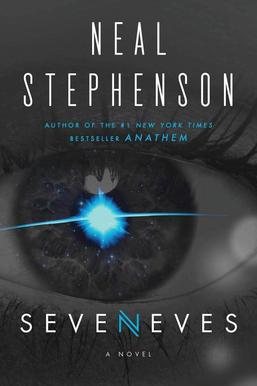
SevenEves by Neal Stephenson

book cover

The moon blew up without warning and for no apparent reason.

I guess in order to indulge in a bit of world-building one must destroy the world first.

Neal Stephenson is a genius. A polymath with a wide range of interests, he specializes in the big idea, and the more concrete the better. In this way he carries forward the tradition of hard science fiction, in which the best example is probably Arthur C. Clarke. Stephenson eschews FTL transportation, time travel, invading aliens, or any of the other tropes of sci-fi that cannot find a solid basis in contemporary science. Instead he takes what is known, adds what is possible, and extrapolates to what could be. His one concession to the unknown is his opening, noted at top. Although a theory or two are trotted out, we never really learn what caused the moon to explode. Consider it the MacGuffin of the novel, the plot device that gets the action moving. I guess breaking up isn’t hard to do. No exploding moon? No story. Why does it explode? Doesn’t matter. The story is about what happens after.

The kernel around which the story nucleated was the space debris problem, which I had been reading about, both as a potential obstacle to the company’s efforts and as a possible opportunity to do something useful in space by looking for ways to remediate it. Some researchers had begun to express concern over the possibility that a collision between two pieces of debris might spawn a large number of fragments, thereby increasing the probability of further collisions and further fragments, producing a chain reaction that might put so much debris into low earth orbit as to create a barrier to future space exploration. – from Stephenson’s site

And the story is a compelling one, not so much in the sense of classic plot construction, but in terms of how we get from the biggest “OH CRAP” moment in human history, to something not guaranteed to soil pants. Stephenson looks most attentively at the engineering details of what is involved in trying to salvage the human race, once it is clear that the sky will go all to pieces, that the term scorched earth will be applicable to all the land on Earth, that the homeland will become a wasteland. What hardware is necessary? What is available? What can go wrong? How do we get from here to up there? This is his gig. He loves this stuff and it shows. He also does a good job of portraying the ensuing struggles down below. Who will be selected to survive? How will they be picked? How will the politics of the selection be handled? What will the criteria be? Ideas bang into other ideas, which fracture and crash into even more ideas, and so on, until you have an entire layer of nifty concept blanketing your brain.

description
World leaders make the big announcement of imminent doom at Crater Lake, and yes, it really is that blue

I think Stephenson is more optimistic than most and his presumptions about the level of on-the-ground conflict and pure lunacy are out of line with what we know about humans. He gives only a little thought to deniers, but in a country like the USA, for example, in which a quarter of the population does not believe in evolution, in which the Republican base clings to beliefs that would make L. Ron Hubbard scream for mercy, in which Texas lunatics of both the tinfoil-hat and elected variety (I know, no real difference there) persuade themselves that a military exercise is a federal invasion, there would be a lot more going on, denier-wise, than Stephenson projects. All theoretical of course, but do you really think that in the time remaining that birthers and those who believe the Apollo moon landing was a hoax would not make use of their considerable ordnance to make life even more miserable for those with brains?

book cover

Neal Stephenson

The book is divided into three parts, although it breaks down into smaller chapter chunks. The first takes us from the initial event to the beginning of the end of Earth as we know it, how humanity comes together, or doesn’t, to preserve the species. Part two takes on the final days of earth and a whole new world of conflict, resolution, or not, setting the stage for Part three, five thousand years on, when, through forces natural and engineer-enhanced, it is again possible to set foot on Mother Earth without singeing your toes. The seven eves of the title refer to the last orbiting survivors, whose reproductive capacity and DNA is used in an attempt to reconstitute the species, and, hopefully, in time, reclaim the original Mother ship.

description
This inflatable harbinger will be heading to the ISS this year – image from Smithsonian Magazine

Stephenson does action-adventure pretty well, and there is plenty of that here. The end of the Earth is a compelling starting point and survival of the species concerns will keep you engaged. Will this work? Will that? Who will live? Who won’t?

Character is not the thing in Neal Stephenson fiction. His greatest talents lie elsewhere. Although it is definitely fun that he puts an avatar of Neal DeGrasse Tyson aboard. The significance of character here is to consider personality differences and their social, and genetic engineering implications. Given people with certain traits, how are they likely to behave, and how will those behaviors help or harm the survivability of homo sap? There is consideration of the concept of the state of nature. What is natural for people? How is that defined? Pretty interesting stuff. And there is plenty more brain candy in SevenEves. (Not for you, zombies, go away) On the hardware side, how about harnessing asteroids and comets for raw materials? Using robots of unexpectedly small dimensions for space-mining? Making orbiting environments in which humanity could survive, and even expand? How about some notions for terra-forming not only lifeless space rocks, but…um…Terra. How about interesting ways of transporting people and materials between orbiting locations, and between Earth and orbit. How about some advanced notions for individual flight on-planet? Life sciences? How about the challenges of food production in space? Bio-engineering is the biggest item here, not only in selecting who gets to be among those sent into orbit to survive torch-ageddon. But in figuring out how the differences in people can be used to ensure survival of the species, and looking at the results, some of which are quite surprising. Social science? Well, the science is a lot softer here, but the politics of end-times Earth and struggles for power among the spacers offer a look at elements of human nature that will be familiar. Stephenson’s optimism about our ability to think our way to actual survival is balanced by his recognition that we are, as a species, probably certifiable, so will continue having at each other as long as there are others to go after.

description
An O’Neill Cylinder – from the outside

I am certain that those more versed in contemporary sci-fi will have more recent comparisons to make, but the work that I was most reminded of here is the Hugo-Award-winner for Best-All-Time Series, Isaac Asimov’s Foundation series. In both, a core of talented people (a broader range of talent than in Stephenson‘s more engineer-and-hard-science-oriented portrayal) are brought together to preserve human culture in the face of an imminent catastrophe. The specifics are quite different, but they share a grandness of vision. No psychohistory in SevenEves, but the multi-millennial look at humanity offers the opportunity for and realization of a great speculative vision.

There are some commonalities between SevenEves and another recent, and very popular, sci-fi offering of the space variety, The Martian. Not in girth, of course. The Martian, at a mere 384 pps, could dock with and be pulled up on the side of the 880 page SevenEves like a tender boat on a cruise ship. Both deal with life-and-death scenarios in an airless void (no, not the US Congress), although one deals with a single life in jeopardy, while the other takes on a larger target. But there is a heavy emphasis on tech in both. Weir’s wonderful story offered an engaging narrator and way too much detail on how he goes about attempting to survive while stranded on the red planet. Stephenson writes about things that he finds interesting whether or not they clutter up the story with technical minutiae, and at 880 pps, trust me, there is too much detail. Hey, his book, his story. He gets off on the details of mechanics, and it is nowhere as mind-numbing as an endless jeremiad by, say John Galt, but you may find yourself feeling a need to skim from time to time. (Purely an aside – I think Chris Moore should write a novel about the Republican clown car of presidential candidates, called The Galt in our Stars, in which someone gets a life threatening disease and no one cares). I wonder also how the very small number of remnant original eves is supposed to be able to provide the training their progeny will require to master all the skills required to sustain civilization. I am sure there are many other details one could look at in considering the next five thousand or so years, but it might take a few more volumes.

SevenEves is a major contribution to contemporary science fiction. It is engaging enough on a visceral level, but it is crack not just for sci-fi fans, but for futurists, scientists, geneticists, engineers, and those concerned with how humanity will survive the challenges that lie ahead. It is a big book, not only in its physical bulk, but in its ambition and range of interests. Like the great works of his predecessors, Asimov, Clarke and other giants of science fiction, the vision Stephenson has built in SevenEves will be read, I expect, as long as there are still people left alive, whether on Earth or not.

Publication date – 5/19/15

This review posted – 5/15/15

======================================EXTRA STUFF

Links to the author’s personal, Twitter, Google Plus and FB pages

Folks who object to paying their taxes are already interested in working on extra-national, and even extra-terrestrial living spaces. At Island One Society there is information on sundry plans that are currently being considered. Please do not take this as an endorsement of any of the political viewpoints expressed there. I include this link purely because it gathers together a nice list of such projects.

O’Neill Cylinders are mentioned in SevenEves. This link offers a nifty animated fly-through that will offer a better sense than a single graphic image could.

Roboticized mining is the likeliest way we will make use of extra-terrestrial natural resources This example of the coming tech is called Swarmies.

I have read several Stephenson books over the years, but Reamde is the only one I have previously reviewed.

More shots of Crater Lake, among other places in that general neck of the woods

Fascinating piece from The Atlantic Magazine on mining the asteroids, among other things, Robots, Platinum, and Tiny Space Telescopes: The Pitch for Mining Asteroids by Ross Anderson from the May 14, 2012 issue

Leave a comment

Filed under Fiction, Literary Fiction, Science Fiction

Girl in the Moonlight by Charles Dubow

book cover

That afternoon was my first inkling that there was more to the world than it appeared. Like the glimpse of a secret garden through a crack in the door, I discovered something I hadn’t known was missing. Where colors were brighter, tastes stronger, feelings deeper. And once I recognized it, I wanted it, missed it—and was unsure I would ever find my way back to it. It was a land of Cockaigne, the hidden kingdom.

Girl in the Moonlight (originally, and better titled Naked in the Moonlight) is the second novel by Charles Dubow, author of the wonderful, steamy 2013 novel, Indiscretion. In …Moonlight, he brings us back to the Hamptons that was the setting for much of the earlier book. Wylie Rose is closing down a summer house where he’d spent much of his youth, and remembering. No madeleines required. But an evocative painting brings back to him, and us, the story of a lifetime of passion, obsession, and love.

book cover

Charles Dubow

How young is too young to meet The One? Wylie was only 10 when he first met Francesca, at 12, the oldest of the four Bonet sibs. A hidden kingdom of attraction opens its doors to him. He falls hard for her, literally. Wylie forms a close friendship with Aurelio Bonet, Cesca’s younger brother, and through this bond, Cesca will pop into and out of Wylie’s life for the duration of his Odyssey. The driving force to the story is the will-they-or-won’t-they-wind-up-together question as they sail through their lives.

Of course, even as a young thing, Cesca is special. In adolescence she begins to take on the characteristics of a siren and sings for all the ships to hear as an adult. Wylie may have known at some level that he should have plugged up his ears (and covered his eyes, for that matter) but he would spend most of his life tied to the mast, enduring the song. Will he be drawn in to his own destruction?

description
Ulysses and the Sirens
– by John William Waterhouse – from the National Gallery in Melbourne

There are certainly gross similarities in form with Dubow’s earlier work. We revisit the Hamptons, and the company of the very well-to-do. The author is of this set and writes what he knows. There is an almost supernaturally attractive female, and a smitten male. (Indiscretion actually had two smitten males, the secondary one having a bit more in common with Wylie than the primary) Trouble soon follows, with a trail of emotional collateral damage. But, lest one suspect that Dubow has shoved off into the water to net the same fish, there are significant differences. In the earlier book, a successful, well-known middle-aged, married man is drawn from (leaps from) his life by an admiring young thing. Here, the two know each other from childhood, growing together and apart over their lives. The time span of the core story (not backstory) is far greater in Moonlight, decades instead of a few years. Indiscretion had much to do with discontent with one’s life, and insecurity about one’s place in it. There is some of that here but Wylie and Cesca are not struggling with the detritus of generations. They seem perfectly content to employ their advantages in pursuit of their movable dreams, trying this and then that in hopes of plotting a steady course. Wylie, for example, opts to pursue a course of study, so enrolls in Harvard for his advanced-degree training, as if it were the equivalent of stopping off at the corner store to buy a lottery ticket. While both novels have a love story at their core, among the one-percent, so do a billion other books. There is a geographical sweep in Moonlight that extends far wider than that in Indiscretion, with stops in Spain, Paris, London and even some connections to Tokyo and Africa, in addition to the usual Hamptons/NYC setting. Indiscretion and Moonlight are indeed very different tales.

There are several elements in Moonlight that stand out. First there is the tension of wondering if the two will ever get together. That sort of thing may be standard fare for stories of this kind, but how that is executed is significant. I found it was quite well done here. Plenty stands in the way of the two getting together (has to be, of course, or there wouldn’t be a story to tell) not least Cesca’s ability to attract men. Second, there is a feeling of melancholy, which may summon your own regrets to mind.

What if I had chosen differently? Would I be here at this moment? There are the dreams our parents have for us, and then there is the life that we create for ourselves. It is impossible to know. The secret, they say, is not to regret—but that, I have found, is impossible. The most one can hope for is to forget. Memory, though, is a poor servant; it bursts in on you when you least expect it.

And there is the ever-present element of hope. It is not a misdirect, there really is a chance they might get together. But I will not tell if they do or don’t. Of course if hope is a thing with feathers, is that a good thing? Would it be better if hope were a thing with scales?

description
Ulysses and the Sirens
– by H.J. Draper – from Wikipedia

I have spent as much time with the one percent as I have with the Illuminati, so I did not feel much connection based on socioeconomic commonalities. On the other hand, I have had my share of emotional disappointments, false steps and traumas, so on a feeling level I found that it was quite possible to connect. Wylie is a very relatable character, a decent guy trying to find himself. Effective writing takes you past surface differences to core emotional experience.

Can she hold him off forever? Doe she really care for him or is Cesca only toying with Wylie, luring him to his own destruction? Can he endure long enough? Should he? What about having a real life and not one based on a myth? At what point does one cross over from being dependable to being a doormat? When do you just throw up your hands and sail back out to sea? And what might happen if you did?

Dubow has a wondrous ability to describe places, imbuing them with life, with history. He can paint a scene beautifully, which is not surprising given that he once planned to be a painter. He can create living characters. Wylie Rose is the evidence. None of the other characters is as fully realized as Wylie, but they are still well done. Aurelio was also very appealing, but we do not see enough of him. Cesca’s path may seem scattered, but Dubow’s explanation for her zig-zag route is believable. I found the other characters much less well realized, but not everyone has to get center stage. They are filled in enough to contribute to the story. The author also has a wondrous gift for communicating the ambivalence we all experience, in looking back, at roads not taken.

Girl in the Moonlight will keep you turning pages, maybe not so quickly as Indiscretion did, but it is a solid read. It will pull you in and hold you, without, thankfully, dashing you on the rocks.

Review posted – 5/8/15

Publication date – 5/12/15

=============================EXTRA STUFF

Links to the author’s Twitter and FB pages

A piece Dubow wrote for Newsweek Magazine on Stuttering

About five minutes of the audio book

My review of Indiscretion

Leave a comment

Filed under Fiction, Literary Fiction

World Gone By by Dennis Lehane

book cover

What they didn’t tell you about absolute power was that it was never absolute; the instant you had it, someone had already lined up to try to take it away. Princes could sleep soundly, but never kings. The ear was always tuned for the creak on the floorboard, the whine of a hinge.

The princes would probably do well to stay alert as well. Remember Richard the Third? World Gone By is the final volume of Dennis Lehane’s Coughlin Family trilogy. The series began ambitiously with The Given Day, set in Boston, among other places, in the late 19-teens. That book cast a perceptive eye on the social movements of the era, and the underlying problems that called them into being. It was an opus magnus, big canvas, big ideas, well realized. The second of the Coughlin books, Live by Night, shifted the focus to Florida in the roaring twenties, Prohibition, rum trade, a fair bit on the DNA of violence. It was smart, literary, insightful, and a damn fine read. It took a lot of wordsmith ordnance to produce the first two. But it seems that there were only a few cartridges left when it came time for the third. This is not to say it is not a good book. I liked it. But, compared to its older siblings, it is disappointing for the reduction in scope, and the feeling one might get that Lehane was dashing through this one to finish the series so he could move on to something else.

Joe Coughlin, in Live by Night, had carved out a nice little chunk of the Florida crime market. Even bought himself some public respectability. But now he has scaled back. Maintains a low public profile. Although he is still a member of the organized crime council, he functions as a freelancer, an advisor, a voice of wisdom, a gangland statesman almost.

“So was I a gangster?” He nodded. “Yes. Now I’m an advisor to people.”
“Criminals.”
He shrugged. “A friend of mine was Public Enemy Number Three about six years ago—“
She sat up quickly. “See, that’s what I’m saying. Who could begin a sentence, ‘A friend of mine was Public Enemy’ anything?”

He is doing well, plenty of money, a son he adores, a gorgeous, connected girlfriend. He hobnobs with the movers and shakers financial and civic, also has working relationships with the military and the police. But he gets wind that there is a hit out on him, and the game is afoot. Who, when, why? This gives the story structure, a ticking bomb, with tension ramping up as the deadline approaches.

book cover

Dennis Lehane -from Boston Magazine

Lehane brings back plenty of the cast from the last episode, but there is enough new blood to keep things pumping. Joe’s pal, boss of bosses Dion Bartolo, appears to have a mole in his organization. People are dying or being locked up. It’s bad for business and needs to end. One of Joe Coughlin’s challenges is to unearth the snitch. There is enough organizational politicking, back-stabbing (literally, as the case may be) and maneuvering for fans of Wolf Hall or Game of Thrones. The seats of power may be smaller, but the desire, and willingness to do whatever it takes is just as high.

The scale of this book is far different from that of its elders, 309 pps for this one, versus 402 for Live by Night and 704 for The Given Day. This one takes place within a few weeks, whereas the prior two covered decades. But thematic strains persist.

the gangster genre to me has always been a metaphor for unfettered capitalism. It’s the American system run completely amok without regulation, without anything. So whereas in the real world you have, say, Exxon buying off the State of New Jersey (a recently proposed [and accepted] pollution settlement) — well, in the gangster novel, that would just be somebody would get killed. – from the U-T San Diego interview

Family figures large here, again. Lehane brings back issues of fathers and sons, how violence by elders scar and steer their children. Can the cycle ever be broken? Moms have a hard time of it, mostly by their absence. Although one, who is, delightfully, a floral arranger and contract killer, makes a well-deserved dent in her abusive hubby’s cranium to achieve her widowhood. Widowers abound, usually with sons. It’s a man’s world, more so than in the earlier books, probably because the female characters have been killed off.

I didn’t realize that until after the book was pretty much going to print. I could have thought that one through a little bit more. Where the hell are all the women in this? – from LA Review of Books interview

Lehane touches on race as well, most poignantly in a scene where Joe Coughlin talks with his mixed race son, Tomas, about being called a nigger.

There are some wonderful characters here. A top-hatted Montooth Dix conjures images of Baron Samedi. A mob doctor has a particularly interesting tale to tell. An unaffiliated don has a group of bodyguards with a particularly daunting rep. One of the mob bosses has a gambling problem. Contract killers have kids, and even a big deal like Joe Coughlin has to cope with his kid getting chicken pox. So there are both broad and fine brushes in Lehane’s set.

Throughout the book Joe sees a young boy. He is uncertain if the boy is real, a message from the other side, maybe manifestation of a brain tumor. But the sightings trouble him. And this is not the only potentially spectral child presence in the book. He wrestles with feeling alone in the world as well, the larger family of which he was a member having, despite the lie about putting family first, done an excellent job of making orphans.

Joe gives some thought to the hereafter, making up for his crimes, sure, but more interestingly, offers up a very interesting notion of time

“Do you think she’s happy? Wherever she is?”
His father turned on the seat and faced him. “Matter of fact, I do.”
“Bus she must be lonely.”
“Depends. If you believe time works like it does down here, then, yeah, she’s only got her father for company and she didn’t much like him.” He patted Tomas’s knee. “But what if there’s no such thing as time after this life?”
“I don’t understand.”
“No minutes, no hours, no clocks. No night turning into day. I like to think your mother’s not alone, because she’s not waiting for us. We’re already there. “

So, what’s not to like? Were this the first book in the series, or a stand-alone volume, one might look at World Gone By differently. But it is part of a trilogy, so the first two parts must be taken into account as well. How does it compare? The Given Day is a big-time historical novel. An epic, a saga, about a time and place, covering considerable time, considerable history. It is a book with heft, and not just from its 700+ pages. Live By Night, while not sharing the same scope as its predecessor, was an amazing book that carried the Coughlin family gangster story forward in the context of American history. There were added artistic elements that gave the work some extra oomph. With World Gone By the scope of the first, and even the second book is abandoned for a smaller tale. The ghostly visitation by a young boy that Joe experiences would be more interesting if Lehane had not played a very similar card already in Live by Night. The sociopolitical concerns persist, and I suppose there is nothing wrong with flogging a theme, but it seemed to me that this had been done pretty clearly in the previous volumes, so that when we stop by there again this time it was a case of been-there-done-that. There is a strain of melancholy here that exceeds that of his prior books. Check out Ivy Pochoda’s interview with Lehane in the LA Review of Books on that. There are reasons.

I liked the book. There is a lot of substance surrounding the gangster tale. Some of the secondary characters were wonderful. The ramping up of tension worked well. You might not have the same sort of reaction I did to what seemed recycled material. That is mostly what kept me from liking it more. (Wish I could give it three and a half stars) Joe Coughlin is an engaging character and, despite his chosen profession, one can relate to him. World Gone By completes the Coughlin trilogy, day, night, gone.

Lehane has already begun work on another trilogy, this one set in more contemporary Boston.

Review posted – 5/1/15

Publication date – 3/10/15

======================================EXTRA STUFF

Links to the author’s personal, Twitter and FB pages

Interviews

—–Ivy Pochoda for the LA Review of Books

—–John Wilkens for the Union Tribune San Diego

—–Colette Bancroft for the Tampa Bay Times

Leave a comment

Filed under Fiction, Literary Fiction

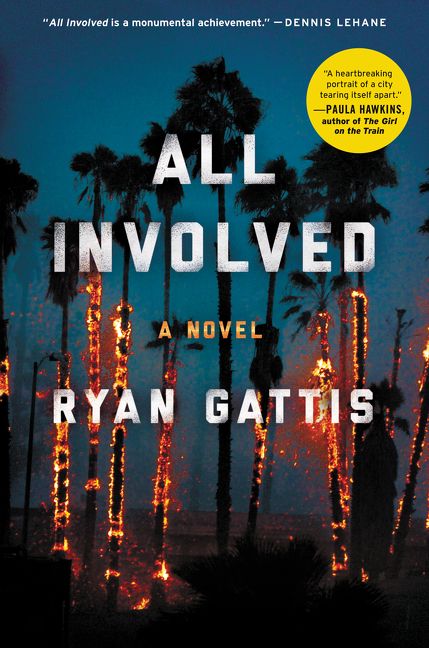
All Involved by Ryan Gattis

book cover

…this whole entire scene says the same to me as it says to every other knucklehead who ever thought bad thoughts across this whole city: now’s your fucking day, homie. Felicdades, you won the lottery! Go out there and get wild, it says. Come and take what you can, it says. If you’re bad enough, if you’re strong enough, come out and take it. Devil’s night in broad daylight, I call it.

At 3:15pm on April 29, 1992, a Simi Valley jury found the police officers who had beaten the crap out of Rodney King, on what was certainly one of the first viral videos, not guilty. At 6:45pm, as news of the verdict spread, Los Angeles exploded with rage. For most of the next week large swaths of the city burned, almost four thousand buildings, with property damage in excess of a billion dollars. Stores were looted. Dozens died, and when the LA Police Department was unable to stem the violence, the National Guard was called in. In many cases police and security personnel stood around as stores were torched and/or looted, a close-to-home reminder of what US troops in Baghdad had done in 1991 when the locals were making off with sundry public property and untold national treasures. Rioting is messy. Stuff happens. The prolonged unrest, called an uprising by some, was a reaction not only to the jury’s decision, but, for many, to a lifetime of duress.

description
Cops beating Rodney King – from the Guardian

Ryan Gattis, who, among other things, is part of a street art project in LA, got considerable insight into what had gone on in 1992 from other members of that group, folks who had been present for the experience. The result is a stunning piece of work, as Guernica was for the Spanish Civil War, so All Involved is for the LA Uprising, a complex, horrifying, moving portrait of a city at war with itself.

description
Picasso’s world-famous mural depicts the horrors of the Spanish Civil War

The book is divided into six parts, one for each day of the riot. Each part is sub-divided into two or three chapters, one for each the 17 characters whose tales are told. The primary character in each chapter is presented in first person, and Gattis does an excellent job of preserving their individuality.

Ernesto Vera, a food worker with a sophisticated palate, aspires to opening his own restaurant. Straight arrow. Keeps his nose clean. Is kind to the less fortunate. A good, no, a very good guy. That does not matter to some. What matters is that he is brother to Ray, aka Lil Mosco, who is very much not a very good guy. Ray managed to shoot a woman while trying to kill someone else. Since Ray cannot be found, since direct revenge cannot be taken by the woman’s family, Ernie will have to do. From this spark the fire grows.

Ernie lived with his sixteen-year-old sister, Lupe, and Big Fe, the leader of a local gang. Big Fe is the general, the warlord, and justice for killing Ernie will be meted out. We see each of the players as they wend their way through this six-day-long drama. A bit player here is featured there. The parts connect. We get to see events from several angles. It is like looking at a holographic image. As you change perspective the image shifts. We are shown individual motivations. This event takes place because of a prior event, but the new event results in subsequent ripples. And on it goes.

description
Ernie’s Last Ride – from Gattis’s site

The primary media focus for the events concerned black rage at injustice. But the Latino population in 1992 was almost as large as the black population. Gattis focuses primarily on the former community here, in the Los Angeles County city of Lynwood. Add to the problems blacks have with the police the potential for many Hispanics who are in the country illegally to be deported. In The Divide Matt Taibbi offered a pretty detailed look at how the unequal treatment dealt out by the criminal justice system has created a large segment of America that has a lot more in common with the West Bank than it does with Beverly Hills. It is not surprising, that a prolonged violent reaction might take place in response to a dramatic legal slap in the face. But the conflagration of violence offered cover to many with other motivations.

They think it’s sad, some kind of thoughtless, primal rage thing. It’s not. It’s mostly planned and it’s one of three things—grudge, mayhem, or insurance…It’s grudge if one guy doesn’t like the other guy for whatever reason, so he takes advantage of the chaos to do something about it, so even the race stuff, like what the blacks are doing to the Koreans, goes here. It’s mayhem if you’re deliberately setting it for the heck of it, or if you’re trying to cover a crime, or using it as a distraction to draw emergency assistance elsewhere so you can commit a crime somewhere else, which the gangs definitely do…. The last and likeliest, it’s insurance of you’ve got a business in a run-down part of the city and it’s not making as much money as you want but you do have fire insurance and you’ve been paying hefty premiums on that policy for damn near too long and then one day the racist cops get acquitted and all of a sudden up pops the opportunity to torch your own premises and get away with it—all you have to do is blame gangs or looters, so why not?

Wars are fought in the smoke-filled nights, personal, gang-related, mindless-rage-based. Ordnance fills the air like Beirut during the Lebanese civil war, L.A as Walpurgisnacht, with witches and demons of all sorts throwing flames, dousing with accelerant, and casting dark spells. A place where it is not uncommon for firefighters to find bullets on their rigs, where a police escort is needed to keep them from being shot while putting out fires. There are scenes that are reminiscent of Mad Max, as those driving fire-trucks know better than to stop when someone walks into their lane. Any rig that does will come under immediate assault. One attack on firefighters is resonant with the real world attack on Reginald Denny. You are there.

description

So how, in all the mayhem, in all the violence, in all the death and destruction can we find some humanity? Gattis may have created a dark portrait of a time and place, but his people are much more than kindling. He takes time with each of his many characters to build, to show where they came from, how they got to where they are, to understand their motivations, their dreams. It is true that for some, all they want is to become even more dangerous than they already are. But there is profound humanity on display as well. A tagger is shown as an artist, a nurse dreams of love, a gang member with CSI skills wonders what else there might be for him in the world. Other gang members connect with old cinema, surprising music, one with his cat, Teeny. There are plenty of pure black hats to go around, but Gattis mixes large dollops of color as well. There are people you can feel for here, and not just the studly Dudley Do-right fireman, or the compassionate nurse. Not all the burned can be healed. Some, as awful as they seem, shouldn’t be. Others might be true citizens if given a chance.

author

Ryan Gattis – from his site

Gattis drops in relevant information through various means. Intel on the number of guns in L.A. is truly alarming, or should be. Information on the number of gang members versus the number of police is frightening. Gangs do not come into existence in a vacuum. Where safety is assured, and enforced, where the population feels protected, attended to, respected, gangs cannot flourish. It is when there is inadequate protection that people turn to other forms of self-preservation. The growth of gangs in Los Angeles and other cities is a testament to the failure of law enforcement to do what is needed, and reflects also the failure of political leaders to provide the resources public safety departments need to do their jobs, the failure of leaders to nurture a vision of the future with educational and career opportunities of the legal sort.

There’s a helicopter overhead—looks like Channel 7—shining a light down on us like we’re at the bottom of a deep, dark hole. The people who live around here, they know what that actually feels like. They know how ugly life can get. Everybody else, the people sitting at home, watching this unfold on television, they have no idea. Those are the people shocked by the riots. They can’t comprehend them because they don’t understand the other side. They don’t understand what happens to people with no money who live in a neighborhood where crime is actually a viable career path when there are no other opportunities, and I’m not excusing it or condoning it or saying it can’t be avoided, but I’m saying that’s how it is.

Ryan Gattis has written a masterpiece. A soldier-by soldier, bullet-by-bullet, Molotov-by-Molotov look at a recurring tragedy in American history. You will smell the smoke, feel the heat and get an urge to bolt the doors and slip into some Kevlar. All Involved is one of the hottest books of the year. It is not to be missed.

Review posted – 4/24/15

Publication date – 4/7/2015

======================================EXTRA STUFF

Links to the author’s personal and Twitter pages and to his transmedia work

There is a bounty of musical links on the author’s site, but you will need to be signed in to spotify to listen. Here are a couple from that list available on youtube:
Ride of the Valkyries
Star Wars – Burning homestead on Tattooine

These were not among the items on the author’s playlist
Disco Inferno
I Love LA

You can see 1:23 of the 12 minute Rodney King tape on George Holliday’s (the guy who shot it) site

The NY Times review by Michiko Kakutani is worth a look

Leave a comment

Filed under Fiction, Historical Fiction

Darkness the Color of Snow by Thomas Cobb

book cover

I mean how much of any one guy belongs to himself and how much belongs to the team? I mean we’re all free individuals, only we’re not. We can’t just do what we want, I mean, look, I can drive a hundred and ten down the wrong side of the road because I’ve got free will, no? No. Something of me belongs to the world or the country or the town or something. I mean I have to do what’s best for it. I mean I have to. I’m not a hundred percent free. Add that part of myself that is free is that way because of the town or country or whatever.

When rookie cop Ronny Forbert pulls over his old buddies for speeding, it should have just been a pain in the neck. Instead, the leader of the pack, well past inebriated, refuses to accede, struggles to avoid being cuffed, falls into the icy road and winds up a prime sample of road pizza when a speeding vehicle launches him head-first into the back end of his own jeep. The cop did nothing wrong. The road stain created his own demise. Scratch one asshole. Addition by subtraction. Right? Not so fast. Righteousness be damned. There are opportunities to be seized, agendas to be taken care of, and if a decent rookie officer is in danger of being gutted in the process, well, hey, that’s just business, nothing personal.

book cover

Thomas Cobb – from The Examiner

Lydell, New York is a remnant of what once was, an aging rust-belt town with its best days in the rearview. Local manufacturing has left for cheaper pastures, taking with it large volumes of hope.

The mother’s house is a little north of the grandmother’s. That makes it a little more upscale. When he gets there, there’s a car parked in the middle of the front lawn, minus hood and engine, and the shingled house is in need of paint or stain, but the porch isn’t buckled. It’s what passes for upscale in these parts.

Police Chief Gordy Hawkins may be a bit of a relic as well. Not just for being a prime candidate for retirement, but for maintaining some sense of honor, decency and community in a world of me-ism and values that do not look past the next quarter. He had brought Forbert in to the force, rescuing him from a youthful wrong turn, and maintains a fatherly connection to the young man. Chief Gordy is an extremely engaging character. I was very much reminded of Robert Taylor as Longmire, or why not double down with Jeff Bridges?

descriptiondescription

Martin Glendenning, president of the town council, a lawyer, and as oily a character as you are likely to encounter, is a different sort. Police? We doan need no steenking police. He has been trying to get rid of the local PD for some time, and turn over policing responsibilities to the state. He worships at the altar of tax cuts, and not having too much local police authority around, poking into his questionable business dealings would be a lovely part of that.

“We’ve become the enemy,” Pete says. “They resent that our service isn’t free. They don’t see what we do for them. They only see that they have to pay us. We’re so far below cable TV and Internet porn, they can’t even see us anymore.”
“There’s a whole new ideology that government, in any form, is an unnecessary evil,” Gordy says. “There’s nothing that’s looked at without suspicion. Used to be, everyone kind of pulled together. Now it’s everyone pulling in separate directions.

The story of Officer Forbert’s travails, particularly his growing self-doubt, and the portrait Thomas Cobb paints of this small town, are compelling in and of themselves.

Cobb, the author of Crazy Heart among other works, knows how to make characters real, knows how to make you feel for them, and knows how to portray place. This is a very moving tale. He is most at home writing about his beloved southwest and has great affection for the cowboy. It is not hard to see in Darkness… a small town sheriff up against the corrupt eastern bankers, particularly when the baddies employ local thugs to do some of their dastardly deeds. But the location speaks to a more contemporary form of conflict.

The larger element here is Lydell as a microcosm of the nation and the time, the conflict between individual wants and civic, communal responsibility. How do communities respond to tough times? Where does community end and the individual begin? Cobb is not offering solutions to what ails. He has written a story about how an unfortunate event is twisted by the unscrupulous, vain and greedy to serve their own ends, to the detriment of the rest of us. He offers praise of honor, seeing clearly that the values of a bygone age are threatened by the new age of self. Chief Gordy is a beacon of light in a bleak landscape, a true hero in place where winter has already arrived.

Review posted – 4/17/2015

Publication date – 8/18/2015

=============================EXTRA STUFF

Links to the author’s personal and FB pages

A short story by Cobb – I’ll Never Get out of This World Alice

Leave a comment

Filed under Fiction, Literary Fiction

The Kind Worth Killing by Peter Swanson

book cover

I’d taken enormous risks in the past two weeks, and I was lucky to have gotten away with them. But now I was done. It was over. I would live a quiet life and make sure that no one could hurt me again. I would continue to survive, knowing, as I’d known that night in the meadow, the stars pouring their light down on me, that I was special, that I was born with a different kind of morality. The morality of an animal—of a crow or a fox or an owl—and not of a normal human being.

Peter Swanson, author of The Girl with a Clock for a Heart, has a twisted mind, not that there’s anything wrong with that. He seems to think in curves, bends, dips and sudden, hairpin turns. The feeling is a bit akin to being here, or maybe here. The sudden changes in direction may generate a bit of screaming, but it’s all good.

It starts with a nod to, well, a bit more of a full body embrace of, Strangers on a Train, a 1950 psychological thriller by Patricia Highsmith, in which two men who meet while traveling get to sharing their troubles and decide that permanently eliminating each other’s problems might be the perfect solution. Hitchcock made a beautiful translation of the book to film in 1951. Swanson is a big fan of both Highsmith and Hitchcock.

I like the idea of sudden change. That you or me or anyone could go out to a bar one evening, and the random stranger who sits down beside you changes your life forever. It’s actually something that Hitchcock liked a lot himself. Most of his protagonists are accidental ones, just ordinary people who wind up in extraordinary circumstances.

In his version, Ted Severson a wealthy corporate raider (formerly a dot.com millionaire sort), at a Heathrow bar pre-flight, is approached by Lily, a lovely young thing. They strike up a conversation, and, as strangers might be better able to manage than people who actually know each other, (a theory titled The Rules of Airport Bars) they agree to tell each other the whole truth, and continue their truth-telling all the way back to Boston. The truth is gonna hurt…someone. Seems that Ted spotted his wife en flagrante with the contractor who was working with her on Ted’s Maine McMansion. Not good.

”How long ago was this?” asked my fellow traveler after I’d told her the story.
“Just over a week.”
She blinked her eyes, and bit at her lower lip. Her eyelids were pale as tissue paper.
“So what are you going to do about it?” she asked.
It was the question I’d been asking myself all week. “What I really want to do is kill her.” I smiled with my gin numbed mouth and attempted a little wink just to give her an opportunity to not believe me, but her face stayed serious. She lifted her reddish eyebrows.”
“I think you should.” She said.

And the game is afoot.

book cover

Peter Swanson

An earlier title for this book was The Lonely Lives of Murderers, which, personally, I prefer. We are treated to multiple narrators, not all of whom are psycho-killers. These serve not only to bear witness to events from diverse perspectives, but to bring in the back story as well, offering a sliver of understanding about how at least one of the psycho killers might have become that way. This is a considerable stylistic switch from Swanson’s previous book, which was written in the third person. It is, however, entirely consistent with the madcap dashings-about of that earlier work. Detective Rebecca James carries over from The Girl With A Clock for a Heart, but that did not seem a significant connection between the two books.

One soft spot of note is that it can sometimes be easy to mistake the voice of one sociopath for another. There could have been more of a tonal difference made between Lily and Miranda’s narration. This is not literature, and makes no bones about it. Swanson considers himself a failed poet, and teases himself a bit in the book by giving Ted an urge to write bawdy limericks. It’s cute. But poetry major or not, he has proven, again, that he can write a wonderful, slick entertainment. No sophomore jinx here. If you are the sort who objects to excessive reliance on the sociopath as a crutch, you may have a point, but then you would probably not be reading this sort of book anyway. Peter Swanson has written a twizzler of a novel, a sweet morsel with surprising and satisfying twists that will, when you are finished, leave you wanting more. It is a gripping read, fun, fast, and furious. The Kind Worth Killing is most definitely a psycho logical thriller worth reading. You might pick this up at an airport or rail terminal or maybe take it along for a day at the beach. You will be glad you had. But while you are sitting at that bar, killing time in a waiting room, maybe lounging under a palm tree or an oceanfront umbrella, be careful who you talk to and what truths you tell.

Review posted – 4/10/15

Publication date – 2/3/2015

=============================EXTRA STUFF

Links to the author’s Tumblr, Twitter and FB pages

Swanson’s web site has a cornucopia of samples of his Hitchcock poems, other poetry, short fiction and non-fiction, and is well worth checking out. Armchair Audience is Swanson’s site for writing on “Books read. Movies seen. TV Watched”

He writes 500 words a day, in the morning, then it is off to his paying gig, as a product manager for a non-profit. Hopefully The Kind Worth Killing will bring in enough scratch that he will have the luxury of writing full time. Early results are encouraging. Foreign book rights have been sold in eleven territories, and a film option has already been bought, by Nick Wechsler, producer of Magic Mike and The Road.

Free download of Strangers on a Train , the book

The film of Strangers on a Train can be seen here. The script was written by Czenzi Ormonde and some up-and-comer named Raymond Chandler, and if it is of interest, you can see the script here

I came across a couple of interviews you might like. Nicola Mira’s interview with Swanson for Thriller Book Journal was the source of Swanson’s comment about sudden change that I included in the review. Another is from the Dead Good site, which, while a Random House property, was not half-bad.. No specific interviewer is identified.

Leave a comment

Filed under Fiction, Thriller

Wolf Hall by Hilary Mantel

book cover

The fate of peoples is made like this, two men in small rooms. Forget the coronations, the conclaves of cardinals, the pomp and processions. This is how the world changes: a counter pushed across a table, a pen stroke that alters the force of a phrase, a woman’s sigh as she passes and leaves on the air a trail of orange flower or rose water; her hand pulling close the bed curtain, the discrete sigh of flesh against flesh.

Uneasy lies the head that wears the crown…but really, crown-wearers seem to have little difficulty with fabrication. Do they mean lie, as in lying down? I mean I would take it off before going to bed. It might get pretty uncomfortable trying to sleep with that thing still on. Wouldn’t it be more accurate to say uneasy “sits the head that wears the crown,” although that creates in my tiny mind an image of Mister Potato head, with legs and feet.

Well, I could not find one with legs but you get the picture.

descriptiondescription
His and Hers

How about uneasy stands the head… , but, oh, see Mr Potato head referred above. So I guess we will leave that one alone, as, clearly, it could be worse. In any case, as uneasy as that head might be, it is clearly more dangerous to anyone who has anything at all to do with the head that has the crown on it. Chopped tops are practically bounding down the streets like bulls in Pamplona. Of course there is the attraction of the power that emanates from the golden circlet. It seems to radiate a glow and a hum that attract the dishonest, the rapacious, seducers, flatterers, scoundrels and hypocrites in far greater numbers than the sort of person Diogenes was looking for, and many of them make moth-like crackling noises as they drift in a bit too close.

description
Hilary Mantel – image from The Guardian

One struggles to come up with a contemporary point of reference to help us grasp who Cromwell was. I suppose one might consider Thomas Cromwell to be a royal bug-zapper. There are other ways to see him of course. He was one of the greatest political fixers of all time. Think Olivia Pope as, say, Chief of Staff to the President. But whereas the fictional Olivia occasionally manifests the odd scruple, the real-world Thomas appears to have manifested fewer. In a similar vein, I suppose we might see him a consigliere to H8’s Don Corleone, or maybe Tony Soprano. Maybe Kissinger to Nixon?

descriptiondescription
Cromwell by Holbein and Mark Rylance as TC – from the Guardian

We meet Thomas as a lad, suffering abuse at the hands and boots, of his drunken father. Thomas is clearly a young man with an elevated spirit and he leaves his bloody home in Putney for a world of adventure and diverse experience. He reappears decades later, the person he had become. I could not help but be reminded of another famous personage who vanished from sight for a couple of decades, only to return from his journeys, possibly abroad, to flash across the pages of history, leaving a very large result. Cromwell was involved in a revolution of a religious sort as well, throwing out the money-changers, but with, perhaps not quite the personal up-side of his predecessor.

He is considered to be one of the most ruthless human beings of his time, in seeing that the king’s word was made flesh. Already married, but wifey does not pop out a male heir? What’s a king to do? Why, twist, turn, beg, borrow, steal, threaten, intimidate, and murder until you get your way. Spoiled children with their own states are fond of such behavior. Of course, to a large extent, one must engage in these forms of feces flinging and head-lopping at one remove, as kings are too proud to be seen with their hands so filled, whether with their own droppings or axe handles. Thus the presence of people like Thomas Cromwell. Thank you, your majesty, I’ll take that now.

Since the Catholic Church was all that stood in the way of Henry VIII getting what he wanted, H8 sought to remove it. Seizing the church’s real estate and other holdings would be a nice bonus. And setting up his non-ecclesiastical self as the head of his own sort-of Catholic Church, the Anglican Church, meant that, in addition to visiting horrors on the RC he would be claiming even more divine rights. Sheesh!

descriptiondescription
H8 by Holbein – from Wikimedia — and Damian Lewis – BBC

So, you would expect that in Hilary Mantel’s rollicking tale of Tudor England, Cromwell would be painted in rather dark shades. The author offers something other. Hogwarts DA Masters notwithstanding, the darkest of the dark arts is the power of manipulation. The proper words tossed near the proper ear can wreak devastation no less awful than an armored division. Cromwell is portrayed as a practitioner of 16th century RealPolitik, someone who uses his rapier wit, his power, his capacity for manipulation, his wide knowledge of the world, and his deep intelligence to serve his king. Is he in it mostly for himself? Maybe. Probably, but he is shown in small bites, talking to this one, planting spies, chatting with that one, nuancing everyone within reach to see things his way, the king’s way, and he sees that more direct action is taken when words alone will not do.

Cromwell, both the real one and his fictitious doppelganger, is a pretty interesting guy, rising from modest (and, if Mantel does not mislead, abusive) origins, dashing off to soldier for hire, becoming expert in international trade of various sorts, making very useful friends and connections along the way, becoming a lawyer, and with his contact list and rep for discretion, rising as far as a low-born can rise in Tudor England. I am sure that, had he shown an inclination towards the culinary arts, he might have been considered a Man for All Seasonings. (sorry)

He is our window on the Tudor era. Regardless of the accuracy of the portrayal, as a literary device, Cromwell is ideally placed to allow us a look into many of the machinations of the era. Questionable prophetess, the Holy Maid of London, making life uncomfortable for a wandering king? Cromwell is there. Both to hear her speak and see her burned. Anne Boleyn plotting to get around the Church’s refusal to annul H8’s marriage? Yep, TC is right in the middle. The population being laid waste by a plague sweating disease? He loses family. Cromwell was a real-life Zelig of the era, with a hand in every historical pie.

What motivates Thomas Cromwell? He moves through the novel like an avatar of the author, a witness to the things the author wants us so know, but lacking much of a personality himself. The delightfully acerbic wit he manifests is hardly unique to him in this telling. One might point to his ambition, and there are certain decisions he makes or directions he takes that offer some guidance, but I never really got much of a feel for what really makes Thomas tick. Is Thomas Cromwell Horatio Alger, an exemplar of hard work, smarts and ambition paying off in the end? Is he a model for the notion that power corrupts? Does he really have morals, or merely goals? Is he a religious extremist or a technocrat? In the second volume of her series Mantel points us to Cromwell’s quest for vengeance on all those who had seen to the toppling of his mentor and father figure, the larger-than-life Wolsey. But that is only hinted at in Wolf Hall (I absolutely see Sidney Greenstreet in my tiny mind as Wolsey) That makes a lot of sense, lending a core of cohesion to a sequence of loose scenes, a lot of this-happens-and-then-that.

descriptiondescription
Anne Boleyn by unknown and Claire Foy in the role

Well, Thomas is only one element here, albeit the largest. It is the era that Mantel brings to life. It was a time of big change. H8 may be established in our 21st century minds as a solidly placed monarch, but the security of his line was very much in question, thus the freaking out about producing a male heir. The Protestant Reformation was underway and the world was in flux. Plagues…um…plagued Europe and the enlightenment was far in the future.

While this look at the Tudor era is gruesome, enlightening and fun, it also shines a light, as good historical fiction does, on contemporary concerns. Torture? Check. Religious extremism? Check. TC is seen by at least one writer as a Tudor version of ISIS. Privacy concerns? Check. Government abuse of authority? Check. The one percent riding roughshod over the rest of us? Check. National wars for private purposes? Check. Issues of separation of church and state? Check. So, for those of you who have not yet taken on this large novel, and it’s younger siblings, one born, the other gestating, keep an eye out for how the Tudor era contains many of the same conflicts we endure today. Of course one might despair by doing this. Really? We have learned nothing in five hundred years? But one might also see some universality in the human condition, across time and space.

There are many, many characters in Wolf Hall. Mantel has included a nice list of them at the front of the book. I found I needed to refer to it frequently. It can be a bit daunting to keep track of what is going on, or to discern who is talking to whom, particularly when so many of the names are used by multiple characters. Most particularly, there are more Toms here than at a convention of male cats held in a turkey farm, enough Johns to construct a considerable public lavatory, as well as herds of Harries and Henries, Annes, Katherines and Marys, and probably a few more household names that repeat uncomfortably often. You will be needing that chart. That said, realizing that TC is the author’s and thus the readers’ eyes on pretty much everything helps.

There is a very different take here on Thomas More than the one we are accustomed to. A Man For All Seasons presented More as a moralist, one who stuck by his principles in opposing H8’s desire to be rid of wife #1 in favor of wife #2. In this version we are shown a Thomas More who is much more an Ayatollah than a serene wise man, as much a political player as a man of the cloth. He happily sends to the torturer and the executioner those who oppose his views. Mantel shows a bit of sympathy for H8 trying to dismantle an organization that includes such dark prigs.

descriptiondescription
Thomas More by Holbein and Anton Lesser in the role

The novel does not tie up neatly. There are two more volumes after all, and those who remember their history, or who, like me, are memory-challenged and need to look such things up, know how it ends, anyway. It is the journey through this often dark age that is the treat. The wit alone would have been enough for me. The feel for the time adds depth.

The novel and it’s younger sib have become the source material for both a BBC miniseries and stage productions in Britain and the USA, and seems to be gathering cultural strength and presence as more branches extend from the Wolf Hall tree. Can the graphic novel and the Barbie Anne Boleyn be far behind? The series from the Beeb has already aired on the east side of the pond, and is scheduled to begin on Easter, April 5, here in the states.

In short, for book with a considerable page count, and covering thirty five years of English and European history, the results of most of which we already know, Wolf Hall is an engrossing read, rich with all-world-large personalities, bristling with sharply barbed wit and intelligence, richly appointed with intrigue and betrayal, red with blood, and great fun to read. There are sections that sag a bit, but keep on, there will be another scene just around the bend that will make you smile and sometimes even laugh out loud. And there are passages that will transport you with their beauty and insight.

BTW, the title, Wolf Hall refers to the residence of the Seymours (the family serving up one of theirs to be counted among the many wives) and is a takeoff on a Latin saying, homo homini lupus est, or ‘man is a wolf to man.’ He is indeed, and what big teeth he has.

Review posted – 4/3/15

Publication date – 4/30/2009

=============================EXTRA STUFF

Links to the author’s personal, Twitter, Google + and FB pages

A nice article from the Telegraph about the historical TC

Another

Fab item by Mantel in the NY Review of Books on how her characters should be played

Interview with Mark Rylance , who plays TC in the BBC production.

He has no doubt there are parallels between Cromwell’s time and our own. “Although we’re not ruled by a sociopathic 14-year-old king, we seem to be ruled by a group of people who are completely in the service of corporations as much as the kings were in the service of the pope before Cromwell and Henry VIII changed the times.”

I included a link in the body of the review, but in case you missed it Dominic Selwood of the Telegraph has a dark view of TC – Thomas Cromwell was the Islamic State of his day

Martin Kettle of the Guardian has a more positive take – Cromwell, the fixers’ fixer: a role model for our times

An article from the NY Times about the upcoming mini-series

Leave a comment

Filed under Fiction, Historical Fiction, Literary Fiction

The Dovekeepers by Alice Hoffman

book cover

We were no different from the doves above us. We could not speak or cry, but when there was no choice we discovered we could fly. It you want a reason, take this: We yearned for our portion of the sky.

Masada, the word summons up images, war, Romans, Zealots, slaughter, mass suicide. A place of national pride for some, historical and archaeological controversy for many, a bit of Python mockery to others. On visiting the place itself Alice Hoffman was inspired to wonder about the experience of the women who had lived and died there. The result is The Dovekeepers. She uses the writings of Jewish historian Flavius Josephus as the foundation for her tale. (The Monty Python crew used Josephus’s writings as well, for a very different purpose, in Life of Brian.)

The four primary characters meet at Masada, where they are assigned to care for the doves. There are those who might consider this a hardship post, regarding doves as dirty, disgusting, filthy, and lice-ridden, or as rats with wings, but they are also a source of fertilizer, meat, eggs, and maybe a bit of hope. No one is designated as the concierge.

book cover

Alice Hoffman

The four are Yael, Revka, Aziza, and Shirah. Yael is notable for, among other things, her coloring. Her father, Yosef bar Elhanan, is a notorious assassin, a member of the Sicarii , a blade-minded branch of the Zealot movement. They do unpleasant things to Jews who collaborate with the occupying Romans. He was known not only for his effectiveness with sharp objects, but for his talent at going unnoticed. He did notice, however, that his wife died giving birth to their second child, Yael, and, possessing a mind and heart not nearly as honed as his weapons, he blames her. Thanks, Dad.

All the while I was growing up I wondered what it might be like to have a father who wouldn’t turn away from the sight of me, one who told me I was beautiful, even though my hair flamed a strange red color and my skin was sprinkled with earth-toned flecks as though I’d been splattered with mud. I’d heard my father say to another man that these marks were specks of my mother’s blood.

Their relationship is, shall we say, strained. Big brother, Amram, however, is the apple of papa’s eye, (I know, shocking) even follows him into the family business. That business involves doing in a Roman general, which gains them the attention of the occupying force and the family is forced to beat a hasty exodus from Jerusalem. They team up with another Sicarii family, headed by Jachim ben Simon. Things get complicated. They all endure a trial by heat, sand and misery on their trek, offering witness to others’ tales of sundry Roman atrocities as well. It is a road of self-discovery for Yael, and she arrives at Masada much changed from who she was when she had set out.

description
Rachel Broshahan as Yael – from CBS

Revka had a nice family. Hubby was a baker. Her daughter was married to a nice studious young man. They had two boys. Romans sacked their town, murdering Revka’s husband while slaughtering anyone within reach. Revka is forced to become a refugee. Further atrocities are visited on her family. While she gets a measure of revenge on the latest evil-doers, she darkens her own soul. Her grandchildren have become mute and her nice-young-man of a son-in-law has become a psycho warrior.

Aziza and her mother were sexually assaulted when Aziza was still a child. Mom decided to raise her as a boy to reduce the likelihood of that happening again. She becomes a bad-ass warrior. Her brother not so much. There is a scene that could have been pulled from Robin Hood in which Aziza demonstrates her proficiency with a bow and arrow. Also gawjuss. Think Xena, at least I did. (you sprouts out there might conjure Katniss)

description
Kathryn Prescott as Aziza – from CBS

Last and definitely not least is Shirah. A witchy sort, with a book of magic spells, great hair and ravishing beauty. She comes from a line of women in a particular line of work, but her mother sent her away from their home in Alexandria when she was young, as an anti-them pogrom was going on, to stay with relations in Jerusalem. Things do not go well for her there. She meets The One, but there is a mess with him being already married, and not up to standing up to his parents, and her being, oh, twelve. She later finds someone with whom to share a home, pops out a few progeny, but is now a single mom in Masada, doing the odd spell to help female residents with this and that, and still looking up to the goddess Ashtoreth for her main religious sustenance. But what’s the deal with her and the hunky head of the Masada warriors, Eleazar Ben Ya’ir? And what’s up with his seriously creepy wife?

description
Cote de Pablo as Shirah – from CBS

So that’s the four. We know (you know, right?) that things do not go well for the residents of Club Masada. The story is in tracking the progress of the place’s demise and how the four got there, and how they cope with the stresses that are steadily building. We are also given a bit of a tour, and get a sense of place beyond the stick figure general notion.

Hoffman definitely has an inclination towards incorporating history into her work, whether of the maritime sort in Blackbird House or a bit of Transcendentalism in The Red Garden. She is also fond of incorporating dollops of magic into her tales, sometimes more than a little. She usually tells tales of women who are forced to cope with challenging circumstances. And she is quite fond of fairy tales. It will come as no shock that this novel is very much in keeping with her previous work. What makes it different is its ambition, scope, and length. It is not a huge book, at 500 pages or so, but is bulkier than her previous work.

First, and probably most important, it is an engaging read. Her main characters are interesting, all strong in their way, and worth finding out about. The story moves along at a decent pace, most of the time. Place is of obviously central import and is given star treatment. I would not say that you could matter-transmit yourself to the fort and know your way around, but you might see places that look familiar and wonder how you knew about them. Hoffman mixes martial material of different flavors, blending some warriors in combat with the more appalling laying waste of defenseless civilians by armed sorts from both sides. There is romantic entanglement aplenty, but my guy-genes did not feel much inclination to generate spew. It all worked pretty well.

She may have overdone it a bit with her imagery, IMHO. Yael, in particular, is associated with, among other things, a Flaming Tree image. Red hair, get it? There are other bits of significance associated with this, but it seemed to me that it was popping up like one of those birthday candles that won’t go out. Yael is also associated with lions, in various guises, a love interest, an encounter with a feline or two in the desert, a kittie held captive by the occupying army. As a host to six of the creatures, I know that, however much we may love and be fascinated by them, sometimes you need to step back a bit. Maybe it is just that in a longer book there are more mentions than one is used to from Hoffman, who knows her way around imagery. I do not recall feeling bugged by other such strands. Watch for image streams relating to serpents and boids, sorry, birds (I am from Brooklyn, after all) Hoffman associates some elemental aspects with her characters, which seemed very fairy-tale-ish and ok. Shirah is associated with water, for example, and that aspect was used in moderation and worked quite well.

Magic most definitely plays a part here. Spells are cast and have the expected impact. Of course some of what works is an expert’s knowledge of science, and that seems like magic at times. It is suggested that one character’s cloak has a feature may make it a likely ancestor of a similar garment used in Hogwarts. One expects magic in AH’s novels. This is all good.

For her historical basis, Hoffman relies on the writings of Flavius Josephus. Here we get into a bit of controversy. The tale of mass suicide that is Masada appears not to have a particularly strong foundation in archaeological research. It was fluffed at a time when it served well as a symbol of Israeli determination and nationhood. Evidence that proves that the events Josephus describes actually occurred is less than entirely persuasive. While there are certainly elements of Josephus’s tale that have a basis in reality, others might constitute a bit of playing to his audience. We all have our national myths. Think George Washington and the Cherry Tree, Paul Revere’s ride, WMDs in Iraq. I do not fault Hoffman for centering her tale around a historical event that is less than universally accepted. Myth is what she does. And she has done an outstanding job with this one. Whether one sees the source material as ancient history or a mythologization of a less exceptional reality, the story she spins around that core is a compelling one.

I have only read a handful of Alice Hoffman’s adult books, so cannot claim a deep knowledge of her oeuvre. But I would put my shekels on The Dovekeepers being the crowning achievement of her career. (One might say it is the feather in her literary cap. I wouldn’t, but some might.)

Review posted – 3/28/15

Pub Date – 10/4/11

=======================================EXTRA STUFF

Links to the author’s personal and FB pages

Here is a reading guide from Hoffman’s site

The CBS mini-series is due any day now. The series makes do with three of the four primary characters, (sorry Revka) and Josephus is not a character in the book.

Oy, there are so many unfamiliar words used in this story that it would be a useful thing to have kept track of them. Sorry, kids, I did not. However, AH does collect some of those in a glossary on her site. It is not comprehensive, though. There are plenty more in the book.

A documentary that looks at the historical event: Time Travellers: Myth of Masada

Here is a nifty site if you are interested in this particular sort of boid bird

A couple of songs that seem, vaguely, suitable

Yes, yes, I know the title of the song is Edge of Seventeen, but I imagine most of us think of it as The White Winged Dove

A favorite from a non-Jewish Prince

And then there is Monty Python, noted at the top. Here is a site that not only links to the infamous Python suicide scene from Life of Brian, but offers a look at a scene, cut from the film, that had been intended to set it up.

Leave a comment

Filed under Fiction, Historical Fiction, Literary Fiction, Religion

Trigger Warning by Neil Gaiman

book cover

The monsters in our cupboards and our minds are always there in the darkness, like mold beneath the floorboards and behind the wallpaper, and there is so much darkness, an inexhaustible supply of darkness. The universe is amply supplied with night.

There is a diversity of material in Neil Gaiman’s third and latest collection of short fiction, Trigger Warning. It is a potpourri of twenty four pieces, if we take as a single piece the entry called A Calendar of Tales, which, itself, holds a dozen. They are not all, despite the collection title, dark or frightening. He brings in some familiar names, David Bowie, Sherlock Holmes, Doctor Who, Maleficent, Snow White, a traveler from other Gaiman writings, Shadow Moon, twists endings into satisfactory curls for the most part, wanders far afield in setting and content, well, within the UK anyway, tosses in a few poems for good measure, and even offers up a few chuckles. He is fond not only of science fiction as a source, but of Scottish and Irish legends as well. If you are not smitten with the story you are reading at a given moment, not to worry, there is another close behind that is certain to satisfy.

Gaiman is overt in noting the absence of connective tissue among the tales. But there are some themes that pop up a time or three. Living things interred in walls, whether after they had expired or not. A bit of time travelling. Fairy tales are fractured. Favorite writers are admired.

book cover

Neil Gaiman – Photo by Kimberly Butler – on Harper Colllins site

In the introduction, Gaiman tells us a bit about the origins of each of the 24, a nifty item to check back on after one has read them all. Some of the material has been developed for other media. I added a link at bottom to a more-than-text offering re the Calendar of Tales, for one.

Overall I found Trigger Warning is a pretty good survey of Gaiman’s impressive range. He seems able to realize the dreams of the alchemists by transforming what seems every experience he has and every notion that crosses his interior crawl into gold. And some of the stories here are glittery indeed.

I quite enjoyed the collection. The uplift of the best more than made up for the downdraft of the lesser. If you enjoy fantasy, with a good dollop of horror, you could definitely give it a shot.

=======================================THE STORIES

1 – Making a Chair – a poem about the writing process.

2 – A Lunar Labyrinth – a tribute to Gene Wolfe – a traveler who enjoys roadside oddities is brought to a maze that is brought into a form of darkness by the full moon.
Here is a link to a site that will clue you in on roadside oddities in the USA. There is a book on such things for the other side of the pond, but I did not find a comparable link

3 – The Thing about Cassandra – An imaginary connection becomes real, with a delicious twist

4 – Down to a Sunless Sea – an abominable feast, but with some just desserts

5 – The Truth is a Cave in the Black Mountain – A not wholly human dwarf engages a local man to lead him to a cave reputed to be filled with tainted gold – I could not get the image of Peter Dinklage as Tyrion Lannister out of my tiny mind while immersed in this one. Sometimes the truth hurts.

6 – My Last Landlady – the rent is definitely too damn high

7 – Adventure Story – a bit of fun guaranteed to make you smile

8 – Orange – A teen who thinks she’s all that may indeed be – another smile-worthy item

9 – A Calendar of Tales – I won’t go into each – the collection was written from ideas received on-line. I found it a mixed bag, with March (Mom has a big secret), August ( a tale of fire and foolishness), September (a magic ring with the quality of a bad penny), October (a sweet tale, involving a Jinni), and December (a hopeful time-travel piece) my favorites

10 – The Case of Death and Honey – a fantastical tale in which a certain Baker Street resident takes on the mystery of death itself

11 – The Man Who Forgot Ray Bradbury – a tribute to Gaiman’s mentor

12 – Jerusalem – on one of the dangers of visiting the city

13 – Click-clack the Rattlebag – stories can be scary, regardless of the age of the teller

14 – An Invocation of Incuriousity – a time-travel piece – don’t touch the settings

15 – And Weep, Like Alexander – one possible reason why we do not have some of the futuristic inventions we expected long ago – cute, not scary

16 – Nothing O’Clock – a Doctor Who tale with a timely solution

17 – Diamonds and Pearls: A Fairy Tale – a fable with a moral

18 – The Return of the Thin White Duke – the completion of a story begun and abandoned while back for a magazine project on Bowie

19 – Feminine Endings – beware of street statue-performers

20 – Observing the Formalities – Maleficent as narrator of a poem about proper forms

21 – The Sleeper and the Spindle – A fairy tale with a nice twist

22 – Witch Work – a poem on the limits of witchy magic

23 – In Relig Odhrain – a poem on a saint who suffered an awful demise

24 – Black Dog – Shadow Moon stops in an ancient pub and is drawn into some serious darkness, scary fun.

Review posted – 3/20/15

Publication date – 2/3/2015

This review has also been posted on GoodReads

=====================================EXTRA STUFF

Links to the author’s personal, Twitter, Tumblr and FB pages

Here is a link to his separate blog

For a full-on media-rich offering the Calendar of Tales piece in Trigger Warning can be seen here

Harper has an on-line reading guide

Other Gaiman books I have reviewed
The Graveyard Book
The Ocean at the End of the Lane
Stardust

2 Comments

Filed under Fantasy, Fiction, Horror, Short Stories