Category Archives: Novella

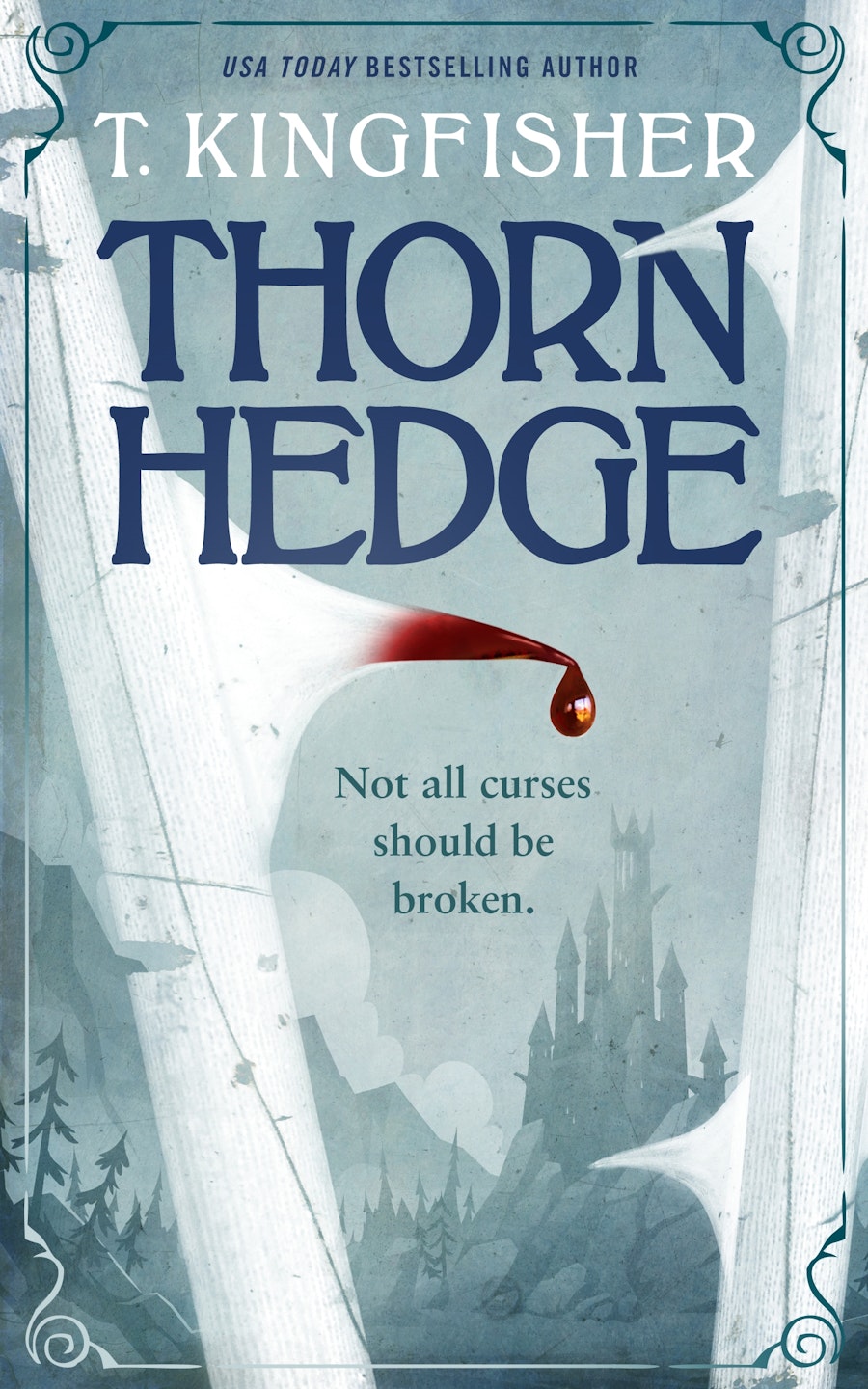
Thornhedge by T. Kingfisher

book cover

In the early days, the wall of thorns had been distressingly obvious. There was simply no way to hide a hedge with thorns like sword blades and stems as thick as a man’s thigh. A wall like that invited curiosity and with curiosity came axes, and it was all the fairy could do to keep some of those curious folk from gaining entrance to the tower.
Eventually, though, the brambles had grown up around the edges—blackberry and briar and dog rose, all the weedy opportunists—and that softened the edge of the thorn wall and gave the fairy some breathing room. Roving princes and penniless younger sons had been fascinated by the thorns, which were so obviously there to keep people out. Hardly anybody was interested in a bramble thicket.

How does anyone manage? There are too many streams and they all flow and all of them could be good and there’s no way to know. How does anyone ever choose to do anything?

Match.com profile – Languid Lady – Wanna meet a real princess? Low maintenance, fond of comfortable bedding, long walks in dreamland, quiet weekends at home in the castle. If you are looking for consistency, a quiet, luxurious, restful life, send me a message. Only real princes need apply. Let’s make some magic together. (Submitted for a friend)

description
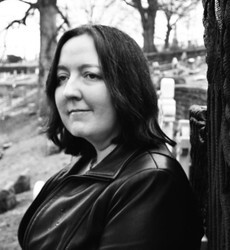
T. Kingfisher aka Ursula Vernon – image from Open Library

We all know, or should know, the story of Sleeping Beauty, whether the Disney version or some other. Beautiful princess is tucked away in a tower for a seemingly endless nap, done dirt by an evil fairy. Kingfisher, as she has done many times with established tales, offers a different perspective.

description
Illustration for Charles Perrault’s La Belle au Bois Dormant from Histoires ou Contes du Temps passé: Les Contes de ma Mère l’Oye (1697) – image from Wiki

This time, what if it was not a dark force, but a kind one that had caused all those zzzzzzzzzs? What if there was a good reason for doing so? What is someone was charged with making sure that no one disturbed the sleeper, however many years, decades, centuries might pass?

One thing I like to do with fairy tales is to look at them and go “How can I make this even worse?” – from the Grim Dark interview

I am not so sure that Kingfisher’s tale really is a worse version. Well, maybe worse that the Disney version. But far from the worst. There is one (and there are others as bad) in which a wandering king happens by the castle where a sleeper named Talia is housed. He decides this is a great opportunity for him, absconds with her virginity, and leaves the unconscious Talia pregnant with twins. What a guy!

We get a look at some of the trappings of fairy tales, including a fairy civilization that is maybe not so nice. Another, the Greenteeth, who raised her, provide our heroine with her other side abilities. These include the power to switch back and forth between human and toad form, which can come in handy. Her name is Toadling. She has been dutifully standing guard over the castle in which the sleeper has been kept for multiple centuries.

description
From MY BOOK OF FAVOURITE FAIRY TALES ILLUSTRATED BY JENNIE HARBOUR. – image from Wiki

Until one day, a knight arrives. Halim is not one of those spoiled, handsome, armored snots who usually trot through such tales, slaying dragons and rescuing (abducting?) fair maidens. He is a Muslim, for one, and, not being a first-born, not exactly in line for a nice inheritance.

Being a knight isn’t about being religious, you know, so much as it is to figure out what to do with your extra sons so they don’t tear up the family seat. Every now and then someone gets the idea we should start chopping each other’s heads off, but in practice, the Pope squats in Rome like a spider and the caliphs glare at one another over their walls, and the rest of us get along as best we can with each other.”

As is obvious from this, Halim comes across as a pretty decent sort, mostly there to check out something he had read, about a long-form sleeper in a tower. I suppose there might be an angle of interest in forming an alliance with a landed bit of royalty when your own prospects are a bit slim, but really, it is mostly curiosity. We are led to think that he is a good guy by the conversations he has with Toadling. But is he on the level with her, or is he trying to manipulate her into letting him past the massive thorn hedge that surrounds the castle?

description
The Sleeping Beauty by Edward Frederick Brewtnall – image from Wiki

For her part, Toadling is riven with guilt for having messed up a magical task she had been assigned, thus her lengthy tenure at this post. She is dutiful, and honor-bound.

Toadling tells Halim her (and thus the sleeper’s) story in bits, so that by the time we are nearing the end, we know all there is to know about how the whole princess-in-a-tower situation came to be, the decisions that were made, the actions that followed and the active perils.
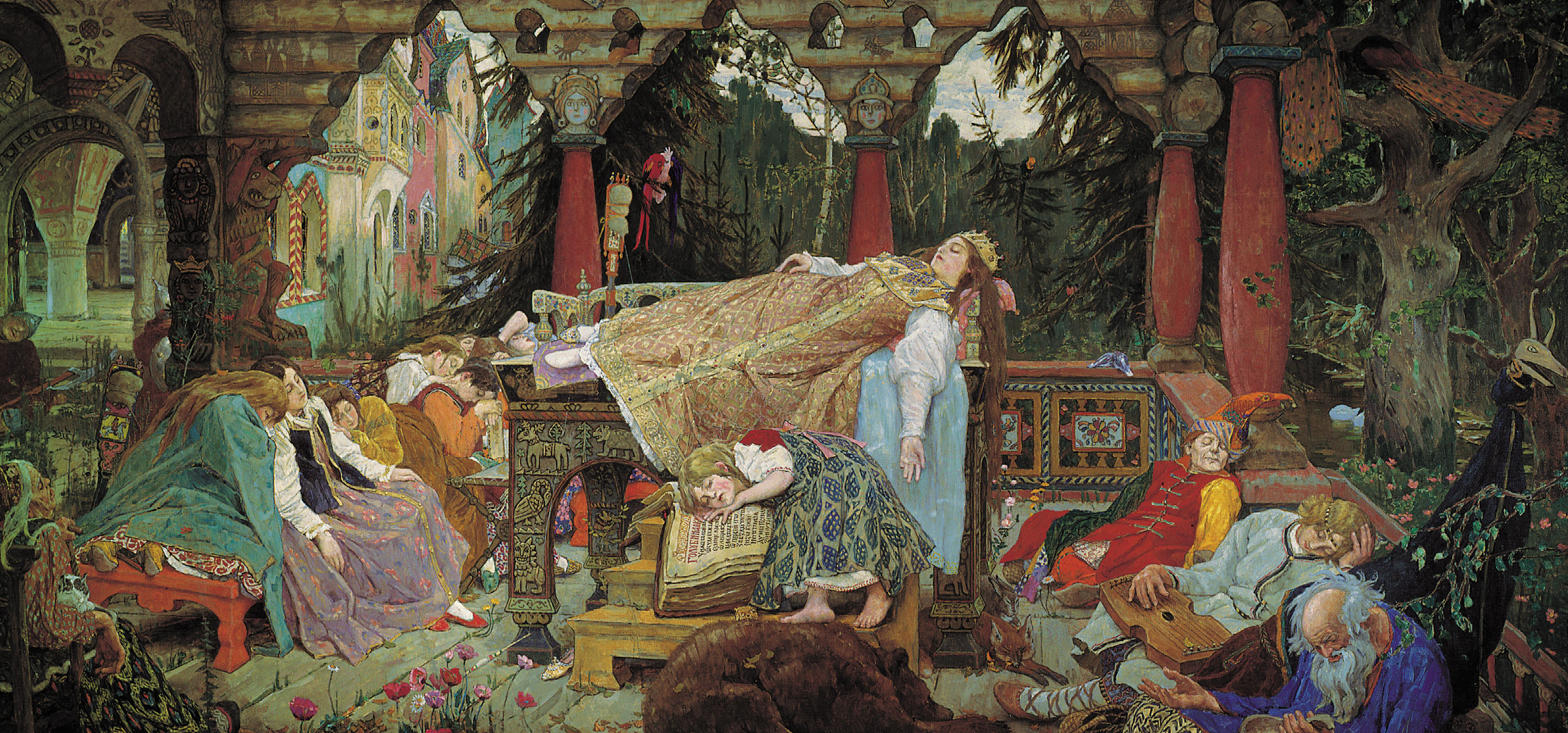
description
The sleeping Beauty by Viktor Vasnetsov – image from Wiki – Showing the somnolence of the entire household – not so much in this telling

There are multiple sources of joy in this novella (30K words). The first is the interaction between Halim and Toadling. Both are modest people. She tells Halim that she is not beautiful, and he says the same of himself.

Practical overworked middle-aged women basically keep the world running…And being myself a rather frumpy middle-aged woman, I write stories about people like me partly because they’re very much who I can write, but also because I want those women to have stories. Sometimes we read fantasy stories in order to pretend we’re someone else, but sometimes we read fantasy stories in order to pretend that people like us can have adventures too. Mind you, if the readers ever get tired of reading about middle-aged gardeners, I’m probably in trouble, but so far, so good. – from the Grim Dark interview

The second is the creative reinterpretation Kingfisher had concocted of the classic tale. It is far from alone. The Sleeping Beauty story first appeared in the 14th century. A later version, adapted by Charles Perrault in the late seventeenth century forms the basis of all later versions, including the one transmitted by the Brothers Grimm. That one was called Little Briar Rose. I am sure you will be excited to learn that there is classification system for fairy tales, called the Aarne-Thompson system. It was news to me that this existed. It is a major tool for folklorists. Sleeping Beauty slots in at Type #410, FYI. There have been many versions over eight hundred years.

The third is Toadling herself. She is such a wonderful character, a good person challenged with outrageous fortune in her life, but holding up because her core is good, kind, and strong. You will quite enjoy spending time with her.

description
Disney’s Aurora – image from ArmChairCinema.com

Thematically, there are walls aplenty in here, the fortress, of course, the thornhedge of the book’s title, and the barriers between the human world and the land of fairy. Halim offers a lovely image for Toadling.

“There’s a very high wall,” said Halim, “according to the imams, called al-A’raf. Between hell and paradise. And if you haven’t been good enough or evil enough to go one place or the other, you live in this wall. But even those people will eventually enter paradise, because God is merciful.” He jammed his chin onto his fist and gazed at Toadling. “It seems like you’ve been stuck in that wall for quite a long time now . . . That’s all the theology I’ve got in me, incidentally, so I hope it’s useful.”
Toadling sighed. “I would like to climb down from that wall,” she admitted.

And there is the wall between Toadling and Halim. Will they break through that one?

description
Sleeping Beauty wakes up after the kiss of a prince — Or –Startled by the presence of a strange man, the young lady sat up while sharply wiping her mouth. “And just who the f&^k are you, dirtbag?” by Otto Kubel- image from Wiki

Bottom line is that Thornhedge is a lot of fun. It takes our expectations and turns them inside out, all the while offering us the welcome companionship of Toadling. This new interpretation of an old tale is rich with creativity. No spindles required. Let Kingfisher put you under her spell and you will be in for a magical read.

Review posted – 10/27/23

Publication date – 8/15/23

I received an ARE of Thornhedge from Tor.com in return for a fair(y) review. Thanks, folks, and thanks to NetGalley for facilitating.

This review is cross-posted on Goodreads. Stop by and say Hi!

=======================================EXTRA STUFF

Links to the author’s personal, Goodreads, and Twitter pages

Profile – from the Fantasy Hive
T. Kingfisher is the adult fiction pseudonym of Ursula Vernon, the multi-award-winning author of Digger and Dragonbreath. She is an author and illustrator based in North Carolina who has been nominated for the Ursa Major Award, the Eisner Awards, and has won the Nebula Award for Best Short Story for “Jackalope Wives” in 2015 and the Hugo Award for Best Novelette for “The Tomato Thief” in 2017. Her debut adult horror novel, The Twisted Ones, won the 2020 Dragon Award for Best Horror Novel, and was followed by the critically acclaimed The Hollow Places.

Interviews
—–The Fantasy Hive – Interview with T. Kingfisher
—–Grim Dark Magazine- Not All Curses should be Broken by Rona Denton
—–Orion Magazine – T. Kingfisher Wrings Hope and Drama from Fairy Tales by Kyla McCallum

My review of an earlier book by Kingfisher
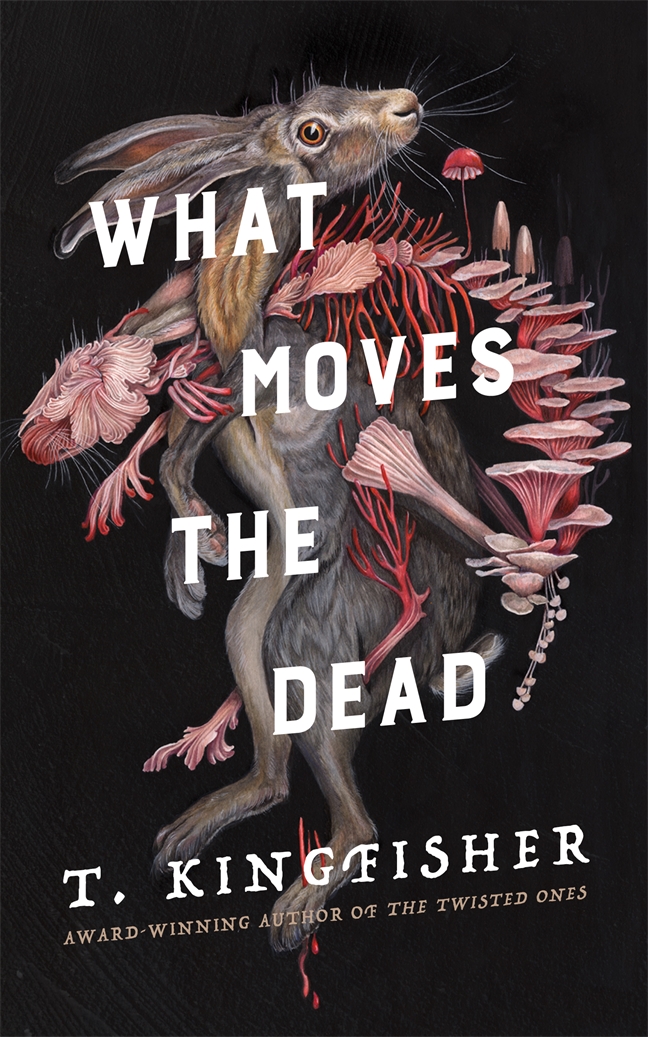
—–What Moves the Dead

Songs/Music
—–Into the Woods – Agony (reprise)
—–Beautiful Dreamer – written by Stephen Foster – performed by Leslie Guinn and Gilbert Kalish

Items of Interest
—–Wiki on Sleeping Beauty – there is a lot here
—–Wiki – The Fairy Tales of the Brothers Grimm (Rackham)/Briar Rose
—–Wiki – Aarne–Thompson–Uther Index

Leave a comment

Filed under Fantasy, Fiction, Literary Fiction, Novella, Romantic Comedy

What Feasts at Night (Sworn Soldier, #2) by T. Kingfisher

book cover

I had the unpleasant feeling that I was riding straight down a giant throat.

…the woods of Gallacia are as deep and dark as God’s sorrow.

T. Kingfisher, nom de plume of Ursula Vernon, introduced Alex Easton, the Sworn Soldier of the series title, in her 2022 novella, What Moves the Dead. Easton is a native of the fictional nation of Gallacia, a place with its own language, nasty weather, and plenty of reasons to stay away. Alex travels with Angus, erstwhile batman from military days, and overall assistant these days. It is the late 19th century. The pair managed to survive the creepy challenges offered in the first book in the series, a particularly original and alarming take on Poes’s, The Fall of the House of Usher. They are looking forward to a holiday at Easton’s hunting lodge. But they do have a penchant for finding the unusual and unpleasant.

description
T. Kingfisher, aka Ursula Vernon – image from Edubilla.com

Easton invited Eugenia Potter to be a guest at the lodge. Potter is Beatrix’s aunt, a personage from the prior book, and a love interest for Angus. Easton is hoping that the lodge has been well maintained, as a local had been hired to see to that, but had proven unreachable. Is the place ready? Is it even standing? Who knows?

The focal point on the spectral scale in this volume is an obscure regional spook. According to wiki, a moroi is a phantom of a dead person which leaves the grave to draw energy from the living, so, not a paying guest. Vacation plans are foiled, in fact, replaced with mortal perils

The initial volume in the series introduced Alex Easton as a person with female physical attributes who is established in a traditionally male role. The author even takes on pronoun-ing in the created culture that incorporates such a person into the extant culture. It was an interesting element in the first volume, but is only lightly addressed here.

Kingfisher has fun setting the creepy stage with grim descriptions of Gallacia, and the particularly dreary part of it in which Alex and company find themselves. For examples, see the two quotes at the top of this review. But she also peppers the tale with humor.

…I recognized the smell of livrit, our beloved national paint thinner, made from lichen, cloudberries, and spite. No Gallacian soldier would be without a bottle, in case we ever need to remember what we’re fighting for. (Mostly the opportunity to be somewhere that has better liquor.)

The greatest city in Gallacia is fine, I suppose, but I didn’t feel the need to linger. Imagine if an architect wanted to re-create Budapest, but on a shoestring budget and without any of the convenient flat bits. While fighting wolves.

And Potter butchering the local patois is quite fun.

Alex and company try to figure out what is going on, then how to address the problem. The local woman, whom they hire to take care of the household, should come with a surgeon general’s warning.

The most interesting element in the story is the fuzzing of the lines between reality and the dreamworld. Are battles fought in an unconscious state still deadly? The struggle for self-control, for self-awareness is as significant as the physical (or is it spectral) harm that is risked, and even suffered.

But frankly, this one was a bit of a dud for me. Only occasionally scary at all. I always enjoy a bit of humor and Kingfisher offers up a fair bit here. But there seems far less richness to this book that there was to its predecessor. An enjoyable read but far from a compelling one. It has the benefit of being a short one, a novella, not a full novel, so you can inhale it in a sitting.

Kingfisher/Vernon has a third Sworn Soldier volume in the works, set in the USA, and featuring Dr. James Denton from What Moves the Dead. Hopefully the digging she has been doing for that project will yield a motherlode of fun and horror.

The silence didn’t feel peaceful. It felt thick. Like a layer of fuzz on your tongue after a hard night of drinking, which you can’t see or touch but you can damn well taste. There weren’t even any birds singing.

Review posted – 04/19/23

Publication date – 02/13/23

I received an ARE of What Feasts at Night from Tor/Nightfire in return for a fair review. Thanks, folks, and thanks to NetGalley for facilitating.

This review is cross-posted on Goodreads. Stop by and say Hi!

=======================================EXTRA STUFF

Links to Kingfisher’s personal, Goodreads, and Twitter pages

Profile – from the Fantasy Hive
T. Kingfisher is the adult fiction pseudonym of Ursula Vernon, the multi-award-winning author of Digger and Dragonbreath. She is an author and illustrator based in North Carolina who has been nominated for the Ursa Major Award, the Eisner Awards, and has won the Nebula Award for Best Short Story for “Jackalope Wives” in 2015 and the Hugo Award for Best Novelette for “The Tomato Thief” in 2017. Her debut adult horror novel, The Twisted Ones, won the 2020 Dragon Award for Best Horror Novel, and was followed by the critically acclaimed The Hollow Places.

My reviews of earlier books by Kingfisher
—–2022 – What Moves the Dead
—–2023 – Thornhedge

Items of Interest
—–Wiki on moroi
—–Stone Soup – The Mess That the Editor Fixes: What Feasts at Night by T. Kingfisher – really only so-so

Leave a comment

Filed under Fantasy, Fiction, Horror, Novella, Reviews

What Moves the Dead by T. Kingfisher

book cover

The dead don’t walk. Except, sometimes, when they do.

It is a cliché to say that a building’s windows look like eyes because humans will find faces in anything and of course the windows would be the eyes. The house of Usher had dozens of eyes, so either it was a great many faces lined up together or it was the face of some creature belonging to a different order of life—a spider, perhaps, with rows of eyes along its head.

How many of you have not read Edgar Allan Poe’s story, The Fall of the House of Usher? Ok, now how many of you read it, but so long ago that you do not really remember what it was all about? All right, the link is right above, so, really, go check it out. Take your time. I get paid the same whether you take half an hour or a year, so no worries on my part. Pop back in when you’re done.

description

All right, I think it has been long enough. Those who have not done the reading can catch up later. As I am sure you get, What Moves the Dead is a pastiche, a reimagining of Poe’s tale. Often these are temporal updates, moving the events to a more contemporary setting. But this one is different. Kingfisher (really Ursula Vernon) keeps Usher in the late 19th century. She supplants Poe’s thick style with a more contemporary, less florid, more conversational presentation.

description
T. Kingfisher – image from her GR page

Poe’s unnamed narrator becomes Alex Easton, of which more in a bit. We first meet the lieutenant examining some disturbing flora.

The mushroom’s gills were the deep-red color of severed muscle, the almost-violet shade that contrasts so dreadfully with the pale pink of viscera. I had seen it any number of times in dead deer and dying soldiers, but it startled me to see it here.

Ok, definitely not good. Continuing on, Alex is alarmed at the state of the Usher manse.

It was a joyless scene, even with the end of the journey in sight. There were more of the pale sedges and a few dead trees, too gray and decayed for me to identify…Mosses coated the edges of the stones and more of the stinking redgills pushed up in obscene little lumps. The house squatted over it all like the largest mushroom of them all.

The invitation (plea) to visit in this version came not from Roderick Usher, but from his twin, Madeline. Neither sibling had had any children, so mark the end of their line, as many prior generations had failed to provide more than a single direct line of descendants. Both Madeline and Roderick look awful, cadaverous, with Maddy, diagnosed as cataleptic, quite wasted away and clearly nearing death. They are having a bad hair life.

description
Redgill Mushroom – image from Forest Floor Narrative

There is another in attendance, Doctor James Denton, an American, whose primary narrative purpose seems to be to provide a conversational and analytical partner for Easton.

We track the demise of Madeline. Given her Poe-DNA, we know her chances for survival are not great. (But was she really dead in that one, or just entombed alive?) Add in a delight of an amateur mycologist, Eugenia, a fictional aunt of Beatrix Potter, who was quite an accomplished student and illustrator of things fungal. Potter is a pure delight upon the page, (maybe she used some spells?) possessed of a sharp mind and wit, and a bit of unkind regard for some. Other supporting cast include Easton’s batman (no, not that one) Angus, and his mount, Hob, who is given a lot more personality than horses are usually allowed.

description
Image from from TV Tropes

So, plenty of dark and dreary, but the atmospherics are not all that is going on here. Kingfisher had read the book as a kid, but rereading it as an adult, found her curiosity piqued. She noted that Poe goes on a fair bit in his story about things fungal, so decided to dig into that as a possible reason for the sad state of the Usher land and clan. The result is a spore-burst of understanding,

…so I was reading old pulp, basically going, is there anything here that grabs me that I can see a story in. And I happened on Usher and I was like, I haven’t reread any Poe in a while. And I read Fall of the House of Usher and it’s obsessed with rotting vegetation and fungus. And it’s really short. And they don’t explain hardly anything…I wanted to know what was wrong with Madeline Usher because you get buried alive, that is a problem. And so I started reading about catalepsy which is what it was diagnosed as at the time and also fungus, there was just so much about fungus and I’m like, okay, obviously these two must be linked somehow.; – from the LitHub interview

There is a particularly creepy element, in the hares around the tarn that sit and stare at people through blank eyes. They do not behave like normal bunnies at all in other unsettling ways I will not spoil here.

description
Image from Television Heaven

It is definitely worth your time to re-read Poe’s original. There are so many wonderful elements. One is a song that Roderick composes, which encapsulates the dark sense of the tale. There are some bits that were changed or omitted from the original. Poe’s Roderick was heavy into painting, an element that Kingfisher opted to omit. And he was particularly taken with Henry Fuseli, whose dark painting, The Nightmare, certainly fits well with the tale. His guitar work in the original was replaced with piano playing.

description
The Nightmare by Henry Fuseli – image from Wikimedia

Kingfisher adds into the story a bit of gender irregularity. What to do if a non-binary person with mammaries wants to become a soldier? Well, these days, can do, but in the late 19th century, not so much. She learned of a practice in the Caucusus, borne of a shortfall of human cannon fodder. A woman could join the military by declaring herself a man, and voila, presto chango, she is legally a dude. Kingfisher took a tangent off that, giving Easton a home in a made-up European nation.

Gallacia’s language is . . . idiosyncratic. Most languages you encounter in Europe have words like he and she and his and hers. Ours has those, too, although we use ta and tha and tan and than. But we also have va and var, ka and kan, and a few others specifically for rocks and God… And then there’s ka and kan. I mentioned that we were a fierce warrior people, right? Even though we were bad at it? But we were proud of our warriors. Someone had to be, I guess, and this recognition extends to the linguistic fact that when you’re a warrior, you get to use ka and kan instead of ta and tan. You show up to basic training and they hand you a sword and a new set of pronouns. (It’s extremely rude to address a soldier as ta. It won’t get you labeled as a pervert, but it might get you punched in the mouth.)

This did not seem particularly necessary to the story, but it is certainly an interesting element.

description
Image from Filo News

So, while you know the outcome in the original, (because you went back and read the story, right?) there is a question of causation. Why is the land so dreary? Why are the Ushers so ill? Why was the family tree more like a telephone pole? Kingfisher provides a delightful answer.

So, What Moves the Dead, in novella length, (about 45K words) provides an intriguing mystery, renders a suitably grim setting, offers up some fun characters, with an interesting take on gender identification possibilities, delivers some serious, scary moments, and pays homage to a classic horror tale, while (didn’t I mention this above?) making us laugh out loud. I had in my notes FIVE LOLs. Add in a bunch of snickers and a passel of smiles. Not something one might expect in a horror tale. Bottom line is that T. Kingfisher has written a scary/funny/smart re-examination (exhumation?) of a fabulous tale. What Moves the Dead moves me to report that this book is perfect for the Halloween season, and a great read anytime if you are looking for a bit of a short, but not short-story short, creepy scare.

DURING the whole of a dull, dark, and soundless day in the autumn of the year, when the clouds hung oppressively low in the heavens, I had been passing alone, on horseback, through a singularly dreary tract of country, and at length found myself, as the shades of the evening drew on, within view of the melancholy House of Usher. – from The Fall of the House of Usher

description
From Otakukart.com – image from Netflix

Review posted – September 9, 2022

Publication date – July 12, 2022

I received an eARE of What Moves the Dead from Tor Nightfire in return for a fair review. Thanks, folks, and thanks to NetGalley for facilitating. Wait, why are you staring at me like that? Stop it! Really, Stop it!

This review has been cross-posted on GoodReads

=============================EXTRA STUFF

Links to the author’s personal, Goodreads, and Twitter pages

Profile – from GoodReads

T. Kingfisher is the vaguely absurd pen-name of Ursula Vernon. In another life, she writes children’s books and weird comics, and has won the Hugo, Sequoyah, and Ursa Major awards, as well as a half-dozen Junior Library Guild selections

Interview
—–Mighty Mu – Spoilers Club 3: T Kingfisher and What Moves the Dead – video – 41:08

Item of Interest from the author
—–Sarah Gailey and T. Kingfisher Talk Haunted Houses, Fantastic Fungi, and the Stories Nonbinary Folks Deserve

Songs/Music
—–Carl Maria von Weber’s Last Waltz is referenced in Poe’s story, in which Roderick played guitar instead of piano
—–John Brown’s Body – Smile-worthy reference to a dead person who still walks among us
—–Ben Morton – Beethoven’s Fifth on piano – …he played dramatic compositions by great composers. (Mozart? Beethoven? Why are you asking me? It was music, it went dun-dun-dun-DUN, what more do you want me to say?)

4 Comments

Filed under Fantasy, Fiction, Horror, Mystery, Novella