Category Archives: Literary Fiction

Last Night at the Blue Angel by Rebecca Rotert

book cover

It just came crashing down, she says. Sometimes in life it just all comes crashing down.

There’s all sorts of crashings-down going on here, some real, some not. Some are anticipated, but never arrive, some happen before you know it. Others happen far away but carry a large impact. Naomi Hill has been a singer in Chicago (her kind of town) ten years or so and in a once-important jazz club that has seen better days for less than a year. But when her photograph appears on the cover of Look magazine in 1965, it signals her arrival. On the night of her last performance at The Blue Angel most of the important people in her life, her true family, are gathered. From this stage we look past the footlights to how each of them came to be there. Most important is her daughter, 11-year-old, Sophia.

Mother is a singer. I live in her dark margin.
For the first ten years of my life, I watch her from the wings.

The story is told from alternating perspectives, Naomi’s and Sophia’s. We see Naomi as a disaffected teen in Kansas,

It was just—nothingness. It filled us with nothingness. It made you feel so…trapped. Isn’t that funny? With so much space around you? Trapped? Can you explain that?

and follow her as she finds her way, geographically, musically and sexually. Naomi is driven by her needs like a dust mote before a haboob:

How could I tell Hilda, or anyone, how much I feared such a life, a normal life. How much I feared becoming invisible again, powerless, dependent. I wanted to do the right thing but I wanted something else more. To be known. To be loved.

Just as Naomi’s quest for fame and fear of enclosure drive her, Sophia is driven by a need to be loved by her mother, to be a necessary part of her world.

Tonight I clap so hard I think she’ll look over at me and pull me out of the wing into the spotlight and introduce me as her daughter, whom I love more than anything, she’ll say. But she doesn’t.

Last Night… is a deceptive book. It reads quickly, and weighs in at a modest 325 pages, but this is one of the richest novels I have read in a long time. One could simply follow the melody of the story and hum along, but I suggest you take your time. There is rarely a single voice trilling in a scene. Almost always it is a combo, offering syncopation, harmony, backbeats and meaningful riffs. Take your time, and let all the notes, beats, rhythms, and emotional sound of the book wash over you.

description
The Author

The settings are the 50s in Kansas and Chicago in 1965. It is a volatile era, in which sexual and racial norms are being challenged, a time in which the new is rising and the established is crumbling, although not without a fight. This is highlighted in Kansas (Something is definitely the matter there) with a display of the antediluvian notions extant in Naomi’s home town. In Chicago we see this through Jim, a guy who clings to the belief that someday Naomi will love him back, and in the meantime he is not only always there for her, he serves as the father Sophia never knew. He delights in photographing, while the opportunity remains, great Chicago buildings that have been slated for demolition, (He also photographs Naomi) celebrating the glorious before it is gone.

Why do you love buildings?
He combs his moustache with his fingers while he thinks. This town…it’s all hustlers and thieves from top to bottom. It always has been. But this…He points to the building. I don’t know, kid. Sometimes we do something right. Make something worth taking care of.

It is also a time of fear. Sophia is concerned about a possible nuclear holocaust, so has been compiling a list of items, the workings of which she wants to understand, (streetlamp, toaster, record player, percolator, et al) so that after the worst happens she can begin to re-invent a bit of civilization.

There is a saying that you can’t choose your family. Well, maybe not your DNA-based family. But you can create a heart-based family, and this is how Naomi and Sophia survive in the world. Naomi may have been raised in Eisenhauer America, but she is at core a modern, independent woman, and strives to find fulfillment on her own terms. We are treated (and it is so very much a treat) to seeing how each came into Naomi’s life. Every story its’ own wonderful melody. Of course, the primary relationship we see is that between Naomi and Sophia,

The seed of this story was planted many years ago. I have this very beautiful, dynamic mother. And it seemed, wherever we were she became immediately central. So, to be at her side rendered you a bit invisible, which was of course both wonderful and terrible. If the world was watching mom, I could watch the world, freely and without notice. It carved this automatic space for me, a private world, the world behind another’s wings.

We see Sophia adapting as a daughter to the spotlight that is her mother much more than the other way around. It is not that Naomi wants to be distant to Sophia, but her drives usually urge her in another direction.

One strong thematic current here is wind.

People in Kansas will tell you how beautiful it is but all I can say is that in Kansas, the wind blows everything down or away, it just beats the shit out of it.

There is even a Sister Windy who is a much more beneficent prairie breeze. You will not go more than a few pages without encountering a draft, a flutter or a gust from a wind reference.

It is also amusing to see how people are always racing ahead of other walkers, or struggling to keep up.

Among the many love stories tucked inside …the Blue Angel, a major one is about a love of beauty. Jim loves those great old buildings. And Naomi loves singing

I lay there in the moonlight breathing deep until I was sure she was asleep. Then I just let my head run back to the music, to little phrases I’d committed to memory. I felt my throat move a little as I imagined singing. And I understood that this must be love, to visit a place in your mind where music is playing, to have such a place at all.

And there is another scene of Naomi singing in an unexpected venue that will leave you gasping.

I have two issues with the book. I thought it could have used a bit more humor. It seems that kind-and-gentle moments are used to serve that purpose. There is one surprise revelation scene that also serves well to turn that frown upside down, but a couple of yucks here and there wouldn’t have hurt. Secondly, there is a hint of danger here. No, not the automatic-weapon sort. The romance sort. I am disinclined toward such things, and there are definite aromas that waft through. For good or ill there is a dishy female lead being wooed by (among others) a male yin and yang, a gun-toting bad boy gambler and a camera-toting too-good-to-be-true guy of the doormat persuasion. Such things usually make me wretch, but it was held in enough check here to stave off any unintended regurgitation.

If Rotert is not working on a musical stage production of this, she should work up a tempest and get cracking. This is major Broadway musical material. Whatever awards this book will win, and there should be many, there are Tonies, and then Oscars just waiting to be scooped up. Which requires a casting call. Much as I would love to cast Amy Adams as Naomi, and as great as she looks, Naomi is, maybe 27 or 28 and the actress would have to pass for 17 in a few scenes. Adams is 39, (even Jessica Chastain, who might be wonderful here, is 37) so, for the umpteenth time, we will return to the well and wonder how cool it would be to see Jennifer Lawrence as Naomi, (but she probably lacks the singing licks – ☹) Bradley Cooper as Jim, whose age is not specified in the book. And

book cover

Johnny Sequoyah

Johnny Sequoyah, of the TV show Believe, as Sophia would be just about perfect. (Please don’t let her age!) And if you think I am getting all sexist about age and gender, I had John Hamm in my tiny mind for another character here, but even Don Draper couldn’t sell Hamm as a twenty-something.

Be warned, I don’t care who you are, young or old, big or small, male or female, hell, human or alien, this novel will break your heart (or hearts in that last case). 210 pounds of old guy was sobbing on the couch at the back end of this book. Ok 220. You had better have those tissues handy. You are gonna need ‘em. Ok, ok, 225, geez. And could you hide those jelly beans please? Thanks. Yeah, went major wet-face. Like a baaaaaaaby.

Last Night at the Blue Angel is one of those rare works where craft meets entertainment. It is not only a brilliantly written novel. It is a dazzlingly satisfying read as well. This angel is indeed heaven-sent.

Review posted – May 2, 2014
Publication date – July 1, 2014

=======================================EXTRA STUFF

A few of the many pieces of music mentioned in the text:

Sam Cooke When I fall in Love

Naomi listens to Bird and Diz when she is sad

Saint Cecilia comes in for a look here as well, yes, Saint Cecilia

===============================================AUTHOR

Rebecca Rotert (roe-tear) has been a poet and singer for many years. Her familiarity with stage performance informs much of the novel.

Kinda light on the usual sorts of social media connections, but here is Rotert’s Twitter link

Harper posted on Soundcloud an amazing audio piece. You must check this out, not only does Rotert sing, smoky and sultry, but she talks about elements that went into the story, and reads a passage from the book that simply dazzles

A nice profile of the author from Femmes Folles Nebraska

3 Comments

Filed under Fiction, Literary Fiction, Reviews

The Sleepwalker’s Guide to Dancing by Mira Jacob

book cover
We arrive in this world connected, to people, to places, to cultures. Just because we move on with our lives, emotionally, intellectually, or geographically, this does not mean that our connections are all left behind.

In Mira Jacob’s debut novel, The Sleepwalker’s Guide to Dancing, her characters all struggle with connections, to each other, to their past, to their culture, and ultimately to themselves. For some that struggle includes a connection to reality. The story looks at three places, India, Albuquerque and Seattle, and three times, the late 70s, early 80s and 1998.

When we meet the Eapen family, in 1979, they are visiting the place and family they had left, in Salem, India. Thomas Eapen, a surgeon, had sought a better life for his wife and children in America. Home still has power, though, and his mother, also a physician, tries her best to persuade her son to remain. We meet the family members who had remained, and see some of the strains that might lead one to seek a life elsewhere. The motherland still has a hold, though, and Thomas’s wife Kamala, would like nothing more than to remain.

Amina Eapen is a photographer, working in Seattle in 1998. She had been a successful photojournalist, but has stepped back from that for reasons I will not go into here, and is now shooting events. Amina has a gift for capturing telling moments and is our camera into the history and struggles of the Eapen family. Dr. Thomas Eapen is seriously ill, seeing things that are not there, talking to people who are long dead. It has affected his work. When his wife calls Amina, she returns home to Albuquerque. Eapen’s illness is the maguffin for examining the experience of the Eapen family.

In addition to the strain of emigrating from India and constructing a new life on the other side of the world, the Eapens suffered a huge loss. We learn early on that Amina’s brother, Akhil, died young. The story goes to the early 1980s, where we see Amina and her brother in school, beginning to have relationships, struggling to grow up. Akhil shows some odd behavior, sleeping for vast stretches, falling asleep in inappropriate situations, believing that something glorious is in store for him if only he can complete a particular task. It is not entirely clear whether this is eccentricity or a condition, and neurosurgeon Thomas dismisses it.

So, there is a bit of mystery here. What happened to Akhil? What is going on with Thomas? It also takes some time to learn why it was that Amina stepped away from photojournalism. It is in peeling back the layers of those stories that we learn about the characters. There is a bit of romance as well, but, thankfully, it does not at all take away from the story.

While this is not a laugh-out-loud sort of read, there are plenty of light, even delightful moments that will make you smile. Of course, there are very sad ones as well

book cover

The author – from her web site

Much is made of attachment to place. When Thomas cedes his ownership rights to a family property in India there is a direct connection to be made to a story to which Amina is connected, of Native Americans in the northwest ceding land to the extant society in return for the hope that a large amount of cash can improve their lives. There are also smaller scale elements relating to territory.

To live in the Eapen’s house was to acknowledge the sharpness of invisible borders, the separations that had divided it like two countries since 1983. It had been years since Amina had seen her mother wade into the yellow light of her father’s porch, and as far as she knew, Thomas had never once crossed the gate into Kamala’s garden.

One of the connections made is in the similarities between the old world and the new, between generations. Just as Thomas’s mother schemes to try to keep him in India, Amina’s mother schemes to try to keep her in New Mexico. Just as Thomas’s brother spoke to people who were not there in India, Thomas holds his own conversations with the dead in America. Both Thomas and Akhil balk at the limitations inherent in their conditions. Food is used as a way for old and new to connect

Cooking was a talent of her mother’s that Amina often thought of as evolutionary, a way for Kamala to survive herself with friendships intact. Like plumage that expanded to rainbow an otherwise unremarkable bird. Kamala’s ability to transform raw ingredients into sumptuous meals brought her the kind of love her personality on its own might have repelled.

Bonds are made through feeding as a way of loving.

Another element is secrecy. Amina maintains a private cache of her special photographs, non-commercial ones that epitomize her skill at catching important moments. Thomas keeps his medical situation secret, and a few other things besides. And that ties in to feeling like an outsider, whether one is a native in a land now dominated by European invaders, or a new arrival in America, whether one is a black sheep in a family or an ostracized teen at school.

Amina has a wonderful relationship with her cousin, the wonderfully named Dimple, and there is a supportive, non-parental adult, the cool aunt, Sanji, who is able to bridge the gap between the young and the not so young, offering understanding and support, along with adult wisdom.

As for the sleepwalking element, there is a character who literally sleepwalks, and his connection to dancing is revealed at the end. Thomas’s visions might be seen as a form of sleepwalking. Akhil has big issues with sleep, but sleepwalking is not among them. And there are other characters who see things that are not there, which may be a form of sleepwalking. There is a mention in the book of a sleepwalker’s disregard for her surroundings. It is unclear if the author is suggesting that we are all sleepwalkers in a way, or that we should pay more attention to our effects on the world, or should attend to our visions. Did not get it. Doesn’t matter though. There is plenty to go with here, even if one is not able to cross every thematic t or dot every metaphorical i.

Gripes? I would have liked to have seen more, well anything actually, on the Eapen family’s experience when they had first moved to the USA. We only get to see them once they are already settled.

Amina is engaging, definitely worth caring about. Family is family is family, whether the family in question is from India or Indiana, and you are sure to recognize some folks in Amina’s clan who remind you of members of yours. The story is interesting. One gets a strong sense of the warmth and humor as well as the struggles inherent in these multigenerational family connections. Awake or asleep, the music is playing here, and it wouldn’t hurt to step out onto the dance floor for a while.

I received this book through GR’s First Reads program – thanks guys!

Review posted – April 25, 2014
Pub date – July 2014

=======================================EXTRA STUFF

Mira Jacob co-authored Kenneth Cole’s autobio, wrote VH-1’s Pop-Up Video, and was a co-founder of Pete’s Reading Series, at Pete’s Candy Store, in Williamsburg, Brooklyn, a venue where authors have been reading their work to appreciative audiences for over a decade. She is married to academy award nominated documentarian, Jed Rothstein. They live, with their son, in Brooklyn.

Links to the author’s personal, Twitter and FB pages

The Eapen family are Syrian or Saint Thomas Christians. This Christian sect was news to me. The wiki entry is pretty interesting.

Leave a comment

Filed under Fiction, Literary Fiction, Reviews

The Miniaturist by Jessie Burton

book coverThe death of Nella Oortman’s father left the family in difficult straits, saddled with unexpected debts and a declining standard of living. But the widow finds a suitable match for Nella, in a successful Amsterdam merchant and trader. As he travels extensively, the wedding is a quick affair, and it is a month before he will return to his home. In October of 1686, Nella arrives there, in a very exclusive part of the city. She is greeted by her new husband’s sister, Marin, who makes her feel as welcome as a case of influenza, and who just might make you think of Mrs. Danvers.

As a wedding gift to his 18-year-old bride 39-year old Johannes Brandt acquires for her a cabinet, a kind of doll house that mirrors the Brandt home. Nella engages the services of a miniaturist, a craftsperson, to help fill the spaces. What she receives is far more than she expected, as the pieces reflect a bit too closely persons and events in the family’s life, some frighteningly so. Also, they do not always remain exactly as they were when she’d received them. And they arrive with Delphic messages. Do these tiny constructions predict the future, reflect their owners’ fears and concerns, reveal secrets, tell truths, or offer misdirections? Nella determines to find out who this mysterious miniaturist is and what is behind these small objects.

descriptiondescription
Burton says “When writing my hero, Johannes, I had this guy in mind.”

Burton did considerable research to get her 17th century details right.

I have a bibliography as long as my arm. And then there are first-hand resources—maps, paintings, diaries, prices of food, inventories, wills—and the physical city of Amsterdam itself. I first went in 2009, which is when I saw the house in the Rijksmuseum, and then again August 2012 for my birthday – with a long list of questions and locations to visit post-fourth draft. Where did they bury the bodies in the Old Church? How many windows on the front of a gable? How did they winch furniture in? A lot in the book is all historically true in terms of life in the city… – from the Richard Lee interview

Nella’s search and her coming of age occur in a difficult time and place. The Amsterdam of the late 17th century, the Dutch Golden Age, is a world financial and military capital, a harsh, unforgiving place, where human failing and difference is not be tolerated, where neighbors are encouraged to spy and report on neighbors, (yes, very much like your office) and where it is always a contest whether the worship of gold or god will hold sway in any given circumstance. The two domains cross paths frequently.

It is this city. It is the years we all spend in an invisible cage, whose bars are made of murderous hypocrisy.

It is a time when being a woman was much more of a challenge than it is today. Marriage, paradoxically, was seen by some as the only way for women to secure any influence over their own lives. But what if a woman wanted something more, something of her own, the opportunity to be the architect of her own fortune, and not submit to a life in a golden cage. Nella may have stepped into a wealthy man’s world, but she must still take care for the many traps that have been laid by a cold society and those jealous of her husband’s success and of her. And there are challenges as well with her marriage, which was not quite what she had bargained for.

I wanted to create women who are not more ‘strongly female’ or ‘stronger than other females’, or ‘strong’ because they are braver than men, or can physically lift more saucepans or anything like that. I just wanted some women who for once are not defined by any other ideal than that they are human. – from the Richard Lee interview

descriptiondescription
Images that inspired Nella and Marin

Jessie Burton has written a dazzling first novel. The Miniaturist presents readers with a worthy mystery, and maybe a bit of magic, offering enough twists and turns for a figure skating contest, opening tiny door after tiny door to reveal the secrets of Brandt’s household. This is a look at the Dutch golden age that will resonate with contemporary gender, race, religious and power issues. The author offers just enough imagery to enhance without overwhelming, and breathes life into an array of compelling characters. In addition, Burton paints this world with the eye of a true artist, and does it all in a book that you will not want to put down. It will require no Dutch courage to get through this one. To have crafted The Miniaturist is no small achievement. Jessie Burton has written a book that seems destined to be huge.

description
The dollhouse of the real Petronelle Oortman, currently in the Rijksmuseum in Amsterdam

Review posted – April 4, 2014
Release date in the UK – July 3, 2014
Release date in the US – August 26, 2014

=======================================EXTRA STUFF

One must wonder what London-resident Burton thinks of actors, given how she portrays one here, and given that she has worked as an actress, while toiling as an executive assistant to bring in a few guilders. Here are links to the author’s personal webpage and her Twitter feed. She has a few more historical novels in the works. If she continues writing at this level she will be making history instead of writing about it.

In addition, her Pinterest page is most definitely worth a look

There is a lot of interesting material on Burton in this interview by Richard Lee at the Historical Novel Society site and more here in a piece from The Guardian.

Sugar loaves figure significantly in the story. While I had heard the term Sugarloaf before, my only association with it was with mountains, whether the iconic mound in the Rio de Janeiro harbor, or the host of other mountains across the planet that share the name. Never gave it much thought. But folks with a bit more historical knowledge than me (most of you) would probably know that there was a time when sugar was routinely formed into solid cone shapes for shipping. That Rio hill and its cousins seem a bit more understandably named now.

Here is a link to the wiki entry for sugarloaf, which I found pretty interesting. And another that deals with tools used for handling the stuff. Sweet.

descriptiondescription

3 Comments

Filed under Fantasy, Fiction, Historical Fiction, Literary Fiction, Reviews

Fourth of July Creek by Henderson Smith

book coverThere should be fireworks shooting off for Smith Henderson’s first novel, as it is a just cause for celebration. This is not to say that the subject matter is exactly festive, but the book is a triumph.

Pete is a social worker in Tenmile, Montana, a place so insignificant it was named for it’s distance from the nearest possible somewhere. The folks he is charged with trying to help out need all the support they can get, but some can’t seem to accept any.

There are three main threads braided into this novel. Cecil is a troubled teen in a household where the biggest problem is his substance-abusing layabout mother. The two do not get along, big time. Firearms are involved.

When eleven-year-old Benjamin Pearl wanders into town alone, dressed in rags, and looking like he’d been reared by wolves, Pete is called in to check things out. Following the story of Benjamin and his family is the core here, although a portion of almost every chapter is given over to the third thread, Rachel Snow, Pete’s daughter, who has troubles of her own. Pete is the central element interlacing with the threads.

Pete Snow is basically a decent guy, bloody far from perfect, but his heart is in the right place. He really cares about the people he is charged with helping, and tries his damndest to figure out what the best thing is to do for each. That it does not always work out, and that he is better at helping others than he is himself, are foregone conclusions.

description
The Author

Smith Henderson offers us a look at a place in America, rural, and sometimes not so rural Montana, but also a time. It is no coincidence that the story is set in 1980, when the promotion of “Morning in America” also encouraged the release of a lot of pent-up insanity. Benjamin’s father is a seriously scary survivalist. His paranoia may at times have a basis in reality, but his worldview is straight out of the Lunatic Fringe Encyclopedia. There have always been folks with Jonathan Pearl’s particular flavor of madness, but it looks like Henderson is signaling what lies ahead, a world in which entities like right-wing talk radio, Fox News and any organization associated with the Koch brothers foment fear 24/7 and offer a media route in which to legitimize lunacy. Ben’s father actually believes, when he sees jet contrails, that the gub’mint is spying on him. There is plenty more to that story, but the political, this-is-what-is-being-unleashed, element is quite significant, although it is only implied. The implications of freedom are given a look. At what point does your ability to be free, living a life of paranoia, infringe on the rights of those who have not chosen the same path? Where is the line between legitimate desires for non-interference and license to do whatever? Where is the line between society’s right to protect it’s children and parents’s rights to raise children as they see fit?

We get a look at institutional limitations and extreme downsides, even when those institutions are staffed by well-meaning folks. Of course not every one is so well-meaning. We also get a look at the hazards to kids of growing up working class, from screwed up homes. Children have a lot to contend with here.

Ok, now that I have made the whole thing sound like such a downer, time to shine a bit of light in the darkness. While Pete definitely has his issues, he is beautifully drawn and is someone we can cheer on, most of the time anyway. There are some good people in Tenmile, a family who fosters kids in need, a caring judge, a tonic to the extant horrors. Learning about the survivalist world is fascinating stuff, even if these days we know more about it than we should have to. The writing is powerful and stunningly beautiful. A sample of lovely descriptive:

He liked the Sunrise Cafe for its coffee and smoky ambience and the way his arms stuck to the cool plastic tablecloths in summer and how the windows steamed, beaded, and ran with tears when everyone got out of church and came in for breakfast on a cold morning. He liked how Tenmile smelt of burnt leaves for most of October. He liked the bench in front of the tobacco shop on the square and how you could still send a child to buy you a pouch of Drum from inside with no problem from the proprietor. He liked the bowling alley that was sometimes, according to a private schedule kept only by them, absolutely packed with kids from the local high school and the surrounding hills who got smashed on bottles of vodka or rotgut stashed under their seats and within their coats. How much biology throbbed and churned here–the mist coming off the swales on the east side of town and a moose or elk emerging as though through smoke or like the creature itself was smoking. How the water looked and how it tasted right out of the tap, hard and ideal, like ice cold stones and melted snow. How trout looked in that water, brown and wavering and glinting all the colors there were and maybe some that didn’t really exist on the color wheel, a color, say, that was moss and brown-spotted like peppercorns and a single terra-cotta-colored stone and a flash of sunlight all at once. That color existed in the water here.

There are plenty more examples to be found here. One particular image of native fauna coming into contact with civilization was particularly chilling.

Henderson may be new to novel-writing, but he has already had some success with other forms. I do not know if he had much success as a social worker, a prison guard or a technical writer, but he co-wrote a feature film, while at the University of Texas, Dance With The One, won a 2012 Pushcart Prize for his story Number Stations, and the 2011 PEN Emerging Writers Award for Fiction. I guess he has emerged. It should be known that you have probably seen some of Smith Henderson’s work already, without realizing. You know that half-time Superbowl ad for Chrysler, with Clint Eastwood, Halftime in America? Henderson was one of the writers. It ain’t halftime this time. Henderson, with Fourth of July Creek goes long and scores a game-winning TD.

There is satisfaction to be had in how Henderson resolves the conflicts he has presented. And even when his outcomes are not happy ones, they are believable. We have been treated in recent years to a wealth of top-notch first novels. Fourth of July Creek will fit in nicely with the likes of The Orchardist, The Enchanted, and The Guilty One, for example, and it would sit very comfortably next to works by Willy Vlautin. Smith Henderson’s is a dazzling new literary voice, and the release of this outstanding work is cause enough to light up the sky with barges-full of pyrotechnics.

Publication date – May 27, 2104

This review was first posted on GoodReads on March 7, 2014

=============================EXTRA STUFF

Couldn’t find a web or FB page for Henderson, but here he is on Twitter

In case you missed it above, here is the Halftime in America ad

Leave a comment

Filed under Fiction, Literary Fiction, Reviews

Winter’s Tale by Mark Helprin

book cover

The last thing Mrs. Gamely said to her daughter was, “Remember, what we are trying to do in this life is to shatter time and bring back the dead.”

Winter’s Tale is a BIG book. I refer not only to its 748-page length, but to its ambition. It is a big book about big ideas, and it takes some big characters to realize the author’s ambition. There are a few here.

description
Colin Farrell as …

Peter Lake, the rock on which Mark Helprin builds much of his story, shares his genesis with the likes of Moses and Kal-El, set adrift as an infant in a small craft in New York harbor when his immigrant-wannabe parents are about to be turned away. Foundling Peter is raised by a group known at Baymen, an unusual band that is part deep interior bayou folk and part Native Americans. They inhabit, and work the Bayonne Marsh, a piece of New Jersey visible from New York harbor. His story is the primary character-driven thread here. We see Peter and this world from the beginning of the twentieth century to the turn of the millennium. Peter makes his way from Dickensian street urchin to mechanic to gang-member and burglar, to something grander.

description
Listo as …

Athansor is a great white horse, the stuff of legends, which comes in handy when there are impossible distances to be leapt and rescues or escapes to be effected. Boy meets horse when this milk-truck equine’s fanciful walkabout through the city is interrupted by his encounter with Peter, who is fleeing for his life from the Short Tails gang and its larger-than-life leader, Pearly Soames. Pearly would like to send Peter to meet his maker with extreme prejudice for a betrayal we will learn about later. Athansor and Peter gallop through this imaginary version of New York, doing things like snatching hats off policemen and dashing through a theater in mid-performance. (A real hoofer on Broadway) If you think this is the beginning of a beautiful friendship, you would be right. Hi, ho, Athansor, Away!

description
Jessica Brown Findlay as …

Beverly Penn is a consumptive 18-year-old (they upped her to 21 for the film) heiress who suffers so from the fever of her condition that she sleeps on the roof in winter in order to cool off. (Cue the Drifters ) She is playing the piano when she is startled, seeing Peter as he is in the process of burglarizing the family home. Having had a vision that something significant would be changing her life, it seems clear to her that the something is the criminal element in her living room. She has other visions as well, visual and auditory perceptions of a reality beyond that of which mere mortals are aware. There are other large figures in the story, and other story lines, but these are the main ones. And the story of Peter and Beverly’s love is balanced by Pearly and Peter’s antipathy.

description
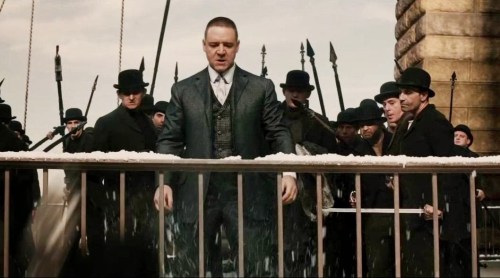
Russell Crowe as Pearly Soames with his droogies Short Tails

The author is not content to weave a tale around his maybe-doomed lovers, but offers us other couples to tote some of that emotional freight. We meet families at various points in their history. A tot in one section becomes a capitalist scion in another, for example. I will spare you too much plot summary, or a fuller list of characters. Even by my generous standards it would be excessively long. But I have included a link to such a blow-by-blow in the Extra Stuff section if that seems useful. Suffice it to say that in upstate New York there is a Brigadoon-like town known as The Lake of the Coheeries, and some pretty magical things take place there. No, you do not have to wait a hundred years before it appears. It actually does not appear on any maps, but can be accessed if you know how. It is the source for several of our additional characters, and some fabulously creative images. It lies beyond the crucible zone that surrounds the city, substituting a huge hill of ice and snow as a barrier for the white clouds that enclose the city farther south. The town serves as a fairyland version of the country, in the same way that Helprin’s vision of New York City (well, really, Manhattan. His vision of the city offers little for the other four boroughs than a Breughelian image of them as places to avoid.) is a fantastical version of the real place. But all this seems a maguffin for the real business here, which lies in the themes being addressed.

Themes
Mark Halperin has written a love song to New York, well, parts of it anyway. There is a stunning lyricism to his descriptions of the city, alive with romantic vision, yet also fueled by a dose of paranoia and class fear. But he is after bigger fish than venting his affection for The Big Apple or whatever nickname might apply in his alternate universe, a whole ocean’s worth. Small matters like free will, the nature of existence, the relationship between the rational and the spiritual, the nature of time, justice, mortality. You know, stuff.

Helprin argues that the spiritual must accompany the rational or the result is a soulless existence.

Well, we’ve been mechanized. We view ourselves as mechanisms. This is a trend since The Enlightenment. The Enlightenment, in my view, has two streams – a good stream and a bad stream. The good stream is the beauty of reason, to approach something via scientific method, via logic. The ugly part of The Enlightenment is that if you confine yourselves to those methods, then you are limiting yourself in terms of your understanding of what a human soul is. By necessity, because you cannot define the soul as it’s not subject to proof, human beings become mechanisms. Without faith, a person is a mechanism, and then there’s no reason he shouldn’t be treated or work under those assumptions, as a mechanism. – from Contemporary Lit interview

Is there some underlying logic to our universe, machines, physical, psychic or spiritual that whirr, turn and grind to support everything?

“Apart from natural laws, from the world as we know it,” Hardesty speculated, “maybe there are laws of organization which bind us to patterns that we can’t see and to tasks that we don’t perceive.”

And Helprin takes a long view of things

“Churchmen,” she had said, “like Boissy d’Anglas, burn themselves up in seeking, and they find nothing. If your faith is genuine, then you meet your responsibilities, fulfill your obligations, and wait until you are found. It will come. If not to you, then to your children, and if not to them, then to their children.”

Helprin posits a world or worlds in which the select few can see and access an underlying reality, and it is not clear that there is a path to this understanding other than dumb luck. One must wonder if the writers of The Matrix or promoters of born-again-isms had Helprin in mind.

her strength was not derived from things which can be catalogued or reasonably discussed. She had an inexplicable lucidity, a power to see things for what they were. Somehow she had come into possession of a pure standard. It was as if lightning had struck the ground in front of her and had been frozen and prolonged until she could see along its bright and transparent shaft all the way to its absolute source.

No, this is not taken from the Left Behind series and Bev was not bitten by an irradiated spider.

Brooklyn Bridge and God

The city as crucible, which we first see from a god-like view, looking down, is surrounded by an enormous and deitifically powerful white cloud. Unlike the low-hanging clouds in real NYC, which can make building tops appear to vanish when they pass through, this white cloud can actually take the things it touches. It makes the city into an almost-closed system that will experience both the deadly cold of extreme winter and intense heat from another source.

“…these winters have not been for nothing. They are the plough. The wind and the stars are harrowing the land and battering the city. I feel it and can see it in everything. The animals know it is coming. The ships in the harbor rush about and have come alive because it is coming. I may be dead wrong but I do believe that every act has significance, and that, in our time, all the ceaseless thunder is not for nothing.”

There is the potential for greatness in cities, this one in particular, but there must be a blood-letting in order to usher in a new golden age, and that seems perfectly fine for the god of this novel.

The notion of justice also comes in for considerable attention. Peter’s first craft is named “City of Justice.” Jackson Mead, a builder of bridges, says, “My purpose, in one word, is justice.” A significant silver tray that Hardesty Marratta (a significant character) cherishes in inscribed thus: “For what can be imagined more than the sight of a perfectly just city rejoicing in justice alone.” Peter engages in a quest for justice as well. In a passage about time, justice gets the final word

The universe is still and complete. Everything that ever was, is; everything that ever will be, is—and so on, in all possible combinations. Though in perceiving it we imagine that it is in motion, and unfinished, it is quite finished and quite astonishingly beautiful. In the end, or, rather, as things really are, any event, no matter how small, is intimately and sensibly tied to all others. All the lost ones are redeemed; the dead come back to life; the perfectly blue days that have begun and ended in golden dimness continue, immobile and accessible; and, when all is perceived in such a way as to obviate time, justice becomes apparent not as something that will be, but as something that is.

And it’s just tough luck on those who fall afoul of the currents of time. If you are rich, then I guess you were meant to be, and if you were dirt poor, well, sorry, it was always thus. It does strike me that this is a point of view that might be favored by those who have landed in the cushier seats.

Imagery
Be careful where you step. You may bump into another image. Gates figure large here. Both the literal gates that surround the Battery in lower Manhattan and a set of four psychic gates that cities are supposed to have, (resonating with the four parts of the novel) visible, of course, only to people who are very, very special. Color figures large. Pearly (whose name certainly reflects the seasonal milieu) is deeply affected by color and seeks it out by whatever means possible.

But, whereas the wall was white, the city was a palette of upwelling colors. Its forms and geometry entranced him—the orange blaze in clear upper windows; a gas lamp’s green and white bell-like glare; leaping tongues of fire; red-hot booming chambers in the charcoal; shoe-black horses trotting airily at the head of varnished carriages; peaked and triangular roofs; the ballet of the crowds as they took stairs, turned corners, and forged across streets; the guttural noise of machinery…sails that filled the ends of streets with billows of white or sharp angular planes, and then collapsed into the bordering buildings or made of themselves a guillotine

Blue and gold come in for particular and much-repeated attention. Stars shine brightly here as well, whether the actual universe of stars or their simulacra in a large chamber or a magical painting. Bridges and rainbows carry significance as well. Machines are also more than mere mechanisms.

description
Mark Helprin – image from NPR

Politics
In case you did not know, Helprin is a political sort, a conservative true believer who writes speeches for Republican leaders. His particular sensibilities enter here as well, as he offers the odd diatribe on how any sort of public assistance is a form of satanic temptation, leading good people astray and allowing bad people to milk the rest of us to support what is portrayed as a life of low leisure. He also has a vision of wide swaths of the lower classes as being purely bent on destruction, as if the race riots of the 60s had burned a hole in his vision and he was forced thereafter to see everything in the world through those altered lenses. It gets intrusive at times. At least he has the decency to balance his Ayn Randish laudatory portrayal of one mogul with an equally dark one of another (a Rupert Murdoch stand-in). And he does offer an interesting proposal for an ideal way to organize a company that speaks to a need for fairness, but which would never be tolerated in the real world by those whose mission it is to absorb ALL the wealth. He also harbors a view of criminality that is, to say the least, eccentric. That said, the political aspect, while present and occasionally toxic, could have been a lot worse.

In Sum
What is impressive about Winter’s Tale is the sheer volume of creativity on display here. His portrayal of a Dickensian sort of steam-punk New York was fascinating and effective. The Lake of the Coheeries is very effectively magical. But just as it is wonderful to enjoy a slice of cake, it can become a different sort of experience if one were to try devouring the entire thing. So it is here, a case of creativity run amok. The author wanders off. For example, after we have invested in Peter, Beverly and Athansor, Helprin sets them aside for almost two hundred pages to play in some other snow fields. Really? Helprin is at his weakest when attempting a sort-of slapstick humor. Those bits fall very, very flat. As do sections where a character acquires otherworldly powers. And Athansor’s propensity for arriving in the nick of time to save this or that one makes one wonder if he might have been a sort of deity made by one of the many machines that populate the story. If you have not yet read Winter’s Tale, prepare to make a special effort to keep track of the characters. There are many. And, oh yeah, lest you think the opening quote was purely gratuitous, there are resurrections here. Helprin is definitely thinking BIG.

You may find Winter’s Tale exhilarating and you may find it exhausting. You may feel enlarged by the beauty of the imagery and reduced by the occasional mean-spiritedness manifested by the author. You may feel intellectually stimulated by the grand notions portrayed, but deadened by the familiar trope of access being reserved only to the elect. You may feel deeply at the poetry of Helprin’s descriptions, (they certainly sing to me in my love for my home town) but may experience frustration that he takes so bloody long to get to the point. Winter’s Tale may leave you cold, or it may warm you to unimagined possibilities. But whether your reaction is pain, exultation or both, you will definitely react. Winter’s Tale has been called one of the 25 greatest American novels of the 20th Century. I do not agree, but I can see why some people think that. It is pretty clear that it is one of the most ambitious. I believe it would have been a better book with a tighter focus and about two hundred or so fewer pages. But, even though I have issues with the book I do believe that it is well worth reading. Winter’s Tale may not have completely warmed the cockles of my reader’s heart, but it is still pretty chill.

Posted on GR on February 28, 2014

==================================EXTRA STUFF

Interview with MH in The Paris Review and in Contemporarylit.com – This the source of the quote from the author used in the review

This review in the Thriving Family web site contains a detailed run through of the events of the book and a look at some of the imagery

Leave a comment

Filed under Fantasy, Fiction, Literary Fiction, Reviews

A Permanent Member of the Family – Russell Banks

book coverGiven the unsettled nature of the families in Russell Banks’ dozen stories, the title of his sixth short story collection, A Permanent Member of the Family, might have a bit of an ironic aroma to it. Marriage is, if anything, impermanent here. The title character in Former Marine had to raise his boys alone after their mother took off. Philandering, while not depicted, is noted as causative in the demise of several other relationships in the collection. And even when a marriage has not dissolved, it is often shown to be or to have been threadbare. There are a few stories where things marital are not seen, Blue, The Invisible Parrot, but the tendency is to the sorry state of home and hearth. It is not surprising that marriage has such a central place in the author’s work. His current marriage is his fourth.

all of us were fissioned atoms spun off nuclear families, seeking new, recombinant nuclei

Lines are drawn, and crossed. They separate before from after, denial from acceptance, uncertainty from realization. In Christmas Party, for example, a man is invited to the home of his ex and her husband for a party, and his underlying humiliation and rage must find an outlet before he can cross over from before to after. A singular event in the title story defines the place where the stretching of connections snaps.

book cover

Russell Banks – from Wikimedia

The characters here often face moral choices, a favorite concern of Banks. Faced with financial stress in his old age, a Former Marine must make difficult decisions in order to be able to continue providing for his children, and later, in order to protect them. In Lost and Found, a businessman at a convention is confronted with the time when he brought a woman who was not his wife to his hotel room, and the decision he faced then. In Searching for Veronica, a woman confronts the guilt she felt for turning out of her home someone who was at great risk in the larger world. The choices are never black and white.

Banks sets his stories largely in the upstate New York town of Keene, his current residence, near Lake Placid, and Florida, his other current residence, so his descriptions of place ring with authenticity. He has a background as a politically concerned sort (he tried joining Castro’s revolution, despite not knowing how to speak Spanish, but got no farther than Florida) and his appreciation for the struggles faced by working people is never far. He had a working class upbringing himself.

I think I inevitably end up feeling a special kind of sympathy for people whose lives are shaped and controlled and manipulated by people with more power than them. – from Harpers article

It is also pretty clear that he holds a less than fond opinion of the media, whether the whores are the media professionals or those who would use them to personal ends, as shown in Blue.

Banks has achieved a status as one of the top writers of his generation, with a dozen novels to his credit, including Continental Drift, Affliction, The Sweet Hereafter and Lost Memory of Skin. A Permanent Member of the Family is his sixth collection of short stories. I found these tales to be extremely well told. There are ironic twists, as every writer of short stories must have at least a bit of O Henry DNA floating about. Banks won an O Henry award for his short story collection Searching for Survivors. A few did not grab me, seeming somewhat obscure commentary on writing per se, but most presented relatable characters confronting real-world choices, or repercussions. Banks has a gift for detail, without cluttering the place up with too much. His style is straight ahead story-telling with less of the lyrical description some other writers employ.

The work of a seasoned pro, A Permanent Member of the Family merits at least a temporary place with yours.

===============================THE STORIES
Former Marine
Faced with the loss of his business and a need to support himself and help out his three sons, who far too conveniently are all in police work, a man takes to a life of crime.

A Permanent Member of the Family
A family pet does not go along with a splitting couple’s custody arrangements. An event regarding the pet defines where one family situation ends and another begins

Christmas Party
A man is invited to the Christmas party thrown by his ex and her husband, who are living the life he had hoped for. What to do with the rage? How to move on?

Transplant
A recent heart transplant recipient is approached by the widow of the man whose heart he received, wanting to hear it beat one last time. The heart may replace the one that stopped working, but cannot truly replace the one that was broken.

Snowbirds
While snowbirding in Florida, a woman’s husband dies. Instead of grief, she appears to feel liberated. And when a friend offers to come help her with arrangements she finds something more.

Big Dog
Seems like it would be a cause for celebration when a sculptor is awarded a Macarthur Fellowship, but his wife and friends seem more resentful than anything else.

Blue
After saving for years to be able to by a car of her own, a black woman in Florida finds herself accidentally trapped in a used car lot after hours, beset by a watchful pit bull.

The Invisible Parrot
A young man in a local store tries to imagine the experience of others there, but imagination is not quite enough. Is this the writer wondering about the ability of writers to imagine the experience of others?

The Outer Banks
A retired couple’s dog has passed away while they are RV’ing about the country. They stop at a beach in North Carolina to bury it.

Lost and Found
A man meets a woman he had almost slept with at a conference years before. He looks back on that decision.

Searching for Veronica
A woman is fearful that a person she tossed out of her house some years back has come to a bad end.

The Green Door
A questionable character in a bar is looking for a place where he can get unusual entertainment. The bar tender directs him, but faces another decision about helping or not helping the man later.

Review posted on GR – 12/29/13

==============================EXTRA STUFF

From December 12, 2012 Harpers – A Conversation with Russell Banks – by Jesse Barron

A wide-ranging interview in the Paris Review

A critical review of his work up to 2001

Banks reads his story “The Moor” on This American Life in 2000 – 19 minutes long, from the 40 minute mark in the program

A New York Times interview with Banks – 1/2/04 – Russell Banks – By the Book

Leave a comment

Filed under Fiction, Literary Fiction, Reviews, Short Stories

The Wind is not a River by Brian Payton

book cover

The Aleutian Archipelago: fourteen large and fifty-five small volcanic islands, strung over more than a thousand miles. Somewhere there, he’s alive. On good days, her faith overshadows doubt. And what is faith but belief independent of proof, a conviction that stands on its own. To this she knows John would roll his eyes. The thought makes her smile.

John Easley is missing. Shaken by the death of his RCAF brother over the English Channel, the 38-year-old writer determines to bring information to the people at home about what is really happening in the war. It seems so much more meaningful to him than reporting on bird migration for National Geographic. He feels he owes Warren at least that much. His wife, Helen, disagrees. Their last words before he took off yet again on a war-reporting mission were harsh, and final.

She is facing challenges of her own. Her father is not well, and she wants to be there for him. She is struggling with not having much by way of work skills and is stuck at a low-level job. John’s absence gnaws at her until, realizing that she still loves him, she decides to do everything in her power to find and bring him home. John had bailed out from a damaged aircraft over the Japanese occupied island of Attu. He struggles to survive in the treeless tundra. Helen struggles to find him.

book cover

Brian Payton – from his site

The story flips back and forth between the challenges John and Helen face. John has to figure out how to stay alive, and hidden from the occupying army. I was reminded of David Malouf’s excellent book, An Imaginary Life , about another person isolated in an arctic realm. Helen must figure out how to find John. Both face daunting tasks.

The Wind is a powerful, beautifully written, heart-wrenching love story, but sails well past any simple notions of romance. There is struggle here with the imagined instead of the actual partner. Does there come a time when imagination, whether fed by love or not, loses its sharp focus? How can love survive absence of the other? How far can love take a person when the odds are overwhelmingly against? Can love keep someone alive?

In addition to the compelling tale of a reverse Odyssey, one in which Penelope goes in search of Ulysses, Payton offers us considerable payload in his look at a little-seen part of WW II history. For those who thought that the last time the USA endured the landing of foreign troops was during the War of 1812, you have another think coming. Japan captured and occupied several of the Aleutian islands, and had plans to advance farther. News media of the time was subject to government censorship and the political leaders did not want it known that a foreign power had successfully invaded US territory. We are given a look at a remote and challenging aspect of the war. Along those lines Payton drops in bits of information. For instance, because the land was challenging as a place on which to build strong flat surfaces, a runway was constructed of metal matting cinched together. Another scene shows Americans dropping off planes for Soviet pilots to fly back to the USSR and use in the war on Hitler. We also get a look at the USO,

USO in the Aleutians
The USO sees action – from strangemilitary.com

and, chillingly, the treatment of local evacuees by the US military. So, food for the brain as well as the heart.

As for gripes, I have two. While the cover art is beautiful, it fails to let the reader know what this book is all about, focusing as it does on a single early moment in the story, and ignoring what follows. I was not all that thrilled with the ending. But that did not detract from the great joy that can be had reading this book. Your heart will get quite a workout. John Easley, a decent guy, is engaged in a prolonged life-and-death struggle, and Helen’s love takes on heroic dimensions. There is a large range of emotion from which to draw here. Uplift to be experienced, delight in beauty of various sorts, appreciation for the sacrifices of some, anger, sadness and disappointment as well. Bring your hankies. The love that Brian Payton portrays glows even brighter against the spare environment in which it is set.

Publication Date is January 7, 2014

Review posted 12/16/13

=======================================EXTRA STUFF

Links to the author’s personal, Twitter and FB pages

The American Booksellers Association named the Wind is not the River a January ’14 Next List pick

Mention is made in the book about John Huston making a documentary of the military campaign in the Aleutians. Here is the film, Report from the Aleutians. It clocks in at 43:13.

A shorter (17:26), color version can be found here

Here is a map of the Aleutians that seemed too tough to read to fit the image into the body of the review

The National Park Service also has some interesting information about the Aleutians here

Leave a comment

Filed under Fiction, Literary Fiction, Reviews

Catching Fire by Suzanne Collins

book coverSparks fly in the second volume of Suzanne Collins’ blockbuster Hunger Games trilogy, Catching Fire. Victory in the 74th games has not been all that sweet for surprise double-victors Katniss Everdeen and Peeta Mellark. And it is extremely sour for the reigning government. Katniss had shown them up big time when she publicly defied the gamemasters to keep from having to kill Peeta, an act of sedition as much as it was an act of courage and honor. President Snow burns with rage at Katniss for showing up the games, the Capitol, and him personally. He recognizes that it is necessary to give the subjects of his government some hope, but Katniss and Peeta have provided a spark to the tinder of popular resentment, and Snow needs to forestall a conflagration.

description
The author

Katniss is not in a good place back in District 12 after the games. Yeah, she has a nifty new house in the victor village, and her family is well taken care of, but she is experiencing a fair bit of PTSD. Collins describes Kat the victor.

She has nightmares. She has flashbacks. And in the beginning you can see she’s practicing avoidance. She’s completely pushed Peeta to arm’s length, you know? She’s trying to stay away from him. Why? Because everything associated with him except some very early childhood memories are associated with the Games. She’s conflicted to some degree about her relationship with Prim because she couldn’t save Rue. So she’s dealing with all that, and her method of dealing with it is to go to the woods and be alone and keep all of that as far away as possible, because there just are so many triggers in her everyday life. – from the Time interview

Part of the requirement for games winners is to go on a Victory Tour across all the districts. One of the soft spots in the logic of the story is that President Snow would think for a second that parading across the defeated districts the youngsters who had killed their children was anything but a guaranteed recipe for disaster. It is believed that Katniss’ popularity and selling the lie of her death-defying love for Peeta would gain some love for the Capitol, and would dampen public unrest. Sure, whatever. Of course, Katniss manages to fan the flames of the people’s unhappiness with things as they are by her acts of kindness and respect for some of her fallen competitors and their families. As her popularity grows, the pin she wore in the 74th games, the mockingjay, spreads as a symbol of resistance. I am sure Emily Dickenson would approve. Time for Plan B.

description

With his hopes for a palliative Victory Tour in ashes, Snow come up with another plan. How better to douse the embers of hope than to destroy all those who would fan the flame. So, for the 75th games, instead of a new crop of potential contestants, children between 12 and 18, from whom game contestants might be selected, he decrees that this time the tributes (those selected) will be chosen from the pool of prior winners. Hell-uh-oh, Kat and Peet, this means you-oo. Hell hath no fury like a president scorned. There is no law, only power, and Snow aims to char those caught, or even suspected, of playing with matches. And if crushing the Hunger Games victors from all twelve districts crushes the rebellious spirit of the people, well, may the odds be ever in your favor. Of course, we all know there is a third volume in the series, so I am giving nothing up by reporting that the plan goes up in smoke.

description

There are many notions in play in Catching Fire, among them visions from the classical world of Greece and Rome. The whole notion of the games was taken from the Greek myth of Theseus and the Minotaur. King Minos of Crete had issues with Athens. There are varying accounts of how this came to be, but the accounts agree on the arrangement that was made. Athens was forced to send seven boys and seven girls to Crete every nine years to make a nice snack for a Minotaur, who resided in a labyrinth constructed by Daedelus. The kids are sent, but Theseus, an Athenian prince, wanted to get rid of the Minotaur, and thus the need for kid-burger specials, and so inserts himself in place of one of the young’uns. He gets some help from Cretan princess Ariadne, who offers a way for the children to escape the Minotaur’s maze after Theseus, hopefully, dispatches the beast. Her solution is significant here, beyond the classic story, as the unraveling of string, of a sort, figures large in Catching Fire in helping out the tributes.

Katniss Everdeen grew from a raw teen in Book I to become a warrior. She grows stronger still in Book II, overcoming her fears and miseries, growing in strength, even while accepting that her fate was likely sealed. She is a gladiator, thrown into an arena to do battle for the pleasure and control of the rulers. And another classical notion comes in here, the slave warrior leading a rebellion. Katniss, by defying the Capitol in Book I and by her actions this time, has become the face of popular resistance, whether potential or kinetic.

There are contemporary issues that resonate as well. Collins said:

The Hunger Games is a reality television program. An extreme one, but that’s what it is. And while I think some of those shows can succeed on different levels, there’s also the voyeuristic thrill, watching people being humiliated or brought to tears or suffering physically. And that’s what I find very disturbing. There’s this potential for desensitizing the audience so that when they see real tragedy playing out on the news, it doesn’t have the impact it should. It all just blurs into one program. – from Scholastic article

And it is not exactly news that we are increasingly living in a world in which the one-percenters get to live lives of obscene luxury while working people are denied basic rights. The ancient Roman practice of eating to excess, then using a vomitorium to make room for even more indulgence is brought up in Collins’ vision as a very telling link between decadence old and new.

And then there is the romantic element. Peeta is a wonderful guy, pure soul, gifted communicator, smart, strong as an ox, loves her, but, while she may find him attractive as a friend, does she find him attractive enough to throw over her childhood sweetheart, Gale? The pressure is unspeakable as the President, in order to save his own face, is insisting that she and Peeta make good on their cover story from their first game together. At the end of the 74th, Katniss had threatened pairs-suicide if the rulers insisted on having a single winner, and she prevailed. But the Capitol sold it as a manifestation of her love for Peeta, while the reality had been that she had stood up against the Capitol rulers. She agreed to help sell the lie after the games in order to keep bad things from happening to her family. Peeta and Katniss have to cope with the public lie of their being a couple, but must also contend with the fact that they really are very fond of each other. Add in another hottie in the shape of the studly Finnick Odair (a tribute in the 75th) and the potential for emotional imbalance is considerable.

Some of Collins’ secondary characters get to spread their wings a bit, most particularly the District 12 mentor, Haymitch Abernathy, who gets to do a lot but much of his activity is told after the fact rather than shown. The president, Coriolanus Snow, gets to strut and fret his hour upon the stage, issuing threats mostly. I expect it is no accident that the president’s given name is the same as that of a Roman consul notorious for his low opinion of the ruled.

Ok, I really enjoyed this book. I do have one gripe, though. Really, you knew there would have to be one. The Hunger Games story is really one long tale, and in order to keep from having to sell the book with its own set of wheels so you can tote it around, the publisher has divided it, like all Gaul, into three parts. (Unlike the greedy film makers who are taking it a step further and making four films out of a trilogy) And while it may make sense for this volume to have ended where it did, it seemed to me that it went from full on action to see ya next time in an awful hurry. That’s it. That’s my gripe. I had originally intended to make this a four-star rating, but on further consideration, in light of what Collins has done in terms of looking at real issues in a serious way, while offering top-notch entertainment, bringing in cultural foundations, and for making me root for a teenager to do something other than get a bad case of zits or run afoul of a serial killer, I am upping it to five. Catching Fire sizzles.

=======================================EXTRA STUFF

An excellent cheat sheet to catch you up on what happened in the first book

An interview on Scholastic.com

Neat bit on Theseus and the Minotaur in an SC interview in the School Library Journal

The five part Time interview

Part 1
Part 2
Part 3
Part 4
Part 5

SC’s site


2 Comments

Filed under Fiction, Literary Fiction, Reviews, YA and kids

The Enchanted by Rene Denfeld

book cover

What matters in prison is not who you are but what you want to become. This is the place of true imagination.

Rene Denfeld, the author of The Enchanted has the heart of a warrior and the soul of a poet. She has written a novel about identity, understanding, the roots of crime, the reality of prison life, the possibility for redemption, and the ability of people to use imagination to rise beyond the purely material to the transcendent. There are three primary and several very strongly written secondary characters whose stories are interwoven.

In the death row of a stone prison somewhere in America, a nameless inmate, entombed in a lightless dungeon, has constructed a fantastical appreciation for the world he inhabits, bringing a glorious light into his Stygian darkness.

The most wonderful enchanted things happen here—the most enchanted things you can imagine. I want to tell you while I still have time, before they close the black curtain and I take my final bow.

In reading, he has the freedom his external circumstances preclude. And he interprets his surroundings through a magical lens. The rumblings of tectonic activity become golden horses racing underground. He sees small men with hammers in the walls (a particularly Lovecraftian notion) and flibber-gibbets, beings who feed on the warmth of death itself. He visualizes his very sweat rising to join the atmosphere and raining down on China. He is also able to perceive feelings and needs in others, observing from his isolation, and offering a bit of narrator omniscience. That he is able to find enchantment in this darkest of situations is breathtaking. I was reminded, in a way, of Tolkien’s Gollum, the battle between the darkness and the light within a single being. But enchantment is not reserved for the inmate alone.

description
Rene Denfeld

An investigator, known only as The Lady, is working on the case of a prisoner named York. After being on death row for twelve years, York had decided to abstain from any further appeals. The Lady had been hired by York’s attorneys to look into his case. We follow her as she unearths a horrific past that helps explain how York came to be where and who he is. She has a history of her own that informs her ability to relate to her clients. Once upon a time she needed a redoubt of her own.

What did she think about during those endless hours in the laurel hedge? As a child, she made an imaginary world so real that she could feel and taste it today. Sometimes she would imagine that she and her mom lived on a magical island where the trees dripped fruit. Other times they traveled all over the world, just the two of them, like the best of buddies. In all the stories her mom was whole and she was safe. When she left the laurel hedge, she would bend the thick green leaves back, to hide where she had been. And when she came back the next day, crawling with a sandwich she had made of stale bread with the mold cut off, and hardened peanut butter from the jar, the magic would be waiting for her.

She has enchantment in her adult life as well, while pursuing her investigation, as she is dazzled by some of the natural beauty she encounters.

A fallen priest tends to the spiritual needs of the inmates, but he guards a secret that he desperately needs to confess. While he offers what comfort he can to the inmates, who can really see him? Who can forgive him?

Much of this novel is about seeing and being seen, of crime, punishment and forgiveness. The Lady’s role is to see the prisoners, see their history, see what lies beneath the awful exterior. She is respected and admired, but not much seen herself. Many of the inmates and guards get by precisely because they succeed in remaining unseen. Prison is a dangerous place in which to be seen. Those who see might use that vision for dark purposes.

Denfeld lifts a wet rock to reveal the maggot-ridden structure of unofficial prison governance, the corruption and cruelty that permeates this world, even with a fair warden nominally in charge. Corrupt guards ally with brutish alpha inmates for their mutual gain. There is considerable detail about prison life, including such things as why metal food trays are used instead of plastic, how the bodies of the deceased are handled, what events are considered disruptive and what are considered ameliorative, and even some history of the prison, including reasons for elements of its design. She also looks through the eyes of the warden and the guards, offering keen insight.

The story lines include learning what The Lady discovers as she looks into York’s past, following the travails of a new, young, white-haired prisoner, seeing how corruption in the prison operates, and accumulating bits of the nameless prisoner’s story.

There are indeed monsters inside the stone walls, as there are monsters without, both drawn to the despoiling of innocence and beauty. But in this pit of ultimate despair, where all hope is lost, there is magic of another sort. Life may be harsh and death may be near, but welcoming the golden subterranean steeds, attending to the little men with hammers, imagining elements of one’s self traversing the planet, traveling along with the characters in a book, seeing, really seeing others, can lift one beyond the cares of the physical world.

Can there be redemption for the horrific crimes these condemned men have committed? Should they die for their crimes, whether they want to or not? Might it be a harsher punishment, even crueler, to keep them alive?

Denfeld has a considerable history. She is an investigator for death-row inmates, and thus the model for The Lady. Her knowledge of the prison world is well applied here. She wrote a piece for the New York Times Magazine on the impact on children of being raised by cognitively impaired parents, a subject that is significant in the story. In addition, her 2007 book, All God’s Children informs her knowledge of the often violent world of street families, young criminals in particular. She is also an amateur boxer. I would not mess with her.

This is simply one of the most moving books I have ever read. Not only is the material heart-breaking, but the language Denfeld uses in her descriptions, the gentle magic of the imagination with which she imbues some of her characters is poetic and stunning.

I hear them, the fallen priest and the lady. Their footsteps sound like the soft hush of rain over the stone floors. They have been talking, low and soft, their voices sliding like a river current that stops outside my cell. When I hear them talk, I think of rain and water and crystal-clear rivers, and when I hear them pause, it is like a cascade of water over falls.

While there is enough darkness in The Enchanted to fill a good-size dungeon, it is the moments of light, the beauty of language and imagination, and the triumph of spirit that will cast a spell over you that will last until you shuffle off this mortal coil.

The Enchanted will be available March 2014

This review was posted November 4, 2013

=====================================EXTRA STUFF

The author’s web site web site

The author’s Facebook page

2 Comments

Filed under Fiction, Literary Fiction, Reviews

The Salinger Contract by Adam Langer

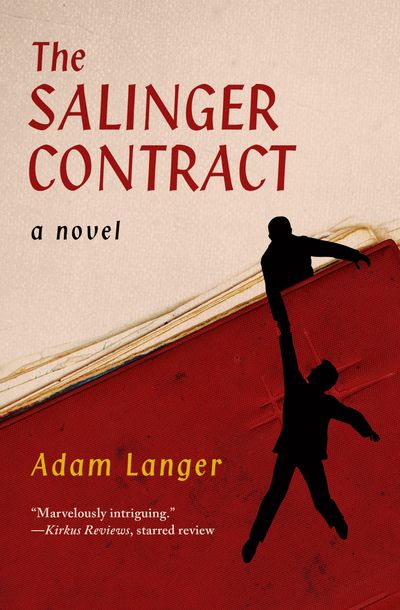
book cover

Whenever I saw Salinger’s novels or story collections on my friends’ bookshelves, or when I heard authors…talk about how much they admired the guy, I wondered how those books could have influenced them so greatly. I wondered too how Mr. Salinger—in seclusion for more than forty years in Cornish, New Hampshire—felt about the readers who admired his work. If somehow knowing he had touched Hinckley and Chapman and, later, Jared Lee Loughner, who shot Congresswoman Gabrielle Giffords, had convinced him that escaping society had been the right move. I wondered how it would feel to write something—a story, a novel, an article—that would inspire someone to change his or her life for better or worse.

There are questions raised in The Salinger Contract about where the responsibility of the author leaves off. Would Salinger have written his books had he known they would inspire murderous lunatics? Would it have made any difference at all? Maybe those sorts would have just found the same inspiration somewhere else, and the rest of us might have been deprived of some pretty good reading. The question becomes less than academic here.

description
The Reclusive One

Another notion is causality in writing. In an interview with Alexandria Symonds in InterviewMagazine.com, after talking about a proposal by a Hollywood sort that he write a new version of Murder, She Wrote, Langer says:

It’s such a cliché to have the writer who writes about crime turn around and solve them. I thought that was a lame idea, and I didn’t write anything for him, but it did occur to me to completely reverse the polarity on it and come up with an idea of a writer whose books become the basis for crimes.

Ever wonder why famous writers vanish during periods we believe to have been creatively fallow? Langer did, and offers one possible answer. Conner Joyce is a writer of crime fiction. But sales are not improving, as attested by the light turnouts on his book tour, and sliding sales. His family finances are not what they should be and his marriage is not exactly the steadiest. So, when a mysterious billionaire, Dex Dunford, offers him a considerable sum to write a novel just for him, and for him alone, Conner is tempted.

I had friends who were fairly prominent in the literary world who would meet some guy who did not have an apparently interesting life story but who would say, “I will give you double what you normally make for your book. Write my life story.” And if you don’t have a trust fund or residuals, it becomes a very tempting sort of offer. – from the Symonds interview

Of course, as with any such deal, there are conditions, secrecy being prime among them. Dex comes complete with a large bodyguard/enforcer named Pavel Bilski. (think a larger version of Steven Bauer as Avi on Ray Donovan, then add a few inches and fifty pounds), so telling would be a definite no-no.

One of the things Langer is addressing here is the notion of the boundaries between art and reality. Where one leaves off and the other begins takes concrete form when Langer casts himself as a character in the art he creates. This technique is hardly novel here, calling to mind, among many others, Charlie Kaufman in The Orchid Thief /Adaptation, Jonathan Ames of Bored to Death, Dante as a visitor to several realms in tales that range from the infernal to the paradisiacal, and John Fowles in The French Lieutenant’s Woman. Langer, the character, had had a bit of time in the limelight while running a New York based literary magazine. He was known for the many interviews he had conducted, and profiles written of authors. Things in the publishing industry being what they are these days, Langer, the character, finds himself trying to work on his personal writing projects while serving as a house-spouse in Bloomington, Indiana, where his wife is teaching at a university, the Lit mag having gone the way of many publications. Real Adam was a senior editor of Book Magazine until it folded. Fictional Langer had written a profile of Joyce back in the day and when the author makes a book-tour stop in Bloomington, the two get together. Langer, the character, is the eyepiece through which we see Conner’s experience, which is the primary plot track.

description
Adam Langer – the real one

One of the fun elements in the book is the author’s look at the publishing industry, offering payload on the significance of literary whales, some detail on the experience of book touring, intel on top editors, and the sort of portrait one might expect of a popular author of junk books. Particularly fun was Dex talking about the household name authors who had taken him up on his offer over the years. While you may get a chuckle here or there, this is not a laugh-out-loud sort of satire, but a darker, substantive look at questions that matter in the world of writing and publishing. I enjoyed it for that as much as anything. There are also larger issues in play; what is truth and what is fiction, what are we willing to do for money, what responsibility do authors have for what readers do with their work. There is also a brief look at politics in academia, but that was pretty familiar territory, so did not offer much that was new, although it was entertaining. Fans of the late TV show, 666 Park Avenue will find a Drakian thing or two to enjoy. And residents of Chi-town will appreciate the many local references, by Chicago native Langer.

I did find, at times, that there were notions proffered that were problematic, for example

In my experience, every criminal would be an artist if he had the talent, and every artist would become a criminal if he had the guts; in my case, it took an artist to teach me how to be a criminal.

Really? Rather a broad generalization, no? And later

Maybe the reader understood more about a book than its writer ever did. Maybe you know more about me from reading this sentence than I ever could.

While there may be something to the notion that once a story has been published into the world, the world will decide what it means, the fact remains that authorial intent is real, and it would be the rare exception, IMHO, for a reader to grasp an author’s intent more clearly than the author herself.

So, does it all work? Well, there are some stretches to be made, some disbelief to be suspended, but The Salinger Contract is a fun, fast-paced, engaging read, with a core of serious and satiric content wrapped in a shell of adventure. If you need to hide away for a while, this would be a good book to take along.

Posted October 25, 2013

I received this book via GR’s First Reads program – Thanks guys!

====================================EXTRA STUFF

A Wiki profile of the author, the real one

Twitter for Langer

An article by AL – How I Learned Not To Be J.D. Salinger

The InterviewMagazine.com Adam Langer is not in Hiding – must-read material

Leave a comment

Filed under Fiction, Literary Fiction, Reviews