Category Archives: Fiction

Atlas of Unknowable Things by McCormick Templeman

book cover

…the world seems especially chaotic and violent to me lately, like basic human decency has gone out the window. Most days I think I’m imagining it, but some nights I wake up with this certainty that it’s real, almost like there’s this slow leak of evil drifting out into the world tainting everything it touches.

I began to understand. I had stepped through a veil of sorts. Hildegard wasn’t like other places. There were rules here I didn’t understand. There were puzzles and clues and mysteries, and even though I felt an almost immediate and palpable sense of danger, some part of me was excited. I’d spent my entire life waiting for something to feel real, to feel important. I’d always wanted to feel at the center of something truly grand. And though I couldn’t say definitively that what was happening to me was necessarily grand, at least it was something.

As for the title, it turns out many of the things at issue are indeed knowable.

Post-grad Robin Quain is going through an identity crisis. She had a bad experience with a bf who had stolen her research to publish as his own. Then she is staying with her cousin, Paloma, in New York when her roomie goes suddenly suspicious and hostile, adding to her disorientation. Robin is looking into the possibility that the witch trials were actually an attempt to squash a long-standing established religion. She finds a clue that might lead her to a great discovery, a particular artifact. While doing this she learns that a woman has died and another, one linked to her research, has gone missing. Both were near a small college in Colorado, one that has an impressive library that might help her find what she seeks, one where the missing woman had taught, one where Robin is now accepted for a summer residency, and the game is on.
description
McCormick Templeman – Image from Lighthouse Writers

Hildegard College really does seem like a game site, not just to us as readers, but also to Robin as a character. The story has a video game feel, find hidden clues, pick up weapons/tools, advance a level, answer riddles, repeat. But she feels less than entirely safe, or welcomed.

I felt like a fawn isolated from the herd as a pack of wolves slowly surrounded it, closing in, preparing for the sacrificial feast.

The student body is gone for the season, leaving the staff, professors mostly. They have a surprising history of connection with the institution. They also seem a particularly unusual collection of brains and beauty.

There is more at stake than the particular bit of history/lore that she is delving into. There are mysteries aplenty in the Rockies, including just what the hell is going on at this very eccentric tucked-away place. It is definitely something significant. There are many hints of things that might be considered supernatural, paranormal, or mythical. (Templeman has a PhD in English lit with a specialty in 19th century horror, so this fits right in) Strange flashes of light and howls in the woods, death of a local from mauling by an unidentified animal, sirens that go off in the wee hours that are most definitely not sounded to warn of loose guard dogs, large horned beings that appear in bedrooms, an island to which no one is allowed access, you know, stuff. Is Robin being paranoid? Is she being paranoid enough? Templeman provides plenty of red-herring clues that keep us guessing. Witches? Vampires? Werewolves? Ghosts? What?

The book makes several mentions of the dubious line that divides science from magic, a major thematic thread.

“Witchcraft and science aren’t as far apart as we’d all like to believe. Some say the supernatural is just natural phenomena for which we don’t yet have a scientific explanation.”

…is it possible to perceive a glimmer of the factual and historical within mankind’s persistent attraction to the supernatural?

…where are we? Where are we really?” In the depth of the night, the trees seemed to be moving in our direction. Or was it something else? He kissed my forehead. “Oh, sweetie, we’re in the place monsters come from.” “Monsters are real?” “They always have been. You just need to venture far enough out into the woods.”

It is not just the line between science and myth that is at issue, but the line between reality and something other. Robin has a real identity challenge, which makes this a more complex than usual journey of self-discovery. It runs the risk of making Robin an unreliable narrator.

There is a lot to enjoy IN Atlas, particularly the research nuggets that enrich the narrative. Templeman fills us in on elements relating to Joan of Arc, Scottish witch trials, ancient religions, a full bouquet of botanical skinny (a PhD in Chinese medicine no doubt helps Templeman here), tarot-like divination, and plenty more.

Robin’s difficulties at the school include a newfound proclivity for somnambulism. This seemed a bit overused, as Robin flits between this and that state whenever it seems convenient for the story to progress. There is a struggle Robin goes through that, while key to our suspension of disbelief, I found less than persuasive. This knocked it down a notch for me. But overall, the genre bending in Atlas is fun. The suspense is palpable. The fodder for imagination is voluminous. The scientific and historical knowledge on display is colossal. Robin is an appealing academic every-woman, a truth-seeker in a challenging place, and thus we can engage with her. It is a knowable thing that Atlas is a fun read that will keep you googling references and flipping pages.

Sometimes no rescue is possible—not when you’re the problem.

Review posted – 10/17/25

Publication date – 10/07/25

I received an ARE of Atlas of Unknowable Things from Saint Martin’s Press in return for a fair review. Thanks, folks, and thanks to NetGalley for facilitating.

This review is cross-posted on Goodreads. Stop by and say Hi!

=======================================EXTRA STUFF

Links to the Templeman’s personal, Instagram, and Goodreads pages

Profile – from her site

McCormick Templeman is a writer, editor, and scholar. A former professor, she has taught a variety of courses in English literature and creative writing. After graduating from Reed College (go Griffins) with a BA in English Literature, she went on to earn an MFA in Creative Writing from Naropa University, and a PhD in English and Literary Arts from the University of Denver where, in addition to creative writing, she specialized in 19th century horror and depictions of medicine in literature.

Possessed of a lifelong interest in the healing arts, she worked for a time as a licensed acupuncturist and herbalist and ran her own clinic in New York City. She holds a doctorate in acupuncture and traditional Chinese medicine from Pacific College of Health and Science, a certificate in plant medicine from Cornell, and she is currently working toward becoming a clinical mental health counselor.

Interviews
—– Dennis James Sweeney’s Substack 2025 – Two Questions with McCormick Templeman, author of Atlas of Unknowable Thing
—–In Walks a Woman – Atlas of Unknowable Things by McCormick Templeman / Special Guest Dr. Rachel Feder – audio – 58 minutes

Items of Interest from the author
—–Eater of Books – Blog Tour Guest Post with McCormick Templeton, Author in Slasher Girls and Monster Boys in which MT lists her top ten under-the-radar horror films
—–Google – preview

3 Comments

Filed under Fantasy, Fiction, Horror, Mystery, Thriller

The October Film Haunt by Michael Wehunt

book cover

Jorie vanished from the scene, from the entire internet. Her connections, her film production and book deal, the screenplay she sold, her agent, the October Film Haunt brand, the two hundred thousand followers scattered across social media—everything drained out of her life a long time ago. She hasn’t so much as watched a trailer for a scary movie since.

“Until it became real. I don’t know if it’s evolution or some Lovecraftian construct, but what is it to know something, really? Belief leads us to something more real than knowing, Jorie. Have you not noticed that everywhere lately?”

Sometimes “belonging” is not such a wonderful thing.

The October Film Haunt is not a book for everyone. If you are a nerd-level horror maven, this will be a bloody fabulous read, with links, left, right, center, up, down and all around for you to catch and relish. For those of us who are just folks who like reading some horror books, it can be disjointed, confusing, and potentially unsatisfying.

About a decade back, Jorie Stroud, a nod to Halloween’s final girl, Laurie Strode, and two friends formed The October Film Haunt. Their schtick was to go to places where horror movies had been filmed, and scope them out for atmospherics, filling their site with reportage and recordings of their outings. Could real places be as creepy or even creepier than the flicks that were made there? Unfortunately, they went a step too far with an indie film, called Proof of Demons, suggesting that there might be more reality to that film than was justified. As a result, some foolish teens tried something out that they should not have, and one of them died.

description
Michael Wehunt – Image from Pseudopod

There was blowback, and Jorie’s film ambitions, of any sort, were buried under a caul of notoriety. Then there was another death in the ripples from the initial fatality. Jorie has lived all these years with a heavy burden of (deserved) guilt. Then one day, a VHS package arrives, a trailer for what appears to be a sequel to the Proof of Demons film that had sparked all the trouble. Why? And why send it to Jorie? Is someone trying to punish her?

The primary stream of the story is final girl Jorie enduring the assaults on her sanity, her person, and those close to her. Who is doing this to her, and why? Is the mysterious PoD director, Helene Enriquez, making a sequel and somehow forcing Jorie to be a part of it?

This novel plays with several horror sub-genres simultaneously. The found-footage form, epitomized by The Blair Witch Project, is one. That film marketed itself as being based on real-world footage left behind by missing documentarians, that was discovered and cobbled together into a narrative. It was nothing of the sort, of course, but many people bought into the PR, which included a documentary style TV special and a website claiming the people who had shot the footage were really missing.

Wehunt adds slasher and demon-possession into the mix. He imbues the former with the sort of faceless, mindless killing machine aspect we would expect of Michael Myers, substituting sheets for disturbing masks. We are not talking KKK sheets here, which should be feared, but hospital sheets (maybe to be feared for different reasons?) featuring crowns worn beneath the bed linen for which the unusual outerwear seems ill-designed. And offers wrinkles on the demon possession motif by blurring the lines between possessor and possessed,

I wanted the book to be, you know, secular. I really wanted to avoid the priest vs. demon Abrahamic Christian typical dynamic of a demon possession story. – from the Talking Scared interview

while tossing into the genre blender cursed films. It is pretty much a part of this story that seeing the VHS tapes that are making the rounds can be lethal for the viewers. Home invasion? Sure, plenty of that. Cult madness? Yup. And probably more.

There are other characters who travel along this dark path with Jorie. Coleman’s brother, Jackson, went missing when he was a kid, in circumstances eerily resonant with the Proof of Demons film. He gets dragged in by a vague promise to find his brother, and maybe rid himself of his cancer.

I wanted to be there as someone who just doesn’t, horror is not on his radar. It’s never been an interest of his. He’s almost 60 years old. He’s not going to become a horror fan now. But he’s chosen for this one element of the book. And so he would have no touchstones.He would have no easy point of reference for the things that are happening to him. And simultaneously, he has been diagnosed with stage four cancer. So, things that happened to his body would to him sort of feel like it’s the cancer, isn’t it? – from the Talking Scared. interview

Beth Kowalczyk was the other survivor of the October Film Haunt trio. Jorie reconnects with her, after a very long estrangement, hoping to gain some support and understanding.

Trevor Henderson created the Pine Arch Creature for the film.

He cheered the modern legend leaking out of the film—but soon became uncomfortable and spoke out against it. “It was a really cool folklore for a minute there,” Henderson says. “A great monster that lingered with you…But then people were pushing these rituals. Some of them were like self-harm. It wasn’t just for fun anymore, so I checked out…Looking back, I can see the root of that kind of thinking that’s everywhere now, that sort of desperation to believe anything you want even when the reality is right there. There’s a difference between make-believe and post-truth. One of them isn’t dangerous.”

Roger Eilertsen was the character actor who played the PoD lead, lending gravitas to the role. He is in his 80s now, and it is unclear why he is being troubled by the sorts of intrusions endured by all the main characters. And the intrusions are considerable, beginning with delivery of a VHS tape and progressing to stalking, home invasion, unwanted filming, assault, kidnapping and worse.

The primary conceptual question that gives this book weight is the notion that belief can create reality. A very different example of such is the musical, The Music Man in which a conman persuades the kids of a midwestern community that they really can play the instruments he has only been pretending to teach. Lo and Behold, the parents somehow perceive their kids as having actually learned to play and construct an idyllic image of their new town orchestra that sounds great to them. But that perception is clearly in the eyes of the receivers. The paranormaling of the world here is quite real. There is plenty that could be made of this in a political analysis, but Wehunt claims no interest in that, so I will take a pass, well mostly, Pathetic followers of QAnon believe some pretty outrageous bullshit, and act on those beliefs in the world. Not to mention the daily flood of lies and provocations spewing from the current administration. And their attempts to create the reality of their fantasies.

The fear level is considerable as common horror trope rules are disregarded and thus expectations are thwarted. The apparent mindlessness of the cult behavior is inexplicable. Not that real-world cult behavior is necessarily understandable. Questions abound, primarily why? Why was this person dragged in to this bizarre undertaking? Why that one? I found the answers less than satisfying. The lines between reality and something else grow increasingly smudged. The portrayal of the Pine Arch Creature, also literally smudged, may offer a suitable metaphor. As does the literal eye in the sky, whether it represents a deity, a film director, or a voyeur. Metafiction can be a difficult thing to pull off, particularly as it makes it a challenge sustaining a reader’s interest in the characters when one so frequently points out the literary and structural underpinnings of the story itself.

There are plenty more details for you to find for yourself, a virtual cornucopia in fact. And catching the references can definitely be fun. But it all seemed too much for me. As noted above, if you are a horror maven, have at it. Enjoy! But it was form over substance, over fear, for me.

“Until it became real. I don’t know if it’s evolution or some Lovecraftian construct, but what is it to know something, really? Belief leads us to something more real than knowing, Jorie. Have you not noticed that everywhere lately?”

Review posted – 10/10//25

Publication date – 09/30/25

I received AREs of The October Film Haunt from Saint Martin’s Press in return for a fair review. Thanks, folks, and thanks to NetGalley for facilitating.

This review is cross-posted on Goodreads. Stop by and say Hi!

=======================================EXTRA STUFF

Links to Wehunt’s personal, FB, Instagram, and Blue Sky pages

Profile – from his site

Michael Wehunt grew up in North Georgia, close enough to the Appalachians to feel them but not quite easily see them. There were woods, and woodsmoke, and warmth. He did not make it far when he left, falling sixty miles south to the lost city of Atlanta, where he lives today, with fewer woods but still many trees. He writes. He reads. Robert Aickman fidgets next to Mary Oliver on his favorite bookshelf.

Interviews
—–Cinemachords – The October Film Haunt Author Michael Wehunt Talks Fandom, Urban Legends, & Digital Mythologizing
– Howard Gorman
—–The Nerd Daily – Q&A: Michael Wehunt, Author of ‘The October Film Haunt’ by Elise Dumpleton
—–Talking Scared – 255 – Michael Wehunt & What If A Horror Film Broke Into Your House? – open in podcasts – then transcript is available

Items of Interest
—– The Philip Experiment: A Benchmark in Paranormal Research by C. Wesley Clough
—–Wikipedia – The Medium is the Message
—–Wikipedia – metafiction

Leave a comment

Filed under Fiction, Horror

Life, and Death, and Giants by Ron Rindo

book cover

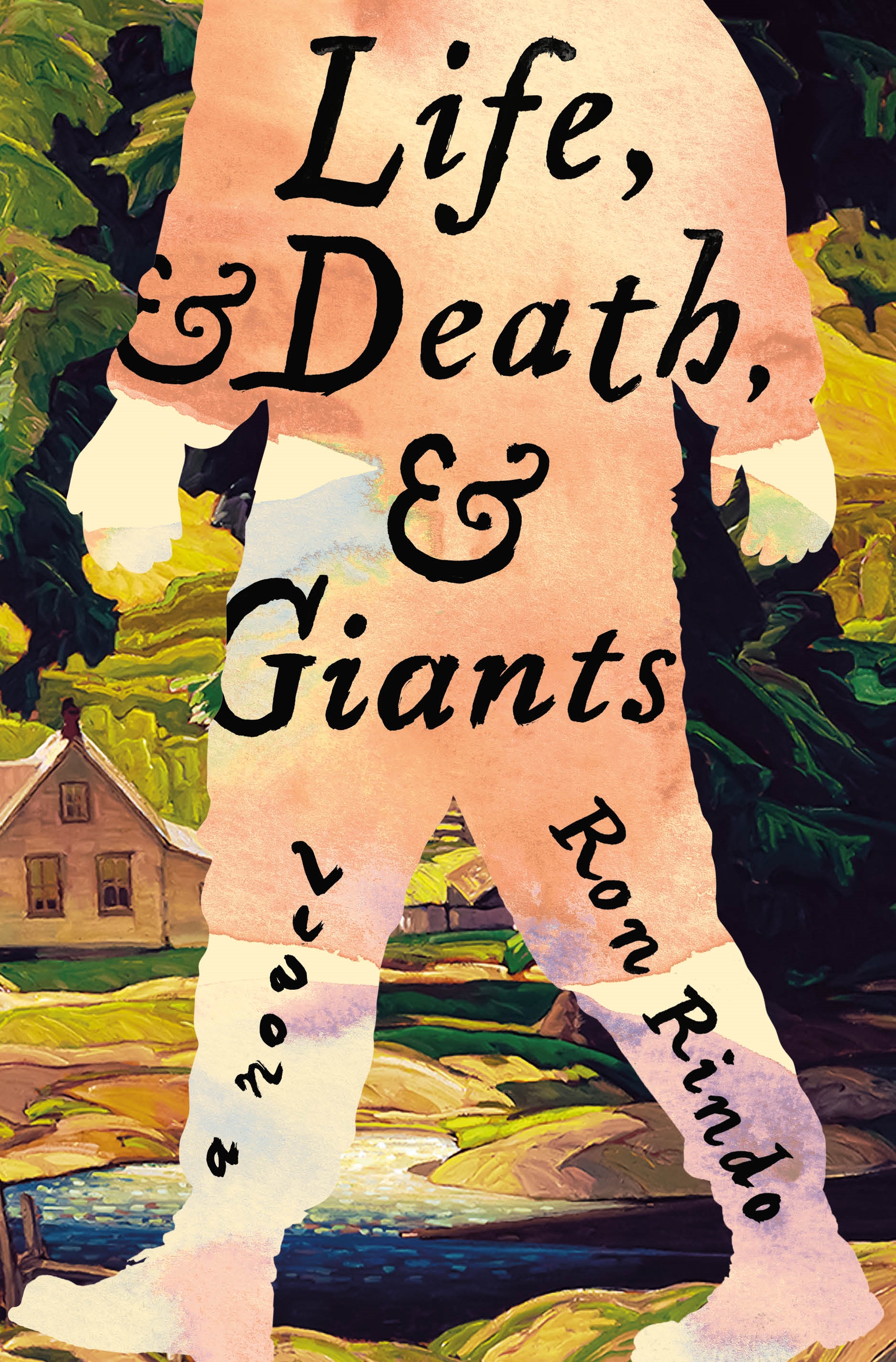
At age one, Gabriel Fisher weighed thirty-four pounds and stood forty-one inches tall. It was not only Gabriel’s unusual size that dazzled Thomas, but also his unusual way with animals. As a three-year-old boy, Gabriel would often sit on a milking stool beside Jasper’s chicken coop with a piece of bread hidden behind his back. He’d wait, watching the chickens scratch in the yard until his favorite hen, a barred rock named Betsy, eased her way close to his feet, and then he’d reveal the bread with a flourish. The other hens would race toward him, but Betsy would immediately hop on his lap and peck at the bread until she’d eaten it all. Afterward, Gabriel would cuddle her while he napped in the afternoon sunshine, and she’d turn her beak into the hollow under his armpit and fall asleep.

I recognized myself inside those pages. In a life devoted to goodness, devoted to God, there can still be yearning. A quiet mouth, a devoted heart, does not mean a quiet mind. Sometimes while reading, I found myself crying, overwhelmed by the depth and breadth of Miss Dickinson’s daring, by the baring of her soul.

Some books you rip through, eager, panting, for the resolution of a conflict and the presentation of the next one. Some books demand that you go through them slowly, a stroll hand in hand. Instead of a 5K. Life, and Death, and Giants is a book you want to take your time with, savor, taste, relish, feel.

description
Ron Rindo – image from Wisconsin Literary Map

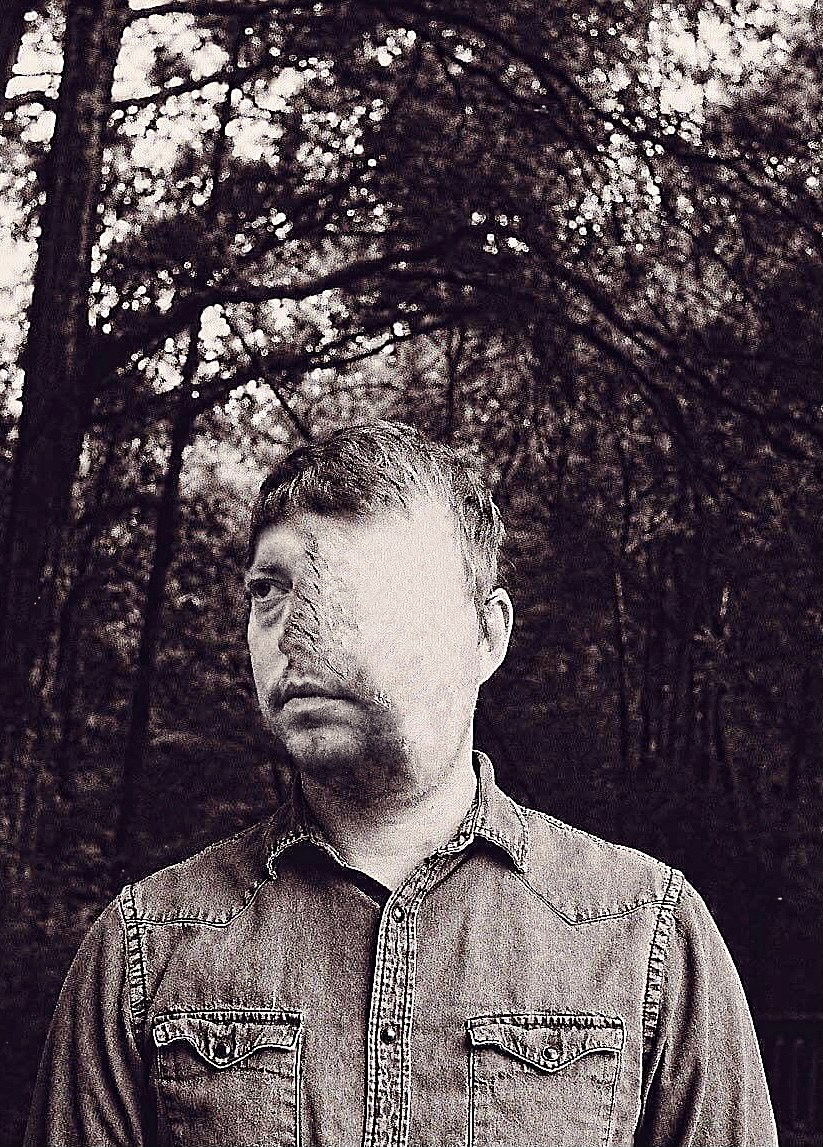
Ron Rindo came across the story of the tallest person ever, from the 1920s and 1930s, and wondered how the modern world might react to a someone of like dimensions.

Just eight pounds five ounces at birth, [Robert Pershing] Wadlow stood eight feet 11.1 inches tall, weighed 439 pounds, and had size 37 feet at the time of his death, at age twenty-two, his extraordinary growth driven by hypertrophy of the pituitary gland. For a time, Wadlow toured with the Ringling Brothers Circus and promoted shoes for the International Shoe Company, but he seems to have sought a normal life, resisting efforts to define him exclusively as a circus attraction. He died of an infection in Manistee, Michigan, and is buried in Oakwood Cemetery in Alton, Illinois. My musings about how the twenty-first-century world might react to a giant in its midst provided the initial inspiration for this novel. – from the Acknowledgments

Giants such as these may have a brief stay among us, but, unlike the “beetle at the candle” or the “Hopper of the mill” can maintain more than their mere accidental existence. (The title of the novel is taken from that of the poem by Emily Dickinson. There is a link to it in EXTRA STUFF.) Gabriel Fisher is a magical person, imbued with qualities of a different realm. It is not just his physical characteristics, which mimic those of an actual human being, or the athletic prowess that traveled with his inflated size, but his kindness, considerateness, his gentleness, and his Franciscan affinity for creatures wild and domestic. A Tom Bombadil comparison would also be apt.

He opened his mouth, bayed like a young coyote. “That’s the boy,” Thomas said, smiling. “Let everyone know you’re here.” From the woods just beyond Thomas’s yard, a red fox barked, and squirrels began chattering. A half mile down the road, farm dogs howled; cattle lowed in their sunny pastures.

But, as great a presence as Gabriel is, it is the other characters in the novel who tell us what we need to know about him. He is a central hub around whom all the character spokes attach and it is their stories that make the novel roll.

“It’s a polyphonic novel, told from multiple perspectives, so in a sense, it’s five different stories,” says Rindo. “Hannah, Doc Kennedy, Billy Walton and Trey Beathards tell Gabriel’s story, but in the process, each of them tell their own story, too.” – from the Madison Magazine interview

Hannah Fisher is Gabriel’s grandmother. She loves him unreservedly, but the code of her Amish religion keeps her at a distance for far too long. Gabriel was born out of wedlock, his mother, who dies in childbirth, shunned by the community. Hers is one of the primary voices we hear throughout, as she struggles with the tensions between her faith, her love, and her sense of right and wrong.

Dr. Thomas Kennedy is a veterinarian, and the other primary voice here. Tragedy and unwarranted suspicion had driven him from a more urban life to this rustic town of Lakota, Wisconsin. He forms a life-time bond with Gabriel by virtue of delivering him into the world. Their connection is a thing of beauty, and will warm your heart. He also nurtures a friendship with Hannah. He is as good a person as you will come across anywhere.

Billy Walton manages a youth baseball team, and recruits the very oversized Gabriel to sign on. He is, of course a marvelous and dangerous player, given his power. Billy owns the local bar, and is making a place for himself after a lifetime of screwups.

Trey Beathards used to be someone, a football player, later a coach, then a drug addict and womanizer. There is much of Trey that is in need to rebuilding. He becomes Gabriel’s high school football coach, and guides his next steps. Billy and Trey introduce us to the great sports myth piece of the novel as Gabriel’s prowess exceeds any reasonable expectation, becoming the stuff of legends.

Most of the primary life tales told here share an arc. A past with troubles, self-inflicted or not, then rising from their ashes to find hope, redemption, or something like it. It is in how the characters behave around Gabriel, how they help him, look after him, care about him that we see a community in action. I am trying not to say it takes a village, but it is unavoidable.

There is a set of secondary characters here who add to the community element of the story, a gay couple who take in a stray, a severe Amish husband who does not welcome any “English” influence, a crusty older Amish man who seems to have burned all his bridges, a brotherly caretaker who goes above and beyond in caring for another.

The lines between Amish and “English” can be difficult to traverse, but Gabriel has a foot in both worlds and helps bring them to a common cause. In a different way, Thomas tries to expose Hannah to possibilities beyond her Amish restrictions. Rindo’s handling of religious and secular perspectives is deft.

You will enjoy the occasional book references scattered throughout, both to specific novels and to other unnamed texts. In parallel with the split between seeking fame versus opting for retreat, there is the tension between looking outward for inspiration and looking inward.

In his day job, Rindo teaches, among other things, the poetry of Emily Dickinson. That appreciation makes its way into the novel in two forms, a book of Dickinson’s poems that Hannah’s mother had left for her, and work left by another maternal influence. The poet’s perspective is woven into the tale, in a concern for faith, for nature ,and for the struggle to figure out how to live one’s best life, alone and in community, and the many sorts of love one can enjoy.

There were multiple times while reading this book that I was moved to tears. Not just for the emotional content of the characters’ struggles, but for the poetic descriptions, particularly of natural events.

Sometimes we feel we are on the scent of hidden things, but we doubt ourselves. Sometimes it’s because we believe we must be mistaken. Other times, it’s because we fear we might be right and we don’t want to be, or can’t be, because of who we are or where we live. But then something comes along to reveal that what we have scented with our innermost soul simply is, and our fear subsides. This revelation was my mother’s legacy, a book of poems she’d hidden, like a pheasant in the orchard grass.

There is no need to fear anything here. Life, and Death, and Giants is a heart-warming novel that will bring tears to your eyes, but which will also prompt you to consider just how to live, and just how society might work with a baseline of respect. It is one of the great works of 2025.

Review posted – 09/12/25

Publication date – 9/9/25

I received an ARE of Life, and Death, and Giants from St. Martin’s in return for a fair review. Thanks, folks, and thanks to NetGalley for facilitating.

This review is cross-posted on Goodreads. Stop by and say Hi!

==================================EXTRA STUFF

Links to Rindo’s personal and Instagram pages

Profile – from Wisconsin Literary Map

An English professor at the University of Wisconsin-Oshkosh, Ron Rindo was raised in Muskego, Wisconsin, and lives with his wife, Jenna, on five acres of wooded land in Pickett, where they raised five children and keep an orchard and an array of vegetable and flower gardens. He has published three short story collections, Suburban Metaphysics and Other Stories (New Rivers Press, 1990); Secrets Men Keep (New Rivers Press, 1995); and Love in an Expanding Universe (New Rivers Press, 2005); and a novel, Breathing Lake Superior (Brick Mantel Books, 2022). His short stories and essays have also appeared in a wide variety of journals, and an essay, “Gyromancy,” was reprinted in The Best American Essays, 2010

Interviews
—–ABC National Radio – Greyhounds, dark academia and an Amish community in new fiction by Toni Jordan, R.F. Kuang and Ron Rindo – audio – from 37:22
—–Madison Magazine – This novel set in small-town Wisconsin is more than a ‘tall tale’ by Anna Kottakis

Music
—–Hungarian Rhapsody Number 2 – in Chapter 8

Items of Interest from the author – Links to these short stories can also be found in Rindo’s website
—–Terrain.org – The Return of Migrating Birds
—–The Summerset Review – Horses
—–Wilderness House Literary Review – The Mystery in Summer Rain
—– The Trumpeter – The Song of the Tree Frog
—–Tikkun – A Theory of Everything

Items of Interest
—–All Poetry – Life, and Death, and Giants
—– Eddie Carmel

For what it’s worth, I had the experience, growing up in the West Bronx, of seeing Eddie Carmel every now and again. He and his parents lived there. It’s not like we ever had a conversation. But my pals and I spotted him climbing into a taxi or other car, feet planted in the front passenger seat. Tush in the rear. At that time of his life, he was afflicted with scoliosis, among other maladies, and walked with at least one cane. While it was startling to see someone that large (believe the 8’9″ number. There is no way he was only 7’3″) it was also very sad. It seemed from looking at him, his face, that this was a man who was in great pain. He was someone who was no longer able, if he had ever been able, to be comfortable in his own oversized skin. Awe was replaced with a very large feeling of pity.

2 Comments

Filed under Fantasy, Fiction, Literary Fiction

Killer on the Road / The Babysitter Lives by Stephen Graham Jones

book cover

“Next hundred and fifty miles are—they’re like the Bermuda Triangle for travelers, do you know that?” he says, finally bringing his pasty face around to Harper. “Thought it was the Snow Chi Minh Trail,” Harper says right back. It’s what her dad used to call 80 in the winter. “He’s talking about all the people who go missing, dear,” the woman says. “You’ve seen the posters in the windows at the gas station, haven’t you? Not just . . . walking people either. Drivers too.” “Just because people don’t call to check in doesn’t mean they’re missing,” Harper says. “Just means they don’t want to get found.”

“Thanks for the ride,” the hitcher says, climbing in from the sheeting rain. “What’s the old joke?” the driver says, clocking his mirror to ease back up to speed. “I ask you—no, you ask me if I’m a serial killer, and I say no, I’m not worried about that. The chances of two serial killers randomly being in the same car are through the roof, right?”

Somewhere in a U-Haul storage unit, there is a box or several with the remnant paperbacks of my wastrel youth. Among the volumes doing battle with mites of diverse sorts is a stack of Ace Doubles. From 1952 until 1973 Ace produced a line of paperback books that were printed in what is called the tête-bêche format.

“The ends of the two parts met in the middle, with a divider between them which functioned as the rear cover of both (the two parts were oriented upside-down with respect to each other in order to effect this)”– from Wiki

It was a bit of an oddity, but my need for science fiction was great, and I took my sustenance where I could find it. This format allowed for the publication of two pieces in a single volume. They could be novels, novellas, or abridged publications. (You can see a nice collection of covers from these on Flickr) There were other sorts, mysteries and westerns, for example, but I only cared about science fiction. As part of a celebration of Saga Press’s tenth anniversary, they decided to revive the format. What fun to see the form brought back to life! Stephen Graham Jones was asked to contribute some work. This volume is the result.
description
Image from Simon & Schuster

These SGJ works are not of immediately recent vintage. Both were written in a two-month period in 2018. The Babysitter Lives, was published as an audio book in 2022.

Release date was about when it would fit in the schedule, when is there gonna be a few months when I don’t have a book out to make these two books happen. It was that and we really wanted to do a flip book as part of Saga’s ten-year celebration. I had these two novels ready to go. Seemed like the perfect time. – from the Spotify interview

The two novels are quite different. Killer on the Road is a duel between a serial killer with a special gift and a final girl, as they drive along route 80 in Wyoming, marking a trail of carnage, exit by exit, stop by stop. (Jones has driven this road many a time and can attest to its many dangers, although maybe not the ones depicted here.) Pre cellphone, of course. Harper is 18 and leaving home after a blowup with her family, hitchhiking. She teams up with some friends who are tooling around in a National Park Service Vehicle. Not your usual road trip. Bucketmouth, a living urban legend, drives this road, eager to add to his personal roadkill total. He is also lonely in his particular form of awfulness and is quite loquacious. Harper becomes someone he likes to talk to, and therein lies the ongoing tension. It began as a novella, but Jones needed more space for Bucketmouth to do his thing. He also needed more space for Harper to grow, and voila. I am not sure why this sat around for seven years waiting to be published.

As with many in the genre, young people are done in with some regularity. Some older folks as well. The doings-in are very creative and awful. There is a non-stop pace to it, keeping the characters moving along route 80 and into and away from peril, a battle of wits and creativity, as Jones finds interesting ways for his monster to reduce the population, and challenge his final girl, the actual final solution to serial-killer-slasher-monsters, to make it stop before everyone succumbs.

description
Stephen Graham Jones – image from El Pais – courtesy of Jones

The Flip side book, The Babysitter Lives starts off with the usual creepy vibe. Teen on a sitter gig, wanting nothing more than to see the kiddies off to bed early enough to get some SAT test prep in. No boyfriend waiting for a chance to hook up. But a buddy of the bff sort will be by to make studying difficult. So, stalker? horror-mask guy in the closet with a machete? Not really, although there is very real mortal peril, and a veeeeerrrry creepy jack-in-the-box, that called to mind the Twilight Zone episode It’s a Good Life. This tale merges the haunted house story with the babysitter alone and in danger genre to create a truly nightmarish read.

The house has issues, including hosting the ghost of a psycho-killer, seemingly able to lock and unlock doors at whim, and is fitted with a chutes-and-ladders characteristic that makes it tough to figure out exactly where and when each transit point leads to, and if it will lead there again, as the house tries to eat her.

I confess, it was all too much for me. I did finish reading it, but was on the verge more than once, of throwing up my hands. While I think I am fairly able to keep track of details and actions in any book, I found that I was often perplexed about what had just happened, who was where, who was who, when we were, and what the rules were. While the lead was appealing, I just did not feel involved enough to make the effort to firm up my understanding of the logic and structure of the story by paying closer attention. Ultimately, while I appreciate genre-bending as much as the next reader, am perpetually impressed by the gift SGJ possesses for creating new images while referencing the classic ones, and enjoy a good scare, The Babysitter Lives did not do it for me. This does not lessen my appreciation of SGJ’s creative genius. I will be lining up to read his next new work as soon as it is announced.

I ran into that darkness, and am still running. – from the 5280 interview

Review posted – 08/29/25

Publication date – 07/15/25

I received an ARE of Killer on the Road – The Babysitter Lives from Saga in return for a fair review. Thanks, folks, and thanks to NetGalley for facilitating.

This review is cross-posted on Goodreads. Stop by and say Hi!

=======================================EXTRA STUFF

Links to Jones’s personal, Twitter and FB pages

Profile – from DemonTheory.net

Stephen Graham Jones is the NYT bestselling author of thirty-five or so novels and collections, and there’s some novellas and comic books in there as well. Stephen’s been an NEA recipient, has won the Texas Institute of Letters Award for Fiction, the Los Angeles Times Ray Bradbury Prize, the Mark Twain American Voice in Literature Award, the August Derleth British Fantasy Award for Best Horror Novel, the Independent Publishers Award for Multicultural Fiction, the Western Literature Association’s Distinguished Achievement Award, the American Library Association’s RUSA Award and Alex Award, the 2023 American Indian Festival of Words Writers Award, the Locus Award, four Bram Stoker Awards, three Shirley Jackson Awards, and six This is Horror Awards. Stephen’s also been inducted into the Texas Literary Hall of Fame, he’s been a finalist for the World Fantasy Award, and the Eisner Award, and he’s made Bloody Disgusting’s Top Ten Horror Novels. He’s the guy who wrote Mongrels, The Only Good Indians, My Heart is a Chainsaw, Earthdivers, I Was a Teenage Slasher, The Buffalo Hunter Hunter, and Killer on the Road. Stephen lives in Boulder, Colorado.

Interviews
—–5280 – Meet Colorado’s Most Prolific Killer, Horror Author Stephen Graham Jones by SPENCER CAMPBELL

After his first few novels, Jones realized his book event audience had begun treating him as an authority on Native American culture, just as his teachers had. “I did not like it even a little bit,” Jones says. He made a decision to swerve hard into slashers, zombies, and werewolves, “as a way of telling all those people, I dare you to try to find the Indian stuff in this,” Jones says. At the same time, Jones tried to publish works in the vein of David Foster Wallace. “What happened was about 2006, 2007, I feel like I became two writers,” Jones says. “One was on kind of a literary track, and one was doing the schlockiest genre stuff I could think of.”

—–Writers Digest – The WD Interview: Stephen Graham Jones by Moriah Richard
—–DemonTheory.net – PFDW # 181 – Interview with Stephen Graham Jones on Mapping the Interior
—–Pen.org – Crafting Nightmares: The Art of Horror with Stephen Graham Jones & Paul Tremblay – brief and not specific to this book.
—–Spotify – Episode 37: “A Fish story” with Stephen Graham Jones – by Matthew Jackson – audio – 1:06:57 – from 3:45

My reviews of (sadly, only six) previous books by Jones
—–2025 – The Buffalo Hunter Hunterin Coots Reviews
—–2024 – The Angel of Indian Lake -The Indian Lake Trilogy #3 in Coots Reviews
—–2023 – Don’t Fear the Reaper -The Indian Lake Trilogy #2in Coots Reviews
—–2021 – My Heart is a Chainsaw -The Indian Lake Trilogy #1in Coot’s Reviews
—–2020 – The Only Good Indians
—–2016 – Mongrels

Leave a comment

Filed under Fiction, Horror

Unworld by Jayson Greene

book cover

At that moment, I understood several things about upload consciousness in rapid succession. Her intelligence wasn’t able to filter out or compartmentalize grief. She had no neurochemical responses flooding in to numb her pain, to soften its impact. A mind was eternal, unforgiving; a brain was a soft, plump cushion. Loss needed a brain.

I was a grieving mother, for Christ’s sake. My pain was meant to crack the earth. And here I was, not even half a year later, one of grief’s private citizens again. Were people’s memories really so short? Or was it just that you could never stop performing—falling to your knees, rending your garments—if you wanted to keep their attention? I guess it was only the people eager to make themselves a burden who reaped the rewards.

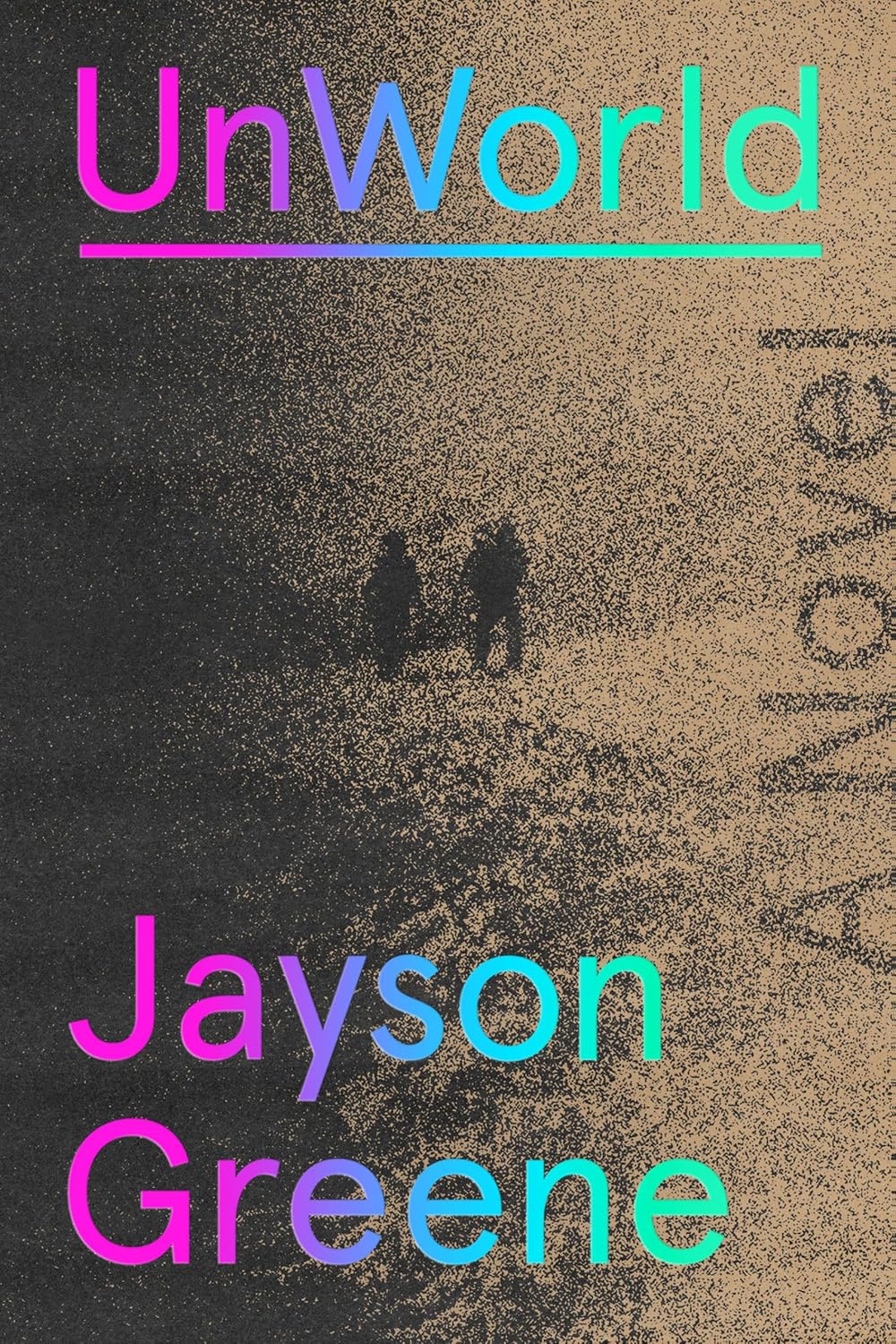
Unworld is a tale of heart-crushing grief that raises a vast array of questions about the nature of our existence. It presents as a twenty-minutes-into-the-future sci-fi look at things that may be near at hand, but which have yet to fully arrive.

We share much of our existence with the digital world, posting images on line, communicating via e-mail, text, et al. But if you are like me, you will struggle to remember considerable chunks of what has been communicated. What if you could get a personal recorder that kept track of everything for you, ready to play it back whenever you need it? Could have used that when I managed to wander away from my baseball glove as a pre-teen. It took a long time to save up enough to replace it. Or later in life, when faced with the hated, hostile question, “How could you not remember?” I definitely get the appeal. But the benefit comes at a cost. The AI that you just invited into your head gets to see everything. It becomes the keeper of your memories. In the patois of the novel this is called an upload, and you are the tether to which it synchs. You may have the option of evicting your digital tenant, but how many people really would? And what if your upload begins to have a yearning for independence? They are comprised of your memories and experiences, after all. Can they make off with that to form their own private being? What if they reside in multiple tethers (sequentially) over time? You can see where this might get complex.

description
Jayson Greene – Image from WAPO – photo by Ebru Yildiz
.
But the story is easier to traverse than that. There are four main characters, well, four from whom we hear. The central person around whom the story circles is Alex, a teenager, who may or may not have committed suicide. We are given four POVs, beginning with Anna, Alex’s mother, who is crushed and confused. Cathy teaches a class called Applied Personhood Theory. Sam(antha) is a teen a bit older than Alex. They had been friends, and had been working on a film project together. Aviva is the upload. We get a second take from Anna to close out the tale. The Alex we get to know is the sum of their memories and impressions.

But then, one could as easily say that the story revolves around Aviva. She is significantly part Anna. But she also has a disembodied relationship with Alex, and thus relates to Sam as she and Alex work on their project, and spends time as an upload in someone else as well.

It is unclear if Aviva is a menace, a predator of some sort, an artificial enhancement, an independent person, a fusion of herself with the people with whom she has synched, or what. She is getting closer to Alex and thinks, Wake up, I wanted to scream at her. (Anna) I am the ogre from a fairy tale. I am the cuckoo bird who kicks the real mother out of the nest to assume her place.

You could go through this book thinking about just who these characters are. Alex clearly has significant issues, enough to make him want to escape his own skull, maybe find release in a digital realm. Anna cannot find an escape from her grief, from the loss of her son, separation from her upload, the shakiness of her marriage. Can she be a whole person on her own? Cathy has had issues of her own. A drug addict earlier in her life, she is looking for something in an illegally obtained upload, some understanding of a real experience that has been purely theoretical to her so far. Sam is the stable one of the lot, struggling with the loss of her friend without ever really knowing why he had died. And Aviva’s construction is the most fraught of all, dependent on her tether(s) for most of her memories and sensations, but yearning to be independent, truly existing on multiple planes.

It is easy to let theoretical peregrinations overwhelm the emotion of the story. But there is plenty of rank human emotion on display as well. Anna’s loss is gut-wrenching. Greene knows something about the experience of losing a child. He published a memoir in 2019, Once More We Saw Stars, in which he writes about recovering from the accidental death of his two-year-old. Aviva may lack the physical tools that humans possess to manage our high-end stress, so her inability to handle strong emotion is understandable. As is Alex’s panic at a sudden new level of overwhelmingness.

In addition to tapping into your feelings UnWorld generates plenty of confusion. More questions are raised than answered, and those questions are the sort that will stick in your head for a while, whether or not you install a special chip behind your right ear.

“Do you feel how shitty it is to be encased in a brain, when you sync with Mom? It’s got to be like going from, like, this wide-open vast universe to locking yourself in a closet. If I were you, I’d never want to come back.” “Actually,” I said, “when I go too long without syncing with your mom, everything is painful and more difficult.” He considered this. “What if you were cut free?” he asked. “Where could you go?” I hesitated. “That’s difficult to answer, Alex,” I said. “What tethers me to your mom is pretty powerful—love, family, history. Cutting it would be severely painful. I could go anywhere, I guess, and listen to anyone’s anything, but who would I be?”

Review posted – 07/18/25

Publication date – 06/17/25

I received an ARE of Unworld from Knopf in return for a fair review. Thanks, folks, and thanks to NetGalley for facilitating. I can turn this thing off now, right?

This review is cross-posted on Goodreads. Stop by and say Hi!

=======================================EXTRA STUFF

Greene’s Instagram page

Interviews
—–Dad Talks
Dad Talks #8 : Jayson Greene By Michael Venutolo-Mantovani – This was for Greene’s previous book Once More We Saw Stars, but relevant to this book as well
—–Circulating Ideas – Jayson Greene – Unworld – with Steve Thomas
—–Books Are Magic – Jayson Greene: UnWorld w/ Mattie Lubchansky video – 46:25 – Greene reads an excerpt to 10:00, then interview

Item of Interest
—–Twenty Minutes into the FutureMax Headroom was a 1987 satirical sci-fi series that had as its tagline “twenty minutes into the future.” The phrase came to be used for any sci-fi that was set in the short-term near-future.

Leave a comment

Filed under AI, Fiction, Literary Fiction, Science Fiction

American Mythology by Giano Cromle

book cover

They reached the far edge of the lake, where the woods grew right up to the shore, making it dark and shadowed. Tree branches seemed to sway and move, even though there was no breeze. Luther stood very still, staring at something deeper inside the forest, a dense knot of branches and limbs braced against each other. Mud was chinked into crevices between logs. Grasses and moss thatched a roof. Jute realized it was a primitive shack, like something out of a fairy tale. Without saying a word, they slowly approached. Once they were upon it, Luther reached out and tugged a gnarled branch, which turned out to be a door. They stepped inside.

…this was what small towns did. They caught you in their nets, kept you from going out into the world and growing into the person you were supposed to be.

The prologue sets the scene. 1853, a trapper crew reports trap lines being cut, members mysteriously disappearing, whispering noises heard in the woods.

description
Giano Cromley – Image from his Twitter profile

Julius (Jute) Ramsey is our leader today. A strange event happened when he was 11 years old, on a hike up to the unmapped Ramsey Lake with his father. Subsequent signs offer more warning than welcome. Dad was clearly afraid, and all but dashed away. He became almost a different person, losing his mood control, and his job, disappearing for increasing durations until he stopped coming back at all when Jute was 16. Jute’s mission today is to return to that place and discover exactly what had so changed his father, as much as he wants to discover proof of something undiscovered

Luther tucked his chin into his Adam’s apple for a moment. “Don’t be surprised if you see some mighty strange stuff up there,” he said. “Ramsey Lake is what some folks call a thin place.” “What’s a thin place?” Jute asked. “Every culture’s got spots like this,” he said. “Where the veil between our world and the spirit world is so thin they practically overlap.”

For Jute Ramsay it is an unmissable opportunity to go on a BigFoot hunt with a major player in the field. For Doctor Marcus Bernard, eager to return to academic acceptability after a long tenure as an expert in Sasquatchology, it is a chance to re-establish his intellectual cred with a bang. He is hoping to be helped along by Vicky Xu, who had started out merely looking to do a film project on Dr. Bernard for her graduate thesis, but who sees the outing as a great opportunity. Vergil Barnes is Jute’s best friend and co-founder of the Basic Bigfoot Society of Basic, Montana, population 484. He has reason to think it may be his last, and he does not want to disappoint his buddy. Vergil’s daughter, Rye, is in from college, and tags along to help look after her father.

description
This zoomed-in image shows a creature resembling bigfoot. Shannon Parker took the photo Sunday, Oct. 8, 2023, while departing Silverton on the Durango & Silverton Narrow Gauge Railroad. She used an SLR camera with a 300 mm lens. (Courtesy of Shannon Parker) – Image from The Durango Herald

There are the usual odd things you might expect on such an adventure. Rapid, unexplained changes in weather, discoveries of clues, such as a casual acquisition of a very old, and relevant notebook. Some mysteries are not well explained, which can be irksome, but, whatever.

So, the bottom line in all such novels comes down to “is there or isn’t there?” I will not spoil it for you here. It is the journey of course that matters, or the journeys, as all six may all be on the same trail but travel their own roads. Is there magic in the world, and if so, of what sorts? Searching for Sasquatch is a journey of self-discovery for all of them.

The journal entries offer a nifty myth-making tool to keep them connected to the past and strange possibility. But the absence of harder evidence roots the tales of BigFoot in oral tradition, where most lore is communicated.

description
Bigfoot allegedly caught on cam near Braxton County, in 2019. (The source has since been determined to be from Jeffrey Stoffel and Jenna Oleson.) – image from West Virginia Explorer

Vergil faces an existential threat. Rye is there to support her ailing dad, but hears the voice of her late mother. Jute’s challenge is his need for the whole truth. Will he find it? He is a good sort, and you sure hope so. Dr. Bernard is up to cynical no-good. His journey is more annoying than not for his eagerness to dismiss all evidence, even any suggestion of possibility. Vicky abets him in this. Her struggle is less fraught than Bernard’s but providing evidence for him is why she is there. Some of the characters’ struggles are more engaging than others, but overall there is enough buy-in to keep you turning the pages for the next twist, surprise, and peril. Their concerns are serious, touching on religion, the endangered planet, and connection to family and community.

description
Image from The Keystone Newsroom

There is an explanation offered at end that was no more unbelievable than any other, maybe even a bit better than most. It is a nice-to-have, but the generally warm-hearted, open-minded, exploratory take of the book makes this an easy Summer read. Whether your piggies are petite or prodigious, and however distant your extremities may be from your face, it will definitely be worth your while to take a large step into American Mythology.

MAGIC PROTECTS THIS SPACE TURN BACK NOW

Review posted – 07/25/25

Publication date – 07/15/25

I received an ARE of American Mythology from Doubleday in return for a fair review, and destroying all copies of that map. Thanks, folks, and thanks to NetGalley for facilitating.

This review is cross-posted on Goodreads. Stop by and say Hi!

=======================================EXTRA STUFF

Links to Cromley’s personal, FB, Instagram, and Twitter pages

Profile – from the book

Author Bio: Born and raised in Montana, GIANO CROMLEY is the author of two young adult novels and a collection of short stories. He is a recipient of an Artist Fellowship from the Illinois Arts Council and was a BookEnds Fellow with Stony Brook University. He is an amateur woodworker, a certified wildlife tracker, and an English professor at Kennedy-King College, where he is chair of the Communications Department. He lives on the Southside of Chicago with his wife and two dogs. Residence: Chicago, IL Hometown: Billings, MT.

Interviews
—–Talking Scared- 245- Giano Cromly & Our Friends in the Forest
—–Chicago Review of Books – The Proof Is Out There: An Interview with Giano Cromley by Rachel Robbins

Item of Interest from the author
—– The Tao of Bigfoot

Items of Interest
—–BFO – The Bigfoot Field Researchers Organization
—–The Keystone – Bigfoot fever grips Pennsylvania as reports of strange footprints and howls surface
—–BFT – BigFoot Times

My other BigFoot book review
—–Devolution by Max Brooks

Leave a comment

Filed under Fantasy, Fiction, Horror

The Ghost Woods by C.J. Cooke

book cover

Oh God, there it is, lit up by the car’s headlights. Four pointy turrets and dark stone walls laced with red ivy. It looks like Dracula’s holiday home.

Something unspeakably evil is stalking the grounds of Lichen Hall.

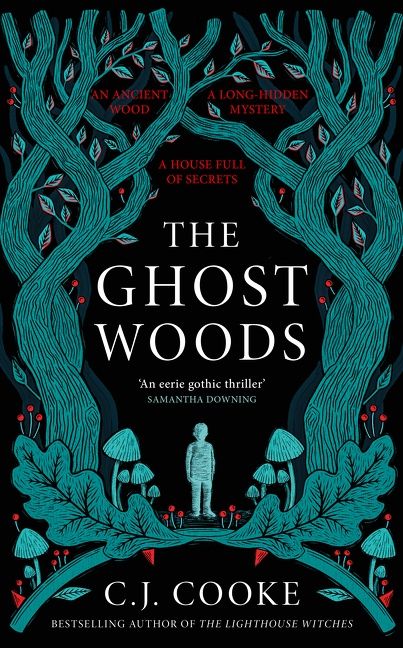
Two women, from different backgrounds, at different times, (1959 and 1965) find themselves in the same position, pregnant without a mate in a period in which that was not considered socially acceptable. Such women were often shunted off to mother-and-baby homes. You may have heard of the Madgalene laundries of Ireland. They were awful, and were not restricted to the Emerald Isle. But Mrs. Whitlock’s Lichen House is soooooo much worse. There is plenty of strangeness about the place and some of its inhabitants, well beyond garden-variety human unpleasantness.

description
C.J. Cooke – image from Curtis Brown

In 1959, seventeen-year-old Mabel Anne Haggith finds herself five months deep in a family way, despite never having had sex. Her mother and stepfather have sent her off to be seen to, out of sight of the neighbors. She is truly a clueless innocent. She feels that there are ghosts in her body. In 1965 Pearl Gotham, twenty-two, a nurse, is likewise facing emerging problems, an unreliable bf among them. Both are taken in by the welcoming, if somewhat chilly, Mrs. Whitlock. The house seems likelier to generate nightmares than comfort to women in need. In fact, it has much in common with the abusive mother-and-baby institutions of its time. More about that later.

Mabel is very much a pleaser, eager to fit in, even when hazed by those already there. She is shy and unsure of herself, working class, uneducated, and for all intents and purposed alone in the world. Until she finds a friend in another young woman there, Morven.

Pearl arrives with much more confidence. A nurse, she is aware of the seriousness of the lack of real medical care at Lichen House. She is also much more worldly, more socially able, not just with the other young women but with Mrs. Whitlock as well. In addition she is charged with tutoring Mrs. Whitlock’s decidedly odd grandson.

Cooke offers a cornucopia of detail that gives the creepiness texture and provides a constant source of surprising revelations. There are mysteries to be sussed out. The overarching imagery of the story has to do with fungi. The house itself is seriously infested with molds of various sorts, and is rapidly sinking into decrepitude.

I follow her gaze to an enormous mass of yellow fungus creeping up the side of a wall. What looks like a series of giant ears are bulging from the gap in the doorframe, right down to the floor. As I draw my eye across the length of the vestibule I spot more fungus spewing from cracks in the tiles and the window frames. The vaulted ceiling is sullied by black blooms of mold. Black frills poke out from the wooden steps at my feet. And at the end of the staircase, a plume of honey-gold mushrooms nub out from the newel post, perfectly formed. It makes me feel physically ill.
“What happened?” I ask, burying my mouth in the crook of my arm.
She sighs wearily. “An infestation of fungus. I still can’t quite believe it. This house has been standing for four hundred years. It has withstood bombs, floods, and a bolt of lightning.” She folds her arms, exasperated. “Fungus can eat through rock, can you believe that?”
“Good God,” I say.

The woods manifest spots of light that can lure one in. Mrs. Whitlock celebrates every birth with a puff of fairy dust toward the newbie. Mr. Whitlock maintains a Micrarium, a sort of mini- museum, a cabinet of curiosities focused on fungi. He makes a big deal about cordyceps, which may be familiar to fans of The Last of Us.

There is plenty of strangeness. Who posts a “Help Me” poster in one of the rooms? Who is that little boy Pearl sees dashing about, the one the other young women deny having seen? Mrs. Whitlock seems particularly averse to making use of the medical profession, forcing her guests to give birth in the house, with only the assistance of the women living there. What’s up with that? Mr. And Mrs. Whitlock were reputed to have had a son who died in an auto accident, but his body was never recovered. Huh? Who is the mysterious, threatening figure in the woods?

“So there’s a story about a witch who lives in the ghost woods out in the forest.”
“I’ve heard of that,” I say. “Mrs. Whitlock mentioned it. At least, the ghost woods part. I don’t believe she mentioned a witch.”
“Well, I heard about it when I first came here,” Rahmi says, and I see Aretta give her a look, as though to warn her not to say more. Rahmi notices, and bites back whatever she was going to say. “I’ve seen her,” she says guardedly.
“Who, the witch?” I say, and she nods. I study her face, expecting her to say “Boo!” or something, revealing it all as a big joke.
“Well, then,” I say, raising my glass of water as though it is a crisp Chardonnay. “I shall seek out this witch in the ghost woods. A little bit of spookiness will spice this place up nicely.”
“Don’t,” Rahmi says, though I’m not sure how much I should take this at face value. “It might be the last thing you ever do.”

As the story goes, Nicnevin was a witch who had lain with a girl who had fallen asleep in the woods. When the girl gave birth, it was to a monstrosity, and it was killed. Nicnevin made the family mad before killing them, then took over the family hall to be a place of rot and ruin, naming it Lichen Hall.

In addition to the ample gothicness of the novel, there is plenty of character and plot content to keep you flipping those pages, and maybe loading up on bleach. Both Mabel and Pearl are sympathetic. What will happen with them, with their babies? What kind of danger are they in? You will definitely care.

There is also plenty of payload beneath the overlaid story. In an image of how women were treated in the 50s and 60s, the awfulness of Mrs. Whitlock’s Lichen House offers a vibrant image of a decaying institution, controlled by ill-meaning people, enforcing wrong-headed social norms, and crushing any people or behaviors falling outside the prescribed lanes. It is a moving, powerful, effective tale.

The Ghost Woods is, first and foremost, a gothic novel, the last installment of a thematic trio that considers our relationship with nature, motherhood, memory, and trauma (the previous two installments are The Nesting and The Lighthouse Witches). I suppose the question could legitimately be asked whether motherhood, gay rights, reproductive rights, and gender inequality have any place in a gothic novel. For me, the gothic is exactly the space to explore darkness of any kind, and the practice of othering is one of the darkest corners of human history. – from the Author’s Note

Review posted – 06/27/25

Publication date US trade paperback – 4/29/25
First published UK – hardcover – 10/13/22

I received an ARE of The Ghost Woods from Berkley in return for a fair review and a pinch of fairy dust. Thanks, folks, and thanks to NetGalley for facilitating.

This review is cross-posted on Goodreads. Stop by and say Hi!

=======================================EXTRA STUFF

Links to Cooke’s personal, FB, Instagram, and Twitter pages

Her personal site was strangely unavailable when I was testing this. I am hoping it has been restored by the time you see this.

Profile – from GR

C.J. (Carolyn) Cooke is an acclaimed, award-winning poet, novelist and academic with numerous publications as Carolyn Jess-Cooke and Caro Carver. Her work has been published in twenty-three languages to date. Born in Belfast, C.J. has a PhD in Literature from Queen’s University, Belfast, and is currently Reader in Creative Writing at the University of Glasgow, where she also researches the impact of motherhood on women’s writing and creative writing interventions for mental health. Her books have been reviewed in The New York Times, The Guardian, Good Housekeeping, and the Daily Mail. She has been nominated for an Edgar Award and an ITW Thriller Award, selected as Waterstones’ Paperback Book of the Year and a BBC 2 Pick, and has had two Book of the Month Club selections in the last year. She lives in Scotland with her husband and four children.

Interviews
—–Rachel Herron – Ep. 208: CJ Cooke on the Thrills of Contemporary Gothic Horror – video – 33:29 – begin at 8:10 – not specific to this book, but interesting
—– Murder by the Book – – C.J. Cooke in Conversation with Rachel Harrison

My review of prior work by Cooke
—–The Lighthouse Witches).

Songs/Music
—–The Beatles – I Want To Hold Your Hand – referenced in Chapter 2

Item of Interest from the author
—–Insta – CJ holds forth on the mother-and-baby homes theme from The Ghost Woods on her insta page
—– Google Play Books – Excerpt – audio – 10:36

Items of Interest
—–Small Things Like These by Claire Keegan – a great novel re the Magdalene laundries
—–Wiki – Magdalene laundries in Ireland
—–What Moves the Dead – another novel involving fungi

Leave a comment

Filed under Feminism, Fiction, Horror, Suspense

Parents Weekend by Alex Finlay

book cover

They run. Run with a primal fear knowing that if they slow down, all five of them will die.
It’s hard to think in this fog of terror.

Blane puts his hands out, palms down: “Stick to the story like we agreed.”
His gut clenches, but he makes sure to smile reassuringly. He warned Stella—warned them all—that Natasha Belov was bad news. Bad, bad news.

Five students are running for their lives. Will they survive? Why are they running? From whom? We go back three days.

description
Alex Finlay – image from his site – shot by Julie Litvin

It is parents’ weekend at Santa Clara University, a private institution on the California coast. (There is an actual SCU. The author’s son goes there.) Events are planned. Parents of freshman are invited to join their children for a Friday dinner. We are introduced to the families of the five in their capstone group (Each freshman dorm breaks the residents into small groups of five to six students. They have to complete a project together by the end of the year, but spend most of the time partying.) and will subsequently rotate among them for POVs. This is standard operating procedure for Finlay, albeit with a larger cast than usual. Well, sort of. More on that in a bit. It is a mixed group.

The Roosevelts include an undersecretary of state, Cynthia, her staff and security. This is necessary as her now-college-age son, Blane, has been kidnapped before. You can’t be too careful. The Maldonados are David and Nina. He is a plastic surgeon, but it will take more than a nip and tuck to repair their marriage. Stella is their co-ed. The Goffmans consist of Alice, who is a secretary to Dean Pratt, and her son, Felix. His education is the primary benefit of a job she does not exactly love. The Akanas are Ken, a relatively famous Chief Judge of Superior Court in LA, and wife Amy. The loss of a child to cancer has made their daughter, Libby, all the more precious. The Kellers are special agent Sarah, husband Bob and their twins. Their son is Michael. Readers of Alex Finlay may remember Sarah Keller from The Night Shift and Every Last Fear.

Keller was a surprise reader favorite in Every Last Fear. I wasn’t planning to bring her back, but as I wrote THE NIGHT SHIFT she just appeared. I love writing her and her husband Bob. Both are so decent and supportive of one another, and they provide some needed moments of calm in the storm. – from The Big Thrill interview about the Night Shift, and here she is again.

Although the five families split time, most is devoted to Sarah Keller, as she takes an active role in the investigation, working closely with the head of security at the university. This is our procedural pathway. Going by the numbers, the Kellers (Sarah, really) takes up half of the chapters in the book, thirty-five of seventy. The four other families get five to seven each, and there are eight chapters assigned to individuals or the missing. This is actually a good thing as the Keller family offers a welcome relief from the dysfunction of some of the others. Tolstoy pops to mind: “Happy families are all alike; each unhappy family is unhappy in its own way.” A loving, supportive marriage in service of truth-telling. What’s not to like? This is not to say that there is much deep character study at work here. This is a thriller, after all. But there is always peril in juggling POVs that two or more may begin to sound the same. Finlay has managed that challenge well, as each is presented with a distinctive voice and personality.

There’s people who write wonderful literary fiction, and they can get into the in-depths of the character like I never could… “I don’t have a lot of internal inner monologue. I try and make you know who these characters are by what they do and what they say. – from the Read with Jul interview

They all have their secrets, well, mostly. We get to see them revealed one by one, and must consider if they have any relevance to the dual mysteries at play. It just so happens that another student at SCU, missing for several days, had been found dead, three days before. The five had been messaging each other about sticking to their story, so a core mystery; what had happened to the girl, how, and what was the involvement of the five? The presenting mystery is the disappearance of the five on the night of the Parents Weekend dinner. What is the link between the two?

There are plenty of clues scattered about, not all of them red herrings. We learn of the parents’ and students’ pathologies and strengths over the course of the investigation. There are bad people at work, and we wonder how much damage they will do before they can be identified and stopped.

Finlay sustains a breathless pace, providing the end-of-chapter hooks that keep us turning the pages. Secondary characters fill in needed blanks, sometimes offering more substantive support to notions or particular primary characters.

The tension, informed by factual discoveries and personal revelations, builds to a dramatic climax. You will get to find out if your guesses were correct. Finlay has made a habit of writing fast-paced thrillers that serve the purpose of pure entertainment. You do not need to be a student or a parent to enjoy this Parents Weekend. It would make an excellent beach, (unless you are going to a place with sea caves) or airplane read (commercial, not private jet), or even something to help you get through the down times at an actual college parents weekend. But pay attention. This will count towards your final grade.

Review posted – 06/13/25

Publication date – 05/06/25

I received an ARE of Parents Weekend from Minotaur Books in return for a fair review and a Gentleman’s “C” on that disappointing final exam. Thanks, folks, and thanks to NetGalley for facilitating.

This review is cross-posted on Goodreads. Stop by and say Hi!

=======================================EXTRA STUFF

Links to Finlay’s personal, FB, and Instagram pages

Profile – From the author’s real-name website

Anthony Franze is a critically acclaimed novelist with St. Martin’s Press, and a lawyer in the Appellate & Supreme Court practice of a prominent Washington, D.C. law firm.
For more than a decade, Anthony was an adjunct professor of law teaching courses in Federal Courts, Legal Rhetoric, and Appellate Practice, and he currently participates in a European faculty exchange program where he teaches at law schools abroad.
He writes legal thrillers under his own name, including THE LAST JUSTICE (2012), THE ADVOCATE’S DAUGHTER (2016), and THE OUTSIDER (2017) He writes commercial fiction under a pen name, [Alex Finley] and his 2021 novel was an Indie Next pick, a LibraryReads selection, an Amazon Editor’s Best Thriller, as well as a CNN, Newsweek, E!, BuzzFeed, Business Week, Goodreads, Parade, PopSugar, and Reader’s Digest best or most anticipated thriller of the year. His work has been translated into more than a dozen languages and optioned for television and film.

My reviews of two of Finlay’s prior books
—–2024 – What Have We Done
—–2023 – If Something Happens to Me

Interviews
—–Authors on the Air – Alex Finlay Parents Weekend Authors on the Air with James L’Etoile – video – 17:30
—–Mystery and Thriller Mavens – Special Pre-launch Q&A with Sara DiVello – 28:47
—–Read with Jul – chapter 86. an interview with bestselling thriller author alex finlay
—–The Big Thrill – Up Close: Alex Finlay The Ties That Bind
—–Outliers Writing University – Get To Know Author Alex Finlay with DP Lyle and Kathleen Antrim – video – 19:24 – good bits on writing process and shifting from legal novels to thrillers, and from Anthony FranZe to Alex Finlay

Songs/Music
—– AC/DC – Back in Black – in Chapter 12

Leave a comment

Filed under Fiction, Mystery, Suspense, Thriller

Happy Land by Dolen Perkins-Valdez

book cover

Calling something your own is a powerful prayer and there was God in it.

This is sacred ground for my family. I graze the tips of the grass with my palm as I wonder about their stories. Who were my people, and what had they sought on this mountain? I’ve never done any kind of family research, never had enough of a family to even know where to start, but now I’m beginning to realize, since arriving here, how much this missing hole goes beyond a decade-long spat.

When Veronica (Nikki) Lovejoy-Berry, a D.C. real estate agent, receives a summons from her long unseen grandmother in North Carolina, she senses the urgency and hurries down. Grandma is getting on, but remains self-reliant and reasonably spry.

Mother Rita was insistent—I need your help and if you come down here I will tell you everything your Mama hasn’t told you about our family. It wasn’t exactly an invitation I could refuse.

Mom and Grandma had become estranged many years earlier, erecting a wall between grandmother and granddaughter as well. During her visit Nikki is regaled with a tale that has a magical aura. The place where her grandmother lives was once called Happy Land. It was a community formed in the post-Civil-War period by freed slaves, not as a typical American town or village, but in the image of the communities from which the ancestors of its members had been taken. These people decided to create a kingdom, with a king and queen, as their ancestors had had in Africa.

description
Dolen Perkins-Velez – image from Torch Literary Arts

The story alternates between the contemporary struggle of Mother Rita to retain ownership of her land, as she fills her granddaughter in on the history of the place, and the tale of one of the original settlers of the kingdom, its first queen, Luella Bobo. We are given a very up-close-and-personal look at what life was like in the 1870s, the closing years of Reconstruction, for freed slaves, what it took to establish themselves both personally and as communities, what obstacles they had to overcome. It offers an eye-opening perspective for any who are not very familiar with the era.

description
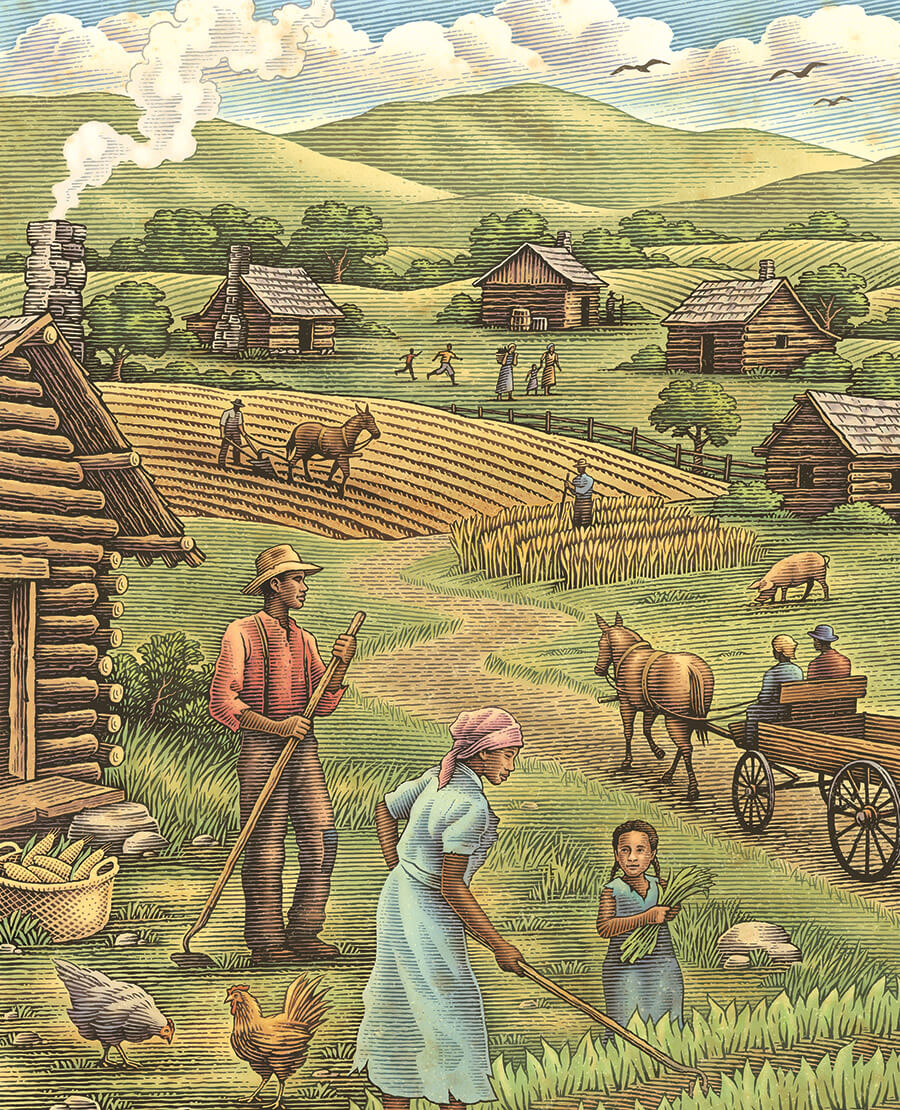
Working the Fields illustration by Erwin Sherman

Nikki is not on a mission. She is tired, struggling and unsatisfied with her life. She is eager to quickly resolve whatever it is that Mother Rita wants of her and dash back to DC as quickly as possible. She has no particular interest in history, family or other, which makes her a fair every-person stand-in for readers. It is through her POV that we slowly gain an appreciation for the importance of knowing one’s personal, and family history, and the significance of the land as an anchor for that connection. The novel is based on real events.

While researching Black history in western North Carolina, I stumbled on an article about this kingdom outside of Hendersonville. It was just a local newspaper, and I thought, “What is that?” It was a very brief article with an illustration showing that there had been this Black community during Reconstruction in the mountains. – from the Rumpus interview

Mother Rita does her best to pass on to Nikki the lore and knowledge she has tended her entire life.

All my life, I’ve been part of a small family circle. By the time my daddy was 20, both of his parents had passed away. He and Mama, with their desire to build a family out of nothing, were a perfect match for each other in that way. The two of them against the world. For me, not having a sibling or even a cousin has been the only existence I’ve ever known. Now here I am, walking beside my grandmother on acres and acres of land that my people have inhabited for over a hundred years. It’s hard to put how I’m feeling into words other than to say I’m dizzy with grief. I didn’t know you could mourn something you never had.

One element is the connection to the outdoors that Rita is able to spark in her grandchild, teaching her to appreciate gardening, and to pass on her considerable expertise. Nikki slowly finds herself able to step back from her urban self to find a connection with and a love for the sights, scents, the tactile feel of this other sort of place.

After the Great Migration, so many Black people ended up concentrated in cities, and we often forget that we are fundamentally a rural people. You don’t have to go back many generations to a grandmother or a great-grandfather who was a country person. – from The Rumpus interview

description
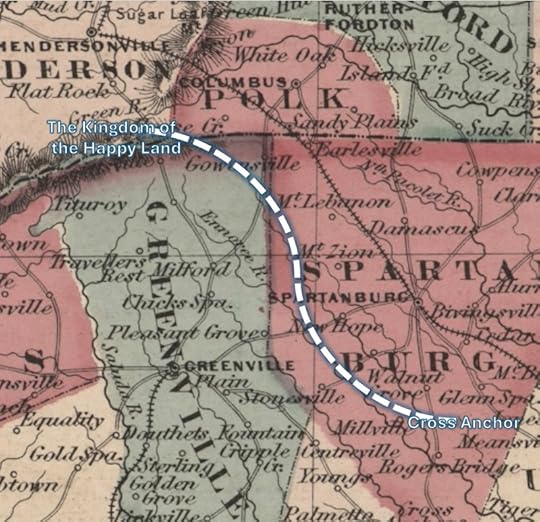
Cross Anchor, a remote township in southern Spartanburg County, S.C., was home to the founders of the Kingdom of the Happy Land before and just after the Civil War. – image from Blue Ridge Archive

A particular revelation is a particular legal mechanism used by the greedy and unscrupulous to cheat people, black people in particular, out of their land. It is remarkable just how much land was taken this way. Less surprising was the abuse of the criminal system to intimidate blacks who owned land, or aspired to do so. Equal treatment before the law remained a dream deferred. This gives the novel particular resonance in a time when the Deconstruction of the Trump era seeks to turn the clock back to an age before legal protections existed.

description
The Kingdom by Erwin Sherman

That said, Happy Land presents a message of hope. Whatever one may think of the royal approach those people favored, they took the opportunity presented by the end of slavery to make decisions for themselves, to organize their own community, to develop their own businesses, to participate in an equal way with the commerce of the area beyond their enclave. Even emerging from the horrors of enslavement, and suffering the ongoing oppression of those who preferred the ownership of human beings as property, these people kept the light of possibility alive. It is a surprising and moving story, which offers us historical reason to keep our spirits receptive to the need for and possibility of hope in an increasingly dark time.

In fall of 1873, a group of freedpeople left Spartanburg County, South Carolina, headed north across the state line into North Carolina. Near Zirconia, North Carolina, the people established a remote community that they called a kingdom. They named a king and queen, formed a communal treasury, and eventually purchased 205 acres of land in 1882 from John Davis, land that was spread across the North Carolina–South Carolina state line. Approximately half was deeded to Luella Montgomery and the other half to Robert Montgomery.
At its height, it is believed the kingdom numbered over two hundred people.
– from the Author’s Note

Review posted – 6/6/25

Publication date – 4/8/25

I received an ARE of Happy Land from Berkley in return for a fair review. Thanks, folks, and thanks to NetGalley for facilitating.

This review is cross-posted on Goodreads. Stop by and say Hi!

=======================================EXTRA STUFF

Links to the author’s personal, FB, Instagram, and Twitter pages

Interviews
—–The Rumpus – The Kingdom of Happy Land: A Conversation with Dolen Perkins-Valdez by NEFERTITI ASANTI – APRIL 28, 2025
—–NPR – Author Dolen Perkins-Valdez discusses her new novel ‘Happy Land’ by Michael Martin
—–May 2025 Feature: Dolen Perkins-Valdez by Jae Nichelle – begins down on the page, after the excerpt
—–Writers Digest – Dolen Perkins-Valdez: On History’s Untold Stories – More about her prior novel, but still quite interesting

My reviews of earlier work by Perkins-Velez
—–2010 – Wench
—–2022 – Take My Hand

Item of Interest from the author
—–Torch Literary Arts – excerpt – Chapter 4

Items of Interest
—–OurState.com – Lost & Found: The Kingdom of the Happy Land by Brad Campbell
—–Blue Ridge Archive – Welcome to the Kingdom of the Happy Land

Leave a comment

Filed under American history, Fiction, Historical Fiction, Literary Fiction, Reviews

Murder at Gulls Nest by Jess Kidd

book cover

This is a house that keeps her secrets well hidden. Her yew trees whisper together in their dour huddles and her windows reflect nothing more than the darkening sky.

Gulls Nest may be quiet but Nora does not feel at peace here. Who knows what dark thoughts are brewing, what chaos is being hatched? In her old life Nora was a ship anchored firmly to the bedrock. Tumultuous waves might come and go but she knew she had a lifeline. At Gulls Nest she feels like a frantically bobbing cork in an unfriendly ocean.

Nora Breen is late of a monastery, having spent the last thirty years as Sister Agnes. A young nun had left the sisterhood, but promised to write back regularly. The sudden absence of these letters is the prompt for Nora’s sudden travels. Frieda had been staying at a seaside hotel, Gulls Nest, in Gore-on-Sea, so that is where Nora begins her search. But what starts out as a missing person inquiry takes a turn when one of the guests catches a bad case of dead. And the game is afoot.

There were several sources of inspiration. The idea of writing a former religious sister came from my childhood. I was taught by a former nun as a child. I was intrigued by her story, in terms of why she joined a religious order and then why she left, but I was never brave enough to ask her about it. The main setting of the first book, Gulls Nest boarding house, was inspired by a disastrous romantic weekend. We booked into an unnamed hotel in Kent, and it was marvellous but not perhaps in the way you’d hope for. There was a formidable landlady, haunted plumbing and eccentric guests. The house would have been beautiful in its day but was shabbily strange when we came to it. But I loved it for its character. – from The Nerd Daily interview

Kidd has planned out a series of eight Nora Breen novels. In the first we are introduced not only to Nora, but to several characters who will be returning. In the Dabble interview, Kidd talks about having a detective who is seeing the world with fresh eyes, after having been shut away for thirty years. Her age, and complete absence of ego also make her seem unthreatening. They do not, however, make her ineffective. While she had to stifle her curiosity and willfulness in the community, she is patient and very deliberate. That said, she remains very much a stranger in a strange world.

description
Jess Kidd – Image from Faber & Faber

1953 England is indeed a strange, gritty place. Still recovering from the war, impacted by the massive loss of men, and the damage done to many of the returning soldiers, and their families. Survival is all. Making things pretty takes a back seat. Gulls Nest is down at the heels, well past its prime. There is a non-zero concern about the safety of the less-than-palatable meals being served at the hotel (very reminiscent of a memorable personal hospital stay). But it is not short on quirky characters. The supporting cast in this one is quite robust. “But Gulls Nest is that sort of a place, isn’t it? Where the dreamers and schemers wash up.”

The hotel residents include Professor Poppy, a Punch and Judy showman, looking the worse for wear, with his own studio and a collection of puppets, Teddy, a well-liked caretaker at the local amusement park, his wife Stella, who clerks at the town hall, Bill Carter, a retired navy chief who works as a bartender at another hotel, Mr. Karel Ježek, a small photographer with a difficult-to-place accent, Irene Rawlings, a resentful housekeeper, the hotel owner, Helena Wells, who sports a posh accent, suggesting a reduction in her circumstances, and then there is Dinah, her daughter, a seemingly feral child who has the run of the hotel and grounds, appears in surprising places, and does not speak. A few locals, including a non-human one, flesh out the roster. Everyone in Gore-on-Sea has secrets, including Nora. Part of the fun of this novel is getting to each one.

Every cozy amateur detective requires a police contact, and DI Rideout serves that role here. We can assume that they will form an alliance. He has the added benefit of rugged good looks, and sundry characteristics that Nora cannot help but observe. But, as in most cozies, there is not much actual flesh on display, of either the steamy or cold variety. Per the genre, bodies are discovered, not actively deprived of their life forces on the page. That said, there are some scary bits.

Nora goes about her detecting business, follows clues, talks to people in the hotel and in town. She keeps her eyes peeled, pokes her nose in places beyond her remit, makes a few friends and develops a very useful local informant. Nora growing parallels Nora finding things out.

While this is a pretty-straight-ahead crime story, Kidd drops in at least one dollop of magical realism, a major feature of her prior work. Personally, I would have liked more of this, fan as I am of Kidd’s magical realism writing, but that’s just me. The 1950s setting is rich with possibility, beautifully achieved here. Kidd is a wonderful writer, and offers not only well-realized characters, but an intriguing mystery or two, and evocative atmospherics.

While it may not hold the same appeal as more exotic vacation spots, if you appreciate a little time away, with quiet days in which to read, walk the beach, enjoy a cuppa, and maybe stumble across the odd body, Gore-on-Sea might be just the place. Jess Kidd will save you a room. You will find yourself eager to return.

Nora tells herself that the world may seem confusing but it is just the sum of its parts. Take it piece by piece until you can work out the whole.

Review posted – 5/9/25

Publication date – 4/8/25

I received an ARE of Murder at Gull’s Nest from Atria in return for a fair review. Thanks, folks, and thanks to NetGalley for facilitating.

This review is cross-posted on Goodreads. Stop by and say Hi!

=======================================EXTRA STUFF

Links to Kidd’s personal, Twitter, Goodreads, Instagram and FB pages

Profile – from Calgary Women’s Literary Club

Kidd holds a Ph.D. in Creative Writing, she has earned numerous literary awards from England and Ireland, and—in addition to her novels, short stories, and children’s books—she is currently developing her own original television project.

Kidd has already written #2 in the series, Murder at the Spirit Lounge. It centers on a famous medium who arrives in Gore-on-Sea and starts taking seances. When one séance goes terribly and mysteriously wrong it seems that Nora might have a supernatural serial killer on her hands.

Interviews
—–The Nerd Daily – Q&A: Jess Kidd, Author of ‘Murder At Gulls Nest’ by Elise Dumpleton
—–Dabble – Writing Historical Cozy Mysteries With Jess Kidd by Hank Garner – video – 56:26

Items of interest – author
—–Writing.ie – Changing Genre by Jess Kidd
—–The Guardian – Jess Kidd: ‘My older sister taught me to read with Mills & Boon’

Item of Interest
—– Death in Paris – this review offers a walk-through on elements in the cozy mystery genre

My reviews of other books by Jess Kidd
—–2020 – Things in Jars
—–2022 – The Night Ship

Leave a comment

Filed under cozy-mystery, Fiction, Historical Fiction, Mystery, Suspense