Monthly Archives: September 2023

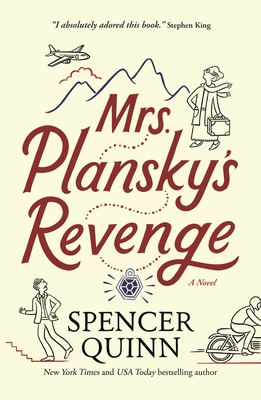
Mrs. Plansky’s Revenge by Spencer Quinn

book cover

Maybe sex made more sense than marriage—or even dating—in old age. Wasn’t courtship for the young?

Meet me at Café des Artistes, eighteen hundred.”
“Is that the address?”
He blew out an irritated-sounding breath. “Six,” he said. “Six o’clock this evening. Your hotel—the Royale, I assume—can give you directions.”
“How will I know you?”
“I’ll wear a billboard with a question mark.”
Click.

Loretta Plansky, widowed, retired, pretty fair tennis player, (particularly considering her new hip, only nine-months in) 71, Florida resident, financially comfortable, wakes one morning to discover that she has been pretty much cleaned out. Bank account, retirement fund, investments, the whole kit and caboodle, well, mostly. It seems that the ten grand she had given to her grandson, Will, overnight went instead to cybercriminals. The real Will had not asked her for anything. (Of course, I am totally in favor of folks sending cash to people named Will, but that’s just me. Any amount gratefully accepted.). The FBI special agent in charge holds out virtually no hope of her ever seeing her lost funds restored, but her number two, about to leave the bureau for a private gig, gives Mrs P one intriguing bit of intel. Unwilling to let this crime stand, she heads out to darkest Romania hoping to do…what? who knows? something.

description
Spencer Quinn (pen name for Peter Abrahams) – image from Macmillan – photo by Diana Gray

Mrs P is an intrepid investigator, with an unusual skill set. She manages to talk to a relevant person at the US embassy in Bucharest, and persists in following up the few clues that float down her way.

The story is told in parallel lanes. Mrs P is the primary of course, but we are also let in on the doings on the other side. Dinu is a teenager with a gift for and enthusiastic interest in American English. He collects colloquialisms and contemporary American slang the way a video-game player collects tokens to gain power. Of course, the power Dinu is amassing causes real harm. His scary uncle has paid to train him, and is now employing Dinu in making calls to American grandparents, pretending to be their stressed-out grandson, in need of emergency cash in order to get out of jail, or whatever. He has a computer whiz bff, Romeo, another teen, who is also employed by the scary uncle. Generally, they do not seem all that morally concerned about what they are doing, and the pay is good.

So, Mrs P makes her way to the relevant town, and stumbles her way through to the sort of cozy resolution one might expect. Along the way there are mysterious passageways, dark deeds, life-threatening adventures, a car chase, a valuable jewel, and some very unpleasant characters. So, I guess this is less of a cozy mystery and more of a cozy adventure tale.

It is a very good-natured story, and Mrs P is a fun lead, a very engaging sort, a good egg, who has been done dirt, but who would prefer to take matters into her own hands rather than leave her fate to the dubious efforts of others. She displays considerable courage, the creativity of an experienced field agent, and a wily serenity in stressful circumstances. One lovely element was her continued connection to her late husband, Norm. No magical realism here, just a pining for the person to whom she had been the closest for most of her life, as she shares thoughts and concerns with his memory, wondering at his theoretical advice. She is also a very kind person, amenable to applying the resources she has…well, had…to helping out her kids, despite that not necessarily being the wisest choice.

You will get a taste of Romania, a very small taste. Most entertaining among these is a hotel festooned with portraits of Bela Lugosi.

There is enough humor in here to generate several actual LOLs, which is always welcome

BUT, as things were winding up to the big finish, there were multiple eye-roller events that took me out of the book. Like running a marathon then tripping over a stick in the road, then another, then another. I did finish the book, and it was a fun read, for the most part. But I found myself saying “Really?” more than once or twice. And that damaged my overall feeling. Bottom line is that you have to be willing to overlook some egregious reliance on coincidence and deus-ex-machina trickery to make the story work out. I expect I am a bit towards the higher end in my sensitivity to such things. But if you are more forgiving, netter at leaping past roadway impediments, then do it, jump in. You will be rewarded with a fun, light read, featuring a very engaging lead. Mrs P will be glad of the company, and so will you.

Review posted – 09/29/23

Publication date – 7/25/23

I received an ARE of Mrs Plansky’s Revenge from Tor Publishing in return for a fair review and the password to my bank account. Hey, now wait a goldarned minute! Thanks, folks, and thanks to NetGalley for facilitating.

This review is cross-posted on Goodreads. Stop by and say Hi!

=======================================EXTRA STUFF

Links to the author’s personal, FB, Instagram, and Twitter pages

Profile

Spencer Quinn is the pen name for Peter Abrahams, the Edgar-winning, New York Times and USA Today bestselling author of the Chet and Bernie mystery series, as well as the #1 New York Times bestselling Bowser and Birdie series for middle-grade readers. He lives on Cape Cod with his wife Diana and dog Pearl.

Interviews
—–The Big Thrill – Up Close: Spencer Quinn by Karen Hugg – all on dog books
—–Famous Writing Routines – Interview with Peter Abrahams: “I love what I do. Love seems to clear a lot of paths.” – nothing particular to this book. More on his methodology.

Songs/Music
—–The Byrds – Eight Miles High – appears in Chapter 13
—–The Chimes – I’m in the Mood for Love – Chapter 20

Items of Interest
—–Excerpt – Chapter One
—–Federal Trade Commission – Consumer AdvicePhone Scams
—–Tor/Forge Blog – Inspiration and Mrs. Plansky’s Revenge by Spencer Quinn! by Ariana Carpenter

Five or six years ago, my dad got a phone call. At the time he was in his early nineties. He died two weeks short of his 97th birthday and was in excellent mental shape and very good physical shape until the end. I want to emphasize that mental part. He was a very smart guy: quick, sharp, clear-headed. Back to the call.
Caller: Hey, Grandpa!
My dad: Jake?
Caller: Yeah, Grandpa, it’s me, Jake.
Cut To: My dad’s wife, noticing he’s putting on his jacket.
Wife: Ed? Where are you going?
My dad: To the bank. Jake’s in trouble and he needs some money.
At that point it was decided to call Jake (living in another city), and he had not called my dad and wasn’t in any trouble. “Jake” never got a penny. But I was amazed that someone like my dad could have been fooled.
And then I got back to writing the Chet and Bernie novel I was working on and thought no more about the two Jakes. Then one day on a bike ride the idea for Mrs. Plansky’s Revenge—indeed the whole set-up, including the Romanian part—came to me in one fell swoop.

Leave a comment

Filed under Comedy, Fiction, Mystery, Suspense, Thriller

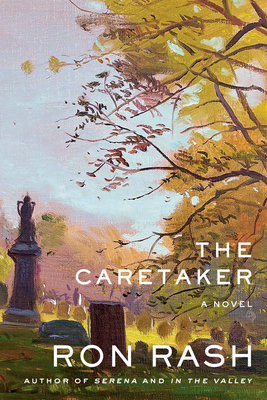
The Caretaker by Ron Rash

book cover

The dead could do nothing worse to him than the living had already done.

He couldn’t shake the inkling that something was about to happen, even as the morning passed undisturbed.

Oh, what a tangled web we weave…

Blackburn Gant has had a tough go of it for such a young man. An unfortunate event when he was six left him with a distorted face and a limp. His parents did for him what they could, Mom, to the extent possible, keeping him away from those who would prey on his otherness, his father tough-loving him into strength and self-sufficiency. He was hired at the tender age of sixteen to be the caretaker of the local cemetery, as his parents were moving to Florida. That was five years ago. He is thoughtful, respectful, and kind.

description
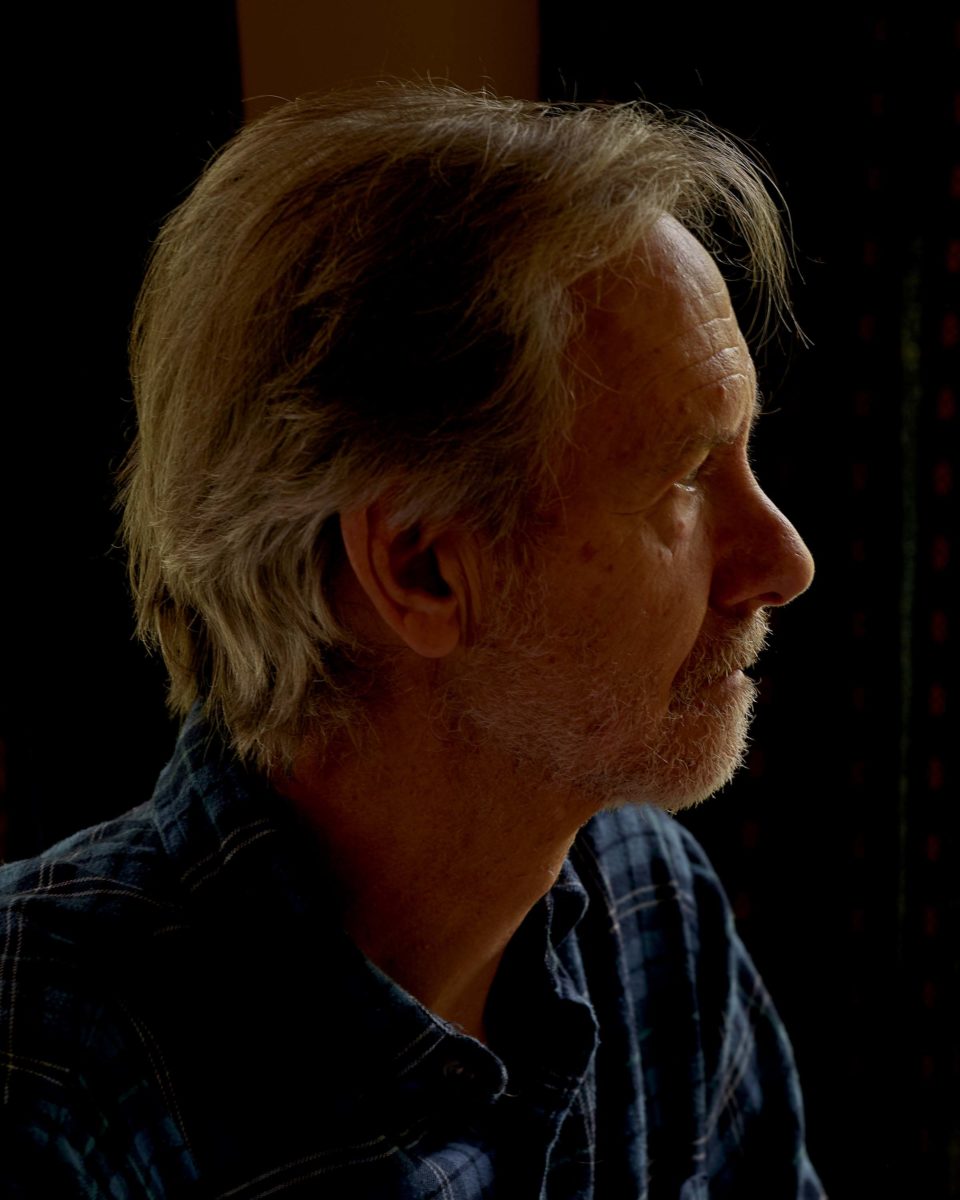
Ron Rash – image from Garden & Gun – photo credit Daniel Dent

Blowing Rock (which might bear a slight resemblance to Boiling Spring, where Rash was raised) has some upsides but it is mostly a place that young people leave if they have a choice. For Naomi, seventeen, pregnant, married to a soldier serving in Korea, and the object of hatred by her in-laws, it constitutes a hostile environment.

When we meet Jacob Hampton, he is having a tough time of his own. Enduring unbelievable cold in Korea, he is drawn into hand-to-hand combat with a North Korean soldier in the opening chapter. He is seriously wounded, at minimum.

Jacob is Blackburn’s best friend. He had charged Blackburn with the responsibility of taking care of Naomi in his absence, knowing that his parents wanted no part of her.

The spring his family moved here from Foscoe, Blackburn’s father sent him to catch trout for supper. He’d been fishing on the edge of the Hampton property when Jacob appeared. Blackburn thought he’d come to run him off. Instead, Jacob guided him to the pasture’s best pools tent, and soon Blackburn’s stringer was heavy with fish. He showed Blackburn a pretend fort made of fallen branches, said that together they could build it up even bigger. It was only when Blackburn was about to head home that Jacob acknowledged his face. Does it hurt? Blackburn said no. I’m glad it doesn’t, Jacob had said.

The closeness between Jacob and Blackburn is palpable, but as Blackburn does all he can for his best friend’s wife, their bond grows as well.

Blackburn and Naomi are both outcasts in the town, people who must maintain a low profile just to get by. Most in the town are willing to at least go along with Jacob’s parents in decrying the marriage. Jacob is in no position to oppose them. Naomi is seen as a too-young gold-digger, interested only in the wealth that Jacob is slated to inherit from his successful parents. They are cruel to her, and disinherit their son. Only Blackburn stands with Naomi, seeing that she is safe, and cared for. He has nemeses of his own, a pair of louts whose desire for mayhem and dominance goes beyond teasing and beating.

A terrible thing takes place as the pregnancy progresses, a criminal deception that throws multiple lives into a particularly hurtful turmoil. You will spend the rest of your time reading this book desperate to see how it all plays out, and terrified about what awfulness will descend on characters you have come to care for.

Considering that this is very short for a novel, less than 60,000 words, there is an awful lot going on in it, so much more than gut-clutching and relatable characters. Rash is a master. He offers up poignant imagery to reinforce the story. Blackburn makes note of the fact that different breeds of apple fruit at different times of year. This just might possibly relate to Blackburn being something of a late bloomer. There are signs of hope as well as just cause for despair.

The storm had shaken branches off the white oak. Blackburn picked them up, including one on Shay Leary’s grave. The weathervane shifted. Clearer skies were coming.

But are they, really? I could not help but think of another expression of hopeful anticipation, Something’s Coming from West Side Story. And how did that story of young-love-thwarted play out? Just sayin’. The imagery is not solely applied for the literary weight-bearing, but, directed through the consciousness of his Appalachian characters, the images serve to speak against any uninformed take about the intelligence of the people living in this part of the world. It requires sophistication to think in images. Giving them these thoughts makes it impossible to think of them as hillbillies, or unintelligent, regardless of how many years of school they may have completed. Some are there not so much to broaden the characters, as to toss readers an omen for our consideration. As soon as you see a mention of Barbara Hightower, for example, your antennae will be on alert for some sort of nefarious trade, whether real or theoretical. Mentions of trout might be there to highlight some form of purity.

Place is always a central element in Rash’s fiction, Appalachia in particular. The Caretaker gives us a look at rural North Carolina in the 1950s. His portrait of small-town life includes a look at how residents interconnect, showing how this person might feel indebted to that one, and how this one might feel too intimidated to say no to another, showing shared histories, bonds, and conflicts. He also provides a look at the supportive side of the community.

When Rash was in high school, his father was hospitalized for depression, an illness that tormented him for years. Sue Rash was left alone to look after three children in a small Southern town, one that often felt to her eldest son like its own dwarf planet. But when the family needed support from their neighbors, they got it. “The whole town helped us,” Ron says. “It was a struggle that was never spoken of, but they knew. And people came through for us.” – from the Garden & Gun interview

Friendship is often in Rash’s spotlight. How far would you go for a friend? Where is the line you would not cross? Family dynamics are given a close look, in Jacob’s family and beyond, particularly how parents treat children and why. Character will be sorely tested. Not all will do themselves proud.

I had one gripe, a convenient bit of unconsciousness that seemed very deus-ex-machinery, but really, that is a quibble. This is a wonderful read.

The Caretaker is Ron Rash’s first novel in ten years. It was inspired by a true story he had heard over twenty five years before, about a soldier who had eloped with a woman his parents disapproved of, before he was sent overseas. Rash changed it from WW II to Korea and expanded on the dark event that happened in that tale. In the lecture linked in EXTRA STUFF, he says, It’s been the hardest novel I’ve ever done. He considers himself more of a short-story writer, which goes a ways to explaining the considerable gap since his last novel.

One of the masters of American literature, Ron Rash has struck again, with a story that will not only dazzle you with the strength of the character portrayals, but keep your abs clenched as you worry how the central crime (Rash is so good that you can really understand why the crime was committed, and appreciate the desperate motivation, without necessarily empathizing with the whole undertaking) will resolve for all involved. He will enrich your reading experience with dazzling literary skill, while giving you a look at a time, a place, and a culture. That West Side Story song may or may not portend something wonderful for the characters in this book, but it definitely works for any new work published by Ron Rash

Somethin’s comin’, I don’t know what it is
But it is gonna be great

Yes. Yes, it is.
Review posted – 09/22/23

Publication date – 09/26/23

I received an ARE of The Caretaker from Doubleday in return for a fair review. Thanks, folks, and thanks to NetGalley for facilitating.

This review is cross-posted on Goodreads. Stop by and say Hi!

=======================================EXTRA STUFF

Link to Rash’s personal site. His son, James, set up, and his daughter, Caroline, currently maintains, a Fan Club FB page for him. But the latter does not appear to have been updated since 2020.

Profile – Marky Rusoff Literary Agency

Ron Rash’s family has lived in the southern Appalachian Mountains since the mid-1700’s, and it is this region that is the primary focus of his writing. Rash grew up in Boiling Springs, North Carolina, and graduated from Gardner-Webb College and Clemson University. He holds the John Parris Chair in Appalachian Studies at Western Carolina University. Rash is the author of 9 books: The Night The New Jesus Fell to Earth (short stories), Casualties (short stories), Eureka Mill (poetry), and Among the Believers (poetry), Raising the Dead (poetry), One Foot in Eden (novel), Saints at the River (novel), The World Made Straight (2006), and Serena (2008). His poetry and fiction have appeared in over one hundred journals, magazines, and anthologies, including The Longman Anthology of Southern Literature, Western Wind, Sewanee Review, Yale Review, Georgia Review, Kenyon Review, New England Review, Southern Review, Shenandoah and Poetry.

Interviews
—–Garden & Gun – August 2020 – Meet Ron Rash, the Blue-Collar Bard by Bronwen Dickey – done for his prior book, but still relevant
—–PBS Books – Ron Rash Interview at Miami Book Fair
– by Jeffrey Brown – video 8:34 – from 2014 – on the impact of landscape on stories and authors who have informed his work

My reviews of other Ron Rash books
—–2020 – In the Valley
—–2016 – The Risen
—–2015 – Above the Waterfall
—–2013 – Nothing Gold Can Stay
—–2012 – The Cove
—–2010 – Burning Bright
—–2008 – Serena

Item of Interest
—–Romantic Asheville – Brown Mountain Lights – mentioned in Chapter 20

Item of Interest from the author
—– CCC&TI Writer’s Symposium – 2023: Ron Rash lecture – video – 56:05 – Rash begins at 6:00

Songs/music
—–Red Foley – Chattanooga Shoe Shine Boy – referenced in chapter 6
—–Arthur Smith – Guitar Boogie– noted in Chapter 15
—–West Side Story – Something’s Coming – from 1961 film

Leave a comment

Filed under Fiction, Literary Fiction, Reviews

Knowing What We Know by Simon Winchester

book cover

The arc of every human life is measured out by the ceaseless accumulation of knowledge. Requiring only awareness and yet always welcoming curiosity, the transmission of knowledge into the sentient mind is an uninterruptible process of ebbings and flowings. There are times—in infancy, or when at school in youth—during which the rate at which knowledge is gathered becomes intense and urgent, a welling tsunami of information ever ready for the mind to process. At other times, maybe later in life, the inbound knowledge drifts in more slowly, set to adhere and thicken like moss, or a patina.

Digital amnesia, for example, is now widely agreed to be a phenomenon, a thing. It is a condition that posits that words looked up online are often forgotten almost as quickly as they are acquired. Information that we know can easily be Googled needs never be known, or if it is known, needs never to be retained. Telephone numbers, for example, once so often known and the more cherished ones remembered, need not even be known at all now. The name of the person to be called is all that is required. The name is hyperlinked to the phone’s dialing system and merely touching the name gets the distant phone to ring.

Epistemology is one of those ten-dollar words that make my brain hurt, particularly as its meaning is not made obvious through common Latin roots. Speaking it aloud could certainly lead one astray. It is neither the study of urine, excessive alcohol consumption, nor anger, but the study of knowledge. Winchester spends some time trying to define just what knowledge is. If you think it is something consisting of 100% verified, tested, water-tight, bullet-proof factoids, you will be disappointed. Simon traces human thought on this back to the ancients and adopts, as the world has, the definition of knowledge as “justified true belief.” (JTB) So, not the same thing as facts, information, or truth. Squishier. But still fascinating. He tracks advances in the Theory of Knowledge (TOK), (sadly, nothing to do with the media platform) including the latest thinking.

description
Simon Winchester – image from Kepler’s Literary Foundation

The sub-title of the book bears noting, The Transmission of Knowledge: From Ancient Wisdom to Modern Magic. Once having established what knowledge actually is, Winchester goes on to write about the means by which that knowledge was dispersed. He goes back to the development of the earliest known languages, marking the bridge where pictographic symbols were succeeded by letters representing sounds. It is fascinating to note that the use of written language arose more or less at the same time across the planet, across cultures that had had no contact with each other.

Once languages existed, schools would be needed, to sustain cultures and communities. The earliest known examples sprang up in Iraq and China. So, the means of transmission, beyond the family, was teachers. Some things never change. Winchester notes the considerable similarities between ancient and modern education. And some modern differences.

A Chinese school final exam is to the American SAT as Go is to Go Fish.

He touches on the greatest hits of educational advancement. Gutenberg democratized, to a considerable degree, the acquisition of knowledge, or at least access to books, with his seminal press. A huge, big deal, as regular folks could now read materials that previously been reserved for the clergy and educated classes.

Another advancement earning considerable attention is the library, humanity’s storehouse of knowledge. Winchester goes into some detail on different sorts of libraries and how they spread. There are many fun bits of intel here, such as on the shift from scrolls to folded paper for books, and on an eccentric indexing system used in one notable private English library.

…knowledge has long been seen as far too precious to treat with casual disregard. It needs to not just be kept, but kept safe and secure. For almost as long as language, especially written language, has existed, we have sought ways of collecting, storing, and safeguarding this endlessly swelling body of what is known, of what has been learned, and of all that can then be taught, discussed, challenged, debated, and decided. The most widely recognized and most ancient means of storage is the institution that derives its English name from the Latin word for the inner bark of a tree, on which early works were said to have been written. The Latin word for this bark is liber; by way of centuries of etymological convolution, the English word, used since Chaucer’s time, is, of course, the library.

Each revolution in how knowledge was transmitted was revolutionary well beyond the specific hardware upgrade. It was not just readily printable books that revolutionized the world. Printing presses were used to print newspapers as well, ushering in a world of regular information delivery to great numbers of people. Of course, newspapers have always been used as a source of propaganda and misinformation in addition to true reporting of actual events. So the capacity for mayhem grew with the capacity for a growth in awareness.

Why…did the transmission of knowledges that seem so potentially beneficial to us all get to be so drowned out by the noise of commerce and nationalism and war?

Encyclopedias come in for a close look. They were seen as the informational bible for large numbers of people, as they sought to offer buyers all the information currently known. He covers several of the major such products, including those beyond the Encyclopedia Britannica. (I remember when I was a child in the 1950s Bronx, our local supermarket, an A&P, sold the Frunk and Wagnall’s encyclopedia volume by volume. Hardcover, very thin paper, occasional illustrations. I remember looking forward to the arrival of every single one of the twenty-five volumes. There would always be something of interest.) Such publications continued the work of Gutenberg, making potentially vast amounts of information available to regular people.

Further advances in info transmission were to come. The telegraph shrunk the world of the 19th century the way the internet has done today. Radio broadcasting had a great impact. We learn much about the early days of the BBC, and its Japanese counterpart, including the impact those institutions had on the education, and attitudes toward education, of their respective populations. This was particularly eye-opening.

The middle of the 20th century saw major advances. Computer chips revolutionized everything. Now we can access information on most things instantly, or close enough to it, using a hand-held device. And in place of bookshelf-filling volumes we can check with Wikipedia for information on almost anything.

But knowledge is a feeder to a larger question. Whither wisdom?

What can and may and will happen next to our mental development if and when we have no further need to know, perhaps no need to think? What if we are then unable to gain true knowledge, enlightenment, or insight—that most precious of human commodities, true wisdom? What then will become of us?

This is not a new concern. Socrates was worried that the development of writing would impair people’s ability to understand things. He thought that if people could access written material, they would no longer have a need to memorize said material, by which means they supposedly incorporated it into their personal long-term storage, and had it available at the speed of thought. It is no big stretch to be concerned that the outsourcing of so much intellectual heavy lifting, which has been a product of the computer revolution, might leave our minds flabby and diminished.

Winchester offers a look at the greatest thinkers of all time, polymaths ancient and modern. In addition to the usual suspects, there are some names here that will be unfamiliar. Really? I never even heard of that guy. is a reaction I had more than once to some of the personages in his all-time, intellectual all-star roster.

If there is one thing that I found lacking in the book, well, lacking is not the right word, more like something I would have liked to have seen there. Is a look at how knowledge is lost or destroyed, whether by misfortune of evil intent. For just as knowledge can advance civilization, denial of access to it can help bring about a dark age.

Winchester’s aim here is to wonder how we will fare going forward when so much of our learning is housed outside our brains. Knowledge is a crucial element in the development of wisdom. Will our brains, uncluttered of vast amounts of information, be freed to contemplate deeper truths? Or will the neurons that gather information be too softened to address heavier thinking? Given what I have heard of so many younger people in the work force, I am leaning toward the dark side on this one. But I sure hope I am wrong. Encountering a passel of bright young minds in the last few years keeps alive hopes for better.

Simon Winchester is a national treasure. (probably for two countries, as he is an English-born American citizen) He repeatedly produces amazingly interesting books that open our eyes to parts of the world, contemporary and historical, that might otherwise remain unknown. Considering how much he has taught us through his writings, there is no question but that the world is a much richer place for how much knowledge and wisdom he has imparted to us all through his ongoing production of fascinating material. You may or may not become wise as a result of reading this book, but I guarantee you will become more knowledgeable.

How, in sum, do we value the knowledge that, thanks to the magic of electronics, is now cast before us in so vast and ceaseless and unstoppable a cascade? Amid the torrent and its fury, what is to become of thought—care and calm and quiet thoughtfulness? What of our own chance of ever gaining wisdom? Do we need it? Does anybody? How does a world function if no one within it is wise?

Review posted – 9/15/23

Publication date – 4/23/23

I received an ARE of Knowing What We Know from Harper in return for a fair review.

This review is cross-posted on Goodreads. Stop by and say Hi!

=======================================EXTRA STUFF

Links to the Winchester’s personal, Twitter and FB pages

A nice overview of Winchester’s professional life can be found here

Interviews
—–The Michael Schermer Show – Are We Risking Our Ability to Think?
There is a wonderful story re material in the Encyclopedia Britannica about how a relied-upon source can foment truly awful errors.
—–Free Library of Philadelphia – Simon Winchester | Knowing What We Know: The Transmission of Knowledge
—–Live Talks Los Angeles – Simon Winchester in conversation with Ted Habte-Gabr at Live Talks Los Angeles

Reviews of other Simon Winchester books we have read:
—–2021 – Land: How the Hunger for Ownership Shaped the Modern World
—–2018 – The Perfectionists
—–2015 – Pacific
—–2010 – Atlantic
—–2008 – The Man Who Loved China
—–2005 – Krakatoa: The Day the World Exploded
—–2001 – The Map That Changed the World
—–1998 – The Professor and the Madman

Leave a comment

Filed under anthropology, History, Non-fiction, Science and Nature

The Apartment by Ana Menéndez

book cover

The dead, after all, do not walk backwards but they do walk behind us. They have no lungs and cannot call out but would love for us to turn around. They are victims of love, many of them. – Anne Carson – from the epigraph

We are our own ghosts, dragging our mournful pasts behind us forever.

An apartment in Miami Beach, from 1942 to 2012, seventy years of tenants, eleven of them, each with a story to be told. The conceit of the novel is that the apartment retains some form of consciousness. Nothing particularly overt, mind you. It is handled more like a repository for emotional flotsam, psychic impressions that accumulate and rattle around with the tide of each new resident, to no obvious major purpose, until the final third of the book, when the apartment acquires a spokesperson, a late resident, who is on a mission to save the current one, Lana.

description
Ana Menendez – Image from her site

So, was all the depositing of emotional residue by the prior nine tenants merely substructure on which this final pair could rest? I found that a jarring shift, a sort of unwelcome unreliable narrator, as we are no longer hearing apt 2B, but as if this person proclaimed, “Shove over, flat. I’ll take it from here.”

Menendez’s work is mostly in short form, so it makes sense that her novel is of the linked-story form, as each resident in turn gets anywhere from six to twenty-two pages for their tale. Even though there is a through-arc, it still feels like a short-story collection, which is fine with me. But this form does limit how much one can get invested in any one character. The final chapter, at a novella-length eighty-four pages, changes this dynamic and gives us a bit more to hold on to with its two primaries.

After a prologue, in which an indigenous woman sees the first European invaders on what is now Miami Beach, establishes the roots of the storytelling arc, we jump to the beginnings of World War II. An apartment building called The Helena is still moist with drying paint when it is requisitioned by the military. Major Jack Appleton has been moved from Texas to lead an officers’ school. His wife, Sophie, is not what you might call thrilled. Appleton is controlling and abusive. They are not long for this place.

During their stay a ship is set ablaze and sunk off the coast by a German U-boat, bringing the war home. In fact, while the violence may be almost entirely off-screen, there is plenty of it. It is a pervasive thread in The Apartment, from the genocidal infections brought by the first Europeans, to carnage wrought by German forces. A veteran suffers from PTSD after serving in Viet Nam. A Marielita flees her abusive father, but is being kept by an abusive lover. A woman dreams that her husband is coming to kill her. A couple fear for their lives, concerned that they are being pursued by agents from their home country. A soldier is killed in action. There is a suicide and another tenant who might follow suit. A man is set upon by thugs in the street and is beaten bloody.

Each chapter ends with an interstitial piece, as the apartment is vacant for a time. Cleaners come in to prepare for the next renter. Some offer some wonderful short character pieces. The apartment sees and feels.

The front door closes, and absence returns to apartment 2B. but there is still someone here to record the fact, this unseen eye that moves across the floor as it if were a page, sweeps the bedroom, the naked walls, lingers at the single living room window with its blinds at half-mast.

We get a Cook’s Tour of many significant moments in American history, including foreign events that impact here through the residents of 2B, WWII, tensions between the USA and Cuba, Viet Nam, the Mariel boatlift, the demise of the junta in Argentina, USA involvement in Central American conflicts, 9/11, the demise of printed newspapers, Lebanon, Afghanistan. A lot.

I’ve been interested for a long time in how the trauma of war and displacement plays out across generations. So this was one of the main ideas I wanted to explore in the novel. Many of the conflicts in this novel have ties to the United States, which of course can sadly be said of many conflicts in the world today. We are all implicated. But simply on a craft level, as a writer, there were some conflicts that I wanted to include for personal reasons.
The conflict in Lebanon is one of them, as my great-grandparents fled to Cuba following early conflict there at the turn of the last century. The violence in Cuba and its long aftermath is of course a special obsession as the daughter of Cuban immigrants. And the conflict in Afghanistan looms large for us as Americans and for me personally as I spent ten unforgettable days in the country in 1998.
– from the Lithub interview

Everyone at the Helena is a transplant from someplace else. Many of the characters are foreign-born, carrying with them a sense of mourning for their lost birthplaces. Some have to jump down to the bottom of the work ladder they had ascended back home and begin the climb again, or take on completely alternate work just to get by. Even those who have made successful new lives pine for what was lost.

SHAPIRO: You introduce us very early on in the text to a Spanish word, morrina. What does the word mean? And how did you think about the concept in relation to the narrative you were writing?
MENENDEZ: It’s a concept that I think runs through maybe all of my books – this sense of saudade, as the Portuguese maybe would describe it. Most cultures have a word for this. It’s this sort of bittersweet nostalgia – the sense that the past is sweet and wonderful to wallow in precisely because it cannot be recovered. And I think that that’s an obsession that has run through most of what I write – not consciously but simply as a product of my upbringing and my own situation. My parents, of course, are immigrants. They call themselves exiles from Cuba. And so for me, it speaks to, you know, one doesn’t need to be an exile or a migrant to have this sense that things were sweet in the past and to sort of take refuge in it.
– from the NPR interview

The vast majority of the stories, eight of eleven, center on women. Conflict abroad manifests as abuse or misery at home. Few move on from 2B to a better life. There are exceptions. Relationships are pretty universally strained. Abuse recurs. A marriage of convenience challenges a relationship of love. There are betrayals, problems with gambling, alcoholism, depression, desperation, racism, bigotry of various sorts, and shame. Some are tormented by decisions they have made in the past. Some seem more like lost wanderers, thrown up on shore after being tossed roughly about by an angry sea.

The residents vary in their work lives, with creative arts well represented. There are multiple painters, their models, a journalist and a concert pianist. The most piercing spectral presence of all is a painting one of the residents is working on, as it manifests a particular bit of darkness.

Snakes pop up throughout. The book opens with A serpent coils through the underbrush of palmetto and coco plum…Harmless, this one, this time.. Later “Time, spooky and fickle. Not arrow, but snake.” There are more.

And now back to the apartment designation. Wait, 2B? Or not? Certainly calls up a soliloquy from Hamlet. And informs a fair piece of the book. The Danish Prince wonders if he should keep on keeping on after, learning that dear uncle murdered his father. Certainly many of the characters here have suffered the slings and arrows of outrageous fortune. Some put up a good fight, taking up arms against a sea of troubles. And by opposing [attempting to] end them. Well, some efforts are made. The alternative, the not 2B part, is to end the Heart-ache and the thousand natural shocks that the flesh is heir to. One last “check, please.” And one of ours does indeed choose to find out what dreams may come, when we have shuffled off this mortal coil. Is it the fear of the undiscovered country, of unknowable death, that keeps most grinding through the day-after-day? Or some loftier feeling, hope, or value? May it is simply momentum.

While The Apartment is not a traditionally formatted novel, it is nonetheless a beautiful work of writing. While we may not have much time with many of the characters, Menendez does a lot in a short space, a talent no doubt honed by her history of short story writing. The stories are moving, at times to the point of tears.

Will Sophie get away from her abusive spouse? Will Eugenio find his way to California? Will Sandman find a way to survive his PTSD? Will Isabel make her own life and not remain a kept toy of an older man? Will Margot and her husband evade those who might be after them? How will Susan handle her loss? Will Marilyn stay with her damaged bf? How will Beatrice cope with the change in her circumstances? Will Pilar be able to find journalism work again? Will Lenin succeed in his mission? Will Lana let the many friendly neighbors help her out, or is her secret too much to reveal?

There is poetic beauty in here that deserves to be read, to be appreciated. You may or may not feel impelled to look for deteriorating flats in a soon-to-be submerged part of Florida, but it would be worth your while to check in with your real estate agent and arrange to give 2B a look. It might turn out to be just the right place for you.

In the English novels she studied in school, the characters all seemed masters of their own fates. When they stumbled, it was because of a flaw. The direction their lives took was the direction they determined through their choices. But this was not Margot’s experience of the world. The world so far acted on her without consultation or sympathy. Her life, dictated first by her family’s wealth and now by her husband’s work, lacked the agency she was taught to recognize in great works. Even this latest leaving had been out of her hands. Maybe the only true literature was the old ghost stories her grandmother used to whisper to her on those windy cold nights on the Pampas. Spirit and mortals alike, all subject to unseen forces that swelled beneath them, hidden and untamable.

Review posted – 9/8/23

Publication date – 6/27/23

I received hardcover of The Apartment from Counterpoint in return for a fair review and a one-year lease. Thanks, folks.

This review is cross-posted on Goodreads. Stop by and say Hi!

=======================================EXTRA STUFF

Links to the Menendez’s personal, FB, Instagram, and Twitter, sorry, X pages

Profile – from her site

Ana Menéndez has published five books of fiction: The Apartment (2023), Adios, Happy Homeland! (2011), The Last War (2009), Loving Che (2004) and In Cuba I Was a German Shepherd (2001), whose title story won a Pushcart Prize. She has worked as a journalist in the United States and abroad, lastly as a prize-winning columnist for The Miami Herald.
As a reporter, she wrote about Cuba, Haiti, Kashmir, Afghanistan, and India. Her work has appeared in Vogue, Bomb Magazine, The New York Times and Tin House and has been included in several anthologies, including The Norton Anthology of Latino Literature. She has a BA in English from Florida International University and an MFA from New York University.
From 2008 to 2009, she lived in Cairo as a Fulbright Scholar in Egypt. She has also lived in India, Turkey, Slovakia and The Netherlands, where she designed a creative writing minor at Maastricht University in 2011. For the past 20 years, she has taught at various writing conferences and programs including, most recently, Bread Loaf and the MFA Program for Writers at Warren Wilson College. She lives in Miami and is currently an associate professor at FIU with joint appointments in English and the Wolfsonian Public Humanities Lab.

Interviews
—–NPR – Author Ana Menendez explores stories a single location could tell in ‘The Apartment’ by Linah Mohammad, Ashley Brown, Ari Shapiro
—–Lithub – Ana Menéndez on Crafting a Connected Cast of Characters by Jane Ciabattari

Items of Interest from the author
—–Links to other things she has written

Items of Interest
—–The Poetry Foundation – To Be or Not To Be – from Shakespeare’s Hamlet
—–Wiki – The Mariel Boatlift
—–Museum of Florida History – Florida on the Home Front: The German Submarine Threat off Florida’s Coast – “The most dramatic sinking in Florida waters took place the night of April 10, 1942, when U-123 torpedoed the tanker Gulfamerica off Jacksonville Beach. The resulting fiery explosion was clearly seen onshore and curious crowds gathered to view the ship’s destruction and looked on in shock as the German submarine surfaced and fired its deck gun at the tanker.”

Leave a comment

Filed under Fiction, Historical Fiction, Literary Fiction, Short Stories