

A cloth covers the jar that Bridie took from the bookcase in the nursery, and Ruby is thankful for this. For the contents have the ability to rearrange even a dead man’s sense of reality. As with all terrible, wondrous sights, there is a jolt of shock, then a hypnotic fascination, then the uneasy queasiness, then the whole thing starts again; the desire to look and the desire never to have looked in the first place.
1860s London, the prime of the Victorian age. About fifteen years before Sherlock Holmes begins using his talents to suss truth from mystery, Bridie applies her peculiar talents to helping the police in cases of an unusual nature. A sign outside her door announces:
Mrs Devine
Domestic Investigations
Minor surgery (Esp. Boils, Warts, Extractions)
Discretion Assured
but she is known mostly for her ability to discern the cause of death, when simple observation will not suffice. She would do as well with a sign that says Investigator of the Bizarre. Her Scotland Yard contact and sometime employer is one Inspector Valentine Rose, and business is brisk.
London is awash with the freshly murdered. Bodies appear hourly, blooming in doorways with their throats cut, prone in alleyways with the head knocked in. Half-burnt in hearths and garroted in garrets, folded into trunks or bobbing about in the Thames, great bloated shoals of them.
She is called on to look into inexplicable deaths, primarily among the flotsam of society. London has been undergoing the installation of a world class sewer system, and diggings have turned up some extremely cold cases. The latest calls her to a crypt in Highgate Chapel. A mother and child have been unearthed, the child having significant bodily abnormalities. Around the same time, a dodgy-seeming doctor comes a-calling, seeking her assistance on behalf of his patron, Sir Edmund Athestan Berwick. Seems the baronet’s daughter has been kidnapped. Going to the police is not really an option. And the game is afoot. Any chance the two cases are linked?

Jess Kidd – image from Metro.
The purloined child, Christabel, has some peculiarities of her own.
The man, looking up, hesitates and the child bites him, a nip of surprising sharpness. He pulls his hand away in surprise and sees a line of puncture holes, small but deep…The man stands, dazed, flexing his hand. Red lines track from palm to wrist to elbow, the teeth marks turn mulberry, then black…What kind of child bites like this, like a rat? He imagines her venom—he feels it—coursing through him …A blistering poison spreads, a sudden fire burning itself out as it travels…All- the time the creature watches him, her eyes darkening—a trick of lamplight, surely!…He would scream if he could, but he can only reach out. He lies gasping like a landed fish.
Poor unfortunate soul.

Image from The Times
With Sherlockian insight, a talent for disguises, and lots of shoe leather, Bridie sets about following leads and examining clues trying to get to the bottom of a case that is unusually fishy. Like that later consulting detective, Bridie smokes a pipe, which is often enlivened by substances other than pure tobacco, things with names such as Mystery Caravan or Fairground Riot, concocted by Dr. Rumhold Fortitude Prudhoe, a close friend. She shares her quarters with a particularly helpful assistant, the seven-foot-tall Cora Butter, who asks more than once whether Bridie would like this or that person held upside down. The medical bag Bridie totes is her own. The other frequent companion in her investigations is a dead man. While on the job at Highgate Chapel, he first appeared to her in the attached graveyard, notable not only for his transparency, but for his indecorous attire. Ruby Doyle had been a renowned boxer in his day, and appears in shorts, shirtless, sporting a cocked top hat, an impressive handlebar moustache, muscles aplenty, and a considerable number of tattoos, with peculiarities all their own. He seems to know Bridie quite well. One of the mysteries of the book is why she does not seem to remember him, particularly as she finds him very, very attractive.

Tom Hardy – add a handlebar moustache, top hat, and some more tats, and Kidd sees him as Ruby
The supporting cast is a delight. Lee refers to those who work with her as Bridie’s Victorian A-team. Beyond those noted above there is a criminal circus owner with a weakness for strong women, psycho killers of both the male and female persuasion, a misshapen sniveling abettor who could have snuck out of a Dickens novel to put some time in here, an honorable street urchin, orphans, a mysterious woman who may be haunting the baronet, and plenty more.
The story is told in two timelines. Bridie investigates the taking of Christabel in 1863, and we get looks back into Bridie’s childhood from 1837 to 1843, the earlier period explaining much of what is to come twenty years later. And explaining how Bridie came to have the skills she possesses. Bridie was born in Ireland, like the author, but I expect Jess Lee’s transition to life in London was a tad less fraught.
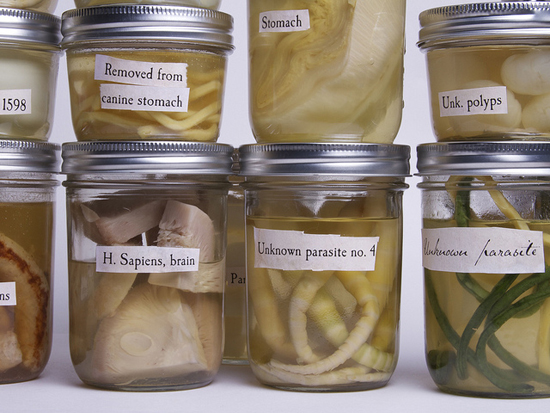
Image from Foodiggity.com
Among other things, Kidd is interested in presenting a realistic portrait of the period. ( I…wanted to give a basis of a real, gritty, accurate portrayal of Victorian London.) Visually, she offers panoramic looks through the dark eyes of ravens, and Bridie’s pedestrian peregrinations, particularly through less-than-posh parts of the city. She offers a particularly effective olfactory perspective as well.
Breathe in—but not too deeply. Follow the fulsome fumes from the tanners and the reek from the brewery, butterscotch rotten, drifting across Seven Dials. Keep on past the mothballs and the cheap tailor’s and turn left at the singed silk of the maddened hatter. Just beyond, you’ll detect the unwashed crotch of the overworked prostitute and the Christian sweat of the charwoman. On every inhale a shifting scale of onions and scalded milk, chrysanthemums and spiced apple, broiled meat and wet straw, and the sudden stench of the Thames as the wind changes direction and blows up the knotted backstreets. Above all, you may notice the rich and sickening chorus of shit.
She was greatly influenced by journalist William Mayhew’s encyclopedic 1851 book London Labour and the London Poor. There is a look at the jailhouse, which appears to be guarded by particularly corrupt versions of Tweedle-Dee and Tweedle-Dum. Toss in, (or dig up) some resurrectionists, too. Part of the Victorian culture was a craze for collecting exotic things. One story that fed her interest was that of The Irish Giant, an exceptionally tall gent (7’7”) who became the talk of London for a brief time. But after his early demise, and despite his specific instructions to the contrary, his remains were obtained by a collector and put on display. There is a link to this tale in EXTRA STUFF.

Image from Traveldarkly.com
Lee is also interested in Irish folklore and partakes of that richly for the core element of the story. The incorporation of this element brings with it the main fantasy strand of the novel. One look at the cover of the book will inform you that there be mermaids (or something akin) here. Lee adds additional magical elements, as such critters appear here to have considerable power to influence the world about them, and specific powers that we would never associate with The Little Mermaid, although, considering the things we see in jars, we might have to reconsider the implications of the song Part of Your World:
Look at this stuff
Isn’t it neat?
Wouldn’t you think my collection’s complete?
Wouldn’t you think I’m the girl
The girl who has ev’rything?
Look at this trove
Treasures untold
How many wonders can one cavern hold?
Lookin’ around here you’d think
(Sure) she’s got everything
Hmmmmmm.

Image from Klyker.com
There is considerable humor in Things in Jars.
Her spectacularly ugly bonnet is curled up before the fire, bristling with feathers. She refused to give it up into the hands of the butler. Not that the butler was overeager to take it. If it comes alive, Sir Edmund thinks, he will do for it with the poker.
My particular LOL favorite is the prayer young Bridie offers up at bedtime.
God grant eternal rest to Mammy, Daddy, James, John, Theresa, Margaret, Ellen, and little baby Owen. God grant that bastard Paddy Fadden a kick up his hole and severe death to him and his gang, of a slow and terrible variety.
How could you not absolutely love such a child?
The disappointments in Things in Jars were few. I wish there had been more provision of clues throughout the book about what the deal was with Ruby. I was ok with the explanation, but it needed a better support structure. A bit more background on Cora would have been welcome. One actual gripe was a scene in which Bridie falls asleep while on the job. No way would this have happened. Booo! Almost all the violence occurs off-stage. In addition to one event described in a quote from the book in the review, we are shown the beginning of one attack by a ruffian on a lady. Tender souls might turn away. That’s really about it for such things.
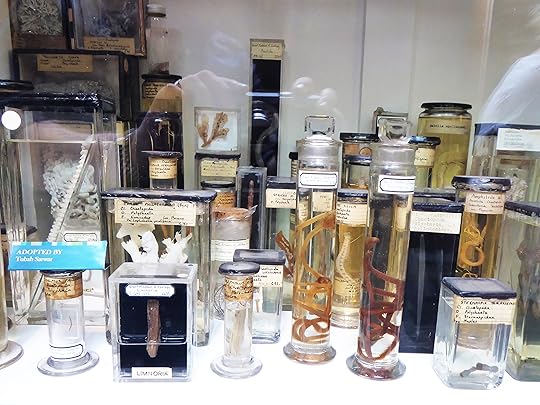
Image from Nickcook.net
But the delights in Things in Jars could fill a wing of the British Museum. Bridie is a delicious lead, tough as nails without being impervious, bright, with a solid background that explains how she knows what she knows. She is a lot of fun to follow. The Holmesian parallels are a treat. The supporting cast is like a three-ring circus, in the best possible way, diverse, interesting, and fun to watch (both the light and the dark). We feel the fear when appropriate, and see Bridie’s affection for Ruby grow. A taste of Irish folklore is both creepy and educational, and Lee’s portrait of 19th century London offers an exceptionally immersive experience. You really get a feel (and smell) of being there. A real-world mystery with fabulous elements of fantasy. In short, Things in Jars is an absolute delight. For the hours you are reading this book you will be part of that world.
Review first posted – January 17, 2020
Publication date – February 4, 2020
I received an ARE of this book from Atria in return for some specimens I have been keeping in a special place in the lab basement for some years. They promised to return them after a thorough examination.




This review is cross-posted on Goodreads. Stop by and say Hi!
=======================================EXTRA STUFF
Links to the author’s personal, Twitter, Goodreads, Instagram and FB pages
My review of a 2023 book by Kidd
—–The Night Ship
Interviews
—–Savidge Reads – Sinister & Supernatural Shenanigans with Jess Kidd – by Simon Savidge
—–Stitcher – S3E4 – Chatting with Jess Kidd – audio – 1:29:12 – by Tim Clare – you can safely begin at about 46:00 for a focus on Jars
—–Well, not an interview, really, but a piece Kidd wrote for LitHub on her favorite ghost stories – Books That Blur the Lines Between Living and Dead
Items of Interest
—–Waterstones – A look at the Operating Theater – Kidd gives a tour
—–Writing i.e. – On Writing Things in Jars by Jess Kidd
—–Gutenberg – London Labour and the London Poor (1851) by William Mayhew
—–Joseph Bazalgette – engineer of the massive sewer works in London
—–Otherworldly Oracle – Mermen Legends. – a fun bit of fluff
—–Wikipedia – The Irish Giant



 Coot's Reviews