
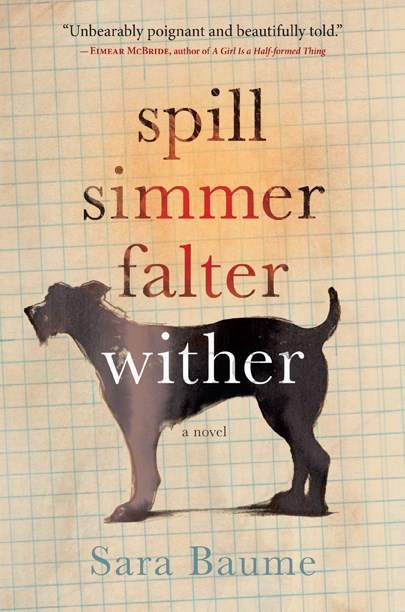
You’re Sellotaped to the inside pane of the jumble shop window. A photograph of your mangled face and underneath an appeal for a COMPASSIONATE & TOLERANT OWNER. A PERSON WITHOUT OTHER PETS & WITHOUT CHILDREN UNDER FOUR. The notice shares street-facing space with a sheepskin overcoat, a rubberwood tambourine, a stiffed wigeon and a calligraphy set. The overcoat’s sagged and the tambourine’s punctured. The wigeon’s trickling sawdust and the calligraphy set’s likely to be missing inks or nibs or paper, almost certainly the instruction leaflet. There’s something sad about the jumble shop, but I like it. I like how it’s a tiny refuge of imperfection. I always stop to gawp at the window display and it always makes me feel a little less horrible, less strange.
You are unsettled tonight, Mouse. I wonder why that is. Come, let me wrap my arm around you and scratch your tiny head. No? Not ready for that? OK. Well, how about I tell you about this book I just read? Go ahead, hop down to the floor. It’s ok. You’re not ready for holding just now. As for this book, there’s a man, Ray. He’s 57. Too old for starting over, too young to give up, he says. He has had a very sad life. His mother died when he was a baby, so he never knew it was usual to have two parents. He had only his factory-worker Da, who not only raised him alone, he raised Ray away from other children. Practically as a shut-in. Children in this rustic waterfront part of Ireland were cruel to Ray, teased him, tormented him. I guess his father thought that Ray, who was not the sharpest tool in the shed, would manage better at home than hassled at school. But it was a lonely life.
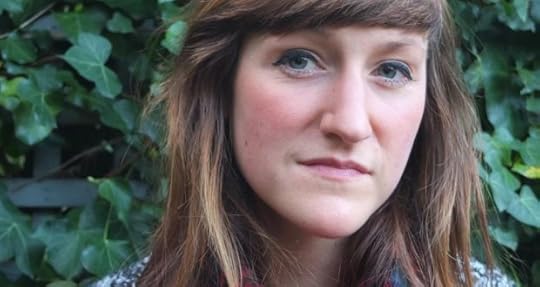
Sara Baume – image from The Irish Times
Are you listening, Mouse? I see your ears are still pointing up and forward, so I suppose you are. Ready to come back up? No? not yet? Ok. I will try to tell you about this in as soft a voice as I can. So, one day Ray is out in town and sees a sign in a store window with a photograph of a dog in need of a home. Do you remember when you used to live on the street? It was only for a short time. We found you when you were soooo tiny. But this dog that Ray found was not a baby like you were. He was a full-grown pooch, who had seen some difficult times. He might have been a young aggressive dog, but he could have been an old one too. We don’t really know. He had even lost an eye. Ray thinks he had been trained to go after badgers, and that a badger had gotten the better of him. But Ray sees something of himself in the dog, something less than beautiful, not like you, Mouse. You are soft and gorgeous. So he brings him home and calls him One Eye. It gives him someone to talk to, at least. And maybe something more.
People talk to their pets for all sorts of reasons. But Ray talked to One Eye because he had no one else. In this book, Ray tells One Eye all about his life, how he had lived with his father for most of it, and alone ever since his father passed. It is a pretty unusual thing in a novel, Mouse, for someone to spend all, or most of the book anyway, talking to someone else. Quite the challenge. But it works pretty well here, I thought. Of course, One Eye may be a good companion, but, like Ray, he was not the best schooled. Has issues with attacking. You don’t know about that sort of attacking, Mouse. When you pounce on and wrestle with your brother, Dash, biting and clawing, wrestling, and rolling over each other, it is all in fun. Not with One Eye. He does not seem to know how to behave around others. This makes things a bit tough for Ray. People tend to get upset when dogs are not well trained.
Ray does not think much of himself. He thinks he looks like a troll. Here is how he describes himself. I’ll try to read it to you in an Irish accent.
I’m a boulder of a man. Shabbily dressed and sketchily bearded. Steamrolled features and iron-filing stubble. When I stand still, I stoop, weighted down by my own lump of fear. When I move, my clodhopper feet and mismeasured legs make me pitch and clump. My callused kneecaps pop in and out of my shredded jeans and my hands flail gracelessly, stupidly.
Oh, that is such a big yawn. Are you ready to come up? Yes? Great. Here, I will cross my skinny legs and make a lap for you. I’ve already told you the story, or at least as much as I can without giving too much away. Did I tell you that the story takes place in Ireland? I did? Oh, ok. The lady who wrote it, Sara Baume, is half Irish. Her father is English. And her mother is Irish. They met while he was working in Ireland. The family moved back and forth, but Ms. Baume knows the place.
I like talking to you, Mouse. But not because I am lonely. I have my Sweetie and all your brothers and sisters. I even get out of the house once in a while. And there are scads of people I can talk to through the computer or on the phone. But I do enjoy your attention. I like the way you watch my face while I talk to you. And I love the way your eyelids slowly droop until you are asleep. It reminds me of when I used to read to my human children at night. I wonder what thoughts scamper through your tiny brain. I bet if you lived outside you would take in all the sights and scents in the world you lived in. Ray does this as well. He does get outside, goes to town, to shops, to the beach. He may not be well educated, but he is not without his interests. He was taught to read by a neighbor, and developed a fondness for flora. He can rattle off the names of every sort of plant you could see in that part of the world. Ray marks the seasons by noting what plants are doing, which ones are blooming, wilting, changing shape and color. It is a remarkable skill and he tells us what he sees of nature all through the book. Here is an example:
See the signs of summer, of the tepid seasons starting their handover with subtle ceremony. Now the forest floor is swamped by bluebells, the celandine squeezed from sight. See how the bells hover above the ground, like an earth-hugging lilac mist. Now the oak, ash, hazle and birch are bulked with newly born leaves, still moist and creased from the crush of their buds. The barley is up to my kneecaps and already it’s outgrown you. As we crest the brow of the hill each day, you are shrouded in green blades.
It occurs to me, Mouse, that you have been living with us for about a year which is a lovely coincidence, as Ms. Baume’s story about Ray and One Eye covers a single year too. She made up names for the seasons, and used those as the title for the book, and a way to divvy the book up into four parts. Throughout it all, Ray describes the seasonal changes he sees.
We get to see Ray long enough to get a sense of what sort of person he is. He is far from perfect, even in what seems like his innocence. So, like a lot of us. Even you, Mouse, I see you sometimes lurking on a chair, the better to swat at brothers and sisters who might be passing below. I have seen you be unkind to siblings who joined the family after you. One Eye has some issues as well, more dramatic ones than you. Ray can be unkind, as well. But mostly he is sad, and fearful.
There is a bit of mystery going on here as well. Just how did Ray’s Da die? And how was that handled by local officials? Also, we wonder what happened to Ray’s mother. Did she die in childbirth? What secrets are kept in rooms of the house that Ray never enters? How did it come to be that Ray’s father was raising him alone?
Overall, though, Mouse, this is a bit of a love story. Two lost souls finding and binding with each other, struggling to make ends meet, to survive, but feeling a closeness neither had experienced for a very long time, if ever. Oh, you are almost asleep. One last stretch. Spread those claws, Go ahead now, curl up, right there in the crook of my left arm. You fit there as if you had been custom-designed for the space. There was one thing I thought was not really successful in the book. Ms. Baume tries to tell us about One Eye’s take on things by giving Ray dreams in which he imagines himself as One Eye. It just seemed forced, and not needed. Even Ms. Baume has admitted she’s had second thoughts about including those parts.
Before you are totally asleep, Mouse, I need to let you know that Ms Baume trained to be an artist, and it was a bit of a surprise that she wound up writing a novel. But one thing about artists who write is that they bring an amazing visual sense to their writing, and she does that here. It reminded me of another book by an author who is mostly a visual artist, The Night Circus. Totally different content, of course, but very strong visual sense.
If you could not already tell, my little sweet, I quite loved this book. It has a lot of pain and a lot of sadness in it. It is both funny at times and heartbreaking. But like another book that shows a very dark time, The Road, it lets us in on the love, the connection between two spirits. If any reader is not moved by this book, they must be bolted in place. I cried at the end. It is simply a beautiful, beautiful book. Not as beautiful as you, Mouse, but then, what could be?
Review first posted – 10/27/2017
Published – 2/1/2015




This review is cross-posted on Goodreads. Stop by and say Hi!
=======================================EXTRA STUFF
If Sara Baume can be reached directly on-line it is news to me.
Interviews
—–The Guardian – 2/18/17 – Sara Baume: ‘I always wanted to be an art monster’ – by Alex Clark
she hit upon the character of Ray, in Spill Simmer Falter Wither, as a way of avoiding dialogue, because, she says, she didn’t want to get the voices of Irish people wrong. “I’m like, I need someone who’s not going to talk much, and who’s going to live very much in his own head. And so the way he speaks comes about from the radio and from the television and from the book.” Her caution at depicting “Irish voices” is striking, and derives from her dual heritage. Her English father came to Ireland to lay gas pipelines, and met her mother, an archaeologist, while “they were both in the ground”. They moved to England for a while, doing the same work, moving around a lot and living in a caravan; her elder sister was born in Surrey and she was born in Wigan, because “that just happened to be where the caravan was parked”. The family moved back to west Cork when Baume was a baby, but a sense of being from two places has persisted.
—–The Irish Times – 2/12/15 – Sara Baume: ‘I actually hate writing. It’s really hard’ – by Sinead Gleesopn
The dog was the starting point . . . the dog in the book is my dog, who is a rescue dog with one eye and he’s a real last-chance-saloon dog. He has caused us a lot of trouble; he’s bitten people and I’ve paid them off to stop him being put down. With the narrator, I wanted him to be an older man, and to be afraid of innocuous things, so he’s frightened of children and he doesn’t have normal social skills. He’s slightly based on a man who I see where I live, who walks up and down the seashore. I wanted to create a character who wasn’t fully me, but partially me, who encapsulated things that I felt.
—–NPR – 3/17/16 For A Young Irish Artist And Author, Words Are Anchored In Images – by Lynn Neary
Before she was a writer, Sara Baume set out to be a visual artist. “First and foremost I see; I see the world and then I describe it …” she says. “I don’t know another way to write. I always anchor everything in an image.”
—–The Times Literary Supplement – 2/13/17 – Twenty Questions with Sara Baume
For any interested in a visual of Mouse, you might check here. Try to ignore the troll seated behind her.


I was drawn into reading this because of the cover. Fabulous review. Loved the back and forth between One Eye and Mouse.
So interesting what you said about artists becoming writers and how Baume added “a great visual sense” to her writing. That makes so much sense.
Caroline
LikeLike
Thanks, C. I was reposting this one on GR and quite loved the review. It has a twinge of sadness for me as Mouse has crossed the rainbow bridge since I wrote this.
LikeLike