

Open the pod bay doors, HAL.
I’m sorry Dave. I’m afraid I can’t do that.
What’s the problem?
I think you know what the problem is just as well as I do.
What are you talking about HAL?
This machine is too important for me to allow you to jeopardize it.– from 2001: A Space Odyssey

Smile for the camera, HAL
This is probably the #1 image most of us of a certain age have concerning the dangers of AI. Whether it is a HAL-9000, or a T-70, T-800, T-888, or T-900 Terminator, a Cylon, a science officer on the Nostromo, a dark version, Lore, of a benign android like STNG’s Commander Data, killer robots on the contemporary TV series Extant, or another of only a gazillion other examples in written word, TV and cinema, there has, for some time now, been a concern, expressed through our entertainment media, that in seeking to rely more and more on computers for everything we do, we are making a Mephistophelian deal and our machines might become our masters. It is as if we, a world of Geppettos, have decided to make our Pinocchios into real boys, without knowing if they will be content to help out in the shop or turn out more like some other artificial being. Maybe we should find a way to include in all AI software some version of the Blue Fairy to keep the souls of the machines on a righteous path.


Cylons
John Markoff, an Oakland, CA native, has been covering the digital revolution for his entire career. He began writing for InfoWorld in 1981, was later an editor at Byte magazine for about eight bits, then wrote about Silicon Valley for the San Francisco Examiner. In 1988 he began writing for the Business Section of the New York Times, where he remains to this day. He has been covering most of the folks mentioned in this book for a long time, and has knowledge and insight into how they tick.
For the past half century an underlying tension between artificial intelligence and intelligence augmentation—AI vs IA—has been at the heart of progress in computing science as the field has produced a series of ever more powerful technologies that are transforming the world. It is easy to argue that AI and IA are simply two sides of the same coin. There is a fundamental distinction, however, between approaches to designing technology to benefit humans and designing technology as an end in itself. Today, that distinction is expressed in whether increasingly capable computers, software, and robots are designed to assist human users or to replace them.
Markoff follows the parallel tracks of AI vs IA from their beginnings to their latest implementation in the 21st century, noting the steps along the way, and pointing out some of the tropes and debates that have tagged along. For example, in 1993, Vernor Vinge, San Diego State University professor of Mathematics and Hugo-award-winning sci-fi author argued, in The Coming Technological Singularity, that by no later than 2030 computer scientists would have the ability to create a superhuman artificial intelligence and “the human era would be ended.” VI Lenin once said, “The Capitalists will sell us the rope with which we will hang them.” I suppose the AI equivalent would be that “In pursuit of the almighty dollar, capitalists will give artificial intelligence the abilities it will use to make itself our almighty ruler.” And just in case you thought the chains on these things were firmly in place, I regret to inform you that the great state of North Dakota now allows drones to fire tasers and tear gas. The drones are still controlled by cops from a remote location, but there is plenty to be concerned about from military killer drones that may have the capacity to make kill-no-kill decisions within the next few years without the benefit of human input. Enough concern that Autonomous Weapons: an Open Letter from AI & Robotics Researchers, signed by the likes of luminaries like Stephen Hawking, Elon Musk, and tens of thousands of others, raises an alarm and demands that limits be taken so that human decision-making will remain in the loop on issues of mortality.

The other Mister “T”
Being “in the loop” is one of the major elements in looking at AI vs IA. Are people part of the process or what computerization seeks to replace? The notion of the driverless car comes in for a considerable look. This would probably not be a great time to begin a career as truck driver, cab driver, or delivery person. On the other hand, much design is intended to help folks, without taking over. A classic example of this is Siri, the voice interface available in Apple products. AI in tech interfaces, particularly voice-intelligent tech, speaks to a bright future.

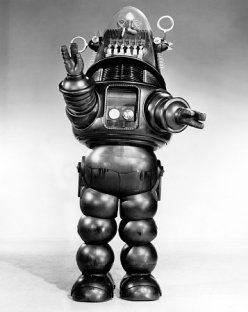
B9 from Lost in Space and Robby the Robot from Forbidden Planet
Markoff looks at the history of funding, research, and rationales. The Advanced Research Projects Agency (ARPA), which has funded so much AI research, began in the 1950s in response to the Soviet launch of Sputnik. Drones is an obvious use for military AI tech, but, on a lower level, there are robot mules designed to tote gear alongside grunts, with enough native smarts to follow their assigned GI without having to be constantly told what to do. I am including links in the EXTRA STUFF section below for some of these. They are both fascinating and creepy to behold. The developers at Boston Dynamics seem to take inordinate glee in trying and failing to knock these critters over with a well placed foot to the midsection. It does not take a lot of imagination to envision these metal pooches hounding escaped prisoners or detainees across any kind of terrain.

Darryl Hannah, as the replicant Pris in Blade Runner, would prefer not to be “retired”
As with most things, tech designed with AI capacity can be used for diverse applications. Search and Rescue can easily become Search and Destroy. Driverless cars that allow folks to relax while on the road, can just as easily be driverless tanks.
Universities have been prime in putting the intel into AI. Private companies have also been heavily involved. Xerox’s Palo Alto Research Center (PARC) did, probably, more than any other organization to define the look and feel of computer interfaces since PCs and Apples first appeared. Much of the tech in the world, and working its way there, originates with researchers taking university research work into the proprietary market.

John Markoff – from TechfestNW
If you are not already a tech nerd (You, with the Spock ears, down, I said tech nerd, not Trek nerd. Sheesh!) and you try to keep up with all the names and acronyms that spin past like a stock market ticker on meth, it might be just a teensy bit overwhelming. I suggest not worrying about those and take in, instead, the general stream of the divergence between computerization that helps augment human capabilities, and computerization that replaces people. There is also a wealth of acronyms in the book. The copy I read was an ARE, so I was on my own to keep track. You will be reading copies that have an actual index, which should help. That said, I am including a list of acronyms, and their close relations, in the EXTRA STUFF section below.
While there are too many names to comfortably keep track of in Machines of Loving Grace, unless of course, you were made operational at that special plant in Urbana, Illinois, it is a very informative and interesting book. It never hurts when trying to understand where we are and struggling to foresee where we might be going, to have a better grasp on where we began and what the forces and decisions have been that led us from then to now. Markoff has offered a fascinating history of the augment-vs-replace struggle, and you need only an actual, biological, un-augmented intelligence to get the full benefit.
My instructor was Mister Langley and he taught me to sing a song. If you’d like to hear it I can sing it for you.
Review Posted – 8/28/15
Publication date – 8/25/2015
=======================================EXTRA STUFF
Links to the author’s Twitter and FB pages
A link to his overall index of NY Times work
Interviews with the author
—–Geekwire
—–Edge
Check out this vid of Boston Dynamics’ Big Dog, coping, on its own with a series of challenges. And Spot, sadly, not Commander Data’s pet.
UC Berkeley Professor Stuart Russell speaking at The Centre for the Study of Existential Risk on The Long Term Future of AI
GR friend Tabasco recommended this fascinating article – The AI Revolution: The Road to Superintelligence – By Tim Urban – must read stuff
And another recent NY Times piece on AI, Software Is Smart Enough for SAT, but Still Far From Intelligent, by John Markoff
And yet another from the Times, on voice recognition,IPhone 6s’s Hands-Free Siri Is an Omen of the Future, by Farhad Manjoo
==========================================ACRONYMS
AI – Artificial Intelligence
ArcMac – Architecture Machine Group
ARM – Autonomous Robot Manipulation
ARPA – Advanced Research Projects Agency
DRC – DARPA Robotics Challenge
CALO – not actually an acronym but short for Calonis, a Latin word meaning “soldier’s low servant” – a cognitive assistant here
CTO – Chief Technology Officer
EST – Erhard Seminars Training
GOAFI – Good Old-Fashioned Artificial Intelligence
HCI – Human Computer Interface
IA – Intelligence Augmentation
ICT – Information and Communications Technology
IFR – International Federation of Robotics
IR3 – The Computer and internet revolution
LS3 – Legged Squad Support System – check out this vid
MIT- Massachusetts Institute of Technology
NCSA – National Center for Supercomputing Applications – at the University of Illinois-Urbana-Champaign – developers of Mosaic, which was later renamed Netscape
NHA – Non-human agents
OAA – Open Agent Architecture –
OpenCV – Open Source Computer Vision
PDP – Parallel Distributed Processing
PR1 – Personal Robot One
SAIL – Stanford Artificial Intelligence Laboratory
SHRDLU – SHRDLU was an early natural language understanding computer program, in which the user carries on a conversation with the computer. The name SHRDLU was derived from ETAOIN SHRDLU, the arrangement of the alpha keys on a Linotype machine, arranged in descending order of usage frequency in English. – from Wiki
SLAM – Simultaneous Localization And Mapping
SNARC – Stochastic Neural Analog Reinforcement Calculator
STAIR – Stanford AI Robot
TFC – The F—ing Clown – Development team Internal name for Microsoft’s Clippy assistant
UbiComp – Ubiquitous Computing
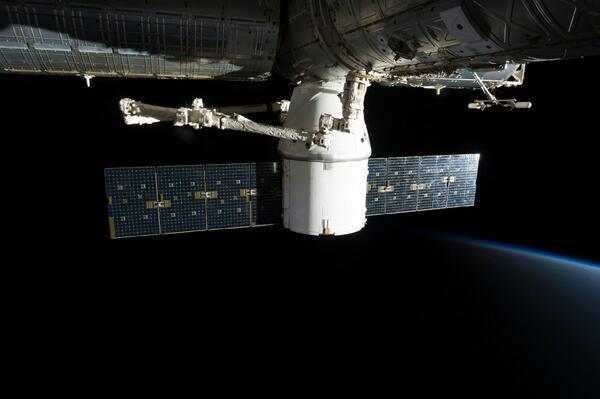
 Elon Musk is not exactly a name that rolls easily off the tongue, like say Tony Stark, the fictional person to whom he is most often compared, or even Steve Jobs, a real-world visionary, whose mantle Musk now wears. There is no question that Musk is a special individual, someone with BIG dreams and the drive, talent, and money to make them happen. But, like Jobs, and Stark for that matter, he might be an acquired taste on a personal level. In Elon Musk: Tesla, SpaceX, and the Quest for a Fantastic Future biographer Ashlee Vance gives us a picture of both the dreams and the man, peering back to where Musk began, describing his journey from then to now, looking at how he is impacting the world today, and gazing ahead to where he wants to go. It is a pretty impressive vista. Here is what it says on the SpaceX website
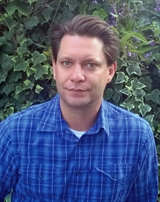 Ashlee Vance – from HarperCollinscaption]Vance take us from his adolescence as a computer geek, bullied at school, through his arrival in Canada, cold-calling to get work, putting together his first dot.com startup, and using the money from that to invest in a banking-oriented company that would become PayPal. It was the mega-bucks from the sale of PayPal that would allow him to begin realizing his big dreams. In 2003, Musk bought into Tesla, then a struggling startup. The company took the early knowledge that lithium ion batteries had gotten pretty good, added some top level engineering, design and programming talent, and, after plenty of mis-steps and struggles, brought the remarkable all-electric Tesla Roadster to the market in 2008. Tesla followed this with the Model S in 2012. Not only did Consumer reports call this a great car, it named both the 2014 and 2015 versions the best overall cars of their years, and the best care they ever tested. The last time an auto startup succeeded in the USA was Chrysler, in the 1920s. But this is not about simply making a buck on a new car. The long term goal is to shift our petrochemical auto industry to renewable power, and the Tesla is a nifty start. Not only is the car amazing, the company has constructed a nationwide series of charging stations where Tesla owners can recharge their vehicles…for free. There are currently 499 such stations, with many more planned. Tesla is involved in building battery production factories, hoping to help support a growing electric-car auto-economy.


 There are so many elements to Some Luck, long-listed for the 2014 National Book Award, that wherever your interests may lie, there is much here from which to choose. Take your pick—a Pulitzer-winning author going for a triple in the late innings, finishing up her goal of writing novels in all forms. Take your pick—a look at 34 years of a planned hundred year scan of the USA through the eyes of a Midwest family, winning, engaging characters, seen from birth to whatever, good, bad and pffft, where’d that one go? Take your pick—a look at the changes in farming, over the decades, the impact of events like the Depression and massive drought on people you care about. Take your pick—the impact of the end of World War I on the breadbasket, a sniper’s eye view of World War II, the chilly beginning of the Cold War. Take your pick– the searing summer heat that killed many, the biting snow-bound winter that stole the heat from every extremity. Take your pick– an infant’s eye view of learning to speak, a teenager’s look at awakening sexuality, an older man looking back on his life. Take your pick—the newness and revolution of cars, tractors, hybrid plants, new fertilizer, the tales brought from the old country, often told in foreign tongues. Take your pick—a bad boy with talent, brains and looks, a steadfast young man taking the old ways of farming and mixing them with the new to make a life and a future, a smart young woman heading to the big city and getting involved with very un-farm-like political interests. Take your pick—shopping for a religion while looking for answers to the sorrows of existence, shopping for political help when no financial seems forthcoming from the nation. Take your pick—love is found, lost, found again, couples struggle through ups and downs, the charring of fate and time, the questions that arise, the doubts, the certainties. Take your pick.




 Coot's Reviews