

Jorie vanished from the scene, from the entire internet. Her connections, her film production and book deal, the screenplay she sold, her agent, the October Film Haunt brand, the two hundred thousand followers scattered across social media—everything drained out of her life a long time ago. She hasn’t so much as watched a trailer for a scary movie since.
“Until it became real. I don’t know if it’s evolution or some Lovecraftian construct, but what is it to know something, really? Belief leads us to something more real than knowing, Jorie. Have you not noticed that everywhere lately?”
Sometimes “belonging” is not such a wonderful thing.
The October Film Haunt is not a book for everyone. If you are a nerd-level horror maven, this will be a bloody fabulous read, with links, left, right, center, up, down and all around for you to catch and relish. For those of us who are just folks who like reading some horror books, it can be disjointed, confusing, and potentially unsatisfying.
About a decade back, Jorie Stroud, a nod to Halloween’s final girl, Laurie Strode, and two friends formed The October Film Haunt. Their schtick was to go to places where horror movies had been filmed, and scope them out for atmospherics, filling their site with reportage and recordings of their outings. Could real places be as creepy or even creepier than the flicks that were made there? Unfortunately, they went a step too far with an indie film, called Proof of Demons, suggesting that there might be more reality to that film than was justified. As a result, some foolish teens tried something out that they should not have, and one of them died.
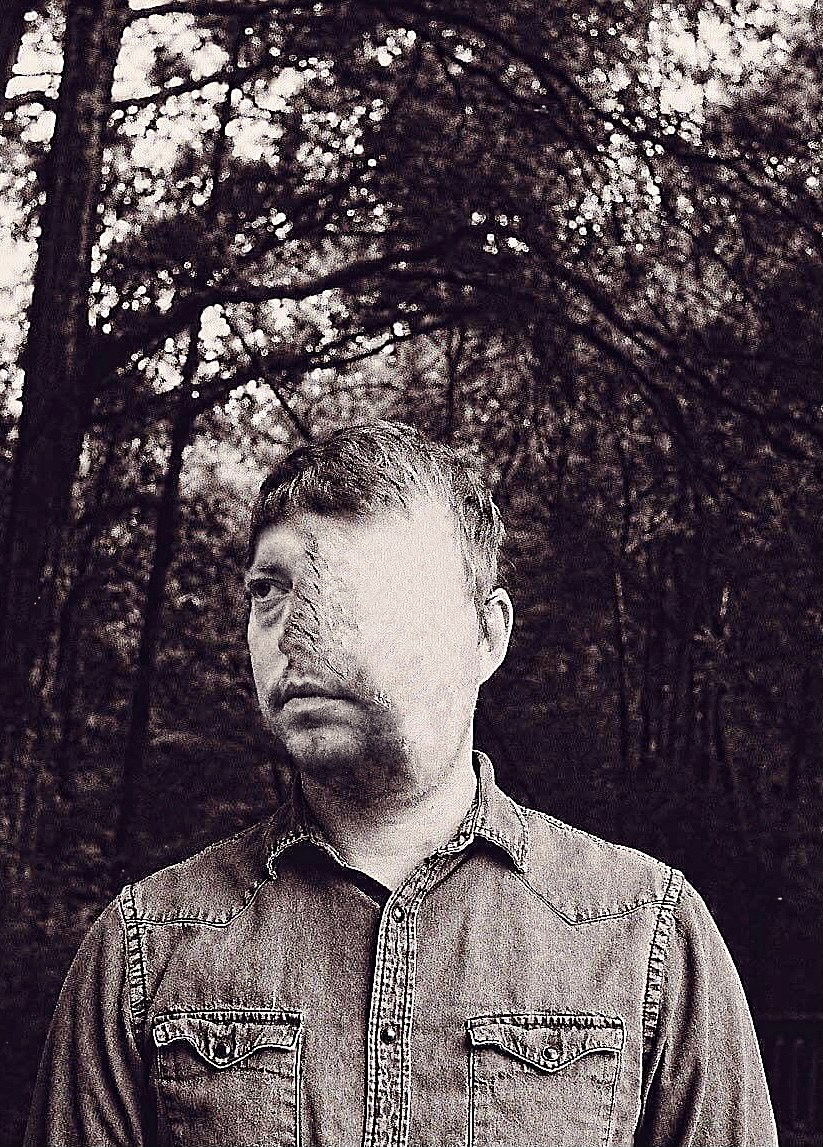
Michael Wehunt – Image from Pseudopod
There was blowback, and Jorie’s film ambitions, of any sort, were buried under a caul of notoriety. Then there was another death in the ripples from the initial fatality. Jorie has lived all these years with a heavy burden of (deserved) guilt. Then one day, a VHS package arrives, a trailer for what appears to be a sequel to the Proof of Demons film that had sparked all the trouble. Why? And why send it to Jorie? Is someone trying to punish her?
The primary stream of the story is final girl Jorie enduring the assaults on her sanity, her person, and those close to her. Who is doing this to her, and why? Is the mysterious PoD director, Helene Enriquez, making a sequel and somehow forcing Jorie to be a part of it?
This novel plays with several horror sub-genres simultaneously. The found-footage form, epitomized by The Blair Witch Project, is one. That film marketed itself as being based on real-world footage left behind by missing documentarians, that was discovered and cobbled together into a narrative. It was nothing of the sort, of course, but many people bought into the PR, which included a documentary style TV special and a website claiming the people who had shot the footage were really missing.
Wehunt adds slasher and demon-possession into the mix. He imbues the former with the sort of faceless, mindless killing machine aspect we would expect of Michael Myers, substituting sheets for disturbing masks. We are not talking KKK sheets here, which should be feared, but hospital sheets (maybe to be feared for different reasons?) featuring crowns worn beneath the bed linen for which the unusual outerwear seems ill-designed. And offers wrinkles on the demon possession motif by blurring the lines between possessor and possessed,
I wanted the book to be, you know, secular. I really wanted to avoid the priest vs. demon Abrahamic Christian typical dynamic of a demon possession story. – from the Talking Scared interview
while tossing into the genre blender cursed films. It is pretty much a part of this story that seeing the VHS tapes that are making the rounds can be lethal for the viewers. Home invasion? Sure, plenty of that. Cult madness? Yup. And probably more.
There are other characters who travel along this dark path with Jorie. Coleman’s brother, Jackson, went missing when he was a kid, in circumstances eerily resonant with the Proof of Demons film. He gets dragged in by a vague promise to find his brother, and maybe rid himself of his cancer.
I wanted to be there as someone who just doesn’t, horror is not on his radar. It’s never been an interest of his. He’s almost 60 years old. He’s not going to become a horror fan now. But he’s chosen for this one element of the book. And so he would have no touchstones.He would have no easy point of reference for the things that are happening to him. And simultaneously, he has been diagnosed with stage four cancer. So, things that happened to his body would to him sort of feel like it’s the cancer, isn’t it? – from the Talking Scared. interview
Beth Kowalczyk was the other survivor of the October Film Haunt trio. Jorie reconnects with her, after a very long estrangement, hoping to gain some support and understanding.
Trevor Henderson created the Pine Arch Creature for the film.
He cheered the modern legend leaking out of the film—but soon became uncomfortable and spoke out against it. “It was a really cool folklore for a minute there,” Henderson says. “A great monster that lingered with you…But then people were pushing these rituals. Some of them were like self-harm. It wasn’t just for fun anymore, so I checked out…Looking back, I can see the root of that kind of thinking that’s everywhere now, that sort of desperation to believe anything you want even when the reality is right there. There’s a difference between make-believe and post-truth. One of them isn’t dangerous.”
Roger Eilertsen was the character actor who played the PoD lead, lending gravitas to the role. He is in his 80s now, and it is unclear why he is being troubled by the sorts of intrusions endured by all the main characters. And the intrusions are considerable, beginning with delivery of a VHS tape and progressing to stalking, home invasion, unwanted filming, assault, kidnapping and worse.
The primary conceptual question that gives this book weight is the notion that belief can create reality. A very different example of such is the musical, The Music Man in which a conman persuades the kids of a midwestern community that they really can play the instruments he has only been pretending to teach. Lo and Behold, the parents somehow perceive their kids as having actually learned to play and construct an idyllic image of their new town orchestra that sounds great to them. But that perception is clearly in the eyes of the receivers. The paranormaling of the world here is quite real. There is plenty that could be made of this in a political analysis, but Wehunt claims no interest in that, so I will take a pass, well mostly, Pathetic followers of QAnon believe some pretty outrageous bullshit, and act on those beliefs in the world. Not to mention the daily flood of lies and provocations spewing from the current administration. And their attempts to create the reality of their fantasies.
The fear level is considerable as common horror trope rules are disregarded and thus expectations are thwarted. The apparent mindlessness of the cult behavior is inexplicable. Not that real-world cult behavior is necessarily understandable. Questions abound, primarily why? Why was this person dragged in to this bizarre undertaking? Why that one? I found the answers less than satisfying. The lines between reality and something else grow increasingly smudged. The portrayal of the Pine Arch Creature, also literally smudged, may offer a suitable metaphor. As does the literal eye in the sky, whether it represents a deity, a film director, or a voyeur. Metafiction can be a difficult thing to pull off, particularly as it makes it a challenge sustaining a reader’s interest in the characters when one so frequently points out the literary and structural underpinnings of the story itself.
There are plenty more details for you to find for yourself, a virtual cornucopia in fact. And catching the references can definitely be fun. But it all seemed too much for me. As noted above, if you are a horror maven, have at it. Enjoy! But it was form over substance, over fear, for me.
“Until it became real. I don’t know if it’s evolution or some Lovecraftian construct, but what is it to know something, really? Belief leads us to something more real than knowing, Jorie. Have you not noticed that everywhere lately?”
Review posted – 10/10//25
Publication date – 09/30/25
I received AREs of The October Film Haunt from Saint Martin’s Press in return for a fair review. Thanks, folks, and thanks to NetGalley for facilitating.




This review is cross-posted on Goodreads. Stop by and say Hi!
=======================================EXTRA STUFF
Links to Wehunt’s personal, FB, Instagram, and Blue Sky pages
Profile – from his site
Michael Wehunt grew up in North Georgia, close enough to the Appalachians to feel them but not quite easily see them. There were woods, and woodsmoke, and warmth. He did not make it far when he left, falling sixty miles south to the lost city of Atlanta, where he lives today, with fewer woods but still many trees. He writes. He reads. Robert Aickman fidgets next to Mary Oliver on his favorite bookshelf.
Interviews
—–Cinemachords – The October Film Haunt Author Michael Wehunt Talks Fandom, Urban Legends, & Digital Mythologizing
– Howard Gorman
—–The Nerd Daily – Q&A: Michael Wehunt, Author of ‘The October Film Haunt’ by Elise Dumpleton
—–Talking Scared – 255 – Michael Wehunt & What If A Horror Film Broke Into Your House? – open in podcasts – then transcript is available
Items of Interest
—– The Philip Experiment: A Benchmark in Paranormal Research by C. Wesley Clough
—–Wikipedia – The Medium is the Message
—–Wikipedia – metafiction







 Coot's Reviews