Tag Archives: native-american

The Buffalo Hunter Hunter by Stephen Graham Jones

book cover

Good Stab fell to his knees, pressed his forehead to the floor and he screamed too, and I daresay our screams harmonized, at least in how much they pained us.
This, I believe, is the story of America, told in a forgotten church in the hinterlands, with a choir of the dead mutely witnessing.
“Your tore out the heart of my people, Three-Persons,” Good Stab said into the floor.
“I’m sorry,” I said back, I knew how weakly. “I’m sorry I’m sorry I’m sorry.”
“Is it wrong to kill?” he asked then, again, sitting back on his haunches, his bared arms hooked around his knees. “Is this what you tell your people who come each Sunday?”
“Yes,” I said.

What I am is the Indian who can’t die.
I’m the worst dream America ever had.

The vampire genre has a new dark star. Far from the European roots we all know, Stephen Graham Jones has created a uniquely American, a uniquely Native American version of the tormented and tormenting blood-sucker. The novel is rich, not only with the horrors of the genre, but with the very un-magical horrors of the time. No vampire could possibly compete with the mass slaughter of the American Bison, nor of the Native American peoples. This envisioning of an American vampire includes a remarkable twist, new to the genre, at least as far as I am aware.

Good Stab’s damnation comes with a wickedly satisfying pair of rules: he must feed on his prey until it’s dry—sometimes causing his side to literally burst open—and he grows to resemble whatever he’s feeding from. – from the PW interview

The structure is frame within a frame within a frame. Etsy Beaucarne is our outermost, in 2012, a struggling academic, the descendant of a pastor from the 19th century. Arthur Beaucarne, a Lutheran, ministered to the religious needs of the residents of Miles City, Montana. His journal, stowed in 1912 was recently found in an old parsonage undergoing renovation (cheekily referred to as revamping). In this journal, Arthur, the second frame, relates the tale told to him by a strange Native American man, Good Stab. The Indian appears at the back of his congregation, in dark clerical garb, wearing sunglasses, and wanting to talk. His tale is terrifying and compelling.
description
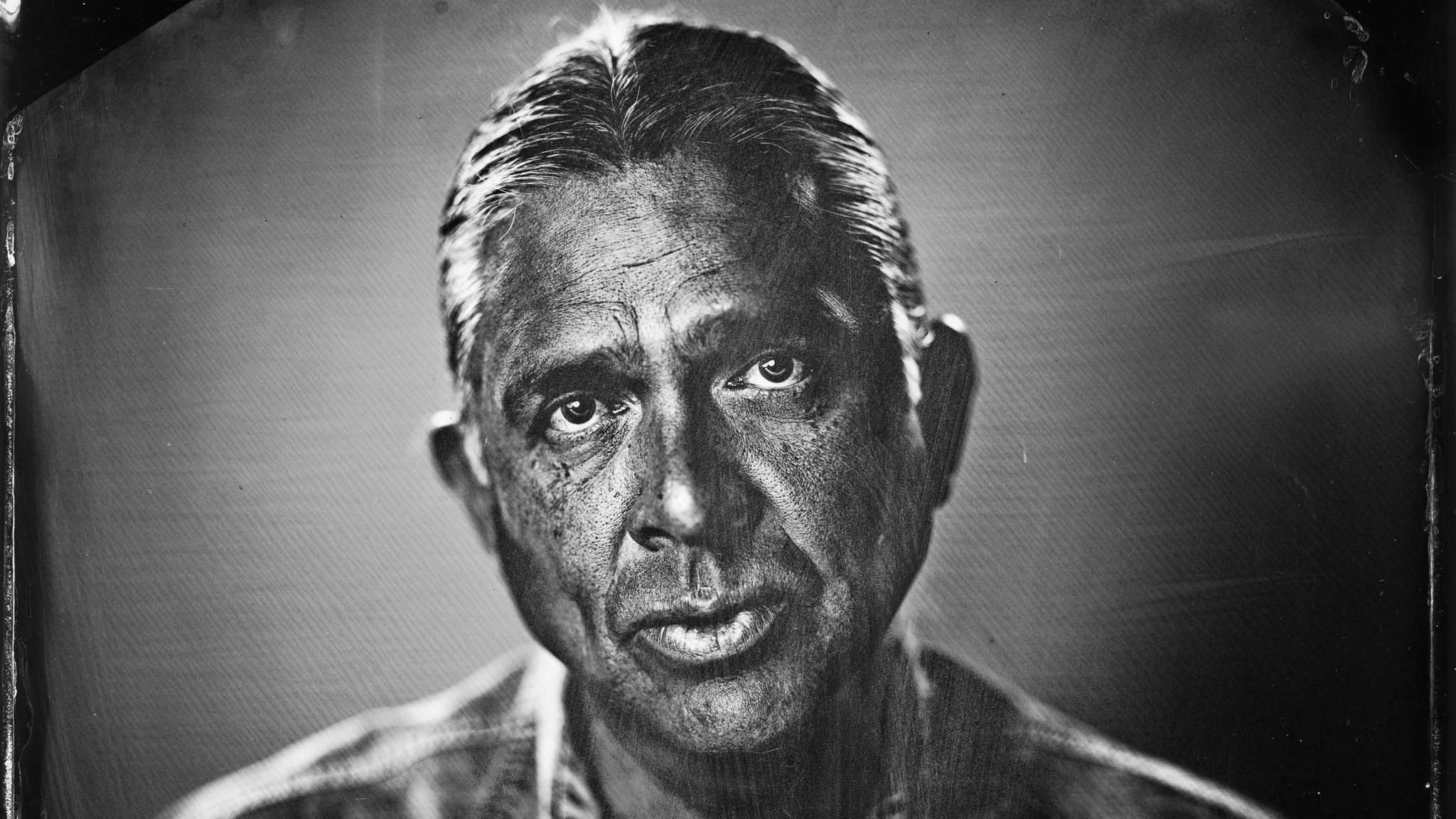
Stephen Graham Jones – image from 5280 Magazine – shot by Matthew DeFeo

It is an American history not taught in Western schools. The Marias Massacre took place 1870. A U.S. cavalry troop was sent to do damage to a particular branch of the Pikuni tribe, not the branch that had made an alliance with the incoming settlers. The leader of the troop, despite being shown documentation of the alliance, decided that one Indian is the same as another and proceeded to massacre 217 mostly women, children, and old men, many suffering from small pox.

Good Stab, a Pikuni, named for his nifty defense against an attacker, was 37 when he encountered the creature he calls Cat Man.

The thing had a thin white face with intelligence to it, and at first I thought its chin and mouth were painted for ceremony, but then I saw that it was just that it ate like a sticky-mouth, where it made a mess, and then let that blood stay like it was proud of it, wanted all the other four-leggeds see what it could do. Its mouth looked like it was pushing out too far, too, bringing the nose with it. But I told myself that was just because the dried blood made it look that way.
Its eyes were like mine, like I see you seeing, and its hair was hanging in its face, and it was naked so we could see it was a man, or had once been a man.
But it was no man

We follow Good Stab’s tale through decades, as told to Pastor Beaucarne, as he struggles to survive, and finds purpose in taking down those who seek to kill “blackhorns.” There are many adventures along his journey of discovery, and many internal struggles. He is a complex character who seems at times inured to the havoc he inflicts, but one who manages to sustain a kind, caring heart, at times anyway. We feel his pain in being an outsider as he yearns to connect with his people.

The backdrop for this story is the Western expansion into the west, including the racism, colonial military dominance, destructiveness, wastefulness, genocide, inhumanity and cruelty of the era. Killers, murderers, and thieves preaching a religion of peace. The irony is not lost. Ultimately, this is a revenge tale. Punishment for many who have come west to pillage nature’s bounty, and targeted attacks on those responsible for the Marias Massacre.

As we get most of the story from Good Stab we get his usage as well, words for creatures of the American west. “Blackhorns” for Bison, as well as Whitehorn, Wags-his-tail, Long-legs, Sticky-mouth and plenty more. Part of the fun of reading this is identifying each species as it is introduced.

Part of the joy of reading The Buffalo Hunter Hunter is seeing the coming together of history and horror in a way that is reminiscent of one of America’s most inspired writers. While this is hardly a magical realism version of history, the incorporation of actual Native American history gives it a very Louise Erdrich-y feel. There is another form of joy to be had here. I have a particularly high bar for horror. I lose no sleep, nor do I have scary dreams as a result of reading a horror book. But there was a night, while reading this one, when I felt that I had somehow ingested three fist-size dollops of Vampire and they had taken root in my torso. I knew in the dream that I could, with effort, expel them, but knew also that it would take a supreme effort to do so. That, to me, is the sign of a good scary book.

Stephen Graham Jones is a prolific writer. Even more than Stephen King, maybe into the domain of Isaac Asimov. I have read only a few (listed below in EXTRA STUFF) but of those I have read, this one stands out. The Buffalo Hunter Hunter is most definitely worth whatever time and trouble it takes to track down. Once you sink your teeth into it, you will have a tough time stepping away until you have ingested it all. This is simply a bloody wonderful book.

You don’t know this yet, but once a generation, once a century, someone is born with a kind of blood no one else has. If you drink from that person . . . how to explain it? It’s like the difference between an animal and a person. But the person is the animal now, and this new one is above them. Their blood, you do anything for it. I’ve only tasted it twice so far in all my years. She’s going to be the third time.”

Review posted – 2/27/25

Publication date – 3/18/25

I received an ARE of The Buffalo Hunter Hunter from Saga Press in return for a fair review. Thanks, folks, and thanks to NetGalley for facilitating.

This review is cross-posted on Goodreads. Stop by and say Hi!

=======================================EXTRA STUFF

Links to Jones’s personal, Twitter and FB pages

Interviews
—–NY Times – By the Book – Stephen Graham Jones Says His University Colleagues Aren’t Snobs About Horror
—–PW – Stephen Graham Jones Knows Good Stories Don’t Happen in Heaven
—–Horror Geek Life – Stephen Graham Jones Discusses ‘First Word on Horror’ & Terror on the Reservation (Exclusive)
by Stephen Rosenberg – but not much on this novel
—–The Nerdy Narrative – THE BUFFALO HUNTER HUNTER by Stephen Graham Jones – video – 12:08
—–5280 – Meet Colorado’s Most Prolific Killer, Horror Author Stephen Graham Jones by Spencer Campbell

My reviews of (sadly, only five) previous books by Jones
—–2024 – The Angel of Indian Lake -The Indian Lake Trilogy #3
—–2023 – Don’t Fear the Reaper -The Indian Lake Trilogy #2
—–2021 – My Heart is a Chainsaw -The Indian Lake Trilogy #1
—–2020 – The Only Good Indians
—–2016 – Mongrels

Items of Interest from the author
—–People – excerpt

Items of Interest
—–Wikipedia – Marias Massacre
—–Montana Historical Society – The Pikuni and the U.S. Army’s Piegan Expedition by Rodger C. Henderson

Leave a comment

Filed under Fiction, Historical Fiction, Horror, Native Americans

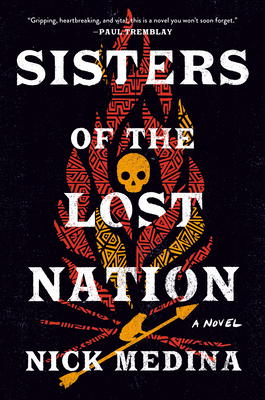
Sisters of the Lost Nation by Nick Medina

book cover

The spirit of a chief, you see, is a powerful thing. The skull became a head again when it was lifted from the grave . . . resurrected.”
“Resurrected?” she echoed.
“Alive again,” he said, his voice measured and grievously low, prolonging every word. “But not like it was before. Not like the old chief. It’s angry now that it’s been ripped from its rest. And ravenous. Hungry for revenge. It’ll eat anyone it encounters. It’ll tear flesh from bone.”
“How?” she said.
“It rolls, gathering mud and moss on its decaying flesh.”

Black bark to her sides and ash beneath her feet, she smelled the earthy odors of dirt, mud, burnt wood, and something so vile her stomach turned. It was the same smell the wind had wafted her way on the nights she’d been chased. Only the odor was stronger now. Inescapable.

Seventeen-year-old Anna Horn is terrified of two things. The first a magical, carnivorous head that gets around by rolling, and is possessed of a set of very nasty teeth. She believes it is determined to eat her. This is the result of a tale her Uncle Ray had told her ten years ago. Her terror about the rolling head permeates, as she fears its arrival every time there is a rustle in the bushes, the main difference in her experience of it being that she can flee faster at seventeen than she could at seven. The second is that she will never see her sister again. Fifteen-year-old Grace has joined the growing list of Native women gone missing.

description
Nick Medina – image from Transatlantic Agency

Anna is in the throes of that perennial challenge of the teen-years, (for some of us, this challenge can go on for decades) figuring out who she is. She is way more mature than most of us were at that age, for sure. She does not exactly dress to impress, favoring her father’s old clothes, and sporting a very unfashionable short haircut. She loves the stories of her tribe, the fictional Takodas, to the point of wanting to start a historical preservation society, to save Takoda history, myths, and traditions for future generations. The considerate and kind classmates at her mostly white school completely understand and support her efforts at self-discovery. As if. They make her school experience a living hell, taking it further than unkind words. Grace is a very different sort, desperate to fit in, wanting attention, focusing on her looks and pleasing others in order to grease the way to hanging with the cool kids. Acquiring a cell phone is the key to her potential rise, and she will do whatever she can to get the money for one.

The story flips back and forth in time, moving forward from Anna’s Day 1 in showing how events came to be, and from the day of Grace’s disappearance, showing the investigation and results. Chapters are labeled in reference to days since Anna’s story begins. Grace does not go missing until well along in those days. Chapters looking at the search for Grace are also labeled with the number of hours since her disappearance.

Medina wanted to highlight the epidemic of Missing and Murdered Indigenous Women and Girls (WWIMG) that has been devastating Native communities for a long time. He shows the all-too-familiar problems residents of tribal lands face when someone goes missing, a viper’s nest of overlapping legal jurisdictions, inadequate police funding, and official indifference among them, not to mention racism. Speaking of which Medina portrays people of all shades as less then admirable. Even the Native manager of the casino assigns Native workers based on their skin color. Fox Ballard, nephew of the tribal leader, is young, handsome, flashy, sculpted, and not at all to be trusted.

Medina pays attention, as well to the impact of modernization on traditional values. The Takoda nation has been significantly changed by the opening of a casino on the reservation. The most obvious contrast is that of Anna (traditional) vs Grace (modern). The new road offers up a steady supply of splatted frogs, a pretty clear image of the cost of replacing treasured values with treasure. Income from the casino is making its way to all the people on the rez, although it is also clear that some Takoda are more equal than others.

As explained in the Author’s note that follows the book, the inspiration for the carnivorous rolling head came from actual Wintu and Cheyenne legends. It reminded me of the relentless ungulate in Stephen Graham Jones’s The Only Good Indians, except that the elk in Jones’s tale is seeking revenge, while the head, though our only real look at it is through Anna’s terrified eyes, seems a more open opportunity attacker. Frankly, scary as it seems to her, it cannot hold a candle to Graham’s hoofed-slasher. It may have been scary to Anna as a character, but did not cause me any lost sleep as a reader.

I did feel at times that this book read more like a YA story than a fully adult one, an observation, not a black mark. The greatest strength of the novel is Medina’s portrayal of his lead, Anna. It is in seeing her social challenges, following her passions, tracking her investigative efforts, admiring her bravery, and rooting for her to mature to a point where she is comfortable in her own skin, that we come to care about her. That alone makes this a good read. The added payload, about the core issue of the book, Missing and Murdred Indigenous Women, about the impact of modernization on traditional values, about gender identity, and about the impact of story on our lives, gives it a far greater heft.

This is Medina’s first novel. He refers to it as a “thriller with mythological horror.” It is an impressive beginning to what we hope is a long and productive career.

She said Frog exemplified transformation. He entered life in one form and left it in another. From egg to tadpole, to tadpole with legs, to amphibian with tail, to tailless frog, he was never the same. He began life in water, only emerging once he was his true self. He symbolized change, rebirth, and renewal, and his spirit could bring rain.
Anna stared down at the ill-fated frog. The reservation was transforming. The asphalt beneath her feet was evidence of that. And yet the very symbol of change had become a victim of it. The absurdity didn’t escape her.

Review posted – 6/23/23

Publication date – 4/18/23

I received an ARE of book name from publisher in return for a fair review. Thanks, folks. Can you get that thing to stop chasing me? And thanks to NetGalley for facilitating.

This review is cross-posted on Goodreads. Stop by and say Hi!

=======================================EXTRA STUFF

Links to the author’s personal, Instagram, and Twitter pages

PROFILE – from The Transatlantic Agency

A Chicago native, Nick Medina is an author and college professor of public speaking and multicultural communication…Nick’s first short story was published in 2009 and he has since had dozens more published by West Pigeon Press, Dark Highlands, and UnEarthed Press, in addition to outlets in the U.S. and the U.K., such as Midwest Literary Magazine, The Washington Pastime, The Absent Willow Review and Underground Voices.

Interviews
—–Paulsemel.com – Exclusive Interview: “Sisters Of The Lost Nation” Author Nick Medina – e-mail interview
—–#Poured Over – The B&N Podcast – Nick Medina on Sisters of the Lost Nation – by Marie Cummings – video – 48:04
—–Murder by the Book – Special Prelaunch Q&A: Nick Medina Presents “Sister of the Lost Nation” by Sara DiVello – video – 33:31
—–FanFiAddict – Author Interview: Nick Medina (Sisters of the Lost Nation) by Cassidee Lanstra

Items of Interest from the author
—–Tor.Com – Excerpt
—–CrimeReads.com – EXPLORING SOCIAL ISSUES THROUGH HORROR

Items of Interest
—–Medina said that his initial inspiration for the novel was from an AP article published in the Chicago Tribune. Here is the article as published by AP – #NotInvisible: Why are Native American women vanishing? by Sharon Cohen
—–CBC – MMIWG cases continued at same rate even after national inquiry began, data shows
—– First People: American Indian Legends – The Rolling Head – A Cheyenne Legend

For horror grounded in the Native experience, I can recommend
—–Stephen Graham Jones – Mongrels
—–Stephen Graham Jones – The Only Good Indians
—–Stephen Graham Jones – My Heart is a Chainsaw
—–Stephen Graham Jones – Don’t Fear the Reaper
—–Cherie Dimaline – Empire of Wild

Leave a comment

Filed under Fantasy, Fiction, Horror, Mystery, Native Americans, Suspense, Thriller