Tag Archives: brain-candy

Emperors of the Deep by William McKeever

book cover

…the sensors jammed into a mako’s head resemble the cockpit of an F-35 fighter jet. [presumably without the design flaws and cost overruns] The mako’s sensors are equal in sophistication to the fighter jet’s advanced systems except they are bundled in nerves, flesh, and blood.

Not comforting.

It was the shark tournament that spurred him to action. William McKeever has had a lifelong interest in sharks, ever since his father took him fishing in Nantucket Sound as a kid. An encounter with a caught (and released) dogfish led to long curiosity-driven hours at the library, hunting down, then devouring all he could find on sharks. A few years ago, a lifetime later, on a weekend in Montauk, he got to see appalling scene after appalling scene, large numbers of sharks on display, most thrown away post photo, a Breughelesque scene of mindless genocidal mayhem, otherwise known as the Montauk Shark Tournament. A bit more research revealed that, despite the bad rap sharks have gotten from our popular media, (I mean you, Spielberg) most shark “attacks” are the equivalent of a dog bite. It really is the sharks who are probably wondering if it’s safe to go back into the water.

While sharks kill an average of four humans a year, humans kill 100 million sharks each year. That is not a typo. Humans kill 100 million sharks each year.

description
William McKeever – image from McKeever’s site

Many of us engage in small ways to try to help when we see outrages in the world. Whether that means trying to help elect public officials who share our concerns, contributing to non-profits engaged in doing battle in our particular areas of concern, maybe volunteering to help out in some way. McKeever was a Wall-Street managing director at Paine Webber, UBS, and Merrill Lynch, and an analyst for Institutional Investor magazine, sharing his expertise on NBC, CNBC, the Wall Street Journal. But it turned out he had bigger fish to fry, and his financial success on Wall Street allowed him the means to pursue his passion. Bringing to light the damage that recreational fishing, particularly scenes of carnage like the one he had seen at Montauk, and the even greater mass annihilation of the world’s shark population by commercial fishing, became his mission. In 2018, he founded a conservancy tasked with helping protect sharks and other fish that man is wiping out, by showing sharks in a new light, as the magnificent creatures they are, survivors extraordinaire, who were here before the dinosaurs, and will probably still be here after people are gone, if we don’t wipe them out first.

description
Hammerhead Shark – image from McKeever’s site

In order to put together educational materials. You need to learn what there is to learn. Although McKeever’s interest had been of long-standing, and although he knew a hell of a lot, having produced two documentary films about sharks, McKeever visited major oceanographic facilities across the planet, interviewed leading scientists and conservationists, and distilled what he learned down to a very readable and informative 295 pages. In addition to producing this book, he and his team are working on a documentary film. It should be available in 2020. (hmmm, 2023 and we are still waiting, so not a sure thing.)

description
Tiger Sharks – image from McKeever’s site

His investigative sojourn took two years, and was truly global, from Montauk, and Cape Cod, to the Florida coast and Keys, the Dry Tortugas, and Hawaii. He traveled to Taiwan, Cambodia, Australia, South Africa and the Bahamas. And I am sure I missed a few. He also interviewed experts, without literally diving in, in many other locations.

Bush Key
The Dry Tortugas – Bush Key – from our vault

While occasionally these field trips were duds, not sighting anything more than a descending dorsal fin in Shark Alley, SHARK bloody ALLEY in South Africa, (although to be fair, not seeing sharks in Shark Alley does speak to the impact humans have had on shark population, so maybe not a dud after all), or noting his arrival in a place just to tick the box and then off to some other place. But mostly the first-person accounts of his meetings with a diverse set of experts, and his observations, both land-based and in the water, are illuminating, sometimes very surprising, and sometimes somewhat grim.

description
Shark Alley in rush hour – image from National Geographic

McKeever concentrates on four sharks in particular, the Mako, Tiger, Hammerhead and Great White, offering fascinating information about each.

Numerous popular articles have described the brain of a white shark as being the size of a walnut, a misleading and inaccurate comparison. The brain of an adult white shark is shaped like a “Y,” and from the scent-detecting bulbs to the brain stem, a shark’s brain can measure up to approximately 2 feet in length…relative to the body weight of birds and marsupials…the great white’s brain is massive.

Makos and Great Whites hunt using their blazing speed, then close the deal with insanely powerful jaws, nicely lined with many large, very sharp teeth; Tiger sharks are also deadly fast, but they prefer to swim slowly and ambush prey with a sudden burst of speed.

Tiger sharks like to sneak up on divers, disappearing and reappearing like a magician’s trick, which unnerves many. Can’t imagine why.

description
Mary Lee – a great white with over 75,000 FB followers- image from her site

Sharks serve a very useful function in marine ecology. An impressive list of items found in very omnivorous Tiger shark stomachs, boat cushions, tin cans, license plates, tires, the head of a crocodile, for example, reinforces the notion that the shark is a high-tech machine assigned the modest job of ocean cleanup.

When tigers remove garbage—weak and sick fish—they remove from the ocean bacteria and viruses that can harm reefs and seagrass. However, the tiger’s work extends beyond mere custodial work: as apex predators, tiger sharks play an important role in maintaining the balance of fish species across the ecosystem. Moreover, the research shows that areas with more apex predators have greater biodiversity and higher densities of individuals than do areas with fewer apex predators.

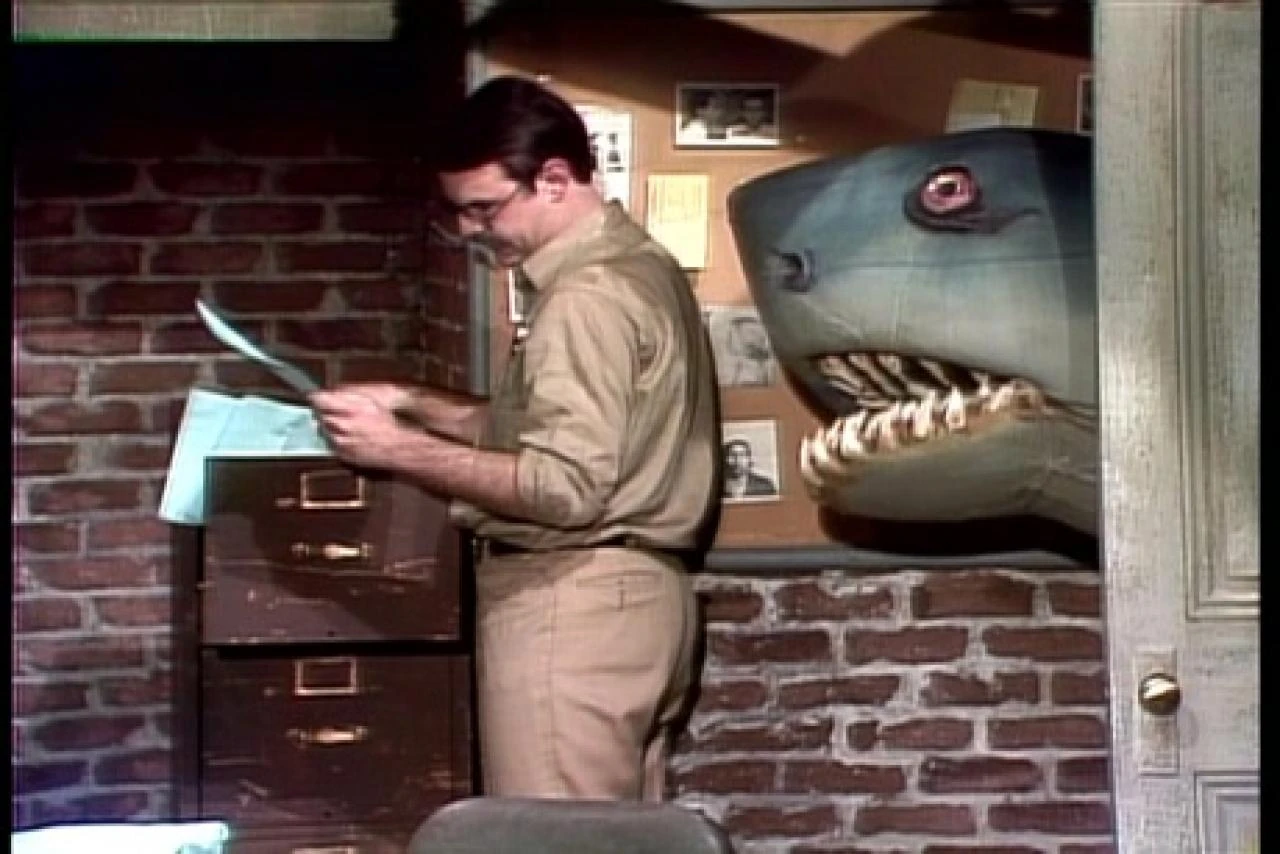
Sorry, no Land Sharks.
description
Land shark – image from from SNL Fandom

Sharks face considerable dangers beyond the risk of chowing down on diverse awful flavors of tire and tags that are not to their liking. You will share McKeever’s outrage when you read his description of the Montauk Tournament. There are gruesome descriptions of the vile, cruel behavior engaged in by people on commercial, and some sport fishing vessels. It makes one ashamed to be a human. You will shudder when you read of the practice of finning, done to satisfy the booming Asian demand for shark fin soup. Sharks face huge perils from sports fishermen, but the greatest danger is from long-lining. Ships drop fishing lines that are sometimes tens of miles long, with a baited hook every few feet. The catch is massive, but only part of what is caught is what the fishermen want. The rest, called bycatch, is thrown overboard, usually dead, sometimes not. It is the equivalent of clearcutting forests or mountaintop-removal mining. Kill them all and toss what you don’t want. Thus the stark disparity in shark-deaths-by-human versus human-deaths-by-shark. McKeever looks at what is likely the impact of climate change on some places where one might expect sharks in abundance but in which they have become scarce.

description
Denticles on a hammerhead – image from hammerheadsharks.weebly.com

There are many details about sharks that may force the word “wow” or “cool” from your lips. Like denticles. Rub a shark’s skin (a small, friendly shark) one way, and it is smooth. Reverse direction and it will feel like sand paper, or worse. Millions of years ago, sharks traded scales in for dermal denticles. These are small scale-like growths that function both as a sort of chain-mail protection and as an aid to swimming speed, as they reduce friction. Ok, you may have known about those, but what about a cephalofoil? Yeah, go ahead, look it up.

description
The Rainbow Warrior – image from Greenpeace

McKeever spends some time on The Rainbow Warrior, Greenpeace’s well-known vessel, learning a great deal about the challenges marine creatures face from unregulated international fishing. The chapter on human trafficking in the fishing industry is must-read material. You will be shocked at what he learned. It is clear that owners of fishing vessels that use and mistreat slave labor have no more regard for human life than they do for the sharks they slaughter by the millions. It was news to me that many of these ships remain at sea for years at a time, offering not even the possibility of escape for desperate captives. I had no idea.

While the book is not suffused with the stuff, McKeever shows a delightful sense of humor from time to time. This is most welcome in a tale that can be quite upsetting at times. His writing is clear, direct, and mostly free of poetic, rapturous description, which is just fine. He tells what he has learned and believes is important for us to know. His personal experiences with close encounters of the shark kind are engaging and relatable.

description
Shark brain -image from wikimedia

You will learn a lot from Emperors of the Deep. Some information may be a bit familiar, but I found that there was a lot in here that was news. I expect most of us have some general knowledge of sharks, and the image in our heads is probably the one created by Steven Spielberg in 1975. One of the best things you will get from this book is at least some appreciation for the range of sharks that share our planet, and what differentiates them from each other, but much more importantly an appreciation for how critical they are to the ecosystem, how much of a threat to people they aren’t, and how quickly we are wiping them out. There is a shark that swim sideways. Whoda thunk? You will gain a new appreciation for the significance of sea grass as a key player in the sustenance of marine ecosystems.

description
Seagrass – image from Florida Keys National Marine Sanctuary

Gripes – The book could really use an index. There is a center section with color photographs. These are fine. I would have preferred graphics, whether drawings or photos, that illustrated the notions he was describing, particularly as regards shark anatomy. There are times when the author seems to lose his focus. For instance, his visit to Brisbane and a bit of attempted kayaking in a rough sea may have been a fun memory for him, but had not much to do with the mission of the book, as he dashes off 340 miles to catch a ferry to the Coral Sea, where the subject at hand is re-engaged. Descriptions of a shark brain, or denticles, differences in the eyes of diverse species, and sundry more items would have been greatly enhanced by the presence of right-there images. More curiosity than a gripe, I wondered about what McKeever had been up to between the time he left Merrill Lynch and when took up conservation. Finally, the book could have used a list of organizations mentioned in the book, with contact information.

description
Lego Mako Shark – image from ideas.lego.com

McKeever, in attempting to rebrand sharks from man-eating monsters to vanishing species, makes the case that we need apex predators to thrive, that they are crucial to maintaining biodiversity, and healthy marine ecosystems. He fills us in on the value of healthy shark populations to the tourism industry. He fills us in on just how amazing and diverse these creatures are, and reports on fishing practices that are certain to push global shark populations to the brink of extinction, if international law, regulation, and enforcement are not directed at the problem. He also offers some hopeful examples of positive programs that are making or seek to make a difference.
description
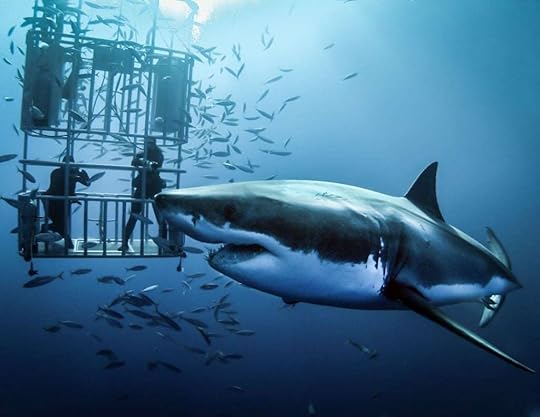
Cage diving is one way sharks contribute to ecotourism – image from Scubaverse.com

If they were able to articulate the notion, sharks would surely be thinking that, with the attacks they are constantly suffering, they’re gonna need a bigger planet.

When Americans eat canned tuna, they do not realize the destruction of the ocean that their meal represents. Imagine if producing a single hamburger required butchers to kill not only the cow but all the other barnyard animals too.

Review first posted – August 3, 2019

Publication dates
—–June 25, 2019 – Hardcover
—–May 26, 2020 – Trade paperback

=======================================EXTRA STUFF

Links to the author’s personal, and FB pages

McKeever has a Twitter page, last updated in April, 2020, and his LinkedIn page is long out of date.

McKeever also has a documentary in the works on plastics in the oceans -looks like he is still looking for a producer for that.

Interviews
—–NY Post – Why sharks aren’t as bad as ‘Jaws’ makes them out to be – by Eric Spitznagel
—–Feather Sound News – In an interview with CMRubinWorld for Earth Day, April 22, 2019, author, conservationist and filmmaker William Mckeever corrects common misconceptions about the world’s most feared and misunderstood predators. – (not big on snappy headlines, are they)
—–The Cape Cod Chronicle – Researcher Uses Book, Film In Quest To Protect Sharks by Debra Lawless

Items of Interest
—–Excerpt – Fox News William McKeever: Sharks aren’t quite the threat that ‘Jaws’ portrayed
—–Mary Lee’s Facebook page – Mary Lee is noted in the book as a tagged shark that had developed a global following, as her peregrinations were tracked
—–Mary Lee’s Twitter page
—–Adventure Sports Network – Is the Famed Great White Shark, Mary Lee, Gone Forever? – by Jon Coen
—–OCEARCH
—–Discovery schedule for Shark Week, the latest season. There will be a 2024 season, but details are yet to be released (as of August 2023)
—–July 2020 – National Geographic – Sizing Up Sharks, the Lords of the Sea – a fun graphic look at shark size vis a vis us

Videos
—–Baby Shark
—–Lesley Rochat – Rethink the Shark – CHECK THIS OUT!!!
—–Book Trailer

Leave a comment

Filed under Non-fiction, Reviews, Science and Nature

Automating Inequality by Virginia Eubanks

book cover

If among you, one of your brothers should become poor, in any of your towns within your land that the Lord your God is giving you, you shall not harden your heart or shut your hand against your poor brother, but you shall open your hand to him and lend him sufficient for his need, whatever it may be … For the poor you will always have with you in the land. Therefore I command you, ‘You shall open wide your hand to your brother, to the needy and to the poor, in your land.’ – (Deuteronomy 15:7-11)

The law, it its majestic equality, forbids the rich as well as the poor to sleep under bridges, to beg in the streets, and to steal bread. — Anatole France

The poorhouse. These days, it’s common parlance for extreme financial misfortune. Someone who has had a particularly bad fiscal spell could be said to be heading to the poorhouse. These days, we do not have literal, brick and mortar poorhouses. Those were usually fetid places, ill-maintained, offering meager shelter and food to the detritus of society, the poor, ill, elderly, and disabled, often requiring labor in return. These days, we have something new.

America’s poor and working-class people have long been subject to invasive surveillance, midnight raids, and punitive public policy that increase the stigma and hardship of poverty. During the nineteenth century, they were quarantined in county poorhouses. During the twentieth century they were investigated by caseworkers, treated like criminals on trial. Today we have forged a digital poorhouse from databases, matched algorithms and statistical risk models. It promises to eclipse the reach and repercussions of everything that came before.

The most famous poorhouse resident in literature is one Oliver Twist. In the novel of that name, Dickens intended to highlight the inhumanity of the Poor Law Act of 1834. The world of poverty he described was, while literarily thrilling, a horrifying exposé of man’s cruelty to man. Poorhouses found a home in the USA as well. The first poorhouse in the city of my current residence was established in 1863. In my erstwhile lifelong home, New York, an 1824 law directed the counties of the state to erect poorhouses. Residents could be required to do whatever work the superintendent demanded. Any resistance resulted in being kicked out. Among other sources for the poorhouse population, children younger than 15 caught begging could be legally remanded there until the person in charge of the poorhouse let them out. There were certainly poorhouses in NY earlier than that. The first poorhouse in the USA was in Boston, in 1662.

description
Virginia Eubanks – from her Twitter page

Virginia Eubanks has been involved with economic justice movements for over twenty years. She is an associate Prof of Poli Sci at the SUNY Albany campus. Her writing about tech in social justice has appeared in The American Prospect, The Nation, Harper’s and Wired. She is a founding member of the Our Data Bodies project, which looks at how the gathering and use of digital info by government impacts our rights. In Automating Inequality, Eubanks offers a bit of history on the poorhouse, noting, with particular relevance for the operation of today’s prisons, and other bits of outsourcing of government welfare responsibilities, that privately run poorhouses led to the residents being particularly exploited and deprived of necessities in order to increase profits for the owners, not that the publicly run ones were any great shakes. Her central notion is that the physical poorhouse of the past has been replaced in the 21st century by a modern version.

For all their high-tech polish, our modern systems of poverty management—automated decision-making, data mining, and predictive analytics—retain a remarkable kinship with the poorhouses of the past. Our new digital tools spring from punitive, moralistic views of poverty and create a system of high-tech containment and investigation that I call the digital poorhouse. The digital poorhouse deters the poor from accessing public resources; polices their labor, spending, sexuality, and parenting; tries to predict their future behavior; and punishes and criminalizes those who do not comply with its dictates. In the process, it creates ever-finer moral distinctions between the “deserving” and “undeserving” poor, categorizations that rationalize our national failure to care for one another.

She takes two approaches. First is tracking the history of how the poor have been treated, noting the Dickensian era preference for punishing the poor overtly, by shunting them into miserable institutions, if providing any aid at all, then a revolutionary approach called Scientific Charity, which employed caseworkers applying the methodology of police work in examining the merits of a person’s application for aid,

As Mary Richmond wrote in Social Diagnosis, her 1917 textbook on casework procedures, “the reliability of the evidence on which [caseworkers] base their decisions should be no less rigidly scrutinized than is that of legal evidence by opposing counsel.” Scientific charity treated the poor as criminal defendants by default.

the reversal of reliance on private charity with the New Deal, the paring back of benefits in the 1970s, beginning the use of computer technology to exclude applicants, and sundry mechanisms being used today.

The second is to offer case studies, on-site looks at three locations. Homelessness is the focus in Los Angeles, the outsourcing of welfare systems in Indiana, and child custody issues at the Allegheny County Office of Children, Youth and Families (CYF) in Pittsburgh.

In short, Eubanks offers a history of US public policy on poverty, along with the mechanisms employed in various eras to manage, and limit public outlays to address it, a look at the mechanisms now in use that serve to exclude applicants rather than enhance service, and an analysis of how those systems impact people today. She very successfully bridges the gap between theory and reality with her field studies. This is what’s going on. This is how it affects people.

Instead of being shunted to three-dimensional concrete buildings, today’s poor are far too frequently denied public services, while the state, in addition, often erects barricades to the poor finding a way out of their situation by making it more difficult for them to get a job. Apparently biblical predictions were not considered adequate to the task, so we appear to be committed, as a society, to keeping the poor poor. We apparently prefer for them to remain that way. Hating the poor has been a national addiction since the invasion of North America by religious extremists. We are so addicted to hating on the poor that we have managed, with very few exceptions in our national history, to define poverty at such an insanely low level of income that the majority of poor people are denied even the dubious comfort of fitting the official definition. For example, the US Census Bureau defines its poverty threshold as $12,331 for a single person. So, if you are a single person, earning, say, $12,500 a year, you are not considered poor. Congratulations! And if you are over 65, that line drops to $11,367. I guess we seniors must eat less. Right, whatever.

I am no stranger to such topics, and while the broad strokes of her Bruegelesque depiction of our welfare system might not be all that surprising, as with the painting, there is much to be appreciated by looking at the details. There were pieces of information in here that were surprising. Did you know that the CCC (Civilian Conservation Corps of the New Deal era) imposed a cap of 10% black recruits during the Depression, despite the dramatically higher unemployment rate they experienced? Or that half of us spend at least some portion of our lives in poverty?

Eubanks offers many instances of Kafkaesque, sometimes deadly results of how people are treated by welfare systems. It is amazing to me that there have not been thousands of incidents of people so frustrated by this mean-spirited, cruel system that they go postal on social service agencies across the nation. Probably because they can’t afford the hardware. God knows it’s easy enough to buy.

When you are poor you surrender your rights as a citizen, hell, as a human being. Innocent until proven guilty? Not once you apply for any sort of public assistance. The right to parent your own child? The right to confront your accusers? Not if a hostile neighbor calls in an anonymous false report accusing you of neglecting your kid. The right to choose your sexual partners? Not if the welfare agency deems that person inappropriate. The right to counsel? Nope. You are on your own, with the entire resources of the state aligned against you. Offer any resistance to or question the caseworkers who are assigned your case and you are denied benefits. It’s yes, Massa, no, Massa, or you are out on the street, and in many places you can be fined and/or put in jail for being homeless.

While I am a senior citizen, retired, with only Social Security for my personal income, I am blessed with a spouse who remains employed full time. But I have had my share of interactions with the welfare and legal systems. When I was 18 years old, I had my own apartment. But after a significant industrial accident, (I was working at a large Postal Service facility in Manhattan) I was unable to work for a long time, several months of which was spent in hospitals. I was covered by worker’s comp, but it took so long for benefits to begin that I lost my apartment. Thanks, guys. At least I had a fallback, however unpleasant that may have seemed at the time. I have had just loads of fun dealing with unemployment, having endured that most American of experiences, the layoff, more than once. After one particularly frustrating interaction at an unemployment office, I ripped a large piece of hardware off the wall of the men’s bathroom. (Statute of limitations is passed for that one, right?) In another I was denied benefits, because I made a typo (press 1 to be insulted, press 2 to be denied, press 3 to be put on permanent hold) in an interactive system that would not allow human contact. While out of work for most of four years, and being held responsible for child support (while having joint custody) based on what I had earned in my highest earnings year ever, I had my driver’s license suspended by the state of New York, because I was unable, not unwilling, unable to pay the considerable monthly sum. Not a small thing, as many of the companies that hired people with my skill set were located in suburbia. Way to help. It took several years before the court accepted the fact (helped along by the reams of documentation I produced) that I had been unable to get work in systems, and had taken a shit-paying job as a security guard because it was the only thing I could get. The support arrears that accumulated during this period helped force me into dire financial straits. So, while I am decidedly middle-class by education and inclination, I have first-hand knowledge of how systems that at least purport to be helpful can do their best to make a bad situation worse, permanent even. I live in dread of the day when I have to face these systems again. (It will almost certainly come) And I am doing ok. The people Eubanks writes of are, mostly, not.

Dealing with welfare agencies, with or without their associated, gun-toting uniformed sorts, or their legal enforcers, is horrifying enough. With the expansion of data collection, and monitoring, real and potential, with the widespread sharing of collected information (privacy rights? You’re kidding, right?) with a vast array of other government entities (and private entities too, where service provision or data collection is outsourced) as well as any law enforcement agency that asks for it, Big Brother has become more like the entire Manson Family. They are watching, and any mis-step, real or imagined, any spark of resistance, real or imagined, any error on your part, real or imagined, can get you cut off whatever public benefit you are on, thus increasing your poverty, reducing your life expectancy and increasing your risk of being incarcerated in what has become that contemporary replacement for the poorhouse of old, jail. There are even systems in place that look at projected behavior, that put one darkly in mind of the film (and story) Minority Report.

Virginia Eubanks has written a piercing appraisal of how the new technology of the digital age has given the state unimaginable power over the lives of any who are forced into contact with it. The needs of the poor are not different from the needs of the middle class. But the latter, with the means to take care of those needs in the private market, can minimize contact with the beast that is the welfare/legal system. Once one comes into contact with that beast, a person is marked, indelibly, for decades or forever.

What can be done? As is often the case, big problems do not lend themselves to simple fixes. Eubanks offers an array of actions that might be taken to help in the Dismantling of the Data Poorhouse. She has highlighted truths we should be aware of, and notes groups that should be targeted for a bit of consciousness raising. Mostly the proposed remedies sound sane, but unlikely, not a rare thing in books about sociopolitical ills.

The strengths of this book are many. I was reminded very much of Barbara Ehrenreich’s perceptive writings on diverse important matters of public policy. Eubanks has dug deeply into the underlying realities of being poor in America and filled in a lot of the blanks. (BTW, it make a perfect companion to the excellent book White Trash), and should find a natural home in college and graduate school classes on poverty and public policy. People who are poor already know a lot of what is in here, although even the reader of meager means will still find fascinating information. The middle class, or wealthy reader will, hopefully, have their eyes opened (dare we say their consciousness raised?), finding serial unsuspected revelations in Automating Inequality. But the most significant group of readers who should read this are those who, like me, have lived at least a bit in both worlds, particularly those who, currently not a part of the public welfare/legal system, expect they never will be, and disparage those who are as lazy or morally suspect.

poverty is not an island; it is a borderland. There’s quite a lot of movement in the economic fringes, especially across the fuzzy boundary between the poor and the working class. Those who live in the economic borderlands are pitted against one another by policy that squeezes every possible dime from the wallets of the working class at the same time that it cuts social programs for the poor and absolves the professional middle class and wealthy of their social obligations. – [see recent tax cuts for the 1%]

As the powers in Washington, and in many of our states, seek to dim the lights of our shining city on a hill, it will be up to those who are not wealthy or connected, those who work for low wages, those who are jobless, those who earn, while knowing that a layoff could happen any day, those who can see through the porous barriers between the middle class, the working poor, and the distraught, to comprehend and act on the need to join forces in order to rekindle that flame. As Eubanks points out, and as you probably already know, in your heart of hearts

…systems designed for the poor will eventually be used on everyone.

It’s enough to enrage and/or depress Dickens.

Review first posted – January 19, 2018

Publication date – January 16, 2018

This review has been cross-posted on GoodReads

=======================================EXTRA STUFF

Links to the author’s personal, and Twitter pages

A sample of the book

The Our Data Bodies project

Based in marginalized neighborhoods in Charlotte, North Carolina, Detroit, Michigan, and Los Angeles, California, we look at digital data collection and our human rights, work with local communities, community organizations, and social support networks, and show how different data systems impact re-entry, fair housing, public assistance, and community development.

HISTORY OF 19th CENTURY AMERICAN POORHOUSES

Poorhouse records by state

January 1, 2018 – NY Times – A.I. and Big Data Could Power a New War on Poverty – by Elisabeth A. Mason
This piece posits that AI could better match people with jobs, and improve computer-based education. In the article, she cites the creation of a Commission on Evidence-Based Policy Making, from legislation sponsored by Dem Patty Murray and Rep Paul Ryan. The commission expired in September 2017, but made recommendations

This provides one more indication of the promise of A.I. and big data in the service of positive, purposeful public good. Before we dismiss these new technologies as nothing more than agents of chaos and disruption, we ought to consider their potential to work to society’s advantage.

Yeah, sure. Or another tool the state can use to exclude assistance applicants. Well, you didn’t take that job 150 miles from home that our system indicated would be a perfect fit, so sorry, your application is rejected. Don’t blame me, blame the computer.

December 12, 2017 – The Business Insider – on another automated approach to poverty – Robots are being used to deter the homeless from setting up camp in San Francisco – by Melia Robinson

description

February 3, 2018 – NY Times – Who’s Able-Bodied Anyway? by Emily Badger and Margot Sanger-Katz – a familiar extra-legal method for keeping people from getting needed benefits

In case you missed the link in the review, White Trash

A report by the AI Now Institute of New York University – AI Now 2017 Report

Recommendation #1
Core public agencies, such as those responsible for criminal justice, healthcare, welfare, and education (e.g. “high stakes” domains) should no longer use “black box” AI and algorithmic systems.
this includes the unreviewed or unvalidated use of pre-trained models, AI systems licensed from third party vendors, and algorithmic processes created in-house. The use of such systems by public agencies raises serious due process concerns, and at a minimum they should be available for public auditing, testing, and review, and subject to accountability standards.

January 16, 2018 – Interview with the author on PBS – The Open Mind – well worth catching – 28 minutes

Items Worth Reading
—–February 10, 2018 – NY Times – New research on how single-mother families are treated by different societies can impact poverty levels – pretty interesting material – Single Mothers Are Not the Problem – by David Brady, Ryan M. Finnigan and Sabine Huben
—–February 13, 2018 – NY Magazine – a very perceptive piece on the how the right seeks to control and infantilize the poor in direct contradiction to their stated values – Trump Wants Big Government to Decide What Poor People Get to Eat – by Eric Levitz
—–April 22, 2018 – NY Times – Public Servants Are Losing Their Foothold in the Middle Class – public jobs used to mean security, and decent pay. Today, not so much.
—–April 23, 2018 – NY Times – Paul Krugman on the Republican war on teachers – We Don’t Need No Education
—–April 27, 2018 – NY Times – Paul Krugman on – Trump’s War on the Poor
—–May 20, 2018 – NY Times – A chilling article on how unscrupulous landlords abuse the housing court system in NYC to push poor and working class people out of their apartments, so they can jack rents up to astronomical amounts – Unsheltered: The Eviction Machine Churning
 Through New York City – by Kim Barker, Jessica Silver-Greenberg, Grace Ashford and Sarah Cohen
—–May 30, 2018 – Southern Poverty Law Center – SPLC sues North Carolina DMV for revoking licenses of people who cannot pay traffic tickets
—–June 22, 2018 – NY Times – The Worrisome Future of Policing Technology – by Barry Friedman

Some of the technology has racial injustice baked into it. Algorithms don’t have to look at race to be racist. Whether written by humans or a product of machine learning, algorithms take past facts and magnify them into future police actions. They rely heavily on criminal records. Much of street policing in recent years — stop and frisk, marijuana enforcement, catching fare-beaters — has been deployed disproportionately against minorities and in poor neighborhoods. Police may “go where the crime is,” but because so much focus has been on low-level offenses in disadvantaged areas that are ignored elsewhere, these algorithms make it inevitable that the police will return to these places time and again.

—–November 8, 2018 – Center for Media Justice – No More Shackles – on the growth in use of and profitabiity from electronic monitoring for parolees, and its tilt against minority communities
—–January 9, 2019- NY Times – How Cities Make Money by Fining the Poor – Eye-opening, but not surprising
—–July 3, 2019 – NY Times Magazine – Digital Jail: How Electronic Monitoring Drives Defendants Into Debt – by Ava Kofman – the endless horror continues
—–October 16, 2019 – Propublica – When Medical Debt Collectors Decide Who Gets Arrested – by Lizzie Presser – an eye-opening, if depressing, heart-breaking, and enraging piece about how the courts are being used by lawyers and creditors as collection agencies, with jail on their list of options. Makes a pretty strong case for MFA, certainly for extending health insurance coverage into many of the crannies in which it currently vanishes.
—-January 3, 2020 – Vox – New food stamp rules won’t just hurt my clients. They’ll hurt struggling social workers like me – by Elena Gormley – even those who work to help the poor are being driven into poverty
—-January 27, 2020 – Washington Post – Supreme Court allows Trump administration to proceed with immigration rules – by Robert Barnes – any contact with public services can now result in deportation
—-February 6, 2020 – NY Times – An Algorithm That Grants Freedom, or Takes It Away – By Cade Metz and Adam Satariano
—–June 24, 2020 – NY Times – Wrongfully Accused by an Algorithm by Kashmir Hill
—–December 4, 2020 – MIT Technology Review – The coming war on the hidden algorithms that trap people in poverty by Karen Hao – PLEASE READ THIS ARTICLE!!! – it explains a lot

Credit-scoring algorithms are not the only ones that affect people’s economic well-being and access to basic services. Algorithms now decide which children enter foster care, which patients receive medical care, which families get access to stable housing. Those of us with means can pass our lives unaware of any of this. But for low-income individuals, the rapid growth and adoption of automated decision-making systems has created a hidden web of interlocking traps.

—–February 16, 2021 – NY Times – The New Debt Prisons by Gene B. Sperling – on how our criminal justice system is financed by fees and fines levied on those charged with crimes, seriously impairing their ability to ever escape an endless burden of debt. This is a shocking, and important piece. Read it. Please.
—–July 28, 2021 – The Guardian – ‘We don’t deserve this’: new app places US caregivers under digital surveillance by Virginia Eubanks and Alexandra Mateescu – Per usual, fraud and abuse are the lies being used as excuses for implementing increased burdens on people in need and the workers who care for them.
—–July 31, 2023 – AP – Child welfare algorithm faces Justice Department scrutiny – By SALLY HO and GARANCE BURKE – AI doing damage to families with disabled members

Leave a comment

Filed under American history, History, Non-fiction, Public policy, World History