Category Archives: Thriller

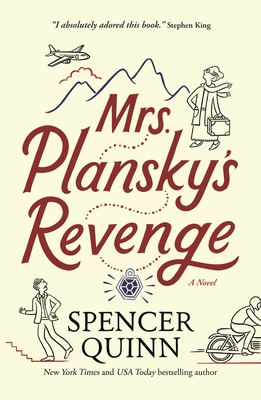
Mrs. Plansky’s Revenge by Spencer Quinn

book cover

Maybe sex made more sense than marriage—or even dating—in old age. Wasn’t courtship for the young?

Meet me at Café des Artistes, eighteen hundred.”
“Is that the address?”
He blew out an irritated-sounding breath. “Six,” he said. “Six o’clock this evening. Your hotel—the Royale, I assume—can give you directions.”
“How will I know you?”
“I’ll wear a billboard with a question mark.”
Click.

Loretta Plansky, widowed, retired, pretty fair tennis player, (particularly considering her new hip, only nine-months in) 71, Florida resident, financially comfortable, wakes one morning to discover that she has been pretty much cleaned out. Bank account, retirement fund, investments, the whole kit and caboodle, well, mostly. It seems that the ten grand she had given to her grandson, Will, overnight went instead to cybercriminals. The real Will had not asked her for anything. (Of course, I am totally in favor of folks sending cash to people named Will, but that’s just me. Any amount gratefully accepted.). The FBI special agent in charge holds out virtually no hope of her ever seeing her lost funds restored, but her number two, about to leave the bureau for a private gig, gives Mrs P one intriguing bit of intel. Unwilling to let this crime stand, she heads out to darkest Romania hoping to do…what? who knows? something.

description
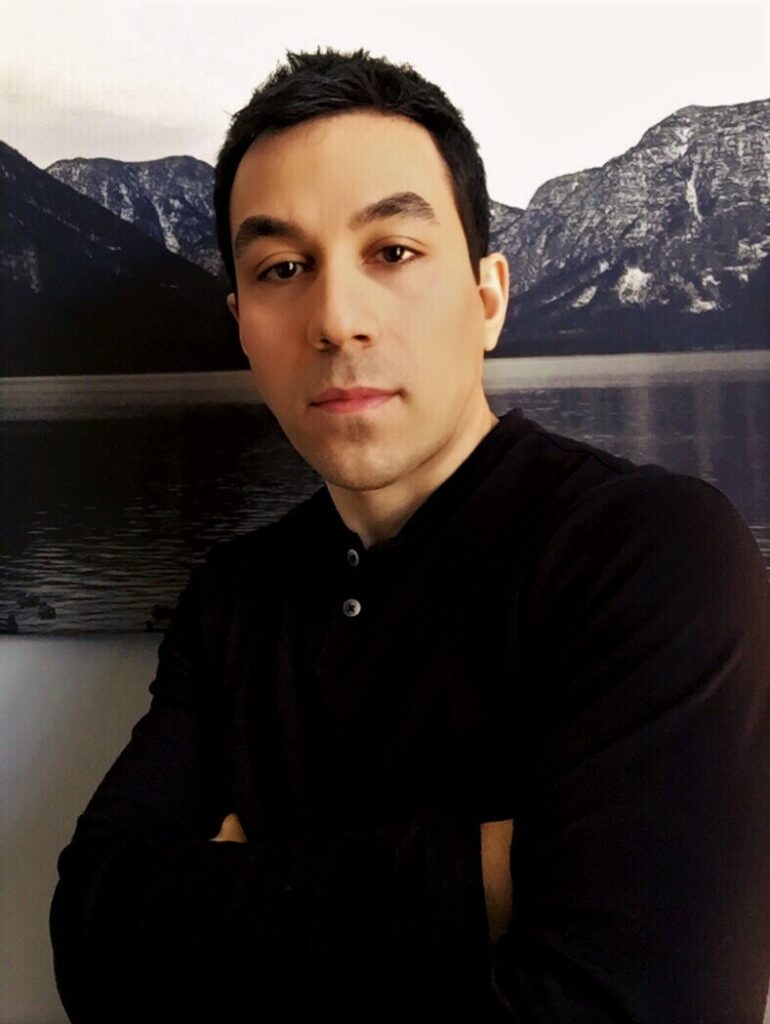
Spencer Quinn (pen name for Peter Abrahams) – image from Macmillan – photo by Diana Gray

Mrs P is an intrepid investigator, with an unusual skill set. She manages to talk to a relevant person at the US embassy in Bucharest, and persists in following up the few clues that float down her way.

The story is told in parallel lanes. Mrs P is the primary of course, but we are also let in on the doings on the other side. Dinu is a teenager with a gift for and enthusiastic interest in American English. He collects colloquialisms and contemporary American slang the way a video-game player collects tokens to gain power. Of course, the power Dinu is amassing causes real harm. His scary uncle has paid to train him, and is now employing Dinu in making calls to American grandparents, pretending to be their stressed-out grandson, in need of emergency cash in order to get out of jail, or whatever. He has a computer whiz bff, Romeo, another teen, who is also employed by the scary uncle. Generally, they do not seem all that morally concerned about what they are doing, and the pay is good.

So, Mrs P makes her way to the relevant town, and stumbles her way through to the sort of cozy resolution one might expect. Along the way there are mysterious passageways, dark deeds, life-threatening adventures, a car chase, a valuable jewel, and some very unpleasant characters. So, I guess this is less of a cozy mystery and more of a cozy adventure tale.

It is a very good-natured story, and Mrs P is a fun lead, a very engaging sort, a good egg, who has been done dirt, but who would prefer to take matters into her own hands rather than leave her fate to the dubious efforts of others. She displays considerable courage, the creativity of an experienced field agent, and a wily serenity in stressful circumstances. One lovely element was her continued connection to her late husband, Norm. No magical realism here, just a pining for the person to whom she had been the closest for most of her life, as she shares thoughts and concerns with his memory, wondering at his theoretical advice. She is also a very kind person, amenable to applying the resources she has…well, had…to helping out her kids, despite that not necessarily being the wisest choice.

You will get a taste of Romania, a very small taste. Most entertaining among these is a hotel festooned with portraits of Bela Lugosi.

There is enough humor in here to generate several actual LOLs, which is always welcome

BUT, as things were winding up to the big finish, there were multiple eye-roller events that took me out of the book. Like running a marathon then tripping over a stick in the road, then another, then another. I did finish the book, and it was a fun read, for the most part. But I found myself saying “Really?” more than once or twice. And that damaged my overall feeling. Bottom line is that you have to be willing to overlook some egregious reliance on coincidence and deus-ex-machina trickery to make the story work out. I expect I am a bit towards the higher end in my sensitivity to such things. But if you are more forgiving, netter at leaping past roadway impediments, then do it, jump in. You will be rewarded with a fun, light read, featuring a very engaging lead. Mrs P will be glad of the company, and so will you.

Review posted – 09/29/23

Publication date – 7/25/23

I received an ARE of Mrs Plansky’s Revenge from Tor Publishing in return for a fair review and the password to my bank account. Hey, now wait a goldarned minute! Thanks, folks, and thanks to NetGalley for facilitating.

This review is cross-posted on Goodreads. Stop by and say Hi!

=======================================EXTRA STUFF

Links to the author’s personal, FB, Instagram, and Twitter pages

Profile

Spencer Quinn is the pen name for Peter Abrahams, the Edgar-winning, New York Times and USA Today bestselling author of the Chet and Bernie mystery series, as well as the #1 New York Times bestselling Bowser and Birdie series for middle-grade readers. He lives on Cape Cod with his wife Diana and dog Pearl.

Interviews
—–The Big Thrill – Up Close: Spencer Quinn by Karen Hugg – all on dog books
—–Famous Writing Routines – Interview with Peter Abrahams: “I love what I do. Love seems to clear a lot of paths.” – nothing particular to this book. More on his methodology.

Songs/Music
—–The Byrds – Eight Miles High – appears in Chapter 13
—–The Chimes – I’m in the Mood for Love – Chapter 20

Items of Interest
—–Excerpt – Chapter One
—–Federal Trade Commission – Consumer AdvicePhone Scams
—–Tor/Forge Blog – Inspiration and Mrs. Plansky’s Revenge by Spencer Quinn! by Ariana Carpenter

Five or six years ago, my dad got a phone call. At the time he was in his early nineties. He died two weeks short of his 97th birthday and was in excellent mental shape and very good physical shape until the end. I want to emphasize that mental part. He was a very smart guy: quick, sharp, clear-headed. Back to the call.
Caller: Hey, Grandpa!
My dad: Jake?
Caller: Yeah, Grandpa, it’s me, Jake.
Cut To: My dad’s wife, noticing he’s putting on his jacket.
Wife: Ed? Where are you going?
My dad: To the bank. Jake’s in trouble and he needs some money.
At that point it was decided to call Jake (living in another city), and he had not called my dad and wasn’t in any trouble. “Jake” never got a penny. But I was amazed that someone like my dad could have been fooled.
And then I got back to writing the Chet and Bernie novel I was working on and thought no more about the two Jakes. Then one day on a bike ride the idea for Mrs. Plansky’s Revenge—indeed the whole set-up, including the Romanian part—came to me in one fell swoop.

Leave a comment

Filed under Comedy, Fiction, Mystery, Suspense, Thriller

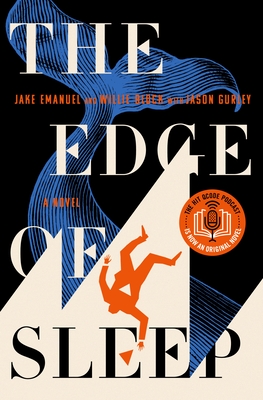
The Edge of Sleep by Jake Emanuel, Willie Block and Jason Hurley

book cover

Here’s what I can say with some certainty. Something is happening. Case in point: WZPE’s AM news show usually ends at 8am. Not today. They’ve basically got the phone lines wide open, and people are calling in by the hundreds. The last caller just sobbed, “They’re dead, they’re dead, they’re dead,” and disconnected.
There are TV and radio stations all over the state that just . . . aren’t on the air at all.
From my window, if I elevate my chair, I usually have a great view of the mile-long gridlock at the intersection of Monaghan and Wolcott. The traffic lights there aren’t even working, but the intersection’s just . . . dead. No cars that I’ve seen.
Usually by now my upstairs neighbor is jazzercising. But the whole building is strangely subdued. I haven’t heard a single other person.
Perhaps it’s my overactive imagination . . . but I really don’t think that’s the case.
If you have any information about what might be happening, I’ll see you in the comments.
—Posted by Eli Broder, 7/4/25 9:12am

Dave Torres is a security guard at Daxalab. He and his co-worker and best friend, Matteo Leon, are having a bad night. After their shift they head, quite late, to a party only to find the guests mostly gone already. Of course, some are more gone than others. Like the one on the couch whom they had thought was passed out. Turns out he had passed on. Dave goes looking for their host only to find him in bed, in no better shape than the couch stiff. What is going on? And why are the roads so empty?

description
Willie Block and Jake Emanuel – image from Deadline.com

Off to the hospital they head, to see that the bodies are handled, or, out of the frying pan…The body count there is impressive, and growing. They meet a tough nurse, Linda, who is doing her best to keep it all together, but things are clearly falling apart. Dave gets that sleep is the trigger and desperately calls his ex to warn her. Katie finally joins them.

A large room, lined with storage bins and shelves, has been transformed into a morgue. Shoved along the west wall are gurneys bearing zippered white bags. Human-sized bags, arranged haphazardly, as though they were rolled into the room and released to drift where they may. Which is exactly what happens next: An orderly in a white smock bangs into the room through an adjacent door, back first, then drags a fresh gurney into the room, pivots, and releases it, sending it spinning across the floor. It thumps into another gurney, and both roll in separate directions. The orderly, not pausing to admire his handiwork, disappears through the door again.

So we have a small group that sets out to decode the situation. There is a separate pair. Eli Broder (of the opening quote) is confined to a wheel chair. Boston is quiet, too quiet. His online messages begging for information on what is happening receive scant response. Millie is a narcoleptic coder, in the process of being fired from her job, who finally responds. She goes to him and they face the situation together.

description
Podcast episode 3 – the Black Triangle – image from Markiplier Wiki

These are our two primary threads. Third is a lookback for Dave to events from this childhood. He has had sleep issues all his life, for which he has received some serious medical intervention. His miseries include nightmares about an elephant and a whale since he was a kid. When his dreams slip into the waking world, his life becomes seriously troubled.

They all figure out in short order that going to sleep is a bad idea. To sleep, perchance to dream? Nah. More like to sleep, perchance to die. Each group goes through challenges in progressing to understanding, and getting, geographically, from where they are to where they want to be. Ergo, road trips. During these, we get more insight into the characters. As they begin to glean some truths behind the sleep-bomb that appears to be wiping out humanity, it becomes harder and harder to function, even to think, as their fatigue become profound. How long can the primaries remain awake? Where can they find answers to the why and how of it all? Even if they find answers will they retain consciousness enough to actually do anything about it?

description
Podcast episode 6 – The Dream – image from Markiplier Wiki

The story is set, primarily, in Santa Mira, California. No, it is not a real place, but it may, still, sound familiar. That is because the fictional place has been used in many films.

Santa Mira felt like a fun nod to Invasion Of The Body Snatchers, a huge influence on the show. And we think it’s a cool tradition that many writers and creators have used the same town. – from Paul Semel interview

The 1956 version of Invasion was set in Santa Mira, as was E.T., a Dean Koontz novel, Phantoms, and several Sharknado sequels.

Edge all began with an eight-episode podcast, the first season airing in 2019. I have listened to some of the podcast, although not all of it, reluctant to spoil the read. There is a link to that in EXTRA STUFF. It was adapted for TV, filmed in Vancouver in 2021. I was unable to find definitive intel on where that might be available. A second podcast season is slated for release this year (2023). Emanuel and Block, authors of the podcast, already rewrote the podcast for the TV series, and with this novel, it is yet another version. They tried to keep it fresh with each rewrite. They even brought in a fresh set of eyes in Jason Gurley to help out. To keep themselves sane, they made changes with each rewrite, so you can expect that this book is not slavishly attached to the original podcast.

After working on The Edge Of Sleep for so long, and in so many different iterations, we needed a fresh set of eyes. Jason had some really creative and cool ideas to expand the story. – from the Paul Semel interview

The authors include a considerable list of one-off characters who struggle with fatigue, and succumb. Were they added for texture, or to establish them for future episodes?

description
Podcast episode 7 – The Pit – image from Markiplier Wiki

The main characters had at least a bit of depth to them, but only Dave was really developed enough to hold much interest. On the other hand, if one looks at this as the first part of a longer series, it is usual to introduce the characters and plan on developing them later.

There are elements that are creative and intriguing, having to do with dreaming, sleep disorders, and things too spoilerish to note here. On the other hand, there are some significant downsides. First is that the ending, while offering some resolutions, feels like too much of a cliffhanger. Explanations were interesting but far too sketchy. If you are interested in continuing on with this series, by all means, dive in. But if you are looking at The Edge of Sleep as a stand-alone read, you are likely to be very disappointed. The characters had a bit of depth to them, but only Dave was really developed enough to hold much interest. On the other hand, if one looks at this as the first part of a longer series, which it certainly is, it is usual to introduce the characters first and develop them later on. While it had conceptual bits that were satisfying, my bottom line on The Edge of Sleep was that it was a bit of a snooze.

“Mama,” Davy, the child, moans.
“This is your fault,” the beast says. Its trunk searches out Davy’s face, presses slick against his cheek, exhales hot, sour breath into his hair. “I warned you, didn’t I.”
Davy looks down at his pajama shirt. Something beneath bulges. Utter panic consumes him as he clutches at his shirt, trying to hold it away from his skin. He looks wildly at the thing above him.
“I can’t stop it now,” the elephant grunts. Its mouth unhinges, and a thick river of mustard-colored bile streams onto Dave’s legs. “I wouldn’t if I could. You aren’t a good boy.”
Davy, blinded by pain, cups his hands over his chest in time to catch the small elephant that bursts from his breastbone. Yellow foam rises in Dave’s throat; he can’t clear it to breathe.
The small elephant stretches in Davy’s little palms, glistening and damp. Davy’s vision blurs; he’s suddenly terribly sleepy, and his hands fall limp.

Review posted – 07/28/23

Publication date – 06/23/23

I received an ARE of The Edge of Sleep from St. Martin’s Press in return for a fair review. I was able to get some shut-eye between reading sessions. Thanks, folks, and thanks to NetGalley for facilitating.

This review is cross-posted on Goodreads. Stop by and say Hi!

=======================================EXTRA STUFF

Jake Emanuel’s Instagram, and Twitter pages

Willie Block’s FB, Instagram, and Twitter pages

Interviews
—–PaulSemel.com – Exclusive Interview: “The Edge Of Sleep” Co-Authors Willie Block & Jake Emanuel
—–Red Cow Entertainment – Discount Film School – Jake Emanuel and Willie Block, on Screenwriting with Frankie Frain

Item of Interest
—–Season 1 of the show, entire

Leave a comment

Filed under Fantasy, Fiction, Horror, Mystery, Sci-fi, Thriller

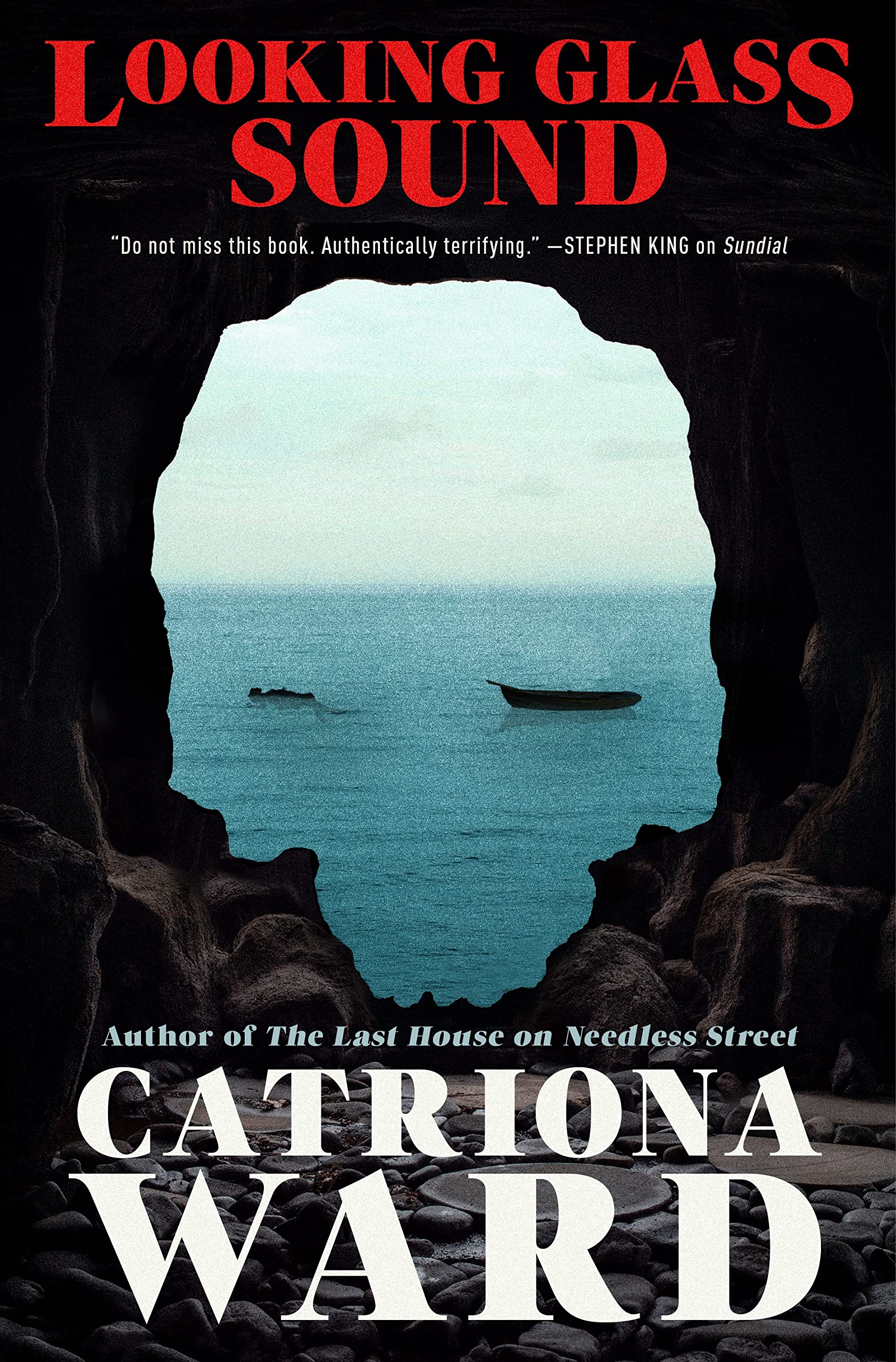
Looking Glass Sound by Catriona Ward

book cover

The sea whispers, faint. It sounds like pages shuffling. A seal barks. I lick a finger and test the breeze. The wind is in the east. A moment later it comes, mournful and high. The stones are singing and I feel it, at last, that I’m home. I listen for a time, despite my tiredness. I think, if heartbreak had a sound, it would be just like this.

She can smell him the way wild animals smell prey.

The visions don’t frighten me anymore. I can usually tell what’s real and what isn’t.

Don’t get comfortable.

Wilder Harlow has returned to the cottage where he stayed as a teen, to write the book he had started over three decades before. He is not entirely well. We meet him in 1989, via his unpublished memoir, which tells of the momentous events of that Summer. He was sixteen. His parents had just inherited a cottage from the late Uncle Vernon, and opt to spend a summer there before deciding whether to sell. It is on the Looking Glass Sound of the title, near a town, Castine, in Maine. Beset in prep school, for his unusual features, particularly pale skin and bug eyes, Wilder is ready for a novel experience. (“I’m looking at myself in the bathroom mirror and thinking about love, because I plan on falling in love this Summer. I don’t know how or with whom.”)

description
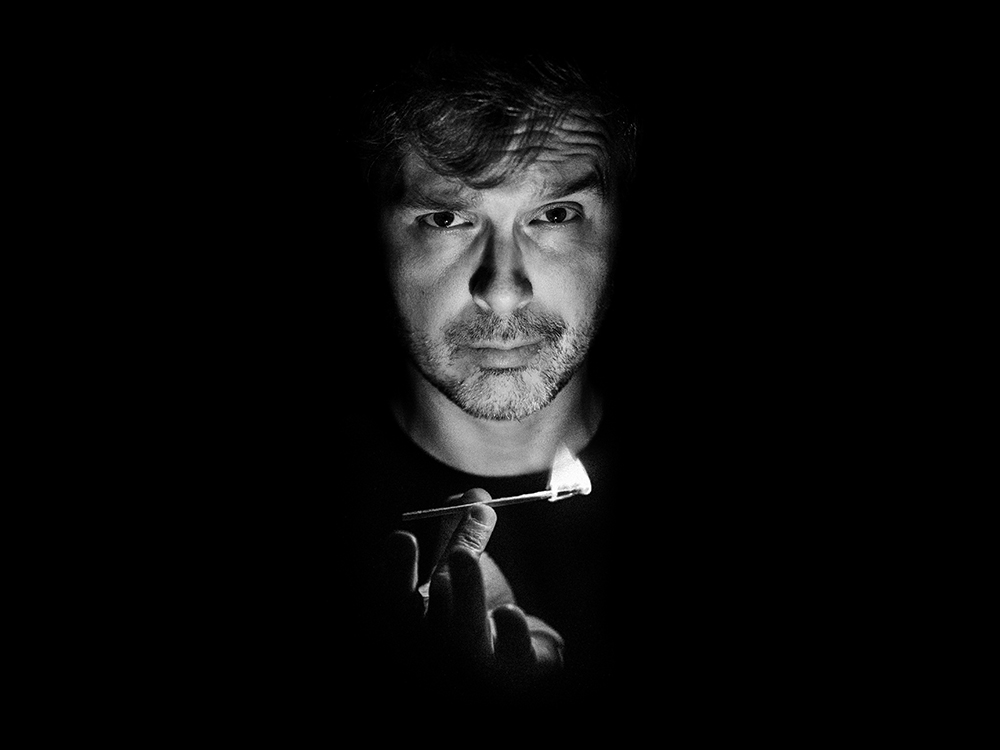
Catriona Ward – image from Love Reading

The sound has an unusual…um…sound.

The leaves of the sugar maple whisper—under it, there’s a high-pitched whine, a long shrill note like bad singing…it sounds like all the things you’re not supposed to believe in—mermaids, selkies, sirens…’What’s that sound?’ It seems like it’s coming from inside of me, somehow. Dad pauses in the act of unlocking the door. ‘It’s the stones on the beach. High tide has eaten away at them, making little holes—kind of like finger stops on a flute—and when the wind is in the east, coming over the ocean, it whistles through.’

Sure, dad, but the wind-driven whistling is not the only sound that haunts in these parts.

It does not take long for Wilder to make two friends. Nathaniel is the son of a local fisherman, his mother long gone. Harper is English, her well-to-do parents summer there. Wilder’s relationships with these two will define not only this Summer and the one after, but the rest of his life. Harper is a flaming redhead, with issues. She has been kicked out of many schools, for diverse crimes. So, of course, Wilder is madly in love with her at first sight. Nat, a golden boy in Wilder’s eyes, has a way of describing fishing with a harshness that is unsettling. The three form their own tribe for a time.

Pearl is named for her mother’s favorite jewel. She was only five when mom disappeared. They had been staying at a B&B in Castine. But Pearl’s mother is far from forgotten.

Sometimes her mother talks to Pearl in the night. She learns to keep herself awake, so she can hear her. It always happens the same way. Rebecca’s coming. It starts with the sound of the wind roaring in Pearl’s head, just like that day on the mountain. And then Rebecca’s warm hands close over her cold ears.

The area has a local creep. Dagger Man is the name assigned to whoever is responsible for a series of break-ins of homes occupied by Summer people. He takes photos of kids sleeping. Then sends the polaroids to the parents.x The images include a dagger to the throat. Adding to the creepiness, there is a history of women going missing here. And a legend of a sea goddess luring people to a dark end.

The second summer in Castine, there is an accident in a secret cave, involving Wilder, Nat, and Harper. It leads to a very dark, traumatic discovery, upending their worlds.

When Wilder heads off to college, soon after, he is intent on becoming a writer, but, while there, his closest friend, Sky, steals his story, going on to publish a wildly successful novel using it. Wilder is never able to get past this, thus his final return to the source a lifetime later, to have one last go at writing his true version.

Ward employs some of the usual tricks of creating a discomfiting atmosphere. The sounds emanating from the bay are strong among these. Even underwater I can still hear the wind singing in the rocks. And I hear a voice, too, calling. In describing Harper, Wilder notes Her hair is deep, almost unnatural red, like blood. And The wet sand of the bay is slick and grey. It’s obscene like viscera, a surface that shouldn’t be uncovered. (Well, ok then. Which way to the pool?) Nat describing how his father kills seals is pretty chilling.

Ward has had some eerie experiences,

I suffer from hypnagogic hallucinations. They started when I was about 13, taking the form of a hand in the small of my back as I was falling asleep, shoving me out of bed really hard. I knew there was someone in the room and I knew they didn’t mean me well. With the information I had at the time – pre-Google as well – there was no other explanation for it, was there? I think it’s probably the deepest chasm I have ever looked into. There’s nothing comparable to it in the daylight world. – from the 9/26/22 Guardian interview

which find their way into the story.

So, there are two presenting mysteries, Dagger Man and the missing women. And a bit of magic in the air, whether it is a dark siren luring some to a watery grave, mysterious noises and notes, or teens fooling around with witchy spells. Are the kids just being imaginative, or is there something truly spectral going on?

A feeling of powerlessness is core to the horror genre. The main characters here share a deep sense of vulnerability. This is very much a coming-of-age novel. Adolescence is a prime vulnerable state, a transition between childhood and the mystery of adulthood. Not knowing who you are. Trying on different roles, names, behaviors, hoping for love, of whatever sort, always susceptible to rejection and/or betrayal, and/or disappointment. There is added vulnerability with their families. Any teen going through changes would benefit from a solid base of parental constancy. Wilder’s parents are going through more than just a rough patch. Nat does not seem particularly close to his only parent. Harper refers to a pet dog that protects her from her father. There are enough secrets in the world. Bad families, bad fathers. Pearl’s mother, like Nat’s, is long gone. In addition to whatever else assails them, there is self-harm.

The Dagger Man is wandering about. People disappear. The bay has disturbing aspects to engage all the senses. There are a few more stressors, as well. That certainly sets the stage for an unsettling horror tale. That would all be plenty. But wait, there’s more.

Some books have unreliable narrators This one has an unreliable ensemble, existing in unreliable worlds. Looking Glass Sound is not your usual scare-fest. The terrors here lie deeper than a slasher villain or a vengeful ghost. In addition to the external frights, these have to do with existential concerns, about identity, who, what, where, and when you are. Offering the sorts of thoughts that can interfere with a restful night, with the legs to disturb your sleep for a long time. This would be more than enough, but wait.

This is also a book about writing. A pretty common element in many novels, it’s on steroids in this one, cruising along in the meta lane.

Writers are monsters, really. We eat everything we see.

The book is a mirror and I am stepping through the looking glass.

‘Writing is power,’ she says. ‘Big magic. It’s a way of keeping someone alive forever.’

I think about our three names, us kids, as we were. ‘Wilder,’ I whisper to myself sometimes. ‘Nathaniel, Harper.’ We’re all named after writers. It’s too much of a coincidence. Harper. Wilder. Harlow. The names chime together. The kind of thing that would never happen in real life but it might happen in a book.

‘You wanted to live forever,’ Harper says gently. ‘You both did, you and Wilder. That’s all writers really want, whatever they say.

She also gets into the morality of story ownership. When does your personal tale become a commodity? Who has the right to tell your story?

I cannot say I have ever read a book quite like this one. It is not an easy read. Despite some surface technique that places it in the gothic/horror realm, there is a lot more going on here. You will have to be on top of your reading game to keep track, but it will be worth your time and studied attention. There should be surgeon general’s warning on this book. Stick with it and you will get a very satisfying read, and endure many nights of unwelcome wondering.

I wake to the sound of breath. No hand caressing me, this time. Instead I have the sense that I am being pummeled and stretched, pulled by firm hands into agonizing, geometrical shapes. I scream but no voice comes from my throat. Instead, an infernal scratching—horrible, like rats’ claws on stone, like bone grinding, like the creak of a bough before it breaks. Or like a pen scratching on paper.

Review posted – 7/21/23

Publication date – 08/08/23

I received an ARE of Looking Glass Sound from Tor/Nightfire in return for a fair review. Thanks, folks, and thanks to NetGalley for facilitating. Can you please turn down the volume on that thing?

This review is cross-posted on Goodreads. Stop by and say Hi!

=======================================EXTRA STUFF

Profile – from Wikipedia
Catriona Ward was born in Washington, D.C. Her family moved a lot and she grew up all over the world, including in the United States, Kenya, Madagascar, Yemen, and Morocco. Dartmoor was the one place the family returned to on a regular basis. Ward read English at St Edmund Hall, Oxford. Ward initially worked as an actor based in New York. When she returned to London she worked on her first novel while writing for a human rights foundation until she left to take an MA in creative writing from the University of East Anglia. That novel, Rawblood (distributed in the United States as The Girl from Rawblood), was published in 2015. Now she writes novels and short stories, and reviews for various publications.[1] Ward won the August Derleth Award for Best Horror Novel in 2016 …and again in 2018 for Little Eve, making her the first woman to win the prize twice.
Her most successful novel has been The Last House on Needless Street.

Links to Ward’s FB and Instagram pages

Interviews
—–The Guardian – 9/26/22 – Catriona Ward: ‘When done right, horror is a transformative experience.’ by Hephzibah Anderson
—–The Guardian – 3/13/21‘Every monster has a story’: Catriona Ward on her chilling gothic novel by Justine Jordan
—–Lit Reactor – Catriona Ward: Learning to Fail by Jena Brown
—–The Big Thrill – 8/31/2021 – Up Close: Catriona Ward by April Snellings
—–Tor/Forge – Catriona Ward – What Was Your Inspiration for Looking Glass Sound?
—–Books Around the Corner – Catriona Ward by Stephanie Ross
—–Quick Book Reviews – Episode 206 – April 24, 2023 – Books! Boks! Books! from 26:06 to 42:30

Items of Interest
—–The Novelry – 10/2/2022 – Catriona Ward and the Power of Writing Horror
—–NHS – Charles Bonnet syndrome

Leave a comment

Filed under Fantasy, Fiction, Horror, Literary Fiction, Mystery, psycho killer, Suspense, Thriller, Thriller

The Red Queen by Juan Gómez-Jurado

book cover

The weight on her chest lightens, her breathing slows. The ‘monkeys inside her head screech a little less loudly. That’s what is so brilliant about certainties, even fleeting ones. They offer us respite.

Police Inspector Jon Guttierez of the Bilbao PD, 43, is a large person, a weightlifter who lives with his mother. He ran into a spot of trouble recently when he attempted to plant evidence on a well-known drug dealer, only to be filmed in the act, said film going viral. Oopsy. He stands to lose a lot more than just his badge. When what to his wondering eyes should appear but a get-out-of-jail-free card, in the form of a mysterious personage known as Mentor. But Mentor has a tough, if unusual ask. He wants Jon to persuade someone to return to work. Someone who really, really does not want back in.

description
Juan Gómez-Jurado – image from Zenda

Antonia Scott (her father the British ambassador, her mother a Spaniard) spends three minutes of every day contemplating suicide. (Whatever works for ya, dear.) Her comatose beloved husband has been in a hospital bed for three years. She has been by his side throughout, clearly feeling some responsibility for his condition. (Antonia’s struggle is reminiscent of how JGJ felt when his father was dying during the writing of the book.) Antonia has regular chats with her English grandmother, who encourages her to put her particular set of skills to good use, instead of letting them go to waste. She has some superpowers, but also some limitations, one being a need for a certain medication when she is overwhelmed.

The inspiration for Antonia and Jon inevitably stems from Don Quixote and Sancho Panza. Antonia is that idealistic being, she does not hesitate to face the windmills, because she believes in a better world. Jon, on the other hand, is that pragmatist who has a dreamer hidden inside of him. – from the Hindustani interview

description
Vicky Luengo plays Antonia Scott in the Prime series – image from InStyle

Jon clearly succeeds in drawing Antonia out, or we wouldn’t have a book. And he becomes her partner. Not spoilers. It appears that Antonia is quite special indeed, with a mental capacity well beyond the norm. She had been a member of an elite international police organization, Red Queen, a network across Europe, one unit per country, each led by a Mentor. They exist outside the usual police structures, relying on the local constabulary for on-scene access and intel. Each unit uses a person with special gifts to help solve major crimes. Red Queens are selected for having a set of particular characteristics, which Antonia has. Uber-smart, amazing memory, analytical capacity just this side of a super-computer. (very Lisbeth Salander) But will she be smart enough to foil a criminal mastermind who has already murdered one child of the uber-rich, and has kidnapped another?

description
Hovik Keuchkerian plays Jon Guttierez in the Prime series – image from his Twitter profile

Alvaro Trueba, a teenager, has been dead several days, drained of blood, and laid out with bizarre religious iconography that is clear to the particularly perceptive. The kidnapper calls himself Ezekiel. The house in which his body was found, in a gated community, was one of several owned by his one-percenter parents.

Antonia and Jon must contend with the Abduction and Extortion Unit. (AEU), led by Captain Jose Luis Parra. Far too often, police stories have a dickish supervisor, tacking to political winds at every breeze, and getting in the way of actual investigators. Parra serves that role here, although as someone in a parallel, instead of superior role. He is not a totally incompetent team leader. Still, very dickish.

Just because we’re a unit created to avoid competition and secrets being kept between different police forces doesn’t mean we don’t repeat the same old mistakes.

Carlos Ortiz is the wealthiest man in the world. When his daughter, Carla, is kidnapped, he receives a call. His next call is to Red Queen, and Jon and Antonia are brought in, seeing the obvious connections between the cases.

The story is told in the 3rd person, primarily following Antonia and Jon as they track down leads in pursuit of the baddie. Once Carla is taken hostage, we flip back and forth between the investigation and her experience. There are occasional sidebar chapters in which we get a closer look at some of the supporting characters.

Red Queen is a particularly fun thriller to read. JGJ has a wonderfully droll (snotty?) sense of humor which permeates. Do not expect rolling on the floor hysterics, but you will smile and titter a lot. Jon gets all he knows about children from Modern Family reruns or When his sandwich arrives, Jon confirms that the hospital follows tradition: the grill they use must never be cleaned. Because she is fluent in many languages, Antonia often brings in obscure words or expressions from diverse cultures (aboriginal, South Ghanaian, and others) when that word is particularly descriptive of a situation. This is a wonderful bit, speaking to the limits of communication in a single language. There is also some intel on the ancient, unseen, infrastructure of Madrid, a nifty Dan-Brownish touch.

The supporting cast is also a plus. Corrupt security guards, a feisty nonagenarian granny, a tattoo artist who delights in disrespecting tourist customers, the testosterone-poisoned Captain Parra, an oily reporter, a mad scientist (I am not crazy; my reality is just different from yours.), and an evil baddie. The portrayal of criminal motivation and history was thin, but hopefully later volumes will flesh those out a bit more.

I was hesitant at first to read this one, as it is the opener of a trilogy. Would there be resolution at the end or a cliffhanger? The answer is yes. There are some things that remain to be resolved, but there is enough of an ending here to make it a viable stand-alone read. Every adventure requires a first step.

There are twists and turns aplenty, which always helps. And questions to be answered. Will Carla escape? Will Antonia and Jon uncover who is behind these crimes? Will the usual competitive misery from other forces interfere with the investigation? What is it the kidnappers want and why are those demands not being met? Will Antonia completely fall apart before they can complete their mission? (We’re all mad here)

You will want to know as you flip-flip-flip-flip through these pages. Red Queen is a good beginning at which to begin. I would urge you to go on till you come to the end, then stop. But of course, that will not be possible for most of us. We only received an English-language translation of Reisa Rosa in 2023. It was originally released in Spain in 2018. There are three books in the series. For those fluent in Spanish there will be no waiting, but for those of us who do not speak Spanish, let the panting begin for volumes two (Loba Negra or Black Wolf, due 3/12/24 from Minotaur) and three (Rey Blanco or White King, presumably a year later) in English translation. The trilogy has been a huge international hit. Prime has optioned the series for a Spanish-language production. In the video interview linked below, we learn that primary shooting has completed for at least five episodes. I would guess a probable release in late 2023 or in 2024. I wouldn’t wait, though. Red Queen is a perfect summer read, whatever color roses you might prefer.

A spasm of pure fear convulses Antonia’s body. Fear and loathing. Because she finally understands—with piercing, icy clarity—what has been going on from the very start.

Review posted – June 30, 2023

Publication date – March 14, 2023 – (English translation)
It was first published in Spanish on November 8, 2018

I received an ARE of Red Queen from Minotaur Books in return for a fair review, and releasing my hostage. Thanks, folks.

This review is cross-posted on Goodreads. Stop by and say Hi!

=======================================EXTRA STUFF

Links to Gomez-Jurado’s personal, FB, and Twitter pages

Profile– from EAE Business School

Juan Gómez-Jurado was born in Madrid in 1977. His interest in literature led him to pursue a career in Information Science. No one at TVE, Canal Plus, La Voz de Galicia or COPE Radio Station —where he has worked— could have imagined what he would become in time. It wasn’t until 2006, when he published his novel, God’s Spy, that his talent became known, not only in Spain, but all across the globe.
Since then, he hasn’t stopped writing. Contract with God, The Traitor’s Emblem, The Legend of the Thief, The Patient, Scar… Year after year, his books keep on coming out. No time to rest. And his success keeps on rising and he keeps on breaking records. The trilogy made up of Red Queen, Black Wolf and White King, was the first to have all three books among the best-selling books in Spain simultaneously. In fact, Red Queen has been the most read book in Spain for two years in a row now, which translates into more than two million copies sold.

Interviews
—–Murder by the Book – Live from Madrid: Juan Gomez-Jurado Presents, “The Red Queen” Hosted by Sara DiVello – video – 35:08 – almost all of this is about his writing process, with bits about this book here and there
—–Hindustan Times – Interview: Juan Gomez-Jurado, author, Red Queen by Arunima Mazumdar

Item of Interest from the author
—–Crime Reads – Excerpt – Jon trying to persuade Antonia to return to work

Items of Interest
—–Gutenberg – Alice’s Adventures in Wonderland by Lewis Carroll
—–Gutenberg – Through the Looking Glass by Lewis Carroll
—–Gutenberg – Don Quixote by Miguel de Cervantes Saavedra
—–Bookroo – quotes from Alice in Wonderland

The epigraph of the novel is a quote from Through the Looking Glass, the book title having been taken from that. So, it seemed fitting to sprinkle throughout the review quotes from that and from Alice’s Adventures in Wonderland. I used the Bookroo site above for that.

Leave a comment

Filed under Fiction, Mystery, Suspense, Thriller, Thriller

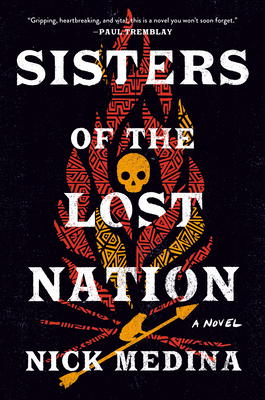
Sisters of the Lost Nation by Nick Medina

book cover

The spirit of a chief, you see, is a powerful thing. The skull became a head again when it was lifted from the grave . . . resurrected.”
“Resurrected?” she echoed.
“Alive again,” he said, his voice measured and grievously low, prolonging every word. “But not like it was before. Not like the old chief. It’s angry now that it’s been ripped from its rest. And ravenous. Hungry for revenge. It’ll eat anyone it encounters. It’ll tear flesh from bone.”
“How?” she said.
“It rolls, gathering mud and moss on its decaying flesh.”

Black bark to her sides and ash beneath her feet, she smelled the earthy odors of dirt, mud, burnt wood, and something so vile her stomach turned. It was the same smell the wind had wafted her way on the nights she’d been chased. Only the odor was stronger now. Inescapable.

Seventeen-year-old Anna Horn is terrified of two things. The first a magical, carnivorous head that gets around by rolling, and is possessed of a set of very nasty teeth. She believes it is determined to eat her. This is the result of a tale her Uncle Ray had told her ten years ago. Her terror about the rolling head permeates, as she fears its arrival every time there is a rustle in the bushes, the main difference in her experience of it being that she can flee faster at seventeen than she could at seven. The second is that she will never see her sister again. Fifteen-year-old Grace has joined the growing list of Native women gone missing.

description
Nick Medina – image from Transatlantic Agency

Anna is in the throes of that perennial challenge of the teen-years, (for some of us, this challenge can go on for decades) figuring out who she is. She is way more mature than most of us were at that age, for sure. She does not exactly dress to impress, favoring her father’s old clothes, and sporting a very unfashionable short haircut. She loves the stories of her tribe, the fictional Takodas, to the point of wanting to start a historical preservation society, to save Takoda history, myths, and traditions for future generations. The considerate and kind classmates at her mostly white school completely understand and support her efforts at self-discovery. As if. They make her school experience a living hell, taking it further than unkind words. Grace is a very different sort, desperate to fit in, wanting attention, focusing on her looks and pleasing others in order to grease the way to hanging with the cool kids. Acquiring a cell phone is the key to her potential rise, and she will do whatever she can to get the money for one.

The story flips back and forth in time, moving forward from Anna’s Day 1 in showing how events came to be, and from the day of Grace’s disappearance, showing the investigation and results. Chapters are labeled in reference to days since Anna’s story begins. Grace does not go missing until well along in those days. Chapters looking at the search for Grace are also labeled with the number of hours since her disappearance.

Medina wanted to highlight the epidemic of Missing and Murdered Indigenous Women and Girls (WWIMG) that has been devastating Native communities for a long time. He shows the all-too-familiar problems residents of tribal lands face when someone goes missing, a viper’s nest of overlapping legal jurisdictions, inadequate police funding, and official indifference among them, not to mention racism. Speaking of which Medina portrays people of all shades as less then admirable. Even the Native manager of the casino assigns Native workers based on their skin color. Fox Ballard, nephew of the tribal leader, is young, handsome, flashy, sculpted, and not at all to be trusted.

Medina pays attention, as well to the impact of modernization on traditional values. The Takoda nation has been significantly changed by the opening of a casino on the reservation. The most obvious contrast is that of Anna (traditional) vs Grace (modern). The new road offers up a steady supply of splatted frogs, a pretty clear image of the cost of replacing treasured values with treasure. Income from the casino is making its way to all the people on the rez, although it is also clear that some Takoda are more equal than others.

As explained in the Author’s note that follows the book, the inspiration for the carnivorous rolling head came from actual Wintu and Cheyenne legends. It reminded me of the relentless ungulate in Stephen Graham Jones’s The Only Good Indians, except that the elk in Jones’s tale is seeking revenge, while the head, though our only real look at it is through Anna’s terrified eyes, seems a more open opportunity attacker. Frankly, scary as it seems to her, it cannot hold a candle to Graham’s hoofed-slasher. It may have been scary to Anna as a character, but did not cause me any lost sleep as a reader.

I did feel at times that this book read more like a YA story than a fully adult one, an observation, not a black mark. The greatest strength of the novel is Medina’s portrayal of his lead, Anna. It is in seeing her social challenges, following her passions, tracking her investigative efforts, admiring her bravery, and rooting for her to mature to a point where she is comfortable in her own skin, that we come to care about her. That alone makes this a good read. The added payload, about the core issue of the book, Missing and Murdred Indigenous Women, about the impact of modernization on traditional values, about gender identity, and about the impact of story on our lives, gives it a far greater heft.

This is Medina’s first novel. He refers to it as a “thriller with mythological horror.” It is an impressive beginning to what we hope is a long and productive career.

She said Frog exemplified transformation. He entered life in one form and left it in another. From egg to tadpole, to tadpole with legs, to amphibian with tail, to tailless frog, he was never the same. He began life in water, only emerging once he was his true self. He symbolized change, rebirth, and renewal, and his spirit could bring rain.
Anna stared down at the ill-fated frog. The reservation was transforming. The asphalt beneath her feet was evidence of that. And yet the very symbol of change had become a victim of it. The absurdity didn’t escape her.

Review posted – 6/23/23

Publication date – 4/18/23

I received an ARE of book name from publisher in return for a fair review. Thanks, folks. Can you get that thing to stop chasing me? And thanks to NetGalley for facilitating.

This review is cross-posted on Goodreads. Stop by and say Hi!

=======================================EXTRA STUFF

Links to the author’s personal, Instagram, and Twitter pages

PROFILE – from The Transatlantic Agency

A Chicago native, Nick Medina is an author and college professor of public speaking and multicultural communication…Nick’s first short story was published in 2009 and he has since had dozens more published by West Pigeon Press, Dark Highlands, and UnEarthed Press, in addition to outlets in the U.S. and the U.K., such as Midwest Literary Magazine, The Washington Pastime, The Absent Willow Review and Underground Voices.

Interviews
—–Paulsemel.com – Exclusive Interview: “Sisters Of The Lost Nation” Author Nick Medina – e-mail interview
—–#Poured Over – The B&N Podcast – Nick Medina on Sisters of the Lost Nation – by Marie Cummings – video – 48:04
—–Murder by the Book – Special Prelaunch Q&A: Nick Medina Presents “Sister of the Lost Nation” by Sara DiVello – video – 33:31
—–FanFiAddict – Author Interview: Nick Medina (Sisters of the Lost Nation) by Cassidee Lanstra

Items of Interest from the author
—–Tor.Com – Excerpt
—–CrimeReads.com – EXPLORING SOCIAL ISSUES THROUGH HORROR

Items of Interest
—–Medina said that his initial inspiration for the novel was from an AP article published in the Chicago Tribune. Here is the article as published by AP – #NotInvisible: Why are Native American women vanishing? by Sharon Cohen
—–CBC – MMIWG cases continued at same rate even after national inquiry began, data shows
—– First People: American Indian Legends – The Rolling Head – A Cheyenne Legend

For horror grounded in the Native experience, I can recommend
—–Stephen Graham Jones – Mongrels
—–Stephen Graham Jones – The Only Good Indians
—–Stephen Graham Jones – My Heart is a Chainsaw
—–Stephen Graham Jones – Don’t Fear the Reaper
—–Cherie Dimaline – Empire of Wild

Leave a comment

Filed under Fantasy, Fiction, Horror, Mystery, Native Americans, Suspense, Thriller

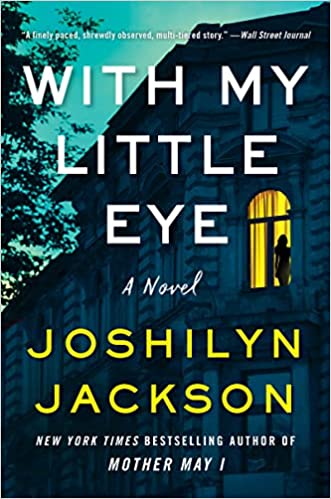
With My Little Eye by Joshilyn Jackson

book cover

The difference between stalking and courtship is so thin, I thought then. It all depends on if the person likes you back.

…there was nothing I could do to shake my stalker’s avid interest. It wasn’t even about me, although Marker Man would say it was. I was a shape to him, the outline of an object, filled in by him, interpreted by him. Not a person. I couldn’t stop him from coming after me, my friends, my family, because he stayed hidden, watching me, inventing me.

Meribel Mills has a problem. Well, a few, really, but there is a GINORMOUS one in particular, even without the age thing. Coming up on the big four-oh, getting work is increasingly challenging. Acting is not kind to anyone, but gets worse, especially for women, as they age. Meribel had been making a living in the biz, her big break playing a regular in a TV series some years back. She is the most fortunate kind of actor, a working actor. People still recognize her on the street “Hey, weren’t you on…?” but she is not hounded by paparazzi like real stars.

Nevertheless, someone in particular did notice her, and is, in fact, obsessed with her. (No doubt he considers himself to be her Number One Fan) He sends her letters in a distinctive hand, candy scented, and brighty colored. While professing undying love, the images he includes tend toward the homicidal. LAPD was not much help. Happy to step in once her body had been found, but short of that, sorry. No crime? No time. It became so bad that she accepted a role in her home town, Atlanta, a place she had sworn never to return to, leaving LA, friends, contacts, and a promising relationship. Maybe her stalker would lose the scent. As if. They call him Marker Man.

description
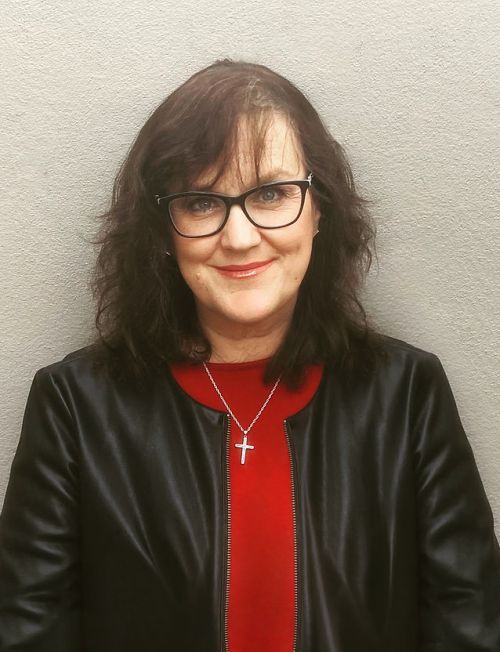
Joshilyn Jackson – image from her site – shot by Scott Winn

We follow Meribel as she tries to cope with the threat from this stalker. She is also trying to negotiate her relationships with the men in her life, her ex, the bf she left in LA, and a new acquaintance in her building. The pressure ratchets up as the killer becomes bolder and more terrifying. Could he be one of her real or potential love interests?

Meribel did not move east alone. Her 12yo adopted daughter, Honor, moved with her. Mother-daughter relationships are always a central element in Jackson’s novels. This one, though, offers a bit of a twist. Honor is on the autism spectrum. It is quite interesting following her trains of thought, and seeing how she copes with the world. There is a reason this piece of the novel works so well.

My daughter came to me in high school and was like, “Mom I think I’m on the autism spectrum…I’ve been reading about girls on the autism spectrum.” I’m like, “Honey, tell me why, what you think, because…that’s insane.” So she starts saying all these things and to every one of them she’s like, “well, girls on the autism spectrum do” this and this and this and this, and I would say, “Honey, that is normal. I was just like that. Every girl does that. OK?” No, they don’t! But the things she was describing were very very classic female autism, and seemed normal to me, because I was autistic…It’s cool that I was able to write Honor from a perspective of knowing what was really going on with her. – from Friends and Fiction interview

The love between Meribel and Honor comes through dazzlingly. We really get to see what it might be like to parent at least one sort of neuro-divergent child.

Additional content covers several areas. Hollywood permeates as a background. We get a look at Meribel’s early days there trying to get work, and at the predation of those with power. She remarks about parties to which she is invited, girls and boys like me are there as party favors. We get a look at how the value assigned to age and beauty impacts an actor’s career options. Not just actors, either. Meribel is not the only woman here struggling to look as young and attractive as possible. There is at least some irony in the fact that Meribel, whose career success requires that people watch her, is afflicted by someone who became smitten via his TV screen, but who now watches in a very different way. He even enters her home. How can you hold off the obsessed when modern media and technology makes it so easy to find out about you, and worse, to locate you? There is further irony in the fact that, now in Atlanta, Meribel does some stalking of her own. And not just on-line. She, however, holds no psychotic views, and sends no terrifying letters.

…this book is about gaze, like who is watching you and how does that change the power dynamic. – from the Friends and Fiction interview

Or, I suppose, spying, if one extends the title. Privacy is tough to come by. Jackson also offers a look at fans and detractors, how they interact with an actor when they recognize one in real life. The book closes with a nod to events that are about to become a big deal back in LaLa Land.

Who can you trust? Several candidates are offered for the baddie. The guy she left on the West Coast has managed a trip to Atlanta. Is he just looking for love, or something darker? A neighbor in Meribel’s new apartment complex has an on-again-off-again girlfriend, but seems interested. He has some nice qualities, but some issues as well. Meribel is still attached to her ex, James, in her head, if not in reality, even though he is now married with kids. Was he the guy watching her from across the street in the rain recently?

This is my sixth Joshilyn Jackson novel. The first was Someone Else’s Love Story, her seventh, so I missed a fair bit. But I believe they were of a cloth in many ways. Her site identifies nine novels as Southern Fiction. I was smitten with SELS and with the two that followed, The Opposite of Everyone and The Almost Sisters. Jackson offered engaging characters, a strong sense of place, and considerations of religion, race, and culture that were smart and moving. With My Little Eye is the third novel she has written of a different sort, following Never Have I Ever in 2019 and Mother May I in 2021. All three are pretty good thrillers, and all have payload beyond the core story. But none of them, however entertaining, provide the deeper resonance and satisfaction of the three written before them. The change came about organically.

I think that what really happened was I’d been trying to say something about my family history and the South, this land that I love, and I feel ambivalent about and I wrote a book called The Almost Sisters. And I’m not saying that I said it perfectly. I don’t think you can ever…the thing I was trying to say, I’ll never be able to say it better than in The Almost Sisters. I felt like a weight had been lifted. So I just started writing my next novel…I got a third of the way through the book and we were in negotiations and I was like this is a thriller. I’m writing a thriller by accident, and I called my agent. I was like “we can’t sign that contract. I’m writing a thriller. And she’s like “You’re writing a what?” – from Friends and Fiction interview

Don’t get me wrong, I like her thrillers, including this one, just fine. I appreciate the content that arrives along with the more page-turning tales, and respect her feeling that she has said all she has to say about the South, for now, anyway. But I enjoyed her earlier work more. I may be in a minority on this, as sales of her thrillers, I am told, have been better than for her Southern books. It’s like ice cream, I expect. It is all wonderful, but everyone has favorite flavors.

In any case, Jackson will engage you with a special mother and daughter, make you smile at their connection, keep you turning pages as you try to figure out, along with Meribel, who Marker Man might be, and worry who may or may not be left alive by the end. Your eyes may or may not be little, but you would do well to put them to use reading Joshilyn Jackson’s latest spark to increased blood pressure and late-night-reading-induced sleep loss.

Q – How did you get into the head of a stalker and how did that affect you?

AHe made me need to take a bath. I didn’t want to write him. I didn’t plan to write him in there. I started writing the book. I knew it would be mostly Meribel’s story. Meribel narrates probably 80 percent of the book, but there are a few other voices that come in, and I did not plan to let that man talk, and then I was like, ok. He has to be more present than this. Like I thought people aren’t gonna understand how, why would she leave her town. They would have to understand. Because I knew how bad he was, but it wasn’t appearing on the page. So, then I wrote his letters. I was like maybe I’ll just show his letters, but even that was not enough. People aren’t gonna understand why she makes these extreme choices until they understand how much danger she’s actually in and how bad this is. But yeah, it was gross and icky and he’s not a good person. – from Friends and Fiction interview

Review posted – 06/16/23

Publication date – 04/25/23

I received an ARE of book name from publisher in return for a fair review. Thanks, folks, and thanks to NetGalley for facilitating.

This review has been cross-posted on GoodReads

=======================================EXTRA STUFF

Links to the author’s personal, FB, Instagram, and Twitter pages

My reviews of other books by Joshilyn Jackson
—–2021 – Mother May I
—–2019 – Never Have I Ever
—–2017 – The Almost Sisters
—–2016 – The Opposite of Everyone
—–2013 – Someone Else’s Love Story

Interviews
—–Friends and Fiction – Joshilyn Jackson | Friends & Fiction #166 April 26, 2023 by Patti Callahan Henry, Mary Kay Andrews, Kristy Woodson Harvey and Kristin Harmel – – from 9:39
—–Military Press – Interview with Joshilyn Jackson by Elise Cooper
—–Decatur Church – 2023-04-25 Joshilyn Jackson “With My Little Eye” Book Launch – with Allison Law – video – 52:20 – start from 10:00 or so

Songs/Music
—–Billy Ray Cyrus – Achy Breaky Heart – Chap 20 – in the wave pool
—–Los Del Rio – Macarena – Chap 20 – in the wave pool
—–The Police – Every Breath You Take

Item of Interest
—–Wrote a Book – Book Club Questions for With My Little Eye by Joshilyn Jackson by Luka

2 Comments

Filed under Fiction, Mystery, Suspense, Thriller, Thriller

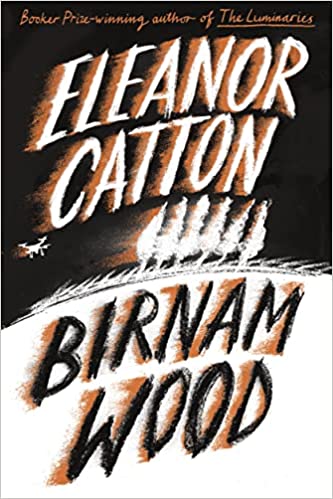
Birnam Wood by Eleanor Catton

book cover

…all the great tragedies are stories ultimately of betrayal. They’re stories where people betrayed the people closest to them but they’re also stories where people betray themselves. They kind of betrayed the better person that they could have become. – B&N interview

Third Apparition –
Macbeth shall never vanquish’d be until
Great Birnam wood to high Dunsiname hill
Shall come against him.


Macbeth –
That will never be.
Who can impress the forest, bid the tree
Unfix his earth-bound root?
The Scottish
Play

Wanna bet?

Birnam Wood is a serious, literary novel, a tragedy, cleverly disguised as an eco-thriller. Mira Bunting, 29, a horticulturist, heads an activist collective called Birnam Wood. They grow food in found plots of land, sometimes with permission, sometimes not. What they grow they consume themselves and give away to any in need. She discovered in childhood an interest in horticulture. It drowns out the relentless patter of self-critique that drives her.

description
Eleanor Catton – image from The Guardian

Shelley Noakes is number two, the sort of efficient workhorse that most organizations need in order to survive. Though she is Mira’s roomie and bff, Shelley has grown tired of being taken for granted, always relegated to second fiddle, and is determined to leave. She struggles, however, with the knowledge that if she leaves, Birnam Wood will not survive Mira’s laughable incapacity for meat and potatoes organizational management.

Tony Gallo has been away for several years, backpacking, teaching English in Mexico, trying to find himself. He wants to become a freelance journalist, despite a thin volume of actual experience. He is idealistic and insufferable, his ideological lines are not only clear, but electrified. He is carrying a torch for Mira and has returned home to see if there are any sparks left. Eager for a journalistic break, he stumbles across a biggie.

Robert Lemoine is an American billionaire, disgustingly rich from his drone business. He is looking for a bug-out retreat in case of global meltdown, and had found just the place. Is Lemoine a well-meaning rich guy, or a Bond villain?

Owen Darvish, recently knighted, is the owner of that place, a considerable swath, cheek by jowl with a national park. Unfortunately, there was a major landslide there recently, which has cut off the town of Thorndike. Will the sale actually go through now?

The landslide has caught Mira’s attention. What if Birnam Wood could set up shop in a place that was effectively cut off from most ongoing enterprise? Might be a great chance to grow her non-profit into a much larger player, and maybe do a fair bit of good? She decides to make the considerable drive and check it out. While there, she encounters Lemoine. This is where the story really gets going.

The novel flows in two parallel streams, often merging, then separating, then merging again. The first is the eco-thriller. What is Lemoine on about? He can certainly come across as charming, and sincere, but is he really? Is the money he offers Mira for Birnam Wood’s work being given sincerely, or is he up to something? Does the devil speak true? That he has a studly appeal adds to the confusion. The other is a deep dive into personality and motivation, with rich literary technique and a host of thematic concerns.

Privacy, or lack thereof, is a frequent focus in the book. Lemoine, for example, is a developer of drone technology, and is a one-percenter as well in terms of knowledge of and facility with surveillance. (…he took his phone out of his pocket, tapped the screen, then turned it around to show her. Under the list of detectable devices nearby was listed ‘mira’s iPhone’.) It permeates down to the ninety-nine-percenters as well. This, for instance, is our introduction to Shelley:

…the yellow circle labelled ‘Mira’ pulled out into the street and began traversing slowly north. Shelley Noakes reduced the scale of the map until her own circle, a gently pulsing blue, appeared at the edge of the screen, and watched the yellow disc advance imperceptibly upon the blue for almost thirty seconds before turning off the phone and throwing it, suddenly and childishly, into the pile of laundry at the end of her bed.

Mira has a tracker app on Shelley’s phone as well. Mrs Darvish keeps up on where her husband is by tracking his phone. Tony’s research is of the investigative reporter sort, on line and in-the-field which, of course, entails some significant snooping. And, of course, he is snooped on while he investigates.

Catton uses interior dialogue to let us in on the main characters’ struggles with who they are and what they want. Well, not so much Lemoine, who struggles less with a values dialectic than with figuring out how to get what he wants from the world. Tony sees himself as a progressive, but wrestles with his feminist credentials, and sincerely wonders if he is inauthentic in his desire to make a meaningful career for himself, in presenting himself as someone who has to struggle to get by, who criticizes the very system that makes his life possible. Mira struggles to hide (…a vanity, an appetite, a capacity for manipulation that she would rather other people did not see; she knew, and was ashamed to know). Shelly has to reconcile her seemingly permanent peace-maker role in life with her need to be her own person.

Shelley wanted out. Out of the group; out of the suffocating moral censure, the pretended fellow feeling, the constant obligatory thrift; out of financial peril; out of the flat; out of her relationship with Mira, which was not romantic in any physical sense, but which had somehow come to feel both exclusive and proprietary; and above all, out of her role as the sensible, dependable, predictable sidekick, never quite as rebellious as Mira, never quite as free-thinking, never – even when they acted together – quite as brave.

This being a tale not told by an idiot, inspired by a tragedy, there will be familiar tragic elements on display. Tragic flaws for everyone. Come one, come all. But can the mere hoi-polloi really be tragic characters? Isn’t that reserved for the high and mighty? Owen Darvish certainly counts for that, as does Lemoine. But Mira? Shelley? Tony? Or is grandiosity alone sufficient to elevate one to a height sufficient to mark a character as potentially tragic? Catton does make us wonder as we read just who are the tragic characters, and who the schlubs who are guilty of, maybe, a bit of overreach, or garden variety foolishness.

Of course, there is more to them than merely wanting beyond their capacities. There is another element from tragedy to consider. Note the quote that opens this review. Betrayal figures large. There is enough deception in the air here that one might be well advised to don a bee-keeper outfit to fend off the tangled webs that permeate the landscape. Secrets will be kept, some minor, some world-class. Our intro to Mira, for example, shows her using a false identity to research the landslide area. More importantly, is she selling out the collective if she comes to a deal with Lemoine? Shelley tries her best to seduce Tony as a passive-aggressive way of getting Mira to separate from her. Others have their own secrets and betrayals nicely tucked away.

Another tragedic element is that outcomes are the result of actions, not fate or chance. If you look back down the path from end to beginning you will see all the characters’ yesterdays lighting the way to an inescapable end. Although it is not the only influence on the book, Macbeth is clearly the primary one.

[Catton] drew up another intricate masterplan in which each of the main characters could be seen as Macbeth, with a corresponding Lady Macbeth, witches and so on. It sounds tricksier than it is: as the narrative perspective shifts, everybody could be the villain. She wanted to stop readers playing “the polarised blame game we are all used to in contemporary politics,” she explains. “You wouldn’t be able to say: ‘These are my people so they are obviously the good guys. These are the people that I despise so they are obviously the bad guys.’” – from The Guardian interview

You will have to find out for yourself how much of this structure made it into the final draft.

Other significant sources of inspiration were 20th century crime fiction, Jane Austen’s Emma, (the structure and taut language) and even Mary Shelley’s Frankenstein. The character Shelley was named for the author, leaving us to wonder whether this Shelley is creature or creator.

While this is a novel in which actions matter, and have consequences, it is also one in which the omniscient narrator will tell you everything you need to know about each of the characters. This ability to look into (monitor remotely? surveil?) everyone’s deepest inner thoughts and feelings resonates with the surveillance elements in the story. One of the precipitating ideas for the book, the Big-Brother-is-watching element certainly, sprung from a 2015 protest in which New Zealand police were taking photos of protesters as they walked past.

Catton is also interested in inter-generational dealings.

It’s something I have thought about a lot…how my generational placement or position has conditioned me. The book is designed generationally. There are three generations represented in terms of the points of view. And I wanted to really explore the generational differences in terms of how they deal with certain contemporary problems that we’re all kind of facing globally. – from The Toronto Public Library interview

But it is no boomer-bashing party.

“Millennials are quite willing to cosy up to the tech gen Xers,” she says. “We are all personally enriching billionaires like Elon Musk by freely giving away our data…These minerals are in the phones that are around us all the time. I want my iPhone. I want to be able to have the freedoms that it brings. We are all complicit.” – from The Guardian interview

In addition to its literary and thriller aspects, Birnam Wood is a satire, a caricature of diverse sorts. Most glaring is the Birnam Wood members, whose motivations and desires are often less idealistic than what they show to the world. Darvish comes in for an uncomplimentary look, too, as does Lemoine. It is a tale, also, about expectations.

Macbeth is a play that’s all about prophecy. It’s animated by prophecy. So I …re-read it with everything that was happening in terms of world events resounding in my head and suddenly saw it in a really different way, as a play that contains very interesting and loud warnings about what happens when you regard the future with too much certainty if you’re too convinced about what lies just down the road. Because of course Macbeth makes the ending of Macbeth happen. None of that was written on the wall before before he received those prophecies and I and so I kind of wanted to achieve a similar effect in a novel by writing a book about incremental political actions and moral actions that end up kind of having these enormous effects that were avoidable. – from the Barnes & Noble interview

In short (too late, I know), Birnam Wood is a multi-layered triumph, building on classic structures and themes to tell a very contemporary story, offering consideration of how people make very human choices, as they contain battles between morality and desire. The tale does not at all creep in a petty pace, but rolls along at a good clip, shifting into turbo as it nears the end, generating an abundance of sound and fury which certainly signifies something.

Like all self-mythologising rebels, Mira preferred enemies to rivals, and often turned her rivals into enemies, the better to disdain them as secret agents of the status quo.

Review posted – 6/9/23

Publication date – 3/7/23

I received an ARE of Birnam Wood from FSG in return for a fair review. Thanks, folks, and thanks to NetGalley for facilitating, but ever since writing the review, I acquired, and can’t seem to wash off, these bloody spots.

This review has been cross-posted on GoodReads

=======================================EXTRA STUFF

Links to Catton’s Good Reads and Wikipedia pages

Profile – from Wiki

Eleanor Catton MNZM (born 1985) is a New Zealand novelist and screenwriter. Born in Canada, Catton moved to New Zealand as a child and grew up in Christchurch. She completed a master’s degree in creative writing at the International Institute of Modern Letters. Her award-winning debut novel, The Rehearsal, written as her Master’s thesis, was published in 2008, and has been adapted into a 2016 film of the same name. Her second novel, The Luminaries, won the 2013 Booker Prize, making Catton the youngest author ever to win the prize (at age 28) and only the second New Zealander. It was subsequently adapted into a television miniseries, with Catton as screenwriter. In 2023, she was named on the Granta Best of Young British Novelists list.

For those looking ahead

…her next work, “a queasy immersion thriller” that will be called Doubtful Sound, after the remote fjord in the south-west of New Zealand where it is set. She has had the title for a long time – “I just think it is so beautiful” – but it was only in the final months of completing Birnam Wood that the story came to her. – from The Guardian interview

Interviews
—–Poured Over: A Barnes & Noble Podcast – Eleanor Catton on Birnam Wood with Miwa Messer
—–Toronto Public Library – Eleanor Catton – Birnam Wood – Mar 6, 2023 – video – 44:50
—–The Guardian – Eleanor Catton: ‘I felt so much doubt after winning the Booker’ by Lisa Allardice
—–NY Times – Eleanor Catton on ‘Birnam Wood’ with Gilbert Cruz – audio – 35:11
—–Stuff – Eleanor Catton on guilty pleasures, being a slow writer, and whether NZ is still home

Songs/Music
—–Rockwell – Somebody’s Watching Me
—–The Police – Every Breath You Take

Item of Interest from the author
—–Waterstones – Eleanor Catton on Birnam Wood and its influences – video – 6:29 – on Emma as inspiration. There is a lot in here.

Item of Interest
—–The New Yorker – March 13, 2023 – Eleanor Catton Wants Plot to Matter Again by B.D. McCloy

Leave a comment

Filed under Cli-Fi, Fiction, Literary Fiction, Mystery, Thriller

What Have We Done by Alex Finlay

book cover

As the bus disappears in a trail of black exhaust, Jenna notices a woman across the street who seems to be staring at her. She’s not one of the usual bus-stop parents. She has a pretty heart-shaped face, high cheekbones. Someone new in the neighborhood maybe. Too young to be a mom. An au pair? Jenna raises her hand to wave, but the woman turns away. Not even fellow outcasts want to be friends. Jenna watches a long moment as the woman crosses the street to avoid the other parents chatting on the sidewalk.

No matter how bad the person, we all cling to the days of innocence we remember from our youth.

Of course, not everyone was innocent. Savior House was less of a group home and more a ring of hell for Jenna, Donnie, and Nico. When they were teens, their female peers were disappearing at an alarming rate. This on top of unhealthy quantities of brutality to endure or evade, not to mention a strange rich person who stopped by occasionally with mysterious purpose. Twenty-five years ago, the three, together with two other friends, committed a homicide. (It’s in the prologue) Today, one of their group is already dead, and the rest are in mortal peril. Can any of them be saved? What goes around…

description
Alex Finlay – image from AnthonyFranzenBooks.com

We follow the three as they try to survive. The action is mostly contemporary, with looks back at their teen experience, which was not pretty, and the events that led up to that fateful day. They did not escape Savior House unscathed.

I love exploring how people deal with, and overcome, trauma. I’d read somewhere about how many people with childhood trauma somehow later channel that into highly successful careers. That was the spark for the idea of a group of teenagers in an abusive foster home growing up and having accomplished lives, but also a secret that will come back to haunt them 25 years later. – from 2023 The Big Thrill interview

Jenna is a DC-suburb stay-at-home stepmom, with a particularly dark past, which she believed she had left behind. Donnie was in a popular band twenty years ago, and is now playing the oldies circuit, currently working a cruise ship. He has issues with substances. Nico is an executive producer for a successful reality TV show, set in a mine. He has issues with gambling. Maybe their troubles are a form of penance. Attempts are made on all their lives.

Asked in the above interview how he came up with the unusual characters in this book, Finlay said,

For Donnie, I’ve long wanted to create an aging rocker as a character. In fact, seven years ago I interviewed the members of a popular 80s band knowing that someday I’d use it for a character. That day came when I wrote my first Donnie chapter for WHAT HAVE WE DONE.
For Nico, I have a friend who’s an executive producer of hit reality TV shows, so I had access to someone with a unique job. And the great fictional characters of others—Jason Bourne, Nikita, and Orphan X to name a few—inspired Jenna.

The book is divided into three parts. In The Targets, we meet and spend some time with each of the three, get to know them, their situations in life, their strengths and their issues. The Reunion brings at least some of the group back together, and The Truth is self-explanatory.

It is a wild ride, as Finlay keeps the action moving, and the pages flipping, as the three do their best to remain alive in a hostile world. There are plenty of white-knuckle passages, and chapter-ending questions left to be answered. Finlay knows how to end his chapters with a hook, to keep you from switching off that bedside lamp (or e-reader). He keeps you wondering who can be trusted.

The chapters are short, averaging a little over four pages per, and many, eighty-six, so you can pop into the book for a few minutes at a time, and still scarf down a chapter or five.

Some moral questions are raised. You will pick up some unexpected bits of intel. A killer uses an unusual weapon for their dark purpose. And there is some useful info on mining safety. You are hardly likely to fall in love with any of the characters, particularly any with a psycho-killer persuasion, but you will like them enough, particularly Jenna, (who, BTW, gets 36 of the 86 total chapters; Donnie and Nico get 22 and 16 respectively) to care about how things go for them, to hope that they can find some redemption, in addition to surviving. But this is pretty much a pure entertainment. Don’t worry about underlying content, themes, or larger issues. Just see what happens next, and then, and then, and then. It is a wonderful beach read. You won’t wonder what you have done once you finish reading. You’ll know. You will have had a good time.

he’s startled by a memory: the four of them at the bank of the river, on their knees, the gun barrel put to the back of Donnie’s head.
Ben’s voice echoes in his head. You don’t have to be scared anymore, Donnie.
A tear rolls down Donnie’s cheek.
I’m not so sure about that, Benny. I’m not so sure.

Review posted – 5/5/23

Publication date – 3/7/23

I received AREs of What Have We Done from Minotaur Books in return for a fair review. Now, would you please tell that person who keeps following me to go away. Thanks, folks, and thanks to NetGalley for facilitating.

This review has been cross-posted on GoodReads

=======================================EXTRA STUFF

Links to Finlay’s personal,
FB, and Instagram, and pages

Profile – From the author’s real-name website

Anthony Franze is a critically acclaimed novelist with St. Martin’s Press, and a lawyer in the Appellate & Supreme Court practice of a prominent Washington, D.C. law firm.
For more than a decade, Anthony was an adjunct professor of law teaching courses in Federal Courts, Legal Rhetoric, and Appellate Practice, and he currently participates in a European faculty exchange program where he teaches at law schools abroad.
He writes legal thrillers under his own name, including THE LAST JUSTICE (2012), THE ADVOCATE’S DAUGHTER (2016), and THE OUTSIDER (2017He writes commercial fiction under a pen name, [Alex Haley] and his 2021 novel was an Indie Next pick, a LibraryReads selection, an Amazon Editor’s Best Thriller, as well as a CNN, Newsweek, E!, BuzzFeed, Business Week, Goodreads, Parade, PopSugar, and Reader’s Digest best or most anticipated thriller of the year. His work has been translated into more than a dozen languages and optioned for television and film.

Interviews
—–The Big Thrill – Up Close: Alex Finlay – A CHILDHOOD DEED TO DIE FOR by K.L. Romo
—–The Big Thrill – 2022 – The Ties That Bind by Dawn Ius
—– Annie’s Book Stop of Worcester – Alex Finlay Interview – on The Night Shift

Item of Interest from the author
—–Criminal element – Excerpt – Chapter 2

Leave a comment

Filed under Fiction, Mystery, Suspense, Thriller

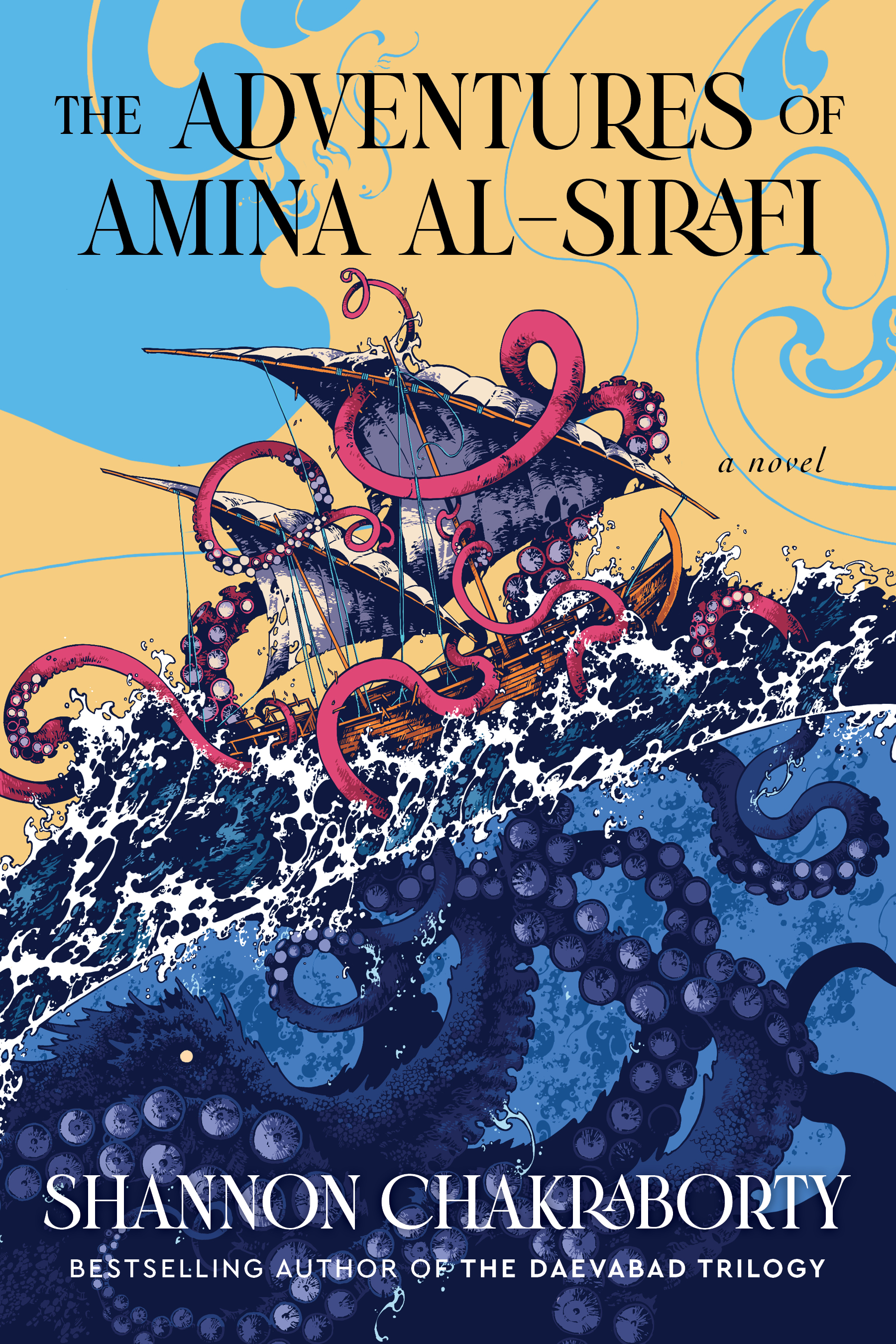
The Adventures of Amina Al-Sirafi by Shannon Chakraborty

book cover

We used to joke that of the three of us, I could kill you up close, Tinbu could kill you from another ship, and Dalila could kill you from a different city three days later.

I’d grown up feeling terribly unusual; out of place and never at peace with the fate afforded young girls. In a hidden corner of my heart, I nursed embarrassing dreams. That I was not the child of my parents, but the daughter of a tribe of female warriors who flew upon winged horses. Or I was heir to a hidden sea kingdom below the waves, and the whispered sighs I heard from the water when we sailed and the strange lightning in the distance were not natural weather phenomena but magic, my true family calling to me. Then I grew into an adult. One who learned the hard way that if there was magic in this world, it could be as brutal and cunning as the worst monsters out of a fairy tale.

We get to see some of that in action.

Amina al-Sirafi has led a storied existence, leaving home at sixteen and making her way on the briny deep, not just a pirate, but a female captain, a nakhudha, notorious for her success at parting the wealthy from their wealth. Not exactly a Robin Hood, not particularly bloodthirsty either. But life moves on. The years take their toll, and one seeks out less perilous enterprises, particularly after a singularly harrowing experience, particularly when pregnant. Years on, Amina is living a sedate existence, raising her ten-year-old daughter. But life comes calling, in a way that might be familiar to Michael Corleone. A rich widow, Salima, the mother of Asif, a crewman of Amina’s who had been lost, wants to hire her to retrieve her granddaughter, 16yo Dunya, Asif’s daughter.

description
Shannon Chakraborty – image from her Twitter pages

Well, maybe not quite lost. An erstwhile Crusader, Falco Palemenestra, a Frank (local speak for European) with a profound lust for magical objects, appears to have made off with young Salima’s greatest treasure, 16yo Dunya. Granny wants her back. She makes Amina an offer she cannot refuse.

And the chase is on. But of course, Amina has to pull together a crew. This is where we meet her erstwhile first mate, Tinbu, who has been in charge of her ship since she went on sabbatical. Much more fun is her good pal Dalila, a professional poisoner. You do not want to sip from the wrong cup in that workshop.

Easily one of the most enjoyable topics to research was criminal activity—specifically overwrought stories and urban legends about criminal activity—in the medieval world. All the cons, tricks, and poisons in this book are pulled from history: there’s actually a thirteenth century charlatan’s guide (recently translated into English by the Library of Arabic Literature) which discusses both the three cups game still used to swindle gullible tourists today and the numerous knock-out drugs Dalila employs. The guild Dalila hails from—the Banu Sasan—was also real, or as “real” as the fantastical odes recited about it were. – From the Fantasy Hive interview

There are jails to break, corrupt local officials to deal with, and a ship to wrest from impoundment. Cons are run, disguises are used, buckles are swashed. And a-sailing we will go. Of course, there are further stops to be made, intel to gather, and some dark magic to encounter. There is a significant supporting cast, with the main characters receiving their due. And then there is Raksh.

Let’s talk about the night I accidentally married a demon.

Oopsy. Amina has issues with relationships. This one did not end well. And now he’s ba-ack. And he is a total hoot, well, except for the darker elements, of course.

So many of the characters in this book are coming to terms with past misdeeds or trying stick to a more righteous path and then you have this utterly selfish, sexy creature of chaos and trickery just waltz in and repeatedly betray them to save his own skin and spin “a better story.” And that’s the very point of him—he’s not human, he’s very much meant to be a relic of a forgotten age when people did tell stories of meddling, petty gods and monsters, a supernatural aspect that naturally feeds on human ambition and wouldn’t even understand why he’s expected to feel remorse for doing so. It was fun to create such a foil for Amina herself and really delve into the almost alien psyche of such a being. – from The Fantasy Hive interview

We learn that Falco is particularly interested in a frighteningly powerful magical object, The Moon of Saba (which has absolutely nothing to do with dropping trou, promise). Can Amina save the teen, and keep Falco from getting his mitts on this very dangerous treasure?

The largest pearl in the world; a miniature moon said to have been snatched from the sky by a lovelorn fairy and gifted to Queen Bilqis, who made it the centerpiece of her crown. A gem believed to bestow upon its owner countless wishes, supernatural sight, and unending good fortune.

description
Map of al-Sirafi’s adventure

Amina stands out from the usual superhero sorts for two reasons. The first is that she is a lifelong criminal, (Make me good, but not yet?) even though she seems to have a good heart. Second is that she is a middle-aged mom. She has to struggle not only with the challenge of her aquatic mission, but with the conflict between her desire to stay at home to raise her daughter and her need for seafaring adventure. Parenting and piracy seem poor partners. There are other ongoing thematic concerns. Coming to terms with one’s past deeds is among them. There are plenty of ledgers to balance.

description
Teuta, Queen of the Illyrian Ardiaei tribe, leads a pirate expedition against rome. – image from WorldHistory.org

The focus of the story is on the humans. Sure, there is a major magical supporting character, and some of the humans dabble in dark arts. But they remain people. That said, there is plenty of magic in the air, and water. Some creatures introduced in the Daevabad trilogy put in appearances here. There is a kaiju-level sea beast, and plenty more. I hesitate to say this, but it seemed at one point that more was less, and that there were maybe too many such roaming and flitting about.

description
(I can only imagine what Ray Harryhausen would do with such a rich trove of material. Above is a still from The 7th Voyage of Sindbad

There is treasure. There is an island, and there is even a possible reference to Treasure Island, although, really, it may just be me projecting, and islands and treasure are merely standard tropes for the genre.

I straightened up with care, pinching my brow to keep black spots from dancing before my eyes.

Per usual, Chakraborty brings her effervescent sense of humor to her writing. There are plenty of LOL moments, particularly when Amina interacts with Dalila or Raksh.

“What about you, Lady Dalila?” Noor asked. “Is there anyone back home you are eager to return to?”
Dalila picked at her teeth. “I had to abandon a time sensitive experiment with extremely promising indications as a knock-out gas.”
“For pain relief,” I amended quickly. “Dalila is our…healer.”
Noor’s brows rose slightly. “Ah, yes. Majed speaks frequently of how you ‘healed’ him when you first met.”
Dalila rolled her eyes. “It was hardly the worst of my poisons. There are some physicians who actually believe it beneficial to vomit blood every now and then. It balances the humors.”

In addition, because Chakraborty is a historian at heart, she has delivered to us a treasure of intel about the world of this time and place.

When I started working on Amina, the goal I had for myself, and I think I wrote this in the author’s note at the end, was that I wanted to make it completely historically accurate—outside of the plot. I did a ton of research. There’s been an incredible amount of new work done on the medieval Indian Ocean, but you’re still looking at 12th-century texts. It’s almost 1,000 years ago, and there is a great limit to what we know. – from The Portalist interview

The series is set a few centuries before Chakraborty’s Daevabad trilogy, but exists in the same general corner of the planet. Some nods are offered to that world, including a small part for a magical creature from the Djinn tales. And a bit of snark.

“Oh, those weren’t humans. Those were daevas.”
“What in God’s name is a daeva?
He held up a hand. “You don’t want to know, trust me. More overdramatic creatures have never existed. And they’re not even the worst ones here. Everyone likes to complain about humans, but let me tell you…spend a couple centuries with the inhabitants of the unseen realms, and you’ll be aching to haunt a mortal latrine.”

There is a form of ecstasy that occurs in reading some books. Some are serious, (Serena pops to mind) others are more of the entertainment sort. I remember, as a kid, being rapt by some of the great classic adventures, by Robert Louis Stevenson, Jules Verne, and others. I was desperate to continue reading, despite the unwillingness of my eyes, and my mother reminding me, yet again, to turn the flashlight off under my covers. Well settled into middle age, the Harry Potter series offered the same sort of excitement. About six years ago, I was delighted to report that I felt that joy once more, at a grizzled time of life, on reading Shannon Chakraborty’s Daevabad trilogy, about djinns and sundry contemporary creatures and figures. While these books did nothing to iron out the wrinkles that brace my eyes, or straighten a spine that has strayed much too far from the standard shape, they did offer many hours of pure, innocent joy, the sort I experienced when my soul was more truly unstained. I am overjoyed to report that Chakraborty has worked her magic again. The Adventures of Amina el-Sirafi, the first in a promised trilogy, is a treat for the eyes and the imagination. Unlike Michael Corleone, I am eager to be pulled back in. You will be, too. No Shanghaiing required. Climb aboard, me hearties, and let’s set sail. The adventure has just begun.

I wanted to travel the world and sail every sea. I wanted to have adventures, to be a hero, to have my tales told in courtyards and street fairs where perhaps kids who’d grown up like me, with more imagination than means might be inspired to dream. Where women who were told there was only one sort of respectful life for them could listen to tales of another who’d broken away—and thrived when she’d done so.

Review posted – 4/14/23

Publication date – 2/28/23

I received an ARE of The Adventures of Amina al-Sirafi from Harper Voyager (well, my book goddess secured this particular treasure for me) in return for a fair review. Thanks, dear, and thanks HV.

This review has been cross-posted on GoodReads

=======================================EXTRA STUFF

Links to the author’s personal, Twitter and FB pages

My reviews of other books by the author
—–2017 – The City of Brass (The Daevabad Trilogy #1)
—–2019 – The Kingdom of Copper (The Daevabad Trilogy #2)
—–2020 – The Empire of Gold (The Daevabad Trilogy #3)

Interviews
—–Lit Reactor – Shannon Chakraborty: Navigating the Creative Voyage by Jena Brown
—–The Portalist – Shannon Chakraborty Breaks Down Her Writing Process and New Book, The Adventures of Amina al-Sirafi by Jena Brown
—–Bookpage – Shannon Chakraborty sets sail for a new horizon by Linda M. Castellitto
—–The Fantasy Hive – INTERVIEW WITH SHANNON CHAKRABORTY (THE ADVENTURES OF AMINA AL-SIRAFI)
—–Writer’s Digest – Shannon Chakraborty: On Humor and Joy in Fantasy by Robert Lee Brewer

Items of Interest from the author
—–Fantasy Hive – Excerpt – Chapter 1
—–Tor – Excerpt – Chapter 5

Items of Interest
—–Americanliterature.com – Arabian Nights – The Story of Sindbad the Sailor
—– Godfather III – Just when I thought I was out, they pull me back in!
—–World History.Org – Queen Teuta of Illyria

Leave a comment

Filed under Action-Adventure, Fantasy, Feminism, Fiction, Historical Fiction, Literary Fiction, Thriller

The Angel Maker by Alex North

book cover

Our experiences and fears collect in the backs of our minds like dry kindling…

…there is really no such thing as long ago

After writing eleven stand-alone mystery/thriller novels, author Steve Mosby shifted course to horror, birthing his nom de doom, Alex North. The Angel Maker is his third under that name. The first, The Whisper Man, was a spine-tingler of the highest order. His second, 2020 – The Shadows, took on lucid-dreaming, bound to garish murders. The Angel Maker returns us to a contemporary setting brought into being by crimes committed a generation ago. It revolves around a spooky book, around one seriously messed-up family, around a young woman, and around a central philosophical theory that fuels a psycho-serial killer.

description
Alex North – image from Hull Noir

Thirty-something Katie Shaw is a caring teacher with a three-and-a-half-year-old daughter, and a shaky marriage to her childhood sweetheart. Her brother, Chris, a couple years younger, has been out of touch for quite a while. Katie had finally reported him to the police after he’d stolen money from her bag during a family event. Drug addiction can do that to a person. But then, if you were 15 when some seemingly random psycho tries to kill you on your own street and literally tear your face off, it can have lifelong repercussions. So, Chris has issues. But he is out now, of jail, of rehab, has been for a while, even has a partner and a life. Which is why Katie is confused when her mother tells her that Chris has gone missing. And the hunt is on, as Katie goes all Miss Marple, trying to track down her little brother.

Professor Alan Hobbes, seventy-something, is getting his affairs in order as he expects to die on October 4, 2017, the present of the novel. He lives, or rather lived in a very large house, one with some decidedly spooky elements.

…at the far end of the room, an archway.
He stared at that for a moment. It clearly led away into some deeper chamber of the house, but the blackness there was impenetrable. [Detective] Laurence [Page] could hear the faintest rush of air emerging from it, and the sound reminded him of something breathing.

This in addition to a section of the upstairs floor that burned decades back, but was never repaired. (The UK title of the book is The Half Burnt House.)

description
Tartini’s Dream by Louis Leopold Boilly – image from Wikipedia – this appears in a lecture Hobbes is giving

Why did Chris disappear? How did Hobbes foresee his own end? And what does all this have to do with notorious child-killer (and possible seer) Jack Lock, who died in prison in 1956? What was Lock writing in his book all those years ago, and why is some rich guy looking to get it? Edward Leland is clearly a nogoodnik, rich, angry, sociopathic, employer of bad people. And he wants that book, whatever it takes.

So, we have our hero, Katie, who is the primary page-getter here. (19 chapters of 50) We follow along as she tries to track down her brother as the threat levels against both her and Chris keep ratcheting up. Oh, and the guy who had tried to kill Chris all those years ago? Out of jail.

When I first started planning and writing The Angel Maker, all I really knew was that I wanted… the characters [to] be searching for a rare and forbidden text. Some of them would end up doing so for innocent reasons, of course, but there would be others who genuinely coveted the dark knowledge they imagined it contained…I settled on the journal of a fictional serial killer called Jack Lock, an item that would be valuable in and of itself to certain damaged people. But I also wanted it to contain some kind of secret knowledge, which raised further questions. What else might drive people to seek this book out?…in the end, I went with an idea that has haunted me more than a little for many years now, and which engages with a number of the themes that have always interested me. Nature versus nurture. The influence of the past on the present. How much control any of us really have. – from the Crimereads interview

North flogs this theme throughout, which is a strength, giving the book more heft than relying solely on a scary story. Here we have a scary philosophical theory. Leads one to wonder, with a shudder, just how many people might hew to this perspective.

Detectives Laurence Page and Caroline Pettifer offer some entertaining banter, but serve mostly as a way of connecting parts of the story. Laurence offers some echoing of parental issues as well.

The story is definitely engaging. Katie is a good egg, and is easy to root for. North provides her with the handicap of an unsupportive, disbelieving husband, which was cause for a bit of eye-rolling. It is such a trope these days. Maybe always has been.

Dangling fantasy items are tossed in, but seem gratuitous. Katie’s daughter reporting that the moon comes to talk to her, for example. There are a few more otherworldly gewgaws added here and there, but they serve, mostly, as window-dressing.

There are elements that permeate. The first is, obviously, the quest for the magical book. Second is Katie’s quest to find her brother. Parent/child relationships are important, particularly when parents display a clear preference for one child over another. Siblings have issues with each other as well. (Don’t we all?) Thematically, the book is about free choice. Are we really free, or is everything laid out, reducing us to actors reading lines? Do events in our past define our options moving forward? And if the future is set, where lies personal responsibility? North has some fun counterpointing characters named Lock and Hobbes, standing in for the immutability of determined events vs the ability of people to effect change via personal decision-making, reflecting their well-known namesakes from Western philosophical history.

The story dips back from the present (2017), with scenes set in the 1950s, ‘70s, 80s, and 90s, offering explanations for what is going on today. Some might find it a bit tough to follow. I did not have a problem. There are fifty chapters in this 336-page book. So, it is easy to read this one in small chunks if that is your style.

There probably are no books that can foretell the future. But, the odds are that by the time you finish reading The Angel Maker, I predict, you will be quivery and exhausted. You are free to read this book, or to pass, a matter of personal choice. But if one believes in God, a god who knows all that has happened, all that is happening, and all that is to come, then the decision was made long before you were ever offered the choice. Are you still responsible for that decision? And if you veer from what is written in God’s plan, are you not defying the Almighty? Read it or not. The choice is up to you?

“If you could see the future,” Sam asked her, “would you want to?”

Review posted – March 31, 2023

Publication date – February 28, 2023

I received an ARE of The Angel Maker from Celadon in return for a fair review and agreeing not to dig up those things in my yard. Thanks, folks, and thanks to NetGalley for facilitating.

This review has been cross-posted on Goodreads. Stop by and say Hi!

=======================================EXTRA STUFF

My reviews of other books by North
—–20219 – The Whisper Man
—–2020 – The Shadows

Songs/Music
—–Cher – If I Could Turn Back Time
—–Jim Croce – Time in a Bottle
—–La Stravaganza – Violin Sonata in G Minor—the Devil’s Trill

Item of Interest from the author
—–Crimereads – Alex North on the Pleasure of Fictional Forbidden Texts

It’s a familiar and recurring motif in fiction: the search for a work of art that may or may not exist. One that is difficult to find. One that is rare because it’s awful, and which is sought after for both reasons. The idea speaks to a human desire to face the forbidden simply because it is forbidden. To be a member of the select few that have gone through an ordeal that others have not. To be let in on a secret even if learning it will ultimately destroy you.

Item of Interest
—–Wiki – Laplace’s Demon
—–CRAM – Hard Determinism and John Locke’s Theory of Human Philosophy

Leave a comment

Filed under Fiction, Horror, Mystery, Suspense, Thriller, Thriller