Category Archives: Short Stories

The Hive and the Honey by Paul Yoon

book cover

Come. I want to show you something. I learned it from the missionary. We haven’t seen him in a while, yes?…I retrieve my teacup where there is a little honey left, and I walk toward the perimeter of the woods and hold it up. I hear her coming up behind me, the slow rustle of her skirt in the grass, but I don’t turn.
A few minutes later, a bee appears, hovering, circling, then dips into the cup. Then it flies away into the woods. I follow it. She follows me. When I can’t see it anymore or hear it anymore, I stand still and hold up the cup and wait for the bee to come back. Which it does. So we move on, and as we head farther into the woods, I tell the daughter that it is a trick I learned from the missionary. We’re creating a trail.
“To the hive,” I say. “And the honey.”

In The Hive and the Honey Paul Yoon returns to areas that readers of his earlier work will recognize. This is his third story collection, following Once the Shore (2009) and The Mountain (2017). He has published two novels as well, Snow Hunters (2013) and Run Me To Earth (2020). He treats often in themes of Korean diaspora, losing a sense of home, trying to build new families and communities, feeling alone, often being alone, the impact of history on one’s lived experience, and the impacts of war. That holds here.

I can’t speak to a unifying Korean identity, but I think, growing up, because I had very little access to an extended family, I was often searching for my own version of that. And I think all my characters are searching for their own version of family. They’re quite literally and figuratively orphans. And they want to rebuild. They want to find a home in all sense of that word. – from the Pen-Ten Interview

There are seven stories in the collection, ranging from 17th century Japan to 20th century New York. The age of the primary characters covers a wide range. One lead is 16, others are in their 20s, returning from war or prison, or still in uniform. There is a couple in their forties and we see one life across decades.

description
Paul Yoon – image from Interlocutor – shot by Paul Yoon

A persistent challenge is to make a home. In Bosun, Bo tries to find a home and family in a small upstate NY town. In At The Post Station, Two samurai must repatriate a 12yo Korean boy to officials from his country. Toshio, the samurai who has been raising his young charge for many years, must face this direct loss of family. The boy must face introduction to an entirely alien culture. Cromer offers a middle-aged London shop-keeper couple, both children of North Korean refugees, who had opted to never have children of their own. But when a 12 yo apparently- battered runaway boy turns up in their shop, many miles from home, it makes them face the insular, child-free lives they had chosen, the community they had not built, the family they had not made. In The Valley of the Moon a man returns from a settlement to his isolated family farm after The Korean War. It is a moonscape, littered with bones and craters. He slowly but steadily brings the farm back. He even takes in two orphans to make a proto-family, but the damage from the war, and from an act he commits before the kids arrived, haunts him for the rest of his life.

Biological families here are all dispersed, or worse. Characters are often stuck on their own. Relations in other places are unreachable, unresponsive, or dead. Some of the impetus for the collection was Yoon’s own familial diaspora.

My grandfather was a Korean War refugee who eventually, after the war, settled in a house in the mountains in South Korea. Where he lived wasn’t nearly as isolated as the setting of “Valley of the Moon,” but my memory of him was that he was—or had become after the war—a bit of a loner, someone who kept to himself, and so I think (a) the character of Tongsu and where he returns to was always linked from the start, and (b) that initial push forward into this story stemmed from wanting to create and capture, perhaps, some corner of family history that felt, and still feels, really distant to me—to engage with that distance, creatively, and to engage with him and with so many others of that generation who had to flee their homes and do anything they could to survive during those horrific years. – from the New Yorker interview

Yoon’s characters also travel far afield. Bosun came to the USA at 18. In Komarov, a Korean cleaning woman is living in Spain. At the Post Station features a boy who was held prisoner by Japan for his entire life and will now be faced with living in an alien culture in Korea. In Cromer, the parents of the couple living in London all escaped from North Korea, and a young Korean boy flees apparent physical abuse. In The Hive and the Honey, the community over which the young soldier watches is comprised of Koreans who had left Korea and were establishing a small community in eastern Russia. In Person of Korea, the lead’s father had taken work far from home and had become unreachable. Families that remain (the survivors) are severely depleted, family trees having been pruned to stumps or worse by war and dispersion. Holding on even to images of one’s past can become a challenge.

Bo thought he would eventually miss Queens or perhaps even South Korea, where he had spent the first eighteen years of his life, but as the months went on, they were like the faces he tried to recall: far away, as though the places he’d once lived had been homes to someone else.

But for all the travails, the challenges, there is an intrepid spirit at work that pushes them onward. How easy would it have been for the farmer to simply walk away from his devastated fields? For the convict to have given up hope?

The use of imagery is exquisite, illuminating themes, showing how the past impacts, intercedes in, and informs the present.

Every night, the moon rose from here, and fell, and shattered. And then built itself back up again.

This certainly stands in well for the challenge of all these characters, forced as they are to reconstruct lives after the world has caused them so much disruption. The quote at the top of this review offers another wonderful image. Luring bees with honey then following them back to their nest, taking the steps one can take, however many may be needed, to reach your goal, whether the location of a hive, a home, or something else. A tree grows through the skull of a corpse, offering a (perhaps grim) reminder that life continues, creating a future by feeding on the past.

These are very moving tales, as rich with hope, tenacity, and sweetness as they are with loss, disappointment, and sadness, personal tales told against a backdrop of a nation’s history. The Hive and the Honey is an outstanding literary short-story collection, well deserving of all the award buzz it has been receiving. What could be sweeter?

economic reasons.”During the pandemic, Yoon says, “we were all scattered. I was separated from friends and to cope I imagined a kind of map. We were all in different places, but we were all part of one world. That got me thinking about the family tree, thinking of that as a map as well. This was the seed of the collection: the movement of a country and its people.” – from the Louisa Ermelino PW interview

THE STORIES

Bosun – a Korean man, just released from an upstate New York prison, tris to make a life for himself in a small community nearby.

Komarov – A refugee from North Korea is working as a cleaner in Spain when she is approached by Korean agents to spy on a Russian boxer they believe to be her son.

At the Post Station – Two 17th C. samurai accompany a Korean boy, who had been held hostage all his life, to Korean officials who will take him home.

Cromer – The children of escaped North Koreans, a middle-aged couple in London consider their life choices when a 12yo runaway boy happens into their convenience store.

The Hive and the Honey – A young Russian soldier is charged with overseeing a Korean settlement in remote eastern Russia. Things get out of hand when there is a killing, then another.

Person of Korea – When the uncle with whom he had been living dies, a 16yo boy travels to find his father, a security guard on an island off the east coast of Russia.

Valley of the Moon – two years after the Korean War a man returns home to a devastated, vacated farm, and tries to bring it back to life. He takes in two orphans and has a difficult, life-changing encounter with someone looking to cross the border.

Review posted – 02/09/24

Publication date – 10/10/23

I received an ARE of The Hive and the Honey from Simon & Schuster in return for a fair review. Thanks, folks, and thanks to NetGalley for facilitating.

This review is cross-posted on my site, Goodreads. Stop by and say Hi!

=======================================EXTRA STUFF

Paul Yoon’s personal site

Profile – from Wiki

Paul Yoon (born 1980) is an American fiction writer. In 2010 The National Book Foundation named him a 5 Under 35 honoree.

Early life and education
Yoon’s grandfather was a North Korean refugee who resettled in South Korea, where he later founded an orphanage. Yoon graduated from Phillips Exeter Academy in 1998 and Wesleyan University in 2002.

Career
His first book, Once the Shore, was selected as a New York Times Notable Book; a Los Angeles Times, San Francisco Chronicle, Publishers Weekly, and Minneapolis Star Tribune Best Book of the Year; and a National Public Radio Best Debut of the Year. His work has appeared in the PEN/O. Henry Prize Stories collection, and he is the recipient of a 5 under 35 Award from the National Book Foundation. His novel, Snow Hunters, won the 2014 New York Public Library Young Lions Fiction Award. His 2023 story collection, The Hive and the Honey, was named a finalist for The Story Prize.
Recently a part of the faculty of the Bennington Writing Seminars, Yoon is now a Briggs-Copeland lecturer at Harvard University.

Interviews
—–Publishers Weekly – In Seven Stories, Paul Yoon’s New Book Spans 500 Years of Korean Diaspora By Louisa Ermelino | Jul 07, 2023
—–The Pen-Ten Interview – Paul Yoon | The PEN Ten Interview by Sabir Sultan – October 12, 2023
—–The New Yorker – Paul Yoon on the Korean War’s Aftershocks by Cressida Leyshon – about Valley of the Moon
—–Publisher’s Weekly – Paul Yoon’s Haunted Geographies by Conner Reed
—–LitHub – Writing as Transformation: Who Paul Yoon Needed to Become to Finish His Book by Laura van den Berg (Yoon’s wife)

Leave a comment

Filed under Fiction, Historical Fiction, Literary Fiction, Short Stories

The Apartment by Ana Menéndez

book cover

The dead, after all, do not walk backwards but they do walk behind us. They have no lungs and cannot call out but would love for us to turn around. They are victims of love, many of them. – Anne Carson – from the epigraph

We are our own ghosts, dragging our mournful pasts behind us forever.

An apartment in Miami Beach, from 1942 to 2012, seventy years of tenants, eleven of them, each with a story to be told. The conceit of the novel is that the apartment retains some form of consciousness. Nothing particularly overt, mind you. It is handled more like a repository for emotional flotsam, psychic impressions that accumulate and rattle around with the tide of each new resident, to no obvious major purpose, until the final third of the book, when the apartment acquires a spokesperson, a late resident, who is on a mission to save the current one, Lana.

description
Ana Menendez – Image from her site

So, was all the depositing of emotional residue by the prior nine tenants merely substructure on which this final pair could rest? I found that a jarring shift, a sort of unwelcome unreliable narrator, as we are no longer hearing apt 2B, but as if this person proclaimed, “Shove over, flat. I’ll take it from here.”

Menendez’s work is mostly in short form, so it makes sense that her novel is of the linked-story form, as each resident in turn gets anywhere from six to twenty-two pages for their tale. Even though there is a through-arc, it still feels like a short-story collection, which is fine with me. But this form does limit how much one can get invested in any one character. The final chapter, at a novella-length eighty-four pages, changes this dynamic and gives us a bit more to hold on to with its two primaries.

After a prologue, in which an indigenous woman sees the first European invaders on what is now Miami Beach, establishes the roots of the storytelling arc, we jump to the beginnings of World War II. An apartment building called The Helena is still moist with drying paint when it is requisitioned by the military. Major Jack Appleton has been moved from Texas to lead an officers’ school. His wife, Sophie, is not what you might call thrilled. Appleton is controlling and abusive. They are not long for this place.

During their stay a ship is set ablaze and sunk off the coast by a German U-boat, bringing the war home. In fact, while the violence may be almost entirely off-screen, there is plenty of it. It is a pervasive thread in The Apartment, from the genocidal infections brought by the first Europeans, to carnage wrought by German forces. A veteran suffers from PTSD after serving in Viet Nam. A Marielita flees her abusive father, but is being kept by an abusive lover. A woman dreams that her husband is coming to kill her. A couple fear for their lives, concerned that they are being pursued by agents from their home country. A soldier is killed in action. There is a suicide and another tenant who might follow suit. A man is set upon by thugs in the street and is beaten bloody.

Each chapter ends with an interstitial piece, as the apartment is vacant for a time. Cleaners come in to prepare for the next renter. Some offer some wonderful short character pieces. The apartment sees and feels.

The front door closes, and absence returns to apartment 2B. but there is still someone here to record the fact, this unseen eye that moves across the floor as it if were a page, sweeps the bedroom, the naked walls, lingers at the single living room window with its blinds at half-mast.

We get a Cook’s Tour of many significant moments in American history, including foreign events that impact here through the residents of 2B, WWII, tensions between the USA and Cuba, Viet Nam, the Mariel boatlift, the demise of the junta in Argentina, USA involvement in Central American conflicts, 9/11, the demise of printed newspapers, Lebanon, Afghanistan. A lot.

I’ve been interested for a long time in how the trauma of war and displacement plays out across generations. So this was one of the main ideas I wanted to explore in the novel. Many of the conflicts in this novel have ties to the United States, which of course can sadly be said of many conflicts in the world today. We are all implicated. But simply on a craft level, as a writer, there were some conflicts that I wanted to include for personal reasons.
The conflict in Lebanon is one of them, as my great-grandparents fled to Cuba following early conflict there at the turn of the last century. The violence in Cuba and its long aftermath is of course a special obsession as the daughter of Cuban immigrants. And the conflict in Afghanistan looms large for us as Americans and for me personally as I spent ten unforgettable days in the country in 1998.
– from the Lithub interview

Everyone at the Helena is a transplant from someplace else. Many of the characters are foreign-born, carrying with them a sense of mourning for their lost birthplaces. Some have to jump down to the bottom of the work ladder they had ascended back home and begin the climb again, or take on completely alternate work just to get by. Even those who have made successful new lives pine for what was lost.

SHAPIRO: You introduce us very early on in the text to a Spanish word, morrina. What does the word mean? And how did you think about the concept in relation to the narrative you were writing?
MENENDEZ: It’s a concept that I think runs through maybe all of my books – this sense of saudade, as the Portuguese maybe would describe it. Most cultures have a word for this. It’s this sort of bittersweet nostalgia – the sense that the past is sweet and wonderful to wallow in precisely because it cannot be recovered. And I think that that’s an obsession that has run through most of what I write – not consciously but simply as a product of my upbringing and my own situation. My parents, of course, are immigrants. They call themselves exiles from Cuba. And so for me, it speaks to, you know, one doesn’t need to be an exile or a migrant to have this sense that things were sweet in the past and to sort of take refuge in it.
– from the NPR interview

The vast majority of the stories, eight of eleven, center on women. Conflict abroad manifests as abuse or misery at home. Few move on from 2B to a better life. There are exceptions. Relationships are pretty universally strained. Abuse recurs. A marriage of convenience challenges a relationship of love. There are betrayals, problems with gambling, alcoholism, depression, desperation, racism, bigotry of various sorts, and shame. Some are tormented by decisions they have made in the past. Some seem more like lost wanderers, thrown up on shore after being tossed roughly about by an angry sea.

The residents vary in their work lives, with creative arts well represented. There are multiple painters, their models, a journalist and a concert pianist. The most piercing spectral presence of all is a painting one of the residents is working on, as it manifests a particular bit of darkness.

Snakes pop up throughout. The book opens with A serpent coils through the underbrush of palmetto and coco plum…Harmless, this one, this time.. Later “Time, spooky and fickle. Not arrow, but snake.” There are more.

And now back to the apartment designation. Wait, 2B? Or not? Certainly calls up a soliloquy from Hamlet. And informs a fair piece of the book. The Danish Prince wonders if he should keep on keeping on after, learning that dear uncle murdered his father. Certainly many of the characters here have suffered the slings and arrows of outrageous fortune. Some put up a good fight, taking up arms against a sea of troubles. And by opposing [attempting to] end them. Well, some efforts are made. The alternative, the not 2B part, is to end the Heart-ache and the thousand natural shocks that the flesh is heir to. One last “check, please.” And one of ours does indeed choose to find out what dreams may come, when we have shuffled off this mortal coil. Is it the fear of the undiscovered country, of unknowable death, that keeps most grinding through the day-after-day? Or some loftier feeling, hope, or value? May it is simply momentum.

While The Apartment is not a traditionally formatted novel, it is nonetheless a beautiful work of writing. While we may not have much time with many of the characters, Menendez does a lot in a short space, a talent no doubt honed by her history of short story writing. The stories are moving, at times to the point of tears.

Will Sophie get away from her abusive spouse? Will Eugenio find his way to California? Will Sandman find a way to survive his PTSD? Will Isabel make her own life and not remain a kept toy of an older man? Will Margot and her husband evade those who might be after them? How will Susan handle her loss? Will Marilyn stay with her damaged bf? How will Beatrice cope with the change in her circumstances? Will Pilar be able to find journalism work again? Will Lenin succeed in his mission? Will Lana let the many friendly neighbors help her out, or is her secret too much to reveal?

There is poetic beauty in here that deserves to be read, to be appreciated. You may or may not feel impelled to look for deteriorating flats in a soon-to-be submerged part of Florida, but it would be worth your while to check in with your real estate agent and arrange to give 2B a look. It might turn out to be just the right place for you.

In the English novels she studied in school, the characters all seemed masters of their own fates. When they stumbled, it was because of a flaw. The direction their lives took was the direction they determined through their choices. But this was not Margot’s experience of the world. The world so far acted on her without consultation or sympathy. Her life, dictated first by her family’s wealth and now by her husband’s work, lacked the agency she was taught to recognize in great works. Even this latest leaving had been out of her hands. Maybe the only true literature was the old ghost stories her grandmother used to whisper to her on those windy cold nights on the Pampas. Spirit and mortals alike, all subject to unseen forces that swelled beneath them, hidden and untamable.

Review posted – 9/8/23

Publication date – 6/27/23

I received hardcover of The Apartment from Counterpoint in return for a fair review and a one-year lease. Thanks, folks.

This review is cross-posted on Goodreads. Stop by and say Hi!

=======================================EXTRA STUFF

Links to the Menendez’s personal, FB, Instagram, and Twitter, sorry, X pages

Profile – from her site

Ana Menéndez has published five books of fiction: The Apartment (2023), Adios, Happy Homeland! (2011), The Last War (2009), Loving Che (2004) and In Cuba I Was a German Shepherd (2001), whose title story won a Pushcart Prize. She has worked as a journalist in the United States and abroad, lastly as a prize-winning columnist for The Miami Herald.
As a reporter, she wrote about Cuba, Haiti, Kashmir, Afghanistan, and India. Her work has appeared in Vogue, Bomb Magazine, The New York Times and Tin House and has been included in several anthologies, including The Norton Anthology of Latino Literature. She has a BA in English from Florida International University and an MFA from New York University.
From 2008 to 2009, she lived in Cairo as a Fulbright Scholar in Egypt. She has also lived in India, Turkey, Slovakia and The Netherlands, where she designed a creative writing minor at Maastricht University in 2011. For the past 20 years, she has taught at various writing conferences and programs including, most recently, Bread Loaf and the MFA Program for Writers at Warren Wilson College. She lives in Miami and is currently an associate professor at FIU with joint appointments in English and the Wolfsonian Public Humanities Lab.

Interviews
—–NPR – Author Ana Menendez explores stories a single location could tell in ‘The Apartment’ by Linah Mohammad, Ashley Brown, Ari Shapiro
—–Lithub – Ana Menéndez on Crafting a Connected Cast of Characters by Jane Ciabattari

Items of Interest from the author
—–Links to other things she has written

Items of Interest
—–The Poetry Foundation – To Be or Not To Be – from Shakespeare’s Hamlet
—–Wiki – The Mariel Boatlift
—–Museum of Florida History – Florida on the Home Front: The German Submarine Threat off Florida’s Coast – “The most dramatic sinking in Florida waters took place the night of April 10, 1942, when U-123 torpedoed the tanker Gulfamerica off Jacksonville Beach. The resulting fiery explosion was clearly seen onshore and curious crowds gathered to view the ship’s destruction and looked on in shock as the German submarine surfaced and fired its deck gun at the tanker.”

Leave a comment

Filed under Fiction, Historical Fiction, Literary Fiction, Short Stories

A Child’s Christmas in Wales by Dylan Thomas

Years and years ago, when I was a boy, when there were wolves in Wales, and birds the color of red-flannel petticoats whisked past the harp-shaped hills, when we sang and wallowed all night and day in caves that smelt like Sunday afternoons in damp front farmhouse parlors, and we chased, with the jawbones of deacons, the English and the bears, before the motor car, before the wheel, before the duchess-faced horse, when we rode the daft and happy hills bareback, it snowed and it snowed. But here a small boy says: “It snowed last year, too. I made a snowman and my brother knocked it down and I knocked my brother down and then we had tea.

description
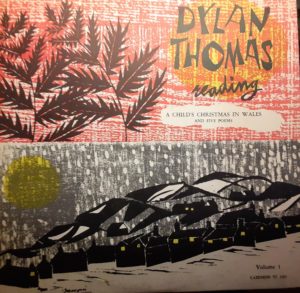
Cover of the original publication – image from Goodreads

It began in 1945 as a radio talk, Memories of Christmas, for the Welsh Children’s Hour program. He later merged bits from a 1947 piece called Conversation About Christmas and sold it to Harper’s Bazaar in 1950 as A Child’s Memories of Christmas in Wales. In 1952, Caedmon Records asked him to record himself reading it for the B-side of a collection of his poems. The title we have come to know for the piece, A Child’s Christmas in Wales, was from this recording. Thomas had been unable to remember the title used in the Harper’s magazine version, so recalled as best he could. It turned into kind of a big deal, as the recording is seen as seminal in starting the audiobook industry in the USA.

description
Dylan Thomas in the White Horse Tavern – image from Peter Harrington – The Journal – photo by Bunny Adler

Set in Swansea in the 1920s, Thomas offers a fragmented memory, recalling not just one particular Christmas but his childhood Christmases in general.

One Christmas was so much like the other, in those years around the sea-town corner now, out of all sound except the distant speaking of the voices I sometimes hear a moment before sleep, that I can never remember whether it snowed for six days and six nights when I was twelve, or whether it snowed for twelve days and twelve nights when I was six.

It is a mix of his perspective as a child and his finer focus, looking back as an adult.

The particular Christmas that stands out includes images of a neighbor’s house catching fire

The overall timbre is warm and loving. But there are hints as well of darker elements in the world around. Some bred from imagination

the winds through the trees made noises as of old and unpleasant and maybe web footed men wheezing in caves… perhaps it was a ghost… perhaps it was trolls…

Others from observation

We returned home through the poor streets where only a few children fumbled with bare red fingers in the wheel-rutted snow and cat-called after us, their voices fading away, as we trudged uphill…I would scour the swatched town for the news of the little world, and find always a dead bird by the Post Office or by the white deserted swings; perhaps a robin, all but one of his fires out… Some few large men sat in the front parlors, without their collars, Uncles almost certainly, trying their new cigars, holding them out judiciously at arms’ length, returning them to their mouths, coughing, then holding them out again as though waiting for the explosion; and some few small aunts, not wanted in the kitchen, nor anywhere else for that matter, sat on the very edge of their chairs, poised and brittle, afraid to break, like faded cups and saucers.

There is also mention of chasing the English and bears in deep Welsh history, a reference to wars that ended with English subjugation of Wales.

The story is about the sequence of events from one Christmas afternoon, when a neighbor’s calls of “Fire” draw the fire brigade and all breathing neighbors, the narrator and his co-conspirators addressing the possible conflagration with the launching of multiple snowballs. It offers a portrait of youthful shenanigans, and homes filled with boisterous “uncles” and tippling, excluded “aunts.”

Gleeful image-making permeates

“Our snow was not only shaken from white wash buckets down the sky, it came shawling out of the ground and swam and drifted out of the arms and hands and bodies of the trees; snow grew overnight on the roofs of the houses like a pure and grandfather moss, minutely ivied the walls and settled on the postman, opening the gate, like a dumb, numb thunder-storm of white, torn Christmas cards.”

The boys imagine themselves as Eskimo-footed Arctic marksmen, snow-blind travelers on north hills, see their large boots as leaving hippo prints, and approach a maybe-haunted house with carols.

It is a tale about memory itself as much as about Thomas’s recollections of childhood, as individual experiences, although some are specifically recalled, merge into sometimes single, catch-all recollection.

Please do listen to Thomas’s reading, a poet’s reading of prose, elevating his story to a form somewhere between literature and song. A smile sprung forth on my face on hearing this (yes, I have heard it more than a couple of times before. The smile returns every time.) and lasted well beyond the delivery of the final sentence. It would, on occasion, pull upwards, straining my cheeks and gums, before settling back a little in preparation for the next assault. The scenes he recalls, and his snarky commentary, will make you smile, probably in recognition of the sort, if not the specifics, maybe even laugh out loud. It always gets a passel of LOLs from me.

The language is celestial, as is his world-class talent for imagery and word-play. It will lift your spirit and make it hover for the duration of the reading, maybe even a while beyond. You could do worse than making the playing of this recitation a seasonal tradition.

One thing this story is likely to do is to spark personal recollections of Christmases of our youth. I would love to hear about yours.

Thomas’s recalled 1920s Christmases resonated with my memories of Christmases in the 1950s and 1960s Bronx. Mine were certainly not all snow-filled, but, as with Thomas’s recollections, they all occupy the well of memory with a fine dusting of white. Unlike Thomas, there is not a single Christmas that stands out from my childhood. Like his, mine have taken on a general character, merging into a common fuzzy-edged recollection.

The space between Thanksgiving and the special morning was always filled with great excitement and anticipation. Going to see the Christmas displays at Macy’s, Saks, Lord & Taylor’s, and even more stores, became a tradition, as was visiting the massive tree at Rockefeller Center. I got to sit on Santa’s lap at Macy’s at least once, but had sense enough to be skeptical even as a sprout. Why would someone claiming to be Santa’s helper look and dress just like him? Something clearly did not add up. The hunt for presents hidden in closets, cupboards, and underneath anything that had an underneath was a seasonal sport.

On Christmas Eve, my sisters (all three much older) would head out for midnight mass, fresh in finery, make-upped, seeming serious. I had no notion at the time that such a display might have been as much a mating ritual as an act of piety. I was spared that particular form of torture, (a Mass even longer and presumably more unendurable than the ones I was forced to attend every week) excused by my youth. Despite my concerted attempts to remain awake hoping to spot Santa, most years I was long asleep before they all arrived back home, cherry-cheeked, coats and hats asparkle as the dim light inside our front door was magnified by reflections from unmelted flakes.

Christmas morning was a bubbling mass of excitement as we all gathered in the living room, and took turns opening gifts. There was always one for me, and for my brother labeled “From Santa,” supplemental to the gifts from our parents, and each other.

As if we were not wired enough from a night of short sleep followed by a meth-level increase in respiration, Christmas breakfast tended to be French toast, slathered with Aunt Jemima’s, Log Cabin, or Vermont Maid. Attending Mass was mandatory, of course. It is a wonder the church did not crumble to the ground from all the child and pre-adolescent vibrations juddering the pews. We would always unwrap an annual gift, a fruit cake, from my father’s aunt, a mysterious figure I never actually met.

In the years since I have come to think of Christmas as akin to the baseball season for us Mets fans. The lead up was all excitement, wondering what goodies might come our way, hoping for some surprises, and that some gift wishes might come true. The reality was rarely very satisfying, filled as it was with things like socks and pajamas. There were toys, of course, but usually of the Woolworth’s sort, things like cap pistols, and plastic trains that rolled uneasily around a circle of plastic rails. Occasionally, there would be something more interesting. A Davy Crockett coonskin cap was a memorable hit. It was my brother who actually got me some of the more exciting, larger-ticket items, a yellow, battery-operated bulldozer, a robot that shot missiles, a wireless walkie-talkie that was pretty cool for 1960.

The day itself was always an opportunity for some of the neighborhood kids to try out brand new sleds. The Bronx may not have San Franciscan hills (although the West Bronx is particularly rich with steep slopes) but there were plenty of hills, snow, slush and ice-covered land to be challenged. Even if you did not get a new sled, there was certain to be a neighbor kid who had, and there was a chance he might let you take it for a ride. Of course, there were always cardboard boxes and trash can lids that offered a sliding descent if not a lot of control. Not that it ultimately made a lot of difference to me. It was while attempting to steer an actual sled down a Tremont Avenue sidewalk that my face made a dent in a stubbornly unmoving tree. Sadly, sledding was one of many skills I never managed to acquire. The tree in our tiny living room was real, in the early years, but as adolescence approached, and my parents ploughed further into middle age, it was supplanted by a disappointing plastic imitation.

The toys were soon in pieces. The new PJ’s supplanted their high-water, short-sleeved predecessors. Winter settled in, and the disappointment of not getting what you really wanted faded. Dashed hope settled back underground, like a perennial, biding its time until the next season arrived for it to sprout forth once again, all shiny and new.

When I had children of my own, I tried to install a few elements to make the day special. We had a tree of course. Watching It’s A Wonderful Life became a Christmas Eve tradition, and I read The Polar Express to them at bedtime. The girls would always find, on Christmas morning, a letter from Santa (typed, in an appropriate font, in red. My hideous penmanship would have been too obvious.) encouraging the sorts of feelings and behavior one might expect from a benign spirit. I made my own Christmas cards for many years, with their names included among the From list. But it was mostly something for me. My greatest parental Christmas triumph, however, was singular. The girls were on the verge of disbelieving. We had recently moved into a new place, a house that featured a beautiful, albeit no longer functional fireplace. I carved a linoleum cut of reindeer hoofs, and proceeded to make hoof prints leading from the fireplace into the living room and kitchen. The girls could not believe that any parent would willingly make such a huge mess, and THEY BOUGHT IT!

description
Cover of the original Caedmon recording

The season has settled into another phase for us. Yes, there is still a tree, although this year is likely to be the last of the real ones. There is my wife and our close immediate relations. The tree skirt is reliably populated with resting felines. My children are scattered so are not a presence, which is sad. I have long since ceased making my own cards, Goodreads review-writing having absorbed that artistic impulse. We still have a special meal, including some foods that only appear once a year. We still exchange gifts on Christmas day. And on Christmas eve I harangue my wife into tolerating yet another showing of It’s A Wonderful Life. I still end up in tears. I can only hope that my kids (all grown up now) have happy memories of the holiday, and that they have found some traditions to carry forward for their own (someday) children.

Merry Christmas, Everyone!

Review first posted – December 4, 2022

Publication date – 1952, in this form, anyway.

This review has been cross-posted on GoodReads

=======================================EXTRA STUFF

Items of Interest
—–Wiki on the history of the poem – very informative
—–Faded Page – The full text in multiple formats
—–Harper Audio on Soundcloud – Dylan Thomas’s reading – 25:07 – with an introduction by Billy Collins – worth checking out
—–* Encyclopedia.com – a Child’s Christmas in Wales
—–Vinyl Writers – Dylan Thomas’ Caedmon Readings: Childhood, Death, and the Welsh Wild Wonder

Leave a comment

Filed under Bio/Autobio/Memoir, Non-fiction, Short Stories, YA and kids

The Angel of Rome by Jess Walter

book cover

I suppose every person, at some point, tries to break free from the identity you are assigned as a kid, from the person your parents and friends see, from your own limitations and insecurities. To create your own story.Angel of Rome

First sex is like being in a stranger’s kitchen, trying all the drawers, looking for a spoon.Famous Actor

You know that guy in the second Indiana Jones movie, The Temple of Doom, the Thuggee priest Mola Ram? Questionable taste in haberdashery, but possessed of a special power. He could reach his hand directly into a person’s torso, secure a grip on the heart, and rip it directly out of the body, not a procedure certified by the AMA. While I expect Jess Walter has better taste in hats, he is possessed of a similar power. Of course, when he rips out your heart, you won’t, unlike Mola Ram’s victims, actually die. You will get your heart back. But you will feel deeply, sometimes painfully, and the experience will stay with you.

description
The author? No. Heartbreaker Mola Ram doing his thing in The Temple of Doom – but clearly a relation – image from Swarajya

It has been nine years since Jess Walter’s last short story collection, We Live in Water, but he has continued to write them, publishing in a variety of journals and other outlets. When it was time, he looked through the fifty or so he had written since his last collection and managed to cull that down to a dozen, well, fourteen, but his editor made him cut two more. (Boooo! So mean of her!)

like many novelists, Walter got his start in fiction writing by crafting short stories and selling them wherever he could – Harper’s, Esquire, McSweeney’s, ESPN the Magazine. Despite his success as a novelist, he still loves writing short stories. After all, he said, they’re no more difficult to write than novels, “they’re just shorter,” he said.> – from the Spokesman Review print interview

description
Jess Walter – benign twin of Mola Ram? – image from The Spokesman-Review – shot by Colin Mulvany

Just for the record, Jess Walter is one of the best writers working today, and this collection is a fine representation of a master at the pinnacle of his power. His work is engaging, powerful, moving, literary, and often LOL-funny.

There are several motifs that repeat through multiple stories but the overall theme here is hope. While there are no overt feathers floating about in the stories, still, there is a comforter’s worth of downy literary substance in the air. Faced with challenging circumstances, many of the lead characters find a way to a hopeful place.

It sorta surprised me because I think of myself as someone who likes to plumb darkness, but I kept coming across dark situations that led to moments of hope, and moments of connection between characters that I found surprising. I look back on those years, from 2013 to now [2022], losing a close friend, having my father suffer from dementia, and I can see different themes. A mother passing away from cancer and cancer always works its way…and I can see these themes that in almost all the stories that I ended up choosing, there was a surprising figure. Like Mr. Voice in the first story. And I think I was finding that I was finding such connection in my family and in my friends, even during a hard several years, personally and politically for a lot of people, I think I was looking for those places where you felt some refuge. – from the Spokesman Review print interview

A subset of this is characters, particularly young ones, coming to define themselves, to mold themselves into the people they want to be, rather than simply accepting the pre-fab path that has been laid out for them.

I suppose every person, at some point, tries to break free from the identity you are assigned as a kid, from the person your parents and friends see, from your own limitations and insecurities. To create your own story. – The Angel of Rome

In To the Corner, one youngster seems to find a way forward, out of the despair that permeates the place where he has been growing up. Before You Blow centers on a young woman who finds an unexpected career option in her future, In Fran’s Friend Has Cancer, a character wonders just how much of their life it is possible to control.

Place is important to Walter

Growing up, the geography of New York was imprinted on me in the literature that I read, especially “Catcher in the Rye.” I’ve always wanted to do that for the city I live in. I think as writers, we mythologize these places where we don’t live. And I love creating a kind of mythology of Eastern Washington. It’s one of my favorite things when people from other cities come to Spokane because they want to visit places from the books. I also just love it there. It’s an incredibly rich place to write and set literature. I can still see Holden Caulfield’s Times Square, and I want readers to be able to see my Spokane that way. – from the Seattle Times interview

More than half the stories are set in Spokane, with one in Boise and another in Bend, Oregon. Three travel farther afield, with one each in Manhattan, Rome, and Mississippi.

Fame
There are several famous characters in the collection. Mr Voice is a household name in Spokane for his voice-over work there. The Famous Actor is both impressed by his own fame, and massively insecure. One of the characters in Before You Blow is destined for fame, of a sort. The Angel of Rome features two stars, an Italian actress and an American TV actor. Walter manages to give them all personalities, for good or ill (mostly good).

Angels
Maybe not the magical sort, but no less benevolent. Mr Voice turns out to be so much more than meets the eye. An American actor in Rome takes a shaky American scholar under his wing. An old friend comes to the rescue of a woman in great need. An old man turns his despair into a pointed generosity.

Teens
Most of the stories focus on characters in their teens and twenties, some adding a POV from the character looking back decades later. A couple focus on older people

Thematic threads, and literary gifts are of no matter if the characters do not gain and hold our interest. Thankfully writing characters you can relate to is yet another tool in his shed. Jess Walter can be counted on to write tales that are both image-rich and accessible. But he also gives us relatable characters, heart-rending tales, great twists, and a comedy-club-night-out worth of raucous laughter. You will be charmed, moved, and very satisfied. A triumph of a collection, The Angel of Rome, I am sure even Kali would agree, is simply heaven-sent.

“I guess it seems to me”—Jeremiah pauses, choosing his words carefully—“that you shouldn’t give up hope until you’ve done everything you can.”

Review posted – July 15, 2022

Publication date – June 28, 2022

======================================THE STORIES

Story 1 – Mr. Voice
Tanya’s father has been out of the picture forever. Mom eliminated boyfriends like they were murder suspects. A looker, she was never short on male attention. But at some point you make a choice and hope for a life. Mom chose Mr. Voice, older, a voice-over performer well known in Spokane. Tanya looks back from forty-nine on her years with her Mom and stepfather from when she was nine into her teens. An intensely moving tale of parental sorts connecting, or failing, and lessons to be learned about relationships, with a gut-punch finale.

Story 2 – Fran’s Friend Has Cancer
On aging, lives being reduced to feeling-free stories
Sheila and Max, an older couple, are having lunch before a Broadway matinee when they notice something strange.

In that story there’s somebody doing what I used to do when I wanted to learn how to write dialogue, sitting in a restaurant, recording the way people speak. I really just wanted to get patterns of speech down. And I started thinking about the…kind of arrogance of that, and…just what sort of flawed thinking it is that just by overhearing a conversation you could create a whole human being. – from the Spokesman Review video interview

…most meta story in the collection. There are all these different parts of the process of writing, and sometimes you feel this ideal, like you’ve created life. And then other times it seems like they’re alive, but they’re only 3 inches tall and they can only do one thing. I was sort of just playing with that idea. – from the Seattle Times interview

Max confronts the writer and finds a whole other layer of concern.

Story 3 – Magnificent Desolation
Jacob is a 12-yo with an attitude problem. His constant smirk accompanies his constant challenging of career science teacher Edward Wells over basic scientific truths with “We don’t believe in that.” When Wells has had enough he e-mails Jacob’s parents. What to do when he is instantly smitten with Jacob’s mother? There are wonderful references here to two contributions to the world by Buzz Aldrin.

Story 4 – Drafting
Myra is 24, way too young to have cancer, to be facing the possibility of an early reaper. Needing a way back to living, she gets in touch with an ex, someone who provided her a highlight film of her emotional life. Beautiful, moving ending.

…so Myra told the carpenter’s wife how, during radiation, there was a moment when she thought it might be okay to die. “In fact, it was like I was already gone—like I was looking back at my life. And I could see the whole thing laid out, like, I don’t know, a straight line. You’re a kid. You go to school. And you see where the line is supposed to go: boyfriend, job, husband, baby, whatever. But when I looked at the line…the only parts that really meant anything to me were the jagged parts…the parts that everyone else saw as mistakes.

Story 5 – The Angel of Rome
is a coming of age story that very much reminded me of the amazing film, My Favorite Year. It is the longest story in the book, more of a novella really, at 65 pages. Nebraska twenty-one-year-old, Jack Rigel, has somehow signed up for a Latin class being taught at the Vatican. He is, of course, in way over his head. About to pack it in and return home he stumbles across a magical scene.

It was like looking into another world, the room so bright as to seem luminescent, like a religious painting, the sparkle of bejeweled patrons, swirl of silverware and wineglasses, gleaming white-shirted waiters carrying trays of rich food, every table filled with beautiful people. They laughed and gestured and smiled like movie stars.
It was as if some kind of dream has been constructed on the other side of this glass. And then I had the simplest realization: I have always been on the outside.

But what if you are invited in? An American TV star, believing Jack is fluent in Italian, and wanting to say something to a woman on his film, hires Jack as his interpreter. This is a hilarious, heart-warming tale that really, really deserves to be made into a film. It began as an audio original, and is the only story in the collection to have a collaborator. Walter had worked with actor Eduardo Ballerini before. Ballerini had read other Walter works for audio books. The paired work, a rare, maybe singular event on Walter’s career, turned out to be hugely satisfying. Walter’s love letter to Rome, this is one of the most fun stories I have ever read, LOLing throughout. You will be charmed, una dolce favola.

Story 6 – Before You Blow
Jeans is seventeen, a high school senior, waitressing in a local Italian restaurant. Joey is 22, works the pizza over Friday and Saturday. There will be flirting and more as Jeans is deciding whether to give this guy her V-chip. There are issues with Joey, but he is pre-law, from a long line of lawyers, which impresses her parents no end.

Your older brother Mike wanted to be a motorcycle cop; that’s what passed for ambition in your family. It was the first time you really thought about a career having anything to do with your station in life. Before, you always thought of careers as simple job descriptions, like figurines in an old PlaySkool town. This one’s a fireman. That one’s a teacher. It didn’t occur to you that a certain profession might make you a more important person, a better human being.

But there are some concerns. Maybe he’s a catch, maybe not. All it takes is a high-stress situation to put it to the test.

In the video interview linked in EXTRA STUFF, Walter reads this story, beginning at about 25:00. It is delicious.

Story 7 – Town and Country
Jay’s father is losing his grip, memory becoming increasingly dodgy, wandering off, mostly to bars. He has not lost his appetite for booze, cigarettes and women. When it becomes too much Jay looks into residential care facilities for him, most of which suck. But then he learns about a very special place, Town & Country, which is both an original kind of care place for a declining population in need of the comfort of an imagined familiarity and a powerful metaphor for a larger senescence.

He wouldn’t know an email from an emu. But this is what happened with him now—he would hear some phrase on TV (Hillary’s emails, slut shaming, Make America Great Again) and it would rattle around in his brain until it became real.

Story 8 – Cross the Woods
Maggie, a single mom, was in a relationship with Markus that seemed more a serial hook-up than anything else. But she had feelings for the guy, despite his fondness for bolting before dawn. After a year of not seeing each other, he shows up at her father’s funeral, and she feels drawn to him again, despite their past. Has she really changed? Has he?

Maggie wondered then if there wasn’t just one ache in the world: sad, happy, horny, drunk, sorry, satisfied, grieving, lonely. If we believed these to be different feelings but they all came from the same sweet unbearable spring.

Story 9 – To the Corner
Leonard is an old, depressed widower, wondering about the point of living. A group of kids hang out on the corner, and indulge in some awful behavior He despairs for them as well. His ditto-head son has given him a gun, supposedly for protection against these middle-school desperadoes. Is there really no way out of this descending spiral?

Walter had been a reading tutor at a local Elementary School

“I would see the kids I tutored in the park,” he said. “Scary kids are a lot less scary when you’ve read ‘Johnny the Turtle’ with them sitting next to you.” – from the Spokesman-Review print interview

Story 10 – Famous Actor
The rich and famous are different from the rest of us, aren’t they?

Story 11 – Balloons
Ellis is 19, and the bane of his parents for not having a paying job. Mom gets him a gig checking up on Mrs Ahearn, the 40-something widow who lives across the street, doing a little shopping, raking leaves, being tongue kissed and having his ass grabbed. Life is not made any easier by having a sainted genius brother in U of Wash law school. Over the course of a few months, Ellis learns some things, and comes to a new appreciation for the experience of others.

That’s the thing, I guess—how impossible it is to know a thing before you know it. What whiskey will taste like. What it’s like to kiss someone. Probably even what it’s like to lose a husband.

Story 12 – The Way the World Ends
Two climate scientists interview for a teaching job at a Central Mississippi college. It gets raucous, which is a challenge for recently out Jeremiah, who is in charge of the guest house where both applicants are staying. Amid the partying there is much conversation about the despair of scientists, but also of reasons not to give up.

Among climate scientists, it’s called “pre-traumatic stress disorder” but the feelings are no joke: anger, hopelessness, depression, panic—a recurring nightmare in which you see the tsunami on the horizon but can’t convince anyone to leave the beach. She knows scientists who have become drunks, who have dropped out and moved to the desert, who have committed suicide.

This review has been cross-posted on GoodReads

======================================EXTRA STUFF

Links to the author’s personal, Twitter, GR and FB pages

My reviews of earlier work by Jess Walter
—–2020 – The Cold Millions
—–2013 – We Live in Water

Interviews
—–Seattle Times – Spokane author Jess Walter on writing short stories, his working-class roots and his hometown by Emma Levy
—–The Spokesman Review – Northwest Passages: Jess Walter and ‘Angel of Rome’ – with Shawn Vestal – video
—–The Spokesman-Review – Finding truth and keeping it real: In Jess Walter’s new collection ‘The Angel of Rome,’ the Spokane author lets character shine through by Carolyn Lamberson

Leave a comment

Filed under Fiction, Literary Fiction, Short Stories

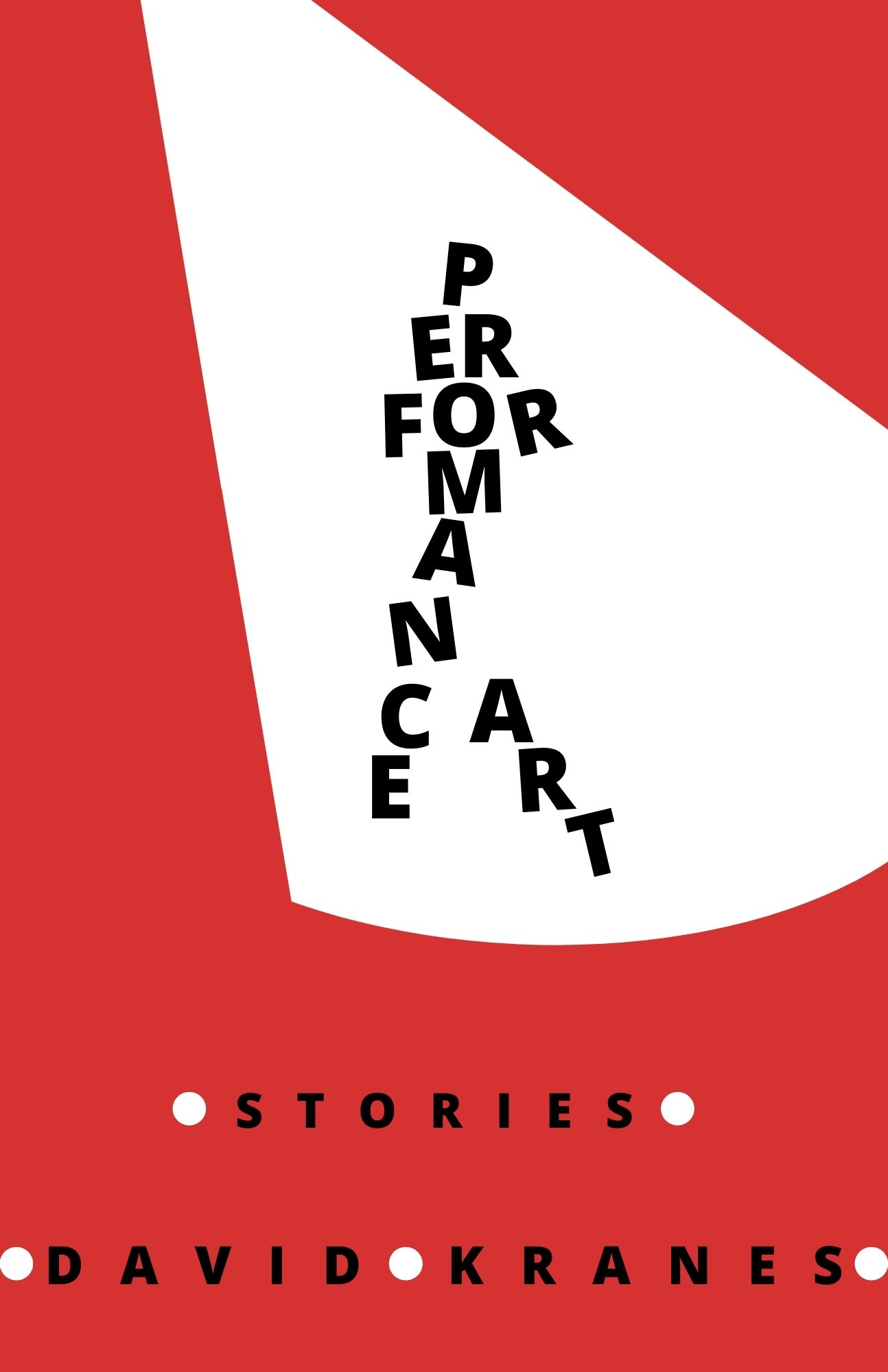
And Now, Presenting… – Performance Art by David Kranes

book cover

I’m missing a dove, he tells me, a small water fountain…half an assistant.
I’ll keep my eyes out, I tell him. 

It’s that awful moment when any of us realize that why we began something is no longer why we’re doing it.

In his latest short story collection, literary lion David Kranes puts on quite the show. Performance Art offers up stories about people who perform in public. Nine of the stories in the collection were published between 1991 and 2015, with four new tales fleshing it out to a baker’s dozen. While offering some new material the collection serves more as an introduction to a powerful literary writer you may not know. Kranes is 84, and has been at this a long time. He writes in whatever vessel seems appropriate for the stories that occur to him, whether that is poety, plays, novels or short stories. Sometimes the stories migrate. One of the included tales here was the inspiration for a novel.

description
David Kranes – image from Continuum

The external focus in this collection is performance, stage performance, for the most part, although the definition is somewhat fluid. The talents on display run quite a gamut, from a daredevil to a stand-up comic, from an actor to an escape artist, from a spokesperson for a weight-loss program to a magician, from a fire and glass eater to a master of sleight of hand, to a world-class photographer, to a carnival knife thrower, and a bit more.

There are some themes, images, and issues that run through, central among which is invisibility. People feeling unseen, maybe even being unseen.

Scott paces four rooms, each one of which, even when he’s in it, seems empty. (A Man Walks Into a Bar)

Nothing about me took up—space or anything else (Target Practice)


Ginger’s twenty-seven and has almost perfected invisibility. (The Weight-Loss Performance Artist)

I turned and moved away. Went. Didn’t stop. Didn’t look back. Instead: became invisible. Became a ghost anchored only by an abiding faith, finally, in the power of absence. (Escape Artist)

Painters permeate. Two of the lead characters paint, and painting is an element in several others. In Daredevil, a character is fascinated with Hans Holbein’s Dance of Death. Target Practice includes a character very into Turner. The Garden of Earthly Delights get some spotlight in Devouring Fire.

Celebrities drift or flash through the stories, and not in a particularly favorable way.

Several characters are faced with potentially life-changing opportunities. A painter has a chance to be a very in-demand actor. Another painter might have a chance to direct a film for a household name producer. A stage performer has a chance to revive a career long thought dead and buried. An obese woman is offered a huge sum to be the public face of weight loss. A drug addict is offered a chance to be the knife instead of the target.

The notion of next comes up. In Daredevil, pop offers useless advice to his son re next steps in life. In Target Practice a social services report on the narrator calls her directionless. (“I had no comprehension of next. I had no next moments; obviously no next month, no next week.”)

The stories are set in Vegas, mostly, the southwest, generically, Idaho a time or three. It is pretty clear that Kranes knows The Strip and Vegas like a local. He lives in Salt Lake City. I do not know if he ever lived in Vegas or maybe spent a lot of time there. Both seem likely.

There are a few tales that include bits of fantasy. Most do not. I would not categorize this as a fantasy collection, per se.

While the circumstances are sometimes extreme, there is still plenty to relate to. How many of us have felt unseen, invisible in the world, or maybe want to be. I can certainly relate to the latter. In my theatrical debut (It was Kindergarten I think) I was called on to walk to center stage and recite Peter Peter Pumpkin Eater. I managed to get the words out, but that was not all. By the time I exited stage left my pants had taken on an unwanted yellow tint. Invisibility cloak, please, NOW!!! And we have probably all felt the sting of feeling completely unseen by that boy or girl, man or woman whom we really, really want to see us.

Bottom line is that this collection may not feature all new material (that said, even the previously published stories were new to me) but it offers a splendid sample of a literary talent of great skill and power. David Kranes is a writer worth getting to know. This is top-tier, star-power material.

Review posted – 10/5/21

Publication date – 10/15/21

I received an e-galley from the University of Nevada Press through NetGalley, in return for a visible, performative review. Thanks.

======================================THE STORIES
The Daredevil’s Son (2010) – imagine your father was Evel Knievel. Imagine he was dead set on you following him in the family business. Imagine you have the body, the build, and the looks. Then imagine you have zero interest in doing that.

“So then, you don’t want to be like…do what your father does?” people asked.
“No, because my father scares people,” Lucas Jr said.

There is a lot here that resonates with Kranes’s life. He grew up in the Boston area, his father a big-shot surgeon at one of the biggest hospitals in the city. He even enrolled in pre-med, but knew it was not for him. Later even tried Yale Law School. Ditto. Dinners at home would feature Nobel Prize winners (as guests, not on the menu). The bar seemed too high, the pressure too intense to succeed, to perform at that level, at things that did not appeal to him all that much. He headed west instead, opting to follow his own inclinations, not those of his father.

The Stand-up Phobic (2015)
Ethan Fallon feels compelled to perform on stage.
The language of the story mimics the sort of stream-of-consciousness that Robin Williams might have launched into in a moment or that George Carlin might have scripted. It is about words, words, words, and associations, free or otherwise There is a manic aspect to Ethan. It is presented as an interview between Ethan and…someone. You feel bad for the guy, with all this verbal churn going on in his head, and only the stage as a venue for relief.

Ethan’s hair is an air show and he’s sweating. Every performance lately seems a conspiracy-theorist’s nightmare. Any room he’s booked into is slack-jawed and oversized and swallows him. Like a bad Jonah dream. Like having a three-day booking at the Whale. AT THE HOUSE OF RIBS. YEAH! PUT Y0UR HANDS TOGETHER—WON’T YOU, PLEASE—for our own sackcloth and ashes! Ethan Fallon!

A Man Walks Into A Bar (2012)
Scott Elias, a dealer (cards, not drugs) and painter, is approached by two men in a Vegas bar. They mistake him for a well-known actor, but offer him a screen test because they like his presence. They see something in him. So Scott is carted off to appear in the film, sorry, project, they are producing, and life gets crazy from there. But is this the life he wants? He has a roomie, a young man, Tory, also a painter, who had been injured in an auto mishap. It is more of a ward and sponsor relationship, not a sexual one. Tory’s paintings reflect Scott’s inner battle.

Escape Artist (2002)
From birth, Lou has been getting out of things. The need comes with some innate capacity. But there are others who would do well to escape unwanted circumstances, yet lack the native tools and even when they learn the learnable skills, opt for the safety of captivity to the freedom of escape. This story includes a bit about escaping the East Coast, and doctor father, which echoes the author’s relationship with his father.

When I was two, a nurse locked me in a closet under a pile of coats. I got out. When I was six, three bullies tethered me with clothesline, filled my mouth with detergent. I escaped, spat the detergent into the sunlight. It turned green in the bright air, hardened into a nugget of turquoise.
At two, six, I had no words, no plan, only knew my need: lift. Rise, break out, court the insane of the world—if that’s what it took.

When the Magician Calls
Daniel Lawrence, or maybe Lawrence Daniel, has tracked Sheila down. (There is a reference in another story to a Sheila who had been at least partly mislaid by a fading magician) He seems to think Sheila will remember him. Sounds like they had had a prior connection. He would like to help her fully disappear from her current, somewhat imprisoned life. Maybe he can conjure a bit of magic, although it may not be his true calling. My stage-self hungers for standing-room-only. Mostly, though. I feel like some kind of bulked tortoise, lumbering to the sea.

Target Practice
The female narrator seems to have almost died too many times to be a coincidence as a kid. Became a target when she got older, for a Sunday school teacher, for boys with an interest and for needles. But when she meets a carnival knife thrower (and former MLB pitcher) she learns, ironically, how not to be a target, but to be the knife, her survival no longer an unexpected miracle.

The Warren Beatty Project (1991)
Ethan Weise has had a bit of success with his painting, sold canvasses to some famous people. He is working on a series of Edward-Hopper-type paintings, set outdoors. Once, he worked as a “visual consultant” with a student at the American Film Institute. And then, one day, Warren Beatty calls, wanting him to direct a project for him. LaLa Land beckons, limo-driven and low on artistic merit, rich with industry glitterati and the suggestion of connection and work, while short on actual delivery. While his girlfriend pulls him in a different direction. Will he gain notice, or remain largely unseen? Is this project the stuff dreams are made of, or something else?

The Weight-Loss Performance Artist (2008)
Ginger is 5’5” and 340 pounds. Two men approach her to take part in a project. They have a weight-loss program called PoundSolve that offers tailored meals to subscribers, and software that can project what someone will look like after reaching certain weight-loss benchmarks. They would like Ginger to be their spokesperson, and will pay her $4k per pound for every sixteen ounces she takes off. It a pretty good deal from where she sits. Ginger’s twenty-seven and has almost perfected invisibility. As she moves up to translucent, and even apparent, life changes in many ways. The question is how she will cope and whether the changes are all welcome.

My Life as a Thief
The narrator here is unnamed. His father is a doctor, working at Mass General (where Kranes’s father worked). He started doing magic at eleven, with a kit his dad bought him. Turns out to be a gateway drug to ever more professional levels of magic. His life as a thief begins when he is thirteen, teamed up with Arthur Foley, a pal, whose father happens to be a criminal. Turns out having a talent for making things disappear offers a direct path to shoplifting. They move on from there.

Devouring Fire—An Interview
Robbie, a young reporter, has a chance to interview an entertainment legend, Anthony Aquila, 89 years young and still scary. Anthony is renowned for his ability to eat both fire and glass.
There is a fun interaction between the two of them, as Anthony totally intimidates the young man, but also sees the potential in him.

I’ll confess here: I was drawn to his image. It was like one I’d seen in my History of Religions course at State; he was an ascetic. A kind of harp with skin. Bare feet. Ribs like a rack of lamb. Deep hollow cavernous eyes. You could almost hear his echos echo. Shabby, torn clothes. I got the sense that whatever he did, at the same time he could stand back and watch himself doing it.

The Resurrection of Ernie Fingers
The Downtown Palace in Vegas seems to be doing everything right, post Covid, yet the players are not showing up. The place needs something

We need an attraction,”Dickie Rice, the GM, said to Tony Padre, Head of Marketing. “We need crowds fighting to get in. We do that and who we offer, what we offer will sell itself.”
Tony Padre agreed, “Attraction! Absolutely! But what? Who?”

They bring a legend back. Ernie Fingers is a fill-the-place-entertaining performer, but he has been out of the business for a while and has gotten way too familiar with a particular brand of hooch. Can Ernie be brought back to his old form? Ernie ha a special ability, though, and his skills may be fading.

The Photojournalism Project (1996)
Melissa Probert is a gifted, very much-in-demand international freelance photographer. Her work has been shown in major national museums. Hunt is a painter, working on a project making tempura images of roadside memorials. They had a thing once but have remained friends. Melissa calls Hunt to help her with a special project, a book. She wants to make a photo history of a binge drunk, her own, she having a history of such antics, sans lens. Hunt and Leah, his wife? gf? have an ongoing conversation while he is at Melissa’s multi-day drunk re what and how he sees and her forbearance of his friends. In offering a stage for the unseen, is Melissa making Leah vanish from Hunt’s life?

The Fish Magician (1997)
Malcolm volunteers from the audience at The Monte Carlo in Vegas to participate in magician Lance Burton’s show. He steps into a Lucite box on the stage and in short order is vanished…well…transported, to Idaho it would appear. Oopsy. And the aging magician cannot recall where he’d sent Malcolm. Some time later his wife, Ginger, alarmed at her husband’s sudden disappearance, and failure to reappear, hires an investigator to find out just WTF happened. This is a fun tale in which the investigator is a psychic former NFL player who dreams of doing standup. The story was the basis for Kranes’s 2018 novel Abracadabra.

=============================EXTRA STUFF

Kranes does not maintain an on-line presence, as far as I can tell.

Here is a profile of him in Mapping Literary Utah

Interview
—–Radiowest – The Legend’s Daughter – by Doug Fabrizio – audio – 52:04 – even though it was recorded eight years ago I found this interview very illuminating re this collection

Songs/Music
—–Arthur Rubinstein – Chopin’s Nocturne in E-Flat – From Ernie Fingers

Items of Interest from the author
—–short story from this collection – The Daredevil’s Son
—–short story – A Figure in a Window
—–a one-act play – Infrastructures

Leave a comment

Filed under Fiction, Literary Fiction, Reviews, Short Stories

The Wonder Garden by Lauren Acampora

book cover

As they approach the gate Bethany thinks of the town, small and safe, awaiting their return. It is cloistered, claustrophobically familiar, but maybe—and her mother’s trembling hands return to her—mired with its own dark disturbances. It is its own kind of restive campground, in a way, its properties penciled upon common land, impinging on one another despite the fences meant to hold them apart. Huddled in that encampment are each of their families, steely cohorts within the greater clan.

Old Cranbury, CT is an older, well established suburb. In the historical part of town some of its homes date from the 18th century, and still carry the names of the families who built them. Residents of those particular homes take pride in preserving their piece of history, some of them maybe a bit too much. OC is a lovely place, a mostly middle and upper-middle-class suburb. Good schools, trimmed lawns. Unlike Chester’s Mill, Wayward Pines, Royston Vasey, or the Village, you can leave if you choose, but you will want to stick around at least long enough to get through the baker’s dozen stories about the local residents in The Wonder Garden.

description
Lauren Acampora

There are plenty of weeds in Lauren Acampara’s linked-stories collection, but not the stories. The tales are flower-show ready. I imagine we have all read, seen or heard groups of tales about a particular town, or location. Our Town, Spoon River (yes, yes, I know, poems, not stories), Olive Kitteridge. Now, think hard. Were any of them yuck-fests? Didn’t think so. Ditto here. It is true that most of these stories show a less than lovely side of life in Old Cranbury. The sins are far from original. Disappointment permeates. But there are rays of sunshine as well. Change is possible, at least for some. Hopes may be dashed, but not all of them, and that there are plenty to go around gives one hope that in their imagined lives, some of these folks might live to see their dreams come true. Most of the characters are just trying to make the best of their circumstances.

It would not be a portrait of a town if the residents were not watering at least a garden-full of secrets.

she becomes aware of the hidden, parallel world beneath the mundane. Just beneath the surface of every defunct moment—finding a spot in the supermarket parking lot, waiting at a stoplight—lurks another moment, sexual, adulterous, waiting to be chosen. It shimmers faintly, a phosphorescent arc of lighter fluid ready to catch fire, detectable only to those attuned to it. She parks the car and watches the men and women going in and out through automatic the doors. Which of them are alight, secretly smoldering?

Unfaithfulness is to be expected. Some marriages are strained, while others, surprisingly, appear to be strengthened by big changes. How about wanting to violate all medical ethics to perform a very strange and intimate act? Maybe show the world the face of a concerned citizen but indulge in a bit of pointed vandalism? There is plenty of imposturing going on here. Maybe parenthood is not for everyone, including some parents? Maybe nurture fears that go well beyond the understandable? A sense of the past permeates as well. There is enough moral ambiguity through the thirteen to spark book group debates aplenty.

Unlike Olive Kitteridge, there is no single character serving as a trellis on which the stories can be strung like vines. But there is considerable back and forth. Characters are woven into and out of stories like threads in a tapestry. The author likes to introduce characters in one story and offer us their names elsewhere. Acampora admits that she inserted some of the connective tissue later on in the writing process, says the links “presented themselves” to her. It is the town itself that is the organizing structure. But there are some elements that repeat. Gardens appear in many of the stories, serving diverse purposes. Another element that struck me was the characterization of the houses of OC as particularly organic.

He intends to keep the bones of the house strong and its organs clean for decades to come, even as the skeletons of newer houses rise and fall around it.

These machines are the pumping heart of the house; everything else is frivolous and disposable in comparison.

The house is gigantic, encrusted with a dark carapace, as if diseased.

The exposed oak beams are strong as ribs along the ceiling of the first floor and the central chimney and hearth—spine and heart of the house—exude the smell of ancient smoke.

And there are more like these. On one level, one might even wonder, in a darker vein, whether people inhabit the town or if the town inhabits them. The homes, as might be expected, often reflect the lives of those who live within.

The language of the book is at times lyrical and compelling, more effectively so for the pedestrian circumstances in which it shines:

John meets the woman’s eyes again, the crystalline irises with nothing in them but confidence in the universe. He feels nearly dead in comparison, more exhausted by the moment, as if he were being depleted by her presence. It seems that there is a lack of air in this place, that the windows have been sealed shut for decades, since the long-ago children were last measured. A slow moment elapses. In the space of this pause, John feels the breath of the past, the cumulative exhalation of the house and its lost inhabitants. They seem to gather in the basement’s webbed corners, fuzzed with dust and dead skin. It strikes him that this is a last capsule of memory, that when it is swept and painted, the raw floor carpeted and windows unstuck, no trace of life will remain. The history of the house will persist only in the memories of its former residents, those far-flung stewards of dwindling, inexact images.

The characters that populate Acampara’s thirteen tales are quite well realized, particularly so, considering the short form involved. The Wonder Garden is a powerful, beautifully written work of fiction. I am sure the horticultural society will approve.

Review posted – 6/12/15

Publication date – 5/5/2015

I received this volume from GR’s First reads program – thanks guys
It was first recommended to me by my good, much younger, GR pal – Elyse. I am in your debt.

=======================================EXTRA STUFF

Links to the author’s personal, Twitter and FB pages

The Wonder Garden found its origin in The Umbrella Bird story. Acampora completed a novel, from the perspective of the wife, Madeleine, but thought it was just not good enough. The Umbrella Bird in this collection is the primary remaining nugget from that project. Some of the supporting cast from the novel show up in the collection as well.

Acampora grew up in Darien, the inspiration for The Stepford Wives, so knows her suburban towns. In visiting Darien as an adult, she found that the houses seemed almost like characters.

Here is an audio interview from The Avid Reader. Beware, though. The sound quality is poor, as the host’s volume is way higher than the author’s so you will have to keep turning the volume way up and way down to keep from being knocked out of your seat.

The author in an exchange with Lily King on B&N

Here is one complete story from the collection, The Umbrella Bird

The Wonder Garden was an Amazon Book of the Month selection for May, 2015

=======================================THE STORIES

Ground Fault – John Duffy is a building inspector with a perceptive eye, and a willingness to let life’s disappointments affect his work. He could probably do with a bit of self-inspection.

Afterglow – Harold, a wealthy corporate raider, wants to be a part of his wife’s brain surgery in an unusual, and very intimate way

The Umbrella Bird – David is fed up with his corporate nine-to-five. Fixated on building a tree house for his expected child, he finds a very different muse, and his life goes in a brand new direction.

The Wonder Garden – Rosalie is a very involved, mother hen of a parent, with children in several grades of the local school. She sits on boards, hosts an exchange student, but there might be a serpent in her garden.

Swarm – Martin, a tenured professor at a state university, is offered the chance of a lifetime to create an art project that would make up for the decades in which he had had to put his art aside. But what might the cost be for realizing this dream?

Visa – Camille is a single mother who has found an amazing guy. They plan a wondrous vacation together. Can he possibly be for real?

The Virginals – Roger and Cheryl Foster live in an 18th century house. They are heavy into the Revolutionary War period, trying to live as much like those earlier Americans as possible. But the new owners of the period house across the way do not seem quite so enthusiastic. What’s a good neighbor to do?

Floortime – Career woman Suzanne Crawford is the single mother of a boy who appears to be on the autism spectrum. This would present a challenge to most parents, but if one’s maternal instincts are on the low end, the problem looms larger.

Sentry – when her neighbor’s child is left unattended for a prolonged time, Helen Tanner invites her in, to hang out a while, then a while longer, then…

Elevations – Mark and Harris own an antiques shop. They share a lovely home. But they may want different things out of life.

Aether – Some young people from OC are at a music festival when something goes terribly wrong.

Moon Roof – Lois Hatfield, on her way to a party thrown by her husband’s boss, gets caught at an intersection and cannot decide when to go.

Wampum – uneasy at a party thrown by the local one-percenters, Michael succumbs to a bit of paranoia, with dangerous results.

Leave a comment

Filed under Fiction, Reviews, Short Stories

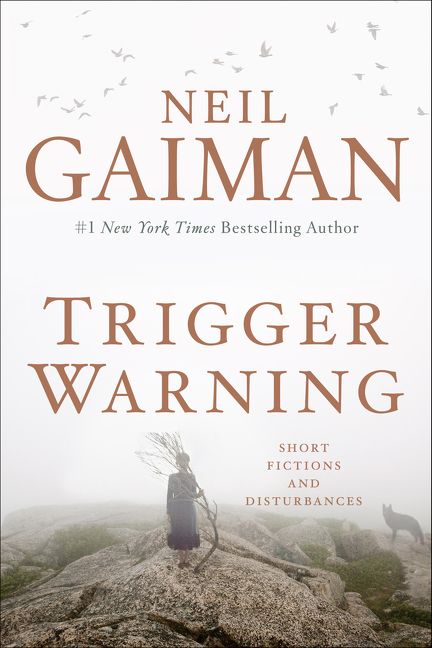
Trigger Warning by Neil Gaiman

book cover

The monsters in our cupboards and our minds are always there in the darkness, like mold beneath the floorboards and behind the wallpaper, and there is so much darkness, an inexhaustible supply of darkness. The universe is amply supplied with night.

There is a diversity of material in Neil Gaiman’s third and latest collection of short fiction, Trigger Warning. It is a potpourri of twenty four pieces, if we take as a single piece the entry called A Calendar of Tales, which, itself, holds a dozen. They are not all, despite the collection title, dark or frightening. He brings in some familiar names, David Bowie, Sherlock Holmes, Doctor Who, Maleficent, Snow White, a traveler from other Gaiman writings, Shadow Moon, twists endings into satisfactory curls for the most part, wanders far afield in setting and content, well, within the UK anyway, tosses in a few poems for good measure, and even offers up a few chuckles. He is fond not only of science fiction as a source, but of Scottish and Irish legends as well. If you are not smitten with the story you are reading at a given moment, not to worry, there is another close behind that is certain to satisfy.

Gaiman is overt in noting the absence of connective tissue among the tales. But there are some themes that pop up a time or three. Living things interred in walls, whether after they had expired or not. A bit of time travelling. Fairy tales are fractured. Favorite writers are admired.

book cover

Neil Gaiman – Photo by Kimberly Butler – on Harper Colllins site

In the introduction, Gaiman tells us a bit about the origins of each of the 24, a nifty item to check back on after one has read them all. Some of the material has been developed for other media. I added a link at bottom to a more-than-text offering re the Calendar of Tales, for one.

Overall I found Trigger Warning is a pretty good survey of Gaiman’s impressive range. He seems able to realize the dreams of the alchemists by transforming what seems every experience he has and every notion that crosses his interior crawl into gold. And some of the stories here are glittery indeed.

I quite enjoyed the collection. The uplift of the best more than made up for the downdraft of the lesser. If you enjoy fantasy, with a good dollop of horror, you could definitely give it a shot.

=======================================THE STORIES

1 – Making a Chair – a poem about the writing process.

2 – A Lunar Labyrinth – a tribute to Gene Wolfe – a traveler who enjoys roadside oddities is brought to a maze that is brought into a form of darkness by the full moon.
Here is a link to a site that will clue you in on roadside oddities in the USA. There is a book on such things for the other side of the pond, but I did not find a comparable link

3 – The Thing about Cassandra – An imaginary connection becomes real, with a delicious twist

4 – Down to a Sunless Sea – an abominable feast, but with some just desserts

5 – The Truth is a Cave in the Black Mountain – A not wholly human dwarf engages a local man to lead him to a cave reputed to be filled with tainted gold – I could not get the image of Peter Dinklage as Tyrion Lannister out of my tiny mind while immersed in this one. Sometimes the truth hurts.

6 – My Last Landlady – the rent is definitely too damn high

7 – Adventure Story – a bit of fun guaranteed to make you smile

8 – Orange – A teen who thinks she’s all that may indeed be – another smile-worthy item

9 – A Calendar of Tales – I won’t go into each – the collection was written from ideas received on-line. I found it a mixed bag, with March (Mom has a big secret), August ( a tale of fire and foolishness), September (a magic ring with the quality of a bad penny), October (a sweet tale, involving a Jinni), and December (a hopeful time-travel piece) my favorites

10 – The Case of Death and Honey – a fantastical tale in which a certain Baker Street resident takes on the mystery of death itself

11 – The Man Who Forgot Ray Bradbury – a tribute to Gaiman’s mentor

12 – Jerusalem – on one of the dangers of visiting the city

13 – Click-clack the Rattlebag – stories can be scary, regardless of the age of the teller

14 – An Invocation of Incuriousity – a time-travel piece – don’t touch the settings

15 – And Weep, Like Alexander – one possible reason why we do not have some of the futuristic inventions we expected long ago – cute, not scary

16 – Nothing O’Clock – a Doctor Who tale with a timely solution

17 – Diamonds and Pearls: A Fairy Tale – a fable with a moral

18 – The Return of the Thin White Duke – the completion of a story begun and abandoned while back for a magazine project on Bowie

19 – Feminine Endings – beware of street statue-performers

20 – Observing the Formalities – Maleficent as narrator of a poem about proper forms

21 – The Sleeper and the Spindle – A fairy tale with a nice twist

22 – Witch Work – a poem on the limits of witchy magic

23 – In Relig Odhrain – a poem on a saint who suffered an awful demise

24 – Black Dog – Shadow Moon stops in an ancient pub and is drawn into some serious darkness, scary fun.

Review posted – 3/20/15

Publication date – 2/3/2015

This review has also been posted on GoodReads

=====================================EXTRA STUFF

Links to the author’s personal, Twitter, Tumblr and FB pages

Here is a link to his separate blog

For a full-on media-rich offering the Calendar of Tales piece in Trigger Warning can be seen here

Harper has an on-line reading guide

Other Gaiman books I have reviewed
The Graveyard Book
The Ocean at the End of the Lane
Stardust

2 Comments

Filed under Fantasy, Fiction, Horror, Short Stories

A Permanent Member of the Family – Russell Banks

book coverGiven the unsettled nature of the families in Russell Banks’ dozen stories, the title of his sixth short story collection, A Permanent Member of the Family, might have a bit of an ironic aroma to it. Marriage is, if anything, impermanent here. The title character in Former Marine had to raise his boys alone after their mother took off. Philandering, while not depicted, is noted as causative in the demise of several other relationships in the collection. And even when a marriage has not dissolved, it is often shown to be or to have been threadbare. There are a few stories where things marital are not seen, Blue, The Invisible Parrot, but the tendency is to the sorry state of home and hearth. It is not surprising that marriage has such a central place in the author’s work. His current marriage is his fourth.

all of us were fissioned atoms spun off nuclear families, seeking new, recombinant nuclei

Lines are drawn, and crossed. They separate before from after, denial from acceptance, uncertainty from realization. In Christmas Party, for example, a man is invited to the home of his ex and her husband for a party, and his underlying humiliation and rage must find an outlet before he can cross over from before to after. A singular event in the title story defines the place where the stretching of connections snaps.

book cover

Russell Banks – from Wikimedia

The characters here often face moral choices, a favorite concern of Banks. Faced with financial stress in his old age, a Former Marine must make difficult decisions in order to be able to continue providing for his children, and later, in order to protect them. In Lost and Found, a businessman at a convention is confronted with the time when he brought a woman who was not his wife to his hotel room, and the decision he faced then. In Searching for Veronica, a woman confronts the guilt she felt for turning out of her home someone who was at great risk in the larger world. The choices are never black and white.

Banks sets his stories largely in the upstate New York town of Keene, his current residence, near Lake Placid, and Florida, his other current residence, so his descriptions of place ring with authenticity. He has a background as a politically concerned sort (he tried joining Castro’s revolution, despite not knowing how to speak Spanish, but got no farther than Florida) and his appreciation for the struggles faced by working people is never far. He had a working class upbringing himself.

I think I inevitably end up feeling a special kind of sympathy for people whose lives are shaped and controlled and manipulated by people with more power than them. – from Harpers article

It is also pretty clear that he holds a less than fond opinion of the media, whether the whores are the media professionals or those who would use them to personal ends, as shown in Blue.

Banks has achieved a status as one of the top writers of his generation, with a dozen novels to his credit, including Continental Drift, Affliction, The Sweet Hereafter and Lost Memory of Skin. A Permanent Member of the Family is his sixth collection of short stories. I found these tales to be extremely well told. There are ironic twists, as every writer of short stories must have at least a bit of O Henry DNA floating about. Banks won an O Henry award for his short story collection Searching for Survivors. A few did not grab me, seeming somewhat obscure commentary on writing per se, but most presented relatable characters confronting real-world choices, or repercussions. Banks has a gift for detail, without cluttering the place up with too much. His style is straight ahead story-telling with less of the lyrical description some other writers employ.

The work of a seasoned pro, A Permanent Member of the Family merits at least a temporary place with yours.

===============================THE STORIES
Former Marine
Faced with the loss of his business and a need to support himself and help out his three sons, who far too conveniently are all in police work, a man takes to a life of crime.

A Permanent Member of the Family
A family pet does not go along with a splitting couple’s custody arrangements. An event regarding the pet defines where one family situation ends and another begins

Christmas Party
A man is invited to the Christmas party thrown by his ex and her husband, who are living the life he had hoped for. What to do with the rage? How to move on?

Transplant
A recent heart transplant recipient is approached by the widow of the man whose heart he received, wanting to hear it beat one last time. The heart may replace the one that stopped working, but cannot truly replace the one that was broken.

Snowbirds
While snowbirding in Florida, a woman’s husband dies. Instead of grief, she appears to feel liberated. And when a friend offers to come help her with arrangements she finds something more.

Big Dog
Seems like it would be a cause for celebration when a sculptor is awarded a Macarthur Fellowship, but his wife and friends seem more resentful than anything else.

Blue
After saving for years to be able to by a car of her own, a black woman in Florida finds herself accidentally trapped in a used car lot after hours, beset by a watchful pit bull.

The Invisible Parrot
A young man in a local store tries to imagine the experience of others there, but imagination is not quite enough. Is this the writer wondering about the ability of writers to imagine the experience of others?

The Outer Banks
A retired couple’s dog has passed away while they are RV’ing about the country. They stop at a beach in North Carolina to bury it.

Lost and Found
A man meets a woman he had almost slept with at a conference years before. He looks back on that decision.

Searching for Veronica
A woman is fearful that a person she tossed out of her house some years back has come to a bad end.

The Green Door
A questionable character in a bar is looking for a place where he can get unusual entertainment. The bar tender directs him, but faces another decision about helping or not helping the man later.

Review posted on GR – 12/29/13

==============================EXTRA STUFF

From December 12, 2012 Harpers – A Conversation with Russell Banks – by Jesse Barron

A wide-ranging interview in the Paris Review

A critical review of his work up to 2001

Banks reads his story “The Moor” on This American Life in 2000 – 19 minutes long, from the 40 minute mark in the program

A New York Times interview with Banks – 1/2/04 – Russell Banks – By the Book

Leave a comment

Filed under Fiction, Literary Fiction, Reviews, Short Stories

Nothing Gold Can Stay by Ron Rash

book cover

The title of Ron Rash’s fifth short story collection, Nothing Gold Can Stay, comes from the chestnut poem, with the same title, by Robert Frost.

Nature’s first green is gold
Her hardest hue to hold
Her early leaf’s a flower
But only so an hour
Then leaf subsides to leaf
So Eden sank to grief
So dawn goes down to day
Nothing gold can stay

It is one of only two three poems I have memorized in my life (the others being Sandberg’s Fog and a classic limerick having to do with Nantucket, thanks for the reminder, Steve), and one that has certainly informed my world view. (cheery sort that I am) That notion may or may not have had merit personally, but for most of the characters who inhabit the fourteen tales in Rash’s Appalachian landscape, that glow of youthful vivacity will soon tarnish.

Characters here cover a wide age range, from middle-teens rattling their social cages to old friends in their sunset years, appreciating what they have had and cherishing what remains, from late teens struggling to find their way to a better life to others descending into criminality. They tend toward the edges, young or old with only a smattering in between, and those in the middle do not fare any better than those at the perimeter. Rash’s time line is likewise broad, with a couple of stories set circa Civil War, one in the 1960s, and most being reasonably contemporary.

Overall, these stories are about the coexistence of dark and light. In the title piece, two wastrel boys stand with one foot in the world of perdition and the other in a heavenly idyll. Or maybe it is only a dream of light, as hopes are raised several times in these stories, only to be melted down. People here feel trapped, by their past, their circumstances, their weakness. But there are also elements here of incredible love and self-sacrifice, enough to move one (ok, mushy old me) to tears. Life is not wonderful in Rash’s world. Kids want to escape, move on, find something better. But the existence into which they were born drags them under like the rough river in Something Rich and Strange. How much of who we are is accounted for by the circumstances in which we were born, the prison of class? Quite a bit.

Jody had watched other classmates, including many in college prep, enter such a life with an impatient fatalism. They got pregnant or arrested or simply dropped out. Some boys, more defiant, filled the junkyards with crushed metal. Crosses garlanded with flowers and keepsakes marked roadsides where they’d died. You could see it coming in the smirking yearbook photos they left behind.

Some seek to leave the imprisonment of literal slavery and one the manacles of actual prison.

So, life’s a bitch and then you die. Have a nice day. But wait, there’s more. Sometimes, there are pieces of life that hang on to their gloss. Two concerned parents live for a video call from their daughter in the service, every 26 days, a shining moment. Two old friends relish their lifelong friendship and enjoy the soft joys of the now. A young girl finds peace and beauty in a very unlikely place. And there is beauty in Rash’s world, even when its vibrant presence is used as a contrast to the living death of what may be a pointless existence.

The OC’s coating starts to dissolve. Its bitterness fills my mouth but I want the taste to linger a few more moments. As we cross back over the river, a small light glows on the far bank, a lantern or a campfire. Out beyond it, fish move in the current, alive in that other world.

Sometimes there is even beauty in death.

Days passed. Rain came often, long rains that made every fold of ridge land a tributary and merged earth and water into a deep orange-yellow rush. Banks disappeared as the river reached out and dragged them under. But that was only surface. In the undercut all remained quiet and still, the girl’s transformation unrushed, gentle. Crayfish and minnows unknitted flesh from bone, attentive to loose threads.

The greatest, for me, was the beauty of a lifetime friendship told in hushed tones as an old veterinarian nestles in the warmth of a moment of serenity.

Carson was always comfortable with solitude. As a boy, he’d loved to roam the woods, loved how quiet the woods could be. If deep enough in them he wouldn’t even hear the wind. But the best was in the barn. He’d climb up in the loft and lean back against a hay bale, then watch the sunlight begin to lean through the loft window, brightening the spilled straw. When the light was at its apex, the loft shimmered as though coated with golden foil. Dust motes speckled the air like midges. The only sound would be underneath, a calf restless in a stall, a horse eating from a feed bag. Carson had always felt an aloneness in those moments, but never in a sad way.

These being short stories, there must be an O Henry ghost wandering around somewhere, and if you anticipate this you will not be disappointed. There are a number of ironic, even darkly comic endings, and certainly some surprising ones.

Gold, as a thematic seam, runs throughout, with actual gold in the title piece, a supposed heart of gold in another, golden hair in a third, pursuit of riches in a fourth, a gold coin in a fifth and so on. I don’t want to lay claim to all the nuggets, so will leave the rest of the lode for those with a miner’s inclination, or if you don’t care for it, a panner’s.

My personal favorite was Night Hawks, clearly inspired by the painting, in which a woman, affected by the social impact of her appearance as a kid, struggles to find her place in the world. Must she be limited by an externality that is no longer there?

Rash inlays a few literary references in most of the stories, ways maybe to mark a trail in his woods. From A Catcher in the Rye to The Hitchhikers Guide to the Galaxy, from Chekov to Darwin and plenty more. But we know whose woods these are and the paths are clear enough.

It may be that nothing gold can stay, but whatever Ron Rash writes is 24 karat and will shine for a very long time, further burnishing his sterling reputation. He seems to breathe in life, landscape and atmosphere and exhale literature. No silver medals for this collection. Only the top prize will do.

=========================================THE STORIES

In The Trusty, a grifter in a chain gang plans an escape with a newly met, unhappy Mrs.

In Nothing Gold Can Stay, two wastrel boys, stand with one foot in the world of perdition and the other in a heavenly idyll.

Rash introduces a bit of magic in Something Rich and Strange, in which a diver, sent to retrieve the body of a drowned girl, has a vision.

Where the Map Ends pays a visit to the Civil War era, offering a bit of good news, followed by bad.

A Servant of History is a darkly comedic look at how a knowledge of one’s history might come in handy when far from home

Twenty Six Days is the time two working class parents have to wait between skype video calls from their daughter in a war zone. They must endure the insensitivity of some professorial sorts as they constantly fear for her life.

A Sort of Miracle contrasts two types of foolishness as a condescending accountant takes his layabout brothers in law into a national park to try to kill a bear.

Those Who are Dead Are Only Now Forgiven tells of how fragile is the path out of hopelessness, even when confronted with love. A smart, ambitious young man tries to bring his meth-addicted girlfriend out of her low state.

The Magic Bus contrasts extremes, a 60s era carefree sort of freedom on the one hand and a controlling, narrow farm life on the other as a teenage girl is tempted by the promise of escape.

The Dowry tells of a post Civil War town in which there is nothing a young Union vet can do to satisfy the Confederate father of his beloved that he is worthy of his daughter’s hand, the father holding a grudge from his having lost an arm in the war. A town cleric finds a surprising solution, in an act of great love.

The Woman at the Pond paints a picture of despair touching the life of a high school senior, without quite penetrating

Night Hawks was one of my favorites, hitting a bit close to home as it does. A young woman considers decisions in her life, informed by elements of her past that were beyond her control. There is a discussion here of the famous Hopper painting. In case you are interested, here is a site with the image and a look at where the actual location may have been.

Three A.M. and the Stars Were Out is a story of long-friendship, loss, rebirth and the value of what remains. Very moving

=======================================EXTRA STUFF

February 16 , 2013 – NPRs Scott Simon’s lovely interview with Ron Rash

February 22, 2013 – Boston Globe review

February 27, 2013 – Janet Maslin’s review in the NY Times

March 1, 2013 – I found this review, complete with some fun turns of phrase, in The Charlotte Observer.

2 Comments

Filed under Fiction, Literary Fiction, Reviews, Short Stories

Brief Encounters with Che Guevara: Stories by Ben Fountain

book cover

Brief Encounters with Che Guevara is a 2006 collection of eight brilliant short stories by Ben Fountain, author of the wonderful novel, Billy Lynn’s Long Half-Time Walk. Brief Encounters established Fountain’s reputation as a writer to watch, earning him a PEN Award, a Whiting Writers Award, an O Henry, and a Barnes and Noble Discover Award. Must be good, right? Indeed it is.

Half the stories are set in Haiti. Others are in Sierra Leone, Columbia, Myanmar and there is even one in Europe. They tell of people trying to do the right thing in an amoral world. The complexity of the world is a central focus in most of these stories, where it is often not so easy to figure out what the right thing to do actually is, let alone doing it. A grad-student ornithologist is taken captive by a revolutionary group in Columbia. An American NGO worker is persuaded to help fund a revolution in Haiti. A soldier returns from an extended tour in Haiti with some very unusual baggage. A pro golfer of questionable morality is recruited by the generals in Myanmar to promote golf in their corrupt and isolated nation. A Haitian fisherman finds that it is not so easy to foil the efforts of drug smugglers. An aid worker in Sierra Leone becomes involved with a blood diamond smuggler, while attempting to support a co-op that provides work for maimed locals. Sundry people relate their intersections with Che in the title piece. And in the final selection, a prodigy pianist with an unusual gift must cope with her notoriety while attempting a supremely challenging piece.

  Larry D. Moore CC BY-SA 3.0. via Wikipedia
Photo by Larry D. Moore via Wikipedia

There is considerable moral ambiguity in these pieces, a feast of Faustian bargains to be considered, and even mention of God and the Devil wagering over people’s souls.

Fountain was not always a writer. He was born in North Carolina and got his law degree from Duke, then worked in real estate law in Dallas for five years before pleading nolo contendere and turning over a new leaf.

It was a lot of things coming together at once: having a kid; my wife, Sharie, making partner at her firm; me having practiced for five years and just absolutely having had enough; me turning thirty and thinking that if I was going to make a run at trying to be a writer I needed to get going. There was a sense of urgency, of time passing. (from Ecotone)

Beginning his new career in 1988, he had stories accepted here and there but it took a long time for him to hone his craft and produce top quality work. One of the stories in this collection was first published in 2000. He had his share of frustration during this time, with a couple of novels taking up space in a drawer to prove it. But he stuck with it, treating writing as a job, whether or not he was published, five days a week writing every day, every day, every day.

As for why Haiti figures so large as a subject

On a rational basis, I saw Haiti as a paradigm for a lot of things I was interested in relating to power, politics, race, and history. I went there a couple of times and at that point I probably had what I needed to get. It was some comfort to me to know, flying out of there the second or third time, that I didn’t really have to go back—and yet I did go back, many times. Once I was there I felt pretty comfortable. And the more time I spent there, the more there was that I felt I needed to understand. But I still can’t give a satisfactory explanation for how it happened.

He would visit Haiti over 30 times. The notion of going to Columbia or Sierra Leone was raised, but funds and time are not limitless and his wife was aghast at the notion.

Fountain is very interested in the impact of the large forces in society on individuals.

I practiced law for five years and that gives you insight into a certain mind-set that maybe a lot of writers haven’t had firsthand access to. There’s an almost casual cruelty, a very low level of overall awareness, but sometimes there’s also knowledge that real damage is being done—this attitude of “Oh, what the hell,” this kind of moral cognitive dissonance. These are people who have never missed a meal. It’s an unknowingness, an unawareness, that Reagan personified. Reagan was so sure of everything and yet his experience of the world was so narrow. How could he be sure of anything? I saw that over and over again in the wealthier people I worked with or had contact with while practicing law. Many people were operating from a very narrow range of experience, and yet they had complete faith in it. Their way was the correct way, the only way. They had virtually no awareness of any other way of life except in terms of demonizing things like communism, socialism, or Islam. It’s an extremely blindered experience of the world.

 By Claudio Reyes Ule
By Claudio Reyes Ule via Wikimedia

The stories turn a widened eye on this sort of myopia, but Fountain does not spare the revolutionary sorts either, who have issues of their own. I found the stories very engaging, enlightening and moving. It is definitely worth your while to encounter Ben Fountain in this volume. You may find that the time spent in his company is too brief.

=======================================THE STORIES


Near-Extinct Birds of the Central Cordillera
John Blair is a grad-student ornithologist who ignored the risks and is doing research in Columbia when he is kidnapped by members of MURC (a FARC stand-in), a revolutionary group, and is held for ransom. He winds up spending a long time with the group and establishing relationships with some members and the leader. It is a tale heavy with political irony and a very O Henry-ish ending.

Reve Haitien
Mason is an OAS observer in Haiti. He throws chess games with the young local players, as a way of boosting their self-esteem. He encounters a player better than himself, Amulatto, and is drawn in his world.

Life here had the cracked logic of a dream, its own internal rules. You looked at a picture and it wasn’t like looking at a picture of a dream, it was a passage into the current of the dream. And for him the dream had its own peculiar twist, the dream of doing something real, something worthy. A blan’s dream, perhaps all the more fragile for that.

The Good Ones are Already Taken
Melissa is a very sexual person and it is a big sacrifice for her to do without while her serviceman husband is away. But when Dirk returns from an extended tour in Haiti, he has changed, gone voodoo, religious, which has implications for their sex life. Can Melissa adapt to the new man who came home? And what’s up with all that weirdness he is into anyway?

Asian Tiger
Sonny Grous, 23, is a pro golfer, built like a bouncer and not all that successful. In Rangoon for a tournament he has the game of his life and is recruited by the generals to be the ambassador of golf for Burma, which is seeking to attract foreigners with great courses. The money is pretty good, but there is the dodgy element of working for people who are truly reprehensible.

Bouki and the Cocaine
Concerned about the massive drug-running, Syto, a small-town Haitian fisherman, and his brother decide to grab the bales that are left by the runners on the beach and bring them to the police, accepting on face value the frequent public announcements decrying the drug trade. Things do not work out as the brothers expect. There are real questions raise here about where honor lies, and how one’s interpretation of that informs behavior. There tale is exceptionally clever and will make you smile, while also getting the moral dilemma involved.

The Lion’s Mouth
Jill runs a co-op that provides employment for many local women in Sierra Leone but funds are cut off. She turns to her unlikely bf, Starkey, a dealer in blood diamonds, for help in finding the needed funds. More moral ambiguity here, and an image of a troubled place.

Brief Encounters with Che Guevara
Che is a touchstone here, not an actual character, for the most part. Several, very diverse, people tell of their encounters with Che. Among them is Laurent, a Haitian who knew Guevara. Laurent was my favorite character in this entire collection. It is worth reading the entire book just to get to meet him.

Fantasy for Eleven fingers
Anna Juhl is a young piano prodigy, gifted in a manner identical to Anton Visser, a luminous player of the early 19th century, and composer of a particularly wonderful and difficult piece called Fantaisie pour onze Doigts. She takes on the challenge. This piece seemed a bit out of place in the collection, geographically anyway.

======================================EXTRA STUFF

A great interview in Ecotone Journal – by Ben George – must read stuff if you find Fountain interesting, and you should, a lot on writing and Fountain’s writing history

An interview in the on-line magazine, The Millions by Edan Lepucki. It is mostly on Billy Lynn, but there is plenty here about how Fountain thinks and writes. Definitely worthwhile.

There is a lovely bit in the Barnes and Noble writer details page on Fountain’s favorite books

In the on-line edition of the magazine Rain Taxi also has a lovely review with the author. He talks about his relationship with Haiti. There is a lot of detailed discussion of the stories.

There is a piece by Malcolm Gladwell in New Yorker that looks at Fountain as an example of a late-bloomer.

Leave a comment

Filed under Fiction, Literary Fiction, Reviews, Short Stories