Category Archives: Fiction

Thorn Jack by Katherine Harbour

book cover

In the beginning was nothing. From nothing emerged night. Then came the children of nothing and night

Seventeen-year-old Finn Sullivan has the luck of the Irish, if you consider how the phrase was used during Irish immigration to the New World. When she was living in Vermont, her mother was killed in an auto accident. A move to San Francisco did not improve things for good as her older sister, Lily Rose, committed suicide there. A need for a change of scene brings Finn and her Da back to the town where he was raised, Fair Hollow, in upstate New York. Enrolled in a local college, HallowHeart, she meets the dazzling but mysterious Jack Fata. They may or may not be fated to be together, but the Fata family is very definitely a big deal in this small town, which is not exactly the epitome of exurban serenity.

“So what’s with all the little pixies everywhere? Carved into HallowHeart, the theater…”
“They were worshipped here…”
“Pixies?”
“Fairy folk. Some of the immigrants from Ireland followed the fairy faith. And the Irish had badass fairies.”

The local décor seems to favor the mythological, as if the entire place had brought in the Brothers Grimm and Arthur Rackham to consult on a makeover. The older mansions tend toward the abandoned and the locals tend toward the odd. Finn finds a few friends, and together they try to figure out the enigma that is Fair Hollow, maybe save a few folks from a dark end, and try to stay alive long enough to accomplish both.

book cover

the author

There are twists aplenty and a steady drumbeat of revelation and challenge to keep readers guessing. Finn is easy to root for, a smart, curious kid with a good heart who sometimes makes questionable decisions, but always means well. Jack offers danger and charm, threat and vulnerability. And Reiko Fata, the local Dragon Lady, a strong malevolent force, provides a worthy opponent. Harbour has fun with characters’ names that even Rowling would enjoy. Jane Ivy, for example, teaches botany. A teacher of metal-working is named, I suspect, for a metal band front man.

Each chapter begins with two quotes (well, most chapters anyway). One is from diverse sources on mythology and literature, and the second is from the journal of Finn’s late sibling. They serve to give readers a heads up about some elements of what lies ahead. One of the things that I found interesting about this book was the sheer volume of references to literature and mythology from across the world, not just in the chapter-intro quotes but in the text as well. I spent quite a bit of time making use of the google machine checking out many of these. You could probably craft an entire course on mythology just from the references in this book. In fact the author includes a bibliography of some of the referenced works. There are references as well to painterly works of art. Harbour includes a glossary of terms used by or in reference to the Fata family that comes in very handy. The core mythological element here is Tam Lin, a tale from the British Isles about a man who is the captive of the Queen of the Fairies and the young lady who seeks to free him.

The dream scene where Finn is speaking with her older sister and things grow sinister was an actual dream I had when I was seventeen. The revision was influenced by a book called Visions and Folktales in the West of Ireland, by Lady Gregory, a collection of local stories about some very scary faeries. The Thorn Jack trilogy is influenced by Shakespeare, Alice in Wonderland, Peter Pan, and Frankenstein. – from the author’s site

It is tough to read a book about young attraction of this sort and not think of Twilight, or Romeo and Juliet for that matter. And where there is a school in a place in which there are some odd goings on, and mystery-laden instructors, there will always be a whiff of Hogwarts in the air. But this one stands pretty well on its own.

Gripes-section. I did indeed enjoy the mythology tutorial available here, but sometimes I felt that the author could have pared this element down a bit. One result of this wealth of material was that it made the book a slow read for me. But then I have OCD inclinations, and have to look up every bloody one of these things. You may not suffer from this particular affliction, so may skip through much more quickly than I did. Or, if you are a regular reader of fantasy fiction, you may already know the references that my ignorant and memory-challenged self had to look up. Also, there are a LOT of characters. I tried my best to keep track by making a list and I strongly advise you to keep a chart of your own. It can get confusing. Finally, the quoted passages from Lily Rose’s journal do not much sound like passages from anyone‘s journal and seem to be present primarily to offer a double-dip into mythological reference material.

That said, Thorn Jack was engaging and entertaining, offering mystery, frights, young romance, and a chance to brush up on your mythology. Think Veronica Mars in Forks by way of Robert Graves.

Harbour has two more planned for the series, The Briar Queen and The Nettle King. I would expect she would address some of the questions that linger at the end of this first entry. What did her parents know and when did they know it? Is there an actual core curriculum requirement at HallowHeart College?

Review Posted March 14, 2014

Release Date – June 24, 2014

=====================================EXTRA STUFF

The author’s personal, Twitter and FB pages

Also, definitely check out another of Harbour’s sites, Dark Faery/Black Rabbit , which includes additional entries from Lily Rose’s journal, among other things.

book cover There are some scenes in Thorn Jack that include statuary of magical beings. I wonder if, as Harbour is from Albany, and was certainly exposed to Saratoga Springs, only about 30 miles away, (my wife and I visited in Autumn 2013) she might have been influenced by this Pan statue and/or similar pieces in Congress Park there. On her site, she talks about being inspired by abandoned mansions along the Hudson. Here is a site that shows all sorts of abandoned buildings, along the Hudson and elsewhere.

2 Comments

Filed under Fantasy, Fiction, Reviews, YA and kids

Fourth of July Creek by Henderson Smith

book coverThere should be fireworks shooting off for Smith Henderson’s first novel, as it is a just cause for celebration. This is not to say that the subject matter is exactly festive, but the book is a triumph.

Pete is a social worker in Tenmile, Montana, a place so insignificant it was named for it’s distance from the nearest possible somewhere. The folks he is charged with trying to help out need all the support they can get, but some can’t seem to accept any.

There are three main threads braided into this novel. Cecil is a troubled teen in a household where the biggest problem is his substance-abusing layabout mother. The two do not get along, big time. Firearms are involved.

When eleven-year-old Benjamin Pearl wanders into town alone, dressed in rags, and looking like he’d been reared by wolves, Pete is called in to check things out. Following the story of Benjamin and his family is the core here, although a portion of almost every chapter is given over to the third thread, Rachel Snow, Pete’s daughter, who has troubles of her own. Pete is the central element interlacing with the threads.

Pete Snow is basically a decent guy, bloody far from perfect, but his heart is in the right place. He really cares about the people he is charged with helping, and tries his damndest to figure out what the best thing is to do for each. That it does not always work out, and that he is better at helping others than he is himself, are foregone conclusions.

description
The Author

Smith Henderson offers us a look at a place in America, rural, and sometimes not so rural Montana, but also a time. It is no coincidence that the story is set in 1980, when the promotion of “Morning in America” also encouraged the release of a lot of pent-up insanity. Benjamin’s father is a seriously scary survivalist. His paranoia may at times have a basis in reality, but his worldview is straight out of the Lunatic Fringe Encyclopedia. There have always been folks with Jonathan Pearl’s particular flavor of madness, but it looks like Henderson is signaling what lies ahead, a world in which entities like right-wing talk radio, Fox News and any organization associated with the Koch brothers foment fear 24/7 and offer a media route in which to legitimize lunacy. Ben’s father actually believes, when he sees jet contrails, that the gub’mint is spying on him. There is plenty more to that story, but the political, this-is-what-is-being-unleashed, element is quite significant, although it is only implied. The implications of freedom are given a look. At what point does your ability to be free, living a life of paranoia, infringe on the rights of those who have not chosen the same path? Where is the line between legitimate desires for non-interference and license to do whatever? Where is the line between society’s right to protect it’s children and parents’s rights to raise children as they see fit?

We get a look at institutional limitations and extreme downsides, even when those institutions are staffed by well-meaning folks. Of course not every one is so well-meaning. We also get a look at the hazards to kids of growing up working class, from screwed up homes. Children have a lot to contend with here.

Ok, now that I have made the whole thing sound like such a downer, time to shine a bit of light in the darkness. While Pete definitely has his issues, he is beautifully drawn and is someone we can cheer on, most of the time anyway. There are some good people in Tenmile, a family who fosters kids in need, a caring judge, a tonic to the extant horrors. Learning about the survivalist world is fascinating stuff, even if these days we know more about it than we should have to. The writing is powerful and stunningly beautiful. A sample of lovely descriptive:

He liked the Sunrise Cafe for its coffee and smoky ambience and the way his arms stuck to the cool plastic tablecloths in summer and how the windows steamed, beaded, and ran with tears when everyone got out of church and came in for breakfast on a cold morning. He liked how Tenmile smelt of burnt leaves for most of October. He liked the bench in front of the tobacco shop on the square and how you could still send a child to buy you a pouch of Drum from inside with no problem from the proprietor. He liked the bowling alley that was sometimes, according to a private schedule kept only by them, absolutely packed with kids from the local high school and the surrounding hills who got smashed on bottles of vodka or rotgut stashed under their seats and within their coats. How much biology throbbed and churned here–the mist coming off the swales on the east side of town and a moose or elk emerging as though through smoke or like the creature itself was smoking. How the water looked and how it tasted right out of the tap, hard and ideal, like ice cold stones and melted snow. How trout looked in that water, brown and wavering and glinting all the colors there were and maybe some that didn’t really exist on the color wheel, a color, say, that was moss and brown-spotted like peppercorns and a single terra-cotta-colored stone and a flash of sunlight all at once. That color existed in the water here.

There are plenty more examples to be found here. One particular image of native fauna coming into contact with civilization was particularly chilling.

Henderson may be new to novel-writing, but he has already had some success with other forms. I do not know if he had much success as a social worker, a prison guard or a technical writer, but he co-wrote a feature film, while at the University of Texas, Dance With The One, won a 2012 Pushcart Prize for his story Number Stations, and the 2011 PEN Emerging Writers Award for Fiction. I guess he has emerged. It should be known that you have probably seen some of Smith Henderson’s work already, without realizing. You know that half-time Superbowl ad for Chrysler, with Clint Eastwood, Halftime in America? Henderson was one of the writers. It ain’t halftime this time. Henderson, with Fourth of July Creek goes long and scores a game-winning TD.

There is satisfaction to be had in how Henderson resolves the conflicts he has presented. And even when his outcomes are not happy ones, they are believable. We have been treated in recent years to a wealth of top-notch first novels. Fourth of July Creek will fit in nicely with the likes of The Orchardist, The Enchanted, and The Guilty One, for example, and it would sit very comfortably next to works by Willy Vlautin. Smith Henderson’s is a dazzling new literary voice, and the release of this outstanding work is cause enough to light up the sky with barges-full of pyrotechnics.

Publication date – May 27, 2104

This review was first posted on GoodReads on March 7, 2014

=============================EXTRA STUFF

Couldn’t find a web or FB page for Henderson, but here he is on Twitter

In case you missed it above, here is the Halftime in America ad

Leave a comment

Filed under Fiction, Literary Fiction, Reviews

Winter’s Tale by Mark Helprin

book cover

The last thing Mrs. Gamely said to her daughter was, “Remember, what we are trying to do in this life is to shatter time and bring back the dead.”

Winter’s Tale is a BIG book. I refer not only to its 748-page length, but to its ambition. It is a big book about big ideas, and it takes some big characters to realize the author’s ambition. There are a few here.

description
Colin Farrell as …

Peter Lake, the rock on which Mark Helprin builds much of his story, shares his genesis with the likes of Moses and Kal-El, set adrift as an infant in a small craft in New York harbor when his immigrant-wannabe parents are about to be turned away. Foundling Peter is raised by a group known at Baymen, an unusual band that is part deep interior bayou folk and part Native Americans. They inhabit, and work the Bayonne Marsh, a piece of New Jersey visible from New York harbor. His story is the primary character-driven thread here. We see Peter and this world from the beginning of the twentieth century to the turn of the millennium. Peter makes his way from Dickensian street urchin to mechanic to gang-member and burglar, to something grander.

description
Listo as …

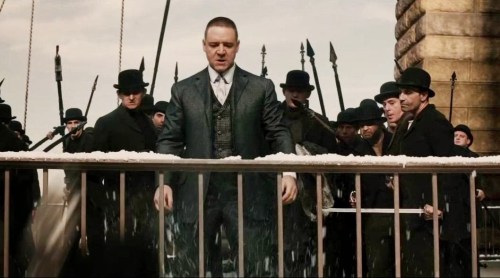
Athansor is a great white horse, the stuff of legends, which comes in handy when there are impossible distances to be leapt and rescues or escapes to be effected. Boy meets horse when this milk-truck equine’s fanciful walkabout through the city is interrupted by his encounter with Peter, who is fleeing for his life from the Short Tails gang and its larger-than-life leader, Pearly Soames. Pearly would like to send Peter to meet his maker with extreme prejudice for a betrayal we will learn about later. Athansor and Peter gallop through this imaginary version of New York, doing things like snatching hats off policemen and dashing through a theater in mid-performance. (A real hoofer on Broadway) If you think this is the beginning of a beautiful friendship, you would be right. Hi, ho, Athansor, Away!

description
Jessica Brown Findlay as …

Beverly Penn is a consumptive 18-year-old (they upped her to 21 for the film) heiress who suffers so from the fever of her condition that she sleeps on the roof in winter in order to cool off. (Cue the Drifters ) She is playing the piano when she is startled, seeing Peter as he is in the process of burglarizing the family home. Having had a vision that something significant would be changing her life, it seems clear to her that the something is the criminal element in her living room. She has other visions as well, visual and auditory perceptions of a reality beyond that of which mere mortals are aware. There are other large figures in the story, and other story lines, but these are the main ones. And the story of Peter and Beverly’s love is balanced by Pearly and Peter’s antipathy.
description
Russell Crowe as Pearly Soames with his droogies Short Tails

The author is not content to weave a tale around his maybe-doomed lovers, but offers us other couples to tote some of that emotional freight. We meet families at various points in their history. A tot in one section becomes a capitalist scion in another, for example. I will spare you too much plot summary, or a fuller list of characters. Even by my generous standards it would be excessively long. But I have included a link to such a blow-by-blow in the Extra Stuff section if that seems useful. Suffice it to say that in upstate New York there is a Brigadoon-like town known as The Lake of the Coheeries, and some pretty magical things take place there. No, you do not have to wait a hundred years before it appears. It actually does not appear on any maps, but can be accessed if you know how. It is the source for several of our additional characters, and some fabulously creative images. It lies beyond the crucible zone that surrounds the city, substituting a huge hill of ice and snow as a barrier for the white clouds that enclose the city farther south. The town serves as a fairyland version of the country, in the same way that Helprin’s vision of New York City (well, really, Manhattan. His vision of the city offers little for the other four boroughs than a Breughelian image of them as places to avoid.) is a fantastical version of the real place. But all this seems a maguffin for the real business here, which lies in the themes being addressed.

Themes
Mark Halperin has written a love song to New York, well, parts of it anyway. There is a stunning lyricism to his descriptions of the city, alive with romantic vision, yet also fueled by a dose of paranoia and class fear. But he is after bigger fish than venting his affection for The Big Apple or whatever nickname might apply in his alternate universe, a whole ocean’s worth. Small matters like free will, the nature of existence, the relationship between the rational and the spiritual, the nature of time, justice, mortality. You know, stuff.

Helprin argues that the spiritual must accompany the rational or the result is a soulless existence.

Well, we’ve been mechanized. We view ourselves as mechanisms. This is a trend since The Enlightenment. The Enlightenment, in my view, has two streams – a good stream and a bad stream. The good stream is the beauty of reason, to approach something via scientific method, via logic. The ugly part of The Enlightenment is that if you confine yourselves to those methods, then you are limiting yourself in terms of your understanding of what a human soul is. By necessity, because you cannot define the soul as it’s not subject to proof, human beings become mechanisms. Without faith, a person is a mechanism, and then there’s no reason he shouldn’t be treated or work under those assumptions, as a mechanism. – from Contemporary Lit interview

Is there some underlying logic to our universe, machines, physical, psychic or spiritual that whirr, turn and grind to support everything?

“Apart from natural laws, from the world as we know it,” Hardesty speculated, “maybe there are laws of organization which bind us to patterns that we can’t see and to tasks that we don’t perceive.”

And Helprin takes a long view of things

“Churchmen,” she had said, “like Boissy d’Anglas, burn themselves up in seeking, and they find nothing. If your faith is genuine, then you meet your responsibilities, fulfill your obligations, and wait until you are found. It will come. If not to you, then to your children, and if not to them, then to their children.”

Helprin posits a world or worlds in which the select few can see and access an underlying reality, and it is not clear that there is a path to this understanding other than dumb luck. One must wonder if the writers of The Matrix or promoters of born-again-isms had Helprin in mind.

her strength was not derived from things which can be catalogued or reasonably discussed. She had an inexplicable lucidity, a power to see things for what they were. Somehow she had come into possession of a pure standard. It was as if lightning had struck the ground in front of her and had been frozen and prolonged until she could see along its bright and transparent shaft all the way to its absolute source.

No, this is not taken from the Left Behind series and Bev was not bitten by an irradiated spider.

Brooklyn Bridge and God

The city as crucible, which we first see from a god-like view, looking down, is surrounded by an enormous and deitifically powerful white cloud. Unlike the low-hanging clouds in real NYC, which can make building tops appear to vanish when they pass through, this white cloud can actually take the things it touches. It makes the city into an almost-closed system that will experience both the deadly cold of extreme winter and intense heat from another source.

“…these winters have not been for nothing. They are the plough. The wind and the stars are harrowing the land and battering the city. I feel it and can see it in everything. The animals know it is coming. The ships in the harbor rush about and have come alive because it is coming. I may be dead wrong but I do believe that every act has significance, and that, in our time, all the ceaseless thunder is not for nothing.”

There is the potential for greatness in cities, this one in particular, but there must be a blood-letting in order to usher in a new golden age, and that seems perfectly fine for the god of this novel.

The notion of justice also comes in for considerable attention. Peter’s first craft is named “City of Justice.” Jackson Mead, a builder of bridges, says, “My purpose, in one word, is justice.” A significant silver tray that Hardesty Marratta (a significant character) cherishes in inscribed thus: “For what can be imagined more than the sight of a perfectly just city rejoicing in justice alone.” Peter engages in a quest for justice as well. In a passage about time, justice gets the final word

The universe is still and complete. Everything that ever was, is; everything that ever will be, is—and so on, in all possible combinations. Though in perceiving it we imagine that it is in motion, and unfinished, it is quite finished and quite astonishingly beautiful. In the end, or, rather, as things really are, any event, no matter how small, is intimately and sensibly tied to all others. All the lost ones are redeemed; the dead come back to life; the perfectly blue days that have begun and ended in golden dimness continue, immobile and accessible; and, when all is perceived in such a way as to obviate time, justice becomes apparent not as something that will be, but as something that is.

And it’s just tough luck on those who fall afoul of the currents of time. If you are rich, then I guess you were meant to be, and if you were dirt poor, well, sorry, it was always thus. It does strike me that this is a point of view that might be favored by those who have landed in the cushier seats.

Imagery
Be careful where you step. You may bump into another image. Gates figure large here. Both the literal gates that surround the Battery in lower Manhattan and a set of four psychic gates that cities are supposed to have, (resonating with the four parts of the novel) visible, of course, only to people who are very, very special. Color figures large. Pearly (whose name certainly reflects the seasonal milieu) is deeply affected by color and seeks it out by whatever means possible.

But, whereas the wall was white, the city was a palette of upwelling colors. Its forms and geometry entranced him—the orange blaze in clear upper windows; a gas lamp’s green and white bell-like glare; leaping tongues of fire; red-hot booming chambers in the charcoal; shoe-black horses trotting airily at the head of varnished carriages; peaked and triangular roofs; the ballet of the crowds as they took stairs, turned corners, and forged across streets; the guttural noise of machinery…sails that filled the ends of streets with billows of white or sharp angular planes, and then collapsed into the bordering buildings or made of themselves a guillotine

Blue and gold come in for particular and much-repeated attention. Stars shine brightly here as well, whether the actual universe of stars or their simulacra in a large chamber or a magical painting. Bridges and rainbows carry significance as well. Machines are also more than mere mechanisms.

description
Mark Helprin – image from NPR

Politics
In case you did not know, Helprin is a political sort, a conservative true believer who writes speeches for Republican leaders. His particular sensibilities enter here as well, as he offers the odd diatribe on how any sort of public assistance is a form of satanic temptation, leading good people astray and allowing bad people to milk the rest of us to support what is portrayed as a life of low leisure. He also has a vision of wide swaths of the lower classes as being purely bent on destruction, as if the race riots of the 60s had burned a hole in his vision and he was forced thereafter to see everything in the world through those altered lenses. It gets intrusive at times. At least he has the decency to balance his Ayn Randish laudatory portrayal of one mogul with an equally dark one of another (a Rupert Murdoch stand-in). And he does offer an interesting proposal for an ideal way to organize a company that speaks to a need for fairness, but which would never be tolerated in the real world by those whose mission it is to absorb ALL the wealth. He also harbors a view of criminality that is, to say the least, eccentric. That said, the political aspect, while present and occasionally toxic, could have been a lot worse.

In Sum
What is impressive about Winter’s Tale is the sheer volume of creativity on display here. His portrayal of a Dickensian sort of steam-punk New York was fascinating and effective. The Lake of the Coheeries is very effectively magical. But just as it is wonderful to enjoy a slice of cake, it can become a different sort of experience if one were to try devouring the entire thing. So it is here, a case of creativity run amok. The author wanders off. For example, after we have invested in Peter, Beverly and Athansor, Helprin sets them aside for almost two hundred pages to play in some other snow fields. Really? Helprin is at his weakest when attempting a sort-of slapstick humor. Those bits fall very, very flat. As do sections where a character acquires otherworldly powers. And Athansor’s propensity for arriving in the nick of time to save this or that one makes one wonder if he might have been a sort of deity made by one of the many machines that populate the story. If you have not yet read Winter’s Tale, prepare to make a special effort to keep track of the characters. There are many. And, oh yeah, lest you think the opening quote was purely gratuitous, there are resurrections here. Helprin is definitely thinking BIG.

You may find Winter’s Tale exhilarating and you may find it exhausting. You may feel enlarged by the beauty of the imagery and reduced by the occasional mean-spiritedness manifested by the author. You may feel intellectually stimulated by the grand notions portrayed, but deadened by the familiar trope of access being reserved only to the elect. You may feel deeply at the poetry of Helprin’s descriptions, (they certainly sing to me in my love for my home town) but may experience frustration that he takes so bloody long to get to the point. Winter’s Tale may leave you cold, or it may warm you to unimagined possibilities. But whether your reaction is pain, exultation or both, you will definitely react. Winter’s Tale has been called one of the 25 greatest American novels of the 20th Century. I do not agree, but I can see why some people think that. It is pretty clear that it is one of the most ambitious. I believe it would have been a better book with a tighter focus and about two hundred or so fewer pages. But, even though I have issues with the book I do believe that it is well worth reading. Winter’s Tale may not have completely warmed the cockles of my reader’s heart, but it is still pretty chill.

Posted on GR on February 28, 2014

==================================EXTRA STUFF

Interview with MH in The Paris Review and in Contemporarylit.com – This the source of the quote from the author used in the review

This review in the Thriving Family web site contains a detailed run through of the events of the book and a look at some of the imagery

Leave a comment

Filed under Fantasy, Fiction, Literary Fiction, Reviews

Gravesend by William Boyle

book cover

When a man knows another man
is looking for him
He doesn’t hide.

–Frank Stanford, “Everybody Who is Dead”

Even death starts to look attractive when hope is gone. And the fittingly named Gravesend of William Boyle’s first novel is a place where hope is regularly interred. Conway D’Innocenzio and RayBoy Calabrese are in a race. The finish line is their own demise, and the contest is neck and neck all the way. Death comes in many guises. Conway’s big brother, Duncan D’Innocenzio, found his when a gay-bashing teenaged thug and his pals chased him into traffic on the Belt Parkway. RayBoy, the alpha asshole, did 16 years for the deed, but the RayBoy that was is no longer. Now he is looking to pay for his crime for real. Conway wants to kill him, which would seem a nice match. Only problem is that, after sixteen years of planning his revenge, letting his life waste away while he stewed, Conway can’t seem to pull the trigger.

The death-wish field here makes it seem more like a group outing than a pairs event. Ray’s nephew, Eugene, is a 15-year-old, wanna-be thug, with a limp, a misguided case of hero worship and a worse case of bad judgment. Alessandra, an actress back from the other coast to help take care of her widowed father, is one of the few main characters here who seem determined to stay alive. The old classmate she looks up, Stephanie, is the epitome of what it is to be trapped like a rat in the place where you grew up, and to internalize the incarceration.

This is not the well-heeled Brooklyn of the Heights, the Slope, Fort Greene or Boerum Hill. Not the trendy arts scene of DUMBO, not the hipster haven of Williamsburg, nor the post-apocalyptic deathscape of Brownsville. Gravesend is a neighborhood on the southern end of Brooklyn, working-class, ethnic, hard-scrabble. Like most neighborhoods in New York it watches as one immigrant group moves up, hopefully, and another moves in. It used be primarily Italian, still is, but things are changing. Not always for the better. Unfortunately, for some, they are not changing enough, and the only way up is to blast your way there or to leave entirely. The place has its share of gangsters and gang-bangers, dive bars and secluded, while public, spots for the exercise of what is usually private behavior. And the environment helps make these characters who they are.

description
The author was raised in a small town in Brooklyn, and now writes and teaches in Mississippi – “I see Brooklyn in new ways from here.”

Boyle has plenty of experience with working class Brooklyn life, having had a full measure, hailing from the County of Kings, Gravesend in particular. He communicates quite well the ironically small-town feeling that pertains in so many New York neighborhoods, where kids have only a slight image of what may lie across the bridges and tunnels in Manhattan, or pretty much anywhere in the wider world. I can affirm from personal experience that Boyle speaks truth.

Neighborhood as small town or not, is it possible to go home again? And would you really want to? Can one really get satisfaction from revenge? Or is it that, in the same way that depression is anger directed inward, revenge is self-loathing directed outward?

The writing here is taut. I would not say that Boyle’s text is a place where adjectives go to die, but they’re not bleeding over the edges of the pages either. The narrative movement is certain and consistent, moving towards resolution of the inevitable sort. Which is not to say there are no surprises. There are. The story is not a mystery, per se, but more a look at how place affects people. Rayboy was admired as a kid for his thuggish exploits, was found attractive by girls. Not exactly a disincentive. Homophobia was hardly unknown in the environment of his youth. His nephew Eugene, short on adult male models on which to base his vision of what being a man looks like, fixates on the one male he knows who was effective and respected.

While the bulk of the story is dark, there are some rays of light. Good can be found, although more in thought than deed. Hope digs its way back up to the surface, allowing for some second chances. Alessandra’s affection for a particular painting at the Met can be seen both as an artistic inspiration and an omen. Her participation in various forms of Manhattan life lifts her spirits. After all, she did manage to make it out to the west coast. But hope had better move quickly before another body lands on it. Stephanie latches on to Alessandra as a way out, but she may be too limited to make a go of that.

Most of the characters may not be the sorts you would want your children to marry, but they are very well realized. Boyle offers us abundant surface, but also scrapes plenty of layers away so we can see what is going on beneath.

My gripe with this book was definitely of the minor sort. The title, Gravesend, is particularly apt, suiting well the content, given the body count, whether from violence or less dramatic means. But Boyle wanders a bit in his native borough. If you are expecting a singular, focused portrait of this neighborhood, fuhgeddaboudit. The author gives us a look, for sure, but we also spend time in Bay Ridge, Sunset Park, Manhattan’s East Village, a small slice of Queens and even go for a couple of jaunts upstate along the Hudson, these reflecting the author’s personal NY geography, or a lot of it anyway.

It was fun to walk through so many places that are personally familiar, Nellie Bly, the promenade near the Verrazano Bridge, Xaverian High School under another name, subway stations, and so on. I also related to the Stephanie character, as one of the things that makes me truly shudder is the thought of being stuck back in the Bronx neighborhood in which I was raised. No love-hate issues going on there. Such dark fears constitute more of a Twilight Zone episode.

Arthur Miller lived for many years in Gravesend, as did Carlo Gambino. In Boyle’s Gravesend we get to hear the patois of the latter, and look at the people and places of his tale through eyes that see the world a lot more like the former. Gravesend, Boyle’s first novel, is a pretty good beginning to what promises to be a very illustrious long-form career. Dig in.

=============================EXTRA STUFF

Links to the author’s personal, Twitter links

Interview with the author from LA Review of Books – mucho goodness to be had here

Another wonderful interview with Boyle, by Irene McGarrity

Plumb Beach is the scene of a crime – here is some info on the place

A real life case that, the author confirmed, provided inspiration for the story.

This is the Joan of Arc image that Alessandra focuses on in the Metropolitan. It is a mind-blowing painting to see in person. This link adds some background to the work.

Leave a comment

Filed under Fiction, Reviews

This Dark Road to Mercy by Wiley Cash

book coverThere is a lot of used-to-be in Wiley Cash’s sophomore novel, This Dark Road to Mercy. Wade Chesterfield used to be a baseball player, used to be a husband and used to be a father. But he went oh-for three and now, as a guy who used to hang drywall and is on the run, he is mostly a crook.

Bobby Pruitt had been a ballplayer too, but his damaged youth led him in a dark direction, and now he is an enforcer for a local thug. He would like to apply his professional skills to Wade, not only in service of his current employer, but as personal payback for something Wade had done to him on the ballfield. He presents a clear and present danger not only to Wade but to his family.

book cover

Wiley Cash

Brady Weller used to be a police detective, but after he was involved in an event that left a boy dead, he became an installer of home security systems, working for his brother-in-law. There is more going on with Brady, though. He is also a court-appointed guardian to children in need of such protection in Gastonia, North Carolina. This includes two young girls.

Easter Quillby hasn’t been around long enough yet to have much in her rear-view. But more than most pre-teens. Wade had surrendered custody of her and her little sister, Ruby, a few years back, and mom died recently of a drug overdose. Have a nice childhood. She and Ruby live in a state-run orphanage.

Writing in the voice of a child has its risks and rewards. Children often lack the power of reflection that adults possess, so their narratives can charge forward without the breaks of reflection or evaluation. Adults are more cautious, especially about what they divulge. If a child is an unreliable narrator it’s probably because he or she doesn’t fully understand what he or she is talking about. If an adult is an unreliable narrator then it means that he or she is hiding something. But child narrators also offer a challenge in terms of their emotional make-up. Their reactions to tragedies great and small are often displayed in similar ways. A young child’s reaction to the death of a pet can be similar to the reaction to the death of a family member. With that in mind, you have to be very careful about how you portray a child’s emotional scale. You want the reader to be able to intuit its depth even if the child’s reaction doesn’t reflect it. – Cash ,in an interview with Crime Fiction Lovers

Easter, Brady and Pruitt are the three alternating narrators through whose eyes we see the events in Cash’s tale. We see Wade mostly through Easter’s eyes.

The action of the novel consists of Wade re-entering the girls’ lives after years of absence, snatching his daughters to join him as he flees dark elements in Gastonia, Pruitt pursuing Wade do him harm, and Brady trying to protect the girls. There are white-knuckle moments in this chase.

One of the true strengths of Wiley Cash’s debut novel, A Land More Kind Than Home, was his portrayal of children. That gift is manifest in full power here. Easter certainly reminds one of Scout from To Kill a Mockingbird, and the usual Stephen King pre-ad heroes and heroines. And with a name like Easter you’ve gotta figure she is gonna be reborn someway, somehow. Name a girl Ruby and I expect most of us might think of slippers and “There’s no place like home.” That would make sense here, for a girl who is hoping to have a family again. But it is Easter who will hold your attention and your affection. When there is danger afoot you will really, really want for Easter to be ok. She is not only a tough and decent kid, she is a very well-drawn one, and the best thing about this book

There are several threads (maybe red stitching?) running through The Dark Road…. Baseball figures large. Page 1 introduces Easter on a ballfield. Wade was a professional player, as was Pruitt. And when baseball is in play, one need not look too far to bring in the element of steroids. Wade and Pruitt have a history with them, and one of them still imbibes. And speaking of steroids, the time is 1998, and McGwire and Sosa are engaged in the most famous ‘roid-fueled home run derby of our age. The contest is large in the consciousness of these characters, and a subject of widespread daily conversation in the environments they inhabit. The heavy-hitters’ contest is even used in a very Hitchcockian way to provide a dramatic backdrop for the climax.

description
The Race is On

Another seam here is parenting. Wade is not a complete screw-up. He may not have made the best choices, and he may not be, exactly, the best person, but he does love his kids, and wants to be a father to them. But abandoning them for several years and snatching them on his way out of town was probably not what a good parent might do. Pruitt’s upbringing comes in for some inspection as well. And Brady copes with having a surly teenager he only gets to see some of the time. Finally, atonement comes in for a look. Wade may be a criminal, but he does want to make up for having left his children. He really wants to make a better life for them. Brady wants to atone for his part in the fatal accident, and does so by acting to protect vulnerable children. Pruitt is more interested in payback than atonement.

Another item you might keep an eye out for is the notion of what’s in a name.

Mom always said that she’d named us what she’d named us because those were her favorite things: Easter was her favorite holiday and rubies were her favorite jewels. Me and ruby used to ask Mom all the time what her other favorite things were, and we’d pretend those things were our names instead…It seems crazy to say we played make-believe like that now, but we used those names so much they almost became real.

Easter has to contend with a real-world decision concerning her name, and there is at least one adult in the story with a temporary alias, and another who has adopted a new name permanently.

Finally, this is a road trip, (it is even in the title) and that usually means a journey of self-discovery. The girls’ fondness for the computer game Oregon Trail foreshadows their later journey with Wade. What will these characters discover, how will they change, grow or wilt on this trip? A Catcher in the Rye mention does let us know there is some of coming of age going on. The girls are looking for a family. Pruitt is looking for revenge and Brady is looking for redemption. Wade is looking for some sort of gateway to a Promised Land.

”Oklahoma, Texas? California?” His eyes got bigger as he listed the names. “We could keep going clear on to the Pacific Ocean if we wanted to.”
“Then what?” I asked. “We can’t live in this car forever.”
“I don’t know,” Wade said again. “I guess that’s why they call it an adventure.”

This is an engaging and fast-paced story. A pretty fair read. I do have some gripes of course. While the attempt for a North by Northwest moment was ambitious, it was not fully realized. Of course by then you have already enjoyed 95 percent of the book so it is not a huge issue. I still read Stephen King and I usually do not much care for his endings either. I did feel that some decisions made by characters here were stage-managed a bit too much. Why such and like has to take place here and then might fit into the author’s desire for the most dramatic possible setting, but did not make all that much sense to me as something the characters would actually do. There are also some convenient events that are inserted into the story to prepare one for the finale. It seemed to me that these were artificial and a bit jarring. Fine, whatever. It’s still a pretty good read, and those elements might not make your Spidey senses tingle the way they did mine.

This Dark Road to Mercy is indeed dark, but illuminated. There is plenty of road to contrast with a desire for home, and sufficient dollops of mercy to soothe sundry pains. This road is one worth taking.

This review was posted on January 28, 2014 – the day the book was published

=============================EXTRA STUFF

Links to the author’s personal, Twitter and FB pages

Interview in Crime Fiction Lovers – this is the source of the writer’s comments on writing kids quoted in the review

Leave a comment

Filed under Baseball, Fiction, Reviews

A Permanent Member of the Family – Russell Banks

book coverGiven the unsettled nature of the families in Russell Banks’ dozen stories, the title of his sixth short story collection, A Permanent Member of the Family, might have a bit of an ironic aroma to it. Marriage is, if anything, impermanent here. The title character in Former Marine had to raise his boys alone after their mother took off. Philandering, while not depicted, is noted as causative in the demise of several other relationships in the collection. And even when a marriage has not dissolved, it is often shown to be or to have been threadbare. There are a few stories where things marital are not seen, Blue, The Invisible Parrot, but the tendency is to the sorry state of home and hearth. It is not surprising that marriage has such a central place in the author’s work. His current marriage is his fourth.

all of us were fissioned atoms spun off nuclear families, seeking new, recombinant nuclei

Lines are drawn, and crossed. They separate before from after, denial from acceptance, uncertainty from realization. In Christmas Party, for example, a man is invited to the home of his ex and her husband for a party, and his underlying humiliation and rage must find an outlet before he can cross over from before to after. A singular event in the title story defines the place where the stretching of connections snaps.

book cover

Russell Banks – from Wikimedia

The characters here often face moral choices, a favorite concern of Banks. Faced with financial stress in his old age, a Former Marine must make difficult decisions in order to be able to continue providing for his children, and later, in order to protect them. In Lost and Found, a businessman at a convention is confronted with the time when he brought a woman who was not his wife to his hotel room, and the decision he faced then. In Searching for Veronica, a woman confronts the guilt she felt for turning out of her home someone who was at great risk in the larger world. The choices are never black and white.

Banks sets his stories largely in the upstate New York town of Keene, his current residence, near Lake Placid, and Florida, his other current residence, so his descriptions of place ring with authenticity. He has a background as a politically concerned sort (he tried joining Castro’s revolution, despite not knowing how to speak Spanish, but got no farther than Florida) and his appreciation for the struggles faced by working people is never far. He had a working class upbringing himself.

I think I inevitably end up feeling a special kind of sympathy for people whose lives are shaped and controlled and manipulated by people with more power than them. – from Harpers article

It is also pretty clear that he holds a less than fond opinion of the media, whether the whores are the media professionals or those who would use them to personal ends, as shown in Blue.

Banks has achieved a status as one of the top writers of his generation, with a dozen novels to his credit, including Continental Drift, Affliction, The Sweet Hereafter and Lost Memory of Skin. A Permanent Member of the Family is his sixth collection of short stories. I found these tales to be extremely well told. There are ironic twists, as every writer of short stories must have at least a bit of O Henry DNA floating about. Banks won an O Henry award for his short story collection Searching for Survivors. A few did not grab me, seeming somewhat obscure commentary on writing per se, but most presented relatable characters confronting real-world choices, or repercussions. Banks has a gift for detail, without cluttering the place up with too much. His style is straight ahead story-telling with less of the lyrical description some other writers employ.

The work of a seasoned pro, A Permanent Member of the Family merits at least a temporary place with yours.

===============================THE STORIES
Former Marine
Faced with the loss of his business and a need to support himself and help out his three sons, who far too conveniently are all in police work, a man takes to a life of crime.

A Permanent Member of the Family
A family pet does not go along with a splitting couple’s custody arrangements. An event regarding the pet defines where one family situation ends and another begins

Christmas Party
A man is invited to the Christmas party thrown by his ex and her husband, who are living the life he had hoped for. What to do with the rage? How to move on?

Transplant
A recent heart transplant recipient is approached by the widow of the man whose heart he received, wanting to hear it beat one last time. The heart may replace the one that stopped working, but cannot truly replace the one that was broken.

Snowbirds
While snowbirding in Florida, a woman’s husband dies. Instead of grief, she appears to feel liberated. And when a friend offers to come help her with arrangements she finds something more.

Big Dog
Seems like it would be a cause for celebration when a sculptor is awarded a Macarthur Fellowship, but his wife and friends seem more resentful than anything else.

Blue
After saving for years to be able to by a car of her own, a black woman in Florida finds herself accidentally trapped in a used car lot after hours, beset by a watchful pit bull.

The Invisible Parrot
A young man in a local store tries to imagine the experience of others there, but imagination is not quite enough. Is this the writer wondering about the ability of writers to imagine the experience of others?

The Outer Banks
A retired couple’s dog has passed away while they are RV’ing about the country. They stop at a beach in North Carolina to bury it.

Lost and Found
A man meets a woman he had almost slept with at a conference years before. He looks back on that decision.

Searching for Veronica
A woman is fearful that a person she tossed out of her house some years back has come to a bad end.

The Green Door
A questionable character in a bar is looking for a place where he can get unusual entertainment. The bar tender directs him, but faces another decision about helping or not helping the man later.

Review posted on GR – 12/29/13

==============================EXTRA STUFF

From December 12, 2012 Harpers – A Conversation with Russell Banks – by Jesse Barron

A wide-ranging interview in the Paris Review

A critical review of his work up to 2001

Banks reads his story “The Moor” on This American Life in 2000 – 19 minutes long, from the 40 minute mark in the program

A New York Times interview with Banks – 1/2/04 – Russell Banks – By the Book

Leave a comment

Filed under Fiction, Literary Fiction, Reviews, Short Stories

The Wind is not a River by Brian Payton

book cover

The Aleutian Archipelago: fourteen large and fifty-five small volcanic islands, strung over more than a thousand miles. Somewhere there, he’s alive. On good days, her faith overshadows doubt. And what is faith but belief independent of proof, a conviction that stands on its own. To this she knows John would roll his eyes. The thought makes her smile.

John Easley is missing. Shaken by the death of his RCAF brother over the English Channel, the 38-year-old writer determines to bring information to the people at home about what is really happening in the war. It seems so much more meaningful to him than reporting on bird migration for National Geographic. He feels he owes Warren at least that much. His wife, Helen, disagrees. Their last words before he took off yet again on a war-reporting mission were harsh, and final.

She is facing challenges of her own. Her father is not well, and she wants to be there for him. She is struggling with not having much by way of work skills and is stuck at a low-level job. John’s absence gnaws at her until, realizing that she still loves him, she decides to do everything in her power to find and bring him home. John had bailed out from a damaged aircraft over the Japanese occupied island of Attu. He struggles to survive in the treeless tundra. Helen struggles to find him.

book cover

Brian Payton – from his site

The story flips back and forth between the challenges John and Helen face. John has to figure out how to stay alive, and hidden from the occupying army. I was reminded of David Malouf’s excellent book, An Imaginary Life , about another person isolated in an arctic realm. Helen must figure out how to find John. Both face daunting tasks.

The Wind is a powerful, beautifully written, heart-wrenching love story, but sails well past any simple notions of romance. There is struggle here with the imagined instead of the actual partner. Does there come a time when imagination, whether fed by love or not, loses its sharp focus? How can love survive absence of the other? How far can love take a person when the odds are overwhelmingly against? Can love keep someone alive?

In addition to the compelling tale of a reverse Odyssey, one in which Penelope goes in search of Ulysses, Payton offers us considerable payload in his look at a little-seen part of WW II history. For those who thought that the last time the USA endured the landing of foreign troops was during the War of 1812, you have another think coming. Japan captured and occupied several of the Aleutian islands, and had plans to advance farther. News media of the time was subject to government censorship and the political leaders did not want it known that a foreign power had successfully invaded US territory. We are given a look at a remote and challenging aspect of the war. Along those lines Payton drops in bits of information. For instance, because the land was challenging as a place on which to build strong flat surfaces, a runway was constructed of metal matting cinched together. Another scene shows Americans dropping off planes for Soviet pilots to fly back to the USSR and use in the war on Hitler. We also get a look at the USO,

USO in the Aleutians
The USO sees action – from strangemilitary.com

and, chillingly, the treatment of local evacuees by the US military. So, food for the brain as well as the heart.

As for gripes, I have two. While the cover art is beautiful, it fails to let the reader know what this book is all about, focusing as it does on a single early moment in the story, and ignoring what follows. I was not all that thrilled with the ending. But that did not detract from the great joy that can be had reading this book. Your heart will get quite a workout. John Easley, a decent guy, is engaged in a prolonged life-and-death struggle, and Helen’s love takes on heroic dimensions. There is a large range of emotion from which to draw here. Uplift to be experienced, delight in beauty of various sorts, appreciation for the sacrifices of some, anger, sadness and disappointment as well. Bring your hankies. The love that Brian Payton portrays glows even brighter against the spare environment in which it is set.

Publication Date is January 7, 2014

Review posted 12/16/13

=======================================EXTRA STUFF

Links to the author’s personal, Twitter and FB pages

The American Booksellers Association named the Wind is not the River a January ’14 Next List pick

Mention is made in the book about John Huston making a documentary of the military campaign in the Aleutians. Here is the film, Report from the Aleutians. It clocks in at 43:13.

A shorter (17:26), color version can be found here

Here is a map of the Aleutians that seemed too tough to read to fit the image into the body of the review

The National Park Service also has some interesting information about the Aleutians here

Leave a comment

Filed under Fiction, Literary Fiction, Reviews

Catching Fire by Suzanne Collins

book coverSparks fly in the second volume of Suzanne Collins’ blockbuster Hunger Games trilogy, Catching Fire. Victory in the 74th games has not been all that sweet for surprise double-victors Katniss Everdeen and Peeta Mellark. And it is extremely sour for the reigning government. Katniss had shown them up big time when she publicly defied the gamemasters to keep from having to kill Peeta, an act of sedition as much as it was an act of courage and honor. President Snow burns with rage at Katniss for showing up the games, the Capitol, and him personally. He recognizes that it is necessary to give the subjects of his government some hope, but Katniss and Peeta have provided a spark to the tinder of popular resentment, and Snow needs to forestall a conflagration.

description
The author

Katniss is not in a good place back in District 12 after the games. Yeah, she has a nifty new house in the victor village, and her family is well taken care of, but she is experiencing a fair bit of PTSD. Collins describes Kat the victor.

She has nightmares. She has flashbacks. And in the beginning you can see she’s practicing avoidance. She’s completely pushed Peeta to arm’s length, you know? She’s trying to stay away from him. Why? Because everything associated with him except some very early childhood memories are associated with the Games. She’s conflicted to some degree about her relationship with Prim because she couldn’t save Rue. So she’s dealing with all that, and her method of dealing with it is to go to the woods and be alone and keep all of that as far away as possible, because there just are so many triggers in her everyday life. – from the Time interview

Part of the requirement for games winners is to go on a Victory Tour across all the districts. One of the soft spots in the logic of the story is that President Snow would think for a second that parading across the defeated districts the youngsters who had killed their children was anything but a guaranteed recipe for disaster. It is believed that Katniss’ popularity and selling the lie of her death-defying love for Peeta would gain some love for the Capitol, and would dampen public unrest. Sure, whatever. Of course, Katniss manages to fan the flames of the people’s unhappiness with things as they are by her acts of kindness and respect for some of her fallen competitors and their families. As her popularity grows, the pin she wore in the 74th games, the mockingjay, spreads as a symbol of resistance. I am sure Emily Dickenson would approve. Time for Plan B.

description

With his hopes for a palliative Victory Tour in ashes, Snow come up with another plan. How better to douse the embers of hope than to destroy all those who would fan the flame. So, for the 75th games, instead of a new crop of potential contestants, children between 12 and 18, from whom game contestants might be selected, he decrees that this time the tributes (those selected) will be chosen from the pool of prior winners. Hell-uh-oh, Kat and Peet, this means you-oo. Hell hath no fury like a president scorned. There is no law, only power, and Snow aims to char those caught, or even suspected, of playing with matches. And if crushing the Hunger Games victors from all twelve districts crushes the rebellious spirit of the people, well, may the odds be ever in your favor. Of course, we all know there is a third volume in the series, so I am giving nothing up by reporting that the plan goes up in smoke.

description

There are many notions in play in Catching Fire, among them visions from the classical world of Greece and Rome. The whole notion of the games was taken from the Greek myth of Theseus and the Minotaur. King Minos of Crete had issues with Athens. There are varying accounts of how this came to be, but the accounts agree on the arrangement that was made. Athens was forced to send seven boys and seven girls to Crete every nine years to make a nice snack for a Minotaur, who resided in a labyrinth constructed by Daedelus. The kids are sent, but Theseus, an Athenian prince, wanted to get rid of the Minotaur, and thus the need for kid-burger specials, and so inserts himself in place of one of the young’uns. He gets some help from Cretan princess Ariadne, who offers a way for the children to escape the Minotaur’s maze after Theseus, hopefully, dispatches the beast. Her solution is significant here, beyond the classic story, as the unraveling of string, of a sort, figures large in Catching Fire in helping out the tributes.

Katniss Everdeen grew from a raw teen in Book I to become a warrior. She grows stronger still in Book II, overcoming her fears and miseries, growing in strength, even while accepting that her fate was likely sealed. She is a gladiator, thrown into an arena to do battle for the pleasure and control of the rulers. And another classical notion comes in here, the slave warrior leading a rebellion. Katniss, by defying the Capitol in Book I and by her actions this time, has become the face of popular resistance, whether potential or kinetic.

There are contemporary issues that resonate as well. Collins said:

The Hunger Games is a reality television program. An extreme one, but that’s what it is. And while I think some of those shows can succeed on different levels, there’s also the voyeuristic thrill, watching people being humiliated or brought to tears or suffering physically. And that’s what I find very disturbing. There’s this potential for desensitizing the audience so that when they see real tragedy playing out on the news, it doesn’t have the impact it should. It all just blurs into one program. – from Scholastic article

And it is not exactly news that we are increasingly living in a world in which the one-percenters get to live lives of obscene luxury while working people are denied basic rights. The ancient Roman practice of eating to excess, then using a vomitorium to make room for even more indulgence is brought up in Collins’ vision as a very telling link between decadence old and new.

And then there is the romantic element. Peeta is a wonderful guy, pure soul, gifted communicator, smart, strong as an ox, loves her, but, while she may find him attractive as a friend, does she find him attractive enough to throw over her childhood sweetheart, Gale? The pressure is unspeakable as the President, in order to save his own face, is insisting that she and Peeta make good on their cover story from their first game together. At the end of the 74th, Katniss had threatened pairs-suicide if the rulers insisted on having a single winner, and she prevailed. But the Capitol sold it as a manifestation of her love for Peeta, while the reality had been that she had stood up against the Capitol rulers. She agreed to help sell the lie after the games in order to keep bad things from happening to her family. Peeta and Katniss have to cope with the public lie of their being a couple, but must also contend with the fact that they really are very fond of each other. Add in another hottie in the shape of the studly Finnick Odair (a tribute in the 75th) and the potential for emotional imbalance is considerable.

Some of Collins’ secondary characters get to spread their wings a bit, most particularly the District 12 mentor, Haymitch Abernathy, who gets to do a lot but much of his activity is told after the fact rather than shown. The president, Coriolanus Snow, gets to strut and fret his hour upon the stage, issuing threats mostly. I expect it is no accident that the president’s given name is the same as that of a Roman consul notorious for his low opinion of the ruled.

Ok, I really enjoyed this book. I do have one gripe, though. Really, you knew there would have to be one. The Hunger Games story is really one long tale, and in order to keep from having to sell the book with its own set of wheels so you can tote it around, the publisher has divided it, like all Gaul, into three parts. (Unlike the greedy film makers who are taking it a step further and making four films out of a trilogy) And while it may make sense for this volume to have ended where it did, it seemed to me that it went from full on action to see ya next time in an awful hurry. That’s it. That’s my gripe. I had originally intended to make this a four-star rating, but on further consideration, in light of what Collins has done in terms of looking at real issues in a serious way, while offering top-notch entertainment, bringing in cultural foundations, and for making me root for a teenager to do something other than get a bad case of zits or run afoul of a serial killer, I am upping it to five. Catching Fire sizzles.

=======================================EXTRA STUFF

An excellent cheat sheet to catch you up on what happened in the first book

An interview on Scholastic.com

Neat bit on Theseus and the Minotaur in an SC interview in the School Library Journal

The five part Time interview

Part 1
Part 2
Part 3
Part 4
Part 5

SC’s site


2 Comments

Filed under Fiction, Literary Fiction, Reviews, YA and kids

Bird Box by Josh Malerman

book cover

Close your eyes and imagine the basso sound of voiceover icon Don LaFontaine intoning, “In a world gone mad…” and that is pretty much where Bird Box begins. Open your eyes and go mad. Kill others, yourself. Can you keep from peeking? For how long? In Josh Malerman’s post-apocalyptic, eye-opening scare-scape, something happened. An invasion? Some natural phenomenon? No one is really certain. But what has become clear is that anyone who steps outside with their eyes open goes insane, not just gibbering or confused, but violently and destructively, homicidally mad.

description
From the film

In the near-future today of the story, Malorie is a young mother, with two small children in her charge. She has been training them for over four years, to hear, with a sensitivity and acuity more usually associated with flying mammals. They embark on a river journey to what she hopes is a safe haven, twenty miles away, blindfolded. Any noise could be someone, or something following them. She must rely on the skill she has rigorously drilled into the boy and girl every day to help guide them, and alert them to danger. And we must wonder if the destination she aims for will offer relief or some version of Mistah Kurtz.

Chapters alternate, mostly, between the river journey and Malorie’s back story. We follow her from when The Problem began, seeing death and destruction in first a few isolated locations, then spreading everywhere, seeing loved ones succumb, then finding a place to live, a refuge, with others, and watch as they cope, or fail.

In horror stories, it helps to have an appealing hero. I am sure most of us have seen our share of splatter films in which the demise of each obnoxious teen is met with cheers rather than with dismay. The other sort is of the Wait until Dark variety, in which our heart goes out to the Audrey Hepburn character beset by dark forces. Bird Box is the latter type. Malorie is a very sympathetic character, an everywoman trying her best under ridiculous circumstances, more the Nancy Thompson (Heather Langenkamp) of Nightmare On Elm Street or the Laurie Strode (Jamie Lee Curtis) of Halloween, than the Ripley (Sigourney Weaver) of Alien, but Malorie does what she must to survive and to prepare with patience and diligence to sally forth against the unknown.

description
Author image taken from Fearnet.com

Malerman was bitten by the horror bug as an early teen:

My big introduction wasTwilight Zone: the Movie, the first horror movie I ever saw. After that came Saturday Shockers and sneaking in whatever I could at a friend’s house (Faces of Death, Psycho… Blacula…Prom Night.) I was also reading a lot. There’s a great period of horror fiction history, before the novel-boom of the 70’s spearheaded by Rosemary’s Baby, The Other, and The Exorcist, in which the short story ruled the genre. That period is golden and completely bursting with ideas. I read M.R. James, H.P. Lovecraft, Poe, Blackwood, Bierce, et al. When you first approach it, the genre, it feels infinite, but it’s not. So, come high school, I was trying to write my own scary stories, weird poems, strange tales. (from Detroit CBS Local news interview)

He likes to write with horror movie soundtracks on. And he is a musical sort as well, singing and playing in the band The High Strung. In fact, fans of Shameless, on Showtime, have already been exposed to Malerman’s work, as the writer and performer of that show’s theme song.

The dynamics of the house-full of refugees in the back story will feel familiar. Who to let in, or not, concerns over sharing limited resources, discussions over what adventuresome risks might or might not be worth taking re looking toward the future, or in trying to learn more about the cause of their situation. One might be forgiven for seeing here a societal microcosm, but I do not really think this was what Malerman was on about. He does offer a bit of a larger, thematic view though, tied to the central image of the book, which definitely adds to the heft of the story. A wondering at more existential questions

She thinks of the house as one big box. She wants out of this box. Tom and Jules, outside, are still in this box. The entire globe is shut in. The world is confined to the same cardboard box that houses the birds outside. Malorie understands that Tom is looking for a way to open the lid. He’s looking for a way out. But she wonders if there’s not a second lid above this one, then a third above that.
Boxed in, she thinks. Forever.

You really want Malorie to reach safety with the children, but there is a gauntlet to be run, and there is no certainty that any of them will make it. The dangers are human, natural and eldritch, and I mean that in a very Lovecraftian way.

You will definitely not want to put Bird Box down once you pick it up. This is a very scary, and gripping novel. If you are reading on the train, you may miss your stop. If you are reading at bedtime, you will definitely miss a few winks, and might want to sleep with the lights on after you finish.

I think some horror authors are trying to scare you, but with me, I’m as scared as the reader is of the story. I’ve always been that way, since watching the Twilight Zone movie — watching Firestarter when my parents were out, or sneaking out to watch A Nightmare on Elm Street at a friend’s house because I couldn’t watch it at my house. That makes you doubly scared — of the movie, and of the possibility of Mom finding out. (from Metrotimes interview)

A generic problem I have with the book is that the dark elements here sometimes tend to step back when they have decided advantages, failing to make the most (or worst as the case may be) of their positions. It was not obvious to me that there was some point being made by these unexpected choices. Nevertheless, Malerman takes the notion of the unseen and pushes readers to create the scariest thing of all, that which lurks in the imagination.

It is not at all dangerous to see how much fun this book is. Usually it is considered a good thing to think outside the box, but in this case it is clearly a far, far better thing that Malerman has done his thinking inside one.

Posted on GR November 19, 2013

Pub date – May 2014

=======================================EXTRA STUFF
Interviews

Huffington Post
Detroit CBL Local News
Metro Times

JM on FB
The High Strung on FB

Leave a comment

Filed under Fiction, Horror, Reviews

The Enchanted by Rene Denfeld

book cover

What matters in prison is not who you are but what you want to become. This is the place of true imagination.

Rene Denfeld, the author of The Enchanted has the heart of a warrior and the soul of a poet. She has written a novel about identity, understanding, the roots of crime, the reality of prison life, the possibility for redemption, and the ability of people to use imagination to rise beyond the purely material to the transcendent. There are three primary and several very strongly written secondary characters whose stories are interwoven.

In the death row of a stone prison somewhere in America, a nameless inmate, entombed in a lightless dungeon, has constructed a fantastical appreciation for the world he inhabits, bringing a glorious light into his Stygian darkness.

The most wonderful enchanted things happen here—the most enchanted things you can imagine. I want to tell you while I still have time, before they close the black curtain and I take my final bow.

In reading, he has the freedom his external circumstances preclude. And he interprets his surroundings through a magical lens. The rumblings of tectonic activity become golden horses racing underground. He sees small men with hammers in the walls (a particularly Lovecraftian notion) and flibber-gibbets, beings who feed on the warmth of death itself. He visualizes his very sweat rising to join the atmosphere and raining down on China. He is also able to perceive feelings and needs in others, observing from his isolation, and offering a bit of narrator omniscience. That he is able to find enchantment in this darkest of situations is breathtaking. I was reminded, in a way, of Tolkien’s Gollum, the battle between the darkness and the light within a single being. But enchantment is not reserved for the inmate alone.

description
Rene Denfeld

An investigator, known only as The Lady, is working on the case of a prisoner named York. After being on death row for twelve years, York had decided to abstain from any further appeals. The Lady had been hired by York’s attorneys to look into his case. We follow her as she unearths a horrific past that helps explain how York came to be where and who he is. She has a history of her own that informs her ability to relate to her clients. Once upon a time she needed a redoubt of her own.

What did she think about during those endless hours in the laurel hedge? As a child, she made an imaginary world so real that she could feel and taste it today. Sometimes she would imagine that she and her mom lived on a magical island where the trees dripped fruit. Other times they traveled all over the world, just the two of them, like the best of buddies. In all the stories her mom was whole and she was safe. When she left the laurel hedge, she would bend the thick green leaves back, to hide where she had been. And when she came back the next day, crawling with a sandwich she had made of stale bread with the mold cut off, and hardened peanut butter from the jar, the magic would be waiting for her.

She has enchantment in her adult life as well, while pursuing her investigation, as she is dazzled by some of the natural beauty she encounters.

A fallen priest tends to the spiritual needs of the inmates, but he guards a secret that he desperately needs to confess. While he offers what comfort he can to the inmates, who can really see him? Who can forgive him?

Much of this novel is about seeing and being seen, of crime, punishment and forgiveness. The Lady’s role is to see the prisoners, see their history, see what lies beneath the awful exterior. She is respected and admired, but not much seen herself. Many of the inmates and guards get by precisely because they succeed in remaining unseen. Prison is a dangerous place in which to be seen. Those who see might use that vision for dark purposes.

Denfeld lifts a wet rock to reveal the maggot-ridden structure of unofficial prison governance, the corruption and cruelty that permeates this world, even with a fair warden nominally in charge. Corrupt guards ally with brutish alpha inmates for their mutual gain. There is considerable detail about prison life, including such things as why metal food trays are used instead of plastic, how the bodies of the deceased are handled, what events are considered disruptive and what are considered ameliorative, and even some history of the prison, including reasons for elements of its design. She also looks through the eyes of the warden and the guards, offering keen insight.

The story lines include learning what The Lady discovers as she looks into York’s past, following the travails of a new, young, white-haired prisoner, seeing how corruption in the prison operates, and accumulating bits of the nameless prisoner’s story.

There are indeed monsters inside the stone walls, as there are monsters without, both drawn to the despoiling of innocence and beauty. But in this pit of ultimate despair, where all hope is lost, there is magic of another sort. Life may be harsh and death may be near, but welcoming the golden subterranean steeds, attending to the little men with hammers, imagining elements of one’s self traversing the planet, traveling along with the characters in a book, seeing, really seeing others, can lift one beyond the cares of the physical world.

Can there be redemption for the horrific crimes these condemned men have committed? Should they die for their crimes, whether they want to or not? Might it be a harsher punishment, even crueler, to keep them alive?

Denfeld has a considerable history. She is an investigator for death-row inmates, and thus the model for The Lady. Her knowledge of the prison world is well applied here. She wrote a piece for the New York Times Magazine on the impact on children of being raised by cognitively impaired parents, a subject that is significant in the story. In addition, her 2007 book, All God’s Children informs her knowledge of the often violent world of street families, young criminals in particular. She is also an amateur boxer. I would not mess with her.

This is simply one of the most moving books I have ever read. Not only is the material heart-breaking, but the language Denfeld uses in her descriptions, the gentle magic of the imagination with which she imbues some of her characters is poetic and stunning.

I hear them, the fallen priest and the lady. Their footsteps sound like the soft hush of rain over the stone floors. They have been talking, low and soft, their voices sliding like a river current that stops outside my cell. When I hear them talk, I think of rain and water and crystal-clear rivers, and when I hear them pause, it is like a cascade of water over falls.

While there is enough darkness in The Enchanted to fill a good-size dungeon, it is the moments of light, the beauty of language and imagination, and the triumph of spirit that will cast a spell over you that will last until you shuffle off this mortal coil.

The Enchanted will be available March 2014

This review was posted November 4, 2013

=====================================EXTRA STUFF

The author’s web site web site

The author’s Facebook page

2 Comments

Filed under Fiction, Literary Fiction, Reviews