Category Archives: Literary Fiction

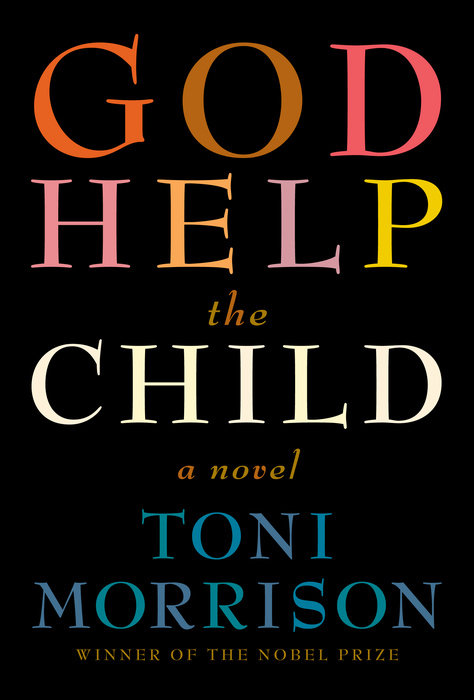
God Help the Child by Toni Morrison

book cover

No lonesome wandering child with a fishing pole passed by and glanced at the adults in the dusty gray car. But if one had, he or she might have noticed the pronounced smiles of the couple, how dreamy their eyes were, but would not care a bit what caused that shine of happiness.
A child. New life. Immune to evil or illness, protected from kidnap, beatings, rape, racism, insult, hurt, self-loathing, abandonment. Error-free. All goodness. Minus wrath.
So they believe.

The children in Toni Morrison’s novel can use all the help they can get, whether from God or some other source. Lula Ann Bridewell was not what her high-yellow parents had expected:

She was so black she scared me. Midnight black, Sudanese black…Ain’t nobody in my family anywhere near that color…I hate to say it, but from the very beginning in the maternity ward, Lula Ann embarrassed me.

Toni Morrison said in an interview, “For me, the tar baby came to mean the black woman who can hold things together.” In this instance it is about a very black woman who cannot.

While she may be a successful cosmetics pro, beautiful, successful, rising in the world, we meet the adult Lula Ann, who has erased the rest of her name and now calls herself by the mononym “Bride,” as she is unceremoniously dumped by her boyfriend, The One, Booker Starbern, who announces, “You’re not the woman I want,” before exiting to the percussive accompaniment of a slammed door. How this came to be, and Bride’s quest to figure out why it did, provide the foundation to which the rest of the narrative elements are added.

Bride has a bit of a tough go, as her appreciation for people and relationships is only skin deep. She tells of her Diet Coke-like sex life, “deceptively sweet minus nutrition.” She tries to blow off her dumping,

Well, anyway it was nothing like those double-page spreads in fashion magazines, you know, couples standing half-naked in surf, looking so fierce and downright mean, their sexuality like lightning and the sky going dark to show off the shine of their skin. I love those ads. But our affair didn’t even measure up to any old R-&-B song-some tune with a beat to generate fever.

but fails at that. In fact the departure of Booker sparks a physical demise for Bride, well, a magical-realist retreat that no one else seems to see, as she progressively devolves back to a child, losing her ear-piercings, pubic hair, weight, sense of taste, menstrual cycle and breasts.

description
Toni Morrison – from The LA Times

Bride’s erstwhile, and very secretive bf, Booker, has issues of his own. (He especially liked her lack of interest in his personal life.) Where Bride is totally focused on the surface of things, Booker, who plays jazz, hides behind his intellect, applying himself to the study of the root of all evil, but never really freeing himself to become an entire person. He carries a burden of rage from his childhood that keeps him from being his own person. Only if Bride and Booker can build themselves up to actual three dimensional people, by looking beyond their own skins to consider the feelings of others, can they have any hope of anything more from life than ephemeral pleasures. Only then can they truly connect.

Much of God Help the Child focuses on children, how they are treated, the long-term impact of that treatment, on themselves and on others. Childhood here is a particularly fraught state. Lula Ann (Bride) is almost shunned by her own mother, who won’t even allow her to call her “Mama,” insisting that she call her “Sweetness” instead, lest people on the street know for sure that someone that dark came from someone that light. As a child she witnesses an act of child abuse. Another character loses a relation to a child abuser, and encounters a school-yard flasher as an adult. Bride had falsely testified against an allegedly abusive teacher, done to gain at least some acceptance from her mother, so children are capable of inflicting harm as well as receiving it. Another child was prostituted by her mother, and a serial abuser, “the nicest man in the world,” is reported to have preyed on many. One might be inclined to wonder a bit at the Cabot Cove-like concentration of awfulness on display here, even if much of it is by reference.

Thematically, there is a lot in here about erasure, not only Bride’s Richard Matheson-reminiscent fairy tale reduction, some of it involving what appears to be a magic razor, Sweetness erasing Lula Ann as much as possible, Sofia, the convicted molester, doing her best to erase Bride from her life, as Bride had attempted to erase her guilt for what she had done, and it can be no accident that Bride is the designer of cosmetics, and even thinks about people in terms of how the right makeup can erase their flaws.

The pages are damp with mentions of precipitation. It rains on Bride the day after Booker leaves. Booker is rained on when he leaves a family gathering in a huff. A child of a prostitute is found while on the street in the rain, and rain moistens one of the most beautiful passages in the book, as Booker celebrates seeing his Galatea for the first time:

The sun still blazed so the raindrops falling from the baby-blue sky were like crystal breaking into specks of light on the pavement. He decided to play his trumpet alone in the rain anyway, knowing that no pedestrians would stop to listen; rather they closed umbrellas as they rushed down the stairs to the trains. Still in thrall to the sheer beauty of the girl he had seen, he put the trumpet to his lips. What emerged was music he had never played before. Low, muted tones held long, too long as the strains floated through drops of rain.

There are plenty more passages that ripple with poetic feeling. And there are some subsidiary characters who brighten up the scene. A fifty-something hippie couple seemed like magical forest dwellers, an epitome of innocence and goodness, with maybe a touch of Tom Bombadil and even Bjorn the Berserker. Booker’s aunt, Queen, is a delight, vivacious, colorful, and very interesting, worthy of an entire book just on her alone. The rescued daughter of a prostitute is fascinating as well.

God Help the Child is a rarity, in that it is a Toni Morrison novel set in the present. Her eleventh novel is a spare one, at 177 pages, similar in girth to Morrison’s previous novels, Home, which weighed in a very novella-like 147 pages and A Mercy, another slim volume, at 167 pages. Not that Morrison is given to producing tomes, but her books these days seem on the thin side. A larger frame might have allowed her a bit more space in which to give us a bit more. I am reminded, though, of Lincoln’s response when asked about the proper length of a man’s legs, he said “they ought to be long enough to reach from his body to the ground.” I expect that the proper size of a Toni Morrison story is the number of pages she needs to say what she has to say. She has said she is, “writing less in order to say more.” A little Toni Morrison goes a long way.

The author is in her 80s now. While God may have been asleep as the wheel when most of the children in this tale suffered what they suffered, maybe God can help the author, at something she is most definitely inclined to do, keep writing until her last breath, and help push that day far off into the future. In this way God will also be helping the reader .

You will need no assistance enjoying God Help the Child. While I would not rank it with her recognized classics, like Sula and Beloved, even a lesser Toni Morrison book is better than most of what is out there.

Review posted – August 7, 2015

Publication date – April 21, 2015

=======================================EXTRA STUFF

Morrison’s Facebook page

Interviews
GR interview by Catherine Elsworth
—Video interview at the 92nd Street Y
— NPR’s Fresh Air, with Terry Gross
The Paris Review – with Elissa Schappel

1 Comment

Filed under Fiction, Literary Fiction

Go Set a Watchman by Harper Lee

book cover Atticus Finch as racist. There it is. Tough to swallow, isn’t it? Atticus Finch, the embodiment of decency, brought to life in To Kill a Mockingbird, widely considered one of the greatest novels in American literature, magnificently brought to cinematic life by Gregory Peck in the film, defender of the powerless, dispenser of wisdom, a hero to generations of readers and movie-goers, spouting opinions that do or should make most folks cringe. Here are a few samples:

…You realize that our Negro population is backward, don’t you? You will concede that? You realize the full implications of the word ‘backward’ don’t you?

…If the scales were tipped over, what would you have? The county won’t keep a full board of registrars, because if the Negro vote edged out the white you’d have Negroes in every county office—

…I’d like my state to be left alone to keep house without advice from the NAACP, which knows next to nothing about its business and cares less.

…do you want Negroes by the carload in our schools and churches and theaters? Do you want them in our world?

So what are we to make of this?

First, let’s step back from the this version versus that one controversy and consider the book on its own. Jean Louise Finch (JLF) is returning to her home town for the fifth time since moving from Maycomb, Alabama to New York City. She sees the place where she grew up more clearly this time than she ever had before. She professes, based on her experience of having been brought up with exposure to all sorts, and having never been overtly taught to be a racist, to be someone who is color blind. That makes her unique in Maycomb, as everyone else has been very much aware of color all their lives. What comes as the biggest shock for JLF is seeing that her sainted father, a man everybody loves, and other people she cares for, despite their positive qualities, hold views that are shocking. JLF struggles to come to terms with this realization. The crux of the story is how she deals with this. While she is already physically an adult, Jean Louise must cope with coming-of-age truths. She realizes that when it comes to her appreciation for the people of Maycomb, dad included, she has been, as Jem describes in Mockingbird, “a caterpillar wrapped in a cocoon.” The watchman of the title is taken from a biblical quotation, (Isaiah 21:6), and refers to conscience. JLF tries to reconcile her conscience with what she now sees, and realizes had been present all along. She is anguished by her internal conflict. With amazing memories of her childhood in this town, it is a huge part of who she is. In facing the possibility of rejecting her father and the place in which she became the person she is, she is faced with rejecting a part of herself and that is the core conflict of the story.

description
Harper Lee – from Smithsonian.com

Set in a time when Brown vs the Board of Education had recently and unalterably changed the legal and social landscape, many in the South perceived changes mandated by that decision as nothing less than another war of northern aggression. One of the biggest strengths of the book is how it communicates the locals’ feelings about and arguments against Civil Rights, and particularly the activities of the NAACP. There is real insight here into the local psyche, from a true local. Another strength of the book is the clear voice of JLF, Scout as a kid, particularly in her recollections of a glowing childhood. The voice of Scout will take you by the hand and lead you through. It is the same voice that appears in Mockingbird, warm, familiar and welcome. I enjoyed JLF’s relationship with her uncle Jack, a character absent from Mockingbird. Jack offers a perspective that is definitely homegrown, but is also decorated with the baubles and gewgaws of an advanced education and unusual interests. The affection between JLF and Jack is palpable. Her interaction with Henry, a friend since childhood, was kludgy. There are moments of real connection between the JLF and the young man who wants to marry her, but so much of their conversation is peppered with excessive use of “honey” and “sweet” that it was distracting from the content of the interaction. It felt forced. The scenes in which JLF confronts Atticus are powerful and even upsetting, but she lays into him without even asking what was up. I do recognize that many people, and particularly the young, jump to conclusions, but I wondered whether Scout, who is portrayed as a pretty bright person, would really be so close minded as to form an opinion, particularly so strong an opinion, based on unexamined evidence.

There is also some wonderful, and playful use of language, although the content reflects some of the very not 2015-politically-correct zeitgeist of the era. There are also beautiful passages that reflect the attachment Harper Lee, through her avatar, feels to her native soil.

The political views on display are appalling, paternalistic, racist, sexist, homophobic, and do reflect the attitudes of the time and place depicted, I expect. But it galls to have characters portray their dark views as accepted wisdom and have far too much of that accepted by a character who should know better.

In short, as a stand-alone there is much to like here, including some strong characters, a wonderful feel for place and a willingness to take on serious and controversial subject matter, but there are plenty of flaws as well. Go Set a Watchman is no classic.

Of course Go Set a Watchman would not have become the literary event of 2015 had it not shared DNA with a novel widely regarded as one of the best American novels ever written, To Kill a Mockingbird. And just in case you are newly arrived on our planet, perhaps are recently thawed out from an extended cryogenic holiday, or have just come to after a nasty crack on the head in 1960, Mockingbird recounts, through the eyes of the grown-up Scout, a time when she was six years old and her father, Atticus Finch, was called on to defend a black man accused of raping a white woman. It offers a view of a golden childhood and a principled father taking on the bigotry of a deep South town in service of justice and decency. If you have not yet read it, go, scoot, scram, take a hike, go find a copy, and come back when you are done.

Ok, read it? Good. There has certainly been a lively reaction to Go Set a Watchman. Would that reaction have been different if there had never been a Mockingbird baseline against which to compare this version of Atticus? That is something we can never know. But it is helpful to think of To Kill a Mockingbird as the second and final version of Nelle Harper Lee’s (Yes, Harper is her middle name) seminal novel. Go Set a Watchman was Mockingbird 1.0. Harper Lee sold her book to the publisher JB Lippincott in 1957. But it was deemed not ready for prime time. I do not know the specifics of what editorial direction Lee was given by her editor, Tay Hohoff, other than to focus on the time of Jean Louise’s childhood. Racism is taken on very powerfully in 1.0. There is less telling and more showing in Mockingbird. The childhood recollections here, while wonderful, do not occupy as much of the stage as they do in version 2.0, but you can certainly see how an editor might laser in on those as strengths to magnify when trying to improve the book. And if one is then going to re-set the primary stage to the time of Scout’s childhood, it makes sense to make Atticus more purely heroic. In fact Mockingbird was intended to have been titled Atticus.

There is danger, of course, that this original depiction of Atticus will forever tarnish the gleaming ideal of a man we admire so from Mockingbird. Why splash racist graffiti over a cherished icon? Actually the racist element was there from the start, in this 1.0 version. It is instructive to see how Atticus evolved in the writer’s molding from the crusty first version to the graceful, fine character that illuminates Lee’s ultimate masterpiece.

There is no need to overstate Atticus’s racism in Watchman. In reviews and commentary some elements have been taken out of context and misrepresented. The KKK thing, for example. Atticus states that his purpose in joining was to find out who was behind the masks, not to further the organization’s agenda. Another item pertains to a racist screed handed out by a lunatic and found by JLF in her father’s home. Atticus agrees that the author is a nut, and that he had been granted the right to speak at the town council, as any other nut might have. Atticus does not subscribe to the views in the pamphlet. He subscribes to enough, though, to cause all who know where his character ends up in version 2.0, to take a large step back. You can get a taste of that in the quotes at the top of this review. It continues on, with nastiness about the NAACP, legalistic hogwash about SCOTUS violating the 10th Amendment, a general sense of feeling under assault by outside forces, and a paternalistic notion that all would be just fine if those northern rabble-rousers would just let Negro advancement proceed at a more measured pace. This is crucial, I believe, to one of the strengths of Watchman. While the views held by the residents of Maycomb, as represented by Atticus, Henry and others, may not receive a universal welcome in 2015, I believe they do fairly represent the beliefs of most educated southern whites during this era. The book might have been instructive to northerners, had it been released in its original form, as to the nature of the strident opposition the civil rights movement faced. As such, Watchman offers a valuable guide to a time and place, where even folks most at the time would consider pretty decent, like Atticus, maintained views that, while they remain widespread among some segments of our population today, are now generally seen as abhorrent.

There are other interesting elements that come from a consideration of the novels set side by side. What remains? What is lost? The courthouse where Scout watches Atticus heroically defend Tom Robinson in Mockingbird is a real place in Monroeville, Alabama, Lee’s birthplace. In Watchman it is a scene of horror as Jean Louise sees a racist propound his views in a public forum in which her father and friend are principal players. Calpurnia, the Finch housekeeper in Mockingbird plays a major role in Watchman as well. In one particularly chilling scene, Jean Louise, who had seen Cal as a nurturing force her entire life, now wonders if Cal ever really cared for her or, instead, saw her only through a racial lens. Dill, her avatar for childhood pal Truman Capote, is present in both novels, but Boo Radley was added in Mockingbird. Henry is gone from Mockingbird. JLF’s brother, Jem, a major character in Mockingbird, is much less of a presence in Watchman.

Go Set a Watchman may occupy a place in the shadow of what was to come, but it does offer insight into the author, her take on the world in the late 1950s, and into her characters. As a blood relation to one of the greatest books in American literature, it is most definitely worth reading.

Published – 7/14/15
Review – 7/24/15

=============================EXTRA STUFF

Harpercollins has made a FaceBook page for GSaW

Robert McCrum’s review in The Guardian is quite informative – Go Set a Watchman by Harper Lee review – a literary curiosity

A Charles Leerhsen article in the June 2010 Smithsonian is also worth a look – Harper Lee’s Novel Achievement

A nice bit of extra intel on Tay Hohoff, Lee’s editor in this article by Emma Cueto on Bustle.com, Harper Lee’s First Editor, Tay Hohoff, Had A Lot To Do With Creating ‘To Kill A Mockingbird’, So Here’s What You Should Know About Her
</a>

Leave a comment

Filed under Fiction, Historical Fiction, Literary Fiction

Life After Life by Kate Atkinson

book cover

“Don’t you wonder sometimes,” Ursula said. “If just one small thing had been changed, in the past, I mean. If Hitler had died at birth, or if someone had kidnapped him as a baby and brought him up in—I don’t know, say, a Quaker household—surely things would be different.” 

Kate Atkinson, author of eight previous novels, including four Jackson Brodie crime books, has come up with a nifty notion for a story. Kill off your heroine, early and often, while offering a look at the history of England from 1910 to the 1960s. I would love to tell you more but an SUV appears to have run a red light at the corner, had a too close encounter with a very large truck and seems to be heading into this café…Gotta go. Damn!

Now, where were we, a review? Yes, I seem to recall something about that. More of a feeling really. So, England, 20th century, perils of Pauline, well in this case Ursula, little bear, of Fox Corner, the manse of a well-to-do sort, not Downton rich, but, you know, comfortable. She has a prat of an older brother and a decent elder sis, with a couple of brothers arriving later.

description
Kate Atkinson – from The Telegraph

Life is full of decision points. Walk this way, survive, walk that way and splat. It begins early with Ursula, who is offed before her first breath the first time around. She gets a better deal on the next go, managing to remain with us into childhood, and so on. The structure seems to employ the backstitch a fair bit, starting Ursula up a few chronological paces before the deadly decision point. She seems to be born again more than an entire congregation of fundamentalist Christians, or, maybe more likely a band of Buddhists, as she seems to pick up a bit of wisdom, a bit of strength with each reincarnation. I counted 15 passings-on, but sure, I could have missed one or two. The lady must have G. Reaper on her autodial. What if I had done this instead of that? How might that have changed the outcomes? One can imagine the fun, and challenge an author experiences. Taking her main character, and plenty of secondary characters as well, in one direction then another, then another. It must mimic, to a degree, the authorial process. What if I do this to Ursula? What might happen? What if I point her in a different direction? And as for stuff happening, while it is usually pretty calm here, writing while on a bench in Prospect Park, I must admit I have never seen tentacles that size emerging from anywhere let alone the very modest Park Lake. The slurping sounds are getting rather loud. That sumbitch is faster than he looks…Gotta go. Damn!

So, I felt like sitting with some coffee but the local café just seemed, I don’t know, not what I wanted. Then I considered maybe heading over to the park to work on a review, but it looks like it might rain, so I think I’ll stick at home for now. Of course the desktop has been a bit dodgy of late, but no big whup. I will dip into the special Kona stash, brew up a nice cuppa and set to, shoes off, no shirt. Maybe a nice bagel with butter and strawberry preserves. Yummm! Review, yes, Atkinson, Ursula, do-overs. Oh yeah, it does call to mind a bit of Groundhog Day, although Phil the Weatherman knew early on that he was coming back each time. Not Ursula, although as time goes on she does develop a bit of a sixth sense about some things. And the other major difference here is that Life After Life takes on some heftier purpose than Phil getting the girl and becoming a better person. Ursula is faced with some immediate challenges, like evading a rapist, a girl-killer, those annoying Nazi bombs during the blitz, not falling out windows, you know, stuff. But she also must contend with moral choices, and larger scale. Not only figuring out what the right thing is to do and then deciding, for her life, but thinking about how events affect other people, the nation, maybe the world. What sort of life does she want to lead? How can she help the most people? What sort of person does she want to be? Can she make an impact beyond her immediate concerns? And within that context, others face similar choices. Ursula is not the only one with multiple exit scenes. There are plenty in the chorus of secondary characters who come and go, or should that be go and come back in varying iterations. What if so-and-so did A this time and B the next? How might that change things? This is part of the fun of the book. Not all the decisions are of the life-threatening variety, but they can seriously impact one’s life, other lives as well. Excuse me a moment, Nala, sweetie, off the desk please. I will be happy to scratch you. No, do not rub up against my coffee cup. Nala, DOWN, NOW! Too late, brown milky liquid splatters from the cup on the desk, rushing over the top of the desktop tower, which is sitting on the floor between desk and couch. I get up to fetch some paper towels. Nala’s tail is vertical as she scampers from the room. Maybe I should have worn slippers. I step away from the desk chair, contact enough wet to matter, and only feel it for moment when my body hair begins to ignite and my heart goes into highly charged spasms. I hear the beginning of a scream and then….sonuva..!

Seems a lovely morning for some reviewing. Rainy out? Well, not yet, but you can feel it coming. So, open a few windows. Sit at the desk. Well. Maybe not. Might be a bit too much breeze there. Maybe the couch for a change. Yeah, book, they killed Kenny. You bastards! England. Ursula. War.

I’d always meant it to be very focused on the Second World War, and I don’t know what I was thinking when I decided to start in 1910, to get her born…I think that’s when the coming back again and again kicked in. And I was, on, oh, page 250 of the manuscript and still in the 1920s. I kept saying to people, “Yeah it’s a book about the war!” and then I’d think, it’s not a book about the war. I hadn’t realized how much I would get entangled in 1910-1939 as opposed to 1939-1945. – from Chatelaine interview

There have certainly been some wonderful novels in the last few years that play with structure. A Visit from the Goon Squad is one of the more dramatic of that sort. The rise of the novel comprised of linked stories has seen a boom in popularity. This year’s Welcome to Braggsville takes some chances with form as well. And so it is with Life After Life. While the notion of reincarnation is hardly new in fiction, how it is handled here is far beyond what we have seen before, a real risk-taking. And so effective.

Ursula is a very engaging character. Each time she comes back, you want her to stick around. And even when she makes bad choices you will be rooting for her to fix those in the next round. Her sister Pamela seems as decent a sort as their brother Maurice seems insufferable, maybe a bit too insufferable. We get to see dimensions to Atkinson’s characters over the many iterations, learn something new about them, sometimes surprisingly so. I found it to be entirely engaging, and was always sad with Ursula went dark yet again. The book opens with her taking aim at the worst baddie of the 20th century and you will keep hoping she finds her way back to that place and completes the mission. Will she?

One of the most riveting and memorable elements in Life After Life is the description of London during the Blitz, on the ground, you-are-there, offering considerable nightmare material, and making it clear just how hardy the survivors must have been, and how fragile the hold on life, whichever iteration a person is in. The best part of the book, for me.

There are many uses of animal references here. Ursula means little bear, The family name, Todd, means Fox. A group of Nazi wives is referred to as a wolf pack. Actual foxes move in and out of the story, residents of Fox Corner, the Todd family home. A German is named Fuchs which also means fox. There are more. A warden during the Blitz is named Woolf. At one point, Atkinson offers a wink and a nod to readers as her characters discuss time travel questions. There is much consideration here of the role and rights of women in the first half of the 20th century, and the changes in mores that marked the era. The difference between love and gratitude when considering marriage is considered. The effect of World War I on the nation is noted as well, the loss of a generation of men in the war, and the loss of vast numbers from both genders from the Spanish flu. While florid passages do not characterize the novel, there are some wonderful descriptions. One of my favorites regards the night sky during the Blitz

“It’s almost like a painting, isn’t it?” Miss Woolf said.
“Of the Apocalypse maybe,” Ursula said. Against the backdrop of black night the fires that had been started burned in a huge variety of colors—scarlet and gold and orange, indigo and a sickly lemon. Occasionally vivid greens and blues would shoot up where something chemical had caught fire. Orange flames and thick black smoke roiled out of a warehouse…”
“It’s spectacular, isn’t it? Savage and strangely magnificent.

Yes it is.

Now that the task is done, I think I will bring in a glass of juice and have some of these lovely hard sourdough pretzels. Maybe catch something from the DVR. Always loved these pretzels, except, of course, when bits get stuck going down. Sometimes large bits, uh oh, a very large bit…trying to self-Heimlich, but no go, hitting my head on the edge of the coffee table as I stumble and fall while trying to stand up. Maybe if I can get some liquid in there it will soften it, but the noggin-knock and the inability to get any air makes decision-making a tough go. Damn!

Published – 5/2/13

Review Posted – 7/17/15

=======================================EXTRA STUFF

Links to the author’s personal and FB pages

Interviews
—–Chatelaine by Alex Laws – this is a two-parter. The link to the second part is at the bottom of this one.

—–NPR – with Scott Simon

—–The Sydney Morning Herald by Linda Morris

Leave a comment

Filed under England, Fantasy, Historical Fiction, Literary Fiction

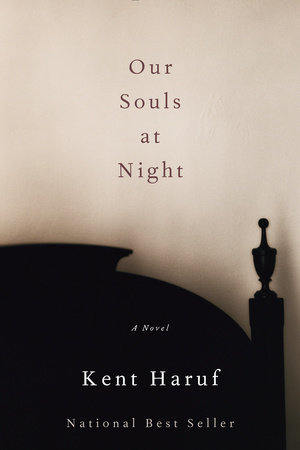
Our Souls at Night by Kent Haruf

book cover

And then there was the day when Addie Moore made a call on Louis Waters.

Louis and Addie are both getting on, in their 70s, Louis having lost his wife a year back, Addie a widow for some time. Both are lonely and could do with some company. While they have known each other for a long time, they have never been close. Acquaintances more than friends. Until Addie suggests that it would be a great help, given her trouble sleeping, if Louis would consent to sleep with her, not hide-the-salami sleep together, but sleep, and talk, in the same bed, overnight, companionship. Louis decides to give it a try.

Addie and Louis slowly begin to share their histories. The biddies of Holt, male and female, are taken aback, of course, at the presumed impropriety, as if, once elderly and alone, it was somehow sinful to still want to have a life. There are scenes in which they each are put on the spot and made to defend themselves to snickering locals about their arrangement. Feel free to cheer. Fueling his unhappiness with permanent rage about his childhood, Addie’s son, Gene, in particular, cannot tolerate his mother and Louis being together, projecting into it his fantasy that Louis is in the relationship to somehow swindle Addie out of her money. Problems ensue.

book cover

Kent Haruf – 1943-2014

A consistent focus in Haruf’s novels is the unconventional family, whether of elderly brothers taking in a pregnant girl, or grandparents taking care of an eight-year old. Well, that may not be all that unconventional these days, but it still ain’t Ozzie and Harriet. In this one, Addie’s son, Gene, has his hands full with problems at home, so sends his son, Jamie, to stay with Addie for a stretch of summer. Addie, Louis and Jamie form a very close relationship. There are moving sequences of outings and bonding moments that exude love and comfort, a contrast to the difficult relationships experienced between closer blood relations and spouses. Another Haruf concern is loneliness, at all ages. It is not only the raison d’etre of Louis and Addie’s arrangement, but is considered in relation to their former marital relationships. The loneliness of others comes in for some attention as well. Connections from generation to generation are considered. There are causes and effects, but life carries on. Haruf said, in relation to Benediction

in the very next house, there is this 8-year-old girl who is the representative of hope and promise and youth and joy. And so what I am wanting people to feel is that the beginning and the ending in all of our lives are set side-by-side. They are not distinct from one another.

The same could very well be applied here, connecting the lives of folks at both ends of their mortality. Haruf had been hoping to get to the January 2015 premier of the Denver Center production of a theater version of his novel Benediction.

The cast is much reduced in Our Souls at Night relative to that of his prior novels. The focus is on the two main characters, with Jamie in a large supporting role, and remains there for the entirety. Of course their history brings in other players, but most remain off-stage or pop by for cameos. Addie and Louis tell their stories to each other each in bed at night. It is a simple and effective mechanism for looking at two lives, their effect on others and others’ effects on them. Haruf used spare language, this, then that. If his writing were a font, it would be sans serif. And he is a master of showing instead of telling. After a rage-inducing encounter, At home he went out to the garden and hoed for an hour, hard, almost violently…. After a difficult scene, Haruf does not tell us how Louis feels. There was a woman on the elevator, she looked at his face once and looked away.

His symbolism is also simple, and effective. The title refers not only to the time of day when Louis and Addie share their lives. It reminds us that time is short. A discussion about a nest of baby mice speaks to unpredictability.

In an interview Haruf did with John Moore for The Denver Center, he talks about his use of references to his own work in the novel:

Kent Haruf: … I will tell you there is a reference to the play Benediction in this new book. It’s something these two old people have a little comment about.

John Moore: That’s part of the fun of reading of your stories. Even in Benediction, which features all new characters, there are those small references that reward those people who have been with you from the beginning.

Kent Haruf: It does. And it was a chance for me to have a little fun. Exactly as you say, people who know these other stories will immediately recognize what I am talking about.

He sets his tale in Holt, Colorado, a place that will be familiar to readers of his earlier work. In another meta moment, his characters refer to the location in reference to seeing a play of a Kent Haruf story! (not Benediction) as a way of letting readers know about his usual locale

he took the physical details from Holt, the place names of the streets and what the country looks like and the location of things, but it’s not this town. And it’s not anybody in this town. All that’s made up.

Well, of course Holt is fictitious but Haruf is making sure readers do not assign the place entirely to a single real location. I guess he wanted to clear that up before he left us.

as a writer, I want to be thought of as somebody who had a very small talent but worked as best he could at using that talent. I want to think that I have written as close to the bone as I could. By that I mean that I was trying to get down to the fundamental, irreducible structure of life, and of our lives with one another. – from the Denver Center interview

I would disagree about the dimensions of his talent, but there is no question that Kent Haruf has offered the readers a world-view that may be bare bones in its form, but which is glorious in its realization.

Our Souls at Night, his sixth novel, is the last book we will ever have from Kent Haruf. It is hopeful without being saccharine. Sharing love as darkness approaches may be one of love’s highest forms, offering no short term trade for a probably unrealistic long-term promise. It makes the sharing sweeter, in a way. I got the sense, without digging into specifics, that one thing Haruf was doing here was stopping off at some favorite spots in Holt for a final goodbye. Holt will remain available for generations of readers. Haruf passed away in November, 2014 at the age of 71. He will be missed.

Review posted – 6/26/15
Publication date – 5/16/15

=======================================EXTRA STUFF

Here is the complete Denver Center interview

In an interview with Robert Birnbaum for the Identity Theory site,

In the Reader’s Guide of Random House’s page for the book, Haruf talks about how he worked:

The idea for the book has been floating around in my mind for quite a while. Now that I know I have, you know—a limited time—it was important to me to try to make good use of that time. So I went out there every day. Typically, I have always had a story pretty well plotted out before I start writing. This time I knew generally where the story was going, but I didn’t know very many of the details. So as it happened, I went out every day trusting myself to be able to add to the story each day. So I essentially wrote a new short chapter of the book every day. I’ve never had that experience before. I don’t want to get too fancy about it, but it was like something else was working to help me get this done. Call it a muse or spiritual guidance, I don’t know. All I know is that the trust I had in being able to write every day was helpful.”

There is more info to be had on Haruf from wikipedia and Barnes and Noble

Leave a comment

Filed under Fiction, Literary Fiction

Jonathan Strange and Mr Norrell by Susanna Clarke

book cover
After a hiatus of several centuries since it was actively practiced, magic is back in early 19th century England. Susanna Clarke has created an alternate, magical history, in which England had once been divided between north and south, and a temporal and a fairy kingdom. Stuffy intellectuals satisfy themselves with studying the writings of the past, forming debating societies. But in 1807 a person emerges who dares to actually practice magic.

Mr Norrell is an arrogant fellow, convinced not only that he is the only decent practical magician in England, but that it would be best if he were the only one allowed to practice at all. He proceeds to play politics to sustain, increase and legitimize his monopoly. The emergence of a second practical magician presents a challenge, solved in the short term by taking on Jonathan Strange as a student.

description
Eddie Marsden as Mr Norrell – from AMC networks

Both magicians want to use their talent for the good of their country, and perform amusing and not so amusing spells on the French enemy. Ultimately they are faced with the growing emergence of a real, powerful, underlying magical realm. It intrudes on their lives and forces them to confront darkness while trying to master the unsuspected reality.

description
Bertie Carvel as Jonathan Strange

The book has a wonderful pretext, and the tale is told in a straight style, with more than a few touches of humor. It offers a look at how the new use the machinery of government to create a sinecure, how a need to impress can lead to corruption. It is fun to read, but does take quite a long time, and has sections in which it drags. It should probably have been shorter by a hundred or two hundred pages.

description
Marc Warren as “The Gentleman”

Meanderings are many. In short, or long, it was enjoyable, and is recommended, but not to the highest degree. Several award committees disagreed, holding it in significantly higher esteem. JS&MN was not only long-listed for the Man Booker Prize, it was short-listed for several other awards and won, among others, the World Fantasy award for best novel, the British Book Award for best newcomer of the Year, and the Hugo Award.

description
Susanna Clarke – from Minnesota public radio

The TV adaptation was shown beginning (in the USA anyway) in June 2015

Review posted – 10/29/2008

Updated and Reposted – 6/19/15

Publication date – 9/30/2004

=============================EXTRA STUFF

I found no personal site for Clarke, nor, FB nor Twitter. Bloomsbury has put up a Facebook page for the book

A particularly nifty site organizes people, placesl et al, from the book. If you get heavily into the book, this is a must-have resource

A nice, soft article on the author visiting the production set

A 2004 interview with Clarke on the SF site

A 2005 interview on Bookslut

Leave a comment

Filed under Fantasy, Literary Fiction

Bring Up the Bodies by Hilary Mantel

book cover

His whole career has been an education in hypocrisy. Eyes that once skewered him now kindle with simulated regard. Hands that would like to knock his hat off now reach out to take his hand, sometimes in a crushing grip. He has spun his enemies to face him, to join him: as in a dance. He means to spin them away again, so they look down the long cold vista of their years: so they feel the wind, the wind of exposed places, that cuts to the bone: so they bed down in ruins, and wake up cold.

Be careful what you wish for. Henry VIII was pining for the younger-than-his-current-wife Anne Boleyn. After getting his heart’s desire, which required him to take on the Catholic Church, one might imagine him speaking to Thomas Cromwell as Ollie might have said to Laurel, “Well, here’s another nice mess you’ve gotten me into!” nicely demonstrating an inability to accept any responsibility for his own actions. Of course, AB had gotten her heart’s desire as well, a nifty crown, plenty of staff, and she gets to headline at the palace. But pride, and not popping out a male heir, goeth before the fall, and well, the girl should have known. I mean H8 was not exactly a model hubby to his first wife. Why would she think he’d be any more loyal to her? Time for the head of household to summon Mister Fixit.

descriptiondescription
Rafe Sadler and Stephen Gardiner

Looking for advice on ridding yourself of unwanted household pests? Running low on funds for your comfortable lifestyle? Need the occasional hard thump to the torso to get the old ticker restarted? Need to re-direct your reproductive efforts towards a more masculine outcome? Need to fend off potential assaults by enemies foreign and domestic? Why, call Mister Fixit (Yes, yes, I know there were no phones in 16th Century England, so summon Mr. Fixit. OK? Happy now? Jeez, some people). Thomas Cromwell, a man of modest origins who had risen to the highest position in the land, that did not absolutely require aristocratic genes, had already demonstrated a penchant for getting things done, by whatever means necessary. And so continues the tale, in book 2 of Hilary Mantel’s trilogy about Tudor England.

book cover

Hilary Mantel

The end of Wolf Hall (You read Wolf Hall, right? If you haven’t, stop reading this now, and go get a copy. Read that and when you are done, feel free to return. What are you waiting for? Go! Scat!) was H8’s marriage to AB. The quest had come to the desired conclusion, and now they’re gonna party like it’s 1533. Not only had H8 succeeded in flipping the bird (a falcon in this case – see the badges below) to the RC, but he was engaged in swiping their stuff as well. Pope? We doan need no steenking Pope. Cromwell was the guy who had done most of the fixing. So everything should be fine now, right? Not so fast.

descriptiondescription
Dueling Badges – Anne Boleyn’s and Catherine of Aragon’s – in case any are needed

AB is getting very full of herself but not, unfortunately full of a male heir, and there are younger ladies-in-waiting, you know, waiting. H8 has an eye problem. It wanders uncontrollably, in this instance to young, demure Jane Seymour. Of course there is the pesky business of clearing that obstruction from the royal path, and Mister Fixit is called in (sorry, summoned) to make it go away. Luckily for him he has his fingers in many administrative pies and is not shy about using his inside knowledge to achieve his boss’s goals. Cromwell also has an excellent network of spies sprinkled throughout the realm. Combine the two, make much of what was probably idle gossip, add a dollop or three of spite and voila. For good measure, TC takes particular pleasure in focusing his skills on those who had done dirt to his mentor, Cardinal Wolsey, ticking off each one as they succumb to his devilry.

descriptiondescription
The once and future – Catherine of Aragon and Jane Seymour

Was AB guilty of the crimes of which she was accused? Probably not. But as long as the folks in charge can get the people with weapons to do their bidding it does not much matter. There is no law, really, only power. Legal processes are often mere window dressing to the underlying exercise of big fish eating smaller fish, and sometimes spitting them out. The fiction of legality keeps the mass of smaller fish from chomping their much larger tormenters to bits. Sort of like now. See, people? It’s all perfectly legal.

Bring Up the Bodies is a masterful achievement, showing, step-by-step, how dark aims are orchestrated and achieved. In laying this out, Hilary Mantel also offers us a look at how the reins of power can be abused by the unscrupulous, and Thomas Cromwell is shown in his full unscrupulousness in this volume. He was gonna get these guys and when he saw his chance, he took it. Where Wolf Hall presented a more removed Cromwell, Bring Up the Bodies shows us Cromwell as more than a fixer, more than a technocrat. We get to see him as a monster, despite his supposed desire to make England more equitable for working people.

H8 is shown much more as a spoiled psycho-child in this volume. Whatever his intelligence, whatever his accomplishments, what we see of Henry here is primarily his boorishness, his childishness. I want what I want and I do not care who gets hurt, or even killed, so I can have it. I was reminded of the great Twilight Zone episode It’s a Good Life.

Mantel won a second Booker prize for this one, and it was well deserved. Not only do we get a very human look at a key period in Western history, but are blessed with Mantel’s amazing wit as manifested by her characters, and consideration of issues that transcend history, as well as a compelling episode of Survival: Tudor. It is an easier read than the first book, more engaging, if that is possible. If you have not seen the miniseries made from the combined volumes you really must. Hilary Mantel has brought out her best in Bring Up the Bodies, using her genius for historical fiction to make the old seem new again. You won’t lose your head if you don’t read this book, but you probably should.

Review posted – 5/22/15

Publication date – 5/8/2012

=======================================EXTRA STUFF

Links to the author’s personal, Twitter, Google + and FB pages

Excellent radio interview with Mantel by Leonard Lopate

A marvelous New Yorker magazine article looking at Mantel’s career

Great material here in another New Yorker article, Invitation to a Beheading, by James Wood

Why isn’t Henry VIII fat and other Wolf Hall mysteries explained

Leave a comment

Filed under Fiction, Historical Fiction, Literary Fiction

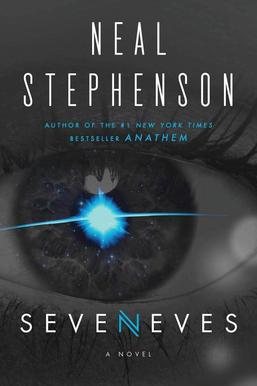
SevenEves by Neal Stephenson

book cover

The moon blew up without warning and for no apparent reason.

I guess in order to indulge in a bit of world-building one must destroy the world first.

Neal Stephenson is a genius. A polymath with a wide range of interests, he specializes in the big idea, and the more concrete the better. In this way he carries forward the tradition of hard science fiction, in which the best example is probably Arthur C. Clarke. Stephenson eschews FTL transportation, time travel, invading aliens, or any of the other tropes of sci-fi that cannot find a solid basis in contemporary science. Instead he takes what is known, adds what is possible, and extrapolates to what could be. His one concession to the unknown is his opening, noted at top. Although a theory or two are trotted out, we never really learn what caused the moon to explode. Consider it the MacGuffin of the novel, the plot device that gets the action moving. I guess breaking up isn’t hard to do. No exploding moon? No story. Why does it explode? Doesn’t matter. The story is about what happens after.

The kernel around which the story nucleated was the space debris problem, which I had been reading about, both as a potential obstacle to the company’s efforts and as a possible opportunity to do something useful in space by looking for ways to remediate it. Some researchers had begun to express concern over the possibility that a collision between two pieces of debris might spawn a large number of fragments, thereby increasing the probability of further collisions and further fragments, producing a chain reaction that might put so much debris into low earth orbit as to create a barrier to future space exploration. – from Stephenson’s site

And the story is a compelling one, not so much in the sense of classic plot construction, but in terms of how we get from the biggest “OH CRAP” moment in human history, to something not guaranteed to soil pants. Stephenson looks most attentively at the engineering details of what is involved in trying to salvage the human race, once it is clear that the sky will go all to pieces, that the term scorched earth will be applicable to all the land on Earth, that the homeland will become a wasteland. What hardware is necessary? What is available? What can go wrong? How do we get from here to up there? This is his gig. He loves this stuff and it shows. He also does a good job of portraying the ensuing struggles down below. Who will be selected to survive? How will they be picked? How will the politics of the selection be handled? What will the criteria be? Ideas bang into other ideas, which fracture and crash into even more ideas, and so on, until you have an entire layer of nifty concept blanketing your brain.

description
World leaders make the big announcement of imminent doom at Crater Lake, and yes, it really is that blue

I think Stephenson is more optimistic than most and his presumptions about the level of on-the-ground conflict and pure lunacy are out of line with what we know about humans. He gives only a little thought to deniers, but in a country like the USA, for example, in which a quarter of the population does not believe in evolution, in which the Republican base clings to beliefs that would make L. Ron Hubbard scream for mercy, in which Texas lunatics of both the tinfoil-hat and elected variety (I know, no real difference there) persuade themselves that a military exercise is a federal invasion, there would be a lot more going on, denier-wise, than Stephenson projects. All theoretical of course, but do you really think that in the time remaining that birthers and those who believe the Apollo moon landing was a hoax would not make use of their considerable ordnance to make life even more miserable for those with brains?

book cover

Neal Stephenson

The book is divided into three parts, although it breaks down into smaller chapter chunks. The first takes us from the initial event to the beginning of the end of Earth as we know it, how humanity comes together, or doesn’t, to preserve the species. Part two takes on the final days of earth and a whole new world of conflict, resolution, or not, setting the stage for Part three, five thousand years on, when, through forces natural and engineer-enhanced, it is again possible to set foot on Mother Earth without singeing your toes. The seven eves of the title refer to the last orbiting survivors, whose reproductive capacity and DNA is used in an attempt to reconstitute the species, and, hopefully, in time, reclaim the original Mother ship.

description
This inflatable harbinger will be heading to the ISS this year – image from Smithsonian Magazine

Stephenson does action-adventure pretty well, and there is plenty of that here. The end of the Earth is a compelling starting point and survival of the species concerns will keep you engaged. Will this work? Will that? Who will live? Who won’t?

Character is not the thing in Neal Stephenson fiction. His greatest talents lie elsewhere. Although it is definitely fun that he puts an avatar of Neal DeGrasse Tyson aboard. The significance of character here is to consider personality differences and their social, and genetic engineering implications. Given people with certain traits, how are they likely to behave, and how will those behaviors help or harm the survivability of homo sap? There is consideration of the concept of the state of nature. What is natural for people? How is that defined? Pretty interesting stuff. And there is plenty more brain candy in SevenEves. (Not for you, zombies, go away) On the hardware side, how about harnessing asteroids and comets for raw materials? Using robots of unexpectedly small dimensions for space-mining? Making orbiting environments in which humanity could survive, and even expand? How about some notions for terra-forming not only lifeless space rocks, but…um…Terra. How about interesting ways of transporting people and materials between orbiting locations, and between Earth and orbit. How about some advanced notions for individual flight on-planet? Life sciences? How about the challenges of food production in space? Bio-engineering is the biggest item here, not only in selecting who gets to be among those sent into orbit to survive torch-ageddon. But in figuring out how the differences in people can be used to ensure survival of the species, and looking at the results, some of which are quite surprising. Social science? Well, the science is a lot softer here, but the politics of end-times Earth and struggles for power among the spacers offer a look at elements of human nature that will be familiar. Stephenson’s optimism about our ability to think our way to actual survival is balanced by his recognition that we are, as a species, probably certifiable, so will continue having at each other as long as there are others to go after.

description
An O’Neill Cylinder – from the outside

I am certain that those more versed in contemporary sci-fi will have more recent comparisons to make, but the work that I was most reminded of here is the Hugo-Award-winner for Best-All-Time Series, Isaac Asimov’s Foundation series. In both, a core of talented people (a broader range of talent than in Stephenson‘s more engineer-and-hard-science-oriented portrayal) are brought together to preserve human culture in the face of an imminent catastrophe. The specifics are quite different, but they share a grandness of vision. No psychohistory in SevenEves, but the multi-millennial look at humanity offers the opportunity for and realization of a great speculative vision.

There are some commonalities between SevenEves and another recent, and very popular, sci-fi offering of the space variety, The Martian. Not in girth, of course. The Martian, at a mere 384 pps, could dock with and be pulled up on the side of the 880 page SevenEves like a tender boat on a cruise ship. Both deal with life-and-death scenarios in an airless void (no, not the US Congress), although one deals with a single life in jeopardy, while the other takes on a larger target. But there is a heavy emphasis on tech in both. Weir’s wonderful story offered an engaging narrator and way too much detail on how he goes about attempting to survive while stranded on the red planet. Stephenson writes about things that he finds interesting whether or not they clutter up the story with technical minutiae, and at 880 pps, trust me, there is too much detail. Hey, his book, his story. He gets off on the details of mechanics, and it is nowhere as mind-numbing as an endless jeremiad by, say John Galt, but you may find yourself feeling a need to skim from time to time. (Purely an aside – I think Chris Moore should write a novel about the Republican clown car of presidential candidates, called The Galt in our Stars, in which someone gets a life threatening disease and no one cares). I wonder also how the very small number of remnant original eves is supposed to be able to provide the training their progeny will require to master all the skills required to sustain civilization. I am sure there are many other details one could look at in considering the next five thousand or so years, but it might take a few more volumes.

SevenEves is a major contribution to contemporary science fiction. It is engaging enough on a visceral level, but it is crack not just for sci-fi fans, but for futurists, scientists, geneticists, engineers, and those concerned with how humanity will survive the challenges that lie ahead. It is a big book, not only in its physical bulk, but in its ambition and range of interests. Like the great works of his predecessors, Asimov, Clarke and other giants of science fiction, the vision Stephenson has built in SevenEves will be read, I expect, as long as there are still people left alive, whether on Earth or not.

Publication date – 5/19/15

This review posted – 5/15/15

======================================EXTRA STUFF

Links to the author’s personal, Twitter, Google Plus and FB pages

Folks who object to paying their taxes are already interested in working on extra-national, and even extra-terrestrial living spaces. At Island One Society there is information on sundry plans that are currently being considered. Please do not take this as an endorsement of any of the political viewpoints expressed there. I include this link purely because it gathers together a nice list of such projects.

O’Neill Cylinders are mentioned in SevenEves. This link offers a nifty animated fly-through that will offer a better sense than a single graphic image could.

Roboticized mining is the likeliest way we will make use of extra-terrestrial natural resources This example of the coming tech is called Swarmies.

I have read several Stephenson books over the years, but Reamde is the only one I have previously reviewed.

More shots of Crater Lake, among other places in that general neck of the woods

Fascinating piece from The Atlantic Magazine on mining the asteroids, among other things, Robots, Platinum, and Tiny Space Telescopes: The Pitch for Mining Asteroids by Ross Anderson from the May 14, 2012 issue

Leave a comment

Filed under Fiction, Literary Fiction, Science Fiction

Girl in the Moonlight by Charles Dubow

book cover

That afternoon was my first inkling that there was more to the world than it appeared. Like the glimpse of a secret garden through a crack in the door, I discovered something I hadn’t known was missing. Where colors were brighter, tastes stronger, feelings deeper. And once I recognized it, I wanted it, missed it—and was unsure I would ever find my way back to it. It was a land of Cockaigne, the hidden kingdom.

Girl in the Moonlight (originally, and better titled Naked in the Moonlight) is the second novel by Charles Dubow, author of the wonderful, steamy 2013 novel, Indiscretion. In …Moonlight, he brings us back to the Hamptons that was the setting for much of the earlier book. Wylie Rose is closing down a summer house where he’d spent much of his youth, and remembering. No madeleines required. But an evocative painting brings back to him, and us, the story of a lifetime of passion, obsession, and love.

book cover

Charles Dubow

How young is too young to meet The One? Wylie was only 10 when he first met Francesca, at 12, the oldest of the four Bonet sibs. A hidden kingdom of attraction opens its doors to him. He falls hard for her, literally. Wylie forms a close friendship with Aurelio Bonet, Cesca’s younger brother, and through this bond, Cesca will pop into and out of Wylie’s life for the duration of his Odyssey. The driving force to the story is the will-they-or-won’t-they-wind-up-together question as they sail through their lives.

Of course, even as a young thing, Cesca is special. In adolescence she begins to take on the characteristics of a siren and sings for all the ships to hear as an adult. Wylie may have known at some level that he should have plugged up his ears (and covered his eyes, for that matter) but he would spend most of his life tied to the mast, enduring the song. Will he be drawn in to his own destruction?

description
Ulysses and the Sirens
– by John William Waterhouse – from the National Gallery in Melbourne

There are certainly gross similarities in form with Dubow’s earlier work. We revisit the Hamptons, and the company of the very well-to-do. The author is of this set and writes what he knows. There is an almost supernaturally attractive female, and a smitten male. (Indiscretion actually had two smitten males, the secondary one having a bit more in common with Wylie than the primary) Trouble soon follows, with a trail of emotional collateral damage. But, lest one suspect that Dubow has shoved off into the water to net the same fish, there are significant differences. In the earlier book, a successful, well-known middle-aged, married man is drawn from (leaps from) his life by an admiring young thing. Here, the two know each other from childhood, growing together and apart over their lives. The time span of the core story (not backstory) is far greater in Moonlight, decades instead of a few years. Indiscretion had much to do with discontent with one’s life, and insecurity about one’s place in it. There is some of that here but Wylie and Cesca are not struggling with the detritus of generations. They seem perfectly content to employ their advantages in pursuit of their movable dreams, trying this and then that in hopes of plotting a steady course. Wylie, for example, opts to pursue a course of study, so enrolls in Harvard for his advanced-degree training, as if it were the equivalent of stopping off at the corner store to buy a lottery ticket. While both novels have a love story at their core, among the one-percent, so do a billion other books. There is a geographical sweep in Moonlight that extends far wider than that in Indiscretion, with stops in Spain, Paris, London and even some connections to Tokyo and Africa, in addition to the usual Hamptons/NYC setting. Indiscretion and Moonlight are indeed very different tales.

There are several elements in Moonlight that stand out. First there is the tension of wondering if the two will ever get together. That sort of thing may be standard fare for stories of this kind, but how that is executed is significant. I found it was quite well done here. Plenty stands in the way of the two getting together (has to be, of course, or there wouldn’t be a story to tell) not least Cesca’s ability to attract men. Second, there is a feeling of melancholy, which may summon your own regrets to mind.

What if I had chosen differently? Would I be here at this moment? There are the dreams our parents have for us, and then there is the life that we create for ourselves. It is impossible to know. The secret, they say, is not to regret—but that, I have found, is impossible. The most one can hope for is to forget. Memory, though, is a poor servant; it bursts in on you when you least expect it.

And there is the ever-present element of hope. It is not a misdirect, there really is a chance they might get together. But I will not tell if they do or don’t. Of course if hope is a thing with feathers, is that a good thing? Would it be better if hope were a thing with scales?

description
Ulysses and the Sirens
– by H.J. Draper – from Wikipedia

I have spent as much time with the one percent as I have with the Illuminati, so I did not feel much connection based on socioeconomic commonalities. On the other hand, I have had my share of emotional disappointments, false steps and traumas, so on a feeling level I found that it was quite possible to connect. Wylie is a very relatable character, a decent guy trying to find himself. Effective writing takes you past surface differences to core emotional experience.

Can she hold him off forever? Doe she really care for him or is Cesca only toying with Wylie, luring him to his own destruction? Can he endure long enough? Should he? What about having a real life and not one based on a myth? At what point does one cross over from being dependable to being a doormat? When do you just throw up your hands and sail back out to sea? And what might happen if you did?

Dubow has a wondrous ability to describe places, imbuing them with life, with history. He can paint a scene beautifully, which is not surprising given that he once planned to be a painter. He can create living characters. Wylie Rose is the evidence. None of the other characters is as fully realized as Wylie, but they are still well done. Aurelio was also very appealing, but we do not see enough of him. Cesca’s path may seem scattered, but Dubow’s explanation for her zig-zag route is believable. I found the other characters much less well realized, but not everyone has to get center stage. They are filled in enough to contribute to the story. The author also has a wondrous gift for communicating the ambivalence we all experience, in looking back, at roads not taken.

Girl in the Moonlight will keep you turning pages, maybe not so quickly as Indiscretion did, but it is a solid read. It will pull you in and hold you, without, thankfully, dashing you on the rocks.

Review posted – 5/8/15

Publication date – 5/12/15

=============================EXTRA STUFF

Links to the author’s Twitter and FB pages

A piece Dubow wrote for Newsweek Magazine on Stuttering

About five minutes of the audio book

My review of Indiscretion

Leave a comment

Filed under Fiction, Literary Fiction

World Gone By by Dennis Lehane

book cover

What they didn’t tell you about absolute power was that it was never absolute; the instant you had it, someone had already lined up to try to take it away. Princes could sleep soundly, but never kings. The ear was always tuned for the creak on the floorboard, the whine of a hinge.

The princes would probably do well to stay alert as well. Remember Richard the Third? World Gone By is the final volume of Dennis Lehane’s Coughlin Family trilogy. The series began ambitiously with The Given Day, set in Boston, among other places, in the late 19-teens. That book cast a perceptive eye on the social movements of the era, and the underlying problems that called them into being. It was an opus magnus, big canvas, big ideas, well realized. The second of the Coughlin books, Live by Night, shifted the focus to Florida in the roaring twenties, Prohibition, rum trade, a fair bit on the DNA of violence. It was smart, literary, insightful, and a damn fine read. It took a lot of wordsmith ordnance to produce the first two. But it seems that there were only a few cartridges left when it came time for the third. This is not to say it is not a good book. I liked it. But, compared to its older siblings, it is disappointing for the reduction in scope, and the feeling one might get that Lehane was dashing through this one to finish the series so he could move on to something else.

Joe Coughlin, in Live by Night, had carved out a nice little chunk of the Florida crime market. Even bought himself some public respectability. But now he has scaled back. Maintains a low public profile. Although he is still a member of the organized crime council, he functions as a freelancer, an advisor, a voice of wisdom, a gangland statesman almost.

“So was I a gangster?” He nodded. “Yes. Now I’m an advisor to people.”
“Criminals.”
He shrugged. “A friend of mine was Public Enemy Number Three about six years ago—“
She sat up quickly. “See, that’s what I’m saying. Who could begin a sentence, ‘A friend of mine was Public Enemy’ anything?”

He is doing well, plenty of money, a son he adores, a gorgeous, connected girlfriend. He hobnobs with the movers and shakers financial and civic, also has working relationships with the military and the police. But he gets wind that there is a hit out on him, and the game is afoot. Who, when, why? This gives the story structure, a ticking bomb, with tension ramping up as the deadline approaches.

book cover

Dennis Lehane -from Boston Magazine

Lehane brings back plenty of the cast from the last episode, but there is enough new blood to keep things pumping. Joe’s pal, boss of bosses Dion Bartolo, appears to have a mole in his organization. People are dying or being locked up. It’s bad for business and needs to end. One of Joe Coughlin’s challenges is to unearth the snitch. There is enough organizational politicking, back-stabbing (literally, as the case may be) and maneuvering for fans of Wolf Hall or Game of Thrones. The seats of power may be smaller, but the desire, and willingness to do whatever it takes is just as high.

The scale of this book is far different from that of its elders, 309 pps for this one, versus 402 for Live by Night and 704 for The Given Day. This one takes place within a few weeks, whereas the prior two covered decades. But thematic strains persist.

the gangster genre to me has always been a metaphor for unfettered capitalism. It’s the American system run completely amok without regulation, without anything. So whereas in the real world you have, say, Exxon buying off the State of New Jersey (a recently proposed [and accepted] pollution settlement) — well, in the gangster novel, that would just be somebody would get killed. – from the U-T San Diego interview

Family figures large here, again. Lehane brings back issues of fathers and sons, how violence by elders scar and steer their children. Can the cycle ever be broken? Moms have a hard time of it, mostly by their absence. Although one, who is, delightfully, a floral arranger and contract killer, makes a well-deserved dent in her abusive hubby’s cranium to achieve her widowhood. Widowers abound, usually with sons. It’s a man’s world, more so than in the earlier books, probably because the female characters have been killed off.

I didn’t realize that until after the book was pretty much going to print. I could have thought that one through a little bit more. Where the hell are all the women in this? – from LA Review of Books interview

Lehane touches on race as well, most poignantly in a scene where Joe Coughlin talks with his mixed race son, Tomas, about being called a nigger.

There are some wonderful characters here. A top-hatted Montooth Dix conjures images of Baron Samedi. A mob doctor has a particularly interesting tale to tell. An unaffiliated don has a group of bodyguards with a particularly daunting rep. One of the mob bosses has a gambling problem. Contract killers have kids, and even a big deal like Joe Coughlin has to cope with his kid getting chicken pox. So there are both broad and fine brushes in Lehane’s set.

Throughout the book Joe sees a young boy. He is uncertain if the boy is real, a message from the other side, maybe manifestation of a brain tumor. But the sightings trouble him. And this is not the only potentially spectral child presence in the book. He wrestles with feeling alone in the world as well, the larger family of which he was a member having, despite the lie about putting family first, done an excellent job of making orphans.

Joe gives some thought to the hereafter, making up for his crimes, sure, but more interestingly, offers up a very interesting notion of time

“Do you think she’s happy? Wherever she is?”
His father turned on the seat and faced him. “Matter of fact, I do.”
“Bus she must be lonely.”
“Depends. If you believe time works like it does down here, then, yeah, she’s only got her father for company and she didn’t much like him.” He patted Tomas’s knee. “But what if there’s no such thing as time after this life?”
“I don’t understand.”
“No minutes, no hours, no clocks. No night turning into day. I like to think your mother’s not alone, because she’s not waiting for us. We’re already there. “

So, what’s not to like? Were this the first book in the series, or a stand-alone volume, one might look at World Gone By differently. But it is part of a trilogy, so the first two parts must be taken into account as well. How does it compare? The Given Day is a big-time historical novel. An epic, a saga, about a time and place, covering considerable time, considerable history. It is a book with heft, and not just from its 700+ pages. Live By Night, while not sharing the same scope as its predecessor, was an amazing book that carried the Coughlin family gangster story forward in the context of American history. There were added artistic elements that gave the work some extra oomph. With World Gone By the scope of the first, and even the second book is abandoned for a smaller tale. The ghostly visitation by a young boy that Joe experiences would be more interesting if Lehane had not played a very similar card already in Live by Night. The sociopolitical concerns persist, and I suppose there is nothing wrong with flogging a theme, but it seemed to me that this had been done pretty clearly in the previous volumes, so that when we stop by there again this time it was a case of been-there-done-that. There is a strain of melancholy here that exceeds that of his prior books. Check out Ivy Pochoda’s interview with Lehane in the LA Review of Books on that. There are reasons.

I liked the book. There is a lot of substance surrounding the gangster tale. Some of the secondary characters were wonderful. The ramping up of tension worked well. You might not have the same sort of reaction I did to what seemed recycled material. That is mostly what kept me from liking it more. (Wish I could give it three and a half stars) Joe Coughlin is an engaging character and, despite his chosen profession, one can relate to him. World Gone By completes the Coughlin trilogy, day, night, gone.

Lehane has already begun work on another trilogy, this one set in more contemporary Boston.

Review posted – 5/1/15

Publication date – 3/10/15

======================================EXTRA STUFF

Links to the author’s personal, Twitter and FB pages

Interviews

—–Ivy Pochoda for the LA Review of Books

—–John Wilkens for the Union Tribune San Diego

—–Colette Bancroft for the Tampa Bay Times

Leave a comment

Filed under Fiction, Literary Fiction

Darkness the Color of Snow by Thomas Cobb

book cover

I mean how much of any one guy belongs to himself and how much belongs to the team? I mean we’re all free individuals, only we’re not. We can’t just do what we want, I mean, look, I can drive a hundred and ten down the wrong side of the road because I’ve got free will, no? No. Something of me belongs to the world or the country or the town or something. I mean I have to do what’s best for it. I mean I have to. I’m not a hundred percent free. Add that part of myself that is free is that way because of the town or country or whatever.

When rookie cop Ronny Forbert pulls over his old buddies for speeding, it should have just been a pain in the neck. Instead, the leader of the pack, well past inebriated, refuses to accede, struggles to avoid being cuffed, falls into the icy road and winds up a prime sample of road pizza when a speeding vehicle launches him head-first into the back end of his own jeep. The cop did nothing wrong. The road stain created his own demise. Scratch one asshole. Addition by subtraction. Right? Not so fast. Righteousness be damned. There are opportunities to be seized, agendas to be taken care of, and if a decent rookie officer is in danger of being gutted in the process, well, hey, that’s just business, nothing personal.

book cover

Thomas Cobb – from The Examiner

Lydell, New York is a remnant of what once was, an aging rust-belt town with its best days in the rearview. Local manufacturing has left for cheaper pastures, taking with it large volumes of hope.

The mother’s house is a little north of the grandmother’s. That makes it a little more upscale. When he gets there, there’s a car parked in the middle of the front lawn, minus hood and engine, and the shingled house is in need of paint or stain, but the porch isn’t buckled. It’s what passes for upscale in these parts.

Police Chief Gordy Hawkins may be a bit of a relic as well. Not just for being a prime candidate for retirement, but for maintaining some sense of honor, decency and community in a world of me-ism and values that do not look past the next quarter. He had brought Forbert in to the force, rescuing him from a youthful wrong turn, and maintains a fatherly connection to the young man. Chief Gordy is an extremely engaging character. I was very much reminded of Robert Taylor as Longmire, or why not double down with Jeff Bridges?

descriptiondescription

Martin Glendenning, president of the town council, a lawyer, and as oily a character as you are likely to encounter, is a different sort. Police? We doan need no steenking police. He has been trying to get rid of the local PD for some time, and turn over policing responsibilities to the state. He worships at the altar of tax cuts, and not having too much local police authority around, poking into his questionable business dealings would be a lovely part of that.

“We’ve become the enemy,” Pete says. “They resent that our service isn’t free. They don’t see what we do for them. They only see that they have to pay us. We’re so far below cable TV and Internet porn, they can’t even see us anymore.”
“There’s a whole new ideology that government, in any form, is an unnecessary evil,” Gordy says. “There’s nothing that’s looked at without suspicion. Used to be, everyone kind of pulled together. Now it’s everyone pulling in separate directions.

The story of Officer Forbert’s travails, particularly his growing self-doubt, and the portrait Thomas Cobb paints of this small town, are compelling in and of themselves.

Cobb, the author of Crazy Heart among other works, knows how to make characters real, knows how to make you feel for them, and knows how to portray place. This is a very moving tale. He is most at home writing about his beloved southwest and has great affection for the cowboy. It is not hard to see in Darkness… a small town sheriff up against the corrupt eastern bankers, particularly when the baddies employ local thugs to do some of their dastardly deeds. But the location speaks to a more contemporary form of conflict.

The larger element here is Lydell as a microcosm of the nation and the time, the conflict between individual wants and civic, communal responsibility. How do communities respond to tough times? Where does community end and the individual begin? Cobb is not offering solutions to what ails. He has written a story about how an unfortunate event is twisted by the unscrupulous, vain and greedy to serve their own ends, to the detriment of the rest of us. He offers praise of honor, seeing clearly that the values of a bygone age are threatened by the new age of self. Chief Gordy is a beacon of light in a bleak landscape, a true hero in place where winter has already arrived.

Review posted – 4/17/2015

Publication date – 8/18/2015

=============================EXTRA STUFF

Links to the author’s personal and FB pages

A short story by Cobb – I’ll Never Get out of This World Alice

Leave a comment

Filed under Fiction, Literary Fiction