
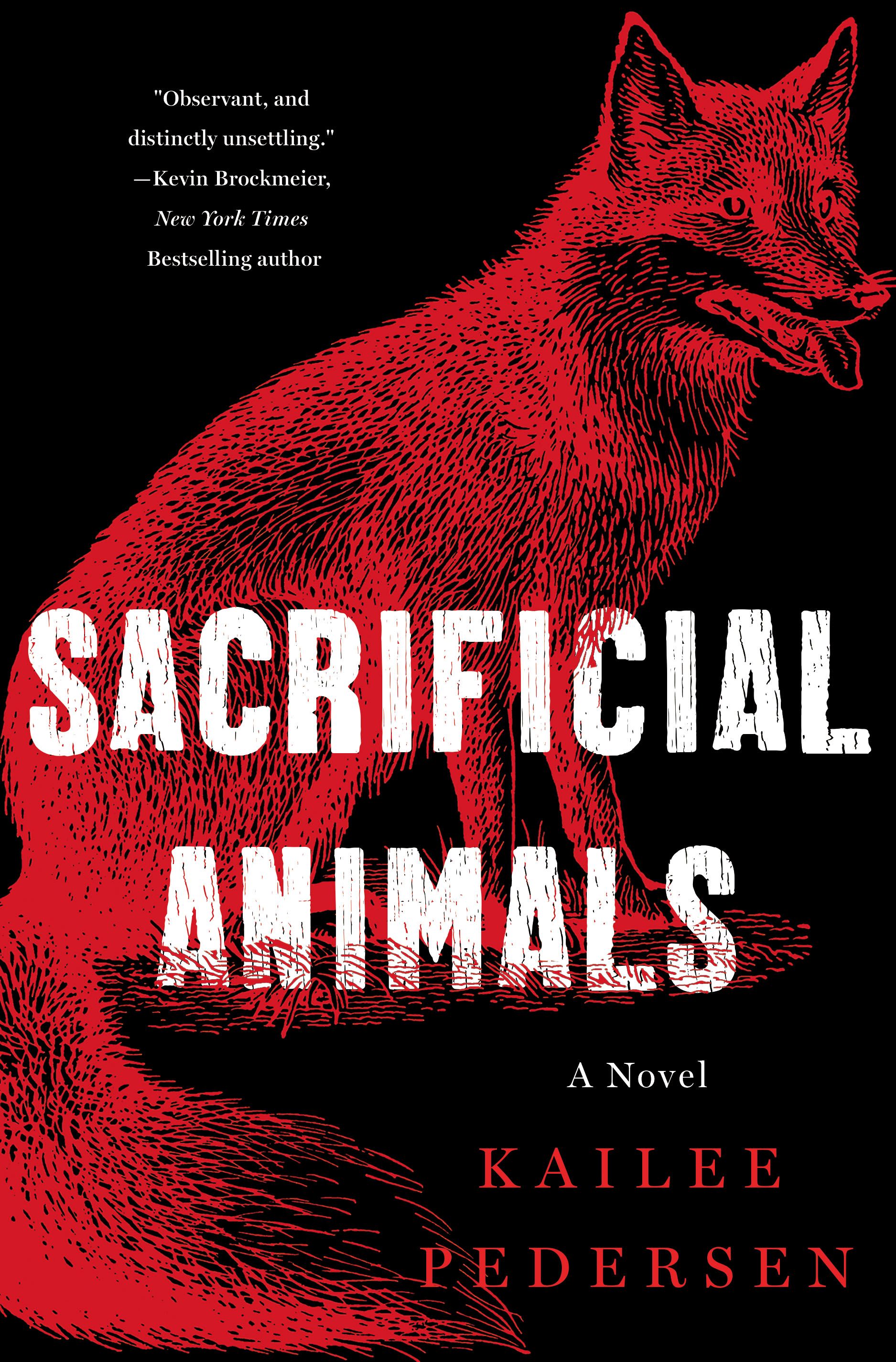
Swiftly and violently as a gunshot a scream pierces the sloped fields lying open and fallow behind the house. Sounding like a woman being murdered in the way he has seen it on television where her agony is drawn out over several breathless and voyeuristic minutes until he changes the channel. Yet he knows it is not a woman but some unnamable beast of the forest come to bewitch and maim. A mother despondent, in all her devastated keening—the fox whose children now reside in the stomachs of the hounds at Stag’s Crossing has finally returned.
The difference between wolves and foxes his father says is that wolves love to hunt and foxes love to play. A tantalizing trail of blood in the half-melted snow. Wolves only have enough foresight to kill and upon their killing they will feed ravenously and strip the bones. But foxes; they are quick-witted and brutal. When they hunt they do so with finesse stalking and pouncing then snapping the spine in their slender jaws.
What goes around comes around.
Life’s a bitch and then you die.
Carlyle Morrow is bitter widower, his third son, Christopher, buried on his land, along with his mother, who died in the attempt to birth him. Morrow is left on his thousand acres in the middle of Nebraska with two sons. Joshua is the golden boy, beautiful, attentive to Carlyle’s every wish, a loyal favorite lapdog. Nick is the second son, plain in appearance, tepid in his embrace of his father’s violent nature. He possesses a bit of his mother’s second sight, his orientation less than that of a purebred. They have both been made to endure a legacy of cruelty passed down from father to son over at least three generations. Carlyle forces him into an act, while hunting, that goes beyond wrongfulness, beyond sin, into the realm of abomination. Nick will live with the guilt the rest of his life, even though the responsibility was not all his. Now in their forties, Nick and Josh have been separated from their father for decades. (Nick still calls) But neither can refuse the summons to return home on news that their father is preparing to die.

Kailee Pederson – image from her Twitter profile
We follow Nick as he recalls his life, his struggles with Joshua and Carlyle, mostly the latter. He always found his brother’s wife, Emilia, fascinating, alluring in the mode of a siren. Carlyle is cruel, requiring complete obedience. He expects his sons to love the raw violence that marks his life. He does not raise his boys so much as train them. He even wishes that they could be as faithful and bloodthirsty as his best friends.
If Carlyle could have had dogs for sons he would have been a happy man; but when has a Morrow man ever been happy?
The structure of the novel is a back and forth, with alternating chapters, Then and Now. We learn how the boys’ treatment (Nick’s mostly) brings them to become the men they are in their forties. One would think that with chapters labeled so, there would be a clear differentiation between the internal timelines of each chapter. But no, there are transgressions within, as “Now” chapters, as well as “Then” chapters include lookbacks. Seems not cricket to me, but no biggie. The personal history is clearly a roadmap to the boys’ doom, which is referenced many times, so will not come as a shock. Pederson keeps offering glimpses of the future, a bell being rung louder and louder with each recurrence. There is an unrelenting atmosphere of dread. Awful things will be happening, although we are not let in on the specifics. For example, an early omen.
No thousand acres, no grand inheritance can ever be enough to postpone their destinies. Nick will die as bitter as he came into the world. He knows this just as well at thirteen as he will in thirty years.
Carlyle’s cruelty and monstrous control pushed them both away, Nick to New York, and a career as a cruel literary reviewer, Josh to the other coast with his wife, Emilia, whom Carlyle would not even allow into the house because of her Asian descent.
Yet in only ten years his children will betray him in their own inimitable ways—Joshua marrying out, Nick exiling himself to a foreign land. And in their absence Stag’s Crossing will lie silent and fallow as the fields surrounding it. This place: no place for young men.
or old men, for that matter. This tale displays the violence of a Cormac McCarthy tale. It is not for anyone with an aversion to scenes of death, particularly the death of animals. It comes as no surprise that
Cormac McCarthy is an all-time favorite writer for me, perhaps my favorite of favorites, and his influence is very obvious here.. – from the JamReads interview
References to animals are legion, not in a happy way, for the most part. It is clear that the Morrows fit in well. A sample:
Would he kneel before his father’s magnificence and eat oats from his hand like a wayward steer?
————————————–
Now he and Joshua must return to Stag’s Crossing. Return to that grand two-story house where as children they were left alone for hours at a time savaging each other like wild dogs.
————————————–
Finally, she turned to him. Only the slightest tilt of her neck, elegant as a swan’s.
————————————–
Upon awakening she is languorous as a cat sunning itself in a windowsill.
————————————–
Joshua sees him lying down next to him perfectly still. Breathing through his nose softly like a newborn foal.
There are only a gazillion more of these.
Pederson is masterful with sustaining tension. The reminders of doom help, but there is much more going on here. The tragedy felt very Shakespearean. (Titus Andronicus maybe? King Lear with competing sons instead of daughters?) People make choices, and suffer the results. The language is rich and diverse, from terse Cormac-McCarthy-esque declaratives to languid poetical passages.
Pederson uses much of her background to inform her tale. She was adopted by a Nebraska family, is of Asian descent and uses her experience as a gay kid coming of age to inform her portrayal of Nick’s growing sexual awareness and exploits. She weaves a Chinese myth into the story, providing some early breadcrumbs to lay a foundation for the horror to come. It does.
Given that the characters are so damaged, and so damaging, it can be tough to work up a lot of sympathy for them, even Nick, who carries forward into his writing the cruelty he was bred to in Nebraska. Carlyle is pretty much a pure monster, and Joshua is given much less coverage that the rest of his family. Emilia is mysterious and alluring whenever we see her, which is mostly at the back end.
This is Kaileen Pederson’s first novel It is an impressive debut, a smartly literary horror story. We cannot get enough of these.
Much of the novel’s setting of Stag’s Crossing, the thousand-acre farm owned by the Morrow family, is directly based on my family’s farm in Nebraska. I always found the woods that surround our farm to be a very contemplative, mystical, and mysterious place. I knew I wanted to draw on my Chinese background for Sacrificial Animals, so I started to think about different aspects of Chinese mythology that could be a good fit for this setting. Without giving anything away, I will just say the natural world plays a huge role in the mythological elements of the novel, and foxes — as featured on the cover — are one of my favorite animals.
Review posted – 11/15/24
Publication date – 8/20/24
I received an ARE of Sacrificial Animals from St. Martin’s Press in return for a fair review. Thanks, folks, and thanks to NetGalley for facilitating.




This review is cross-posted on Goodreads. Stop by and say Hi!
=======================================EXTRA STUFF
Links to Pederson’s personal, Instagram, and Twitter pages
Profile – from Macmillan
Kailee Pedersen writes haunted, unsettling speculative fiction. She graduated with a B.A. in Classics from Columbia University, specializing in ancient Greek. Kailee was adopted from Nanning in 1996 and grew up in Nebraska, where her family owns a farm. Her writing on LGBTQ+ and Asian American themes was awarded an Artist Fellowship by the Nebraska Arts Council in 2015. When not scribbling down her next book, you can catch her singing opera, playing video games, or working as a software engineer in New York City. Sacrificial Animals is her first novel.
Interviews
—–B&N Reads – Poured Over: Kailee Pedersen on Sacrificial Animals By Jenna Seery / August 20, 2024 – audio
Sound quality is bad, Kailee is tough to understand.
—–JamReads – Some Thoughts with … Kailee Pedersen – by Jamedi
Items of Interest from the author
—–American Foreign Service Association – 2012 – Burmese Days: Democratization and the U.S. – Burma Relationship
—– KAILEE PEDERSEN: IN PRAISE OF THE DIFFICULT WOMEN OF EAST ASIAN LITERATURE
 ” alt=”book cover” width=”187″ height=”300″ align=”left” hspace=”10″ vspace=”10″>



 Coot's Reviews