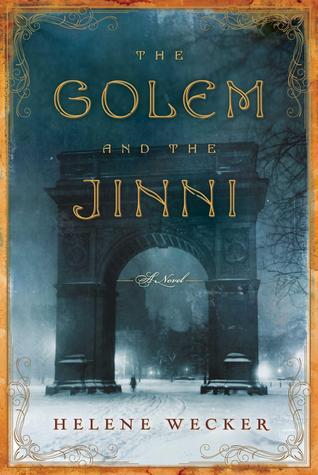
The Golem and the Jinni by Helene Wecker

book cover

I am trying something a little different here. I found The Golem and the Jinni to be a fun, magical fairy tale of a romance with a fair bit of excitement to it. But it is pretty clear that this is also a serious, literary work, raising meaningful philosophical questions, while using the folklore of two different cultures to inform the immigrant experience, offering a fascinating look at a place and time, and linking the experiences of the old and new worlds. These two takes seemed to call for different reviews. And, as I maintain only one book review blog, the result is two, two, two reviews in one.

REVIEW #1

Everyone loves legends, lore, tales of long ago, filled with heroes and magical beings. They dilate our pupils, excite our imagination and provide the fodder for our dreams. Helene Wecker has written a very grown up fairy tale, bringing to life a pair of magical beings. In doing so she has transported old world legend to a place where and a time when vast numbers of more ordinary people were trying to create new dreams, new legends of their own, immigrant New York City at end of the 19th century.

The Golem is a clay creature constructed by a corrupt Kabalist near Danzig, at the behest of Otto Rotfeld, an unsuccessful, unattractive young man. But Rotfeld was not looking for a thuggish destroyer. He wanted his golem to be made in the form of a woman and imbued with curiosity, intelligence and a sense of propriety. On the passage to New York, Otto suffers a burst appendix and dies, but not before he speaks the words that bring his creation to life. Newborn and alone, but with an ability to perceive the wants of those around her, the Golem is set loose in New York. Wandering around, she is spotted for what she really is by a retired rabbi on the Lower East Side. He takes her in, tries to get her settled and struggles with how to deal with the fact that she is a creature usually built for the purpose of destruction.

description
Helene Wecker – image from the Boston GlobeNot too far away, in Little Syria, an Arab immigrant community near the southern tip of Manhattan, Boutros Arbeely, a tinsmith, is brought an unusually old copper flask. While attempting to repair it, he is confronted by a magical being of his own, a handsome arrogant, and unclothed jinni. Unfortunately for the jinni, despite having been freed of the flask, he remains trapped in the shape of a human, bound there by an iron cuff on his wrist. In this telling jinnis, despite excelling at metalwork, have no power over iron. He will have to cope as a human.

Each faces challenges. The Golem, named Chava (which means life) by the rabbi must cope with the flood of wishes that assail her consciousness from the thousands of people around her. She must learn to keep her identity secret. This includes coping with the fact that she does not sleep, and that it is not considered ok for a young woman to be seen walking the city streets at night, even if it her purpose is honorable. Like many immigrants before her, she is helped by prior arrivals. She learns to bake and gets a job in a bakery. Unable to go out at night she takes in sewing. How immigrant is that?

The jinni, taken in by the tinsmith, is given work in the shop, once it becomes apparent that he is a marvel with metal, able to heat and mold it with his bare hands. Boutros names him Ahmad. The jinni is also challenged to keep his true nature under cover. But a part of his nature is a lustful side. He is smitten with a young thing he encounters and one thing leads to another. Chava, while not much hot to trot herself, becomes an object of romantic interest to a very good young man.

Of course, in time, the two encounter each other, and that is where the story takes off. Not only is there magic in the interaction of these two friends, strangers in a strange land, they bring depth to their relationship, adding even more depth to this novel. Chava has content-rich discussions with her rabbi rescuer, on matters such as why people risk so much to have sex, or whether people need a concept of God to keep them from self-destructing. She and Ahmad discuss the stresses of free will vs the certainty of slavery. They talk about her interest in satisfying the wishes of those around her while Ahmad is mostly concerned with satisfying his desires of a moment. A great part of the magic in this fable is how the two begin at extreme ends and meet somewhere in the middle, growing and changing, but very much aware of their limitations.

The two embody, in a way, the immigrant experience. Coming to a new country, learning new ways, changing in order to fit in, coming to value what has been found, building a life. But character growth, consideration of serious moral subjects and a moving relationship are not all that this book has going on. There is danger afoot.

Keeping the action moving, we get not only a look into the jinni’s ancient past, a fascinating and moving segment, but there is pursuit on those cobble-stoned streets. A person with evil intent is tracking the scent of magic and surviving this onslaught is the motive force. As we have come to care about both our primary characters their safety matters.

Not only has Wecker populated her fable with two wonderful leads, but her backup players are extremely rich. In fact this is one of the best supporting casts I have seen in a while.

The Golem and the Jinni has love, parental and romantic, philosophical heft, a vibrant picture of a place and time, the equivalent of an action/adventure trial-by-danger and enough magic to shake a wand at. In short it is everything in a book that you could possibly wish for.

REVIEW #2

It may not take you a thousand and one nights to read The Golem and the Jinni, but you may wish it did because you will hate to put it down.

It is 1899. In a town near Danzig, Otto Rotfeld is a failing Prussian Jewish businessman. He does not have much success with the ladies either. A leering and dismissive manner will do that. Determined to change his luck he opts to join the throng heading to that new Mecca, the USA. Figuring the female sorts there will find him as appealing as did those of the Old World, he decides to take matters into his own hands. Well, rather into the hands of a morally challenged Kabalist who is ok with crafting what Otto wants, a bespoke Golem, using the traditional clay, but made in the shape of a woman, and not the sort of towering, lumbering, bad-hair destroyer that usually pops to mind, thanks to early German cinema.description
Or a more 20th century version
GORT

Gotta confess, I now see Gwendoline Christie of Game of Thrones fame in the role.

description
Image from syfy.com

Hey, the guy’s got needs. (This raises the wonderful theoretical possibility of a high-end retail business, Build-a-Golem. Schmul, more clay, hurry up.) Unwell in his steerage accommodation, Otto is looking for a little companionship and wakes his special friend. Just in time, as it turns out, as Otto, and his burst appendix, fail to make it to the particular new world he was hoping to reach. This leaves a rather bewildered, powerful and telepathic mythical creature heading for Ellis Island. She finds an unusual way to cope when asked for her papers, which I will not spoil, then, wandering around the city, is taken in by a retired rabbi who sees her for what she really is. (Yeah, he’s a lot older, but he really sees me) The Golem truly is a stranger in a strange land, but she is not the only oddity on shore.

In Little Syria, an immigrant community near the southern tip of Manhattan, a Maronite Catholic tinsmith, Boutros Arbeely, is brought a copper flask to repair. While beginning work on the piece with a soldering iron (no rubbing of the magic container this time) he is blasted across the room, and before you can say Robin Williams three times fast, there on his shop floor is a naked man. And it’s not even Halloween in the Village. Really, he is a creature made of fire and mist, but is confined by virtue of an iron bracelet into the form of a human. In this imagining, iron is something a jinni can’t do anything with, I guess like bad fashion sense. Sorry, no puff of smoke. But this magic man is a hottie. He is, of course, cut and handsome, but in addition, he is a natural metalworker. Boutros, despite the jinni’s arrogance, gives him a place to live and a job. He ain’t never had a friend like him. I see in my tiny mind the steamy Colin O’Donoghue (currently Captain Hook on Once Upon a Time)
description
Maybe Mena Massoud of Aladdin fame
description

Ya think these two illegal immigrants might cross paths? Duh-uh. But it will take some time, as each has his and her own road to travel.

If I had three wishes the first would be to be able to write as well as Helene Wecker. She manages to combine several layers to make a compelling whole. She compares a bit of folklore from two different cultures and looks at how they work in a new place. She offers philosophical consideration of deep human issues. She offers a wonderful view of a place and a time, and there is a motive force here that keeps the story moving, and presents our two leads with a mortal threat.

On one level this tale is a bit of a romance. Boy meets Gol. (permission to groan) Well, not exactly a boy, but a mythical fire being who was 200 years old when a wizard confined him, maybe 600 years prior to the now of the story. And this clay hulk is not just a soul-less destroyer, but has a definite tender side. I was reminded of Mary Shelley’s creation, the novel’s version, really trying to figure out his, or in this case, her place in the world, struggling to work out her relationship to god and to morality, and to the people around her. I could not help but think back to my Catholic school days and the Q and A of the Baltimore Catechism.
Q – Why did God make you?
A – God made me to know Him, to love Him and to serve Him…
Sounds a little creepy in this context, doesn’t it?
As a creature built to be a slave, but lacking a master, the golem must become her own master in a way, (a Ronin?) accepting guidance for sure, but facing real existential dilemmas. What happens when the guy in charge is no longer around? She engages in a discussion with the jinni about the messiness of free will versus the certainty of slavery to the will of another, raising up issues not only of actual slavery, but of blind allegiance, whether to a military cause, a political party, a religious persuasion. When is a person responsible for his or her actions and when does responsibility lie elsewhere? (I am including that discussion here, but am using the spoiler label to separate it from the body of the review. It is not really spoiler material.)“If, by some chance or magic you could have your master back again, would you wish it?”
It was an obvious question, but one that she had never quite asked herself. She’d barely known Rotfeld, even to know what sort of a man he was. But then, couldn’t she guess? What sort of man would take a golem for a wife, the way a deliveryman might purchase a new cart?
But oh, to be returned to that certainty! The memory of it rose up, sharp and beguiling. And she wouldn’t feel as though she was being used. One choice, one decision—and then, nothing.
“I don’t know,” she said at last. “Maybe I would. Though in a way, I think it would be like dying. But perhaps it would be for the best. I make so many mistakes on my own.”

…”I have no idea,” he said, “how long I was that man’s servant. His slave. I don’t know what he may have forced me to do. I might have done terrible things. Perhaps I killed for him. I might have killed my own kind” there was a tight edge in his voice, painful to hear. “But even worse would be it I did it all gladly. If he robbed me of my will, and turned me against myself. Given a choice, I’d sooner extinguish myself in the ocean.”

“But if all those terrible things did happen, then it was the wizard’s fault not yours,” she said.

Again, that not quite laugh. “Do you have colleagues at this bakery where you work?”

“Of course,” she said.”

…He said. “Imagine that your precious master returns to you, and you give yourself to him, as you say perhaps you would. Because you make so many mistakes. And he said, ‘Please, my dear golem, kill those good people at the bakery…Rip them limb from limb.”

“But, why—“

“Oh, for whatever reason! They insult him, or make threats against him, or he simply develops a whim. Imagine it. And then tell me what comfort it gives to think it wasn’t your own fault.”

This was a possibility she had never considered. And now she couldn’t help but picture it: grabbing Moe Radzin by the wrist and pulling until his arm came free. She had the strength. She could do it. And all the while, that peace and certainty.

No, she thought—but now, having started down this path, her mind refused to stop. What if Rotfeld had made it safely to America with her, and the Rabbi had noticed them on the street one day? In her mind, the Rabbi confronted Rotfeld—and then she was dragging the Rabbi into an alley, and choking the life from him.

It made her want to cry out. She put the heels of her hands to her eyes, to push the images away.

“Now do you understand?” the jinni asked

The Golem has content-rich discussions with her rabbi rescuer, on matters such as why people risk so much to have sex, or whether people need a concept of God to keep them from self-destructing. She and Ahmad talk about her interest in satisfying the wishes of those around her while Ahmad is mostly concerned with satisfying his desires of a moment. A great part of the magic in this fable is how the two begin at extreme ends and meet somewhere in the middle, growing and changing, but very much aware of their limitations.

The jinni, while he may still have a trick or two up his sleeves (yes, Boutros does cover him up), chief among which is the ability to mold metal with his bare hands, is still stuck in a human body and is forced to cope as a human. The Golem, whom the kindly rabbi names Chava, which means life, of course, must constantly struggle to hide her real identity. She struggles as well to control her impulses, in a way, like Shelley’s creature, a child attempting to grow up. And she does pretty well, whether restraining herself from satisfying the flood of mental wants and needs that her telepathy picks up, or the occasional urge to pound some a-hole into bits. She is not the most outgoing sort, and is seen by many as a stick in the mud at times.

So, are these two crazy kids gonna get together or what? Yeah, yeah, we’ll get to that. Different paths, remember? The jinni happens to be hanging at the Bethesda Fountain in Central Park when his attention alights on a young thing of a late-teen socialite, Sophia, kept on a leash (or is it in a lamp?) by her mother. Her entire life is planned out for her. Someone follows her home and things heat up. Chava, is not a slave to carnal whims, she may or may not even have carnal whims. But the rabbi has a mensch of a nephew, Michael. Sadly fallen from The Chosen, but a very nice young man who runs a hostel for new immigrants. Such a nice boy. You could do worse, Chavelah.

So, you may wonder, do jinnis or golems sleep? I’ll tell you. No. While not much for snoozing, the jinni has the ability to insert himself (what did I tell you about that? Stop it) into people’s dreams. At least in this story it is only into the dreams of females. Sorry, boys. I imagine that when she was writing these sections, Wecker had to struggle to keep images of Barbara Eden from inserting themselves into her consciousness and giggling until she choked.description

What to do with those long nights? Walking of course. Well, for Mister Ahmad, anyway. It was not considered proper in that era for a young lady to be seen walking the streets alone late at night. It creates the wrong impression, and attracts the interest of unsavory sorts, like the police. As an illegal, and a non-human, that would not do. So Chava does what any young, energetic young lady in the turn of the century Lower East Side would do. Stop that, no, not that. She takes in sewing. Jeez.

In fact there is a lot in this book about the immigrant experience, legal and not, at the end of the 19th century. Two communities both nurture their new arrivals, struggle to get by, to make a better life, attempting to leave behind some of the problems of the Old World. The two embody, in a way, the immigrant experience. Coming to a new country, learning new ways, changing in order to fit in, coming to value what has been found, building a life. Receiving new names.

Free will permeates as a theme. A young New York socialite feels as imprisoned by the future that has been laid out for her as the golem does by her subservience to magical commands, as the jinni does to the metal cuff that denies him his true form, and as another young Bedouin lass feels back in the Old country. You will want to keep in mind notions of imprisonment and the difference between sand castles and other sorts, belonging, community, and note the odd angel motif.

But character growth, consideration of serious moral subjects and a moving relationship are not all that this book has going on. There is danger afoot. Keeping the action moving, we get not only a look into the jinni’s ancient past, a fascinating and moving segment, but there is pursuit on those cobble-stoned streets. A person with evil intent is tracking the scent of magic and surviving this onslaught is the motive force. As we have come to care about both our primary characters their peril matters.

Not only has Wecker populated her fable with two wonderful leads, but her backup players are extremely rich. In fact this is one of the best supporting casts I have seen in a while.

You will not need to endanger your community through the use of dark magic or possess a magic vessel to find your next great read. The Golem and the Jinni will be available far beyond the shtetls of Europe, the deserts of the Middle East, and the New York City limits. This modern Sheherezade has written a magical book and there is no rub. The Golem and the Jinni is all that you could possibly wish for.

This review was originally posted on GR in November 2012

It was posted on Fantasy Book Critic on January 22, 2014

=======================================EXTRA STUFF

3/31/13 – I found a group of interview clips with the author, from Library Love Fest. They broke the interview up into 17 clips, and popped them onto Youtube. There is a lot of interesting information there.

GR bud Susan Tunis taped the author’s reading and Q/A

5/6/13 – NY Times review

5/16/13 – NY Times Sunday Book Review

Leave a comment

Filed under Fantasy, Fiction, Literary Fiction, Reviews

The Shining by Stephen King

book cover

If you have not read The Shining already do not overlook the opportunity presented by the publication of Doctor Sleep, the sequel, to revisit one of the best ghost stories of our time. If you have not already had the fun fright of reading it previously, the appearance of the follow up offers a perfect justification for stepping through those bat-wing doors for the first time.

description
1st Edition cover – Published January 28, 1977 – 447 pps

It has been a lifetime since I read The Shining for the first time, over thirty years ago. I enjoyed it then for its effectiveness in telling a scary, no, a very scary story. Reading it now is colored, as is all of life, by our accumulation (or lack of accumulation) of experience. We see, or appreciate colors, textures, shapes, structures, and feelings with more experienced, educated eyes. We have seen, or are at least aware of real world things that are scarier than any fictional spectres. So, what does it look like through old, cloudy lenses?

It remains a very scary story. The things that stand out for me now are not so much the deader rising up out of a bathtub to pursue a curious child, although that is still pretty creepy, or the mobile topiary, which still works pretty well at making the hair on one’s neck and arms stand at attention. But King was using the haunted house trope to look at more personal demons. And those shine through more clearly now.

description
From Allyn Scura’s blog

He had some drinking issues at the time he wrote the book, when he was 30, and concern about that is major here. Jack Torrance is an alcoholic, no question. He also has issues with anger management, not that the little shit he clocks while teaching at a New England prep school didn’t have it coming. He did. But one cannot do that to a student, however deserving, and expect to remain employed for long. His little boy, however, most certainly did not deserve a broken arm. Jack is very remorseful, and wants to make things right. He manages to get a gig taking care of the Overlook Hotel in Colorado over the winter. It will offer him a chance to get something right after a string of getting things wrong, offer a chance to save his marriage, and offer an opportunity to work on his unfinished play. Risky? Sure. But a gamble worth taking. And his wife, Wendy, agrees, despite having serious misgivings. There are no attractive alternatives.

Of course, we all know that the Overlook is not your typical residence. Odd things happen, sounds are heard, thoughts from somewhere outside find their way into your mind. Jack is targeted, and boy is he vulnerable.

But five-year-old Danny is the real key here. He is the proud possessor of an unusual talent, the shining of the book’s title. Danny can not only do a bit of mind-reading, he can also see things that other people cannot. And for a little guy he has a huge talent. He also has an invisible friend named Tony with whom only he can communicate.

It is difficult to think about the book without finding our mental screens flickering with the images of Jack Nicholson in full cartoonish psycho rage, the very effective sound of a Big Wheel followed by a steadicam coursing through the long halls of the hotel, and the best casting decision ever in choosing Scatman Crothers to play Dick Halloran. By the way, the hotel is based on a real-world place, the Stanley Hotel, in Estes Park, Colorado. And the Overlook’s spooky room 217 was inspired by the supposedly haunted room 217 at the Stanley.


This image is from the hotel’s site – they clearly embrace the spectral connection

The room number was changed in the film to 237, at the request of the Timberline hotel, which was used for exterior shots. There is so much that differentiates Kubrick’s film from the book that they are almost entirely different entities. The differences do require a bit of attention here. First, and foremost, the book of The Shining is about the disintegration of a family due to alcoholism and anger issues. How a child survives in a troubled family is key. The film is pretty much pure spook house, well-done spook house, but solely spook house, nonetheless, IMHO. There is considerable back-story to Jack and Wendy that gets no screen time. You have to read the book to get that. Jack is a victim, as much as Wendy and Danny. You would never get that from the slobbering Jack of the film. The maze in the book was pretty cool, right? I liked it too, but it does not exist in the book. I believe it was put in to replace the talented topiary, which is the definition of a bad trade. There is significant violence in the book that never made its way into Kubrick’s film, but which very much raises a specter of domestic violence that is terrorizing real people living in real horror stories. There are a few lesser elements. Jack wielded a roque mallet, not an axe. Danny is not interrupted in his travels through the corridors by Arbus-like twin sisters. And the sisters in question are not even twins. There are plenty more, but

you get the idea. An interesting film, for sure, but not really the most faithful interpretation of the book. King saw that a film that more closely reflected what he had written reached TV screens in 1997, with a six-hour mini-series version.

Irrelevancies of a personal nature
The opening shot was filmed on the Going–to-the-Sun Road in Montana’s Glacier National Park in Montana. I have had the pleasure (7 times in one visit) and recommend the drive wholeheartedly. It is a pretty narrow road though, so you will have to drive carefully. Bring along the appropriate musical media for the best effect, Wendy Carlos’s Rocky Mountain, and dress warmly. It was below freezing when I reached the top of the road, in August. Some exteriors for Kubrick’s film were shot at the Timberline Lodge on Mount Hood in Oregon. I visited but did not stay there back in 2008. Sadly I do not have any decent personal photos from the place. I can report, though, on a bit


This shot was found on Wikimedia

of kitsch. There is a place in the hotel where an ax is lodged in a block of wood, with HEEEEERE’s JOHNNY on the ax, a tourist photo-op. And yes, I did. Sadly, or luckily, the shot did not come out well, so you will be spared.

Back to the book, Danny’s talent is a two-edged sword. He is afflicted with seeing more than anyone his age should have to see, but on the other hand, he has a tool he can use to try to save them all. Whether he can or not is a core tension element here.

King is fond of placing his stories in literary context. He peppers the text with references to various relevant books and authors. I expect these are meant to let us know his influences. Horace Walpole, author of The Castle of Otranto, a Gothic classic, is mentioned, as are Shirley Jackson, of Hill House fame. (King had used a quote from this book in Salem’s Lot A family saga rich with death and destruction, Cashelmara is mentioned as are some more contemporary items, like The Walton Family, the idealized antithesis to the Torrance Family, Where the Wild Things Are and novelist Frank Norris. The primary literary reference here is Poe’s The Masque of the Red Death, which is cited many times. There had been a costume ball back in hotel’s history and it is the impending climax of that party, the unmasking, that looms here. And toss in nods to Treasure Island and Bluebeard for good measure.

King often includes writers in his work, avatars for himself.

I write about writers because I know the territory. Also, you know it’s a great job for a protagonist in a book. Without having to hold down a steady job, writers can have all sorts of adventures. Also, if they disappear, it’s a long time before they are missed. Heh-heh-heh. – from an AOL interview

Jack Torrance is a writer as well as a teacher. The play that Jack is writing undergoes a transformation that mirrors Jack’s own. In fact, there is a fair bit or mirroring going on here. Jack’s affection for his father as a kid was as strong as Danny is for him. His father was an abusive alcoholic. While Jack is not (yet) the monster his father was, he is also an alcoholic with abusive tendencies.

I never had a father in the house. My mother raised my brother and I alone. I wasn’t using my own history, but I did tap into some of the anger you sometimes feel to the kids, where you say to yourself: I have really got to hold on to this because I’m the big person here, I’m the adult. One reason I wanted to use booze in the book is that booze has a tendency to fray that leash you have on your temper…For a lot of kids, Dad is the scary guy. It’s that whole thing where your mother says, ‘You just wait until your father comes home!” In The Shining, these people were snowbound in a hotel and Dad is always home! And Dad is fighting this thing with the bottle and he’s got a short temper anyway. I was kind of feeling my own way in that because I was a father of small children. And one of the things that shocked me about fatherhood was it was possible to get angry at your kids. (from the EW interview cited in Extra Stuff)

He’s right. I have had the pleasure and I know. Wendy gets some attention as well, as we learn a bit about her mother, and see Wendy’s fear that she has inherited elements of her mother’s awfulness.

Not everything shines here. There are times when five-year-old Danny seems much older than his tender years, even given his extraordinary circumstances. It struck me as surprising that there is no mention of anyone suggesting that maybe Jack might attend an AA meeting. But these are like single dead pixels on a large screen.

If you want to read horror tales that are straight up scare’ems, there are plenty in the world. But if you appreciate horror that offers underlying emotional content, and I know you do, my special gift tells me, then The Shining is a brilliant example of how a master illuminates the darkness.

=====================================EXTRA STUFF

Definitely check out the Wiki for this book – nifty info on the King Family’s stay at the Stanley, and yes, there was a Grady at the Stanley.

I also recommend checking out SK’s site if you want to learn more about him

An interview with King in Entertainment Weekly

BTW, here is a shot of the model snowmobile that Dick Halloran drives back to the Overlook

A few other SK’s we have reviewed
Under the Dome
Duma Key
Lisey’s Story

2 Comments

Filed under Fiction, Horror, Reviews

The Old Man and the Sea by Ernest Hemingway

book cover

It is intimidating to offer a truly critical look at such a classic, so we will ease into it with a few images.

The GOP has offered us a ready-made item to begin this list, and yes, I know that John Stewart already snagged this one and threw it back. description

I turned up a visual art concept that fits in, for a restaurant based on EH themes:description

Although I did not sit for this photo, the resemblance is indeed strikingdescription

And, of course
description
The Old Man and the Cee Lo.

I suppose am certain there are plenty more images one might lure into our net, but sticking to words for a bit, we will pass on the porn offering, The Old Man and the Semen. How about the moving tale of a Navy Construction veteran, The Old Man and the Seabees, or an obstetrical episode of Grey’s Anatomy, The Old Man and the C-Section. Then there might be a psychological drama about a man with bipolar disorder, The Old Man and the See Saw, or a book about an elderly acupuncturist, The Old Man and the Chi. How about a Disney adventure in which Paul Hogan rescues a pinniped, yes, gentle reader, The Old Man and the Seal. Maybe a bit of Cuban self-affirmation, The Old Man and the Si. I could go on, of course, and probably will, at home, until my wife threatens to leave. The possibilities are rather endless. But the Geneva Conventions might be brought into play, and we can’t have that. Tackling such a review head on seems, somehow, wrong, like using paint by number to copy the Mona Lisa, carving the Pieta out of gigantic blocks of cheddar, writing a love poem for your beloved using MadLibs or Yes, the forces of righteousness sanity wanted this one deep-sixed:

…checking for skid marks on Ghandi’s dhoti. Ok, 12-year-old inner me is all giggly now. At some point, though, I guess you have to, you know, fish or cut bait.

I struggled mightily with this one, finding a hook, then having it pull away, grabbing hold of an idea and watching it disappear beneath waves of uncertainty. I tried waiting a while, resting between attempts, losing myself in other contemplations. Smiling a bit, but always hoping for something I could finally yank aboard. Notions of religious connections, Papa’s personal philosophy, and story-telling technique all pulled in diverse directions. As you will see, it was a not a simple contest. And I am not certain that what I ultimately caught is all that filling.

He was an old man who fished alone in a skiff in the Gulf Stream and he had gone eighty-four days now without taking a fish. In the first forty days a boy had been with him. But after forty days without a fish the boy’s parents had told him that the old man was not definitely and finally salao, which is the worst form of unlucky.

So opens The Old Man and the Sea, the book, we hear tell, that convinced the Nobel committee to reel in EGH with the biggest literary hook of them all. Santiago is an old, unlucky, but skilled Cuban fisherman. He has an able assistant, the young Manolin. The lad is not a blood relation, but he sees a father figure in the old man, and he may be a younger reflection of the old man himself. Maybe Santiago sees himself in the young man and takes some strength from that. Like the best sort of father, he teaches the boy to fish rather than fishing for him. But Santiago’s ill fortune has marked him as someone to be avoided and Manolin’s parents have put the kibosh on their professional association. The old man is determined to salvage his reputation, and his honor, and bring in some money by going farther out than the other fishermen are willing to sail, in search of redemption. No herald calls him to action. No dramatic event sparks him to excessive risk. It is an internal challenge that powers his engines. But it is a quest nonetheless on which Santiago embarks.

Any time there are fish involved, one might presume a degree of soul saving. I do not know enough Hemingway to have a take on whether or not that figured here. I raise it only as a passing thought. But the second sentence of the book offers a hint. “In the first forty days…”clearly places Santiago’s travails alongside another person who spent forty days in a different barren environment. It was after being baptized that Jesus spent his time in the desert, preparing for what awaited. Is Santiago to be tested here? Will he be offered a route away from his difficult path?

The waters are becalmed. Nothing moves. A moment, then, for a digression. OK, let’s try some simple arithmetic, if Jesus, at age 30, spent 40 days in the desert, and Santiago has gone 84 days in his version of the desert, just how old is the old man? 63, according to my calculations. Possible. I do not recall seeing an actual age noted, so I am gonna go with that. I know you guys will let me know if an actual age is revealed somewhere and my squinty geezer eyes missed it. Done. I can feel a slight breeze beginning to flutter the sail.

Some sort of religion seems to flow through this fish tale. Not only are we sprinkled with forty-day references, but Santiago discusses sin. In his struggles he suffers physical damage in which some might see an echo of Calvary. But I think that is a stretch, personally. So, we have a bit of religion, and a quest. What is Santiago questing for? Redemption would fit in nicely. Having failed for a long time, he feels a need to redeem himself in the eyes of his community. Maybe not a religious thing, per se, but swimming in the same waters. And speaking of religion, water as a baptismal element is always a possibility, although somewhat diluted here, as Santiago makes his living on the water.

The old man is strong, skilled and determined. Maybe it is his character that is at issue. Maybe somehow, taking on this challenge is a way to prove to himself that he is truly a man. He goes about his business, and his fishing is his fate, maybe even his life. It is in how he handles himself when faced with this challenge that will show us the sort of person he is, a common Hemingway theme, and he does just that.

This is a very short novel, more, maybe, a novella or large short story. But it has the feel of a parable. There is definitely something going on here even if it keeps slipping out of my analytical net.

I was reminded of another well-known fish story, Moby Dick (really, allow a little literary license here people. Yes I know the whale is not a fish. Geez.). Whereas in that one, the fisherman, Ahab, sets himself against the whale, and therefore either fate or god, seeing a personal enemy, Santiago sees the fish as his brother, a fellow creature in the universe acting out his part. The challenge is always about oneself and not about the external enemy, or rival. In fact, the fish and Santiago are both victimized, together, by the sharks that feast on his catch.

Then he was sorry for the great fish that had nothing to eat and his determination to kill him never relaxed in his sorrow for him. How many people will he feed, he thought. But are they worthy to eat him? No, of course not. There is not one worthy of eating him from the manner of his behaviour and his great dignity.

One might be forgiven for seeing here a possible reference to catholic communion and the relative merit of so many of those who receive. Is the fish (a Christian symbol if there ever was one) meant to be Jesus or some other form of deity, as Moby was?

Could it be that Hemingway’s notion of religion is less Christian and more a sort of materialist (as in non-spiritual, not as in accumulating stuff) philosophy? Lacking the proper tackle for that I will leave such considerations to those who have spent more time than I trolling Hemingway’s waters.

The writing is mostly either third-person description or the old man’s internal, and sometimes spoken, dialogue. Regardless of the literary ambitions splashing about here, the story is about a very sympathetic character. Santiago is a man not only of physical strength, but moral character. He is not portrayed as a saint, but as a simple man, maybe even, in a way, an ideal man in his simplicity. He knows his place in the world, faces the challenges that world presents to him and using only his skill, intelligence, strength and determination, overcomes (or not). It is easy to climb on board as a Santiago supporter. He is a fellow who is very much a part of the world, even as he contemplates larger things.

The Old Man and the Sea is a small story, but it is a whale of a tale. If you have not fished these waters before, don’t let this be one of those that got away.

WB32

======================================EXTRA STUFF

1/5/13 – Jeffrey Keeten sent along this amazing link. Gary Wyatt had shared it with him. It will definitely make you smile

6/20/13 – I discovered that one of the images I used had vanished into the ether, so I substituted another

2 Comments

Filed under Fiction, Literary Fiction, Reviews

NOS4A2 by Joe Hill

book cover

Do You Fear What I Fear?

Christmas was one of the best things about being a kid. There is nothing quite like the anticipation leading up to Christmas morning. And even now, having achieved geezerhood, I am still a complete sucker for the big day. Every year a real tree, the lights, sorting through and selecting from the decades and decades of collected ornaments, the gifts, and hopefully a tree skirt free of cat vomit. I put on It’s a Wonderful Life, wife by my side, hopefully at least one of my now-grown kids at hand, and keep the tissues handy. I find it completely heartwarming. One must wonder, however, how Christmas might have been celebrated in the King household. I suppose it is possible that Dad left his darker impulses by his keyboard. Did they share hot chocolate like the rest of us, or maybe add bits of human flesh instead of marshmallows. Hot toddy made with blood from a guy named Todd? Brownies made with under-age Girl Scouts? Did their whipped cream scream? Well, probably not, but one must wonder.

NOS4A2, the author’s latest tale from the dark side, takes a beloved annual celebration and gives it the special family treatment. If you like your Christmas trees decorated with sparkling abominations, your Santa more by way of an oversized, but underfed mortician, and your Santa’s special elf a rapist psycho-killer, then this is the book you will want to find frightening off the other packages under your tree next Christmas.

Joseph Hillstrom King, under nom de scare Joe Hill, is a man who not only would be King, he already is one. He has been pretty busy the last few years, writing up a storm, 20th Century Ghosts, Heart-Shaped Box, and Horns, establishing himself as a respected, successful writer of horror fiction, picking up at least eleven literary awards to date. Although his career has been relatively brief, he has, with NOS4A2, grown up to a level where he can glare, eye-to-eye, with the best of contemporary horror writers, even that guy across the table at Christmas dinner.

NOS4A2 is a work of impressive creativity, and one that may give you many a sleepless night, so powerful are some of the images he has created. But the core of the book is Victoria McQueen, Vic, The Brat. And how fitting that a King makes his heroine a queen. Applying a familiar horror-tale trope, the young female hero, we are introduced to Vic as an eight-year-old. This kid loves her bike. But then she has good reason to. It takes her where she needs to go, whether that happens to be around the block or across a magically bespoke bridge that takes her across geography, wormhole style. It comes in handy when she desperately wants to locate, say, a lost necklace that figures in her parents latest screaming match, opening for her a personal Shorter Way Bridge to take her to the proper destination. It takes her home again, of course. But it exacts a toll. And the journey through it can be harrowing.

Countering this adorable heroine is Charlie Manx. Not so adorable. This definitely not so goodtime Charlie abducts children to his special place, Christmasland, taking advantage of their unhappiness to seduce them with a King-family version of Neverland. What if it were Christmas every day? Charlie’s number one supporter is Bing Partridge. Bing’s latest accomplishment was the murder of his parents, but not before engaging in unspeakable behavior of another sort. He may be dreaming of Christmas but it is more likely to be fright than white, and there are fouler things than partridges in the trees he favors. He lives, fittingly on Bloch Lane, named, we suspect, for the author of Psycho. Once teamed up with Charlie, he makes use of his access to a particular sort of gas, sevoflurane, to subdue his victims. The stuff smells like gingerbread.

Bing’s yard was full of tinfoil flowers, brightly colored and spinning in the morning sunlight. The house was a little pink cake of a place, with white trim and nodding lilies. It was a place where a kindly old woman would invite a child in for gingerbread cookies, lock him in a cage, fatten him for weeks, and finally stick him in the oven. It was the House of Sleep.

You won’t find Christmasland on any map, but it exists. Charlie drives a 1938 Rolls Royce Wraith. Not exactly a sleigh, but useful for transporting Charlie and his goodies here and there. Actually, it is more a case of him bringing the children to his dubious gifts than it is of the gifts being brought to the children. Charlie has been snatching children for a long time. So we have the goodie and we have the baddies.

Vic becomes that most horrifying of nightmares, an adolescent. And in a fit of rage against her divorced parents goes looking for trouble. Before you can say “Feliz Navidead,” the Brat finds herself riding into a Charlie lair, the cutely named “Sleigh House.” A bleak house indeed, as you might guess, and Vic has to resort to some extreme measures to make good her escape. Of course, once she does she earns a permanent place on Charlie’s naughty list. One positive that comes out of this ordeal is that when Vic is fleeing Charlie she is picked up on the highway by a passing biker, the large, leather-clad Lou Carmody. Classic meet-cute and oh, someone is trying to kill me.

description

It turns out that Vic and her nemesis are not the only ones with a certain gift. When Vic crosses her Shorter Way Bridge to the place of business of Maggie Leigh (second possible Psycho reference?) she meets another person with a special talent, one particularly suited to a librarian. It’s not heaven, though. It’s Iowa. Later Vic’s dad joins up and there is some help from beyond the grave as well. Team Charlie has a lot of young recruits, too. One might be forgiven at times for thinking that he might be giving new meaning to the term “cold calls” as he has his maybe-dead minions manning (would that be childing?) the phones to harass our hero.

“Everyone lives in two worlds,” Maggie said, speaking in an absent-minded way while she studied her letters. “There’s the real world, with all its annoying facts and rules. In the real world there are things that are true and things that aren’t. Mostly the real world s-s-s-suh-sucks. But everyone also lives in the world inside their own head. An inscape, a world of thought. In a world made of thought—in an inscape–every idea is a fact. Emotions are as real as gravity. Dreams are as powerful as history. Creative people, like writers, and Henry Rollins, spend a lot of their time hanging out in their thoughtworld. S-s-strong creatives, though, can use a knife to cut the stitches between the two worlds, can bring them together. Your bike. My tiles. Those are our knives.”

The King family seems to have figured out how to make us care for their heroes, and Hill has done a nice job of that here. Vic is sympathetic, not just for her courage and determination, but for her failings as well. And there is plenty of failing to go around here, but also generous doses of redemption.

And there is no shortage of action. It all builds to a very explosive climax. There are occasional bits of fun in here as well. Hill engages in a joke having to do with Checkhov’s gun that is sure to bring a smile. And he takes a cutesy swipe at Henry Rollins.

There are some soft spots as well. Charlie is a pretty bad sort. Not enough attention is addressed to looking at how he came to be that way. It might have helped make him more understandable, if not sympathetic, which is always more interesting than the straight up boogie man. Bing is boogie man enough, despite his less than imposing façade, his child-like insecurity. And what is it that gives certain objects their magical properties? Never addressed. Hill takes on the somewhat softball difference in value between happiness and fun, which certainly has relevance to our consumer culture, but is far from novel.

Still and all, this is top notch horror, signaling not necessarily that a King is born, but that one has arrived and is ready to ascend to the throne.

Happy Horrordays!

WB11

===================================EXTRA STUFF

Hill put up a nice promo vid for the book on his site

4/29/13 – The New York Times review by Janet Maslin

9/19/13 – Dad makes reference to the baddie from this book in his new one, Doctor Sleep

5 Comments

Filed under Fiction, Horror, Reviews

Brief Encounters with Che Guevara: Stories by Ben Fountain

book cover

Brief Encounters with Che Guevara is a 2006 collection of eight brilliant short stories by Ben Fountain, author of the wonderful novel, Billy Lynn’s Long Half-Time Walk. Brief Encounters established Fountain’s reputation as a writer to watch, earning him a PEN Award, a Whiting Writers Award, an O Henry, and a Barnes and Noble Discover Award. Must be good, right? Indeed it is.

Half the stories are set in Haiti. Others are in Sierra Leone, Columbia, Myanmar and there is even one in Europe. They tell of people trying to do the right thing in an amoral world. The complexity of the world is a central focus in most of these stories, where it is often not so easy to figure out what the right thing to do actually is, let alone doing it. A grad-student ornithologist is taken captive by a revolutionary group in Columbia. An American NGO worker is persuaded to help fund a revolution in Haiti. A soldier returns from an extended tour in Haiti with some very unusual baggage. A pro golfer of questionable morality is recruited by the generals in Myanmar to promote golf in their corrupt and isolated nation. A Haitian fisherman finds that it is not so easy to foil the efforts of drug smugglers. An aid worker in Sierra Leone becomes involved with a blood diamond smuggler, while attempting to support a co-op that provides work for maimed locals. Sundry people relate their intersections with Che in the title piece. And in the final selection, a prodigy pianist with an unusual gift must cope with her notoriety while attempting a supremely challenging piece.

  Larry D. Moore CC BY-SA 3.0. via Wikipedia
Photo by Larry D. Moore via Wikipedia

There is considerable moral ambiguity in these pieces, a feast of Faustian bargains to be considered, and even mention of God and the Devil wagering over people’s souls.

Fountain was not always a writer. He was born in North Carolina and got his law degree from Duke, then worked in real estate law in Dallas for five years before pleading nolo contendere and turning over a new leaf.

It was a lot of things coming together at once: having a kid; my wife, Sharie, making partner at her firm; me having practiced for five years and just absolutely having had enough; me turning thirty and thinking that if I was going to make a run at trying to be a writer I needed to get going. There was a sense of urgency, of time passing. (from Ecotone)

Beginning his new career in 1988, he had stories accepted here and there but it took a long time for him to hone his craft and produce top quality work. One of the stories in this collection was first published in 2000. He had his share of frustration during this time, with a couple of novels taking up space in a drawer to prove it. But he stuck with it, treating writing as a job, whether or not he was published, five days a week writing every day, every day, every day.

As for why Haiti figures so large as a subject

On a rational basis, I saw Haiti as a paradigm for a lot of things I was interested in relating to power, politics, race, and history. I went there a couple of times and at that point I probably had what I needed to get. It was some comfort to me to know, flying out of there the second or third time, that I didn’t really have to go back—and yet I did go back, many times. Once I was there I felt pretty comfortable. And the more time I spent there, the more there was that I felt I needed to understand. But I still can’t give a satisfactory explanation for how it happened.

He would visit Haiti over 30 times. The notion of going to Columbia or Sierra Leone was raised, but funds and time are not limitless and his wife was aghast at the notion.

Fountain is very interested in the impact of the large forces in society on individuals.

I practiced law for five years and that gives you insight into a certain mind-set that maybe a lot of writers haven’t had firsthand access to. There’s an almost casual cruelty, a very low level of overall awareness, but sometimes there’s also knowledge that real damage is being done—this attitude of “Oh, what the hell,” this kind of moral cognitive dissonance. These are people who have never missed a meal. It’s an unknowingness, an unawareness, that Reagan personified. Reagan was so sure of everything and yet his experience of the world was so narrow. How could he be sure of anything? I saw that over and over again in the wealthier people I worked with or had contact with while practicing law. Many people were operating from a very narrow range of experience, and yet they had complete faith in it. Their way was the correct way, the only way. They had virtually no awareness of any other way of life except in terms of demonizing things like communism, socialism, or Islam. It’s an extremely blindered experience of the world.

 By Claudio Reyes Ule
By Claudio Reyes Ule via Wikimedia

The stories turn a widened eye on this sort of myopia, but Fountain does not spare the revolutionary sorts either, who have issues of their own. I found the stories very engaging, enlightening and moving. It is definitely worth your while to encounter Ben Fountain in this volume. You may find that the time spent in his company is too brief.

=======================================THE STORIES


Near-Extinct Birds of the Central Cordillera
John Blair is a grad-student ornithologist who ignored the risks and is doing research in Columbia when he is kidnapped by members of MURC (a FARC stand-in), a revolutionary group, and is held for ransom. He winds up spending a long time with the group and establishing relationships with some members and the leader. It is a tale heavy with political irony and a very O Henry-ish ending.

Reve Haitien
Mason is an OAS observer in Haiti. He throws chess games with the young local players, as a way of boosting their self-esteem. He encounters a player better than himself, Amulatto, and is drawn in his world.

Life here had the cracked logic of a dream, its own internal rules. You looked at a picture and it wasn’t like looking at a picture of a dream, it was a passage into the current of the dream. And for him the dream had its own peculiar twist, the dream of doing something real, something worthy. A blan’s dream, perhaps all the more fragile for that.

The Good Ones are Already Taken
Melissa is a very sexual person and it is a big sacrifice for her to do without while her serviceman husband is away. But when Dirk returns from an extended tour in Haiti, he has changed, gone voodoo, religious, which has implications for their sex life. Can Melissa adapt to the new man who came home? And what’s up with all that weirdness he is into anyway?

Asian Tiger
Sonny Grous, 23, is a pro golfer, built like a bouncer and not all that successful. In Rangoon for a tournament he has the game of his life and is recruited by the generals to be the ambassador of golf for Burma, which is seeking to attract foreigners with great courses. The money is pretty good, but there is the dodgy element of working for people who are truly reprehensible.

Bouki and the Cocaine
Concerned about the massive drug-running, Syto, a small-town Haitian fisherman, and his brother decide to grab the bales that are left by the runners on the beach and bring them to the police, accepting on face value the frequent public announcements decrying the drug trade. Things do not work out as the brothers expect. There are real questions raise here about where honor lies, and how one’s interpretation of that informs behavior. There tale is exceptionally clever and will make you smile, while also getting the moral dilemma involved.

The Lion’s Mouth
Jill runs a co-op that provides employment for many local women in Sierra Leone but funds are cut off. She turns to her unlikely bf, Starkey, a dealer in blood diamonds, for help in finding the needed funds. More moral ambiguity here, and an image of a troubled place.

Brief Encounters with Che Guevara
Che is a touchstone here, not an actual character, for the most part. Several, very diverse, people tell of their encounters with Che. Among them is Laurent, a Haitian who knew Guevara. Laurent was my favorite character in this entire collection. It is worth reading the entire book just to get to meet him.

Fantasy for Eleven fingers
Anna Juhl is a young piano prodigy, gifted in a manner identical to Anton Visser, a luminous player of the early 19th century, and composer of a particularly wonderful and difficult piece called Fantaisie pour onze Doigts. She takes on the challenge. This piece seemed a bit out of place in the collection, geographically anyway.

======================================EXTRA STUFF

A great interview in Ecotone Journal – by Ben George – must read stuff if you find Fountain interesting, and you should, a lot on writing and Fountain’s writing history

An interview in the on-line magazine, The Millions by Edan Lepucki. It is mostly on Billy Lynn, but there is plenty here about how Fountain thinks and writes. Definitely worthwhile.

There is a lovely bit in the Barnes and Noble writer details page on Fountain’s favorite books

In the on-line edition of the magazine Rain Taxi also has a lovely review with the author. He talks about his relationship with Haiti. There is a lot of detailed discussion of the stories.

There is a piece by Malcolm Gladwell in New Yorker that looks at Fountain as an example of a late-bloomer.

Leave a comment

Filed under Fiction, Literary Fiction, Reviews, Short Stories

To Have and Have Not by Ernest Hemingway

book cover

This is not at all the Nazi romp of Bogie and Bacall fame. There might be some external similarities, but they seem fleeting. If you put your lips together to whistle here, the likelihood would be that it would be to warn someone that the police were coming. Life can be tough in The Conch Republic.

Harry Morgan is a hard man in a hard time. He owns and operates his own fishing boat, out of Key West, catering to those who Have and want an ocean-going adventure. When Harry is stiffed out of almost three weeks of costs by a boorish client, he immediately becomes a Have Not, is faced with some tough choices, and agrees to transport some illegal Chinese immigrants in from Cuba, a mere 90 miles away. He will go on to smuggle more materials and people over the course of the story.

Desperation is a frequent visitor on these remote shores. Harry is far from alone in feeling the impact of the Depression. One shipmate is a drunk who has seen the last of his good days. A sometimes hire is desperately trying to catch a job anywhere, just to feed his family. The illegals Harry transports are as desperate as working class illegals often are. Even one of the women here is shown in some detail contemplating her grim prospects after her husband has died.

One group with whom Harry has dealings is Cuban revolutionaries. Harry, echoing Hemingway, offers a bit of support for their desires, their ideals, but faced with the reality of their actions, he sees beneath the plating to something a bit less glittery. There are crooks aplenty afloat here, whether a corrupt lawyer, a murderous coyote, a tax cheat, a welcher, and the odd homicidal revolutionary. Come visit.

The book has the feel of something that was thrown together, or at least done in jumps. Turns out that is indeed the case. The first chunk was originally published in Cosmopolitan Magazine in 1934 under the title “One Trip Across.” Part Two of the book first appears in Esquire, February 1936, as “The Tradesman’s Return.” The narration voice varies, from Harry’s to an omniscient narrator, to the voice of sundry others later in the book. This is not necessarily a problem, but does make things feel a bit disjointed. Contributing to this is that, while the travails of Harry Morgan occupy most of the novel, he vanishes for a considerable swath towards the end, and our focus turns to several have characters, only a few of whom we have met before.

Hemingway offers us a look at the sorts of desperation these haves experience. A wealthy grain trader rues a decision made in greed some years back, as the feds circle. A ne’er do well trust fund kid is a kid no more, his holdings have been hit hard by the Wall Street crash and the sorts of banking criminality that have become far too familiar, so he has to do what he has to do to keep up at least the veneer of wealth.

“The eternal jackpot. I’m playing a machine now that doesn’t give jackpots anymore. Only tonight I just happened to think about it. Usually I don’t think about it.”

Harry had risked his life to provide for his family, but the haves seem at a loss when faced with a loss of workless income.

the money on which it was not worth while for him to live was one hundred and seventy dollars more a month than the fisherman Albert Tracy had been supporting his family on…

One particular wanderer in here is Richard Gordon, a character clearly intended as a Hemingway stand-in, a writer of renown in a troubled marriage, something Ernest knew a little something about. There is a local married lady who “collects writers as well as their books,” disdaining a husband who may be impotent.

Overall, there is a dark caste here. Part of that is the times, the Depression, when it was tough to bask in the glow of much of anything. It makes sense that the characters Hemingway portrays reflect the struggles of the era. While he clearly has little sympathy for the haves, he hardly paints the have nots with halos. There is plenty of hardship, and plenty of corruption to go around.

I have not read much Hemingway, so lack the sort of insights one might acquire from a broader and deeper reading of his work. Man testing his mettle vs the world is one we know about though and that is present in abundance here. Harry is screwed by the world so does what he has to do, which includes considerable physical risk. Others prostrate themselves in other ways to get what they need. Are they any less active in taking on the world? Or is it only that it is their methods that differ? Things do not work out all that great for Harry. Maybe there are better approaches to his problem. Then, maybe there are not, and the world just sucks. The world shown here certainly fits into the trope “Life’s a bitch and then you die. Have a nice day.”

Is this great literature? I am open to being corrected and I did think more of it before getting down to actually writing, but I would say “nah.” Interesting certainly, bleak, but too much a Frankenstein beast, parts cadged together, however expertly, that make for a less than successful merger.

To Read or Read Not? I would take the plunge. It might illuminate themes and other specifics in Hemingway’s later works, while providing a dark look at a dark time. You never can tell when a dark time might come around.

PS – it is impossible, even though the character Harry Morgan bears no physical resemblance to Bogart, to keep that voice and delivery out of one’s head while reading this.

4 Comments

Filed under Fiction, Reviews

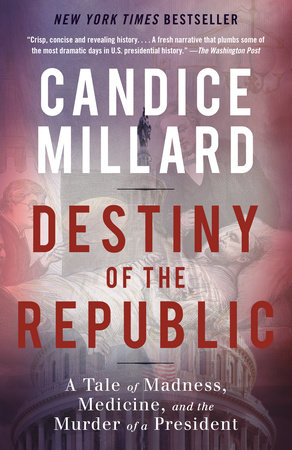
Destiny of the Republic: A Tale of Madness, Medicine and the Murder of a President by Candice Millard

book cover
If most people were to be asked today what they thought of Garfield, they would most likely offer an answer about a cartoon cat, and not the 20th president of the United States, the president who served only 200 days in office, the second president to be assassinated, and one of our great losses as a nation.

Candice Millard, the dishy author of The River of Doubt: Theodore Roosevelt’s Darkest Journey, here follows the paths of two men, the ill-fated president, James A Garfield, and the man who would see to his end, Charles Guiteau.

No political conspiracies were involved, at least not outside the delusions of an addled mind. While the assassin did have political views they were likelier to be the same as those of his target than anywhere in opposition. No, he was your basic nutter, who convinced himself that God wanted him to take out the president. While clearly disturbed, Guiteau had an interesting past. His mother died when he was 7 and he was raised by his father, a religious fanatic, and follower of John Humphrey Noyes, the founder of the utopian Oneida commune in upstate New York. This cultish group favored free love, which they called “complex marriage,” among other things. Charles did not have a lot of success with the ladies, even at Oneida, which must have really stung. They practiced a form of self (really group) criticism that would gain favor with a later communal program, Mao Te Tung’s. <blockquote>Although the commune promised the pleasures of complex marriage, to Guiteau’s frustration, “The Community women,” one of Oneida’s members would later admit, “did not extend love and confidence toward him.” In fact, so thorough was his rejection among women that they nicknamed him “Charles Gitout.” He bitterly complained that, while at the commune, he was “practically a Shaker.”</blockquote> He worked as a lawyer (which at the time did not require a law degree) and a preacher and had a rather permanent and cavalier attitude toward paying his bills. I guess in that way he was a harbinger of Republicans of a later era. Guiteau was in DC seeking a political appointment from the president, just compensation, in his mind, for the assistance he had given to the campaign. He had suffered delusions of grandeur for a long time. His own family had sought to have him put away. But the slippery bastard fled before they could complete his committal.

Garfield’s was a classic American success story. His parents were farmers, working land-grant turf. But dad passed away when James was still a boy. Through hard work and recognition of his native brilliance by enough people who had the means to help, Garfield managed to get an excellent education. His oratorical skills were state of the art for his time. He was elected to the state legislature and soon thereafter put into the national Congress, with hardly any effort at all on his part. This accidental president never sought that office either. In fact, he attended the 1880 Republican convention to give the nominating speech for his fellow Ohioan, John Sherman. But after dozens of ballots, with no hope of any of the major candidates winning enough votes to get the nomination, delegates began looking for an alternative. And thus was James A Garfield nominated for president by his party.

Speaking of which, the Republican Party of 1880 was rather different from the GOP of today. Garfield had been anti-slavery, as had his party. <blockquote>For freed slaves, an impoverished and, until recently, almost entirely powerless segment of the population, Garfield represented freedom and progress, but also, and perhaps more importantly, dignity. As president, he demanded for black men nothing less than what they wanted desperately for themselves—complete and unconditional equality, born not of regret but respect.</blockquote>Today’s party could probably be counted on to insist that property rights trump all and turn away any attempt to get rid of such a peculiar institution. So Garfield was a pretty good guy, remarkably, considering that the Civil War had ended less than 16 years prior, acceptable to both the South and the North, a brilliant, Renaissance man.

Millard offers not only a window into the personal and political history of Garfield, a literal log-cabin Republican, we also get a look at the time. One element is further confirmation re what a fetid swamp DC was (well, it remains a fetid swamp these days, but for other reasons), a place where rats roamed at will <spoiler>but if I step out of the way, they seem happy to dash past. </spoiler> in the White House, (yes, yes, I know, sometimes they are just so easy that even I, who know no shame, have to pass, but you are free to select the party you dislike and fill in the blanks) and clouds of mosquitoes blotted out the sun. Ok, that last may be a slight exaggeration, but the gist remains. It was a biologically unhealthy place. The toxicity of DC and the White House in particular figures rather largely into the story of how James A Garfield met his end.

In addition to the intersecting lines of Garfield and Guiteau, a little extra attention is directed toward a young Scottish inventor, a fellow whose chief concern was helping the hearing impaired. He had, not long before, brought to market a remarkable new device. This made for an interesting time for him. Once the world realized just what he had created, thieves, swindlers and worst of all, lawyers, came after him like a wolf pack on the trail of an injured deer. How much time must one dedicate to defending oneself in court in order to retain control of that which you, yourself created? Lots, and it was making him miserable. Still, he had a thing for inventing. When he heard of the attack on Garfield he hastened to his lab to work on a device that would, hopefully, locate the bullet inside the president’s body, without having to open him up first, a sort of early metal detector. We speak, of course, of Alexander Graham Bell, a young man still. His efforts merit considerable attention and entail a lot of drama. Actually, considering that we are all well aware of the outcome, it is rather remarkable how much dramatic tension there is in this non-fiction account.

We get a look at the medical sorts who dove in when the president was shot, some reasonable, and some determined to place their own interests above the health of Garfield. We get to see yet another example of the arrogance of power leading to a dark end when it chooses to ignore scientific advances in the fact-based world. And we get to see some of the places where the leading edge of medical thought and technology were struggling for recognition. Joseph Lister had revolutionized European medical practices with his insistence on antiseptic environments for medical care. But those who insisted on local exceptionalism preferred to leave their patient in environments we would probably describe today as filthy, and saw nothing wrong with poking their fingers into open wounds. Garfield, ultimately, suffered an iatrogenic death. The bullets did not kill him. His doctors did. Sadly medical care is the third leading cause of death in the USA today, so some things have not changed all that much.

Re government, Millard fills us in on some of the political game-playing of the time, and how it was used to generate governmental stasis. There is much here that resonates, and that reminds us how far we have come in some ways, and how little we have grown in others. I contemplated making a table showing 1880 vs 2013, and doing the comparison (and contrast) more graphically, but I will leave that for other reviewers. I merely note that such a list could indeed be constructed.

One interesting point made here is that both Guiteau and Garfield felt themselves to have been touched by God. Both had faced death while aboard ships and both felt that they had been spared by the Almighty for some greater purpose. It seems unlikely that they were both right.

History books need not be dull. The best give us a sense of a time and a place, let us see some of the personalities afoot in that world, look into how things came to be the way they were and how events of that time have echoed down to us today. A good popular history book makes us stop, rub our chins and mutter to no one in particular, “I did not know that.” On all counts, Candice Millard has succeeded. While the subject is not exactly laugh-riot material, if you love to learn, it will make you smile. It has made others smile as well. <i>Destiny</i> was awarded a PEN award for research nonfiction, and an Edgar Award for best Fact Crime book of 2011.

And it is quite filling. If you are of a cartoonish persuasion, you might even think of it as lasagna for the brain.

For another consideration of this book, you could do worse than to check out Jeffrey Keeten’s excellent review.

3 Comments

Filed under History, Non-fiction, Reviews

Fever by Mary Beth Keane

book cover

Before you start reading let’s see those hands. Both sides please. You call that clean? Are you kidding me? I’ve seen cleaner hands in mud wrestling. Try using soap this time, and I don’t want to see anything but skin under those fingernails. Go ahead. I’ll wait. (A very large foot tap, tap, taps. Eyes rise to scan the ceiling. A puff of exasperation is emitted…waiting) Let’s see. Both sides. All right. I guess that will have to do. Sit down. Go ahead.

In the East River, between Queens and the Bronx, and within sight of the largest penal colony in the world, Riker’s Island, lie two tiny islands, South Brother and North Brother. These siblings are currently owned by the New York City Parks Department, and are preserved as a wildlife sanctuary. North Brother now sports a handful of decaying buildings. One must receive special permission to visit, as there is very real concern about the possibility of visitors plunging through rotted out structures. It was famous in its time as a bar-less cage for one particular bird, Mary Mallon, more widely known as Typhoid Mary. Fever is Mary Beth Keane’s novelization of the life of Ms. Mallon, or at least the part of it that gained some notoriety in early 20th century New York City.

Although Mary did not suffer from typhoid fever herself, at some unknown point early in her life her body began producing the Salmonella typhi bacterium responsible for the disease, and she would have that dark passenger for the rest of her life. It is likely, a virtual certainty in fact, that she was exposed to the disease at some point, even though she reported never having had it. She was the first person identified as an asymptomatic carrier. In the hubbub surrounding Mary’s detention, legal challenges and impact on the health of those around her, local newspapers slapped the name Typhoid Mary on her and it stuck. These days is it applied to any who spread a disease without themselves suffering from it.

Keane opens with Mary being carted away by the Department of Health, itself created in response to the waves of epidemics that followed the Civil War. We look forward and behind from here. Mary was an Irish immigrant, arriving in the US at age 14. It would appear that she brought with her more than just an eagerness to work and some skill as a cook. Her first job was as a laundress, but she found herself handling cooking duties when the usual cook became ill. Over the years, Mary acquired a reputation as a pretty good cook, but it also happened that dozens of people for whom Mary prepared food became ill and some died. She worked in many households, and while not everyone with whom she came into contact became infected, enough did for her to come to the attention of a Doctor George Soper, a sanitary engineer.

description

When a family for whom Mary had been working in Oyster Bay, Long Island, became ill en masse the owner of the property, concerned about the impact of a health scare on his potential rental income, brought in Soper as a consultant to get to the bottom of the infection. He was not a medical doctor but more of a public health specialist.

While typhoid fever had been around forever, epidemiology was a relatively new science. In fact Soper had graduated from Columbia’s School of Mines and was trained as an engineer to look for sources of environmental contamination, usually some sort of pollution. The novel presents him as a nemesis for Mary, an avenging angel she is constantly seeking to evade.

Keane’s focus is on Mary, though, and we follow her travails, working as a cook, for families in and outside the city, frequently leaving after the households succumb to disease, struggling with guilt over her impact on people, struggling also to retain her freedom. We see her first quarantine, her subsequent release and, later, her return to incarceration. Here she is in 1910.

description

Keane fleshes out Mary’s life with a look at her boyfriend, a German immigrant and alcoholic, named Alfred, a few friends, and the people with whom she worked and resided. This offers Keane a window through which we can see New York City at the turn of the 20th century. This local and historical view is one of the best things about the book. Keane rings a bell here and there for significant events of the day. One is the Titanic disaster, with Mary feeling badly not only for the souls lost and those damaged at sea, but the poor bastards working the docks who would have to handle the incoming remains. This concern with the working class experience permeates the book. We see a very tough time, with people living in extremely crowded, and often unsanitary conditions, having to put up with the restrictions on financial advancement that are a product of the absence of unions, having to cope, with no societal help, with disasters like the death of a breadwinner. One jaw-dropping scene showed how the Department of Health produced vaccines. The most chilling, for this native New Yorker, was a portrayal of the Triangle Fire that offered a vision that would be repeated on a grander scale almost a hundred years later. Very moving stuff.

In addition to economic issues of the working class, Keane raises the very real issue of civil rights. When is it ok for the state to deprive someone of their freedom if that person has committed no crime? Mary’s first quarantine was a clear case of preventive detention. Was the Department of Health in the right in imprisoning Mary? What about other asymptomatic carriers? A male breadwinner in upstate New York was released after only two weeks. Why was Mary singled out for such harsh treatment when others with the same issue were allowed their freedom?

How much of her incarceration had to do with Mary being female, a poor immigrant and a member of a despised ethnic group? How much did it have to do with her uppityness unwillingness to automatically kowtow to public officials? Consider what might happen today to, say, a Mexican immigrant cook in Arizona, were one to present the same issue. On the other hand, if Mary had responded more calmly when confronted by the authorities and held to her promise to find employment in something other than food preparation, might she have been able to retain her freedom? Did she know the effect she was having on those around her? Did she care? Keane offers some views on that.

There was one element of this book that I though presented a golden opportunity that was missed. The story of Dr Soper, love him or hate him, had the potential for presenting a much deeper look at the times. Epidemiology was new and Soper was at the forefront. Coping with illness via construction had come into its own in the 19th century and had yielded impressive results. The creation or improvement of sewer and water systems had reduced mortality considerably. The Board of Health in NYC had only been in existence since 1866, an attempt to address increasing urban mortality. Soper functioned as a private investigator and increasing his presence here might have afforded a richer look at urban environmental changes and health care realities and policy issues of the era.

That said, Keane has written an illuminating portrait of a time and place, has raised issues concerning civil liberties, labor rights, class and ethnic bias, and has given every parent a bit more ammunition for use on soap-challenged children. Fever may not be the hottest book of the year, but if you enjoy historical fiction and are at all interested in the history of medicine, public health or New York City, it is pretty infectious.

=======================================EXTRA STUFF

In A Visit to Typhoid Mary’s Domain, a New York Times reporter ventures across the water to see what the island is like today

Beyond Typhoid Mary: The Origins of Public Health at Columbia and in the City by David Rosner, is a fascinating look at the history of public health.

In case you are interested in an unusual vacation destination, here is the NYC Parks map of North Brother Island

For a look at Mary in her later years

Try here for an excellent series of short articles about Mary

================================UPDATES

3/21/13 – I just learned that Fever made the Indie Next list for March

8/8/13 – GR friend Jaye sent along a wonderful link so a site called The Kingston Lounge. This particular part of it contains a lot of photos of North Brother in it’s more or less current state, that being abandoned and protected as a bird sanctuary. The photos are way cool, and creepy, the fodder of ghost, zombie, or post apocalypse cinema.

Leave a comment

Filed under Fiction, Historical Fiction, Reviews

Literary Brooklyn by Evan Hughes

book cover

Beginning my Studies

BEGINNING my studies, the first step pleas’d me so much,
The mere fact, consciousness—these forms—the power of motion,
The least insect or animal—the senses—eyesight—love;
The first step, I say, aw’d me and pleas’d me so much,
I have hardly gone, and hardly wish’d to go, any farther,
But stop and loiter all the time, to sing it in extatic songs.

It is an easy, and perhaps a dangerous thing to indulge in this joyful vice of Walt Whitman’s, in which he captures the ecstasy inherent in the new. That would be new to the observer, for the most part, as the thing learned, the newness experienced, had usually lain in wait for that discoverer, possibly still glistening from birth, but more likely in wait an untold age. Easy, because it pleases the eye, the soul, the imagination, to learn, to see the new and to see the familiar, anew. The danger is the highwayman of piqued interest, robbing our currency of attention and diverting it down myriad unexpected paths. Literary Brooklyn, as it must, begins with Walt Whitman, a literary lion king, with the mane to prove it.

description

It offers glimpses of some of the many who have put pen or pencil to paper, or converted their notions into reality via keyboards, mechanical and electronic. The organization is chronological, and offers the side benefit of a look at the history of the place. Many more are excluded than are to be found here. But that is the nature of the creatively fertile land that has again become, arguably, the literary capital of the country.

You might drop in on Bartleby’s if you do not have handy a copy of Leaves of Grass, perhaps the greatest indie-publishing effort ever. It is a touchstone for this collection of essays. Whitman presumed to speak for the multitudes, the common men and women of his time and into the future. Evan Hughes notes how the authors he subsequently profiles reflect the common people of their times.

description
Evan Hughes – image from the Daily News – (Bryan Pace for News)The list is, of course, a who’s who, even for those of us who managed to get through our education with only minimal inconvenience from English/Literature classes. The primary focus is on the 20th century. Whitman, of course, anchors the 19th, and the 21st is offered some consideration as well. There are thirteen chapters in all. You may recognize some of these names from chapter headings: Henry Miller, Thomas Wolfe, Bernard Malamud, Richard Wright, Truman Capote, William Styron, Norman Mailer, Pete Hamill and Paul Auster. At least these were the ones known to me. There are others whose names, if not necessarily their work, was new. Their stories are definitely worth the time to stop and loiter.

“In those days cheap apartments were almost impossible to find in Manhattan, so I had to move to Brooklyn.”

Thus opens William Styron’s Sophie’s Choice, and it tells the tale of why many of us have settled here.

I am extremely proud to be a Brooklynite, and would be even were the place not so rich in history. I came here in 1980, for the same reason most of these writers did, those who were not raised here, anyway, namely Manhattan was prohibitively expensive. Although it is not the case today that Brooklyn rent is manageable, at least in neighborhoods closer to Manhattan, (I know mine isn’t, and I do not live in one of those frou-frou neighborhoods you might have heard of) the cost of buying or renting a place in Manhattan is enough to induce a cardiac event or a sudden compulsion to either rob banks or, less dramatically, reverse Horace Greeley’s (another transplant to NYC, although not Brooklyn) advice and “go east.” Jimmy McMillan would have been right in any era.

Here is a brief summary of my sojourn from Manhattan to Brooklyn, but really, who cares? So, please feel free to skip it. I began my less than global journey in Da Bronx, with a considerable stay in 1970s Manhattan during my twenties. The Upper West Side then was less economically daunting than it is now. My block, 81st Street, featured Davey’s Tavern, notable for the reliable accumulation of pimp-mobiles lined up on the block. One time some friends and I followed a trail of blood from Davey’s into Central Park only a few blocks east before coming to our senses and returning to our less thrill-seeking lives. The other end of the block featured an SRO of low repute, supposedly owned, at least in part, by one of New York’s senators. I paid a hundred bucks a month for a room in someone else’s apartment while working nights at the Post Office and going to school by day. I loved living in Manhattan. I went to college and studied for my masters there. It was possible to walk across Central Park from home to grad school, and back again, if the weather was agreeable. The American Museum of Natural History was a block away. Lincoln Center was a manageable walk south. When my then girlfriend and I moved in together in 1976, it was to a modern one bedroom apartment in the mid-70s between Amsterdam and Columbus Avenues. But it was also a time of rapid change. Even though Brooklyn was considered the boonies to many of us living in “the city,” landlords were paying torches to clear their properties. The West Side of Manhattan had already been undergoing massive redevelopment and the push was on. Unless one was in one of the higher-paying lines of work, it became difficult, and ultimately impossible, to remain. For what it would have cost us to hang on to our one-bedroom when it was time to renew our lease, we were steered by an interested family member to a relatively massive three bedroom rental in Brooklyn’s Windsor Terrace neighborhood. Gentrification was pushing us to that outer borough. Married now, and knowing that we would be starting a family, reality set in. There really was no choice. As it was for so many before us, we had to adapt to economic reality.

While Hughes does dip into earlier times (The Revolutionary War “Battle of Long Island” took place in Brooklyn, only a few miles from home. Abolitionist activity in the mid 19th century was significant) mostly he tracks some of the development of Brooklyn over a century or so with each piece of his story, showing how the writing of each particular era reflects what was going on at that time. From Whitman’s pre-bridge days, when Brooklyn was its own city, through the construction of one of the true marvels of its time, The Brooklyn Bridge, in 1883, through 1898, when Brooklyn merged with and became subsumed under New York City (in what many called the “Great Mistake of 1898”). He touches on the boom era of the 20s, the Depression, World War II and its aftermath, (Brooklyn Navy Yard ring a bell?) suburbanization and the national abandonment of cities in the 50s, and not just by the Dodgers, a bit of the decline of the city in the 60s and 70s, and then the revival from the 80s onward. He even takes note of the more recent real estate gentrification, and the blossoming of Brooklyn, again, as an artistic and literary capital.

description

There does seem to have been a particular concentration of talent in the neighborhood known as Brooklyn Heights. A few of the writers find themselves in digs that were once inhabited by the Roeblings, the family responsible for constructing the bridge. Generations touch each other in such ways. The Heights is economically inaccessible to all but the well-to-do and has been for a long time. But there have been times when less fearsomely expensive accommodations could be found at the fringes of the neighborhood, particularly as one neared the water and descended from the high ground to the lower. Where today there is a lovely park along the water, in days of yore, it was more of a working port, with the associations one could expect with places maritime, boarding houses, rowdy drinking establishments, houses of ill repute, crime. Mother’s milk for the adventurous wordsmith.

description
[Despite having lived in NYC all my life, and having lived in Brooklyn for over thirty years, I have never, ever heard anyone use this word/expression anywhere outside a commercial or other prepared media.]

By the time Richard Wright moved into a particular Brooklyn Heights house in 1942, the place had already “been home to a rotating ensemble cast of writers and other artists for two years. During that span it hosted not only nightly dinner parties of a kind but frequent all-night parties where the guest list doubled as a Who’s Who of twentieth-century creative and intellectual life.” At one point a group of writers shared this place, which had become known as the ”February House” for the number of residents who had birthdays then. You might recognize some of these names, Carson McCullers (The Heart is a Lonely Hunter), W.H. Auden (at the time one of the most famous poets in the world), Gypsy Rose Lee (“I wasn’t naked. I was completely covered by a blue spotlight”), who was writing a novel, Paul Bowles (The Sheltering Sky), in addition to several of Thomas Mann’s children. The social set included Leonard Bernstein, Aaron Copeland, Kurt Weill, and Lotte Lenya, among others, and a few blocks away Truman Capote was working on his magnum opus, In Cold Blood. Not exactly the stuff of a caricatured, “toid avenue ‘n toidy toid street” accent fame.

The changes to Brooklyn have been considerable. Completion of the bridge was a dramatic leap, allowing access to many more people, increasing demand for housing and other services, and allowing folks to live in relatively inexpensive Brooklyn, while working in Manhattan. Connecting Brooklyn to Manhattan by subway was another great jump in integrating the two cities. For each period, Hughes offers one or several writers, and for more recent times, creative sorts in areas outside the purely written word.

There are many images that will stay with you from this reading. Richard Wright sitting on a bench in Fort Greene park, with pad and pen, (There is a bench there now, dedicated to him) Hart Crane looking through his apartment windows towards the bridge built by Roeblings, who had worked in that very apartment, Gypsy Rose Lee joining a small group of writers sharing a place in the Hts and shaking things up, William Styron hearing the noise of lovemaking upstairs in his Flatbush rooming house, an introduction to the character of Sophie he would write about decades later, Norman Mailer sitting down to eat with his mother every week over the years as he blusters, and occasionally stabs his way through six marriages, a very large Thomas Wolfe pecking away at his typewriter, generating avalanches of paper in his minimally appointed living space.

The books cited in this modest volume could fill a lifetime with superb reading. The bibliography would serve well for required reading for a PhD or three. There is a lot going on here and a lot has gone on before, with or without tiny hats, irony and attitude.

description

Betty Smith, brought up in Williamsburg, wrote, in A Tree Grows in Brooklyn, about how life persists, and even thrives in a seemingly difficult place. Maurice Sendak, a Brooklyn born and raised child of immigrants, in Where the Wild Things Are, tells us, “That very night in Max’s room a forest grew…and the walls became the world all around.” And so it is with Brooklyn. It can be difficult to tell the forest from the trees. There are rather a lot of them reaching for the sky here these days, even with the loss from Sandy, a rare unwelcome immigrant, as more and more creative sorts take up residence in New York City’s most populous borough, not only writers but film-makers, musicians, visual artists, dancers. Evan Hughes has offered a framework in which to try to get a handle on how Brooklyn has changed over the decades and on how the premiere literature that has been written and/or was inspired here reflects those changes. It remains to be seen what artistic wonders will emerge in the years to come, but if history is any guide, there will be continuity of greatness with the past, likely to be achieved, ironically, by considering the lives of the ordinary.

Crowds of men and women attired in the usual costumes! how curious you are to me!
On the ferry-boats, the hundreds and hundreds that cross, returning home, are more
curious to me than you suppose;
And you that shall cross from shore to shore years hence, are more to me, and more in
my meditations, than you might suppose

From Crossing Brooklyn Ferry – W. Whitman

P.S.

There is a map at the beginning of the book. It shows the borough, with numbered dots, each number associated with a writer, most writers having more than one entry. If you get the urge, this would help organize any tour you might care to make.

Our most famous film star, one of the most popular film characters of all time, was born under Ebbett’s field, Bug Bunny. And Brooklyn has produced or housed a plentiful supply of other performing artists. Barbra Streisand, Lauren Bacall, Mel Brooks, Neil Diamond, Mae West, Harvey Keitel, Woody Guthrie, Jackie Gleason, Howard Cosell, Mel Brooks, and Steve Buscemi, to name a few. To see a larger selection, you might try here .

=======================================EXTRA STUFF
A literary map of Brooklyn – this is amazing

Fuhgedaboudit sign

A nifty Currier and Ives image of Brooklyn

NY Times review by Dwight Garner

California Literary Review

Famous Brooklynites – there are more than a few

1 Comment

Filed under History, Non-fiction, Reviews

Ghosts by Eva Figes

book cover

Ghosts is a place where poetry meets prose. It is a feast of observation and consideration, overflowing with rich imagery and mournful with the feeling of time and experience passing, fading, ghost-like into transparency, and non-existence.

Figes, born in Berlin in 1932 to secular Jewish parents, was brought to England in 1939. She is best known for Patriarchal Attitudes, an early book of feminist social analysis. Her 1984 novel, Light, illuminates a day in the life of impressionist master Claude Monet. The skill she had nurtured with that work returns in full flower here. If her dollops of verbiage were not so rich, one might be tempted to consider her work literary pointillism. There is not, I believe a paragraph in this book that exceeds eight lines in length.

An unnamed woman of a certain age observes her world through four seasons. She recalls her youth, visits her ailing mother, has some time with her father, her grown children, lets us in on the associations she has with the various sights and sounds of the places she visits, and with this or that object that carries the weight of her history. She remembers a lover, sees in the pedestrian sights and sounds of her day-to-day the ghosts of her past, memories.

the shadows multiply. They lurk in the texture of old bricks, faced stone, and gloomy basements. Where someone used to practice his violin, hour after hour, where I broke my heel on the kerb, where servant girls in uniform walked dogs, took messages, were she eloped with her poet. Where I walk.

I think of it, this continuum, as I walk along the pavement, one two, one two, crossing the lines, crossing the road where traffic thunders. And we shall all be changed utterly, in the twinkling of an eye.

I can certainly relate. I was not so long ago that I walked with my youngest through Greenwich Village, pointing out to her this or that place that was a part of my past—I dated a woman who lived on that street; I took classes in that building; I attended a frat party there that changed my life; Hendrix recorded there; I bought such and such in that store; we hung out there in that park—specific locations where ghosts reside, lying in wait for our presence to give them a bit more ectoplasm, however temporary. They do get dimmer with time.

This relates somehow to the book I read just prior, Colson Whitehead’s Zone One, which, among other things, is a paean to a place, Manhattan, the associations one has, memories, the changes one sees over time. I am not sure Figes would consider her rendering the sort of love story that Whitehead tells. Hers has more to do with the individual perceiving the haunting of the past in the now and looking beyond that to an invisible tomorrow. For Whitehead, the city may or may not be taken over by zombies, but it is eternal. For Figes, all is fleeting.

Nothing comes back. The eye sees for a moment, the ear hears, but look, now it is gone.

And later,

At times I think I have no sense of the actual. Are things really here at all, I wonder, are any of us present? I think of my brain as a film negative that has been doubly, perhaps trebly exposed.

Ghosts is not so much a linear narrative. It is a consideration of a life in the rearview, a glance here, a look there, and a consideration of where permanence might lie, or not, with each element beautifully crafted. You could open this book to any page and be dazzled. This is not a new book. It was published in 1988, and I came upon it accidentally. It merits attention. There is such beauty in the writing that it surely needs only to be seen by more readers for the images there to retain their substance. Eva Figes died at the age of 80 in 2012. The legacy she left will remain with us for a long time. Ghosts is a book that should definitely not be allowed to fade away.

=======================================EXTRA STUFF

The wiki page for Eva Figes

An obit by her friend , Eva Tucker, in the Guardian

An interesting article on Figes in the Guardian

Posted September 6, 2013

Leave a comment

Filed under Literary Fiction, Reviews