The Enchanted by Rene Denfeld

book cover

What matters in prison is not who you are but what you want to become. This is the place of true imagination.

Rene Denfeld, the author of The Enchanted has the heart of a warrior and the soul of a poet. She has written a novel about identity, understanding, the roots of crime, the reality of prison life, the possibility for redemption, and the ability of people to use imagination to rise beyond the purely material to the transcendent. There are three primary and several very strongly written secondary characters whose stories are interwoven.

In the death row of a stone prison somewhere in America, a nameless inmate, entombed in a lightless dungeon, has constructed a fantastical appreciation for the world he inhabits, bringing a glorious light into his Stygian darkness.

The most wonderful enchanted things happen here—the most enchanted things you can imagine. I want to tell you while I still have time, before they close the black curtain and I take my final bow.

In reading, he has the freedom his external circumstances preclude. And he interprets his surroundings through a magical lens. The rumblings of tectonic activity become golden horses racing underground. He sees small men with hammers in the walls (a particularly Lovecraftian notion) and flibber-gibbets, beings who feed on the warmth of death itself. He visualizes his very sweat rising to join the atmosphere and raining down on China. He is also able to perceive feelings and needs in others, observing from his isolation, and offering a bit of narrator omniscience. That he is able to find enchantment in this darkest of situations is breathtaking. I was reminded, in a way, of Tolkien’s Gollum, the battle between the darkness and the light within a single being. But enchantment is not reserved for the inmate alone.

description
Rene Denfeld

An investigator, known only as The Lady, is working on the case of a prisoner named York. After being on death row for twelve years, York had decided to abstain from any further appeals. The Lady had been hired by York’s attorneys to look into his case. We follow her as she unearths a horrific past that helps explain how York came to be where and who he is. She has a history of her own that informs her ability to relate to her clients. Once upon a time she needed a redoubt of her own.

What did she think about during those endless hours in the laurel hedge? As a child, she made an imaginary world so real that she could feel and taste it today. Sometimes she would imagine that she and her mom lived on a magical island where the trees dripped fruit. Other times they traveled all over the world, just the two of them, like the best of buddies. In all the stories her mom was whole and she was safe. When she left the laurel hedge, she would bend the thick green leaves back, to hide where she had been. And when she came back the next day, crawling with a sandwich she had made of stale bread with the mold cut off, and hardened peanut butter from the jar, the magic would be waiting for her.

She has enchantment in her adult life as well, while pursuing her investigation, as she is dazzled by some of the natural beauty she encounters.

A fallen priest tends to the spiritual needs of the inmates, but he guards a secret that he desperately needs to confess. While he offers what comfort he can to the inmates, who can really see him? Who can forgive him?

Much of this novel is about seeing and being seen, of crime, punishment and forgiveness. The Lady’s role is to see the prisoners, see their history, see what lies beneath the awful exterior. She is respected and admired, but not much seen herself. Many of the inmates and guards get by precisely because they succeed in remaining unseen. Prison is a dangerous place in which to be seen. Those who see might use that vision for dark purposes.

Denfeld lifts a wet rock to reveal the maggot-ridden structure of unofficial prison governance, the corruption and cruelty that permeates this world, even with a fair warden nominally in charge. Corrupt guards ally with brutish alpha inmates for their mutual gain. There is considerable detail about prison life, including such things as why metal food trays are used instead of plastic, how the bodies of the deceased are handled, what events are considered disruptive and what are considered ameliorative, and even some history of the prison, including reasons for elements of its design. She also looks through the eyes of the warden and the guards, offering keen insight.

The story lines include learning what The Lady discovers as she looks into York’s past, following the travails of a new, young, white-haired prisoner, seeing how corruption in the prison operates, and accumulating bits of the nameless prisoner’s story.

There are indeed monsters inside the stone walls, as there are monsters without, both drawn to the despoiling of innocence and beauty. But in this pit of ultimate despair, where all hope is lost, there is magic of another sort. Life may be harsh and death may be near, but welcoming the golden subterranean steeds, attending to the little men with hammers, imagining elements of one’s self traversing the planet, traveling along with the characters in a book, seeing, really seeing others, can lift one beyond the cares of the physical world.

Can there be redemption for the horrific crimes these condemned men have committed? Should they die for their crimes, whether they want to or not? Might it be a harsher punishment, even crueler, to keep them alive?

Denfeld has a considerable history. She is an investigator for death-row inmates, and thus the model for The Lady. Her knowledge of the prison world is well applied here. She wrote a piece for the New York Times Magazine on the impact on children of being raised by cognitively impaired parents, a subject that is significant in the story. In addition, her 2007 book, All God’s Children informs her knowledge of the often violent world of street families, young criminals in particular. She is also an amateur boxer. I would not mess with her.

This is simply one of the most moving books I have ever read. Not only is the material heart-breaking, but the language Denfeld uses in her descriptions, the gentle magic of the imagination with which she imbues some of her characters is poetic and stunning.

I hear them, the fallen priest and the lady. Their footsteps sound like the soft hush of rain over the stone floors. They have been talking, low and soft, their voices sliding like a river current that stops outside my cell. When I hear them talk, I think of rain and water and crystal-clear rivers, and when I hear them pause, it is like a cascade of water over falls.

While there is enough darkness in The Enchanted to fill a good-size dungeon, it is the moments of light, the beauty of language and imagination, and the triumph of spirit that will cast a spell over you that will last until you shuffle off this mortal coil.

The Enchanted will be available March 2014

This review was posted November 4, 2013

=====================================EXTRA STUFF

The author’s web site web site

The author’s Facebook page
2 Comments

Filed under Fiction, Literary Fiction, Reviews

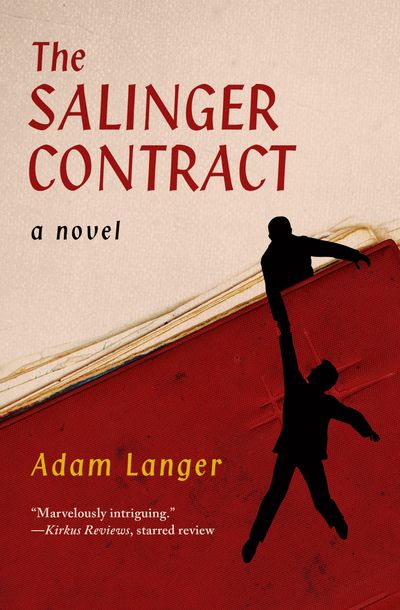
The Salinger Contract by Adam Langer

book cover

Whenever I saw Salinger’s novels or story collections on my friends’ bookshelves, or when I heard authors…talk about how much they admired the guy, I wondered how those books could have influenced them so greatly. I wondered too how Mr. Salinger—in seclusion for more than forty years in Cornish, New Hampshire—felt about the readers who admired his work. If somehow knowing he had touched Hinckley and Chapman and, later, Jared Lee Loughner, who shot Congresswoman Gabrielle Giffords, had convinced him that escaping society had been the right move. I wondered how it would feel to write something—a story, a novel, an article—that would inspire someone to change his or her life for better or worse.

There are questions raised in The Salinger Contract about where the responsibility of the author leaves off. Would Salinger have written his books had he known they would inspire murderous lunatics? Would it have made any difference at all? Maybe those sorts would have just found the same inspiration somewhere else, and the rest of us might have been deprived of some pretty good reading. The question becomes less than academic here.

description
The Reclusive One

Another notion is causality in writing. In an interview with Alexandria Symonds in InterviewMagazine.com, after talking about a proposal by a Hollywood sort that he write a new version of Murder, She Wrote, Langer says:

It’s such a cliché to have the writer who writes about crime turn around and solve them. I thought that was a lame idea, and I didn’t write anything for him, but it did occur to me to completely reverse the polarity on it and come up with an idea of a writer whose books become the basis for crimes.

Ever wonder why famous writers vanish during periods we believe to have been creatively fallow? Langer did, and offers one possible answer. Conner Joyce is a writer of crime fiction. But sales are not improving, as attested by the light turnouts on his book tour, and sliding sales. His family finances are not what they should be and his marriage is not exactly the steadiest. So, when a mysterious billionaire, Dex Dunford, offers him a considerable sum to write a novel just for him, and for him alone, Conner is tempted.

I had friends who were fairly prominent in the literary world who would meet some guy who did not have an apparently interesting life story but who would say, “I will give you double what you normally make for your book. Write my life story.” And if you don’t have a trust fund or residuals, it becomes a very tempting sort of offer. – from the Symonds interview

Of course, as with any such deal, there are conditions, secrecy being prime among them. Dex comes complete with a large bodyguard/enforcer named Pavel Bilski. (think a larger version of Steven Bauer as Avi on Ray Donovan, then add a few inches and fifty pounds), so telling would be a definite no-no.

One of the things Langer is addressing here is the notion of the boundaries between art and reality. Where one leaves off and the other begins takes concrete form when Langer casts himself as a character in the art he creates. This technique is hardly novel here, calling to mind, among many others, Charlie Kaufman in The Orchid Thief /Adaptation, Jonathan Ames of Bored to Death, Dante as a visitor to several realms in tales that range from the infernal to the paradisiacal, and John Fowles in The French Lieutenant’s Woman. Langer, the character, had had a bit of time in the limelight while running a New York based literary magazine. He was known for the many interviews he had conducted, and profiles written of authors. Things in the publishing industry being what they are these days, Langer, the character, finds himself trying to work on his personal writing projects while serving as a house-spouse in Bloomington, Indiana, where his wife is teaching at a university, the Lit mag having gone the way of many publications. Real Adam was a senior editor of Book Magazine until it folded. Fictional Langer had written a profile of Joyce back in the day and when the author makes a book-tour stop in Bloomington, the two get together. Langer, the character, is the eyepiece through which we see Conner’s experience, which is the primary plot track.

description
Adam Langer – the real one

One of the fun elements in the book is the author’s look at the publishing industry, offering payload on the significance of literary whales, some detail on the experience of book touring, intel on top editors, and the sort of portrait one might expect of a popular author of junk books. Particularly fun was Dex talking about the household name authors who had taken him up on his offer over the years. While you may get a chuckle here or there, this is not a laugh-out-loud sort of satire, but a darker, substantive look at questions that matter in the world of writing and publishing. I enjoyed it for that as much as anything. There are also larger issues in play; what is truth and what is fiction, what are we willing to do for money, what responsibility do authors have for what readers do with their work. There is also a brief look at politics in academia, but that was pretty familiar territory, so did not offer much that was new, although it was entertaining. Fans of the late TV show, 666 Park Avenue will find a Drakian thing or two to enjoy. And residents of Chi-town will appreciate the many local references, by Chicago native Langer.

I did find, at times, that there were notions proffered that were problematic, for example

In my experience, every criminal would be an artist if he had the talent, and every artist would become a criminal if he had the guts; in my case, it took an artist to teach me how to be a criminal.

Really? Rather a broad generalization, no? And later

Maybe the reader understood more about a book than its writer ever did. Maybe you know more about me from reading this sentence than I ever could.

While there may be something to the notion that once a story has been published into the world, the world will decide what it means, the fact remains that authorial intent is real, and it would be the rare exception, IMHO, for a reader to grasp an author’s intent more clearly than the author herself.

So, does it all work? Well, there are some stretches to be made, some disbelief to be suspended, but The Salinger Contract is a fun, fast-paced, engaging read, with a core of serious and satiric content wrapped in a shell of adventure. If you need to hide away for a while, this would be a good book to take along.

Posted October 25, 2013

I received this book via GR’s First Reads program – Thanks guys!

====================================EXTRA STUFF

A Wiki profile of the author, the real one

Twitter for Langer

An article by AL – How I Learned Not To Be J.D. Salinger

The InterviewMagazine.com Adam Langer is not in Hiding – must-read material

Leave a comment

Filed under Fiction, Literary Fiction, Reviews

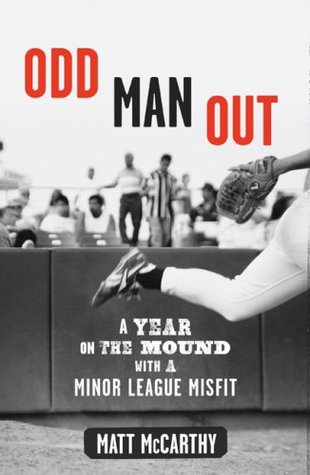
Odd Man Out by Matt McCarthy

book cover

In the 2002 ML baseball draft, Matt McCarthy, a Yale lefty with a fastball that had occasional familiarity with 90+mph was drafted in the 26th round by the Anaheim Angels. He was urged by friends and relations to keep a journal of his experiences, and those journals form the basis of this 2009 story of his single season in the sun of professional baseball.

When the book came out, there was a bit of a firestorm. McCarthy got some of his names, dates, and possibly facts wrong enough that the New York Times highlighted them in two articles. (The links are at the bottom of this review.) It does sound to me that he got a few things wrong. It is even possible that his characterization of this player or that might cause those people some harm. I have no way of knowing the truthfulness of McCarthy’s writing. But I am familiar with how difficult it can be to reconstruct events several years after the events, based on handwritten notes, so am inclined to give McCarthy the benefit of the doubt, and ascribe no malice to his writing. I expect that mistakes which do appear in the book are simply off the plate and are not intentional beanballs. In several instances, I expect that people are simply embarrassed at some of the revelations and it is easier to deny them than to take responsibility.

description
Matt McCarthy

There are some items in the book that might be troublesome for some of the players. McCarthy describes behavior between players that indicates a gay inclination. And that is a barrier that MLB has not yet faced up to. McCarthy also reports on his Rookie League manager’s antics. These include directing his pitcher to hit an opposing batter in retaliation for Provo players having been hit, some mood-swinging, and a remarkable and humorous substitute for the team’s rally monkey. Some players are reported to be milking their disabled list status to avoid playing, and the ethnic separation of players is distinctive, with all Hispanic players, of whatever national origin, designated as “Dominicans” and all others as “Americans.”

So what’s the big deal? Frankly, I do not think there is one. I have read my share of baseball books, and I did not find this one to be exceptional. There were some bits of information that were not at all surprising, such as the use of steroids, (The only surprise might be that there were players who were not using) and the horrors of massive bus rides, the low-wage life that most of these players endure, and the mix of fresh blood on the way up and older players on the way down, high draft picks being handled with kid gloves, and lower draft picks being treated with far less kindness. Class as defined by draft rank may be different from class as defined by wealth or race, but the results are similar. The eagerness of some families in Provo to take in players for a season was a bit of news for me. Aside from a laugh here or there it was mostly pedestrian material, IMHO. That the coach was a character offered some spice. And a ballpark visit by Larry King, his much younger trophy wife and a vile offspring was amusing in a horrifying way.

While McCarthy writes in a very readable, breezy style, there are plenty of baseball books that offer more substance. Jim Bouton’s Ball Four remains the standard beaver-shoot-and-tell example if you are looking for player shenanigans. Bottom of the 33rd: Hope, Redemption, and Baseball’s Longest Game is another that offers a look at the minors, although for a much more defined moment in time. Slouching Toward Fargo by Neal Karlen gives the reader some sense of the non-ML minors.

McCarthy, realistic about his pro-ball prospects, always kept a hand in his other career option, and continued working and studying towards a life in medicine, no, not sports medicine, but infectious diseases. He is now a practicing physician.

Odd Man Out is neither a grand slam nor a strikeout, but more of a seeing eye single ahead of a stolen base.

Posted October 15, 2013

======================================= EXTRA STUFF

Two articles noted above, from the New York Times, both by Benjamin Hill and Alan Schwarz, both published March 2, 2009
Errors Cast Doubt on a Baseball Memoir
and
Excerpts From a Disputed Baseball Memoir

And a more respectful interview – Matt McCarthy, author of ‘Odd Man Out,’ talks with USA TODAY by Dan Friedell

2 Comments

Filed under Baseball, Bio/Autobio/Memoir, Non-fiction, Reviews

The Free by Willy Vlautin

book cover

When Leroy Kervin was 24, a roadside bomb in Iraq parked him in a German hospital with fractures and a serious brain injury. Couldn’t talk. Couldn’t walk. Despite seven years of rehab and huge struggles to regain some of his normal functions, Leroy still suffers from acute PTSD, physical struggles, constant fear, and a fog-shrouded view of the world around him. So, when he wakes up one day miraculously clear-headed, and assumes that this respite is temporary, all he can think is that he will never return to the way things were. To make sure of that he decides to use this fleeting moment of personal reanimation to kill himself. Leroy’s decision brings together the main characters in Willy Vlautin’s look at what it is to be working class in 21st century America.


I write, or hope to write, stories about the working class. I’ve always been a fan of stories about working people, and normal people and the day-to-day struggles they go through. – from interview at 13E Note Editions

Freddie McCall was the night man at the long term care facility where Leroy was living. He is roused by the commotion of Leroy plunging down a staircase onto some wooden stakes. Freddie calls 911 and sees that Leroy is taken to a hospital.

…he held two kitchen towels over the main wound and stared at Leroy’s face. There was a two-inch cut on his cheek leaking blood, and a growing welt on his forehead. Freddie wanted to say something to comfort him, but every time he tried to speak he began to cry.

He’d always liked Leroy. For a man who couldn’t speak, whose brain had been caved in by war, he had a personality. He liked Cap’n Crunch and would watch the science fiction channel for days on end. He had never picked a fight or become violent towards the other residents. He would fall into fits of despair when he refused to leave his bed, but who wouldn’t? And there were times, dozens of them, in the two years that Freddie had been there, when Leroy would wake him in the middle of the night. He would pull Freddie to the back door and knock on it. Freddie would find the key, unlock it, and they would go outside and look at the stars. Leroy would move around the small lawn like an old man, his head back, staring at the faraway galaxies.

Freddie has had a rough go of it himself, and gets why Leroy might want to end his suffering. McCall is the third generation living in his house, but he is among the many suffering under the burden of the number one cause of bankruptcy in the nation, medical bills. One of his daughters was born with dysplasia, required multiple surgeries to repair her hips and Freddie is sinking quickly in a quicksand of debt. And his wife took off with their kids to Vegas to live with her boyfriend. She didn’t take the bills with her. Freddie works two jobs, overnights at the group home and days at Logan’s Paint Store. He catches snatches of sleep when he can. There is no longer heat in his house because he was unable to pay the fuel bill. Desperate for money, he takes on a dodgy venture.

In its majestic equality, the law forbids rich and poor alike to sleep under bridges, beg in the streets, and steal loaves of bread. – Anatole France from La Vie en fleur

Pauline is a nurse at the hospital where Leroy is taken. She tries to help take care of her father, who declines to bathe, wash or eat more than a very narrow list of things. Her mother took off when she was a kid, leaving her in the care of a man who was mentally ill. She did not understand that at the time, but does now. Pauline lives with her pet rabbit Darla, and gets lonely, sometimes. But she has a friend she has known since childhood, and a heart that pulls her to connect with people.

description
the author – from Australian Broadcasting in 2010

One of the major elements in The Free is how just folks can care for each other in a pure way.

I do believe in the kindness of strangers. One of the great things about being in a band is you find that out. People really help struggling bands. Over the years people have been so nice to me and my band, helped us out, fed us, put us up for the night…It’s easy to be scared and cynical. All you have to do is read the paper. I know I have a rough time that way. But I do believe humans, although violent and destructive, have a great ability for kindness. – from interview at 13E Note Editions

Freddie looks out for the residents at the group home and their families, looking for ways to spare them unnecessary costs, even if it means having to do extra work himself. Pauline comes across a runaway teen girl, and goes to extraordinary lengths trying to save her from certain destruction. For all the hoopla given the wealthy when they make large contributions to this or that, it is the lower economic end that actually gives more, and Vlautin is well aware of that.

One of the most surprising, and perhaps confounding, facts of charity in America is that the people who can least afford to give are the ones who donate the greatest percentage of their income. In 2011, the wealthiest Americans—those with earnings in the top 20 percent—contributed on average 1.3 percent of their income to charity. By comparison, Americans at the base of the income pyramid—those in the bottom 20 percent—donated 3.2 percent of their income. The relative generosity of lower-income Americans is accentuated by the fact that, unlike middle-class and wealthy donors, most of them cannot take advantage of the charitable tax deduction, because they do not itemize deductions on their income-tax returns. – from Why the Rich Don’t Give to Charity by Ken Stern in the April 2013 Atlantic

And this does not even take into account the in-kind contributions people make with their time and labor.

Leroy’s suicide attempt was not successful and he hangs on in a hospital room. Awake, he is in constant pain, so he decides to remove himself from the realm of the real. Most of our experience of Leroy is in his sci-fi fantasies. I was reminded of Billy Pilgrim’s escape to Tralfamador in Kurt Vonnegut’s Slaughterhouse Five. Leroy’s adventures contain elements of memory and of fantasy. They are also where Vlautin becomes most metaphorically direct in his critique of 21st century America. This is a world in which people are marked as military-worthy or not, but the mark eventually becomes a mark of Cain and bands of vigilantes hunt them. There is a lot in here about racism, the media, the mean-spirited world in which we live. Leroy’s real-world girlfriend, Jeannette, is a major character in Leroy’s dream-life and nurtures him there the way she nurtured him in real life. It is sometimes difficult to tell where memory leaves off and fantasy picks up.

Religion comes in for some attention here, and not in a supportive way. Religious faith in Vlautin’s universe is a bludgeon used by the unscrupulous, the ignorant, or both to inflict their demands on the young and the powerless. Christian charity in the land of The Free is an oxymoron.

One of the core problems of our economy is personified by an owner who is completely incompetent, but owns and benefits from having a business only because his father left it to him.

Detroit is like rich people. You always hear stories where the dad comes up the rough way, struggles and works harder than everyone else. He builds something, something of value. He spends his whole life doing it. Then his kids come along and take over. They’re so well off that they don’t understand how hard it is to create something good. They just see the money and run with that until it quits. Then everything is lost and even the good idea gives out…

I was most moved by the stories of Freddy and Pauline. Leroy’s story is certainly compelling, but I found it the least engaging of the trio. The one-step-removed methodology used for him kept me feeling one-step–removed as well. If the option were available, I would have knocked my rating down to a 4.5, but the power of the rest moves me to keep this one at five stars. I expect that Willy Vlautin will begin to gain recognition as one of America’s finest artists, a modest guy who embraces his humble beginnings and works to offer us a look at what is becoming the real America for increasing numbers of us. To all of you who are not doing so great in our new two-tiered economy, I strongly encourage you to get into Willy Vlautin. He has been into you for a long time.

Posted – October 10, 2013

The Free will be published in February 2014

====================================THE AUTHOR

Willy Vlautin, born in 1967, grew up in Reno, Nevada. He was a working class kid, raised by a single mom. He was never a great student but had a feel for music and for story. He is one of the founders of the alt-country band Richmond Fontaine. Vlautin’s stories make up much of the lyrics used in the band’s songs. There is a fair bit of crossover between the songs and Willy’s other writing. The Free is his fourth novel. His first, Motel Life has been made into a film with Emile Hirsch, Stephen Dorff and Kris Kristofferson, among others. It is due for release November 2013. His second novel was the award-winning Northline, and the 2010 release, Lean on Pete, was also widely praised.. Vlautin continues to write songs and stories. He lives outside Portland, Oregon these days, when not travelling with the band, but would love to return to Reno someday. His writing calls to mind John Steinbeck and his musical work summons images of Woody Guthrie. He is one of the best writers of his generation.

======================================EXTRA STUFF

Willy Vlautin’s site

Willy on Facebook

A promotional vid for The Free

Wiki page on Willy

A short story by WV

Interview with 13eNote

1 Comment

Filed under Fiction, Literary Fiction, Reviews

Doctor Sleep by Stephen King

There is a boy (now a man) a girl, a band of baddies with a charismatic leader, a coalition of the willing, battles to be fought, supernatural elements and magical powers. Stephen King was at this long before Harry Potter lived under the stairs. He has a preternatural (not to say supernatural) talent for writing kids, and can keep you turning pages, losing sleep, and getting back late to work from your lunch breaks.

We will presume for the purposes of this review that you have read, or at least seen one version of The Shining. If you have not, read no further, as there are details here that would be considered spoilerish were they to appear in a review of that book. And if you have not read The Shining you should probably do so before taking on Doctor Sleep, a sequel. Ok, everyone here has read The Shining, yes? All right, but we are using the honor system here, and do not want to ruin the fun of reading that one for anyone. So, as long as you’re sure…

At the end of The Shining, three people survive the carnage, Danny Torrance, a five year old with a special gift, Wendy Torrance, Danny’s mother and newly widowed wife of the late Jack Torrance, and Dick Halloran, an employee of The Overlook and possessor of a gift like Danny’s, one that allowed him to hear Danny’s psychic 911 call and return from his home in Florida in time to do something about it. What happened next?

description
from CBC News

King does not typically do sequels, if one does not count books that are part of a planned series, but

Every now and then somebody would ask, ‘Whatever happened to Danny?’ I used to joke around and say, ‘He married Charlie McGee from Firestarter and they had these amazing kids!’ But I did sort of wonder about it. – (from EW)

One of the central features of The Shining was Jack’s Torrance’s battle with alcoholism. As with the real world, King’s fictional realm notes that alcoholism runs in families. And one of the criticisms of The Shining was that the possibility of Jack considering getting some help from AA is never even raised. If King has ever considered that to have been an oversight, I have not seen that interview. But it is clear that he has given the matter some thought.

Jack Torrance never tries Alcoholics Anonymous. That is never even mentioned in “The Shining.” He has what they call white-knuckle sobriety. He’s doing it all by himself. So, I wondered what it would be like to see Danny first as an alcoholic, and then see him in AA. (from an NPR Interview)

description
Ewan McGregor as Danny Torrance in the film

It gives nothing away to let you know that Danny is a true Torrance. Not only does he self-medicate to quiet the terrors that still haunt him, he is far from the best person he can be.

I knew if I did this sequel I’d have to try to put together some of the same elements, but at the same time I didn’t want to make it too similar. I didn’t want to make Danny a grown up with kids of his own, and try to replicate that whole losing-your-temper-because-you’re-drunk thing. But I did think to myself: ‘Not only alcoholism can be a family disease, but rage can be a family disease.’ You find that the guys who abuse their children were abused themselves as kids. That certainly fit Danny as I knew him. – from EW

All SK novels require a baddie, or a set of them. No disappointment here. King has again succeeded in taking the ordinary and making it horrifying.

Driving back and forth from Maine to Florida, which I do twice a year, I’m always seeing all these recreational vehicles — the bounders in the Winnebagos. I always think to myself, ‘Who is in those things?’ You pass them a thousand times at rest stops. They’re always the ones wearing the shirts that say ‘God Does Not Deduct From a Lifespan Time Spent Fishing.’ They’re always lined up at the McDonald’s, slowing the whole line down. And I always thought to myself, ‘There’s something really sinister about those people because they’re so unobtrusive, yet so pervasive.’ I just wanted to use that. It would be the perfect way to travel around America and be unobtrusive if you were really some sort of awful creature. – from EW

This wandering band call themselves The True Knot. They feed on the essence of those gifted with the sort of talent people like Danny possess. It provides them with extraordinary longevity, but as with their Transylvanian counterparts, the need is ongoing and the supply is limited. Like right-wing politicians they are more than happy to gorge on the pain of others and are shown here feasting on the spirits set adrift on 9/11. The usual condiments for this substance they call steam will not do. The taste and benefit is enhanced, however, if their victims endure extreme and prolonged torture. Does Ted Cruz drive a Winnebago? King gives the members Damon Runyon-esque names, like Crow Daddy, Steamboat Steve and Tommy the Truck.

By the time you finish reading Doctor Sleep you might have a new image of the top hat to consider next time you are planning a formal night out. We all have one, probably this one:

description

But the baddie in Stephen King’s latest is likely to do for the top hat what this guy

description

did for the derby. Rose O’Hara, the leader of a group called The True Knot, won’t leave home without it. It adds a nice visual element, calling to mind a certain Caribbean Baron, and making Rosie even more riveting.

description
Rebecca Ferguson as Rose the Hat- from the film

And what of our young heroine? Abra is born with a shining of prodigious proportions. (btw, the name Abra was inspired by Abra Bacon, a character in East of Eden) She manages to send out a signal even when she is newly arrived. She’s a good kid, despite scaring her parents on occasion with tricks like making all the silverware in the kitchen take to the air, or causing the odd earthquake when she does a mental Bruce (or if you prefer, David) Banner. Don’t make her angry. You wouldn’t like her when she’s angry. Bad-ass teen girl power fuh shoo-uh. But, just as Danny needed Dick Hallorann and Tony, Abra needs help as well. That she and Danny will team up is a foregone conclusion.

As for Danny, the shining never left him, despite his attempts to wipe it out with spirits of a different sort. But he finds the help he needs and manages to put his talent to good use. He works in a hospice, the Helen Rivington House, in Frazier, NH, easing the transition for those near death, with the assistance of a resident feline, and earning himself the name Doctor Sleep, which also serves to remind us of what his parents called him.

…It is this moment of transition that Doctor Sleep deals with and the idea, like so many of King’s, came from an incidental story in a newspaper. This one was about “a cat in a hospice that knows when people are going to die. He would go into that patient’s room and curl up next to them. And I thought, that’s a good advertisement for death, for the emissary of death. I thought, ‘I can make Dan the human equivalent of that cat, and call him Doctor Sleep.’ There was the book.” – from an interview in The Guardian

description
Azzie – the real Doctor Sleep – image from TheReelBits.comKing has a bit of fun, naming the cat Azzie, short for Azreel, the archangel of death. Cute.

What else do you need, really? Dark vs light, colorful baddies vs our everyman and everygirl. And that is indeed enough. But it is not all that King uses. He gives us a look at how people can really help people overcome, or at least handle their problems. When asked, in the NPR interview, whether his AA depictions were from personal experience, King says that the second part of AA stands for Anonymous, so he declined to offer a yes or no, however

You could say, having read these two books and knowing that I was a very heavy drinker at the time that I wrote “The Shining,” and I haven’t had a drink in about 25 years now – you could draw certain conclusions from that…I’ve done a lot of personal research in these subjects. – from NPR interview

AA figures very large in this story, is central really. And the wisdom one can find in AA permeates the novel, from the importance of recognizing that we need help from others, to accepting our past and dealing with it, a very strong, serious element.

description
Kyleigh Curran as Abra Stone – image from the gww.com

King sets the time of the events by referring to external realities, like who the president is, calls on contemporary cultural references, such as a mention of the Sons of Anarchy and a Hank Wiliams Jr song. He also mentions a variety of other writers in his travels, some approvingly, (John Sandford, George Seferis, Bernard Malamud, Bill Wilson) some not so much (the authors of the Twilight and Hunger Games series, and Dean Koontz and Lisa Gardner, although he may merely be playing with the latter two). He also drops in an Easter egg reference to Salem’s Lot and make two references (that I caught anyway) to his son, Joe’s, imagined world from Joe’s book, NOS4A2.

It has been my experience with reading Stephen King that his conclusions sometimes offer a poor partner to the journey one takes in reaching them. That is much less the case here. The ending is not an alien spider disguised as Tim Curry with bad fashion sense or alien young playing with humans in a ham-fisted manner. And the journey is indeed fun. But I had some gripes. King gives Dick Hallorann a cameo here, which was fine, and the strongest of those. Tony returns for a look-see but goes alarmingly quiet at crucial moments. We could have used a lot more about Tony other than the weak explanation that is offered near the end. If the True Knot are so bad-ass, how come there are so few of them? There is an explanation offered of prey-predator stability of numbers, but I found that unpersuasive. And why the hell introduce Jack if he is not going to be a part of the action? This is one that actively irked.

Sequels present a danger. One of the things that is stimulating about any book, any story is newness. That is why most sequels are not as popular as their predecessors. It is hard to avoid a been-there-done-that problem when working atop existing material. The next story in line is unlikely to retain the sparkle, the shine of what went before. Given the constraints, Doctor Sleep fares better than most as a follow-on. There is enough distance in the story from the events of the past, and little enough overlap with those characters that the story seems fresh. When events from The Shining are mentioned, they do inform the current action and do not distract much. In fact there could have been more of that. So, in that way, this is a very nice addition. There is another element involved. Any event, any activity, is a product of the thing itself and of the perspective from which we view or participate in it. I read The Shining many years ago. I was an adult then, in my late twenties, and remember it as a VERY SCARY story. I have not come across much in horror lit that is still scary in that way, in the several decades since. I will not have any nights (on in my case days) of lost sleep because of the images King has proferred. But then, I am getting on, and am looking at those scary things with aging eyes. Someone younger (which would be almost all of you reading this) might find them far more frightening than I did.

So while Doctor Sleep might not cause much by way of lost rest, it is good, mainstream Stephen King and thus, hardly a snooze. The Doctor of Horror is in. Wake up!

Posted October 4, 2013

=======================================EXTRA STUFF

This is a wonderful interview with The Guardian

And another, this one from NPR

Here is SK’s site

And a top notch review by Sam Leith in The Observer section of The Guardian – I promise I did not read this until after I finished writing mine. But I confess to pangs of jealousy

A few other King Family items I have reviewed
By Stephen
The Shining
Under the Dome
Duma Key
Lisey’s Story
And by Joe Hill
NOS4A2
20th Century Ghosts
Heart-Shaped Box

4 Comments

Filed under Fiction, Horror, Reviews

The Love Song of Jonny Valentine by Teddy Wayne

book cover

Jonny Valentine is an almost-twelve-year old pop star. It does not take the character’s iconic haircut to let us know who the model for his character is. Jonny faces the problem that has daunted royalty, and state leaders forever. While he may have an outsized talent and while he may enjoy some perks beyond the reach of most of us, his actual life is rather pint-sized.

Jonny is managed by his mother, late of a job at Schnuck’s (yes, really) supermarket in Saint Louis, and determined never to return. She has some control and substance issues. JV considers his bodyguard, Walter, who is a pretty sweet guy, to be his best friend, which says something. He is also genuinely talented and is dedicated to his work, doing his best to give his fans what they came to see, and working off the extra ounces of chub that appear on his frame from time to time. He has mastered the patois of celebrity interviewing with the confidence of a Crash Davis (the catcher in Bull Durham). So, what about his childhood? It’s kinda tough to fit one in, between touring, recording, making appearances, training, studying, and the like. He wrestles with the possibility of taking a break from the celeb life to go to school like a real boy.

Jonny’s primary entertainment is the role-playing video game Zenon. It is even in his contract that, while on tour, every hotel room he stays in has to have Zenon, installed and ready to go. He spends much of his free time playing. However, despite the quality gaming access, unlike most kids his age, he has considerable difficulty gaining access to an actual computer. This is a result of his mother’s need to control, and probably a reality based desire to spare him the sort of slings and arrows typically launched against anyone famous. Brangelina might be able to laugh it all off, but hey, this kid is only eleven years old. One night, with Mom out and about, Jonny wrangles access to her machine and finds a mysterious query. It looks to be from his father, long MIA. Is it really him or some faker, maybe a pedophile? They seem to be legion in this world, BTW.

This is the primary thread for the novel, Jonny’s quest to connect with his father. There are other threads, or threats, as well. Physical maturation for one. Jonny has just gotten his first zit, among other bodily changes. He is quite eager for his bod to mature, but one wonders what that might mean for his career. With attendance at Jonny’s concerts beginning to sag, drastic measures are considered and Jonny is faced with existential career choices.

We get to see how this child star is marketed, sometimes in painful, if enlightening detail

we always want to have as much control as possible over my image, but the Lisa Pinto [a child actress with whom Jonny is set up for a PR faux date] exposure made sense from a packaging-strategy perspective, since even if it was driving off some of the fat girls, it would bring in more of the pretty girls, and if they liked me then the fat girls would like me more to try to be like the pretty girls, plus the pretty girls would bring their boyfriends to my concerts, which effectively doubled gate receipts and they also had to buy them crap merch to make them happy, but the fat girls didn’t have boyfriends. They had to buy the crap merch for themselves to feel happier. But Jane says we’re in the business of making fat girls feel like they’re pretty for a few hours and that most pretty girls are afraid other people think they’re fat anyway, so maybe it’s all the same.

There is so much in here about the life under scrutiny that I could feel the walls closing in just reading it. For Jonny it really is lonely at the top. Wayne offers us a couple of parallel lines, tracks on which Jonny’s train heads towards its destination. JV has a tutor and the primary subject he is working on is slavery. He is much taken with The Confessions of Nat Turner and has to write a report on it. This element continues through the story, reminding us every now and again that Jonny, while hardly a slave, spends his days in chains of a different sort.

Another recurring image is JV’s video game. In the absence of an actual life, Zenon becomes the primary frame of reference through which he tries to interpret the world. For example, while visiting a hospital burn unit

everyone in this unit and in the whole hospital was like a character whose body was damaged bad in Zenon and couldn’t hardly walk anymore and what didn’t kill them did not make them stronger.

Later

When you can do whatever you want vocally and everyone in the stadium knows it, it’s like getting the invincibility potion in Zenon.

I was reminded of the teens in The Round House seeing the world through the lens of Star Trek NG. Jonny begins at a certain level, and advances through levels as he faces sundry challenges in real life, reaching the top tier at the story’s climax. We can see the challenges Jonny faces in the real world reflected in his video game existence. It is a nice bit of craft. And could be a key to unlocking the whole book.

One way of looking at this coming-of-age tale is to see it as being about mythology, how contemporary mythology is created, managed, massaged into the best possible form. Jonny is busy creating a mythos around his public persona, from controlling every ounce of weight on his body to planning which packaged remarks to slip in to his performances to give an illusion of spontaneity. His managers and instructors are all concerned about maintaining his public image. In walking this path, Jonny has to descend from his show-biz Olympus in order to deal in a real way with people, but the distance created has grown too large. His relationships with girls ares based on mythology. A groupie deals with him as a thing not a person. And the star child-actress with whom he is placed into a celeb-date situation is very different in person from the persona she projects to the world. She is playing the same image game. It is all about the myth and not at all about substance. Jonny has an image, a myth about his father, and whether that is true or not, it is the image, the myth, that offers him motivation to continue his quest. Even those who threaten Jonny and others like him, react to the image they have of Jonny and know nothing of the actual person. TV is maybe the best known creator of mythology these days, and it is easy to see it’s hard out there for a myth. When Jonny stumbles in sustaining his myth during an interview the maintenance crew comes in and tries to restore the image to what it should be. A corporate sort at Jonny’s label is also focused on mythology, or image, looking to make that image more appealing to an older demographic. Jonny’s daily engagement with Zenon allows him to engage in a mythological battle that informs how he sees the actual concrete world. Just like the rest of us. He wonders how his in-game avatar might handle a situation instead of asking, say, what would Jesus do?

I liked this book a lot. It offered a look at a world with which I am completely unfamiliar. This is not an environment that I particularly care about, so the fact that Wayne captured and held my interest for the duration and offered up a lot of detail about that place speaks to his power as a novelist. I learned stuff, and that is always a happy statement to make.

The book is rich with snappy observations. I do not possess the knowledge to judge their accuracy, but they sound reasonable from here. Here are some of my favorites:

Coastal [media] never probes when you bring up religion, because the risk of controversy is too big

TV people were paparazzi with fancier job titles

A celeb is only a celeb if you remember them. It’s like we disappear if no one is paying attention. We think we have all the power, but it’s actually the public who decides, just like with politicians. Except it’s really the record and movie execs and probably a few guys in a room in Washington, D.C. who control the purse strings and give the public the next number-one Billboard singer and movie star and president, but they make it seem like the public chose it so no one gets too upset

the audience was pretending to text and singing along with “U R Kewt” so loudly that I couldn’t hardly hear the band or my own vocals, which made me pissed. If they actually cared about hearing me sing they’d let me sing, but it’s really all for them, which is why like eighty percent of pop lyrics are about you, not her or an actual name, so the listeners can pretend it’s them.

You can’t challenge the listener that much, but if you only give them what they already know, you might have quick commercial success but no rotation stamina. And if it’s too complex, you don’t like it till you’ve heard it a few times, and it’s more important than ever to hook listeners within the first seven seconds or they switch to the next video on YouTube or the next song on the radio.

Jonny is not without his flaws. He gives in to some less than admirable temptations, taking advantage of the privileges associated with celebrity, and, of course, having to pay a PR price, at times. Giving him some texture makes him human as does his real disappointment at the loss of some of the things he had in his life prior to becoming famous. Whatever his flaws, Jonny is a likeable and relatable character, even for an old buzzard like me. He takes on some serious challenges, learns something of the world, overcomes or not, but certainly grows.

My one gripe with the book is that Jonny seemed, at times, much too knowledgeable for a person his age. I suppose it is conceivable that he might know most of what is attributed to him, but I was not 100% convinced of that. Nevertheless, The Love Song of Jonny Valentine, released, cutely, in February 2013, is more than a mere holiday confection. It offers a sometimes heart-breaking look at growing up. You will never look at Justin Bieber in the same way again, or any of the other child pop stars who will surely succeed him.

BTW, should you read this book, you may never be able to make a tuna sandwich or egg salad without having a certain image arrive unbidden to your consciousness. I’m just sayin’.

=======================================EXTRA STUFF

January 28, 2013 – Michiko Kakatani’s NY Times review

Leave a comment

Filed under Fiction, Reviews

The Chase by Lorna Fergusson

book cover

What lies below cannot be ignored, whether what lurks there is something physical, historical or emotional. In Lorna Fergusson’s The Chase, Netty and Gerald Feldwick have fled Oxford, scene of a crushing family tragedy. Gerald sold his share in his business and has bought an ancient place near the village of Malignac (sounds daunting, non?) in the Dorgogne region of France, a bargain-rich magnet for retiring Brits during the downturn in the Euro some years back.

Netty’s first view of their new home calls to mind Manderley, so we can expect some unpleasantness. We can also keep in mind that, as with Rebecca, we are looking at a relationship in which the power of the parties is far from equal.

The house is named Le Sanglier, or The Wild Boar, and those critters, of the four and two-legged variety will inform much of the tale. Place, the house and the surroundings, is crucial. Although the action does, on occasion break back to Oxford when Gerald is summoned for diverse reasons, it is this region of France that is the primary setting.

Fergusson’s experience as an award-winning short story writer is clearly an asset as she intersperses images and tales of what has taken place before, from early cave artists, to Pan, to Roman invaders, a scene from the hundred years war, some aristocratic goings on in the 18th century, a 19th century tale of love and woe, and a story of the most recent uninvited guests, from 1944. The tempests of earlier times must have seeped into the soil, and left seeds, both physical and spectral, which pursue the 20th century residents.

description
Lorna Fergusson

Apparitions will indeed appear, but in short enough supply that this cannot really be seen as primarily a ghost story. It is more one in which manifestations of the past make their presence known on occasion, projections, perhaps, of more contemporary emotional states. Are we doomed to follow the same paths as those who came before? Are we prisoners to history?

Although the primary focus is on Netty and Gerald, The Chase features an ensemble cast. Ex-pat Brits, some British visitors and a fair number of locals also. A well-to-do local widow serves as a sort of lady of the manor. There is an artist, a professor, an attractive gentleman of uncertain means, and an earthy farming family with a secret of their own. And many meal-time gatherings. Fergusson seems particularly fond of herding her troops into room-size clumps the better to bounce them off each other. I found the most moving parts, though, to be several intense one-on-ones.

Can Netty ever get past her tragedy, and the guilt which harries her? She does break out from time to time, feels her oats. But it is outside the box for her. Can Gerald face his feelings about it instead of running away? Can these two actually talk to and see each other? There are adult children who play parts on and off stage. The Feldwicks’ son visits and is a source of competition between his parents. Netty handles things very badly when her son tells her a large secret. Their daughter remains out of the picture, living in Virginia.

The chase theme reverberates throughout the book, from a cave painter recalling hunts of his time, to battles in the middle ages, to some 20th century pursuits, to an actual present-day hunt. The pressing of classical mythological suits is noted as well. These echo the interpersonal chasing that is going on among Fergusson’s contemporary characters, and which appear in art the characters own or create.

The picture was simple: the goddess of love stood in the midst of a forest, each branch on every tree heavy with birds in pairs. Venus’ unbraided golden tresses hung to her knees, gently waving in an unfelt breeze.
‘She sees the beautiful youth Adonis. It is a coup de foudre; instantly she loves him, she pursues him, and who can blame her, tied as she is to the dark and sullen Vulcan?’
Netty followed the sidelong glance of the divinity to the next picture, and drank in, as she did, the taut grace of the boy, his freshness, his eagerness, his easy strength and as yet unshaken confidence. The birds had left the branches and were crowding above his head. She could almost hear their voices.
‘The goddess and the mortal meet: how can the mortal resist? Her divine passion ignites him, he is consumed with desire, he forgets the world of men, he thinks only of her.’
The next panel depicted Venus reclining at ease, sated, triumphant, the boy lying in her lap. Her slender fingers coiled in his hair and curled round his white neck and held him there.
‘But alas, even for gods, perfection is hard to preserve. The youth becomes restless. Like all men he finds it hard to live for love alone. He chooses to go hunting, and defies his mistress.

It can be a struggle, when presenting characters who are not all that appealing, to sustain a reader’s interest, but Fergusson manages. Netty, our primary, has suffered, but does not seem able to get past her trauma. Also she has some difficulty allowing others their reactions to the tragedy. She is not a bad sort, but she could do with a bit of sensitivity training. It is not easy to root all that much for her husband either. Gerald is an action-oriented man, who would rather do something than feel something. He decides, she accedes. Combined with his wife’s inability to get past her problems, theirs is a marriage that is almost certainly doomed. On the other hand, the depiction of the relationship does have a definite ring of reality to it. One exception there is Netty’s complete disinterest in her grandchildren. This struck me as curious.

The strength of The Chase lies in its heated moments, real and spectral, which are gripping and effective, and the intermission chapters in which tales from the past provide a diverse palette against which Fergusson frames the events of the contemporary story. She offers an interesting portrait of a place and its history, and a vibrant portrait of people trying to come to terms with the problems that hound them.

The author sent me a digital copy of her book in return for an honest review.

=======================================EXTRA STUFF

The e-book I read was 169 pages, but the print length of the book (it is available in paperback) is 304 pps

The Chase was first published in hardcover by Bloomsbury in 1999. The author has retrieved publishing rights and is re-publishing it now via FictionFire Press in e-Book and paperback.

The author’s Facebook page

Interview of Fergusson on Richard Hardie’s blog

Fergusson also offers writing workshops in Oxford.

1 Comment

Filed under Fiction, Literary Fiction, Reviews

The Graveyard Book by Neil Gaiman

book cover

When a family is murdered by a mysterious killer, one of the intended victims is missing, a young, diapered boy, who had wandered off just before the crime took place. But the killer needed to complete the job. Fortunately for the boy, he was taken in by the late residents of a nearby graveyard. And when the spirit of his newly deceased mother asks for their help, the residents agree to raise her son. He is given to the care of the Owens couple and named “Nobody,” Bod for short, as he looks like “nobody but himself.”

In this Newbery Medal, Carnegie Medal and Hugo Award winning novel, it takes a graveyard to raise an actual corporate being, and there are many who chip in. Perhaps most important is Silas, resident of the worlds of the dead and the living. As Bod grows there are many interesting sorts who cross his path, a young witch lacking a gravestone, an unscrupulous dealer in antiques, a snake-like protector of a long-dead master, and an array of teachers. And there must, of course, be a girl, Scarlett by name, a living girl. Bod does venture out into the unprotected world beyond the graveyard gates, not always with permission. He wants to go to school like other kids, and does, with mixed results. He wants to buy a headstone for a friend who lacks one. He wants to spend time with Scarlett. As he enters his teen years, he determines to find the person who had killed his family.

This is not your usual coming-of-age story. Bod is indeed a likeable kid, good-hearted, innocent, easy to care about. One of Gaiman’s inspirations for this story was Kipling’s The Jungle Book, with Bod as Mowgli and the graveyard residents substituting, sometimes generically, for their animal counterparts in the earlier work. There is a section equivalent to Mowgli having been kidnapped by monkeys, a werewolf might be Akela. Bod’s nemesis is the killer Jack, the Shere-Khan of this tale. Each chapter jumps in time, and we see Bod take on new challenges as he ages. Of course, his home being a graveyard, the challenges he faces are not pedestrian. And finally, he faces an adult, mortal test that will define whether he actually gets to come of age or not.

There is so much in The Graveyard Book that is just flat-out charming that you will find, as I did, that your lips keep curling up at the corners. From Bod trying to find properly fitting clothing, to struggling to learn some of the unusual skills the locals have mastered, to coping with some of the lesser baddies who make life difficult for those around them, Bod will gain your allegiance and your affection.

The baddie, Jack, is a purely dark sort. No gray areas there. And that makes the central conflict one of pretty much pure good, against completely pure evil. There are plenty of moments of real danger for Bod and that keeps tension high. But there are nuances to other characters that add color and texture to what might otherwise have become a flat gray panel. These additions add heft to the story, and make one wonder larger thoughts about the limits of change, of redemption. This one is easy to recommend, to kids of all ages, but don’t wait too long. You never know when it might be…you know…too late.

PS – Disney has acquired the film rights for this and it is likely that it will emerge, someday, with a look similar to that of Coraline and The Nightmare Before Christmas.

=======================================EXTRA STUFF
The official website for the book

Neil Gaiman reads the entire book

This Literary Wiki page seems rather slight

I also reviewed Gaiman’s The Ocean at the End of the Lane in August, 2013, and Stardust, briefly, a few years earlier.

3 Comments

Filed under Fantasy, Fiction, Reviews, YA and kids

The Silence of Bonaventure Arrow by Rita Leganski

book cover

The past is never dead. It’s not even past.

William Faulkner

It is this notion, of the past steering the present away from a true course, that drives the narrative in The Silence of Bonaventure Arrow, and in at least one way, it is the past that helps steer it back onto the road.

If you liked Edgar Sawtelle, the story or film of Benjamin Button, the TV show Pushing Daisies or the more imaginary tales of Alice Hoffman, you will love this book, a tale imbued with a few large dollops of magical realism. Like Edgar, Bonaventure is born somewhat different from other children. Like Edgar, he makes no sound. But while Edgar has a particular Mowgli-like talent for relating to his pooches, Bonaventure is possessed of an otherworldly sense of hearing. The medical term for one aspect of this is synaesthesia. He is able to hear color. But his gift goes far beyond the odd skills that as many as one in twenty-three humans might have. As he grows into his gift, he can hear the stories of inanimate objects. Eventually, Bonaventure is able to hear at a molecular level. He is even able to hear sounds that happened long ago.

Bonaventure never met his father, William, at least while he was alive. Before the boy’s birth, Dad was shot down on the streets of New Orleans by a madman known only as “the Wanderer.” But William hangs around, having a few tasks to complete before he can graduate from Almost Heaven, and helps his unusual son adapt to the world and complete his own mission. Bonaventure’s mother, Dancy, lives with a burden of guilt originating in the day her husband was killed. Dancy’s mother, Letice, carries a heavy load of sorrow from her adolescence. It is only through Bonaventure’s gift, with the help of his father, that these decent people can move ahead with their lives. Another force is at play here as well, in the person of Trinidad PreFontaine, maker of healing potions, and well versed in the potential of most plant life. She feels the presence of Bonaventure as if they are connected by a personal, psychic tether. She has a role to play as well in seeing Bonaventure realize his potential.

It is easy for a story with a fair bit of magic in it to get caught up in the pyrotechnics (verbotechnics?) of the incredible. (See The Night Circus) But that is not a fate suffered here. We are acutely aware of the humanity of these characters, and it is their emotional life that drives the story. The Magic takes an appropriate, supportive role.

We follow the Wanderer, a physically maimed and mentally ravaged war veteran, from his constricted life in Detroit, as he sets out on a mission of unknown origin, to the point of his deed, and after that we see him occasionally in an asylum. He is very fixated on Alexandre Dumas, particularly The Count of Monte Cristo. One wonders what the wrong is that he is avenging.

It is possible that there may be readers who are put off by the obvious religious perspective presented in Bonaventure’s world. Like the Blues Brothers, some characters here are most definitely on a mission from God.

Bonaventure Arrow had been chosen to bring peace. There was guilt to be dealt with, and poor broken hearts, and atonement gone terribly wrong. And too there were family secrets to be heard; some of them old and all of them harmful.

One cannot help but wonder if Trinidad PreFontaine, given her evocative name, might have some sort of baptismal relationship with BA. But take it from this atheist. It is worth the weight of Leganski’s perspective to gain the benefit of this wondrous landscape. And she does offer an image, as well, of some who would use religion for unseemly purposes.

Leganski feathers her literary nest with some lovely imagery. Sparrows flit in and out, standing in for, probably, a variety of things. Birds, as a group are a significant presence

In the middle of her sleepless night, Trinidad experienced a vision. A scavenging raven circled the room, its beady eyes questing after death. The bird spread its wings to swoop and glide, its feathers sounding like rustling silk. From the bird’s shaggy throat came a prruk-prruk call and a toc-toc click and a dry, rasping kraa-kraa cry. After the raven came a pure white dove, and after the dove, a sparrow.

Later,

Trinidad regarded circles as symbols of God’s eternal love. Her favorite circle was that which is found in the small dark eye of a sparrow.

And again

Tristan had rescued a bird—a sparrow—and needed her [Letice’s] help. It was a life or death situation…The bird seemed no more than a wisp, nearly weightless. She believed she could feel its bones and imagined them to be made of straw, all hollowed-out and light. Letice decided the bird was a girl sparrow, a young and delicate one. The tiny creature lay on its left side, breathing very fast. Letice could feel its heart beating in sync with her own

Are sparrows the souls of these characters? Angels? Don’t know, maybe, or maybe something else entirely. Bonaventure associates another character with an eagle later in the book, keeping the bird imagery aloft. There are plenty more, but I will stop there.

There is a lovely sequence in which a few of the characters incorporate some voodoo gris gris into their experience, in a very warm, nurturing way. No black magic here, thank you very much, but maybe a bit of the sympathetic variety

Some characters seem to have maybe a bit too much of a vision, if not always an absolute road map, directing them toward their goals. Trinidad certainly has a finger on the pulse of the force. William seems to have gotten a bullet-pointed memo from the Almighty in his in-box, and Bonaventure has his father to show him the way. While this may be tactically a bit convenient, strategically it supports the emotional journey of others. Bonaventure struggles to adapt to a world that is not all that accepting of someone as different as he is, particularly in the social cacophony of school, where he tries mightily to feel normal despite his large difference. I wish that we had gotten to see more of that effort. But the boy remains a pretty nifty character on his own for someone charged with helping change others. Really, it is the women whose journey we follow most here, Dancy, Letice, and Adelaide, Dancy’s awful mother, who could easily be a member of the De Vil clan, and who adds a layer of unpleasantness to the expression going postal.

Along the way, Leganski offers a fascinating look at a time and place, New Orleans and the fictitious town of Bayou Cymbaline of the 1950s, primarily. The author, although from Wisconsin, and currently residing in Chicago, has a Southern heart. She has always been enamored of many great southern writers, Faulkner, Eudora Welty, Tennessee Williams, and Harper Lee, among others. That sensibility comes through. Despite her northern Midwest DNA, the soul of this book resides in the South. She all but strokes the landscape with her rich, languid prose. There are enough overt literary references to offer tethers to other works. Dancy is, like her creator, a huge fan of Faulkner. From a different, if no less wonderful world, C.S. Lewis gets a mention, as does Lewis Carroll.

Leganski writes with conviction about a sense of god, but not in a good versus evil way, although there is a bit of that in this tale. Here the battle is, mostly, about good versus despair, belief as a tool to help one overcome barriers and find again one’s better personal paths. Her notion of god, while clearly Christian in origin, extends the concept to a sort of areligious universality. Hers is not one of those church-bound deities, but a wondrous extra layer of existence that embraces profound beauty, kindness, forgiveness and understanding. The Sinners in The Hands of An Angry God sorts are anathema here. The story of Bonaventure Arrow takes place in a universe of love, a universe in which bad things certainly can and do happen, but in which there are forces at work trying to heal wounds and make things right. In addition to lifting up some of its characters, this is a book that will lift up its readers. Enjoy it as pure fantasy if that works for you. Embrace the religious aspect if you prefer. The characters feel real and their struggles are all too mortal. The Silence of Bonaventure Arrow is most assuredly worth shouting about.

=======================================EXTRA STUFF

March 18, 2013 – I just came across this – lovely interview with the author. It adds a lot to one’s appreciation of the novel.

March 21, 2013 – I just learned that Bonnie made the Indie Next list for March

I stumbled on a fascinating web site pertaining to Bonaventure’s particular talent

2 Comments

Filed under Fantasy, Fiction, Literary Fiction, Reviews

Nothing Gold Can Stay by Ron Rash

book cover

The title of Ron Rash’s fifth short story collection, Nothing Gold Can Stay, comes from the chestnut poem, with the same title, by Robert Frost.

Nature’s first green is gold
Her hardest hue to hold
Her early leaf’s a flower
But only so an hour
Then leaf subsides to leaf
So Eden sank to grief
So dawn goes down to day
Nothing gold can stay

It is one of only two three poems I have memorized in my life (the others being Sandberg’s Fog and a classic limerick having to do with Nantucket, thanks for the reminder, Steve), and one that has certainly informed my world view. (cheery sort that I am) That notion may or may not have had merit personally, but for most of the characters who inhabit the fourteen tales in Rash’s Appalachian landscape, that glow of youthful vivacity will soon tarnish.

Characters here cover a wide age range, from middle-teens rattling their social cages to old friends in their sunset years, appreciating what they have had and cherishing what remains, from late teens struggling to find their way to a better life to others descending into criminality. They tend toward the edges, young or old with only a smattering in between, and those in the middle do not fare any better than those at the perimeter. Rash’s time line is likewise broad, with a couple of stories set circa Civil War, one in the 1960s, and most being reasonably contemporary.

Overall, these stories are about the coexistence of dark and light. In the title piece, two wastrel boys stand with one foot in the world of perdition and the other in a heavenly idyll. Or maybe it is only a dream of light, as hopes are raised several times in these stories, only to be melted down. People here feel trapped, by their past, their circumstances, their weakness. But there are also elements here of incredible love and self-sacrifice, enough to move one (ok, mushy old me) to tears. Life is not wonderful in Rash’s world. Kids want to escape, move on, find something better. But the existence into which they were born drags them under like the rough river in Something Rich and Strange. How much of who we are is accounted for by the circumstances in which we were born, the prison of class? Quite a bit.

Jody had watched other classmates, including many in college prep, enter such a life with an impatient fatalism. They got pregnant or arrested or simply dropped out. Some boys, more defiant, filled the junkyards with crushed metal. Crosses garlanded with flowers and keepsakes marked roadsides where they’d died. You could see it coming in the smirking yearbook photos they left behind.

Some seek to leave the imprisonment of literal slavery and one the manacles of actual prison.

So, life’s a bitch and then you die. Have a nice day. But wait, there’s more. Sometimes, there are pieces of life that hang on to their gloss. Two concerned parents live for a video call from their daughter in the service, every 26 days, a shining moment. Two old friends relish their lifelong friendship and enjoy the soft joys of the now. A young girl finds peace and beauty in a very unlikely place. And there is beauty in Rash’s world, even when its vibrant presence is used as a contrast to the living death of what may be a pointless existence.

The OC’s coating starts to dissolve. Its bitterness fills my mouth but I want the taste to linger a few more moments. As we cross back over the river, a small light glows on the far bank, a lantern or a campfire. Out beyond it, fish move in the current, alive in that other world.

Sometimes there is even beauty in death.

Days passed. Rain came often, long rains that made every fold of ridge land a tributary and merged earth and water into a deep orange-yellow rush. Banks disappeared as the river reached out and dragged them under. But that was only surface. In the undercut all remained quiet and still, the girl’s transformation unrushed, gentle. Crayfish and minnows unknitted flesh from bone, attentive to loose threads.

The greatest, for me, was the beauty of a lifetime friendship told in hushed tones as an old veterinarian nestles in the warmth of a moment of serenity.

Carson was always comfortable with solitude. As a boy, he’d loved to roam the woods, loved how quiet the woods could be. If deep enough in them he wouldn’t even hear the wind. But the best was in the barn. He’d climb up in the loft and lean back against a hay bale, then watch the sunlight begin to lean through the loft window, brightening the spilled straw. When the light was at its apex, the loft shimmered as though coated with golden foil. Dust motes speckled the air like midges. The only sound would be underneath, a calf restless in a stall, a horse eating from a feed bag. Carson had always felt an aloneness in those moments, but never in a sad way.

These being short stories, there must be an O Henry ghost wandering around somewhere, and if you anticipate this you will not be disappointed. There are a number of ironic, even darkly comic endings, and certainly some surprising ones.

Gold, as a thematic seam, runs throughout, with actual gold in the title piece, a supposed heart of gold in another, golden hair in a third, pursuit of riches in a fourth, a gold coin in a fifth and so on. I don’t want to lay claim to all the nuggets, so will leave the rest of the lode for those with a miner’s inclination, or if you don’t care for it, a panner’s.

My personal favorite was Night Hawks, clearly inspired by the painting, in which a woman, affected by the social impact of her appearance as a kid, struggles to find her place in the world. Must she be limited by an externality that is no longer there?

Rash inlays a few literary references in most of the stories, ways maybe to mark a trail in his woods. From A Catcher in the Rye to The Hitchhikers Guide to the Galaxy, from Chekov to Darwin and plenty more. But we know whose woods these are and the paths are clear enough.

It may be that nothing gold can stay, but whatever Ron Rash writes is 24 karat and will shine for a very long time, further burnishing his sterling reputation. He seems to breathe in life, landscape and atmosphere and exhale literature. No silver medals for this collection. Only the top prize will do.

=========================================THE STORIES

In The Trusty, a grifter in a chain gang plans an escape with a newly met, unhappy Mrs.

In Nothing Gold Can Stay, two wastrel boys, stand with one foot in the world of perdition and the other in a heavenly idyll.

Rash introduces a bit of magic in Something Rich and Strange, in which a diver, sent to retrieve the body of a drowned girl, has a vision.

Where the Map Ends pays a visit to the Civil War era, offering a bit of good news, followed by bad.

A Servant of History is a darkly comedic look at how a knowledge of one’s history might come in handy when far from home

Twenty Six Days is the time two working class parents have to wait between skype video calls from their daughter in a war zone. They must endure the insensitivity of some professorial sorts as they constantly fear for her life.

A Sort of Miracle contrasts two types of foolishness as a condescending accountant takes his layabout brothers in law into a national park to try to kill a bear.

Those Who are Dead Are Only Now Forgiven tells of how fragile is the path out of hopelessness, even when confronted with love. A smart, ambitious young man tries to bring his meth-addicted girlfriend out of her low state.

The Magic Bus contrasts extremes, a 60s era carefree sort of freedom on the one hand and a controlling, narrow farm life on the other as a teenage girl is tempted by the promise of escape.

The Dowry tells of a post Civil War town in which there is nothing a young Union vet can do to satisfy the Confederate father of his beloved that he is worthy of his daughter’s hand, the father holding a grudge from his having lost an arm in the war. A town cleric finds a surprising solution, in an act of great love.

The Woman at the Pond paints a picture of despair touching the life of a high school senior, without quite penetrating

Night Hawks was one of my favorites, hitting a bit close to home as it does. A young woman considers decisions in her life, informed by elements of her past that were beyond her control. There is a discussion here of the famous Hopper painting. In case you are interested, here is a site with the image and a look at where the actual location may have been.

Three A.M. and the Stars Were Out is a story of long-friendship, loss, rebirth and the value of what remains. Very moving

=======================================EXTRA STUFF

February 16 , 2013 – NPRs Scott Simon’s lovely interview with Ron Rash

February 22, 2013 – Boston Globe review

February 27, 2013 – Janet Maslin’s review in the NY Times

March 1, 2013 – I found this review, complete with some fun turns of phrase, in The Charlotte Observer.

2 Comments

Filed under Fiction, Literary Fiction, Reviews, Short Stories