Category Archives: Literary Fiction

The Free by Willy Vlautin

book cover

When Leroy Kervin was 24, a roadside bomb in Iraq parked him in a German hospital with fractures and a serious brain injury. Couldn’t talk. Couldn’t walk. Despite seven years of rehab and huge struggles to regain some of his normal functions, Leroy still suffers from acute PTSD, physical struggles, constant fear, and a fog-shrouded view of the world around him. So, when he wakes up one day miraculously clear-headed, and assumes that this respite is temporary, all he can think is that he will never return to the way things were. To make sure of that he decides to use this fleeting moment of personal reanimation to kill himself. Leroy’s decision brings together the main characters in Willy Vlautin’s look at what it is to be working class in 21st century America.


I write, or hope to write, stories about the working class. I’ve always been a fan of stories about working people, and normal people and the day-to-day struggles they go through. – from interview at 13E Note Editions

Freddie McCall was the night man at the long term care facility where Leroy was living. He is roused by the commotion of Leroy plunging down a staircase onto some wooden stakes. Freddie calls 911 and sees that Leroy is taken to a hospital.

…he held two kitchen towels over the main wound and stared at Leroy’s face. There was a two-inch cut on his cheek leaking blood, and a growing welt on his forehead. Freddie wanted to say something to comfort him, but every time he tried to speak he began to cry.

He’d always liked Leroy. For a man who couldn’t speak, whose brain had been caved in by war, he had a personality. He liked Cap’n Crunch and would watch the science fiction channel for days on end. He had never picked a fight or become violent towards the other residents. He would fall into fits of despair when he refused to leave his bed, but who wouldn’t? And there were times, dozens of them, in the two years that Freddie had been there, when Leroy would wake him in the middle of the night. He would pull Freddie to the back door and knock on it. Freddie would find the key, unlock it, and they would go outside and look at the stars. Leroy would move around the small lawn like an old man, his head back, staring at the faraway galaxies.

Freddie has had a rough go of it himself, and gets why Leroy might want to end his suffering. McCall is the third generation living in his house, but he is among the many suffering under the burden of the number one cause of bankruptcy in the nation, medical bills. One of his daughters was born with dysplasia, required multiple surgeries to repair her hips and Freddie is sinking quickly in a quicksand of debt. And his wife took off with their kids to Vegas to live with her boyfriend. She didn’t take the bills with her. Freddie works two jobs, overnights at the group home and days at Logan’s Paint Store. He catches snatches of sleep when he can. There is no longer heat in his house because he was unable to pay the fuel bill. Desperate for money, he takes on a dodgy venture.

In its majestic equality, the law forbids rich and poor alike to sleep under bridges, beg in the streets, and steal loaves of bread. – Anatole France from La Vie en fleur

Pauline is a nurse at the hospital where Leroy is taken. She tries to help take care of her father, who declines to bathe, wash or eat more than a very narrow list of things. Her mother took off when she was a kid, leaving her in the care of a man who was mentally ill. She did not understand that at the time, but does now. Pauline lives with her pet rabbit Darla, and gets lonely, sometimes. But she has a friend she has known since childhood, and a heart that pulls her to connect with people.

description
the author – from Australian Broadcasting in 2010

One of the major elements in The Free is how just folks can care for each other in a pure way.

I do believe in the kindness of strangers. One of the great things about being in a band is you find that out. People really help struggling bands. Over the years people have been so nice to me and my band, helped us out, fed us, put us up for the night…It’s easy to be scared and cynical. All you have to do is read the paper. I know I have a rough time that way. But I do believe humans, although violent and destructive, have a great ability for kindness. – from interview at 13E Note Editions

Freddie looks out for the residents at the group home and their families, looking for ways to spare them unnecessary costs, even if it means having to do extra work himself. Pauline comes across a runaway teen girl, and goes to extraordinary lengths trying to save her from certain destruction. For all the hoopla given the wealthy when they make large contributions to this or that, it is the lower economic end that actually gives more, and Vlautin is well aware of that.

One of the most surprising, and perhaps confounding, facts of charity in America is that the people who can least afford to give are the ones who donate the greatest percentage of their income. In 2011, the wealthiest Americans—those with earnings in the top 20 percent—contributed on average 1.3 percent of their income to charity. By comparison, Americans at the base of the income pyramid—those in the bottom 20 percent—donated 3.2 percent of their income. The relative generosity of lower-income Americans is accentuated by the fact that, unlike middle-class and wealthy donors, most of them cannot take advantage of the charitable tax deduction, because they do not itemize deductions on their income-tax returns. – from Why the Rich Don’t Give to Charity by Ken Stern in the April 2013 Atlantic

And this does not even take into account the in-kind contributions people make with their time and labor.

Leroy’s suicide attempt was not successful and he hangs on in a hospital room. Awake, he is in constant pain, so he decides to remove himself from the realm of the real. Most of our experience of Leroy is in his sci-fi fantasies. I was reminded of Billy Pilgrim’s escape to Tralfamador in Kurt Vonnegut’s Slaughterhouse Five. Leroy’s adventures contain elements of memory and of fantasy. They are also where Vlautin becomes most metaphorically direct in his critique of 21st century America. This is a world in which people are marked as military-worthy or not, but the mark eventually becomes a mark of Cain and bands of vigilantes hunt them. There is a lot in here about racism, the media, the mean-spirited world in which we live. Leroy’s real-world girlfriend, Jeannette, is a major character in Leroy’s dream-life and nurtures him there the way she nurtured him in real life. It is sometimes difficult to tell where memory leaves off and fantasy picks up.

Religion comes in for some attention here, and not in a supportive way. Religious faith in Vlautin’s universe is a bludgeon used by the unscrupulous, the ignorant, or both to inflict their demands on the young and the powerless. Christian charity in the land of The Free is an oxymoron.

One of the core problems of our economy is personified by an owner who is completely incompetent, but owns and benefits from having a business only because his father left it to him.

Detroit is like rich people. You always hear stories where the dad comes up the rough way, struggles and works harder than everyone else. He builds something, something of value. He spends his whole life doing it. Then his kids come along and take over. They’re so well off that they don’t understand how hard it is to create something good. They just see the money and run with that until it quits. Then everything is lost and even the good idea gives out…

I was most moved by the stories of Freddy and Pauline. Leroy’s story is certainly compelling, but I found it the least engaging of the trio. The one-step-removed methodology used for him kept me feeling one-step–removed as well. If the option were available, I would have knocked my rating down to a 4.5, but the power of the rest moves me to keep this one at five stars. I expect that Willy Vlautin will begin to gain recognition as one of America’s finest artists, a modest guy who embraces his humble beginnings and works to offer us a look at what is becoming the real America for increasing numbers of us. To all of you who are not doing so great in our new two-tiered economy, I strongly encourage you to get into Willy Vlautin. He has been into you for a long time.

Posted – October 10, 2013

The Free will be published in February 2014

====================================THE AUTHOR

Willy Vlautin, born in 1967, grew up in Reno, Nevada. He was a working class kid, raised by a single mom. He was never a great student but had a feel for music and for story. He is one of the founders of the alt-country band Richmond Fontaine. Vlautin’s stories make up much of the lyrics used in the band’s songs. There is a fair bit of crossover between the songs and Willy’s other writing. The Free is his fourth novel. His first, Motel Life has been made into a film with Emile Hirsch, Stephen Dorff and Kris Kristofferson, among others. It is due for release November 2013. His second novel was the award-winning Northline, and the 2010 release, Lean on Pete, was also widely praised.. Vlautin continues to write songs and stories. He lives outside Portland, Oregon these days, when not travelling with the band, but would love to return to Reno someday. His writing calls to mind John Steinbeck and his musical work summons images of Woody Guthrie. He is one of the best writers of his generation.

======================================EXTRA STUFF

Willy Vlautin’s site

Willy on Facebook

A promotional vid for The Free

Wiki page on Willy

A short story by WV

Interview with 13eNote

1 Comment

Filed under Fiction, Literary Fiction, Reviews

The Chase by Lorna Fergusson

book cover

What lies below cannot be ignored, whether what lurks there is something physical, historical or emotional. In Lorna Fergusson’s The Chase, Netty and Gerald Feldwick have fled Oxford, scene of a crushing family tragedy. Gerald sold his share in his business and has bought an ancient place near the village of Malignac (sounds daunting, non?) in the Dorgogne region of France, a bargain-rich magnet for retiring Brits during the downturn in the Euro some years back.

Netty’s first view of their new home calls to mind Manderley, so we can expect some unpleasantness. We can also keep in mind that, as with Rebecca, we are looking at a relationship in which the power of the parties is far from equal.

The house is named Le Sanglier, or The Wild Boar, and those critters, of the four and two-legged variety will inform much of the tale. Place, the house and the surroundings, is crucial. Although the action does, on occasion break back to Oxford when Gerald is summoned for diverse reasons, it is this region of France that is the primary setting.

Fergusson’s experience as an award-winning short story writer is clearly an asset as she intersperses images and tales of what has taken place before, from early cave artists, to Pan, to Roman invaders, a scene from the hundred years war, some aristocratic goings on in the 18th century, a 19th century tale of love and woe, and a story of the most recent uninvited guests, from 1944. The tempests of earlier times must have seeped into the soil, and left seeds, both physical and spectral, which pursue the 20th century residents.

description
Lorna Fergusson

Apparitions will indeed appear, but in short enough supply that this cannot really be seen as primarily a ghost story. It is more one in which manifestations of the past make their presence known on occasion, projections, perhaps, of more contemporary emotional states. Are we doomed to follow the same paths as those who came before? Are we prisoners to history?

Although the primary focus is on Netty and Gerald, The Chase features an ensemble cast. Ex-pat Brits, some British visitors and a fair number of locals also. A well-to-do local widow serves as a sort of lady of the manor. There is an artist, a professor, an attractive gentleman of uncertain means, and an earthy farming family with a secret of their own. And many meal-time gatherings. Fergusson seems particularly fond of herding her troops into room-size clumps the better to bounce them off each other. I found the most moving parts, though, to be several intense one-on-ones.

Can Netty ever get past her tragedy, and the guilt which harries her? She does break out from time to time, feels her oats. But it is outside the box for her. Can Gerald face his feelings about it instead of running away? Can these two actually talk to and see each other? There are adult children who play parts on and off stage. The Feldwicks’ son visits and is a source of competition between his parents. Netty handles things very badly when her son tells her a large secret. Their daughter remains out of the picture, living in Virginia.

The chase theme reverberates throughout the book, from a cave painter recalling hunts of his time, to battles in the middle ages, to some 20th century pursuits, to an actual present-day hunt. The pressing of classical mythological suits is noted as well. These echo the interpersonal chasing that is going on among Fergusson’s contemporary characters, and which appear in art the characters own or create.

The picture was simple: the goddess of love stood in the midst of a forest, each branch on every tree heavy with birds in pairs. Venus’ unbraided golden tresses hung to her knees, gently waving in an unfelt breeze.
‘She sees the beautiful youth Adonis. It is a coup de foudre; instantly she loves him, she pursues him, and who can blame her, tied as she is to the dark and sullen Vulcan?’
Netty followed the sidelong glance of the divinity to the next picture, and drank in, as she did, the taut grace of the boy, his freshness, his eagerness, his easy strength and as yet unshaken confidence. The birds had left the branches and were crowding above his head. She could almost hear their voices.
‘The goddess and the mortal meet: how can the mortal resist? Her divine passion ignites him, he is consumed with desire, he forgets the world of men, he thinks only of her.’
The next panel depicted Venus reclining at ease, sated, triumphant, the boy lying in her lap. Her slender fingers coiled in his hair and curled round his white neck and held him there.
‘But alas, even for gods, perfection is hard to preserve. The youth becomes restless. Like all men he finds it hard to live for love alone. He chooses to go hunting, and defies his mistress.

It can be a struggle, when presenting characters who are not all that appealing, to sustain a reader’s interest, but Fergusson manages. Netty, our primary, has suffered, but does not seem able to get past her trauma. Also she has some difficulty allowing others their reactions to the tragedy. She is not a bad sort, but she could do with a bit of sensitivity training. It is not easy to root all that much for her husband either. Gerald is an action-oriented man, who would rather do something than feel something. He decides, she accedes. Combined with his wife’s inability to get past her problems, theirs is a marriage that is almost certainly doomed. On the other hand, the depiction of the relationship does have a definite ring of reality to it. One exception there is Netty’s complete disinterest in her grandchildren. This struck me as curious.

The strength of The Chase lies in its heated moments, real and spectral, which are gripping and effective, and the intermission chapters in which tales from the past provide a diverse palette against which Fergusson frames the events of the contemporary story. She offers an interesting portrait of a place and its history, and a vibrant portrait of people trying to come to terms with the problems that hound them.

The author sent me a digital copy of her book in return for an honest review.

=======================================EXTRA STUFF

The e-book I read was 169 pages, but the print length of the book (it is available in paperback) is 304 pps

The Chase was first published in hardcover by Bloomsbury in 1999. The author has retrieved publishing rights and is re-publishing it now via FictionFire Press in e-Book and paperback.

The author’s Facebook page

Interview of Fergusson on Richard Hardie’s blog

Fergusson also offers writing workshops in Oxford.

1 Comment

Filed under Fiction, Literary Fiction, Reviews

The Silence of Bonaventure Arrow by Rita Leganski

book cover

The past is never dead. It’s not even past.

William Faulkner

It is this notion, of the past steering the present away from a true course, that drives the narrative in The Silence of Bonaventure Arrow, and in at least one way, it is the past that helps steer it back onto the road.

If you liked Edgar Sawtelle, the story or film of Benjamin Button, the TV show Pushing Daisies or the more imaginary tales of Alice Hoffman, you will love this book, a tale imbued with a few large dollops of magical realism. Like Edgar, Bonaventure is born somewhat different from other children. Like Edgar, he makes no sound. But while Edgar has a particular Mowgli-like talent for relating to his pooches, Bonaventure is possessed of an otherworldly sense of hearing. The medical term for one aspect of this is synaesthesia. He is able to hear color. But his gift goes far beyond the odd skills that as many as one in twenty-three humans might have. As he grows into his gift, he can hear the stories of inanimate objects. Eventually, Bonaventure is able to hear at a molecular level. He is even able to hear sounds that happened long ago.

Bonaventure never met his father, William, at least while he was alive. Before the boy’s birth, Dad was shot down on the streets of New Orleans by a madman known only as “the Wanderer.” But William hangs around, having a few tasks to complete before he can graduate from Almost Heaven, and helps his unusual son adapt to the world and complete his own mission. Bonaventure’s mother, Dancy, lives with a burden of guilt originating in the day her husband was killed. Dancy’s mother, Letice, carries a heavy load of sorrow from her adolescence. It is only through Bonaventure’s gift, with the help of his father, that these decent people can move ahead with their lives. Another force is at play here as well, in the person of Trinidad PreFontaine, maker of healing potions, and well versed in the potential of most plant life. She feels the presence of Bonaventure as if they are connected by a personal, psychic tether. She has a role to play as well in seeing Bonaventure realize his potential.

It is easy for a story with a fair bit of magic in it to get caught up in the pyrotechnics (verbotechnics?) of the incredible. (See The Night Circus) But that is not a fate suffered here. We are acutely aware of the humanity of these characters, and it is their emotional life that drives the story. The Magic takes an appropriate, supportive role.

We follow the Wanderer, a physically maimed and mentally ravaged war veteran, from his constricted life in Detroit, as he sets out on a mission of unknown origin, to the point of his deed, and after that we see him occasionally in an asylum. He is very fixated on Alexandre Dumas, particularly The Count of Monte Cristo. One wonders what the wrong is that he is avenging.

It is possible that there may be readers who are put off by the obvious religious perspective presented in Bonaventure’s world. Like the Blues Brothers, some characters here are most definitely on a mission from God.

Bonaventure Arrow had been chosen to bring peace. There was guilt to be dealt with, and poor broken hearts, and atonement gone terribly wrong. And too there were family secrets to be heard; some of them old and all of them harmful.

One cannot help but wonder if Trinidad PreFontaine, given her evocative name, might have some sort of baptismal relationship with BA. But take it from this atheist. It is worth the weight of Leganski’s perspective to gain the benefit of this wondrous landscape. And she does offer an image, as well, of some who would use religion for unseemly purposes.

Leganski feathers her literary nest with some lovely imagery. Sparrows flit in and out, standing in for, probably, a variety of things. Birds, as a group are a significant presence

In the middle of her sleepless night, Trinidad experienced a vision. A scavenging raven circled the room, its beady eyes questing after death. The bird spread its wings to swoop and glide, its feathers sounding like rustling silk. From the bird’s shaggy throat came a prruk-prruk call and a toc-toc click and a dry, rasping kraa-kraa cry. After the raven came a pure white dove, and after the dove, a sparrow.

Later,

Trinidad regarded circles as symbols of God’s eternal love. Her favorite circle was that which is found in the small dark eye of a sparrow.

And again

Tristan had rescued a bird—a sparrow—and needed her [Letice’s] help. It was a life or death situation…The bird seemed no more than a wisp, nearly weightless. She believed she could feel its bones and imagined them to be made of straw, all hollowed-out and light. Letice decided the bird was a girl sparrow, a young and delicate one. The tiny creature lay on its left side, breathing very fast. Letice could feel its heart beating in sync with her own

Are sparrows the souls of these characters? Angels? Don’t know, maybe, or maybe something else entirely. Bonaventure associates another character with an eagle later in the book, keeping the bird imagery aloft. There are plenty more, but I will stop there.

There is a lovely sequence in which a few of the characters incorporate some voodoo gris gris into their experience, in a very warm, nurturing way. No black magic here, thank you very much, but maybe a bit of the sympathetic variety

Some characters seem to have maybe a bit too much of a vision, if not always an absolute road map, directing them toward their goals. Trinidad certainly has a finger on the pulse of the force. William seems to have gotten a bullet-pointed memo from the Almighty in his in-box, and Bonaventure has his father to show him the way. While this may be tactically a bit convenient, strategically it supports the emotional journey of others. Bonaventure struggles to adapt to a world that is not all that accepting of someone as different as he is, particularly in the social cacophony of school, where he tries mightily to feel normal despite his large difference. I wish that we had gotten to see more of that effort. But the boy remains a pretty nifty character on his own for someone charged with helping change others. Really, it is the women whose journey we follow most here, Dancy, Letice, and Adelaide, Dancy’s awful mother, who could easily be a member of the De Vil clan, and who adds a layer of unpleasantness to the expression going postal.

Along the way, Leganski offers a fascinating look at a time and place, New Orleans and the fictitious town of Bayou Cymbaline of the 1950s, primarily. The author, although from Wisconsin, and currently residing in Chicago, has a Southern heart. She has always been enamored of many great southern writers, Faulkner, Eudora Welty, Tennessee Williams, and Harper Lee, among others. That sensibility comes through. Despite her northern Midwest DNA, the soul of this book resides in the South. She all but strokes the landscape with her rich, languid prose. There are enough overt literary references to offer tethers to other works. Dancy is, like her creator, a huge fan of Faulkner. From a different, if no less wonderful world, C.S. Lewis gets a mention, as does Lewis Carroll.

Leganski writes with conviction about a sense of god, but not in a good versus evil way, although there is a bit of that in this tale. Here the battle is, mostly, about good versus despair, belief as a tool to help one overcome barriers and find again one’s better personal paths. Her notion of god, while clearly Christian in origin, extends the concept to a sort of areligious universality. Hers is not one of those church-bound deities, but a wondrous extra layer of existence that embraces profound beauty, kindness, forgiveness and understanding. The Sinners in The Hands of An Angry God sorts are anathema here. The story of Bonaventure Arrow takes place in a universe of love, a universe in which bad things certainly can and do happen, but in which there are forces at work trying to heal wounds and make things right. In addition to lifting up some of its characters, this is a book that will lift up its readers. Enjoy it as pure fantasy if that works for you. Embrace the religious aspect if you prefer. The characters feel real and their struggles are all too mortal. The Silence of Bonaventure Arrow is most assuredly worth shouting about.

=======================================EXTRA STUFF

March 18, 2013 – I just came across this – lovely interview with the author. It adds a lot to one’s appreciation of the novel.

March 21, 2013 – I just learned that Bonnie made the Indie Next list for March

I stumbled on a fascinating web site pertaining to Bonaventure’s particular talent

2 Comments

Filed under Fantasy, Fiction, Literary Fiction, Reviews

Nothing Gold Can Stay by Ron Rash

book cover

The title of Ron Rash’s fifth short story collection, Nothing Gold Can Stay, comes from the chestnut poem, with the same title, by Robert Frost.

Nature’s first green is gold
Her hardest hue to hold
Her early leaf’s a flower
But only so an hour
Then leaf subsides to leaf
So Eden sank to grief
So dawn goes down to day
Nothing gold can stay

It is one of only two three poems I have memorized in my life (the others being Sandberg’s Fog and a classic limerick having to do with Nantucket, thanks for the reminder, Steve), and one that has certainly informed my world view. (cheery sort that I am) That notion may or may not have had merit personally, but for most of the characters who inhabit the fourteen tales in Rash’s Appalachian landscape, that glow of youthful vivacity will soon tarnish.

Characters here cover a wide age range, from middle-teens rattling their social cages to old friends in their sunset years, appreciating what they have had and cherishing what remains, from late teens struggling to find their way to a better life to others descending into criminality. They tend toward the edges, young or old with only a smattering in between, and those in the middle do not fare any better than those at the perimeter. Rash’s time line is likewise broad, with a couple of stories set circa Civil War, one in the 1960s, and most being reasonably contemporary.

Overall, these stories are about the coexistence of dark and light. In the title piece, two wastrel boys stand with one foot in the world of perdition and the other in a heavenly idyll. Or maybe it is only a dream of light, as hopes are raised several times in these stories, only to be melted down. People here feel trapped, by their past, their circumstances, their weakness. But there are also elements here of incredible love and self-sacrifice, enough to move one (ok, mushy old me) to tears. Life is not wonderful in Rash’s world. Kids want to escape, move on, find something better. But the existence into which they were born drags them under like the rough river in Something Rich and Strange. How much of who we are is accounted for by the circumstances in which we were born, the prison of class? Quite a bit.

Jody had watched other classmates, including many in college prep, enter such a life with an impatient fatalism. They got pregnant or arrested or simply dropped out. Some boys, more defiant, filled the junkyards with crushed metal. Crosses garlanded with flowers and keepsakes marked roadsides where they’d died. You could see it coming in the smirking yearbook photos they left behind.

Some seek to leave the imprisonment of literal slavery and one the manacles of actual prison.

So, life’s a bitch and then you die. Have a nice day. But wait, there’s more. Sometimes, there are pieces of life that hang on to their gloss. Two concerned parents live for a video call from their daughter in the service, every 26 days, a shining moment. Two old friends relish their lifelong friendship and enjoy the soft joys of the now. A young girl finds peace and beauty in a very unlikely place. And there is beauty in Rash’s world, even when its vibrant presence is used as a contrast to the living death of what may be a pointless existence.

The OC’s coating starts to dissolve. Its bitterness fills my mouth but I want the taste to linger a few more moments. As we cross back over the river, a small light glows on the far bank, a lantern or a campfire. Out beyond it, fish move in the current, alive in that other world.

Sometimes there is even beauty in death.

Days passed. Rain came often, long rains that made every fold of ridge land a tributary and merged earth and water into a deep orange-yellow rush. Banks disappeared as the river reached out and dragged them under. But that was only surface. In the undercut all remained quiet and still, the girl’s transformation unrushed, gentle. Crayfish and minnows unknitted flesh from bone, attentive to loose threads.

The greatest, for me, was the beauty of a lifetime friendship told in hushed tones as an old veterinarian nestles in the warmth of a moment of serenity.

Carson was always comfortable with solitude. As a boy, he’d loved to roam the woods, loved how quiet the woods could be. If deep enough in them he wouldn’t even hear the wind. But the best was in the barn. He’d climb up in the loft and lean back against a hay bale, then watch the sunlight begin to lean through the loft window, brightening the spilled straw. When the light was at its apex, the loft shimmered as though coated with golden foil. Dust motes speckled the air like midges. The only sound would be underneath, a calf restless in a stall, a horse eating from a feed bag. Carson had always felt an aloneness in those moments, but never in a sad way.

These being short stories, there must be an O Henry ghost wandering around somewhere, and if you anticipate this you will not be disappointed. There are a number of ironic, even darkly comic endings, and certainly some surprising ones.

Gold, as a thematic seam, runs throughout, with actual gold in the title piece, a supposed heart of gold in another, golden hair in a third, pursuit of riches in a fourth, a gold coin in a fifth and so on. I don’t want to lay claim to all the nuggets, so will leave the rest of the lode for those with a miner’s inclination, or if you don’t care for it, a panner’s.

My personal favorite was Night Hawks, clearly inspired by the painting, in which a woman, affected by the social impact of her appearance as a kid, struggles to find her place in the world. Must she be limited by an externality that is no longer there?

Rash inlays a few literary references in most of the stories, ways maybe to mark a trail in his woods. From A Catcher in the Rye to The Hitchhikers Guide to the Galaxy, from Chekov to Darwin and plenty more. But we know whose woods these are and the paths are clear enough.

It may be that nothing gold can stay, but whatever Ron Rash writes is 24 karat and will shine for a very long time, further burnishing his sterling reputation. He seems to breathe in life, landscape and atmosphere and exhale literature. No silver medals for this collection. Only the top prize will do.

=========================================THE STORIES

In The Trusty, a grifter in a chain gang plans an escape with a newly met, unhappy Mrs.

In Nothing Gold Can Stay, two wastrel boys, stand with one foot in the world of perdition and the other in a heavenly idyll.

Rash introduces a bit of magic in Something Rich and Strange, in which a diver, sent to retrieve the body of a drowned girl, has a vision.

Where the Map Ends pays a visit to the Civil War era, offering a bit of good news, followed by bad.

A Servant of History is a darkly comedic look at how a knowledge of one’s history might come in handy when far from home

Twenty Six Days is the time two working class parents have to wait between skype video calls from their daughter in a war zone. They must endure the insensitivity of some professorial sorts as they constantly fear for her life.

A Sort of Miracle contrasts two types of foolishness as a condescending accountant takes his layabout brothers in law into a national park to try to kill a bear.

Those Who are Dead Are Only Now Forgiven tells of how fragile is the path out of hopelessness, even when confronted with love. A smart, ambitious young man tries to bring his meth-addicted girlfriend out of her low state.

The Magic Bus contrasts extremes, a 60s era carefree sort of freedom on the one hand and a controlling, narrow farm life on the other as a teenage girl is tempted by the promise of escape.

The Dowry tells of a post Civil War town in which there is nothing a young Union vet can do to satisfy the Confederate father of his beloved that he is worthy of his daughter’s hand, the father holding a grudge from his having lost an arm in the war. A town cleric finds a surprising solution, in an act of great love.

The Woman at the Pond paints a picture of despair touching the life of a high school senior, without quite penetrating

Night Hawks was one of my favorites, hitting a bit close to home as it does. A young woman considers decisions in her life, informed by elements of her past that were beyond her control. There is a discussion here of the famous Hopper painting. In case you are interested, here is a site with the image and a look at where the actual location may have been.

Three A.M. and the Stars Were Out is a story of long-friendship, loss, rebirth and the value of what remains. Very moving

=======================================EXTRA STUFF

February 16 , 2013 – NPRs Scott Simon’s lovely interview with Ron Rash

February 22, 2013 – Boston Globe review

February 27, 2013 – Janet Maslin’s review in the NY Times

March 1, 2013 – I found this review, complete with some fun turns of phrase, in The Charlotte Observer.

2 Comments

Filed under Fiction, Literary Fiction, Reviews, Short Stories

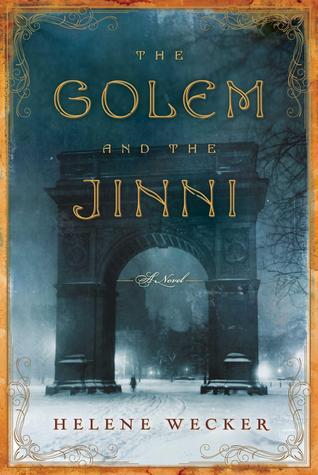
The Golem and the Jinni by Helene Wecker

book cover

I am trying something a little different here. I found The Golem and the Jinni to be a fun, magical fairy tale of a romance with a fair bit of excitement to it. But it is pretty clear that this is also a serious, literary work, raising meaningful philosophical questions, while using the folklore of two different cultures to inform the immigrant experience, offering a fascinating look at a place and time, and linking the experiences of the old and new worlds. These two takes seemed to call for different reviews. And, as I maintain only one book review blog, the result is two, two, two reviews in one.

REVIEW #1

Everyone loves legends, lore, tales of long ago, filled with heroes and magical beings. They dilate our pupils, excite our imagination and provide the fodder for our dreams. Helene Wecker has written a very grown up fairy tale, bringing to life a pair of magical beings. In doing so she has transported old world legend to a place where and a time when vast numbers of more ordinary people were trying to create new dreams, new legends of their own, immigrant New York City at end of the 19th century.

The Golem is a clay creature constructed by a corrupt Kabalist near Danzig, at the behest of Otto Rotfeld, an unsuccessful, unattractive young man. But Rotfeld was not looking for a thuggish destroyer. He wanted his golem to be made in the form of a woman and imbued with curiosity, intelligence and a sense of propriety. On the passage to New York, Otto suffers a burst appendix and dies, but not before he speaks the words that bring his creation to life. Newborn and alone, but with an ability to perceive the wants of those around her, the Golem is set loose in New York. Wandering around, she is spotted for what she really is by a retired rabbi on the Lower East Side. He takes her in, tries to get her settled and struggles with how to deal with the fact that she is a creature usually built for the purpose of destruction.

description
Helene Wecker – image from the Boston GlobeNot too far away, in Little Syria, an Arab immigrant community near the southern tip of Manhattan, Boutros Arbeely, a tinsmith, is brought an unusually old copper flask. While attempting to repair it, he is confronted by a magical being of his own, a handsome arrogant, and unclothed jinni. Unfortunately for the jinni, despite having been freed of the flask, he remains trapped in the shape of a human, bound there by an iron cuff on his wrist. In this telling jinnis, despite excelling at metalwork, have no power over iron. He will have to cope as a human.

Each faces challenges. The Golem, named Chava (which means life) by the rabbi must cope with the flood of wishes that assail her consciousness from the thousands of people around her. She must learn to keep her identity secret. This includes coping with the fact that she does not sleep, and that it is not considered ok for a young woman to be seen walking the city streets at night, even if it her purpose is honorable. Like many immigrants before her, she is helped by prior arrivals. She learns to bake and gets a job in a bakery. Unable to go out at night she takes in sewing. How immigrant is that?

The jinni, taken in by the tinsmith, is given work in the shop, once it becomes apparent that he is a marvel with metal, able to heat and mold it with his bare hands. Boutros names him Ahmad. The jinni is also challenged to keep his true nature under cover. But a part of his nature is a lustful side. He is smitten with a young thing he encounters and one thing leads to another. Chava, while not much hot to trot herself, becomes an object of romantic interest to a very good young man.

Of course, in time, the two encounter each other, and that is where the story takes off. Not only is there magic in the interaction of these two friends, strangers in a strange land, they bring depth to their relationship, adding even more depth to this novel. Chava has content-rich discussions with her rabbi rescuer, on matters such as why people risk so much to have sex, or whether people need a concept of God to keep them from self-destructing. She and Ahmad discuss the stresses of free will vs the certainty of slavery. They talk about her interest in satisfying the wishes of those around her while Ahmad is mostly concerned with satisfying his desires of a moment. A great part of the magic in this fable is how the two begin at extreme ends and meet somewhere in the middle, growing and changing, but very much aware of their limitations.

The two embody, in a way, the immigrant experience. Coming to a new country, learning new ways, changing in order to fit in, coming to value what has been found, building a life. But character growth, consideration of serious moral subjects and a moving relationship are not all that this book has going on. There is danger afoot.

Keeping the action moving, we get not only a look into the jinni’s ancient past, a fascinating and moving segment, but there is pursuit on those cobble-stoned streets. A person with evil intent is tracking the scent of magic and surviving this onslaught is the motive force. As we have come to care about both our primary characters their safety matters.

Not only has Wecker populated her fable with two wonderful leads, but her backup players are extremely rich. In fact this is one of the best supporting casts I have seen in a while.

The Golem and the Jinni has love, parental and romantic, philosophical heft, a vibrant picture of a place and time, the equivalent of an action/adventure trial-by-danger and enough magic to shake a wand at. In short it is everything in a book that you could possibly wish for.

REVIEW #2

It may not take you a thousand and one nights to read The Golem and the Jinni, but you may wish it did because you will hate to put it down.

It is 1899. In a town near Danzig, Otto Rotfeld is a failing Prussian Jewish businessman. He does not have much success with the ladies either. A leering and dismissive manner will do that. Determined to change his luck he opts to join the throng heading to that new Mecca, the USA. Figuring the female sorts there will find him as appealing as did those of the Old World, he decides to take matters into his own hands. Well, rather into the hands of a morally challenged Kabalist who is ok with crafting what Otto wants, a bespoke Golem, using the traditional clay, but made in the shape of a woman, and not the sort of towering, lumbering, bad-hair destroyer that usually pops to mind, thanks to early German cinema.description
Or a more 20th century version
GORT

Gotta confess, I now see Gwendoline Christie of Game of Thrones fame in the role.
description
Image from syfy.com

Hey, the guy’s got needs. (This raises the wonderful theoretical possibility of a high-end retail business, Build-a-Golem. Schmul, more clay, hurry up.) Unwell in his steerage accommodation, Otto is looking for a little companionship and wakes his special friend. Just in time, as it turns out, as Otto, and his burst appendix, fail to make it to the particular new world he was hoping to reach. This leaves a rather bewildered, powerful and telepathic mythical creature heading for Ellis Island. She finds an unusual way to cope when asked for her papers, which I will not spoil, then, wandering around the city, is taken in by a retired rabbi who sees her for what she really is. (Yeah, he’s a lot older, but he really sees me) The Golem truly is a stranger in a strange land, but she is not the only oddity on shore.

In Little Syria, an immigrant community near the southern tip of Manhattan, a Maronite Catholic tinsmith, Boutros Arbeely, is brought a copper flask to repair. While beginning work on the piece with a soldering iron (no rubbing of the magic container this time) he is blasted across the room, and before you can say Robin Williams three times fast, there on his shop floor is a naked man. And it’s not even Halloween in the Village. Really, he is a creature made of fire and mist, but is confined by virtue of an iron bracelet into the form of a human. In this imagining, iron is something a jinni can’t do anything with, I guess like bad fashion sense. Sorry, no puff of smoke. But this magic man is a hottie. He is, of course, cut and handsome, but in addition, he is a natural metalworker. Boutros, despite the jinni’s arrogance, gives him a place to live and a job. He ain’t never had a friend like him. I see in my tiny mind the steamy Colin O’Donoghue (currently Captain Hook on Once Upon a Time)
description
Maybe Mena Massoud of Aladdin fame
description

Ya think these two illegal immigrants might cross paths? Duh-uh. But it will take some time, as each has his and her own road to travel.

If I had three wishes the first would be to be able to write as well as Helene Wecker. She manages to combine several layers to make a compelling whole. She compares a bit of folklore from two different cultures and looks at how they work in a new place. She offers philosophical consideration of deep human issues. She offers a wonderful view of a place and a time, and there is a motive force here that keeps the story moving, and presents our two leads with a mortal threat.

On one level this tale is a bit of a romance. Boy meets Gol. (permission to groan) Well, not exactly a boy, but a mythical fire being who was 200 years old when a wizard confined him, maybe 600 years prior to the now of the story. And this clay hulk is not just a soul-less destroyer, but has a definite tender side. I was reminded of Mary Shelley’s creation, the novel’s version, really trying to figure out his, or in this case, her place in the world, struggling to work out her relationship to god and to morality, and to the people around her. I could not help but think back to my Catholic school days and the Q and A of the Baltimore Catechism.
Q – Why did God make you?
A – God made me to know Him, to love Him and to serve Him…
Sounds a little creepy in this context, doesn’t it?
As a creature built to be a slave, but lacking a master, the golem must become her own master in a way, (a Ronin?) accepting guidance for sure, but facing real existential dilemmas. What happens when the guy in charge is no longer around? She engages in a discussion with the jinni about the messiness of free will versus the certainty of slavery to the will of another, raising up issues not only of actual slavery, but of blind allegiance, whether to a military cause, a political party, a religious persuasion. When is a person responsible for his or her actions and when does responsibility lie elsewhere? (I am including that discussion here, but am using the spoiler label to separate it from the body of the review. It is not really spoiler material.)“If, by some chance or magic you could have your master back again, would you wish it?”
It was an obvious question, but one that she had never quite asked herself. She’d barely known Rotfeld, even to know what sort of a man he was. But then, couldn’t she guess? What sort of man would take a golem for a wife, the way a deliveryman might purchase a new cart?
But oh, to be returned to that certainty! The memory of it rose up, sharp and beguiling. And she wouldn’t feel as though she was being used. One choice, one decision—and then, nothing.
“I don’t know,” she said at last. “Maybe I would. Though in a way, I think it would be like dying. But perhaps it would be for the best. I make so many mistakes on my own.”

…”I have no idea,” he said, “how long I was that man’s servant. His slave. I don’t know what he may have forced me to do. I might have done terrible things. Perhaps I killed for him. I might have killed my own kind” there was a tight edge in his voice, painful to hear. “But even worse would be it I did it all gladly. If he robbed me of my will, and turned me against myself. Given a choice, I’d sooner extinguish myself in the ocean.”

“But if all those terrible things did happen, then it was the wizard’s fault not yours,” she said.

Again, that not quite laugh. “Do you have colleagues at this bakery where you work?”

“Of course,” she said.”

…He said. “Imagine that your precious master returns to you, and you give yourself to him, as you say perhaps you would. Because you make so many mistakes. And he said, ‘Please, my dear golem, kill those good people at the bakery…Rip them limb from limb.”

“But, why—“

“Oh, for whatever reason! They insult him, or make threats against him, or he simply develops a whim. Imagine it. And then tell me what comfort it gives to think it wasn’t your own fault.”

This was a possibility she had never considered. And now she couldn’t help but picture it: grabbing Moe Radzin by the wrist and pulling until his arm came free. She had the strength. She could do it. And all the while, that peace and certainty.

No, she thought—but now, having started down this path, her mind refused to stop. What if Rotfeld had made it safely to America with her, and the Rabbi had noticed them on the street one day? In her mind, the Rabbi confronted Rotfeld—and then she was dragging the Rabbi into an alley, and choking the life from him.

It made her want to cry out. She put the heels of her hands to her eyes, to push the images away.

“Now do you understand?” the jinni asked

The Golem has content-rich discussions with her rabbi rescuer, on matters such as why people risk so much to have sex, or whether people need a concept of God to keep them from self-destructing. She and Ahmad talk about her interest in satisfying the wishes of those around her while Ahmad is mostly concerned with satisfying his desires of a moment. A great part of the magic in this fable is how the two begin at extreme ends and meet somewhere in the middle, growing and changing, but very much aware of their limitations.

The jinni, while he may still have a trick or two up his sleeves (yes, Boutros does cover him up), chief among which is the ability to mold metal with his bare hands, is still stuck in a human body and is forced to cope as a human. The Golem, whom the kindly rabbi names Chava, which means life, of course, must constantly struggle to hide her real identity. She struggles as well to control her impulses, in a way, like Shelley’s creature, a child attempting to grow up. And she does pretty well, whether restraining herself from satisfying the flood of mental wants and needs that her telepathy picks up, or the occasional urge to pound some a-hole into bits. She is not the most outgoing sort, and is seen by many as a stick in the mud at times.

So, are these two crazy kids gonna get together or what? Yeah, yeah, we’ll get to that. Different paths, remember? The jinni happens to be hanging at the Bethesda Fountain in Central Park when his attention alights on a young thing of a late-teen socialite, Sophia, kept on a leash (or is it in a lamp?) by her mother. Her entire life is planned out for her. Someone follows her home and things heat up. Chava, is not a slave to carnal whims, she may or may not even have carnal whims. But the rabbi has a mensch of a nephew, Michael. Sadly fallen from The Chosen, but a very nice young man who runs a hostel for new immigrants. Such a nice boy. You could do worse, Chavelah.

So, you may wonder, do jinnis or golems sleep? I’ll tell you. No. While not much for snoozing, the jinni has the ability to insert himself (what did I tell you about that? Stop it) into people’s dreams. At least in this story it is only into the dreams of females. Sorry, boys. I imagine that when she was writing these sections, Wecker had to struggle to keep images of Barbara Eden from inserting themselves into her consciousness and giggling until she choked.description
What to do with those long nights? Walking of course. Well, for Mister Ahmad, anyway. It was not considered proper in that era for a young lady to be seen walking the streets alone late at night. It creates the wrong impression, and attracts the interest of unsavory sorts, like the police. As an illegal, and a non-human, that would not do. So Chava does what any young, energetic young lady in the turn of the century Lower East Side would do. Stop that, no, not that. She takes in sewing. Jeez.

In fact there is a lot in this book about the immigrant experience, legal and not, at the end of the 19th century. Two communities both nurture their new arrivals, struggle to get by, to make a better life, attempting to leave behind some of the problems of the Old World. The two embody, in a way, the immigrant experience. Coming to a new country, learning new ways, changing in order to fit in, coming to value what has been found, building a life. Receiving new names.

Free will permeates as a theme. A young New York socialite feels as imprisoned by the future that has been laid out for her as the golem does by her subservience to magical commands, as the jinni does to the metal cuff that denies him his true form, and as another young Bedouin lass feels back in the Old country. You will want to keep in mind notions of imprisonment and the difference between sand castles and other sorts, belonging, community, and note the odd angel motif.

But character growth, consideration of serious moral subjects and a moving relationship are not all that this book has going on. There is danger afoot. Keeping the action moving, we get not only a look into the jinni’s ancient past, a fascinating and moving segment, but there is pursuit on those cobble-stoned streets. A person with evil intent is tracking the scent of magic and surviving this onslaught is the motive force. As we have come to care about both our primary characters their peril matters.

Not only has Wecker populated her fable with two wonderful leads, but her backup players are extremely rich. In fact this is one of the best supporting casts I have seen in a while.

You will not need to endanger your community through the use of dark magic or possess a magic vessel to find your next great read. The Golem and the Jinni will be available far beyond the shtetls of Europe, the deserts of the Middle East, and the New York City limits. This modern Sheherezade has written a magical book and there is no rub. The Golem and the Jinni is all that you could possibly wish for.

This review was originally posted on GR in November 2012

It was posted on Fantasy Book Critic on January 22, 2014

=======================================EXTRA STUFF

3/31/13 – I found a group of interview clips with the author, from Library Love Fest. They broke the interview up into 17 clips, and popped them onto Youtube. There is a lot of interesting information there.

GR bud Susan Tunis taped the author’s reading and Q/A

5/6/13 – NY Times review

5/16/13 – NY Times Sunday Book Review

Leave a comment

Filed under Fantasy, Fiction, Literary Fiction, Reviews

The Old Man and the Sea by Ernest Hemingway

book cover

It is intimidating to offer a truly critical look at such a classic, so we will ease into it with a few images.

The GOP has offered us a ready-made item to begin this list, and yes, I know that John Stewart already snagged this one and threw it back. description

I turned up a visual art concept that fits in, for a restaurant based on EH themes:description

Although I did not sit for this photo, the resemblance is indeed strikingdescription

And, of course
description
The Old Man and the Cee Lo.

I suppose am certain there are plenty more images one might lure into our net, but sticking to words for a bit, we will pass on the porn offering, The Old Man and the Semen. How about the moving tale of a Navy Construction veteran, The Old Man and the Seabees, or an obstetrical episode of Grey’s Anatomy, The Old Man and the C-Section. Then there might be a psychological drama about a man with bipolar disorder, The Old Man and the See Saw, or a book about an elderly acupuncturist, The Old Man and the Chi. How about a Disney adventure in which Paul Hogan rescues a pinniped, yes, gentle reader, The Old Man and the Seal. Maybe a bit of Cuban self-affirmation, The Old Man and the Si. I could go on, of course, and probably will, at home, until my wife threatens to leave. The possibilities are rather endless. But the Geneva Conventions might be brought into play, and we can’t have that. Tackling such a review head on seems, somehow, wrong, like using paint by number to copy the Mona Lisa, carving the Pieta out of gigantic blocks of cheddar, writing a love poem for your beloved using MadLibs or Yes, the forces of righteousness sanity wanted this one deep-sixed:

…checking for skid marks on Ghandi’s dhoti. Ok, 12-year-old inner me is all giggly now. At some point, though, I guess you have to, you know, fish or cut bait.

I struggled mightily with this one, finding a hook, then having it pull away, grabbing hold of an idea and watching it disappear beneath waves of uncertainty. I tried waiting a while, resting between attempts, losing myself in other contemplations. Smiling a bit, but always hoping for something I could finally yank aboard. Notions of religious connections, Papa’s personal philosophy, and story-telling technique all pulled in diverse directions. As you will see, it was a not a simple contest. And I am not certain that what I ultimately caught is all that filling.

He was an old man who fished alone in a skiff in the Gulf Stream and he had gone eighty-four days now without taking a fish. In the first forty days a boy had been with him. But after forty days without a fish the boy’s parents had told him that the old man was not definitely and finally salao, which is the worst form of unlucky.

So opens The Old Man and the Sea, the book, we hear tell, that convinced the Nobel committee to reel in EGH with the biggest literary hook of them all. Santiago is an old, unlucky, but skilled Cuban fisherman. He has an able assistant, the young Manolin. The lad is not a blood relation, but he sees a father figure in the old man, and he may be a younger reflection of the old man himself. Maybe Santiago sees himself in the young man and takes some strength from that. Like the best sort of father, he teaches the boy to fish rather than fishing for him. But Santiago’s ill fortune has marked him as someone to be avoided and Manolin’s parents have put the kibosh on their professional association. The old man is determined to salvage his reputation, and his honor, and bring in some money by going farther out than the other fishermen are willing to sail, in search of redemption. No herald calls him to action. No dramatic event sparks him to excessive risk. It is an internal challenge that powers his engines. But it is a quest nonetheless on which Santiago embarks.

Any time there are fish involved, one might presume a degree of soul saving. I do not know enough Hemingway to have a take on whether or not that figured here. I raise it only as a passing thought. But the second sentence of the book offers a hint. “In the first forty days…”clearly places Santiago’s travails alongside another person who spent forty days in a different barren environment. It was after being baptized that Jesus spent his time in the desert, preparing for what awaited. Is Santiago to be tested here? Will he be offered a route away from his difficult path?

The waters are becalmed. Nothing moves. A moment, then, for a digression. OK, let’s try some simple arithmetic, if Jesus, at age 30, spent 40 days in the desert, and Santiago has gone 84 days in his version of the desert, just how old is the old man? 63, according to my calculations. Possible. I do not recall seeing an actual age noted, so I am gonna go with that. I know you guys will let me know if an actual age is revealed somewhere and my squinty geezer eyes missed it. Done. I can feel a slight breeze beginning to flutter the sail.

Some sort of religion seems to flow through this fish tale. Not only are we sprinkled with forty-day references, but Santiago discusses sin. In his struggles he suffers physical damage in which some might see an echo of Calvary. But I think that is a stretch, personally. So, we have a bit of religion, and a quest. What is Santiago questing for? Redemption would fit in nicely. Having failed for a long time, he feels a need to redeem himself in the eyes of his community. Maybe not a religious thing, per se, but swimming in the same waters. And speaking of religion, water as a baptismal element is always a possibility, although somewhat diluted here, as Santiago makes his living on the water.

The old man is strong, skilled and determined. Maybe it is his character that is at issue. Maybe somehow, taking on this challenge is a way to prove to himself that he is truly a man. He goes about his business, and his fishing is his fate, maybe even his life. It is in how he handles himself when faced with this challenge that will show us the sort of person he is, a common Hemingway theme, and he does just that.

This is a very short novel, more, maybe, a novella or large short story. But it has the feel of a parable. There is definitely something going on here even if it keeps slipping out of my analytical net.

I was reminded of another well-known fish story, Moby Dick (really, allow a little literary license here people. Yes I know the whale is not a fish. Geez.). Whereas in that one, the fisherman, Ahab, sets himself against the whale, and therefore either fate or god, seeing a personal enemy, Santiago sees the fish as his brother, a fellow creature in the universe acting out his part. The challenge is always about oneself and not about the external enemy, or rival. In fact, the fish and Santiago are both victimized, together, by the sharks that feast on his catch.

Then he was sorry for the great fish that had nothing to eat and his determination to kill him never relaxed in his sorrow for him. How many people will he feed, he thought. But are they worthy to eat him? No, of course not. There is not one worthy of eating him from the manner of his behaviour and his great dignity.

One might be forgiven for seeing here a possible reference to catholic communion and the relative merit of so many of those who receive. Is the fish (a Christian symbol if there ever was one) meant to be Jesus or some other form of deity, as Moby was?

Could it be that Hemingway’s notion of religion is less Christian and more a sort of materialist (as in non-spiritual, not as in accumulating stuff) philosophy? Lacking the proper tackle for that I will leave such considerations to those who have spent more time than I trolling Hemingway’s waters.

The writing is mostly either third-person description or the old man’s internal, and sometimes spoken, dialogue. Regardless of the literary ambitions splashing about here, the story is about a very sympathetic character. Santiago is a man not only of physical strength, but moral character. He is not portrayed as a saint, but as a simple man, maybe even, in a way, an ideal man in his simplicity. He knows his place in the world, faces the challenges that world presents to him and using only his skill, intelligence, strength and determination, overcomes (or not). It is easy to climb on board as a Santiago supporter. He is a fellow who is very much a part of the world, even as he contemplates larger things.

The Old Man and the Sea is a small story, but it is a whale of a tale. If you have not fished these waters before, don’t let this be one of those that got away.

WB32

======================================EXTRA STUFF

1/5/13 – Jeffrey Keeten sent along this amazing link. Gary Wyatt had shared it with him. It will definitely make you smile

6/20/13 – I discovered that one of the images I used had vanished into the ether, so I substituted another

2 Comments

Filed under Fiction, Literary Fiction, Reviews

Brief Encounters with Che Guevara: Stories by Ben Fountain

book cover

Brief Encounters with Che Guevara is a 2006 collection of eight brilliant short stories by Ben Fountain, author of the wonderful novel, Billy Lynn’s Long Half-Time Walk. Brief Encounters established Fountain’s reputation as a writer to watch, earning him a PEN Award, a Whiting Writers Award, an O Henry, and a Barnes and Noble Discover Award. Must be good, right? Indeed it is.

Half the stories are set in Haiti. Others are in Sierra Leone, Columbia, Myanmar and there is even one in Europe. They tell of people trying to do the right thing in an amoral world. The complexity of the world is a central focus in most of these stories, where it is often not so easy to figure out what the right thing to do actually is, let alone doing it. A grad-student ornithologist is taken captive by a revolutionary group in Columbia. An American NGO worker is persuaded to help fund a revolution in Haiti. A soldier returns from an extended tour in Haiti with some very unusual baggage. A pro golfer of questionable morality is recruited by the generals in Myanmar to promote golf in their corrupt and isolated nation. A Haitian fisherman finds that it is not so easy to foil the efforts of drug smugglers. An aid worker in Sierra Leone becomes involved with a blood diamond smuggler, while attempting to support a co-op that provides work for maimed locals. Sundry people relate their intersections with Che in the title piece. And in the final selection, a prodigy pianist with an unusual gift must cope with her notoriety while attempting a supremely challenging piece.

  Larry D. Moore CC BY-SA 3.0. via Wikipedia
Photo by Larry D. Moore via Wikipedia

There is considerable moral ambiguity in these pieces, a feast of Faustian bargains to be considered, and even mention of God and the Devil wagering over people’s souls.

Fountain was not always a writer. He was born in North Carolina and got his law degree from Duke, then worked in real estate law in Dallas for five years before pleading nolo contendere and turning over a new leaf.

It was a lot of things coming together at once: having a kid; my wife, Sharie, making partner at her firm; me having practiced for five years and just absolutely having had enough; me turning thirty and thinking that if I was going to make a run at trying to be a writer I needed to get going. There was a sense of urgency, of time passing. (from Ecotone)

Beginning his new career in 1988, he had stories accepted here and there but it took a long time for him to hone his craft and produce top quality work. One of the stories in this collection was first published in 2000. He had his share of frustration during this time, with a couple of novels taking up space in a drawer to prove it. But he stuck with it, treating writing as a job, whether or not he was published, five days a week writing every day, every day, every day.

As for why Haiti figures so large as a subject

On a rational basis, I saw Haiti as a paradigm for a lot of things I was interested in relating to power, politics, race, and history. I went there a couple of times and at that point I probably had what I needed to get. It was some comfort to me to know, flying out of there the second or third time, that I didn’t really have to go back—and yet I did go back, many times. Once I was there I felt pretty comfortable. And the more time I spent there, the more there was that I felt I needed to understand. But I still can’t give a satisfactory explanation for how it happened.

He would visit Haiti over 30 times. The notion of going to Columbia or Sierra Leone was raised, but funds and time are not limitless and his wife was aghast at the notion.

Fountain is very interested in the impact of the large forces in society on individuals.

I practiced law for five years and that gives you insight into a certain mind-set that maybe a lot of writers haven’t had firsthand access to. There’s an almost casual cruelty, a very low level of overall awareness, but sometimes there’s also knowledge that real damage is being done—this attitude of “Oh, what the hell,” this kind of moral cognitive dissonance. These are people who have never missed a meal. It’s an unknowingness, an unawareness, that Reagan personified. Reagan was so sure of everything and yet his experience of the world was so narrow. How could he be sure of anything? I saw that over and over again in the wealthier people I worked with or had contact with while practicing law. Many people were operating from a very narrow range of experience, and yet they had complete faith in it. Their way was the correct way, the only way. They had virtually no awareness of any other way of life except in terms of demonizing things like communism, socialism, or Islam. It’s an extremely blindered experience of the world.

 By Claudio Reyes Ule
By Claudio Reyes Ule via Wikimedia

The stories turn a widened eye on this sort of myopia, but Fountain does not spare the revolutionary sorts either, who have issues of their own. I found the stories very engaging, enlightening and moving. It is definitely worth your while to encounter Ben Fountain in this volume. You may find that the time spent in his company is too brief.

=======================================THE STORIES


Near-Extinct Birds of the Central Cordillera
John Blair is a grad-student ornithologist who ignored the risks and is doing research in Columbia when he is kidnapped by members of MURC (a FARC stand-in), a revolutionary group, and is held for ransom. He winds up spending a long time with the group and establishing relationships with some members and the leader. It is a tale heavy with political irony and a very O Henry-ish ending.

Reve Haitien
Mason is an OAS observer in Haiti. He throws chess games with the young local players, as a way of boosting their self-esteem. He encounters a player better than himself, Amulatto, and is drawn in his world.

Life here had the cracked logic of a dream, its own internal rules. You looked at a picture and it wasn’t like looking at a picture of a dream, it was a passage into the current of the dream. And for him the dream had its own peculiar twist, the dream of doing something real, something worthy. A blan’s dream, perhaps all the more fragile for that.

The Good Ones are Already Taken
Melissa is a very sexual person and it is a big sacrifice for her to do without while her serviceman husband is away. But when Dirk returns from an extended tour in Haiti, he has changed, gone voodoo, religious, which has implications for their sex life. Can Melissa adapt to the new man who came home? And what’s up with all that weirdness he is into anyway?

Asian Tiger
Sonny Grous, 23, is a pro golfer, built like a bouncer and not all that successful. In Rangoon for a tournament he has the game of his life and is recruited by the generals to be the ambassador of golf for Burma, which is seeking to attract foreigners with great courses. The money is pretty good, but there is the dodgy element of working for people who are truly reprehensible.

Bouki and the Cocaine
Concerned about the massive drug-running, Syto, a small-town Haitian fisherman, and his brother decide to grab the bales that are left by the runners on the beach and bring them to the police, accepting on face value the frequent public announcements decrying the drug trade. Things do not work out as the brothers expect. There are real questions raise here about where honor lies, and how one’s interpretation of that informs behavior. There tale is exceptionally clever and will make you smile, while also getting the moral dilemma involved.

The Lion’s Mouth
Jill runs a co-op that provides employment for many local women in Sierra Leone but funds are cut off. She turns to her unlikely bf, Starkey, a dealer in blood diamonds, for help in finding the needed funds. More moral ambiguity here, and an image of a troubled place.

Brief Encounters with Che Guevara
Che is a touchstone here, not an actual character, for the most part. Several, very diverse, people tell of their encounters with Che. Among them is Laurent, a Haitian who knew Guevara. Laurent was my favorite character in this entire collection. It is worth reading the entire book just to get to meet him.

Fantasy for Eleven fingers
Anna Juhl is a young piano prodigy, gifted in a manner identical to Anton Visser, a luminous player of the early 19th century, and composer of a particularly wonderful and difficult piece called Fantaisie pour onze Doigts. She takes on the challenge. This piece seemed a bit out of place in the collection, geographically anyway.

======================================EXTRA STUFF

A great interview in Ecotone Journal – by Ben George – must read stuff if you find Fountain interesting, and you should, a lot on writing and Fountain’s writing history

An interview in the on-line magazine, The Millions by Edan Lepucki. It is mostly on Billy Lynn, but there is plenty here about how Fountain thinks and writes. Definitely worthwhile.

There is a lovely bit in the Barnes and Noble writer details page on Fountain’s favorite books

In the on-line edition of the magazine Rain Taxi also has a lovely review with the author. He talks about his relationship with Haiti. There is a lot of detailed discussion of the stories.

There is a piece by Malcolm Gladwell in New Yorker that looks at Fountain as an example of a late-bloomer.

Leave a comment

Filed under Fiction, Literary Fiction, Reviews, Short Stories

Ghosts by Eva Figes

book cover

Ghosts is a place where poetry meets prose. It is a feast of observation and consideration, overflowing with rich imagery and mournful with the feeling of time and experience passing, fading, ghost-like into transparency, and non-existence.

Figes, born in Berlin in 1932 to secular Jewish parents, was brought to England in 1939. She is best known for Patriarchal Attitudes, an early book of feminist social analysis. Her 1984 novel, Light, illuminates a day in the life of impressionist master Claude Monet. The skill she had nurtured with that work returns in full flower here. If her dollops of verbiage were not so rich, one might be tempted to consider her work literary pointillism. There is not, I believe a paragraph in this book that exceeds eight lines in length.

An unnamed woman of a certain age observes her world through four seasons. She recalls her youth, visits her ailing mother, has some time with her father, her grown children, lets us in on the associations she has with the various sights and sounds of the places she visits, and with this or that object that carries the weight of her history. She remembers a lover, sees in the pedestrian sights and sounds of her day-to-day the ghosts of her past, memories.

the shadows multiply. They lurk in the texture of old bricks, faced stone, and gloomy basements. Where someone used to practice his violin, hour after hour, where I broke my heel on the kerb, where servant girls in uniform walked dogs, took messages, were she eloped with her poet. Where I walk.

I think of it, this continuum, as I walk along the pavement, one two, one two, crossing the lines, crossing the road where traffic thunders. And we shall all be changed utterly, in the twinkling of an eye.

I can certainly relate. I was not so long ago that I walked with my youngest through Greenwich Village, pointing out to her this or that place that was a part of my past—I dated a woman who lived on that street; I took classes in that building; I attended a frat party there that changed my life; Hendrix recorded there; I bought such and such in that store; we hung out there in that park—specific locations where ghosts reside, lying in wait for our presence to give them a bit more ectoplasm, however temporary. They do get dimmer with time.

This relates somehow to the book I read just prior, Colson Whitehead’s Zone One, which, among other things, is a paean to a place, Manhattan, the associations one has, memories, the changes one sees over time. I am not sure Figes would consider her rendering the sort of love story that Whitehead tells. Hers has more to do with the individual perceiving the haunting of the past in the now and looking beyond that to an invisible tomorrow. For Whitehead, the city may or may not be taken over by zombies, but it is eternal. For Figes, all is fleeting.

Nothing comes back. The eye sees for a moment, the ear hears, but look, now it is gone.

And later,

At times I think I have no sense of the actual. Are things really here at all, I wonder, are any of us present? I think of my brain as a film negative that has been doubly, perhaps trebly exposed.

Ghosts is not so much a linear narrative. It is a consideration of a life in the rearview, a glance here, a look there, and a consideration of where permanence might lie, or not, with each element beautifully crafted. You could open this book to any page and be dazzled. This is not a new book. It was published in 1988, and I came upon it accidentally. It merits attention. There is such beauty in the writing that it surely needs only to be seen by more readers for the images there to retain their substance. Eva Figes died at the age of 80 in 2012. The legacy she left will remain with us for a long time. Ghosts is a book that should definitely not be allowed to fade away.

=======================================EXTRA STUFF

The wiki page for Eva Figes

An obit by her friend , Eva Tucker, in the Guardian

An interesting article on Figes in the Guardian

Posted September 6, 2013

Leave a comment

Filed under Literary Fiction, Reviews

Zone One by Colson Whitehead

book cover

Start spreading the news. I’m leaving today

There is a lot to sink your teeth into in the latest book from MacArthur Genius grantee Colson Whitehead. The nation has pretty much collapsed, with the implication that things are no better elsewhere in the world. But there is still some hope. A provisional government has been set up in Buffalo, and some organization is returning. The government wants to clear Manhattan of undesirables, in order to repopulate, in order to show that there is a future, that there is hope.

Mark Spitz, a nom de guerre, is a sweeper. There are zombies and mindless survivors still hanging out and Omega Unit is charged with clearing out a specific geographic area inside Zone One, the real estate below Manhattan’s Canal Street, where a wall has been built to keep out the deadbeats. I suppose one might call the area R/EbeCa. Manderley had nothing on this place.

Over three days we get Spitz’s story and that of some others as well. Do you remember where you were on 9/11? Do you recall what was happening when shots were fired that took out JFK, RFK, MLK? Maybe you have been around long enough to remember a day which will live in infamy? For the characters in Colson Whitehead’s latest novel, Zone One, the event is called “Last Night.” It was the moment it became clear that a zombie apocalypse plague had run amok. Fight or flight. Time to wonder if your loved ones had succumbed and decision time re whether you would risk your life to try saving or finding them. One of the major elements in this book is the characters’ recollections of that fateful night.

description
From Colsonwhitehead.com

The largest element is the city itself, well, Manhattan, and even more focused, Manhattan below Canal Street. Whitehead loves New York. He is the author of The Colossus of New York, a love song to the city, and one of my all time favorite books.

I grew up in New York in the ’70s and so I took films like The Warriors and Escape from New York as documentaries. Other kids did sports; I liked to hang around watching The Twilight Zone and various movies about the end of the world, whether it was Planet of the Apes, or Damnation Alley. And so that’s part of the city I carry with me from my childhood. … In doing this book, I was trying to pay homage to certain cinematic depictions of a ruined New York.
(From NPR interview)

CW did not have a lot of trouble imagining NYC as a wasteland, noting that in the wee hours parts of the city that never sleeps are remarkably unoccupied, desolate. ”Wall Street is completely empty. All the buildings are closed and no one’s on the street. It’s as empty as it’s described in the book.” He also remembers growing up in the 1970s, a pretty tough time for the city, with the boom in drug use, the loss of revenue as a result of white flight, and the federal government telling us to go to hell. That’s a pretty good start for building an apocalyptic landscape. He sees the accretion of the new atop the old, the replacement of the current with the new, then the replacement of the new with the newer.

“I’m walking around with my idea of what New York was 30 years ago, 20 years ago. So is everybody else. And we superimpose that ruined city over what’s here now. So it’s cleaned up, but we’re still seeing that old shoe store, dry cleaners, that old apartment where we used to live. So, any street you walk down in New York is a heap of rubble because that’s sort of how we see it if we’ve been here a while.”

I can relate. I moved from the Bronx to Manhattan in 1972, shared an apartment on the Upper West Side before it became an unaffordable yuppie apocalypse zone. I was on 81st Street between Columbus and Amsterdam. On one end of the block was a notorious SRO, and the other featured Davey’s Tavern, notable for the lineup of pimp-mobiles up the street. One night some pals and I decided to follow a trail of blood that led from Davey’s a few blocks east into Central Park, before re-attaching our brains and desisting. It was widely assumed that landlords were having their properties torched to evict the current residents and get insurance money with which to re-build, renovate and return to business with rentals several multiples of what they had been. So it is quite understandable how one could take the reality of that era and build on it to flesh out a flesh-eating landscape.

Whitehead is also well aware of the city’s life sucking potential.

Was this skel a native New Yorker, or had it been lured here by the high jinks of [a TV personality] and her colorful roommates. One of those seekers powerless before the seduction of the impossible apartment that the gang inexplicably afforded on their shit-job salaries, unable to resist the scalpel-carved and well-abraded faces of the guest stars the characters smooched in one-shot appearances or across multi-episode arcs. Struck dumb by the dazzling stock footage of the city avenues at teeming evening. Did it work, the hairdo, the bleached teeth, the calculated injections, did it transform the country rube into the cosmopolitan? Mold their faces to the prevailing grimace?

There are plenty of folks who might pass for undead in the city, even now:

the city had long carried its own plague. Its infection had converted this creature into a member of its bygone loser cadre, into another one of the broke and the deluded, the mis-fitting, the inveterate unlucky. They tottered out of single-room-occupancies or peeled themselves off the depleted relative’s pullout couch and stumbled into the sunlight for miserable adventures. He had seen them slowly make their way up the sidewalks in their woe, nurse an over-creamed cup of coffee at the corner greasy spoon in between health department crackdowns. This creature before them was the man on the bus no one sat next to, the haggard mystic screeching verdicts on the crowded subway car, the thing the new arrivals swore they’d never become but of course some of them did. It was a matter of percentages.

It cannot be a coincidence that in CW’s future Manhattan the powerless are being driven out of prime real estate by force, so the lucky can take their places. It’s called gentrification, and has been going on, under that name anyway, since the 70s. There are plenty of landlords who would like nothing more than to have armed groups evict anyone not paying market rates, so they could bring in new prey to gouge. No zombie apocalypse needed for that. It is extant reality here.

CW does not expect that, whatever disaster may arrive, those at the extremes of the human bell curve will be the likely remnants:

In the apocalypse, I think those average, mediocre folks are the ones who are going to live,” he says. “I think the A-pluses will probably snuff themselves. The C-minus personalities will probably be killed off very quickly. But it’s the mediocre folks that will become the heroes. … Anyone who survives will be a hero.”
From an NPR interview

Thus Mark Spitz is, by design, the ultimate average guy.

There is particular poignance for this native in scenes of a zombie crematorium creating mass quantities of gray ash that fall like snow on the city. I know CW’s city very well. I worked and have played in the area called Zone One for many years. To see it brought to life in these pages is a remarkable experience for me. As if someone had written a biography of your child and got all the facts and feel right, even about the aspects you do not admire. Whitehead has a remarkable gift, his writing rich with insight and observational acuity.

We have seen our share of death in New York, physical and spiritual, from the horror of 9/11 to the siren call of the city, tuned to the young and hopeful, luring so many onto the rocks of not good-looking/talented/smart/connected/special-enough, to the middle-aged newly unemployed dazedly going through the motions, even after there is no destination for the trains and their feet to take them to. The magic of power, lights, glitter and energy has its dark side, when the lights go out, the sparkle fades and security is no longer up to the task of keeping that which menaces at bay.

This is not a story where this happens and then that happens. It offers a novel format as a structure within which Whitehead can relate what he has seen and felt about his beloved city. (And to seriously bitch about Connecticut. Dude, did Connecticut shoot your dog?) If a few characters become fodder for roving people-eaters, like so many large hot dogs on the hoof, then so be it. If you can’t make it there, well, buh-bye.

There are elements of Zone One that reminded me of Gary Shteyngart, (and Max Headroom) a twenty-minutes-into-the-future feel to his social satire. Survivors of Last Night are often afflicted with PASD, or Post Apocalyptic Stress Disorder, pronounced “PAST.” So folks suffering with PASD are said to have a problem with their past, snicker, snicker. A remnant coven of lawyers who are looking for actual pounds of flesh. Corporate sponsorship is alive and well in the world of the zombie apocalypse with wonderfully cute corporate armadillo logos finding their ways onto a wide range of official items. The new national Anthem is “Stop! Can You Hear the Eagle Roar? (Theme From Reconstruction).” Trebly delicious for the Ashcroft ref, the intentional malaprop and the parenthetical ref to far too many contemporary songs

The creature feature is a means to an end for Whitehead. “I’ve had the same publisher for six books, and they know it’s not just about elevator inspectors, it’s not just about zombies—it’s about people, it’s about culture.” Yeah, it is. And as a portrait of New York, it is dead on.

========================================EXTRA MEAT

A wonderful interview with the author in The Atlantic, Colson Whitehead on Zombies, ‘Zone One,’ and His Love of the VCR by Joe Fassler

Terry Gross’s interview with the author on Fresh Air, A ‘Zone’ Full Of Zombies In Lower Manhattan, the transcript

The audio can be heard here

2 Comments

Filed under Horror, Literary Fiction, Reviews

The Hobbit: Or There and Back Again by J.R.R. Tolkien

book cover

In a hole in the ground there lived a hobbit.

Books exist in time and place and our experience of them is affected by the specific time and place in which we encounter them. Sometimes an uplifting or inspiring book can change the path of a life that has wandered onto a wrong course. Sometimes a book, discovered early on, can form part of the foundation of who we are. Or, discovered late, can offer insight into the journey we have taken to date. Sometimes a book is just a book. But not The Hobbit. Not for me. In January, 2013, I pulled out my forty-year old copy in anticipation of seeing the recently released Peter Jackson film. It is a substantial book, heavy, not only with its inherent mass, but for the weight of associations, the sediment of time. The book itself is a special hard-cover edition published in 1973, leather bound, in a slipcase, the booty of new love from that era. The book, while victim to some internal binding cracks (aren’t we all?) is still in decent shape, unlike that long-vanquished relationship. Not surprising. I had read the story six times and been there and back again with this particular volume five.

The Hobbit had first come to my attention in 1965 or ’66. I was then a high school underclassman, and my eyes were drawn to it at a school book fair. That was probably the ideal age, for me anyway, to gain an introduction to Tolkien. Not too far along into adolescence and an appreciation of the reality of the world to have completely tarnished my capacity for child-like wonder. That is what one must bring to a reading of this book, openness and innocence. Tolkien was a step sidewise for me, as I was a fan of the science fiction of that and prior eras. It was also, of course, a gateway drug for the grander addiction of LOTR, still my favorite read of all time.

One might think that looking at this book again with old, weary fresh eyes might lend new insight. After all, I have read literally thousands of books since, and have picked up at least a little critical capacity. And yes, there are things I notice now that perhaps skipped past back then. Of course that begs a specification of which back then one considers. While I first read the book as a high-schooler, I read it again when I was gifted with this beautiful volume, in my twenties. That makes two readings. But there would be more. I well recall reading the book aloud while sitting in a chair by my son’s bed. And yes, each of the major characters was delivered with a distinct voice. I went as deep as I could for Gandalf. I vaguely recall giving the dwarves a Scottish burr. Bilbo was definitely a tenor. My Gollum was remarkably like the sound of the one created by Andy Serkisssssss. (patting self on back).

Of course, my son was not the last to arrive at the gathering. Some years later there was a daughter, and more bedside theater. It was a bit more of a struggle then. Life was rather hectic. Nerves were often frayed. Sleep was in short supply. And there were far too many times when my eyes closed before those of my little gingersnap. But reading it that fourth time, one couldn’t help but notice the absence of any significant females. Who might my little girl relate to here? It is certainly possible for folks to identify with characters of another gender, but the stark absence of representatives of the female persuasion did stand out. Somehow I managed to keep my eyes open long enough to get through the volume.

But the party was not yet complete. There would be one more arrival, and one more opportunity to sit on or near a daughter’s bed and read aloud, sometimes to an upturned, eager face, sometimes to a riot of ringlets as she settled. My capacity for consciousness remained an issue. By then, my voice had also suffered a bit with the years, the reward for too many cigarettes, too much yelling, too much ballpark whistling, and the usual demise of age, so it took a fair bit more effort and strain than reading it aloud had done previously. I am pretty certain I made it through that third time aloud. Truthfully, I am not 100% certain that I did.
description

You probably know the story, or the broad strokes anyway. In the quiet rural village of Hobbiton Across the Water, in a land called Middle Earth, an unpresupposing everyman, Bilbo Baggins, lives a quiet existence. He has a smidgen of wanderlust in him, the genetic gift of ancestors on the Took branch of his family tree, but he is mostly content to enjoy hearty meals and a good pipe. One day, Gandalf, a lordly, father-figure wizard Bilbo has known for many years, comes a-calling and Bilbo’s life is upended. Gandalf is helping a group of dwarves who are on a quest. Led by Thorin Oakenshield, a dwarf king, they aim to return to their home, inside the Lonely Mountain, somehow rid the place of Smaug, the dragon who has taken up residence, and regain the land and incredible treasure that is rightfully theirs. Gandalf has recommended that Bilbo accompany the group, as a burglar. Bilbo, of course, has never burgled a thing in his life, and is horrified by the prospect. But, heeding his Tookish side, Bilbo joins the dwarves and the adventure is on.

One need not go far to see this as a journey of self-discovery, as Bilbo finds that there is more to him than even he realized. This raises one question for me. How did Gandalf know that Bilbo would be the right hobbit for the job? Bilbo faces many challenges and I betray no secrets for any who have not just arrived on this planet by reporting that Bilbo’s dragons, real and symbolic, are ultimately slain and he returns home a new, and somewhat notorious hobbit. Bilbo serves well as the everyman, someone who is quite modest about his capacities, but who rises to meet the challenges that present, acting in spite of his fear and not in the absence of it. He is someone we can easily care and root for.

Elements abound of youthful adventure yarns, treasure, a map to the treasure, a secret entrance that requires solving a riddle to gain entry, a spooky forest, foolishness and greed among those in charge, a huge battle, and, ultimately, good sense triumphing over evil and stupidity. Oh, yeah, there is something in there as well about a secret, powerful ring that can make it’s wearer invisible. Sorry, no damsels in distress.

(Rivendell remains a pretty special place. If I am ever fortunate enough to be able to retire, I think I would like to spend my final days there, whether the vision seen by Tolkien or the Maxfield Parrish take as seen in the LOTR films.)
description

There are magical beings aplenty here. Hobbits, of course, and the wizard and dwarves we meet immediately. A shape shifting Beorn assists the party but remains quite frightening. There are trolls, giant spiders, giants, goblins, were-wolf sorts called wargs, talking eagles, a communicative, if murderous dragon, elves of both the helpful and difficult sorts, and a few men, as well. Then there is Gollum.

IMHO, Bilbo is not the most interesting character in Tolkien’s world. Arguably there is a lot more going on with Gollum, an erstwhile hobbit riven by the internal conflict of love and hate, corrupted, but not without a salvageable soul. While he is given considerably more ink in the LOTR story, it is in The Hobbit that we meet him for the first time. He is the single least YA element in this classic yarn, one of the things that elevates this book from the field and makes it a classic.

The Hobbit was written before Tolkien’s ambitious Lord of the Rings. While there are many references to classic lore, the bottom line is that this is a YA book. It is easy to read, and to read aloud, (something that is not the case with LOTR. I know.) and is clearly intended for readers far younger than I am today. It remains a fun read, even on the sixth (or so, I may have dipped in again somewhere along the line) time through. Were I reading it today for the first time, I would probably give it four stars. But as, for me, it bears the weighty treasure of memory, I must keep it at five. If you are reading this for the first time as an adult, or an antique, the impact is likely to be different for you. If you are a younger sort, of the adolescent or pre-adolescent persuasion, particularly if you are a boy, it might become an invaluable part of your life. Maybe one day you can sit by your child’s or grandchild’s bedside and be the person who reads these words to them for the first time, “In a hole in the ground there lived a hobbit” and begin the adventure again. To see the glowing young eyes as the tale unfolds is nothing less than absolutely precious.

PS – I would check out the review offered by GR pal Ted. He includes in his review outstanding, informative and very entertaining excerpts and comments re info on The Hobbit from JRRT’s son Christopher.

========================================EXTRA STUFF

Here is a lovely article on JRRT, from Smithsonian Magazine, January 2002

Leave a comment

Filed under Fantasy, Literary Fiction, Reviews